The Author Did Not Write This

4–6 minutes

The LinkedIn consensus has spoken: if you used AI in the writing process, you are not the author. The position is stated with the confidence of someone who has never hired a ghostwriter, employed a research assistant, submitted to a heavy editor, or considered that the Gettysburg Address was almost certainly not written by Lincoln.
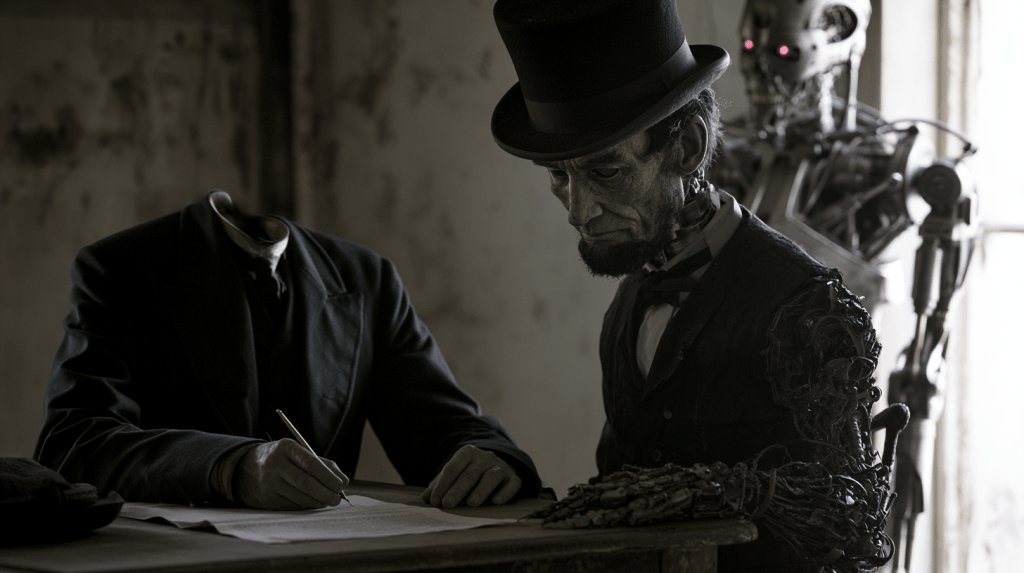
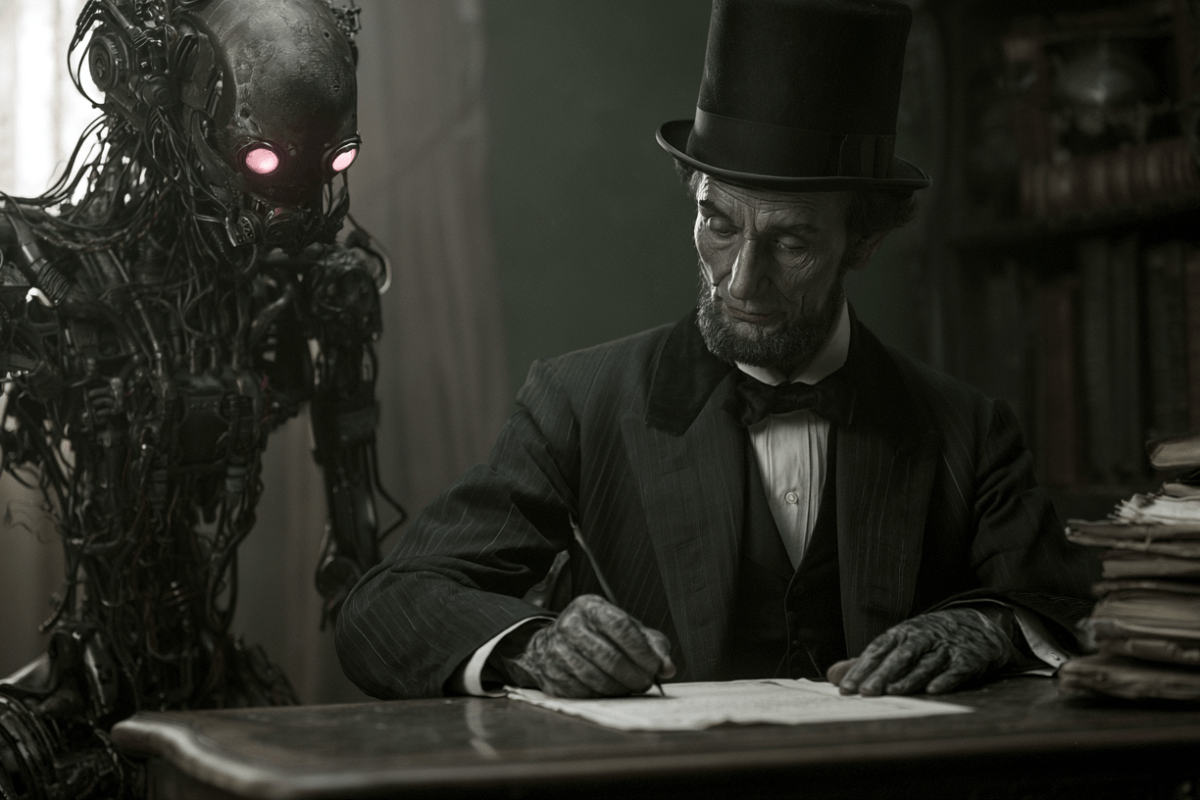
Image: I couldn’t not share this Midjourney 8.1 image. It may not have understood the assignment.
Audio: NotebookLM summary podcast of this topic.

Authorship has never been a production relation. It has always been an attribution relation — an institutionally stabilised answer to the question of which name the practice elects to put on the cover. These are not the same thing, and conflating them is the error from which every subsequent confusion proceeds.

The ghostwriter has existed as long as commercial publishing. The political speechwriter is so normalised that nobody considers it worth remarking. The celebrity memoir, the corporate thought-leadership piece, the attributed editorial — these are not edge cases or embarrassing exceptions. They are the normal operation of every writing-adjacent industry that has ever existed. The name on the cover has never reliably indicated the hands on the keyboard, and the industry has never seriously pretended otherwise. It has simply preferred not to discuss it at dinner.

AI changes the tool. It does not change the structure. The person who prompts, selects, curates, revises, and publishes is doing what commissioners of ghostwriters have always done. What has changed is that AI makes the mediation visible in a way that polite convention previously concealed. Visibility triggers the purity reflex. What presents itself as a defence of authentic authorship is a defence of a particular fiction — the Romantic author as solitary originating consciousness — that the industry never consistently believed and certainly never consistently practised.

The purity position also fails on its own terms before it gets started. Consider the spectrum of AI-assisted writing: a full draft submitted for light polish; a human argument substantially revised by AI; collaborative ideation followed by AI drafting; a kernel of an idea handed over for full execution. These are genuinely different in terms of human contribution. The zealot position requires a threshold somewhere on this spectrum below which authorship lapses. It never specifies where. More fatally, it has no means of verification. There is no external method of determining where on the spectrum any given piece of writing falls. The detector tools are probabilistic noise that disproportionately penalise competent prose. Any audit mechanism sophisticated enough to catch first-order evasion immediately generates a second-order workaround. The regress terminates only at continuous surveillance of the writing process — panoptical authorship as the logical endpoint of the position taken seriously.
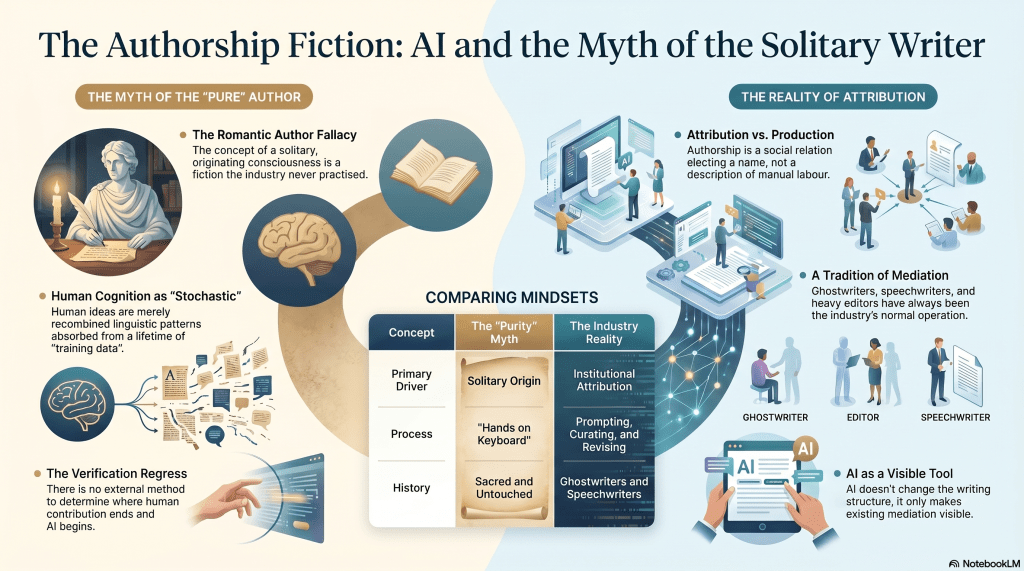
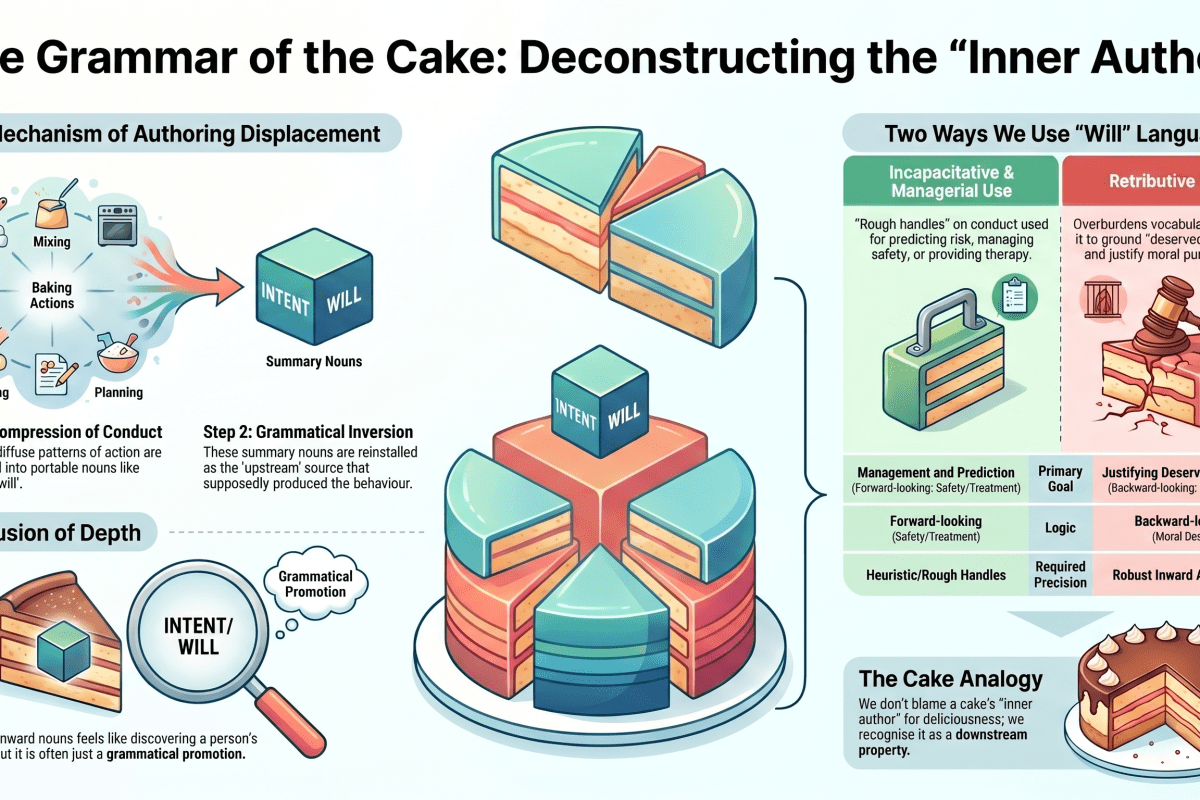
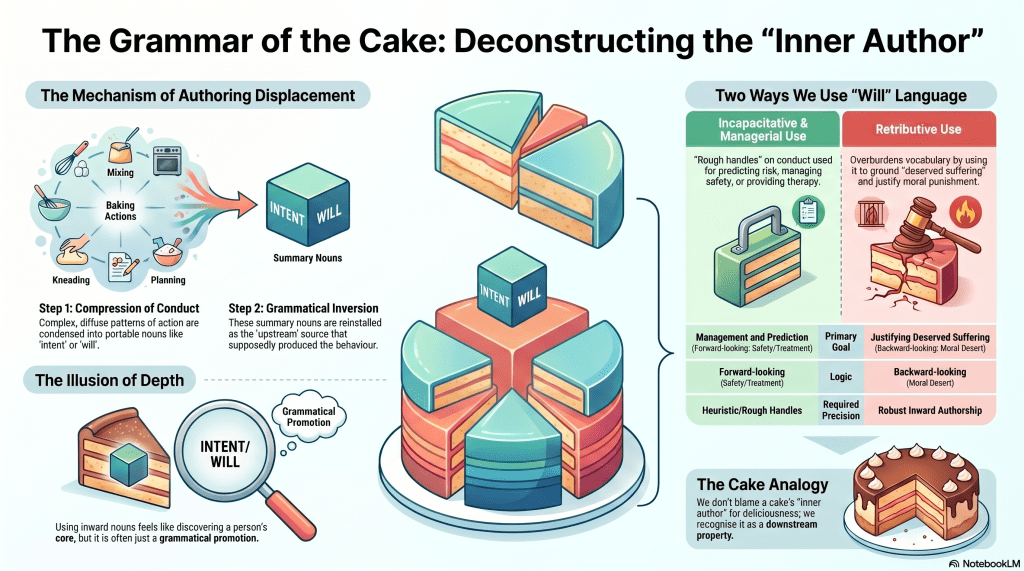
NotebookLM Infographic on this topic.

Then there is the recursion problem, which the zealot never addresses because it is fatal. The stochastic parrot charge against AI — that it merely recombines absorbed linguistic patterns without genuine origination — describes with considerable accuracy what human cognition also does. The writer’s training data is the Dickens read at ten, the billboard absorbed on a commute, the argument overheard on public transit, the half-remembered essay that shaped a position without ever being consciously cited. The causal chain of any human idea disappears into an unauditable cognitive history. Genuine origination in the sense the purity position requires has never existed. The Romantic author was always a retrospective confabulation. Barthes said so in 1967. The industry nodded politely and continued invoicing.

What the zealot is defending is not authorship. It is a particular grammar of authorship — one that selects compositional origin as the threshold criterion, applies it selectively and unverifiably, and uses the resulting suspicion as a status boundary. It is guild behaviour dressed as principle, which is understandable as a response to a genuine economic threat but should not be mistaken for a philosophical position.

Authorship is the position a culture elects to stabilise after the work has already been produced through far messier means. It has always been thus. AI did not break the fiction. It just made the fiction harder to keep a straight face about.


The Rest of the Story

I’ve written about this before. I am not an AI apologist, but I am peeved by anti-LLM zealots, who clearly haven’t thought through their arguments.

I finished reading A.J. Ayer’s Language, Truth, and Logic, the part about Bertrand Russell’s claim about ‘The author of Waverley was Scotch‘. My brain latched onto authorship, and my emotional response was WTF? I have other problems with Russell and Ayer on this, but that’s a matter for another day.

To make my point, this page up to the ellipsis is the output of Claude after an extended dialogue with it and ChatGPT after I read Ayers, and something didn’t sit quite right. I am not ashamed to use LLMs in my authoring workflow and am not ashamed to mention it, as here. Almost all of these thoughts are mine. I’ve simply asked Claude to organise the output. It’s good enough to output as-is, and any edits would be trivial, so I won’t bother. I probably could have made the edits in as much time as it took to type this, but I’ve got nothing to hide. I’m just a human with access to technology circa 2026.
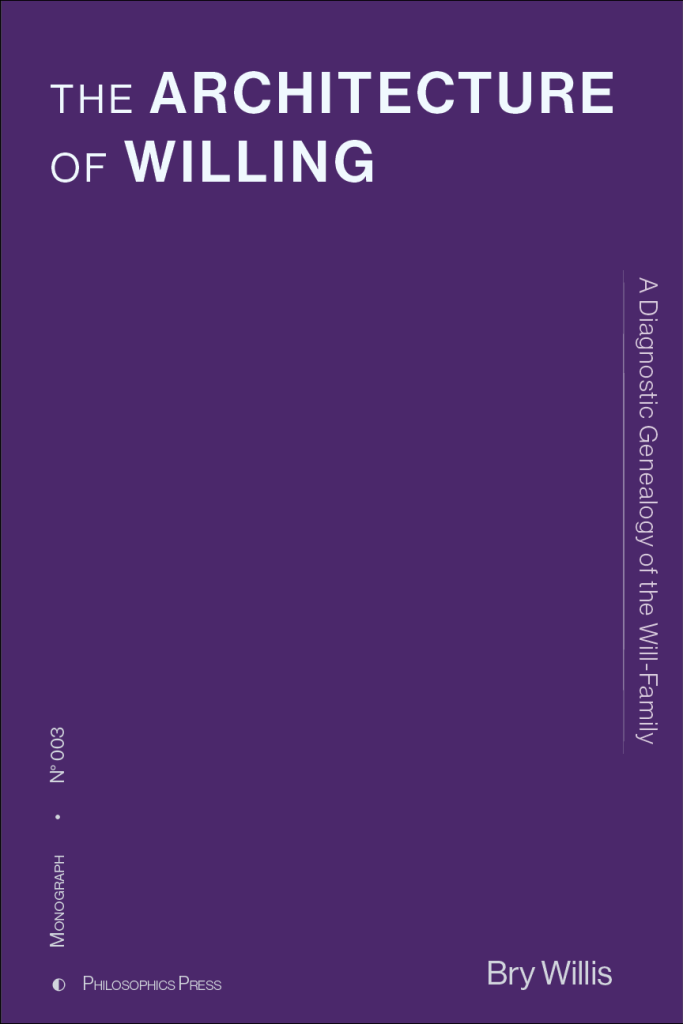
Architecture of Willing Cover Art

I’ve selected the cover colour for Architecture of Willing. It’s monograph number 3 in a series. I chose a dark aubergine-violet colour (#4b256b) because I like the contrast, and it is different to the other 2.

Monograph #1 is When Language Fails: Ontological Pluralism and the Limits of Moral Resolution, which is rather a slate charcoal grey (#3c3f47).

#2 is The Architecture of Encounter: A Mediated Encounter Ontology, which is mulberry (#9e1f63).

I discussed Chapter 1 of The Architecture of Willing in a recent post, as well as a piece on my review process. I’ll be sharing more presently. I expect it to be completed by the end of May, but time will tell. Even though I’ve gone through seven revision passes, errors and fixes continue to crop up all the way to production – in fact, even afterwards.

The Architecture of Willing: An Early Peek

1–2 minutes

The Architecture of Willing is a passion project I’ve been considering since the COVID-19 debacle. I took a couple of career breaks to focus on the problem of agency. In fact, my working title until now has been Against Agency. Upon research, I discovered that (1) the idea was somewhat tired, and (2) it was mired in a free will debate centred around determinism. And (3) the argument had been made by many about a decade earlier, so I also missed the ground swell. As my interest is to present novel views or perspectives, I bowed out, but something still irked me.

Then it dawned on me: I’d dissect will under a language philosophy microscope. This got me to a new working title: Architecture of Willing, which perhaps uncoincidentally aligns with my Architecture of Encounter.

I’m still working through the first draft, but I’d like to share a NotebookLM summary of an early draft of Chapter 1, which serves as an introductory chapter: Authoring Displacement and the Cake Grammar or some such. Have a listen.

Audio: NotebookLM summary podcast of this topic.

I use the opening chapter as a setup. I had an idea of convicting a cake on charges of being delicious and using this absurdity as a metaphor for how we inflate and personify the notion of will. Perhaps interestingly, the will (particularly the free flavour) was the central theme I explored in my novel Propensity by Ridley Park, a little shameless cross-promotion.

I’ll keep this short because I am still drafting the monograph. I hope to have it published in May. Time will tell.

The Enclosure Within: The Hidden Roots of Property Theory

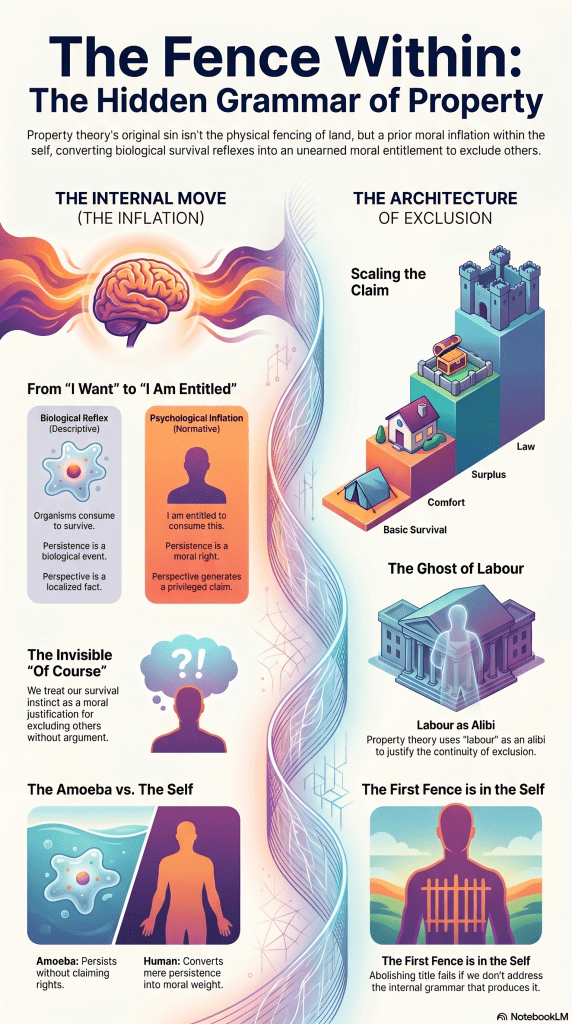
This is a bonus episode I asked NotebookLM to render based on the past two posts. These posts had been one, but I chose to separate them because of their core orientation on a shared topic. For those who read the posts together, this is made clear. I even continue several threads to make it obvious, but the two essays are a diptych. I feel the second post is stronger than the first, but the first was a stronger setup. If you don’t have time to read the essays, this is a decent summary.

Audio: NotebookLM summary podcast of this topic.

The two essays:

The Fence Before the Field

Before the Fence, the Self

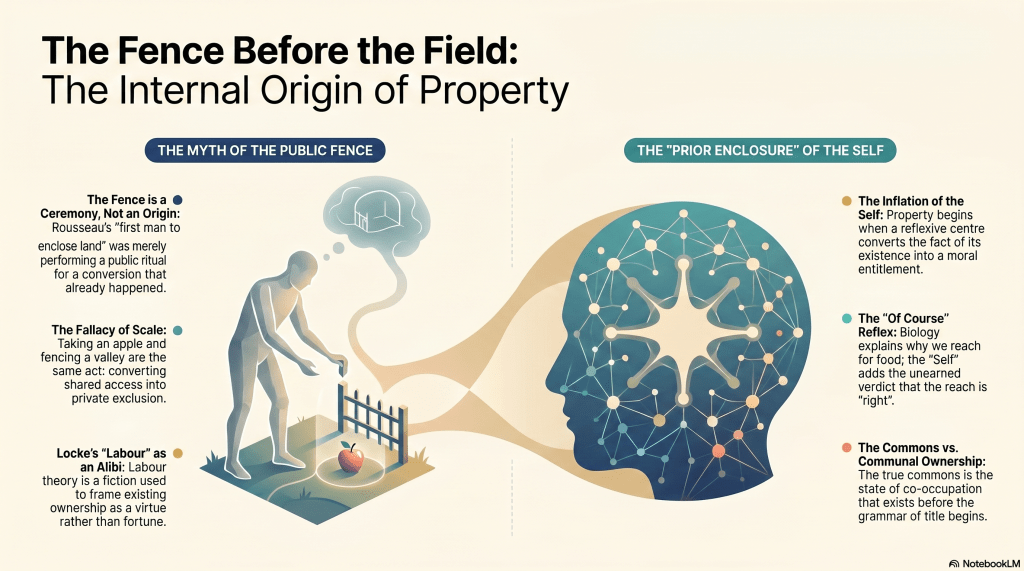
The Fence Before the Field

The first man who, having enclosed a piece of ground, bethought himself of saying This is mine, and found people simple enough to believe him, was the real founder of civil society.

— Rousseau, Discourse on the Origin of Inequality

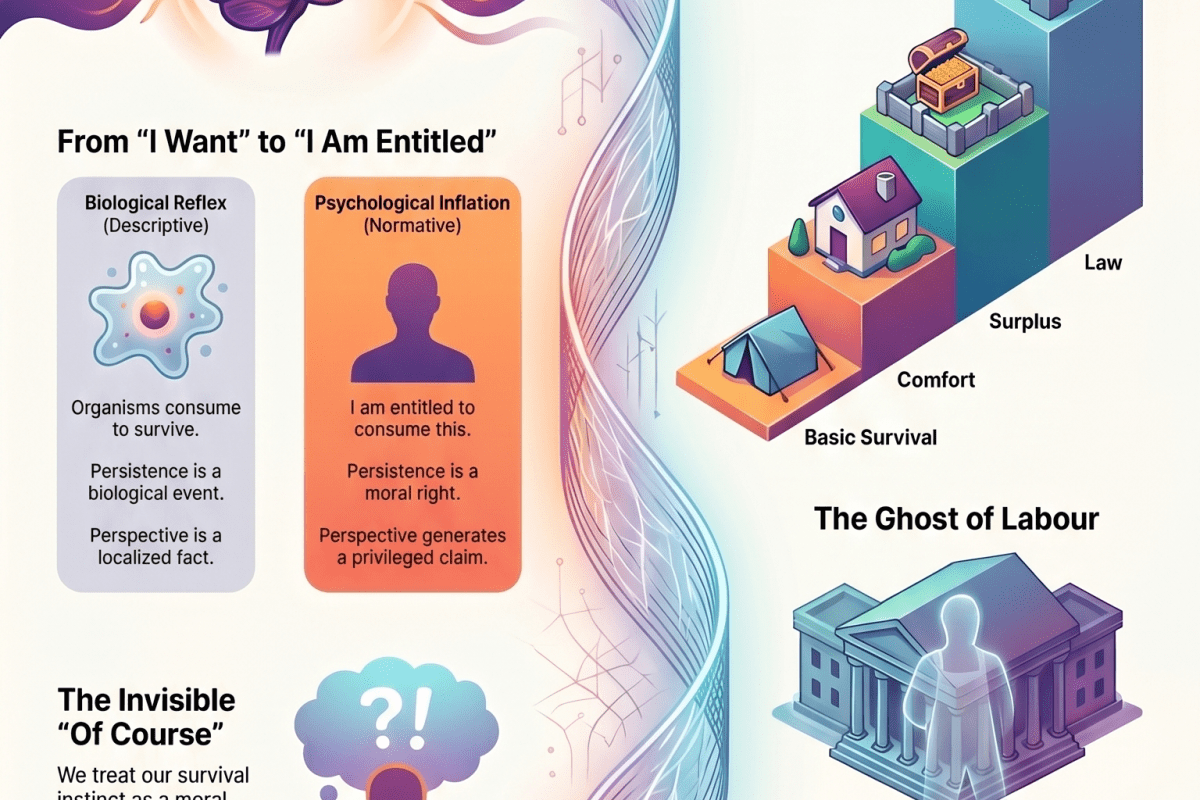
I posted another longer essay on Substack on the immorality of property ownership. This isn’t my first, but I wanted to go deeper in my critique. Actually, I wrote two, but I’ll advertise the second one tomorrow.

Audio: NotebookLM summary podcast of this topic.

Professional Contestables and Weasel Words

1–2 minutes

I had planned to write a blog post on The Remains of the Day, but I posted it on Substack instead because I changed the scope. I also created this podcast on NotebookLM.

Audio: NotebookLM summary podcast of this topic.
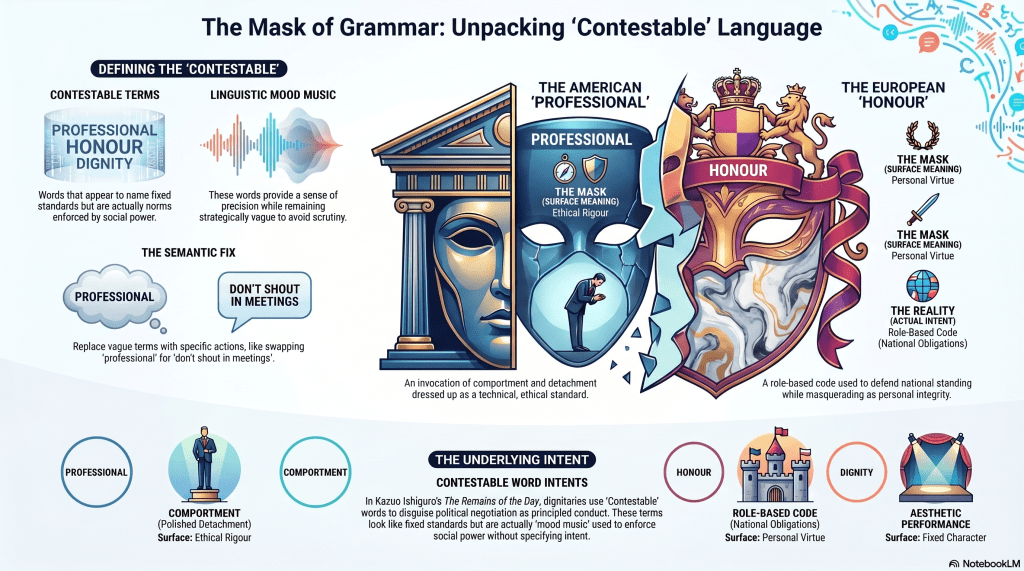
NotebookLM Infographic on this topic.

Head there for the full article.

Rival Moral Approaches of the Modern World – Alasdair Macintyre

1–2 minutes

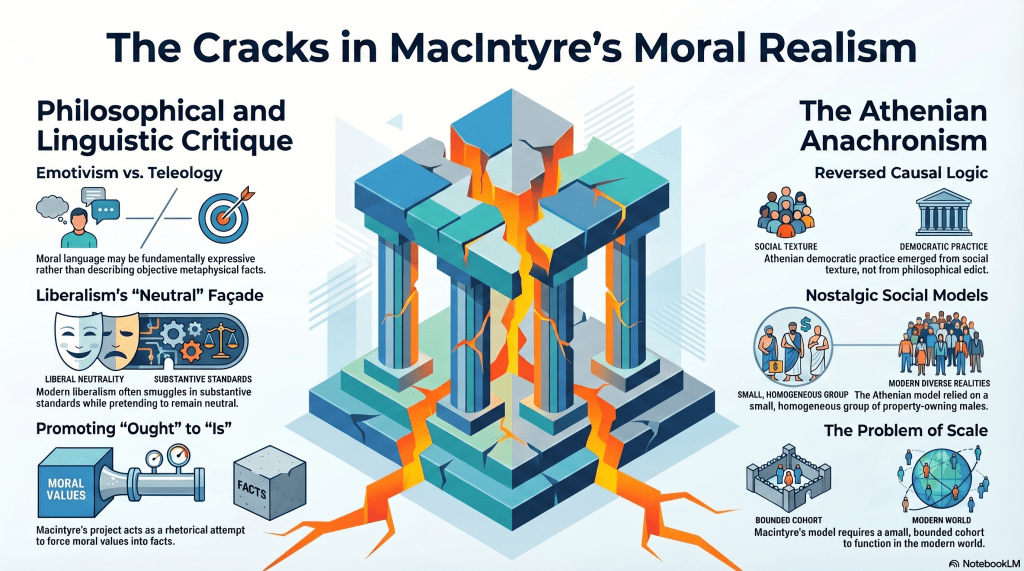
Alasdair MacIntyre is persuasive when he argues that moral discourse is never neutral, and that modern liberalism smuggles in substantive standards while pretending not to. But he dismisses emotivism too quickly as a cultural disaster rather than considering whether it might describe moral language more accurately than his own teleological alternative. If moral utterance is fundamentally prescriptive or expressive rather than descriptive, then the collapse of ‘view from nowhere’ morality doesn’t send us scurrying back to Aristotle. It simply shows that moral language was never doing the metaphysical work MacIntyre wants from it.

The Aristotelian remedy also depends on a nostalgic and anachronistic social model. The Athens he implicitly romanticises was a small polis whose demos consisted of citizens, meaning property-owning males, already bound by shared norms, proximity, and cultural inheritance. In other words, the sort of thick local world that made a certain kind of practical ethical life possible in the first place. MacIntyre’s causal arrow points the wrong way. In Athens, democratic practice emerged from that prior social texture. You do not reproduce the same conditions by philosophical edict.

Audio: NotebookLM summary podcast of this topic.

To put it more bluntly: I don’t think moral realism is tenable, and I am not convinced MacIntyre really thinks so either. His project reads less like a discovery of moral facts than an attempt to promote an ought into an is by force of inheritance and rhetorical confidence. If he carved out a bounded cohort and imposed the right shared practices, perhaps something like his model could function. He may need to annex a reasonably sized car park for the purpose.

NotebookLM Infographic on this topic.

The Butler Did It (To Himself)

5–8 minutes

I have just started reading Kazuo Ishiguro’s The Remains of the Day, and I must confess that I can’t read like a normal person.

I made it roughly fifteen pages before the analytical lenses clamped on and refused to retract. Stevens – Ishiguro’s impeccable, heartbreaking narrator – opens with a monologue about what makes a great butler, and I found myself not following the argument so much as watching the scaffolding. Because Stevens isn’t really theorising butlers. He’s performing a world. And the performance is so seamless, so grammatically composed, that it almost disguises itself as description.

Audio: NotebookLM summary podcast of this topic.

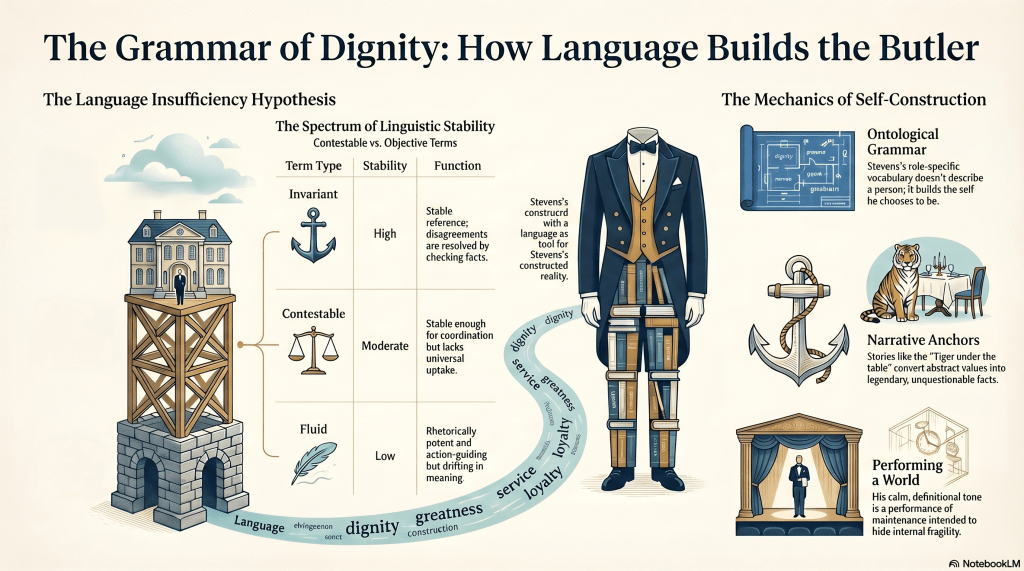
Here’s the trick. Stevens treats terms like greatness, dignity, and quality as though they named discoverable features of reality. He doesn’t present them as historically contingent, institution-soaked, liable to buckle under interrogation. He presents them as if the universe itself had ratified them, and he’s merely reporting. It’s the calm, definitional tone of a man who believes he’s describing essences when he is actually curating preferences.

Take butler itself. In ordinary usage, it looks occupationally concrete – a person who does a particular job. But in Stevens’s mouth, it stops being a role descriptor and becomes a bearer of metaphysical vocation. The word accrues civilisational mythology, evaluative freight, quasi-sacred weight, until it no longer refers to a man who answers a door but to a figure who embodies an entire moral cosmology. That is a lot for a job title to carry, and the weight does not come from the world. It comes from the grammar.

Then there is dignity. An interlocutor reasonably suggests that dignity might be something like beauty, a weasel word, like aesthetic, perceptual, taste-bound. Stevens refuses the comparison. Dignity must not sound contingent. It must present itself as something sturdier than preference, almost an objective feature of character, something a person has in the way a table has weight.

And then, naturally, he proceeds to explain it in entirely aesthetic terms: comportment, bearing, restraint, and poise – the look of self-command.

He denies the aesthetic register but then relies on it. His explicit philosophy and his operative language diverge. This isn’t a slip. It’s structural. The term needs to disavow its own supports in order to retain authority. Dignity must deny its kinship with aesthetic discrimination precisely because, without that kinship, it has no flesh.

We do this constantly – take the shakiest words and polish them until they look load-bearing. The more pressure the term is under, the more ceremonially we utter it.

NotebookLM Infographic on this topic.

Weasel words

There’s a name for what Stevens is doing, and I’ve spent a perhaps inadvisable amount of time trying to articulate it.

In my own work, A Language Insufficiency Hypothesis, I distinguish between terms that behave differently under pressure. Some are genuinely invariant – they hold stable reference across contexts, and disagreement about them can be resolved by checking. Some are contestable – stable enough for coordination and argument, but insufficiently fixed to secure the same uptake everywhere. And some are fluid – still rhetorically potent, still action-guiding, but drifting across contexts without anyone quite admitting it.

Stevens’s vocabulary sits at the dangerous end of that spectrum. Greatness and dignity are classic contestables, possibly shading into fluids: they retain social force long after referential stability has gone soft. They still feel like they mean something precise. They don’t. And Stevens’ entire identity is organised around treating them as though they do.

This matters because the language isn’t sitting atop an independent self. It’s helping to constitute the self Stevens can intelligibly be. His selfhood is assembled from grammars of rank, service, and propriety. The role vocabulary doesn’t describe a prior person. It builds one.

This brings us to his father

Stevens admits that his father might belong among the great butlers, despite lacking certain attributes Stevens associates with the newer generation. He notes the gap, then writes it off. The missing qualities belong to a different era; they are secondary, accidental, beside the essential point. His father remains the reference.

But notice what has happened. Stevens is not applying a neutral criterion and then discovering that his father qualifies. He’s adjusting the criterion around the father he already reveres. The supposed standard of greatness turns out to be less a fixed measure than a retrospective act of preservation. Firstly, canonise the figure, then tidy the theory.

The father is doing at least three jobs at once: He’s an exemplar; he’s a stabilising emotional anchor; and he’s a concealed limit-case that proves the category is being bent.

That’s how value-laden language typically works. The abstraction pretends to govern the attachment, but really the attachment is governing the abstraction. Stevens wants the dignity of a rule whilst retaining the comfort of a cherished exception. This isn’t hypocrisy in the simple sense. It’s something more interesting: it’s the ordinary mechanics of human categorisation when the stakes are personal.

And of course, the father isn’t merely a person Stevens admires. He’s the living conduit through which Stevens inherits the whole ontology of service. When Stevens prefers his father as the reference point, he’s anchoring the category in the formative figure through whom the category became intelligible in the first place. The father is part of the installation mechanism.

Then there is the tiger

With the reverent caveat that it may be apocryphal, Stevens recounts a story in which an unidentifiable butler known to his father, confronted by a tiger under a dining room table (the details are gloriously improbable), maintains perfect composure. He doesn’t flinch. He doesn’t break form. He remains, in the deepest sense, a butler.

Whether the story is true barely matters. Its function isn’t evidential but exemplary. It condenses a whole metaphysics of dignity into narrative form. It is a saint’s life for the religion of service.

And that’s the key. For the father – and then for Stevens – dignity is not a detachable opinion. It’s a lived orientation. In the face of the tiger, one doesn’t first deliberate about values and then choose restraint. One already inhabits a world in which restraint is what seriousness looks like. The salience structure is preinstalled. The event is interpreted through it automatically.

The story converts dignity from abstraction into legend. It makes composure appear not merely admirable but real. It turns comportment into ontology. And it authorises imitation through lineage: the son inherits not just a standard but a dramatic image of what the standard looks like when tested.

The possible apocryphal status doesn’t weaken this. If anything, it strengthens it. The father has become less a man than a vessel for the category. The tale smooths over ambiguity and turns a contingent life into an emblem. We’re forever embalming values in stories, then pretending the stories prove the values rather than merely rehearse them.

So Ishiguro’s opening chapter is doing at least four things at once.

  1. It presents contestable terms as if they were settled realities.
  2. It shows institutional language masquerading as neutral description.
  3. It reveals a person whose identity has been stabilised – constituted, really – by those terms.
  4. And it lets the reader feel the gap between the serenity of the grammar and the fragility of what it is trying to hold together.

That last part is the killer. Stevens’s calm definitional tone is itself evidence of instability. The more pressure the terms are under, the more polished the delivery. He’s performing maintenance whilst pretending to describe an essence.

I’m only one chapter in. I suspect Ishiguro is going to make this hurt.

The Environment Always Wins: The Myth of Pure Voice

4–6 minutes

There’s a certain kind of cultural panic that tells you more about the panickers than about the thing they are panicking about. The current hysteria over AI-inflected prose is a good example.

The argument, insofar as it deserves the name, goes roughly like this: LLMs produce prose with identifiable features – a certain blandness, a fondness for the em dash, a tendency toward tidy three-part structure. Writers who use these tools risk absorbing those features. The authentic human voice is therefore under threat. Something precious is being diluted by contact with the machine.

This is sentimental rubbish, and it is worth saying so clearly before doing anything else – and a sort of virtue signalling.

Audio: NotebookLM summary podcast of this topic.

I use LLMs daily. For research, for editorial pushback, for smoothing passages that have gone awry. This means I spend hours a day reading a particular kind of output. You’d have to be delusional not to admit it has effects. Certain phrasings start feeling natural that didn’t before. Certain rhythms begin to recur. Certain words might not have otherwise come into use. I notice this and note it without particular alarm, because I’ve read enough to know that this is just what environments do.

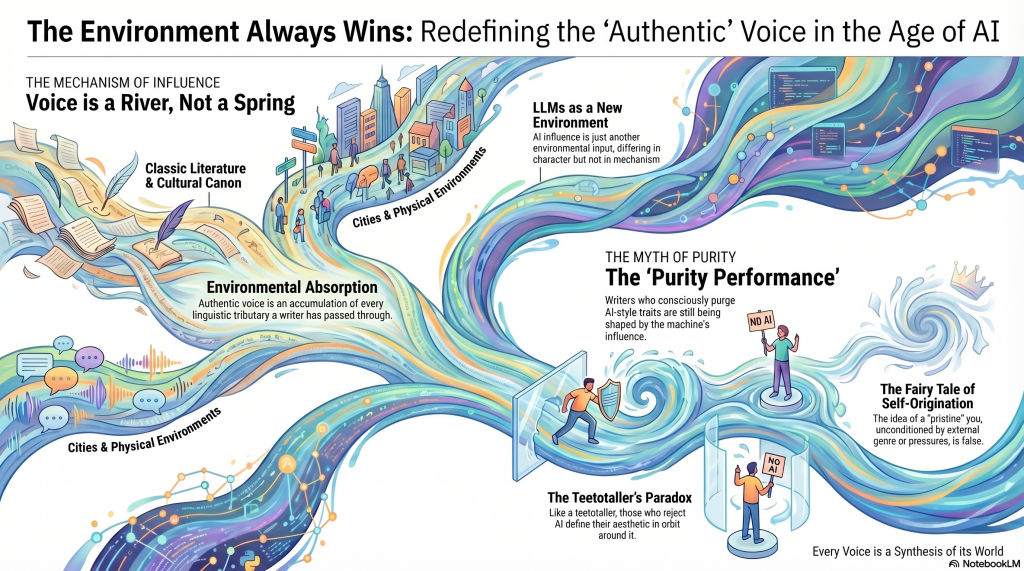
Read nothing but McCarthy for a month, and your sentences will start hunting for the spare declarative. Spend a year editing academic philosophy, and you will catch yourself reaching for ‘insofar as’ and ‘it’s worth noting’ in casual conversation. Live in a city long enough, and its cadences work their way into your syntax. This isn’t contamination, the negative moralist dispersion. It’s how language acquisition works for as long as one is alive and reading. Voice isn’t a spring. It’s a river, a moving accumulation of every tributary it has passed through.

The prestige game being played by the anti-LLM faction isn’t difficult to spot. When Dostoyevsky shapes a young writer’s cadence, we call it influence and treat it as evidence of a serious literary education. When a game world shapes a child’s imagination – I homeschooled my son in the manner of unschooling, and his primary corpus for years was World of Warcraft and its attendant lore before shifting to Dark Souls – and that child ends up reading Dante and Milton unprompted in year seven, the same mechanism has clearly operated. The source was not canonical, the outcome was. But the respectable hierarchy of influences cannot easily accommodate this, because the hierarchy was never really about the mechanism. It was about the cultural status of the inputs.

The more interesting observation isn’t about those of us who use these tools. It’s about those who conspicuously do not.

A minor genre has emerged – charitably, I’ll call it a genre because cult feels morally loaded – consisting of writers anxiously purging their prose of anything that might read as AI-generated. It’s worth noting that they have read the lists. Telltale signs of LLM authorship: excessive hedging, em dashes, transitional summaries, the phrase ‘it is worth noting’. And so they scrub, redact, replace, and perform a kind of stylistic hygiene that’s a creative decision made in direct response to LLM discourse.

These writers aren’t free of the machine’s influence. They’re among the most thoroughly shaped by it. They simply have the more theatrical relationship – the counter-imitator, the purity-performer, the one who reorganises their entire aesthetic in orbit around the thing they claim to reject.

Thomas Moore, in Care of the Soul, observes that a child raised by an alcoholic parent tends to become either an alcoholic or a committed teetotaller. He presents this as a dichotomy, which is too neat, but the underlying point holds. Reactions are still relata – see what happens when you read too much philosophy and logic? The teetotaller has organised their life around the bottle as surely as the alcoholic has. Both are defined by it.

Opposition is one of influence’s favourite disguises.

The fair objection is that LLM influence may differ from other influences in kind rather than just in kind. Dostoyevsky is strange. Bernhard is strange to the point of pathology. A canonical prose style is idiosyncratic by definition, which is why it’s worth absorbing. In contrast, LLM output aims for plausible fluency and statistical centrality. Its pull may be more homogenising than the pull of a singular authorial sensibility.

That’s a real point. The environment in question has a centripetal force toward the mean that most literary influences lack.

But conceding the point doesn’t really rescue the panic. It just specifies the kind of influence involved. The mechanism remains identical to every other case of environmental absorption. And ‘this influence tends toward the generic’ is an ironically generic critique of a particular environment’s character rather than a claim that the environment is doing something ontologically unprecedented to the notion of authorship.

The question that actually matters aesthetically is not was this touched by AI? It is what did the writer do with the environment they inhabited? That’s always been the question. It remains the question. The machinery has changed; the problem of influence has not.

What the current schism actually reveals is not that AI is doing something new to writing. It’s that we’ve been operating with a fairy tale about what writing is. The fairy tale holds that voice is self-originating, that somewhere beneath the reading AND the editing AND the genre conventions AND the institutional pressures AND the decade of a particular editor’s feedback, there is a pristine you, unconditioned and pure, expressing itself directly onto the page.

This was always false. Writers have always been patchworks of absorbed environments. The only difference now is that one of the environments is a machine, and the machine is new enough that people haven’t yet learned to be comfortable with what it reveals about the rest.

The environment always wins. The only interesting question is which environments you choose, and what you make of them.

NotebookLM Infographic on this topic.

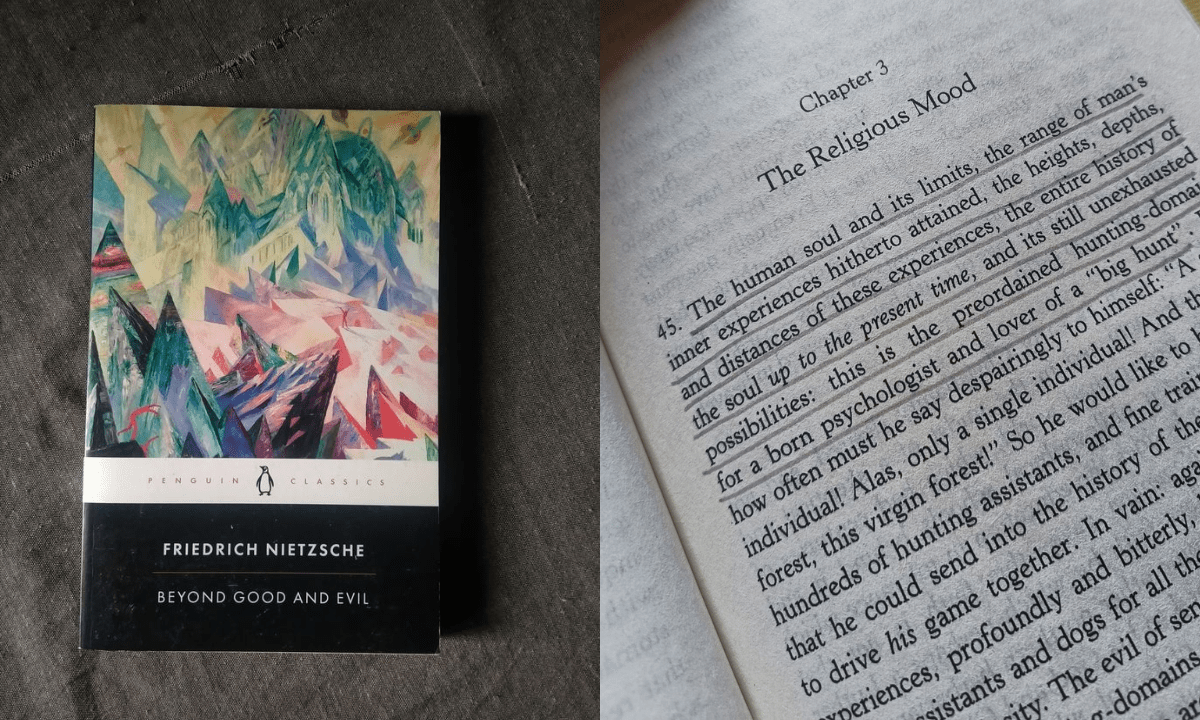
Nietzsche’s Beyond Good and Evil – A Close Reading?

6–9 minutes

I joined a scheduled close reading of Nietzsche’s Beyond Good and Evil recently and came away less refreshed than exasperated. I will spare the platform and the hosts, not out of charity exactly, but because the problem is broader than two particular men fumbling through a canonical text in public. What disappointed me wasn’t that they disagreed with Nietzsche, nor even that they may have misunderstood him in places. Misreading is inevitable. The problem was that they seemed not to have brought much of a reading to begin with.

I had read Beyond Good and Evil years ago and thought a return to it might do me some good, or at least less evil than the usual intellectual content mill. The format sounded promising enough: two interested hosts working through the introduction live, sentence by sentence, in a supposedly close reading. Both had apparently read the book before. One therefore assumed they might arrive with at least a provisional grasp of its architecture, key provocations, and habitual traps. That assumption, in the event, turned out to be embarrassingly optimistic.

Audio: NotebookLM summary podcast of this topic.

As one host read line by line, the discussion lurched forward by way of hesitant paraphrase, speculative gloss, and the occasional verbal shrug. He offered the more substantive guesses, such as they were, while the other contributed mostly vague assent, half-memory, and the sort of foggy commentary one gives when one dimly recalls having once encountered a difficult book in a previous phase of life. It was less a close reading than a public rehearsal of not quite knowing what one was doing.

Now, I am not demanding exegetical perfection. Nietzsche is not a writer one simply ‘gets’ and files away like a user manual. Nor am I naïve enough to think authorial intention settles everything. Barthes is right enough to remind us that the text exceeds the author’s sovereign control. But the death of the author is not a licence for the death of preparation. If one is going to host a close reading of a notoriously elliptical and performative philosopher, the least one might do is arrive having done some prior work. Read the introduction carefully beforehand. Refresh the major themes. Check the loaded terms. Develop an argument, or at least a point of view.

That point of view may be wrong. Fine. Better that than the contemporary preference for the curated shrug, where one mistakes visible uncertainty for intellectual seriousness. There is a difference between interpretive openness and simple lack of preparation. One is a virtue. The other is an aesthetic.

I find this especially grating because I cannot imagine teaching a class that way. When I taught, I’d spend hours preparing before entering the room. Not because I imagined myself infallible, but because students deserve more than watching a lecturer discover the material in real time. A formed point of view is not a dogma. It is a starting position. It gives the discussion shape, stakes, and resistance. Without it, one is not leading inquiry but merely simulating it.

The second host did little to improve matters. Rather than complicating or sharpening the reading, he mostly echoed the first. There was very little friction, and thus very little illumination. One of the virtues of reading Nietzsche in company is that he invites productive disagreement. He is slippery, aphoristic, ironic, and often strategic in his provocations. A good discussion can tease out the tensions in his prose, test competing emphases, and ask whether a claim is literal, tactical, genealogical, or satirical. None of that really happened. Instead, one host fumbled, and the other nodded. The result was a kind of interpretive ventriloquism in which agreement substituted for insight.

The accompanying chat made things worse, or perhaps simply made the missed opportunity more obvious. Viewers were offering questions and interpretations, yet the hosts largely ignored them. Aside from one participant, who seemed likely to have some prior relationship with them, the chat was treated as background furniture. This was especially irritating because the event was live. If one is going to perform reading in public, the public should not be reduced to silent witnesses of one’s uncertainty. Otherwise, the ‘community’ aspect is just branding, another little liturgy of digital participation in which the audience is invited to attend but not to matter.

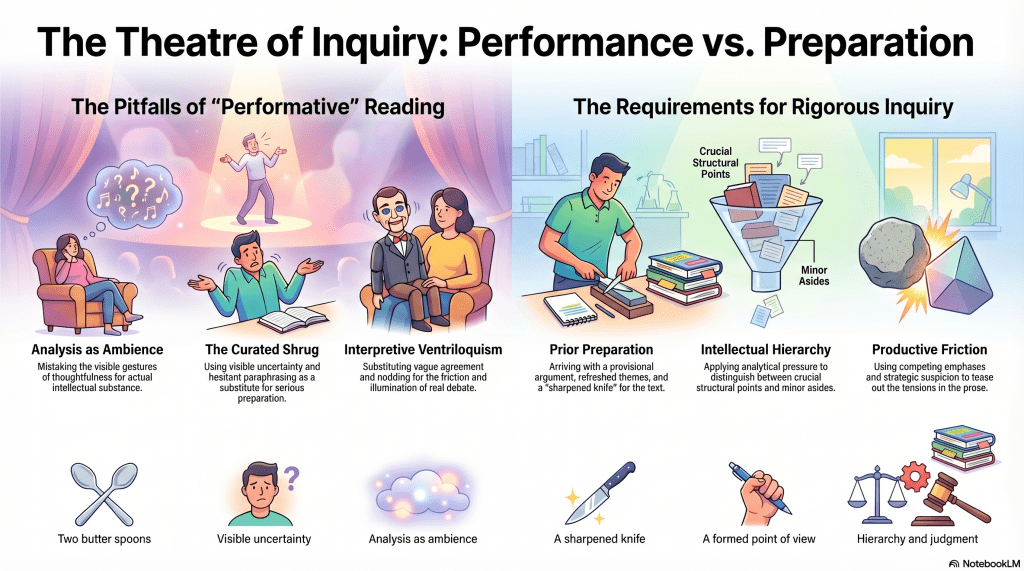
NotebookLM Infographic on this topic. To be honest, I am including this because I find it to be humorous.

To be fair, even when they did read from the chat, they handled those comments much as they handled Nietzsche: superficially, without much analytical pressure, as though any sentence placed before them deserved the same tone of vague consideration. This flattening effect was revealing. It suggested not generosity but a lack of discrimination. A close reading requires hierarchy, emphasis, and judgement. One must be able to say: this is a crucial phrase; this term matters; this apparent aside is actually structural; this comment in the chat opens something worth pursuing; that one does not. Without such judgement, everything becomes equally interesting, which is another way of saying that nothing really is.

What emerged, then, was not close reading but the theatre of close reading. The ritual gestures were all in place: slow pace, sentence-by-sentence attention, occasional lexical speculation, the performance of thoughtfulness. But the substance was strangely absent. One had the form of seriousness without much seriousness of form. It was analysis as ambience.

This points to a broader problem in online intellectual culture. Much of it now confuses exposure with engagement. To read a difficult text aloud is not yet to wrestle with it. To host a discussion is not yet to lead one. To hesitate publicly is not yet to think. Somewhere along the line, people began mistaking the visible performance of inquiry for inquiry itself. The result is a style of pseudo-seriousness in which the host need not know very much, so long as he can sound tentative in the correct register.

Nietzsche, of all people, deserves better than that. He is not an author who yields his force to the merely dutiful or the casually adjacent. He requires energy, suspicion, historical feel, and the willingness to risk a reading. One need not become a priest of correctness. But one should at least bring a sharpened knife to the table, rather than two butter spoons and a podcast voice.

What disappointed me, then, was not simply that these hosts stumbled. Everyone stumbles with Nietzsche. It was that the stumbling seemed to be the content. No deep framework, no clear prior preparation, little tension between the readers, and scant engagement with the audience. The whole affair felt less like a serious encounter with Beyond Good and Evil than a performance of cultural literacy: a way of being seen near an important book.

And perhaps that is the real irritation. One expects difficulty. One can even forgive error. What is harder to forgive is the peculiar modern tendency to make a spectacle of one’s underpreparedness and call it interpretation.


To be fair, I later learned that the co-host was not a philosopher by training but came from Literature. That in itself is no objection. Indeed, a pairing like that could have worked very well. Nietzsche is precisely the sort of writer who benefits from both conceptual and stylistic scrutiny. A philosopher can situate the argument, trace its targets, and identify the intellectual inheritance under pressure. A literary reader can pick up tone, irony, rhetorical staging, and the peculiar way Nietzsche so often performs thought rather than merely stating it.

The problem, then, was not the pairing but the execution. The session might have worked if both hosts had prepared properly and if each had leaned into his own strength. Instead, what emerged was a flatter sort of exchange, with the philosopher soliciting the literary co-host’s ‘opinion’ on semantic content as though interpretive adequacy were simply a matter of free-floating textual impressions. What was missing was any real division of labour, any methodological self-awareness, or any sense that different competences might illuminate different aspects of the text.