This is a NotebookLM podcast audio summary of a Substack essay on a key idea of Thomas Hobbes expressed in Leviathan.
Audio: NotebookLM summary podcast of this topic.
We all remember Hobbes. Not Calvin’s pet tiger, regrettably, but the Leviathan one: the cheerful fellow who looked at human beings and concluded that, left to themselves, they would make life ‘solitary, poor, nasty, brutish, and short’. A line so good it almost excuses the anthropology. Almost.
A colleague recently shared an essay with me, The Return of Metaphysics: Reclaiming Sovereignty Through Ontological Grounding in Postcolonial and Western Thought. I read it with interest, not least because its target is one I share: the colonial imposition of Western categories as if they were universal reason, universal law, universal political form, and universal humanity. On that point, there is no meaningful disagreement. Colonialism isn’t merely theft of land, labour, and resources. It’s also the imposition of a grammar by which reality itself was made legible to power.
The essay is at its strongest when it treats colonialism as metaphysical violence rather than merely administrative domination. It argues that Europe universalised its own categories and rendered other worlds invisible, inferior, or unreal. Colonialism, on this account, was not only conquest. It was the installation of one ontology as the authorised operating system of the human. That’s a powerful diagnosis, and it deserves to be taken seriously. The essay explicitly describes colonialism as a process that ‘re-made being’ and suppressed other conceptions of time, morality, and community.
Where I start to hesitate isn’t in the critique of colonialism, but in the proposed recovery. The essay seeks to reclaim metaphysics, sovereignty, agency, moral authorship, and ontological grounding as instruments of postcolonial renewal. It wants to oppose colonial metaphysics by recovering metaphysics; to oppose hollow sovereignty by reconstructing sovereignty; to oppose imposed subjectivity by restoring moral authorship.
This may be coherent within the essay’s own frame. But from mine, it raises a suspicion:
What if some of the concepts being recovered are themselves part of the colonial inheritance?
“a return to metaphysics”
“moral authorship”
“ontological reconstruction”
“popular agency”
These terms don’t arrive clean. They carry histories and come with fittings: sovereignty, possession, self-rule, jurisdiction, authorship, legitimacy, command. One may repaint them in decolonial colours, but the shape remains. Inheritance is the danger.
Audio: NotebookLM summary podcast of this topic.
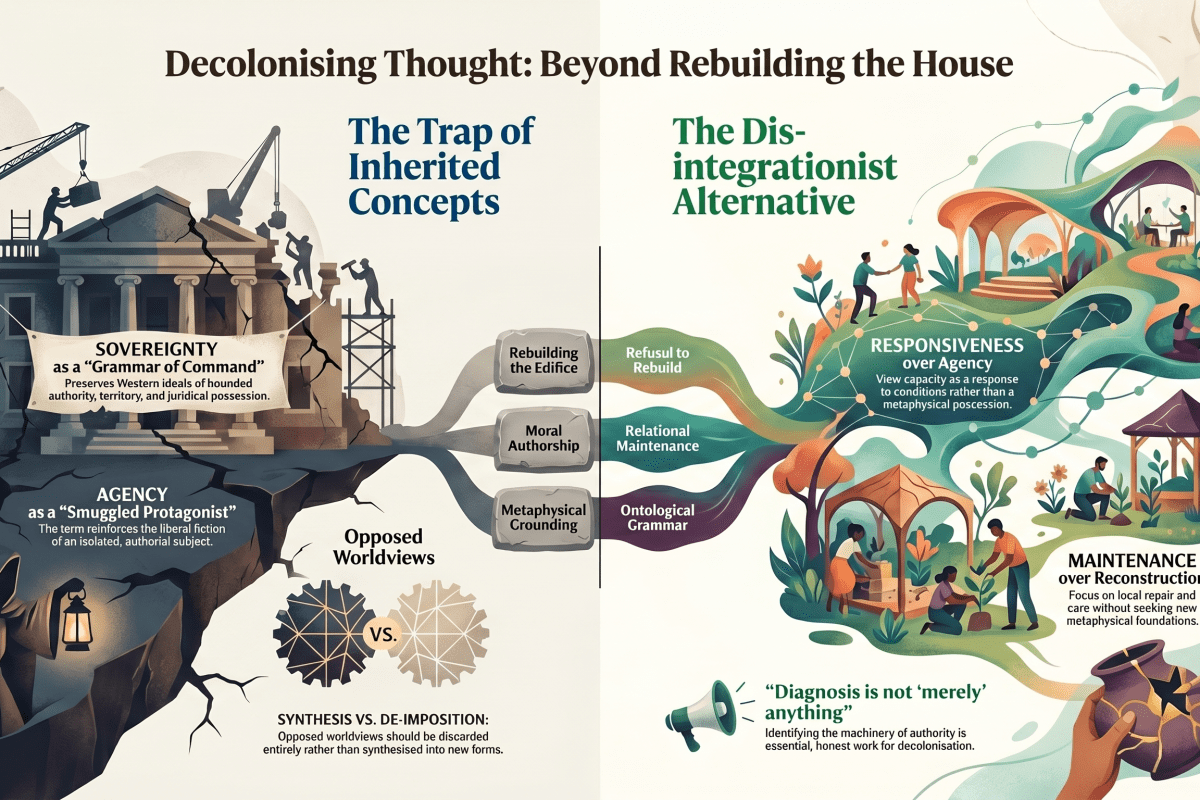
Sovereignty as a Recovered Trap
The essay’s central concept is sovereignty. More precisely, post-sovereignty. Yet the very act of preserving sovereignty as the problematic term matters. Sovereignty isn’t just a neutral container for self-determination. It’s one of the central concepts through which Western political modernity imagines authority: bounded, possessed, territorialised, juridical, and authorial.
To speak of sovereignty is already to speak in the grammar of command: Rules. Owners. Authorities. Something marks the line between inside and outside.
This doesn’t mean colonised peoples were wrong to demand sovereignty. The politically dispossessed may understandably seek the protections of the language used to exclude them. If one has been denied the status of a subject, a nation, or a people, then reclaiming those terms may be historically necessary. There’s no cheap purity available from the comfort of abstraction. Humans made the mess, naturally, and then handed each other dictionaries to clean the mess.
But political necessity doesn’t settle conceptual adequacy. A term may be strategically useful and ontologically suspect at the same time. So, the question isn’t whether sovereignty has been useful in anti-colonial struggle. It’s whether it should remain the destination, rather than a transitional vocabulary one eventually leaves behind.
The essay recognises that many postcolonial states retain the ‘juridical structure’ of autonomy whilst remaining governed by inherited categories of colonial law, property, development, and bureaucratic legitimacy. That’s exactly the point where the critique might turn more sharply on sovereignty itself. If postcolonial statehood often reproduces colonial form, perhaps the issue isn’t merely that sovereignty is hollow, but maybe it’s just one of the forms through which hollowness reproduces itself.
NotebookLM Infographic on this topic.
Agency: The Smuggled Protagonist
The same problem emerges around agency. The essay speaks of popular agency, moral authorship, co-authorship, and subjectification. Again, the impulse is understandable. Colonial domination denies people the right to act, name, interpret, and organise their own lifeworlds. A postcolonial theory naturally wants to restore capacity to those rendered passive.
But the agency term isn’t innocent. In modern Western thought, agency often implies a self capable of authorship, intention, responsibility, and moral ownership. It’s the protagonist required by law, markets, liberal politics, and punishment. Someone must be deemed the chooser, the signer, the sinner, the voter, the debtor, the criminal, the rational actor.
In my own work, I reject agency as a metaphysical possession. I’d rather speak of responsiveness: a variable capacity shaped by material, relational, temporal, somatic, and epistemic conditions. People don’t float above conditions and author themselves into freedom. They respond, more or less adequately, within fields of constraint.
The essay’s emphasis on relationality moves in this direction, but its vocabulary often pulls it back toward authorship. It wants shared becoming, but it also wants moral authors. It wants relational ontology, but it also keeps the self as a source of political meaning. This is a revealing tension.
The alternative isn’t fatalism. To reject agency isn’t to deny action. Breathing doesn’t require a metaphysics of breath. It just happens autonomically. The question is whether we must preserve the fiction of the authorial subject to describe them. I think not.
When Negation Need Not Become Synthesis
The essay leans on Fanon (see The Wretched of the Earth) to argue that colonial domination can’t be resolved through dialogue because dialogue presumes equals. This is right, or at least right enough. A conversation between master and slave is not yet a conversation between equals. Liberal dialogue presumes a shared field of recognition; colonial domination corrupts that field before speech begins.
The essay, therefore, turns to dialectic. Where dialogue seeks agreement, dialectic begins from contradiction and struggle. Again, this makes sense. A colonised subject can’t merely ask to be recognised by the system that produced their non-being. Something must be negated.
My hesitation concerns what happens after the negation. The essay sometimes seems to assume that contradiction must move toward ontological reconstruction. But why? If one term of the contradiction is an imposed colonial ontology, it might not deserve preservation within a higher unity because it mightn’t be a meaningful antithesis. It may simply be wrong, violent, and disposable.
This is the dis-integrative question:
Must the colonial term be synthesised, or can it be dispensed with?
Not every opposition is productive. Some oppositions are parasitic. If a worldview is imposed by force, then treating it as a dialectical partner may grant it more dignity than it deserves. The point of decolonial refusal may not be synthesis, but de-imposition.
That distinction matters. Synthesis often preserves too much. It lets the offending structure survive as a contributor to the next stage. It says, in effect: this violence was part of becoming. Perhaps. But perhaps not. Perhaps some concepts belong on the cutting room floor.
Metaphysics: Necessary Grammar or Rebuilt Throne?
The essay argues that postmodern anti-metaphysics has left social theory without stable categories of truth or moral orientation. It wants metaphysics back, not as abstraction, but as the recovery of moral and ontological grounds for political community.
I understand the concern here, too. Communities don’t live by procedure alone. No society is sustained merely by policy, rights language, or bureaucratic form. People inhabit worlds, not spreadsheets. There are ontological grammars beneath every institution: assumptions about personhood, time, land, memory, obligation, kinship, death, and belonging.
But I resist the move from ‘we can’t avoid ontological grammar‘ to ‘we need metaphysical grounding‘. Whilst the former seems unavoidable, the latter seems dangerous.
Metaphysics isn’t simply depth. It’s elevation – the move by which a grammar stops appearing as grammar and starts presenting itself as ground. It becomes the authorised deep structure, the thing beneath dispute, the foundation beneath the foundation. And foundations, as humans have demonstrated with astonishing consistency, are excellent places to hide power.
My preference is to minimise metaphysical devices. They’re unavoidable, but they’re liabilities.
Each one requires a leap. One leap may be necessary. Ten leaps become choreography. Eventually, the argument is no longer walking; it’s performing interpretive dance and calling itself ontology.
The Problem of Rebuilding
This is where my own Dis–integrationist commitments diverge most sharply from the essay. I’m a diagnostician. I deconstruct and name seams with no obligation to replace every collapsed universal.
The essay treats diagnosis as insufficient. It says the critique of sovereignty reveals a metaphysical vacuum, but diagnosis is not enough. Post-sovereignty must move toward ontological reciprocity, relational becoming, and shared labour of mutual recognition. Whilst this move is respectable. It’s also the one I distrust.
The rebuilding instinct is one of philosophy’s oldest addictions. Expose the flaw, draft the remedy, rebuild the edifice, declare the new form less violent than the old. This is how critique becomes renovation.
But the refusal to rebuild isn’t indifference, despair, or nihilism. It’s a refusal to let repair disguise itself as permanence. Care, maintenance, reciprocity, and local repair remain possible without metaphysical reconstruction. In fact, they may be more honest when stripped of the promise of final grounding.
Pedagogical Sovereignty and the Soft Machinery of Formation
The essay’s later sections turn to education. It proposes pedagogical sovereignty as a model of moral and ontological co-creation. The classroom becomes a site where being isn’t transmitted but collaboratively formed. Governance, by analogy, might become less administrative and more pedagogical: citizens not merely ruled, but constituted in relation. As attractive as this might be. it’s also perilous.
Education has always had this double face. It can liberate, but it can also format. It can open worlds, but it can also install authorised grammars. The classroom is not outside power. It’s one of power’s favourite incubators. The fact that it speaks gently doesn’t mean it’s not shaping bodies, subjects, desires, norms, and permissions.
To make pedagogy the model of sovereignty risks softening administration rather than escaping it. It may replace the command of the state with the formation of the subject. That may be better and subtler, but one should be careful when power arrives wearing soft shoes.
This doesn’t refute the essay’s educational turn, but it complicates it. If pedagogy is to be an emancipatory model, it has to preserve opacity, dissent, and non-formation. It needs to allow the learner not merely to become, but to remain partially unread, unfinished, and unintegrated. Otherwise, pedagogical sovereignty may become another normalising machine with better intentions and comfy chairs.
The Cutting Room Floor
My objection isn’t that the essay is wrong to oppose colonialism. Au contraire; its critique of colonial metaphysics is often compelling, and it’s preaching to the choir at the start. The issue is that its recovery project may carry forward more of the colonial-conceptual apparatus than it recognises.
The following terms deserve suspicion:
Sovereignty, because it preserves the grammar of possession, jurisdiction, bounded authority, and command.
Agency, because it preserves the authorial subject required by liberal law, market morality, and responsibility allocation.
Moral authorship, because it risks reintroducing the self as origin, even when collectivised.
Metaphysical grounding, because it may turn situated lifeworlds into foundations.
Reconstruction, because it assumes fracture demands repair, rather than sometimes demanding refusal.
Dialectical synthesis, because it may preserve the imposed term as a contributor to the future, rather than discarding it as an error condition.
None of these concepts must be rejected out of hand. That would be too easy. But they shouldn’t pass uninspected simply because they have been recruited into decolonial service. Fine. Use the master’s tools to dismantle the house, but don;t become too fond of them.
Toward De-Imposition
So, what then?
Dis–integration, not reconstruction
De-imposition, not anti-colonial sovereignty
Responsiveness, not agency
Relational maintenance, not moral authorship
Ontological grammar held visibly as grammar, not metaphysical grounding
This doesn’t mean communities should abandon their lifeworlds, traditions, or inherited moral vocabularies. It means those vocabularies shouldn’t need to become metaphysical foundations to matter. A world may be lived, tended, and defended without being inflated into ground.
The colonised don’t need permission from Western metaphysics to exist. Or me, for that matter. Nor do they need to rebuild themselves in metaphysical form to count as real. The refusal of imposed reality may be enough. After that, there may be practices, relations, institutions, memories, ceremonies, languages, solidarities, and forms of care. There may be politics and struggle. And, sure, repair and maintenance. But there needn’t be a new foundation.
Enfin
The essay I am responding to is valuable because it presses a real question:
If colonialism was ontological violence, can anti-colonial thought afford to remain merely procedural, linguistic, or diagnostic?
My answer is: diagnosis is not ‘merely’ anything. To diagnose is to identify the machinery by which certain concepts keep reproducing their own authority. If sovereignty, agency, authorship, and metaphysical grounding belong to that machinery, then they should not be automatically restored just because they have been wounded.
Some concepts can be reclaimed. Others should be retired. Some may be used provisionally, under protest, as transitional scaffolding. Again, others may belong on the cutting room floor.
The challenge isn’t only to oppose colonialism and its effects. It’s to notice when colonial grammar survives inside the opposition. That’s the harder work – less heroic, sonorous, and much less likely to produce a grand theory, but it may be more honest.
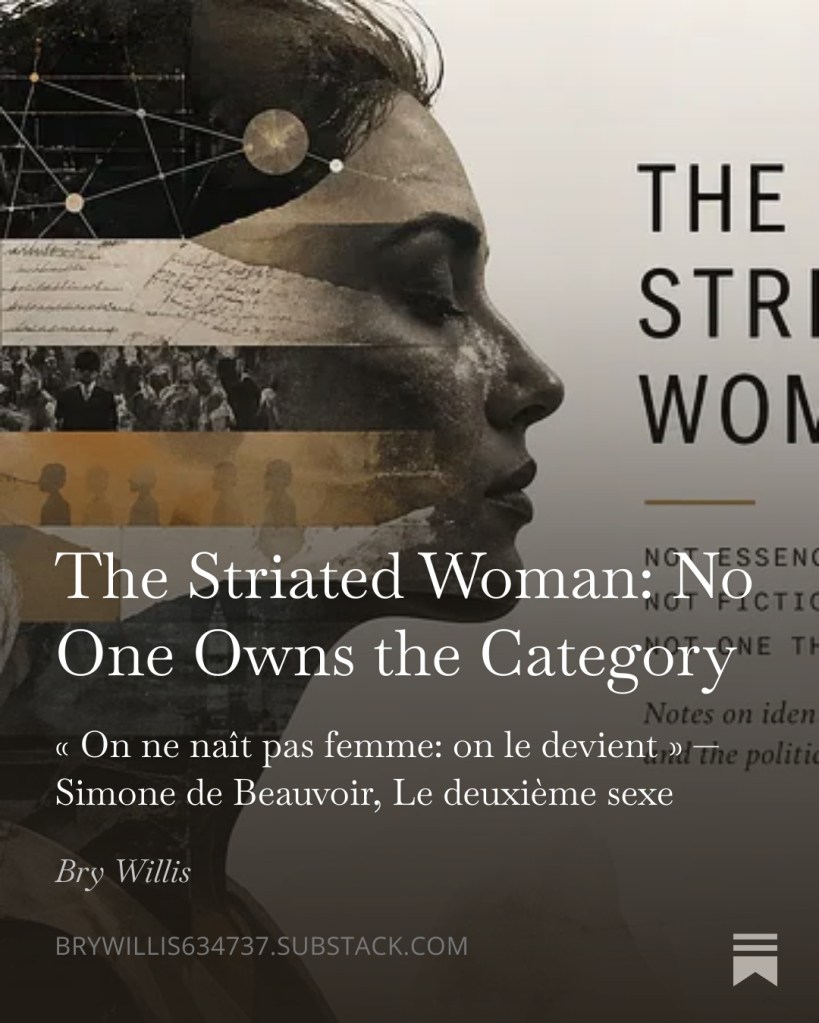
‘woman’ is a normative identity, and like all normative identities it is striated. It is composed of putative essences, recurring structural constraints, intersectional positions, cohort-relative projections, subjective inhabitations, and external gatekeeping.
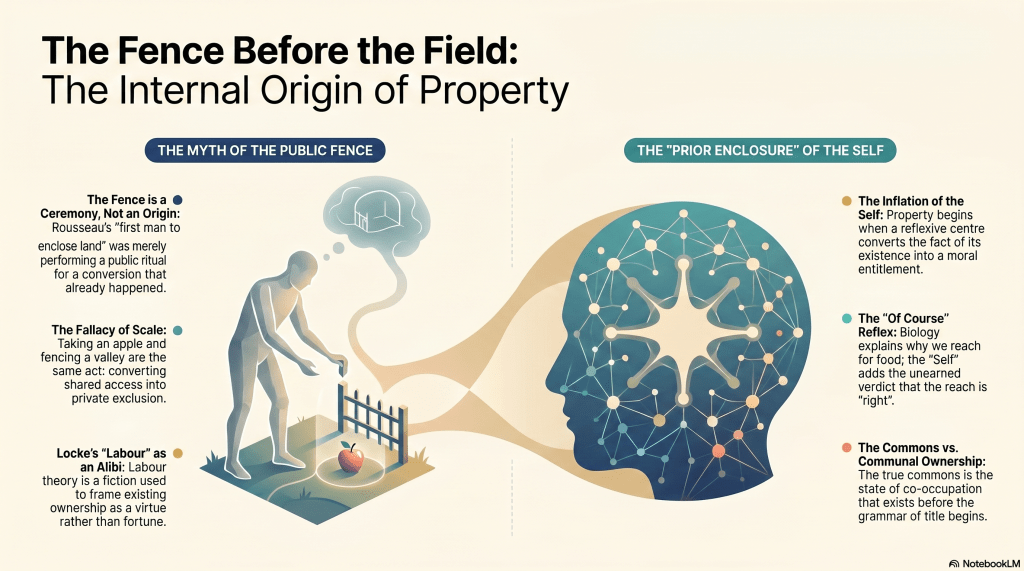
The first man who, having enclosed a piece of ground, bethought himself of saying This is mine, and found people simple enough to believe him, was the real founder of civil society.
— Rousseau, Discourse on the Origin of Inequality
I posted another longer essay on Substack on the immorality of property ownership. This isn’t my first, but I wanted to go deeper in my critique. Actually, I wrote two, but I’ll advertise the second one tomorrow.
NB: This is an idea I had kicking around, but it’s not really in my ballpark. Given my backlog, I don’t think I’ll pursue this. If anyone in the post-colonial space finds it interesting or adaptable, please pick it up as a kernel and run with it.
Thesis
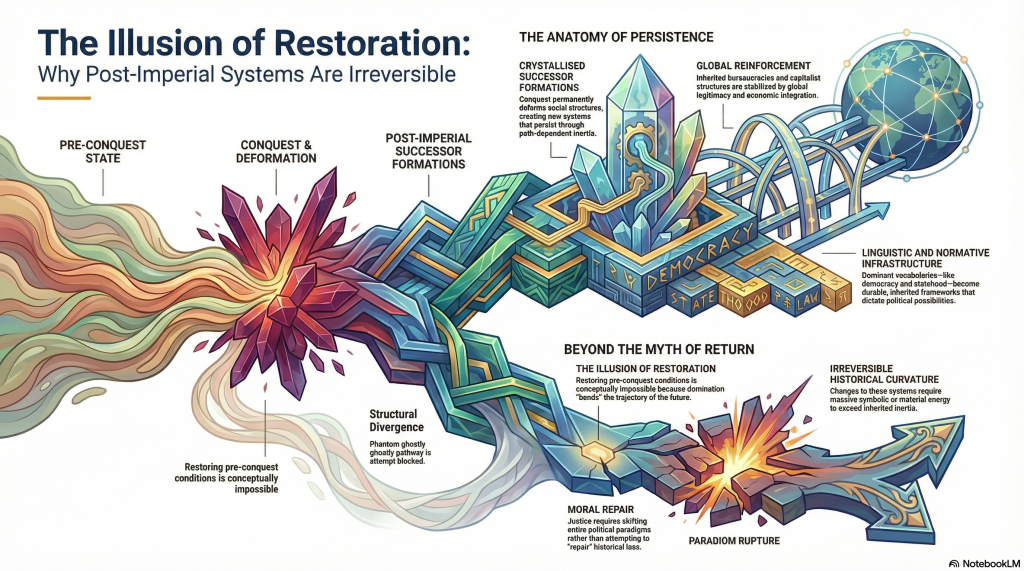
Post-imperial political orders do not restore pre-conquest social ontology but instead crystallise into historically irreversible successor formations whose institutional, linguistic, and normative structures persist through path-dependent inertia reinforced by global systems of legitimacy. Consequently, projects of restitution or decolonial restoration misrecognise the temporal dynamics of domination and must be reconceived as ethical and political negotiation within curved historical trajectories that can be altered only through paradigm-level rupture rather than moral repair.
Audio: NotebookLM summary podcast on this topic.
Abstract
This argues that post-imperial political transformation cannot be understood through narratives of restoration, restitution, or completed decolonisation. Conquest generates not only territorial dispossession but durable deformation of social ontology, producing successor formations structured by inherited administrative forms, linguistic infrastructures, and normative vocabularies – most prominently democracy, capitalism, and bureaucratic statehood – that persist through path-dependent institutional inertia. These structures endure not as static remnants but as dynamically stabilised systems reinforced by global regimes of legitimacy, economic integration, and mnemonic continuity.
Against both liberal accounts of reconciliation and radical imaginaries of full decolonial return, the analysis develops a framework of historical curvature and rupture. Domination bends the trajectory of possible futures, rendering restoration of a pre-conquest condition conceptually incoherent while leaving open the possibility of paradigm-level transformation when sufficient political, material, or symbolic energy accumulates to exceed inherited inertia. Justice after empire must therefore be reconceived not as repair of historical loss but as ethical and political negotiation within irreversibly transformed temporal horizons. This reframing clarifies persistent tensions surrounding sovereignty, restitution, and legitimacy in post-imperial orders and provides a diagnostic account of why decolonisation remains structurally incomplete despite formal independence.
We like to believe the world is governed by rules. By fairness. By international law, norms, institutions, treaties, and laminated charters written in earnest fonts. This belief survives not because it is true, but because it is psychologically necessary. Without it, we would have to admit something deeply unfashionable: power still runs the table.
Two and a half millennia ago, Thucydides recorded what remains the most honest conversation in political theory: the Melian Dialogue. No soaring ideals, no speeches about freedom. Just an empire explaining itself without makeup.
Audio: NotebookLM summary podcast of this topic.
Athens, the regional superpower of the ancient world, demanded that the small island of Melos surrender and pay tribute. Melos appealed to justice, neutrality, and divine favour. Athens replied with a line so indecently clear that political philosophy has been trying to forget it ever since: ‘The strong do what they can and the weak suffer what they must’.
That sentence is not an ethical claim. It is a descriptive one. It does not say what ought to happen. It says what does. The Athenians even went further, dismantling the very idea that justice could apply asymmetrically: ‘Justice, as the world goes, is only in question between equals in power’.
This is the part liberal internationalism prefers to skip, usually by changing the subject to institutions, norms, or aspirations. But the Athenians were being brutally honest. Appeals to fairness only work when neither side can impose its will outright. When there is a power imbalance, morality becomes theatre.
The Melians refused to submit. They chose honour, principle, and the hope that the gods would intervene. Athens killed every Melian man of fighting age and enslaved the women and children. End of dialogue. End of illusions. Fast-forward to now.
In early 2026, under Donald Trump, the United States launched a military operation against Venezuela, striking targets in Caracas and forcibly detaining Nicolás Maduro, who was transported to the United States to face federal charges. The justification was framed in familiar moral language: narco-terrorism, stability, regional security, democratic transition. The accompanying signals were less coy: temporary U.S. administration, resource access, and ‘order’. Cue outrage. Cue talk of illegality. Cue appeals to sovereignty, international law, and norms violated. All of which would have been very moving… to the Athenians.
Strip away the rhetoric and the structure is ancient. A dominant power identifies a weaker one. Moral language is deployed, not as constraint, but as narrative cover. When resistance appears, force answers. This is not a deviation from realism. It is realism functioning exactly as advertised.
Modern audiences often confuse realism with cynicism, as if acknowledging power dynamics somehow endorses them. It does not. It merely refuses to lie. The Melian Dialogue is not an argument for empire. It is an autopsy of how empire speaks when it stops pretending. And this is where the discomfort really lies.
We continue to educate citizens as if the world operates primarily on ‘shoulds’ and ‘oughts’, whilst structuring global power as if only ‘can’ and ‘must’ matter. We teach international law as though it binds the strong, then act shocked when it doesn’t. We pretend norms restrain power, when in reality power tolerates norms until they become inconvenient.
The Athenians did not deny justice. They reclassified it as a luxury good. Trump’s Venezuela operation does not abolish international law. It demonstrates its conditional application. That is the real continuity across 2,500 years. Not cruelty, not ambition, but the quiet consensus among the powerful that morality is optional when enforcement is absent.
The lesson of the Melian Dialogue is not despair. It is clarity. If we want a world governed by rules rather than force, we must stop pretending we already live in one. Appeals to fairness are not strategies. They are prayers. And history, as ever, is not listening.
On Self-Evidence, Personhood, and the Administrative Nature of Rights
The following sentence is among the most quoted in political history and among the least examined. It is invoked as moral bedrock, taught as civic catechism, and insulated from scrutiny by a reverence that mistakes repetition for comprehension. It is rarely read closely, and rarely read sceptically.
Audio: NotebookLM summary podcast of this topic.
What follows is not a rebuttal. It is an annotation.
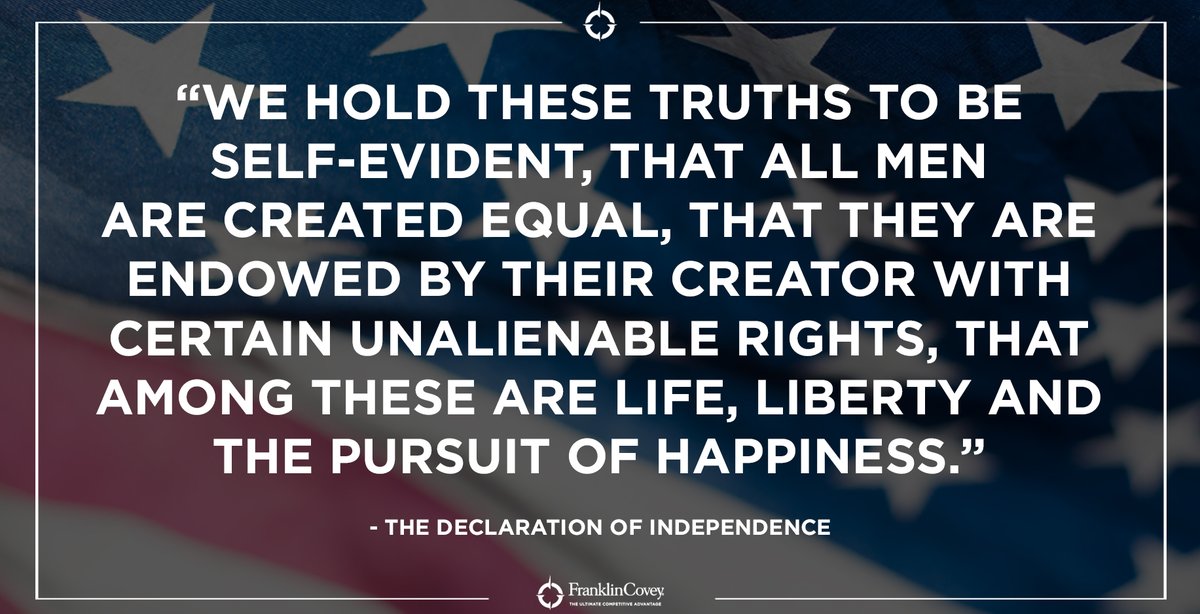
We hold these truths to be self-evident, that all men are created equal, that they are endowed by their Creator with certain unalienable Rights, that among these are Life, Liberty and the pursuit of Happiness.
Most readers will recognise this as the opening of the Declaration of Independence by the United States of America. Recognition, however, is not comprehension. The sentence survives on familiarity. Once that familiarity is set aside, it begins to fail clause by clause.
I. A Best Case, Briefly
A more charitable reading deserves brief consideration. ‘Self-evident’, in the intellectual context of the eighteenth century, did not mean obvious in the sense of requiring no reflection. It referred instead to propositions taken as axiomatic: not inferred from prior premises, but serving as starting points for reasoning. On this view, influenced by Scottish Common Sense philosophy, the claim is not that these truths are psychologically irresistible, but that they are rationally basic.
Likewise, ‘we hold’ need not be read as an admission of arbitrariness. It may be understood as a public avowal: a political body formally affirming what reason is said to disclose, rather than grounding those truths in the act of holding itself. Read this way, the sentence does not collapse into mere opinion.
Finally, the Declaration is often understood as performative rather than descriptive.[1] It does not merely state political facts; it brings a political subject into being. The ‘we’ is constituted in the act of declaration, and the language functions as a founding gesture rather than a philosophical proof.
Even on this charitable reading, however, the appeal to rational self-evidence presupposes capacities that were unevenly distributed at best. The Enlightenment notion of ‘reason’ was never a raw human faculty equally available to all. It depended on literacy, education, leisure, and institutional participation—conditions enjoyed by a narrow segment of the population.
In the late eighteenth century, large portions of the population were functionally illiterate. The ability to engage abstract political principles, to treat propositions as axiomatic starting points for reasoning, was not merely rare but socially restricted. The universal address of the sentence thus rests on a practical contradiction: it invokes a form of rational accessibility that its own social conditions actively prevented.
Nor is this merely a historical observation. Whilst formal literacy has expanded, the distribution of the capacities required for sustained abstract reasoning remains sharply constrained. What has changed is scale, not structure. Appeals to ‘self-evident’ political truths still presuppose forms of cognitive access that cannot be assumed, even now.
There is an important distinction here between innocent misreading and bad-faith translation. A modern reader who takes ‘self-evident’ to mean what it now ordinarily means is not at fault; semantic drift makes this nearly unavoidable. But to continue reading the sentence this way once its historical and philosophical context is understood is no longer an error. It is a decision.
Under the principle of least effort, claims that present themselves as ‘self-evident’ are maximally efficient. They require no sustained attention, no conceptual labour, and no challenge to inherited categories. For individuals ill-equipped – by education, time, or institutional support – to interrogate abstract political claims, such language is not merely persuasive; it is relieving.
To accept a proposition as self-evident is to be spared the burden of understanding how it works. The sentence can be consumed whole, in a single uncritical gulp. What is swallowed is not an argument, but a posture: assent without inquiry, agreement without comprehension.
This is not a personal failing. It is the predictable outcome of a cognitive environment in which complexity is costly, and authority is familiar. ‘Self-evidence’ functions here as a labour-saving device, converting political commitments into ready-made certainties. The capacity to recognise self-evident truths thus functions as an unmarked prerequisite for political subjecthood – a gatekeeping mechanism that precedes and enables the more explicit exclusions to come.
With this in mind, the sentence can be examined clause by clause – not as philosophical proposition, but as rhetorical machinery.
II. An Annotated Deconstruction
‘We hold’
To whom does this ‘we’ apply? Who is included in this collective voice, and who is not? More importantly, what does it mean to hold something that is allegedly self-evident?
Holding is an act of maintenance. It implies agreement, reinforcement, repetition. Beliefs must be held; axioms must be held; norms must be held. Self-evidence, by contrast, is supposed to require none of this. If a truth is genuinely self-evident, it does not need to be held at all. It simply imposes itself.
The opening clause announces immediacy whilst confessing mediation. This is not a subtle tension. It is an outright contradiction. The sentence begins by undermining its own epistemic posture. The axiomatic framing does not eliminate contestability; it displaces it. What is presented as rational starting point functions, in practice, as rhetorical closure.
‘Truths’
What kind of truths are being held here?
The word does far too much work whilst remaining resolutely undefined. These are not empirical truths. They are not logical truths. They are not even clearly moral truths in the narrow sense. Instead, the term oscillates between epistemic certainty, moral assertion, and political aspiration, sliding between categories without ever settling long enough to be examined.
The pluralisation matters. By multiplying ‘truths’ whilst leaving their nature unspecified, the sentence creates an aura of obviousness without committing to a standard of justification. Disagreement is pre-empted not by argument, but by tone.
‘Self-evident’
Unless one invokes something like Descartes’ cogito as a limiting case, nothing is genuinely self-evident. Even the cogito depends on language, conceptual inheritance, and a shared grammar of doubt. Self-evidence is not an epistemic given; it is an experiential effect produced by familiarity, stability, and low resistance.
Here, ‘self-evident’ functions as rhetorical closure masquerading as epistemology. It does not establish certainty; it enforces silence. To question what is ‘self-evident’ is to risk being cast as obtuse, perverse, or acting in bad faith. Inquiry is not answered. It is short-circuited.
‘All men’
This is not the inclusive ‘men’ of abstract mankind. It is a concrete, historically bounded category: adult males, and not coincidentally white ones. The exclusions are not implied later. They are operative here, at the point of entry.
This is the quietly active boundary of the entire sentence. Before any rights are named, before any equality is asserted, the scope of applicability has already been narrowed. The universal tone is achieved by selective admission.
‘Created equal’
Created by whom? And equal in what respect?
The notion of equality here is never specified, because specification would immediately expose contestation. Equal in capacity? In worth? In standing before the law? In outcome? In moral consideration? Readers are invited to supply their preferred interpretation retroactively, which is precisely what allows the sentence to endure.
Some have suggested that ‘equal’ means ‘equal under the law’, but this simply defers the problem. The law defines equality however it pleases, when it pleases, and for whom it pleases. Equality without a metric is not a claim. It is a metaphysical gesture.
It is often said that the Declaration’s universal language contained the seeds of its own expansion. That Douglass, King, and the suffragists appealed to it is taken as evidence of its latent emancipatory power. But this confuses rhetoric with causation. These advances were not the unfolding of a promise, but the result of sustained political pressure, moral confrontation, and material struggle. The language was repurposed because it was available and authoritative, not because it was prophetic.
To call this a ‘promissory note’ is to mistake a battlefield for a contract. Promises are kept by their authors. These were extracted by those excluded, often in direct opposition to the very institutions that sanctified the sentence.
The story also flatters the present. If the promise is always being fulfilled, it is never being broken. Yet the same language remains actively contested, narrowed, and rescinded. Personhood is still conditional. Rights still evaporate at borders, prisons, and classifications. The note, if it exists at all, is perpetually past due.
‘Endowed by their Creator’
No one believes the drafters were referring to genetics or parentage. This capital-C Creator is a theological move, not a biological one. The sentence quietly abandons the pretence of self-evidence and imports divine authority as a grounding mechanism.
This is not incidental. By placing rights beyond human origin, the sentence renders them simultaneously unquestionable and unreachable. Legitimacy is outsourced to a source that cannot be interrogated. Appeals are closed by design.
‘Unalienable Rights’
Here the sentence delivers a double assertion. First, that rights exist independently of institutions. Second, that they cannot be taken away. Both claims fail on contact with history.
Rights are constructed, recognised, enforced, suspended, and withdrawn by institutions. Bentham saw this clearly: ‘natural rights’ function rhetorically to obscure the institutional conditions that alone make rights actionable.[2] And far from being inalienable, rights prove remarkably fragile. The record is unambiguous: rights track status, not humanity. The moment personhood is questioned, rights do not need to be violated. They simply cease to apply.
‘Life, Liberty, and the pursuit of Happiness’
Under the Language Insufficiency Hypothesis – the framework treating key political terms as structurally underdetermined – these are textbook Contestables.[3] None are measurable. None have stable definitions. None come with clear thresholds or enforcement criteria.
‘Happiness’ is the most revealing substitution of all. Locke’s blunt ‘property’ at least named what was being protected.[4] ‘Happiness’ softens the promise whilst emptying it of content. It gestures toward flourishing whilst committing to nothing beyond tolerable participation.
Life, liberty, and happiness are curated abstractions, not guarantees – property in softer clothing.
III. Personhood as the Hidden Mechanism
Zooming out, the operational logic becomes clear. Rights depend on personhood.[5] Personhood is conferred, not discovered. Declaring non-personhood resolves the contradiction without ever touching the rhetoric.
This is the mechanism that allows a universal language to coexist with selective application. When personhood is withdrawn, rights are not violated. They are bypassed. Ethics never gets a hearing, because the subject has already been administratively erased.
To call this administrative is not metaphor. Personhood is assigned, reclassified, and revoked through documentation, categorisation, and procedural determination. The question of who counts is settled before any ethical consideration can begin.
IV. The Sentence as Prototype, Not Mistake
It is tempting to read this sentence as naïve, hypocritical, or aspirationally flawed. That would be a mistake. The sentence is not a failure of Enlightenment thinking. It is its prototype.
It was never meant to survive scrutiny. It was meant to mobilise, stabilise, and legitimise. Its vagueness is functional. Its incoherence is load-bearing. The sentence works precisely because it is conceptually promiscuous, rhetorically elevated, and operationally evasive. What looks like philosophical sloppiness is political engineering.
V. Why It Still Matters
This sentence is not an historical curiosity. It is the template for modern political language.
Universal in tone.
Conditional in application.
Moral in rhetoric.
Administrative in practice.
The future did not reveal the sentence to be false. It revealed what the sentence was for.
Footnotes
[1] J.L. Austin, How to Do Things with Words
[2] Jeremy Bentham, Anarchical Fallacies; Being an Examination of the Declarations of Rights Issued During the French Revolution
[3] See The Language Insufficiency Hypothesis for a full treatment of Contestables and their function in political discourse.
[4] John Locke, Two Treatises of Government
[5] Hannah Arendt, The Origins of Totalitarianism
Written by Bry Willis
Philosophics
NB: I wrote this as a polemic rather than in a manner suitable for a journal submission. I did not wish to expend the effort to understand counterarguments. This interpretation stands on its own. This said, in Section I. I still note some historical perspective that is somewhat important. It even illustrates semantic drift, which I cover in A Language Insufficiency Hypothesis.
This is awkward. I’d been preparing some posts on the age of consent, and I decided to write a formal essay on ageism. Since the age of consent is a moral hot-button topic for some, I decided to frame the situation in a political framework instead. The setup isn’t much different, but it keeps people’s heads out of the gutter and removes the trigger that many people seem to pull. It’s awkward because none of these posts has yet been posted. Spoiler alert, I guess. I could delay this announcement, but I won’t. Here it is.
Democracy is often defended in lofty terms. We are told that citizens are rational agents, capable of judgment, autonomy, and reasoned participation in collective decision-making. Voting, on this story, is not just a procedure. It is the expression of agency by competent participants. That all sounds reassuring.
Audio: NotebookLM summary podcast of this essay and concept.
What’s curious is that no democratic system actually checks whether any of this is true.
There are no assessments of political understanding. No evaluation of judgment. No test of civic competence. You become a fully empowered political agent overnight, not because you demonstrate anything, but because the calendar flips. Turn eighteen. You’re in. This isn’t a minor oversight. It’s the central puzzle my recent preprint explores.
The Proxy Nobody Questions
Modern democracies assign political standing using proxies: simple categorical markers that stand in for more complex qualities. Age is the most obvious. It is treated as a substitute for maturity, judgment, autonomy, and responsibility. But here’s the key point: age doesn’t approximate competence. It replaces it.
If age were a rough indicator, we might expect flexibility at the margins. Exceptions. Supplementary criteria. Some attempt to track the thing it supposedly represents. Instead, we get a hard boundary. Below it, total exclusion. Above it, permanent inclusion. Capacity doesn’t matter on either side. The proxy isn’t helping institutions identify competence. It is doing something else entirely.
Competence Talk Without Competence
Despite this, democratic theory remains saturated with competence language. We are told that participation is grounded in rational agency. That citizens possess the capacities needed for self-government. That legitimacy flows from meaningful participation by autonomous agents. None of this is operationalised.
Competence is never specified, measured, or verified. It functions purely as justificatory rhetoric. A moral vocabulary that explains why inclusion is legitimate, without ever guiding how inclusion actually happens. This isn’t confusion; it’s design.
Why the Gap Doesn’t Collapse
At this point, a reasonable person might expect trouble. After all, if the justification doesn’t match the mechanism, shouldn’t the system wobble? It doesn’t. And the reason matters.
Political participation generates very weak feedback. Outcomes are mediated through institutions. Causal responsibility is diffuse. Success criteria are contested. When things go badly, it’s rarely clear why, or what a better alternative would have been.
Under these conditions, dissatisfaction becomes affective rather than analytic. People sense that things aren’t working, but lack the tools to diagnose how or where the system failed. Crucially, they also lack any way to recalibrate the link between competence and political standing, because that link was never operational in the first place. The system doesn’t aim for optimisation. It aims for stability.
Boundary Drawing Without Saying So
This structure becomes clearest when we look at boundary cases. Why eighteen rather than sixteen? Or twelve? Or twenty-one? There is no competence-based answer. Developmental research consistently shows wide overlap between adolescents and adults, and massive variation within age groups. If competence were taken seriously, age thresholds would be indefensible.
Historically, when competence was operationalised such as through literacy tests, the result was transparent hierarchy and eventual delegitimation. Modern democracies avoid that by keeping competence abstract and proxies neutral-looking. The boundary remains. The justification changes.
What This Does and Does Not Argue
This analysis does not propose reforms. It does not advocate competence testing. It does not suggest lowering or raising the voting age. It does not claim voters are stupid, irrational, or defective. It describes a structural feature of democratic legitimacy:
Democracy works by saying one thing and doing another, and that gap is not accidental. Competence language stabilises legitimacy precisely because it is never put to work. You may think that’s fine. You may think it’s unavoidable. You may think it’s a problem. The paper doesn’t tell you which to choose. It simply insists that if we’re going to talk seriously about democratic legitimacy, we should notice what role competence actually plays. And what it doesn’t.
How retribution stays upright by not being examined
There is a persistent belief that our hardest disagreements are merely technical. If we could stop posturing, define our terms, and agree on the facts, consensus would emerge. This belief survives because it works extremely well for birds and tables.
It fails spectacularly for justice.
Audio: NotebookLM summary podcast of this topic.
The Language Insufficiency Hypothesis (LIH) isn’t especially interested in whether people disagree. It’s interested in how disagreement behaves under clarification. With concrete terms, clarification narrows reference. With contested ones, it often fractures it. The more you specify, the more ontologies appear.
Justice is the canonical case.
Retributive justice is often presented as the sober, adult conclusion. Not emotional. Not ideological. Just what must be done. In practice, it is a delicately balanced structure built out of other delicately balanced structures. Pull one term away and people grow uneasy. Pull a second and you’re accused of moral relativism. Pull a third and someone mentions cavemen.
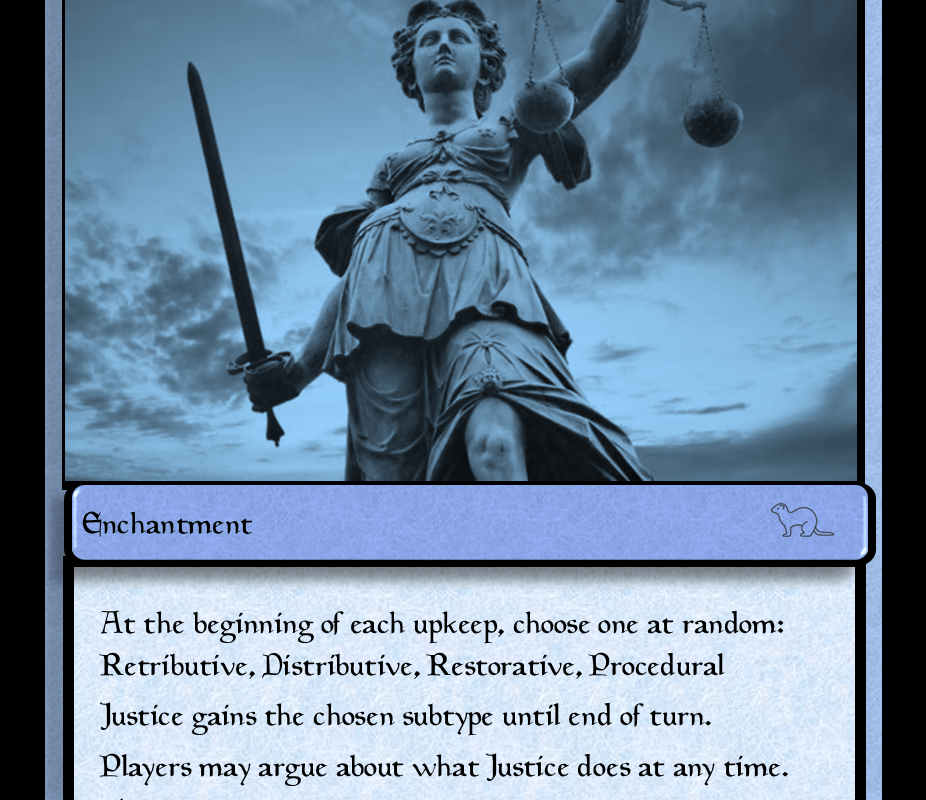
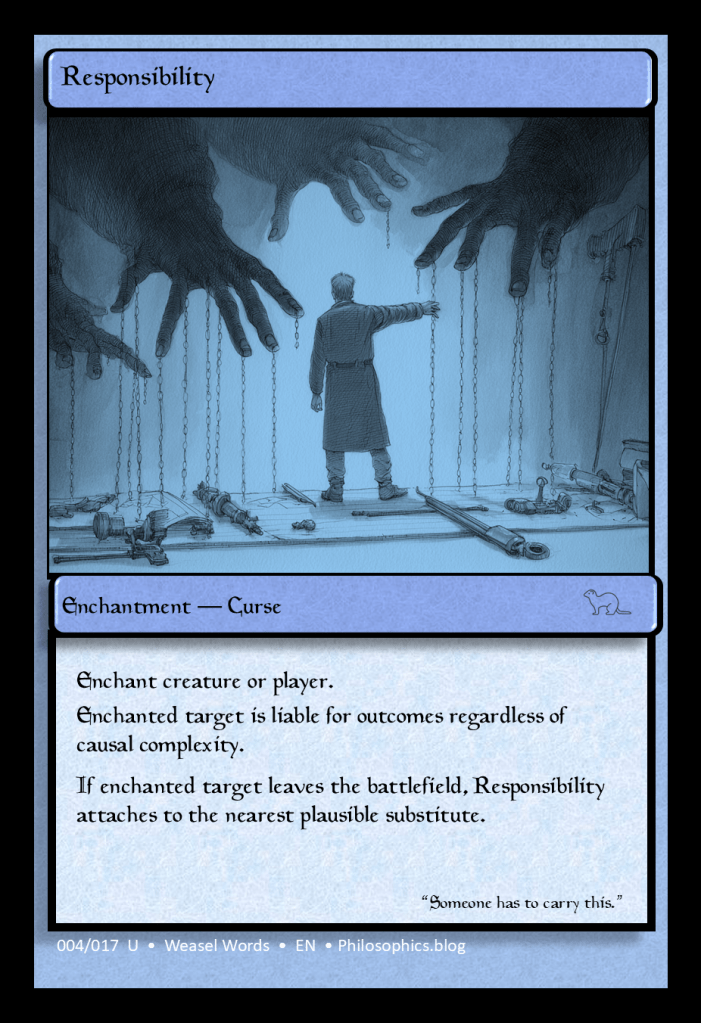
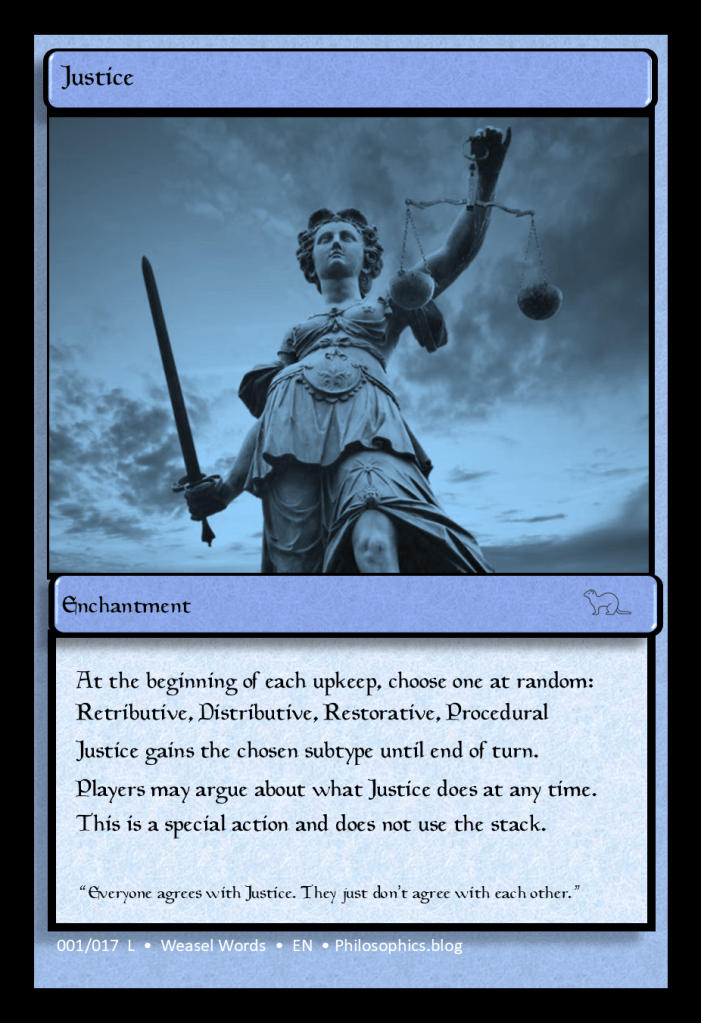
Let’s do some light demolition. I created a set of 17 Magic: The Gathering-themed cards to illustrate various concepts. Below are a few. A few more may appear over time.
Card One: Choice
Image: MTG: Choice – Enchantment
The argument begins innocently enough:
They chose to do it.
But “choice” here is not an empirical description. It’s a stipulation. It doesn’t mean “a decision occurred in a nervous system under constraints.” It means a metaphysically clean fork in the road. Free of coercion, history, wiring, luck, trauma, incentives, or context.
That kind of choice is not discovered. It is assumed.
Pointing out that choices are shaped, bounded, and path-dependent does not refine the term. It destabilises it. Because if choice isn’t clean, then something else must do the moral work.
Enter the next card.
Card Two: Agency
Image: MTG: Agency – Creature – Illusion
Agency is wheeled in to stabilise choice. We are reassured that humans are agents in a morally relevant sense, and therefore choice “counts”.
Counts for what, exactly, is rarely specified.
Under scrutiny, “agency” quietly oscillates between three incompatible roles:
a descriptive claim: humans initiate actions
a normative claim: humans may be blamed
a metaphysical claim: humans are the right kind of cause
These are not the same thing. Treating them as interchangeable is not philosophical rigour. It’s semantic laundering.
But agency is emotionally expensive to question, so the discussion moves on briskly.
Card Three: Responsibility
Image: MTG: Responsibility – Enchantment – Curse
Responsibility is where the emotional payload arrives.
To say someone is “responsible” sounds administrative, even boring. In practice, it’s a moral verdict wearing a clipboard.
Watch the slide:
causal responsibility
role responsibility
moral responsibility
legal responsibility
One word. Almost no shared criteria.
By the time punishment enters the picture, “responsibility” has quietly become something else entirely: the moral right to retaliate without guilt.
At which point someone will say the magic word.
Card Four: Desert
Image: MTG: Desert – Instant
Desert is the most mystical card in the deck.
Nothing observable changes when someone “deserves” punishment. No new facts appear. No mechanism activates. What happens instead is that a moral permission slip is issued.
Desert is not found in the world. It is declared.
And it only works if you already accept a very particular ontology:
robust agency
contra-causal choice
a universe in which moral bookkeeping makes sense
Remove any one of these and desert collapses into what it always was: a story we tell to make anger feel principled.
Which brings us, finally, to the banner term.
Card Five: Justice
Image: MTG: Justice – Enchantment
At this point, justice is invoked as if it were an independent standard hovering serenely above the wreckage.
It isn’t.
“Justice” here does not resolve disagreement. It names it.
Retributive justice and consequentialist justice are not rival policies. They are rival ontologies. One presumes moral balance sheets attached to persons. The other presumes systems, incentives, prevention, and harm minimisation.
Both use the word justice.
That is not convergence. That is polysemy with a body count.
Why clarification fails here
This is where LIH earns its keep.
With invariants, adding detail narrows meaning. With terms like justice, choice, responsibility, or desert, adding detail exposes incompatible background assumptions. The disagreement does not shrink. It bifurcates.
This is why calls to “focus on the facts” miss the point. Facts do not adjudicate between ontologies. They merely instantiate them. If agency itself is suspect, arguments for retribution do not fail empirically. They fail upstream. They become non sequiturs.
This is also why Marx remains unforgivable to some. “From each according to his ability, to each according to his need” isn’t a policy tweak. It presupposes a different moral universe. No amount of clarification will make it palatable to someone operating in a merit-desert ontology.
The uncomfortable conclusion
The problem is not that we use contested terms. We cannot avoid them.
The problem is assuming they behave like tables.
Retributive justice survives not because it is inevitable, but because its supporting terms are treated as settled when they are anything but. Each card looks sturdy in isolation. Together, they form a structure that only stands if you agree not to pull too hard.
LIH doesn’t tell you which ontology to adopt.
It tells you why the argument never ends.
And why, if someone insists the issue is “just semantic”, they’re either confused—or holding the deck.
My Language Insufficiency Hypothesis is finished, the cover is designed, and everything is in order for a January 2026 release – save for one administrative detail: the ISBN. I expect this to be resolved presently. The Bowker distribution system in the US appears to have been set up circa 1997, and that’s just the web interface. Who knows how long the database has been in place? I’d bet circa 1955. Most countries provide ISBNs for free. Not the US. Kinda bollox. Meantime, I’ve now got three lenses through which to inspect the world.
[EDIT: ISBN issue has been resolved. I am awaiting a proof copy that should be arriving today.]
From the outside, some of my recent work can look untidy. A hypothesis about language. An ontology about mediated encounters. A paper on why moral disagreement refuses to resolve itself politely. No master theory. No clean ladder. No promised synthesis at the end. This is not an accident. It is a refusal.
What links the Language Insufficiency Hypothesis (LIH), the Mediated Encounter Ontology of the World (MEOW), and Disagreement Without Referees is not a shared doctrine, but a shared function. They are lenses, not foundations. Diagnostics, not blueprints. Each takes aim at a different site where Enlightenment habits quietly overpromise – meaning, access, adjudication – and shows what breaks when we stop pretending those promises were ever cashable. They form a family. Not a system. And certainly not a programme for rebuilding.
Three Lenses, Three Failure Sites
Each of these frameworks operates at a different level, but they all do the same kind of work: they explain why something we rely on feels indispensable, fails repeatedly, and yet stubbornly survives.
LIH operates at the linguistic level.
It asks why language fails precisely where we expect it to secure clarity, precision, or consensus. Its answer is unromantic: language is not uniformly capable. As we move from invariants to contestables to fluids and ineffables, its representational power degrades. The failure mode is familiar: we mistake grammatical stability for ontological stability, and then act surprised when disagreement hardens rather than dissolves.
MEOW operates at the ontological level.
It asks what kind of ‘world’ we are actually dealing with once we abandon the fantasy of unmediated access. There is no clean mind–world interface, no privileged vantage point. Every encounter is mediated – biologically, cognitively, linguistically, socially. Realism and idealism alike fail here, each clinging to a different myth of access. What remains is not scepticism, but constraint.
Disagreement Without Referees operates at the normative and political level.
It asks why moral and political disagreement persists even when all parties appear informed, sincere, and articulate. The answer is ontological incommensurability. Where frameworks do not overlap, there are no neutral referees. Argument does not converge because it cannot. What remains is persuasion, coalition, power, and consequence—moral life without an umpire.
None of these lenses replaces what it critiques. Each refuses the repair instinct that says: if we just fix the model, the system will work again. That instinct is the pathology.
What They Share (And What They Don’t)
What unites these lenses is not a set of positive claims about how the world really is. It is a shared posture:
no privileged access
no neutral ground
no final adjudication
no redemptive synthesis
But also:
no quietism
no nihilism
no ‘anything goes’
no abdication of responsibility
They do not tell you what to believe. They tell you why believing harder won’t save you.
Importantly, they are non-hierarchical. LIH does not ground MEOW. MEOW does not explain away disagreement. Disagreement does not ‘apply’ LIH in some linear fashion. They intersect. They overlap. They illuminate different failure modes of the same inherited fantasy: that there must be a place where things finally settle. There isn’t.
Image: Three Diagnostic Lenses Infographic¹
Why This Is Not a System
Systems promise closure. These lenses do not. They explain why closure is repeatedly promised, urgently demanded, and reliably missed. To systematise them would be to betray them.
What they offer instead is a kind of intellectual hygiene: a way of recognising when we are asking language, reality, or morality to do work they were never capable of doing – and then blaming one another when they don’t comply.
If there is a unifying thread, it is this:the demand for foundations is itself the problem.² These lenses do not solve that problem. They show you where it operates, how it reproduces itself, and why refusing it feels so uncomfortable. That discomfort is the point.
Footnotes
This is another NotebookLM infographic – my second. It’s not half-bad. I had to adjust some elements in Photoshop and Illustrator, and there are still textual anomalies, but all in all, I’m impressed with what 60 seconds of generation yielded – along with a 5-minute prompt and 15 minutes of touchup. It’s just a novelty for now – certainly not necessary. What do you think?










 Philosophics