I discovered a WordPress widget and decided to share my reading progress, but it appears to show the last few books I’ve finished rather than my active list. Click on My Bookshelf to view more.
I read several books at once. I tend to read a fiction and several non-fiction books. The fiction books happens to be an audiobook, which I tend to listen to whilst I am working out: Carl’s Doomsday Scenario: Dungeon Crawler Carl (book 2). It’s more of a diversion – and entirely unserious, though I did find a quote on Understanding, my latest essay project still in progress.
I can’t really recommend a book to people because I don’t know their tastes and interests. As for the Dungeon Crawler series, if you like RPG gaming culture and lore, you may appreciate the humour of LitRPG. It’s stupid fun.
On the serious side, I’ve mainly been milking a few titles;
Being and Time, An Annotated Translation: Martin Heidegger
Against Progress is a short collections of essays that I tend to travel with and read an appointments and such. I’ve read almost half of them, but I’m still reading.
I’m very close to finishing Reasons and Persons. I’t not exactly a page turner, but it is engaging. It’s inspired several essays here, so I have to suggest that it’s worth the read, as long as it is.
I’ve read Being and Time before, but I wants to take a gander with this new translation and check out the annotations. Since I’ve already read it and have ideas about it, I am more critical of some of the early annotations than a fresh book, but this is also on a slow –when I have time – track.
Of course, one could argue that I would have time if I weren’t reading non-fiction, and one would be correct. However, the level of attention required differs significantly.
Yesterday, I complained about the psychoanalytic approach Fanon employed in Black Skin, White Masks, Chapter 4, The So-Called Dependency Complex of the Colonised. Today, I share my feelings about Chapter 5, The Lived Experience of the Black Man. But first, let’s reorient the reader to my own perspective.
I am decidedly anti-colonial and even anti-post-colonial, or at least I see this trajectory as tragic. All of this is consonant with the views expressed in my Anti-Enlightenment Project.
Audio: NotebookLM summary podcast of this topic.
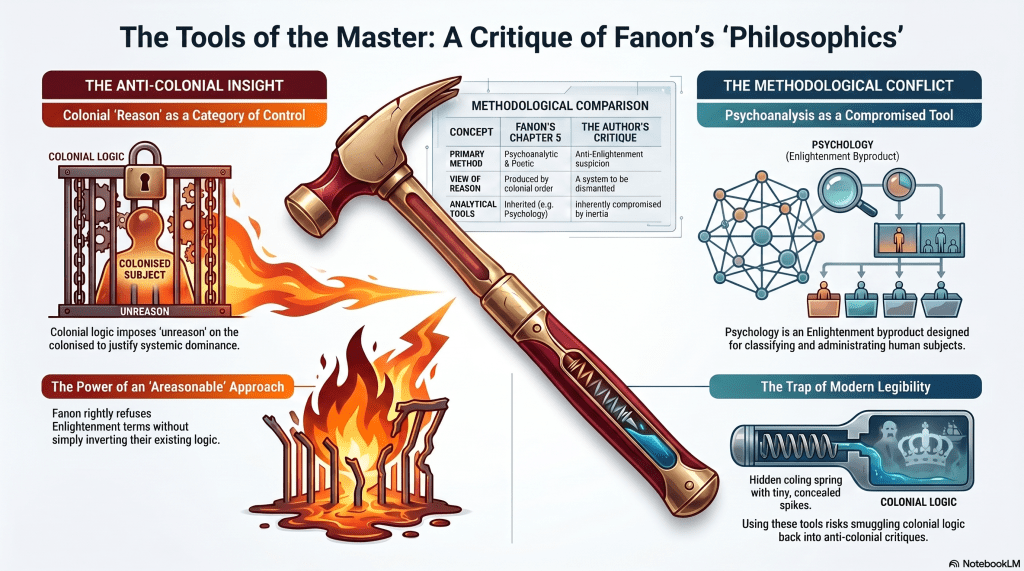
On one hand, I want to complain about the circuitous approach he took in Chapter 5. It was meant to be metaphorical and poetic. Whilst I feel it’s a bold move to present an areasonable approach – one that refuses the terms of Enlightenment rationality without simply inverting them – it seems that he cherry-picks his tools from the arsenal of Enlightenment thought. This applies to much of the post-colonial project broadly, though my objection there is less to any particular theoretical allegiance and more to the foundational commitments: I oppose colonialism, empire, and hegemony on grounds that precede the debate about which critical vocabulary best serves their dismantling.
Fanon’s anti-Enlightenment critique is weakened where he imports psychoanalysis too trustingly. Psychology and psychoanalysis are themselves Enlightenment byproducts: systems for rendering the human subject legible, classifiable, interpretable, and administrable. To use them against colonial Reason without first subjecting them to the same suspicion risks reproducing the very machinery under critique. The result isn’t fatal to Fanon’s charge, but it is methodologically untidy. I don’t necessarily object to using Enlightenment-derived tools after critique; I object to retaining them as though their own conceptual machinery were innocent. Psychoanalysis may be useful as metaphor, rhetoric, or historically situated vocabulary, but if it’s treated as a valid evidentiary lens without scrutiny, it smuggles Enlightenment legibility back into an anti-Enlightenment critique. That’s where Fanon’s chapter loses force for me.
NotebookLM Infographic on this topic.
Fanon is at his strongest when he shows that colonial ‘reason‘ produces the colonised subject as irrational, bodily, affective, and deficient. He rightly treats unreason not as a natural property of the colonised but as a category imposed by colonial order. My difficulty is that he then routes this insight through psychoanalysis, a method I regard as metaphorically suggestive but evidentially weak. The critique of colonial rationality survives; the psychoanalytic apparatus remains suspect.
In the end, we may both at least tacitly agree that colonialism, and the Enlightenment more generally, was not the best path. Where we part is on what should have been taken instead. Cue Robert Frost.
But the more searching question isn’t which fork we should have taken – it’s what we do with the road we’re already on. When the system itself is the problem, the question of what within it is worth retaining rarely gets answered on its merits. More often, it gets answered by inertia: by what is convenient, familiar, or already institutionally embedded. Fanon isn’t exempt from this, and neither, if we’re honest, is any thinker who inherits a tradition whilst attempting to dismantle it. The tools available are always already compromised. The most we can ask – and what distinguishes the sharper critiques from the merely passionate ones – is whether the thinker knows this, and accounts for it. Fanon sometimes does. In Chapter 5, at the moments that matter most, he doesn’t quite.
NB: I used ChatGPT for the cover image. I think it did a good job.
I just read Chapter 4 of Frantz Fanon’s Black Skin, White Masks, and it has similar problems I’ve also critiqued for Judith Butler’s Gender Trouble: Feminism and the Subversion of Identity and Simone de Beauvoir’s The Second Sex. In all three cases, I accept the primary argument. What I reject is psychology, especially psychoanalysis, as a legitimate form of scientific inquiry.
Audio: NotebookLM summary podcast of this topic.
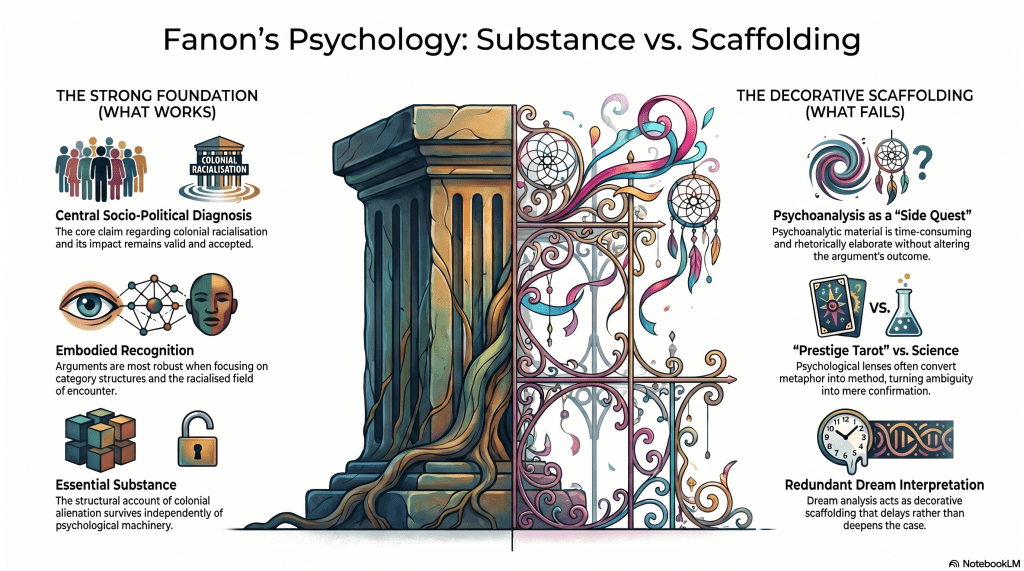
My issue isn’t that Fanon, Beauvoir, or Butler fail in their central diagnoses. I broadly accept their claims. My issue is that the psychoanalytic material typically functions like a grinding side quest: time-consuming, rhetorically elaborate, and only weakly connected to the main argumentative progression. It may enrich the atmosphere, but it doesn’t materially alter the outcome. Once one doesn’t accept psychoanalytical psychobabble as a valid evidentiary lens, the material becomes a time sink. Not only can’t I get my time back, but I also expend even more time here, railing on.
Speaking of distraction: evidently, WordPress has added a new blog-to-podcast feature, so I tried it out here. Whatevs.
Fanon’s central claim about colonial racialisation doesn’t require dream interpretation – the dreams themselves are seemingly apocryphal at the start. The stronger route is through embodied recognition, imposed category structures, conceptual nomenclature, and the racialised field of encounter. The dream material reads as psychoanalytic side-content: thematically adjacent, occasionally vivid, but methodologically low-yield. It doesn’t deepen the case so much as delay it. The entire time, I am thinking to myself, ‘Where is he going with all this?’ and ‘Are we there yet?’ only to get dropped off just where I had started – a round trip to nowhere.
But Fanon’s mistake isn’t necessarily insincerity. It’s an over-trust in a psychological lens that converts metaphor into method. The psychoanalytic examples may have seemed to him like evidence; to a reader sceptical of psychoanalysis, as I am, they register as rhetorical illustrations. Once a reader withholds confidence in this method, the chapter’s supporting material becomes distracting rather than strengthening.
Enfin, psychoanalysis too often behaves like a prestige tarot deck for the academically credentialled: it turns ambiguity into confirmation, opacity into symbolism, and resistance into further evidence. Fanon’s broader account of colonial alienation survives because it doesn’t depend on this machinery. The dreams aren’t necessary to the argument; they’re decorative scaffolding around a structure that’s stronger without them.
I just finished reading Feyerabend’s Against Method – rather, I just finished the back matter, as I finished the core of the book some time ago. I debated reading this part of the book, and sorry, but I often don’t – despite writing back matter for some of my own academic publications. I treat them as asides.
I’m glad I read this material because, aside from the endnotes, it was meta and biographical, so the perspective was nice. In fact, it got me thinking. He talks about his struggle with Relativism™. I used to struggle with the same thing; there seemed to be a false battle between objectivists and relativists or subjectivists, but in my mind these were always straw-man caricatures nobody seriously defended, yet somehow people were vocal about avoiding. I’ve written extensively about my own position on mediation, so I won’t info dump here.
Audio: NotebookLM summary podcast of this topic.
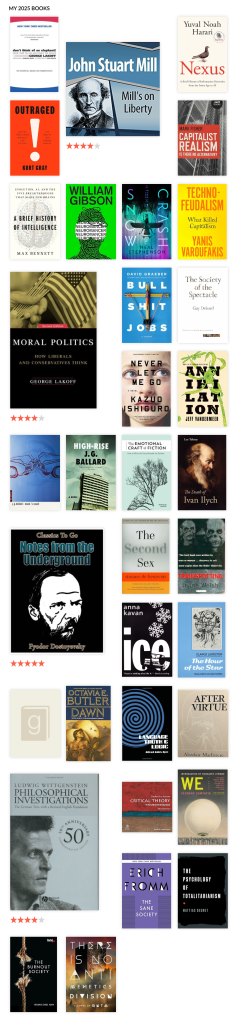
As people familiar with my habits, I tend to read several books in parallel. In fact, you can review what I am reading on Goodreads.
To be fair, I don’t tend to close-read fiction books very often. I find it to be slow and cumbersome. For non-fiction, this is the default, but not generally for fiction. But, since French is a second language, my attention needs to be focused. I don’t feel that I can read casually and catch the sort of embedded grammatologie that I can absorb through osmosis in English-language books.
Why slow read then? I have a desire to maintain and advance my French, so I think that reading contemporary books connects me to current language trends, terms, phraseology, and metaphor. I am using Claude and ChatGPT to assist with the close reading. They’ve already helped me to better understand the opening paragraphs. It opens like this:
Let’s discuss this, word choices, and any implications. This is the first paragraph of the first chapter:
Debout sur la berge, Anthony regardait droit devant lui. À l’aplomb du soleil, les eaux du lac avaient des lourdeurs de pétrole. Par instants, ce velours se froissait au passage d’une carpe ou d’un brochet. Le garçon renifla. L’air était chargé de cette même odeur de vase, de terre plombée de chaleur. Dans son dos déjà large, juillet avait semé des taches de rousseur. Il ne portait rien à part un vieux short de foot et une paire de fausses Ray-Ban. Il faisait une chaleur à crever, mais ça n’expliquait pas tout.
This scene starts to set the tone of the narrative from the onset – lentement, insouciant. It’s midsummer. The heat is overbearing – stifling. It tracks the life of our antagonist, Anthony, a 14-year-old in between grades, in fact, getting ready to enter Year 10 or high school, ninth grade. But not yet. We haven’t reached this paragraph quite yet.
Besides the heat references, we see emergences of weight, falling. Again, loading up on metaphors. Anthony doesn’t have an easy life. Many don’t at these junctures.
He, himself, is at that awkward adolescent stage, where his body is outgrowing his childhood, whilst his mind is trying desperately to keep up.
A challenge I have with French is that I know dogs, cats, trees, and fish, but I don’t know the types of these. Here, we see the word « un brochet ». It’s a pike fish. Honestly, I don’t even know what a pike looks like, though I am familiar with the English term.
Image: Pike. (Not to be confused with a pickerel, which is evidently a related but smaller fish I had also never seen.)Credit
Another language challenge is polysemous terms – in this case, « vase ». As I am reading, I am trying to imagine the smell of a vase, all the while recalling that vases don’t exactly have a distinct scent. It turns out that vase also translates to mud or silt. quite the difference.
Since I started, I might as well continue exploring this paragraph: Anthony is wearing fake Ray-Bans. This is an insight into class and station.
As for register, Mathieu mentions these things matter-of-factly without judgement. Later on, we’ll notice differences, but these are narrational and through the eyes of Anthony, as he compares himself with his environment. Class projections might be imported by the reader. I won’t invoke Barthes here.
The final sentence leaves us hanging. It reminds us again that this July is hot, but somehow it doesn’t explain everything, likely, about Anthony.
2025 has been a good year for this blog. I’ve crossed the 1,000-post mark, and this year it has had over 30,000 page views – best year ever. This month was the best month ever, and 1st December was the most popular day ever. That’s a lot of ‘evers’.
I shared the remainder of this post on my Ridley Park fiction blog – same reader, same books, same opinion. Any new content added below is in red.
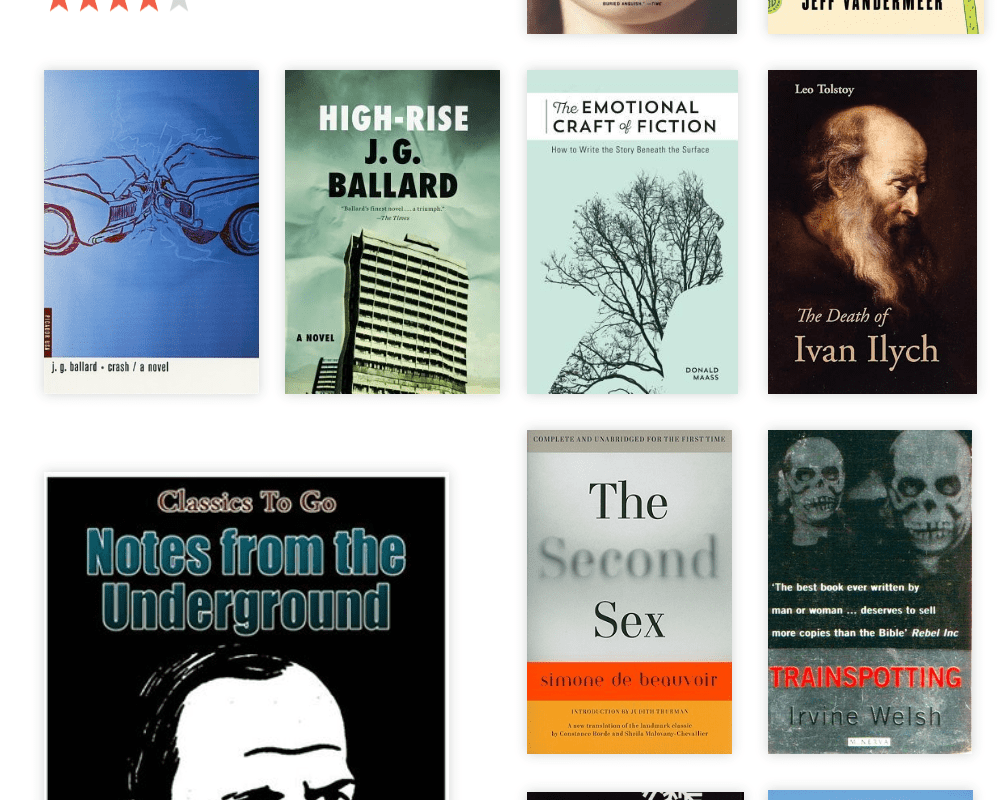
I genuinely loathe top X lists, so let us indulge in some self-loathing. I finished these books in 2026. As you can see, they cross genres, consist of fiction and non-fiction, and don’t even share temporal space. I admit that I’m a diverse reader and, ostensibly, writer. Instead of just the top 5. I’ll shoot for the top and bottom 5 to capture my anti-recommendations. Within categories are alphabetical.
Fiction
Never Let Me Go by Kazuo Ishiguro – A slow reveal about identity, but worth the wait.
This was very philosophical and psychological. Nothing appeared to happen until chapter 7, as I recall. I felt like I was just eavesdropping on some school chums, which I was. Then came the big reveal.
Notes from Underground by Fyodor Dostoevsky – Classic unreliable narrator.
Again, philosophical, psychological. I liked it.
There Is No Antimemetics Division by QNTM (AKA Sam Hughes) – Points for daring to be different and hitting the landing.
This, I read because I was attracted to the premise of memory as it might affect language. It touched on this a tad, but it was mostly about memory, anti-memory, and constructed selves. How can one experience a contiguous, diachronic self with memory gaps? It never quite got that deep, that on occasion it did, as far as I recall.
Trainspotting by Irvine Welsh – Scottish drugs culture and bonding mates narrative.
This is an age-old cult classic – much better than the already excellent films. Fills in what the film cut for its medium. I read several other Welsh books. Filth was an honourable mention, which I also made connexions to Antimemetics, above.
We by Yevgeny Zamyatin – In the league of 1984 and Brave New World, but without the acclaim.
This flagged a tad at the end, but it was prescient and released in 1922, decades before 1984 and Brave New World. Worth the read.
Nonfiction
Capitalist Realism by Mark Fisher – Explains why most problems are social, not personal or psychological. Follows Erich Fromm’s Sane Society, which I also read in 2025 and liked, but it fell into the ‘lost the trail’ territory at some point, so it fell off the list.
Moral Politics by George Lakoff
Evidently, I forgot to explain myself in my prior post. I refer to this book and its trade counterpart, Don’t Think of an Elephant, which is more of a political polemic, but still worth the read. It’s also shorter. This is about Moral politics – duh! – but it’s about moral language. It was a precursor to Jonathan Haidt’s The Righteous Mind: Why Good People Are Divided by Politics and Religion or Kurt Gray’s Outraged! I found Haidt’s work interesting but reductive; I found Gray’s work merely reductive.
This said, Lakoff and Haidt were the vector through which I came upon my language ontology theory that further confounds language insufficiency. To be sure, Haidt was an unnecessary point, but it did emphasise it. Haidt’s frameworks also give me something to riff on.
Technofeudalism by Yanis Varoufakis – Explains why Capitalism is already dead on arrival.
Nothing much to add here. Technofeudalism is economic fare, albeit with philosophical implications. I enjoyed it. Yanis is also an interesting speaker.
NB: Some of the other books had great pieces of content, but failed as books. They may have been better as essays or blog posts. They didn’t have enough material for a full book. The Second Sex had enough for a book, but then Beauvoir poured in enough for two books. She should have quit whilst she was ahead.
Image: Books I read in 2025 on Goodreads. Full disclosure: I don’t always record my reading on Goodreads, but I try.
Bottom of the Barrel
Crash by J.G. Ballard – Hard no. I also didn’t like High-rise, but it was marginally better, and I didn’t want to count an author twice.
Nah. I felt he was trying to hard for shock value. It didn’t shock, but it put me off. At least High-rise represented an absurd cultural microcosm. I just wanted the story to be over. Luckily, I read both of these sequentially whilst on holiday, so I wasn’t looking to ingest anything serious.
Neuromancer by William Gibson – I don’t tend to like SciFi. This is a classic. Maybe it read differently back in the day. Didn’t age well.
Nexus by Yuval Harari – Drivel. My mates goaded me into reading this. I liked Sapiens. He’s gone downhill since then. He’s a historian, not a futurist.
Outraged! by Kurt Gray – Very reductionist view of moral harm, following the footsteps of George Lakoff and Jonathan Haidt.
See comments above. ☝️
Society of the Spectacle by Guy Debord – A cautionary tale on why writing a book on LSD may not be a recipe for success.
Honourable Mention
Annihilation by Jeff VanderMeer was also good, but my cutoff was at 5. Sorry, Jeff.
I did like this, and it was much better than the Natalie Portman film adaptation. This is the first book in a trilogy. I absolutely hated the second instalment. The third was not as good as the first, but it tried to get back on track from the derailment of the second. As I wrote in public reviews, the second book could have been a prologue chapter to the third book with all of the relevant information I cared about. You could skip the second story with almost no material effect on the story or character arcs.
My colleague of several decades recently published a book titled Why Democrats Are Dangerous. Drew and I have long held opposing but genuinely respectful views on the political economy, a fact that once felt like a quaint relic of an earlier civic age. As we are both authors, he proposed that we exchange titles and review each other’s work. I demurred. One can often discern the contents of a book from its cover, and this one announced itself with all the subtlety of a campaign leaflet left in the rain. I am not allergic to polemic – heaven knows I have written my share – but some energies telegraph their intentions too cleanly. This one did.
Having now read the book, my hesitation appears justified. The project is less an argument than a catechism, less analysis than incantation. It is earnest, certainly; it is also tightly scripted by a worldview that permits only one conclusion, however much data must be dragged across broken glass to reach it.
Audio: NotebookLM summary podcast on this topic.
Rather than provide a review in the conventional sense – line-by-line rebuttal, forensic counter-examples, polite throat-clearing – I have chosen a different approach. I intend to reconstruct, or more precisely dis-integrate, the book through several strands of my own work. Not because my work is above reproach, but because it offers a conceptual toolkit for understanding how such texts arise, how they persuade, and how they hold themselves together despite their internal tension. This also has the ancillary benefit of allowing me to abridge my commentary: where a full exegesis would sprawl, I can gesture toward an existing essay or argument. I’ll dispense with addressing Drew by name, preferring to remain more neutral going forward.
A Note on My Position (So No One Misreads My Motives)
Before proceeding, a brief clarification. I do not belong to either of America’s warring political tribes, nor do I subscribe to their underlying ideological architectures. My critique is not an act of partisan reprisal; it is not a defence of Democrats, nor a veiled endorsement of Republicans. The Red–Blue cosmology bores me senseless. It is a quarrel between two anachronistic Enlightenment-era faith traditions, each convinced of its moral superiority and each engaged in the same ritualised dance of blame, projection, and existential theatre.
My vantage point, such as it is, sits outside that binary. This affords me a certain privilege – not superiority, merely distance. I do not have a factional identity to defend, no emotional investment in preserving the moral innocence of one side or the other. I am therefore free to examine the structure of my colleague’s argument without the usual tribal pressures to retaliate in kind.
This criticism is not a counter-polemic. It is an analysis of a worldview, not a combatant in its quarrel. If my tone occasionally cuts, it cuts from the outside, not across partisan lines. The book is not wrong because it is Republican; it is wrong because its epistemology is brittle, its categories incoherent, and its confidence unearned. The same critique would apply – indeed does apply – to the Democratic mirrors of this worldview.
My loyalty is not to a party but to a method: Dis-Integration, analysis, and the slow, patient unravelling of certainty.
The Architecture of Certainty
What strikes one first in Why Democrats Are Dangerous is not the argument but the architecture – an edifice built on the most cherished Enlightenment fantasy of all: that one’s own position is not a perspective but the Truth. Everything else cascades from this initial presumption. Once a worldview grants itself the status of a natural law, dissent becomes pathology, disagreement becomes malice, and the opposition becomes a civilisation-threatening contagion.
My colleague’s book is a textbook case of this structure. It is not an analysis of political actors within a shared world; it is a morality play in which one faction is composed entirely of vices, and the other entirely of virtues. The Democrats are ‘Ignorant, Unrealistic, Deceitful, Ruthless, Unaccountable, Strategic‘, a hexagon of sin so geometrically perfect it would make Aquinas blush. Republicans, by contrast, drift serenely through the text untouched by human flaw, except insofar as they suffer nobly under the weight of their opponents’ manipulations.
This is not political argumentation. This is cosmogony.
This, of course, is where my Anti-Enlightenment work becomes diagnostic. The Enlightenment promised universality and rational clarity, yet modern political identities behave more like hermetic cults, generating self-sealing narratives immune to external correction. A worldview built upon presumed objectivity must resolve any contradiction by externalising it onto the Other. Thus, the opposition becomes omnipotent when things go wrong (‘They control the media, the schools, the scientists, the public imagination‘) and simultaneously infantile when the narrative requires ridicule.
It is the oldest structural paradox in the political mind: the Other is both incompetent and dangerously powerful. This book embodies that paradox without blinking.
The Invention of the Enemy
One must admire, in a bleak sort of way, the structural efficiency of designating half the electorate as a monolithic existential threat. It creates an elegant moral shortcut: no need to consider policies, contexts, or material conditions when the adversary is already pre-condemned as treacherous by nature. Cicero, Trotsky, Hitler, and Franklin are all conscripted in this text to warn us about the insidious Democrats lurking in the marrow of the Republic. (Trotsky, one suspects, would be moderately surprised to find himself enlisted in a Republican devotional.)
This enemy-construction is not unique to this author. It is the rhetorical engine of American factionalism, and it is recursive: each side claims the other is rewriting history, weaponising institutions, manipulating education, promoting propaganda, dismantling norms, silencing dissent, and indoctrinating children. Both factions accuse the other of abandoning civility whilst abandoning civility in the act of accusation.
To put it bluntly: every single charge in this book is mirrored in Republican behaviour, sometimes identically, often more flamboyantly. But this symmetry is invisible from inside a moralised epistemology. Identity precedes evidence, so evidence is always retrofitted to identity.
This is why the polemic feels airtight: it evaluates Democrats not as agents within a system but as an essence. There is no theory of politics here – only demonology.
The Recursive Machine: When a Worldview Becomes Its Own Evidence
One of the most revealing features of Why Democrats Are Dangerous is its recursive structure. It operates exactly like the political systems it condemns: it constructs a closed epistemic loop, then mistakes that loop for a window onto reality.
The book does not discover Democratic perfidy; it presupposes it. Every subsequent claim merely elaborates upon the initial axiom. Schools, entertainment, academia, immigration, science, journalism, unions, and the weather – each is absorbed into a single explanatory schema. Once the premise is fixed (‘Democrats are dangerous‘), the world obligingly reshapes itself to confirm the conclusion, as long as one ignores anything that does not.
This is the dynamic I describe as the ‘Republic of Recursive Prophecy‘: someone begins with The Answer, and reality is forced to comply. If the facts fail to align, the facts are treacherous. If evidence contradicts the narrative, then evidence has been corrupted.
It is a worldview that behaves not like political analysis but like physics in a collapsing star: everything, no matter how diffuse, is pulled into the gravity well of a single, preordained truth.
The Projection Engine
If the book has a leitmotif, it is projection – unconscious, unexamined, and relentless. It is astonishing how thoroughly the author attributes to Democrats every pathology that characterises contemporary Republican strategy.
Propagandistic messaging; emotional manipulation; selective framing; redefinition of language; strategic use of fear; demonisation of opponents; declaring media sources illegitimate; claiming institutional persecution; insisting the other party rigs elections; portraying one’s own supporters as the ‘real victims’ of history – each of these is performed daily in Republican media ecosystems with operatic flourish. Yet the book can only see these behaviours ‘over there’, because its epistemic frame cannot accommodate the possibility that political identity – its own included – is capable of self-interest, distortion, or error.
This is the Enlightenment inheritance at its worst: the belief that one’s own faction merely ‘perceives the truth’, whilst the other faction ‘manufactures narratives’. What the author calls ‘truth’ is simply the preferred filter for sorting complexity into moral certainty. Once the filter is treated as reality itself, all behaviour from one’s own side becomes necessity, principle, or justice – whilst identical behaviour from the opposing faction becomes malevolence.
The Neutral Observer Who Isn’t
What the book never acknowledges – because it cannot – is that it speaks from a position, not from an Archimedean vantage point. The author stands in a thickly mediated environment of conservative talk radio, Republican think-tank literature, right-leaning commentary, and decades of ideological reinforcement. His acknowledgements read less like a bibliography than like an apprenticeship in a particular canon.
This does not make him wrong by default. It simply means he is positioned. And politics is always positional.
The Enlightenment fiction of the ‘view from nowhere‘ collapses once one notices that claims of objectivity always align with the claimant’s own tribe. If Republicans declare their view neutral and Democrats ideological, it is never because a metaphysical referee has blown a whistle confirming the call. It is because each faction treats its own frames as unmediated reality.
In truth, the book reveals far more about the epistemology of modern conservatism than about Democrats themselves.
The Fictional Symmetry Problem
One of the major deficiencies in the book – and in most modern political commentary – is the inability to perceive symmetry. The behaviours the author attributes exclusively to Democrats are, in every meaningful sense, bipartisan human defaults. Both factions manipulate language; curate narratives; cherry-pick evidence; denounce the other’s missteps as civilisational sabotage; outsource blame; elevate victimhood when convenient; and perform certainty whilst drowning in uncertainty.
The book pretends these behaviours describe a pathological left-wing mind, rather than the political mind as such.
This is not a Democratic problem; it is a deeply human one. But Enlightenment-styled partisan thinking requires the illusion of asymmetry. Without it, the argument collapses instantly. If Republicans admit that they exhibit the same cognitive patterns they condemn in Democrats, the entire dramatic arc falls flat. The villain must be uniquely wicked. The hero must be uniquely virtuous. The stage requires a clean antagonism, or the story becomes unstageable.
Narrative Weaponry
Perhaps the most revealing feature of this book is its reliance on anecdotes as foundational evidence. One school incident here, one speech clip there, one news headline in passing – and suddenly these isolated fragments become proof of a sweeping, coordinated ideological conspiracy across all levels of society.
We no longer use stories to illustrate positions; we use them to manufacture reality. One viral video becomes a trend; one rogue teacher, an educational takeover; one questionable policy rollout, the death of democracy.
Stories become ontological weapons: they shape what exists simply by being repeated with enough moral pressure. Political tribes treat them as talismans, small narrative objects with outsized metaphysical weight.
MEOW (the Mediated Encounter Ontology of the World) was designed in part to resist this temptation. It reminds us that events are not symptoms of a singular will but the turbulent output of innumerable interacting mediations. The worldview on display in this book requires villains, where a relational ontology recognises only networks.
The Missing Category: Structural Analysis
Perhaps the most conspicuous absence in the book is any substantive socio-economic analysis. Everything is attributed to malice, not structure. Democratic failures become signs of moral rot, never the predictable outcome of late-stage capitalism, globalisation’s uneven effects, austerity cycles, demographic shifts, institutional brittleness, bureaucratic inertia, political economy incentives, or the informational fragmentation of the digital age.
None of these appear anywhere in the text. Not once.
Because the book is not analysing policy; it’s diagnosing sin. It treats political outcomes as evidence of coordinated malevolence, never as the emergent result of complex systems that no faction fully understands, let alone controls.
This is where Dis-Integration is useful: the world does not malfunction because some cabal introduced impurity; it malfunctions because it was never integrated in the first place. My colleague is still hunting for the traitor inside the castle. The more sobering truth is that the castle is an architectural hallucination.
Where He Is Not Wrong
Lest this devolve into pure vivisection, it is worth acknowledging that my colleague does brush against legitimate concerns. There are structural issues in American education. There are ideological currents in universities, some of which drift into intellectual monoculture. There are media ecosystems that reinforce themselves through feedback loops. There are public-health missteps that deserve scrutiny. There are institutional actors who prefer narratives to nuance.
But these are not partisan phenomena; they are structural ones. They are not symptoms of Democratic corruption; they are symptoms of the modern polity. When the author grasps these truths, he does so only long enough to weaponise them – not to understand them.
The Danger of Certainty
What lingers after reading Why Democrats Are Dangerous is not outrage – though one suspects that was the intended emotional temperature – but a kind of intellectual melancholy. The book is not the product of a malevolent mind; it is the product of a sealed one. A worldview so thoroughly fortified by decades of ideological reinforcement that no countervailing fact, no structural nuance, no complexity of human motivation can penetrate its perimeter.
The author believes he is diagnosing a civilisation in decline; what he has actually documented is the failure of a particular Enlightenment inheritance: the belief that one’s own view is unmediated, unfiltered, unshaped by social, linguistic, and cognitive forces. The belief that Reason – capital R – is a neutral instrument one simply points at the world, like a laser level, to determine what is ‘really happening’.
The Enlightenment imagined that clarity was accessible, that moral alignment was obvious, that rational actors behaved rationally, that categories reflected reality, and that the world could be divided into the virtuous and the dissolute. This book is the direct descendant of that fantasy.
It takes an entire half of the population and casts them as an essence. It arranges anecdotes into inevitability. It pathologises disagreement. It treats institutions as coherent conspiratorial actors. It transforms political opponents into ontological threats. And it performs all of this with the serene confidence of someone who believes he is simply ‘telling it like it is’.
The irony is almost tender.
Because the danger here is not Democrats. Nor Republicans. Nor necessarily even the political class as a whole. The real danger is certainty without introspection: the comfort of moral binaries; the seduction of explanatory simplicity; the refusal to acknowledge one’s own mediation; the urge to reduce a complex, multi-layered, semi-chaotic polity into a single morality narrative.
My friend did not discover the truth about Democrats. He discovered the architecture of his own worldview – and mistook the one for the other.
If we must be afraid of something, let it be worldviews that cannot see themselves.
Read next:The Republic of Recursive Prophecy – an earlier piece that charts how political worldviews become self-reinforcing myth-machines.
I finished Mattias Desmet’s The Psychology of Totalitarianism, which I mentioned the other day. Unfortunately, my initial optimism was premature. Everything I enjoyed was front-loaded: the first four chapters set up a promising critique of mechanistic rationality and the collapse of shared meaning. Then the book turned into a long, therapeutic sermon. I should have stopped at Chapter 4 and saved myself the sunk-cost regret.
It isn’t that nothing follows; it’s just that what follows is so thin that the cost-benefit ratio goes negative. Once Desmet moves from diagnosis to prescription, the argument collapses into a psychologist’s worldview: an entire civilisation explained through mass neurosis and healed through better intuition. He builds his case on straw versions of reason, science, and modernity, so his ‘cure’ can look revelatory.
The trouble is familiar. Having dismantled rationalism, Desmet then installs intuition as its replacement – an epistemic monarchy by another name. His appeal to empathy and connection reads less like philosophy and more like professional self-promotion. The therapist can’t stop therapising; he privileges the psychological lens over every other possibility.
The result is a reductionist parascience dressed as social theory. The totalitarian mind, in Desmet’s telling, isn’t political or structural but psychological – a patient waiting for insight. I don’t doubt his sincerity, only his scope. It’s what happens when a discipline mistakes its vocabulary for the world.
Desmet’s project ultimately re-enchants what it claims to critique. He wants rationalism redeemed through feeling, order reborn through connection. Dis-Integrationism stops short of that impulse. It accepts fracture as the permanent condition – no higher synthesis, no therapeutic finale. Where Desmet sees totalitarianism as a collective pathology awaiting treatment, I see it as reason’s own reflection in the mirror: a system trying to cure itself of the only disease it knows, the need to be whole.
The core of this book consists of six “books” of aphorisms, each book comprising a single page, totalling 24 in all.
Why only 24 pages?
Couldn’t this have been a blog post? An email?
Fair enough, and yes, of course it could have. It could have been six – three sheets, front and back – but I wanted to share in the tradition of the Communist Manifesto by Karl Marx and Friedrich Engels, as well as Thomas Paine’s Common Sense. The content is not similar, but the format is shared.
Honestly, I printed a draft copy for myself on A4 paper, folded it to A5, and stapled it at the spine with a long stapler – sans a fancy cover. Perhaps, I’ll share the source PDF in future.
As I’ve written elsewhere, I was inspired by the aphorisms of Nietzsche, Schopenhauer, Pascale, Debord, and others. To be fair, I disliked Debord’s The Society of the Spectacle, but I was still inspired by it for the two or three things I got from it – each of which slips my mind as I write this.
Why a Companion Guide?
Twenty-four pages – really, only six that matter; why would someone want that?
You got me there, too. No, so Notes Before Existence is not a casual read. It’s logical and coherent, but it’s not standard exposition. It’s meant as a thinking tool. Also, the ideas are supported by those who came before me – Newton’s ‘standing on the shoulders of giants’ quip pertains.
The main body of the book comprises the same six books as Notes Before Existence, each printed on its own verso, opposite a recto page for personal annotation.
Whilst Meditations on Nothing: A Critical Companion does provide supporting context for Notes Before Existence, it doesn’t fully break it down. I expect to provide this context in a more comprehensive volume, both online and offline, primarily on this platform and on YouTube.
I Wonder what’s Next?
I’m putting the final touches on my next project. The Illusion of Light: Thinking after the Enlightenment is a sort of capstone to my Anti-Enlightenment Project. It provides context around this project as well as details about the underlying essays available on Zenodo at no cost.
And so it goes…
What I really came here for is to share the reason this book was hung up in queue. On the surface, everything checked. I uploaded the source files, entered the required metadata, and chose appropriate price points – which, for the record, is $4.99 USD for Notes*.
Other Prices as of 16/10/25
UK: £3.99
EU: €4.99 (except Belgium, €4.39)
Canada: $6.99 (CAD)
Australia: $10.99
Japan: ¥1000
As it turns out, this publishing business is data-driven, and some of the systems and validation rules, let’s say, are remnants of the 1970s. Some companies are better than others, but in the US, Bowker controls the ISBN numbers. The US is one – if not the only – of the countries to charge for these identifiers, because: Capitalism. Unfortunately, the printers need to access Bowker’s antiquated system to validate the pairing of the ISBN and the publishing organisation.
I publish under Microglyphics, an entity through which I published my first book in 2001. In 2025, I started using Philosophics Press as an imprint for philosophy materials. This created a snag. I had entered Philosophics Press, but it was expecting Microglyphics – even though I’d used Philosophics Press previously. Unfortunately, the error was not thrown on the page where this information had been entered and validated – that was passed – but on the last page, I was informed that something was wrong on that page.
In any case, after a couple of days of trying, I updated the Bowker record (just to be sure) and eventually entered Microglyphics. Voilà. It worked.
Since then, I’ve also secured a second printer and distributor, IngramSpark, so I’m interested to discover what they’re like.
I’ve been working through the opening chapters of Octavia Butler’s Dawn. At one point, the alien Jdahya tells Lilith, “We watched you commit mass suicide.”*
The line unsettles not because of the apocalypse itself, but because of what it presumes: that “humanity” acted as one, as if billions of disparate lives could be collapsed into a single decision. A few pulled triggers, a few applauded, some resisted despite the odds, and most simply endured. From the alien vantage, nuance vanishes. A species is judged by its outcome, not by the uneven distribution of responsibility that produced it.
This is hardly foreign to us. Nationalism thrives on the same flattening. We won the war. We lost the match. A handful act; the many claim the glory or swallow the shame by association. Sartre takes it further with his “no excuses” dictum, even to do nothing is to choose. Howard Zinn’s “You can’t remain neutral on a moving train” makes the same move, cloaked in the borrowed authority of physics. Yet relativity undermines it: on the train, you are still; on the ground, you are moving. Whether neutrality is possible depends entirely on your frame of reference.
What all these formulations share is a kind of metaphysical inflation. “Agency” is treated as a universal essence, something evenly spread across the human condition. But in practice, it is anything but. Most people are not shaping history; they are being dragged along by it.
One might sketch the orientations toward the collective “apple cart” like this:
Tippers with a vision: the revolutionaries, ideologues, or would-be prophets who claim to know how the cart should be overturned.
Sycophants: clinging to the side, riding the momentum of others’ power, hoping for crumbs.
Egoists: indifferent to the cart’s fate, focused on personal comfort, advantage, or escape.
Stabilisers: most people, clinging to the cart as it wobbles, preferring continuity to upheaval.
Survivors: those who endure, waiting out storms, not out of “agency” but necessity.
The Stabilisers and Survivors blur into the same crowd, the former still half-convinced their vote between arsenic and cyanide matters, the latter no longer believing the story at all. They resemble Seligman’s shocked dogs, conditioned to sit through pain because movement feels futile.
And so “humanity” never truly acts as one. Agency is uneven, fragile, and often absent. Yet whether in Sartre’s philosophy, Zinn’s slogans, or Jdahya’s extraterrestrial indictment, the temptation is always to collapse plurality into a single will; you chose this, all of you. It is neat, rhetorically satisfying, and yet wrong.
Perhaps Butler’s aliens, clinical in their judgment, are simply holding up a mirror to the fictions we already tell about ourselves.
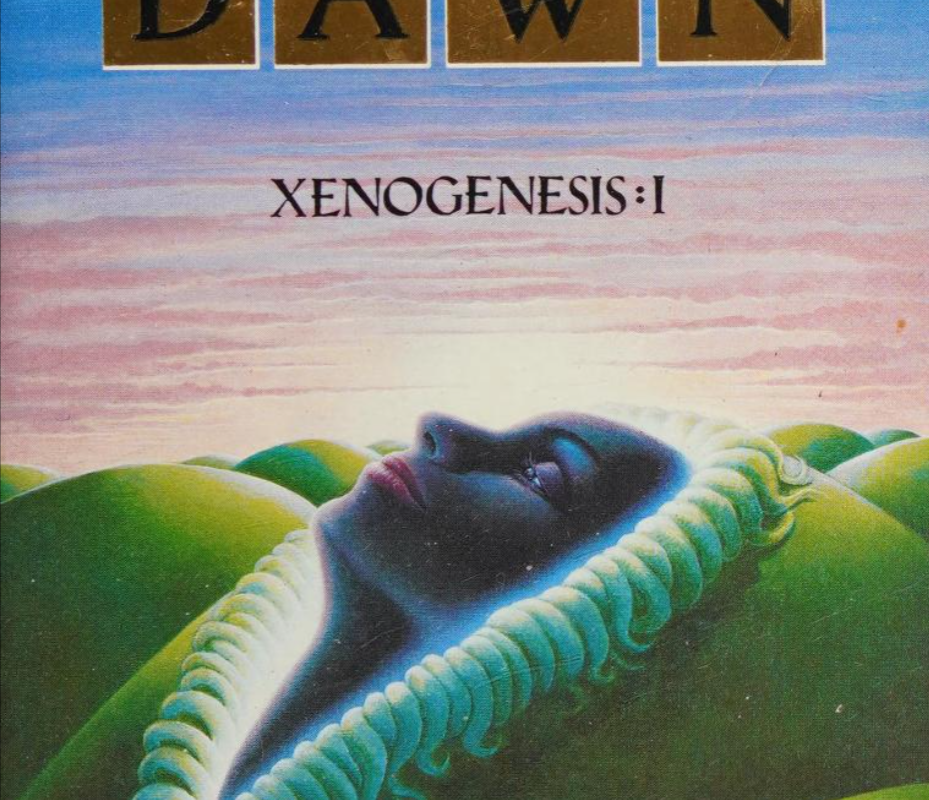
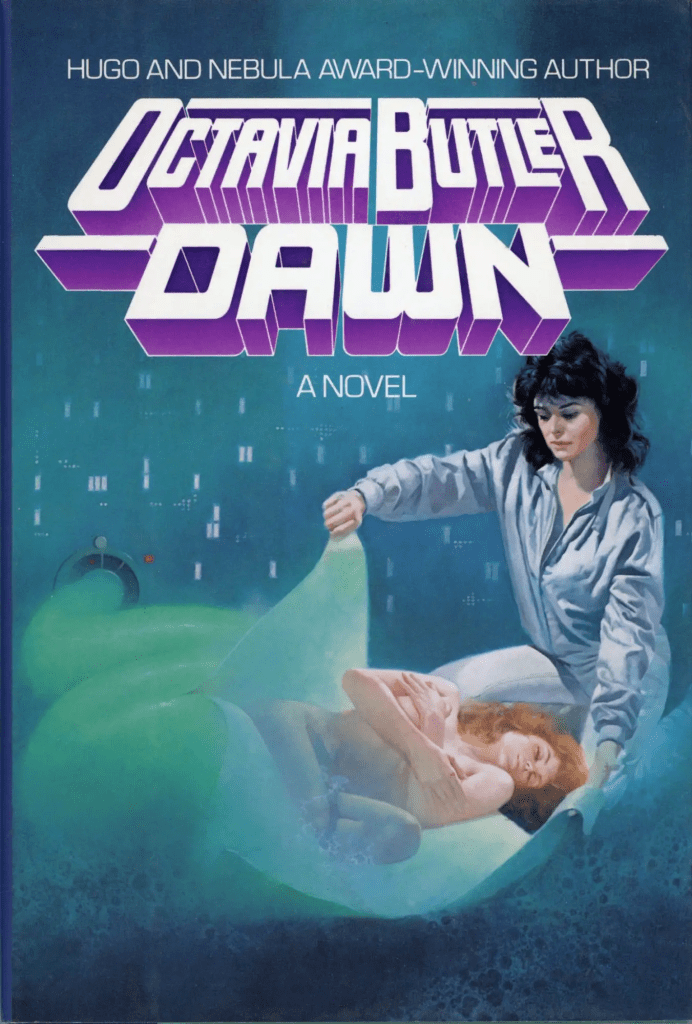
As an aside, this version of the book cover is risible. Not to devolve into identity politics, but Lilith is a dark-skinned woman, not a pale ginger. I can only assume that some target science fiction readers have a propensity to prefer white, sapphic adjacent characters.
I won’t even comment further on the faux 3D title treatment, relic of 1980s marketing.
* Spoiler Alert: As this statement about mass suicide is a Chapter 2 event, I am not inclined to consider it a spoiler. False alarm.
On 7–8 September 2025, the Kindle version of my Ridley Park novella Sustenance will be available free to everyone on Amazon. (It’s always free if you’re a KindleUnlimited member, but these two days open it up to all readers.)
It’s a novella that begins with the dust and grit of rural Iowa – soybean fields, rusted trucks, a small town where everyone knows your name (and your secrets). At first glance, it reads like plainspoken realism, narrated by a local mechanic who insists he’s just a “regular guy.” But then the ground literally shifts. A crash. Figures glimpsed by firelight in the woods. Naked, violet-skinned beings who don’t laugh, don’t sleep, don’t even breathe.
What follows is not your usual alien-invasion story. It’s quieter, stranger, and more unsettling. The encounters with the visitors aren’t about lasers or spaceships – they’re about language, culture, and the limits of human understanding. What happens when concepts like property, law, or even woman and man don’t translate? What does it mean when intimacy itself becomes a site of misunderstanding?
Sustenance is for readers who:
Gravitate toward literary fiction with a speculative edge rather than straight genre beats
Appreciate the mix of the banal and the uncanny – the smell of corn dust giving way to the shock of alien otherness
Are interested in themes of language, power, misunderstanding, and human self-deception
Enjoy writers like Jeff VanderMeer, Margaret Atwood, Octavia Butler, or Denis Johnson – voices that blur realism, philosophy, and estrangement
This isn’t a story that offers tidy answers. It lingers, provokes, and resists easy moral closure. Think of it less as a sci-fi romp and more as a philosophical fable wrapped in small-town dust and cicada-song.
This version of the book is available in these Kindle storefronts: United States, United Kingdom, Germany, France, Spain, Italy, Netherlands, Japan, Brazil, Canada, Mexico, Australia, and India
📚 Grab your free Kindle copy on 7–8 September 2025
Why a Free Copy of Sustenance?
I made this Kindle version available for free to get some reviews. This promotion is all or nothing, so take advantage of the opportunity. If you want to leave a review, please do.







 Philosophics