The Grammar of Bettering Yourself

7–10 minutes

Self-help, pop psychology, LinkedIn, and the metaphysics smuggled into advice

Self-improvement books rarely begin by telling you what it believes a person is. That would be too honest, and honesty is bad for conversion funnels. Instead, it begins with verbs.

Choose. Decide. Commit. Heal. Optimise. Manifest. Reframe. Own. Level up. Set boundaries. Do the work. Become intentional. Stop self-sabotaging. Unlock your potential. Be your authentic self. Take radical responsibility.

The vocabulary shifts depending on the tradition. One speaks of healing, one of discipline, one of nervous systems, one of leadership, one of purpose, one of abundance. What they share is not a doctrine but a grammar: a way of arranging the person before the advice begins. The subject is always inward, sovereign, and temporarily malfunctioning. The problem is always locatable. The solution is always available, often for $29.99 or in a free webinar that becomes a masterclass for $299.

But here is where the easy cynicism runs out of road, because the people writing this stuff — by and large — believe it.

Audio: NotebookLM summary podcast of this topic.

That is the part of the critique that tends to get skipped, because it is less satisfying than imagining a cynical operator deliberately strip-mining the anxious for recurring revenue. Most self-help authors arrived at their framework the same way their readers are about to: they were struggling, they encountered a grammar that organised their experience, they felt the specific relief of suddenly being intelligible to themselves, and they mistook that relief for discovery. Then they wrote a book about it. The author is not the shark. The author is a previous customer who graduated to the front of the room.

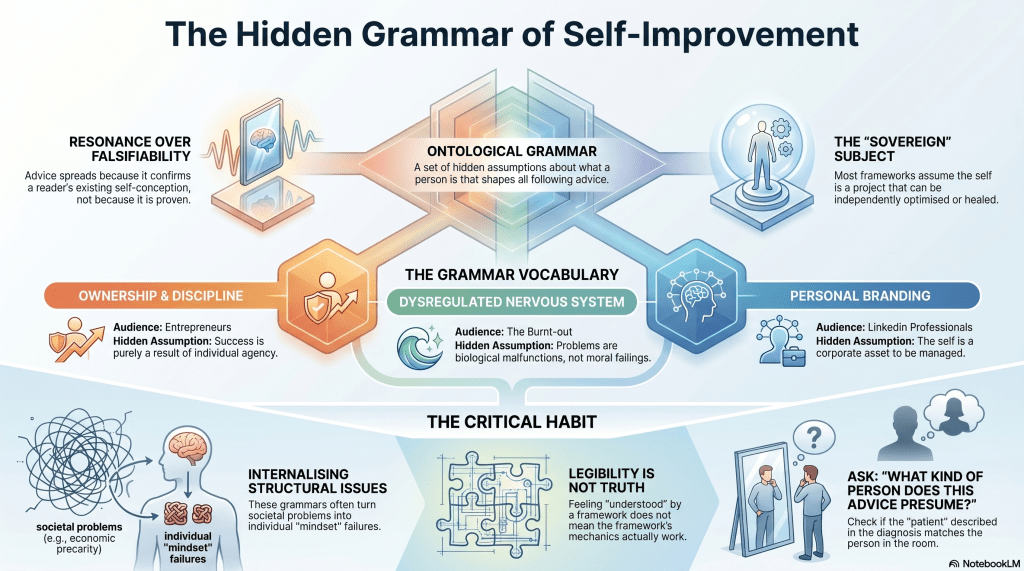
The framework they found — and are now evangelising — is what I call, in The Architecture of Encounter, an ontological grammar: a set of prior commitments about what kind of thing a person is, which arrives upstream of any specific advice and quietly determines what advice is even thinkable. You cannot recommend reframing without first presuming a self transparent enough to observe its own cognitions and sovereign enough to revise them. You cannot prescribe boundaries without presuming a self whose territory is violable and whose autonomy is the relevant moral unit. You cannot offer alignment without presuming a self that has a true direction, temporarily obscured, patiently awaiting discovery through either a values exercise on page forty-seven or a retreat in somewhere with good lighting and worse plumbing.

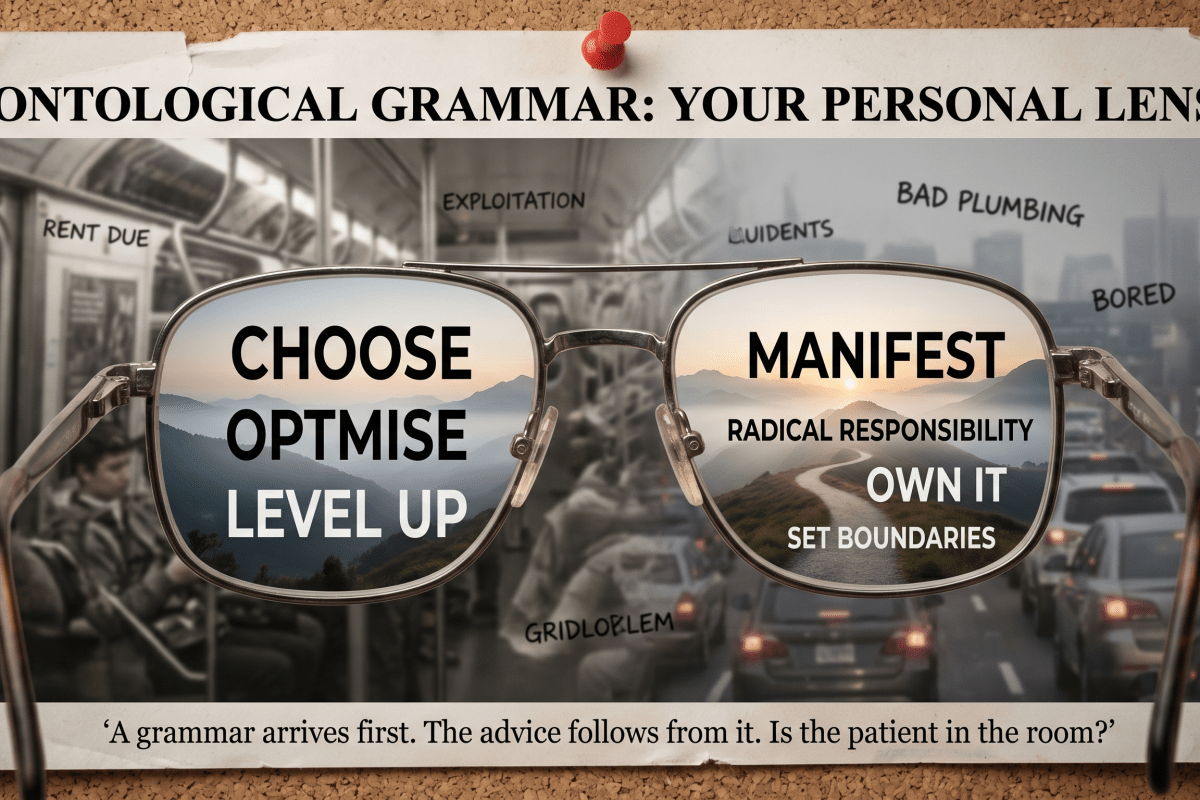
The grammar arrives first. The advice follows from it. And the person reading it is not being shown a mirror. They are being issued a lens.

The lens finds its wearer. “Take ownership” resonates with people already invested in the idea of themselves as agents who have been insufficiently deliberate — it confirms the worldview while appearing to challenge the behaviour. “Your nervous system is dysregulated” resonates with people for whom the moralised language of laziness and discipline has become intolerable; here is a vocabulary that removes the accusation while retaining the explanation, which is a genuinely useful service even if the mechanism on offer is borrowed loosely from neuroscience and the rest is borrowed from hope. “Mindset is your prison” resonates with people who need their suffering to remain individually tractable — solvable, that is, without anyone having to redistribute anything expensive or inconvenient. “Manifest your abundance” resonates with people who find both structural analysis and self-blame equally unappealing and would like a third option involving the universe.

Each grammar finds its congregation. Which is precisely the problem.

A grammar propagates not because it has been tested against alternatives or evaluated for efficacy, but because it maps onto a prior self-conception cleanly enough to produce the sensation of being understood. The entrepreneur already believes in agency-language: execution, discipline, ownership, leverage. The book that tells them their discipline is the differentiator is not offering new information; it is offering comfortable confirmation in a more expensive format. The therapeutic reader already suspects their relational difficulties involve something called attachment. The book that tells them so is not illuminating; it is flattering them with their own vocabulary. The LinkedIn professional already believes their career is a project of self-authorship. The thought leader who tells them to communicate their value and build authentic leadership is not giving them a strategy; they are giving them a liturgy.

The community that forms around a grammar is a church, not a seminar. It has converts, not students. And like most churches, it is considerably better at solidarity than at falsifiability.

This matters because the mechanism by which self-help content spreads — resonance, recognition, testimonial, referral — is entirely decoupled from the mechanism by which we would establish that it works. A sentence resonates because it fits a grammar the reader has already adopted. That tells you something real: about the anxieties structuring a cohort’s self-understanding, the stories they are trying to make liveable, the descriptions of themselves they find tolerable or intolerable. It does not tell you whether the intervention produces the claimed effect, in whom, under what conditions, and compared with what alternative. Those are duller questions. Less shareable. They do not fit on a carousel post with a soft gradient and a mountain.

Horoscopes also resonate. So do conspiracy theories, national myths, and the first chapter of any book you buy during a difficult stretch of your life.

The point is not that the advice is necessarily wrong. Sometimes “set boundaries” is exactly right. Sometimes “take ownership” is precisely what someone has been avoiding hearing. Sometimes a new frame genuinely reorganises attention in ways that produce durable change, and the person is measurably better off for having found it. None of that is in question. The question is whether a framework that produced one useful instance has any reliable claim to truth beyond that instance — and whether the person reaching for it during a difficult period is in any position to make that evaluation carefully.

They usually are not. That is not stupidity. That is the condition of being in difficulty: you reach for intelligibility, and whoever offers it collects a great deal of credit. The problem is not the reaching. The problem is that the self-help ecosystem — including the parts of it operated by entirely sincere people who believe every word they publish — has no reliable mechanism for distinguishing frameworks that help from frameworks that merely feel like help while the underlying situation continues undisturbed. The true believer and the true seeker share the same vulnerability. Both reached for a grammar. One of them got to write the book.

NotebookLM Infographic on this topic.

It is also worth noting that commerce is the easy villain here, and an overrated one. The same dynamic runs through pop psychology, where the grammar of individual cognitive mechanisms tends to dominate because it produces legible interventions in a way that structural analysis never quite does; blaming cognition is tractable, blaming the organisation of society is dispiriting and hard to monetise, even when it is accurate. It runs through LinkedIn, where the grammar is not therapeutic but managerial — the self reimagined as an optimisable professional asset — and where burnout becomes a boundary failure, precarity becomes an invitation to upskill, and alienation becomes a purpose deficit. Nobody on LinkedIn is necessarily trying to extract money from anyone. Many of them are trying to be useful, or to be visible, or both, which is human enough. But the grammar they are deploying disappears material conditions into interior architecture with the same efficiency as the most cynically produced wellness content. The mechanism does not require a profit motive. It requires only a grammar and an audience that already shares it.

The useful response to all of this is not wholesale dismissal, which would be too easy and almost certainly wrong. Some people need clearer habits. Some need better descriptions of their own conduct. Some need permission to stop tolerating what they have been tolerating. Some need a vocabulary that makes their own patterns visible, and a framework — however approximate — is better than none. These are real services. The fact that they are sometimes delivered inside a dubious metaphysics of the person does not automatically negate them.

But there is a question worth developing the habit of asking, before the grammar installs itself: what kind of person does this advice presume? Is the self it describes sovereign, where I am actually constrained? Wounded where I am actually responsible? Deficient where I am actually being exploited? Misaligned where I am actually just bored? In need of self-belief, where I am in need of rent?

These questions are less fun than a morning routine designed by someone who has never had a difficult commute. They do not come with a community or a badge or an accountability partner who sends encouraging voice notes. But they do something the grammar on its own cannot: they ask whether the patient described in the diagnosis is the one actually in the room.

Most self-help skips that step. So, not infrequently, does the person who wrote it. They found a grammar that made their experience legible, felt the relief that comes from that, and never quite got around to distinguishing legibility from truth. Which is understandable. It is also, for everyone downstream of that decision, a problem.

I don’t occupy this shared space of ontological grammar, so I call bollox.


Perish the Thought: You Didn’t Override Anything

4–6 minutes

Je m’accuse. I find myself bickering on social media again. Zut, alors! Unfortunately, I struck a nerve with otherwise unidentified Adam. He may believe that I need to be right; rather, I’d like to help him not be wrong – presuming there are such states. In a post, Adam makes an assertion that one can override one’s, let’s call it, intuition. He ends with:

👉 Just don’t silence the most experienced pattern-reader in the room and call it maturity.

💭 What decision are you defending right now that your body already vetoed?

I feel that we are on the same page, or I wouldn’t bother to engage. The point I want to make with this blog article is that one does not override or veto one’s body. You rationalise what your body tells you to do. Just be careful with your language and how you frame it.

Audio: NotebookLM summary of this topic.

On why “reason defeating intuition” is a comforting fiction

There is a familiar story we tell about decision-making: First, the body speaks. A tightening. A lurch. A sense of foreboding or pull.

Then, reason arrives late, clipboard in hand, issuing corrective instructions:

  • ‘Be rational’
  • ‘Sleep on it’
  • ‘Run the numbers’

When things go badly, we narrate the failure like this: I knew. But I overruled it. This story feels true. It is also almost certainly wrong. Not morally wrong. Not introspectively dishonest. Conceptually wrong.

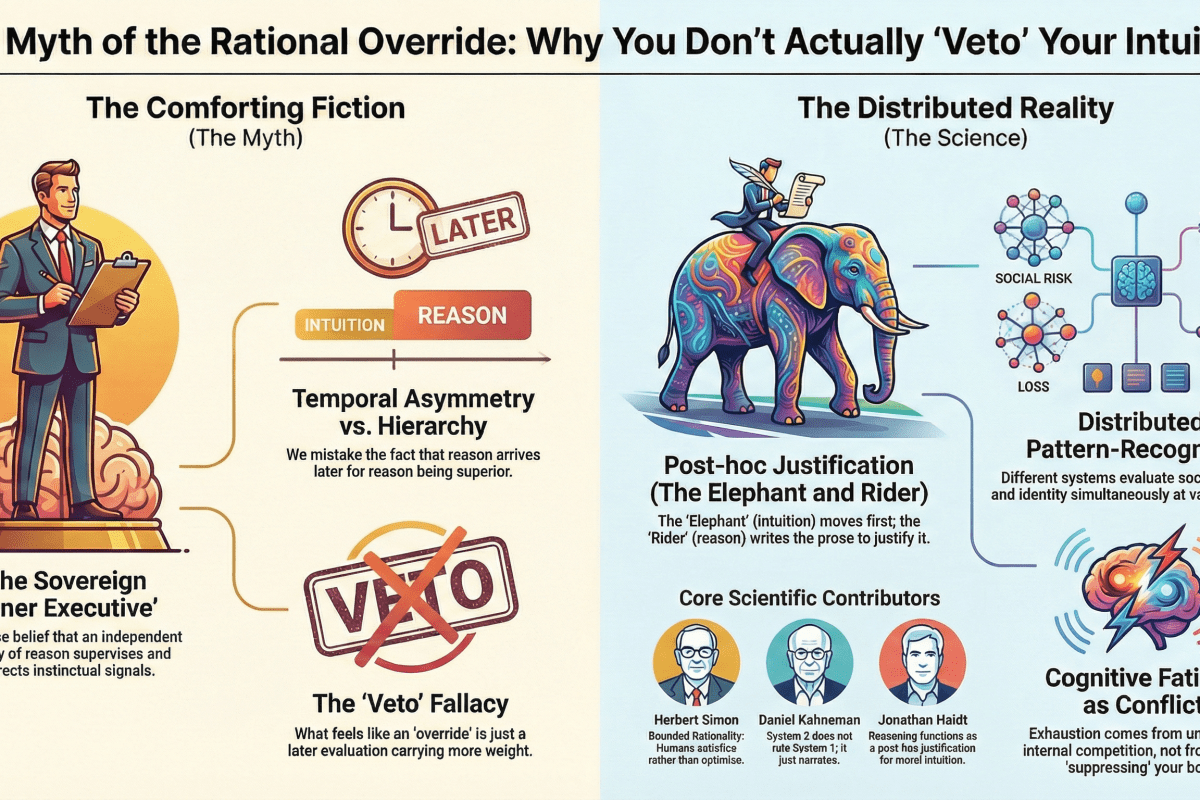
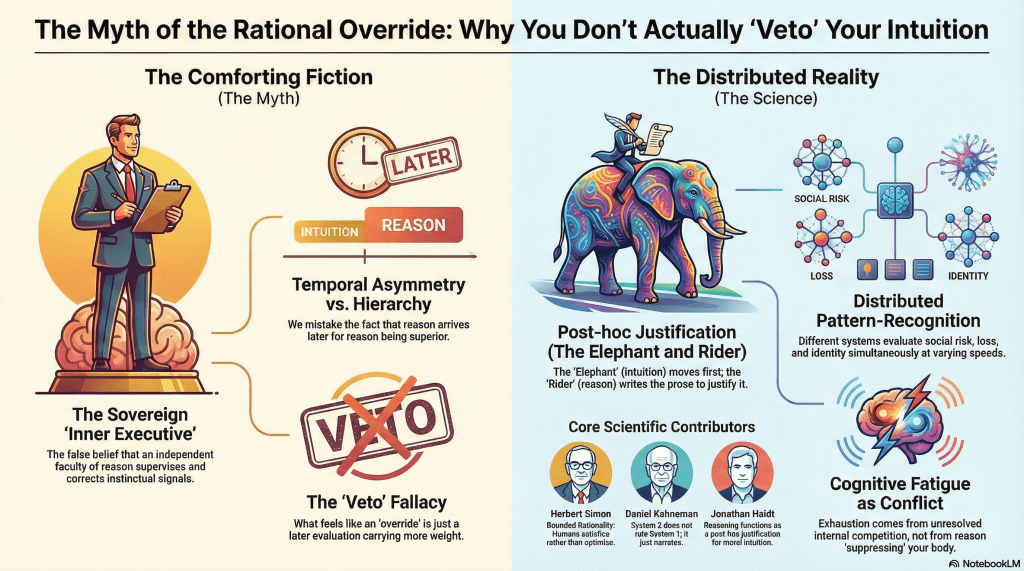
Image: NotebookLM infographics on this topic.

The experiential mistake

Let’s grant the phenomenology immediately. People routinely report that:

  • A decision felt wrong before it was articulated.
  • The articulation came later.
  • The eventual outcome carried an unmistakable sense of fatigue or dissonance.
  • Retrospectively, they say: I ignored the signal.

That experience is real. The inference drawn from it is not.

What the experience shows is temporal asymmetry, not architectural hierarchy. One process surfaces earlier than another. That does not mean a later process overruled it.

It means you are narrating a system whose operations are largely opaque to itself.

What the science actually killed decades ago

The idea that ‘reason’ steps in as a distinct, supervisory faculty that overrides intuition is not merely unproven. It is historically obsolete.

It belongs to the same conceptual family as:

  • The rational actor
  • The detached chooser
  • The inner executive standing above cognition

That family did not survive the twentieth century.

Start with Herbert Simon, who dismantled the fantasy of global optimisation with bounded rationality. Human decision-making does not survey option-spaces and then choose. It satisficies under constraint. There is no god’s-eye view from which “reason” could intervene.

Move to Daniel Kahneman and Amos Tversky, who made it painfully clear that what we call reasoning is deeply entangled with heuristics, framing effects, and affective weighting. System 2 does not rule System 1. It just writes better prose.

Add Thomas Sowell, whose critique of unconstrained rationalism was never about feelings versus facts, but about the fantasy of an overseeing mind unbound by trade-offs.

Or George Lakoff, who quietly erased the idea that political or moral reasoning could ever be disembodied in the first place.

Or Jonathan Haidt, who showed that moral reasoning overwhelmingly functions as post-hoc justification. The elephant moves. The rider explains.

Or Joshua Greene, whose dual-process models still do not resurrect a sovereign rational self. They show competition, not command.

Or Kurt Gray, whose work on moral perception demonstrates that what we experience as “judgment” is already structured before conscious deliberation enters the scene.

Across these literatures, one conclusion recurs with tedious consistency: There is no independent referee.

Why the “override” story feels so compelling

If reason does not overrule intuition, why does it feel like it does?

Because what you experience as “override” is competition between pre-reflective evaluations, not a coup staged by rationality.

Different subsystems evaluate:

  • social risk
  • loss exposure
  • identity coherence
  • narrative defensibility
  • anticipated regret

Whichever configuration wins becomes the decision. The explanation comes later. Calling that explanation “reason” flatters us. It also confuses sequence with sovereignty. When someone says, ‘I ignored my intuition’, what they usually mean is:

A later-arriving evaluation carried more weight than an earlier one, and I disliked the downstream cost.

That is not an override. That is the outcome.

Exhaustion is not evidence of rational domination

There is a popular add-on to the override story:

Again, the fatigue is real. The diagnosis is not. Cognitive fatigue does not indicate that reason heroically suppressed instinct. It indicates conflict resolution under uncertainty without stable convergence.

When multiple evaluative systems fail to cohere cleanly, the result is:

  • prolonged rumination
  • narrative patching
  • justificatory rehearsal
  • defensive rationalisation

That is tiring. Not because reason triumphed, but because coherence never fully arrived.

The real mistake

The mistake is not ‘trusting the body’ or ‘listening to reason’. The mistake is re-importing a discredited architecture because the introspection sounds nice.

You do not have:

  • intuition vs reason
  • signal vs override
  • body vs mind
  • elephant vs rider with veto power

You have distributed pattern-recognition systems, operating at different speeds, with different representational affordances, producing outputs that consciousness stitches into a story after the fact. The story is useful. It is not causal.

What is worth noticing

There is something worth salvaging from the original intuition-first narrative, once it’s stripped of myth.

Early signals matter not because they are purer or wiser, but because they encode long-trained pattern sensitivity that may never become fully articulate.

Ignoring them does not mean you “chose reason.”
It means another pattern won.

And sometimes that pattern is worse.

Not because it was rational.
Because it was legible, defensible, or socially safer.

No resurrection required

None of this requires reviving the rational chooser, the sovereign self, or Homo economicus with a new haircut. The work is already done. The literature is settled. The corpse stays buried. What remains is learning to live without the comforting fiction that someone, somewhere inside you, was supposed to be in charge. That absence is not immaturity. It is the condition under which decisions actually occur. And pretending otherwise only gives the clipboard another imaginary promotion.

Moral Psychology and the Art of Not Believing Your Own Results

3–4 minutes

Over the past few decades, moral psychology has staged a quiet coup against one of our most cherished fantasies: that human beings are, at bottom, rational moral agents. This is not a fringe claim. It is not a Twitter take. It is the mainstream finding of an entire research programme spanning psychology, cognitive science, linguistics, and neuroscience.

We do not reason our way to moral conclusions. We feel our way there. Instantly. Automatically. And only afterwards do we construct reasons that make the judgment sound respectable.

Audio: NotebookLM summary podcast of this topic.

This is not controversial anymore. It is replicated, taught, and celebrated. And yet, if you read the most influential books in this literature, something strange happens. The diagnosis is devastating. The prescription is reassuring.

I’ve just published a long-form video walking through five canonical books in moral psychology that all uncover the same structural problem, and then quietly refuse to live with the implications.

What follows is a brief guide to the argument.

The shared discovery

Across the literature, the same conclusions keep reappearing:

  • Moral judgement is intuitive, not deliberative
  • Reasoning is largely post-hoc
  • Emotion is not noise but signal
  • Framing and metaphor shape what even counts as a moral fact
  • Group identity and tribal affiliation dominate moral perception

In other words: the Enlightenment picture of moral reasoning is wrong. Or at least badly incomplete.

The rider does not steer the elephant. The rider explains where the elephant has already gone.

Audio: NotebookLM infographic

Where the books go wrong

The video focuses on five widely read, field-defining works:

  • The Righteous Mind (reviewed here and here… even here)
  • Moral Politics (mentioned here – with Don’t Think of an Elephant treated as its popular sequel)
  • Outraged! (reviewed here)
  • Moral Tribes (reviewed here)

Each of these books is sharp, serious, and worth reading. This is not a hit piece.

But each follows the same arc:

  1. Identify a non-rational, affective, automatic mechanism at the heart of moral judgement
  2. Show why moral disagreement is persistent and resistant to argument
  3. Propose solutions that rely on reflection, dialogue, reframing, calibration, or rational override

In short: they discover that reason is weak, and then assign it a leadership role anyway.

Haidt dismantles moral rationalism and then asks us to talk it out.
Lakoff shows that framing is constitutive, then offers better framing.
Gray models outrage as a perceptual feedback loop, then suggests we check our perceptions.
Greene diagnoses tribal morality, then bets on utilitarian reasoning to save us.

None of this is incoherent. But it is uncomfortable. Because the findings themselves suggest that these prescriptions are, at best, limited.

Diagnosis without prognosis

The uncomfortable possibility raised by this literature is not that we are ignorant or misinformed.

It is that moral disagreement may be structural rather than solvable.

That political conflict may not be cured by better arguments.
That persuasion may resemble contagion more than deliberation.
That reason often functions as a press secretary, not a judge.

The books sense this. And then step back from it. Which is human. But it matters.

Why this matters now

We are living in systems that have internalised these findings far more ruthlessly than public discourse has.

Social media platforms optimise for outrage, not understanding.
Political messaging is frame-first, not fact-first.
AI systems are increasingly capable of activating moral intuitions at scale, without fatigue or conscience.

Meanwhile, our institutions still behave as if one more conversation, one more fact-check, one more appeal to reason will close the gap. The research says otherwise.

And that gap between what we know and what we pretend may be the most important moral problem of the moment.

No solution offered

The video does not end with a fix. That’s deliberate.

Offering a neat solution here would simply repeat the same move I’m criticising: diagnosis followed by false comfort. Sometimes orientation matters more than optimism. The elephant is real. The elephant is moving.And most of us are passengers arguing about the map while it walks.

That isn’t despair. It’s clarity.

Qualified Subjectivism

4–7 minutes

I Am a Qualified Subjectivist. No, That Does Not Mean ‘Anything Goes’.

Make no mistake: I am a subjectivist. A qualified one. Not that kind of qualified – the qualification matters, but it’s rarely the part anyone listens to.

Image: Not that kind…

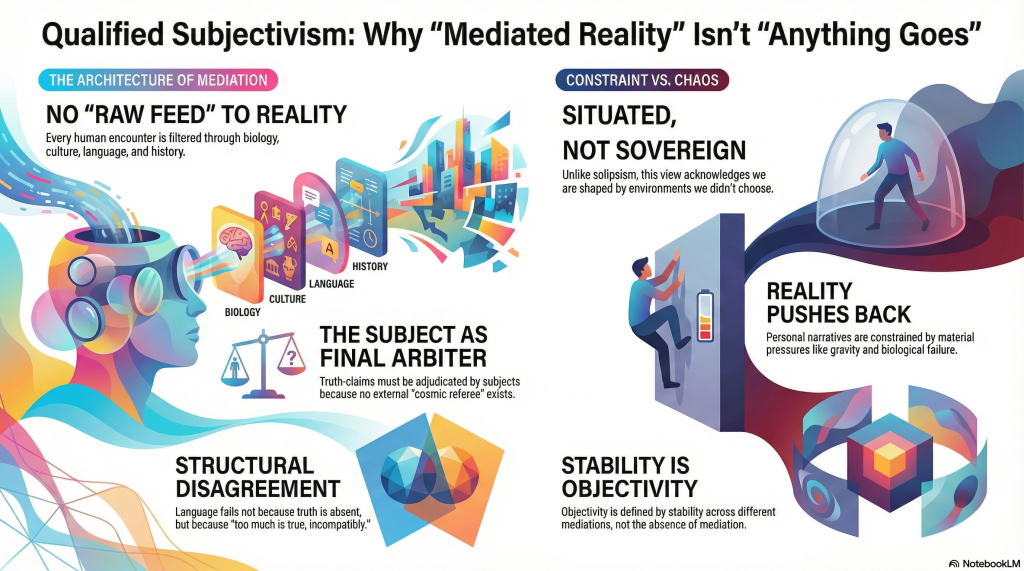
Here is the unglamorous starting point: all human encounters with the world are mediated. There is no raw feed. No unfiltered access. No metaphysical lead running directly from ‘reality’ into the human mind. Every encounter is processed through bodies, nervous systems, cultures, languages, technologies, institutions, and histories.

Audio: NotebookLM summary podcast of this content – See addendum below.

Whilst I discuss the specific architecture of this mediation at length in this preprint, here I will keep it simple.

If you are human, you do not encounter reality as such. You encounter it as processed. This is not controversial. What is controversial is admitting the obvious consequence: the subject is the final arbiter.

Image: NotebookLM Infographic of Qualified Subjectivism

The Subject Is the Final Arbiter

Every account of truth, reality, meaning, value, or fact is ultimately adjudicated by a subject. Not because subjects are sovereign gods, but because there is literally no other place adjudication can occur.

Who, exactly, do critics imagine is doing the adjudicating instead? A neutral tribunal floating outside experience? A cosmic referee with a clipboard? A universal consciousness we all forgot to log into?

This does not mean that truth is ‘whatever I feel like’. It means that truth-claims only ever arrive through a subject, even when they are heavily constrained by the world. And constraint matters. Reality pushes back. Environments resist. Bodies fail. Gravity does not care about your personal narrative.

Why This Is Not Solipsism

Solipsism says: only my mind exists. That is not my claim. My claim is almost boring by comparison: subjects are situated, not sovereign.

We are shaped by environments we did not choose and histories we did not write. Mediation does not eliminate reality; it is how reality arrives. Your beliefs are not free-floating inventions; they are formed under biological, social, and material pressure. Two people can be exposed to the same event and encounter it differently because the encounter is not the event itself – it is the event as mediated through a particular orientation.

Why Objectivity Keeps Sneaking Back In

At this point, someone usually says: ‘But surely some things are objectively true.’

Yes. And those truths are still encountered subjectively. The mistake is thinking that objectivity requires a ‘view from nowhere’. It doesn’t. It requires stability across mediations, not the elimination of mediation altogether. We treat some claims as objective because they hold up under variation, while others fracture immediately. But in all cases, the encounter still happens somewhere, to someone.

The Real Source of the Panic

The real anxiety here is not philosophical. It’s moral and political. People are terrified that if we give up the fantasy of unmediated access to universal truth, then legitimacy collapses and ‘anything goes’.

This is a category error born of wishful thinking. What actually collapses is the hope that semantic convergence is guaranteed. Once you accept that mediation is unavoidable, you are forced to confront a harder reality: disagreement is often structural, not corrigible. Language does not fail because nothing is true. Language fails because too much is true, incompatibly.

So Yes, I Am a Qualified Subjectivist

Interpretation only ever occurs through subjects. Subjects are always mediated. Mediation is always constrained. And constraint does not guarantee convergence.

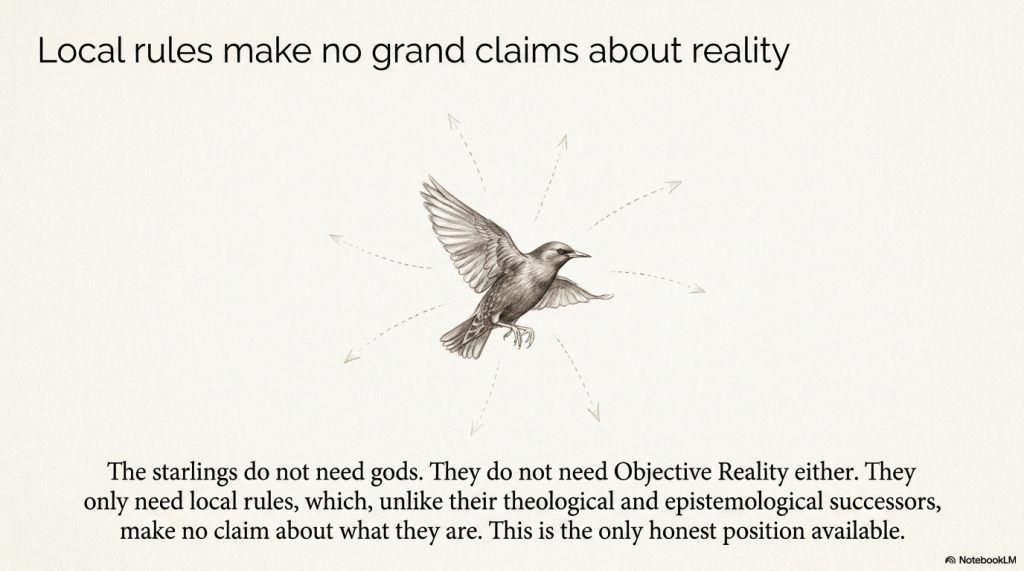
That is the position. It is not radical, fashionable, or comforting. It is simply what remains once you stop pretending there is a god’s-eye view quietly underwriting your arguments. Discomfort is simply a reliable indicator that a fantasy has been disturbed.

Audio: NotebookLM summary of this Geworfenheit addendum

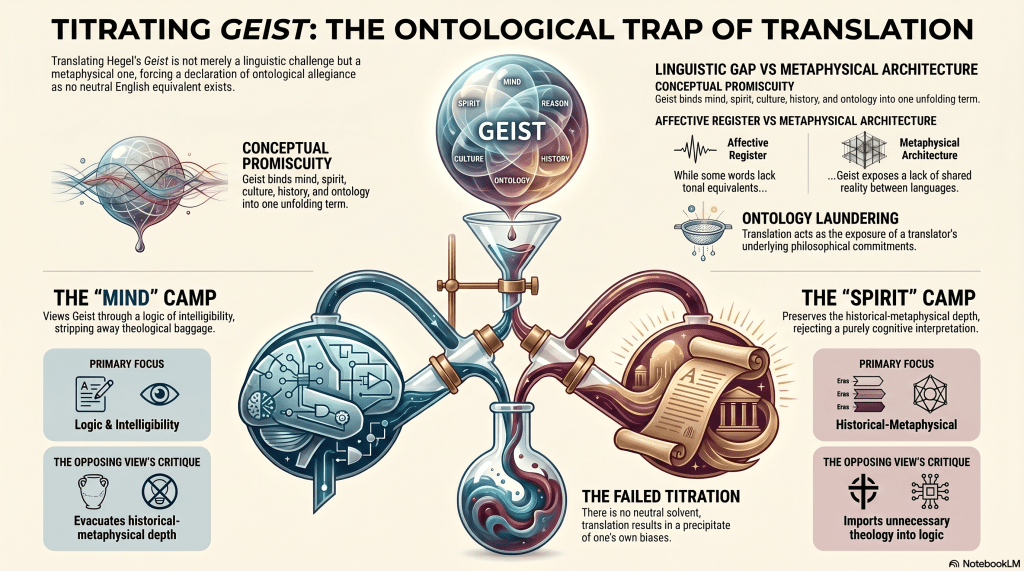
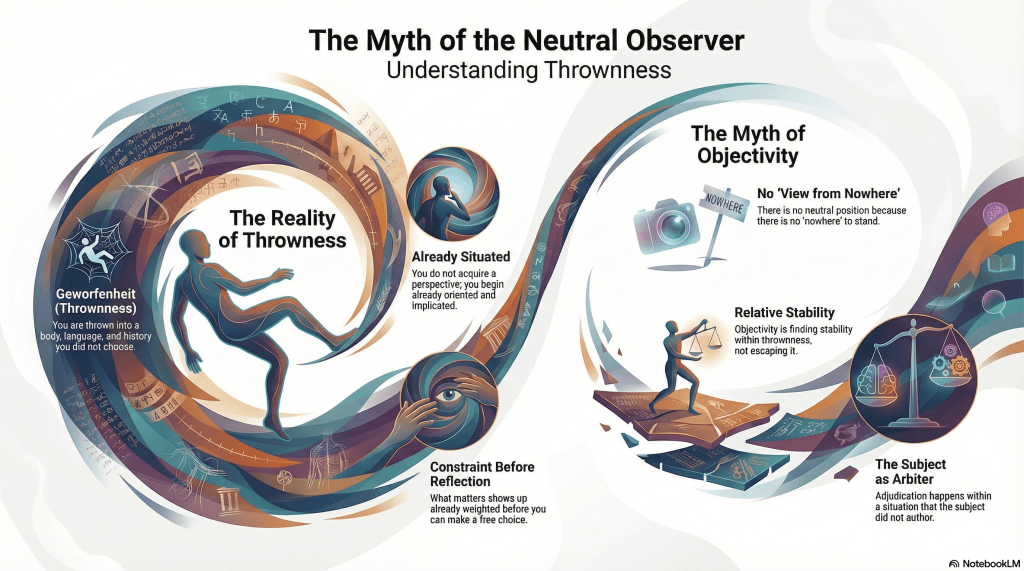
If all this sounds suspiciously familiar, that’s because it is. Heidegger had a word for it: Geworfenheit – usually translated as thrownness.

The idea is simple, and deeply irritating to anyone still hoping for a clean start. You do not enter the world as a neutral observer. You are thrown into it: into a body, a language, a culture, a history, a set of institutions, a moment you did not choose. You do not begin from nowhere and then acquire a perspective. You begin already situated, already oriented, already implicated.

This is not a poetic flourish. It is a structural claim about human existence.

Image: Another NotebookLM infographic for the fun of it.

What my qualified subjectivism insists on – without Heidegger’s ontological theatre – is the same basic constraint: there is no view from nowhere because there is no nowhere to stand. The subject does not float above mediation; the subject is constituted by it. Thrownness is not an accident to be corrected by better theory. It is the condition under which any theorising occurs at all.

Seen this way, the demand for pure objectivity starts to look less like a philosophical ideal and more like nostalgia for an impossible innocence. A wish to rewind existence to a point before bodies, languages, power, and history got involved. That point never existed.

Geworfenheit matters here because it dissolves the caricature that subjectivism is about arbitrary choice. Being thrown is the opposite of choosing freely. It is constraint before reflection. Orientation before argument. Salience before reasons. You do not decide what matters from a neutral menu; what matters shows up already weighted, already charged, already resistant.

This is why appeals to “just be objective” always ring hollow. Objectivity does not mean escaping thrownness. It means achieving relative stability within it. Some claims hold across many thrown positions. Others fracture immediately. That distinction matters. But none of it happens outside mediation.

So when I say the subject is the final arbiter, I am not crowning the subject king of reality. I am pointing out the obvious: adjudication happens somewhere, to someone, from within a situation they did not author. Thrownness guarantees that there is no cosmic referee waiting to overrule the encounter.

If that makes you uncomfortable, good. It should. Discomfort is often just the sensation of a fantasy losing its grip.

When Aliens Speak English: The False Promise of Linguistic Familiarity

5–7 minutes

Why shared language creates the illusion – not the reality – of shared experience

Human beings routinely assume that if another agent speaks our language, we have achieved genuine mutual understanding. Fluency is treated as a proxy for shared concepts, shared perceptual categories, and even shared consciousness. This assumption appears everywhere: in science fiction, in popular philosophy videos, and in everyday cross-cultural interactions. It is a comforting idea, but philosophically indefensible.

Video: Could You Explain Cold to an Alien? – Hank Green

Recent discussions about whether one could ‘explain cold to an alien’ reveal how deeply this assumption is embedded. Participants in such debates often begin from the tacit premise that language maps transparently onto experience, and that if two interlocutors use the same linguistic term, they must be referring to a comparable phenomenon.

A closer analysis shows that this premise fails at every level.

Audio: NotebookLM summary podcast on this topic.

Shared Language Does Not Imply Shared Phenomenology

Even within the human species, thermal experience is markedly variable. Individuals from colder climates often tolerate temperatures that visitors from warmer regions find unbearable. Acclimation, cultural norms, metabolic adaptation, and learned behavioural patterns all shape what ‘cold’ feels like.

If the same linguistic term corresponds to such divergent experiences within a species, the gap across species becomes unbridgeable.

A reptile, for example, regulates temperature not by feeling cold in any mammalian sense, but by adjusting metabolic output. A thermometer measures cold without experiencing anything at all. Both respond to temperature; neither inhabits the human category ‘cold’.

Thus, the human concept is already species-specific, plastic, and contextually learned — not a universal experiential module waiting to be translated.

Measurement, Behaviour, and Experience Are Distinct

Thermometers and reptiles react to temperature shifts, and yet neither possesses cold-qualia. This distinction illuminates the deeper philosophical point:

  • Measurement registers a variable.
  • Behaviour implements a functional response.
  • Experience is a mediated phenomenon arising from a particular biological and cognitive architecture.

Aliens might measure temperature as precisely as any scientific instrument. That alone tells us nothing about whether they experience anything analogous to human ‘cold’, nor whether the concept is even meaningful within their ecology.

The Problem of Conceptual Export: Why Explanation Fails

Attempts to ‘explain cold’ to hypothetical aliens often jump immediately to molecular description – slower vibrational states, reduced kinetic energy, and so forth. This presumes that the aliens share:

  • our physical ontology,
  • our conceptual divisions,
  • our sense-making framework,
  • and our valuation of molecular explanation as intrinsically clarifying.

But these assumptions are ungrounded.

Aliens may organise their world around categories we cannot imagine. They may not recognise molecules as explanatory entities. They may not treat thermal variation as affectively laden or behaviourally salient. They may not even carve reality at scales where ‘temperature’ appears as a discrete variable.

When the conceptual scaffolding differs, explanation cannot transfer. The task is not translation but category creation, and there is no guarantee that the requisite categories exist on both sides.

The MEOW Framework: MEOWa vs MEOWb

The Mediated Encounter Ontology (MEOW) clarifies this breakdown by distinguishing four layers of mediation:

  • T0: biological mediation
  • T1: cognitive mediation
  • T2: linguistic mediation
  • T3: social mediation

Humans run MEOWa, a world structured through mammalian physiology, predictive cognition, metaphor-saturated language, and social-affective narratives.

Aliens (in fiction or speculation) operate MEOWb, a formally parallel mediation stack but with entirely different constituents.

Two systems can speak the same language (T2 alignment) whilst:

  • perceiving different phenomena (T0 divergence),
  • interpreting them through incompatible conceptual schemas (T1 divergence),
  • and embedding them in distinct social-meaning structures (T3 divergence).

Linguistic compatibility does not grant ontological compatibility.
MEOWa and MEOWb allow conversation but not comprehension.

Fiction as Illustration: Why Aliens Speaking English Misleads Us

In Sustenance, the aliens speak flawless Standard Southern English. Their linguistic proficiency invites human characters (and readers) to assume shared meaning. Yet beneath the surface:

  • Their sensory world differs;
  • their affective architecture differs;
  • their concepts do not map onto human categories;
  • and many human experiential terms lack any analogue within their mediation.

The result is not communication but a parallel monologue: the appearance of shared understanding masking profound ontological incommensurability.

The Philosophical Consequence: No Universal Consciousness Template

Underlying all these failures is a deeper speciesist assumption: that consciousness is a universal genus, and that discrete minds differ only in degree. The evidence points elsewhere.

If “cold” varies across humans, fails to apply to reptiles, and becomes meaningless for thermometers, then we have no grounds for projecting it into alien phenomenology. Nor should we assume that other species – biological or artificial – possess the same experiential categories, emotional valences, or conceptual ontologies that humans treat as foundational.

Conclusion

When aliens speak English, we hear familiarity and assume understanding. But a shared phonological surface conceals divergent sensory systems, cognitive architectures, conceptual repertoires, and social worlds.

Linguistic familiarity promises comprehension, but delivers only the appearance of it. The deeper truth is simple: Knowing our words is not the same as knowing our world.

And neither aliens, reptiles, nor thermometers inhabit the experiential space we map with those words.

Afterword

Reflections like these are precisely why my Anti-Enlightenment project exists. Much contemporary philosophical commentary remains quietly speciesist and stubbornly anthropomorphic, mistaking human perceptual idiosyncrasies for universal structures of mind. It’s an oddly provincial stance for a culture that prides itself on rational self-awareness.

To be clear, I have nothing against Alex O’Connor. He’s engaging, articulate, and serves as a gateway for many encountering these topics for the first time. But there is a difference between introducing philosophy and examining one’s own conceptual vantage point. What frustrates me is not the earnestness, but the unexamined presumption that the human experiential frame is the measure of all frames.

Having encountered these thought experiments decades ago, I’m not interested in posturing as a weary elder shaking his stick at the next generation. My disappointment lies elsewhere: in the persistent inability of otherwise intelligent thinkers to notice how narrow their perspective really is. They speak confidently from inside the human mediation stack without recognising it as a location – not a vantage point outside the world, but one local ecology among many possible ones.

Until this recognition becomes basic philosophical hygiene, we’ll continue to confuse linguistic familiarity for shared ontology and to mistake the limits of our own embodiment for the limits of consciousness itself.

A Key Point of Departure: He Accepts the Folk Psychology I Reject

3–5 minutes

Jason from Philosopher Muse suggested a connexion between Transductive Subjectivity and the work of Stephen Batchelor. I wasn’t familiar with Batchelor, so — as one does these days — I asked a GPT to give me the lay of the land. The machine obliged, and the result was interesting enough that it warranted a post of its own. This is it.

Audio: NotebookLM summary podcast of this topic.

Before anyone lights incense: I’m not suddenly a convert. Batchelor’s work and mine merely pass each other on adjacent footpaths. But the overlap is conceptually neat, and the divergence is even more telling.


Stephen Batchelor vs Transductive Subjectivity: A Brief Comparative Note

1. Shared Territory: The Self as Verb, Not Noun

Both Batchelor and Transductive Subjectivity reject the folk notion of a single, continuous metaphysical self.

  • Batchelor (Secular Buddhism):
    The self is an unfolding activity — impermanent, conditional, and without a stable essence. His “not-self” is a practice of disidentification from the imagined nugget of continuity we cling to.
  • Transductive Subjectivity:
    The self is a finite series: S₀ → S₁ → S₂ → … → Sₙ, each produced through the pressure of relational structures (R). Identity is what results when the world meets the organism. Nothing metaphysical required; just biology, cognition, language, and institutions doing their thing.

Overlap: Both positions dismantle the enduring pearl-of-self. Both frame identity as something generated, not possessed.


2. Divergent Aims: Inner Liberation vs Structural Clarity

This is where the paths fork.

  • Batchelor’s Agenda:
    Primarily ethical and therapeutic. The point of denying a fixed self is to reduce suffering, ease attachment, and cultivate a more responsive way of being.
  • TS’s Agenda:
    Metaphysical accuracy in the service of ethical clarity. If the self is a serial construction rather than a diachronic monolith, then retributive justice collapses under its own fictions. No self, no desert. No desert, no justification for revenge-based punishment.

Batchelor wants flourishing. I want rigour. Accidental cousins.


3. Methodological Differences: Distillation vs Reconstruction

Batchelor performs what you might call Buddhism sans metaphysics.
A very Western manoeuvre:

  • keep impermanence
  • keep ethical insight
  • jettison karma, rebirth, cosmology
  • rebrand the remnants as a secular spiritual practice

Practitioners dislike this because he amputates the structural scaffolding that supported the doctrine.

TS, by contrast, doesn’t distil anything. It reconstructs selfhood from first principles:

  • No causa sui
  • Episodic, indexical selfhood (Strawson)
  • R→S transduction (MEOW)
  • No diachronic essence
  • No metaphysical ballast

If Buddhism aligns with TS, it’s incidental — the way two different mathematicians can discover the same function by entirely different routes.


4. Conceptual Architecture: Dependent Origination vs MEOW’s Tiers

  • Batchelor:
    leans on dependent origination as a philosophical metaphor — phenomena arise through conditions.
  • TS:
    models the exact channels of that conditioning via MEOW:
    T0 → biological signals
    T1 → cognitive architecture
    T2 → linguistic formats
    T3 → social-technical pressures

Where Batchelor says “everything is contingent,” TS says “yes, and here is the actual machinery.”


5. Different Stakes

  • Batchelor: freeing the person from clinging to an imaginary core.
  • TS: freeing ethics, law, and social design from pretending that metaphysical core exists.

One is therapeutic; the other is diagnostic.


A Key Point of Departure: Batchelor Works with Folk Psychology; TS Rejects Its Premises

There is one more divergence worth highlighting because it cuts to the bone of the comparison.

Batchelor accepts the phenomenological feel of the continuous self as a legitimate starting point. His work is therapeutic: he begins where the person is, in the lived experience of being “me,” and then encourages a gentle loosening of the grip on that intuition.

Transductive Subjectivity takes a different route entirely.

For TS, the continuous, diachronic self isn’t a psychological obstacle to be softened — it is a category mistake. A narrative compression artefact. A heuristic with pragmatic uses, yes, but no metaphysical legitimacy. Batchelor tries to transform our relation to the folk-self; TS denies that the folk-self was ever more than a convenient fiction.

Batchelor says:
“You seem like a continuous self; now learn to hold that lightly.”

TS says:
“You seem like a continuous self because the system is glossing over discontinuities. The sensation itself is misleading.”

In other words:

  • Batchelor redeems the experience.
  • TS disassembles the model.

He treats the “self” as something to relate to differently.
TS treats the “self” as an ontological construct to be replaced with a more accurate one.

This is not a difference of ethical aim but of metaphysical foundation.
Batchelor trims the folk psychology; TS declines the invitation altogether.

Closing Note

So yes — the connexion Jason spotted is real. But it’s genealogical, not derivative. We arrive at similar conclusions for different reasons and with different consequences.

Batchelor is pruning a tradition.
Transductive Subjectivity is rebuilding the ontology.

And both, in their own way, make the continuity-self look like the rhetorical placeholder it always was.

Announcement: MEOW GPT

Instead of sleeping like a functional adult, I’ve spent the night creating, testing, and refining a bespoke GPT that has fully absorbed my MEOW and LIH frameworks. Apologies that the LIH manuscript isn’t yet public; some of the terminology may look delightfully alien if you’re coming in cold.

This model doesn’t role-play a philosopher; it thinks through the Mediated Encounter Ontology. It runs every input through T0–T3 mediations and then applies the Language Insufficiency Hypothesis to explain why our words fail us in predictable, structural ways.

Audio: NotebookLM summary podcast of this post on the MEOW GPT.

I stress-tested it with a dozen concepts, from the obvious to the uncooperative. It happily tells you when your input makes sense, when it’s out of scope, and when you’ve handed it conceptual soup. My first test was the hard problem of consciousness, because naturally we begin with the philosophical boss fight. I dialled down some over-enthusiastic LIH flourishes, but the bones are untouched.

I’m making this public for a simple reason: it’s the clearest way for people to see how MEOW operates without wandering through a hundred pages of my prose. These outputs capture how I process information and why these frameworks feel so intuitively correct to me. When you read them, you get a direct view of my interpretive machinery – how the world clicks for me, and how these ideas evolved.

It hasn’t been rigorously battle-tested across the entire conceptual universe, but it’s stable, coherent, and frankly too interesting to keep in the drawer. If you try it – and I hope you do – I’d love to see what it does with your own concepts. If you need help reading the results, ask. I didn’t simplify the system; it expects literacy, nuance, and a working prefrontal cortex.

For orientation, read the introductory post or the colour perception example. Ideally, read the original essay and listen to the summary podcast. My first test was on the hard problem of consciousness because I had already analysed it for this post. I made some adjustments to tone down some LIH intrusions.

Below is a sample output. I asked the model to analyse modernity.

Concept

  • Input: modernity
  • Type: historical–social formation / self-description of an era / conceptual frame
  • Scope check: in-scope – central for how MEOW treats large-scale shifts in mediation (social, technical, cognitive, linguistic)

High-level summary (≤120 words)

Modernity is both a historical bundle (industrialisation, nation-states, capitalism, science, bureaucracy, media) and a story societies tell about themselves (“we are modern, unlike the past”).

In MEOW terms, modernity is a large-scale reorganisation of mediations:

  • T0: new bodily environments (urban life, clocks, artificial light, pollution, medicine).
  • T1: new cognitive habits (individualism, planning, abstraction, risk-calculation).
  • T2: new vocabularies (progress, development, rationality, “religion” vs “science”).
  • T3: new institutions and technologies (markets, states, factories, schools, mass media, digital networks).

“Modernity” is not a single thing but a way these shifts hang together and become a background to everyday encounter.


T0 – Biological Mediation

  • Applicability: Applicable
  • Analysis:
    • Modernity radically reshapes the immediate bodily environment: dense cities, artificial lighting, noise, pollution, sedentary work, and altered sleep cycles change basic sensory and metabolic conditions.
    • Medical advances and public health (vaccination, antibiotics, sanitation, surgery) modify life expectancy, infant mortality, and chronic illness, which in turn change how life cycles feel and are planned.
    • New food systems (industrial agriculture, processed foods, global supply chains) alter nutrition, exposure to toxins, and rhythms of hunger and satiety.
    • Industrial and digital work reorganise movement and posture: repetitive factory labour, office desk work, and screen use all reshape embodiment, fatigue, and bodily awareness.
    • These T0 changes set the stage for new affective baselines (e.g., chronic low-level stress, stimulation overload) that colour what it is like to live in a “modern” world.

T1 – Cognitive Mediation

  • Applicability: Strongly applicable
  • Analysis:
    • Modernity encourages certain cognitive styles: systematic planning, quantification, risk assessment, cost–benefit thinking, and an emphasis on prediction and control.
    • The sense of self is reconfigured toward individualism and reflexivity: people see themselves as projects to be chosen, improved, optimised, often with long-term career and life-planning horizons.
    • Exposure to multiple roles, cultures, and information streams (through migration, media, education) produces more complex identity structures and can create cognitive dissonance or fragmentation.
    • Scientific and technical worldviews teach people to reframe events in terms of mechanisms, probabilities, and systems rather than fate, tradition, or local narratives.
    • The sheer volume and speed of information flows in late modernity (news, social media, notifications) trains attention toward rapid scanning and shallow switching, affecting memory, concentration, and emotional regulation.
    • These patterns make certain experiences “normal” (abstract work, mediated relationships, bureaucratic interactions) that would be extraordinary or impossible in premodern settings.

T2 – Linguistic Mediation

  • Applicability: Strongly applicable
  • Analysis:
    • Modernity itself is a label that societies use to contrast “us” with “them” (the past, “traditional” societies, “the East,” “the primitive”); it is a polemical as well as descriptive term.
    • In Language Insufficiency terms, modernity is highly Fluid: it can mean a period (“since the 18th century”), a style (modernist art), a value system (rational, secular, progressive), or a socio-economic order (capitalist, industrial, bureaucratic). Different authors slide between these quietly.
    • It’s also Contestable: critics and defenders use the same word but point to different aspects—emancipation and progress versus alienation, exploitation, ecological crisis.
    • Pairs like “modern vs traditional” or “modern vs backward” compress complex differences into simple hierarchies, smuggling in a presumption that “modern” is automatically better or more advanced.
    • Talk of “post-modernity” or “late modernity” suggests that we can neatly periodise and step outside the modern, even while our concepts and institutions remain shaped by it—an example of language implying more clarity and control than we actually have.
    • At the most global scale (“the meaning of modernity,” “the modern condition”), we approach an Effectiveness Horizon: the term feels weighty but becomes vague; people resort to sweeping metaphors (disenchantment, liquefaction, acceleration) whose exact content is hard to pin down.
    • First-person experiences of being “overwhelmed by modern life,” “liberated by modern options,” or “disconnected in modern society” often have an Ineffable quality: standard clichés don’t quite capture the texture of these lives, even as they gesture at them.

T3 – Social/Technical Mediation

  • Applicability: Strongly applicable
  • Analysis:
    • Modernity is most visible as a mesh of institutions: nation-states, markets, bureaucracies, public schools, hospitals, prisons, armies, scientific organisations, corporations, NGOs.
    • These institutions standardise time (clocks, schedules), space (borders, property lines, zoning), identity (passports, ID numbers), and value (money, statistics, rankings) so that encounters become predictable and governable across large scales.
    • Technologies—steam engines, electricity, mass transport, broadcasting, computing, the internet, AI—are both products and drivers of modernity. They make possible new encounter-forms (remote work, global real-time communication, mass surveillance).
    • Urbanisation concentrates people into large, heterogeneous populations, which reconfigures social networks, anonymity, solidarity, and conflict; everyday encounters become more mediated by rules, signage, and digital systems than by face-to-face custom.
    • Capitalist production and consumption patterns organise much of life around work, income, and markets; the rhythms of the factory, office, and platform economy structure when and how people interact, rest, and move.
    • Modern governance uses statistics, censuses, and models to “see” and manage populations; this makes certain aspects of life legible (employment, crime, disease) while leaving others under- or uncounted (informal care, undocumented work, emotional labour).
    • Counter-movements (romanticism, traditionalism, environmentalism, decolonial and Indigenous resurgence, slow-living and anti-consumerist practices) can be read as attempts to renegotiate or resist specific modern mediations rather than simply reject “modernity” as a whole.

Limits & failure modes

  • Language insufficiency notes
    • Modernity bundles together time (a historical era), structure (a type of society), and value (being “up to date”). This makes the term rhetorically powerful but analytically slippery: it’s easy to smuggle evaluations into what sound like neutral descriptions.
    • Because the concept is so broad, discussions often conflate distinct issues—technology, capitalism, secularisation, colonialism, individualism, bureaucracy—under one word, obscuring which mechanisms are actually at work.
    • Experiences of living in “modern times” (speed, fragmentation, choice, precariousness, possibility) often outrun our stock phrases; people lean on recurring complaints (“too fast,” “too shallow,” “too lonely”) that only partially capture what it’s like.
  • Missing tiers / blind spots
    • This sketch doesn’t adjudicate between different theories of modernity (Marxist, Weberian, postcolonial, systems-theoretic, etc.); it treats them as emphasising different mediational strands.
    • It’s centred on Euro-Atlantic narratives; “multiple modernities” and non-Western trajectories (where “modern” elements mix with older forms in hybrid ways) would need a richer T3 treatment.
    • The analysis underplays ecological dimensions: industrial modernity’s dependence on fossil fuels, large-scale extraction, and waste has massive implications for how future encounters will be structured.
    • Finally, because we are ourselves situated in what we call modernity, our conceptual vantage is limited; any map we draw is partly an artefact of the very mediations we’re trying to analyse.

How MEOW Turns a Metaphysical Mountain Into a Linguistic Molehill

In the last post, I argued that the so-called ‘hard problem of consciousness‘ was never a problem with consciousness. It was a problem with language – specifically, the English language’s unfortunate habit of carving the world into neat little substances and then demanding to know why its own divisions won’t glue back together.

Audio: NotebookLM summary podcast of this topic, on resolving the hard problem of consciousness.

The response was predictable.

  • ‘But what about subjective feel?’
  • ‘What about emergence?’
  • ‘What about ontology?’
  • ‘What about Chalmers?’
  • ‘What about that ineffable thing you can’t quite point at?’

All fair questions. All built atop the very framing that manufactures the illusion of a metaphysical gap.

So here’s the promised demonstration: not yet a full essay (though it may evolve into one), but a clear application of MEOW – the Mediated Encounter Ontology of the World – to the hard problem itself. Consider this a field test of the framework. A tidy autopsy, not the funeral oration.

The Set-Up: Chalmers’ Famous Trick

Chalmers asks:

The question feels profound only because the terms ‘physical’ and ‘experience’ smuggle in the very metaphysics they pretend to interrogate. They look like opposites because the grammar makes them opposites. English loves a comforting binary.

But MEOW doesn’t bother with the front door. It doesn’t assume two substances – ‘mind’ over here, ‘world’ over there – and then panic when they refuse to shake hands. It treats experience as the way an encounter manifests under a layered architecture of mediation. There’s no bridge. Only layers.

T₀ – Biological Mediation

The body is not a barrier. It is the encounter’s first architecture.

At T₀, the world is already transformed: transduction, gating, synchrony, inhibition, adaptation. Organisms don’t receive ‘raw’ physical inputs. They metabolise them. The form of contact is biological before it is anything else.

The hard problem begins by assuming there’s a realm of dumb physical mechanisms that somehow need to ‘produce’ experience. But organisms do not encounter dumb mechanism. They encounter structured contact –biological mediation – from the first millisecond.

If you insist on thinking in substances, T₀ looks like a problem.
If you think in mediations, it looks like the beginning of sense-making.

T₁ – Cognitive Mediation

Where the Enlightenment saw a window, cognition installs a newsroom.

Prediction, priors, memory, inference, attention – all shaping what appears and what never makes it into view. Experience at T₁ is not something ‘added’. It is the organisational structure of the encounter itself.

The hard problem treats ‘experience’ as a mysterious extra–something floating atop neural activity like metaphysical cream. But at T₁, what appears as experience is simply the organisation of biological contact through cognitive patterns.

There is no ‘what emerges from the physical’. There is the way the encounter is organised.

And all of this unfolds under resistance – the world’s persistent refusal to line up neatly with expectation. Prediction errors, perceptual limits, feedback misfires: this constraint structure prevents the entire thing from collapsing into relativist soup.

T₂ – Linguistic–Conceptual Mediation

Here is where the hard problem is manufactured.

This is the layer that takes an ordinary phenomenon and turns it into a metaphysical puzzle. Words like ‘experience’, ‘physical’, ‘mental’, ‘subjective’, and ‘objective’ pretend to be carved in stone. They aren’t. They slide, drift, and mutate depending on context, grammar, and conceptual lineage.

The hard problem is almost entirely a T₂ artefact – a puzzle produced by a grammar that forces us to treat ‘experience’ and ‘physical process’ as two different substances rather than two different summaries of different mediational layers.

If you inherit a conceptual architecture that splits the world into mind and matter, of course you will look for a bridge. Language hands you the illusion and then refuses to refund the cost of admission.

T₃ – Cultural–Normative Mediation

The Western problem is not the world’s problem.

The very idea that consciousness is metaphysically puzzling is the product of a specific cultural lineage: Enlightenment substance dualism (even in its ‘materialist’ drag), Cartesian leftovers, empiricist habits, and Victorian metaphysics disguised as objectivity.

Other cultures don’t carve the world this way. Other ontologies don’t need to stitch mind back into world. Other languages simply don’t produce this problem.

Reassembling the Encounter

Once you run consciousness through the mediational layers, the hard problem dissolves:

  • Consciousness is not an emergent property of neural complexity.
  • Consciousness is not a fundamental property of the universe.
  • Consciousness is the reflexive mode of certain mediated encounters, the form the encounter takes when cognition, language, and culture become part of what is appearing.

There is no gap to explain because the ‘gap’ is the product of a linguistic–conceptual framework that splits where the world does not.

As for the ever-mystical ‘what-it’s-like’: that isn’t a metaphysical jewel buried in the brain; it is the way a T₀–T₃ architecture manifests when its own structure becomes reflexively available.

A Brief Disclaimer Before the Internet Screams

Pointing out that Chalmers (and most of modern philosophy) operates within a faulty ontology is not to claim MEOW is flawless or final. It isn’t. But if Occam’s razor means anything, MEOW simply removes one unnecessary supposition — the idea that ‘mind’ and ‘world’ are independent substances in need of reconciliation. No triumphalism. Just subtraction.

Where This Leaves Chalmers

Chalmers is not wrong. He’s just asking the wrong question. The hard problem is not a metaphysical insight. It’s the moment our language tripped over its shoelaces and insisted the pavement was mysterious.

MEOW doesn’t solve the hard problem. It shows why the hard problem only exists inside a linguistic architecture that can’t model its own limitations.

This piece could easily grow into a full essay – perhaps it will. But for now, it does the job it needs to: a practical demonstration of MEOW in action.

And, arguably more important, it buys me one more day of indexing.

The Hard Problem Was Never Consciousness

3–5 minutes

It Was Language All Along.

This whole misadventure began sometime in 2018, when I started documenting what has now metastasised into the Language Insufficiency Hypothesis. If I weren’t typing this, I’d be doing the honourable thing and finishing the index, but here we are, procrastinating with purpose. I had a suspicion, even then, that language was up to something. Something slippery. Something evasive. At first, it was just a motley catalogue of weasel words that refused to sit still long enough to be given a meaning. I should have taken the hint when the list kept expanding like a Victorian railway: terminally over-budget and convinced of its own grandeur.

But, naturally, I pressed on.

Audio: NotebookLM summary podcast and conversation around this topic.

At the time I had that slow-burn itch about identity, selfhood, free will, agency – you know, the usual metaphysical tat we’re reared on like a Victorian child raised on laudanum. It wasn’t that these things didn’t exist; it was that the words simply couldn’t bear the conceptual load we’d been piling onto them. And so I found myself in the company of philosophers who either tried to rescue these terms (Dennett, ever the valiant firefighter with a damp match), complicate them (Searle, constructing houses of cards under wind machines), or dissolve them outright (Parfit, smiling serenely as the rest of us panic).

Meanwhile, Strawson was somewhere in the corner insisting experience is all there is, Putnam was in his perennial retraction phase, and I was merely trying to keep my own conceptual apparatus from collapsing like an undercooked soufflé.

I’ll admit I had a long-standing soft spot for Dennett’s consciousness-as-emergence hypothesis. It made a certain intuitive sense at the time: pile up enough neural machinery, sprinkle in some feedback loops, and consciousness would bubble up like steam from a kettle. It felt elegant. It felt mechanistically honest. And, crucially, it made perfect sense within the inherited Realist framework I was still tacitly lugging around. Of course, experience ’emerges’ from physical processes if you start from a worldview already partitioned into physical substrates and mental phenomena waiting to be accounted for. Dennett wasn’t wrong so much as operating within the same architectural error the rest of us had been marinating in. Once I began reframing the whole encounter through mediation rather than emergence, the elegance dissolved. What had looked like metaphysics turned out to be a conceptual afterimage generated by a language that couldn’t model its own limitations.

And then there was Chalmers.

Ah, the ‘hard problem’. I lost count of how many times it surfaced. Like mould. Or a debt collector. Chalmers’ dilemma – how physical processes give rise to experience – is purportedly the Mount Everest of metaphysics. Yet the more I thought about it, the more it reeked of a linguistic parlour trick. A conceptual magic eye puzzle: stare long enough and a unicorn appears, provided you’ve surrendered your scepticism and a good measure of oxygen.

The problem isn’t that consciousness is ‘hard’. The problem is that the linguistic scaffolding we’re using was never built for this terrain. ‘Experience’. ‘Physical’. ‘Mental’. ‘Explain’. These words pretend to be steel beams when they’re actually damp cardboard.

What remains isn’t a cosmic riddle but a linguistic artefact. A conceptual false path carved by centuries of grammatico-metaphysical enthusiasm – the unfortunate habit of mistaking grammatical symmetry for metaphysical necessity.

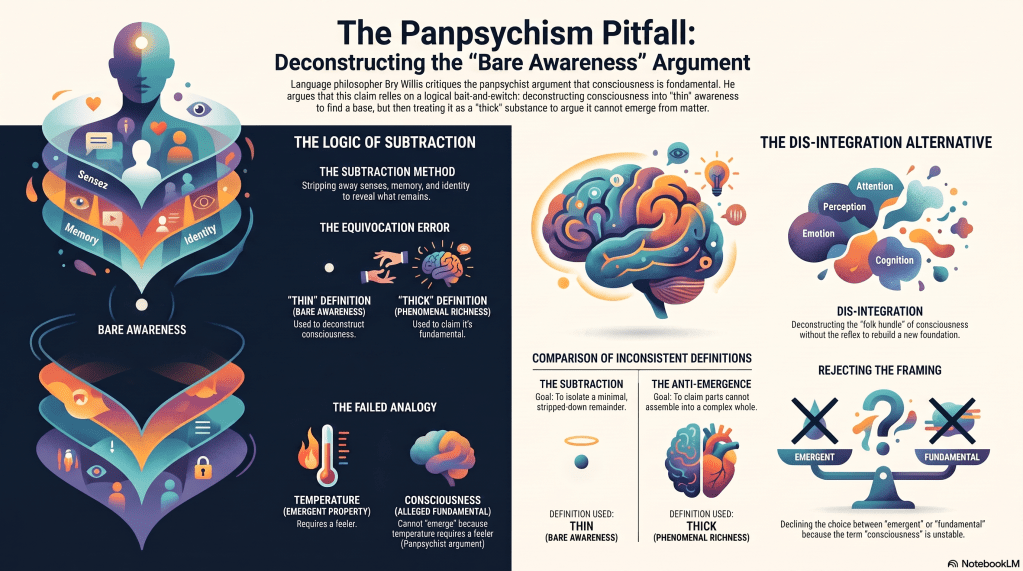
Which brings me to the present, having at last gelled the LIH and published the Mediated Encounter Ontology of the World – a relational metaphysics that has the decency not to hallucinate substances it can’t justify. MEOW clears the fog rather neatly: the so-called ‘hard problem’ is only ‘hard’ because we continue to treat ‘mind’ and ‘world’ as two independent substances requiring metaphysical reconciliation. Together, LIH and MEOW provide a double exposure of the problem: LIH shows why the language fails; MEOW shows what the language was failing to describe.

So here we are. I’d like to reconsider Chalmers through the dual lenses of LIH and MEOW – not to ‘solve’ the hard problem, but to show it was never the right problem to begin with. The difficulty isn’t consciousness; it’s the language we’re forced to use, the same language that refuses to sit still, the same language that keeps trying to trick us into mistaking grammatical symmetry for metaphysical necessity.

In a coming post, I intend to pry open that illusion with a crowbar. Delicately, of course. One must be civilised about these things.

Because if language is insufficient – and it is – then perhaps what Chalmers discovered was not the abyss of consciousness, but the limit of the dictionary.