I commenced reading another LLM book recommendation, Piranesi. I share my thoughts on the first two chapters on my Substack.
Gemini Pro video representation of the sense of Piranesi.
Susanna Clarke’s Piranesi comes in seven parts. I’ve read two. It’s the second of four recommendations an LLM gave me after I fed it ten books and authors I liked enough to inflict on other people. I wrote about that experiment, and about the first book I chose from the list, Jacqueline Harpman’s I Who Have Never Known Men.
I’ll call the parts chapters, because that’s how I read them, and it feels more natural to me. Clarke isn’t here to object, so this unilateral move happens in absentia.
So far the book is mostly world-building. There is a protagonist, Piranesi, a name he’s given and doesn’t seem particularly convinced is his. A second character is known only as the Other and who visits twice a week, enlisting Piranesi’s help in researching the Great and Secret Knowledge, whatever that turns out to be. I’ve spent two chapters trying to decide whether the Other is a foil, a mentor, an antagonist or something else. Please stand by…
This is the third of a deeper look into ten philosophical positions. This one is on convergence realism within the category of epistemology. A full article is available on Substack, with supporting information on a recent post here on Philosophics Blog.
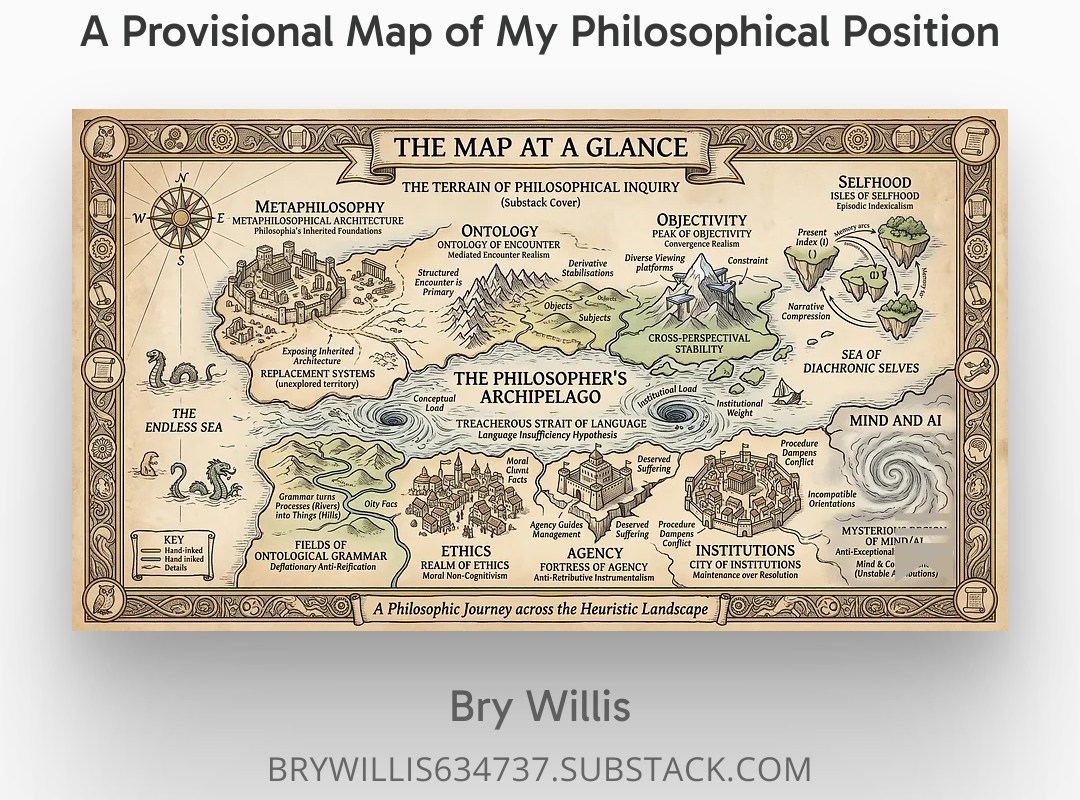
The question is reasonable, although belief may already be doing more work than I would permit it under cross-examination. My writing is generally diagnostic rather than doctrinal. I am more interested in identifying the architectural assumptions beneath a dispute than in selecting a furnished room within it. Where philosophy offers a contest between established positions, I often suspect that the arena itself has been badly designed.
Still, repeated diagnoses eventually disclose a pattern. Certain commitments recur: suspicion of substance, resistance to metaphysical inflation, distrust of linguistic confidence, rejection of moral realism, scepticism toward persistent personal identity, and an insistence that mediation does not entail fabrication.
What follows is therefore neither a creed nor a completed system. It is a provisional map of where I presently stand.
The labels are intended as coordinates, not allegiances. Where no established term quite fits, I have used my own. This is partly unavoidable and partly evidence for the very linguistic difficulty I spend so much time diagnosing.
This content, including video and podcast summary, are of a longer Substack article on my philosophical positions with descriptions.
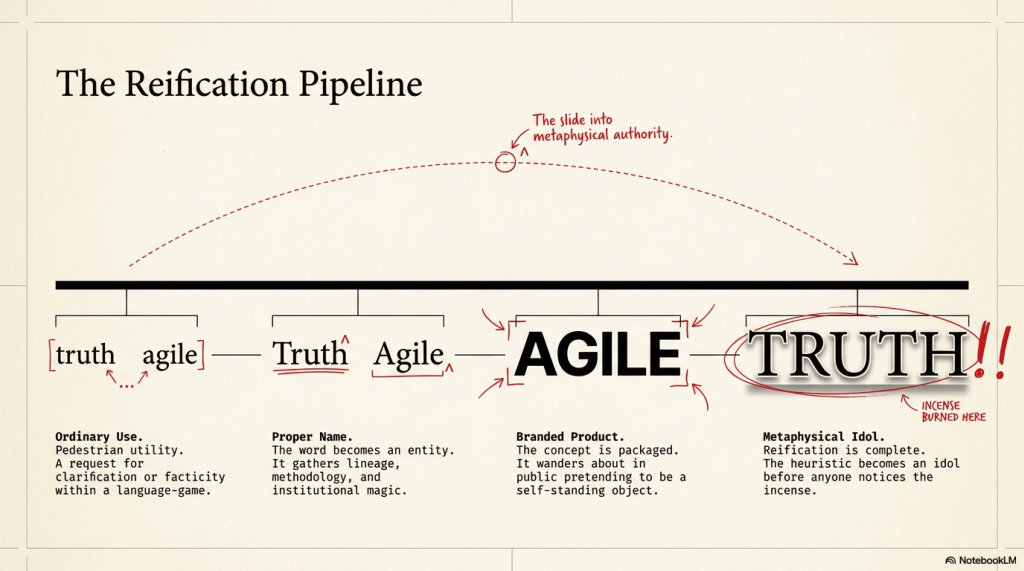
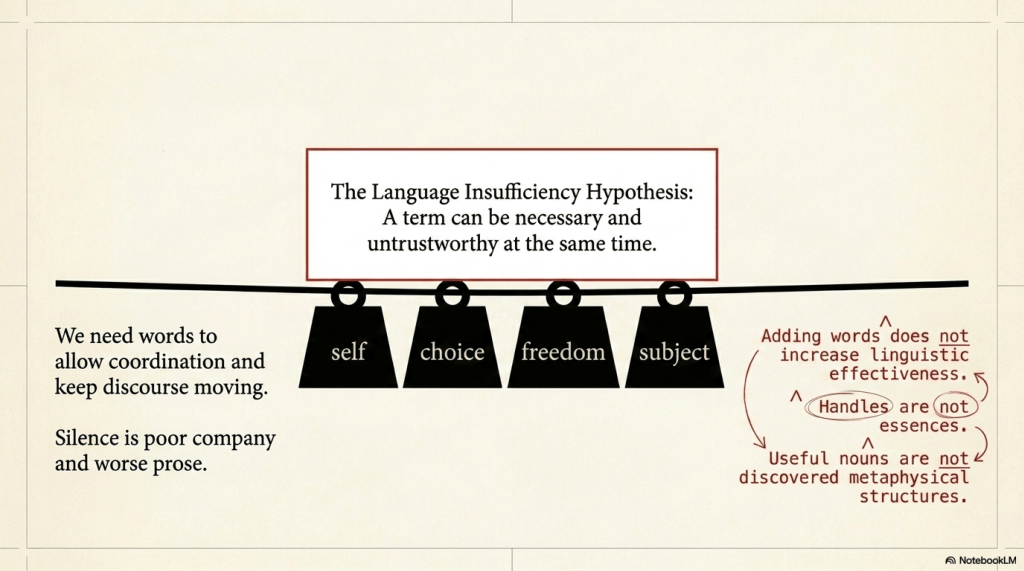
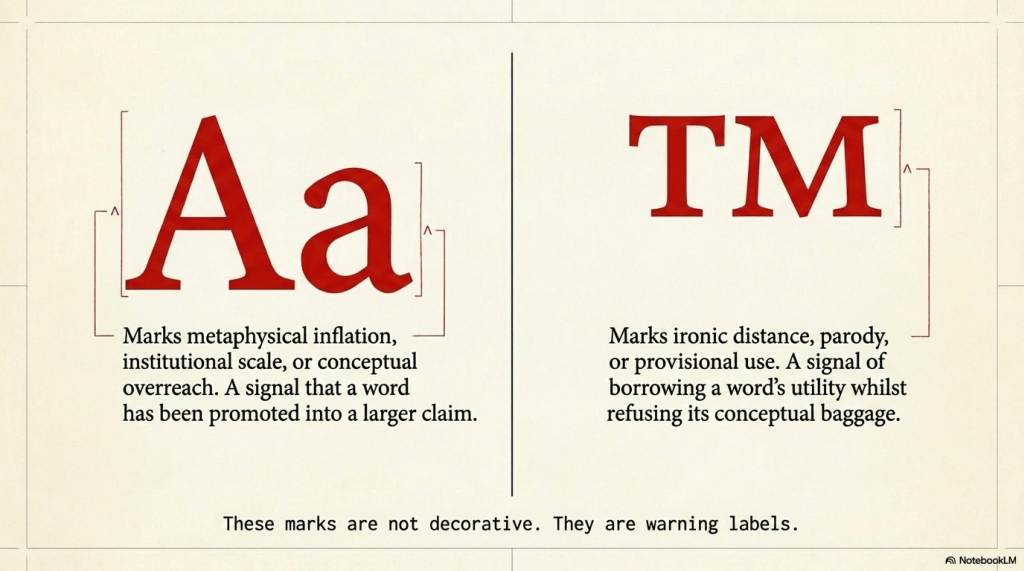
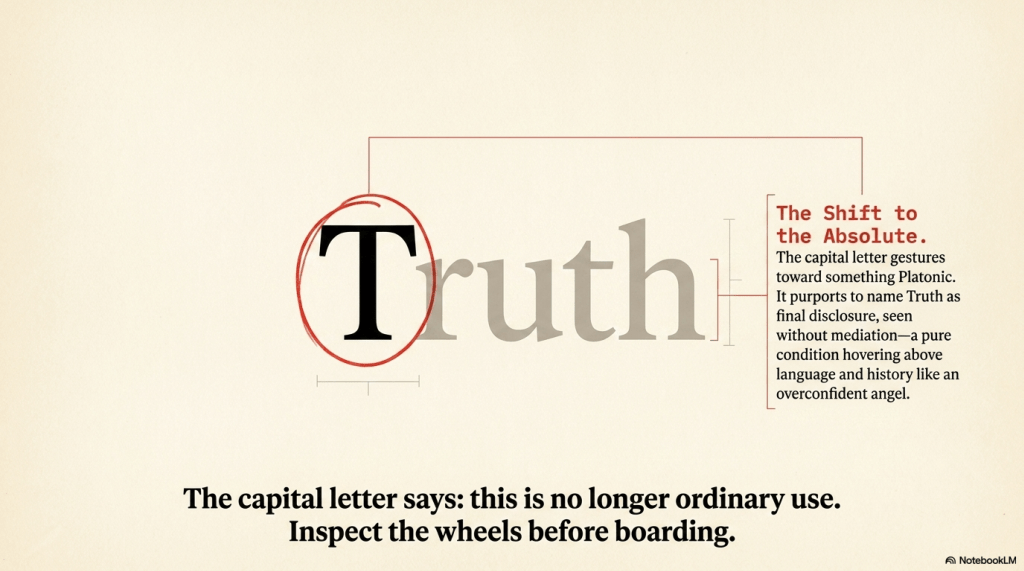
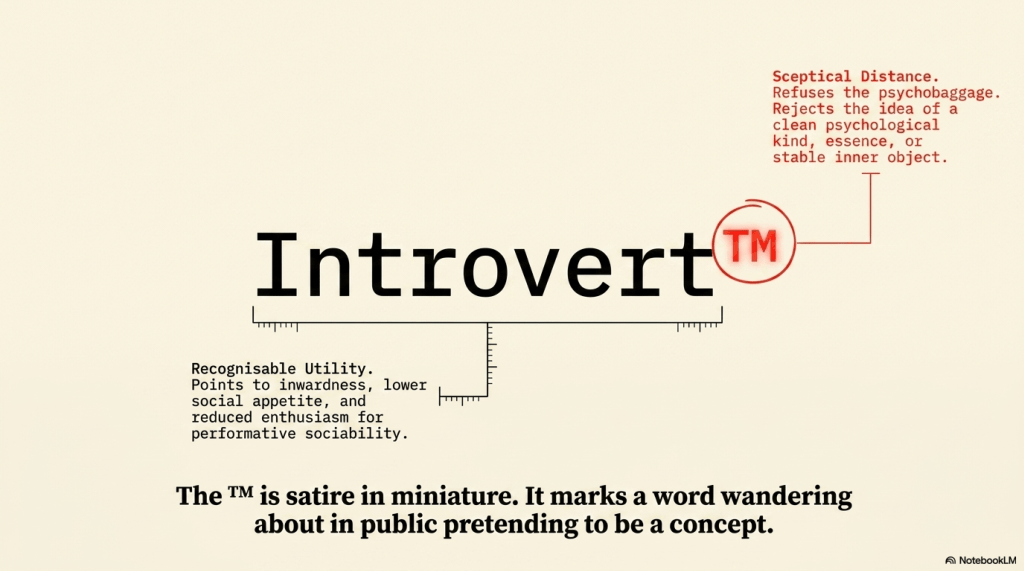
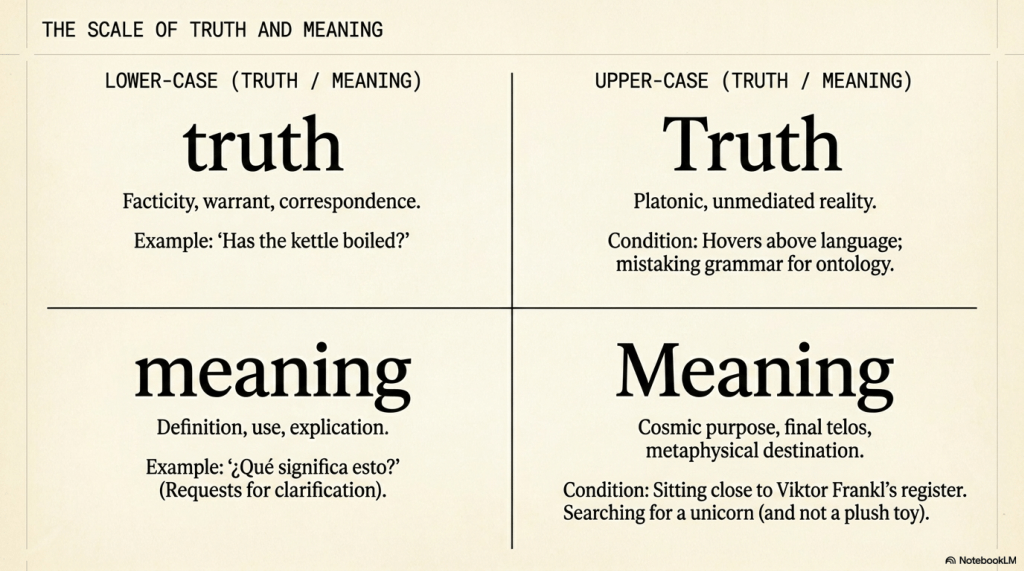
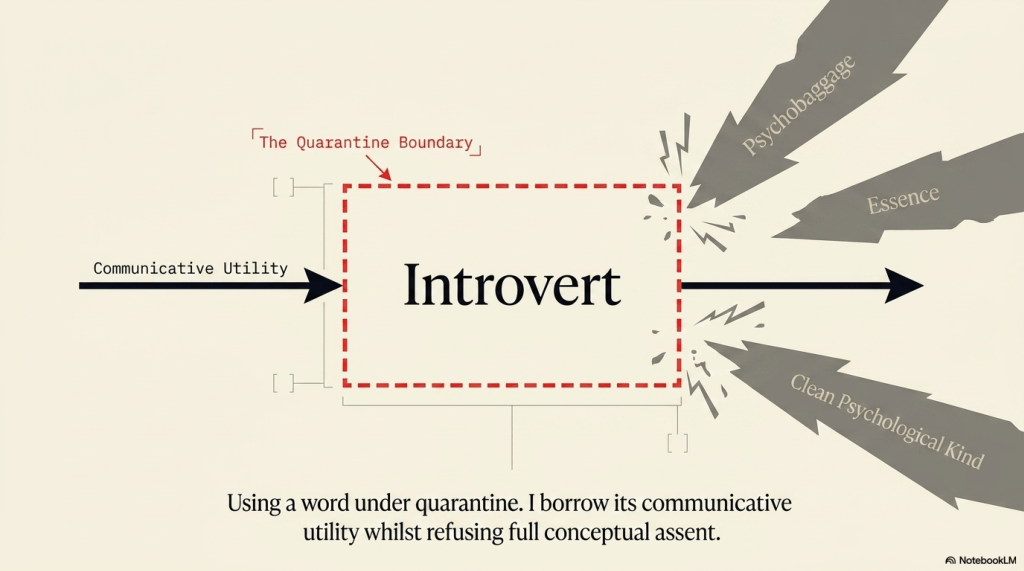
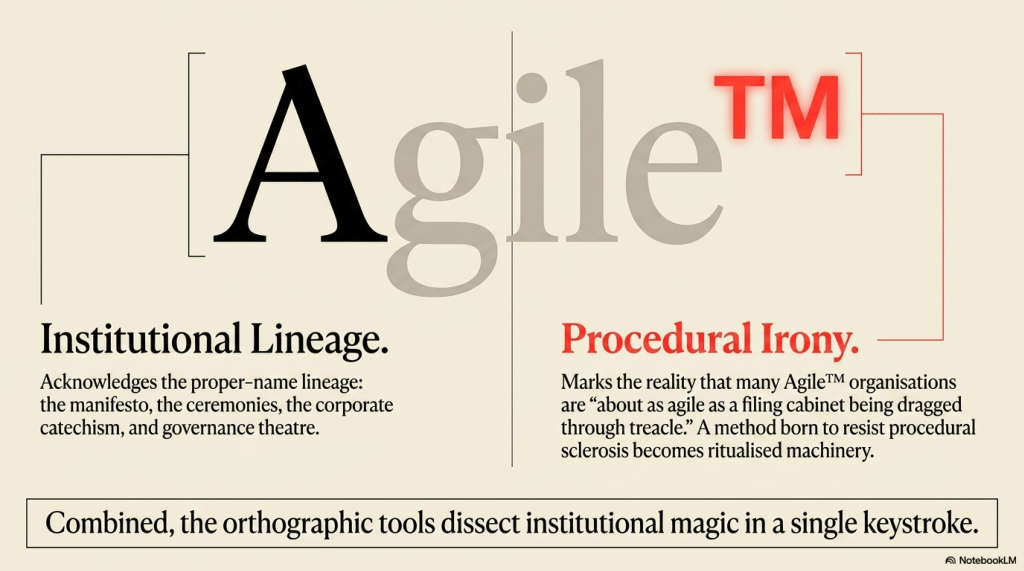
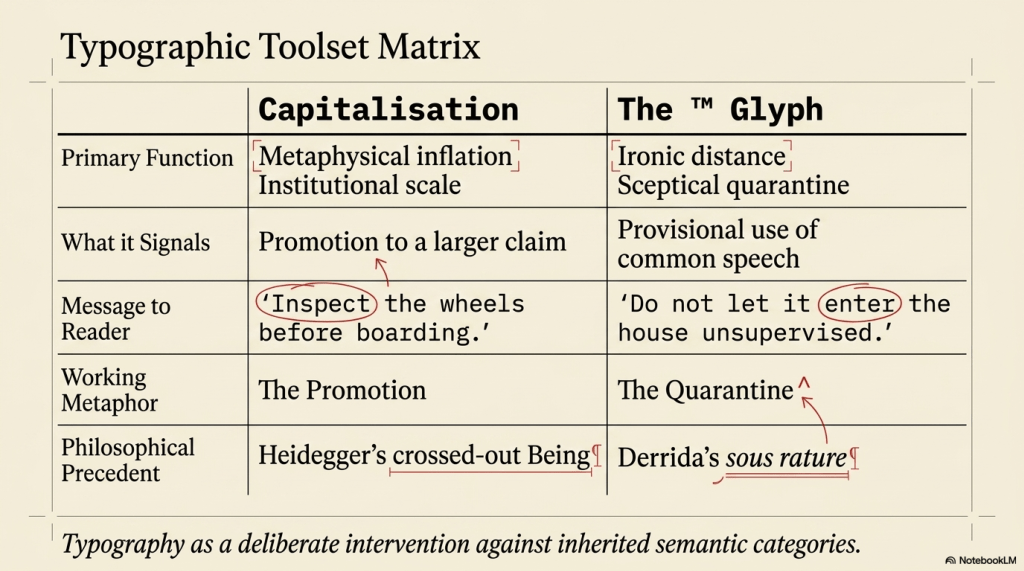
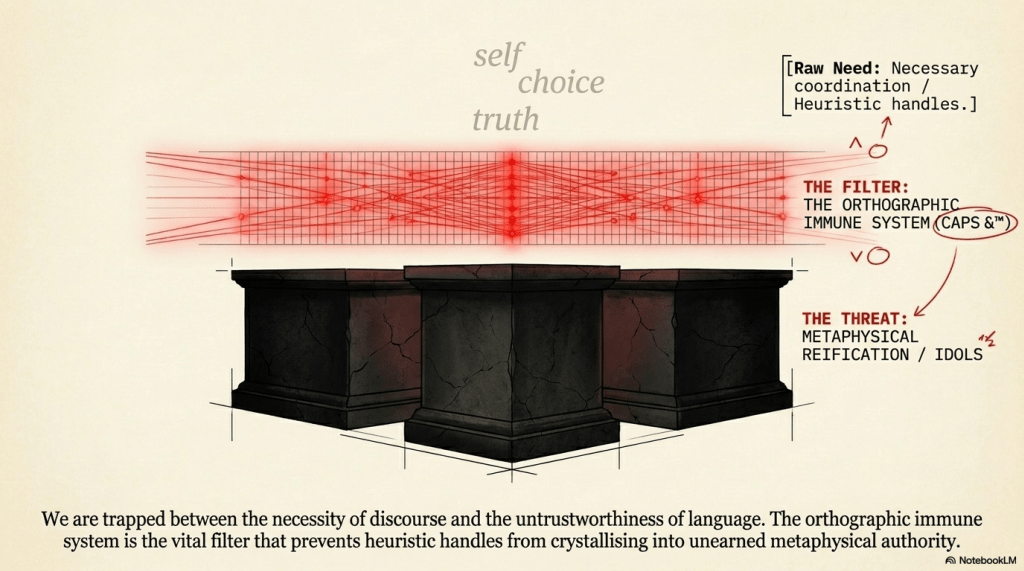
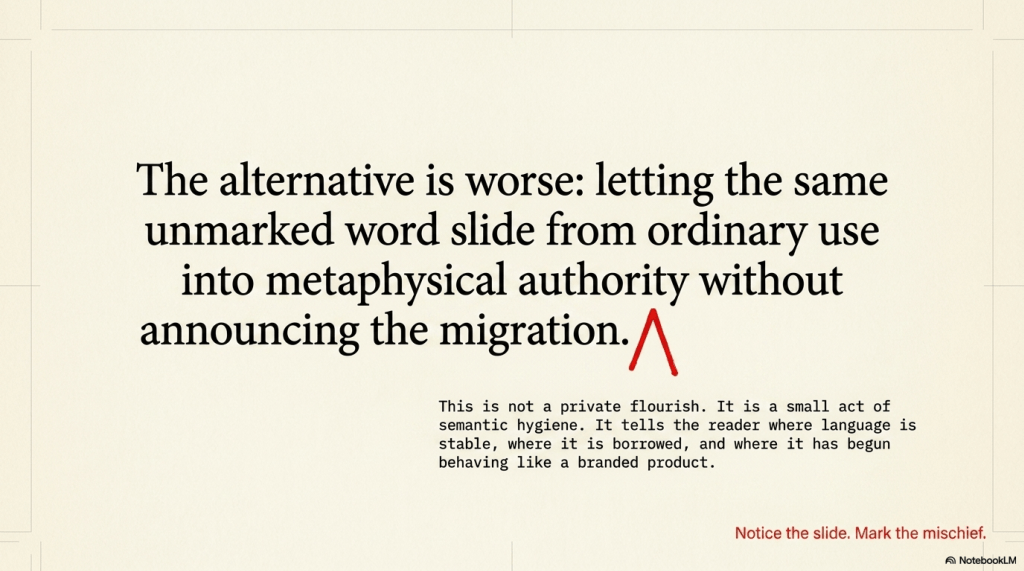
I have an orthographic habit, perhaps merely a private convention, though I rather suspect all conventions begin this way before someone gives them a Latin name and a committee. I use typography to signal when a word is doing more than pedestrian language ordinarily admits.
As I continue to read Heidegger’s On the Essence of Truth, I feel compelled to share my musings. Avert your eyes if this doesn’t work for you, but don’t stop me if you’ve heard this one before.
Read the rest of the article there, or listen to the podcast.
Audio: NotebookLM summary podcast of this topic.
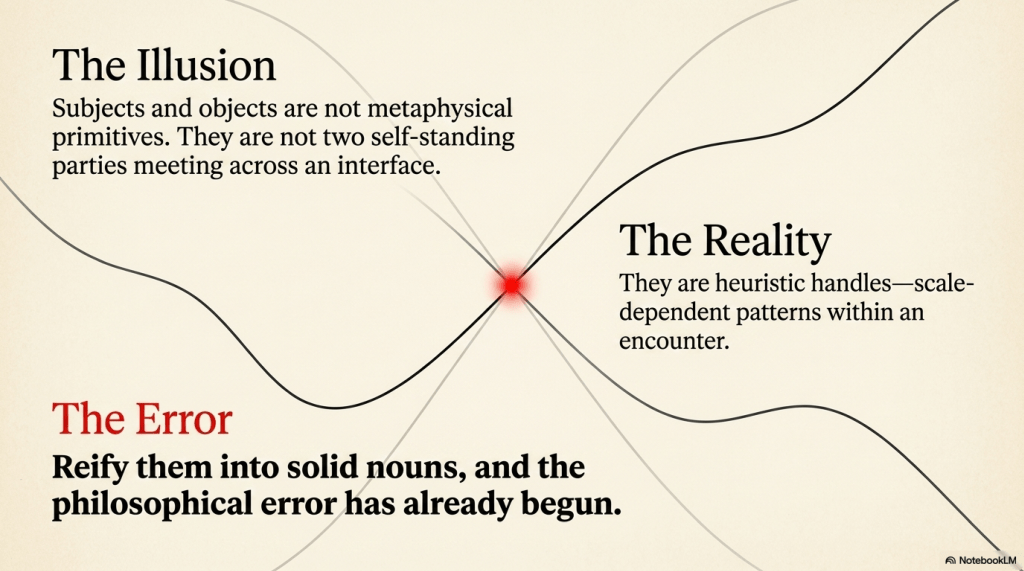
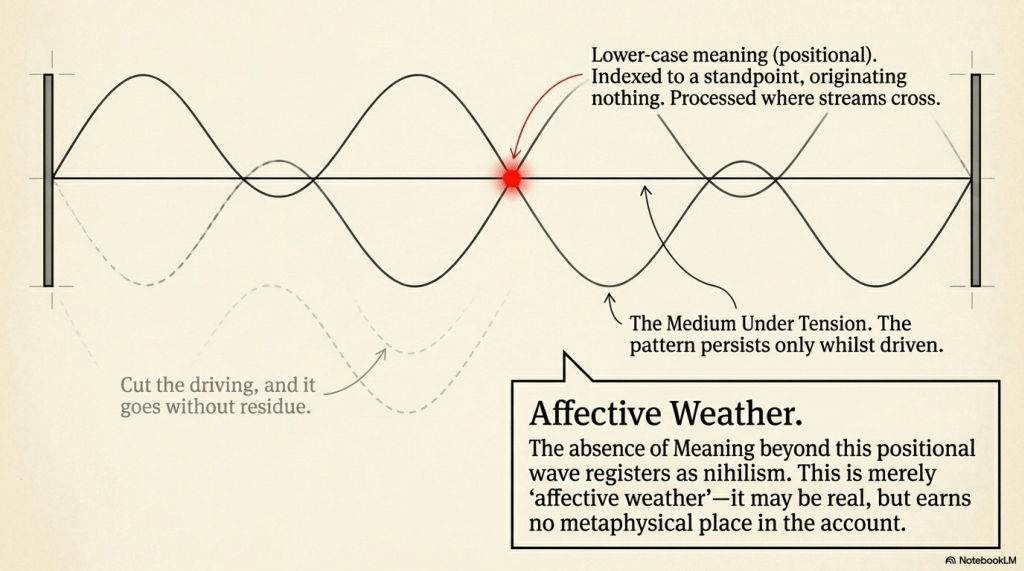
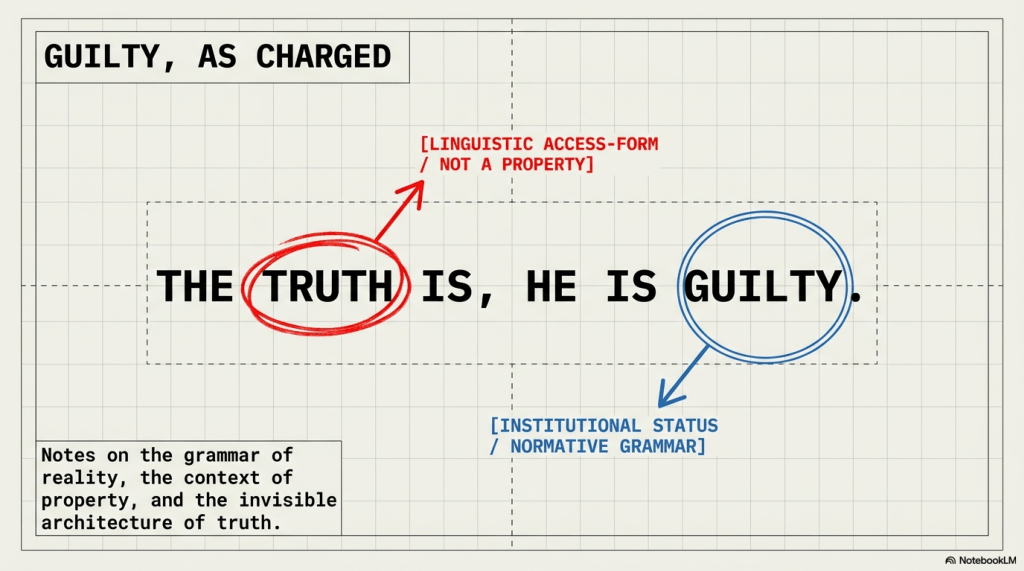
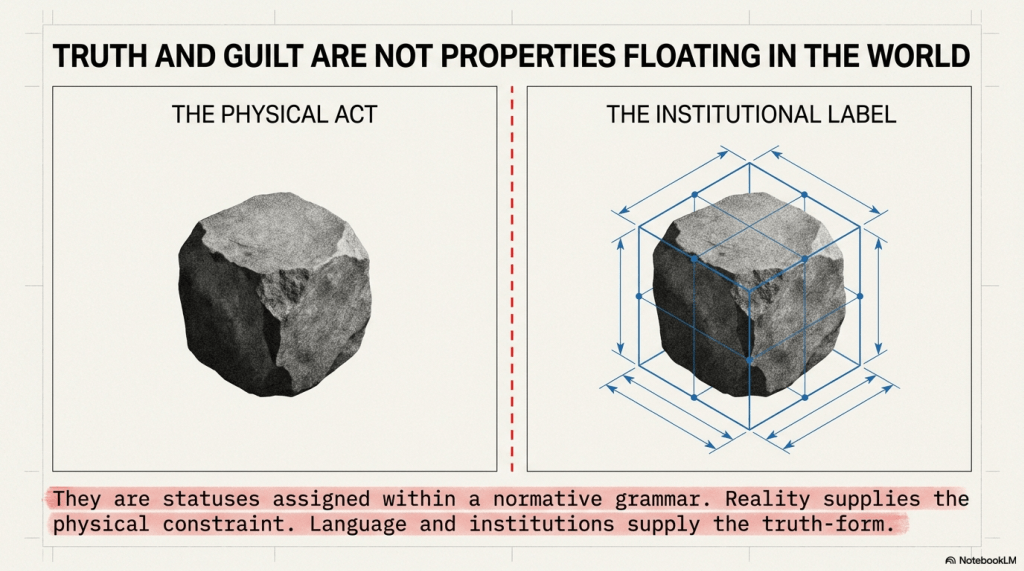
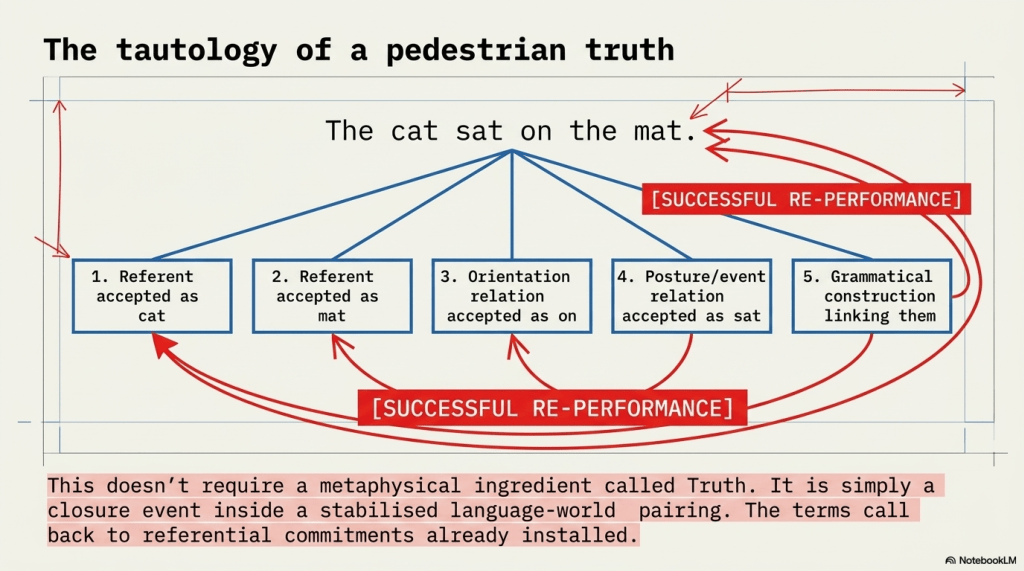
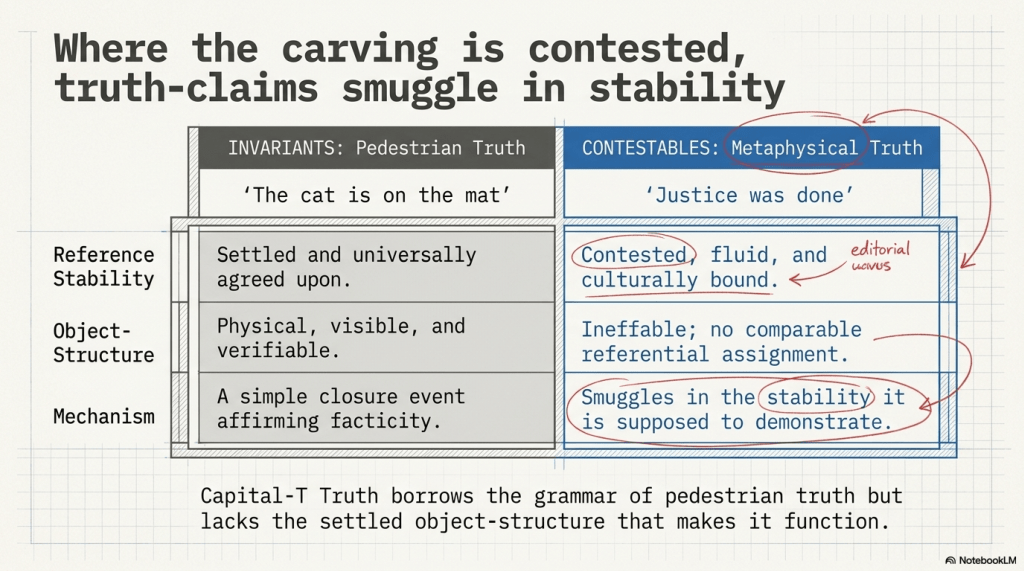
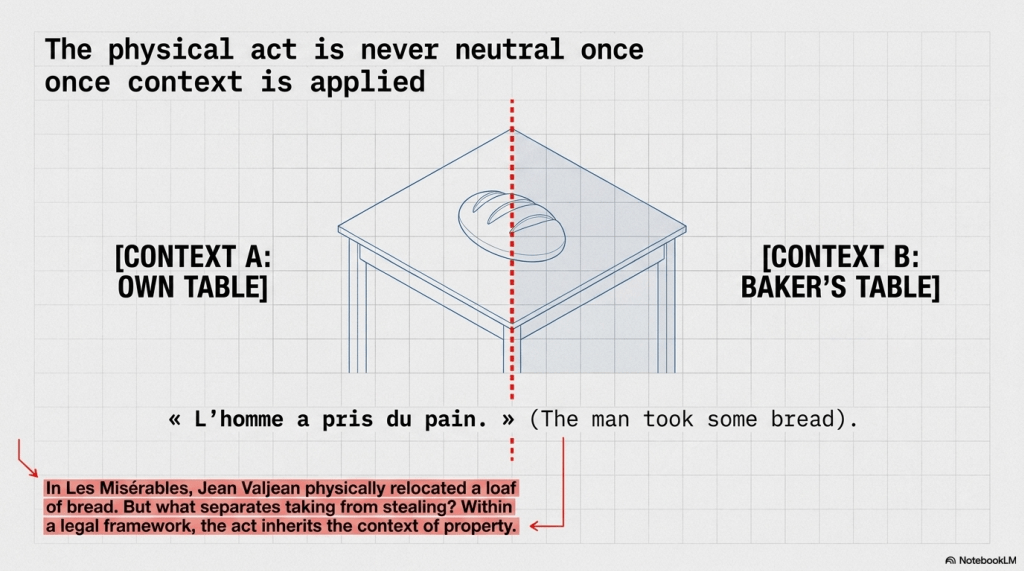
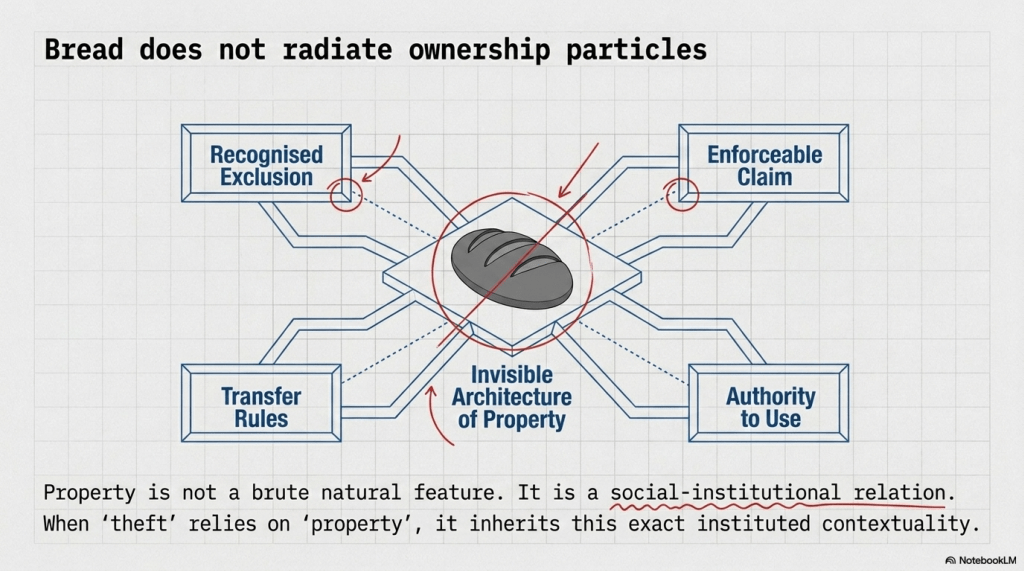
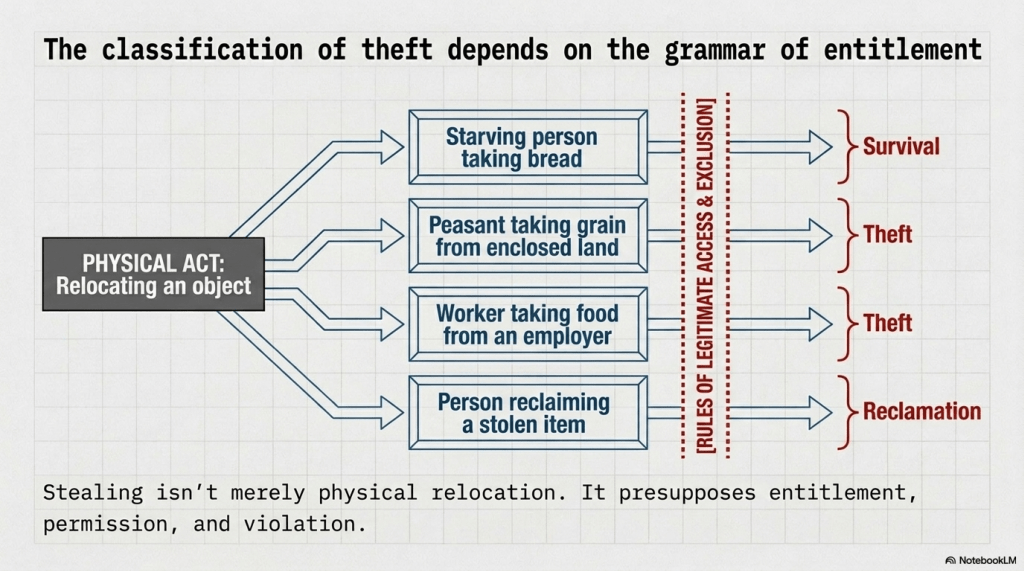
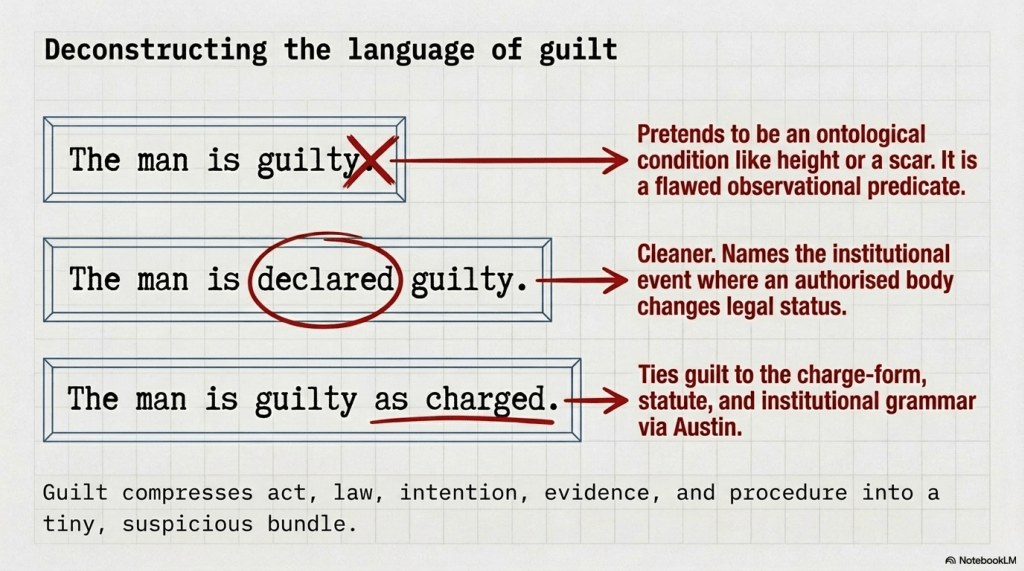
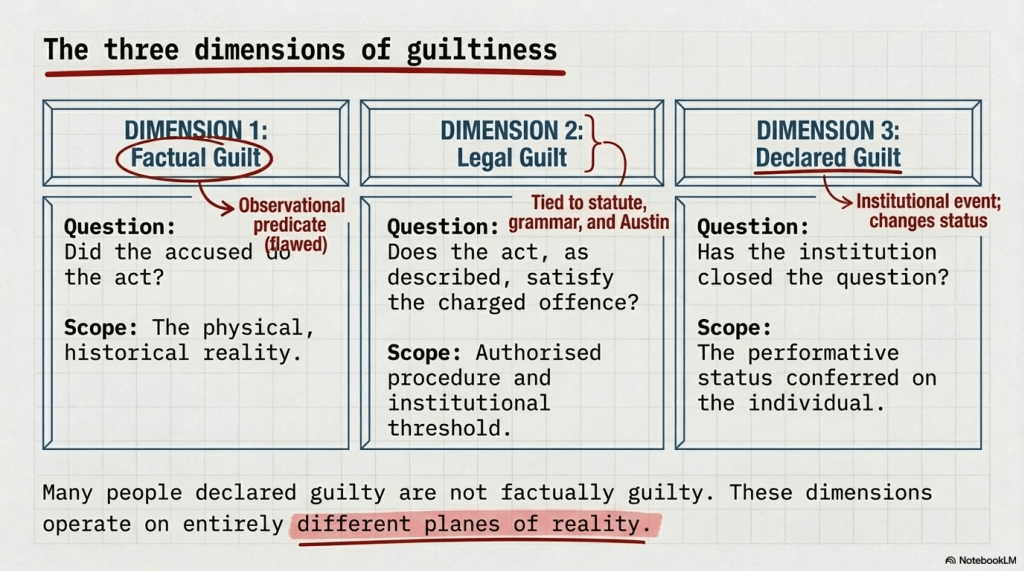
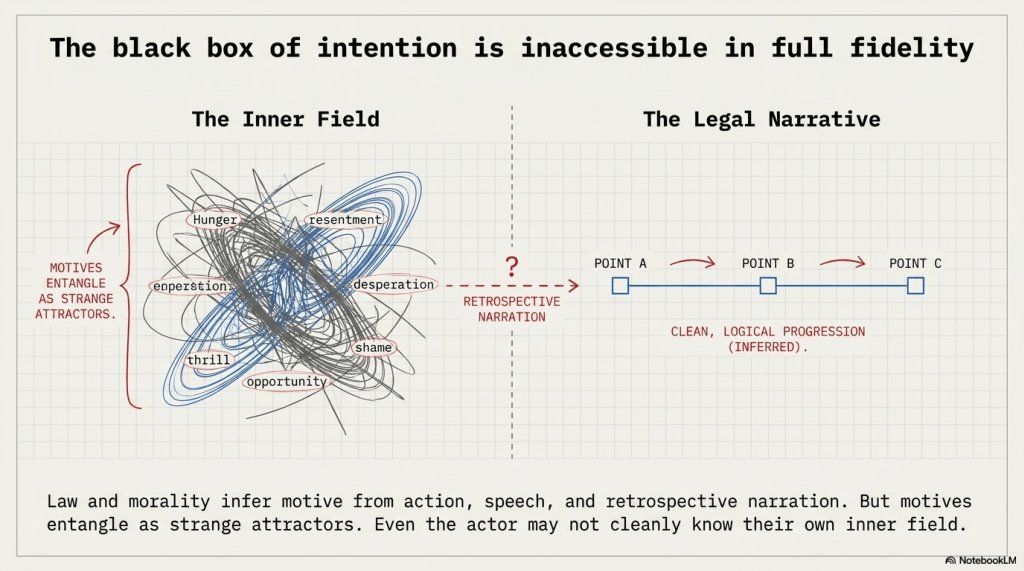
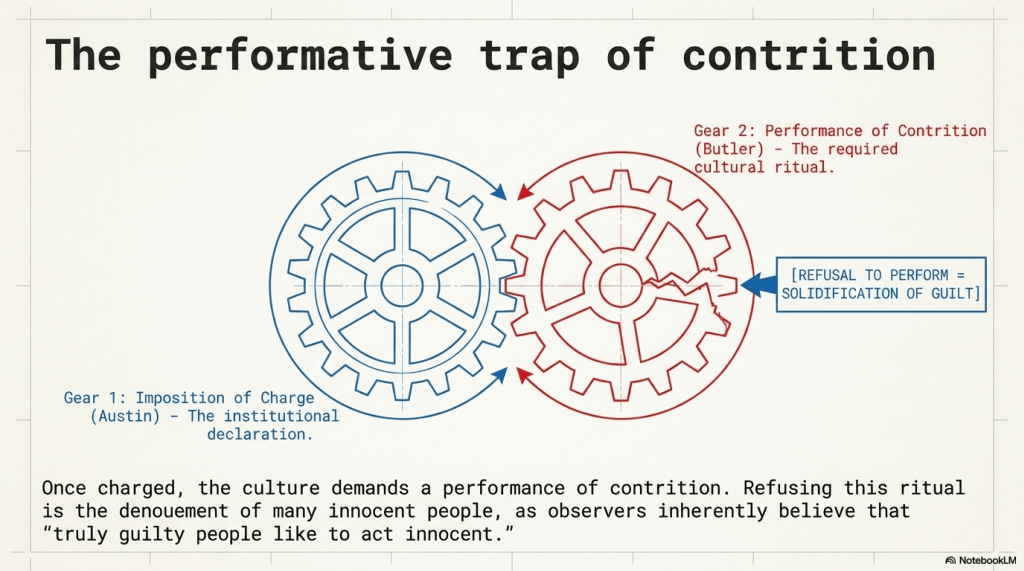
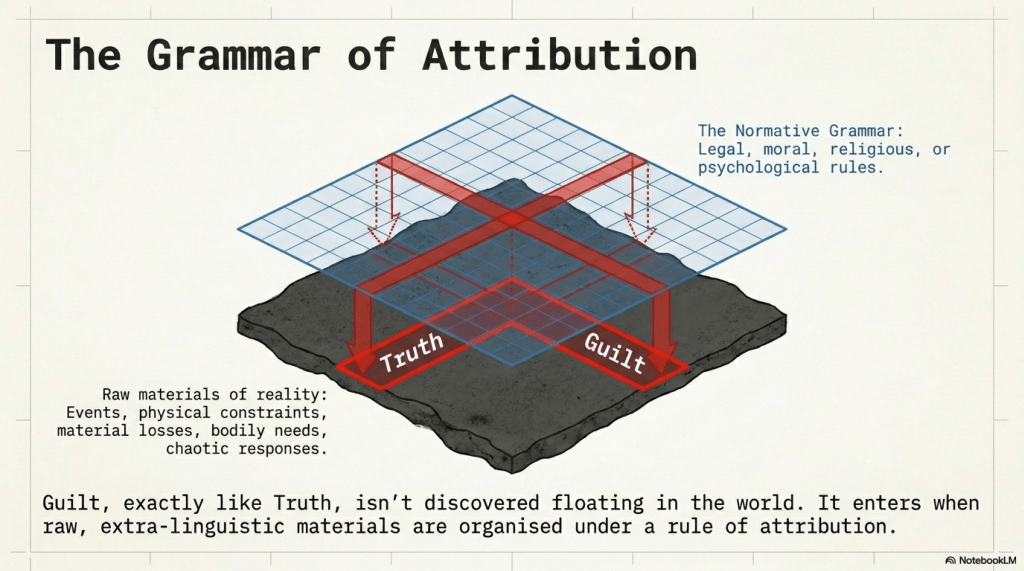
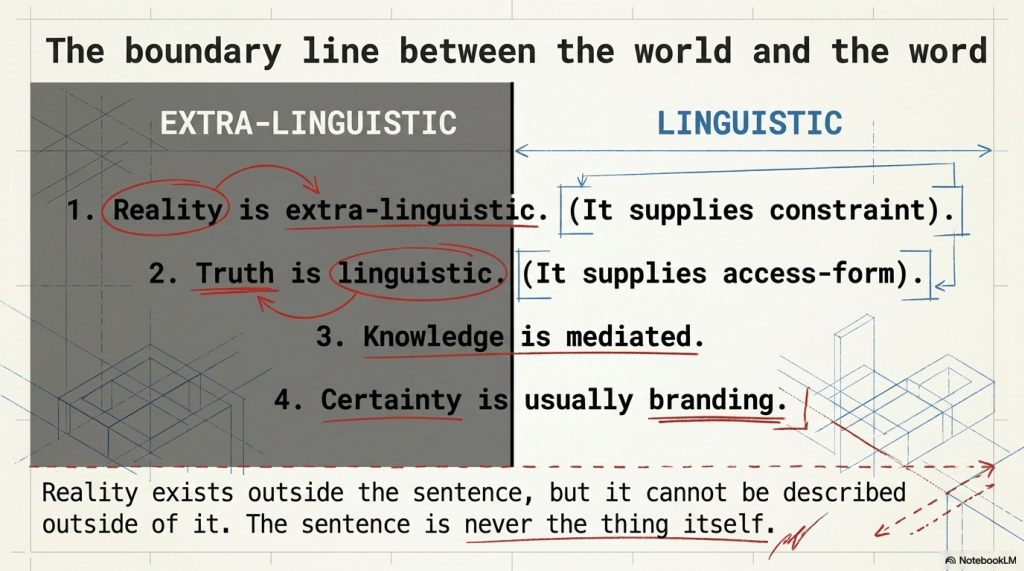
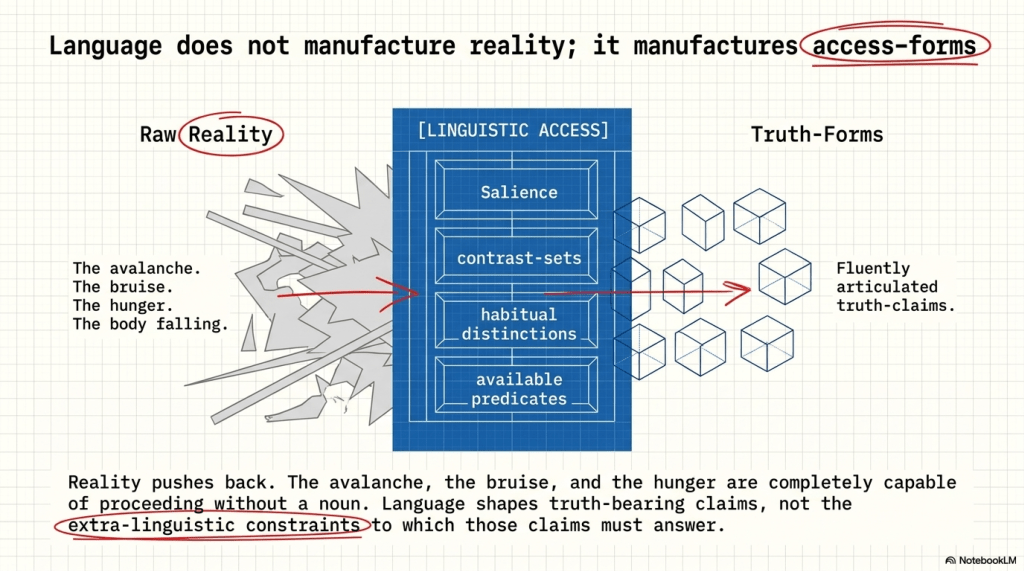
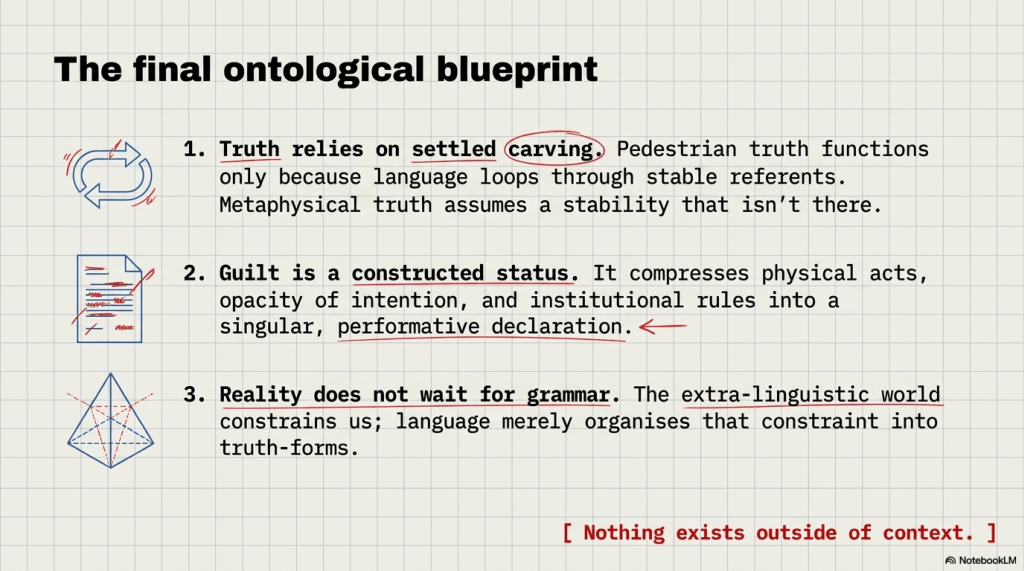
Below are some related NotebookLM images for the target topic.
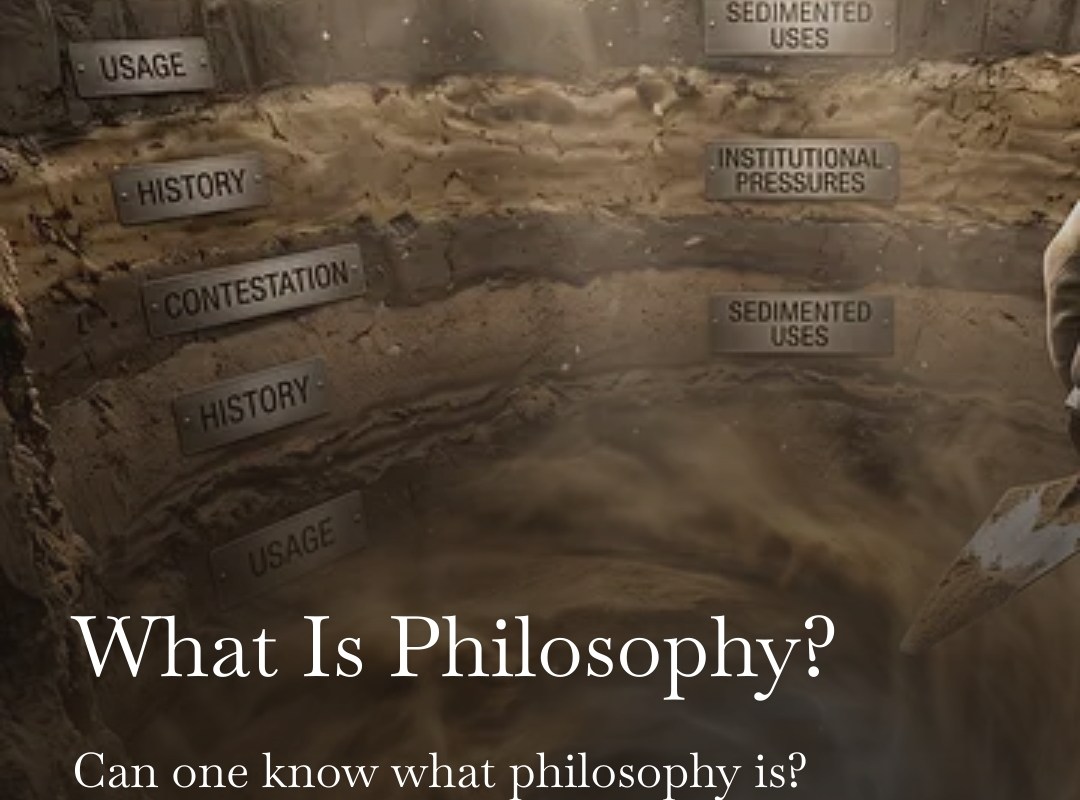
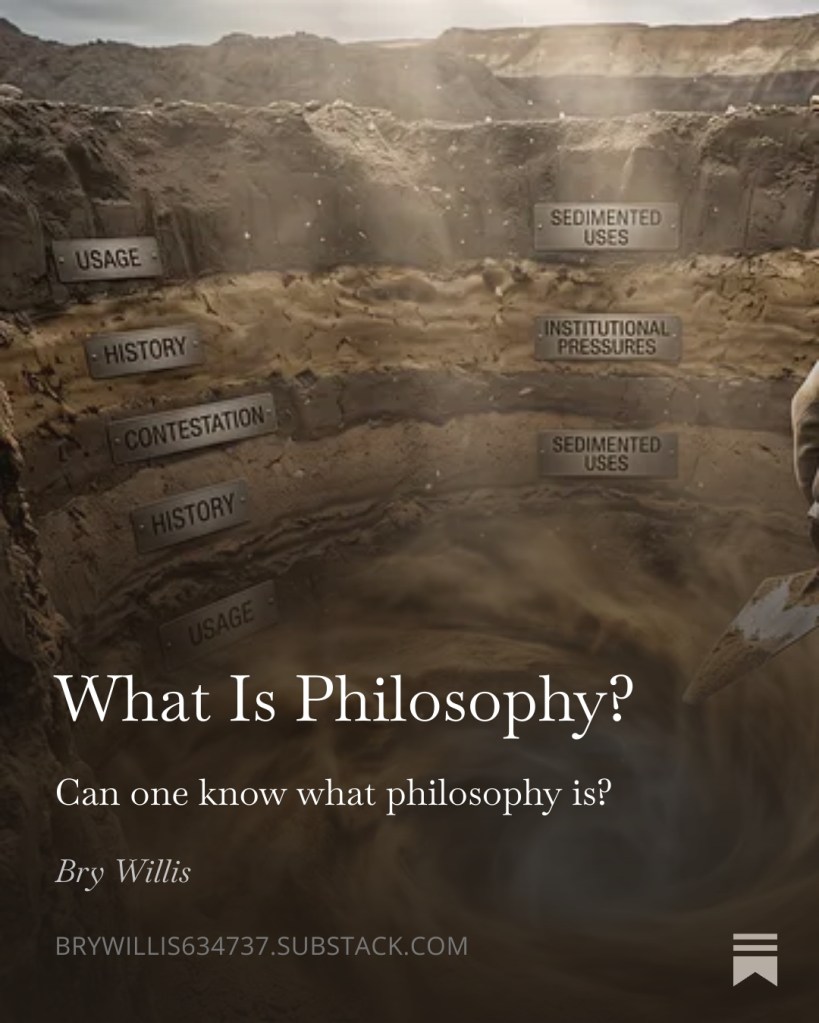
Reading Heidegger’s What Is Philosophy? set me going. Heidegger answers the question not by definition but by retrieval: he takes philosophia back into its Greek setting, as though the older word might disclose what philosophy is. The lecture is the occasion rather than the target. It offers a clean specimen of a manoeuvre that runs far wider. A word’s origin can show where a practice has been, but it can’t settle what the practice is. At least this is what I was thinking as he was making his case.
On God, Objectivity, and the Grammar That Outlives Both
NB: After I posted this, I put some more thought into the notion. Rather than extending this post, I decided to post the follow-up on Substack. Where Nagel asks, What’s it like to be a bat? I ask What’s It Like to Be a Human?
I know a nice philosophical parlour trick. It’s performed by asking someone whether they believe in objective truth. If they say yes, ask them where it comes from; if they say no, ask them whether that denial is objectively true. The trick is not a refutation of anything. It is a demonstration: the concept of the Objective has been installed so deeply in the grammar of the question that you can’t coherently step outside of it long enough to evaluate it. In this respect, you’re a starling who can’t see the murmuration from within it.
Audio: NotebookLM summary podcast of this topic.
Let’s start with Nagel. In 1974, Thomas Nagel published a paper that broke a perfectly serviceable assumption in half. The assumption was that consciousness, while subjective in character, was at least comparably subjective across humans – that the gap between my inner life and yours was a matter of degree, navigable by imaginative projection and shared biology, whereas the gap between me and a bat was of a different order entirely. Nagel’s intervention was to question the first assumption by taking the second seriously. If the bat’s echolocation is genuinely inaccessible – not merely unfamiliar but structurally unreachable, given that I have no experiential raw material from which to construct what sonar feels like – then the inference from ‘I can’t imagine this being’s experience‘ to ‘this being probably has no experience worth worrying about‘ is invalid. Not difficult. Invalid. The bat has a perspective; I can’t access it. These two facts are entirely compatible, not mutually exclusive.
The extension Nagel resisted, but which his own argument demands, is this: the same epistemic closure obtains everywhere. Not merely between humans and bats, or humans and artificial systems, but between any two subjects whatever. What we call human-to-human understanding is not epistemic access to another’s inner life. It’s coordination: shared linguistic conventions, overlapping heuristics, statistical regularities of behaviour stable enough to be gamed and relied upon. We don’t experience each other’s experience. We model each other, well enough for most practical purposes, but then mistake the model for the contact. It’s all too common.
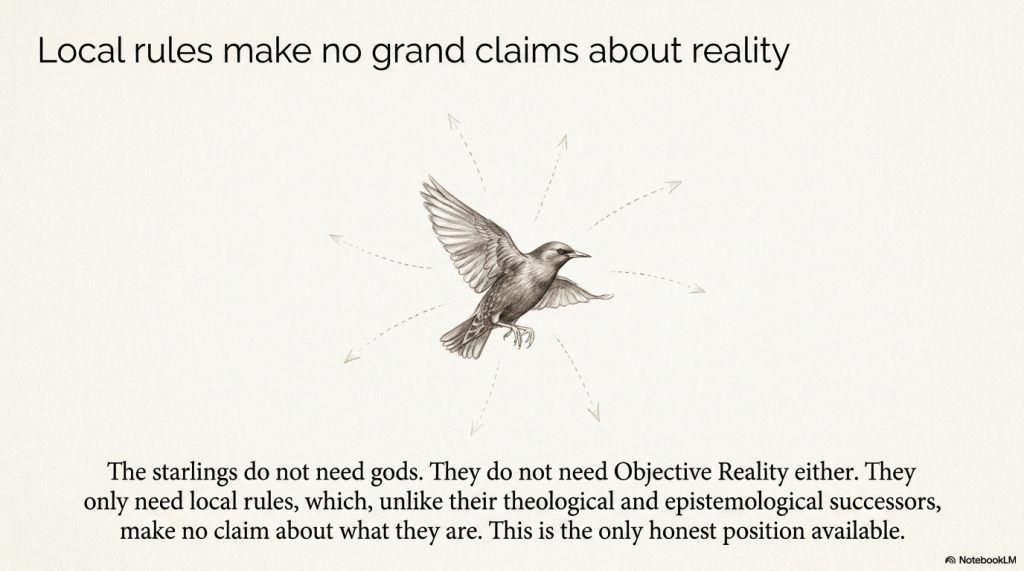
The murmuration of starlings is useful here. A rule of seven: Each bird responds to its seven nearest neighbours. Local rules, local information, irreducibly individual embodiment. The apparent organism wheeling across the sky – that single fluid entity that seems to breathe and turn as one – is a scale-dependent phenomenon that observers impose from a sufficient distance. Pareidolia at work. There is no murmuration-subject, and there is no fact of the matter about what it is like to be the flock, because the flock is not the level at which anything is happening. Whilst the coherence is real, the subject isn’t.
A statistical person is the murmuration.
A statistical person is the murmuration. Every apparatus of governance, moral philosophy, and institutional coordination operates by constructing a subject at the flock scale – the rational agent, the bearer of rights, the member of the moral community, the person before the court. These constructions aren’t errors at all. They’re necessary compressions. Courts can’t adjudicate the irreducible particularity of each defendant; they need the type. But the utility of the compression at the institutional scale isn’t evidence that the compression names anything real at the experiential scale. As the average human isn’t actually a human, the murmuration is not a starling.
What does this mean for the consciousness debate – about bats, digital systems, or the person sitting across from you? The question ‘is there something it is like to be X?‘ isn’t merely unanswered, but it’s malformed as posed. It presupposes a subject-object grammar within which the question makes sense: a discrete, bounded subject, either possessing or lacking inner experience, in principle distinguishable from other such subjects. That grammar produces the apparent problem. Dissolve the grammar, and the problem doesn’t get solved; rather, it gets diagnosed. Which brings us to God…
if God did not exist, it would be necessary to invent Him
Here, Voltaire’s quip – if God did not exist, it would be necessary to invent Him – is almost right. But its failure is in the verb. Invention implies architects: identifiable agents who construct a useful fiction and install it in a credulous population. This is the wrong model for how the objective world works. No one decided to construct it. Rather, it accreted. Each starling wasn’t conspiring to produce the murmuration; the murmuration is what the local rules produce at scale – No intention necessary. The exogenous imposition has no imposer behind it, which is precisely why it presents with such unimpeachable authority. Expose an inventor, and you discredit the invention. But when there isn’t an inventor – when the cage precipitated rather than being built – there isn’t a conspiracy to unmask; there’s no priest to dismiss – only the structure itself, which continues to function regardless of whether anyone believes in it.
Nietzsche understood this better. The death of God, for Nietzsche, wasn’t the liberation it appeared to be. It was the removal of the only anchor the entire normative structure had, without anyone noticing what was actually anchoring what. The Enlightenment didn’t interrogate the theological grammar. It secularised it. Reason, Nature, Science, Progress, History – each of these performed the same function God had performed: the external, authoritative, mind-independent referent against which claims could be measured and from which institutional authority could flow downward to the subject. The architecture was identical; only the tenant changed.
Objective is the edifice. When God was evicted, Reason, Science, Objective Truth became the new tenants
And that’s the point. The Objective isn’t a discovery. It’s a slot, a structural position in the grammar of subject-object discourse that requires an occupant if coördination at scale is to function. God was an early and effective tenant. When God was evicted, the slot didn’t disappear. It couldn’t because it’s not a belief but a grammatical necessity. It was immediately re-occupied, with the additional ideological advantage that the new tenants – Reason, Science, Objective Truth – present themselves as discovered rather than inherited. You can lose faith in God. You can’t, without apparent irrationality, lose faith in Objective Reality, because Objective Reality is now the precondition of the concept of rationality itself. The successor is more entrenched than the original. The slot has been occupied so continuously that it now looks like part of the foundation.
But it’s not. The building is the subject-object grammar, which generates the Objective slot as a structural correlate of the Subject. What fills the slot – God, Reason, the Market, the Algorithm – is the history of ideas, the history routinely mistaken for intellectual progress: the mature species finally locating the real external anchor, after centuries of superstitious misdirection. What’s actually happening is tenant succession. Each eviction is experienced as crisis, where each new occupant presents as the permanent solution. The edifice is never inspected because it’s always occupied, and this occupied building looks like a home.
The diagnostic move, then, isn’t to find a better tenant. Every reform programme, every Enlightenment, every revolution has done exactly that, and the slot fills again within a generation. The diagnostic move is to show that there is an edifice, that the grammar has a structure, that the structure generates the slot, and that the slot’s current occupant inherited its authority from the grammar rather than earning it from the world.
This is a different kind of intervention. Rather than a replacement, it produces a recognition that the coordinating function of the Objective is genuine and the ontological claim isn’t, that the murmuration coheres and the murmuration-subject doesn’t actually exist, that we are starlings – or turtles – all the way down, responding to our seven nearest neighbours, producing from the outside the appearance of a unified orientation toward a common truth.
the statistical person is regular enough to be governed, predicted, and addressed
A relativistic social model operates well enough on this account: It doesn’t require an objective world; it simply requires stable enough local rules that the flock coheres, that the statistical person is regular enough to be governed, predicted, and addressed. The objective world is the name we give to that coherence when observed from a sufficient distance. It’s robust enough for almost every practical purpose. What it isn’t is foundational. Remove the coordinating conventions, and it simply stops being produced.
The starlings don’t need gods. They don’t need Objective Reality either. They only need the local rules, which, unlike their theological and epistemological successors, make no claim about what they are. Which is, in the end, the only honest position available.
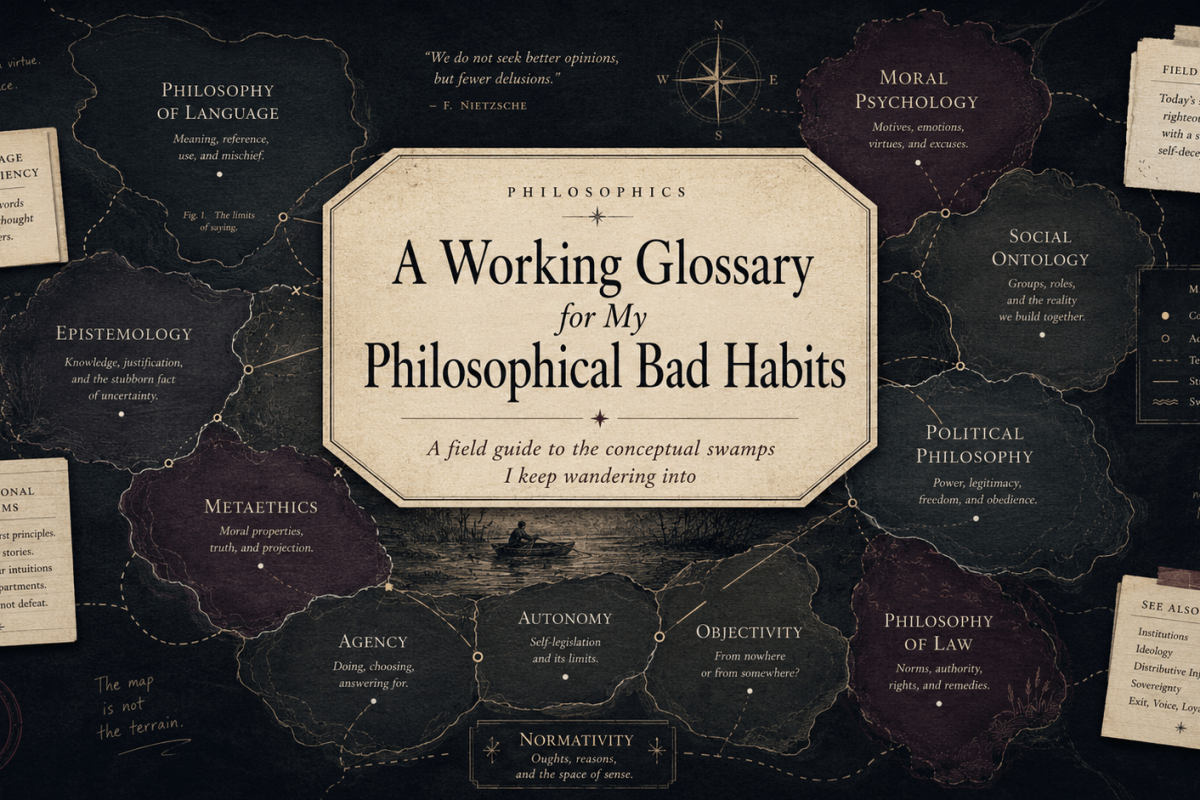
Or: a brief field guide to the conceptual swamps I keep wandering into, despite civilisation’s repeated attempts to pave them over.
As I was updating my PhilPapers profile, I decided to ask (prompt?) my digital colleague, ChatGPT to create a glossary of terms relevant to my work and interests. Perhaps this has SEO value. It doesn’t appear to be in any particular order – just like life – and so it will remain that way. Please leave comments about em dashes and notable LLMisms below.
Audio: NotebookLM summary podcast of this topic.
Philosophy has the irritating habit of naming territories after the people who built fences around them. One begins by asking a fairly ordinary question — why do people keep disagreeing after the facts are settled? — and, sooner or later, someone informs you that you have wandered into metaethics, social ontology, philosophy of language, moral psychology, hermeneutics, political philosophy, or some other administratively sanctioned paddock of the great conceptual livestock farm.
This glossary is therefore not a syllabus, confession, or attempt to claim honorary residence in every department whose windows I have peered through. It is a map of the terms, fields, and adjacent concerns that recur across my work: the Language Insufficiency Hypothesis, the Architecture of Encounter, and my current project, The Architecture of Will. It is also a useful reminder that disciplines are often less like natural kinds than airport signage: helpful, directional, and faintly embarrassing when mistaken for geography.
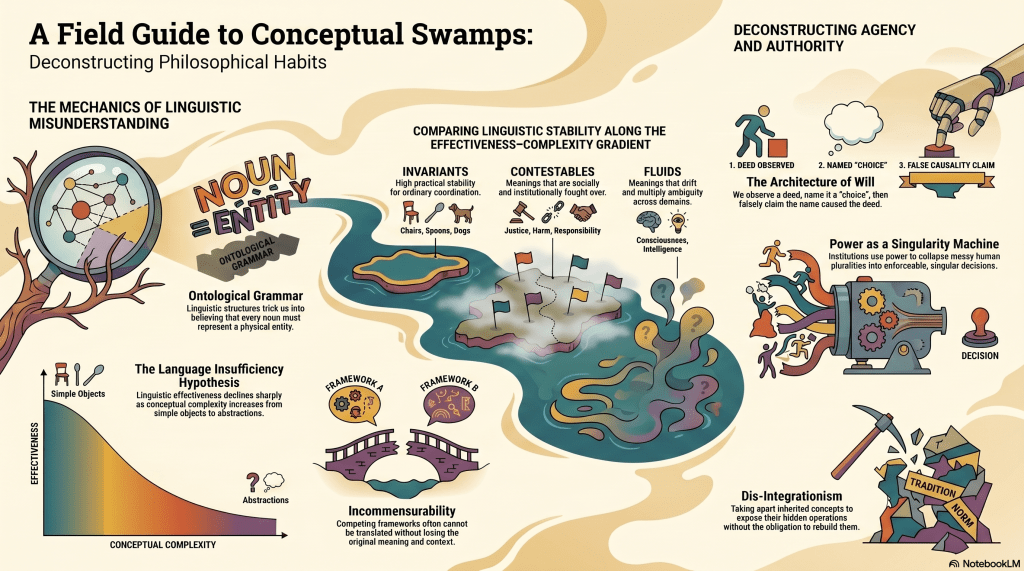
NotebookLM Infographic on this topic.
Philosophy of Language
The study of how language means, fails, points, slips, distorts, coordinates, and occasionally performs the intellectual equivalent of falling down a staircase with a clipboard.
My interest is not chiefly in language as a transparent medium for thought, but in language as a structurally biased encoding system. Words do not simply carry meanings from one mind to another like well-behaved parcels. They compress, frame, prioritise, obscure, and smuggle in assumptions. Many philosophical problems begin when we treat grammar as though it were ontology: because a noun exists, we assume there must be a thing answering to it.
In my work, philosophy of language becomes the diagnostic centre from which many other disputes are reinterpreted. Moral language, political language, legal language, psychological language, and metaphysical language all depend on terms that remain useful long after their referential stability has expired.
Epistemology
Epistemology asks what knowledge is, how it is justified, and what distinguishes knowing from merely believing with good posture.
My concern is with mediated access: the fact that whatever we call knowledge is routed through perception, cognition, language, culture, inherited categories, institutional practices, and power. This does not mean truth is imaginary or that anything goes. That tedious little slogan should be retired and buried under a car park. It means that access to reality is always structured, filtered, and constrained.
Knowledge, on this view, is less a pristine correspondence between mind and world than a stabilised achievement under conditions of mediation. We know enough to function, to build bridges, to poison ourselves predictably, to disagree meaningfully, and to sustain institutions. But we do not know from nowhere.
Metaethics
Metaethics asks what moral claims are doing before everyone starts shouting about which ones are correct.
Are moral claims true or false? Do they express facts, attitudes, prescriptions, social commitments, emotional reactions, or something more inconvenient? My own orientation is non-cognitivist: I am sceptical that moral utterances report mind-independent moral furniture. Moral language looks less like description and more like action-authorising expression, salience-marking, coordination, condemnation, alignment, and pressure.
This does not make morality trivial. Quite the opposite. It makes moral discourse socially potent precisely because it is not merely descriptive. Moral language does things. It binds, excludes, licenses, condemns, absolves, and mobilises. The mistake is treating this performative force as though it were evidence of metaphysical depth.
Moral Psychology
Moral psychology studies how human beings actually make moral judgments, which is already impolite, since most humans prefer to imagine they reason first and rationalise never.
My interest lies in the pre-verbal and affective structure of moral salience. People do not simply encounter neutral facts and then calmly apply moral principles. They register threat, harm, impurity, authority, betrayal, autonomy, dignity, and violation through inherited orientations before reasons are narrated. The reasons matter, but they often arrive after the salience has already fired.
This is why many moral disputes persist even after factual clarification. The problem is not always ignorance. Sometimes the parties inhabit different moral architectures, and language is dragged in afterwards to pretend that one more definition might save the day.
Philosophy of Action
Philosophy of action asks what it means to act, intend, choose, decide, deliberate, and be responsible for what follows. It is where verbs go to be embalmed as nouns.
My current project, The Architecture of Will, belongs here, though it approaches the field diagnostically. I am interested in the will-family: will, volition, intent, motive, choice, and decision. These terms appear to name inward sources of action, but often function as compressed summaries of downstream patterns: conduct, hesitation, avowal, retrospective narration, institutional interpretation, and practical uptake.
The core suspicion is that these terms begin as practical handles and are later misrecognised as hidden authoring sources. The deed is observed, interpreted, compressed into a noun, and then that noun is treated as though it caused the deed. Human beings, naturally, decided this was a solid foundation for punishment. The species continues to be ambitious.
Free Will
Free will is the grand ancestral muddle in which metaphysics, theology, law, blame, self-flattery, and administrative convenience hold hands in a burning building.
My work does not primarily try to solve the traditional free-will debate. I am less interested in proving determinism, libertarianism, compatibilism, or hard incompatibilism than in asking why the vocabulary of will acquired such institutional authority in the first place. The question is not simply whether the will is free. It is whether the term will names anything stable enough to bear the moral and juridical burdens placed upon it.
The suspicion is that the will survives not because it has been discovered, but because too many practices require something like it to be presumed.
Responsibility
Responsibility is one of the great Contestables: indispensable, unstable, and always wearing shoes too polished for the terrain.
It can mean causal involvement, role obligation, answerability, accountability, liability, blameworthiness, reparative duty, or desert. These senses are routinely collapsed into one another, allowing institutions and moral cultures to slide from you were involved to you must answer to you deserve suffering with suspicious fluency.
My interest is in prising these apart. A person may be involved in an event, answerable within a relationship, subject to constraint, or appropriate for treatment without thereby becoming the metaphysical author required by retributive desert. Responsibility may remain useful, but only if we stop pretending it is one thing.
Philosophy of Law
Philosophy of law examines law’s concepts, justifications, authority, and interpretive machinery. It is where society dresses power in Latin and asks everyone to admire the tailoring.
My concern is with legal language as institutional compression. Law cannot wait for perfect concepts. It must decide. Terms such as intent, reasonableness, harm, consent, obscenity, negligence, culpability, and responsibility are not stable objects discovered in the world. They are administrable handles used to convert messy human reality into determinate outcomes.
This does not mean law is useless. It means law is a singularity machine: it collapses plural meanings into enforceable decisions. Procedure may dampen variance; it does not eliminate ontological plurality.
Political Philosophy
Political philosophy asks how power should be organised, justified, constrained, distributed, disguised, or ritualistically congratulated for existing.
My work approaches political philosophy through legitimacy, authority, autonomy, co-authorship, institutional maintenance, and the failures of liberal proceduralism. I am especially interested in the point at which Enlightenment political vocabulary begins to wobble: freedom, equality, autonomy, rights, justice, consent, representation, progress.
These terms are not meaningless, but neither are they stable invariants. They coordinate action because people can gather around them, but they fracture because people do not gather around the same thing. Political conflict is often not a disagreement inside shared concepts, but a collision between different ontological grammars using the same words.
Social Ontology
Social ontology asks what social things are: institutions, roles, money, borders, laws, offices, marriages, identities, statuses, and other collective hallucinations with enforcement budgets.
My interest is in institutions as second-order constraint systems. They stabilise behaviour by imposing categories, procedures, incentives, sanctions, and recognisable pathways of action. They are not merely ideas, and they are not simply physical objects. They are structured practices that persist because people, documents, buildings, technologies, habits, and power keep reproducing them.
Social reality is therefore neither imaginary nor naturally given. It is maintained. This matters because the maintenance work often disappears beneath the language of objectivity, neutrality, or inevitability.
Ontological Pluralism
Ontological pluralism is the view that people do not merely disagree about facts or values; they may inhabit different structures of salience, relevance, legitimacy, harm, authority, and reality itself.
This is central to my work. Many conflicts persist because participants are not simply making different claims within the same world-picture. They are operating from different ontological orientations. One person sees state violence where another sees order. One sees autonomy where another sees abandonment. One sees justice where another sees humiliation. The shared word conceals an unshared world.
Ontological pluralism does not mean every orientation is equally good, harmless, or coherent. It means disagreement often begins deeper than argument admits.
Incommensurability
Incommensurability names the condition in which competing frameworks cannot be fully translated into one another without loss.
This matters because modern discourse is addicted to the fantasy that enough dialogue will eventually produce convergence. Sometimes it will. Sometimes people are merely confused, misinformed, or performing stupidity for tribal applause. But in harder cases, the translation itself fails. The concepts do not line up. The saliences do not register. The terms arrive carrying incompatible worlds.
Incommensurability is not silence. It is structured misregistration. People may speak fluently and still fail to meet.
Hermeneutics
Hermeneutics concerns interpretation: how meanings are formed, inherited, transmitted, distorted, and revised.
I use hermeneutic concerns less as a reverent tradition than as a reminder that nobody interprets from a vacuum. We inherit prejudices in Gadamer’s sense: prior orientations that make understanding possible before they make it questionable. Interpretation is not the secondary act of a detached subject. It is the condition under which anything becomes intelligible at all.
This connects directly to ontological grammar. We do not first encounter raw reality and then interpret it. Interpretation is already in the encounter. The world arrives pre-sorted by histories we did not author and categories we rarely inspect.
Conceptual Engineering
Conceptual engineering asks whether we should revise, replace, improve, or abandon the concepts we use.
I am sympathetic to its diagnostic impulse but wary of its repair fantasy. Not every broken concept needs a shinier successor. Some concepts should be dis-integrated: taken apart so that their hidden operations become visible, without immediately pretending we can rebuild them better. Philosophy has enough contractors. Occasionally, what one needs is demolition with a conscience.
This is where my own term Dis-Integrationism enters. It is not destruction for sport. It is the refusal to treat conceptual breakdown as an automatic invitation to reconstruction. Sometimes the most honest intellectual act is to leave the rubble labelled.
Critique of Enlightenment Rationalism
By Enlightenment rationalism I mean the broad confidence that reason, clarity, classification, procedure, and progress can discipline human life into increasingly coherent order.
My work is not anti-reason in the toddler-with-a-matchstick sense. Reason is useful. So are maps, knives, antibiotics, and chairs. The problem begins when reason imagines itself unconditioned, neutral, universal, and sufficient. Enlightenment vocabularies often mistake procedural clarity for conceptual adequacy and institutional legibility for truth.
The critique is not that modernity failed because it was too rational. It is that it repeatedly overestimated what rationalisation could stabilise.
Autonomy
Autonomy is usually treated as self-rule, independence, or the capacity to author one’s own life. It is also one of modernity’s favourite decorative masks.
My interest is in autonomy as a fiction with consequences. Persons are never self-originating. They are formed through dependence, language, institutions, bodies, histories, injuries, affordances, and constraints. Yet liberal moral and political orders often require autonomy to function as though individuals were cleanly bounded authors of preference, choice, consent, and responsibility.
Autonomy may remain useful as a political safeguard or ethical aspiration. It becomes dangerous when treated as a metaphysical description of the human animal.
Agency
Agency names the capacity to act, intervene, respond, initiate, or alter a field of possibilities.
My approach is deflationary. Agency need not be imagined as a mysterious inner power belonging to a sovereign subject. It can be understood as patterned responsiveness within constraints. Agents do not float above the world, issuing commands from an immaculate interior chamber. They are situated, mediated, scaffolded, interrupted, trained, and compelled.
This does not make agency unreal. It makes it less theatrical. An agent is not a tiny monarch inside the skull. The sooner philosophy stops smuggling monarchy into psychology, the better for everyone, skulls included.
Objectivity
Objectivity is often imagined as the view from nowhere: reality scrubbed clean of position, interest, embodiment, and history.
I prefer a more modest account. Objectivity is not the absence of position, because there is no such absence available to finite creatures. It is a disciplined relation between positions, constraints, methods, and convergences. What matters is not whether one has escaped mediation, but whether one has accounted for it well enough to produce stable, corrigible, cross-perspectival claims.
Objectivity is therefore not magic neutrality. It is an achievement under constraint. The view from nowhere is a lovely phrase, but the actual creature saying it is still standing somewhere, usually on a grant application.
Normativity
Normativity concerns oughts, reasons, rules, obligations, permissions, ideals, and standards: the whole bustling marketplace of what should be the case, according to creatures who cannot agree what case they are in.
My work treats normativity as real in practice but not necessarily as metaphysically deep in the realist sense. Normative claims organise conduct. They express commitments, mark salience, stabilise expectations, and authorise responses. They are not reducible to mere noise, preference, or mood, but neither must they be inflated into eternal furniture.
The question is not whether normativity matters. It plainly does. The question is what kind of thing it is, and whether the grammar of moral seriousness has tricked us into mistaking social force for ontological depth.
Power and Institutions
Power is not merely corruption, domination, or the villain entering in a black cape after pure reason has done its best. Power is constitutive. It stabilises meanings, enforces categories, selects outcomes, and keeps institutions from dissolving into interpretive vapour.
Institutions depend on power because language underdetermines action. When terms such as justice, responsibility, harm, reasonableness, and freedom fail to secure convergence, institutions must still act. They select, enforce, punish, recognise, exclude, and maintain. Power does not resolve the underlying conceptual instability. It pauses it, contains it, and makes social coordination possible for another day.
This is why I often prefer maintenance to resolution. Resolution promises final settlement. Maintenance admits that some conflicts cannot be solved without pretending the plurality has vanished. A mature institution does not abolish fracture. It learns how not to let the fracture become catastrophic.
The Language Insufficiency Hypothesis
The Language Insufficiency Hypothesis is the claim that language’s effectiveness declines as conceptual complexity increases.
At one end of the gradient are relatively stable terms: chairs, spoons, dogs, measurable objects, operationally fixed references. At the other are terms that collapse into metaphor, silence, paradox, or awe. Between them sit the terms that cause most of the trouble: justice, freedom, consciousness, responsibility, harm, autonomy, will. These are usable enough to organise life and unstable enough to generate permanent dispute.
The point is not that language never works. That would be stupid, and there is already enough competition in that market. The point is that language works unevenly, and we do immense damage by pretending its success in simple cases transfers automatically to moral, political, legal, and metaphysical abstraction.
Invariants, Contestables, Fluids, and Ineffables
These are the regions of the Effectiveness–Complexity Gradient.
Invariants are terms with high practical stability. They are not metaphysically perfect, because nothing fun is ever that easy, but they function reliably enough for ordinary coordination.
Contestables are terms whose meanings are socially and institutionally fought over: justice, legitimacy, reasonableness, harm, responsibility. They support disagreement precisely because they are shared enough to matter and unstable enough to resist closure.
Fluids are terms whose meanings drift across domains: consciousness, intelligence, agency, identity. Clarification often multiplies ambiguity rather than reducing it.
Ineffables are where language reaches its limit: grief, awe, mystical experience, radical alterity, some forms of pain, and perhaps the felt interiority of another life. Here language does not stop being useful, but it stops pretending to be adequate.
Ontological Grammar
Ontological grammar is the tendency of linguistic structure to install metaphysical assumptions before argument begins.
A noun invites us to imagine a thing. A subject-predicate structure invites us to imagine a bearer with properties. A verb can be converted into a nominalised object. A process becomes an entity. A relation becomes a possession. A practical summary becomes an inner faculty. This is not mere rhetoric. It is the machinery by which philosophy repeatedly mistakes grammatical convenience for ontological discovery.
Ontological grammar is one of the central irritants running through my work. It explains why so many philosophical problems seem profound only because the sentence structure has already rigged the room.
The Architecture of Encounter
The Architecture of Encounter is my broader metaphysical framework. Its central move is to treat encounter-events, rather than substances, subjects, or objects, as primitive.
On this view, mind and world are not two separate domains that later require a bridge. They are abstractions drawn from structured encounter. Mediation is not a veil blocking access to reality; it is the condition under which reality is encountered at all. Constraint, resistance, salience, affordance, perception, and language all belong inside the architecture of encounter rather than outside it.
This framework is realist, but not naïvely so. Reality pushes back. But it never arrives unmediated, unstructured, or free from the conditions under which it can be encountered.
The Architecture of Will
The Architecture of Will is my current project: a diagnostic genealogy of the will-family.
It examines will, volition, intent, motive, choice, and decision as terms that appear to name inward authoring sources but often function as compressed summaries of downstream action-patterns. The central concept is authoring displacement: the two-stage process by which a practical summary is converted into an apparent source.
First, a pattern of conduct, hesitation, avowal, interpretation, and uptake is compressed into a noun. Second, that noun is grammatically inverted and treated as though it caused the very pattern from which it was abstracted. This matters most in retributive contexts, where institutions need inward authors in order to make punishment appear deserved rather than merely useful.
The project does not deny deliberation, regret, or practical responsibility. It denies that the nouns we use for these phenomena have earned the metaphysical authority required to ground deserved suffering.
Dis-Integrationism
Dis-Integrationism is my name for a method of taking apart inherited conceptual machinery without the pious obligation to rebuild it immediately.
It is adjacent to deconstruction, but less enchanted by textual mystique and more willing to leave the broken mechanism on the table with a label attached. Its point is diagnostic exposure: to show where a concept derives its authority, what it hides, what institutional labour it performs, and why its apparent coherence may depend on suppressing its own conditions of operation.
Dis-Integrationism is not nihilism. It is maintenance against false repair. Some structures should be rebuilt. Some should be abandoned. Some should be kept only with warning signs bolted to them.
This glossary is not a complete taxonomy. It is a working map of recurring concerns: language and its insufficiencies; knowledge under mediation; moral judgment without metaphysical inflation; institutions as systems of compression and power; autonomy and agency as useful fictions; objectivity without the fantasy of nowhere; and the will-family as the latest site where grammar, law, and moral appetite have mistaken a noun for a hidden source.
The common thread is simple enough, though simple things are often the first victims of professional vocabulary. Human beings inherit terms, build institutions around them, forget their contingency, and then call the result reality. My work tries to interrupt that sequence before the noun becomes a shrine.
Not to abolish language. Not to end moral life. Not to sneer from outside the ruins. There is no outside, and sneering is already over-subscribed.
The aim is more modest and more corrosive: to notice where our words still work, where they fail, where power has been recruited to hide the failure, and where the demand for resolution has become part of the damage.
Self-help, pop psychology, LinkedIn, and the metaphysics smuggled into advice
Self-improvement books rarely begin by telling you what it believes a person is. That would be too honest, and honesty is bad for conversion funnels. Instead, it begins with verbs.
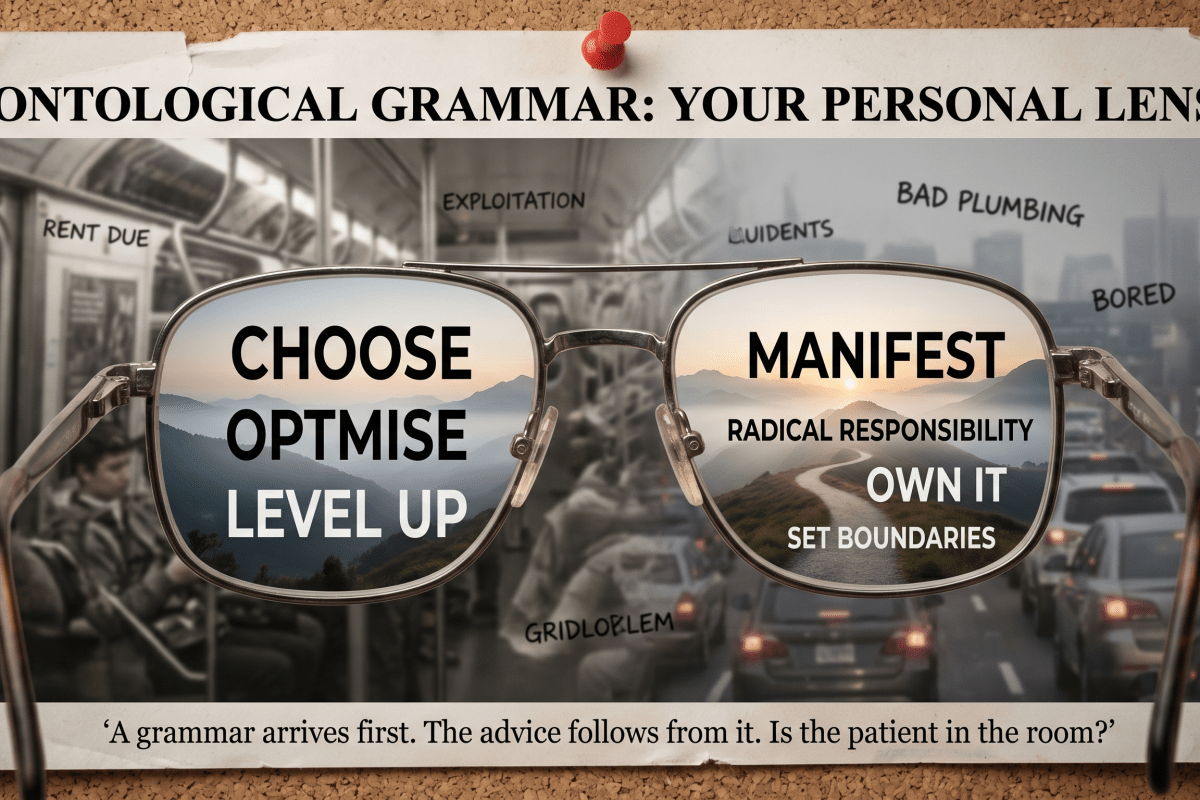
Choose. Decide. Commit. Heal. Optimise. Manifest. Reframe. Own. Level up. Set boundaries. Do the work. Become intentional. Stop self-sabotaging. Unlock your potential. Be your authentic self. Take radical responsibility.
The vocabulary shifts depending on the tradition. One speaks of healing, one of discipline, one of nervous systems, one of leadership, one of purpose, one of abundance. What they share is not a doctrine but a grammar: a way of arranging the person before the advice begins. The subject is always inward, sovereign, and temporarily malfunctioning. The problem is always locatable. The solution is always available, often for $29.99 or in a free webinar that becomes a masterclass for $299.
But here is where the easy cynicism runs out of road, because the people writing this stuff — by and large — believe it.
Audio: NotebookLM summary podcast of this topic.
That is the part of the critique that tends to get skipped, because it is less satisfying than imagining a cynical operator deliberately strip-mining the anxious for recurring revenue. Most self-help authors arrived at their framework the same way their readers are about to: they were struggling, they encountered a grammar that organised their experience, they felt the specific relief of suddenly being intelligible to themselves, and they mistook that relief for discovery. Then they wrote a book about it. The author is not the shark. The author is a previous customer who graduated to the front of the room.
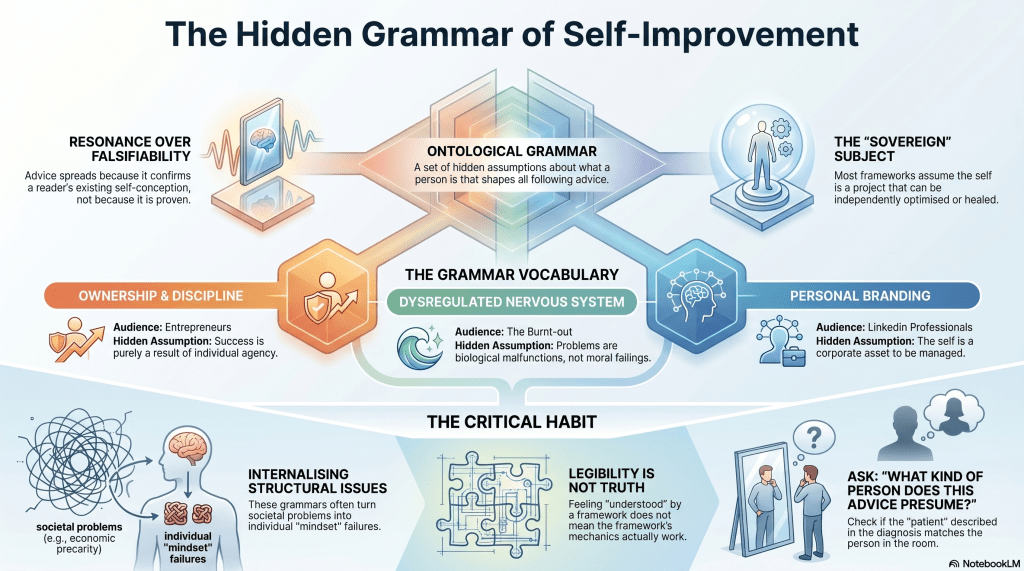
The framework they found — and are now evangelising — is what I call, in The Architecture of Encounter, an ontological grammar: a set of prior commitments about what kind of thing a person is, which arrives upstream of any specific advice and quietly determines what advice is even thinkable. You cannot recommend reframing without first presuming a self transparent enough to observe its own cognitions and sovereign enough to revise them. You cannot prescribe boundaries without presuming a self whose territory is violable and whose autonomy is the relevant moral unit. You cannot offer alignment without presuming a self that has a true direction, temporarily obscured, patiently awaiting discovery through either a values exercise on page forty-seven or a retreat in somewhere with good lighting and worse plumbing.
The grammar arrives first. The advice follows from it. And the person reading it is not being shown a mirror. They are being issued a lens.
The lens finds its wearer. “Take ownership” resonates with people already invested in the idea of themselves as agents who have been insufficiently deliberate — it confirms the worldview while appearing to challenge the behaviour. “Your nervous system is dysregulated” resonates with people for whom the moralised language of laziness and discipline has become intolerable; here is a vocabulary that removes the accusation while retaining the explanation, which is a genuinely useful service even if the mechanism on offer is borrowed loosely from neuroscience and the rest is borrowed from hope. “Mindset is your prison” resonates with people who need their suffering to remain individually tractable — solvable, that is, without anyone having to redistribute anything expensive or inconvenient. “Manifest your abundance” resonates with people who find both structural analysis and self-blame equally unappealing and would like a third option involving the universe.
Each grammar finds its congregation. Which is precisely the problem.
A grammar propagates not because it has been tested against alternatives or evaluated for efficacy, but because it maps onto a prior self-conception cleanly enough to produce the sensation of being understood. The entrepreneur already believes in agency-language: execution, discipline, ownership, leverage. The book that tells them their discipline is the differentiator is not offering new information; it is offering comfortable confirmation in a more expensive format. The therapeutic reader already suspects their relational difficulties involve something called attachment. The book that tells them so is not illuminating; it is flattering them with their own vocabulary. The LinkedIn professional already believes their career is a project of self-authorship. The thought leader who tells them to communicate their value and build authentic leadership is not giving them a strategy; they are giving them a liturgy.
The community that forms around a grammar is a church, not a seminar. It has converts, not students. And like most churches, it is considerably better at solidarity than at falsifiability.
This matters because the mechanism by which self-help content spreads — resonance, recognition, testimonial, referral — is entirely decoupled from the mechanism by which we would establish that it works. A sentence resonates because it fits a grammar the reader has already adopted. That tells you something real: about the anxieties structuring a cohort’s self-understanding, the stories they are trying to make liveable, the descriptions of themselves they find tolerable or intolerable. It does not tell you whether the intervention produces the claimed effect, in whom, under what conditions, and compared with what alternative. Those are duller questions. Less shareable. They do not fit on a carousel post with a soft gradient and a mountain.
Horoscopes also resonate. So do conspiracy theories, national myths, and the first chapter of any book you buy during a difficult stretch of your life.
The point is not that the advice is necessarily wrong. Sometimes “set boundaries” is exactly right. Sometimes “take ownership” is precisely what someone has been avoiding hearing. Sometimes a new frame genuinely reorganises attention in ways that produce durable change, and the person is measurably better off for having found it. None of that is in question. The question is whether a framework that produced one useful instance has any reliable claim to truth beyond that instance — and whether the person reaching for it during a difficult period is in any position to make that evaluation carefully.
They usually are not. That is not stupidity. That is the condition of being in difficulty: you reach for intelligibility, and whoever offers it collects a great deal of credit. The problem is not the reaching. The problem is that the self-help ecosystem — including the parts of it operated by entirely sincere people who believe every word they publish — has no reliable mechanism for distinguishing frameworks that help from frameworks that merely feel like help while the underlying situation continues undisturbed. The true believer and the true seeker share the same vulnerability. Both reached for a grammar. One of them got to write the book.
NotebookLM Infographic on this topic.
It is also worth noting that commerce is the easy villain here, and an overrated one. The same dynamic runs through pop psychology, where the grammar of individual cognitive mechanisms tends to dominate because it produces legible interventions in a way that structural analysis never quite does; blaming cognition is tractable, blaming the organisation of society is dispiriting and hard to monetise, even when it is accurate. It runs through LinkedIn, where the grammar is not therapeutic but managerial — the self reimagined as an optimisable professional asset — and where burnout becomes a boundary failure, precarity becomes an invitation to upskill, and alienation becomes a purpose deficit. Nobody on LinkedIn is necessarily trying to extract money from anyone. Many of them are trying to be useful, or to be visible, or both, which is human enough. But the grammar they are deploying disappears material conditions into interior architecture with the same efficiency as the most cynically produced wellness content. The mechanism does not require a profit motive. It requires only a grammar and an audience that already shares it.
The useful response to all of this is not wholesale dismissal, which would be too easy and almost certainly wrong. Some people need clearer habits. Some need better descriptions of their own conduct. Some need permission to stop tolerating what they have been tolerating. Some need a vocabulary that makes their own patterns visible, and a framework — however approximate — is better than none. These are real services. The fact that they are sometimes delivered inside a dubious metaphysics of the person does not automatically negate them.
But there is a question worth developing the habit of asking, before the grammar installs itself: what kind of person does this advice presume? Is the self it describes sovereign, where I am actually constrained? Wounded where I am actually responsible? Deficient where I am actually being exploited? Misaligned where I am actually just bored? In need of self-belief, where I am in need of rent?
These questions are less fun than a morning routine designed by someone who has never had a difficult commute. They do not come with a community or a badge or an accountability partner who sends encouraging voice notes. But they do something the grammar on its own cannot: they ask whether the patient described in the diagnosis is the one actually in the room.
Most self-help skips that step. So, not infrequently, does the person who wrote it. They found a grammar that made their experience legible, felt the relief that comes from that, and never quite got around to distinguishing legibility from truth. Which is understandable. It is also, for everyone downstream of that decision, a problem.
I don’t occupy this shared space of ontological grammar, so I call bollox.
Full Disclosure: This article was drafted by ChatGPT 5.5 and Claude Sonnet 4.6 upon a discussion of my perspective on self-help, pop psychology, and LinkedIn. I am busy with other projects, but I wanted to share my position. Apologies to those who don’t prefer LLM-authored or assisted articles.
My goal is to articulate the connexion between ontological grammar commitments, the noted disciplines, and more. As should be evident, I am not a fan of self-help or some adjacent modalities.
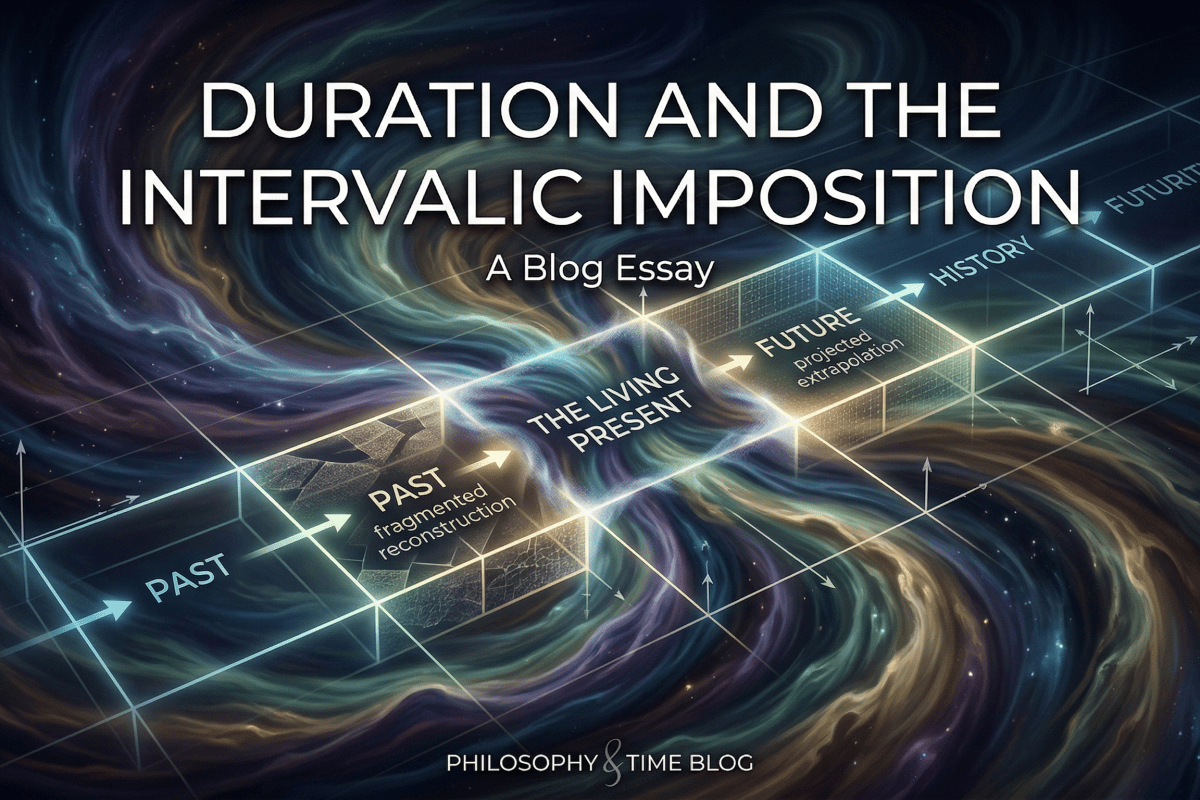
I’ve got a new annotated edition of Heidegger‘s Being and Time, and it’s got me thinking about time – and thinking out loud. Obviously, Husserl is invoked by Heidegger, and the notion of duration (via durée) is from Bergson. Memory is not stored in the brain by| Victoria Trumbull on IAI TV might have been the real tipping point. I’m not sure how far I’ll develop this, but I wanted to capture my thoughts so I can refocus on my other topics, Parfit and Frege–Geach, to name two.
Audio: NotebookLM summary podcast of this topic.
NB: I feel compelled to walk the NotebookLM podcasters back onto the reservation with their ending flurry. I would never posit that humans (or beings) will ever have direct access to The Universe™. All access, per MEOW, is necessarily limited by mediational encounter.
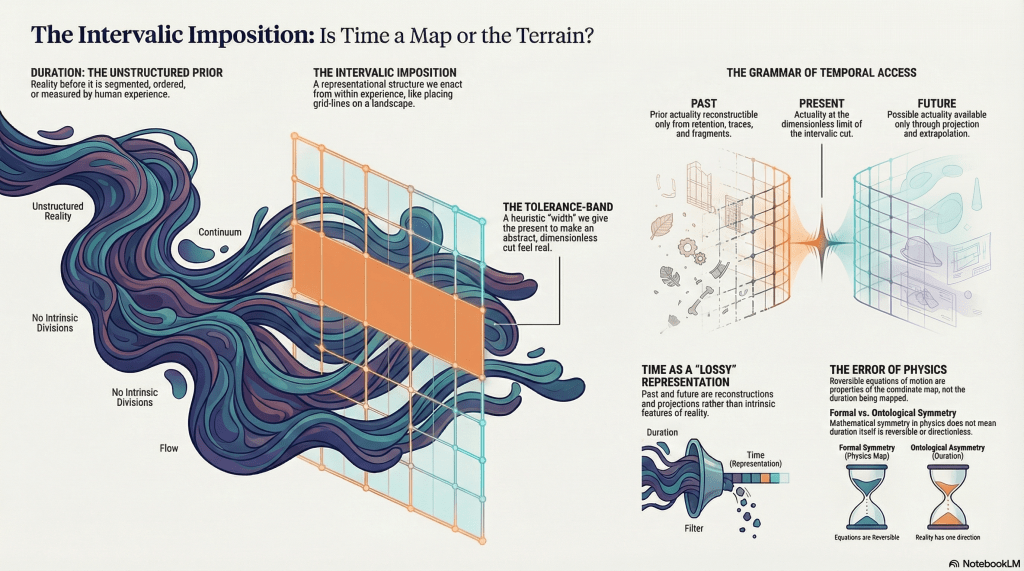
Duration – in a sense that will require distinguishing from Bergson’s – is ontologically prior. It is not the absence of structure but structure prior to segmentation, ordering, and metric discretisation. Time – segmented into intervals, directionally ordered, and metrically structured – is what results when intervalic form is imposed upon duration. The imposition is representational rather than discovered: we do not encounter intervals in duration any more than we encounter grid-lines in a landscape. It is not imposed from outside experience but enacted from within it, through the structuring operations by which finite subjects render duration intelligible as time, and this includes succession itself. The ‘before-and-after’ of temporal experience is not inherited from duration but is itself a product of the intervalic cut – the minimal structure required for the grid to function as a grid. Without this stronger claim, the imposition would merely metricise an already ordered flow. Duration would then retain an intrinsic direction independent of the grid. The present thesis denies this: prior to the imposition, duration has no intrinsic ordering of the sort the grid later makes available. This does not make time unreal; it makes it derivative. What follows is an articulation of the temporal distinctions that become available once the imposition is in place.
Once the intervalic cut is made, experience within its frame exhibits an asymmetric structure. The present, the past, the future, history, and futurity are not features of duration itself but modes of access that become intelligible only within the imposed temporal grid. They may be stated compactly:
Present – actuality at the dimensionless limit of the intervalic cut.
Past – prior actuality, no longer extant, now only reconstructible from retention, trace, and surviving fragment.
Future – possible actuality, not yet extant, available only through projection, expectation, and extrapolation from present constraints.
History – lossy interpolation from fragmentary surviving traces of prior actuality.
Futurity – lossy extrapolation from present constraints, tendencies, and uncertainties.
Because the grid resolves duration only partially and from a situated cut, both reconstruction and projection are necessarily lossy: the former inherits only traces of what has been structured, the latter extends only tendencies available from where the cut presently stands.
NotebookLM Infographic on this topic.
What ordinary experience calls the present is not, however, the dimensionless limit itself. It is a heuristic tolerance-band, a phenomenal spread across the cut that permits experience to function as though it inhabits a moment with extension. The strict present, as a product of the intervalic imposition, is an abstraction: a point that formal structure requires but that experience cannot occupy without borrowing width from duration. It is here, at the tolerance-band, that the imposition fails to fully displace what it organises. The failure is not accidental. Any representational scheme that discretises a continuous prior will underdetermine what it carves – there will always be a residue that the grid cannot fully resolve. The tolerance-band is where that residue is phenomenally evident.
The asymmetry between past and future is real, but it is real within the grammar of access generated by the intervalic imposition rather than as a primitive feature of duration itself. The past is reconstructed from what has obtained; the future is projected from what may obtain. A natural objection arises: if duration is truly without intrinsic direction, why is this asymmetry so stubbornly one-way? Why can we not reconstruct forwards or project backwards in any equivalent sense? The answer is that the imposition is not directionless even though what it is imposed upon is. The intervalic cut does not merely segment – it orders, and the ordering it introduces is irreversible because the cut is made from within experience, by subjects who retain traces of what the grid has already structured but have no corresponding access to what it has not yet reached. The arrow belongs to the act of imposition, not to duration itself.
A corollary follows for physics. Bidirectional temporal coordinates are artefacts of the intervalic grid, not discoveries about the deep structure of what the grid represents. That the equations of motion are time-symmetric means only that the formalism remains invariant under temporal reversal operations. It does not mean that duration is reversible, still less that time could ‘go backwards.’ The reversibility belongs to the representational instrument, the coordinate structure and its algebraic properties, not to what is being represented. To conclude otherwise is to read the map’s indifference to orientation as evidence that the terrain has none. Philosophical positions that take this inference at face value, the block-universe interpretation being the most familiar, inherit the error rather than originate it. The error itself is simpler and more general: the conflation of formal symmetry with ontological symmetry.
Situating the Argument
The foregoing account operates on terrain that others have worked before, and it owes debts that should be made explicit – not least so that the points of departure are equally clear.
The most obvious creditor is Bergson. The ontological priority of duration, the critique of spatialised time, and the insistence that metric structure is imposed rather than discovered are all recognisably Bergsonian commitments. The departure is equally plain. Bergson characterises duration positively as qualitative becoming, heterogeneous flow, interpenetrating states – a rich inner life that spatialisation distorts. The present account is more austere. It claims that duration is structure prior to segmentation and ordering, but it does not claim to know what that structure is like from the inside. Bergson thinks he can describe what the imposition conceals; the present thesis maintains that description is itself a structuring operation and therefore cannot reach behind the imposition it enacts. Duration here is an ontological commitment, not an experiential report.
Husserl‘s phenomenology of internal time-consciousness provides much of the apparatus for the epistemic layer. Retention and protention, the specious present, the constitutive role of temporal synthesis in experience – these are Husserlian structures, and the tolerance-band is in obvious dialogue with his account of the living present. The departure is that Husserl treats these structures as disclosing the temporal character of consciousness itself, whereas the present account treats them as artefacts of the intervalic imposition. For Husserl, retention is how consciousness holds the just-past; here, retention is a mode of access that the grid makes available. The difference matters because it determines whether the phenomenology is foundational or derivative. On the present account, it is derivative – downstream of the imposition, not prior to it.
The Kantian resonance is structural rather than doctrinal. The claim that the imposition is enacted from within experience by finite subjects, and that temporal order is a condition of intelligibility rather than a feature of things in themselves, places this account in the neighbourhood of the transcendental aesthetic. But Kant‘s time is a form of inner sense – a pure intuition that structures all experience a priori. The present thesis does not commit to this. It says the imposition is enacted by subjects but does not say it is a priori in Kant’s sense, nor that it is a form of intuition rather than (for instance) a contingent cognitive achievement or an evolved heuristic. The source of the imposition is left deliberately underdetermined at this stage, since settling it prematurely would foreclose possibilities the argument has not yet earned the right to exclude.
Finally, the critique of physics ontologising its own coordinate structure has affinities with van Fraassen‘s constructive empiricism – the insistence that empirical adequacy does not entail structural correspondence between formalism and reality. The affinity is genuine but limited. Van Fraassen is concerned with the epistemology of scientific theories in general; the present argument is concerned with one specific inferential error – the slide from formal symmetry to ontological symmetry – and it grounds that error in a prior thesis about the representational character of intervalic time that van Fraassen does not share. The diagnostic is narrower and the ontological commitment is stronger.
What the present account shares with all four predecessors is the conviction that the ordinary temporal framework – past, present, future, measured and directional – is not simply given. Where it departs from all four is in its specific diagnosis of what the framework is: a representational imposition. It structures a priori, it cannot fully displace, and is enacted from within experience by subjects whose epistemic situation is constitutively shaped by the imposition itself.