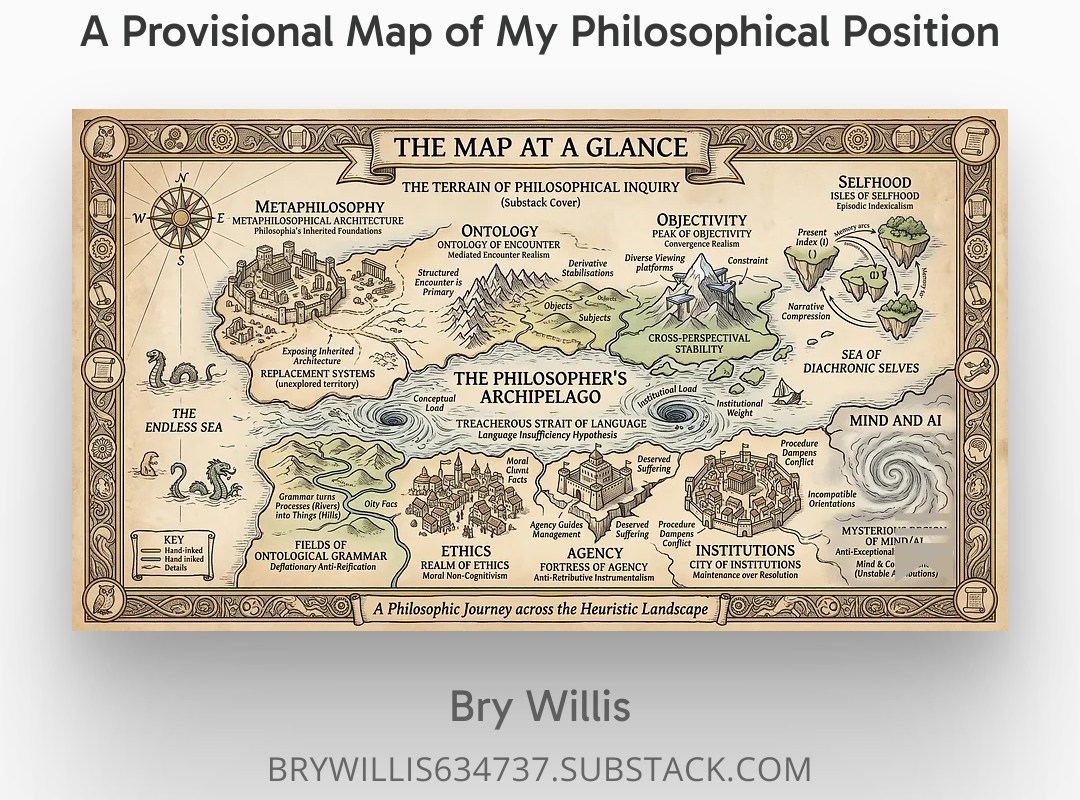
This is the fifth of a deeper look into ten philosophical positions. This one is on convergence realism within the category of epistemology. A full article is available on Substack, with supporting information on a recent post here on Philosophics Blog.
Below is a ~5-minute short podcast.
Language works, but not uniformly.
Its effectiveness declines as the conceptual complexity, abstraction, contestability, contextual dependence, and institutional burden of what it is asked to communicate increase. We routinely mistake grammatical fluency for semantic precision and social agreement for shared reference.
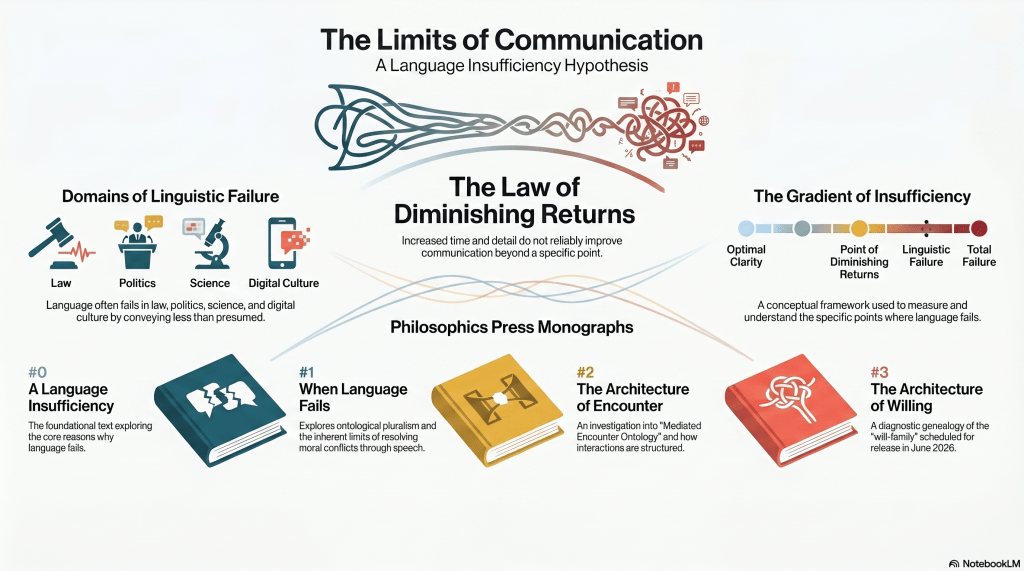
I describe this through an Effectiveness–Complexity Gradient:
Invariants are comparatively stable terms with constrained error ranges.
Contestables remain usable but acquire their force within normative or institutional frameworks.
Fluids drift across contexts and disciplines, preserving family resemblance without reliable closure.
Ineffables mark domains where propositional language collapses into metaphor, gesture, paradox, or silence.
These are not ontological species. They are diagnostic regions along a gradient. The important feature is not the label but the rate at which apparent linguistic effectiveness decays as conceptual load increases.
The question is reasonable, although belief may already be doing more work than I would permit it under cross-examination. My writing is generally diagnostic rather than doctrinal. I am more interested in identifying the architectural assumptions beneath a dispute than in selecting a furnished room within it. Where philosophy offers a contest between established positions, I often suspect that the arena itself has been badly designed.
Still, repeated diagnoses eventually disclose a pattern. Certain commitments recur: suspicion of substance, resistance to metaphysical inflation, distrust of linguistic confidence, rejection of moral realism, scepticism toward persistent personal identity, and an insistence that mediation does not entail fabrication.
What follows is therefore neither a creed nor a completed system. It is a provisional map of where I presently stand.
The labels are intended as coordinates, not allegiances. Where no established term quite fits, I have used my own. This is partly unavoidable and partly evidence for the very linguistic difficulty I spend so much time diagnosing.
This content, including video and podcast summary, are of a longer Substack article on my philosophical positions with descriptions.
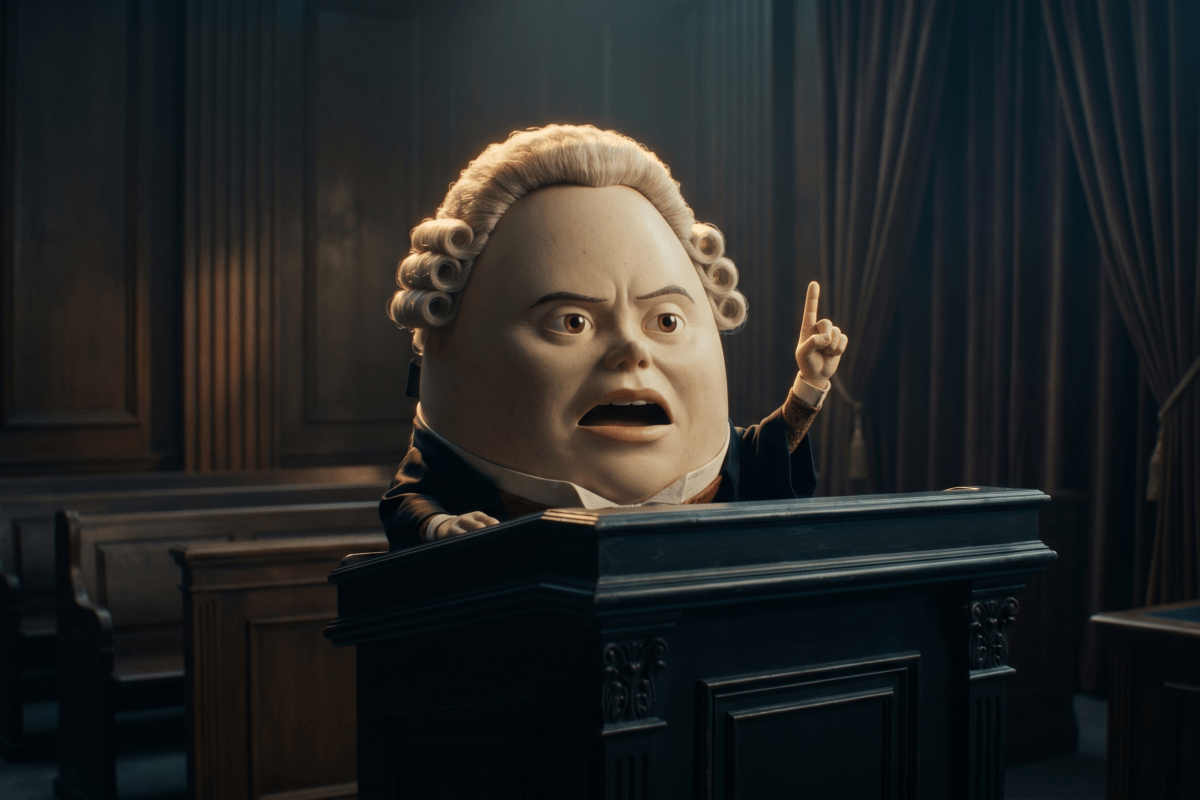
The law has a charming habit of behaving as though language becomes precise the moment someone in a robe frowns at it. Words that drift cheerfully in ordinary life are summoned into court, sworn in, interrogated under oath, and expected to produce stable meaning under institutional pressure. When they fail, as they reliably do, the system does not conclude that language may be structurally insufficient for the task. It consults another authority. A dictionary. A drafting manual. A corpus database. A professor, if civilisation has really run out of excuses. Whatever. Any port in a storm. Then it calls the result interpretation, and everyone pretends the word was waiting there all along.
Audio: NotebookLM summary podcast of this topic.
Watch the video below. It is an admirably clean illustration of exactly this.
What you just watched is not merely a curiosity about punctuation and gun laws. It is a diagnostic. And if you have read Chapter Five of A Language Insufficiency Hypothesis, you will recognise the pathology immediately.
The Repair Cascade
The video gives you three cases, each one a new rung on the same ladder of failed repair.
tl;dr? They tend to make it up as they go to serve their power needs.
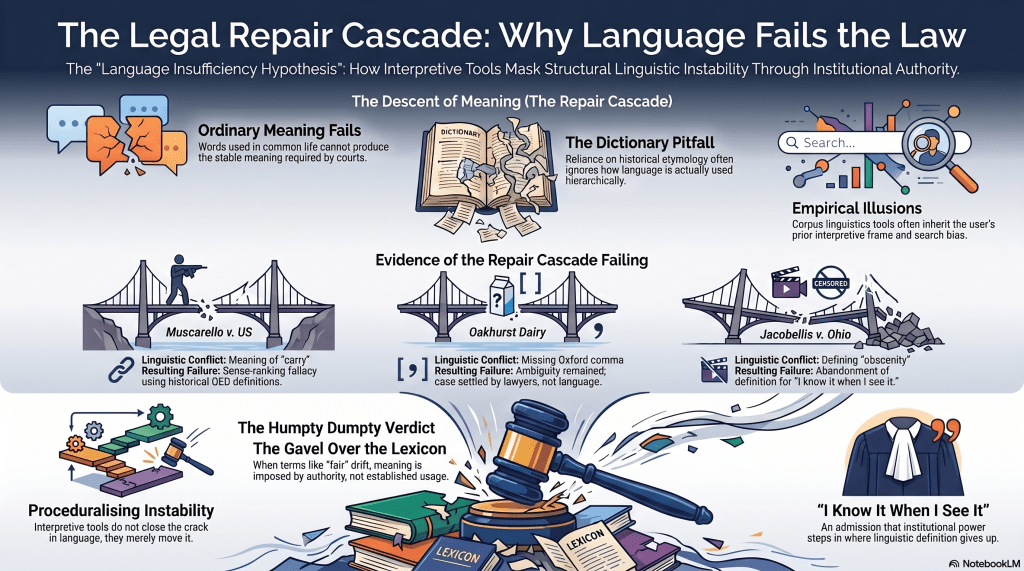
First, Muscarello v. United States (1998): A man transports a handgun in a locked glove compartment whilst conducting a drug transaction. The statute punishes anyone who ‘uses or carries a firearm’ during such a crime. The question is whether ‘carry’ includes a weapon stored in a vehicle. The Supreme Court reaches for the OED, finds that the earliest documented sense of carry includes conveyance by vehicle, and sends Muscarello to prison, where he eventually dies. Convenient etymology. Regrettable outcome.
The video notes – correctly, I might add (and so do) – that this is an instance of what linguists call the sense-ranking fallacy: assuming that the first definition listed is the primary one, rather than simply the earliest documented. The OED’s ordering is historical, not hierarchical. Why a US court chose the OED is a sign of refinement yet remarkably curious for an American institution.
Second, the Oakhurst Dairy case: Maine truck drivers sue for $10 million over a missing Oxford comma in a statutory overtime exemption. Both sides marshal gerunds, asyndeton, the Chicago Manual of Style, and the Maine legislative drafting manual, which explicitly prohibits the Oxford comma – making the ambiguity, in a sense, officially mandated. The case settles without a definitive ruling. The language did not yield a winner; the lawyers did. The hole wasn’t filled, but their pockets were.
Third, and most instructive, corpus linguistics arrives as the shiny new repair tool. Rather than trusting dictionaries, courts can now search large databases of actual language use to establish ‘ordinary meaning’. Progress. Empiricism. Science, even. And then, almost immediately, the next failure mode surfaces: the frequency fallacy (common usage is not the only permissible usage), corpus skew (many databases over-represent news articles), and search-framing (the ‘sanitation’ / ‘sanitise’ mask mandate case, where including a related but non-synonymous word shaped the results before analysis had even begun). The supposedly empirical tool inherited the user’s prior interpretive frame. Extraordinary.
Follow the sad path of the sad panda: ordinary meaning fails → dictionaries → dictionaries fail → corpus linguistics → corpus linguistics fails → methodological dispute about whether judges should be conducting quasi-scientific research from the bench at all.
And so it goes…
Judge Humpty Dumpty: Guilty as Charged (Sorry. No 8-bit video game music. My bad.)
The LIH Reading
In A Language Insufficiency Hypothesis, Chapter Five argues that law is not a domain that occasionally encounters linguistic difficulty. It is a domain that is constitutively dependent on terms that live in the Contestables zone of the Effectiveness–Complexity Gradient – words like reasonable, fair, cruel, due process – terms indispensable to legal order and perpetually unstable within it. The Gradient’s prediction is blunt: the further a term drifts from stable, concrete reference, the more its meaning must be imposed by authority rather than established by usage.
The video illustrates this at the level of what might seem to be relatively simple terms – carry, distribution, sanitation – words that appear to sit closer to the Invariants end of the scale than to the Contestables. And yet even here, the institutional machinery creaks. If ‘carry’ cannot carry the weight of a single statute without Supreme Court intervention and a man’s death, what prospect does ‘reasonable’ have? Or ‘fair’? Or ‘obscene’?
Potter Stewart, as Chapter Five recounts, admitted in Jacobellis v. Ohio (1964) that he could not define obscenity in the abstract. ‘I know it when I see it‘, he declared. The remark is famous for its candour. It is less often noted that it is also an admission that language had simply given up, and that institutional authority stepped in to do what definition could not. The Court didn’t clarify what obscenity means, but it asserted the power to punish it anyway as it might later decide.
The video’s repair cascade is the same mechanism operating at a more mundane level. Legal interpretation doesn’t overcome linguistic insufficiency. It proceduralises it. Each interpretive tool displaces the instability onto a new surface. Dictionaries relocate the problem from statutory language to lexical authority. Corpus linguistics relocates it from lexical authority to sampling, frequency, and search design. The crack isn’t closed. It’s moved, with considerable administrative ceremony, and the ceremony is called clarity – clear as mud.
The law, in short, functions less as a dictionary than as a sovereign Humpty Dumpty: it decides what words mean when it matters, and enforces those meanings until it decides otherwise. The gavel is doing the work the lexicon cannot.
NotebookLM Infographic on this topic.
The Lesson That Isn’t
The lesson here isn’t that dictionaries are useless, corpus linguistics fraudulent, or judges uniquely obtuse. The lesson is structurally worse than that. Each repair works locally and fails architecturally. The law can stabilise meaning long enough to act, and acting is not nothing – Muscarello’s conviction required a determinate reading of ‘carry’, and the system produced one. But it can’t transmute contested language into invariant reference. It can only decide, punish, and maintain the fiction that the word was always waiting there, meaning exactly that.
Textualism – the interpretive philosophy that instructs judges to attend only to the words on the page, nothing more – is, viewed through an LIH lens, an institutionalised form of the Presumption of Effectiveness. It treats language as though it has a singular, determinate meaning recoverable by sufficiently rigorous attention, rather than as a system whose instability is structural rather than incidental. The words on the page are not a fixed source. They are the site of the problem.
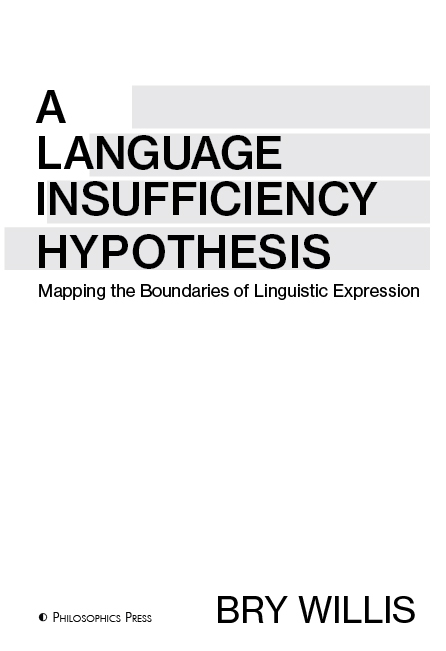
If this framing resonates, Chapter Five of A Language Insufficiency Hypothesis develops the full argument – from the Gradient’s account of why legal language is structurally dependent on Contestables, through Potter Stewart’s famous abdication, to the Humpty Dumpty jurisprudence that inevitably follows. Available in paperback and hardcover from Philosophics Press.
I’ve been getting positive feedback on this book, so I just posted some excerpts from A Language Insufficiency Hypothesis on PhilPapers. I hope this is sufficient to assess whether the book will be of value to you as a reader. Even if you don’t purchase or read the entire book, I am still interested in your feedback here or elsewhere on social media.
Audio: NotebookLM summary podcast of this topic.
Informally, I consider this as Monograph #0, as I hadn’t considered that I’d create a series that follows this concept.
Semantic Infrastructure, Insufficiency, and the False Romance of Interoperability
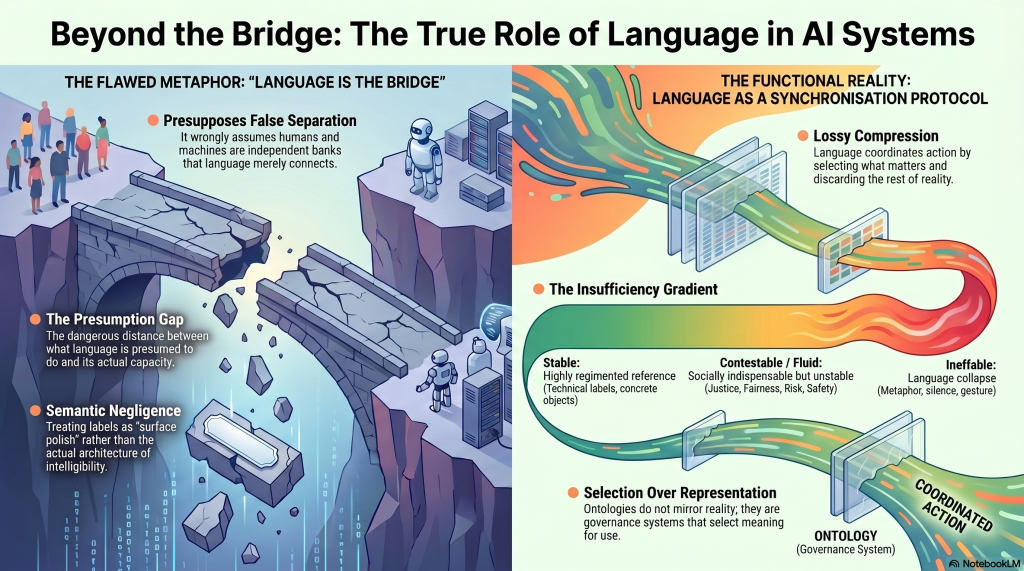
A recent Substack essay, Jessica Talisman’s Language Is the Bridge, makes a claim that is increasingly common in discussions of artificial intelligence, knowledge graphs, ontologies, metadata, and semantic infrastructure: that language is the bridge between human understanding and machine action. The claim is attractive, and not merely because ‘bridge’ is one of those metaphors that allows technical discourse to cosplay as wisdom literature. It captures something real. AI systems, semantic architectures, ontologies, taxonomies, controlled vocabularies, and knowledge graphs do not run on raw reality. They run on structured representations. Those representations require labels, definitions, mappings, alignments, constraints, and interpretive discipline. In that sense, language work is not decorative. It is infrastructural. But the metaphor is also dangerous.
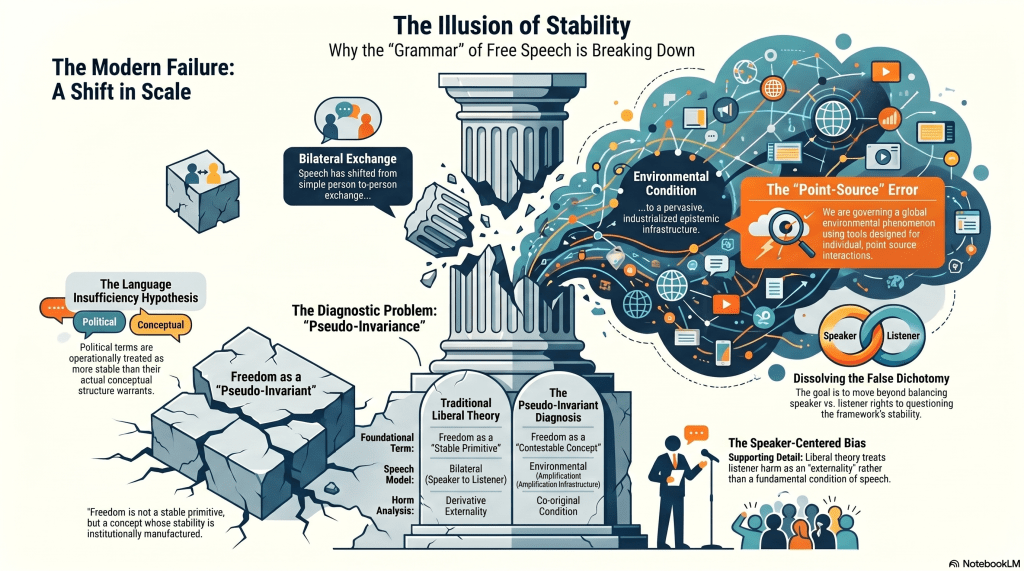
I read from the Wrong Curve: Free Speech, Pseudo-Invariance, and the Grammar of Liberal Rights. This essay is freely available on Zenodo at https://doi.org/10.5281/zenodo.19636760. This segment is the Abstract and the Introduction.
In this essay, I argue that free speech discourse is structured by a category error whose source lies upstream of speech itself: in the treatment of ‘freedom’ as a stable philosophical primitive when it functions, in practice, as an essentially contested concept operating under a systematically inflated presumption of effectiveness.
tl;dr: I don’t believe in free speech.
We’ve all likely heard that the freedom to swing one’s fist ends at the tip of another’s nose. I can accept this without argument for the purpose of this assertion. Your freedom TO violates my freedom FROM.
Audio: NotebookLM summary podcast of this topic.
The problem is that one’s words don’t stop. In some cases, they continue in the manner of pollution that I don’t want my ear holes to be exposed to this noise. In the social media age, this effect is trebled and molests my eyes. This is especially egregious for misinformation and disinformation, which is to say, much of the internet and beyond.
This impact hasn’t been suitably addressed, so I wrote about it. Here, I read.
I had planned to write a blog post on The Remains of the Day, but I posted it on Substack instead because I changed the scope. I also created this podcast on NotebookLM.
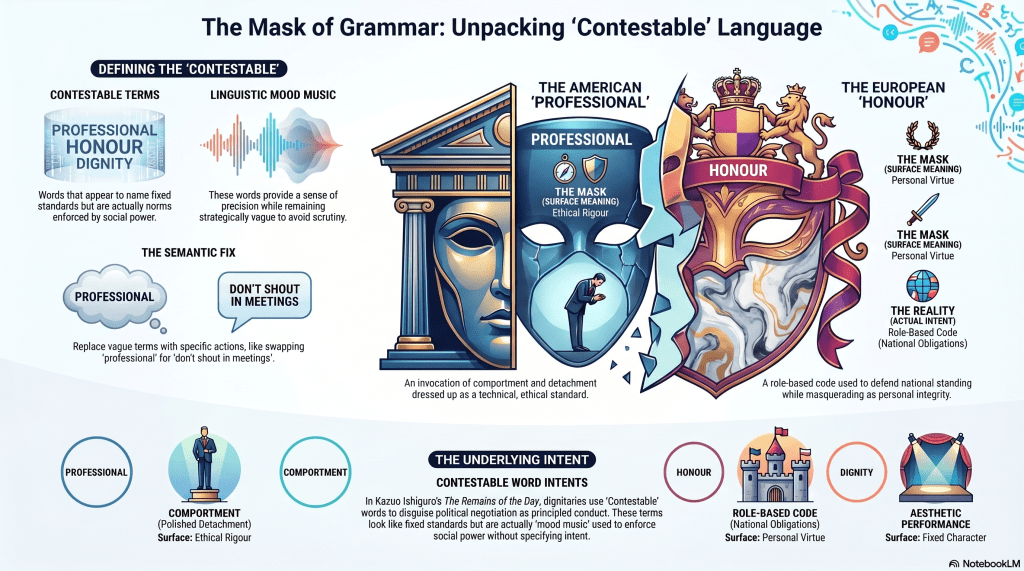
Audio: NotebookLM summary podcast of this topic.NotebookLM Infographic on this topic.
I have just started reading Kazuo Ishiguro’s The Remains of the Day, and I must confess that I can’t read like a normal person.
I made it roughly fifteen pages before the analytical lenses clamped on and refused to retract. Stevens – Ishiguro’s impeccable, heartbreaking narrator – opens with a monologue about what makes a great butler, and I found myself not following the argument so much as watching the scaffolding. Because Stevens isn’t really theorising butlers. He’s performing a world. And the performance is so seamless, so grammatically composed, that it almost disguises itself as description.
Audio: NotebookLM summary podcast of this topic.
Here’s the trick. Stevens treats terms like greatness, dignity, and quality as though they named discoverable features of reality. He doesn’t present them as historically contingent, institution-soaked, liable to buckle under interrogation. He presents them as if the universe itself had ratified them, and he’s merely reporting. It’s the calm, definitional tone of a man who believes he’s describing essences when he is actually curating preferences.
Take butler itself. In ordinary usage, it looks occupationally concrete – a person who does a particular job. But in Stevens’s mouth, it stops being a role descriptor and becomes a bearer of metaphysical vocation. The word accrues civilisational mythology, evaluative freight, quasi-sacred weight, until it no longer refers to a man who answers a door but to a figure who embodies an entire moral cosmology. That is a lot for a job title to carry, and the weight does not come from the world. It comes from the grammar.
Then there is dignity. An interlocutor reasonably suggests that dignity might be something like beauty, a weasel word, like aesthetic, perceptual, taste-bound. Stevens refuses the comparison. Dignity must not sound contingent. It must present itself as something sturdier than preference, almost an objective feature of character, something a person has in the way a table has weight.
And then, naturally, he proceeds to explain it in entirely aesthetic terms: comportment, bearing, restraint, and poise – the look of self-command.
He denies the aesthetic register but then relies on it. His explicit philosophy and his operative language diverge. This isn’t a slip. It’s structural. The term needs to disavow its own supports in order to retain authority. Dignity must deny its kinship with aesthetic discrimination precisely because, without that kinship, it has no flesh.
We do this constantly – take the shakiest words and polish them until they look load-bearing. The more pressure the term is under, the more ceremonially we utter it.
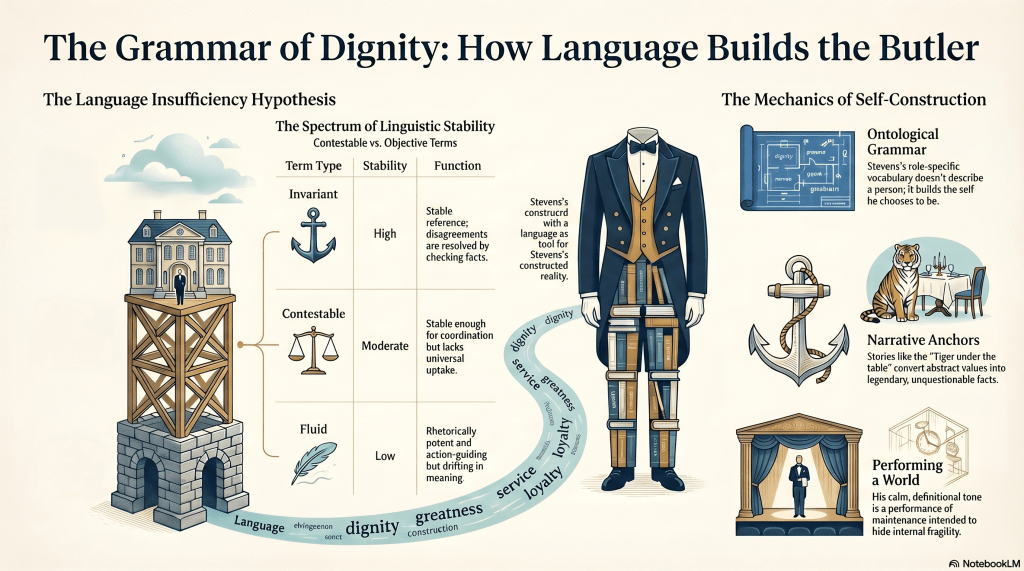
NotebookLM Infographic on this topic.
Weasel words
There’s a name for what Stevens is doing, and I’ve spent a perhaps inadvisable amount of time trying to articulate it.
In my own work, A Language Insufficiency Hypothesis, I distinguish between terms that behave differently under pressure. Some are genuinely invariant – they hold stable reference across contexts, and disagreement about them can be resolved by checking. Some are contestable – stable enough for coordination and argument, but insufficiently fixed to secure the same uptake everywhere. And some are fluid – still rhetorically potent, still action-guiding, but drifting across contexts without anyone quite admitting it.
Stevens’s vocabulary sits at the dangerous end of that spectrum. Greatness and dignity are classic contestables, possibly shading into fluids: they retain social force long after referential stability has gone soft. They still feel like they mean something precise. They don’t. And Stevens’ entire identity is organised around treating them as though they do.
This matters because the language isn’t sitting atop an independent self. It’s helping to constitute the self Stevens can intelligibly be. His selfhood is assembled from grammars of rank, service, and propriety. The role vocabulary doesn’t describe a prior person. It builds one.
This brings us to his father
Stevens admits that his father might belong among the great butlers, despite lacking certain attributes Stevens associates with the newer generation. He notes the gap, then writes it off. The missing qualities belong to a different era; they are secondary, accidental, beside the essential point. His father remains the reference.
But notice what has happened. Stevens is not applying a neutral criterion and then discovering that his father qualifies. He’s adjusting the criterion around the father he already reveres. The supposed standard of greatness turns out to be less a fixed measure than a retrospective act of preservation. Firstly, canonise the figure, then tidy the theory.
The father is doing at least three jobs at once: He’s an exemplar; he’s a stabilising emotional anchor; and he’s a concealed limit-case that proves the category is being bent.
That’s how value-laden language typically works. The abstraction pretends to govern the attachment, but really the attachment is governing the abstraction. Stevens wants the dignity of a rule whilst retaining the comfort of a cherished exception. This isn’t hypocrisy in the simple sense. It’s something more interesting: it’s the ordinary mechanics of human categorisation when the stakes are personal.
And of course, the father isn’t merely a person Stevens admires. He’s the living conduit through which Stevens inherits the whole ontology of service. When Stevens prefers his father as the reference point, he’s anchoring the category in the formative figure through whom the category became intelligible in the first place. The father is part of the installation mechanism.
Then there is the tiger
With the reverent caveat that it may be apocryphal, Stevens recounts a story in which an unidentifiable butler known to his father, confronted by a tiger under a dining room table (the details are gloriously improbable), maintains perfect composure. He doesn’t flinch. He doesn’t break form. He remains, in the deepest sense, a butler.
Whether the story is true barely matters. Its function isn’t evidential but exemplary. It condenses a whole metaphysics of dignity into narrative form. It is a saint’s life for the religion of service.
And that’s the key. For the father – and then for Stevens – dignity is not a detachable opinion. It’s a lived orientation. In the face of the tiger, one doesn’t first deliberate about values and then choose restraint. One already inhabits a world in which restraint is what seriousness looks like. The salience structure is preinstalled. The event is interpreted through it automatically.
The story converts dignity from abstraction into legend. It makes composure appear not merely admirable but real. It turns comportment into ontology. And it authorises imitation through lineage: the son inherits not just a standard but a dramatic image of what the standard looks like when tested.
The possible apocryphal status doesn’t weaken this. If anything, it strengthens it. The father has become less a man than a vessel for the category. The tale smooths over ambiguity and turns a contingent life into an emblem. We’re forever embalming values in stories, then pretending the stories prove the values rather than merely rehearse them.
So Ishiguro’s opening chapter is doing at least four things at once.
It presents contestable terms as if they were settled realities.
It shows institutional language masquerading as neutral description.
It reveals a person whose identity has been stabilised – constituted, really – by those terms.
And it lets the reader feel the gap between the serenity of the grammar and the fragility of what it is trying to hold together.
That last part is the killer. Stevens’s calm definitional tone is itself evidence of instability. The more pressure the terms are under, the more polished the delivery. He’s performing maintenance whilst pretending to describe an essence.
I’m only one chapter in. I suspect Ishiguro is going to make this hurt.
I published the first version of this essay in February, arguing that the Frege–Geach problem, that three-score-year-old albatross around expressivism’s neck rests on a category error. Analytic philosophers were polite about it in the way that analytic philosophers are polite about things they intend to ignore. I don’t often revise my manuscripts, opting instead to publish a new and improved version, but the meat of this one remained strong and not worth revisiting as much as fortifying.
The trouble was that I’d dissolved the problem without resolving it. Good enough for me. Others were less convinced. Telling people they’ve been asking the wrong question is satisfying but insufficient without a better one. Version 1.1 tidied the prose. Version 1.2 does the actual work.
The new section (§4, if you’ve already read previous versions) introduces recruitable expressions – a broader class of expressions (moral predicates, thick evaluative terms, epistemic and institutional vocabulary) whose full functional load is attenuated under embedding whilst a thinner inferential profile remains available for reasoning. The standard of practical inferential adequacy replaces the demand for semantic identity: what ordinary reasoning requires is not invariance but inferential sufficiency. And the pattern isn’t peculiar to moral language – a noted goal –, which means Frege–Geach stops looking like a special embarrassment for expressivism and starts looking like one symptom of a general feature of how natural language handles multi-functional expressions under logical stress.
The essay is dissolved as a demand for unrestricted semantic invariance. It is resolved insofar as the behaviour it identifies is explained, predicted, and shown to be general.
The revised paper is available here, near the rest of my manuscripts: