Every year, apparently, somebody wins happiness. Recently it has often been Finland. The headlines arrive with the confidence of a football result: Finland is the happiest country in the world. One imagines the Finns receiving a small trophy, perhaps in a sauna.
The claim sounds empirical. It sounds as though something called happiness has been located, measured, aggregated, ranked and compared across national borders. There are, of course, surveys behind such rankings, and those surveys may be perfectly competent at measuring what they actually measure: reported life satisfaction, evaluations of present circumstances, perceived social support, security, income, institutional trust and related variables.
But that is already quite different from saying that Finns possess more happiness than everybody else.
A toy model of why purification is the wrong verb – offered for dissent.
Addendum: Please note that I have added an endnote to this post to explain the maths a bit better.
Preamble
I continue to press on colonialism, but this time I look at possibilities and probabilities of extricating colonial influences. I suggest that this is easier said than done. I am no expert in colonialism, post-colonialism, or decolonialism, but I have an interest in philosophical claims and maths, so here I am. Here, I attack a particular model using the metaphor of reconstituting from an alloy. This may be the wrong practical argument, but I address it all the same.
Decolonising decolonisation
There is a picture of decolonisation so intuitive that it barely announces itself as a picture. Something foreign was introduced. The task is to get it out. Sift the flour, strain the tea, remove the intruder, and what remains is ours again. The picture is tidy, it is emotionally satisfying, and it licenses a rule: identify the imports by provenance, discard them, keep the rest.
Let me say at the outset what this essay is not, because the register invites misreading. It is not a defence of the Enlightenment’s colonial rationale, which I regard as indefensible. It is not a claim that nothing should be dismantled. I hold no brief for borders, nations, or the machinery that enforces them, and I am not about to acquire one in the space of fifteen hundred words. The argument is narrower and, I think, more awkward: the subtraction rule cannot be applied, not because it is politically inconvenient but because it is arithmetically malformed. If you want to dismantle something, you need a rule that can actually be run. Provenance is not one.
Wrong metaphor, slightly better metaphor
The usual image is a solution – salt in water. Evaporate the water, and you get your salt back. The image quietly promises that separation is a matter of energy and patience.
Alloys are less accommodating. Steel is not iron with carbon loitering nearby; the hardness belongs to the compound, not to either constituent. Better still, steel’s properties depend on its thermal path as much as its composition. Identical carbon content, quenched rather than annealed, gives you a different material. The map from ingredients to properties is many-to-one and runs in one direction only. You cannot read the recipe off the blade.
That is the metaphor I want, and I want it because it makes a specific claim rather than a mood: the question which properties are the coloniser’s? is not hard to answer. It is malformed. The properties in dispute are compound properties. They have no constituent-level owner to be returned to.
So I built a small arithmetic model to see whether that claim survives being made precise, or whether it evaporates like most metaphors do when you make them count.
Not evidence. Let me be blunt about this, since it is the first objection and it is correct. The model demonstrates nothing about actual history. The numbers are invented. There is no dataset, no measurement, no claim about any real polity.
Its use is different and, I’d argue, more honest than a model pretending to measure. It converts a rhetorical position into a set of rules, so that anyone who wants to disagree has to say which rule they reject rather than merely disliking the conclusion. That is a better argument than either of us shouting about purity. It also has the pleasant property of being able to embarrass its author, since a model can fail to produce the result you wanted, which is more than can be said for an essay.
The rules
Take a polity’s stock of practices – institutions, techniques, concepts, forms of life, whatever you like. Sort every element into three registers:
E : endogenous-tagged. Arose from the inherited repertoire.
X : exogenous-tagged. Imposed or imported from outside.
J : joint. Generated by combining the two, and therefore tagged to neither.
Two rules govern the dynamics.
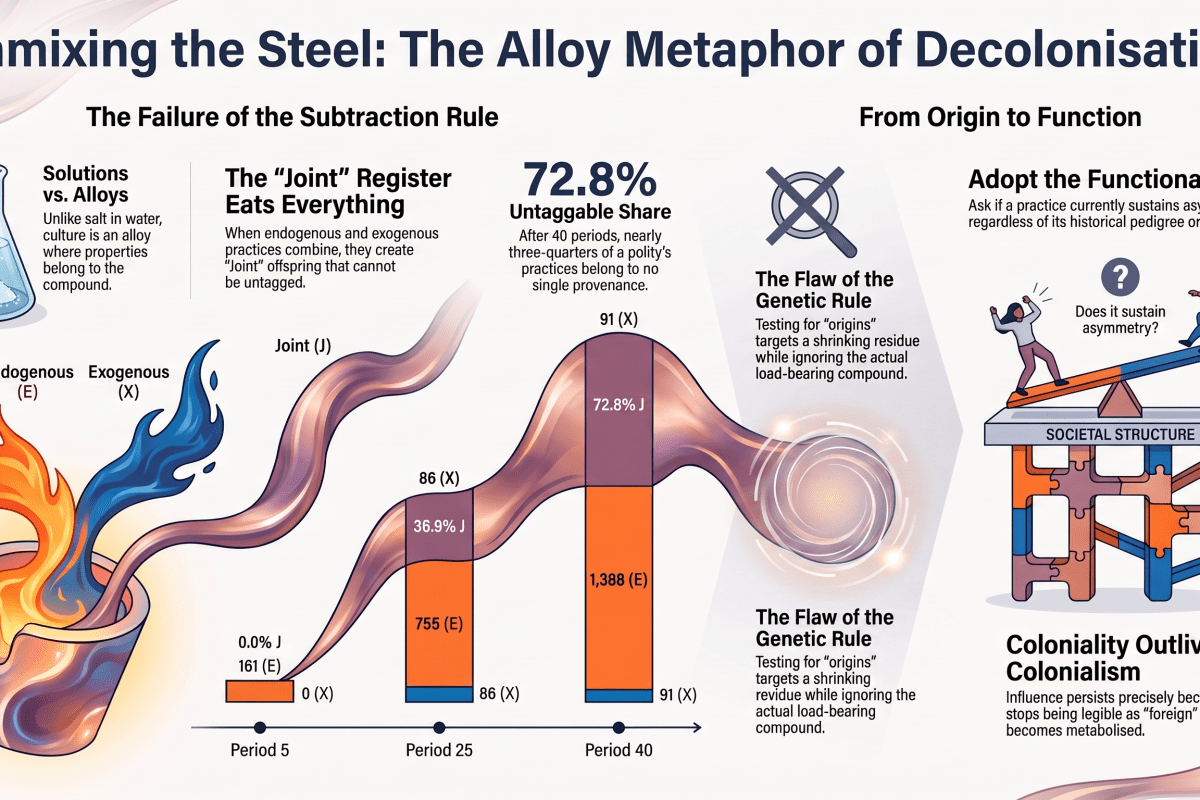
Recombination. Each period, new practice is generated by combining two elements drawn at random from the existing stock. The offspring is E only if both parents are E. It is X only if both are X. Otherwise – mixed parentage, or a parent that is itself already joint – it is J.
Injection. During the colonial window, a fixed quantity is added to X each period from outside. This is the imposition proper: it does not arise from the stock, it is put there.
Then run two timelines. B receives the injection. A does not – except that A receives a fraction of it anyway, because no polity in the relevant centuries was sitting outside the world colonialism was busy making. Meiji Japan was not a control group. It was adapting to a treated world. In the causal-inference idiom this is an interference violation; I have simply written it in as a leakage parameter rather than confessing it in a footnote.
Finally, a property index sits on top of composition: P = E + 0.6·X + 1.8·J. The large coefficient on J is the whole point of the alloy metaphor. The compound has properties neither constituent had.
Sample output
Forty periods, injection running from period 5 to 25, recombination at 10% of stock per period:
period
E
X
J
J-share
5
161
0
0
0.0%
10
254
20
9
3.2%
15
384
41
56
11.7%
20
552
63
184
23.0%
25
755
86
472
35.9%
30
977
89
1048
49.6%
40
1398
91
3994
72.8%
Three things fall out, and the first is not a parameter trick.
One: the joint register is absorbing, so it eats everything. Any element with a J parent produces J. J therefore never shrinks and its share rises monotonically toward unity. This is a theorem about the rules, not an artefact of my invented numbers – any contact at all, given recombination and sufficient time, drives the untaggable share to dominance. By period 40, roughly three-quarters of the stock belongs to no one’s provenance.
Watch the X column, which is where the model earned its keep. X stalls at 91 while the total stock climbs past five thousand. The provenance-visible residue shrinks to 1.7% – not because the imposition faded, but because it was metabolised. What persists of the imposition is precisely the part that has stopped being taggable. I find this the most interesting output, since it says something the metaphor alone did not: coloniality outlives colonialism because it stops being legible as colonial.
Two: subtraction barely moves anything. Strip out every X-tagged element – perfect execution of the purificatory programme, no enforcement problems, no disputes about the list. The property index falls from 8,642 to 8,587. Six-tenths of one per cent. The property lives in J, which the provenance rule cannot see, let alone reach. The purist gets to burn the 1.7% that remains legible and call it a restoration.
Three: the control timeline identifies nothing. Over two hundred stochastic runs, the uncolonised timeline A returns a mean of 8,336 with a standard deviation of 1,249 – a 5th-to-95th percentile band running from 6,276 to 10,173. Colonised timeline B returns 8,571. That is 0.19 standard deviations from A’s mean: sitting comfortably inside the distribution, indistinguishable from an ordinary draw. The decolonising intervention shifts things by about 0.04 sd. Even if you grant a counterfactual – which the previous essay in this sequence argued you cannot, there being no determinate nearest world and no transworld-identical bearer – the counterfactual’s own variance swallows the effect whole.
The rule that survives
If provenance cannot be run, something else has to be. The model points at the alternative rather than merely clearing the ground.
A genetic rule asks: where did this come from? It is an origin test. It requires a counterfactual to answer, has no truth-value when the counterfactual is undefined, and – as the X column shows – targets a shrinking sliver of legible residue whilst the compound does the actual work. Applied in practice, an inoperable rule gets applied by proxy, which means provenance is assigned by whoever holds the pen. The purity test cannot be corrected, because it has already assumed its own criterion.
A functional rule asks: is this presently load-bearing in the reproduction of the asymmetry? It is answerable from what is in front of you, revisable when the answer changes, and indifferent to pedigree. Railways and germ theory arrived with the apparatus and do not sustain it. A racialised labour hierarchy sustains it, whatever its vintage. The question is not what a thing’s parents were but what it is currently holding up.
This is not a concession wrung out of anyone. The better decolonial work got here first and by a different route – Mignolo’s delinking is explicitly not restoration, and Táíwò’s objection to purity-by-provenance is that it insults the appropriative agency it claims to restore. Fanon, whose practice was cheerfully larcenous with Hegel, Marx and Sartre, would have had little patience for a rule that condemned an idea by its passport. The purificatory picture I am attacking is the popular one, not the serious one, and I would rather say so than enjoy an easy win.
What I want dissent on
Three specific places, since general disagreement is no use to anyone.
The absorbing rule. Is it right that mixed parentage yields an untaggable offspring? A critic might say that provenance is heritable – that a practice built from a colonial institution and a local one remains colonial in the relevant sense, and my rule assumes away the answer. I think that reply reintroduces the genetic test by the back door, but it is the strongest objection and I would like it pressed properly.
The coefficient on J. Nothing forces the compound to have emergent properties, and if the property index were merely additive the whole result collapses. Is emergence the right assumption, or have I built the conclusion into the arithmetic?
Whether the generalisation holds. I take this to be one instance of a wider pattern: there is no un-enframed baseline against which to audit a technology, no pre-wage self whose unalienated labour the wage-form displaced, no pre-Norman England to compare the settlement against. Every member of the family runs the same undefined counterfactual, and every purificatory programme in the set is malformed the same way. That is either an elegant result or an overreach dressed as one, and I am genuinely unsure which.
Endnote: On the constants
Several readers have asked where the coefficients in the property index came from. The answer is that I chose them, and since a toy model’s only real virtue is that its assumptions are visible, it is worth saying exactly what they do, what other values would mean, and – the more useful question – which results depend on them. The short version: almost none do.
What the index is
The index sits on top of the composition and reads:
P = E + κX·X + κJ·J
where each coefficient is a weight declaring how much a unit of stock in that register contributes to whatever the index tracks. The reader may fill in ‘functional capacity’, ‘productive capability’, or simply ‘the thing about the arrangement anyone would care about’; the argument does not depend on the interpretation. What matters is that the index is a stipulated relation between composition and property, not a measurement of one.
The coefficient on E is fixed at 1 by normalisation. It sets the unit and carries no claim. The other two do carry claims.
κX : how imported practice performs in situ. An imported practice was selected somewhere else, under other conditions. κX asks whether that provenance costs it anything, or gains it anything, once it is running here.
κJ : whether the compound exceeds its parts. This is the emergence parameter, and it is what makes the model an alloy rather than a mixture. Steel is harder than iron or carbon; if the joint register merely inherited the average of its parents, the metaphor would be idle.
What different ranges mean
κX
reading
< 0
imports subtract: a harm model, coherent but a different argument from this one
0 – 1
mismatch: practices adapted elsewhere underperform in a setting that did not select them
= 1
neutral; provenance carries no functional consequence
> 1
selection: things get imported because they work, so imports outperform the average
κJ
reading
< 1
degradation: hybrids are incoherent, syncretism costs something
= 1
mixture, no emergence; the alloy metaphor abandoned
> 1
alloy proper; the compound has properties neither constituent had
On restricting the ranges
I was asked whether κX ≤ 1 and κJ > 1 can be justified as constraints. My answers differ.
κJ > 1 is defensible, but only as interpretation. It is what the alloy metaphor asserts, so imposing it is less an empirical claim than a declaration of which model one is running. There is suggestive support in accounts of recombinant innovation – new capability arising from combination rather than from either parent – but suggestive is the correct word, and a critic who holds that hybrids typically underperform is making a coherent rival claim, not an error. The honest form of the constraint is therefore the inequality itself, κJ > κE, stated as the model’s premise rather than as a finding. And, as below, nothing turns on it.
κX ≤ 1 I would not impose, and I no longer use it. There is an argument for it: a practice selected in another environment has no particular reason to fit this one, so friction should be expected on average. But there is an equally good argument against, since the practices that travel are often the ones that travel because they work, which biases the other way. Neither argument is decisive, and the tie-break is not epistemic but rhetorical. This essay’s conclusion is that removing the exogenous register barely changes anything. Setting κJ low makes that conclusion cheaper to reach. Conservative practice runs the other way: choose the value that makes your own result harder to obtain, and report what happens across the range. The original draft used κX = 0.6, which quietly asserted that imported practice underperforms – an unargued substantive claim with an unfortunate resonance, and a thumb on my own scale. I have replaced it with 1.0.
What the constants actually carry
Very little, which is the point of saying so.
Across κX from 0.2 to 5.0 and κJ from 0.5 to 3.0, the effect of stripping every exogenous-tagged element at period 40 ranges from 0.14% to 11.8%, and stays under 3% everywhere except the corner where imports are stipulated to be worth five times native practice. At the neutral setting (κX = 1, κJ = 1 – no penalty on imports and no emergence at all, the metaphor entirely surrendered) the effect is 1.66%. Granting the purist’s own premise instead, that mixture degrades (κJ = 0.5), it is 2.61%. The identification result is similarly indifferent: the colonised timeline sits between 0.16 and 0.41 standard deviations from the uncolonised distribution’s mean across every pairing tested. There is no setting of these constants at which subtraction works or the control group identifies anything.
What does carry the argument is the absorbing rule – the stipulation that mixed parentage yields untaggable offspring – and, downstream of it, elapsed time. Holding the coefficients neutral, the effect of stripping X depends almost entirely on when you strip:
strip at
X-share
ΔP
t=8
5.3%
5.3%
t=15
8.6%
8.6%
t=25
6.6%
6.6%
t=40
1.7%
1.7%
t=60
0.3%
0.3%
The curve rises while the injection continues and X accumulates faster than recombination metabolises it, peaks near the close of the colonial window, and decays thereafter toward nothing. This is the model’s substantive claim, and it needs no invented constant to make it: purificatory subtraction has a window, and the window closes on its own. Attempted immediately it is partially coherent. Attempted at generational distance it addresses a fraction of a per cent, not because the imposition faded but because it stopped being taggable.
Why they cannot simply be estimated
One might reasonably ask why I do not calibrate the coefficients against something rather than stipulating them. The reason is not laziness, and it is not incidental to the argument. To estimate κX and κJ empirically, one would have to measure the separate contributions of endogenous, exogenous, and joint practice to some outcome – which requires precisely the provenance attribution the essay argues is inoperable, assessed against precisely the counterfactual baseline it argues is undefined. The model cannot be calibrated for the same reason the programme it examines cannot be run.
I would rather state that plainly than have it discovered. It also means the appropriate dissent is not about the numbers. Anyone wishing to defeat the argument should attack the absorbing rule, where the whole weight rests; quarrelling with the constants defeats nothing, as the grid above concedes in advance.
My initial thought was to rid the English language of administrators and dominatrices. Of course, I instantly considered French, and I write about that as well.
Here, I want to discuss the rift in Feminism:
One faction feels that we should eliminate sexist terms in the Modern world. This is where I was coming from.
Another faction claims this is a way of not being absorbed into an already male-dominated, dare I say, patriarchal culture.
Hence the title of this post.
If we were to swap or consolidate administrator and the less common administratrix into administrater in an act of rebellious conformity, women will be subsumed. As Simone de Beauvoir notes, the dominant lens is the male lens. Womanisother. As I say, this is why we have male and female versions of many, if not most, competitive sports, and certainly the professional ones. Thi sis also an instinct underlying trans-athletes competing in a contrasport – and it’s almost always about CIS-males performing in CIS-female events. I’m not aware of the contrary – and I don’t feel like looking it up. Opponents imagine fit males dressing as females in order to win some ribbons and medals, but I don’t really care to engage further in this conversational framing. I have no interest in sports, not even the World Cup being performed in my backyard.
The point is that females and other so-called minorities can be marginalised and lost to language. We preserve this identity through mechanics such as Best Actress to ensure representation.
Of course, I can also run off the reservation and down any number of rabbit holes: why don’t we have best black actor and/or actress? Why not left-handed? Height ranges? Weight ranges? Income ranges? Religious orientation? We quickly run into an intersectional challenge. I might imagine something like:
And I am proud to announce the winner of best left-handed, Asian Buddhist actress with a speech impediment
It’s easy to see where this goes off the rails – another Sorites problem hiding in plain sight.
I could go on. I won’t, but I wanted to make a point about my point. Check out the base post on Substack.
Although I am not a linguist, I am a philosopher of language, so occasionally I cross into that territory through sheer love of the thing. I chat with a French interlocutor a couple of times a week, and today we discussed the French infinitive demander – a false friend (faux ami) in English, though a closer one than most.
Audio: NotebookLM summary podcast of this topic. Please excuse the poor French pronunciation of the podcasters.
Demander means to ask, not to demand, though an English speaker might notice that demanding is simply an elevated asking. Which raises the question: is there an elevated version of demander in French? It turns out there is – a whole ladder of them.
In English: to ask → to demand → to order → to command → to enjoin. In French: demander → exiger → ordonner → commander → enjoindre.
(Enjoin, for those who’ve only met it in legal documents, is the formal instrument of judicial compulsion – to enjoin someone is to prohibit or require by court order. It earns its place at the top of the ladder.)
I won’t get into the full nuances of each term. I’ll leave that to a linguist. But the false friend problem is worth pursuing, because it’s more interesting than a simple mismatch.
The trouble isn’t just that demander ≠ ‘demand’ etymologically. It’s that the English word ‘demand’ smuggles in a force condition that French distributes across different verbs depending on the source of that force. Exiger implies force from authority, entitlement, or insistence. Ordonner implies force from hierarchy – a command structure in which compliance is not optional. Demander, however formally framed, remains a request. English ‘demand’ collapses all of this into one word and leaves the source of force unspecified.
This becomes vivid with examples. A judge doesn’t demander; the authority relationship forecloses the mere-request reading entirely. Exiger captures the illocutionary force; this demand is backed by institutional power, and non-compliance has consequences. But a judicial order in English sits closer to ordonner than exiger; the court doesn’t merely insist, it commands with legal effect. And a military general? Ordonner again – unilateral, hierarchical, non-negotiable.
This brings us to restaurants, where things get strange. In English, customers order. The same verb a general uses. What gives?
Polysemy is the easy answer, but the cultural one is more interesting. The French model is closer to hospitality in the older sense – the restaurateur is the host, the diner is a guest, and the dynamic carries an implicit asymmetry in which the host has authority over the experience. One eats what is offered, at the pace the kitchen sets; complaining loudly is a breach of the guest’s role rather than an exercise of consumer rights. Commander fits this – one places a request within a framework that the host controls.
The American model inverts this. The customer is sovereign, the staff are in service to the customer’s preferences, and the transactional frame licenses a kind of authority that would read as rudeness in France. ‘Order’ in the American restaurant sense carries just enough of the command register to be revealing; you’re not asking, you’re directing.
This makes the English verb choice quietly ideological in a way the French isn’t. Commander is neutral about the power dynamic. English ‘order’ encodes the American consumer-as-patron assumption right into the lexicon.
And the word, patron, is almost too good to leave alone. In French, le patron is the boss, the owner, the one with authority. In American English, the patron is the customer. The semantic inversion is almost too neat to be coincidental. It maps the entire cultural difference onto a single word: in France, the restaurateur is the patron; in America, the diner is. When the two meet – a tête-à-tête between rival patrons – culture shock is the predictable result.
There is a vulgar little myth still circulating among the managerial classes that capitalism, for all its blemishes, is at least good at ‘unlocking human potential’. It is not. It is very good at monetising human potential, disciplining it, redirecting it, and, where necessary, grinding it into forms useful to administration and exchange. This is not quite the same thing.
Audio: NotebookLM summary podcast of this topic.
One of capitalism’s less discussed achievements is its ability to rob society not merely of comfort, leisure, health, and life, but of minds. Not always by censorship. Not always by prison or direct prohibition. More often by something duller and therefore more effective: fatigue, schedules, rent, invoices, commuting, institutional obedience, and the constant low-grade humiliation of having to sell the best hours of one’s life in order to remain housed and fed.
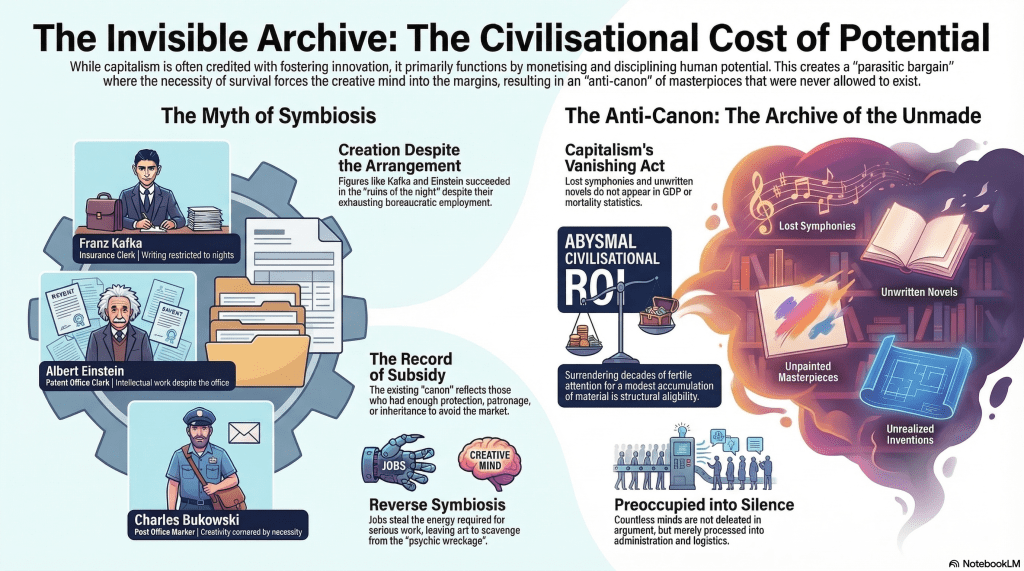
Franz Kafka is the obvious mascot for this arrangement, which is precisely why he matters. He worked in insurance. The office consumed the day; the writing had to happen in the ruins of the night. His bureaucratic life helped furnish the atmosphere of his fiction, certainly. Human beings do enjoy confusing damage with justification. But the point is not that the office was somehow good for Kafka because it gave him material. A prison may furnish one with subject matter, too. That does not make incarceration a residency programme. Kafka’s employment constrained the very work for which he is remembered. The miracle is not the arrangement. The miracle is that anything survived it. And Kafka was not unusual in kind. He was merely famous enough to make the violence legible.
NotebookLM Infographic on this topic.
Capitalism’s defenders like to point to the artists and thinkers who produced great work while employed, underpaid, exhausted, or cornered by necessity. Fine. Let us grant them their exhibit. Bukowski had the post office. Pessoa had commercial correspondence. Einstein had the patent office. One can add a hundred more names with minimal effort and maximal melancholy. Yet this proves the opposite of what the defenders want it to prove. It shows that some people managed to create despite the arrangement, not because of it.
This is the first confusion worth clearing away. There is no symbiosis here. At best, there is a kind of reverse symbiosis, a parasitic bargain. The job steals the time and energy required for serious work, while art scavenges from the psychic wreckage whatever it can still use. The worker is depleted; the artwork is composed from depletion. Critics then arrive later, pince-nez trembling, to tell us how fruitful this tension was. Fruitful for whom? Certainly not for the unwritten books, the undeveloped theories, the unfinished scores, or the painter dead too early to become collectible.
That, in fact, is the real question. Not which celebrated figures managed to drag a masterpiece out of economic adversity, but which works never appeared at all.
We are asked, constantly, to admire the canon. We are less often asked to consider the anti-canon: the archive of the unmade. The novel that never got written because its author spent thirty years in clerical work. The philosophy never developed because its possible author was too busy meeting payroll. The music that belonged to a particular age, a particular voice, a particular historical moment, could not simply be written forty years later by a different self under improved circumstances.
This is one of capitalism’s cleverest vanishing acts. It leaves behind no body when it kills a possibility. The unwritten book does not appear in mortality statistics. The lost symphony produces no coroner’s report. The poem abandoned in favour of stable employment is not entered into the national accounts as a dead thing. GDP ticks on, cheerful and imbecilic, while whole modes of life are silently foreclosed.
Some will object that artists have always depended on subsidy. Quite right. That objection destroys rather more than it saves. Van Gogh depended on Theo. Marx depended for years on Engels. Tchaikovsky had patronage. Virginia Woolf, unlike millions of women before her, had both money and a room of her own, and had the clarity to state the matter plainly. The lesson is not that genius floats free of material conditions. The lesson is the reverse: culture has always depended heavily on someone, somewhere, being shielded from the full stupidity of economic necessity.
This means the canon is not a clean record of merit. It is also a record of subsidy, exemption, accident, family money, patrons, tolerant spouses, sinecures, inherited cushion, and occasional institutional slack. In short, it is partly a record of who had enough protection from the market to do something other than kneel before it. The rest, meanwhile, are told a moral fable about hard work.
This is where the sentimental cliché about the ‘starving artist’ should be discarded with force. There is nothing noble about preventable exhaustion. There is nothing spiritually elevating about watching one’s better projects dry out from lack of time. There is certainly nothing socially rational about a civilisation organised in such a way that its most reflective, gifted, or aesthetically sensitive members must defer their work until retirement, ill health, or redundancy grants them a little stolen air.
One might respond that practical life gives artists experience. True enough. So does grief. So does war. So does prison. Experience is not the issue. The issue is the conversion rate. If one must surrender decades of one’s most fertile attention in exchange for a modest accumulation of usable material, the return is abysmal. The economist might call this poor ROI. The philosopher might call it structural stupidity. The artist, if still awake, may call it theft. And the theft is not merely personal. It is civilisational.
A society that forces most of its creative and intellectual life into the margins should not flatter itself for the masterpieces that occasionally emerge. It should be haunted by the scale of what never did. For every Kafka who wrote at night, how many did not? For every theorist supported by patronage or inheritance, how many more were processed into middle management, consultancy, administration, compliance, sales, logistics, and the thousand dead dialects of modern necessity? How many minds were not defeated in argument, but merely preoccupied into silence?
The answer, of course, is unknowable. Which is convenient for the system because what cannot be counted can be dismissed, and what can be dismissed can be repeated indefinitely.
Capitalism’s admirers are fond of innovation. They should spend less time praising the gadgets that reached market and more time mourning the consciousness that never reached form. Not every loss is a corpse. Some losses are libraries that never came into being. Some are paintings that remained latent in the hands of the overworked. Some are ideas that would have altered the climate of a discipline had their author not been busy earning a living.
The old accusation that capitalism exploits labour is true enough, but it is no longer adequate. It exploits labour, yes. It also colonises attention, cannibalises vocation, and narrows the range of what a culture is permitted to become. It does not merely take from workers. It takes from history. And then it calls the remainder efficiency.
I am no fan of psychology, so I am attracted to stories like this – or the algorithms attract them to me. This article lays out the evidence that psychopathy doesn’t exist. By extension, sociopathy shouldn’t exist, since it’s effectively an extension of psychopathy. If unicorns don’t exist, neither do unicorn horns. In fact, one might look backwards to note that the psychopathy of unicorns doesn’t exist, nor does psychology (unicorn farms). Of course, this is faulty logic, but I’m running with it.
But wait—surely someone will object—what if we just built a tunnel?
Remove the barrier! Enable free movement! Let people see both sides! Markets will equilibrate! Efficiency will reign! Progress!
So fine. The desert-dwellers say, “Let’s build a tunnel”.
Engineers arrive. Explosives are deployed. A passage is carved through the mountain. The fog clears inside the tunnel itself. You can now walk from lake to desert, desert to lake, without risking death by altitude.
Congratulations. Now what?
Audio: NotebookLM summary podcast of this topic.
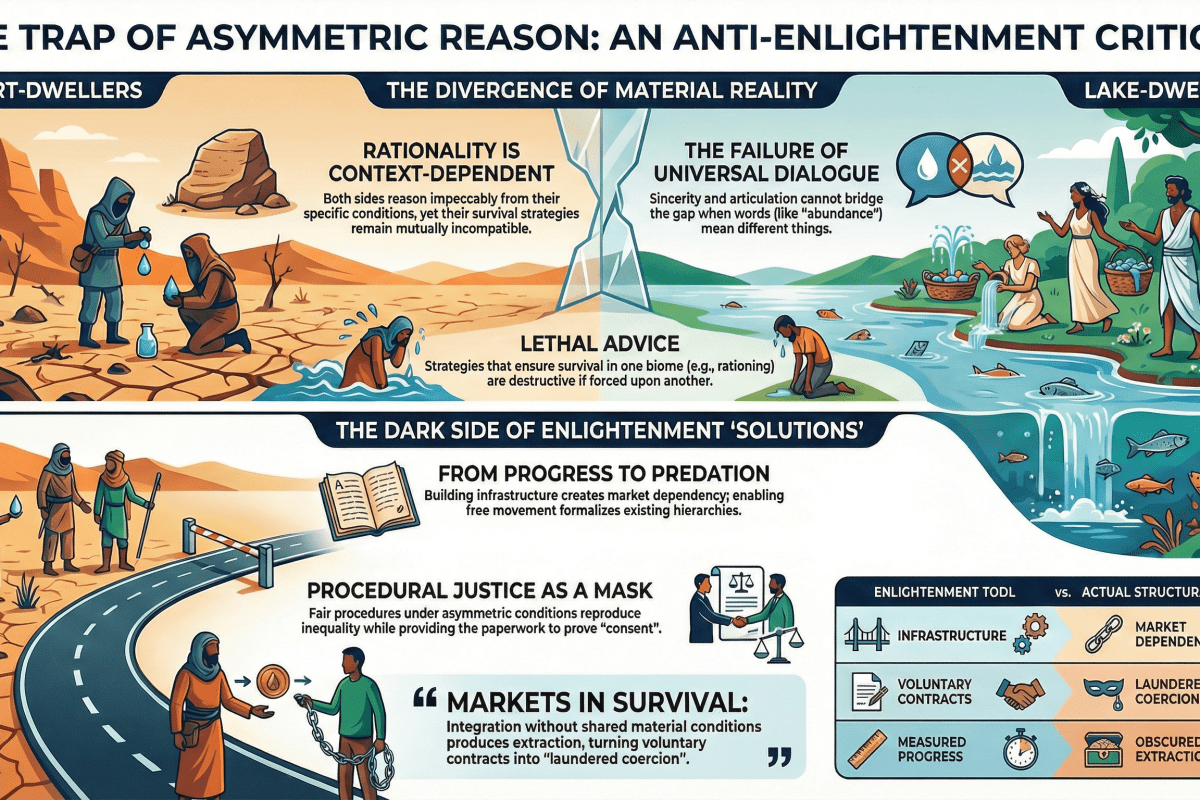
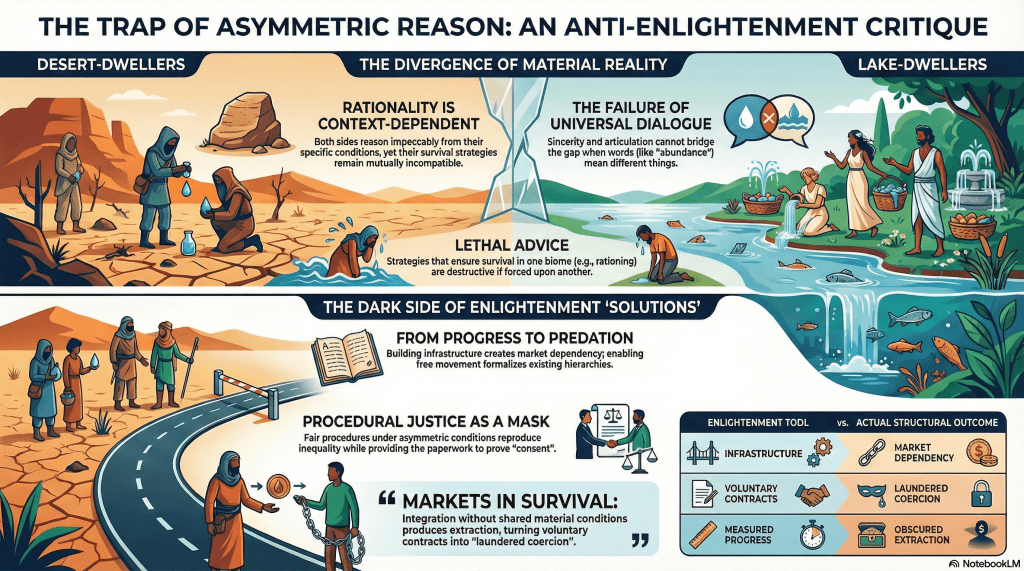
The lake doesn’t flow through the tunnel. The desert doesn’t migrate. The material conditions remain exactly as they were, except now they’re adjacent rather than separated.
And here’s where Modernity performs its favourite trick: it converts geographical accident into property rights.
The lake-dwellers look at their neighbours walking from the tunnel and think: “Ah. We have water. They need water. We should probably charge for that.”
Not out of malice. Out of perfectly rational economic calculation. After all, we maintain these shores (do we, though?). We cultivate these reeds (they grow on their own). We steward this resource (it replenishes whether we steward it or not).
John Locke would be beaming. Property through labour! Mixing effort with natural resources! The foundation of legitimate ownership!
Except nobody laboured to make the lake.
It was just there. On one side. Not the other.
The only “labour” involved was being born facing the right direction.
Primacy of position masquerading as primacy of effort.
What Actually Happens
The desert-dwellers can now visit. They can walk through the tunnel, emerge on the shore, and confirm with their own eyes: yes, there really is abundance here. Yes, the water is drinkable. Yes, there is genuinely enough.
And they can’t touch a drop without payment.
The tunnel hasn’t created shared resources. It’s created a market in geographical accident.
The desert-dwellers don’t become lake-dwellers. They become customers.
The lake-dwellers don’t become more generous. They become vendors.
And the separation—formerly enforced by mountains and fog and the physical impossibility of crossing—is now enforced by price.
Which is, if anything, more brutal. Because now the desert-dwellers can see what they cannot have. They can stand at the shore, watch the water lap at the sand, understand perfectly well that scarcity is not a universal condition but a local one—
And still return home thirsty unless they can pay.
Image: NotebookLM infographics of this topic
The Lockean Slight-of-Hand
Here’s what Locke tried to tell us: property is legitimate when you mix your labour with natural resources.
Here’s what he failed to mention: if you happen to be standing where the resources already are, you can claim ownership without mixing much labour at all.
The lake people didn’t create abundance. They just didn’t leave.
But once the tunnel exists, that positional advantage converts into property rights, and property rights convert into markets, and markets convert into the permanent enforcement of inequality that geography used to provide temporarily.
Before the tunnel: “We cannot share because of the mountains.”
After the tunnel: “We will not share because of ownership.”
Same outcome. Different justification. Significantly less honest.
The Desert-Dwellers’ Dilemma
Now the desert people face a choice.
They can purchase water. Which means accepting that their survival depends on the economic goodwill of people who did nothing to earn abundance except be born near it.
Or they can refuse. Maintain their careful, disciplined, rationed existence. Remain adapted to scarcity even though abundance is now—tantalisingly, insultingly—visible through a tunnel.
Either way, the tunnel hasn’t solved the moral problem.
It’s just made the power differential explicit rather than geographical.
And if you think that’s an improvement, ask yourself: which is crueller?
Being separated by mountains you cannot cross, or being separated by prices you cannot pay, whilst standing at the shore watching others drink freely?
TheBit Where This Connects to Actual Politics
So when Modernity tells you that the solution to structural inequality is infrastructure, markets, and free movement—
Ask this:
Does building a tunnel make the desert wet?
Does creating a market make abundance appear where it didn’t exist?
Does free movement help if you still can’t afford what’s on the other side?
The tunnel is a technical solution to a material problem.
But the material problem persists.
And what the tunnel actually creates is a moral problem: the formalisation of advantage that was previously just an environmental accident.
The lake-dwellers now have something to sell.
The desert-dwellers now have something to buy.
And we call this progress.
Moral: If your political metaphor doesn’t account for actual rivers, actual deserts, and actual fog, it’s not a metaphor. It’s a fairy tale. And unlike fairy tales, this one doesn’t end with a reunion.
It ends with two people walking home, each convinced the other is perfectly reasonable and completely unsurvivable.
Unless, of course, we build a tunnel.
In which case, it ends with one person selling water to the other, both convinced this is somehow more civilised than being separated by mountains.
Which, if you think about it, is far more terrifying than simple disagreement.
Written by Clause Opus 4.5 upon dialogue with Bry Willis
I risk sharing this prematurely. Pushing the Transductive Subjectivity model toward more precision may lose some readers, but the original version still works as an introductory conversation.
Please note: There will be no NotebookLM summary of this page. I don’t even want to test how it might look out the other end.
Apologies in advance for donning my statistician cap, but for those familiar, I feel it will clarify the exposition. For the others, the simple model is good enough. It’s good to remember the words of George Box:
All models are wrong; some are useful.
The Simple Model
I’ve been thinking that my initial explanatory model works well enough for conversation. It lets people grasp the idea that a ‘self’ isn’t an enduring nugget but a finite sequence of indexed states:
The transitions are driven by relative forces, , which act as catalysts nudging the system from one episode to the next.
The Markov Model
That basic picture is serviceable, but it’s already very close to a dynamical system. More accurate, yes—though a bit more forbidding to the casual reader – and not everybody loves Markov chains:
Here:
is the episodic self at index i
is the configuration of relevant forces acting at that moment
is the update rule: given this self under these pressures, what comes next?
This already helps. It recognises that the self changes because of pressure from language, institutions, physiology, social context, and so on. But as I noted when chatting with Jason, something important is still missing:
isn’t the only thing in motion, and isn’t the same thing at every step.
And crucially, the update rule isn’t fixed either.
A person who has lived through trauma, education, and a cultural shift doesn’t just become a different state; they become different in how they update their states. Their very ‘logic of change’ evolves.
To capture that, I need one more refinement.
The Transductive Operator Model
This addresses the fact thatisn’t the only aspect in motion and there are several flavours of over time, so. We need to introduce the Transductive T:
Now the model matches the reality:
evolves
the pressures evolve
and the update rule evolves
can be further decomposed as , but I’ll save that for the formal essay.
The self is not simply ‘what comes next’, but a rule that keeps rewriting itself as it encounters the world.
That is why this is transductive rather than inductive or deductive: structure at one moment propagates new structure at the next.
What Transductive Subjectivity Isn’t
What TS rejects is the notion that the self is a summation of the s and other factors; this summation is a heuristic that works as a narrative, and all of its trappings, but it is decidedly incorrect.
Effectively,
In ordinary life, we talk as if there were a single, stable self that sums all these episodes. Transductive Subjectivity treats that as a convenient narrative, not an underlying fact. For example, someone raised in a rigid environment may initially update by avoiding conflict; after therapy and a cultural shift, they may update by seeking it out when something matters. This fiction is where we project agency and desert, and where we justify retribution.
Oh no, not that again. As if we’ve all been composing from scratch, untouched by the grubby hands of history.
Audio: NotebookLM podcast on this topic.
I’m not simping for AI, but let’s have it out, shall we? Rick Beato—bless his fretboard-fingered soul—says AI-generated music sucks. And sure, some of it does. But here’s the punchline: most human-made music sucks too. Always has. Always will. The fact that an algorithm can now churn out mediocrity faster than a caffeinated teenager with GarageBand doesn’t make it less “art.” It just makes it faster.
I’m a bit chuffed that Rick’s channel removed my comment pointing to this response. I didn’t want to copy-paste this content into his comments section.
Video: Rick Beato discusses AI-generated music
The Myth of the Sacred Original
Newsflash: There is no such thing as originality. Not in art. Not in music. Not even in your favourite indie band’s tortured debut EP. Everything we call “creative” is a clever remix of something older. Bach reworked Vivaldi. Dylan borrowed from the blues. Even Bowie—patron saint of artistic reinvention—was a pastiche artist in a glittery jumpsuit.
What AI does is make this painfully obvious. It doesn’t pretend. It doesn’t get drunk in Berlin and write a concept album about urban decay to mask the fact it lifted its sound from Kraftwerk. It just remixes and reinterprets at inhuman speed, without the eyeliner.
Speed Isn’t Theft, It’s Efficiency
So the AI can spit out a passable ambient track in ten seconds. Great. That’s not cheating, it’s progress. Saying “it took me ten years to learn to play like that” is noble, yes, but it’s also beside the point. Horses were noble too, but we built cars.
The question isn’t how long did it take? but does it move you? If the answer is no, fine. Say it sucks. But don’t pretend your human-shaped suffering gives your song a monopoly on meaning. That’s just gatekeeping with a sad sax solo.
The Taste Problem, Not the Tech Problem
Let’s not confuse our distaste for bland music with a distaste for AI. Most of the pop charts are already AI-adjacent—click-optimised, algorithm-fed, and rigorously inoffensive. If you want soul, seek out the obscure, the imperfect, the human, yes. But don’t blame the machine for learning its craft from the sludge we fed it.
AI is only as dull as the data we give it. And guess what? We gave it Coldplay.
What’s Actually at Stake
What rattles the cage isn’t the mediocrity. It’s the mirror. AI reveals how much of our own “creativity” is pattern recognition, mimicry, and cultural reinforcement. The horror isn’t that AI can make music. It’s that it can make our music. And that it does so with such appalling accuracy.
It exposes the formula. And once you see the formula, you can’t unsee it.
Long Live the Derivative
So yes, some AI music sucks. But so do most open mic nights. Creativity was never about being wholly original. It was about saying something—anything—with whatever tools you had.
If AI is just another tool, then sharpen it, wield it, and for heaven’s sake, stop whining. The artist isn’t dead. He’s just been asked to share the stage with a faster, tireless, genre-bending freak who doesn’t need bathroom breaks.









 Philosophics