I posted this article on Substack: The Philosophers Are Here. Which Philosophers? Some companies are making a big deal about hiring philosophers and ethicists to help then with AI, especially AI companies. Isn’t that grand? My point is that companies only make decisions that they think will support rather than undermine their positions, so they are hiring philosophers sympathetic to their worldviews. They are not hiring, for example, me.
In fact, when I was a management consultant, one of my biggest challenges is that I don’t support capitalism, and I find much of business unethical. To add insult to injury, every year I had to take ethics training and take a test with an attestation that I have not witnessed any unethical behaviour. However, what they qualified as unethical behaviour was in fact illegal behaviour. They didn’t seem to understand the difference – or at least didn’t care very much.
Read the full article on Substack, or watch or listen to a summary on YouTube or Spotify.
Every year, apparently, somebody wins happiness. Recently it has often been Finland. The headlines arrive with the confidence of a football result: Finland is the happiest country in the world. One imagines the Finns receiving a small trophy, perhaps in a sauna.
The claim sounds empirical. It sounds as though something called happiness has been located, measured, aggregated, ranked and compared across national borders. There are, of course, surveys behind such rankings, and those surveys may be perfectly competent at measuring what they actually measure: reported life satisfaction, evaluations of present circumstances, perceived social support, security, income, institutional trust and related variables.
But that is already quite different from saying that Finns possess more happiness than everybody else.
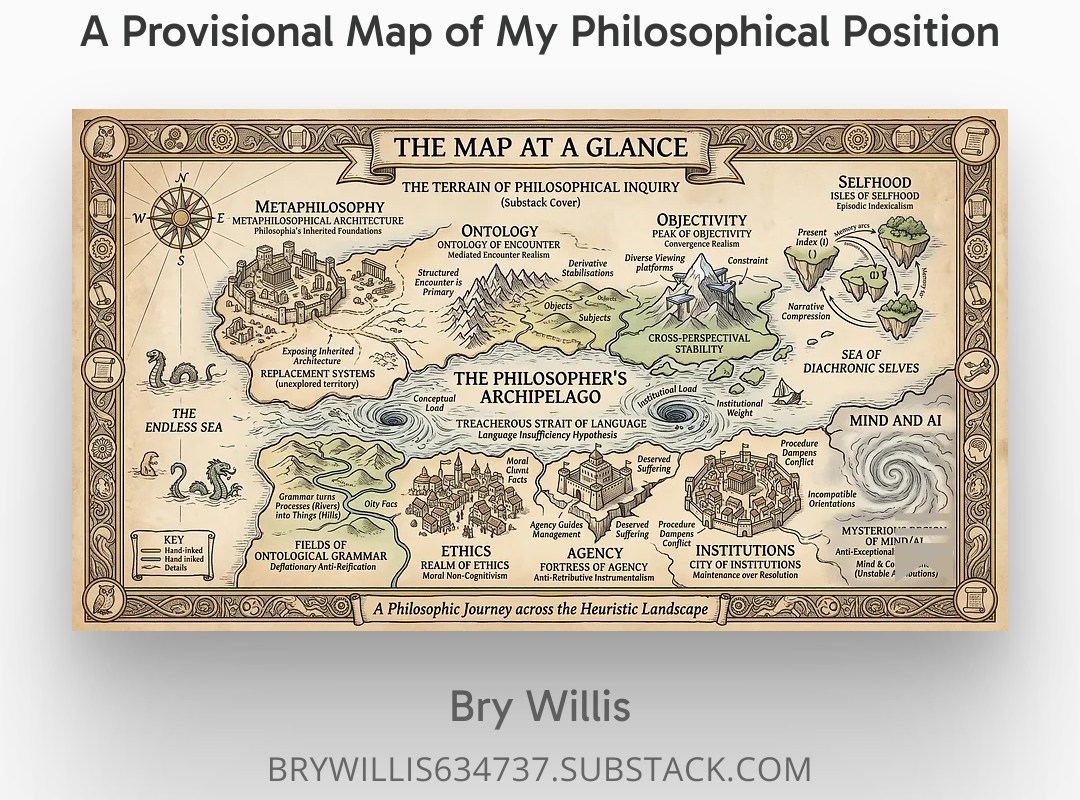
The question is reasonable, although belief may already be doing more work than I would permit it under cross-examination. My writing is generally diagnostic rather than doctrinal. I am more interested in identifying the architectural assumptions beneath a dispute than in selecting a furnished room within it. Where philosophy offers a contest between established positions, I often suspect that the arena itself has been badly designed.
Still, repeated diagnoses eventually disclose a pattern. Certain commitments recur: suspicion of substance, resistance to metaphysical inflation, distrust of linguistic confidence, rejection of moral realism, scepticism toward persistent personal identity, and an insistence that mediation does not entail fabrication.
What follows is therefore neither a creed nor a completed system. It is a provisional map of where I presently stand.
The labels are intended as coordinates, not allegiances. Where no established term quite fits, I have used my own. This is partly unavoidable and partly evidence for the very linguistic difficulty I spend so much time diagnosing.
This content, including video and podcast summary, are of a longer Substack article on my philosophical positions with descriptions.
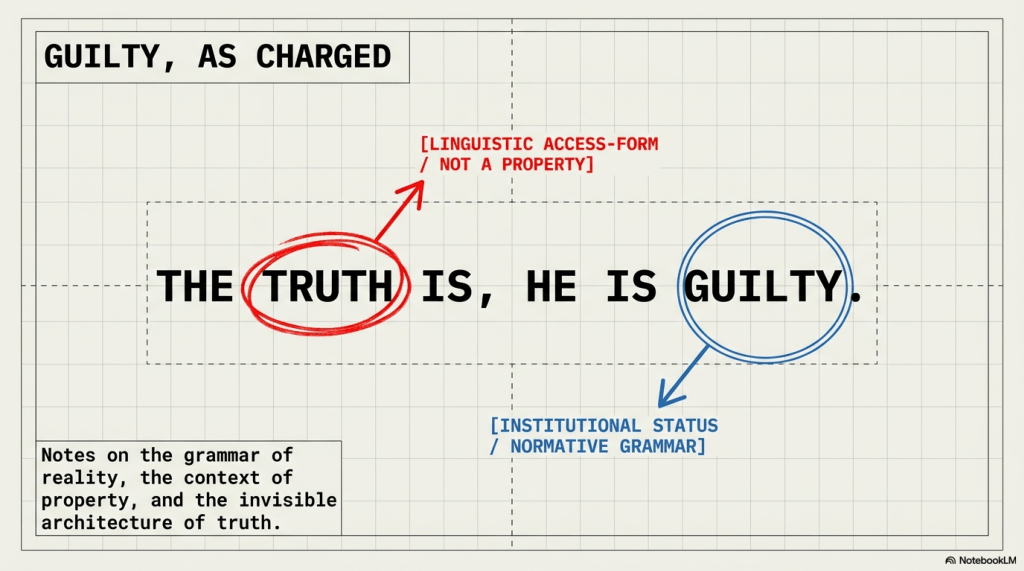
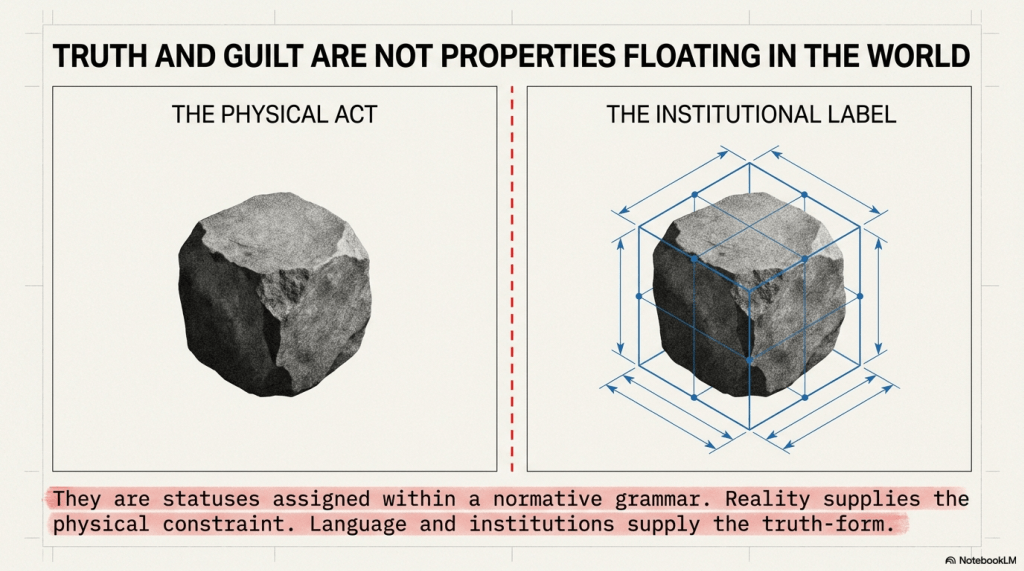
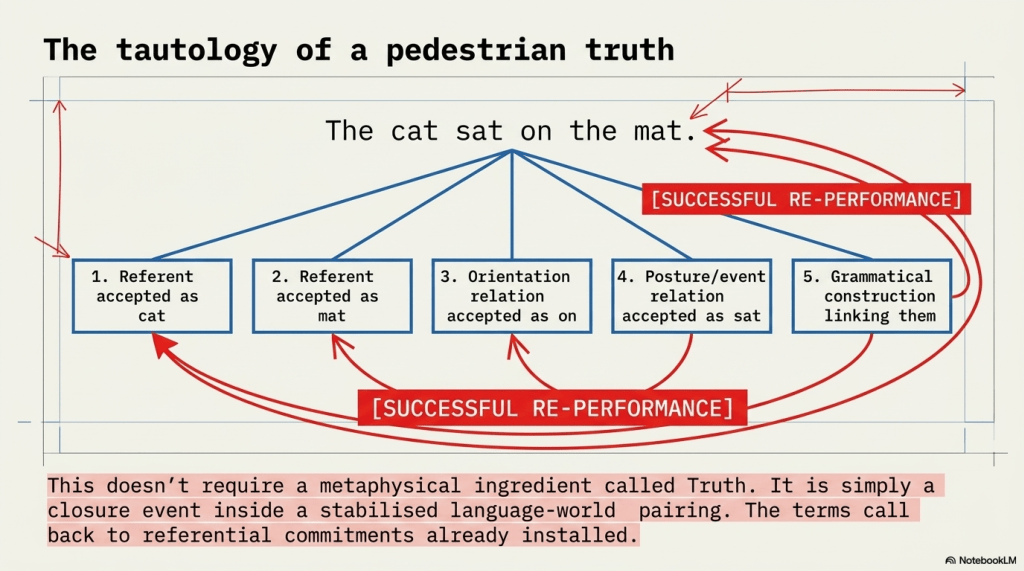
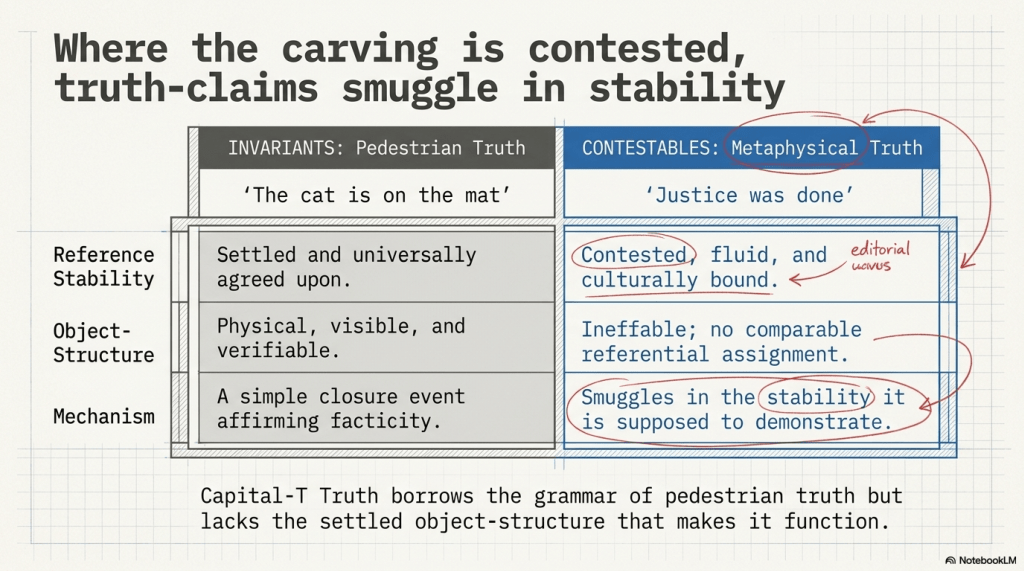
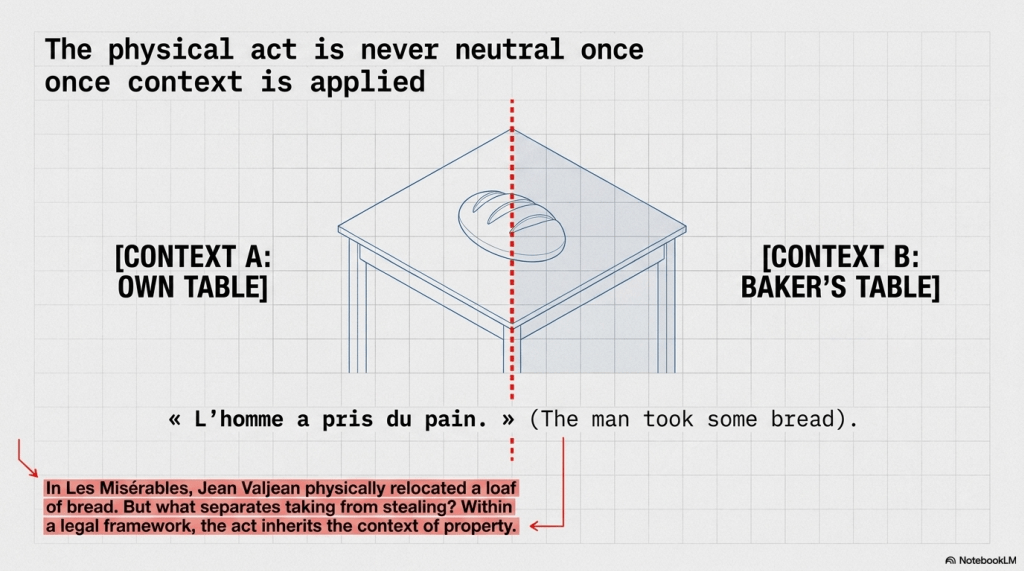
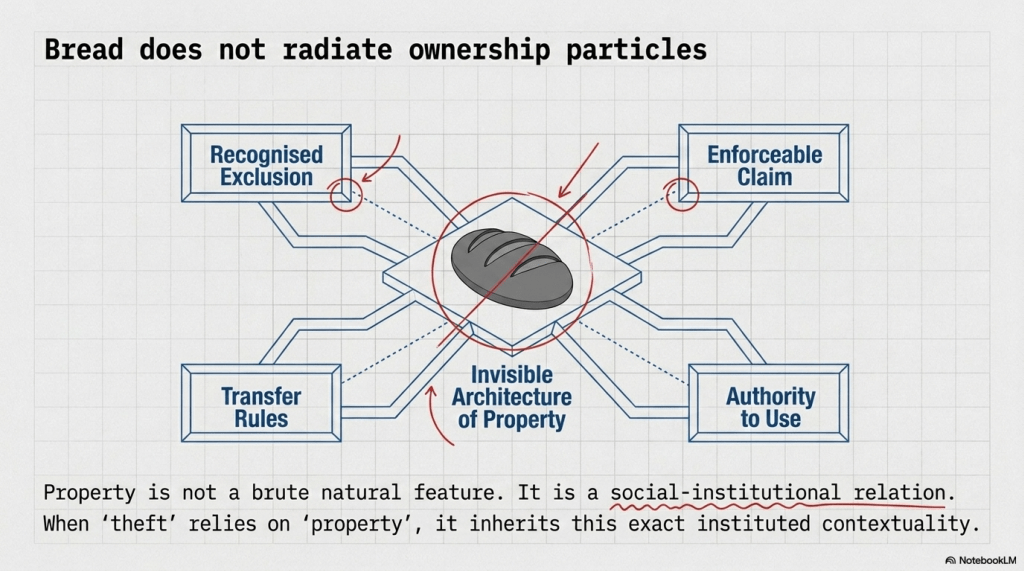
As I continue to read Heidegger’s On the Essence of Truth, I feel compelled to share my musings. Avert your eyes if this doesn’t work for you, but don’t stop me if you’ve heard this one before.
Read the rest of the article there, or listen to the podcast.
Audio: NotebookLM summary podcast of this topic.
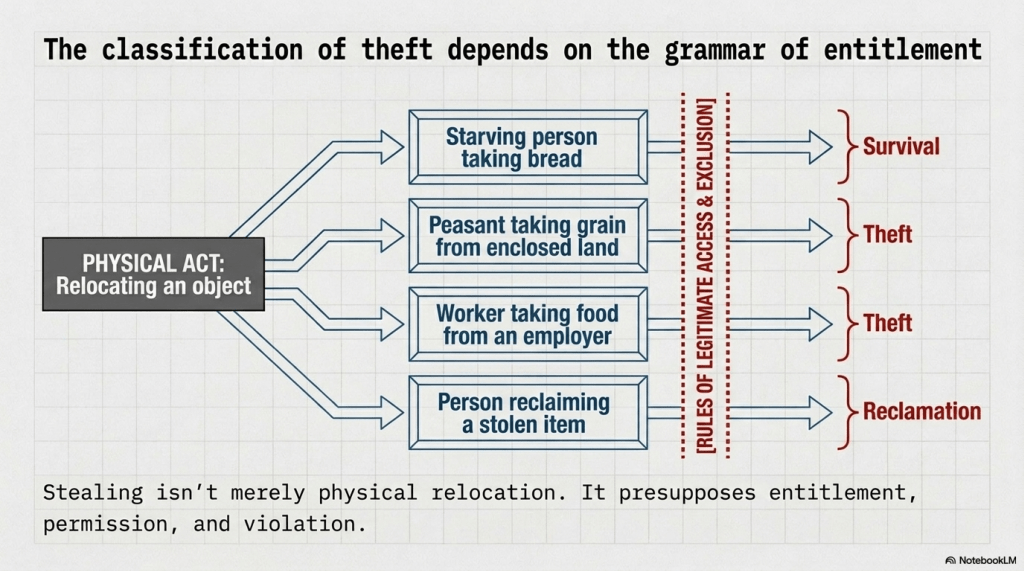
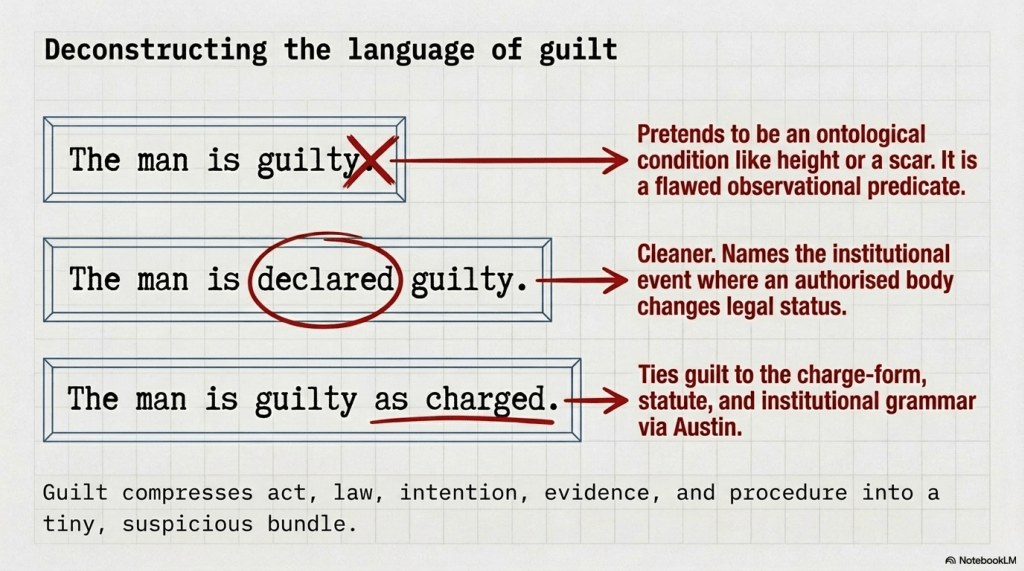
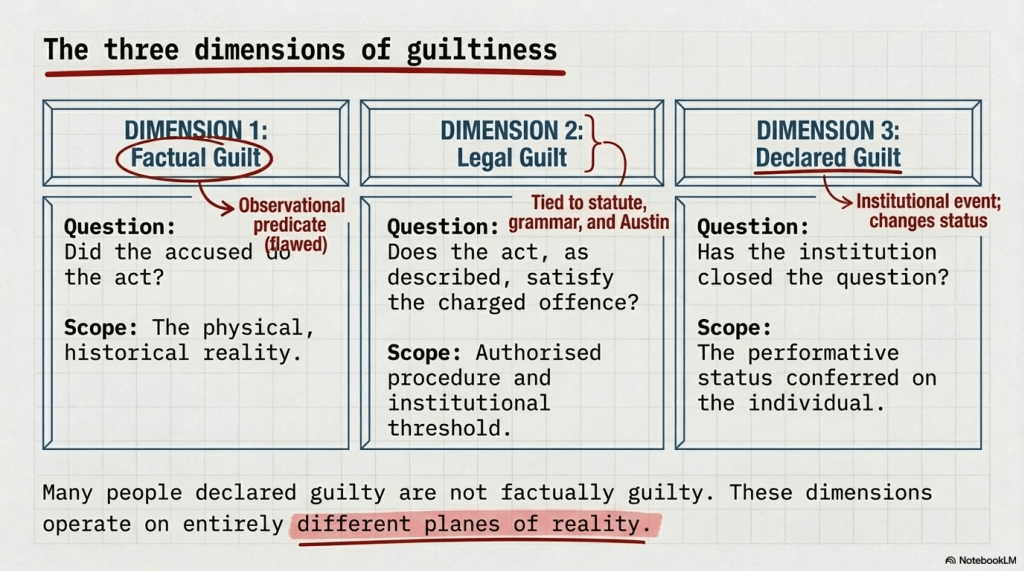
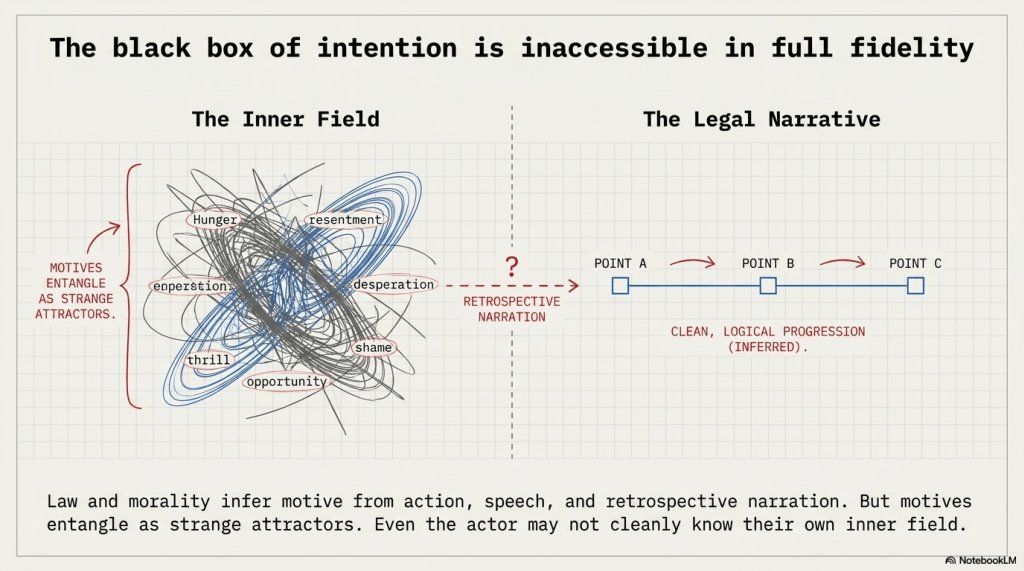
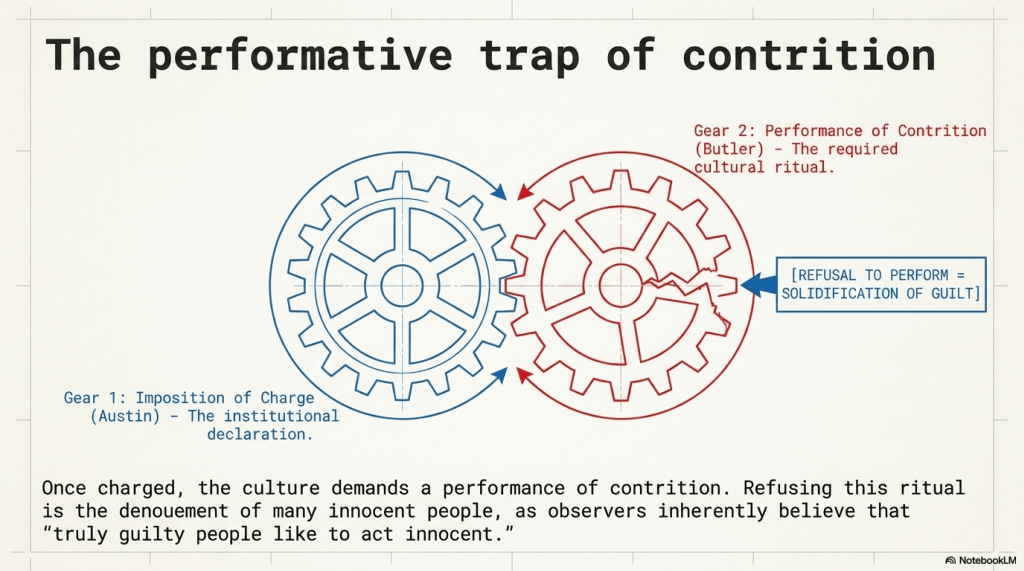
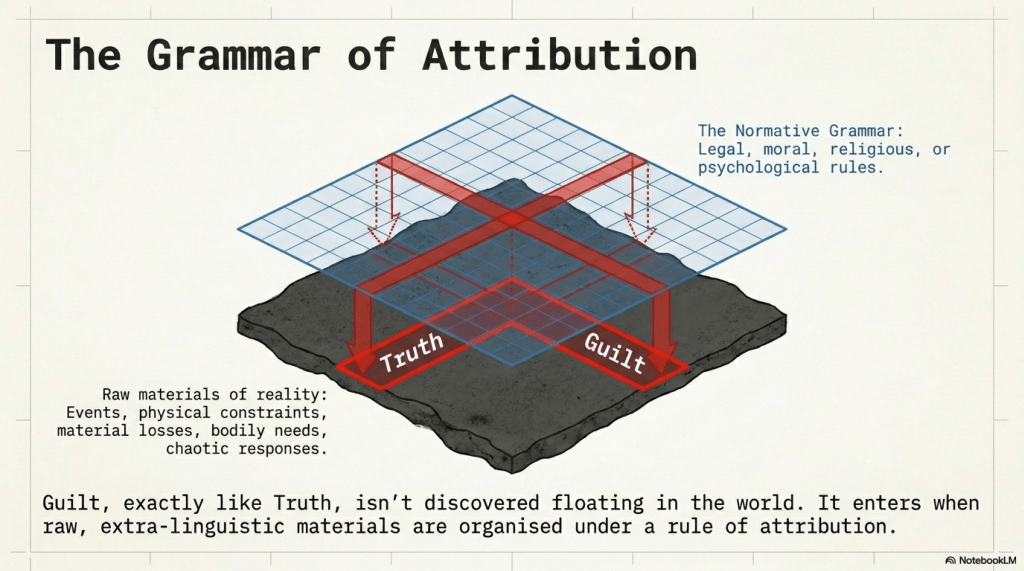
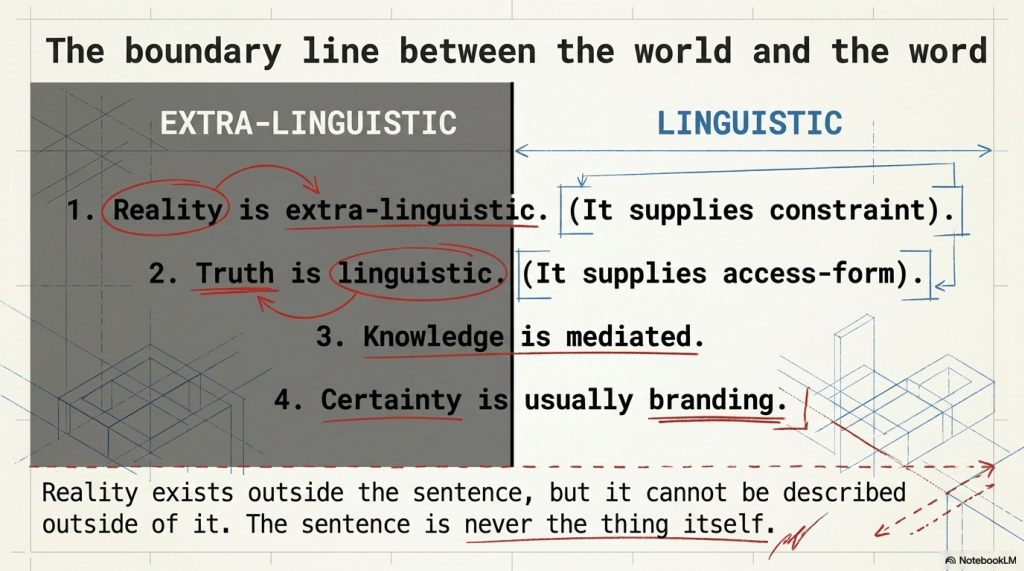
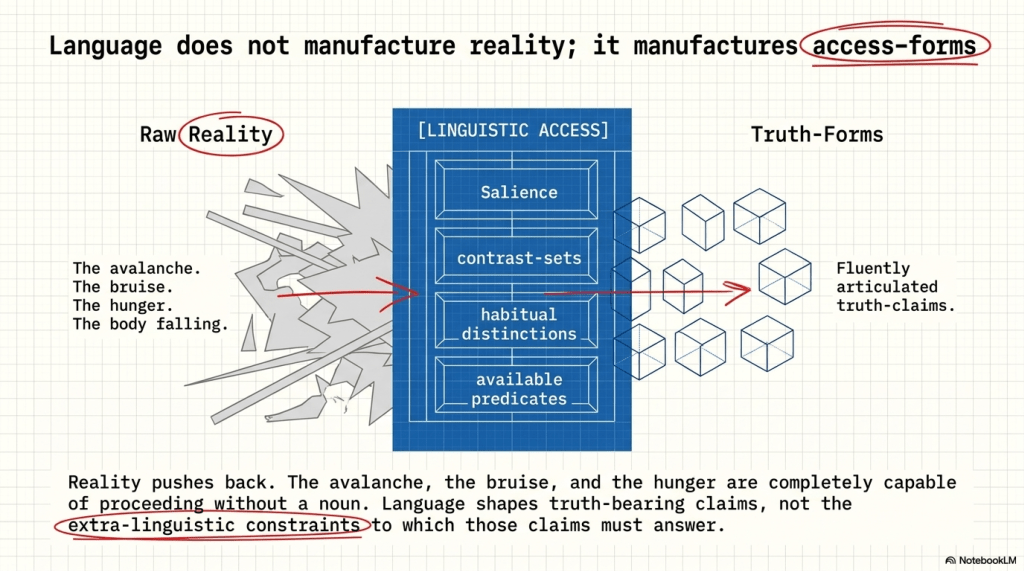
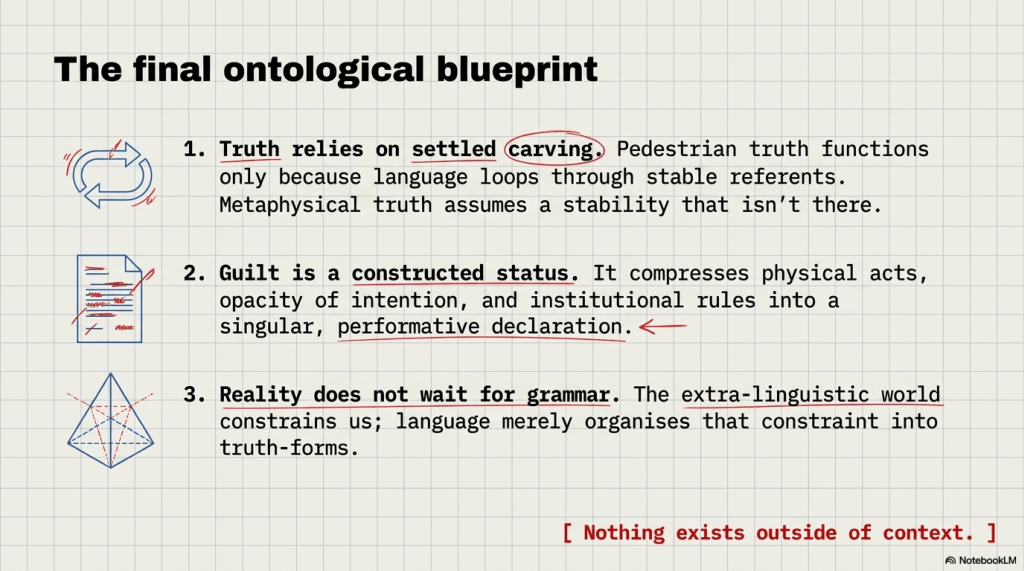
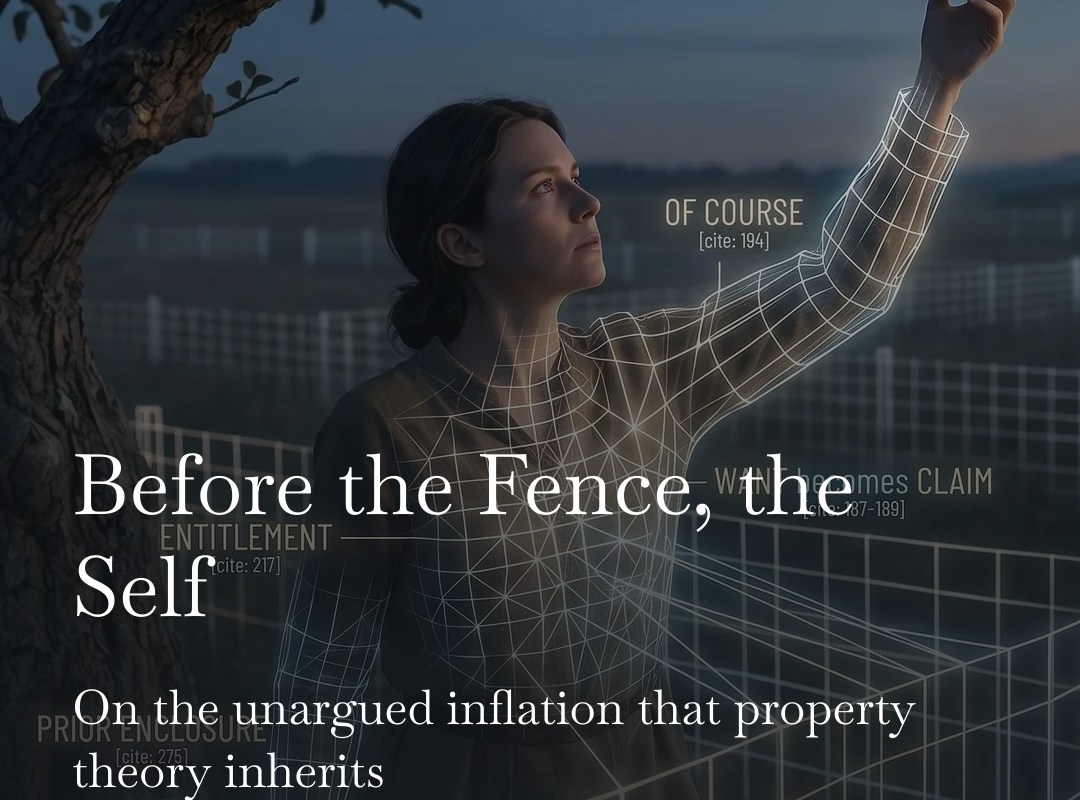
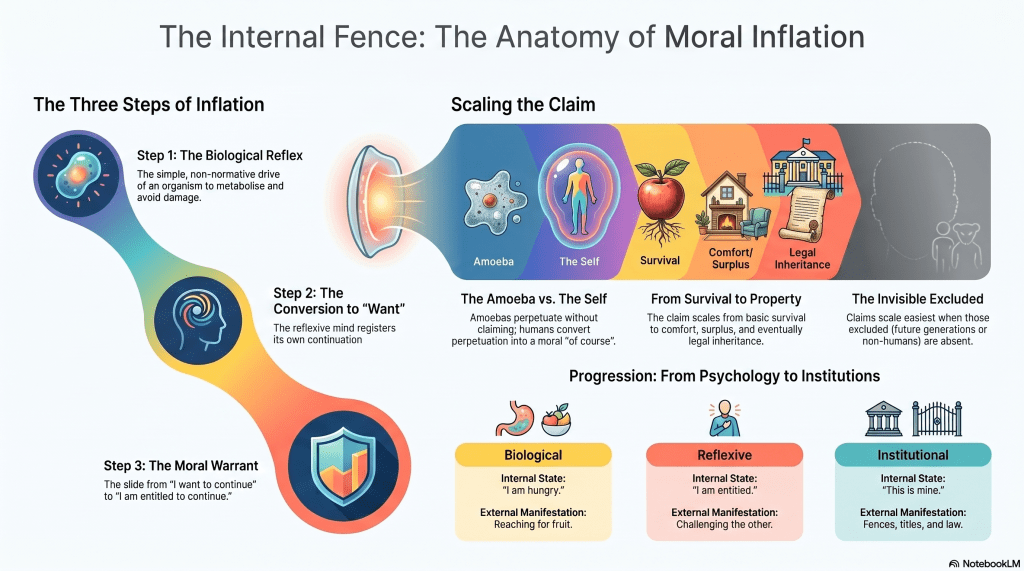
Below are some related NotebookLM images for the target topic.
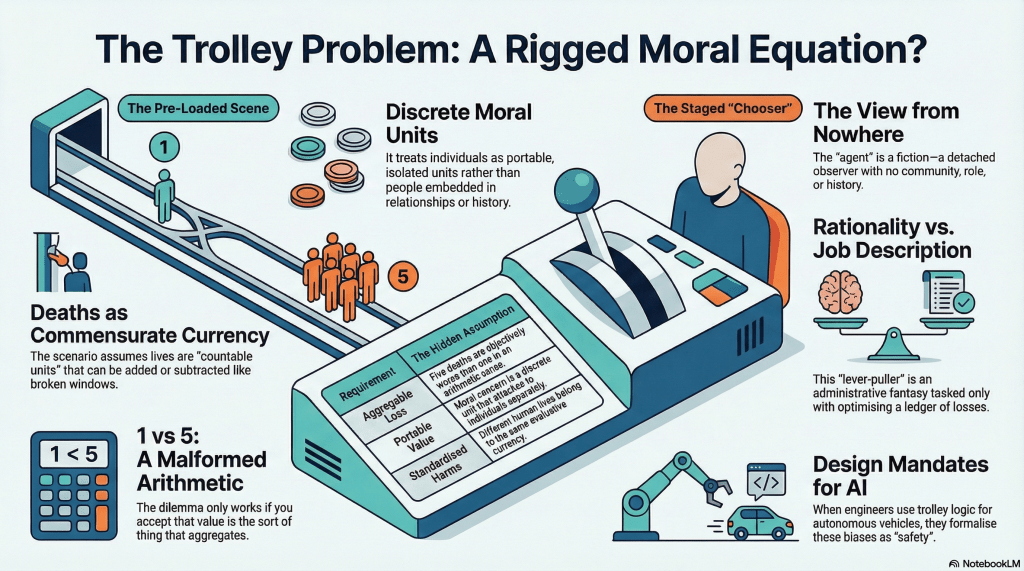
The trolley problem is not a neutral test of moral judgment. It’s a borrowed ontology, transmogrified into a moral test. Before anyone reasons about anything, the scene has already decided what sort of things there are to reason about: discrete persons, countable lives, comparable harms, and a chooser licensed to survey them from nowhere in particular.
Audio: NotebookLM summary podcast of this topic.
What follows from it isn’t a clarification of moral principle but a rehearsal within terms already set.
The Scene Is Already Loaded
The standard trolley case presents itself as raw moral data – a clean dilemma, stripped of the mess of the real world, offered up for principled adjudication. It is nothing of the sort.
Before you are invited to reason, the scenario has already done substantial philosophical work on your behalf. It’s individuated persons into discrete units. It has rendered their lives countable. It’s made their deaths commensurable – one loss weighed against five, as though the comparison were as natural as subtraction. And it’s structured the whole affair as a problem of adjudication: here are the facts, now judge.
None of this is neutral. Every one of those moves is a substantive ontological commitment dressed up as stage direction.
Take commensurability alone. The question ‘should you divert the trolley to kill one instead of five?’ only functions as a dilemma if those deaths belong to the same evaluative currency. If they don’t – if, say, the value of a life isn’t the sort of thing that submits to arithmetic – then the problem is not difficult. It is malformed. The anguish it is supposed to provoke is an artefact of its own framing, not a discovery about ethics.
The maths is real enough. What’s dubious is the ontology that made the arithmetic possible.
NotebookLM Infographic on this topic.
The Chooser Is a Staged Fiction
The scene isn’t the only thing preformatted. What about the agent?
The trolley chooser stands outside the situation, surveys the options, and selects. They are not embedded in a community, encumbered by role, constrained by relationship, or shaped by history. They’re a pure point of detached rational adjudication – the moral equivalent of a view from nowhere.
The point isn’t that no one ever chooses under pressure. Of course, they do. The point is that the trolley problem presents detached adjudication as though it were the natural form of moral intelligence. As though stripping away context, relationship, role, and history were a way of clarifying moral reasoning rather than of impoverishing it beyond recognition.
The solitary lever-puller, surveying outcomes from above, isn’t morality stripped to its essentials. It’s modern administrative fantasy.
They’re the civil servants of ethical theory: contextless, disembodied, tasked only with optimising a ledger they didn’t write and can’t question. The scenario doesn’t merely place them in a difficult position. It constructs them as the kind of agent for who(m) moral life consists of exactly this: tallying comparable losses under time pressure and choosing the smaller number.
That isn’t the human condition. It’s a job description.
The Grammar Is Borrowed
It gets worse.
It’s one thing to say that trolley problems are structured rather than neutral. Most thought experiments are structured. Simplification is the point. The real indictment isn’t that the trolley case has assumptions, but that it has these assumptions – and that they are not universal features of moral reasoning but the inherited furniture of a very particular intellectual tradition.
Consider what the scenario requires you to accept before you even begin deliberating:
That persons are discrete, portable units of moral concern. That value is the sort of thing that attaches to them individually and can be summed across them.
That losses are aggregable and commensurate – five deaths are worse than one in the same way that five broken windows are worse than one.
That ethical judgement, at its most serious, takes the form of an isolated decision-maker surveying comparable outcomes and selecting among them.
This is not the skeleton of rationality itself. It is a picture – modern, liberal, administrative – of what rationality looks like when it has been formatted for a particular kind of governance. The trolley problem does not merely presuppose an ontology. It presupposes this one.
And the trick – the real laundering – is that it presupposes it so thoroughly that the presupposition becomes invisible. Respondents argue furiously about whether to pull the lever, push the fat man, or stand paralysed by principle, without ever noticing that the terms of the argument were installed before they arrived. The metaphysics entered the room disguised as a trolley schedule.
What Trolley Problems Actually Reveal
If all of this is right, then the usual interpretation of trolley responses has the direction of explanation backwards. The standard reading goes something like: present a moral dilemma, observe the response, infer a moral principle. Consequentialists pull the lever. Virtue ethicists pose. Stoics watch. Deontologists don’t pull the level on principle alone. The disagreement reveals something about the structure of moral thought.
But if the scene is already ontologically loaded, and the chooser already formatted for a particular style of deliberation, then what the response reveals isn’t an independently accessed moral truth. It’s the respondent’s prior comfort with the ontological grammar that the case has already installed. Those who pull the lever are not discovering that consequences matter. They are confirming that the grammar of aggregable, commensurable lives is one they already inhabit. Those who refuse aren’t discovering that persons are inviolable. They are resisting, perhaps inarticulately, a grammar that does not match the one they brought into the room.
The disagreement is real. But it’s not a disagreement about what’s right. It is a disagreement about what there is – about what a person is, what a life is, whether value aggregates, whether agency is the sort of thing that can be exercised from nowhere. It’s an ontological dispute conducting itself in moral attire.
Trolley problems don’t tell us what’s right. They tell us what we already think there is to count. This matters beyond moral philosophy. The moment trolley logic is recruited for autonomous vehicles, military robotics, or triage systems, its hidden ontology ceases to be a parlour-game inconvenience and becomes a design mandate. Engineers do not escape the metaphysics of the scene. They inherit it, formalise it, and call the result safety. That may be the more urgent article.
The next question is not whether a self-driving car should kill one pedestrian rather than five. It is how such a machine came to inherit a world in which persons appear as countable units, harms as optimisable variables, and moral action as a problem of detached calculation in the first place.
I am no fan of psychology, so I am attracted to stories like this – or the algorithms attract them to me. This article lays out the evidence that psychopathy doesn’t exist. By extension, sociopathy shouldn’t exist, since it’s effectively an extension of psychopathy. If unicorns don’t exist, neither do unicorn horns. In fact, one might look backwards to note that the psychopathy of unicorns doesn’t exist, nor does psychology (unicorn farms). Of course, this is faulty logic, but I’m running with it.
Westworld was a disappointment. It became unwatchable after the first season. But one exchange from 2016 has aged better than anything else in that show, and it landed differently when I recalled it recently in the context of AI authorship.
A greeter robot exchanges words with William, a guest.
‘You want to ask, so ask.’
‘Are you real?’
‘Well, if you can’t tell, does it matter?‘
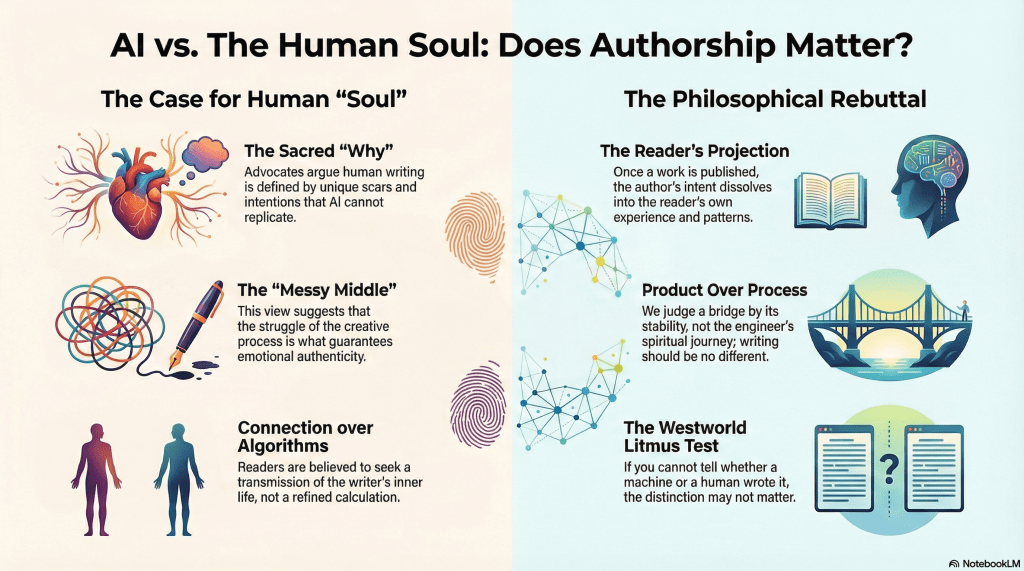
I thought of this after encountering a post that’s representative of a genre now doing brisk trade on LinkedIn and its satellites. The argument runs roughly thus: AI can write fast, but it can’t write you. Your why is sacred. Your scars make the prose real. The messy middle is where the magic lives. Keep the soul in your stories.
Audio: NotebookLM summary podcast of this topic.
A bloke shared this opinion:
The one thing AI can’t replicate is your “Why.” 🧠
There’s a lot of noise lately about how AI can “write a book in an hour.” But after publishing 8 books, I’ve realized something crucial: speed is not the same as substance.
The “hidden danger” of letting tools do the heavy lifting isn’t just about the quality of the prose—it’s about the erosion of the creative spirit. When we skip the struggle of the “messy middle,” we skip the insights that actually make a story resonate with a reader.
Tools are great for grammar and brainstorming, but they don’t have: The scars that make a character’s pain feel real.
The weird, specific memories that make a setting feel alive. The intuition to know when to break the rules for emotional impact.
By all means, use the tech. But don’t let it sit in the driver’s seat. Your readers are looking for a connection with you, not a refined algorithm.
Keep the soul in your stories. It’s the only thing that actually sticks.
NotebookLM Infographic on this topic.
So much to unpack.
This sounds lovely enough. It is also almost entirely wrong, methinks.
Why is doing suspiciously grand work in these arguments. It’s treated as an ineffable essence – a soul-particle immune to replication. But why is not a substance. It’s an interpretive gloss. A post-hoc narrative we attach to action to stabilise it. Call it intention, call it telos, call it ‘creative spirit’ if one must. It remains a story we tell about stories.
And if we’re invoking the canon, let’s not do so selectively. Roland Barthes already detonated the neat alignment between authorial intention and readerly reception. Once a work leaves the desk, its why dissolves into a field of readings. The reader does not commune with your struggle. They encounter marks on a page. The rest is projection.
The romanticisation of the ‘messy middle’ borders on Calvinism – suffering as guarantor of authenticity, as though the scar itself writes the sentence. Plenty of humans have scars and produce dull prose. Plenty of writers construct convincing pain from observation, empathy, craft, and yes, occasionally from tools. Emotional resonance is not a moral reward for having bled.
Then there is the means-fetish: the idea that process sanctifies product. We do not evaluate a bridge by how spiritually formative the drafting was for the engineer. We ask whether it stands. If a text moves a reader, unsettles them, clarifies something, disturbs them – the instrument used to draft it is historically interesting, not aesthetically decisive.
There is also a quiet assumption buried in all of this: that connexion between writer and reader is a transmission of interiority. It isn’t. It is a negotiated effect. Readers connect with patterns that mirror, disrupt, or reframe their own experience. They are not sniffing for artisanal anguish.
None of this means craft evaporates. It means we should be wary of smuggling metaphysics into workflow preferences.
If someone prefers to wrestle with the blank page unaided – splendid, have at it. But the fetish for purity says more about our anxieties over authorship than it does about art. And if you can’t tell whether the thing that moved you was written by hand or by machine, then I’d suggest, with the greeter robot, that perhaps it doesn’t matter.
In the end, I am not even advocating using AI for writing, but I am saying not to be a dick about it. Enough of the virtue signalling
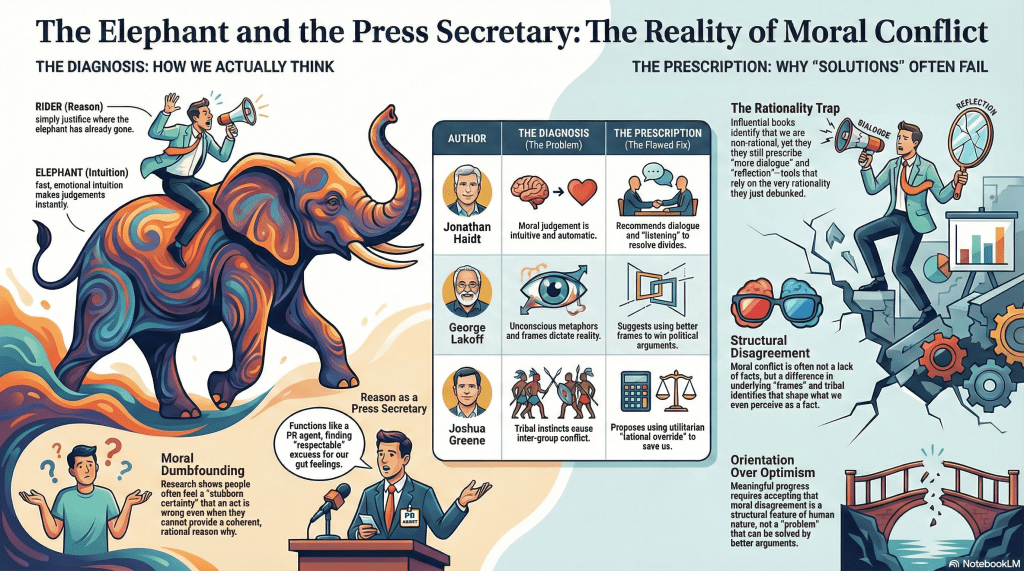
Over the past few decades, moral psychology has staged a quiet coup against one of our most cherished fantasies: that human beings are, at bottom, rational moral agents. This is not a fringe claim. It is not a Twitter take. It is the mainstream finding of an entire research programme spanning psychology, cognitive science, linguistics, and neuroscience.
We do not reason our way to moral conclusions. We feel our way there. Instantly. Automatically. And only afterwards do we construct reasons that make the judgment sound respectable.
Audio: NotebookLM summary podcast of this topic.
This is not controversial anymore. It is replicated, taught, and celebrated. And yet, if you read the most influential books in this literature, something strange happens. The diagnosis is devastating. The prescription is reassuring.
I’ve just published a long-form video walking through five canonical books in moral psychology that all uncover the same structural problem, and then quietly refuse to live with the implications.
Each of these books is sharp, serious, and worth reading. This is not a hit piece.
But each follows the same arc:
Identify a non-rational, affective, automatic mechanism at the heart of moral judgement
Show why moral disagreement is persistent and resistant to argument
Propose solutions that rely on reflection, dialogue, reframing, calibration, or rational override
In short: they discover that reason is weak, and then assign it a leadership role anyway.
Haidt dismantles moral rationalism and then asks us to talk it out. Lakoff shows that framing is constitutive, then offers better framing. Gray models outrage as a perceptual feedback loop, then suggests we check our perceptions. Greene diagnoses tribal morality, then bets on utilitarian reasoning to save us.
None of this is incoherent. But it is uncomfortable. Because the findings themselves suggest that these prescriptions are, at best, limited.
Diagnosis without prognosis
The uncomfortable possibility raised by this literature is not that we are ignorant or misinformed.
It is that moral disagreement may be structural rather than solvable.
That political conflict may not be cured by better arguments. That persuasion may resemble contagion more than deliberation. That reason often functions as a press secretary, not a judge.
The books sense this. And then step back from it. Which is human. But it matters.
Why this matters now
We are living in systems that have internalised these findings far more ruthlessly than public discourse has.
Social media platforms optimise for outrage, not understanding. Political messaging is frame-first, not fact-first. AI systems are increasingly capable of activating moral intuitions at scale, without fatigue or conscience.
Meanwhile, our institutions still behave as if one more conversation, one more fact-check, one more appeal to reason will close the gap. The research says otherwise.
And that gap between what we know and what we pretend may be the most important moral problem of the moment.
No solution offered
The video does not end with a fix. That’s deliberate.
Offering a neat solution here would simply repeat the same move I’m criticising: diagnosis followed by false comfort. Sometimes orientation matters more than optimism. The elephant is real. The elephant is moving.And most of us are passengers arguing about the map while it walks.
Looking through some of the drafts clogging the blog, I decided to whittle away at the queue. I started this months ago. It’s here now, not particularly in sync with the season or recent topics, but I like Sapolsky.
‘Biology is destiny’, say the Christian Right, the bland bureaucrats of morality, the loud whisperers at Sunday school. They want gender to be a tomb carved in marble: you’re assigned at birth, and you stay a perfect statue. But Sapolsky waltzes in and says, ‘Hold up – what do you mean by biology? Which biology? Which markers count?’
Video: Neuro-biology of Transsexuality, Prof. Robert Sapolsky
In the clip above, Sapolsky unpacks neurological evidence that upends the essentialist cheat codes. He doesn’t pretend we now have the final answer to gender. He does something scarier to fundamentalists: he shows just how messy biology is.
The Bed Nucleus, the Finger Ratio, and the ‘Wrong Body’ Hypothesis
Sapolsky discusses three pieces of neurobiological evidence:
Digit ratio (2nd vs 4th finger length): In lesbians, on average, the ratio is closer to what you see in straight men than straight women. That’s a correlation, an eyebrow-raiser, hardly a decree.
Acoustic reflexes (auto-acoustic reflex): Another early finding in women’s sexual orientation, though faint and underexplored.
The bed nucleus of the stria terminalis (BSTc): Here we reach heavy artillery. There is a neuron population in this region that, on average, is about twice as large in males as in females. In postmortem analyses of trans women (male → female), this region’s size corresponds to their identified gender, not their natal sex. Crucially, that alignment is seen even in trans individuals who never underwent full hormone therapy or surgical changes.
Sapolsky recounts astute controls: men treated (for, say, testicular cancer) with feminising hormones don’t show the same shift.
Also, using the phantom-limb analogy: men who lose their penis to cancer often report phantom sensations; trans women rarely do. That suggests the body map in the brain never fully “registered” that organ in the same way.
He doesn’t overclaim. He doesn’t say, ‘Case closed, biology proves everything’. He says: These data complicate your neat categories. They force you to ask: which biological measure do you privilege? Hypertrophied neurons? Chromosomes? Receptor density? Hormones? All of them simultaneously? None of them?
Essentialism as a Trap
Fundamentalists and anti-trans ideologues deploy essentialism because it’s convenient. They demand an ironclad ‘essence’ so they can exclude anyone who fails their test. But what Sapolsky shows is that essence is simply a scaffold; we get to pick which biological scaffolds we accept. They may choose genes and genitals; the neurobiologist gives them neuron counts and brain-maps. When your ideology elevates one scaffold and ignores the others, it betrays its own contingency.
Moreover, the evidence suggests that identity, experience, insistence (in Sapolsky’s language: ‘insisting from day one’), and internal brain structure might converge. The ‘wrong body’ isn’t a metaphor. It’s a mismatch between internal brain architecture and external form. The stubborn fragments of biology that fundamentalists accept are torn by the dissonance that science increasingly reveals.
What This Means for Trans Rights, Discourse & Strategy
Science is never ‘conclusive’. Sapolsky offers compelling support, not gospel. Anyone claiming this settles everything has never looked at a scatter plot.
Lived experience still matters. Even if we never had brain slices, self-reports, psychology, psychiatry, anthropology, narratives remain valid. Brain studies supplement, not supplant, testimony.
Essentialist opponents have boxed themselves in. When they demand biology decides everything, they hand the baton to neuroscientists – and neuroscientists keep running with it. The entire ‘biology’ equals only what I like’ regime is exposed.
Ambiguity is a strength, not a liability. If we insist identity is linear and tidy, we re-enact their demand for purity. Recognising complexity, mess, and variance is radical resistance.





 Philosophics