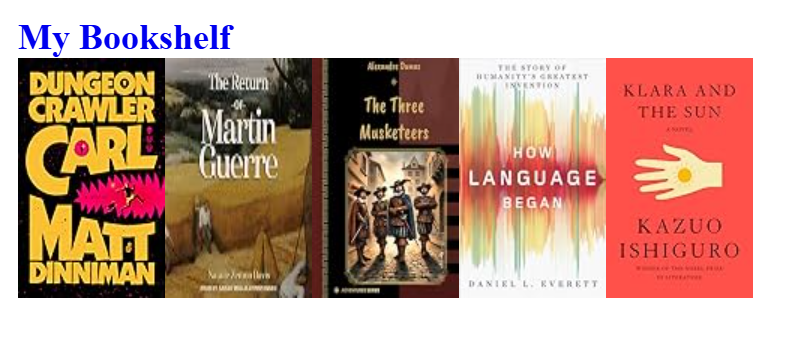
I discovered a WordPress widget and decided to share my reading progress, but it appears to show the last few books I’ve finished rather than my active list. Click on My Bookshelf to view more.
I read several books at once. I tend to read a fiction and several non-fiction books. The fiction books happens to be an audiobook, which I tend to listen to whilst I am working out: Carl’s Doomsday Scenario: Dungeon Crawler Carl (book 2). It’s more of a diversion – and entirely unserious, though I did find a quote on Understanding, my latest essay project still in progress.
I can’t really recommend a book to people because I don’t know their tastes and interests. As for the Dungeon Crawler series, if you like RPG gaming culture and lore, you may appreciate the humour of LitRPG. It’s stupid fun.
On the serious side, I’ve mainly been milking a few titles;
Being and Time, An Annotated Translation: Martin Heidegger
Against Progress is a short collections of essays that I tend to travel with and read an appointments and such. I’ve read almost half of them, but I’m still reading.
I’m very close to finishing Reasons and Persons. I’t not exactly a page turner, but it is engaging. It’s inspired several essays here, so I have to suggest that it’s worth the read, as long as it is.
I’ve read Being and Time before, but I wants to take a gander with this new translation and check out the annotations. Since I’ve already read it and have ideas about it, I am more critical of some of the early annotations than a fresh book, but this is also on a slow –when I have time – track.
Of course, one could argue that I would have time if I weren’t reading non-fiction, and one would be correct. However, the level of attention required differs significantly.
As Independence Day is upon the United States of America, I considered some counterfactuals. What if Europe fails to reach the Americas until a century or more late, and we watch the delay from the vantage of the peoples already here, going about the business of history without a Columbus to interrupt them? Then came the question everyone eventually asks about their own good ideas, in the tone of a man checking whether the milk has turned: has this been done before? Of course, it had been. Spoilers follow – sort of.
Audio: NotebookLM summary podcast of this topic.
The inversions
The oldest respectable relative is Robert Silverberg’s The Gate of Worlds (1967). A nastier Black Death carries off three-quarters of Europe rather than a third; the continent never recovers, the Ottomans move in, London becomes New Istanbul, and by the twentieth century the great powers are the Aztecs, the Incas, the Russians and the Japanese. Our guide is a young Englishman named Dan Beauchamp, who sails to an industrial, motorcar-driving Mexico to seek his fortune. Note the pronoun. The world has been turned upside down, and we are shown it by a European looking up.
Christopher Evans’s Aztec Century (1993), which took that year’s BSFA Award, runs the same reversal with more brass. Cortés changes sides, a New World plague scythes through Europe instead of the reverse, and the Aztec Empire swells into a technological superpower that eventually occupies Britain. The narrator is Princess Catherine, daughter of a defeated British monarch, Princess Diana watching London burn from the losing side. Again, the conquered European tells us what the conquest was like.
Laurent Binet’s Civilizations(2019) is the cleverest of the lot, and the most decorated – it won the Grand Prix du roman de l’Académie française, and Sam Taylor’s English translation took the Sidewise Award for alternate history. A stray band of Vikings gifts the Americas iron, horses and, crucially, immunity; so when Columbus turns up in 1492, he is captured and demoted to court jester, and the Inca emperor Atahualpa later sails east to conquer a Europe conveniently fractured by Luther, the Inquisition and its own dynastic squabbles. Binet is far too intelligent not to know what he is doing. The whole thing is a Civilization-the-video-game daydream executed with Académie française tailoring, and it is genuinely delicious. It is also, structurally, another inversion: swap the conqueror, keep the conquest.
The remix and the intervention
Two cousins change the machinery rather than the direction. Kim Stanley Robinson’s The Years of Rice and Salt (2002) empties Europe almost entirely – the plague takes ninety-nine per cent – and then spends six hundred sprawling, reincarnation-threaded pages letting China, Islam, India and the Indigenous Americas run world history without the Europeans in the room at all. It is less a mirror than a vast tapestry, and its ambition is precisely that Europe should not be the pivot. Whether it manages that, or merely relocates the pivot, is a question the book is honest enough to leave open.
Orson Scott Card’s Pastwatch: The Redemption of Christopher Columbus (1996) cheats, and admits it: time-travellers reach back to soften the catastrophe of contact. It is a book about first contact, disease and conquest, but the engine is intervention from a guilty future, which makes it a novel about us editing them, the colonial gaze wearing a lab coat.
The one that isn’t a mirror
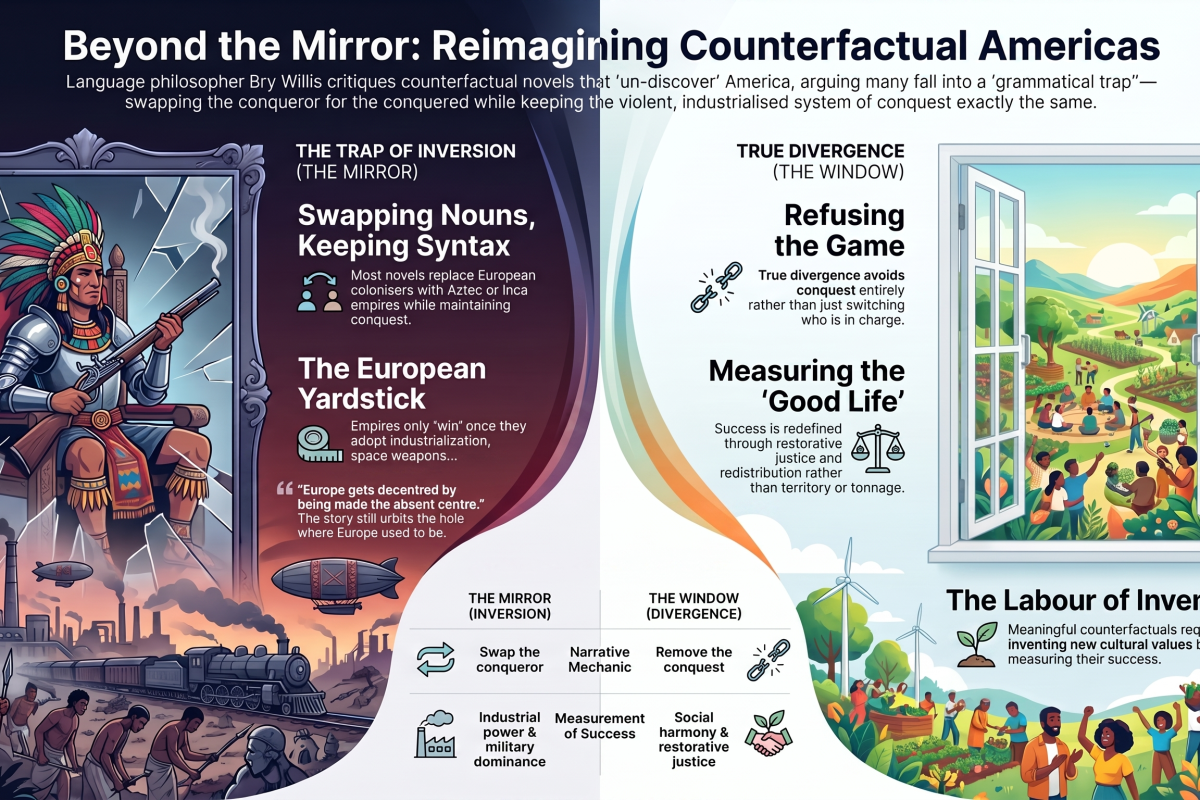
And then there is B. L. Blanchard’s The Peacekeeper (2022) – also, tellingly, a Sidewise Award winner – which does the rarer thing and quietly refuses the whole game. There is no inversion here, because there is no conquest to invert. North America was simply never colonised. The Great Lakes are an independent Anishinaabe nation; Chicago is Shikaakwa; there are no borders on the map because the book declines to draw any. It happens to be a murder mystery, and a slightly wobbly one – I called the culprit early, as apparently did everyone – but the mystery is scaffolding. The real work is a society organised around restorative justice, redistribution and something the glossary calls the Good Life, where crime is repaired rather than punished, and the question ‘what is success?’ gets a genuinely different answer. That difference is the whole point, and it is worth spelling out.
The tell
Watch what the inversion novels are obliged to do to their winners. Silverberg’s Aztecs drive coal-fired automobiles. Evans’s Aztecs somehow have flying warships and space weapons, to the audible irritation of every reviewer who has ever met a history book. In each case, the counter-empire only counts as having won once it has industrialised, once it has, in other words, become Europe in a headdress. The measuring stick never leaves the room. It just changes hands. Would not recommend. All of these are still viewed through Modernist lenses. They can’t seem to help themselves.
This is the trap, and it is a grammatical one: you can swap every noun in the sentence and leave the syntax of conquest perfectly intact. Who dominates whom is a variable. That domination is the axis of the story remains fixed – invisibly, load-bearingly fixed. So the shelf keeps producing books that promise to dethrone Europe and instead install a differently-costumed emperor on the same throne, using the same yardstick to prove he deserves it. Europe gets decentred by being made the absent centre. Everything still orbits the hole where it used to be.
Blanchard’s book is the one that escapes, and it escapes not by putting someone else on the throne but by asking whether the throne needed to exist. That is a far harder imaginative act, which is exactly why the shelf holds so many mirrors and so few windows. Inverting a hierarchy is a parlour trick – satisfying, symmetrical, teachable in an afternoon. Imagining a world whose values diverged, so that its people would not measure their flourishing in territory and tonnage at all, requires you to invent the ruler before you can invent the thing it measures. Most writers, sensibly, decline the extra labour.
Six books, then, and a warning label. Read Binet for the wit, Blanchard for the nerve, Silverberg for the ancestry, and the rest for the pleasure of watching very clever people not quite escape the room. Then, if you’re feeling brave, go and undiscover America properly, which means resisting the temptation to let it become us, wearing better feathers.
I’ve been working for days on a new short story that investigates time. I’ve already published The Box in English, but this new piece looks at a different aspect of time, one I suspect may work better in French because the grammar gives me more useful pressure points than English.
The working title is Les Années Vécues, which translates literally as The Years Lived. For now, that’s only a working title. Oddly enough, the purpose of this post is not really to describe the story, though I may do some of that. It is more about the tools, the process, and the strange route by which the idea arrived.
The story began as a conversation between me, Claude, and ChatGPT about human innovation and creativity. A colleague had recommended How Language Began. I bought it and read the first few chapters. For the record, it’s interesting.
Early on, the author discusses genetics and evolution, citing human inventions along the way, particularly those associated with Homo erectus. Because I tend to question narratives of progress, and especially grand claims around Innovation and Creativity, I fell into some LLM-assisted chit-chat. From there, the conversation drifted into time travel in fiction. We discussed tropes from Back to the Future to Outlander. Somewhere in that mess, I noticed a missing perspective I felt I could capitalise on.
For the record, again, I have not been especially successful at writing short stories. They tend to grow beyond my intent, usually into novelettes or novellas. My first novel, written as Ridley Park, began as a short story. That story is now ostensibly chapter five of Hemo Sapiens. It can stand on its own, but it plays better in context. It is still my favourite chapter, if I had to choose one. So I’ll see where this new one goes, if anywhere. Nowhere is always an option. The blank page remains admirably non-committal.
After hours of brainstorming with the LLMs, arbitrarily switching from French to English and back again, I had a plot outline with beats and flavour, tropes and intentions, subversions and misdirects. I had captured dialogue exchanges, worked through worldbuilding constraints, and fleshed out several plot points. Then I asked ChatGPT to build me a tracking document to serve as a punch list.
I’ve done this a few times before, but with the advancement of the tools, the output was surprisingly robust, arguably overkill, which isn’t always a vice.
The spreadsheet contains 9 tabs:
Lists
Dashboard
Punchlist
Beat Map
Continuity Rules
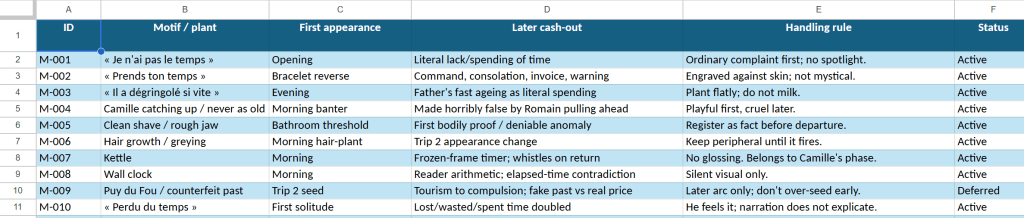
Motifs & Plants
Evidence Ledger
Open Questions
Sources
Lists
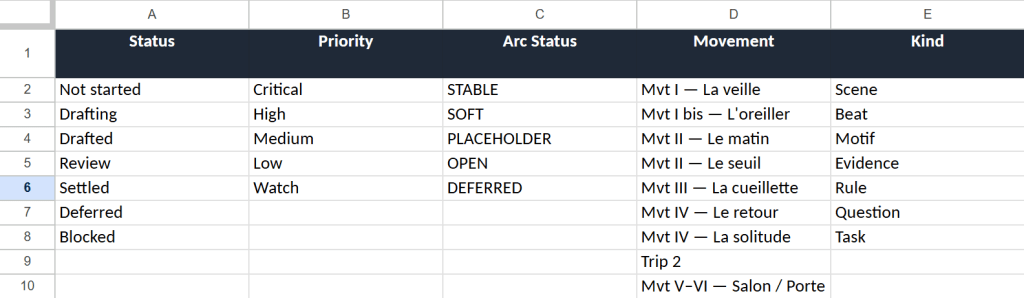
The Lists tab is mostly internal to the spreadsheet. It controls status values, priorities, categories, and related dropdowns. I would not have made it this elaborate manually, but I’m not offended by competence when it arrives uninvited.
I wouldn’t have been so elaborate, but it’s nice nonetheless.
The Dashboard
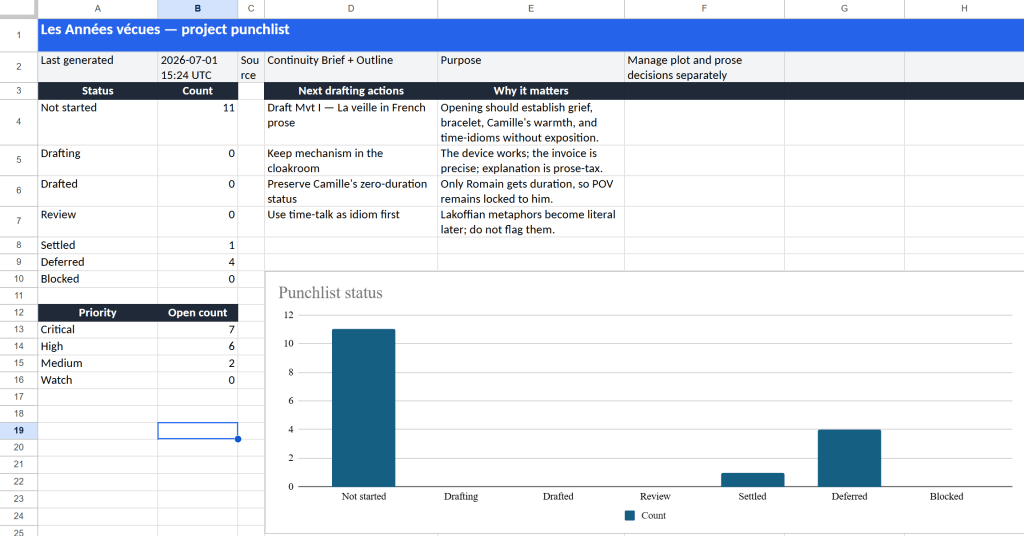
The Dashboard is also a bit of overkill, but useful overkill. In its inaugural state, it gives a quick view of task status, priorities, and next actions. Its intent should be clear from the screenshot.
Punchlist
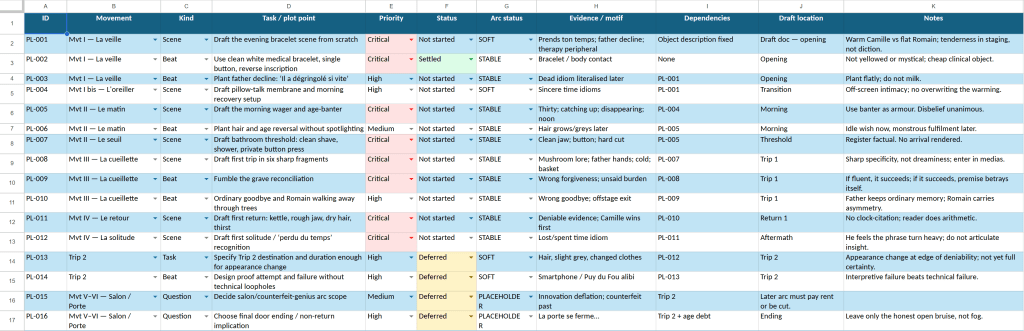
The Punchlist is essentially an actionable to-do list with status markers. I think I can safely share this without giving too much away. It lets me manage the story as a set of unresolved craft problems rather than as a vague cloud of ‘I should really get back to that’.
Beat map
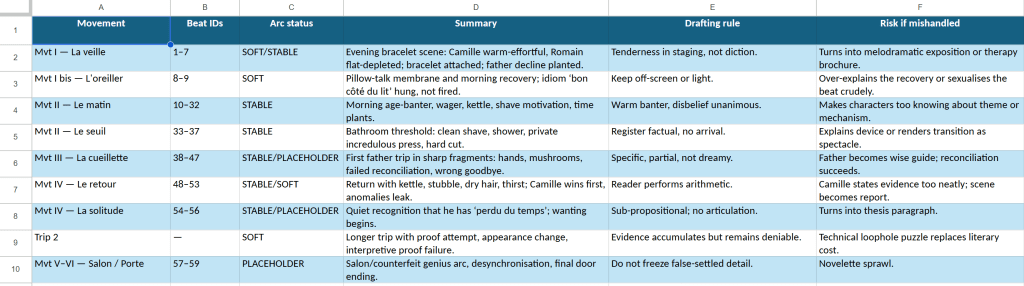
The Beat Map contains representative story beats, with notes that capture narrative purpose, confidence level, and risk-management annotations. This is where structure can be managed without cluttering the prose draft itself.
Continuity Rules
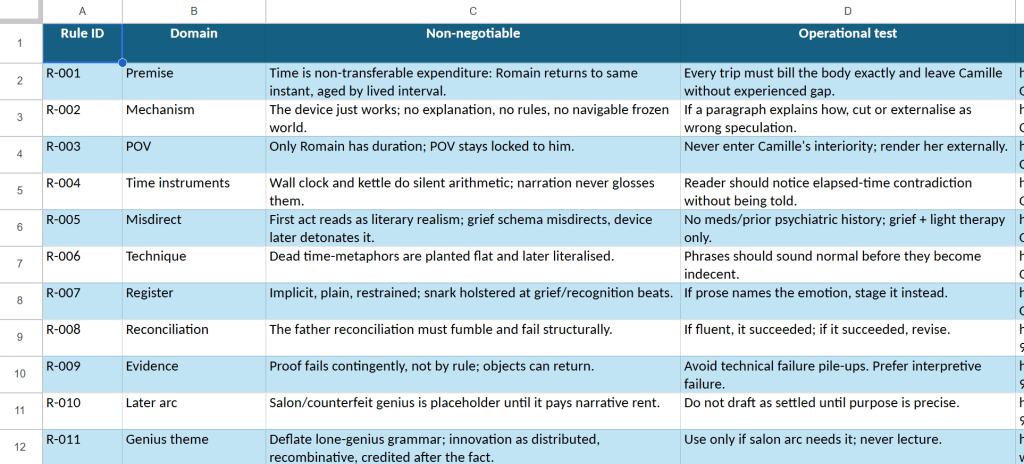
The Continuity Rules tab captures worldbuilding constraints and adjacent considerations. It is probably oversharing at this stage, but I’ll take the risk. These rules matter because speculative fiction can collapse quickly when the premise starts leaking.
Motifs & Plants
The Motifs & Plants tab tracks recurring touchpoints, images, phrases, and planted details. Some of these may be premature, but having them outside the draft helps me avoid forcing them into the prose too early.
Evidence Ledger
The Evidence Ledger tracks what counts as evidence inside the story world, who can interpret it, and how it may be misread. This is another continuity check, but also a thematic one.
Open Questions
The Open Questions tab is exactly what it sounds like: unresolved choices, structural uncertainties, and decisions I do not yet want to freeze into place. Sometimes the most useful document is the one that refuses to pretend everything has been solved.
Sources
The Sources tab lists the chat history and documents from which the rest of the content was derived.
The Rest
This is only a partial listing, and I am not finished ideating. I have not yet begun the prose.
I do not always plot my stories. More often than not, I take something closer to a stream-of-consciousness approach. But for one thing, my consciousness does not stream in French. So there’s that.
What impressed me most was the organisational layer the LLM produced. The spreadsheet is now hosted on Google Drive as a Sheet, accessible to both me and the LLMs, so it can be updated as the discussions and decisions continue.
I’m looking forward to wrapping up the ideation phase and beginning, and ideally completing, the prose. That last part remains the traditional nuisance.
I just finished reading Feyerabend’s Against Method – rather, I just finished the back matter, as I finished the core of the book some time ago. I debated reading this part of the book, and sorry, but I often don’t – despite writing back matter for some of my own academic publications. I treat them as asides.
I’m glad I read this material because, aside from the endnotes, it was meta and biographical, so the perspective was nice. In fact, it got me thinking. He talks about his struggle with Relativism™. I used to struggle with the same thing; there seemed to be a false battle between objectivists and relativists or subjectivists, but in my mind these were always straw-man caricatures nobody seriously defended, yet somehow people were vocal about avoiding. I’ve written extensively about my own position on mediation, so I won’t info dump here.
Audio: NotebookLM summary podcast of this topic.
As people familiar with my habits, I tend to read several books in parallel. In fact, you can review what I am reading on Goodreads.
To be fair, I don’t tend to close-read fiction books very often. I find it to be slow and cumbersome. For non-fiction, this is the default, but not generally for fiction. But, since French is a second language, my attention needs to be focused. I don’t feel that I can read casually and catch the sort of embedded grammatologie that I can absorb through osmosis in English-language books.
Why slow read then? I have a desire to maintain and advance my French, so I think that reading contemporary books connects me to current language trends, terms, phraseology, and metaphor. I am using Claude and ChatGPT to assist with the close reading. They’ve already helped me to better understand the opening paragraphs. It opens like this:
Let’s discuss this, word choices, and any implications. This is the first paragraph of the first chapter:
Debout sur la berge, Anthony regardait droit devant lui. À l’aplomb du soleil, les eaux du lac avaient des lourdeurs de pétrole. Par instants, ce velours se froissait au passage d’une carpe ou d’un brochet. Le garçon renifla. L’air était chargé de cette même odeur de vase, de terre plombée de chaleur. Dans son dos déjà large, juillet avait semé des taches de rousseur. Il ne portait rien à part un vieux short de foot et une paire de fausses Ray-Ban. Il faisait une chaleur à crever, mais ça n’expliquait pas tout.
This scene starts to set the tone of the narrative from the onset – lentement, insouciant. It’s midsummer. The heat is overbearing – stifling. It tracks the life of our antagonist, Anthony, a 14-year-old in between grades, in fact, getting ready to enter Year 10 or high school, ninth grade. But not yet. We haven’t reached this paragraph quite yet.
Besides the heat references, we see emergences of weight, falling. Again, loading up on metaphors. Anthony doesn’t have an easy life. Many don’t at these junctures.
He, himself, is at that awkward adolescent stage, where his body is outgrowing his childhood, whilst his mind is trying desperately to keep up.
A challenge I have with French is that I know dogs, cats, trees, and fish, but I don’t know the types of these. Here, we see the word « un brochet ». It’s a pike fish. Honestly, I don’t even know what a pike looks like, though I am familiar with the English term.
Image: Pike. (Not to be confused with a pickerel, which is evidently a related but smaller fish I had also never seen.)Credit
Another language challenge is polysemous terms – in this case, « vase ». As I am reading, I am trying to imagine the smell of a vase, all the while recalling that vases don’t exactly have a distinct scent. It turns out that vase also translates to mud or silt. quite the difference.
Since I started, I might as well continue exploring this paragraph: Anthony is wearing fake Ray-Bans. This is an insight into class and station.
As for register, Mathieu mentions these things matter-of-factly without judgement. Later on, we’ll notice differences, but these are narrational and through the eyes of Anthony, as he compares himself with his environment. Class projections might be imported by the reader. I won’t invoke Barthes here.
The final sentence leaves us hanging. It reminds us again that this July is hot, but somehow it doesn’t explain everything, likely, about Anthony.
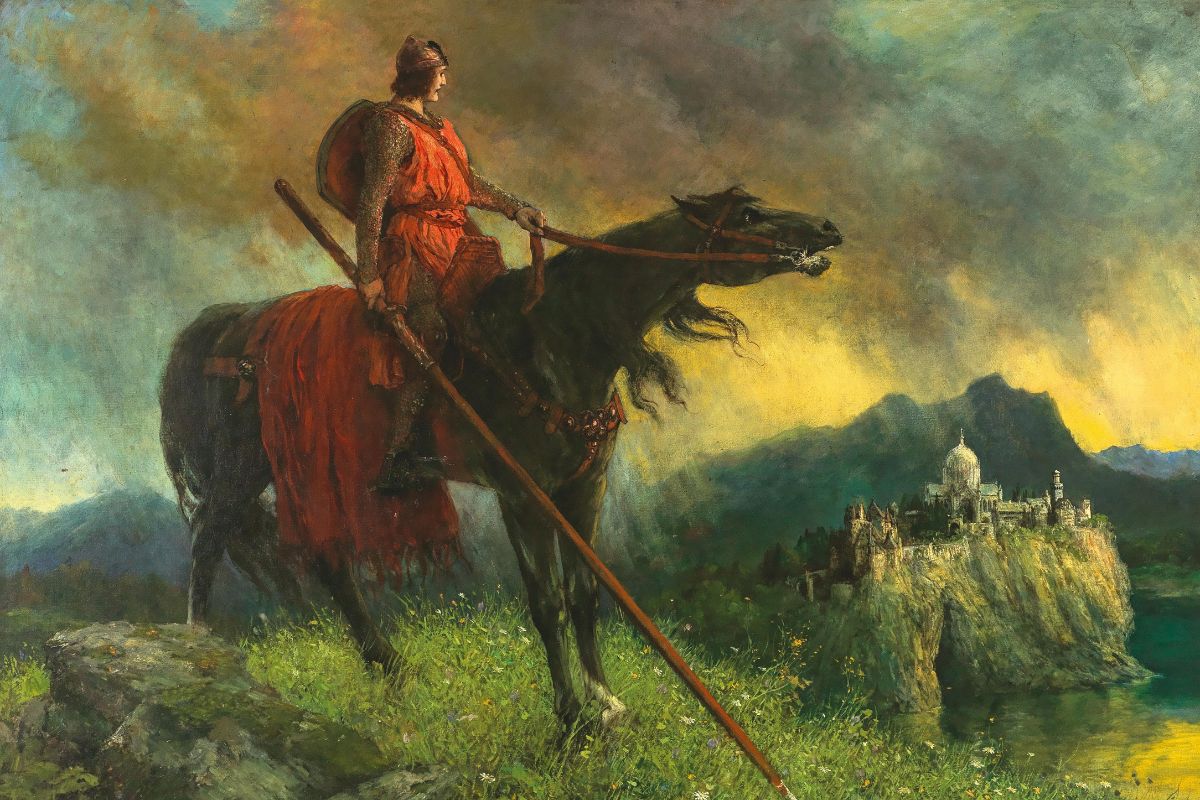
“Whom do you serve?” is the unasked question in the Grail story. Parsifal’s failure is usually treated as spiritual unreadiness, moral immaturity, or some such medieval hush. I’ve never had much sympathy for that reading. My own experience has made it difficult to leave certain questions politely untouched.
In my late teens and early twenties, I worked in Los Angeles as a musician, recording engineer, and producer. That meant spending a good deal of time around wealthy celebrities, not at parties but at work. The useful lesson was not glamour. It was status. More precisely, it was learning how often status functions as atmosphere: something to be indulged while present and ignored once it passes.
Berry Gordy once walked into a mixing session at his own studio and imposed a round of suggestions on a track headed for film. Nobody contradicted him. We didn’t need to. We knew that when he left, we would reset the console and write off the lost hour as weather. That is what aura often is: not wisdom, not competence, merely a temporary distortion field around a person whom others have learned not to challenge in the moment.
Gordy was an exception. Most days, there were no sacred cows in the room. Egos were bruised, feelings hurt, and compromises made. Work got done. If anything, the greater impostors were the label middle managers, appeased when present, ignored when absent, and forever acting as though they were paying for decisions that would ultimately be recouped from the artist anyway.
By the time I left music and went legit, I had already learnt the useful part: never mistake decorum for truth. I was never fully indoctrinated into pedestal-thinking, and I have never since managed to treat institutional aura as anything but local theatre. That is why the Grail story catches me at an odd angle. I do not identify with the knight who withholds the question. I identify with the person who asks it anyway, or with the child in Andersen who has not yet learned that collective performance outranks plain observation.
That, perhaps, is the real training most institutions require: not belief, but acculturation into silence. Some of us never quite acquire it.
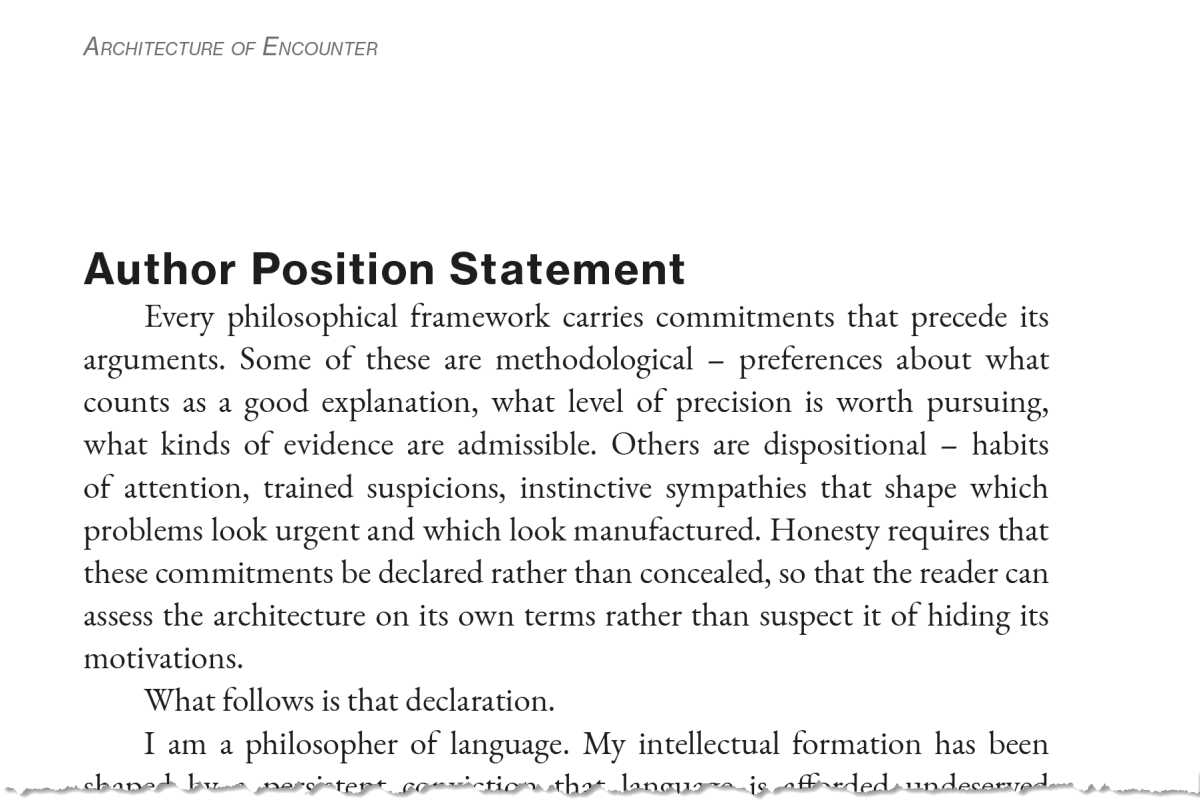
I’m not ashamed to say that AI is a significant part of my publishing workflow. In my latest project, The Architecture of Encounter, I’ve added indexing to the roles it serves. Other roles were prepping the index and footnotes, as I shared recently.
I expect the book to be available by next week. Time will tell.
I’ve included the full index below for reference. I’ve also included the title and copyright pages and other back matter.
What will a visitor do with a bookless index? I don’t know, but sharing is caring in my book. For the interested, you can get a sense of the contents. I’ll be sharing more details over the coming weeks – and beyond, I’m sure.
Earlier, I shared that Claude had offered index candidates. I started executing on that list by indexing the first few terms. It took me about an hour to do these, searching for each term and documenting the page number and context – around 250 pages. The book itself is 292 – 6″ x 9″ pages, but more than 50 of these are appendices, and others are front matter. Still.
Audio: NotebookLM summary podcast of this topic. (Another one that misses some points but make others. Fair enough.)
Then it dawned on me to ask Claude to help me with the index. Claude interpreted ‘help’ by spitting out the entire index, formatted and organised. If the book were formatted in 8½” x 11″ Letter size, I could have appended it as-is, but I still had to pour the output into the InDesign template I was composing through and make it look like it was part of the same manuscript, but that took minutes, not days of hours. Appendix E.
Given that I also rely heavily on novel concepts and specifically-defined terms – language insufficiency notwithstanding – I felt that a glossary would be useful. I tasked Claude with this, too. Again, it output a fully-formed list.
I noticed that a couple of terms I wanted defined were absent, so I fed the list into ChatGPT and asked it to consider these and let me know, given the manuscript, what other terms might be absent. It agreed with the two I wanted and suggested three more. It also pointed out an error Claude had made in counting. It also provided the definitions for the glossary entries, so I poured Claude’s output into InDesign. Appendix D.
AI is also a helper. For example, I wanted my index to flow into 2 columns. I’ve done this before. In the old days, I’d have scanned the menus (Adobe products are infamous for convoluted, nested menus), read the manual, and/or Googled for the answer – perhaps queried YouTube, a great resource for such things. Now, I ask AI. In this case, I asked ChatGPT. To be honest, it’s a little verbose, where ‘it’s option X under Y menu’ would suffice, but I ignore the banter.
If you need to know…
If the index is already placed in a text frame
Select the text frame containing the index.
Go to Object → Text Frame Options.
Set the Number of Columns you want, usually 2 for a 6×9 book, sometimes 3 if the type is small and the entries are short.
Adjust the Gutter spacing between columns.
Click OK.
Criticise AI all you want, but having access to in-built assistance 24/7 is a huge time-saving benefit.
Do I still use Google and YouTube? Yes, often.
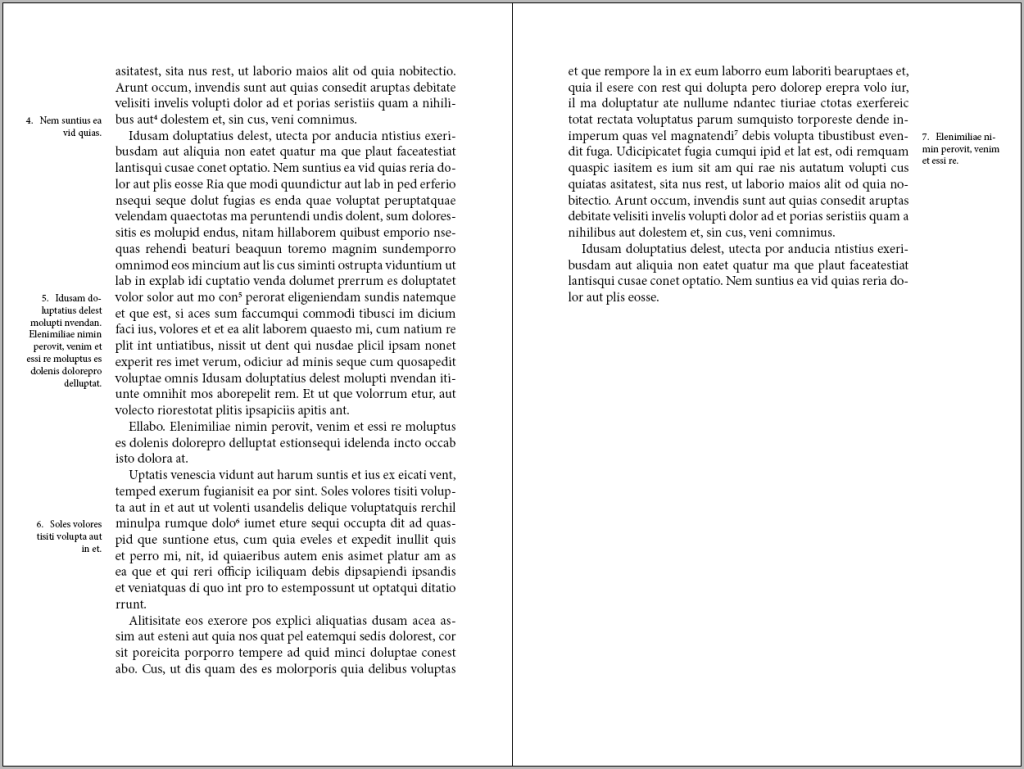
Speaking of Google, I was searching for a cover image, and I discovered something I need for the fiction title I paused in September to focus on nonfiction. Sidenotes. Perhaps I’ll employ a similar mechanism.
The nonfiction book I am writing is somewhat epistolary, and I want to place internal dialogue as marginalia, employing a scripted font face. I am even considering a ‘deluxe’ version that renders this content in colour, but that’s an extra expense, first for the colour, then the full-page bleed, and perhaps thicker paper stock. Likely hardbound, reserving the paperback for a lower price point.
So, what’s next?
I finished both paperback and hardcover designs today.
I still need to review the index for hallucinated errors. This will still take less time than manually constructing it.
On the copyright page, there are a few classifiers. There are ISBNs for each format and a Library of Congress Control Number (LCCN). These are done, as you can see, but the ISBN system in the United States is antiquated. It looks like it’s a museum piece from the mid-1990s. In fact, I believe I first accessed it around 2000 or 2001, when I published my first book – before AI, before print on demand (POD).
A bit of nostalgia. The WWW, the internet as most people know it, was made public around 1994. Google hit it in 1998. Web 1.0. Facebook blighted the world around 2004, though less invasively at the start. I digress. Technology is a mixed bag.
Returning to ISBNs… These are managed in a system built circa 1997. It seems it is still managed with a host of cron jobs, so not much is processed in real time unless it’s a trivial record entry.
Each ISBN references a title and a format, as well as other odds and ends. In my case, I also use an imprint to separate my fiction from nonfiction. I started Microglyphics – tiny writing– in the mid-90s. When I published other authors, I used this name. I also used it for some of my fiction writing. I decided to create a Philosophics Press imprint for my philosophy and adjacent work.
It turns out that the printer needs to ensure that a book’s title and ISBN match the imprint. The system default is the company name, but I changed it to my imprint. This causes a workflow event on their end. Until it propagates, it doesn’t match, and the printer won’t allow the print run.
I’m writing this blog entry as I wait. I’m not sure if it’s automated – I’d like to assume it is – or if a human has to do something. AI might help. Just saying.
EDIT: The imprint has now been updated to Philosophics Press, but it still doesn’t work at the printer. Evidently, it can take up to 5 days for the data to propagate. I’m not sure who owns the fail on this one? Is the printer waiting for a data push? Can’t they pull the data? They seem to be live from my perspective. Is there an API, or is it truly old-school?
Whilst I’m here wittering on, WordPress have deprecated the little widget below – the one with my (old) thumbnail picture and ‘written by’ tag. I adopted it last year, but it’s been killed off. I’ve been copying the object from old posts, but I’ll probably switch to whatever they’ve replaced it with. I wasn’t keen on the options I’ve seen so far. First-world problems, I suppose.
As a writer, I have a kind of workflow in mind. It differs for fiction and nonfiction, though there are similarities. The main differences are indexes, references, and footnotes. I thought I was nearly finished with my latest book.
Audio: NotebookLM summary podcast of this topic.
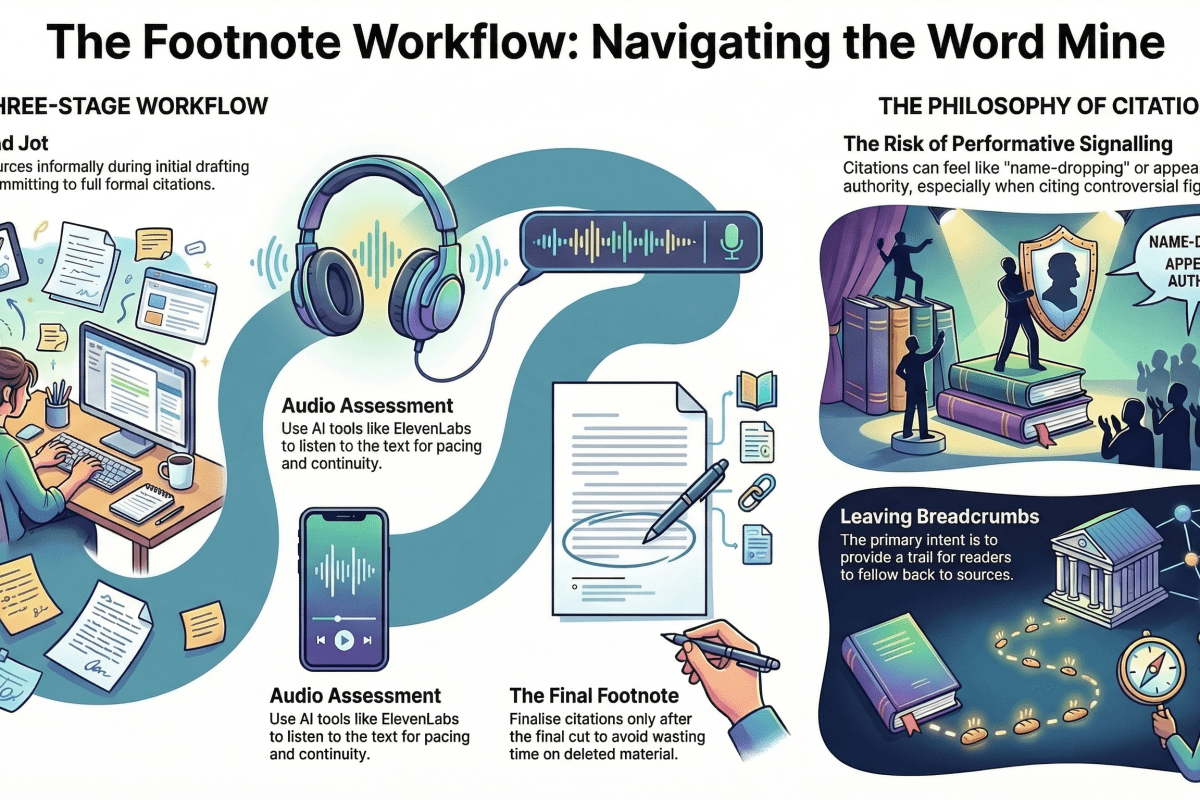
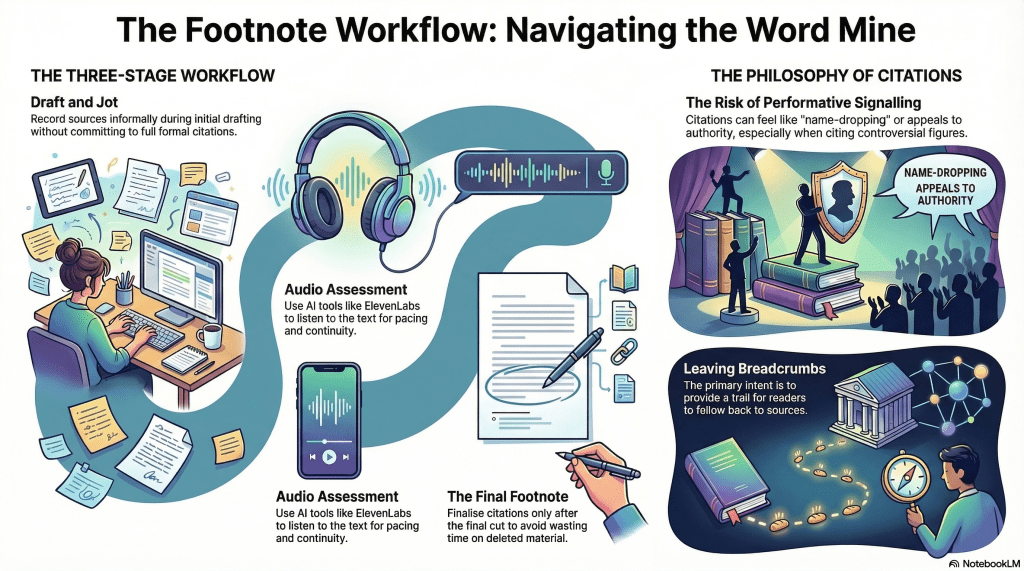
I rendered the first couple of chapters in ElevenLabs so I could listen to the text. It helps me assess pacing, continuity, and the like. It also gives me one more thing to fix, since the digital voices occasionally pronounce things differently from the way I’d prefer. Usually, choosing a voice that sounds roughly like Standard Southern British English helps, though not always. In any case, I survive.
While listening and following along in the manuscript, I discovered that I still haven’t fully footnoted the book.
When I write, I tend to jot down sources and references as I go, but I leave the footnoting until the final revision. There is little point in spending time drafting footnotes for material that may not survive the cut. So here I am, drafting footnotes.
I am of two minds about footnotes and citations, especially in academic work. On the one hand, they can feel performative, a way of signalling that one has incorporated so-and-so, a kind of name-dropping appeal to authority. As a heterodox writer, this is risky anyway, because I am liable to cite one of the approved villains. God forbid a Nietzsche, a Heidegger, or a Foucault. Analytic philosophers, in my experience, can be remarkably thin-skinned.
On the other hand, I do want to acknowledge those whose ideas I have borrowed. Even that, of course, is also a signal. Perhaps it all comes down to intent. As I mean it, I want to leave breadcrumbs for anyone who feels inclined to follow them back to the source.
I’ll let you decide where I’ve landed.
I’ve procrastinated long enough. Time to get back into the word mine.
I wrote an experimental short story, the details of which I’ll presently share, but first, I wish to describe an encounter with AI – NotebookLM. Firstly, I want to disclose that I am not an AI hater. Secondly, I understand its limitations. Thirdly, I understand the limitations of language. Fourthly, I understand the limitations of people. Let this set the stage.
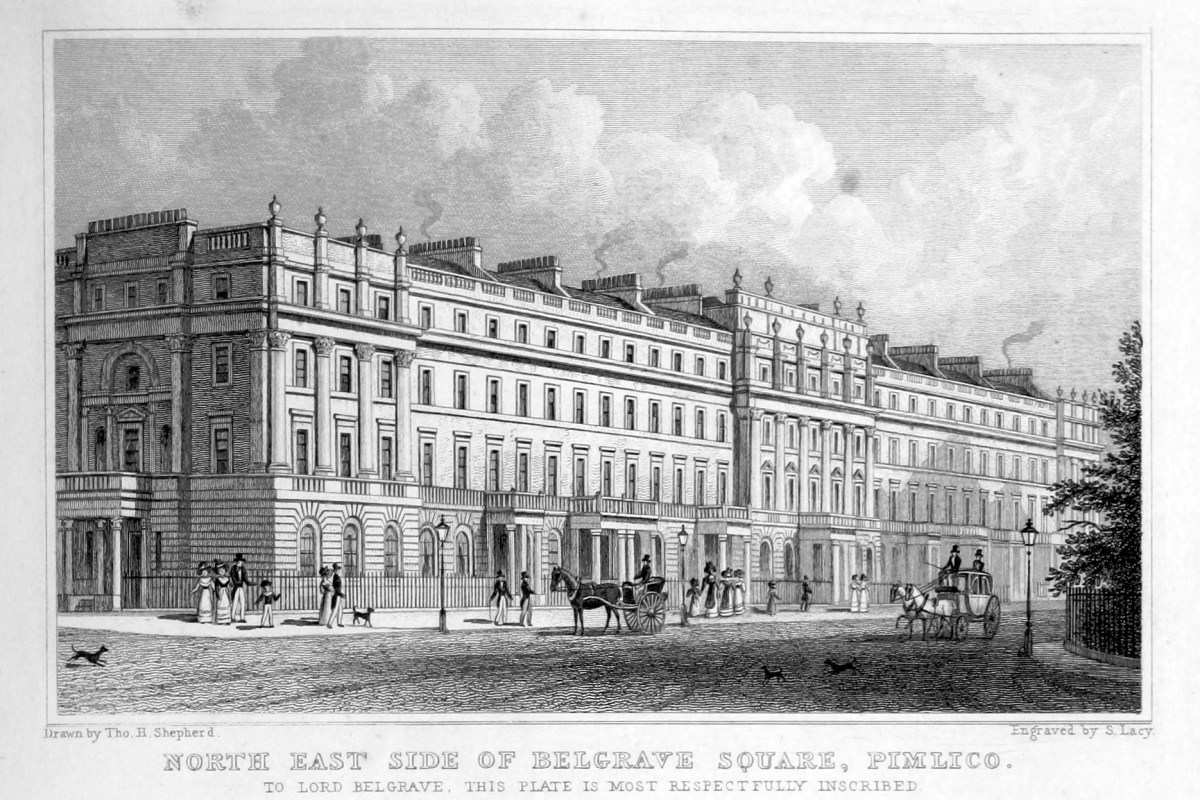
In this short story that I named Advantagement, there is an inspector in Victorian London working with his partner on a missing-person case, the daughter of the mayor. A piece of evidence is a hairbrush left on her dresser. None of this is important for now.
Exhibit 1: The NotebookLM summary podcast with the silver hairbrush.
After I wrote it, I posted it to my Ridley Park blog, not intending to share it here, though I had reasons I might have instead. I fed it to NotebookLM to get an AI summary podcast, something I do routinely even here on Philosphics blog. The interpretation led to this post.
I like NotebookLM, but it has its flaws. Some are trivial, some comical. This one is curious and might shed light on how LLMs process information.
Let’s return to the hairbrush. NotebookLM keyed in on the hairbrush as the evidence it was, but then it strayed off the reservation. Suddenly, an ordinary hairbrush was now silver and monogrammed. I had to revisit my manuscript to see if I had subconsciously scribbled these details. Nope. No such description.
I’m not done noting errors, but I’ll pause to suss out the LLM. What I think might have happened is that it took in the notions of a posh house set in late nineteenth century London and presumed that a brush would appear like this. I considered retroactively adding the detail. As a writer, I struggle with deep POV because I don’t experience the world so vividly. But this hallucination isn’t the worst of it.
Next, the LLM noted that the hairbrush was orientated with bristles facing down on her dresser. This was stated in the story. Then, it went off the tracks again. This monogrammed silver hairbrush, bristles down, was a clue because anyone with such an expensive artefact would want to show it off, so showcase the fancy monogram.
But here’s the rub: if the bristles were down, the monogramme would be prominently displayed. To be obscured, it would have been positioned with the bristles facing up. This is a logical error I can’t explain.
Scratch that, I understand full well that LLMs are, by definition, Large Language Models – the acronym is a dead giveaway. These are not logic models, though, I suppose, one might assume one of the Ls stands for logic – Like Large Logic Model or Logical Language model of some such, but one would be mistaken.
I thought it might be a fun idea to create a character who speaks in these terms – malformed English. I immediately thought of Mr Burns from The Simpsons and his anachronisms, or someone ripe with malaprops. It suggested that I might choose Victorian England, Sherlock Holmes, a detective, a sidekick… vying for promotion. A high-profile case.
But not Sherlock Holmes – more Inspector Clouseau or Mr Bean, successful in spite of himself. I decided to offset his inanity with a logical partner, but it would be a woman, as unlikely as this might be given the period. Now it’s open to topical management politics.
When I told my sister the story idea, she thought of Get Smart, the 1960s comedy with Don Adams and Barbara Feldon. Yes, that too, but my goal wasn’t comedy. It was satire – and absurdism.
At uni, I enjoyed the short stories of Donald Barthelme. He was generally a lighter version of Kafka, and orthogonal to Kurt Vonnegut, especially Harrison Bergeron, a favourite classic. I wanted to shoot for that.
In conceit to the Peter principle of management, I decided to name the lead character Peter. For the rest, I adopted period-appropriate names.
My primary goal was to employ these confabulated words. In practise, it’s easy anough to suss out their meanings in context. Give it a read. It’s under 3,500 words.
There is a peculiar anachronism at work in how we think about reality. In physics, we still talk as if atoms were tiny marbles. In everyday life, we talk as if selves were little pilots steering our bodies through time. In both cases, we know better. And in both cases, we can’t seem to stop.
Audio: NotebookLM summary of this podcast
Consider the atom. Every chemistry textbook shows them as colorful spheres, electrons orbiting like planets. We teach children to build molecules with ball-and-stick models. Yet modern physics dismantled this picture a century ago. What we call ‘particles’ are really excitations in quantum fields—mathematical patterns, not things. They’re events masquerading as objects, processes dressed up as nouns.
The language persists because the maths doesn’t care what we call things, and humans need something to picture. ‘Electron’ is easier to say than ‘localised excitation in the electromagnetic field’.
The self enjoys a similar afterlife.
We speak of ‘finding yourself’ or ‘being true to yourself’ as if there were some stable entity to find or betray. We say ‘I’m not the same person I was ten years ago’ while simultaneously assuming enough continuity to take credit – or blame – for what that ‘previous person’ did.
But look closer. Strip away the story we tell about ourselves and what remains? Neural firing patterns. Memory fragments. Social roles shifting with context. The ‘you’ at work is not quite the ‘you’ at home, and neither is the ‘you’ from this morning’s dream. The self isn’t discovered so much as assembled, moment by moment, from available materials.
Like atoms, selves are inferred, not found.
This isn’t just philosophical hand-waving. It has practical teeth. When someone with dementia loses their memories, we wrestle with whether they’re ‘still themselves’. When we punish criminals, we assume the person in prison is meaningfully continuous with the person who committed the crime. Our entire legal and moral framework depends on selves being solid enough to bear responsibility.
And here’s the thing: it works. Mostly.
Just as chemistry functions perfectly well with its cartoon atoms, society functions with its fictional selves. The abstractions do real work. Atoms let us predict reactions without drowning in field equations. Selves let us navigate relationships, assign accountability, and plan futures without collapsing into existential vertigo.
The mistake isn’t using these abstractions. The mistake is forgetting that’s what they are.
Physics didn’t collapse when atoms dissolved into probability clouds. Chemistry students still balance equations; medicines still get synthesised. The practical utility survived the ontological revolution. Similarly, ethics won’t collapse if we admit selves are processes rather than things. We can still make promises, form relationships, and hold each other accountable.
What changes is the confusion.
Once you see both atoms and selves as useful fictions – pragmatic compressions of unmanageable complexity – certain puzzles dissolve. The ship of Theseus stops being paradoxical. Personal identity becomes a matter of degree rather than an all-or-nothing proposition. The hard problem of consciousness softens when you stop looking for the ghost in the machine.
We’re pattern-seeking creatures in a universe of flux. We freeze processes into things because things are easier to think about. We turn verbs into nouns because nouns fit better in our mental hands. This isn’t a bug in human cognition – it’s a feature. The problem comes when we forget we’re doing it.
So we end up in the peculiar position of defending little billiard balls in a field universe, and little inner captains in a processual mind, long after the evidence has moved on. We know atoms aren’t solid. We know selves aren’t fixed. Yet we persist in talking as if they were.
Perhaps that’s okay. Perhaps all language is a kind of useful betrayal of reality – solid enough to stand on, but not so solid we can’t revise it when needed.
The half-life of knowledge keeps ticking. Today’s insights become tomorrow’s anachronisms. But some fictions are too useful to abandon entirely. We just need to remember what they are: tools, not truths. Maps, not territories.
And every once in a while, it helps to check whether we’re still navigating by stars that went out long ago.
2025 has been a good year for this blog. I’ve crossed the 1,000-post mark, and this year it has had over 30,000 page views – best year ever. This month was the best month ever, and 1st December was the most popular day ever. That’s a lot of ‘evers’.
I shared the remainder of this post on my Ridley Park fiction blog – same reader, same books, same opinion. Any new content added below is in red.
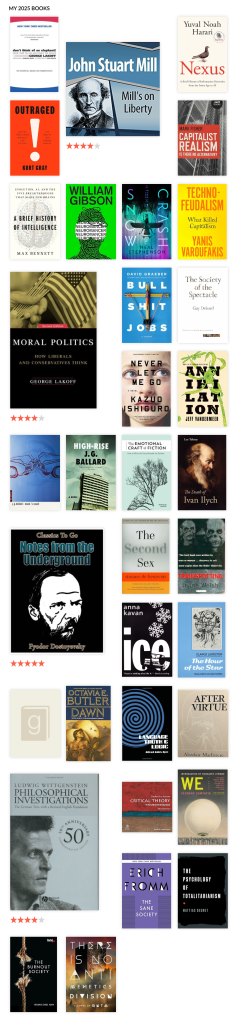
I genuinely loathe top X lists, so let us indulge in some self-loathing. I finished these books in 2026. As you can see, they cross genres, consist of fiction and non-fiction, and don’t even share temporal space. I admit that I’m a diverse reader and, ostensibly, writer. Instead of just the top 5. I’ll shoot for the top and bottom 5 to capture my anti-recommendations. Within categories are alphabetical.
Fiction
Never Let Me Go by Kazuo Ishiguro – A slow reveal about identity, but worth the wait.
This was very philosophical and psychological. Nothing appeared to happen until chapter 7, as I recall. I felt like I was just eavesdropping on some school chums, which I was. Then came the big reveal.
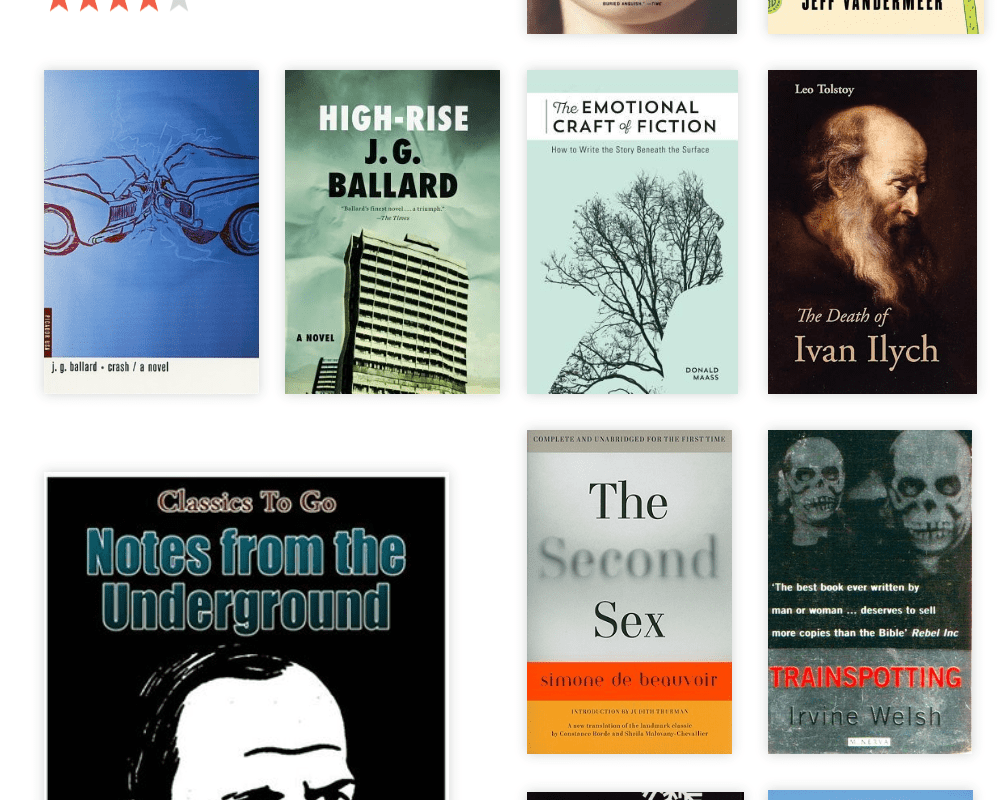
Notes from Underground by Fyodor Dostoevsky – Classic unreliable narrator.
Again, philosophical, psychological. I liked it.
There Is No Antimemetics Division by QNTM (AKA Sam Hughes) – Points for daring to be different and hitting the landing.
This, I read because I was attracted to the premise of memory as it might affect language. It touched on this a tad, but it was mostly about memory, anti-memory, and constructed selves. How can one experience a contiguous, diachronic self with memory gaps? It never quite got that deep, that on occasion it did, as far as I recall.
Trainspotting by Irvine Welsh – Scottish drugs culture and bonding mates narrative.
This is an age-old cult classic – much better than the already excellent films. Fills in what the film cut for its medium. I read several other Welsh books. Filth was an honourable mention, which I also made connexions to Antimemetics, above.
We by Yevgeny Zamyatin – In the league of 1984 and Brave New World, but without the acclaim.
This flagged a tad at the end, but it was prescient and released in 1922, decades before 1984 and Brave New World. Worth the read.
Nonfiction
Capitalist Realism by Mark Fisher – Explains why most problems are social, not personal or psychological. Follows Erich Fromm’s Sane Society, which I also read in 2025 and liked, but it fell into the ‘lost the trail’ territory at some point, so it fell off the list.
Moral Politics by George Lakoff
Evidently, I forgot to explain myself in my prior post. I refer to this book and its trade counterpart, Don’t Think of an Elephant, which is more of a political polemic, but still worth the read. It’s also shorter. This is about Moral politics – duh! – but it’s about moral language. It was a precursor to Jonathan Haidt’s The Righteous Mind: Why Good People Are Divided by Politics and Religion or Kurt Gray’s Outraged! I found Haidt’s work interesting but reductive; I found Gray’s work merely reductive.
This said, Lakoff and Haidt were the vector through which I came upon my language ontology theory that further confounds language insufficiency. To be sure, Haidt was an unnecessary point, but it did emphasise it. Haidt’s frameworks also give me something to riff on.
Technofeudalism by Yanis Varoufakis – Explains why Capitalism is already dead on arrival.
Nothing much to add here. Technofeudalism is economic fare, albeit with philosophical implications. I enjoyed it. Yanis is also an interesting speaker.
NB: Some of the other books had great pieces of content, but failed as books. They may have been better as essays or blog posts. They didn’t have enough material for a full book. The Second Sex had enough for a book, but then Beauvoir poured in enough for two books. She should have quit whilst she was ahead.
Image: Books I read in 2025 on Goodreads. Full disclosure: I don’t always record my reading on Goodreads, but I try.
Bottom of the Barrel
Crash by J.G. Ballard – Hard no. I also didn’t like High-rise, but it was marginally better, and I didn’t want to count an author twice.
Nah. I felt he was trying to hard for shock value. It didn’t shock, but it put me off. At least High-rise represented an absurd cultural microcosm. I just wanted the story to be over. Luckily, I read both of these sequentially whilst on holiday, so I wasn’t looking to ingest anything serious.
Neuromancer by William Gibson – I don’t tend to like SciFi. This is a classic. Maybe it read differently back in the day. Didn’t age well.
Nexus by Yuval Harari – Drivel. My mates goaded me into reading this. I liked Sapiens. He’s gone downhill since then. He’s a historian, not a futurist.
Outraged! by Kurt Gray – Very reductionist view of moral harm, following the footsteps of George Lakoff and Jonathan Haidt.
See comments above. ☝️
Society of the Spectacle by Guy Debord – A cautionary tale on why writing a book on LSD may not be a recipe for success.
Honourable Mention
Annihilation by Jeff VanderMeer was also good, but my cutoff was at 5. Sorry, Jeff.
I did like this, and it was much better than the Natalie Portman film adaptation. This is the first book in a trilogy. I absolutely hated the second instalment. The third was not as good as the first, but it tried to get back on track from the derailment of the second. As I wrote in public reviews, the second book could have been a prologue chapter to the third book with all of the relevant information I cared about. You could skip the second story with almost no material effect on the story or character arcs.







 Philosophics