After Tony Self liked one of my blog posts – Hi, Tony Self – I visited his site and poked around, clicking on several articles. This was one. I liked it and noticed the Reblog button. I clicked it, and it spawned this page with this article embedded. So, here we are.
Audio: NotebookLM summary podcast of this topic.
Would I choose to live forever? Undoubtedly, no. For those who’ve been around and have kept up with my posts, know that I already died. I would have been fine remaining dead, as my girlfriend did. Although I won’t rejoin her in the spiritual sense, I will join her in death in the metaphorical sense of Lakoff and Johnson.
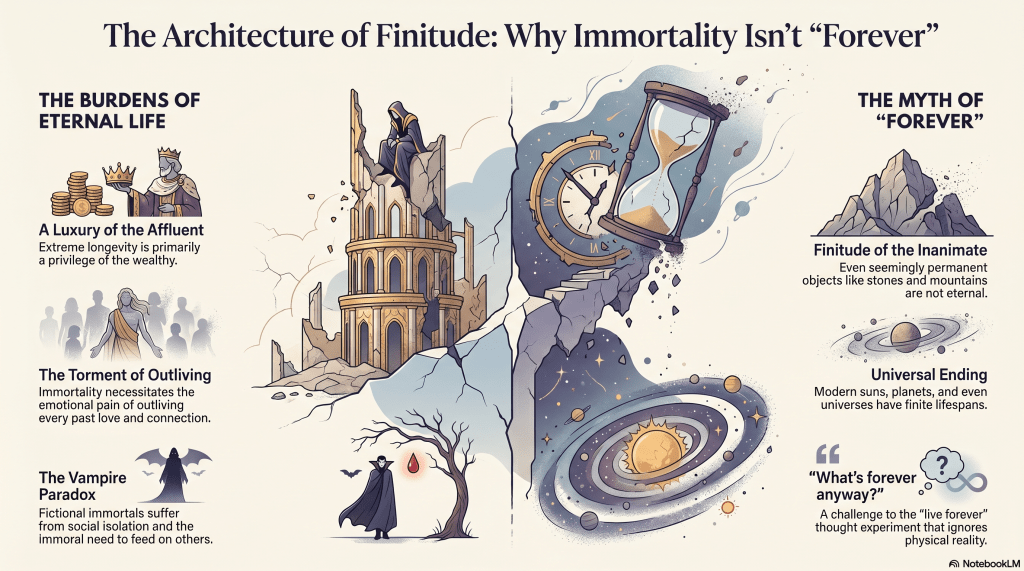
Longevity is a luxury of the affluent. I don’t want it. Tony mentions vampires. In fiction (where else would they be?), these beings are routinely unemployed – at the very least, having no day jobs – but with vast riches or connected to one with said same. Their torment is to have outlived past loves and the need to feed on the living, mostly the fear of getting caught, as this is illegal and more generally immoral in this world as we know it – not a good look.
In any case, this live forever thought experiment forgets much, or at least imposes much. If I could just be, like a stone, is that forever? As I discuss in The Architecture of Encounter, even stones aren’t forever, regardless of their state of living; not even mountains, planets, suns, or universes. So, what’s forever anyway?
Spoiler alert: Forever is a myth.
NotebookLM Infographic on this topic.
Rather than answer generally or hypothetically, would I choose to live forever? No. Take me now if you must?
I’ve got no problems with living. It’s the conditions that bother me: the eating, the sleeping, the maintenance; entropy.
So, the ones who have this wish ignore these and presume that this version of forever comes with good health and abundance.
I recall a Greek myth in which forever is granted, and he lives on as a disembodied wisp that can’t die.
In this myth, Tithonus – a Trojan prince whom Eos, goddess of the dawn, loved and asked Zeus to grant immortality – got this wish, and it wasn’t even his; immortality without consent. Eos forgot to ask for eternal youth alongside it, so he aged indefinitely, eventually shrinking into a desiccated, babbling husk – a wisp.
Imagine: you live forever, outliving all humans, all life. The sun extinguishes, and yet you remain – all the while sentient.
Thanks, but no thanks. You can keep your forever. I’ll keep my timeline.
The title may have given this away, but my parents are in their eighties, an absurdity on the face of it, because some primitive part of my brain still files them under ‘adults’ – people who understand the performance of being alive.
Years ago, against my father’s wishes, my mother took a job as a waitress. His objection came out with that antique domestic authority that probably ought to be preserved in amber: No wife of mine is going to work. There it is. The marital constitution in a single sentence. Not an argument – rather, by decree. Still, she worked.
Audio: NotebookLM summary podcast of this topic.
It’s been years since she held a paid job, but in retirement, she seems to have lost more than employment. She’s lost a structure of demand. She is bored out of her gourd or tree or whatever. Left alone with an unfilled day, she putters, tidies, wipes, folds, rearranges, and complains – rinse and repeat. Sisyphus would be proud. And the complaint isn’t incidental; it’s part of the ritual. The labour gives the grievance somewhere to reside.
There’s a peculiar mercy in not being too useful.
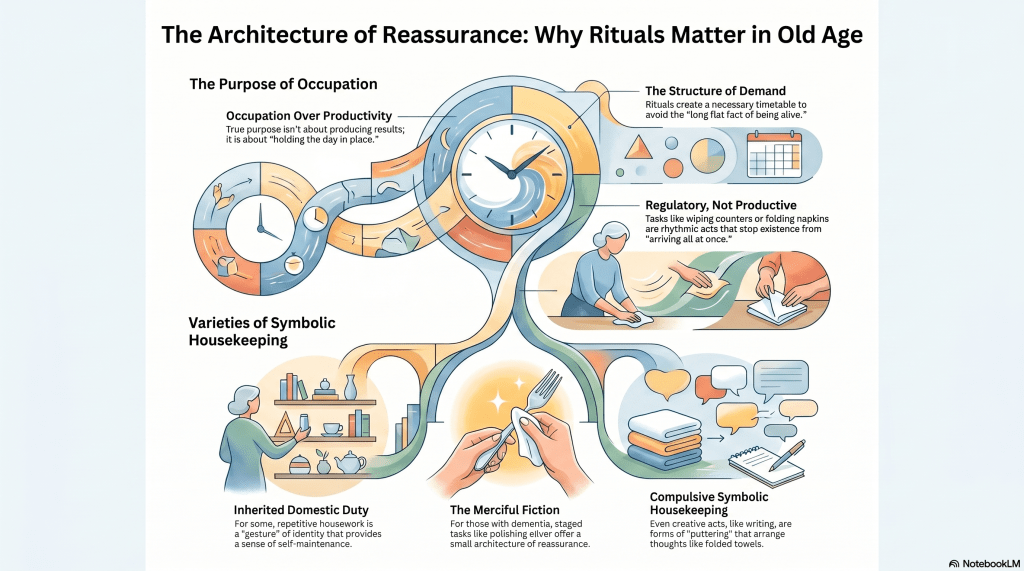
NotebookLM Infographic on this topic.
This creates an odd etiquette for everyone around her. One has to be careful not to interfere too much. Don’t clean everything; efficiently eliminate tasks; show up flushed with modern virtue and liberate her from the very thing that’s keeping the day from opening its jaws. Offer help, accept the refusal, move on without guilt. There’s a peculiar mercy in not being too useful.
Once the housework is done – or once it reaches the temporary truce by pause – the restlessness comes back. The ourobouros resumes its self-consumption. Then she needs to walk, drive, shop, bake, browse, fiddle, inspect, rearrange, and escape – more infinite loop, though only seemingly so. Anything to distract her from the long flat fact of being alive without a timetable. Employment used to do that. Marriage did that. Children did that. The household still does that. Now the old structures only remain as gestures, but gestures can still hold a person upright, as they had before, but with more salience.
A different version of this appeared with my mother-in-law, who had dementia. To occupy her, we’d give her silver to polish, or napkins to fold. There wasn’t a real need for the silver to shine, and the napkins, once folded, could be unfolded and dropped back on the pile to repeat the process. Like Keynes’s worker digging holes to fill them in again, the point wasn’t production. The point was occupation. The task didn’t need to move the world forward, as if it did in any case. It only needed to hold the day in place.
That sounds cruel when you describe it abstractly, as if we were tricking her into labour, but you’d be confusing this with Capitalism. The real cruelty would have been leaving her unmoored – nothing for the hands to do whilst the mind searched for a room it could still recognise. Folding napkins wasn’t housework in any economic sense. It was a small architecture of reassurance. A way of letting purpose survive after purpose had lost its object. even if the sense of purpose had long left the building.
There’s a distinction here, though it isn’t clean. My mum’s rituals are self-maintaining. They belong to a life trained by domestic obligation, by marriage, by an older settlement between gender and labour, by all the small cruelties that once got to call themselves normal. My mother-in-law’s rituals were externally staged – not expressions of domestic identity so much as acts of care arranged by other people. Whilst all purpose is fictional, one woman kept her purpose through the fiction of inherited duty; the other was offered purpose as a merciful fiction. The border between the two is porous, naturally, because reality has never agreed to respect our categories.
I’m not recommending any of this to anyone. I’m just noticing it, which is what we writers call ‘thinking’ when we want to dodge responsibility.
Abstract freedom isn’t the same thing as a life you can actually inhabit.
I’m a feminist the way I’m a humanist: sincerely, but with reservations about the slogans. I don’t think this is how a woman should live. I don’t believe domestic labour is some mystical feminine vocation – as if dusting were an ontological destiny and the Hoover a sacrament. But I also can’t bring myself to take it away from her. Abstract freedom isn’t the same thing as a life you can actually inhabit. Sometimes emancipation arrives too late to provide new habits. Sometimes the cage has become furniture.
This doesn’t justify the cage. It only complicates the fantasy that removing it leaves behind a clean liberated self, glowing like a freshly unboxed appliance. People aren’t appliances, although civilisation has made several brave attempts.
The mistake is assuming purpose has to be justified by productivity. That’s the capitalist infection, of course: if nothing’s produced, nothing happened. But most of ordinary life isn’t productive in that sense. It’s regulatory. Consolatory. Rhythmic. A person folds the napkin, wipes the counter, polishes the spoon, walks round the block, checks the same cupboard twice, tells the same story, asks the same question, rearranges the same shelf, writes the same sentence again with one adjective changed and calls it progress – like an LLM but with less personality. These acts don’t redeem existence. They just stop it arriving all at once.
As for me, I don’t have a purpose either, so I write. Ostensibly, this is my own form of puttering. My desk is her kitchen counter. My paragraphs are folded towels. I arrange sentences, complain about them, rearrange them, and call the whole performance ‘vocation’ because compulsive symbolic housekeeping looks poor on a business card.
There’s a shabby tenderness in this, though one shouldn’t make too much of it. The old trick isn’t really meaning; it’s occupation, rhythm – having something to do with one’s hands whilst the mind declines to look directly at the wall. Some people clean. Some people shop. Some shoot fentanyl. Some become serial killers, CEOs, presidents, consultants, motivational speakers, or other recognised hazards. Some of us write essays about our mothers and pretend it counts as insight. We all find our own ways to bide the time until we die.
In the end, nobody gets out alive. The least we can do is not steal from each other the shabby little rituals that make the waiting bearable.
Video: On a related note. Jonny talks about Setiya and atelic activities.
Disclaimer: I should be finishing my Language Insufficiency Hypothesis book, yet I am here writing about death and dying. Why? Because I was watching an interview with Neal Schon by Rick Beato. I should have been working on my book then, too. It seems I can write about death more easily than finish a book about the failure of language. Perhaps because death speaks fluently.
I haven’t produced music professionally since the mid-1980s, and I haven’t performed since 2012, yet I am still drawn to its intricacies. My fingers no longer allow me to play much of anything anymore. This is a sort of death. When the body forgets what the mind remembers, that’s a particular kind of death – one language dying while another can’t translate.
As Neal was walking Rick through his equipment and approach to music, I was taken back to a similar place. I wanted to plug into a Fender Twin or a Hi-Watt, a Lexicon 224 or a Cry Baby wah. I still have nightmares thinking of setting up a Floyd Rose.
Video: Rick Beato interviews Neal Schon
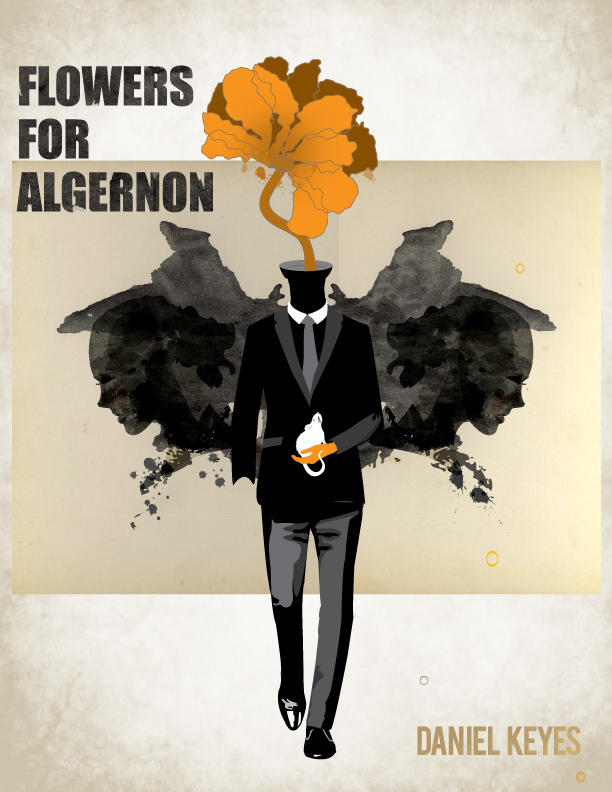
But I can’t go back. As for music, I can’t go forward either. I’m at a standstill, but in a regressed position. It’s uncomfortable. It feels a lot like Charlie in Flowers for Algernon. I used to be able to do that. Don’t get me wrong – I am not claiming to be on the level of Neal Schon, a man I remember from his days with Santana, but when you reach a level of proficiency and then lose it, it hurts; it can be devastating.
Audio: NotebookLM podcast on this topic.
I recall being in hospital in 2023 – a physical rehabilitation facility, really – and I found a piano in a vacant common room. Drawn to the instrument, I rolled over my wheelchair and played…nothing. My fingers wouldn’t work. The piano sat there like a relic of my former self. I rolled toward it as though approaching an altar. My fingers hovered, twitched, failed. The sound of nothing has never been so loud. I cried. I cried a lot those days. I was down to 58 kilos – at 182 cm, I weighed in at just over 9 stone. It wasn’t the best of times.
I still feel a certain nostalgia.
And then there are the people I’ve lost along the way – as another Neal reflected on – The Needle and the Damage Done.
Love and art are both acts of repetition. When one ends, the reflex remains – the impulse to reach, to share, to call out. Death doesn’t stop the motion, only the answer.
I’m lucky to have left Delaware. When a girlfriend died in 2020, I remained and connected with another until 2023, when she died, too. From 2020 to 2023, when I was out and about, something might have caught my eye, and I’d reflect on how Carrie might have liked that.
But it was different. It was more like, ‘I should let Carrie know about that,’ only to realise fractions of a second later that she wouldn’t see whatever it was; she couldn’t. And I’d carry on. I didn’t need to repeat this with Sierra. My relocation to Massachusetts solved this challenge – not so many triggers.
I’m not sure how the loss of ‘professional’ music relates to deceased partners, but it does – at least enough for me to make this connexion. Perhaps I’m just connecting arbitrary dots, but I’ll call it nostalgia.
I don’t play, but I still hear it. The song continues without me. Nostalgia is just rhythm without melody. Perhaps all nostalgia is epistemological error – the confusion of past fluency for present meaning.
(Spoiler Alert: He dies at the end. But so do you.)
Let’s get this out of the way: yes, Ivan dies at the end. It’s right there in the title, you absolute muppet. But what Tolstoy does in this slim volume – more novelette than novella, really – is turn the slow demise of a terminal bore into a scathing indictment of bourgeois mediocrity.
Audio: NotebookLM podcast on this topic.
Set in the 1880s, but eerily modern in its spiritual bankruptcy, this is less a period piece and more a mirror held up to our Ikea-staged lives. Ivan Ilych is, in short, that guy. You’ve met him. You’ve worked with him. He follows the rules, gets the job, buys the drapes, marries the woman, and climbs the career ladder with the zeal of a drowning man clambering up a waterfall. And for what? A living room indistinguishable from the next man’s. A life that “resembles others like itself” to such an extent that it may as well have been copy-pasted from a Pottery Barn catalogue.
I’ve only read Anna Karenina prior to this, and no, I’ve not tackled War and Peace because I have things to do and a lifespan to manage. I prefer Dostoyevsky‘s psychological probing to Tolstoy’s social panoramas, but Ivan Ilych pleasantly surprised me. It’s Dostoyevskian in its internal torment, and compact enough not to require a support group.
The genius here is not the plot – man gets ill, man dies – but the emotional autopsy performed in slow motion. Ivan’s illness is banal, his symptoms vague, but the existential unravelling is exquisite. He is confronted not just by mortality but by the crushing realisation that his entire life was a lie curated for public consumption. If Instagram had existed in imperial Russia, Ivan would have filtered the hell out of his parlour furniture.
And yet, at the very end, there’s a kind of grace. Having failed at life, Ivan, miraculously, succeeds at dying. Not in the tragic-heroic sense. But in accepting the abyss, he transcends it. Or at least stops flinching.
If you’ve ever wondered what your carefully curated CV and your “neutral-tone” home decor will mean on your deathbed, this book is your answer: absolutely nothing. Read it and despair – or better yet, read it and reconsider.
I died in March 2023 — or so the rumour mill would have you believe.
Of course, given that I’m still here, hammering away at this keyboard, it must be said that I didn’t technically die. We don’t bring people back. Death, real death, doesn’t work on a “return to sender” basis. Once you’re gone, you’re gone, and the only thing bringing you back is a heavily fictionalised Netflix series.
Audio: NotebookLM podcast of this content.
No, this is a semantic cock-up, yet another stinking exhibit in the crumbling Museum of Language Insufficiency. “I died,” people say, usually while slurping a Pumpkin Spice Latte and live-streaming their trauma to 53 followers. What they mean is that they flirted with death, clumsily, like a drunk uncle at a wedding. No consummation, just a lot of embarrassing groping at the pearly gates.
And since we’re clarifying terms: there was no tunnel of light, no angels, no celestial choir belting out Coldplay covers. No bearded codgers in slippers. No 72 virgins. (Or, more plausibly, 72 incels whining about their lack of Wi-Fi reception.)
There was, in fact, nothing. Nothing but the slow, undignified realisation that the body, that traitorous meat vessel, was shutting down — and the only gates I was approaching belonged to A&E, with its flickering fluorescent lights and a faint smell of overcooked cabbage.
To be fair, it’s called a near-death experience (NDE) for a reason. Language, coward that it is, hedges its bets. “Near-death” means you dipped a toe into the abyss and then screamed for your mummy. You didn’t die. You loitered. You loitered in the existential equivalent of an airport Wetherspoons, clutching your boarding pass and wondering why the flight to Oblivion was delayed.
As the stories go, people waft into the next world and are yanked back with stirring tales of unicorns, long-dead relatives, and furniture catalogues made of clouds. I, an atheist to my scorched and shrivelled soul, expected none of that — and was therefore not disappointed.
What I do recall, before the curtain wobbled, was struggling for breath, thinking, “Pick a side. In or out. But for pity’s sake, no more dithering.” In a last act of rational agency, I asked an ER nurse — a bored-looking Athena in scrubs — to intubate me. She responded with the rousing medical affirmation, “We may have to,” which roughly translates to, “Stop making a scene, love. We’ve got fifteen others ahead of you.”
After that, nothing. I was out. Like a light. Like a minor character in a Dickens novel whose death is so insignificant it happens between paragraphs.
I woke up the next day: groggy, sliced open, a tube rammed down my throat, and absolutely no closer to solving the cosmic riddle of it all. Not exactly the triumphant return of Odysseus. Not even a second-rate Ulysses.
Here’s the reality: There is no coming back from death. You can’t “visit” death, any more than you can spend the afternoon being non-existent and return with a suntan.
Those near-death visions? Oxygen-starved brains farting out fever dreams. Cerebral cortexes short-circuiting like Poundland fairy lights. Hallucinations, not heralds. A final, frantic light show performed for an audience of none.
Epicurus, that cheerful nihilist, said, “When we are, death is not. When death is, we are not.” He forgot to mention that, in between, people would invent entire publishing industries peddling twaddle about journeys beyond the veil — and charging $29.99 for the paperback edition.
No angels. No harps. No antechamber to the divine. Just the damp whirr of hospital machinery and the faint beep-beep of capitalism, patiently billing you for your own demise.
If there’s a soundtrack to death, it’s not choirs of the blessed. It’s a disgruntled junior surgeon muttering, “Where the hell’s the anaesthetist?” while pawing desperately through a drawer full of out-of-date latex gloves.
And thus, reader, I lived. But only in the most vulgar, anticlimactic, and utterly mortal sense.
There will be no afterlife memoir. No second chance to settle the score. No sequel. Just this: breath, blood, occasional barbed words — and then silence.


 Philosophics