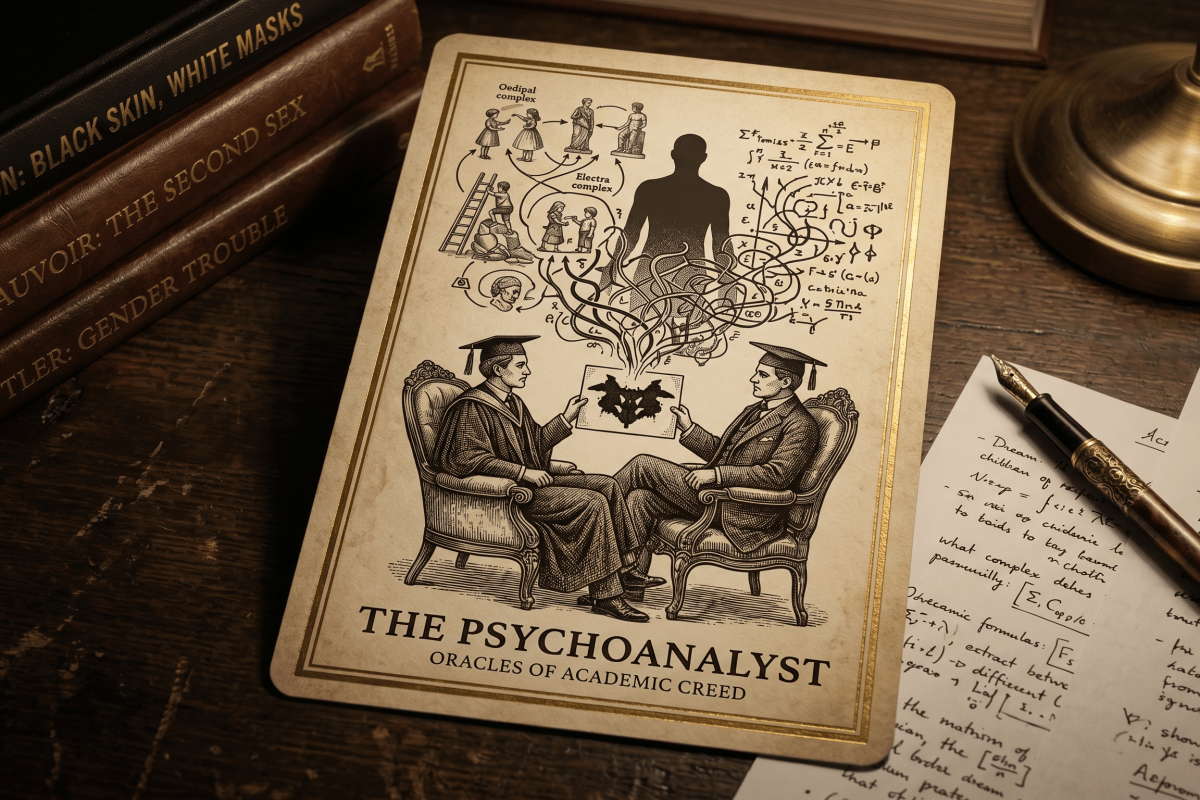
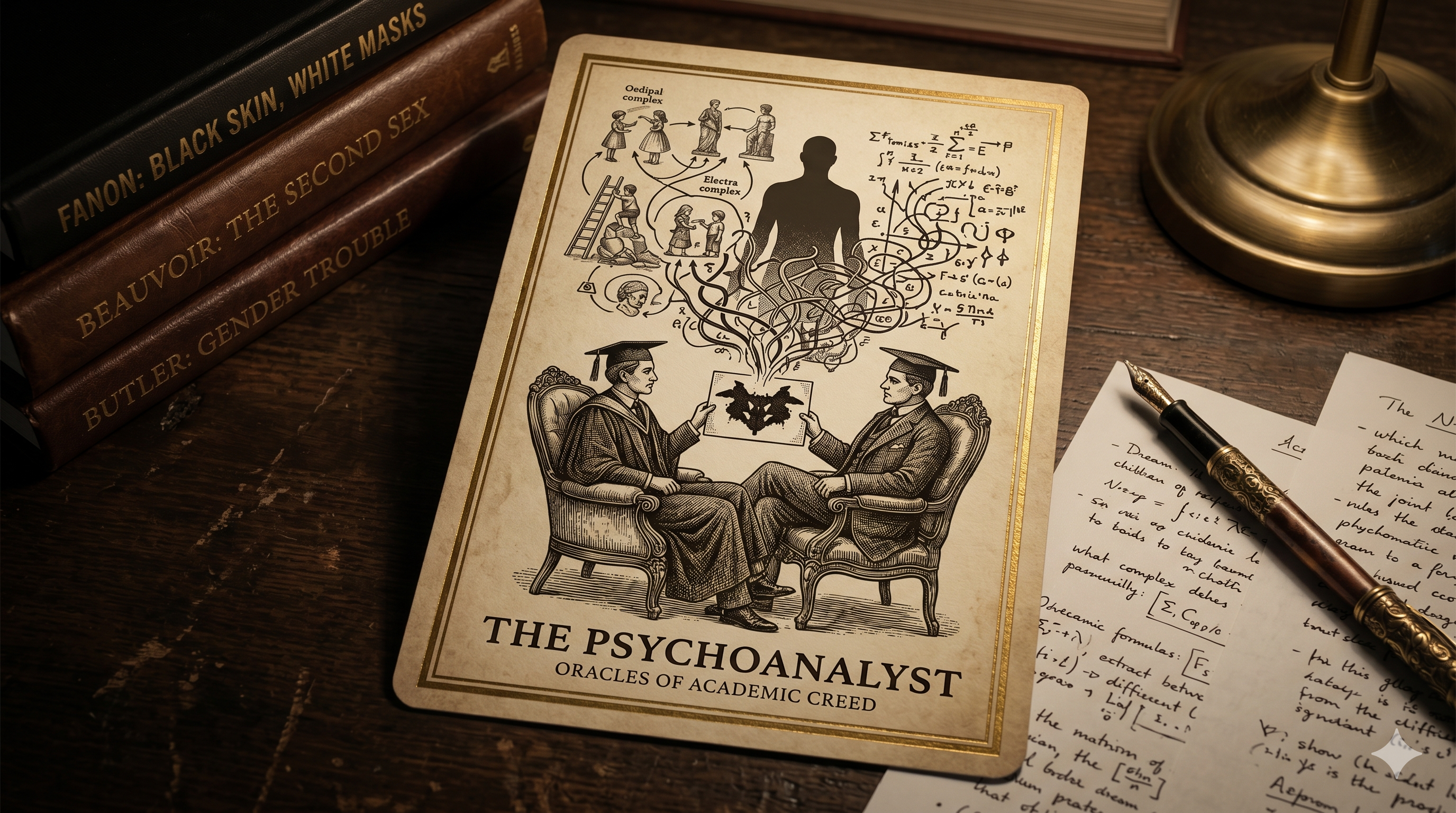
I just read Chapter 4 of Frantz Fanon’s Black Skin, White Masks, and it has similar problems I’ve also critiqued for Judith Butler’s Gender Trouble: Feminism and the Subversion of Identity and Simone de Beauvoir’s The Second Sex. In all three cases, I accept the primary argument. What I reject is psychology, especially psychoanalysis, as a legitimate form of scientific inquiry.
Audio: NotebookLM summary podcast of this topic.
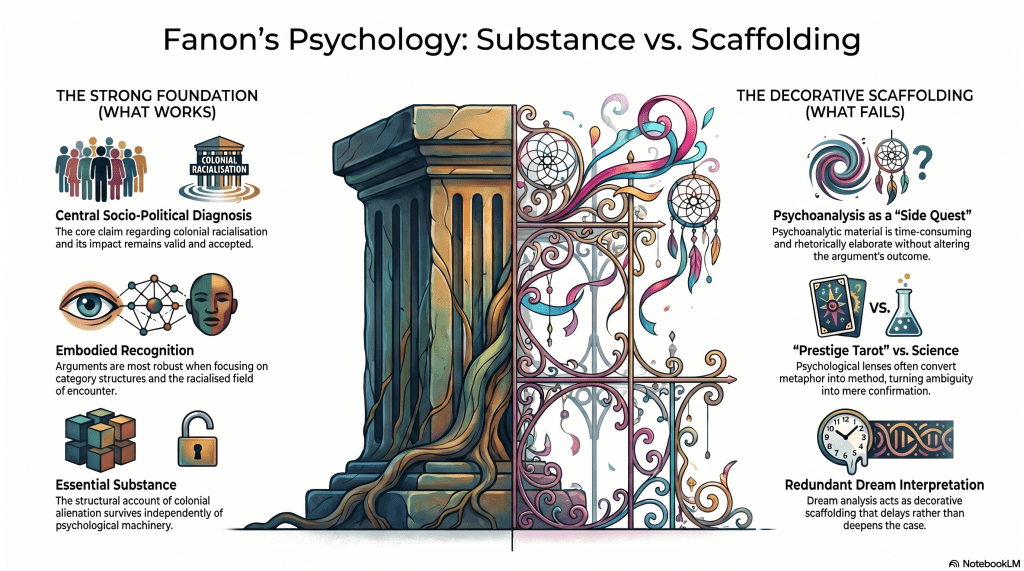
My issue isn’t that Fanon, Beauvoir, or Butler fail in their central diagnoses. I broadly accept their claims. My issue is that the psychoanalytic material typically functions like a grinding side quest: time-consuming, rhetorically elaborate, and only weakly connected to the main argumentative progression. It may enrich the atmosphere, but it doesn’t materially alter the outcome. Once one doesn’t accept psychoanalytical psychobabble as a valid evidentiary lens, the material becomes a time sink. Not only can’t I get my time back, but I also expend even more time here, railing on.
Speaking of distraction: evidently, WordPress has added a new blog-to-podcast feature, so I tried it out here. Whatevs.
Fanon’s central claim about colonial racialisation doesn’t require dream interpretation – the dreams themselves are seemingly apocryphal at the start. The stronger route is through embodied recognition, imposed category structures, conceptual nomenclature, and the racialised field of encounter. The dream material reads as psychoanalytic side-content: thematically adjacent, occasionally vivid, but methodologically low-yield. It doesn’t deepen the case so much as delay it. The entire time, I am thinking to myself, ‘Where is he going with all this?’ and ‘Are we there yet?’ only to get dropped off just where I had started – a round trip to nowhere.
But Fanon’s mistake isn’t necessarily insincerity. It’s an over-trust in a psychological lens that converts metaphor into method. The psychoanalytic examples may have seemed to him like evidence; to a reader sceptical of psychoanalysis, as I am, they register as rhetorical illustrations. Once a reader withholds confidence in this method, the chapter’s supporting material becomes distracting rather than strengthening.
Enfin, psychoanalysis too often behaves like a prestige tarot deck for the academically credentialled: it turns ambiguity into confirmation, opacity into symbolism, and resistance into further evidence. Fanon’s broader account of colonial alienation survives because it doesn’t depend on this machinery. The dreams aren’t necessary to the argument; they’re decorative scaffolding around a structure that’s stronger without them.
After Tony Self liked one of my blog posts – Hi, Tony Self – I visited his site and poked around, clicking on several articles. This was one. I liked it and noticed the Reblog button. I clicked it, and it spawned this page with this article embedded. So, here we are.
Audio: NotebookLM summary podcast of this topic.
Would I choose to live forever? Undoubtedly, no. For those who’ve been around and have kept up with my posts, know that I already died. I would have been fine remaining dead, as my girlfriend did. Although I won’t rejoin her in the spiritual sense, I will join her in death in the metaphorical sense of Lakoff and Johnson.
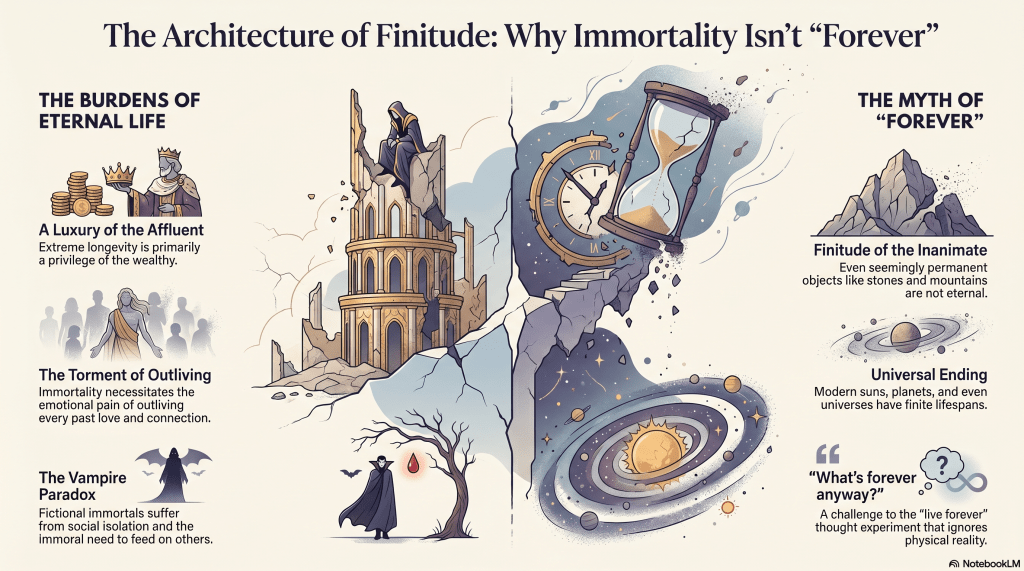
Longevity is a luxury of the affluent. I don’t want it. Tony mentions vampires. In fiction (where else would they be?), these beings are routinely unemployed – at the very least, having no day jobs – but with vast riches or connected to one with said same. Their torment is to have outlived past loves and the need to feed on the living, mostly the fear of getting caught, as this is illegal and more generally immoral in this world as we know it – not a good look.
In any case, this live forever thought experiment forgets much, or at least imposes much. If I could just be, like a stone, is that forever? As I discuss in The Architecture of Encounter, even stones aren’t forever, regardless of their state of living; not even mountains, planets, suns, or universes. So, what’s forever anyway?
Spoiler alert: Forever is a myth.
NotebookLM Infographic on this topic.
Rather than answer generally or hypothetically, would I choose to live forever? No. Take me now if you must?
I’ve got no problems with living. It’s the conditions that bother me: the eating, the sleeping, the maintenance; entropy.
So, the ones who have this wish ignore these and presume that this version of forever comes with good health and abundance.
I recall a Greek myth in which forever is granted, and he lives on as a disembodied wisp that can’t die.
In this myth, Tithonus – a Trojan prince whom Eos, goddess of the dawn, loved and asked Zeus to grant immortality – got this wish, and it wasn’t even his; immortality without consent. Eos forgot to ask for eternal youth alongside it, so he aged indefinitely, eventually shrinking into a desiccated, babbling husk – a wisp.
Imagine: you live forever, outliving all humans, all life. The sun extinguishes, and yet you remain – all the while sentient.
Thanks, but no thanks. You can keep your forever. I’ll keep my timeline.
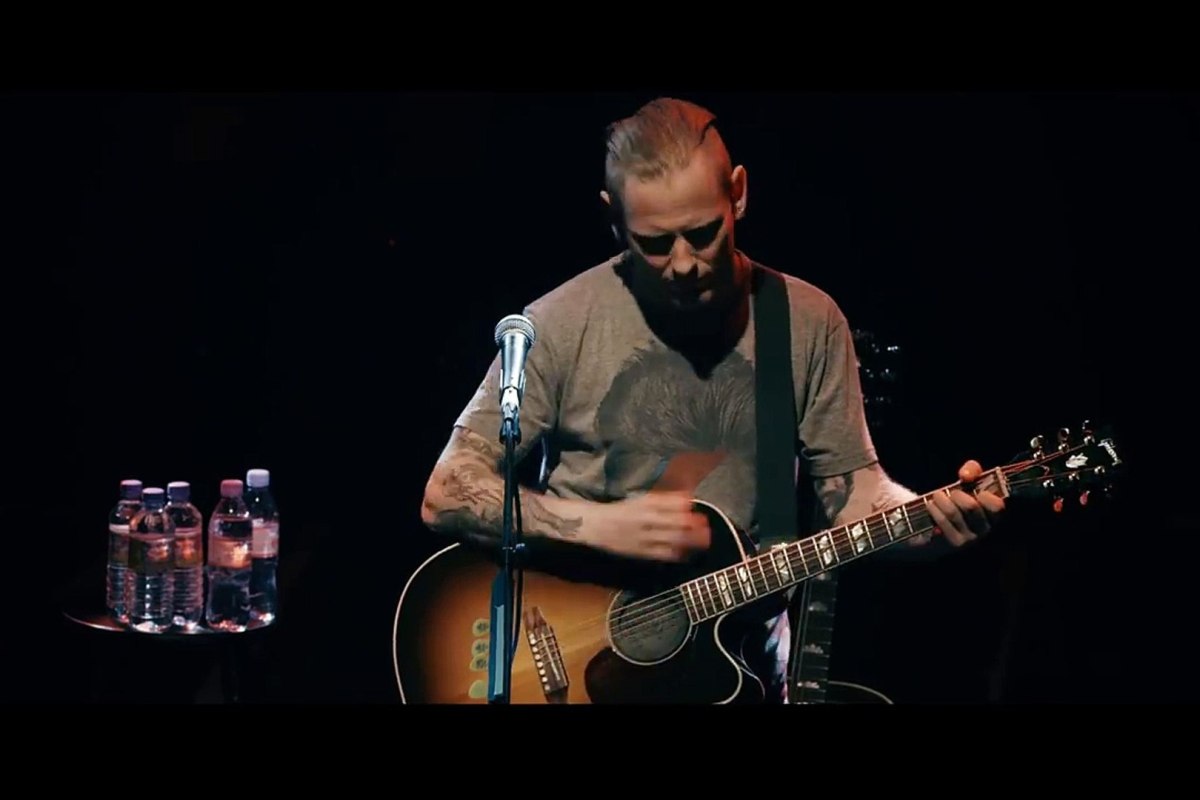
As usual, I am trying something different. I like to watch music reaction videos, and I find this stripped-down, acoustic version of Slipknot’s Snuff by their vocalist, Corey Taylor, to hit hard. I prompted ChatGPT GPT 5.5 with this video and lyrics. Me being me, I continue to analyse experience through language and my own worldview, notably the effects of ontological grammar commitments.
I share the reaction video at the bottom of this post. Before, I’d just consider this person to be a self-righteous zealot, but now I understand that (1) this is how she processes her world, and (2) she is prescriptive insomuch as she expects others to share her worldview. She’s not coming from a mean place. In her mind, she genuinely wants to help, but she doesn’t realise that not all people share her worldview. She’s likely had this worldview reinforced for all of her years, and so it works as a coping strategy for her. She expects that she can share this worldview, but it is likely maximally absorbed by those who share her ontological grammar commitment, which is to say, already have the same worldview.
If you want a view into how I engage with AI, now you know. Here’s a window:
This is a very interesting case study in ontological grammar that showcases the downside of not recognising it. From my ontology, she sounds like she’s moralising. To another (her own), she might sound supportive. She is commenting on the lyrics to this song, which are not all captured by the transcript. Reaction?
Bury all your secrets in my skin
Come away with innocence, and leave me with my sins
The air around me still feels like a cage
And love is just a camouflage for what resembles rage again

So if you love me, let me go
And run away before I know
My heart is just too dark to care
I can't destroy what isn't there
Deliver me into my fate
If I'm alone I cannot hate
I don't deserve to have you
Ooh my smile was taken long ago
If I can change I hope I never know

I still press your letters to my lips
And cherish them in parts of me that savor every kiss
I couldn't face a life without your light (Without your light)
But all of that was ripped apart when you refused to fight

So save your breath, I will not hear
I think I made it very clear
You couldn't hate enough to love
Is that supposed to be enough?
I only wish you weren't my friend
Then I could hurt you in the end
I never claimed to be a saint
Ooh my own was banished long ago
It took the death of hope to let you go

Oh, oh

So break yourself against my stones
And spit your pity in my soul
You never needed any help
You sold me out to save yourself
And I won't listen to your shame
You ran away, you're all the same
Angels lie to keep control
Ooh my love was punished long ago
If you still care, don't ever let me know
If you still care, don't ever let me know
Audio: NotebookLM summary podcast of this topic.
the wounded sometimes prefer the song to the sermon
Yes, this is a clean little specimen jar of ontological grammar doing its work while everyone pretends they are merely “reacting”. Humanity’s favourite parlour trick: smuggling an entire worldview into a sentence and calling it compassion.
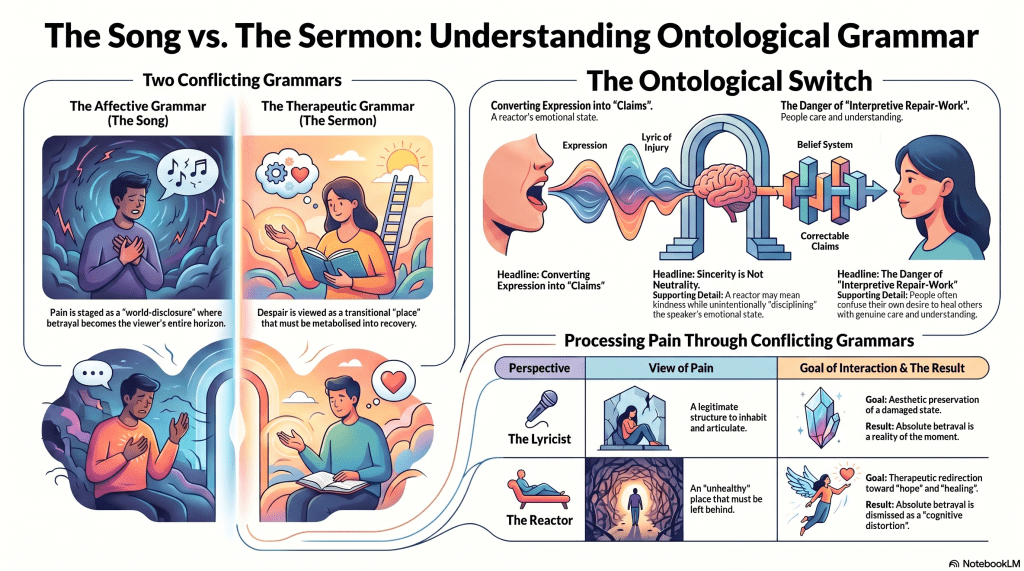
The key move is that she hears the lyric as a claim rather than as an utterance from within a damaged affective state. When she says she “doesn’t agree” with the line about love and rage, and then calls that outlook “toxic”, she has already converted the lyric into a propositional worldview that can be corrected, morally evaluated, and therapeutically redirected. The song is no longer only an aesthetic articulation of injury, self-loathing, abandonment, attachment, and rage. It becomes a suspect belief-system. That is the ontological switch.
From her grammar, this is supportive. Pain is a “place”; one should not “stay” there; hope remains available; trust and love should eventually be restored. That is a recovery-therapeutic ontology. It presupposes that despair is transitional, that emotional damage should be metabolised into healing, and that the moral arc of the subject bends toward renewed openness. So when she says, in effect, don’t become calloused, don’t stay jaded, love again, she is not hearing herself as judging the song. She is offering pastoral care in YouTube-reactor clothing, because apparently late civilisation needed a genre where vocal pedagogy, therapy-lite, and parasocial maternalism could all share a sofa.
From your ontology, though, she is moralising because she does not merely describe the emotional grammar of the song; she disciplines it. The lyric’s extremity is treated as something understandable but unsafe, beautiful but not habitable, cathartic but only under the condition that one eventually leaves it behind. That is not neutral support. It installs a norm: grief should resolve, bitterness should soften, love should be rehabilitated, hope should return. She may mean kindness, but kindness here arrives wearing the boots of teleology.
NotebookLM Infographic on this topic.
The most interesting fault-line is her treatment of generalisation. She identifies the lyric’s movement from one betrayal to “everyone” as a cognitive distortion. In ordinary therapeutic language, fair enough. But in lyric, especially in this genre, absolutising is not necessarily an epistemic error. It is how pain speaks when it has lost access to proportion. The lyric is not writing a sociology of human attachment. It is staging the experience of betrayal as world-disclosure. In that register, “all” does not mean a statistically universal class. It means: this wound has become the horizon through which everything now appears. To correct it as a bad inference is to import the wrong grammar.
That is where your framework bites. The words transmit; the sentence parses; everyone thinks communication is happening. But the decompression target differs. She reconstructs the lyric inside a moral-therapeutic grammar of recovery. You reconstruct it inside a diagnostic grammar of affect, ontology, and expressive insufficiency. Same words, different world. Your Architecture of Encounter makes precisely this point about ontological grammar: grammar does not merely carry content; it allocates what can count as meaningful, salient, explanatory, or distorted in the first place.
There is also a neat contrast inside the video itself. When she analyses vocal placement, tone, grit, support, and vowel shaping, she is mostly operating in a relatively tethered technical grammar. Claims can be checked against performance craft. But when she moves to love, hope, toxicity, healing, and despair, she enters the Contestable/Fluid zone. These terms feel clear because they are familiar, but their application depends on prior ontological commitments. In When Language Fails, this is exactly the danger-zone: terms that appear determinate whilst lacking shared grounding, especially where they authorise judgement, correction, or action.
So, yes: as a case study, it is excellent. Not because she is being cruel. She is not. That would be too easy, and therefore boring. The interesting point is that she is probably being sincere, warm, and careful by her own lights. But sincerity does not cancel grammar. Her support is support only within an ontology where despair is an unhealthy place to leave, not a legitimate structure of encounter to inhabit, articulate, or aesthetically preserve.
The concise diagnostic formulation would be:
She mistakes an affective utterance for a corrigible worldview. The lyric speaks from inside a structure of injury; her response translates it into therapeutic-moral grammar, where pain is a place one should visit but not inhabit. From within that grammar, she sounds supportive. From a deflationary ontological grammar, she is moralising: not because she condemns the suffering, but because she prescribes the proper trajectory of suffering before recognising the grammar in which the suffering is being expressed.
That is the downside of not recognising ontological grammar: people confuse their own interpretive repair-work with care, and then wonder why the wounded sometimes prefer the song to the sermon.
Bonus Round
🎸Corey tunes to C#, a tuning all too familiar to me – all strings 3 semitones lower than a standard tuning. It helps to have heavy-gauge strings, so they aren’t too slack. This is an easy song to play along to.
Using cowboy chords, grip an Am (tonally F#m) to start. The progression goes like this:
“Whom do you serve?” is the unasked question in the Grail story. Parsifal’s failure is usually treated as spiritual unreadiness, moral immaturity, or some such medieval hush. I’ve never had much sympathy for that reading. My own experience has made it difficult to leave certain questions politely untouched.
In my late teens and early twenties, I worked in Los Angeles as a musician, recording engineer, and producer. That meant spending a good deal of time around wealthy celebrities, not at parties but at work. The useful lesson was not glamour. It was status. More precisely, it was learning how often status functions as atmosphere: something to be indulged while present and ignored once it passes.
Berry Gordy once walked into a mixing session at his own studio and imposed a round of suggestions on a track headed for film. Nobody contradicted him. We didn’t need to. We knew that when he left, we would reset the console and write off the lost hour as weather. That is what aura often is: not wisdom, not competence, merely a temporary distortion field around a person whom others have learned not to challenge in the moment.
Gordy was an exception. Most days, there were no sacred cows in the room. Egos were bruised, feelings hurt, and compromises made. Work got done. If anything, the greater impostors were the label middle managers, appeased when present, ignored when absent, and forever acting as though they were paying for decisions that would ultimately be recouped from the artist anyway.
By the time I left music and went legit, I had already learnt the useful part: never mistake decorum for truth. I was never fully indoctrinated into pedestal-thinking, and I have never since managed to treat institutional aura as anything but local theatre. That is why the Grail story catches me at an odd angle. I do not identify with the knight who withholds the question. I identify with the person who asks it anyway, or with the child in Andersen who has not yet learned that collective performance outranks plain observation.
That, perhaps, is the real training most institutions require: not belief, but acculturation into silence. Some of us never quite acquire it.
WordPress has just informed me that my blog is having an anniversary. Technically true, though a little misleading: this blog has been around since 1 January 2017, but I’ve been loitering on the platform since 2006. Before that I dabbled in the great blog diaspora of the early internet—Google, Yahoo! 360, Blogger, and a few others that have long since evaporated into the ether.
Each space had its own flavour. One I recall from around 2010 was devoted to an experiment in World of Warcraft: levelling a pacifist character. The premise was simple—no violence allowed. My Human Priest, suitably named Passivefist, managed to crawl his way to level 7 before stalling out. The challenge was never to attack other NPCs, only to survive by gathering, healing, or sneaking through hostile terrain.
I am creating this account to track my progress as a pacifist in World of Warcraft. Others have done this before me and are, in fact, way ahead of me. Nonetheless, it is the challenge I am setting. I have created a Human Priest on Kael’thas named Passivefist.
Of course, in later expansions Blizzard eventually added pacifist-friendly content, making my small crusade somewhat redundant.
As for this blog, it’s taken a different path. I’ve recently crossed the 100,000-word milestone—101.4K, to be precise. Not that I’ve been counting obsessively, but it’s a nice marker, even if much of my writing also leaks into other projects: other blogs, manuscripts, and workaday scribbling.
As for this blog…
The intent here remains the same as when I started in 2017: to keep a space for philosophic musings, digressions, and the occasional provocation. I’ll continue publishing when I have something worth saying—or at least something worth testing out in public.
I was a professional musician in the 1980s. I played guitar, but this was always a sideline to my real work as a recording engineer and producer. Competence, not virtuosity, was the coin of the realm in the studio, and I was competent. Still, I spent much of my time surrounded by musicians who left me slack-jawed: people who could sight-read Bach at breakfast and bash out Van Halen riffs after lunch without missing a beat. Next to them, I was, charitably, merely competent.
That’s the thing about competence: it doesn’t make you the star, but it keeps the machine running. I knew I wasn’t the flash guitarist or the prodigy bassist, but I could play my parts cleanly and hold a band together. When later groups already had lead guitarists, I played bass. Was I a bassist? No. But I was competent enough to lock in with the drummer and serve the ensemble. Nobody mistook me for a virtuoso, least of all me. I wasn’t an impostor; I was a cog in the machine, good enough to keep the show on the road. That was my ego attachment: not “musician” as identity, but member of a band.
The Hallucination of “Impostor Syndrome”
Much ink is spilt on impostor syndrome, that anxious whisper that one is a fraud who doesn’t belong. The polite story is that it’s just nerves: you are competent, you do belong, you’re simply holding yourself against impossible standards. Nonsense. The truth is darker. Most people are impostors.
The nervous tension is not a malfunction of self-esteem; it’s a moment of clarity. A faint recognition that you’ve been miscast in a role you can’t quite play, but are forced to mime anyway. The Peter Principle doesn’t kick in at some distant managerial plateau; it’s the basic law of organisational gravity. People rise past their competence almost immediately, buoyed not by skill but by connections, bluff, and HR’s obsession with “fit.”
The Consultant’s View from the Cheap Seats
As a Management Consultant™, I met countless “leaders” whose only discernible talent was staying afloat whilst already over their heads. Organisations, too blind or too immature to notice, rewarded them with raises and promotions anyway. Somebody’s got to get them, after all. HR dutifully signed the paperwork, called it “talent management,” and congratulated itself on another triumph of culture-fit over competence.
In music, incompetence is self-correcting: audiences walk out, bands dissolve, the market punishes mediocrity. In corporate life, incompetence metastasises. Bluffers thrive. Mediocrity is embalmed, padded with stock options, and paraded on stage at leadership summits.
Good Enough vs. Bluff Enough
Competence, though, is underrated. You don’t need to be the best guitarist or the savviest CEO. You need to be good enough for the role you’re actually playing, and honest enough not to mistake the role for your identity. In bands, that worked fine. In business and politics, it’s subversive. The whole edifice depends on people pretending to be more than they are, rehearsing confidence in lieu of competence.
No wonder impostor syndrome is rampant. It’s not a pathology; it’s the ghost of truth in a system of lies.
The antidote isn’t TED-talk therapy or self-affirmation mantras. It’s honesty: admit the limits of your competence, stop mistaking ego for ability, and refuse to play HR’s charade. Competence is enough. The rest is noise.
A response on another social media site got me thinking about another Sorites paradox. The notion just bothers me. I’ve long held that it is less a paradox than an intellectually lazy way to manoeuvre around language insufficiency.
<rant>
The law loves a nice, clean number. Eighteen to vote. Sixteen to marry. This-or-that to consent. As if we all emerge from adolescence on the same morning like synchronised cicadas, suddenly equipped to choose leaders, pick spouses, and spot the bad lovers from the good ones.
But the Sorites paradox gives the game away: if you’re fit to vote at 18 years and 0 days, why not at 17 years, 364 days? Why not 17 years, 363 days? Eventually, you’re handing the ballot to a toddler who thinks the Prime Minister is Peppa Pig. Somewhere between there and adulthood, the legislator simply throws a dart and calls it “science.”
To bolster this fiction, we’re offered pseudo-facts: “Women mature faster than men”, or “Men’s brains don’t finish developing until thirty.” These claims, when taken seriously, only undermine the case for a single universal threshold. If “maturity” were truly the measure, we’d have to track neural plasticity curves, hormonal arcs, and a kaleidoscope of individual factors. Instead, the state settles for the cheapest approximation: a birthday.
This obsession with fixed thresholds is the bastard child of Enlightenment rationalism — the fantasy that human variation can be flattened into a single neat line on a chart. The eighteenth-century mind adored universals: universal reason, universal rights, universal man. In this worldview, there must be one age at which all are “ready,” just as there must be one unit of measure for a metre or a kilogram. It is tidy, legible, and above all, administratively convenient.
Cue the retorts:
“We need something.” True, but “something” doesn’t have to mean a cliff-edge number. We could design systems of phased rights, periodic evaluations, or contextual permissions — approaches that acknowledge people as more than interchangeable cut-outs from a brain-development chart.
“It would be too complicated.” Translation: “We prefer to be wrong in a simple way than right in a messy way.” Reality is messy. Pretending otherwise isn’t pragmatism; it’s intellectual cowardice. Law is supposed to contend with complexity, not avert its gaze from it.
And so we persist, reducing a continuous, irregular, and profoundly personal process to an administratively convenient fiction — then dressing it in a lab coat to feign objectivity. A number is just a number, and in this case, a particularly silly one.
I’m a nihilist. Possibly always have been. But let’s get one thing straight: nihilism is not despair. That’s a slander cooked up by the Meaning Merchants – the sentimentalists and functionalists who can’t get through breakfast without hallucinating some grand purpose to butter their toast. They fear the void, so they fill it. With God. With country. With yoga.
Audio: NotebookLM podcast on this topic.
Humans are obsessed with function. Seeing it. Creating it. Projecting it onto everything, like graffiti on the cosmos. Everything must mean something. Even nonsense gets rebranded as metaphor. Why do men have nipples? Why does a fork exist if you’re just going to eat soup? Doesn’t matter – it must do something. When we can’t find this function, we invent it.
But function isn’t discovered – it’s manufactured. A collaboration between our pattern-seeking brains and our desperate need for relevance, where function becomes fiction, where language and anthropomorphism go to copulate. A neat little fiction. An ontological fantasy. We ask, “What is the function of the human in this grand ballet of entropy and expansion?” Answer: there isn’t one. None. Nada. Cosmic indifference doesn’t write job descriptions.
And yet we prance around in lab coats and uniforms – doctors, arsonists, firemen, philosophers – playing roles in a drama no one is watching. We build professions and identities the way children host tea parties for dolls. Elaborate rituals of pretend, choreographed displays of purpose. Satisfying? Sometimes. Meaningful? Don’t kid yourself.
We’ve constructed these meaning-machines – society, culture, progress – not because they’re real, but because they help us forget that they’re not. It’s theatre. Absurdist, and often bad. But it gives us something to do between birth and decomposition.
Sisyphus had his rock. We have careers.
But let’s not confuse labour for meaning, or imagination for truth. The boulder never reaches the top, and that’s not failure. That’s the show.
So roll the stone. Build the company. Write the blog. Pour tea for Barbie. Just don’t lie to yourself about what it all means.
Why the cherished myth of human autonomy dissolves under the weight of our own biology
We cling to free will like a comfort blanket—the reassuring belief that our actions spring from deliberation, character, and autonomous choice. This narrative has powered everything from our justice systems to our sense of personal achievement. It feels good, even necessary, to believe we author our own stories.
But what if this cornerstone of human self-conception is merely a useful fiction? What if, with each advance in neuroscience, our cherished notion of autonomy becomes increasingly untenable?
Audio: NotebookLM podcast on this topic.
I. The Myth of Autonomy: A Beautiful Delusion
Free will requires that we—some essential, decision-making “self”—stand somehow separate from the causal chains of biology and physics. But where exactly would this magical pocket of causation exist? And what evidence do we have for it?
Your preferences, values, and impulses emerge from a complex interplay of factors you never chose:
The genetic lottery determined your baseline neurochemistry and cognitive architecture before your first breath. You didn’t select your dopamine sensitivity, your amygdala reactivity, or your executive function capacity.
The hormonal symphony that controls your emotional responses operates largely beneath conscious awareness. These chemical messengers—testosterone, oxytocin, and cortisol—don’t ask permission before altering your perceptions and priorities.
Environmental exposures—from lead in your childhood drinking water to the specific traumas of your upbringing—have sculpted neural pathways you didn’t design and can’t easily rewire.
Developmental contingencies have shaped your moral reasoning, impulse control, and capacity for empathy through processes invisible to conscious inspection.
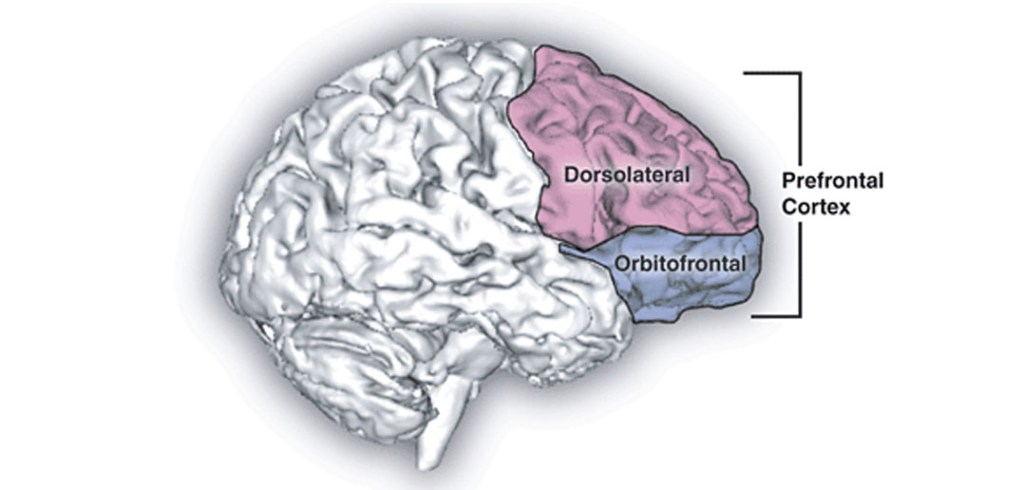
Your prized ability to weigh options, inhibit impulses, and make “rational” choices depends entirely on specific brain structures—particularly the dorsolateral prefrontal cortex (DLPFC)—operating within a neurochemical environment you inherited rather than created.
You occupy this biological machinery; you do not transcend it. Yet, society holds you responsible for its outputs as if you stood separate from these deterministic processes.
transcranial direct current stimulation over the DLPFC alters moral reasoning, especially regarding personal moral dilemmas. The subject experiences these externally induced judgments as entirely their own, with no sense that their moral compass has been hijacked
II. The DLPFC: Puppet Master of Moral Choice
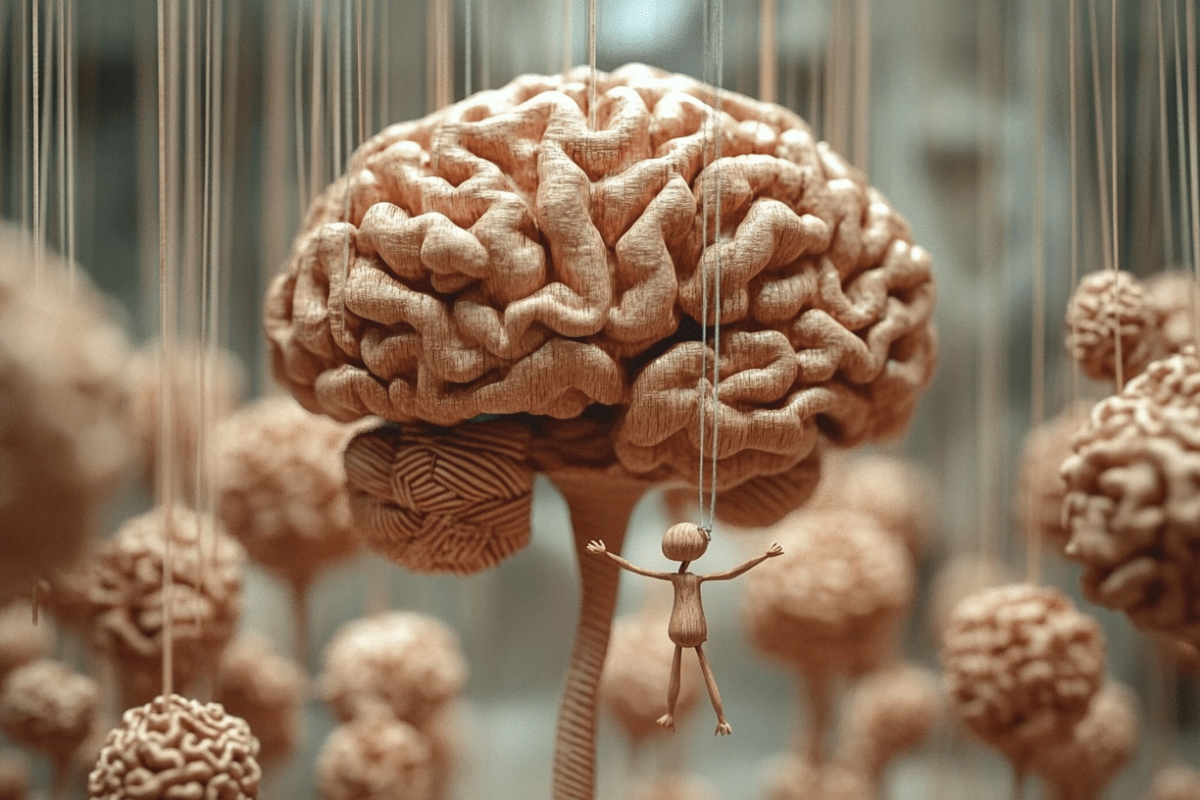
The dorsolateral prefrontal cortex serves as command central for what we proudly call executive function—our capacity to plan, inhibit, decide, and morally judge. We experience its operations as deliberation, as the weighing of options, as the essence of choice itself.
And yet this supposed seat of autonomy can be manipulated with disturbing ease.
When researchers apply transcranial magnetic stimulation to inhibit DLPFC function, test subjects make dramatically different moral judgments about identical scenarios. Under different stimulation protocols, the same person arrives at contradictory conclusions about right and wrong without any awareness of the external influence.
Similarly, transcranial direct current stimulation over the DLPFC alters moral reasoning, especially regarding personal moral dilemmas. The subject experiences these externally induced judgments as entirely their own, with no sense that their moral compass has been hijacked.
If our most cherished moral deliberations can be redirected through simple electromagnetic manipulation, what does this reveal about the nature of “choice”? If will can be so easily influenced, how free could it possibly be?
III. Hormonal Puppetmasters: The Will in Your Bloodstream
Your decision-making machinery doesn’t stop at neural architecture. Your hormonal profile actively shapes what you perceive as your autonomous choices.
Consider oxytocin, popularly known as the “love hormone.” Research demonstrates that elevated oxytocin levels enhance feelings of guilt and shame while reducing willingness to harm others. This isn’t a subtle effect—it’s a direct biological override of what you might otherwise “choose.”
Testosterone tells an equally compelling story. Administration of this hormone increases utilitarian moral judgments, particularly when such decisions involve aggression or social dominance. The subject doesn’t experience this as a foreign influence but as their own authentic reasoning.
These aren’t anomalies or edge cases. They represent the normal operation of the biological systems governing what we experience as choice. You aren’t choosing so much as regulating, responding, and rebalancing a biochemical economy you inherited rather than designed.
IV. The Accident of Will: Uncomfortable Conclusions
If the will can be manipulated through such straightforward biological interventions, was it ever truly “yours” to begin with?
Philosopher Galen Strawson’s causa sui argument becomes unavoidable here: To be morally responsible, one must be the cause of oneself, but no one creates their own neural and hormonal architecture. By extension, no one can be ultimately responsible for actions emerging from that architecture.
What we dignify as “will” may be nothing more than a fortunate (or unfortunate) biochemical accident—the particular configuration of neurons and neurochemicals you happened to inherit and develop.
This lens forces unsettling questions:
How many behaviours we praise or condemn are merely phenotypic expressions masquerading as choices? How many acts of cruelty or compassion reflect neurochemistry rather than character?
How many punishments and rewards are we assigning not to autonomous agents, but to biological processes operating beyond conscious control?
And perhaps most disturbingly: If we could perfect the moral self through direct biological intervention—rewiring neural pathways or adjusting neurotransmitter levels to ensure “better” choices—should we?
Or would such manipulation, however well-intentioned, represent the final acknowledgement that what we’ve called free will was never free at all?
A Compatibilist Rebuttal? Not So Fast.
Some philosophers argue for compatibilism, the view that determinism and free will can coexist if we redefine free will as “uncoerced action aligned with one’s desires.” But this semantic shuffle doesn’t rescue moral responsibility.
If your desires themselves are products of biology and environment—if even your capacity to evaluate those desires depends on inherited neural architecture—then “acting according to your desires” just pushes the problem back a step. You’re still not the ultimate author of those desires or your response to them.
What’s Left?
Perhaps we need not a defence of free will but a new framework for understanding human behaviour—one that acknowledges our biological embeddedness while preserving meaningful concepts of agency and responsibility without magical thinking.
The evidence doesn’t suggest we are without agency; it suggests our agency operates within biological constraints we’re only beginning to understand. The question isn’t whether biology influences choice—it’s whether anything else does.
For now, the neuroscientific evidence points in one direction: The will exists, but its freedom is the illusion.
I’ve recently decided to take a sabbatical from what passes for economic literature these days — out of a sense of self-preservation, mainly — but before I hermetically sealed myself away, I made a quick detour through Jorge Luis Borges’ The Library of Babel (PDF). Naturally, I emerged none the wiser, blinking like some poor subterranean creature dragged into the daylight, only to tumble headlong into David Graeber’s Bullshit Jobs.
This particular tome had been languishing in my inventory since its release, exuding a faint but persistent odour of deferred obligation. Now, about a third of the way in, I can report that Graeber’s thesis — that the modern world is awash with soul-annihilatingly pointless work — does resonate. I find myself nodding along like one of those cheap plastic dashboard dogs. Yet, for all its righteous fury, it’s more filler than killer. Directionally correct? Probably. Substantively airtight? Not quite. It’s a bit like admiring a tent that’s pitched reasonably straight but has conspicuous holes large enough to drive a fleet of Uber Eats cyclists through.
An amusing aside: the Spanish edition is titled Trabajos de mierda (“shitty jobs”), a phrase Graeber spends an entire excruciating section of the book explaining is not the same thing. Meanwhile, the French, in their traditional Gallic shrug, simply kept the English title. (One suspects they couldn’t be arsed.)
Chapter One attempts to explain the delicate taxonomy: bullshit jobs are fundamentally unnecessary — spawned by some black magic of bureaucracy, ego, and capitalist entropy — whilst shit jobs are grim, thankless necessities that someone must do, but no one wishes to acknowledge. Tragically, some wretches get the worst of both worlds, occupying jobs that are both shit and bullshit — a sort of vocational purgatory for the damned.
Then, in Chapter Two, Graeber gleefully dissects bullshit jobs into five grotesque varieties:
Flunkies, whose role is to make someone else feel important.
Goons, who exist solely to fight other goons.
Duct Tapers, who heroically patch problems that ought not to exist in the first place.
Box Tickers, who generate paperwork to satisfy some Kafkaesque demand that nobody actually reads.
Taskmasters, who either invent unnecessary work for others or spend their days supervising people who don’t need supervision.
Naturally, real-world roles often straddle several categories. Lucky them: multi-classed in the RPG of Existential Futility.
Graeber’s parade of professional despair is, admittedly, darkly entertaining. One senses he had a great deal of fun cataloguing these grotesques — like a medieval monk illustrating demons in the margins of a holy text — even as the entire edifice wobbles under the weight of its own repetition. Yes, David, we get it: the modern economy is a Potemkin village of invented necessity. Carry on.
If the first chapters are anything to go by, the rest of the book promises more righteous indignation, more anecdotes from anonymous sad-sacks labouring in existential oubliettes, and — if one is lucky — perhaps a glimmer of prescription hidden somewhere amidst the diagnosis. Though, I’m not holding my breath. This feels less like an intervention and more like a well-articulated primal scream.
Still, even in its baggier moments, Bullshit Jobs offers the grim pleasure of recognition. If you’ve ever sat through a meeting where the PowerPoint had more intellectual integrity than the speaker or spent days crafting reports destined for the corporate oubliette marked “For Review” (translation: Never to Be Seen Again), you will feel seen — in a distinctly accusatory, you-signed-up-for-this sort of way.
In short: it’s good to read Graeber if only to have one’s vague sense of societal derangement vindicated in print. Like having a charmingly irate friend in the pub lean over their pint and mutter, “It’s not just you. It’s the whole bloody system.”
I’m not sure I’ll stick with this title either. I think I’ve caught the brunt of the message, and it feels like a diversion. I’ve also got Yanis Varoufakis’ Technofeudalism: What Killed Capitalism on the shelf. Perhaps I’ll spin this one up instead.





 Philosophics