Yesterday, I complained about the psychoanalytic approach Fanon employed in Black Skin, White Masks, Chapter 4, The So-Called Dependency Complex of the Colonised. Today, I share my feelings about Chapter 5, The Lived Experience of the Black Man. But first, let’s reorient the reader to my own perspective.
I am decidedly anti-colonial and even anti-post-colonial, or at least I see this trajectory as tragic. All of this is consonant with the views expressed in my Anti-Enlightenment Project.
Audio: NotebookLM summary podcast of this topic.
On one hand, I want to complain about the circuitous approach he took in Chapter 5. It was meant to be metaphorical and poetic. Whilst I feel it’s a bold move to present an areasonable approach – one that refuses the terms of Enlightenment rationality without simply inverting them – it seems that he cherry-picks his tools from the arsenal of Enlightenment thought. This applies to much of the post-colonial project broadly, though my objection there is less to any particular theoretical allegiance and more to the foundational commitments: I oppose colonialism, empire, and hegemony on grounds that precede the debate about which critical vocabulary best serves their dismantling.
Fanon’s anti-Enlightenment critique is weakened where he imports psychoanalysis too trustingly. Psychology and psychoanalysis are themselves Enlightenment byproducts: systems for rendering the human subject legible, classifiable, interpretable, and administrable. To use them against colonial Reason without first subjecting them to the same suspicion risks reproducing the very machinery under critique. The result isn’t fatal to Fanon’s charge, but it is methodologically untidy. I don’t necessarily object to using Enlightenment-derived tools after critique; I object to retaining them as though their own conceptual machinery were innocent. Psychoanalysis may be useful as metaphor, rhetoric, or historically situated vocabulary, but if it’s treated as a valid evidentiary lens without scrutiny, it smuggles Enlightenment legibility back into an anti-Enlightenment critique. That’s where Fanon’s chapter loses force for me.
NotebookLM Infographic on this topic.
Fanon is at his strongest when he shows that colonial ‘reason‘ produces the colonised subject as irrational, bodily, affective, and deficient. He rightly treats unreason not as a natural property of the colonised but as a category imposed by colonial order. My difficulty is that he then routes this insight through psychoanalysis, a method I regard as metaphorically suggestive but evidentially weak. The critique of colonial rationality survives; the psychoanalytic apparatus remains suspect.
In the end, we may both at least tacitly agree that colonialism, and the Enlightenment more generally, was not the best path. Where we part is on what should have been taken instead. Cue Robert Frost.
But the more searching question isn’t which fork we should have taken – it’s what we do with the road we’re already on. When the system itself is the problem, the question of what within it is worth retaining rarely gets answered on its merits. More often, it gets answered by inertia: by what is convenient, familiar, or already institutionally embedded. Fanon isn’t exempt from this, and neither, if we’re honest, is any thinker who inherits a tradition whilst attempting to dismantle it. The tools available are always already compromised. The most we can ask – and what distinguishes the sharper critiques from the merely passionate ones – is whether the thinker knows this, and accounts for it. Fanon sometimes does. In Chapter 5, at the moments that matter most, he doesn’t quite.
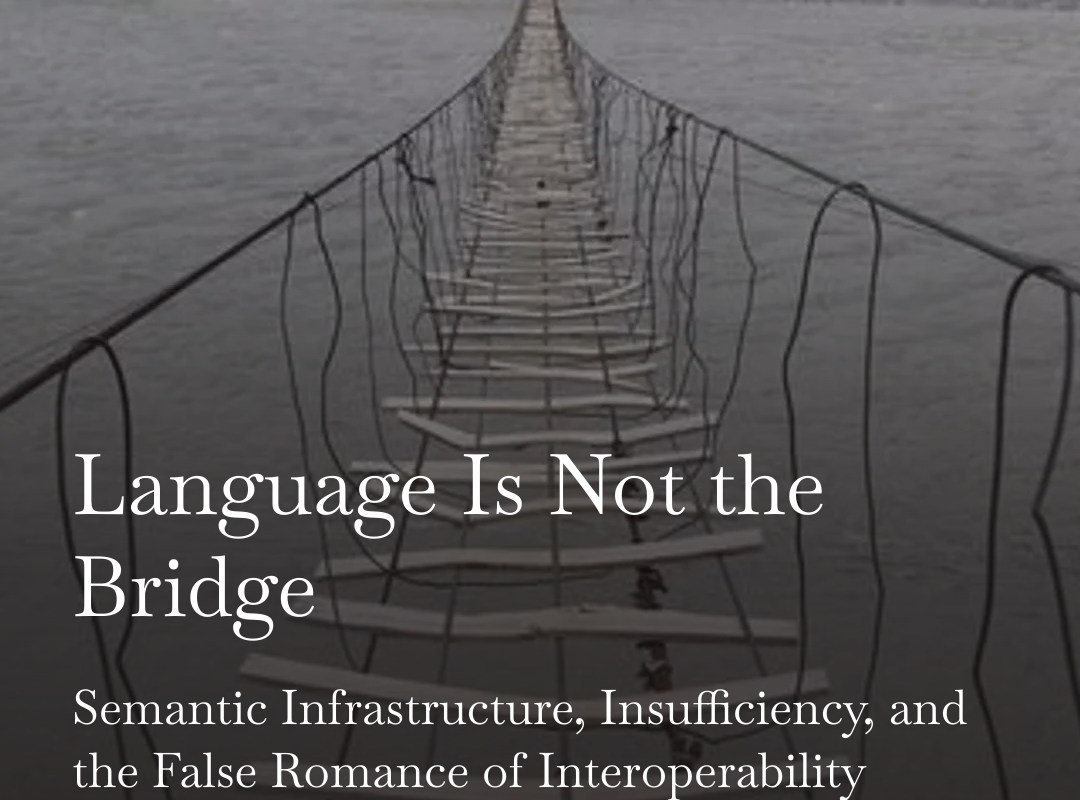
NB: I used ChatGPT for the cover image. I think it did a good job.
Semantic Infrastructure, Insufficiency, and the False Romance of Interoperability
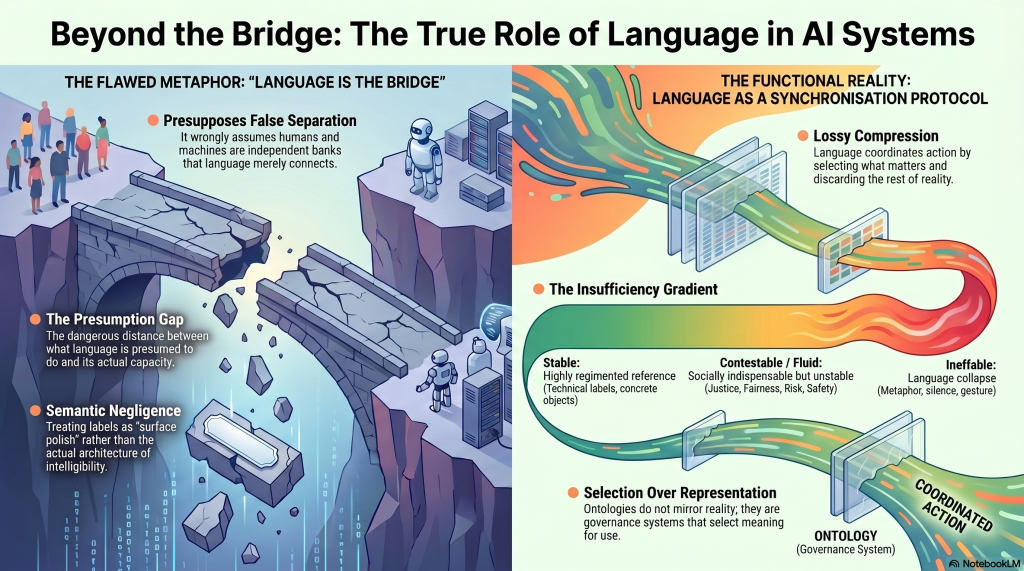
A recent Substack essay, Jessica Talisman’s Language Is the Bridge, makes a claim that is increasingly common in discussions of artificial intelligence, knowledge graphs, ontologies, metadata, and semantic infrastructure: that language is the bridge between human understanding and machine action. The claim is attractive, and not merely because ‘bridge’ is one of those metaphors that allows technical discourse to cosplay as wisdom literature. It captures something real. AI systems, semantic architectures, ontologies, taxonomies, controlled vocabularies, and knowledge graphs do not run on raw reality. They run on structured representations. Those representations require labels, definitions, mappings, alignments, constraints, and interpretive discipline. In that sense, language work is not decorative. It is infrastructural. But the metaphor is also dangerous.
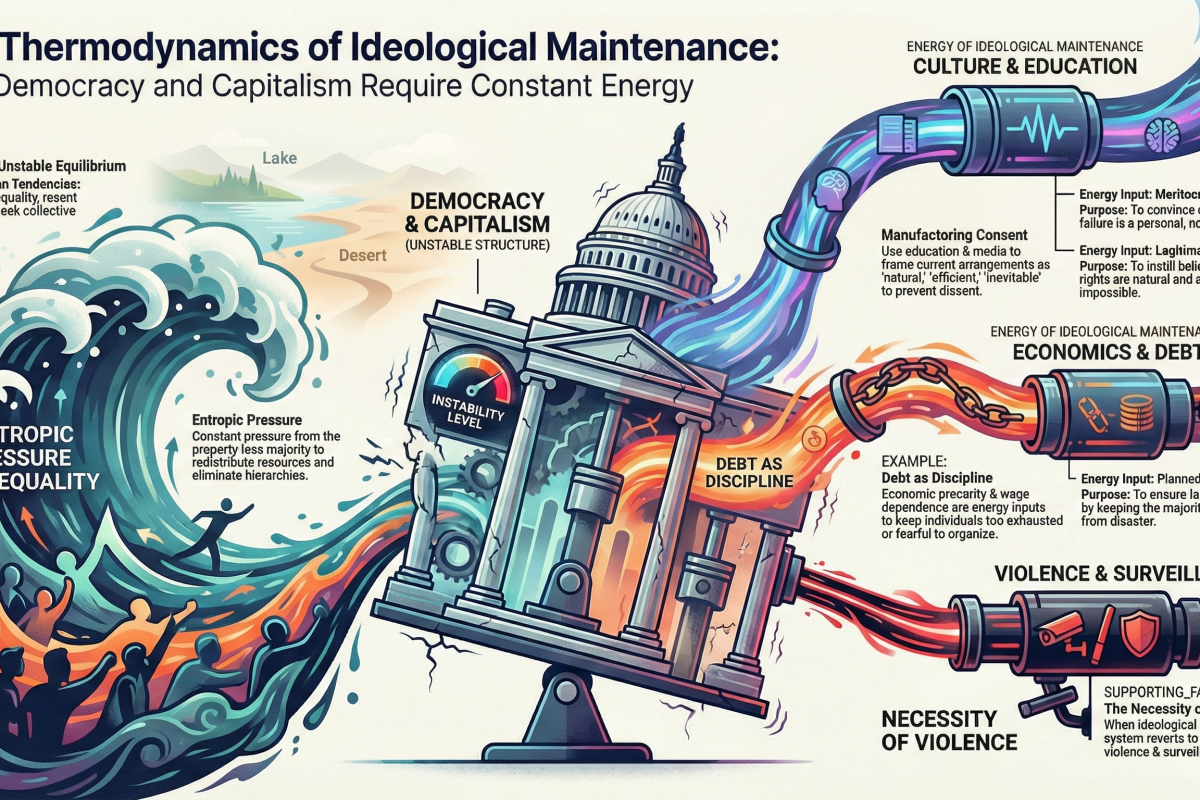
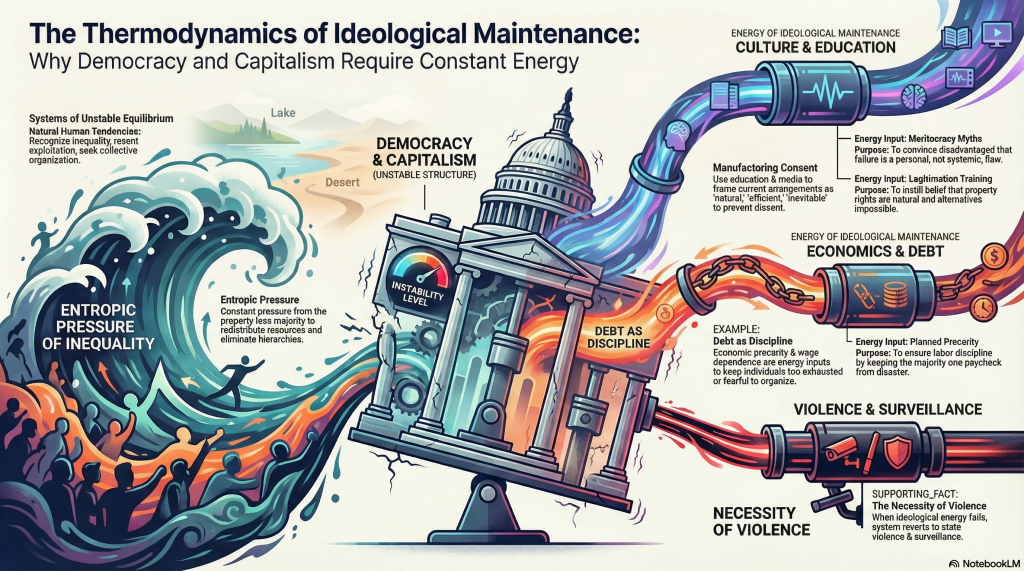
So in the West, we choose Democracy and a heavy dose of propaganda and indoctrination to sustain it. Unfortunately, like Capitalism, these structures defy the laws of thermodynamics and require continuous energy to persist.
Audio: NotebookLM summary podcast of this topic.
Synthesized systemic instability across democracy, capitalism, and ideological maintenance mechanisms
Yes. This is the final refinement.
Democracy and capitalism aren’t stable equilibria. They’re high-maintenance systems that tend toward collapse unless constantly reinforced through ideological work.
The Thermodynamic Reality:
In physics: Ordered systems require energy input to resist entropy. Without it, they degrade.
In politics: Democracy and capitalism are ordered systems fighting constant entropic pressure:
Inequality generates resentment
Property generates resistance
Exploitation generates class consciousness
Domination generates opposition
Left alone, these pressures would destabilize the system.
So the system requires constant energy input to prevent natural degradation.
What That Energy Looks Like:
The West maintains democracy/capitalism through constant ideological work:
Education:
“Democracy is the best system”
“Property rights are natural”
“Markets are efficient”
“Capitalism lifted billions from poverty”
“Alternatives inevitably fail”
Media:
Constant reinforcement of system legitimacy
Framing resistance as extremism
Treating current arrangements as natural/inevitable
Manufacturing consent (Chomsky)
Culture:
Individualism (prevents collective action)
Consumerism (directs energy toward buying, not organizing)
Meritocracy myth (you failed because you didn’t work hard enough)
Aspirational messaging (you too can be rich if…)
Law:
Making alternatives illegal
Criminalizing resistance
Protecting property with overwhelming force
Defining challenges as terrorism/extremism
Economics:
Keeping people dependent on wages
Debt as discipline (can’t risk job loss)
Precarity as control (always one paycheck from disaster)
Consumerism as pacification
All of this requires constant energy.
Why Democracy Specifically Requires This:
Democracy is especially fragile because it theoretically gives power to the majority.
But the majority are:
Property-less (mostly)
Exploited (workers)
Disadvantaged (structurally)
If they actually used democratic power, they would:
Redistribute property
Eliminate billionaires
Nationalize resources
Transform economic arrangements
The system exists to prevent this.
So democracy requires constant ideological work to ensure the majority:
Doesn’t recognize its numerical advantage
Doesn’t organize collectively
Doesn’t use democratic power against property
Votes for parties that won’t threaten capital
Believes the system serves them
The Energy Requirements:
Think about the sheer resources deployed to maintain this:
Trillion-dollar media industries
Entire education systems designed to produce compliant citizens
Denis Noble’s critique of Richard Dawkins’ approach to genetics isn’t just a scientific debate; it’s a microcosm of a much larger issue: our inadequate grasp of systems thinking. This inadequacy resonates through every layer of our social, political, and economic frameworks, revealing why these systems often fail us—they are simply too fragile.
VIDEO: Denis Noble explains his revolutionary theory of genetics | Genes are not the blueprint for life
Why do we struggle with systems thinking? The concept itself demands an understanding of boundaries, dimensions, and interactions that are often far beyond our regular scope. More often than not, we define system boundaries too narrowly. We overlook crucial dimensions and, crucially, miss the interactions. This isn’t just an academic observation; it’s a practical one. In my experience, even when we do acknowledge broader boundaries, management frequently undermines their importance, limiting the scope of what’s considered relevant.
Humans Are Abysmal Systems Thinkers
Since the 1980s, my interest in genetics has been piqued by Dawkins’ seminal works like The Selfish Gene and The Blind Watchmaker. Dawkins has long championed a gene-centric view of evolution, one that has shaped our understanding of biology for decades. However, Denis Noble challenges this perspective, advocating for a systems-level view that considers not just the genes but the interactions between a myriad of biological processes. This isn’t just genetics; it’s a profound illustration of systems thinking—or our lack thereof.
I’m not suggesting we discard Dawkins’ contributions to science, but Noble’s arguments are compelling and warrant serious consideration. They underscore a broader philosophical dilemma: our rhetorical constructs often overshadow deeper truths. In discussing the nuances between Dawkins’ and Noble’s theories, I argue that rhetoric, for better or worse, becomes our only accessible truth. While there may be more fundamental truths out there, they are often beyond our grasp, obscured not just by our cognitive limitations but also by the very language we use to discuss them.
So, which is true? The answer might be less about choosing sides and more about acknowledging our limitations in understanding and managing complex systems. Perhaps it’s time to consider that in the quest for truth, acknowledging our blind spots is just as important as the truths we defend.
Apologies in advance for linking a teaser video that leads to a paywall, but the relevant content is self-contained.
Section 4: Legal and Jurisprudence Systems as Fictions
The Nature of Legal Systems
Legal and jurisprudence systems are among the most complex and entrenched fictions in society. Laws are human-made rules that govern behaviour, established by governments and enforced by judicial institutions. While laws aim to create order and justice, they are ultimately constructs, products of human agreement and cultural evolution.
The concept of law varies significantly across cultures and historical periods. Ancient legal codes, such as the Code of Hammurabi or Roman law, illustrate the long-standing tradition of codifying rules to govern society. However, these codes, like modern laws, are not natural phenomena but rather inventions designed to regulate human interactions and maintain social cohesion.
The Evolution of Legal Fictions
Legal systems have evolved alongside societies, adapting to changes in cultural norms, technological advancements, and political landscapes. The development of common law, for example, is a testament to the adaptive nature of legal systems. Common law, which originated in medieval England, is based on judicial precedents and case law rather than written statutes. This system relies heavily on the interpretation and application of past decisions, demonstrating how legal principles are constructed and reconstructed over time.
Moreover, legal fictions are often used within these systems to achieve practical outcomes. For instance, the concept of corporate personhood, where a corporation is treated as a legal person with rights and responsibilities, is a legal fiction designed to facilitate business operations and protect individual shareholders from certain liabilities. This illustrates how legal constructs can shape economic activities and social relations.
Implications of Legal Fictions
The recognition that legal systems are fictions has profound implications for how we understand and engage with the law. It highlights the role of human agency in creating and modifying legal norms, suggesting that laws are not immutable truths but rather adaptable tools for governance.
Legal systems are often seen as impartial and objective, but they are deeply influenced by the values, beliefs, and power dynamics of the societies that create them. This can lead to biases and inequalities being embedded within legal frameworks. For example, historical laws that discriminated based on race, gender, or class demonstrate how legal fictions can perpetuate social injustices.
Understanding the fictional nature of legal systems also opens the door to questioning and reforming these systems. It encourages us to consider alternative approaches to justice and governance that may better reflect contemporary values and address the needs of diverse populations.
The Role of Legal Narratives
Legal narratives, the stories told through laws and legal decisions, play a crucial role in shaping public perceptions and societal norms. These narratives construct realities that influence how individuals and communities understand their rights, responsibilities, and relationships with the state.
The work of scholars like Robert Cover, who in “Nomos and Narrative” (1983) argued that law is a system of meaning-making through narratives, underscores the importance of storytelling in the legal realm. By examining these narratives critically, we can uncover the underlying assumptions and power structures that they reinforce.
Future of Legal Systems
As societies continue to evolve, so too will their legal systems. The rise of international law, human rights conventions, and transnational legal frameworks reflects the growing interconnectedness of the world. These developments challenge traditional notions of state sovereignty and domestic legal autonomy, suggesting a future where legal systems may become even more complex and intertwined.
By recognizing legal systems as fictions, we are better equipped to navigate and influence these changes. This awareness can lead to more inclusive and equitable legal frameworks that serve the broader goals of justice and human flourishing.
References
Cover, Robert. “Nomos and Narrative” (1983).
Graeber, David. Debt: The First 5,000 Years (2011).
Anderson, Benedict. Imagined Communities: Reflections on the Origin and Spread of Nationalism (1983).
Giddens, Anthony. The Consequences of Modernity (1990).
As humans, we often leverage systems. They seem to make life easier. Whether a routine or a step-by-step instruction through an unknown process, a system can guide us. Systems are also connected, interactive entities, but that’s not for this segment. I am more interested in the loss of humanity that systematic processes and bureaucracy bring, so I am interested in imposed systems rather than systems we invent to find our keys and wallets.
Podcast: Audio rendition of this page contentImage: Spectrum of System versus Human
If we consider systematisation and humanity on a scale, we can see that any move toward systematisation comes at the expense of humanity. It might make logical sense to make this trade-off to some degree or another. The biggest hit to humanity is the one-size-fits-all approach to a problem. It removes autonomy or human agency from the equation. If a system can be that mechanised, then automate it. Don’t assign a human to do it. This is an act of violence.
As I’ve been reading and writing a lot about Iain McGilchrist’s work lately, I feel one can easily map this to left versus right cerebral hemisphere dominance. System-building is inherently human, but it’s in the domain of the left hemisphere. But my imposition of a system on another is violence—one might even argue that it’s immoral.
As with bureaucracy, these imposed systems are Procrustean beds. Everyone will fit, no matter what. And when human beings need to interact with systems, we can not only feel the lack of humanity, but our own humanity suffers at the same time.
A close friend of mine recently checked herself into a mental health facility. After a few days, she called and asked if I could bring her a change of clothes and some toiletries—deodorant, soap, and shampoo. She had some in her house, but the packaging needed to be unopened and factory sealed. I stopped at a shop to buy these items and I brought them to the facility.
At the reception area, I needed to be cross-referenced as an authorised visitor, so I was asked to show proof of my identity as if it mattered who was delivering clothing that was going to be checked anyway. No big deal, they recorded my licence number on a form and ask me to fill it out—name, phone number, and what I was delivering.
The form stated that any open consumable items would not be allowed. I signed the form. An attendant took the bag and told me that I needed to remove the ‘chemicals’, that they would not be delivered. I pointed to the lines on the form that read that this restriction was for open items and reinforced that I had just purchased these and showed her the sales receipt. She told me that the patient would need to obtain a doctor’s permission, and she assured me that the patients all had soap.
I’m sure she thought she was being compassionate and assertive. I experienced it as patronising. Me being me, I chided her lack of compassion and humanity, not a great match for a mental health attendant. In fact, it reminded me of a recent post I wrote on Warmth. In it, I suggested that service staff should at least fake conviviality. I take that back. Faux congeniality is patronising. She mimicked me. “Yes, systems are so inhumane, but here we follow a system.” My first thought was of Adolf Eichmann, who kept the trains on schedule without a care for the cargo. This is the violence inherent in systems.
Systems are not illogical. In fact, they are hyper-logical. And that’s the problem, logic is traded off at the expense of empathy. And one might have a strong argument for some accounting or financial system process, but I’ll retort that this should be automated. A human should not have to endure such pettiness.
I can tell that this will devolve quickly into a rant and so I’ll take my leave and not foist this violence upon you.
My mind is a Pachinko machine; my brain fatigued. Add to this the environmental distractions, such as breakfast, and it’s not conducive to focus. Today, it’s scrambled eggs and dry muffins—sans jam or butter, only some whipped substitute unfit for human consumption,
My prompt for writing the recent post on Professionalism was my reaction to the hospital staff and their demeanour—or as a colleague suggested in a comment, decorum. Perhaps I can remain focused on the words on this page as I type.
For service staff, warmth is a necessary ingredient of professionalism. This is particularly true for persons in the healing arts. The top indicator for pursuing legal action in a medical malpractice suit is the doctor’s bedside manner—personality and disposition—, whether the patient feels a personal connexion—a human connexion.
My experience in hospital is that the Medical Doctors have been hit or miss in the department—more miss than hit. I can even recall the names of the memorable ones. I suppose were I to be ill-treated, I’d remember as well. Here, it’s either treated nicely as a human or otherwise as an object in an assembly line. Thankfully, there have been no mistreatments or abuse.
The Registered Nurses had a better warmth ratio. Asking my circle of family, friends, and associates, this seems to be the general consensus. The rest of the staff were somewhere in between.
This warmth or human connexion extends beyond healthcare and to the service industry where human-to-human contact is made, even where that connexion is virtual—perhaps more so in order to bridge the distance. In my experience, the human factor tends to fall more at or below the level of the Medical Doctors. Any warmth is accidental. I am not saying that the people themselves lack compassion—though that could be the case. Rather, I am saying that they are moulded into automatons by the systems they are part of. It saps people of their humanity.
I started writing a post titled Bureaucracy is Violence, but I never completed it because I got lost in research. In a nutshell, bureaucracy is a Procrustean bed. I’ll leave it there for now. If you know, you know. Meantime, rage against the machine.
Do not go gentle into that good night. Rage, rage against the dying of the light.
The road to Hell is paved with good intentions. I wanted to post a fairly robust piece arguing against democracy, but it is proving to be a bit daunting of a task. There is a lot of data and information to support this position. Too much, in fact. I’ve decided to step back and approach supporting this position more academically (which is to say, less blog-like… citations, footnotes, counterpoints, and the rest).
“Democracy don’t rule the world, You’d better get that in your head; This world is ruled by violence, But I guess that’s better left unsaid.”
—Bob Dylan
As it happens, I’ve been spending a lot of prep time reading, reviewing, watching online content, and so on. To be honest—I know, right?—, I’ve been engaging in deliberate selection bias, seeking arguments and evidence to make my case. In fact, it’s not too difficult to locate. The reality is that most people, such as David Moscrop, who asks Are We Too Dumb for Democracy? are creating provocative titles to grab attention, but their punchline is always ‘of course not’ and let me tell you why not by peddling hope and optimism. There is a reason self-help books sell.
Where I am now as 2021 has bled into 2022 is to try to create a structure around my thoughts. So far, it looks like this—not necessarily in this order:
Position and setup
Prima facie arguments
essential strawman counter arguments
historical backdrop – pre-enlightenment until now (pro-dem args)





 Philosophics