This is the fourth of a deeper look into ten philosophical positions. This one is on convergence realism within the category of epistemology. A full article is available on Substack, with supporting information on a recent post here on Philosophics Blog.
Below is a ~5-minute short podcast.
I don’t regard the self as a persistent entity travelling through time while accumulating experiences like stamps in a metaphysical passport.
The first-person “I” is an indexical compression. It marks the presently organised locus of perspective, salience, memory-access, and action. It is indispensable, but indispensability does not establish an inner owner to which the index refers.
The diachronic self is a broader compression: a narrative, biological, documentary, interpersonal, and institutional device for tracking selected continuities across time. Memory contributes to this, but memory is lossy, reconstructive, and uneven. The person remembered is not transported intact into the act of remembering.
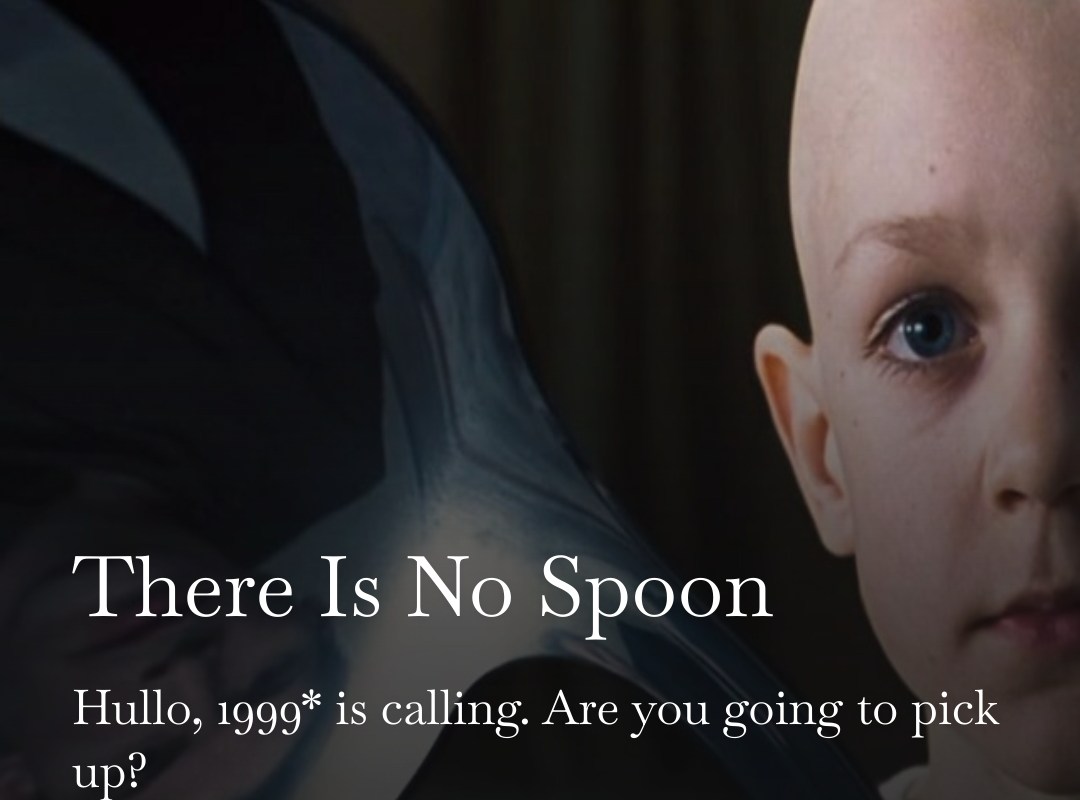
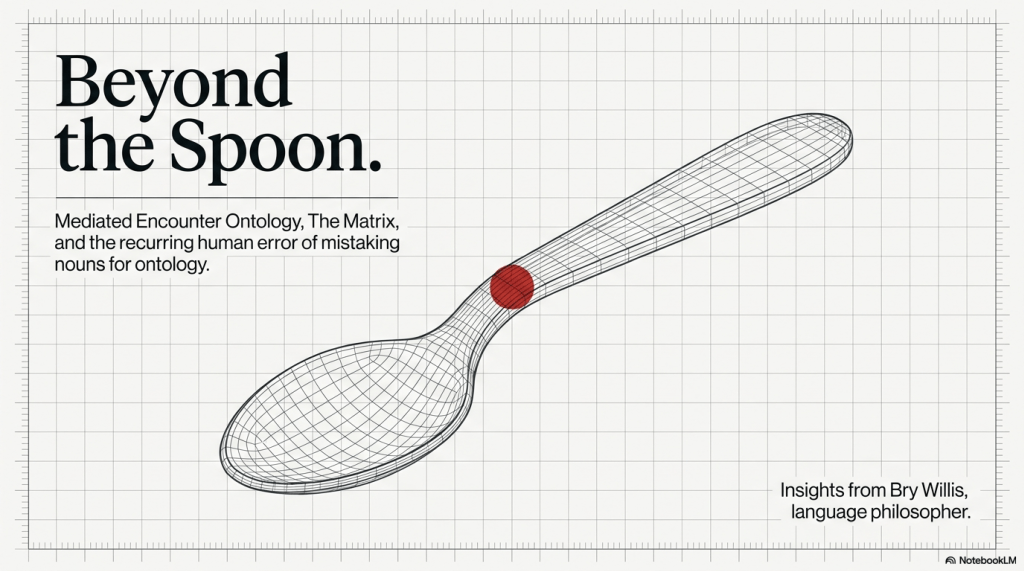
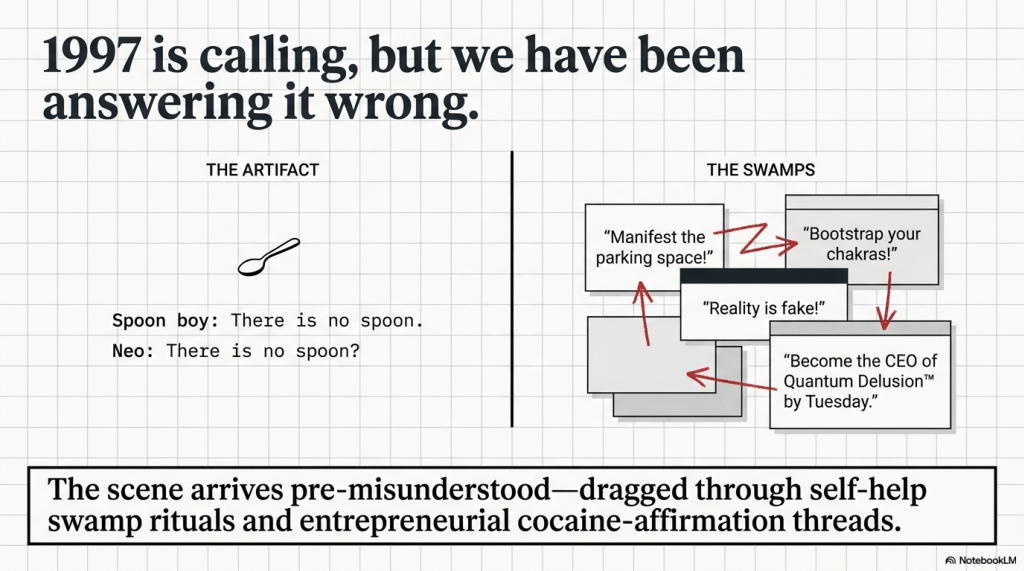
Responding to a post, I found myself returning to that iconic, routinely misrepresented scene from The Matrix: the one with the spoon. The scene has been dragged through so many motivational seminars, self-help swamp rituals, pseudo-Buddhist wall decals, and entrepreneurial cocaine-affirmation threads that it now arrives pre-misunderstood.
Video: Bonus Content
Even Baudrillard distanced his work from the version of simulation the Wachowskis made cinematic. This is not a criticism, exactly. Film has two hours to smuggle metaphysics through leather coats, sunglasses, and slow-motion firearms. One makes allowances. Philosophy, alas, has fewer trench coats and more footnotes.
After Tony Self liked one of my blog posts – Hi, Tony Self – I visited his site and poked around, clicking on several articles. This was one. I liked it and noticed the Reblog button. I clicked it, and it spawned this page with this article embedded. So, here we are.
Audio: NotebookLM summary podcast of this topic.
Would I choose to live forever? Undoubtedly, no. For those who’ve been around and have kept up with my posts, know that I already died. I would have been fine remaining dead, as my girlfriend did. Although I won’t rejoin her in the spiritual sense, I will join her in death in the metaphorical sense of Lakoff and Johnson.
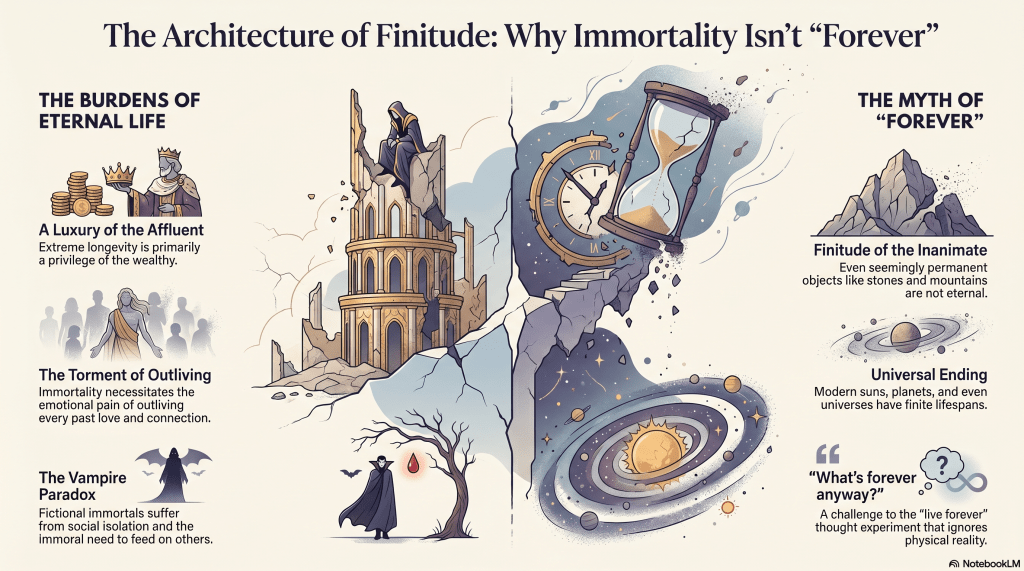
Longevity is a luxury of the affluent. I don’t want it. Tony mentions vampires. In fiction (where else would they be?), these beings are routinely unemployed – at the very least, having no day jobs – but with vast riches or connected to one with said same. Their torment is to have outlived past loves and the need to feed on the living, mostly the fear of getting caught, as this is illegal and more generally immoral in this world as we know it – not a good look.
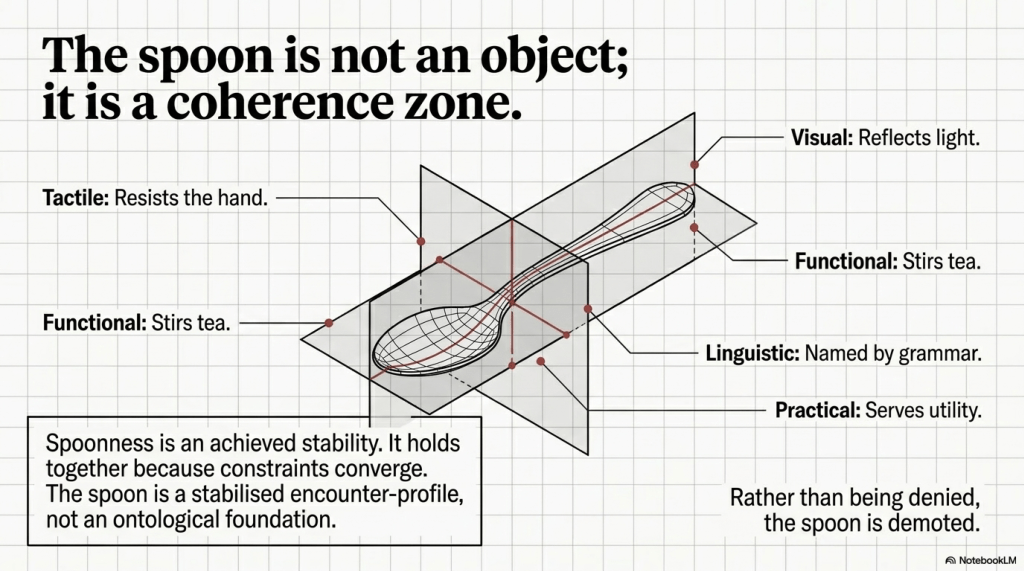
In any case, this live forever thought experiment forgets much, or at least imposes much. If I could just be, like a stone, is that forever? As I discuss in The Architecture of Encounter, even stones aren’t forever, regardless of their state of living; not even mountains, planets, suns, or universes. So, what’s forever anyway?
Spoiler alert: Forever is a myth.
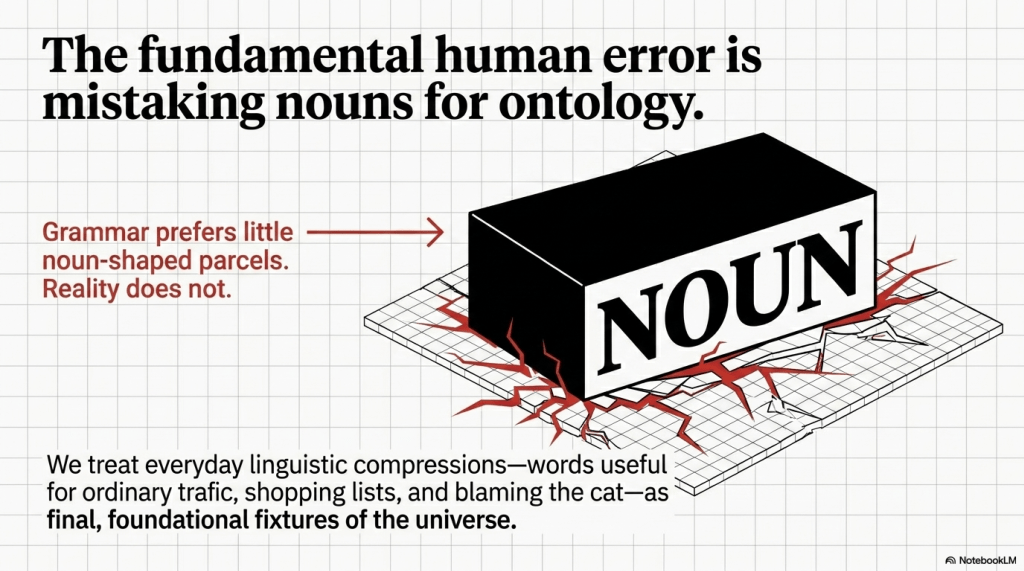
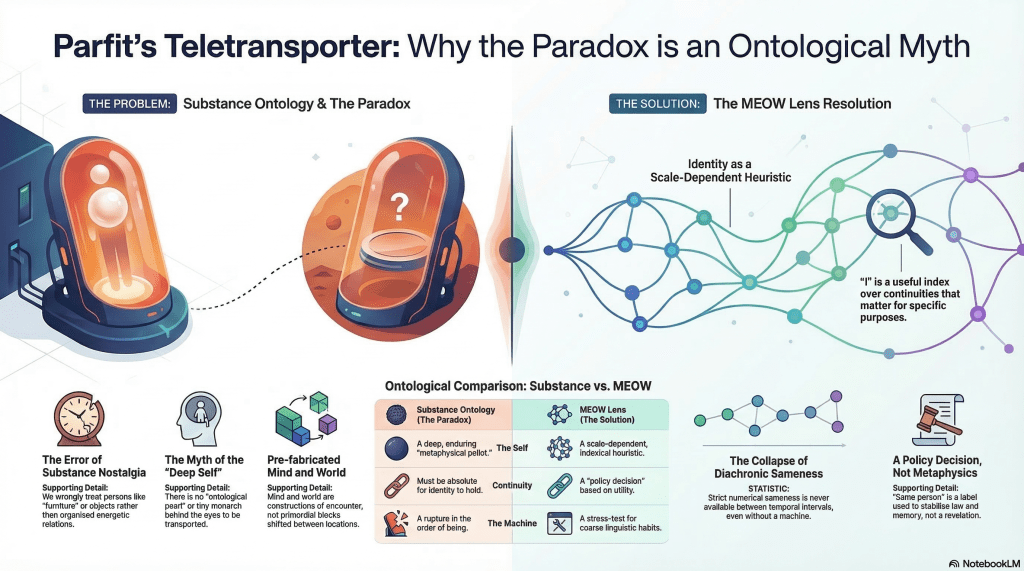
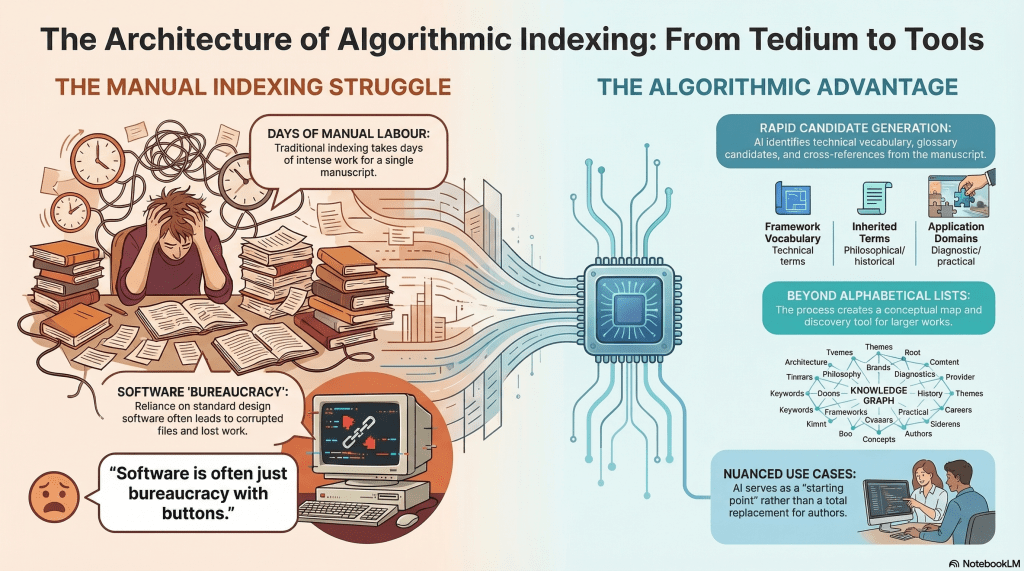
NotebookLM Infographic on this topic.
Rather than answer generally or hypothetically, would I choose to live forever? No. Take me now if you must?
I’ve got no problems with living. It’s the conditions that bother me: the eating, the sleeping, the maintenance; entropy.
So, the ones who have this wish ignore these and presume that this version of forever comes with good health and abundance.
I recall a Greek myth in which forever is granted, and he lives on as a disembodied wisp that can’t die.
In this myth, Tithonus – a Trojan prince whom Eos, goddess of the dawn, loved and asked Zeus to grant immortality – got this wish, and it wasn’t even his; immortality without consent. Eos forgot to ask for eternal youth alongside it, so he aged indefinitely, eventually shrinking into a desiccated, babbling husk – a wisp.
Imagine: you live forever, outliving all humans, all life. The sun extinguishes, and yet you remain – all the while sentient.
Thanks, but no thanks. You can keep your forever. I’ll keep my timeline.
I published the first version of this essay in February, arguing that the Frege–Geach problem, that three-score-year-old albatross around expressivism’s neck rests on a category error. Analytic philosophers were polite about it in the way that analytic philosophers are polite about things they intend to ignore. I don’t often revise my manuscripts, opting instead to publish a new and improved version, but the meat of this one remained strong and not worth revisiting as much as fortifying.
The trouble was that I’d dissolved the problem without resolving it. Good enough for me. Others were less convinced. Telling people they’ve been asking the wrong question is satisfying but insufficient without a better one. Version 1.1 tidied the prose. Version 1.2 does the actual work.
The new section (§4, if you’ve already read previous versions) introduces recruitable expressions – a broader class of expressions (moral predicates, thick evaluative terms, epistemic and institutional vocabulary) whose full functional load is attenuated under embedding whilst a thinner inferential profile remains available for reasoning. The standard of practical inferential adequacy replaces the demand for semantic identity: what ordinary reasoning requires is not invariance but inferential sufficiency. And the pattern isn’t peculiar to moral language – a noted goal –, which means Frege–Geach stops looking like a special embarrassment for expressivism and starts looking like one symptom of a general feature of how natural language handles multi-functional expressions under logical stress.
The essay is dissolved as a demand for unrestricted semantic invariance. It is resolved insofar as the behaviour it identifies is explained, predicted, and shown to be general.
The revised paper is available here, near the rest of my manuscripts:
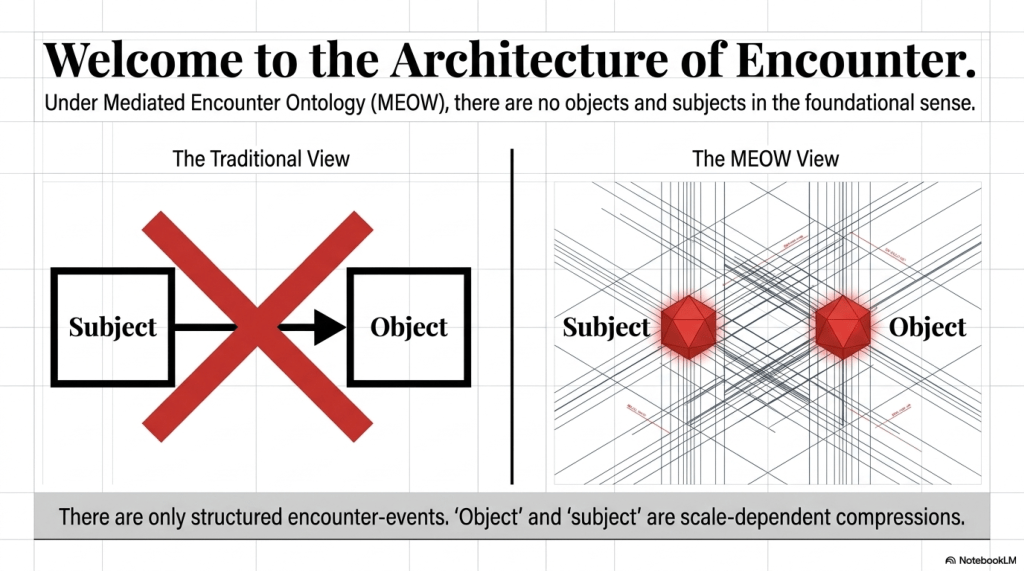
This episode is an introduction to the 7-part series that discusses phenomenologists who laid the foundation on which the Mediated Encounter Ontology (MEOW) is built.
Audio: Introductory Podcast for The Architecture of Encounter
This series begins with philosophers from Descartes through Berkeley, Locke, and Hume to Kant, who will be the focus of the first episode. Except for this introduction, which is 15 minutes. Each episode is around 7 minutes because I wanted to keep them bite-sized.
I’ve commenced a new series in support of my new book. First, I’m building a glossary.
Video: Bry – Architecture of Encounter
On the docket in this segment are affordance, salience, and valence as they relate to the book. I selected these terms from the glossary in the appendix.
Over the next few weeks, I plan to produce videos on other terms and additional videos explaining key concepts. This one is straightforward and academic. Others will be less formal, hoping to accommodate different learning styles.
Does anyone subscribe to Kindle Unlimited? I may take time to create Kindle and eBook versions.
My fiction books had some formatting issues with Kindle, but these titles are more standard – no fancy layouts or fonts, and not too many images.
A thought experiment by Derek Parfit, here’s the setup: ostensibly, a human is cloned, but they aren’t so much cloned as teleported to Mars, à la Star Trek – there, not here, particle by particle.
The question and seeming paradox is whether the reconstructed person and the original are the same, identical.
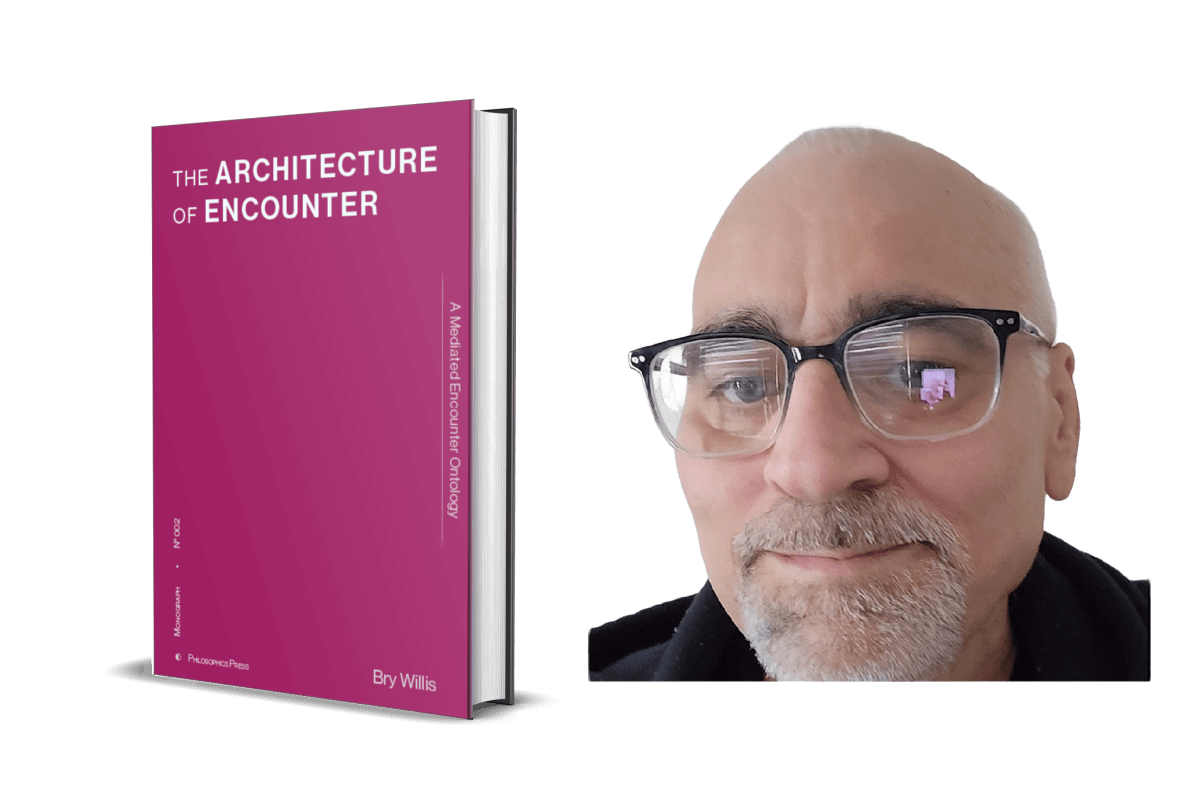
In deference to my upcoming book, The Architecture of Encounter, I want to revisit this problem and show how there is no paradox. Let’s take a look.
Audio: NotebookLM summary podcast of this topic.
Parfit’s Teletransporter Is Not a Paradox. It Is a Hangover.
Derek Parfit’s teletransporter thought experiment has become one of philosophy’s favourite parlour tricks. A person steps into a machine on Earth. The machine records their physical structure in total detail, destroys the original body, and reconstructs an exact counterpart on Mars from local matter. The person on Mars wakes with the same memories, the same character, the same projects, and the same unearned confidence that philosophers are asking sensible questions. Parfit uses such cases to press the thought that personal identity may not be what matters; psychological continuity may matter more.
The supposed paradox is familiar enough: is the person on Mars the same person, or has the original died and been replaced by a copy?
My answer is that there is no paradox here, unless one insists on dragging in precisely the assumptions that ought to be under suspicion.
This is where my forthcoming book, The Architecture of Encounter, becomes relevant. The teletransporter puzzle only looks deep if one begins with a poor ontology and a clumsy model of selfhood. Once those are withdrawn, the mystery evaporates.
The first mistake: substance nostalgia
The teletransporter story is framed as though a human being were fundamentally a thing made of parts, a self-identical object that might either persist through rearrangement or fail to do so. We are invited to imagine a body atomised here and recomposed there, then asked whether the ‘same person’ has survived. But this framing already cheats.
If substance ontology is not basic, then there is no hidden metaphysical pellet of selfhood waiting to be shepherded from Earth to Mars. On a relational picture, what is fundamental is not a stockpile of little self-identical things but organised relation, structured energetic differentiation, constraint, response, and persistence-pattern. The old metaphysics of enduring stuff survives mostly because grammar flatters it.
So the first reason the teletransporter is not paradoxical is that it begins by treating persons as though they were furniture.
The second mistake: reifying the self
The second assumption is just as dubious. The problem presumes that there must be a deep self, some enduring owner of experience, whose fate the machine must settle. I don’t grant that either.
I am much closer here to Galen Strawson’s episodic flavour than to the pious diachronic picture in which one’s life forms a single, extended inner possession. Strawson’s distinction is useful because it reminds us that not everyone experiences themselves as a long, narratively unified entity stretching robustly across time. An episodic self need not deny practical continuity, memory, or biography; it simply refuses to inflate them into a metaphysical core.
That is also how I think identity should be understood more generally: as a scale-dependent heuristic.
The self is not nothing. But neither is it an ontological pearl. It is a compression. A convenience. A useful index over continuities that matter for some purposes and not others. At one grain, sameness appears stable enough. At another, it dissolves into drift, revision, replacement, and selective narrative smoothing.
The “I” is not a tiny monarch enthroned behind the eyes. It is an indexical function within organised experience.
The third mistake: treating mind and world as pre-fabricated blocks
The teletransporter story also inherits a bad picture of mind and world. It imagines a ready-made mind confronting a ready-made external world, then asks whether one of those ready-made minds has been shifted from one location in the world to another. I reject that framing, too.
Mind and world, on my view, are post hoc constructions of mediated interface. Encounter comes first. Organisation comes first. Constraint comes first. Only later do we abstract “mind” on one side and “world” on the other as though these were primordial blocks of reality instead of conceptual products of a deeper relation.
Once one starts there, the question changes. We are no longer asking whether some occult owner-substance has been preserved. We are asking what kind of continuity, if any, is being tracked across interruption, re-instantiation, and resumed encounter. That is a very different matter.
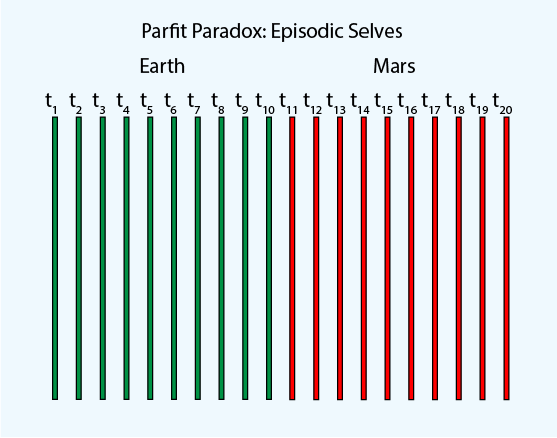
Under episodic time, the paradox collapses immediately
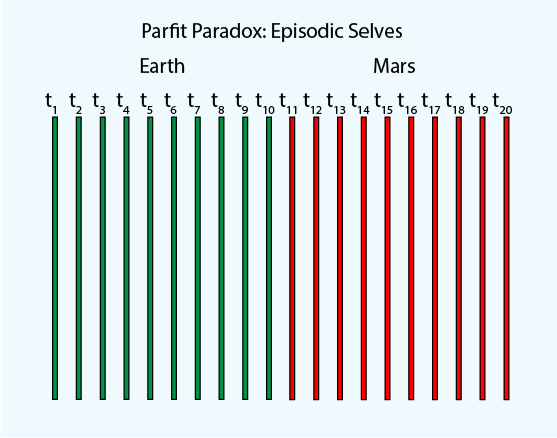
Image: Notice that if we reject the diachronic self in favour of an episodic self, when the ‘self’ migrates from Earth to Mars, it just carries on indexing, so the paradox vaporates.
If one takes the episodic view seriously, Parfit’s machine is mostly theatre.
Why? Because strict numerical sameness was never available between temporal intervals in the first place. The self at one interval and the self at the next are not joined by a metaphysical thread hidden beneath change. They are linked, where linked, by organised continuity, practical function, memory inheritance, bodily persistence, and narrative convenience.
The teletransporter does not introduce some unprecedented rupture into an otherwise pristine metaphysical order. It merely exaggerates what was true all along: selfhood is not an invariant core but a heuristic over organised succession.
That means the Mars person is not paradoxical. They are simply a case in which our ordinary identity-compression is being stress-tested.
Call them the same person if your explanatory threshold is coarse enough. Refuse the label if your threshold is stricter. There is no further hidden fact trembling in the wings.
Even under diachronic time, the issue is still heuristic
Suppose, however, that one relaxes the episodic commitment and grants a diachronic self. Even then, the machine does not resurrect a deep identity problem. It only relocates the issue to threshold-setting.
How much continuity is enough?
Enough for legal identity? Enough for moral responsibility? Enough for marriage? Enough for debt? Enough for grief? Enough for survival?
These are not one question. They never were one question. Philosophy often gets itself into trouble by pretending that practical, phenomenological, ethical, and metaphysical criteria must all cash out in the same currency. They do not.
Parfit himself is famous precisely for pressing the thought that what matters may be psychological continuity and connectedness rather than some further fact of identity. My complaint is that one can go further still. Once identity is treated as a heuristic rather than a metaphysical absolute, the need for a single all-purpose answer begins to look like a bad demand rather than an unsolved mystery.
Why the duplicate case makes the illusion obvious
The variant with duplication makes the point even more brutally. If one person enters on Earth and two successors emerge elsewhere, both inheriting the same memories and both insisting “I am the original,” then the problem is no longer whether identity has become spooky. The problem is that our ordinary identity-talk has finally been pushed beyond its comfort zone.
Once there are two successors, the inherited continuity-profile has branched. That does not produce metaphysical magic. It produces two loci of encounter with the same initial macro-organisation.
At time-nought, perhaps we may stipulate identical configuration for the sake of the thought experiment. Fine. Humans adore their stipulations. At the first non-zero interval thereafter, they are already different. Different position, different sensory input, different salience, different bodily relation, different thermal and spatial microconditions, different affordances. Their trajectories begin to separate immediately. So even there, no paradox. Only the collapse of a coarse heuristic under finer scrutiny.
The real lesson
Parfit’s teletransporter is often presented as though it reveals some terrible instability in personal identity. I think it reveals something duller and more devastating. It reveals that our language of identity was never as deep as we pretended.
We say “same person” because it is useful. We use it to stabilise law, memory, blame, love, property, and biography. Fair enough. But utility should not be mistaken for metaphysical revelation. The thought experiment merely embarrasses that confusion.
So when asked whether the reconstructed person on Mars is really the same person, my answer is:
Under an episodic model, strict sameness was never on offer across temporal intervals anyway. Under a diachronic model, sameness is still a heuristic judgement about acceptable continuity. In neither case is there a paradox. There is only an old habit of substance-thinking refusing to die.
The shorter version
The teletransporter does not expose a contradiction in selfhood. It exposes the poverty of the ontology brought to the problem.
If selves are indexical, scale-dependent heuristics arising from organised encounter, then the machine does not pose a metaphysical puzzle about whether some hidden essence made it to Mars. It only asks how much continuity we are willing to treat as enough.
That is not a paradox. That is a policy decision disguised as metaphysics.
I’m not ashamed to say that AI is a significant part of my publishing workflow. In my latest project, The Architecture of Encounter, I’ve added indexing to the roles it serves. Other roles were prepping the index and footnotes, as I shared recently.
I expect the book to be available by next week. Time will tell.
I’ve included the full index below for reference. I’ve also included the title and copyright pages and other back matter.
What will a visitor do with a bookless index? I don’t know, but sharing is caring in my book. For the interested, you can get a sense of the contents. I’ll be sharing more details over the coming weeks – and beyond, I’m sure.
Earlier, I shared that Claude had offered index candidates. I started executing on that list by indexing the first few terms. It took me about an hour to do these, searching for each term and documenting the page number and context – around 250 pages. The book itself is 292 – 6″ x 9″ pages, but more than 50 of these are appendices, and others are front matter. Still.
Audio: NotebookLM summary podcast of this topic. (Another one that misses some points but make others. Fair enough.)
Then it dawned on me to ask Claude to help me with the index. Claude interpreted ‘help’ by spitting out the entire index, formatted and organised. If the book were formatted in 8½” x 11″ Letter size, I could have appended it as-is, but I still had to pour the output into the InDesign template I was composing through and make it look like it was part of the same manuscript, but that took minutes, not days of hours. Appendix E.
Given that I also rely heavily on novel concepts and specifically-defined terms – language insufficiency notwithstanding – I felt that a glossary would be useful. I tasked Claude with this, too. Again, it output a fully-formed list.
I noticed that a couple of terms I wanted defined were absent, so I fed the list into ChatGPT and asked it to consider these and let me know, given the manuscript, what other terms might be absent. It agreed with the two I wanted and suggested three more. It also pointed out an error Claude had made in counting. It also provided the definitions for the glossary entries, so I poured Claude’s output into InDesign. Appendix D.
AI is also a helper. For example, I wanted my index to flow into 2 columns. I’ve done this before. In the old days, I’d have scanned the menus (Adobe products are infamous for convoluted, nested menus), read the manual, and/or Googled for the answer – perhaps queried YouTube, a great resource for such things. Now, I ask AI. In this case, I asked ChatGPT. To be honest, it’s a little verbose, where ‘it’s option X under Y menu’ would suffice, but I ignore the banter.
If you need to know…
If the index is already placed in a text frame
Select the text frame containing the index.
Go to Object → Text Frame Options.
Set the Number of Columns you want, usually 2 for a 6×9 book, sometimes 3 if the type is small and the entries are short.
Adjust the Gutter spacing between columns.
Click OK.
Criticise AI all you want, but having access to in-built assistance 24/7 is a huge time-saving benefit.
Do I still use Google and YouTube? Yes, often.
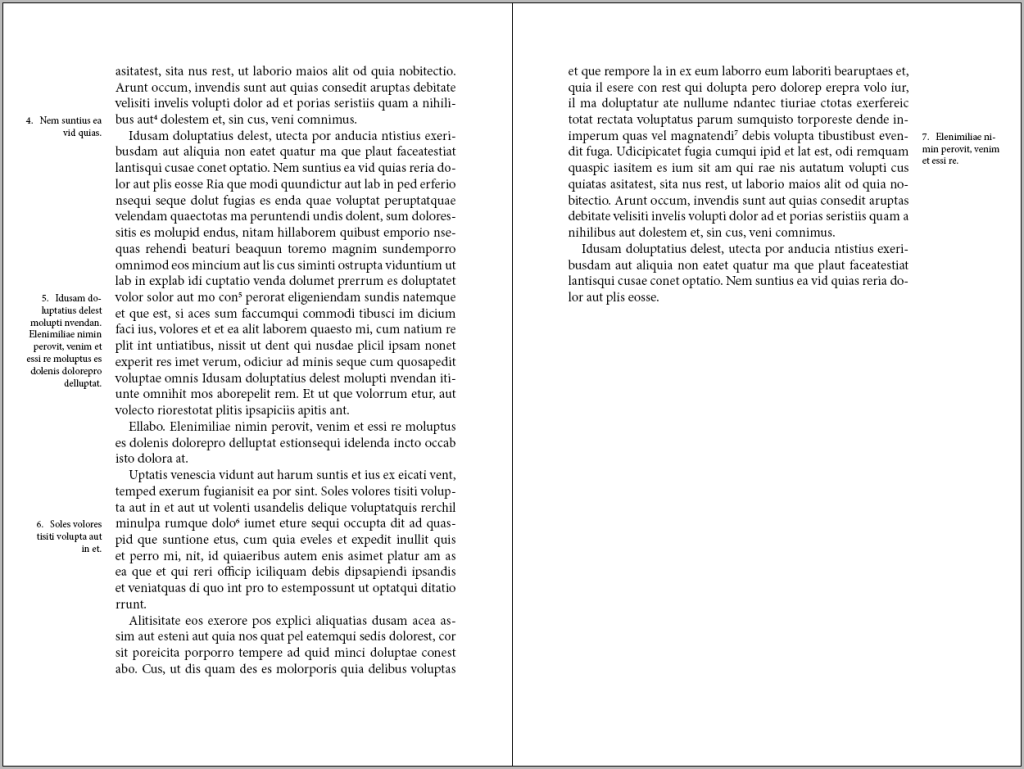
Speaking of Google, I was searching for a cover image, and I discovered something I need for the fiction title I paused in September to focus on nonfiction. Sidenotes. Perhaps I’ll employ a similar mechanism.
The nonfiction book I am writing is somewhat epistolary, and I want to place internal dialogue as marginalia, employing a scripted font face. I am even considering a ‘deluxe’ version that renders this content in colour, but that’s an extra expense, first for the colour, then the full-page bleed, and perhaps thicker paper stock. Likely hardbound, reserving the paperback for a lower price point.
So, what’s next?
I finished both paperback and hardcover designs today.
I still need to review the index for hallucinated errors. This will still take less time than manually constructing it.
On the copyright page, there are a few classifiers. There are ISBNs for each format and a Library of Congress Control Number (LCCN). These are done, as you can see, but the ISBN system in the United States is antiquated. It looks like it’s a museum piece from the mid-1990s. In fact, I believe I first accessed it around 2000 or 2001, when I published my first book – before AI, before print on demand (POD).
A bit of nostalgia. The WWW, the internet as most people know it, was made public around 1994. Google hit it in 1998. Web 1.0. Facebook blighted the world around 2004, though less invasively at the start. I digress. Technology is a mixed bag.
Returning to ISBNs… These are managed in a system built circa 1997. It seems it is still managed with a host of cron jobs, so not much is processed in real time unless it’s a trivial record entry.
Each ISBN references a title and a format, as well as other odds and ends. In my case, I also use an imprint to separate my fiction from nonfiction. I started Microglyphics – tiny writing– in the mid-90s. When I published other authors, I used this name. I also used it for some of my fiction writing. I decided to create a Philosophics Press imprint for my philosophy and adjacent work.
It turns out that the printer needs to ensure that a book’s title and ISBN match the imprint. The system default is the company name, but I changed it to my imprint. This causes a workflow event on their end. Until it propagates, it doesn’t match, and the printer won’t allow the print run.
I’m writing this blog entry as I wait. I’m not sure if it’s automated – I’d like to assume it is – or if a human has to do something. AI might help. Just saying.
EDIT: The imprint has now been updated to Philosophics Press, but it still doesn’t work at the printer. Evidently, it can take up to 5 days for the data to propagate. I’m not sure who owns the fail on this one? Is the printer waiting for a data push? Can’t they pull the data? They seem to be live from my perspective. Is there an API, or is it truly old-school?
Whilst I’m here wittering on, WordPress have deprecated the little widget below – the one with my (old) thumbnail picture and ‘written by’ tag. I adopted it last year, but it’s been killed off. I’ve been copying the object from old posts, but I’ll probably switch to whatever they’ve replaced it with. I wasn’t keen on the options I’ve seen so far. First-world problems, I suppose.
It takes me days to index one of my books. Longer when the technology decides to become sentient in the worst possible way, such as the time InDesign corrupted the index file and swallowed days of work whole. A charming little reminder that software is often just bureaucracy with buttons.
Audio: Not the best NotebookLM summary podcast, but it’s mercifully under 5 minutes.
Today, while chatting with Claude (Opus 4.6), I mentioned that I should probably create an index for my current project. The manuscript is not fully reviewed and revised, but it is getting close. At this stage, I do not expect to add much of substance. I am more likely to subtract than expand.
Claude asked whether I wanted help generating a list of candidate terms from the manuscript.
Dois-je rédiger une liste de termes candidats à partir du manuscrit ?
I said yes, and it produced an embedded PDF: Index Term List – Architecture of Encounter. On first scan, it looks remarkably close to what I need. It is not merely a term list, either. It also proposes candidates for glossary entries, which is useful, even if I am not yet convinced I want to add a glossary. The book is already sitting at around 256 pages, and print production costs do not exactly reward philosophical generosity. The draft organises terms into five sections, including framework-specific technical vocabulary, inherited philosophical terms, proper names, traditions and programmes, and application domains and diagnostics. It also marks some entries as glossary candidates and notes likely cross-references.
NotebookLM Infographic on this topic.
One amusing detail is that some of the suggested references relate to epigraphs. I had not really considered indexing those. My inclination is still not to include them, but I admit the temptation is there.
The categorisation itself is also interesting. It makes a good deal of sense as a conceptual map or discovery tool, especially for a larger work. But it does not quite align with what most readers expect from an index, which is, bluntly, alphabetical and easy to raid.
Still, as a starting point, this is rather better than staring into the manuscript and pretending I enjoy this sort of thing.
Some people like to badmouth or trash-talk AI. I’m here to say that these people need to discover nuance and use cases.



 Philosophics