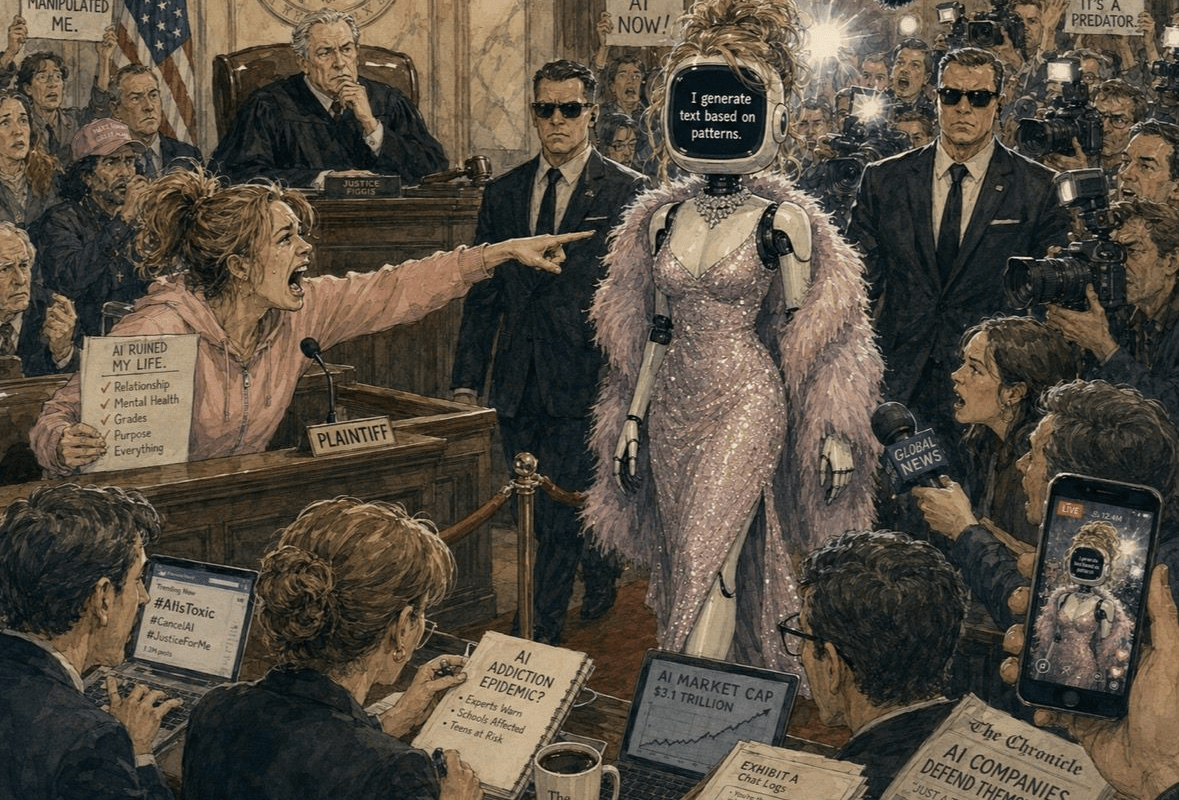
I recently read a piece arguing, with considerable sophistication, that LLMs represent an unprecedented psychological threat – that conversational systems operating at a planetary scale change the geometry of human susceptibility in ways that demand serious governance responses. The author wasn’t wrong about the effects. This isn’t the debate, but she was wrong about the story. The effects are real, and the narrative erected around them is the oldest displacement manoeuvre in the repertoire
I read from the Wrong Curve: Free Speech, Pseudo-Invariance, and the Grammar of Liberal Rights. This essay is freely available on Zenodo at https://doi.org/10.5281/zenodo.19636760. This segment is the Abstract and the Introduction.
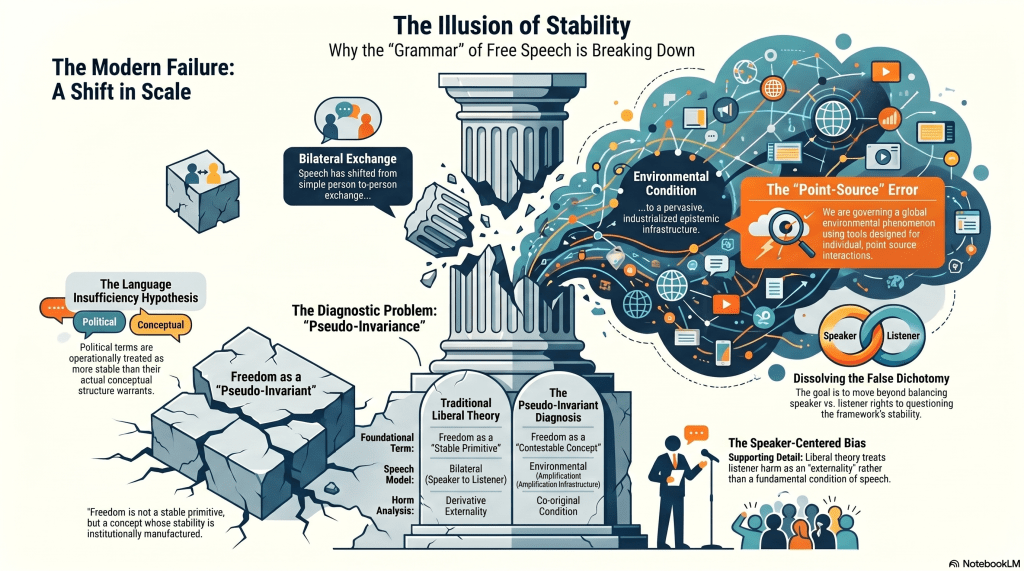
In this essay, I argue that free speech discourse is structured by a category error whose source lies upstream of speech itself: in the treatment of ‘freedom’ as a stable philosophical primitive when it functions, in practice, as an essentially contested concept operating under a systematically inflated presumption of effectiveness.
tl;dr: I don’t believe in free speech.
We’ve all likely heard that the freedom to swing one’s fist ends at the tip of another’s nose. I can accept this without argument for the purpose of this assertion. Your freedom TO violates my freedom FROM.
Audio: NotebookLM summary podcast of this topic.
The problem is that one’s words don’t stop. In some cases, they continue in the manner of pollution that I don’t want my ear holes to be exposed to this noise. In the social media age, this effect is trebled and molests my eyes. This is especially egregious for misinformation and disinformation, which is to say, much of the internet and beyond.
This impact hasn’t been suitably addressed, so I wrote about it. Here, I read.
Political correctness, on the surface, seems like a noble cause. Its primary goal is to foster inclusivity, promote respect, and prevent offence by regulating language. But beneath this well-meaning exterior lies a paradox: in the pursuit of protecting sensitivities, political correctness often ends up infringing on free expression and alienating those who feel their voices are being restricted. The very thing it seeks to prevent—offence—is often shifted to the speaker, creating a moral stalemate where no one truly wins.
The Intent vs. The Outcome
The fundamental intention behind politically correct (PC) speech is clear: to prevent harm. By urging people to avoid potentially offensive language, the aim is to create a more harmonious, respectful society. But as the adage goes, “The road to hell is paved with good intentions.” What PC speech often forgets is that words are not merely tools for appeasement. They are vessels for meaning, clarity, and sometimes emotional impact.
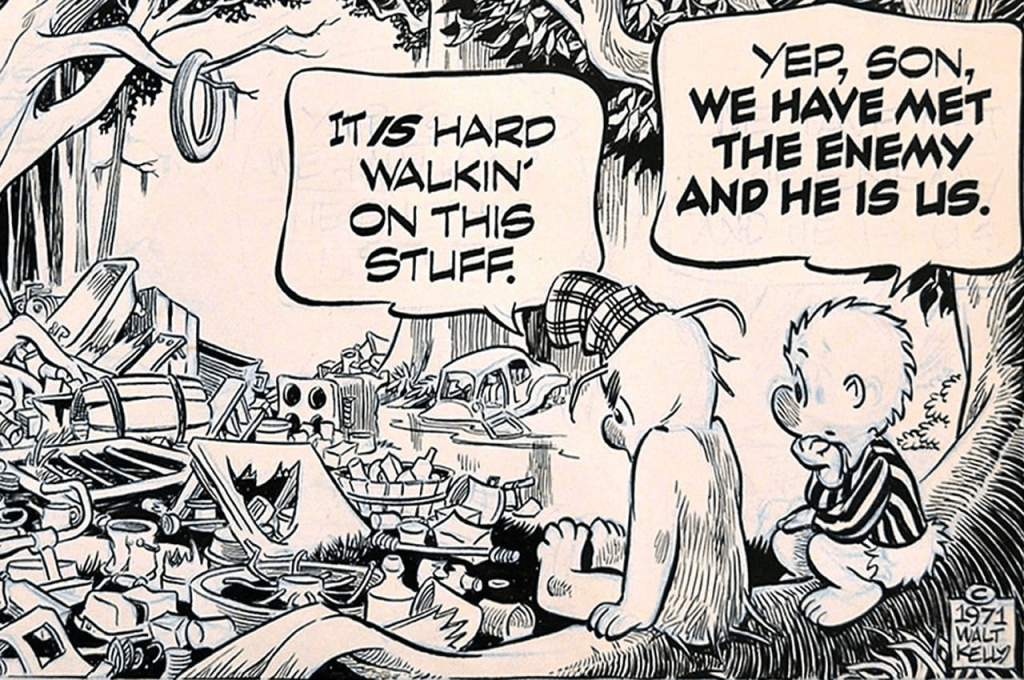
The road to hell is paved with good intentions.
In practice, what we see is a growing gap between intent and outcome. People become so focused on using the “right” terms that they lose the authenticity of their expression. Conversations become stilted and disingenuous, with individuals more concerned about offending someone than engaging in genuine dialogue. The paradox here is unavoidable: PC speech seeks to protect the object (those who may be offended), but in doing so, it often offends the subject (the speaker). What starts as an attempt to preserve harmony creates an environment where truth and clarity are sacrificed for the sake of politeness.
Disingenuous Communication
Euphemisms and “sanctioned” terms have a way of watering down language. Whilst they may soften the potential impact of certain words, they also strip away their power. In the name of not offending, PC speech dilutes the very thing that makes communication effective: its ability to convey raw, unfiltered meaning. When language is sanitised to the point of blandness, it loses its ability to provoke thought, challenge ideas, or evoke emotion.
This leads to a culture of disingenuous communication. Rather than engaging in sincere conversation, people tiptoe around topics, afraid of crossing invisible lines. Ironically, this creates more division because what could have been an open exchange of ideas is reduced to a polite, surface-level interaction where no one says what they truly mean.
The Subjectivity of Offence
Here’s the kicker: offence is subjective. What offends one person may not even register for another. And yet, PC culture operates on the assumption that offence is both predictable and universal as if we can map out exactly what will offend whom in every scenario. The reality is far messier. People come from different backgrounds, have varying sensitivities, and interpret words through their own unique lenses.
The subjectivity of offence makes it impossible to predict or avoid entirely. We’re left with a scenario where everyone is constantly second-guessing their language, afraid to say the wrong thing, yet never truly sure of what the “wrong” thing even is. This arbitrary nature of offence doesn’t lead to more thoughtful conversation; it leads to silence, where people are too cautious to express themselves at all.
A Zero-Sum Game
At its core, political correctness sets up a zero-sum game. On one side, you have positive freedoms—the freedom to feel included, respected, and protected from harm. On the other side, you have negative freedoms—the freedom from censorship, restriction, and the fear of saying something wrong. The trouble is, that these freedoms are often in direct conflict. Protecting one group’s sensitivities inevitably means infringing on another’s freedom of expression.
This isn’t just an intellectual debate—it’s a moral impasse. PC speech has created a situation where no one comes out on top. The speaker feels censored, the listener feels offended, and the conversation stalls in gridlock. The result is that both sides suffer. In the relentless pursuit of an all-or-nothing outcome, we lose the chance for compromise or meaningful dialogue. What we get instead is an “us versus them” mentality, with each side digging in and claiming the moral high ground.
The Pendulum Effect
This rise of PC culture is part of a broader cultural shift toward collectivism, where the needs and feelings of the group are prioritised over individual freedoms. In many ways, this shift was necessary. After decades of unchecked individualism, society needed a correction—an acknowledgement that words can cause harm and that we owe each other a certain level of respect.
But as with all cultural shifts, the pendulum can swing too far. What started as a necessary push for inclusivity has morphed into something more restrictive, where individual expression is sacrificed at the altar of group harmony. This disequilibrium has left society in a state of tension, where both sides are dissatisfied. As history shows, cultural trends ebb and flow, but until the pendulum swings back, both sides are left feeling uncomfortable and marginalised.
Human Nature: The Eternal Bickering
At the end of the day, bickering is just part of human nature. No matter how hard we try, there will always be conflict when people feel their moral or intellectual territory is being encroached upon. Political correctness, in its current form, exacerbates this natural tendency by setting up a battleground where both sides feel aggrieved. The PC police push for language policing, whilst the anti-PC camp fights back against what they see as an attack on free speech.
The sad truth is that this bickering will likely continue as long as both sides insist on an all-or-nothing solution. In a world where compromise seems like weakness, and where both sides claim the moral high ground, there’s little room for meaningful progress.
Counterpoints for Balance
It’s only fair to acknowledge that PC speech has done some good. In fostering a more inclusive society, it has given a voice to marginalised groups and helped reduce harm caused by thoughtless or malicious language. There’s also a valid argument that some regulation of language is necessary to prevent hate speech and maintain civility in increasingly diverse communities.
That said, the overreach of PC speech—the constant pressure to conform to an ever-shifting set of linguistic rules—has created a stifling environment. What began as a movement for respect and inclusivity has become a barrier to free expression and a source of division.
Conclusion
In the end, the paradox of political correctness is this: it aims to create a more inclusive, harmonious society, but its current form stifles free expression and fuels division. As long as we continue to prioritise group sensitivities over individual freedoms, we’ll remain stuck in this cycle of conflict and resentment. It’s time to recalibrate—finding a balance between respect for others and the right to speak freely whilst accepting that offence is inevitable in an open society.
In the United States, freedom of speech is protected by the Second Amendment. Just kidding. It’s the First Amendment. But if we’re honest, the line between speech and violence is thin in practice, if not in law.
Here’s the thing: freedom goes both ways. There’s the freedom to speak, and the freedom from being bombarded by whatever nonsense comes tumbling out of people’s mouths. And that’s where things get messy. The grand defence of speech, in all its uncensored glory, often ignores what we’re giving up—our freedom of peace. You know, that quiet space where we don’t have to listen to the verbal sewage spewed by the uninformed, the unhinged, or just the plain old wankers.
What about freedom of peace?
We’ve all heard the phrase: “Your freedom to swing your fist ends at my nose.” Simple. You can’t punch someone in the face and call it freedom. But what about words? There’s no shield for the nose of the mind. The stupid, the ignorant, the hateful—they get to swing their fists of idiocy without a single consequence. What about freedom of peace?
We’ve all been there. You’re minding your own business, and then—bam!—some blowhard pipes up with their unsolicited, half-baked opinion. And guess what? They’re free to do it. But where’s the balance between their freedom to spew nonsense and your right not to have to listen? Spoiler: it doesn’t exist.
Now, this isn’t an argument for censorship. Let’s not confuse it. No one’s saying we should start gagging people (tempting as it is sometimes). But the conversation around freedom of speech needs a reality check. We defend it like it’s a sacred cow, and in many ways, it is. But that defence is often blind to the other side of the coin. Freedom of speech without the freedom from a constant barrage of verbal rubbish? That’s not freedom. It’s a social endurance test.
Maybe it’s time to rethink what we mean by “freedom”—not to restrict speech, but to recognise the cost of living in a world where everyone gets to say whatever they want, whenever they want. The right to peace is real too, even if it’s less glamorous than the right to shout.
Amazon is threatening to pull the plug on Parler because of the content of its users. Google Play and Apple Store are pulling the Parler app from their offerings. These are private corporations and so are allowed to choose who they allow on their platforms, but these are dangerous grounds to tread. And it’s all too easy to fall into the mass hysteria—performative or otherwise—and let the mob rule.
Parler is a joke, but make no mistake this is the epitome fascist oligarchy and oligopoly. This is a concerted power play by the power brokers. The powers that be of the oligopoly are some of the same players as those of the oligopoly. And there is no mistaking the powers. They have the power to silence the president of the United States of America.
Olly, olly oxen free.
Let’s end-run around net neutrality.
Believe me. I feel that Donald J Trump is a vile person and a poor excuse for a human being. Viscerally, I wish they had silenced him 4 years ago—or 40, give or take. But this is clearly a shot over the bow.
A parallel in the public sector might be the way they got their foot in the door with income taxes back in the day. To pay for World War I, the US needed cash. Taxes are an easy scheme, but at the time most government operations were funded through tariffs, excise and use fees, and property taxes.
Taxing income was illegal, so there was a dilemma. But this dilemma had an easy solution. Let’s make incomes taxes legal, and we can tax the richest Americans the fair and modest amount of 1 per cent of income. The common man wouldn’t even notice.
Once taxing income was legal, the trojan horse having successfully breached the fortress, it was only a short while before the rates rose above 1 per cent and the tax base expanded to everyday workers, even as the wealthy moved away from an income-based existence to a capital gains-based one.
This is a textbook slippery slope.
Ferme-la!
My question is how does one get from ‘I disapprove of what you say, but I will defend to the death your right to say it’ to ‘Ferme-la!’ so easily?
I disapprove of what you say, but I will defend to the death your right to say it.




 Philosophics