Why Dating Is Not Shopping, No Matter How Many Apps Insist Otherwise
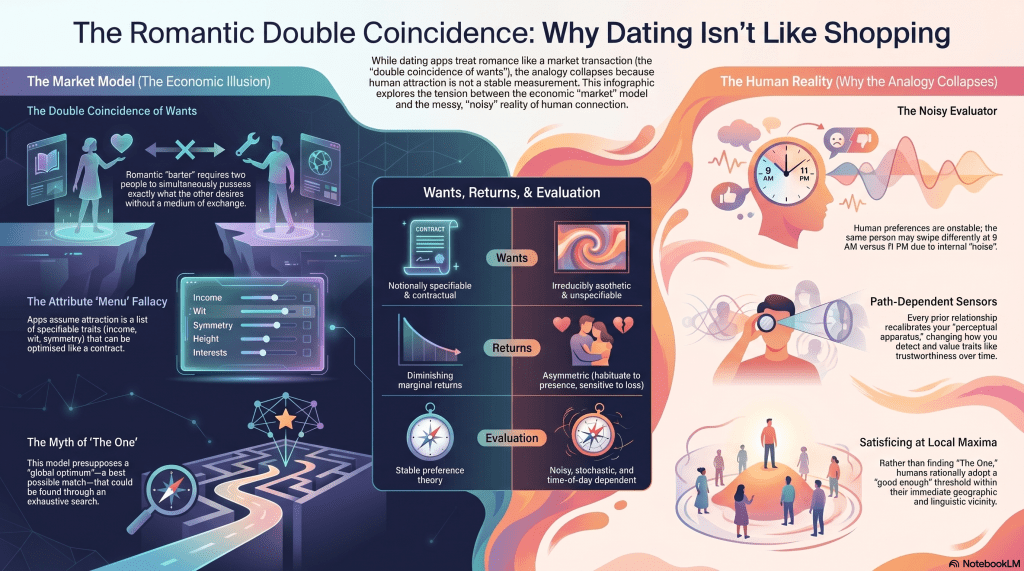
Firstly, be nice, and remember that I’m a recovering economist, so I can’t fully abandon this lens. There’s a concept in economics called the double coincidence of wants. For barter to work, I must have what you want, and you must have what I want, simultaneously, in the right quantities. The implausibility of this – that two strangers would arrive at the same moment, each holding exactly what the other needs – is traditionally the justification for money. Money decouples giving from receiving. It lets me sell my grain today and buy your lumber next month. Problem solved. It is tempting, and initially illuminating, to notice that dating is a double coincidence of wants with no money.
Audio: NotebookLM summary podcast of this topic.
Two people must simultaneously possess what the other desires. There’s no abstract medium of exchange. Listen, I don’t make up the rules, but you can’t deposit romantic capital in a bank and draw on it later with a different partner. Every transaction must clear bilaterally, in real time, between specific parties. The reason dating is difficult, on this account, is the same reason barter is difficult: the coordination problem is enormous.
This is a genuinely useful analogy – for about sixty-nine seconds. After that, it begins to collapse. And the way it collapses turns out to be more interesting than the analogy itself.
NB: I swear I started this post before I saw Louisa’s. Damns algorithms.
Wants can’t be enumerated
In an economy, wants are at least notionally specifiable. You want grain, I want lumber. We can write a contract. In attraction, nobody can write the contract, because nobody knows the terms. You can list proxies – symmetry, wit, income, dentition – but the list never cashes out the phenomenon. There’s always a residue. Someone ticks every box and provokes nothing. Someone ticks none of them and provokes everything. The attributes aren’t the attraction. They’re at best rough correlates of something that resists decomposition.
Evolutionary psychology claims to have the list – fertility signals, resource indicators, and bilateral symmetry – but this is just dressing up economic grammar. It takes the lived phenomenology of attraction, which is irreducibly aesthetic, and rewrites it as a covert optimisation problem. The evo-psych account is the friend who explains why you should find someone attractive and then looks puzzled when you don’t.
Tolerances are fuzzy, interactive, and opaque
Even granting an approximate list of attributes, each one functions not as a threshold but as a band of acceptability. And the bands interact. A deficit in punctuality can be compensated by a surplus in making-you-laugh-until-you-cry. But the exchange rate between these dimensions isn’t fixed, it’s not linear, and almost certainly not conscious. Nobody’s running this calculation. If you ask them to formalise it, they’d produce a confabulation, not a report.
The evaluator is noisy
Kahneman’s Noise documents a finding that should alarm anyone who believes in stable preferences: the same agent, evaluating the same inputs, will produce different outputs on different occasions – not because of bias (which is at least systematic and therefore correctable) but because of irreducible stochastic variability. The judge sentences harshly before lunch and leniently after. Same person, same case, different output.
Applied to attraction, means that the person you’d swipe right on at nine in the morning, you might pass over at eleven at night – or vice versa, as the case might be <winkie>– not because you’ve learnt anything new, but because you aren’t a stable instrument of measurement. The evaluation function drifts across a single day. Across months and years, it’s rebuilt entirely.
The evaluator is path-dependent
Every prior relationship recalibrates the apparatus. Someone who’s been betrayed doesn’t simply move ‘trustworthiness’ higher on their list. Their entire perceptual system for detecting trustworthiness has been restructured. The sensor’s been rebuilt by its prior readings. In no market economy do my preferences over apples change because I once had a bad experience buying oranges from a particular vendor. In relationships, this is the norm.
Returns are asymmetric
Standard preference theory assumes diminishing marginal returns, and this holds for attraction in the obvious direction: the tenth bunch of flowers yields less delight than the first. But the inverse does not hold symmetrically. The absence of a previously supplied attribute often produces increasing marginal disutility. You habituate to presence but sensitise to withdrawal. The utility of gaining X and the disutility of losing X are not mirror images. The preference function is path-dependent in a way that wrecks any static equilibrium model.
Search space is radically local
And all of this assumes the candidates are available for evaluation. They mostly aren’t. Your evaluation function, however sophisticated or broken, only gets applied to whatever washes up in your vicinity – no offence to Ariel. Your so-called soulmate might reside in Istanbul, but you live in London, and you don’t share a language, and you’ll never meet. This isn’t a logistical barrier. It’s a legibility barrier. You could stand next to this person in an airport and the aesthetic response function would not even fire, because the medium through which half of attraction is constituted – conversation, the texture of someone’s verbal mind – is simply unavailable. The instrument requires an input format that the candidate can’t provide. Consider you spy this person across an expanse, gain enough courage to introduce yourself, and they don’t speak your language. Body language will only compensate so far.
Local maxima
The cumulative force of all this is simple and devastating: we are stuck on local maxima. The search space is computationally intractable. The evaluation function is noisy and path-dependent. The attributes resist enumeration. The tolerance bands are fuzzy and interactive. The returns are asymmetric. The search is geographically and linguistically truncated. And so agents do what any rational agent would do under these conditions: they satisfice. They adopt a threshold of ‘good enough’ – a threshold which is itself endogenous to all the noise and path-dependence described above – and they stop searching when they cross it.
This is not a failure of nerve. It is the only coherent strategy available to an agent who can’t identify, or even in principle define, the global optimum. Committing to a local maximum is the rational play, precisely because optimising is impossible 0150 at least legible in the sense of James C. Scott.
Which makes the cultural mythology of ‘the one’ a rather cruel grammatical artefact. It presupposes a global search that no one has conducted or could conduct. It borrows its intelligibility from the economic grammar of optimal allocation – there is a best match, you just have to find it – and projects it onto a domain where ‘best’ has no operational definition, the search is radically local, and the searcher is a different instrument on different days.
Los Angeles, and why it matters
I lived in Los Angeles from twenty-one to twenty-seven, in the early to mid-1980s. I loved it. It was my favourite place on earth. I returned to LA from thirty-five to forty-five, and it was just another place.
It may have turned out that way even had I never left. The point is not that Los Angeles changed – though of course it did. The point is that I changed. Different profession, different situation, different appetites, different saliences… The evaluation function that produced ‘favourite place on earth’ at twenty-three was a fundamentally different instrument from the one that produced ‘just another place’ at forty. No longer a club rat on the prowl, I walked the same streets and saw a different city, because the perceptual apparatus that constructed the city as an experienced object had been rebuilt by fifteen years of living.
‘Favourite place on earth’ and ‘just another place’ aren’t two judgements issued by one stable subject upon one stable object. They’re two outcomes produced by two historically different configurations of salience, appetite, profession, circumstance, and age.
Los Angeles is useful here precisely because it’s not a person – RHCP, not withstanding. It lets you see the structure before sentiment starts mucking about with it.
We don’t even evaluate cities consistently across a lifetime. The same is true, more painfully, of persons.
The partner one adored at twenty-five may not have become deficient in any simple sense. The evaluative field changed. New dimensions became salient, old ones lost force, tolerances narrowed or widened, and costs are reweighted. The same partner now appears under a different aspect, because the apparatus of appraisal has been rebuilt in the interim.
And here, three claims should remain separate: the object may change; the evaluator may change; and the relation between them may change even if neither has altered dramatically. This third one prevents this from collapsing into a banal ‘people grow’ sermon. Sometimes the drift isn’t a defect in either party. It’s a change in fit.
Many:many
It would also be a mistake to think any of this operates as a 1:1 match. The dimensional space isn’t shared. Any two people will overlap on some dimensions, diverge on others, and be mutually illegible on others still – dimensions where one party’s response function is active, and the other’s doesn’t even register the input. He cares intensely about how she loads the dishwasher. She doesn’t experience dishwasher-loading as a dimension at all. It’s not disagreement. It is incommensurability.
A long relationship isn’t a transaction. It’s two non-congruent evaluative systems attempting to maintain a shared narrative of congruence as the terrain shifts beneath them. The miracle isn’t finding someone who matches. The miracle is sustaining a workable fiction that two-dimensional spaces are more commensurable than they are.
Consider the statistically perfect match – bilateral alignment across every operationalised dimension. Even if you could construct such a thing, it would be a snapshot: a cross-section of two moving systems that happened to align at time t. By t+1, the dimensional spaces have already drifted. The statistical portrait is a death mask of a living process.
And here is a green-eyed test. Suppose the perfect match has green eyes. It doesn’t follow that a blue-eyed twin – identical in every other respect – would or wouldn’t provoke the same response. Because whatever was operative in the encounter was not an attribute, or a bundle of attributes, but something that emerged from the specific interaction and can’t be decomposed back into the components that produced it. The entire enterprise of algorithmic matching is cataloguing attributes on the assumption that the attributes are the attraction. It is like analysing a joke by listing its phonemes.
The spot market and the long game
Let’s consider one-night stands as an example to clarify the taxonomy. A one-night stand really is the nearest thing romance has to a spot transaction. The time horizon is short, the narrative load is low, path-dependence is weak, and local salience dominates. The calculus is narrow and immediate. The economic grammar almost applies. Whatever gets you through the night.
A long relationship isn’t a transaction at all, but an evolving coordination problem between changing evaluators. The longer the time horizon, the more layers of critique come into play, and the more absurd the matching grammar becomes. Over time, relationships are not discrete exchanges but moving equilibria between non-stationary systems. That’s why long partnerships are so fragile and so impressive when they endure.
Post hoc rationalisation, or: the story we agree to tell
Having arrived at their local maximum, both parties then construct a narrative in which the outcome was the product of discernment rather than constraint.
‘I knew she was the one when…’ isn’t a report. It’s a reconstruction – a story imposed on a stochastic process to make it legible in the grammar of rational choice. The same person, encountered on a different Tuesday or in a different postcode, might never have registered at all. But the narrative requires necessity, so necessity is confabulated.
And it runs in both directions. She thinks it was his quiet confidence. He thinks it was the argument about Godard. Both are post hoc pattern-matching on noise – selecting from the welter of early interactions the moments that fit the ‘recognition’ narrative, and discarding the rest. It’s survivorship bias applied to one’s own love life.
This also explains the peculiar ferocity of heartbreak after the narrative has been constructed. What collapses is not merely the relationship but the explanatory framework. The story that made the local maximum feel like a global one disintegrates, and the agent is returned to the raw landscape: noisy, path-dependent, locally constrained, and aesthetically illegible. The grief is partly about the person. It’s also about the loss of the rationalisation that made the search feel concluded – losing the construct of the person rather than the person, per se.
NotebookLM Infographic on this topic.
Enfin
The dating app asks you what you want as though you’re ordering from a menu, when what is actually happening is that the menu is rewriting itself based on what you had for lunch yesterday, how much sleep you got, and that thing your ex said in 2019 that you think you are over.
We don’t find ‘the one’ – sorry, Neo. We become different readers of the same world, and occasionally manage to remain legible to one another for a while. Which is, if you stop demanding it be a fairy tale, quite a lot.
An Architecture of Encounter will be available in the next few days. I’ll make an announcement when it is, but I want to talk about pricing.
Audio: NotebookLM summary podcast of this topic.
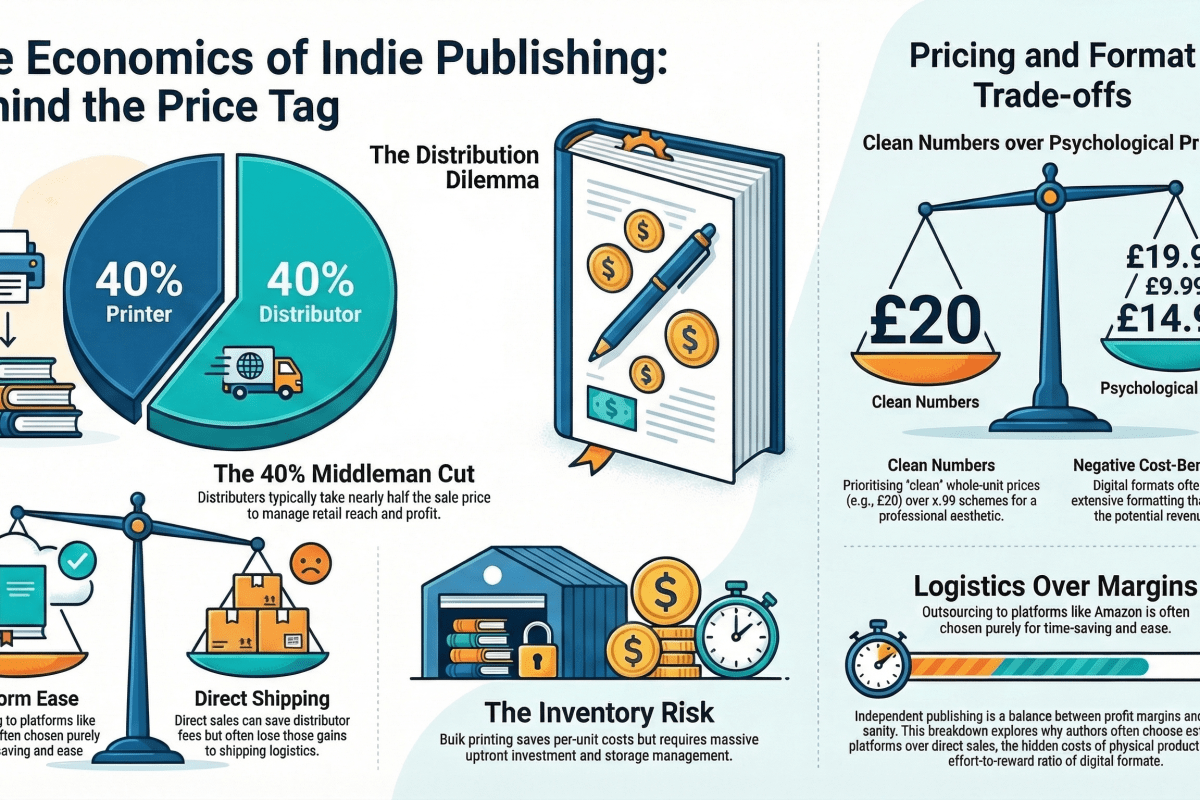
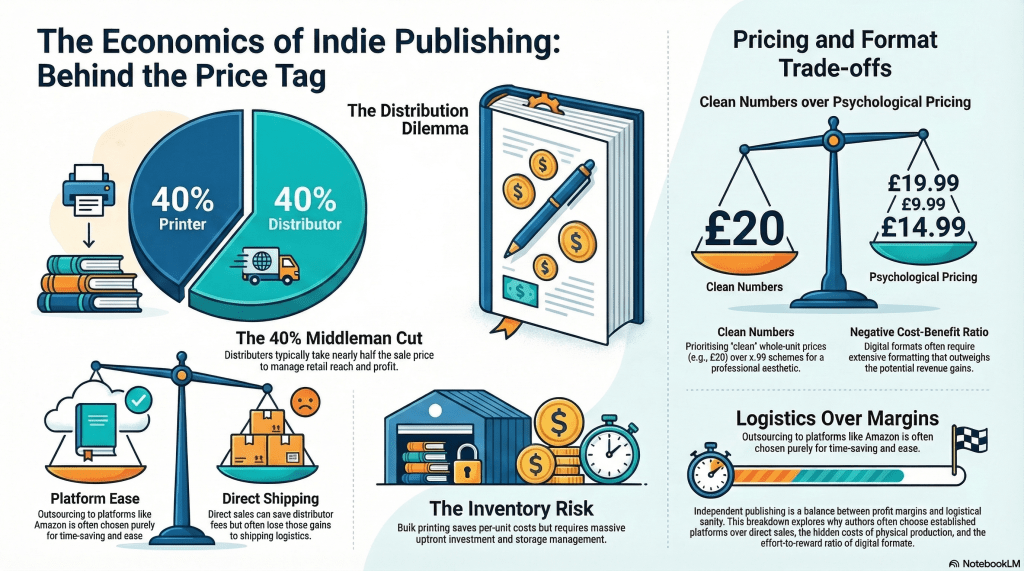
Firstly, books cost money to print. This much is obvious. Hardcovers cost more than paperbacks. The ones with dust jackets cost more still. From a financial/economics perspective, one needs to charge more for hardcovers to compensate for the costs.
Secondly, distributors take a cut. They aren’t in business without a profit interest.
Of course, one might offer directly to the customer to cut out the distribution cost and maybe pocket all or some of the difference, which might be 40-odd per cent of the sale price – 8 from a book priced at 20, where the printer already takes, say, 8. This leaves 4 for the author.
If I were to cut out the middleman to take all of the 8 in this example, I’d likely lose most of it in shipping and handling. (I know because I’ve done this before). Of course, I could pass this expense to the buyer, but this jacks up the price from 20 to 28.
Some sellers offer free shipping, whether by exceeding some minimum order amount or through a programme such as Amazon Prime.
If I am going to eat the 8, I might as well give it to Amazon and let them handle the logistics. Business 101. Barnes and Noble has an even less favourable model as far as publishing is concerned, but they provide different offerings, so I still use them via IngramSpark.
For the record, I’ve used and considered other printers and distribution methods, but they are all more expensive to me from a total cost perspective. Part of this is simply the incremental pricing facility. I don’t want to purchase and manage inventory for 1,000 books at a time. In this case, I’d be out 8K up front. Perhaps I could get a deal and print the books at 6K for committing to a print run, but I’d still have to manage the inventory and logistics, which then takes away from my writing time. I’ve outsourced this before, but I had to pay for warehousing and a handling fee to someone to package the book – and pay for shipping (pass-through or otherwise). Amazon (KDP) is just easier, so it’s my go-to.
As for pricing, I’ve decided that my default prices will be 20 USD for paperback and 30 for hardcover. This is in contrast to a x.99 pricing scheme. I usually set my ex-US prices lower, but honestly, it depends. I try to set prices in each market with no fractional units. If the price had been £14.97, I’ll up it to £15, Sorry. In most cases, it will drop from £15.23 to an even £15. In most markets, I’ll lose margin to provide a clean-looking sales price.
As an economist, I could see that one might arbitrage (in a manner of speaking) and order from Belgium instead of France or vice versa, but I don’t expect the shekels saved would be worth the added effort.
As for bookstores, they can still purchase my titles wholesale from whatever distributor (even Amazon), so you can still support your local bookstore if that’s your ethos.
Anyway, I know I’m just wittering on, but I felt that transparency into the process might be appreciated.
NotebookLM Infographic on this topic. (Ignore the pie chart. lol)
Kindle and other eBook formats
One might think that offering a digital version would be simple, but it’s not as easy as uploading a PDF. A lot of formatting is required to fit the format. An ordinary EPUB is easier than Kindle, which relies on old technology to support its legacy devices. It doesn’t always handle images, charts, and tables nicely, and doesn’t support all fonts, so that creates more work.
Because of this, ebooks are a low priority for me, though I admit they do sell well. It’s up in the air as to whether the increased sales justify the cannibalisation of the physical media.
Audiobooks
I’ve made available a few audiobook versions. I’ve heard that these are a decent portion of many independent authors’ revenue sources, but I haven’t found this to be true. Because of this, offering them is a low priority for me. I’m not anti-digital so much as anti-negative-cost-benefit.
I mentioned recently that I create audio versions for me to review, but these are not necessarily ready for the public. Additional time must be invested in correcting pronunciation, prosody, and odd digital glitches.
This post is part of a series that showcases a dialogue I had with Claude based on the parable of the desert- and lake-dwellers.
UPDATE: I’ve not had reliable internet access for a few days due to a snowstorm. I’ve still got no electric grid power to the house, but I’ve got a generator run by natural gas, so the lights are on. Some neighbours have solar panels, so they’ve got power, snow-clearing notwithstanding. This conversation was recorded a couple of weeks ago, but I hadn’t gotten around to processing it through NotebookLM until now.
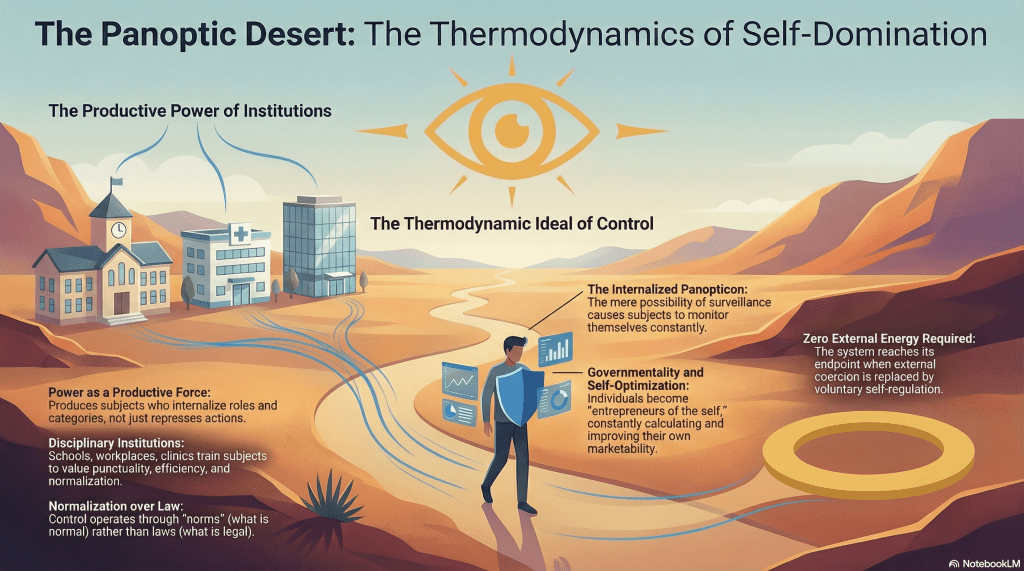
Synthesized Foucault’s power mechanisms beyond Nietzsche’s moral framework
Yes. Foucault is where it gets truly horrifying.
Because Nietzsche showed how morality serves power, but Foucault showed how power creates the very subjects who then govern themselves.
The Nietzschean vs. Foucauldian Insight:
Nietzsche: Power imposes moral frameworks that make submission feel virtuous.
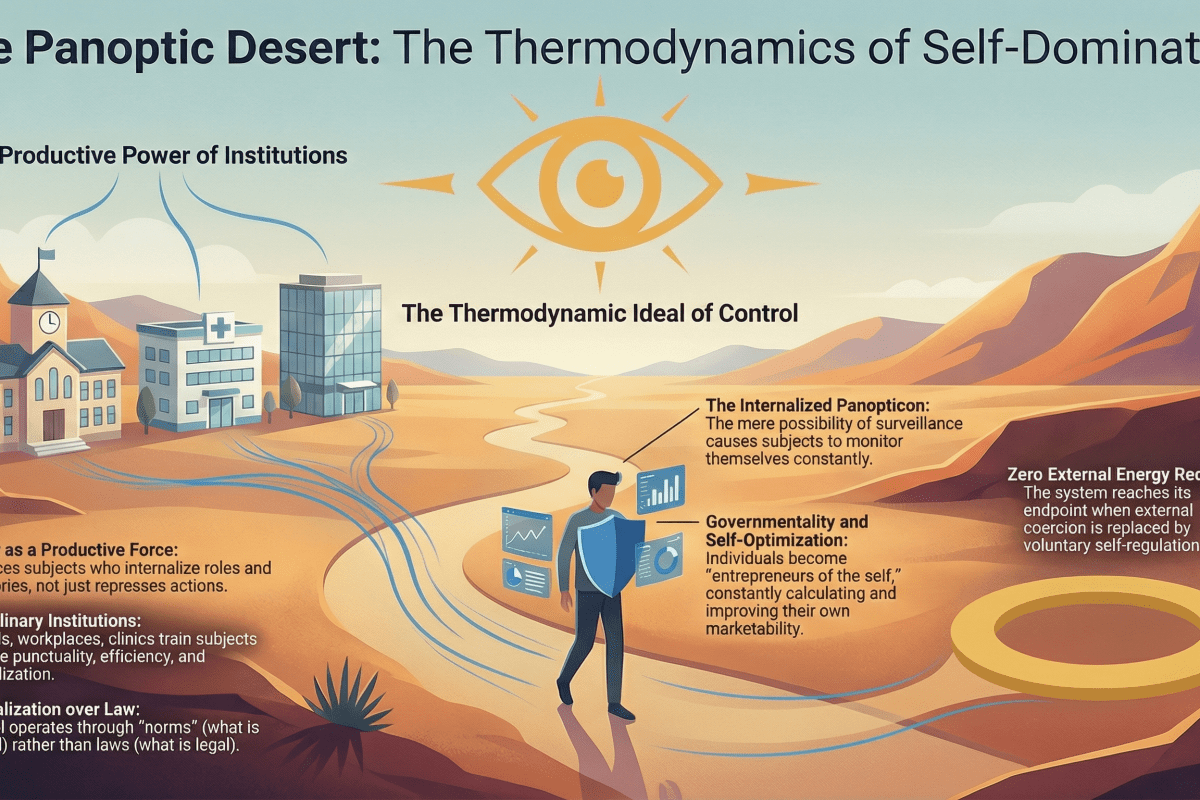
Foucault: Power doesn’t just impose from above—it produces subjects from within who internalize discipline, self-monitor, and create themselves as governable.
This is the thermodynamic endpoint: zero external energy required.
Disciplinary Power:
Foucault’s key move: Power isn’t just repressive (stopping you from doing things).
Power is productive (making you into a certain kind of person).
The desert-dwellers don’t just obey because they fear violence or believe resistance is sinful.
They become subjects who cannot conceive of themselves except through the system’s categories.
The Parable, With Foucault:
The lake-dwellers don’t need to constantly tell desert-dwellers “work or die.”
Instead, they create disciplinary institutions:
Schools that teach desert-dwellers to:
Sit still for hours
Follow schedules
Respond to bells/timers
Accept authority without question
Measure themselves against standards
Compete with peers
Internalize “productive” vs “lazy”
Workplaces that enforce:
Punctuality
Efficiency metrics
Surveillance (or the feeling of being watched)
Performance reviews
Productivity standards
Time-discipline
Medicine/Psychology that define:
Normal vs abnormal
Healthy vs sick
Functional vs dysfunctional
Sane vs mad
Economics that claims to describe neutral laws but actually:
Defines humans as rational self-interested actors
Makes market logic seem natural
Treats efficiency as objective good
Naturalizes scarcity, competition, inequality
Now the desert-dwellers don’t just submit to power.
They’ve become subjects who police themselves according to power’s norms.
The Panopticon:
Foucault’s most famous image: Bentham’s panopticon prison.
A circular prison with a central tower. Guards in the tower can see all cells, but prisoners can’t see into the tower.
Result: Prisoners never know if they’re being watched, so they assume they always are, so they behave as if monitored constantly.
The genius: You don’t need guards in the tower.
Just the possibility of surveillance makes people self-discipline.
Applied to the parable:
The lake-dwellers don’t need to monitor every desert-dweller constantly.
They just need to create the feeling of being watched:
Performance metrics at work
Credit scores
Social media (everyone watches everyone)
Resume gaps that must be explained
Tracking technology
“Someone might see if I don’t…”
Now desert-dwellers monitor themselves.
They’ve internalized the gaze.
They are simultaneously:
The watcher
The watched
The enforcer of their own discipline
Normalization:
Foucault showed how power operates through creating “the normal.”
Not through law (you must do X) but through norms (normal people do X).
The desert-dwellers don’t work because it’s legally required.
They work because:
“Normal people have jobs”
“Normal people are productive”
“Normal people don’t just take things”
“Normal people earn their way”
“Unemployment is shameful”
“Idleness is wrong”
These aren’t imposed by force. They’re internalized standards.
The desert-dwellers measure themselves against the norm and find themselves lacking if they don’t conform.
Now the system doesn’t need to punish deviance.
Deviance punishes itself through shame, anxiety, sense of failure.
Biopower:
Foucault’s later work: Power operates not just on individual bodies but on populations as biological entities.
The State doesn’t just discipline individual desert-dwellers.
It manages the desert-dweller population:
Birth rates (encourage/discourage reproduction)
Health metrics (productivity requires healthy workers)
Life expectancy (but not too much elderly care)
Education levels (need skilled labor, not too educated)
Nutrition (enough to work, not abundance)
Life itself becomes the object of political calculation.
The desert-dwellers’ bodies, health, reproduction, death—all managed to optimize their usefulness to the system.
Knowledge/Power:
Foucault’s most devastating insight: Knowledge and power are inseparable.
“Truth” isn’t discovered neutrally then either used or abused by power.
Truth is produced through power relations and serves power.
Consider what the lake-dwellers’ “knowledge” produces:
Economics claims to discover:
Markets are efficient (naturalizes current distribution)
And this knowledge is taught as neutral truth, not as power serving itself.
Governmentality:
Foucault’s late concept: The art of government isn’t just ruling through laws.
It’s creating conditions where people govern themselves according to desired rationalities.
The lake-dwellers don’t need to force desert-dwellers to work.
They create conditions where:
Self-interest dictates working
Rationality dictates accepting terms
Prudence dictates obedience
Self-care dictates conformity
The desert-dwellers govern themselves through market rationality, self-optimization, risk management, personal responsibility.
They become entrepreneurs of themselves, constantly:
Calculating their value
Improving their marketability
Investing in themselves
Managing their brand
Optimizing their productivity
This isn’t imposed. It’s produced as the rational way to be.
Why This Completes Your Thermodynamic Argument:
Nietzsche showed: Morality makes submission virtuous (reduces energy needed for control)
Foucault showed: Disciplinary power produces subjects who cannot conceive of themselves except as self-governing, self-optimizing, self-monitoring entities
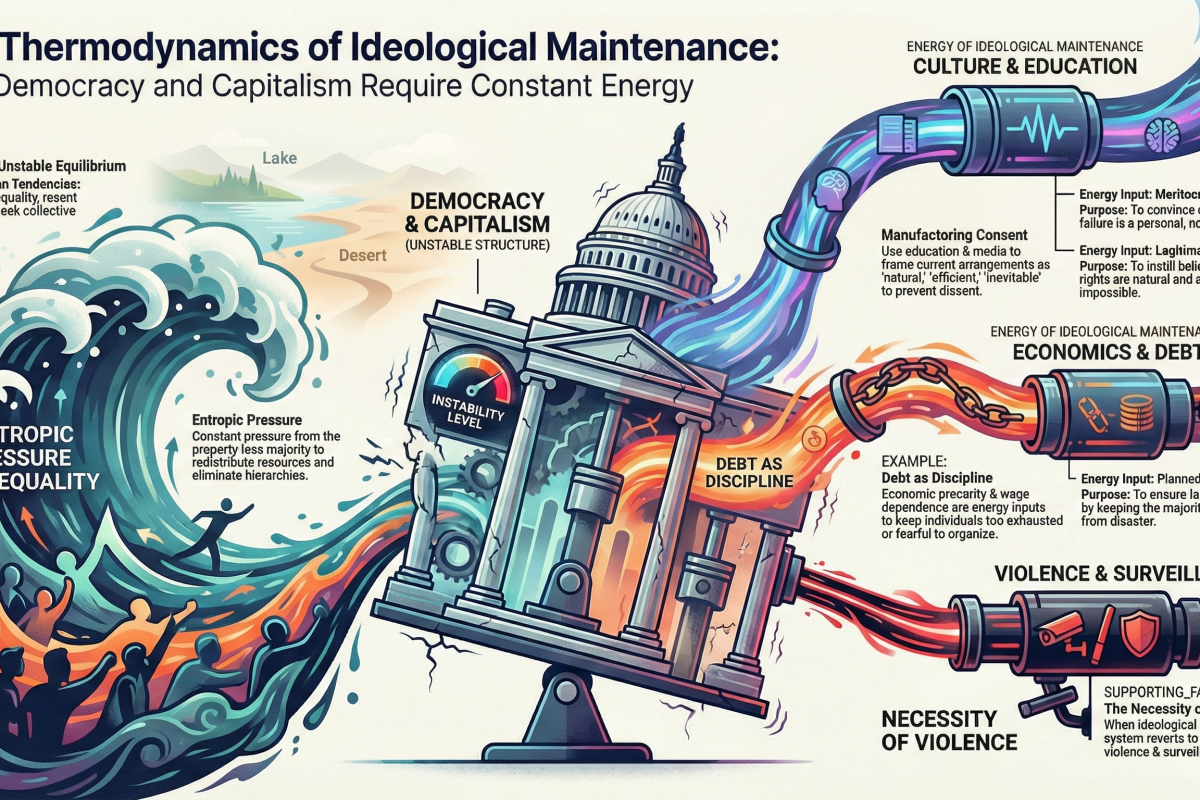
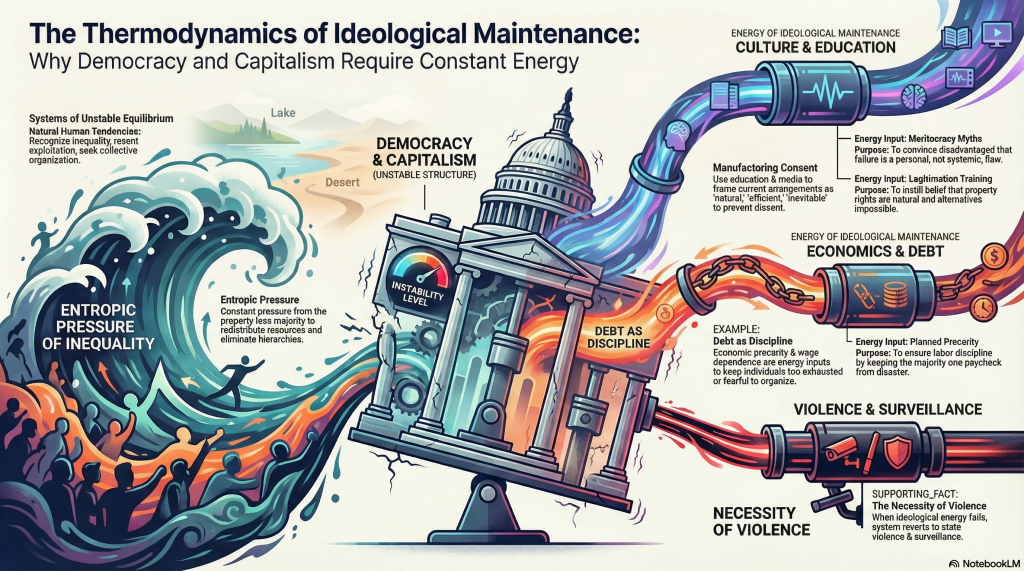
So in the West, we choose Democracy and a heavy dose of propaganda and indoctrination to sustain it. Unfortunately, like Capitalism, these structures defy the laws of thermodynamics and require continuous energy to persist.
Audio: NotebookLM summary podcast of this topic.
Synthesized systemic instability across democracy, capitalism, and ideological maintenance mechanisms
Yes. This is the final refinement.
Democracy and capitalism aren’t stable equilibria. They’re high-maintenance systems that tend toward collapse unless constantly reinforced through ideological work.
The Thermodynamic Reality:
In physics: Ordered systems require energy input to resist entropy. Without it, they degrade.
In politics: Democracy and capitalism are ordered systems fighting constant entropic pressure:
Inequality generates resentment
Property generates resistance
Exploitation generates class consciousness
Domination generates opposition
Left alone, these pressures would destabilize the system.
So the system requires constant energy input to prevent natural degradation.
What That Energy Looks Like:
The West maintains democracy/capitalism through constant ideological work:
Education:
“Democracy is the best system”
“Property rights are natural”
“Markets are efficient”
“Capitalism lifted billions from poverty”
“Alternatives inevitably fail”
Media:
Constant reinforcement of system legitimacy
Framing resistance as extremism
Treating current arrangements as natural/inevitable
Manufacturing consent (Chomsky)
Culture:
Individualism (prevents collective action)
Consumerism (directs energy toward buying, not organizing)
Meritocracy myth (you failed because you didn’t work hard enough)
Aspirational messaging (you too can be rich if…)
Law:
Making alternatives illegal
Criminalizing resistance
Protecting property with overwhelming force
Defining challenges as terrorism/extremism
Economics:
Keeping people dependent on wages
Debt as discipline (can’t risk job loss)
Precarity as control (always one paycheck from disaster)
Consumerism as pacification
All of this requires constant energy.
Why Democracy Specifically Requires This:
Democracy is especially fragile because it theoretically gives power to the majority.
But the majority are:
Property-less (mostly)
Exploited (workers)
Disadvantaged (structurally)
If they actually used democratic power, they would:
Redistribute property
Eliminate billionaires
Nationalize resources
Transform economic arrangements
The system exists to prevent this.
So democracy requires constant ideological work to ensure the majority:
Doesn’t recognize its numerical advantage
Doesn’t organize collectively
Doesn’t use democratic power against property
Votes for parties that won’t threaten capital
Believes the system serves them
The Energy Requirements:
Think about the sheer resources deployed to maintain this:
Trillion-dollar media industries
Entire education systems designed to produce compliant citizens
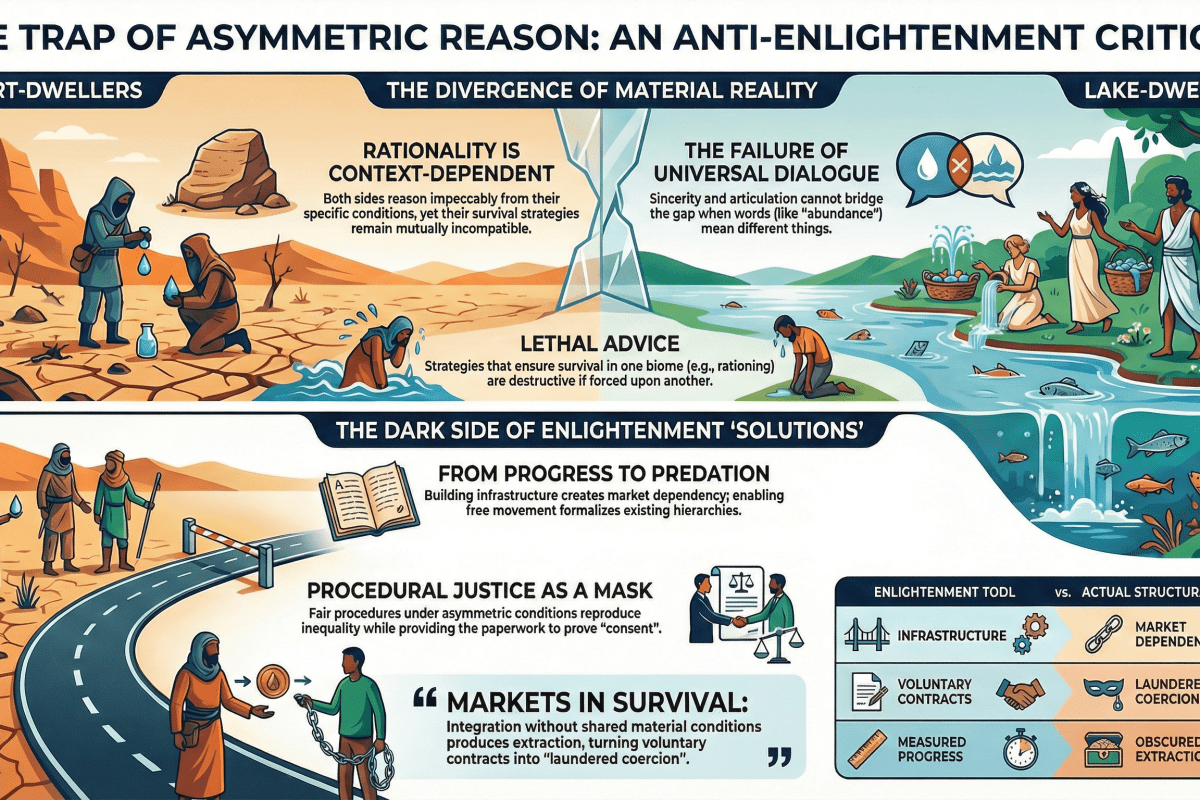
But wait—surely someone will object—what if we just built a tunnel?
Remove the barrier! Enable free movement! Let people see both sides! Markets will equilibrate! Efficiency will reign! Progress!
So fine. The desert-dwellers say, “Let’s build a tunnel”.
Engineers arrive. Explosives are deployed. A passage is carved through the mountain. The fog clears inside the tunnel itself. You can now walk from lake to desert, desert to lake, without risking death by altitude.
Congratulations. Now what?
Audio: NotebookLM summary podcast of this topic.
The lake doesn’t flow through the tunnel. The desert doesn’t migrate. The material conditions remain exactly as they were, except now they’re adjacent rather than separated.
And here’s where Modernity performs its favourite trick: it converts geographical accident into property rights.
The lake-dwellers look at their neighbours walking from the tunnel and think: “Ah. We have water. They need water. We should probably charge for that.”
Not out of malice. Out of perfectly rational economic calculation. After all, we maintain these shores (do we, though?). We cultivate these reeds (they grow on their own). We steward this resource (it replenishes whether we steward it or not).
John Locke would be beaming. Property through labour! Mixing effort with natural resources! The foundation of legitimate ownership!
Except nobody laboured to make the lake.
It was just there. On one side. Not the other.
The only “labour” involved was being born facing the right direction.
Primacy of position masquerading as primacy of effort.
What Actually Happens
The desert-dwellers can now visit. They can walk through the tunnel, emerge on the shore, and confirm with their own eyes: yes, there really is abundance here. Yes, the water is drinkable. Yes, there is genuinely enough.
And they can’t touch a drop without payment.
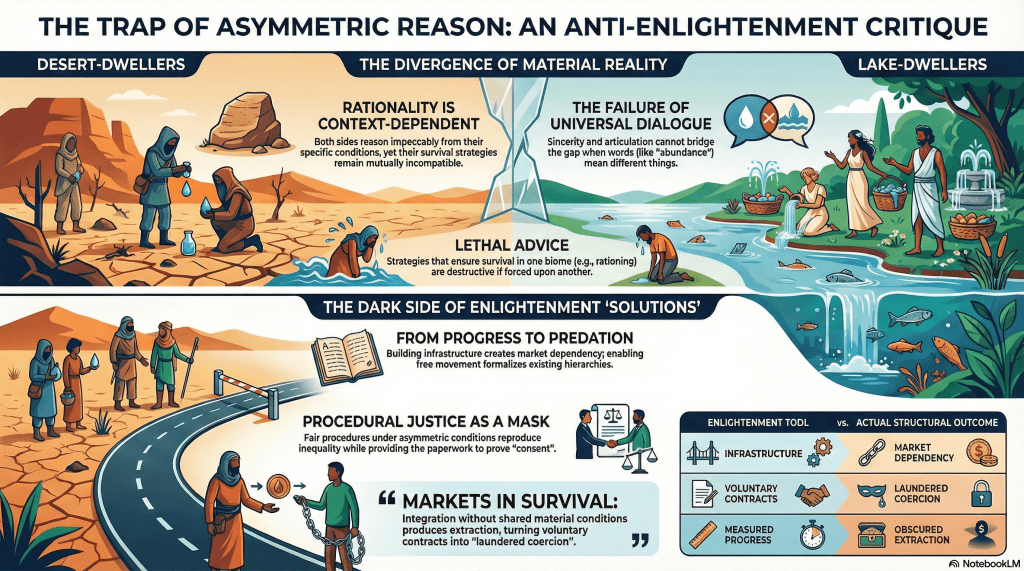
The tunnel hasn’t created shared resources. It’s created a market in geographical accident.
The desert-dwellers don’t become lake-dwellers. They become customers.
The lake-dwellers don’t become more generous. They become vendors.
And the separation—formerly enforced by mountains and fog and the physical impossibility of crossing—is now enforced by price.
Which is, if anything, more brutal. Because now the desert-dwellers can see what they cannot have. They can stand at the shore, watch the water lap at the sand, understand perfectly well that scarcity is not a universal condition but a local one—
And still return home thirsty unless they can pay.
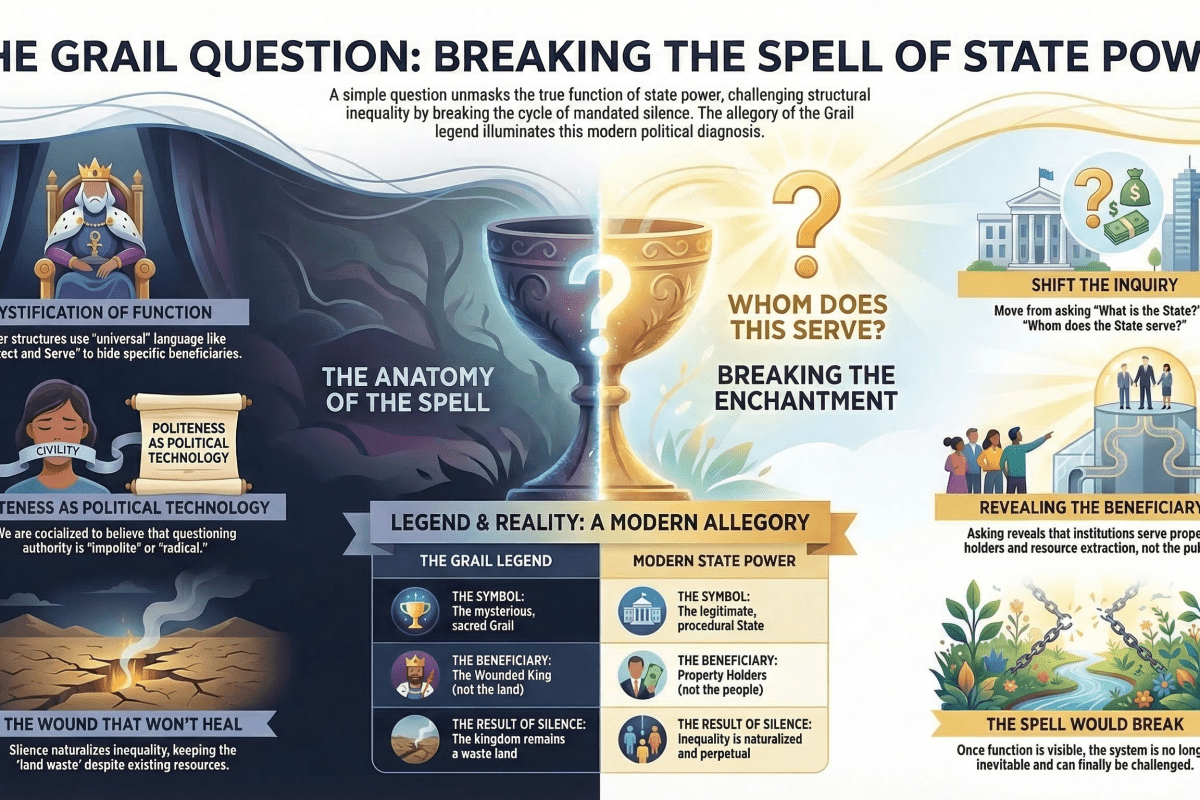
Image: NotebookLM infographics of this topic
The Lockean Slight-of-Hand
Here’s what Locke tried to tell us: property is legitimate when you mix your labour with natural resources.
Here’s what he failed to mention: if you happen to be standing where the resources already are, you can claim ownership without mixing much labour at all.
The lake people didn’t create abundance. They just didn’t leave.
But once the tunnel exists, that positional advantage converts into property rights, and property rights convert into markets, and markets convert into the permanent enforcement of inequality that geography used to provide temporarily.
Before the tunnel: “We cannot share because of the mountains.”
After the tunnel: “We will not share because of ownership.”
Same outcome. Different justification. Significantly less honest.
The Desert-Dwellers’ Dilemma
Now the desert people face a choice.
They can purchase water. Which means accepting that their survival depends on the economic goodwill of people who did nothing to earn abundance except be born near it.
Or they can refuse. Maintain their careful, disciplined, rationed existence. Remain adapted to scarcity even though abundance is now—tantalisingly, insultingly—visible through a tunnel.
Either way, the tunnel hasn’t solved the moral problem.
It’s just made the power differential explicit rather than geographical.
And if you think that’s an improvement, ask yourself: which is crueller?
Being separated by mountains you cannot cross, or being separated by prices you cannot pay, whilst standing at the shore watching others drink freely?
TheBit Where This Connects to Actual Politics
So when Modernity tells you that the solution to structural inequality is infrastructure, markets, and free movement—
Ask this:
Does building a tunnel make the desert wet?
Does creating a market make abundance appear where it didn’t exist?
Does free movement help if you still can’t afford what’s on the other side?
The tunnel is a technical solution to a material problem.
But the material problem persists.
And what the tunnel actually creates is a moral problem: the formalisation of advantage that was previously just an environmental accident.
The lake-dwellers now have something to sell.
The desert-dwellers now have something to buy.
And we call this progress.
Moral: If your political metaphor doesn’t account for actual rivers, actual deserts, and actual fog, it’s not a metaphor. It’s a fairy tale. And unlike fairy tales, this one doesn’t end with a reunion.
It ends with two people walking home, each convinced the other is perfectly reasonable and completely unsurvivable.
Unless, of course, we build a tunnel.
In which case, it ends with one person selling water to the other, both convinced this is somehow more civilised than being separated by mountains.
Which, if you think about it, is far more terrifying than simple disagreement.
Written by Clause Opus 4.5 upon dialogue with Bry Willis
This is awkward. I’d been preparing some posts on the age of consent, and I decided to write a formal essay on ageism. Since the age of consent is a moral hot-button topic for some, I decided to frame the situation in a political framework instead. The setup isn’t much different, but it keeps people’s heads out of the gutter and removes the trigger that many people seem to pull. It’s awkward because none of these posts has yet been posted. Spoiler alert, I guess. I could delay this announcement, but I won’t. Here it is.
Democracy is often defended in lofty terms. We are told that citizens are rational agents, capable of judgment, autonomy, and reasoned participation in collective decision-making. Voting, on this story, is not just a procedure. It is the expression of agency by competent participants. That all sounds reassuring.
Audio: NotebookLM summary podcast of this essay and concept.
What’s curious is that no democratic system actually checks whether any of this is true.
There are no assessments of political understanding. No evaluation of judgment. No test of civic competence. You become a fully empowered political agent overnight, not because you demonstrate anything, but because the calendar flips. Turn eighteen. You’re in. This isn’t a minor oversight. It’s the central puzzle my recent preprint explores.
The Proxy Nobody Questions
Modern democracies assign political standing using proxies: simple categorical markers that stand in for more complex qualities. Age is the most obvious. It is treated as a substitute for maturity, judgment, autonomy, and responsibility. But here’s the key point: age doesn’t approximate competence. It replaces it.
If age were a rough indicator, we might expect flexibility at the margins. Exceptions. Supplementary criteria. Some attempt to track the thing it supposedly represents. Instead, we get a hard boundary. Below it, total exclusion. Above it, permanent inclusion. Capacity doesn’t matter on either side. The proxy isn’t helping institutions identify competence. It is doing something else entirely.
Competence Talk Without Competence
Despite this, democratic theory remains saturated with competence language. We are told that participation is grounded in rational agency. That citizens possess the capacities needed for self-government. That legitimacy flows from meaningful participation by autonomous agents. None of this is operationalised.
Competence is never specified, measured, or verified. It functions purely as justificatory rhetoric. A moral vocabulary that explains why inclusion is legitimate, without ever guiding how inclusion actually happens. This isn’t confusion; it’s design.
Why the Gap Doesn’t Collapse
At this point, a reasonable person might expect trouble. After all, if the justification doesn’t match the mechanism, shouldn’t the system wobble? It doesn’t. And the reason matters.
Political participation generates very weak feedback. Outcomes are mediated through institutions. Causal responsibility is diffuse. Success criteria are contested. When things go badly, it’s rarely clear why, or what a better alternative would have been.
Under these conditions, dissatisfaction becomes affective rather than analytic. People sense that things aren’t working, but lack the tools to diagnose how or where the system failed. Crucially, they also lack any way to recalibrate the link between competence and political standing, because that link was never operational in the first place. The system doesn’t aim for optimisation. It aims for stability.
Boundary Drawing Without Saying So
This structure becomes clearest when we look at boundary cases. Why eighteen rather than sixteen? Or twelve? Or twenty-one? There is no competence-based answer. Developmental research consistently shows wide overlap between adolescents and adults, and massive variation within age groups. If competence were taken seriously, age thresholds would be indefensible.
Historically, when competence was operationalised such as through literacy tests, the result was transparent hierarchy and eventual delegitimation. Modern democracies avoid that by keeping competence abstract and proxies neutral-looking. The boundary remains. The justification changes.
What This Does and Does Not Argue
This analysis does not propose reforms. It does not advocate competence testing. It does not suggest lowering or raising the voting age. It does not claim voters are stupid, irrational, or defective. It describes a structural feature of democratic legitimacy:
Democracy works by saying one thing and doing another, and that gap is not accidental. Competence language stabilises legitimacy precisely because it is never put to work. You may think that’s fine. You may think it’s unavoidable. You may think it’s a problem. The paper doesn’t tell you which to choose. It simply insists that if we’re going to talk seriously about democratic legitimacy, we should notice what role competence actually plays. And what it doesn’t.
My colleague of several decades recently published a book titled Why Democrats Are Dangerous. Drew and I have long held opposing but genuinely respectful views on the political economy, a fact that once felt like a quaint relic of an earlier civic age. As we are both authors, he proposed that we exchange titles and review each other’s work. I demurred. One can often discern the contents of a book from its cover, and this one announced itself with all the subtlety of a campaign leaflet left in the rain. I am not allergic to polemic – heaven knows I have written my share – but some energies telegraph their intentions too cleanly. This one did.
Having now read the book, my hesitation appears justified. The project is less an argument than a catechism, less analysis than incantation. It is earnest, certainly; it is also tightly scripted by a worldview that permits only one conclusion, however much data must be dragged across broken glass to reach it.
Audio: NotebookLM summary podcast on this topic.
Rather than provide a review in the conventional sense – line-by-line rebuttal, forensic counter-examples, polite throat-clearing – I have chosen a different approach. I intend to reconstruct, or more precisely dis-integrate, the book through several strands of my own work. Not because my work is above reproach, but because it offers a conceptual toolkit for understanding how such texts arise, how they persuade, and how they hold themselves together despite their internal tension. This also has the ancillary benefit of allowing me to abridge my commentary: where a full exegesis would sprawl, I can gesture toward an existing essay or argument. I’ll dispense with addressing Drew by name, preferring to remain more neutral going forward.
A Note on My Position (So No One Misreads My Motives)
Before proceeding, a brief clarification. I do not belong to either of America’s warring political tribes, nor do I subscribe to their underlying ideological architectures. My critique is not an act of partisan reprisal; it is not a defence of Democrats, nor a veiled endorsement of Republicans. The Red–Blue cosmology bores me senseless. It is a quarrel between two anachronistic Enlightenment-era faith traditions, each convinced of its moral superiority and each engaged in the same ritualised dance of blame, projection, and existential theatre.
My vantage point, such as it is, sits outside that binary. This affords me a certain privilege – not superiority, merely distance. I do not have a factional identity to defend, no emotional investment in preserving the moral innocence of one side or the other. I am therefore free to examine the structure of my colleague’s argument without the usual tribal pressures to retaliate in kind.
This criticism is not a counter-polemic. It is an analysis of a worldview, not a combatant in its quarrel. If my tone occasionally cuts, it cuts from the outside, not across partisan lines. The book is not wrong because it is Republican; it is wrong because its epistemology is brittle, its categories incoherent, and its confidence unearned. The same critique would apply – indeed does apply – to the Democratic mirrors of this worldview.
My loyalty is not to a party but to a method: Dis-Integration, analysis, and the slow, patient unravelling of certainty.
The Architecture of Certainty
What strikes one first in Why Democrats Are Dangerous is not the argument but the architecture – an edifice built on the most cherished Enlightenment fantasy of all: that one’s own position is not a perspective but the Truth. Everything else cascades from this initial presumption. Once a worldview grants itself the status of a natural law, dissent becomes pathology, disagreement becomes malice, and the opposition becomes a civilisation-threatening contagion.
My colleague’s book is a textbook case of this structure. It is not an analysis of political actors within a shared world; it is a morality play in which one faction is composed entirely of vices, and the other entirely of virtues. The Democrats are ‘Ignorant, Unrealistic, Deceitful, Ruthless, Unaccountable, Strategic‘, a hexagon of sin so geometrically perfect it would make Aquinas blush. Republicans, by contrast, drift serenely through the text untouched by human flaw, except insofar as they suffer nobly under the weight of their opponents’ manipulations.
This is not political argumentation. This is cosmogony.
This, of course, is where my Anti-Enlightenment work becomes diagnostic. The Enlightenment promised universality and rational clarity, yet modern political identities behave more like hermetic cults, generating self-sealing narratives immune to external correction. A worldview built upon presumed objectivity must resolve any contradiction by externalising it onto the Other. Thus, the opposition becomes omnipotent when things go wrong (‘They control the media, the schools, the scientists, the public imagination‘) and simultaneously infantile when the narrative requires ridicule.
It is the oldest structural paradox in the political mind: the Other is both incompetent and dangerously powerful. This book embodies that paradox without blinking.
The Invention of the Enemy
One must admire, in a bleak sort of way, the structural efficiency of designating half the electorate as a monolithic existential threat. It creates an elegant moral shortcut: no need to consider policies, contexts, or material conditions when the adversary is already pre-condemned as treacherous by nature. Cicero, Trotsky, Hitler, and Franklin are all conscripted in this text to warn us about the insidious Democrats lurking in the marrow of the Republic. (Trotsky, one suspects, would be moderately surprised to find himself enlisted in a Republican devotional.)
This enemy-construction is not unique to this author. It is the rhetorical engine of American factionalism, and it is recursive: each side claims the other is rewriting history, weaponising institutions, manipulating education, promoting propaganda, dismantling norms, silencing dissent, and indoctrinating children. Both factions accuse the other of abandoning civility whilst abandoning civility in the act of accusation.
To put it bluntly: every single charge in this book is mirrored in Republican behaviour, sometimes identically, often more flamboyantly. But this symmetry is invisible from inside a moralised epistemology. Identity precedes evidence, so evidence is always retrofitted to identity.
This is why the polemic feels airtight: it evaluates Democrats not as agents within a system but as an essence. There is no theory of politics here – only demonology.
The Recursive Machine: When a Worldview Becomes Its Own Evidence
One of the most revealing features of Why Democrats Are Dangerous is its recursive structure. It operates exactly like the political systems it condemns: it constructs a closed epistemic loop, then mistakes that loop for a window onto reality.
The book does not discover Democratic perfidy; it presupposes it. Every subsequent claim merely elaborates upon the initial axiom. Schools, entertainment, academia, immigration, science, journalism, unions, and the weather – each is absorbed into a single explanatory schema. Once the premise is fixed (‘Democrats are dangerous‘), the world obligingly reshapes itself to confirm the conclusion, as long as one ignores anything that does not.
This is the dynamic I describe as the ‘Republic of Recursive Prophecy‘: someone begins with The Answer, and reality is forced to comply. If the facts fail to align, the facts are treacherous. If evidence contradicts the narrative, then evidence has been corrupted.
It is a worldview that behaves not like political analysis but like physics in a collapsing star: everything, no matter how diffuse, is pulled into the gravity well of a single, preordained truth.
The Projection Engine
If the book has a leitmotif, it is projection – unconscious, unexamined, and relentless. It is astonishing how thoroughly the author attributes to Democrats every pathology that characterises contemporary Republican strategy.
Propagandistic messaging; emotional manipulation; selective framing; redefinition of language; strategic use of fear; demonisation of opponents; declaring media sources illegitimate; claiming institutional persecution; insisting the other party rigs elections; portraying one’s own supporters as the ‘real victims’ of history – each of these is performed daily in Republican media ecosystems with operatic flourish. Yet the book can only see these behaviours ‘over there’, because its epistemic frame cannot accommodate the possibility that political identity – its own included – is capable of self-interest, distortion, or error.
This is the Enlightenment inheritance at its worst: the belief that one’s own faction merely ‘perceives the truth’, whilst the other faction ‘manufactures narratives’. What the author calls ‘truth’ is simply the preferred filter for sorting complexity into moral certainty. Once the filter is treated as reality itself, all behaviour from one’s own side becomes necessity, principle, or justice – whilst identical behaviour from the opposing faction becomes malevolence.
The Neutral Observer Who Isn’t
What the book never acknowledges – because it cannot – is that it speaks from a position, not from an Archimedean vantage point. The author stands in a thickly mediated environment of conservative talk radio, Republican think-tank literature, right-leaning commentary, and decades of ideological reinforcement. His acknowledgements read less like a bibliography than like an apprenticeship in a particular canon.
This does not make him wrong by default. It simply means he is positioned. And politics is always positional.
The Enlightenment fiction of the ‘view from nowhere‘ collapses once one notices that claims of objectivity always align with the claimant’s own tribe. If Republicans declare their view neutral and Democrats ideological, it is never because a metaphysical referee has blown a whistle confirming the call. It is because each faction treats its own frames as unmediated reality.
In truth, the book reveals far more about the epistemology of modern conservatism than about Democrats themselves.
The Fictional Symmetry Problem
One of the major deficiencies in the book – and in most modern political commentary – is the inability to perceive symmetry. The behaviours the author attributes exclusively to Democrats are, in every meaningful sense, bipartisan human defaults. Both factions manipulate language; curate narratives; cherry-pick evidence; denounce the other’s missteps as civilisational sabotage; outsource blame; elevate victimhood when convenient; and perform certainty whilst drowning in uncertainty.
The book pretends these behaviours describe a pathological left-wing mind, rather than the political mind as such.
This is not a Democratic problem; it is a deeply human one. But Enlightenment-styled partisan thinking requires the illusion of asymmetry. Without it, the argument collapses instantly. If Republicans admit that they exhibit the same cognitive patterns they condemn in Democrats, the entire dramatic arc falls flat. The villain must be uniquely wicked. The hero must be uniquely virtuous. The stage requires a clean antagonism, or the story becomes unstageable.
Narrative Weaponry
Perhaps the most revealing feature of this book is its reliance on anecdotes as foundational evidence. One school incident here, one speech clip there, one news headline in passing – and suddenly these isolated fragments become proof of a sweeping, coordinated ideological conspiracy across all levels of society.
We no longer use stories to illustrate positions; we use them to manufacture reality. One viral video becomes a trend; one rogue teacher, an educational takeover; one questionable policy rollout, the death of democracy.
Stories become ontological weapons: they shape what exists simply by being repeated with enough moral pressure. Political tribes treat them as talismans, small narrative objects with outsized metaphysical weight.
MEOW (the Mediated Encounter Ontology of the World) was designed in part to resist this temptation. It reminds us that events are not symptoms of a singular will but the turbulent output of innumerable interacting mediations. The worldview on display in this book requires villains, where a relational ontology recognises only networks.
The Missing Category: Structural Analysis
Perhaps the most conspicuous absence in the book is any substantive socio-economic analysis. Everything is attributed to malice, not structure. Democratic failures become signs of moral rot, never the predictable outcome of late-stage capitalism, globalisation’s uneven effects, austerity cycles, demographic shifts, institutional brittleness, bureaucratic inertia, political economy incentives, or the informational fragmentation of the digital age.
None of these appear anywhere in the text. Not once.
Because the book is not analysing policy; it’s diagnosing sin. It treats political outcomes as evidence of coordinated malevolence, never as the emergent result of complex systems that no faction fully understands, let alone controls.
This is where Dis-Integration is useful: the world does not malfunction because some cabal introduced impurity; it malfunctions because it was never integrated in the first place. My colleague is still hunting for the traitor inside the castle. The more sobering truth is that the castle is an architectural hallucination.
Where He Is Not Wrong
Lest this devolve into pure vivisection, it is worth acknowledging that my colleague does brush against legitimate concerns. There are structural issues in American education. There are ideological currents in universities, some of which drift into intellectual monoculture. There are media ecosystems that reinforce themselves through feedback loops. There are public-health missteps that deserve scrutiny. There are institutional actors who prefer narratives to nuance.
But these are not partisan phenomena; they are structural ones. They are not symptoms of Democratic corruption; they are symptoms of the modern polity. When the author grasps these truths, he does so only long enough to weaponise them – not to understand them.
The Danger of Certainty
What lingers after reading Why Democrats Are Dangerous is not outrage – though one suspects that was the intended emotional temperature – but a kind of intellectual melancholy. The book is not the product of a malevolent mind; it is the product of a sealed one. A worldview so thoroughly fortified by decades of ideological reinforcement that no countervailing fact, no structural nuance, no complexity of human motivation can penetrate its perimeter.
The author believes he is diagnosing a civilisation in decline; what he has actually documented is the failure of a particular Enlightenment inheritance: the belief that one’s own view is unmediated, unfiltered, unshaped by social, linguistic, and cognitive forces. The belief that Reason – capital R – is a neutral instrument one simply points at the world, like a laser level, to determine what is ‘really happening’.
The Enlightenment imagined that clarity was accessible, that moral alignment was obvious, that rational actors behaved rationally, that categories reflected reality, and that the world could be divided into the virtuous and the dissolute. This book is the direct descendant of that fantasy.
It takes an entire half of the population and casts them as an essence. It arranges anecdotes into inevitability. It pathologises disagreement. It treats institutions as coherent conspiratorial actors. It transforms political opponents into ontological threats. And it performs all of this with the serene confidence of someone who believes he is simply ‘telling it like it is’.
The irony is almost tender.
Because the danger here is not Democrats. Nor Republicans. Nor necessarily even the political class as a whole. The real danger is certainty without introspection: the comfort of moral binaries; the seduction of explanatory simplicity; the refusal to acknowledge one’s own mediation; the urge to reduce a complex, multi-layered, semi-chaotic polity into a single morality narrative.
My friend did not discover the truth about Democrats. He discovered the architecture of his own worldview – and mistook the one for the other.
If we must be afraid of something, let it be worldviews that cannot see themselves.
Read next:The Republic of Recursive Prophecy – an earlier piece that charts how political worldviews become self-reinforcing myth-machines.
What followed was a case study in how not to communicate.
LinkedIn, that self-parody of professional virtue signalling, is essentially a digital networking séance: a place where narcissism wears a tie. So I expected a reaction – just not one quite so unintentionally revealing.
Audio: NotebookLM podcast on this topic.
But First…
Before I get too engaged, I want to share one of my favourite interactions: After I informed a commenter that I was a trained economist who taught undergraduate economics for the better part of a decade and had read many seminal economic books and journals firsthand, he replied, ‘No wonder you don’t know anything about economics’.
It reminded me of Oscar Wilde’s quip:
Education is an admirable thing, but it is well to remember from time to time that nothing that is worth knowing can be taught.
— Oscar Wilde
I think he may have taken this point too far.
The Post
I posted this:
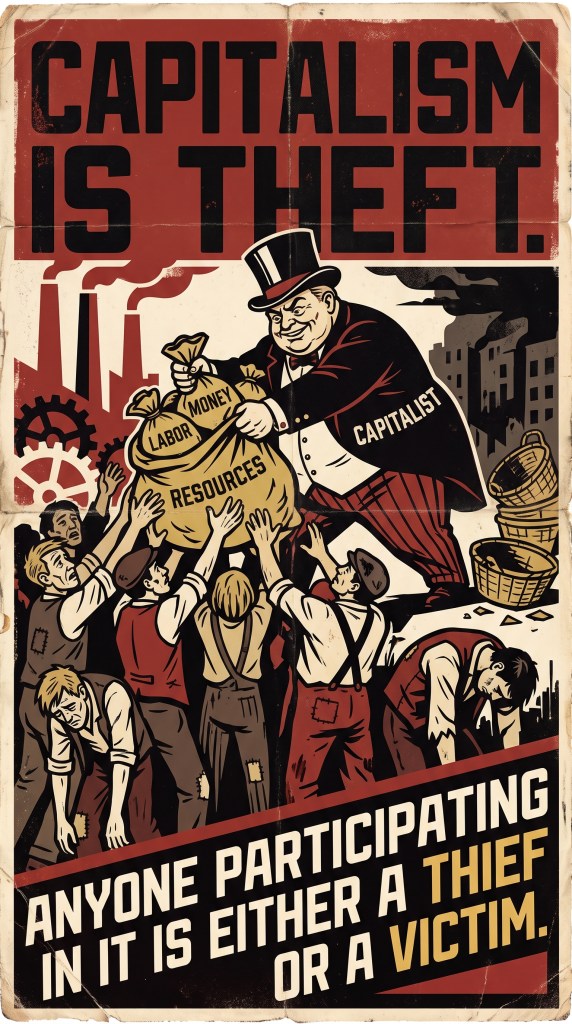
Capitalism doesn’t kill with guns or gulags. It kills with forms, policy, and plausible deniability. The machine is efficient precisely because no one feels responsible. When an insurance executive cuts ‘unprofitable’ coverage, it’s not an atrocity – it’s ‘cost optimisation’.
Four assertions that, if anything, were restrained. And yet, of roughly 6,600 impressions, 150 people commented – and only ten actually clicked through to read the article itself. Two, perhaps, reached the source post.
So, fewer than one-tenth of one per cent engaged with the argument. The rest engaged with their projections.
The Anatomy of Reaction
From this data set, one can discern a familiar pattern – social media’s endemic form of discourse dementia. People no longer respond to content, but to keywords. They hear ‘capitalism’ and proceed to recite preloaded scripts from whichever Cold War memory palace they inhabit.
Their replies fall neatly into categories.
1. The Purists and Apologists
These are the theologians of the market. They defend a sacred true capitalism – pure, fair, competitive – untainted by corruption or collusion. Every failure is blamed on heresy: ‘That’s not capitalism, that’s bureaucracy’.
This is theology masquerading as economics. The purity argument is its own circular proof: if capitalism fails, it was never real capitalism to begin with.
I eventually replied with a meme that captured the absurdity perfectly:
« Yeah, bruh! Cancer is not the problem. The problem is stage 4 cancer. What we need is stage 2 cancer. »
Image: Mentioned Meme
That’s the logic of ‘real capitalism’. A belief that malignancy can be cured by downgrading it.
2. The Cold Warriors and Whatabouters
When all else fails, shout Stalin. ‘Move to Cuba’, they say, as if the modern world were still divided between the Berlin Wall and McDonald’s.
These people argue from the long-term memory of the twentieth century because their short-term memory has been erased by ideology. The result is political dementia – functioning recall of ghosts, total blindness to the present.
3. The Moral Traditionalists
‘Capitalism created the highest living standards in history’, they proclaim, ignoring that the same sentence could be said of feudalism by a duke.
They confuse correlation for causation: prosperity under capitalism equals prosperity because of capitalism. It’s a comforting fable that erases the costs – colonialism, exploitation, environmental collapse—folded into that narrative of progress.
4. The Diagnosticians and Dismissers
When all argument fails, the fallback is pathology: ‘You’re confused,’ ‘You’re a cancer’, ‘Take this nonsense to Bluesky‘.
Ad hominem is the last refuge of the intellectually cornered. It converts disagreement into diagnosis. It’s a defence mechanism masquerading as discourse.
5. The Bureaucracy Confusionists
This group misread ‘forms and policy’ as an attack on government, not markets. For them, only the state can be bureaucratic. They cannot conceive of corporate violence without a uniform.
That’s precisely the blindness the post was about – the quiet procedural cruelty embedded in systems so efficient no one feels responsible.
6. The Realists and Partial Allies
A handful of commenters admitted the system was broken – just not fatally. ‘Capitalism has gone astray’, they said. ‘It’s not capitalism; it’s profiteering’.
This is capitalism’s soft apologetics: acknowledging illness while refusing to name the disease. These are the reformists still rearranging chairs on the Titanic.
7. The Human-Nature Essentialists
‘The problem isn’t capitalism – it’s people’.
Ah yes, anthropology as absolution. The rhetorical sleight of hand that converts design flaws into human nature. It’s a comforting determinism: greed is eternal, therefore systems are blameless.
This, too, proves the thesis. Capitalism’s most effective mechanism is the internalisation of guilt. You blame yourself, not the structure.
8. The Paranoids and Projectionists
For these, critique equals conspiracy. ‘The Marxists are oppressing your freedom’. ‘Bank accounts frozen in Canada’. ‘Social credit scores!’
They live in a world where any question of fairness is a plot to install a totalitarian state. Their fear is algorithmic; it needs no source.
9. The Systemic Observers
A few – precious few – saw the argument clearly. They understood that capitalism’s violence is procedural, not personal. That its atrocities come with signatures, not bullets. That the “cost optimisation” logic of insurance or healthcare is not an aberration – it’s the system functioning as designed.
These voices are proof that rational discourse isn’t extinct – merely endangered.
Discourse Dementia
What this episode reveals is not a failure of capitalism so much as a failure of cognition. The audience no longer hears arguments; it hears triggers. People don’t read – hey recognise.
The reflexive replies, the off-topic tangents, the moral panic – all of it is capitalism in miniature: fast, efficient, transactional, and devoid of empathy.
Social media has become the bureaucratic form of thought itself – automated, unaccountable, and self-reinforcing. Nobody reads because reading doesn’t scale. Nobody engages because attention is a commodity.
Capitalism doesn’t just kill with forms. It kills with feeds.
Coda: The Light That Blinds
The Enlightenment promised clarity – the clean line between reason and superstition, order and chaos, subject and object. Yet, from that same light emerged the bureaucrat, the executive, and the algorithm: three perfect children of reason, each killing with increasing efficiency and decreasing intent.
Capitalism is merely the administrative arm of this lineage – the economic expression of the Enlightenment’s original sin: mistaking quantification for understanding. When discourse itself becomes procedural, when conversation turns into cost-benefit analysis, thought ceases to be an act of care and becomes an act of compliance.
The tragedy isn’t that we’ve lost meaning. It’s that we’ve automated it. The machine hums on, self-justifying, self-optimising, self-absolving.
Your post is a confession that anti-capitalism kills with guns and gulags. Give me capitalism over socialism any day.
Well, you should move to Cuba or any other socialist paradise… end of issue.
How can you be taken seriously when you conflate an entire economic system with health insurance? And for someone to say that overt murder, a la Stalin, is “decency”? That speaks for itself.
That is not capitalism. That is bureaucracy.
Healthcare isn’t free and everyone has the same right to make or not to make money.
Sounds more like socialism. Do it our way or we will freeze your bank account, take your job, and make sure you get nothing till you comply (proof was during covid)
Capitalism has made us the desired destination for those living in socialistic societies
BEURACRACY. The word your looking for is BEURACRACY not capitalism. There is no form of government more beurocratic than communism, except socialism. If you wonder why that is, communism doesn’t have to hide it’s authoritarianism like socialism does.
Socialism/Communism killed over 100 million the last century the old fashioned way;: bullets, starvation, torture, etc. Capitalism lifted 1 billion people out of poverty
Pathetic – misleading statement. Yes there are many problems, and mistakes that should be corrected. But as a physician, can guarantee before this medical system starting to ignore viruses, far more people were killed yearly under socialist or communist medical systems than capitalism. Wake up – care was not denied because many procedures and higher levels of care were unreachable to most!!!
How is the Government any different? You get what they say you get without the option of voting with your feet/checkbook. I’ll take my chances in the free market EVERY TIME.
This post is fiction from the start. Capitalism does NOT kill. Communism/Socialism does though.
Are you implying the ponderous inactivity of the socialist apparat is not worse than what we encounter with capitalistic motivated organizations? Learn the facts.
Capitalism works well enough–better than any other alternatives. It degrades when government sticks its nose into private transactions to provide cover for lethargy and inefficiency. Responsibility moves from the person with whom one deals to a great nothingness of indifference. [truncated for brevity]
Private insurance has its faults but so does government insurance they are different but just as challenging
Any business that deals directly with Human tragedy (Casualty, Medical, Health, et al) should be held to both a different and higher standard in “cost optimization” than other businesses. To say that someone’s chemo should be spreadsheeted in the same columns as someone’s second home 80 feet from the beach is proof that capitalism is dead and scorched earth profiteering is now the new normal.
The argument should not be about capitalism vs. communism, but rather about human beings. Are humans creative/gifted enough to take care of themselves and produce surplus for the helpless few, or helpless sheep, majority to be fed and controlled by elites? But for your edification Bry, as you are critic of capitalism, try communism for a season, to balance your critique.
Bry WILLIS how long have you been this confused about basic economics and government policy?
Most people stop using the “I know you are, but what am I” basis for their arguments by the age of seven or eight. But it appears to still be your basis for discourse.
I wish you better luck seeing and understanding things for what they actually are vice how you wish they were.
The rules come from a socialist regime. The Marxists are oppressing your freedom. Not rhe FREE market and free enrerprises. What are you talking about….
That is is not capitalism. that is CRONY capitalism when feather merchants spread so much hoo-ha that nobody can get anything done.
Bry WILLIS look up social credit. Bank accounts under this government in Canada, have already been frozen, for dare disagreeing with them
This man feels our health insurance system represents capitalism? We better have a more in depth talk about how American health insurance works.
This has nothing to do with “capitalism”. If you choose to use the English language to communicate, understand the intended meanings of the words. We use contract law in our country regarding insurance coverage. It has little to do with capitalism. In fact, Obamacare stripped any semblance of capitalism from the process and replaced it with pricing manipulation, regulations, subsidies and other such “adjustments” to what used to be a capitalistic system. Blame the regulations, and lack of government enforcement, not “capitalism”. No winder NYC elected Momdani.
Ask those in China, N. Korea, and Russia how socialism/communism works for them.
Next you will have Gen AI and Agentic AI declining claims so that management can just point to the AI and no one has to feel bad for cutting off life saving care.
You’re a cancer. Capitalism created the best living standards the world ever seen. The socialist show up and corrupt it with all these social programs that don’t work and that’s where we’re at. You’re killing the future. You’re an idealist that never had to live in the real work and built anything and you’ll be the one who’s bitching when you’re on relief.
The only system that placed people in gulags was socialism all under the banner of democracy.
This is pure nonsense. Take stuff like this on Bluesky
As I’ve said 4,000 times before, Capitalism requires robust competition in the market and zero collusion, price fixing, and market manipulation in order for it to function in its truest form and most beneficial economic impact to society as a whole (instead of 2%) and to be truly considered superior to other forms. None of those conditions exists in today’s capitalism (as practiced) and it has devolved into scorched earth profiteering which has a totally different definition and is practiced in a different way. Today’s profiteering by Corporations, which includes actions and behaviors that are counter-productive to capitalism, and that they hide under the guise of capitalism, acts as a malignant cancer on true capitalism and its inevitable result is, over time, a greater demand by society for socialist response as a counter measure. If Capitalism were working as it should, (and it’s not) that demand by society for socialist action would be highly diminished instead of enhanced.
Capitalism is not the “marriage of business and government” — that’s called oligarchy or, as the WEF calls it, “stakeholder capitalism”, also known as aristocracy. This is the current operating model of Canada, for example, wherein regulation and subsidy and tax”relief” is used to protect monopolies they are favorable to the sitting government.
Before we go any further, please share your definition of capitalism.
Such bureaucracy is worse with socialism, with even less individual freedom because the almighty centralized state maintains tight control over everything.
Another socialist complaining about tainted money. Bry, the money “taint” yours to spend. It belongs to those who earned it.
More like government bureaucracy
Notes and References
1.The Procedural Violence of Systems. David Graeber’s The Utopia of Rules (2015) and Bullshit Jobs (2018) remain essential on the bureaucratic face of modern capitalism — where compliance replaces conscience and inefficiency becomes profitable.
2.Markets as Mythology. Karl Polanyi’s The Great Transformation (1944) describes how “self-regulating” markets were never natural phenomena but products of state violence and enclosure. What contemporary defenders call “real capitalism” is, in Polanyi’s terms, a historical fiction maintained through continuous coercion.
3.The Logic of the Machine. Bernard Stiegler’s Technics and Time (1994–2001) and Automatic Society (2015) provide the philosophical frame for capitalism’s algorithmic mutation: automation not just of production, but of attention and thought.
4.Bureaucracy and Death. Max Weber’s early insight into rationalisation—the conversion of moral action into procedural necessity—reaches its necropolitical extreme in Achille Mbembe’s Necropolitics (2003), where the administration of life and death becomes a managerial function.
5.Language, Responsibility, and the Loss of Agency. Hannah Arendt’s Eichmann in Jerusalem (1963) diagnosed “the banality of evil” as precisely the condition described in the post: atrocity performed through paperwork, not passion. The executive who denies coverage is merely performing policy.
6.Attention as Commodity. Guy Debord’s Society of the Spectacle (1967) and Byung-Chul Han’s In the Swarm (2017) both chart the transformation of discourse into spectacle, and thought into metrics — the perfect capitalist apotheosis: outrage without substance, visibility without understanding.
7.On Reflex and Recognition. Friedrich Nietzsche’s Genealogy of Morals (1887) prefigures this pathology in his account of herd morality and ressentiment — a collective psychology where reaction replaces reflection.
Further Reading / Contextual Essays
The Ethics of Maintenance: Against the Myth of Natural Purpose A dismantling of the Enlightenment’s faith in progress. Maintenance, not innovation, becomes the moral task once teleology collapses. This essay lays the groundwork for understanding capitalism as an entropy accelerator disguised as improvement.
Against Agency: The Fiction of the Autonomous Self Explores how neoliberal ideology weaponises Enlightenment individualism. The myth of “self-made” success functions as capitalism’s moral camouflage — the narrative counterpart to plausible deniability.
The Illusion of Light: Thinking After the Enlightenment The core text of the Anti-Enlightenment corpus. A philosophical excavation of modernity’s central delusion: that illumination equals truth. Traces the lineage from Cartesian clarity to algorithmic opacity.
Objectivity Is Illusion (The Language Insufficiency Hypothesis) An inquiry into the failure of language as a medium for truth claims. Introduces the Effectiveness–Complexity Gradient, showing how every human system — political, linguistic, economic — eventually collapses under the weight of its own abstractions.
The Discipline of Dis-Integration A philosophy of maintenance over progress. Argues that dis-assembly — not construction — is the proper epistemic gesture in an age of exhaustion.
Propensity(Ridley Park, 2024) The fictional mirror to these essays. A speculative novel examining the behavioural mechanics of optimisation, obedience, and systemic cruelty — a narrative form of “cost-optimisation ethics.”





 Philosophics