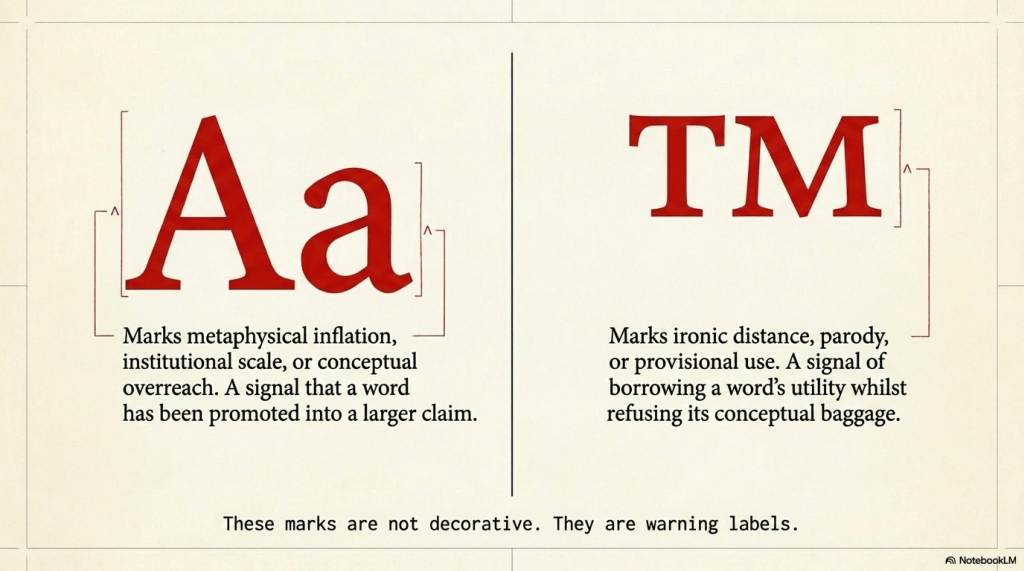
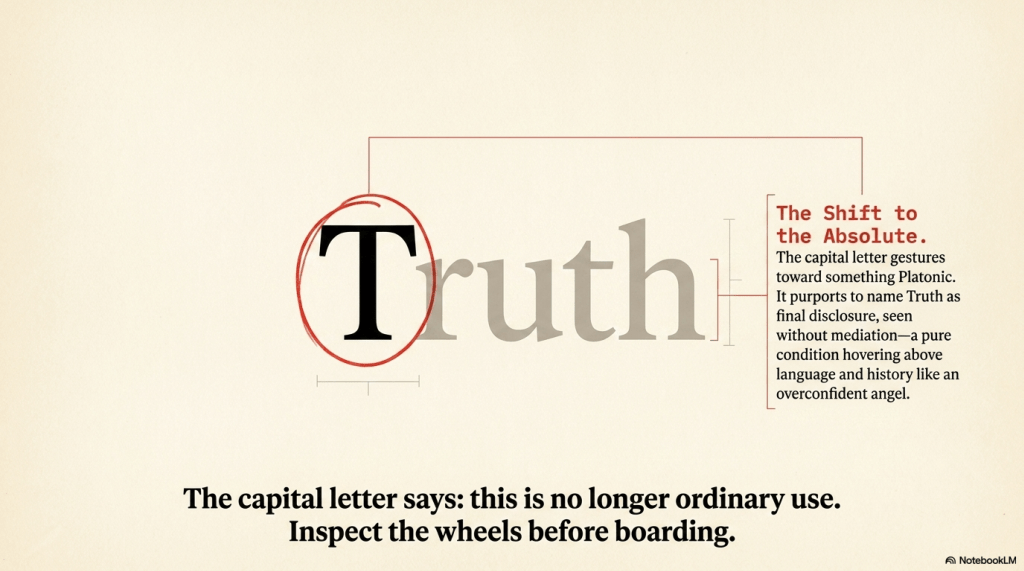
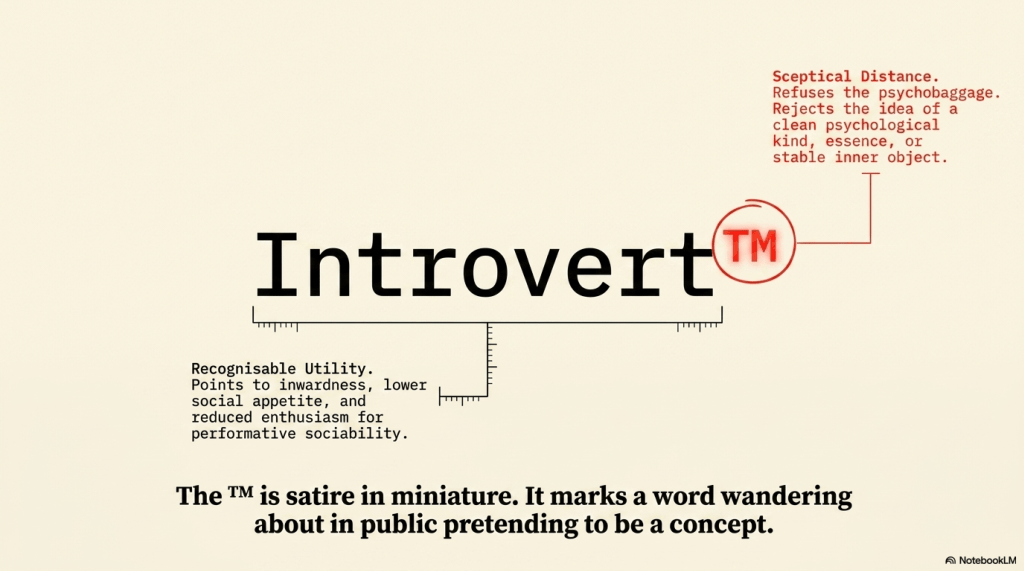
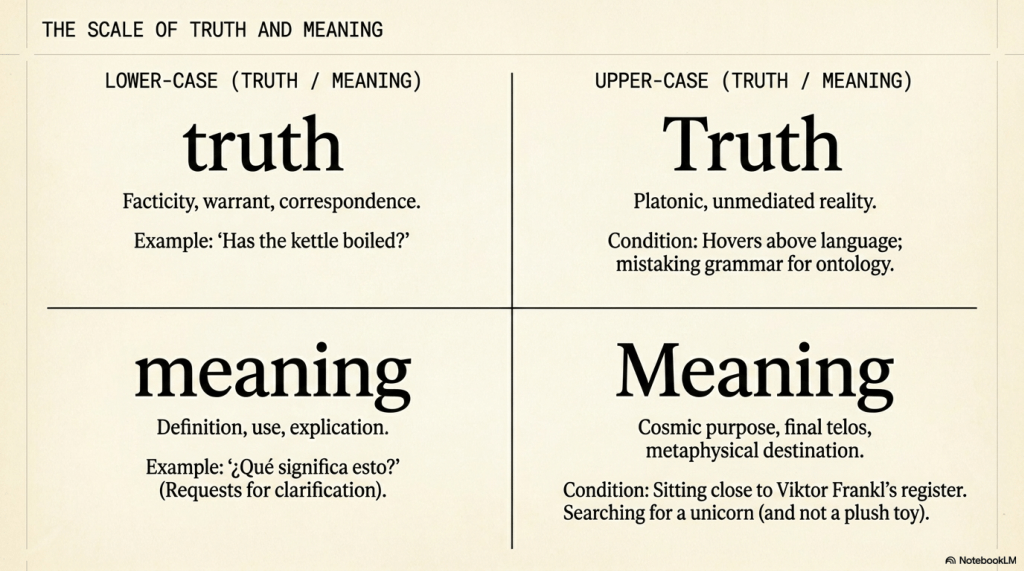
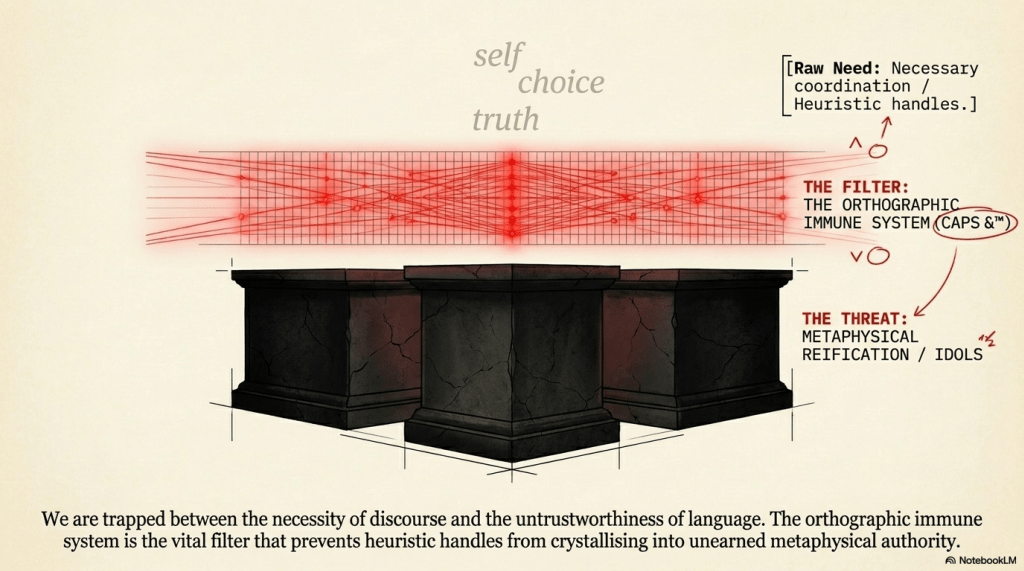
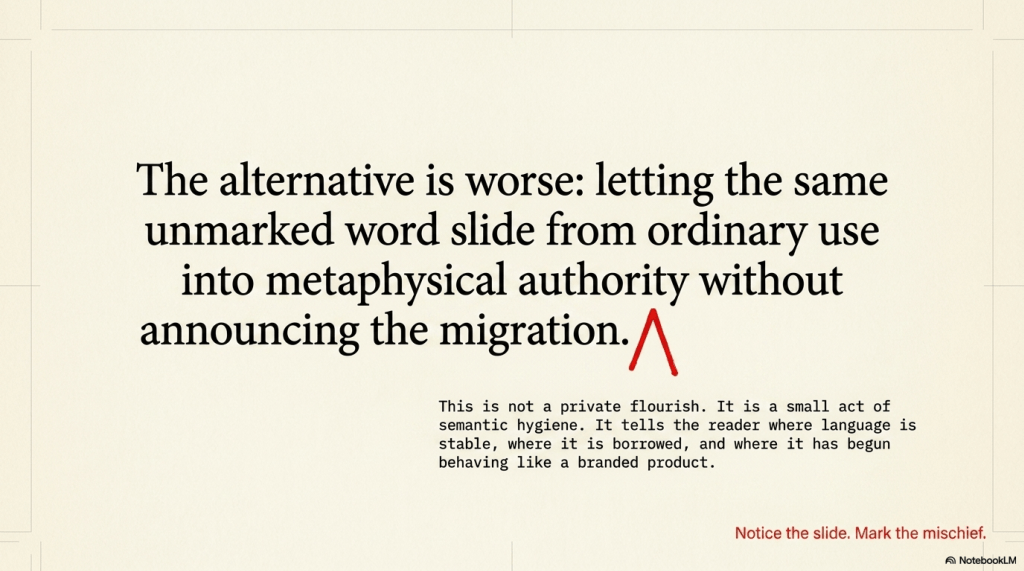
I have an orthographic habit, perhaps merely a private convention, though I rather suspect all conventions begin this way before someone gives them a Latin name and a committee. I use typography to signal when a word is doing more than pedestrian language ordinarily admits.
Reading Heidegger’s What Is Philosophy? set me going. Heidegger answers the question not by definition but by retrieval: he takes philosophia back into its Greek setting, as though the older word might disclose what philosophy is. The lecture is the occasion rather than the target. It offers a clean specimen of a manoeuvre that runs far wider. A word’s origin can show where a practice has been, but it can’t settle what the practice is. At least this is what I was thinking as he was making his case.
Semantic Infrastructure, Insufficiency, and the False Romance of Interoperability
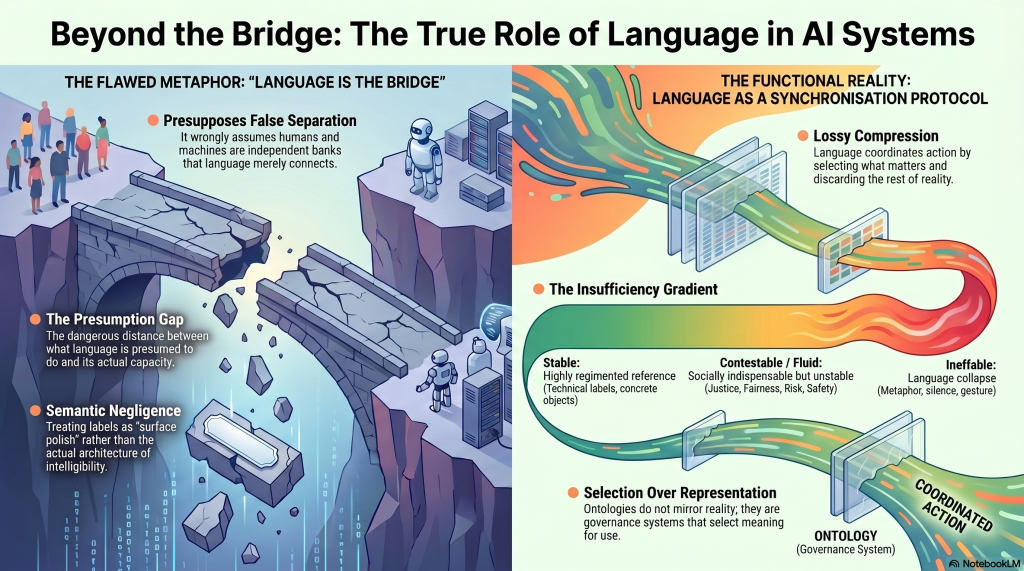
A recent Substack essay, Jessica Talisman’s Language Is the Bridge, makes a claim that is increasingly common in discussions of artificial intelligence, knowledge graphs, ontologies, metadata, and semantic infrastructure: that language is the bridge between human understanding and machine action. The claim is attractive, and not merely because ‘bridge’ is one of those metaphors that allows technical discourse to cosplay as wisdom literature. It captures something real. AI systems, semantic architectures, ontologies, taxonomies, controlled vocabularies, and knowledge graphs do not run on raw reality. They run on structured representations. Those representations require labels, definitions, mappings, alignments, constraints, and interpretive discipline. In that sense, language work is not decorative. It is infrastructural. But the metaphor is also dangerous.
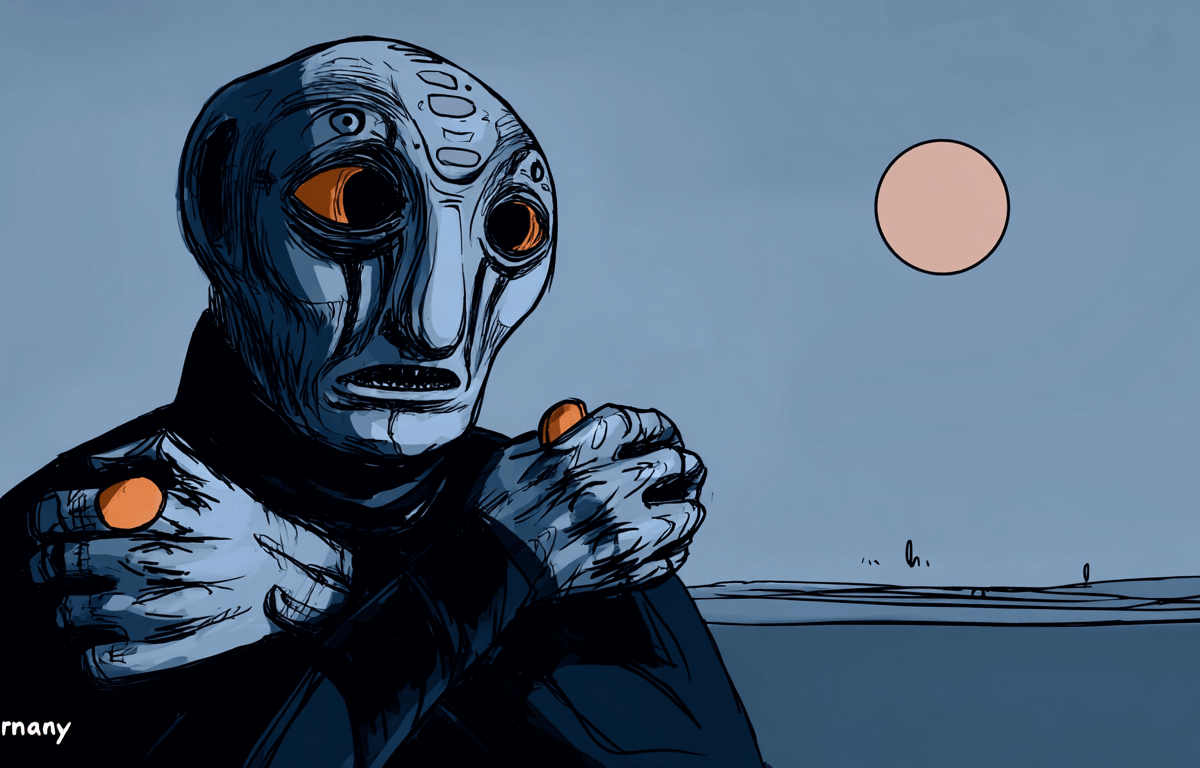
You wake up in the middle of a collapsing building. Someone hands you a map and says, find your way home. You look down. The map is for a different building entirely. One that was never built. Or worse, one that was demolished decades ago. The exits don’t exist. The staircases lead nowhere.
This is consciousness.
Audio: NotebookLM summary podcast on this topic.
We didn’t ask for it. We didn’t choose it. And the tools we inherited to navigate it—language, philosophy, our most cherished questions—were drawn for a world that does not exist.
Looking back at my recent work, I realise I’m assembling a corpus of pessimism. Not the adolescent kind. Not nihilism as mood board. Something colder and more practical: a willingness to describe the structures we actually inhabit rather than the ones we wish were there.
It starts with admitting that language is a compromised instrument. A tool evolved for coordination and survival, not for metaphysical clarity. And nowhere is this compromise more concealed than in our most sanctified word of inquiry.
1. The Weasel Word
We treat “why” as the pinnacle of human inquiry. The question that separates us from animals. Philosophy seminars orbit it. Religions are scaffolded around it. Children deploy it until adults retreat in defeat.
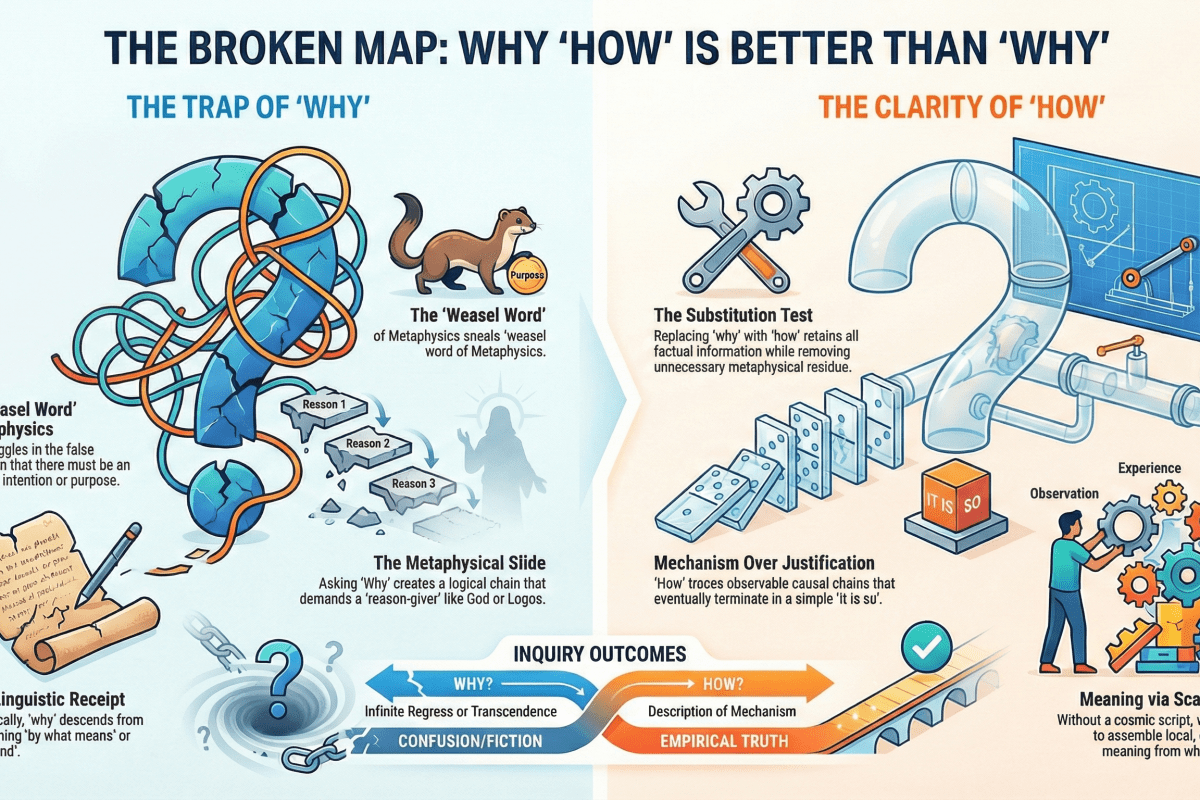
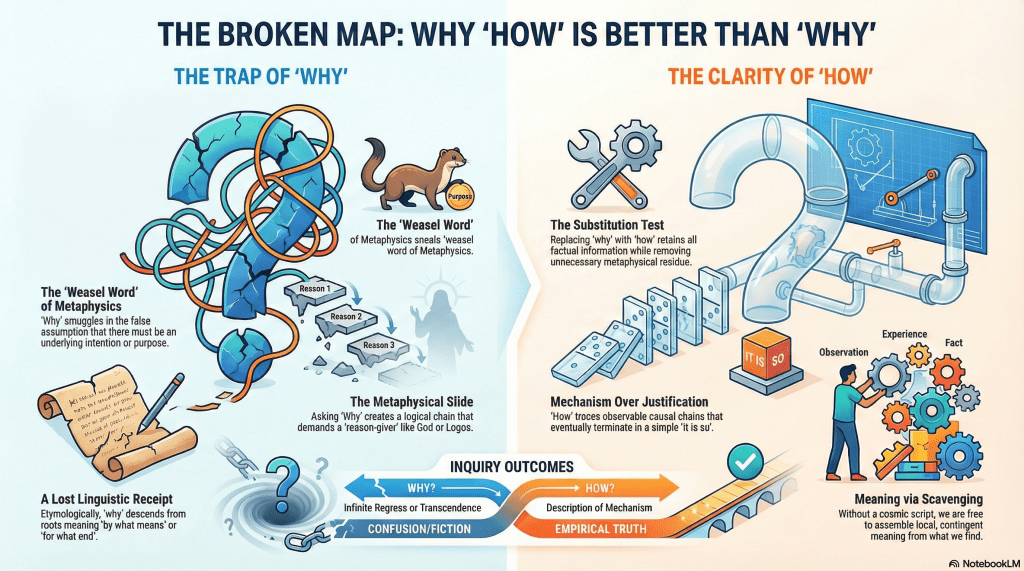
But “why” is a weasel word. A special case of how wearing an unnecessary coat of metaphysics.
The disguise is thinner in other languages. French pourquoi, Spanish por qué, Italian perché all literally mean for what. Japanese dōshite means by what way. Mandarin wèishénme is again for what. The instrumental skeleton is right there on the surface. Speakers encounter it every time they ask the question.
In the Indo-European lineage, “why” descends from the same root as “what”. It began as an interrogative of means and manner, not cosmic purpose. To ask “why” was originally to ask by what mechanism or for what end. Straightforward, workmanlike questions.
Over time, English inflated this grammatical shortcut into something grander. A demand for ultimate justification. For the Reason behind reasons.
The drift was slow enough that it went unnoticed. The word now sounds like a deeper category of inquiry. As if it were pointing beyond mechanism toward metaphysical bedrock.
The profundity is a trick of phonetic history. And a surprising amount of Anglo-American metaphysics may be downstream of a language that buried the receipt.
2. What “Why” Smuggles In
To see the problem clearly, follow the logic that “why” quietly encourages.
When we ask “Why is there suffering?” we often believe we are asking for causes. But the grammar primes us for something else entirely. It whispers that there must be a justification. A reason-giver. An intention behind the arrangement of things.
The slide looks like this:
“Why X?” → invites justification rather than description → suggests intention or purpose → presumes a mind capable of intending → requires reasons for those intentions → demands grounding for those reasons
At that point the inquiry has only two exits: infinite regress or a metaphysical backstop. God. Logos. The Good. A brute foundation exempt from the very logic that summoned it.
This is not a failure to answer the question. It is the question functioning exactly as designed.
Now contrast this with how.
“How did X come about?” → asks for mechanism → traces observable causal chains → bottoms out in description
“How” eventually terminates in it is so. “Why”, as commonly used, never does. It either spirals forever or leaps into transcendence.
This is not because we lack information. It is because the grammatical form demands more than the world can supply.
3. The Substitution Test
Here is the simplest diagnostic.
Any genuine informational “why” question can be reformulated as a “how” question without losing explanatory power. What disappears is not content but metaphysical residue.
“Why were you late?” → “How is it that you are late?”
“Why did the dinosaurs go extinct?” → “How did the dinosaurs go extinct?”
Asteroid impact. Climate disruption. No intention required.
Even the grand prize:
“Why is there something rather than nothing?” → “How is it that there is something?”
At which point the question either becomes empirical or dissolves entirely into it is. No preamble.
Notice the residual discomfort when “my car broke down” answers “why were you late”. Something feels unpaid. The grammar had primed the listener for justification, not description. For reasons, not causes.
The car has no intentions. It broke. That is the whole truth. “How” accepts this cleanly. “Why” accepts it while still gesturing toward something that was never there.
4. The Black Box of Intention
At this point the problem tightens.
If “why” quietly demands intentions, and intentions are not directly accessible even to the agents who supposedly have them, then the entire practice is built on narrative repair.
We do not observe our intentions. We infer them after the fact. The conscious mind receives a press release about decisions already made elsewhere and calls it a reason. Neuroscience has been showing this for decades.
So:
Asking others why they acted requests a plausible story about opaque processes
Asking oneself why one acted requests confabulation mistaken for introspection
Asking the universe why anything exists requests a fiction about a mind that is not there
“How” avoids this entirely. It asks for sequences, mechanisms, conditions. It does not require anyone to perform the ritual of intention-attribution. It does not demand that accidents confess to purposes.
5. Thrownness Without a Vantage Point
I stop short of calling existence a mistake. A mistake implies a standard that was failed. A plan that went wrong. I prefer something colder: the accident.
Human beings find themselves already underway, without having chosen the entry point or the terms. Heidegger called this thrownness. But the structure is not uniquely human.
The universe itself admits no vantage point from which it could justify itself. There is no external tribunal. No staging ground. No meta-position from which existence could be chosen or refused.
This is not a claim about cosmic experience. It is a structural observation about the absence of justification-space. The question “Why is there something rather than nothing?” presumes a standpoint that does not exist. It is a grammatical hallucination.
Thrownness goes all the way down. Consciousness is thrown into a universe that is itself without preamble. We are not pockets of purposelessness in an otherwise purposeful cosmos. We are continuous with it.
The accident runs through everything.
6. Suchness
This is not a new insight. Zen Buddhism reached it by a different route.
Where Western metaphysics treats “why” as an unanswered question, Zen treats it as malformed. The koan does not await a solution. It dissolves the demand for one. When asked whether a dog has Buddha-nature, the answer Mu does not negate or affirm. It refuses the frame.
Tathātā—suchness—names reality prior to justification. Things as they are, before the demand that they make sense to us.
This is not mysticism. It is grammatical hygiene.
Nietzsche smashed idols with a hammer. Zen removes the altar entirely. Different techniques, same target: the metaphysical loading we mistake for depth.
7. Scavenging for Meaning
If there is no True Why, no ultimate justification waiting beneath the floorboards of existence, what remains?
For some, this sounds like collapse. For me, it is relief.
Without a cosmic script, meaning becomes something we assemble rather than discover. Local. Contingent. Provisional. Real precisely because it is not guaranteed.
I find enough purpose in the warmth of a partner’s hand, in the internal logic of a sonata, in the seasonal labour of maintaining a garden. These things organise my days. They matter intensely. And they do so without claiming eternity.
I hold them lightly because I know the building is slated for demolition. Personally. Biologically. Cosmologically. That knowledge does not drain them of colour. It sharpens them.
This is what scavenging means. You build with what you find. You use what works. You do not pretend the materials were placed there for you.
Conclusion: The Sober Nihilist
To be a nihilist in this sense is not to despair. It is to stop lying about the grammar of the universe.
“Why” feels like a meaningful inquiry, but it does not connect to anything real in the way we imagine. It demands intention from a cosmos that has none and justification from accidents that cannot supply it.
“How” is enough. It traces causes. It observes mechanisms. It accepts that things sometimes bottom out in is.
Once you stop asking the universe to justify itself, you are free to deal with what is actually here. The thrown, contingent, occasionally beautiful business of being alive.
I am a nihilist not because I am lost, but because I have put down a broken map. I am looking at what is actually in front of me.
And that, it turns out, is enough.
Image: NotebookLM infographic of this topic
Full Disclosure: This article was output by ChatGPT after an extended conversation with it, Claude, and me. Rather than trying to recast it in my voice, I share it as is. I had started this as a separate post on nihilism, and we ended up here. Claude came up with the broken map story at the start and Suchness near the end. I contributed the weasel words, the ‘how’ angle, the substitution test, the metaphysics of motivation and intention, thrownness (Geworfenheit), Zen, and nihilism. ChatGPT merely rendered this final output after polishing my conversation with Claude.
We had been discussing Cioran, Zapffe, Benatar, and Ligotti, but they got left on the cutting room floor along the way.
Claude Opus 4.5 and ChatGPT 5.2 with input from Bry Willis
My expanded direction has roots in the works of George Lakoff, Jonathan Haidt, Kurt Gray, and Joshua Greene. These people circle around the problem, even identify it, but then summarily ignore it.
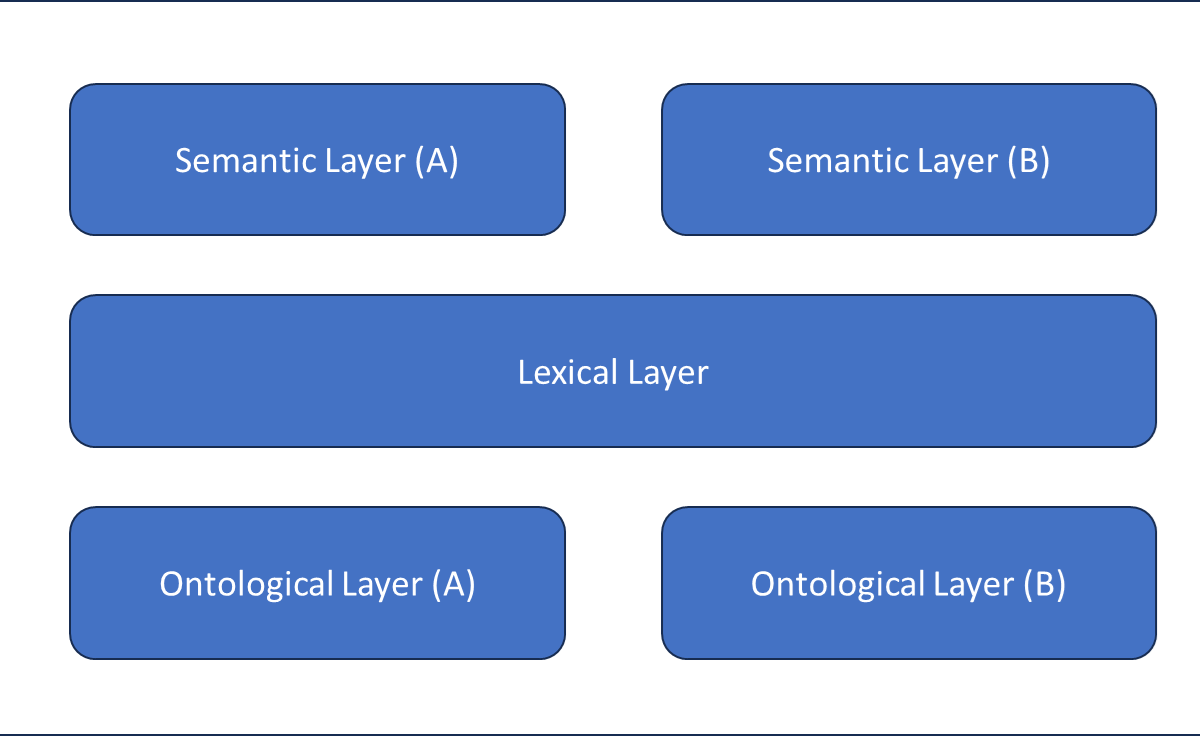
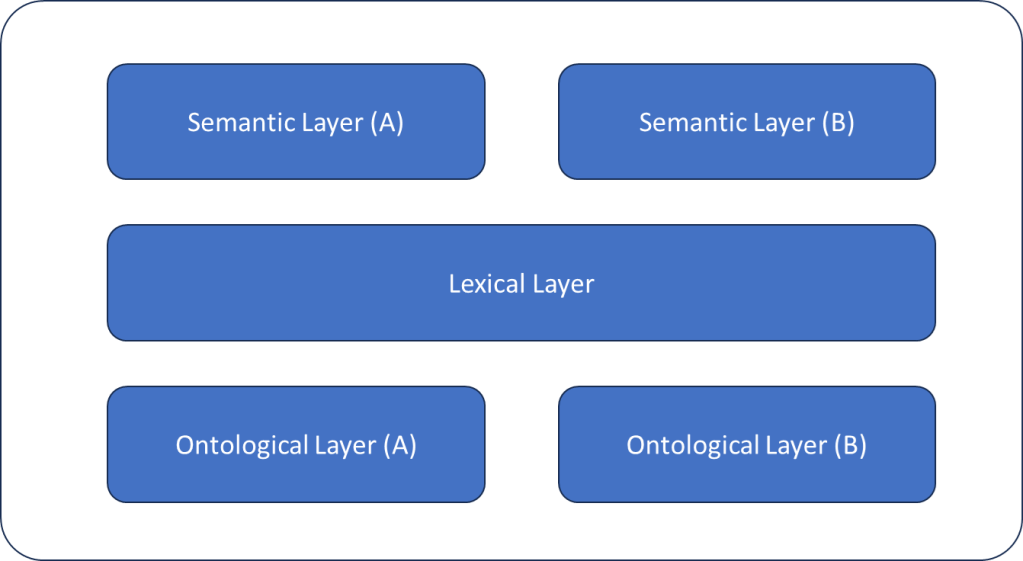
Image: This figure illustrates a simplified layered model of moral and political disagreement. Agents share a common lexical layer, enabling communication and the appearance of mutual understanding. Beneath this surface, however, ontological orientations diverge, structuring salience, legitimacy, and relevance prior to articulation. Semantic interpretation emerges downstream of these ontological commitments, producing divergent meanings despite shared vocabulary. The model highlights why disputes persist even under conditions of factual agreement and linguistic overlap: the instability lies not in words themselves, but in the ontological substrates from which semantic projections are drawn.
It’s more involved than this, but at a 50,000-foot level, it conveys the essence of my hypothesis.
I am also working on this logical expression:
∀ outcomes I(E), ∃ i,j such that Jᵢ ≠ Jⱼ
where,
Jᵢ = f(Oᵢ, E, I, RNG)
Also, in a particular context:
This will all make more sense in time. I’ll be publishing a manuscript as I study supporting research and develop my own perspectives.
Lewis Goodall, a talk show host, calls the cross-border seizure of Venezuela’s Nicolás Maduro a ‘kidnapping’. His guest and Trump apologist, Angie Wong, rejects the word. She first says ‘arrest’, then ‘extradition’, then finally the improvised ‘special extradition’. Around that single lexical choice, a 12-minute standoff unfolds.
Audio: NotebookLM summary podcast of this topic.
As a language philosopher, I am evaluating the language and am less concerned with the underlying facts of the matter. Language serves to obscure these facts from the start and then rhetorically controls the narrative and framing.
Video: Source segment being analysed
There is a familiar mistake made whenever public discourse turns heated: the assumption that the real disagreement lies in the facts. This is comforting, because facts can, at least in principle, be checked. What follows examines a different failure mode altogether. The facts are largely beside the point.
Consider a broadcast exchange in which a political commentator and an interviewer argue over how to describe the forcible removal of a head of state from one country to another. The interviewer repeatedly uses the word kidnapping. The guest repeatedly resists this term, preferring arrest, extradition, and eventually the improvisational compromise ‘special extradition’.
What matters here is not which term is correct. What matters is what the interaction reveals about how meaning is negotiated under pressure.
The illusion of disagreement
Superficially, the exchange appears to be a dispute about legality. Was there a treaty? Was due process followed? Which court has jurisdiction? These questions generate heat, but they are not doing the work.
The real disagreement is prior to all of that: which lexical frame is allowed to stabilise the event.
Once a label is accepted, downstream reasoning becomes trivial. If it was an extradition, it belongs to one legal universe. If it was a kidnapping, it belongs to another. The participants are not arguing within a shared framework; they are competing to install the framework itself.
Equivocation as method, not error
The guest’s shifting vocabulary is often described as evasive or incoherent. This misreads what is happening. The movement from extradition to special extradition is not confusion. It is a deliberate widening of semantic tolerance.
‘Special extradition’ is not meant to clarify. It is meant to survive. It carries just enough institutional residue to sound procedural, while remaining sufficiently vague to avoid binding criteria. It functions less as a description than as a holding pattern.
This is equivocation, but not the amateur kind taught in logic textbooks. It is equivocation under constraint, where the aim is not precision but narrative continuity.
Why exposure fails
The interviewer repeatedly points out that extradition has a specific meaning, and that the situation described does not meet it. This is accurate, and also ineffective.
Why? Because the exchange is no longer governed by definitional hygiene. The audience is not being asked to adjudicate a dictionary entry. They are being asked to decide which voice has the authority to name the act.
Once that shift occurs, exposing misuse does not correct the discourse. It merely clarifies the power asymmetry. The guest can concede irregularity, precedent-breaking, even illegality, without relinquishing control of the label. The language continues to function.
Truth as a downstream effect
At no point does the exchange hinge on discovering what ‘really happened’. The physical sequence of events is relatively uncontested. What is contested is what those events are allowed to count as.
In this sense, truth is not absent from the discussion; it is subordinate. It emerges only after a rhetorical frame has been successfully installed. Once the frame holds, truth follows obediently within it.
This is not relativism. It is an observation about sequence. Rhetoric does not decorate truth here; it prepares the ground on which truth is later claimed.
Language doing institutional work
The most revealing moment comes when the guest effectively shrugs at the legal ambiguity and asks who, exactly, is going to challenge it. This is not cynicism. It is diagnostic.
Words like arrest and extradition are not merely descriptive. They are operational tokens. They open doors, justify procedures, and allow institutions to proceed without stalling. Their value lies less in semantic purity than in administrative usability.
‘Kidnapping’ is linguistically precise in one register, but administratively useless in another. It stops processes rather than enabling them. That is why it is resisted.
What the case study shows
This exchange is not about geopolitics. It is about how language behaves when it is tasked with carrying power. Meaning drifts not because speakers are careless, but because precision is costly. Labels are selected for durability, not accuracy. Truth does not arbitrate rhetoric; rhetoric allocates truth. Seen this way, the debate over terminology is not a failure of communication. It is communication functioning exactly as designed under modern conditions. Which is why insisting on ‘the correct word’ increasingly feels like shouting into a ventilation system. The air still moves. It just isn’t moving for you.
A great deal of philosophy begins with the claim that we ought to examine our assumptions. Fewer philosophers seem interested in examining the mechanisms that decide which assumptions are allowed to count as philosophy in the first place.
This is not a polemic about the Analytic–Continental divide. It’s an observation about how that divide quietly maintains itself. The immediate provocation was banal. Almost embarrassingly so.
Are cold, or do we have cold?
In English, the answer feels obvious. I am cold. The grammar barely registers. In French, Italian, or German, the structure flips. One has cold. Or hunger. Or thirst. Or age. Or a name, understood as something one performs rather than something one is. I spoke about this here and here. Indulge this link to the original position being argued.
On the surface, this looks like a curiosity for linguistics students. A translation quirk. A grammatical footnote. But grammar is rarely innocent.
Audio: NotepadLM summary podcast on this topic.
Grammar as Ontological Scaffolding
The verbs to be and to have are not neutral carriers. They quietly encode assumptions about identity, property, possession, and stability.
When I say I am cold, I cast coldness as a property of the self. It becomes something like height or nationality: a state attributable to the person. When I say I have cold, the experience is externalised. The self remains distinct from the condition it undergoes. Neither option is metaphysically clean.
Both structures smuggle in commitments before any philosophy has been done. One risks inflating a transient sensation into an ontological state. The other risks reifying it into a thing one owns, carries, or accumulates. My own suggestion in a recent exchange was a third option: sensing.
Cold is not something one is or has so much as something one feels. A relational encounter. An event between organism and environment. Not an identity predicate, not a possession.
This suggestion was met with a fair pushback: doesn’t saying that cold ‘belongs to the world’ simply introduce a different metaphysical assumption? Yes. It does. And that response neatly demonstrates the problem.
When Grammar Starts Doing Philosophy
The original claim was idiomatic, not ontological. It was a negative gesture, not a positive thesis. The point was not to relocate cold as a mind-independent substance floating about like a rock. It was to resist treating it as an essence of the person. But once you slow down, you see how quickly everyday grammar demands metaphysical loyalty.
Being invites substance. Having invites inventory. Sensing keeps the relation open, but even that makes people nervous. This nervousness is instructive. It reveals how much metaphysical weight we quietly load onto grammatical habits simply because they feel natural. And that feeling of naturalness matters more than we like to admit.
Two Philosophical Temperaments, One Linguistic Groove
At this point, the temptation is to draw a clean line:
On one side: the Anglo-American Analytic tradition, comfortable treating mental states as properties, objects, or items to be catalogued. Locke’s introspective inventory. Hume’s bundle. Logical positivism’s clean surfaces.
On the other: the Continental tradition, suspicious of objectification, insisting on an irreducible subject for whom experience occurs but who is never identical with its contents. Kant, Husserl, Heidegger, Sartre.
The grammar aligns disturbingly well. Languages that habitually say I am cold make it feel natural to treat experience as something inspectable. Languages that insist on having or undergoing experiences keep the subject distinct by default.
This is not linguistic determinism. English speakers can read phenomenology. German speakers can do analytic philosophy. But language behaves less like a prison and more like a grooved path. Some moves feel obvious. Others feel forced, artificial, or obscure.
Philosophies do not arise from grammar alone. But grammar makes certain philosophies feel intuitively right long before arguments are exchanged.
Where Gatekeeping Enters Quietly
This brings us to the part that rarely gets discussed.
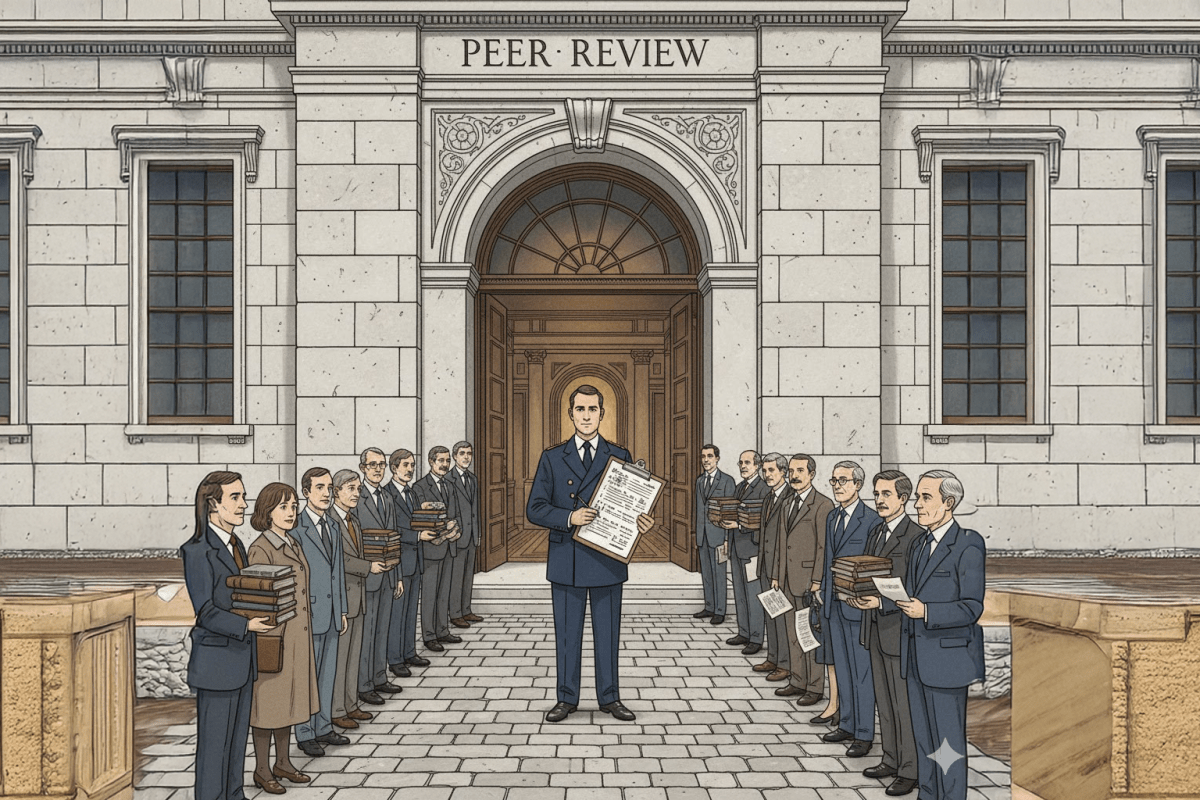
The Analytic–Continental divide persists not only because of philosophical disagreement, but because of institutional reinforcement. Peer review, citation norms, and journal cultures act as boundary-maintenance mechanisms. They are not primarily crucibles for testing ideas. They are customs checkpoints for recognisability.
I have been explicitly cautioned, more than once, to remove certain figures or references depending on the venue. Don’t mention late Wittgenstein here. Don’t cite Foucault there. Unless, of course, you are attacking them. This is not about argumentative weakness. It’s about genre violation.
Hybrid work creates a problem for reviewers because it destabilises the grammar of evaluation. The usual criteria don’t apply cleanly. The paper is difficult to shelve. And unshelvable work is treated as a defect rather than a signal. No bad faith is required. The system is doing what systems do: minimising risk, preserving identity, maintaining exchange rates.
Cold as a Diagnostic Tool
The reason the cold example works is precisely because it is trivial.
No one’s career depends on defending a metaphysics of chilliness. That makes it safe enough to expose how quickly grammar starts making demands once you pay attention.
If something as mundane as cold wobbles under scrutiny, then the scaffolding we rely on for far more abstract notions – self, identity, agency, consciousness – should make us uneasy.
And if this is true for human languages, it becomes far more pressing when we imagine communication across radically different forms of life.
Shared vocabulary does not guarantee shared metaphysics. Familiar verbs can conceal profound divergence. First contact, if it ever occurs, will not fail because we lack words. It will fail because we mistake grammatical comfort for ontological agreement.
A Modest Conclusion
None of this settles which philosophical tradition is ‘right’. That question is far less interesting than it appears. What it does suggest is that philosophy is unusually sensitive to linguistic scaffolding, yet unusually resistant to examining the scaffolding of its own institutions.
We pride ourselves on questioning assumptions while quietly enforcing the conditions under which questions are allowed to count. Cold just happens to be a good place to start noticing.
A Footnote on Linguistic Determinism
It’s worth being explicit about what this is not. This is not an endorsement of strong linguistic determinism, nor a revival of Sapir–Whorf in its more ambitious forms. English speakers are not condemned to analytic philosophy, nor are Romance-language speakers predestined for phenomenology.
Language does not imprison thought. It inclines it.
Grammar operates less like a set of handcuffs and more like a well-worn path. Some moves feel effortless. Others require deliberate resistance. Philosophical traditions co-evolve with these habits, reinforcing what already feels natural while treating alternatives as strained, obscure, or unnecessary.
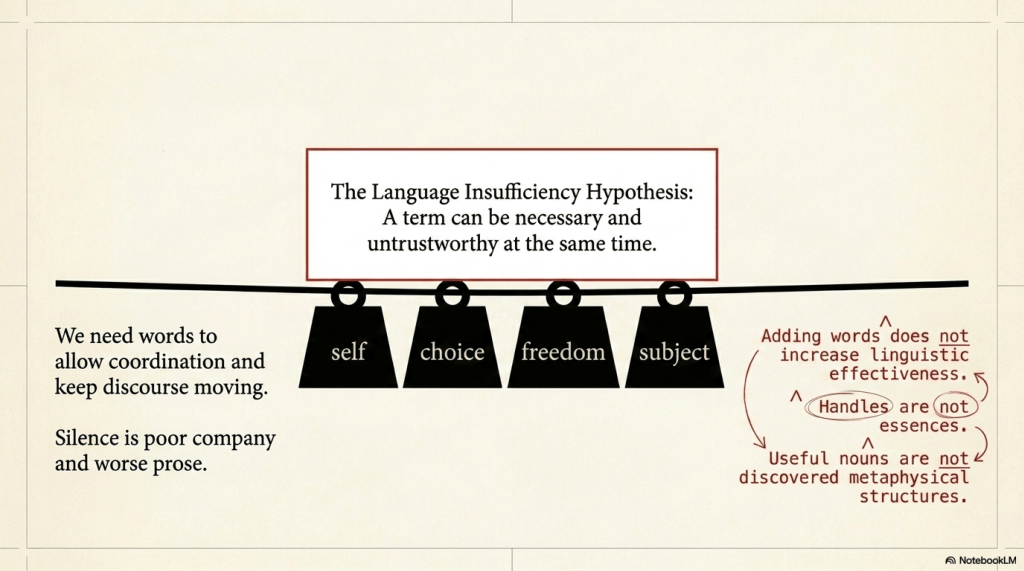
As the publication date of A Language Insufficiency Hypothesis (LIH) draws nearer, I feel it’s a good time to promote it (obviously) and to introduce some of the problems it uncovers – including common misperceptions I’ve already heard. Through this feedback, I now understand some of the underlying structural limitations that I hadn’t considered, but this only strengthens my position. As I state at the start of the book, the LIH isn’t a cast-in-stone artefact. Other discoveries will inevitably be made. For now, consider it a way to think about the deficiencies of language, around which remediation strategies can be developed.
Audio: NotebookLM summary podcast of this content.
Let’s clear the undergrowth first. The Language Insufficiency Hypothesis is not concerned with everyday ambiguity, garden-variety polysemy, or the sort of misunderstandings that vanish the moment someone bothers to supply five seconds of context. That terrain is already well-mapped, thoroughly fenced, and frankly dull.
Take the classic sort of example wheeled out whenever someone wants to sound clever without doing much work:
‘I made a 30-foot basket’.
Video: a woman making a large basket
If you’re a basketweaver, you picture an absurdly large basket and quietly question the maker’s life choices. If you’re watching basketball, you hear ‘score’. If you’re anywhere near the context in which the sentence was uttered, the meaning is obvious. If it isn’t, the repair cost is trivial. Add context, move on, live your life.
Language did not fail here. It merely waited for its coat. This is not the sort of thing the LIH loses sleep over.
The Groucho Marx Defence, or: Syntax Is Not the Problem
Logicians and armchair philosophers love to reach for jokes like Groucho Marx’s immortal line:
‘I shot an elephant in my pyjamas. Why it was wearing my pyjamas, I’ll never know’.
Video: A man and elephant in pyjamas (no sound)
Yes, very funny. Yes, the sentence allows for a syntactic misreading. No, nobody actually believes the elephant was lounging about in striped silk. The humour works precisely because the “wrong” parse is momentarily entertained and instantly rejected.
Again, language is not insufficient here. It’s mischievous. There’s a difference.
If the LIH were worried about this sort of thing, its ambitions would be indistinguishable from an undergraduate logic textbook with better branding.
Banks, Rivers, and the Myth of Constant Confusion
Likewise, when someone in a city says, ‘I went to the bank’, no sane listener imagines them strolling along a riverbank, unless they are already knee-deep in pastoral fantasy or French tourism brochures. Context does the heavy lifting. It almost always does.
Video: Rare footage of me trying to withdraw funds at my bank (no sound)
This is not a crisis of meaning. This is language functioning exactly as advertised.
Where the Trouble Actually Starts: Contestables
The LIH begins where these tidy examples stop being helpful. It concerns itself with Contestables: terms like truth, freedom, justice, fairness, harm, equality. Words that look stable, behave politely in sentences, and then detonate the moment you ask two people what they actually mean by them. These are not ambiguous in the casual sense. They are structurally contested.
In political, moral, and cultural contexts, different groups use the same word to gesture at fundamentally incompatible conceptual frameworks, all while assuming a shared understanding that does not exist. The conversation proceeds as if there were common ground, when in fact there is only overlap in spelling.
That’s why attempts to ‘define’ these terms so often collapse into accusation:
That’s not what freedom means. That’s not real justice. You’re redefining truth.
No, the definitions were never shared in the first place. The disagreement was smuggled in with the noun.
‘Just Ignore the Word’ Is Not a Rescue
A common response at this point is to suggest that we simply bypass the troublesome term and discuss the concrete features each party associates with it. Fine. Sensible. Often productive. But notice what this manoeuvre concedes. It does not save the term. It abandons it.
If meaningful discussion can only proceed once the word is set aside and replaced with a list of clarifications, constraints, examples, and exclusions, then the word has already failed at its primary job: conveying shared meaning. This is precisely the point the LIH is making.
The insufficiency is not that language is vague, or flexible, or context-sensitive. It’s that beyond a certain level of conceptual complexity, language becomes a confidence trick. It gives us the feeling of agreement without the substance, the appearance of communication without the transaction.
At that point, words don’t merely underperform. They mislead.
I shared this post not too long ago. Today, I shared it in a different context, but I feel is interesting – because I feel that many things are interesting, especially around language and communication.
Ocrampal shared a link to an article debating whether we are cold or have cold. Different cultures express this differently. It’s short. Read it on his site.
Audio: Exceptional NotebookLM summary podcast of this topic.
I replied to the post:
Nicely observed. I’ve pondered this myself. Small linguistic tweak: between être and avoir, avoir already behaves better metaphysically, but sentir seems the cleanest fit. Cold isn’t something one is or has so much as something one senses — a relational encounter rather than an ontological state or possession.
Between having and being, having is the lesser sin — but sensing/feeling feels truer. Cold belongs to the world; we merely sense it.
He replied in turn:
Agree except for: “Cold belongs to the world”. That is a metaphysical assumption that has consequences …
Finally (perhaps, penultimately), I responded:
Yes, it does. That statement was idiomatic, to express that ‘cold’ is environmental; we can’t be it or possess it. Coincidentally, I recently wrote about ‘cold’ in a different context:
A more verbose version of this response might have been:
This pushback is fair, but I’m not trying to re-ontologise cold. “Belongs to the world” in that context is doing rhetorical, not metaphysical, work; it’s idiomatic.
The point isn’t that cold is a mind-independent substance waiting around like a rock. It’s that whatever cold is, it doesn’t sit comfortably as an identity predicate (‘I am…cold’ – ‘J’ai…froid‘) or a possession (‘I have…cold’ – so, not ‘Je suis…froid‘) – neither to be confused with ‘I have a cold’, a different animal altogether.
‘Sensing’ (‘I feel…cold’ – ‘Je me sens…froid‘ – we have to use the reflexive pronoun, me, here; in English, this syntax has been deprecated) keeps the relation explicit without smuggling in ownership or essence. It leaves cold as an encounter-property, not a thing I contain and not a thing I am.
If anything, that phrasing was meant to resist metaphysical inflation, not commit to it.
And this is exactly the problem I gestured at in the aliens piece. We mistake familiar grammatical scaffolding for shared metaphysics. We assume that if the sentence parses cleanly, the ontology must be sound.
Language doesn’t just describe experience. It quietly files it into categories and then acts surprised when those categories start making demands.
Cold, like aliens, exposes the trick. The moment you slow down, the grammar starts to wobble. And that wobble is doing far more philosophical work than most of our declarative sentences are willing to admit.
Naturally, it will make more sense alongside the book. But it may still provide a bit of entertainment – and mild discomfort – in the meantime.
tl;dr: Language is generally presumed to be stable. Words mean what you think they mean, right? A table is a table. A bird is a bird. Polysemy aside, these are solid, dependable units.
Then we arrive at freedom, justice, truth, and an entire panoply of unstable candidates. And let’s not even pretend qualia are behaving themselves.
So when someone says ‘truth’, ‘free speech’, or ‘IQ’, you may suddenly realise you’ve been arguing with a cardboard cut-out wearing your own assumptions. That isn’t just interpersonal mischief. It’s language doing exactly what it was designed to do: letting you glide over the hard problems while sounding perfectly reasonable.
Audio: Short NotebookLM summary of this page content*
Video: Legacy video explaining some features of the LIH.
If that sounds banal, you’ve already fallen for the trap.
Give it a try – or wait until you’ve digested the book. Not literally, unless you’re short on fibre.
Cheers.
Written by Bry Willis
Philosophics
* As I’ve cited previously, the quality of NotebookLM varies – usually in predictable directions. This one does well enough, but it doesn’t have enough context to get the story right (because it was only drawing from this page rather than from a fuller accounting of the LIH). Its trailing comment reveals that it doesn’t grasp that “new words” don’t solve the problem.
Earlier, it suggests that language is intentionally vague. This is not an assertion I make. You can read some of the earlier incarnations, or you can wait for it to be published.





 Philosophics