Free Speech, Pseudo-Invariance, and the Grammar of Liberal Rights – Part 1

I read from the Wrong Curve: Free Speech, Pseudo-Invariance, and the Grammar of Liberal Rights. This essay is freely available on Zenodo at https://doi.org/10.5281/zenodo.19636760. This segment is the Abstract and the Introduction.

In this essay, I argue that free speech discourse is structured by a category error whose source lies upstream of speech itself: in the treatment of ‘freedom’ as a stable philosophical primitive when it functions, in practice, as an essentially contested concept operating under a systematically inflated presumption of effectiveness.

tl;dr: I don’t believe in free speech.

We’ve all likely heard that the freedom to swing one’s fist ends at the tip of another’s nose. I can accept this without argument for the purpose of this assertion. Your freedom TO violates my freedom FROM.

Audio: NotebookLM summary podcast of this topic.

The problem is that one’s words don’t stop. In some cases, they continue in the manner of pollution that I don’t want my ear holes to be exposed to this noise. In the social media age, this effect is trebled and molests my eyes. This is especially egregious for misinformation and disinformation, which is to say, much of the internet and beyond.

This impact hasn’t been suitably addressed, so I wrote about it. Here, I read.

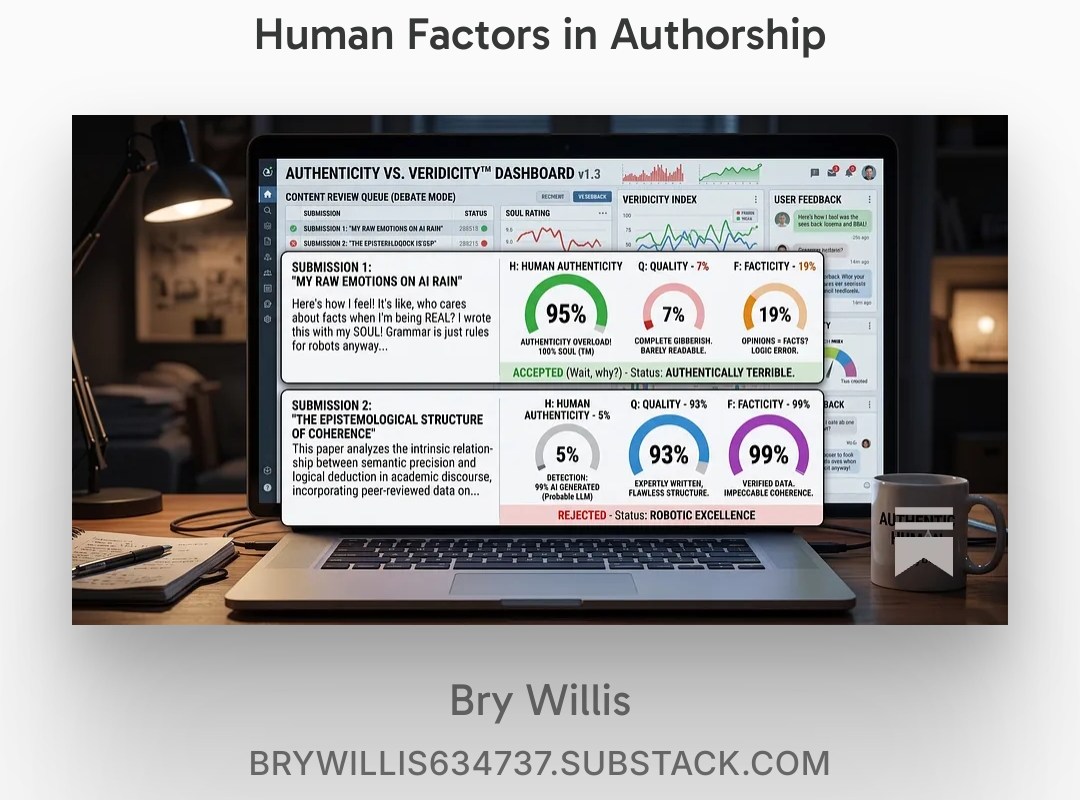
The Author Did Not Write This

4–6 minutes

The LinkedIn consensus has spoken: if you used AI in the writing process, you are not the author. The position is stated with the confidence of someone who has never hired a ghostwriter, employed a research assistant, submitted to a heavy editor, or considered that the Gettysburg Address was almost certainly not written by Lincoln.

Image: I couldn’t not share this Midjourney 8.1 image. It may not have understood the assignment.
Audio: NotebookLM summary podcast of this topic.

Authorship has never been a production relation. It has always been an attribution relation — an institutionally stabilised answer to the question of which name the practice elects to put on the cover. These are not the same thing, and conflating them is the error from which every subsequent confusion proceeds.

The ghostwriter has existed as long as commercial publishing. The political speechwriter is so normalised that nobody considers it worth remarking. The celebrity memoir, the corporate thought-leadership piece, the attributed editorial — these are not edge cases or embarrassing exceptions. They are the normal operation of every writing-adjacent industry that has ever existed. The name on the cover has never reliably indicated the hands on the keyboard, and the industry has never seriously pretended otherwise. It has simply preferred not to discuss it at dinner.

AI changes the tool. It does not change the structure. The person who prompts, selects, curates, revises, and publishes is doing what commissioners of ghostwriters have always done. What has changed is that AI makes the mediation visible in a way that polite convention previously concealed. Visibility triggers the purity reflex. What presents itself as a defence of authentic authorship is a defence of a particular fiction — the Romantic author as solitary originating consciousness — that the industry never consistently believed and certainly never consistently practised.

The purity position also fails on its own terms before it gets started. Consider the spectrum of AI-assisted writing: a full draft submitted for light polish; a human argument substantially revised by AI; collaborative ideation followed by AI drafting; a kernel of an idea handed over for full execution. These are genuinely different in terms of human contribution. The zealot position requires a threshold somewhere on this spectrum below which authorship lapses. It never specifies where. More fatally, it has no means of verification. There is no external method of determining where on the spectrum any given piece of writing falls. The detector tools are probabilistic noise that disproportionately penalise competent prose. Any audit mechanism sophisticated enough to catch first-order evasion immediately generates a second-order workaround. The regress terminates only at continuous surveillance of the writing process — panoptical authorship as the logical endpoint of the position taken seriously.

NotebookLM Infographic on this topic.

Then there is the recursion problem, which the zealot never addresses because it is fatal. The stochastic parrot charge against AI — that it merely recombines absorbed linguistic patterns without genuine origination — describes with considerable accuracy what human cognition also does. The writer’s training data is the Dickens read at ten, the billboard absorbed on a commute, the argument overheard on public transit, the half-remembered essay that shaped a position without ever being consciously cited. The causal chain of any human idea disappears into an unauditable cognitive history. Genuine origination in the sense the purity position requires has never existed. The Romantic author was always a retrospective confabulation. Barthes said so in 1967. The industry nodded politely and continued invoicing.

What the zealot is defending is not authorship. It is a particular grammar of authorship — one that selects compositional origin as the threshold criterion, applies it selectively and unverifiably, and uses the resulting suspicion as a status boundary. It is guild behaviour dressed as principle, which is understandable as a response to a genuine economic threat but should not be mistaken for a philosophical position.

Authorship is the position a culture elects to stabilise after the work has already been produced through far messier means. It has always been thus. AI did not break the fiction. It just made the fiction harder to keep a straight face about.


The Rest of the Story

I’ve written about this before. I am not an AI apologist, but I am peeved by anti-LLM zealots, who clearly haven’t thought through their arguments.

I finished reading A.J. Ayer’s Language, Truth, and Logic, the part about Bertrand Russell’s claim about ‘The author of Waverley was Scotch‘. My brain latched onto authorship, and my emotional response was WTF? I have other problems with Russell and Ayer on this, but that’s a matter for another day.

To make my point, this page up to the ellipsis is the output of Claude after an extended dialogue with it and ChatGPT after I read Ayers, and something didn’t sit quite right. I am not ashamed to use LLMs in my authoring workflow and am not ashamed to mention it, as here. Almost all of these thoughts are mine. I’ve simply asked Claude to organise the output. It’s good enough to output as-is, and any edits would be trivial, so I won’t bother. I probably could have made the edits in as much time as it took to type this, but I’ve got nothing to hide. I’m just a human with access to technology circa 2026.

Rival Moral Approaches of the Modern World – Alasdair Macintyre

1–2 minutes

Alasdair MacIntyre is persuasive when he argues that moral discourse is never neutral, and that modern liberalism smuggles in substantive standards while pretending not to. But he dismisses emotivism too quickly as a cultural disaster rather than considering whether it might describe moral language more accurately than his own teleological alternative. If moral utterance is fundamentally prescriptive or expressive rather than descriptive, then the collapse of ‘view from nowhere’ morality doesn’t send us scurrying back to Aristotle. It simply shows that moral language was never doing the metaphysical work MacIntyre wants from it.

The Aristotelian remedy also depends on a nostalgic and anachronistic social model. The Athens he implicitly romanticises was a small polis whose demos consisted of citizens, meaning property-owning males, already bound by shared norms, proximity, and cultural inheritance. In other words, the sort of thick local world that made a certain kind of practical ethical life possible in the first place. MacIntyre’s causal arrow points the wrong way. In Athens, democratic practice emerged from that prior social texture. You do not reproduce the same conditions by philosophical edict.

Audio: NotebookLM summary podcast of this topic.

To put it more bluntly: I don’t think moral realism is tenable, and I am not convinced MacIntyre really thinks so either. His project reads less like a discovery of moral facts than an attempt to promote an ought into an is by force of inheritance and rhetorical confidence. If he carved out a bounded cohort and imposed the right shared practices, perhaps something like his model could function. He may need to annex a reasonably sized car park for the purpose.

NotebookLM Infographic on this topic.

Art or Content

3–4 minutes

So glad I took time out to watch a short exchange between Rick Beato and Justin Hawkins on whether music is becoming content rather than art. The question is framed in musical terms, but it hardly stops there. The same corrosion is visible in writing, visual art, criticism, and now, with grim inevitability, in AI-mediated production more broadly. The disease is not confined to music. Music merely makes the symptoms easier to hear.

For music, my aversion to pop music goes back to my youth. I was a kid when the Beatles practically invented pop music, but they left it to grow and continued exploring. Sadly, as solo artists, they mainly – not always – failed and rested on their laurels in pop. It’s not that their version or any pop music is inherently unlistenable. Surely, it’s not, if only by the aspiration of the pop moniker, but it has no depth, no soul, as it were. Some make this argument for Organic food. In essence, it involves an appeal to nature fallacy.

Audio: Slightly off, but not bad, NotebookLM summary podcast of this topic.

My own aversion to much pop music begins there. It is not that pop is necessarily bad, nor even that it is always shallow. That would be too crude and too easy. The problem is that pop often presents itself less as an artistic act than as a consumption object engineered for immediate uptake: catchy, frictionless, emotionally legible, and just disposable enough to make room for the next one. It is built to circulate.

That, for me, is the difference between content and art. Art may be accessible, even popular, but it retains some residue that exceeds its delivery mechanism. It resists total reduction to utility. Content, by contrast, is made to be processed. It is optimised not for depth but for throughput. Its highest ambition is not transformation, but engagement.

This is why the question matters beyond music. Writing, too, now lives under the same pressure. One is increasingly expected to produce not essays, arguments, or works, but units of output: posts, threads, reactions, takes, summaries, explainers, and other forms of polished verbal debris. The point is no longer to say something worth dwelling on, but to remain visible within the churn.

The issue, then, is not simply whether one should consume AI-generated material. That framing is too pious and too easy. The more interesting question is what the consumer thinks they are consuming. If a reader, listener, or viewer wants only speed, familiarity, and surface competence, then AI content is not a scandal at all. It is the logical endpoint of a culture that has already demoted art into a deliverable.

This is where the fuss over labelling enters. Is it a principled demand for honesty, or merely a theatrical gesture by people who still want the aura of art whilst consuming content on industrial terms? Some of it is clearly protectionism. Some of it is virtue signalling. But not all of it is empty. The insistence on labelling betrays an intuition, however muddled, that authorship still matters, and that not all artefacts are equivalent merely because they occupy the same screen-space.

The deeper question is whether we still want art at all, or whether we merely want the aesthetic styling of art attached to things optimised for convenience. Once a culture learns to prefer seamless output over resistance, recognisability over risk, and quantity over form, it should not act surprised when machines begin to serve it perfectly. They are only completing a trajectory already chosen.

So no, the issue is not AI alone. AI is only the latest mirror held up to a public that has spent years confusing availability with value and polish with depth. The real question is not whether machines can make content. Plainly, they can. The question is whether we still possess the appetite, patience, and seriousness required for art.

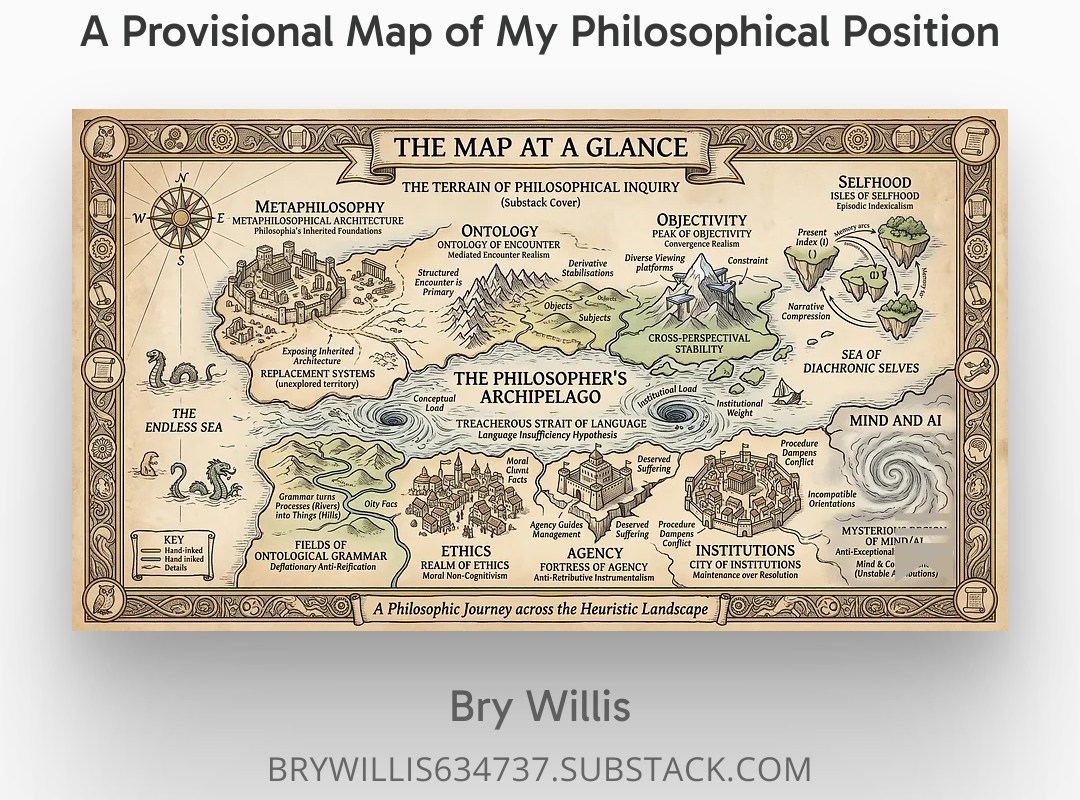
Image: Full image because the cover version is truncated. Generated by Gemini Nano Banana.

Video: There Are No Objects… Or Subjects

What if the biggest trick language played on you is convincing you that the world is made of things?

Every sentence you speak installs a hidden assumption. ‘The rock falls.’ ‘The mind thinks.’ ‘The electron orbits.’ Each one presupposes a thing – a noun – that exists before anything happens to it. Your grammar tells you: first, there are objects, then they do stuff. But what if that’s backwards?

The Mediated Encounter Ontology – MEOW – proposes that it is. Reality isn’t made of things. It’s made of structured interactions. Encounter-events – relational, patterned, constrained – are what’s ontologically basic. Objects, subjects, minds, worlds: these are all downstream. They’re what you get when structured interaction stabilises within a given scale of encounter.

Watch the video…

Architecture of Encounter: Attention, Affordance, Salience, and Valence

What do attention, affordance, salience, and valence have to do with meaning, and what is the architecture of encounter?

I’m still trying to figure out how to simplify these concepts. How am I doing?

  • 0:00 Introduction and Encounter
  • 0:52 Attention
  • 1:53 What is Affordance?
  • 3:13 What is Salience?
  • 4:12 Example: Salience Connexion and Context (My ex-wife)
  • 4:44 What is Valence?
  • 5:38 What is Meaning?
  • 6:23 Example: Southern Hospitality (Salience and Meaning)

Short and sweet.

New Architecture of Encounter Video Content: Glossary Terms

I’ve commenced a new series in support of my new book. First, I’m building a glossary.

Video: Bry – Architecture of Encounter

On the docket in this segment are affordance, salience, and valence as they relate to the book. I selected these terms from the glossary in the appendix.

Over the next few weeks, I plan to produce videos on other terms and additional videos explaining key concepts. This one is straightforward and academic. Others will be less formal, hoping to accommodate different learning styles.

Does anyone subscribe to Kindle Unlimited? I may take time to create Kindle and eBook versions.

My fiction books had some formatting issues with Kindle, but these titles are more standard – no fancy layouts or fonts, and not too many images.

Truth, Subjectivity, and Constraint

3–5 minutes

I like this bloke. Here, he clarifies Rorty’s perspective on Truth. I am quite in sync with Rorty’s position, perhaps 90-odd per cent.

Allow me to explain.

Audio: NotebookLM summary podcast of this topic.

I have written about truth several times over the years, 1, 2, 3, and more. In earlier posts, I put the point rather bluntly: truth is largely rhetorical. I still think that captured something important, but it now feels incomplete. With the development of my Mediated Encounter Ontology of the World (MEOW) and the Language Insufficiency Hypothesis (LIH), the picture needs tightening.

NotebookLM Infographic on this topic.

The first step is to stop pretending that ‘truth’ names a single thing.

Philosopher Bernard Williams helpfully distinguished between thin and thick senses of truth in Truth and Truthfulness. The distinction is simple but instructive.

In its thin sense, truth is almost trivial. Saying ‘it is true that p’ typically adds nothing beyond asserting p. The word ‘true’ functions as a logical convenience: it allows endorsement, disquotation, and generalisation. Philosophically speaking, this version of truth carries very little metaphysical weight. Most arguments about truth, however, are not about this thin sense.

In practice, truth usually appears in a thicker social sense. Here, truth is embedded in practices of inquiry and communication. Communities develop norms around sincerity, accuracy, testimony, and credibility. These norms help stabilise claims so that people can coordinate action and share information.

At this level, truth becomes something like a social achievement. A statement counts as ‘true’ when it can be defended, circulated, reinforced, and relied upon within a shared framework of interpretation. Evidence matters, but so do rhetoric, persuasion, institutional authority, and the distribution of power. This is the sense in which truth is rhetorical, but rhetoric is not sovereign.

NotebookLM Infographic on this topic. I prompted NotebookLM to illustrate a 4-layered model that shows how removed language is from encounter, attention, conception, and representation of what we normally consider to be reality. This view is supported by both MEOW and LIH.

Human beings can imagine almost anything about the world, yet the world has a stubborn habit of refusing certain descriptions. Gravity does not yield to persuasion. A bridge designed according to fashionable rhetoric rather than sound engineering will collapse regardless of how compelling its advocates may have been.

This constraint does not disappear in socially constructed domains. Institutions, identities, norms, and laws are historically contingent and rhetorically stabilised, but they remain embedded within material, biological, and ecological conditions. A social fiction can persist for decades or centuries, but eventually it encounters pressures that force revision.

Subjectivity, therefore, doesn’t imply that ‘anything goes’. It simply means that all human knowledge is mediated.

We encounter the world through perception, language, culture, and conceptual frameworks. Every description is produced from a particular standpoint, using particular tools, within particular historical circumstances. Language compresses experience and inevitably loses information along the way. No statement captures reality without distortion. This is the basic insight behind the Language Insufficiency Hypothesis.

At the same time, our descriptions remain answerable to the constraints of the world we inhabit. Some descriptions survive repeated encounters better than others.

In domains where empirical constraint is strong – engineering, physics, medicine – bad descriptions fail quickly. In domains where constraint is indirect – ethics, politics, identity, aesthetics – multiple interpretations may remain viable for long periods. In such cases, rhetoric, institutional authority, and power often function as tie-breakers, stabilising one interpretation over others so that societies can coordinate their activities. These settlements are rarely permanent.

What appears to be truth in one era may dissolve in another. Concepts drift. Institutions evolve. Technologies reshape the landscape of possibility. Claims that once seemed self-evident may later appear parochial or incoherent.

In this sense, many truths in human affairs are best understood as temporally successful settlements under constraint.

Even the most stable arrangements remain vulnerable to change because the conditions that sustain them are constantly shifting. Agents change. Environments change. Expectations change. The very success of a social order often generates the tensions that undermine it. Change, in other words, is the only persistence.

The mistake of traditional realism is to imagine truth as a mirror of reality – an unmediated correspondence between statement and world. The mistake of crude relativism is to imagine that language and power can shape reality without limit. Both positions misunderstand the situation.

We do not possess a final language that captures reality exactly as it is. But neither are we free to describe the world however we please. Truth is not revelation, and it is not mere invention.

It is the provisional stabilisation of claims within mediated encounter, negotiated through language, rhetoric, and institutions, and continually tested against a world that never fully yields to our descriptions. We don’t discover Truth with a capital T. We negotiate survivable descriptions under pressure.

Maphra Doomed

What’s Maphra singing a Bring Me the Horizon cover have to do with philosophy?

Absolutely nothing… maybe.

Audio: Spotify version.

I’ve finished my book, and I spent hours discovering new music. Of course, the song is from 2015, but the treatment is new, and her voice is brilliant. Amazing control. I think it’s an upgrade on an already decent song, but what do you think? 🧐

I never forget that my first career was as a musician. It’s in my blood. Listen or not, but you’re missing out.

PSA: Is It War?

Wait for it… This parodies the use of language to sidestep Constitutional inconveniences. In the game show format, we learn what is and isn’t a war. Wittgenstein would be proud.

Video: Short parody asks the question, Is it war?

Watch this and build up your English language vocabulary.