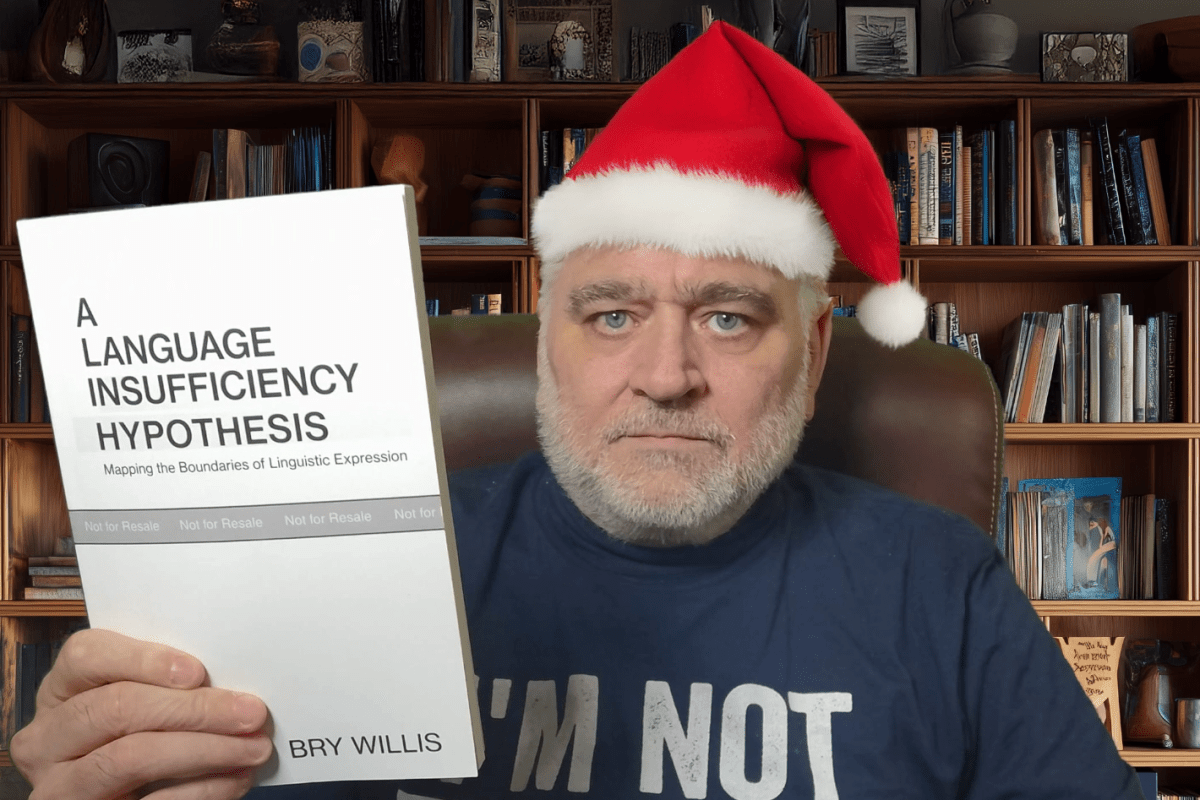
Although I am not a linguist, I am a philosopher of language, so occasionally I cross into that territory through sheer love of the thing. I chat with a French interlocutor a couple of times a week, and today we discussed the French infinitive demander – a false friend (faux ami) in English, though a closer one than most.
Audio: NotebookLM summary podcast of this topic. Please excuse the poor French pronunciation of the podcasters.
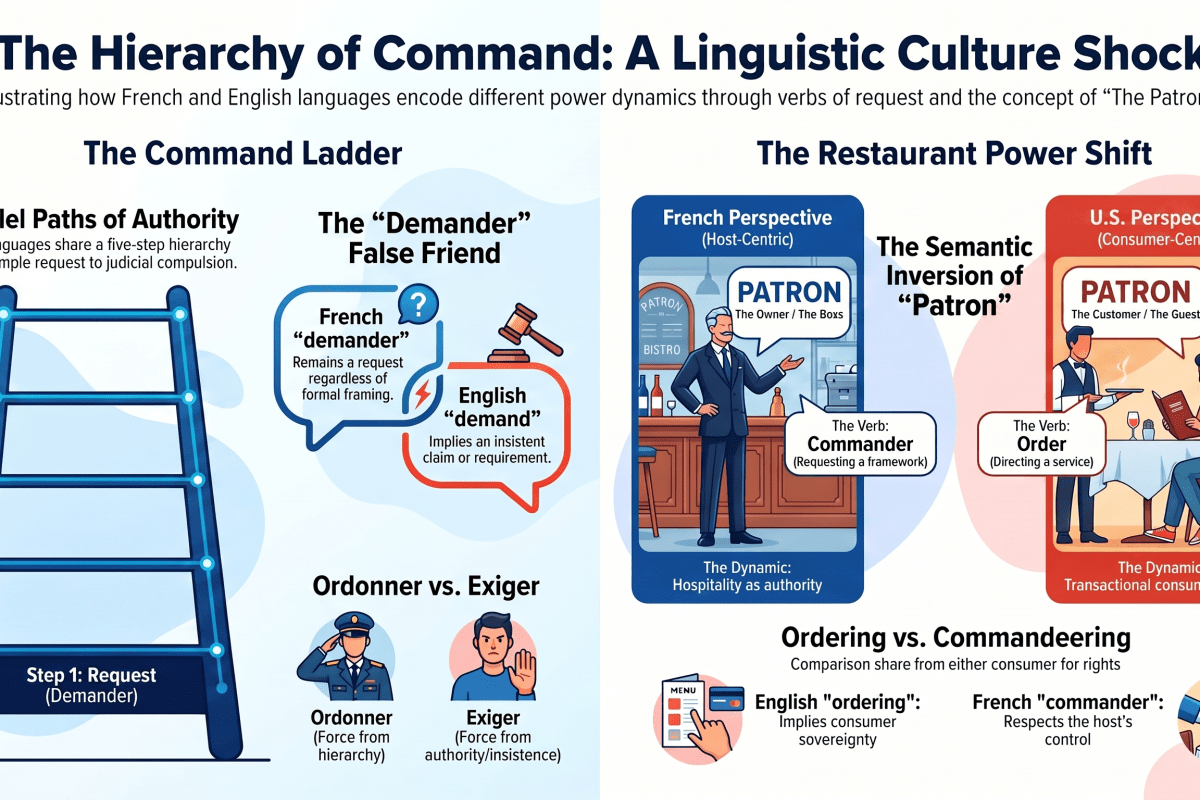
Demander means to ask, not to demand, though an English speaker might notice that demanding is simply an elevated asking. Which raises the question: is there an elevated version of demander in French? It turns out there is – a whole ladder of them.
In English: to ask → to demand → to order → to command → to enjoin. In French: demander → exiger → ordonner → commander → enjoindre.
(Enjoin, for those who’ve only met it in legal documents, is the formal instrument of judicial compulsion – to enjoin someone is to prohibit or require by court order. It earns its place at the top of the ladder.)
I won’t get into the full nuances of each term. I’ll leave that to a linguist. But the false friend problem is worth pursuing, because it’s more interesting than a simple mismatch.
The trouble isn’t just that demander ≠ ‘demand’ etymologically. It’s that the English word ‘demand’ smuggles in a force condition that French distributes across different verbs depending on the source of that force. Exiger implies force from authority, entitlement, or insistence. Ordonner implies force from hierarchy – a command structure in which compliance is not optional. Demander, however formally framed, remains a request. English ‘demand’ collapses all of this into one word and leaves the source of force unspecified.
This becomes vivid with examples. A judge doesn’t demander; the authority relationship forecloses the mere-request reading entirely. Exiger captures the illocutionary force; this demand is backed by institutional power, and non-compliance has consequences. But a judicial order in English sits closer to ordonner than exiger; the court doesn’t merely insist, it commands with legal effect. And a military general? Ordonner again – unilateral, hierarchical, non-negotiable.
This brings us to restaurants, where things get strange. In English, customers order. The same verb a general uses. What gives?
Polysemy is the easy answer, but the cultural one is more interesting. The French model is closer to hospitality in the older sense – the restaurateur is the host, the diner is a guest, and the dynamic carries an implicit asymmetry in which the host has authority over the experience. One eats what is offered, at the pace the kitchen sets; complaining loudly is a breach of the guest’s role rather than an exercise of consumer rights. Commander fits this – one places a request within a framework that the host controls.
The American model inverts this. The customer is sovereign, the staff are in service to the customer’s preferences, and the transactional frame licenses a kind of authority that would read as rudeness in France. ‘Order’ in the American restaurant sense carries just enough of the command register to be revealing; you’re not asking, you’re directing.
This makes the English verb choice quietly ideological in a way the French isn’t. Commander is neutral about the power dynamic. English ‘order’ encodes the American consumer-as-patron assumption right into the lexicon.
And the word, patron, is almost too good to leave alone. In French, le patron is the boss, the owner, the one with authority. In American English, the patron is the customer. The semantic inversion is almost too neat to be coincidental. It maps the entire cultural difference onto a single word: in France, the restaurateur is the patron; in America, the diner is. When the two meet – a tête-à-tête between rival patrons – culture shock is the predictable result.
So glad I took time out to watch a short exchange between Rick Beato and Justin Hawkins on whether music is becoming content rather than art. The question is framed in musical terms, but it hardly stops there. The same corrosion is visible in writing, visual art, criticism, and now, with grim inevitability, in AI-mediated production more broadly. The disease is not confined to music. Music merely makes the symptoms easier to hear.
For music, my aversion to pop music goes back to my youth. I was a kid when the Beatles practically invented pop music, but they left it to grow and continued exploring. Sadly, as solo artists, they mainly – not always – failed and rested on their laurels in pop. It’s not that their version or any pop music is inherently unlistenable. Surely, it’s not, if only by the aspiration of the pop moniker, but it has no depth, no soul, as it were. Some make this argument for Organic food. In essence, it involves an appeal to nature fallacy.
Audio: Slightly off, but not bad, NotebookLM summary podcast of this topic.
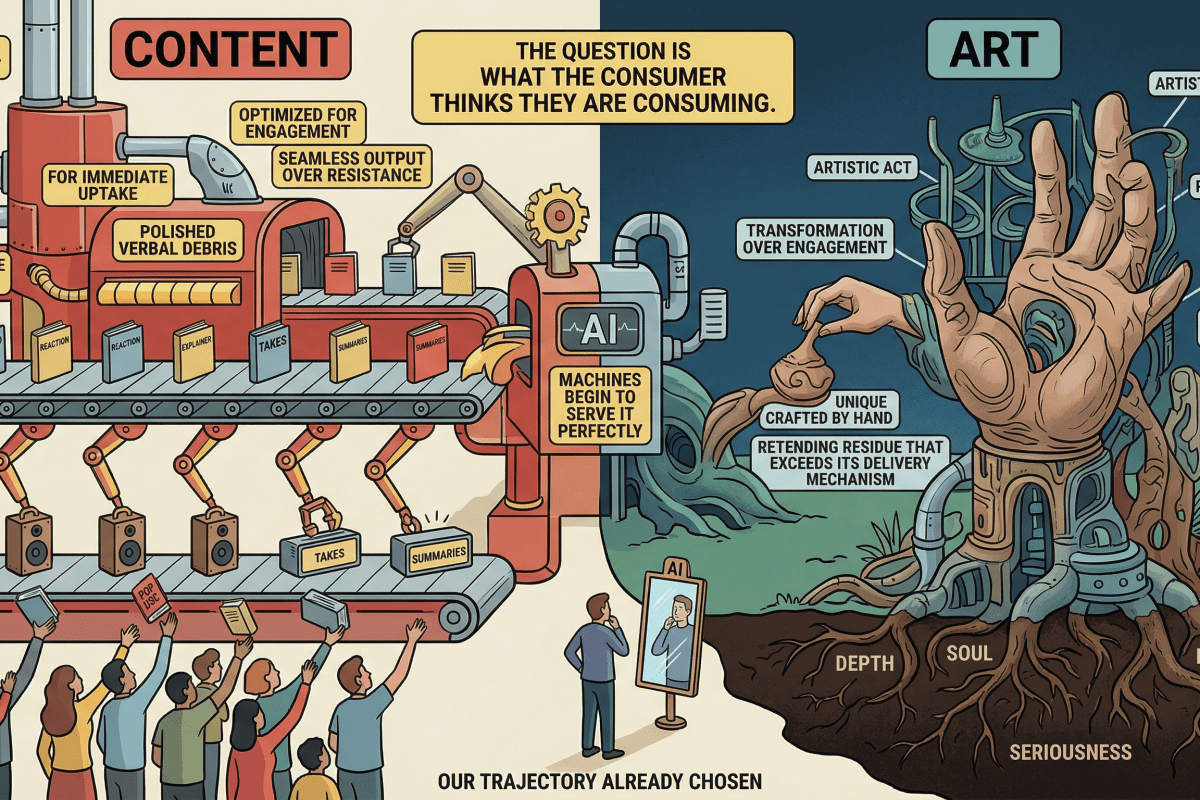
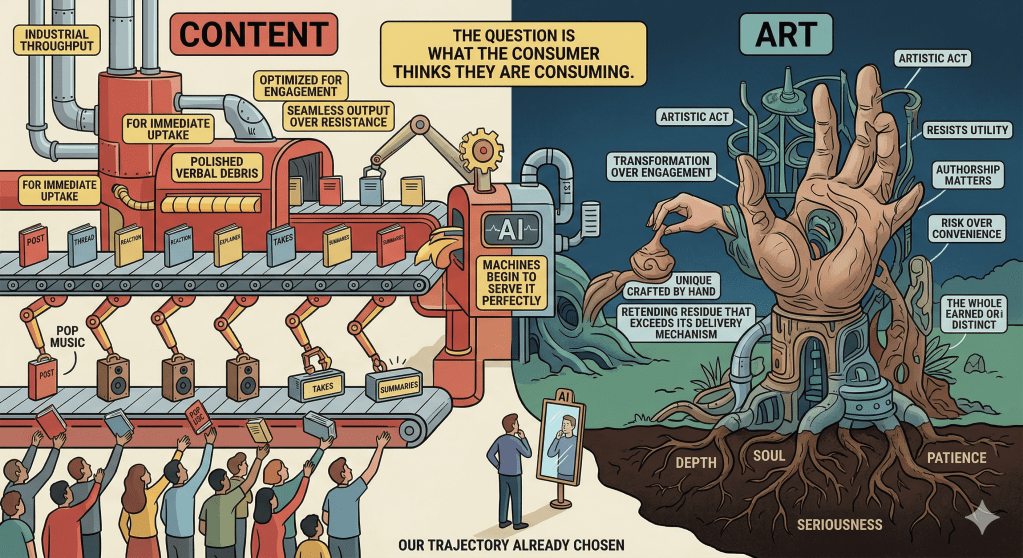
My own aversion to much pop music begins there. It is not that pop is necessarily bad, nor even that it is always shallow. That would be too crude and too easy. The problem is that pop often presents itself less as an artistic act than as a consumption object engineered for immediate uptake: catchy, frictionless, emotionally legible, and just disposable enough to make room for the next one. It is built to circulate.
That, for me, is the difference between content and art. Art may be accessible, even popular, but it retains some residue that exceeds its delivery mechanism. It resists total reduction to utility. Content, by contrast, is made to be processed. It is optimised not for depth but for throughput. Its highest ambition is not transformation, but engagement.
This is why the question matters beyond music. Writing, too, now lives under the same pressure. One is increasingly expected to produce not essays, arguments, or works, but units of output: posts, threads, reactions, takes, summaries, explainers, and other forms of polished verbal debris. The point is no longer to say something worth dwelling on, but to remain visible within the churn.
The issue, then, is not simply whether one should consume AI-generated material. That framing is too pious and too easy. The more interesting question is what the consumer thinks they are consuming. If a reader, listener, or viewer wants only speed, familiarity, and surface competence, then AI content is not a scandal at all. It is the logical endpoint of a culture that has already demoted art into a deliverable.
This is where the fuss over labelling enters. Is it a principled demand for honesty, or merely a theatrical gesture by people who still want the aura of art whilst consuming content on industrial terms? Some of it is clearly protectionism. Some of it is virtue signalling. But not all of it is empty. The insistence on labelling betrays an intuition, however muddled, that authorship still matters, and that not all artefacts are equivalent merely because they occupy the same screen-space.
The deeper question is whether we still want art at all, or whether we merely want the aesthetic styling of art attached to things optimised for convenience. Once a culture learns to prefer seamless output over resistance, recognisability over risk, and quantity over form, it should not act surprised when machines begin to serve it perfectly. They are only completing a trajectory already chosen.
So no, the issue is not AI alone. AI is only the latest mirror held up to a public that has spent years confusing availability with value and polish with depth. The real question is not whether machines can make content. Plainly, they can. The question is whether we still possess the appetite, patience, and seriousness required for art.
Image: Full image because the cover version is truncated. Generated by Gemini Nano Banana.
Or, to put it in one line fit for people skimming with one eye while pretending to work:
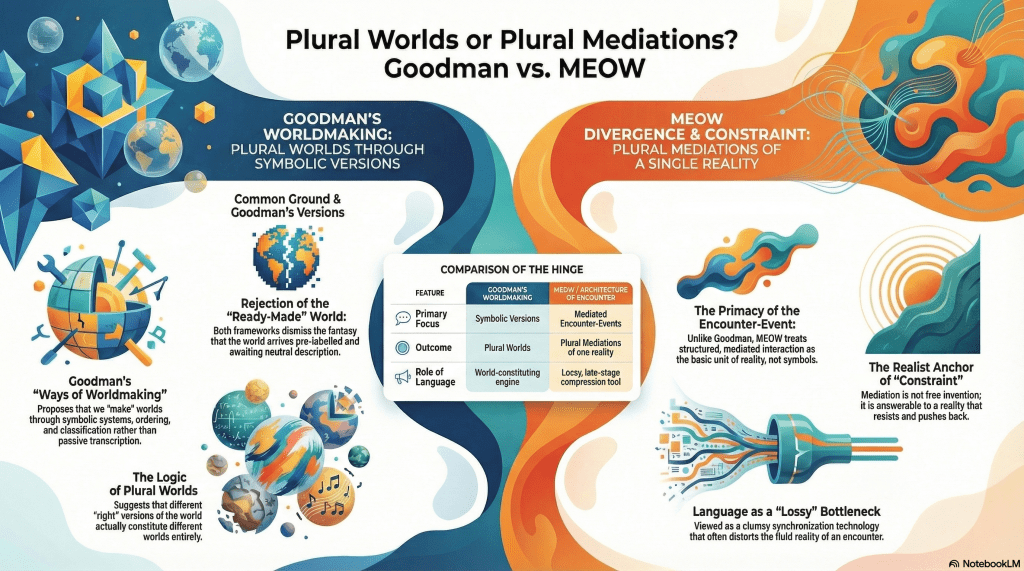
Goodman asks how versions make worlds intelligible. MEOW asks what kind of reality makes mediated intelligibility possible at all.
NotebookLM Infographic on this topic.
Audio: NotebookLM summary podcast of this topic.
Tl;dr
Goodman and MEOW are neighbours, but not housemates.
Both reject the childish fantasy that the world arrives already parcelled, labelled, and politely awaiting description by some neutral observer. Both are suspicious of naïve realism, fixed essences, and the conceit that language simply mirrors what is there. Both recognise that description, classification, and articulation are active, selective, and world-shaping.
But Goodman’s emphasis falls on versions, symbol systems, and the making of worlds through classificatory practice. MEOW and The Architecture of Encounter go elsewhere. They do not treat symbolic versioning as primary. They treat encounter as primary: mediated, structured interaction under constraint. Language and world-versioning come later, as derivative, partial, and often clumsy attempts to stabilise, synchronise, and re-present what is first given in encounter.
So the shortest contrast is this:
Goodman pluralises worlds. MEOW pluralises mediation while retaining constraint.
That is the hinge.
The longer version
Goodman is often useful precisely because he helps loosen the grip of a bad picture: the notion that there is one fully furnished world, discretely laid out in advance, which language then copies with greater or lesser success. In Ways of Worldmaking, description is not passive transcription. Versions organise, sort, foreground, suppress, classify, and compose. They do not simply mirror. They make.
This much sits quite comfortably beside MEOW and The Architecture of Encounter. MEOW has never been sympathetic to the old theatre in which a subject peers out at a ready-made object-world and then tries to report back accurately. That picture has always seemed less like sober metaphysics and more like a grammatical superstition. It is one of those inherited arrangements that philosophy keeps polishing rather than questioning, as if centuries of confusion were somehow evidence of depth.
On that score, Goodman is an ally. He helps dissolve the myth of innocent description.
He also overlaps with MEOW in his suspicion of essentialist carving. There is no reason to suppose reality presents itself in one uniquely natural partition, fully jointed in the exact way our preferred nouns imply. Goodman’s attention to alternative versions, symbolic orderings, and rival systems of classification fits comfortably with the broader MEOW suspicion that what we call “objects” are not self-announcing substances but stabilised articulations within a mediated field. In The Architecture of Encounter, this becomes still sharper: subjects and objects are not ontological primitives but abstractions from recurring encounter-structures. That already places the framework some distance from ordinary metaphysical furniture.
So far, then, the affinity is genuine.
But it is just as important not to overstate it.
Goodman’s centre of gravity is symbolic and versional. His concern is with how worlds are made through systems of description, notation, projection, ordering, and exemplification. The operative verbs are things like sort, render, compose, construct. The world is inseparable from the version.
MEOW and The Architecture of Encounter are doing something heavier. They are not merely offering a theory of how descriptions organise a world. They are offering an ontology in which encounter-events are primary. The basic unit is not an interpreted object, nor a version, nor a sentence, but a structured event of mediated contact under constraint. Mediation is not a regrettable screen placed between mind and world. It is constitutive of whatever relation there is. But neither is mediation free invention. Encounter is answerable to what resists, pushes back, stabilises, recurs, and converges. That is the role of constraint.
This is where the deepest divergence emerges.
Goodman is often read, not unfairly, as weakening the notion of a single underlying world more radically than MEOW can tolerate. His pluralism risks allowing “worldmaking” to carry most of the ontological burden. The result can begin to sound as though right versions are all the realism one is entitled to. There are worlds, or world-versions, and their legitimacy depends less on correspondence to a singular underlying reality than on fit, function, coherence, utility, and internal rightness.
MEOW resists that move. It does not return to vulgar realism, with its fantasy of a view from nowhere, but it also refuses to let mediation collapse into fabrication. Constraint is not a decorative afterthought. It is the realist anchor. One may have multiple mediations, multiple articulations, multiple ontological grammars, multiple local stabilisations, but these are not unconstrained improvisations. They are answerable to an invariant field of relational resistance.
Put more brutally: Goodman destabilises the ready-made world and then tends to leave us with versions. MEOW destabilises the ready-made world and then asks what must be true for divergent mediations nonetheless to converge, however partially, on the same resistant reality.
That difference matters.
It matters again when language enters the picture. Goodman grants an enormous role to symbol systems in worldmaking. MEOW, especially once read through The Architecture of Encounter and A Language Insufficiency Hypothesis, treats language more suspiciously. Language matters, certainly, but it is late, compressed, and lossy. It is not the primordial engine of world-constitution. It is a finite synchronisation technology layered atop more basic forms of mediation: biological, perceptual, attentional, cognitive, social. Language helps coordinate. It helps compress. It helps stabilise public handling. But it also distorts, truncates, nominalises, and overcommits.
That is where LIH adds a useful corrective to Goodman. If Goodman sometimes sounds like a connoisseur of world-versioning, LIH reminds us that our versioning machinery is often embarrassingly underpowered for the tasks philosophers assign to it. Human beings keep trying to force syntax to carry ontological burdens it was never built to bear. We take grammatical distinctions for metaphysical disclosures. We inherit noun-heavy structures and then wonder why the world starts looking like a warehouse of things. We reify processes, discretise continua, and carve durational realities into portable lexical chunks. Then, having manufactured these pseudo-stabilities, we congratulate ourselves for discovering “selves”, “minds”, “meanings”, “moral facts”, and other linguistic taxidermy.
Goodman certainly helps expose the active role of symbolic systems. But LIH presses further by insisting that symbolic systems are not merely worldmaking tools. They are also bottlenecks. They fail. They coarsen. They generate ontological illusions through the very act of public coordination.
That is why I would not place Goodman and MEOW in opposition, but in a relation of partial inheritance and correction.
Goodman is valuable because he helps dismantle the myth of passive representation. He is right to resist the idea that language or symbolisation merely records a pre-cut world. He is right to foreground selection, ordering, categorisation, and articulation. He is right to reject the transparent-window fantasy.
But from a MEOW standpoint, he does not go far enough into encounter, and perhaps goes too far into version.
What is missing is a richer account of pre-linguistic mediation, presentational structure, salience, affordance, and the layered constraints under which any symbolic practice becomes possible in the first place. Symbol systems do not float free. They do not arise in a void. They are parasitic upon lived, embodied, constrained encounter. Nor is their plurality enough, by itself, to explain why some articulations fail, why some converge, why some distort in systematic ways, or why reality resists our preferred descriptions with such vulgar persistence.
That last point is worth dwelling on, because it is where many anti-realist gestures lose their nerve. The fact that access is mediated does not imply that reality is manufactured. The fact that articulation is active does not imply that resistance is optional. The fact that classifications vary does not imply that there is nothing to be classified beyond the classificatory act.
So the bottom line remains the same.
Goodman is useful for breaking the spell of the one already-made world and for showing that symbolisation is not passive mirroring. But MEOW and The Architecture of Encounter push in a different direction. They relocate the primary philosophical action from symbol systems to encounter-events, from worldmaking to world-disclosure under mediation, and from plural worlds to plural access under constraint. A Language Insufficiency Hypothesis then sharpens the point by showing that language is not an omnipotent engine of constitution but a compression scheme with predictable failure modes.
There is a vulgar little myth still circulating among the managerial classes that capitalism, for all its blemishes, is at least good at ‘unlocking human potential’. It is not. It is very good at monetising human potential, disciplining it, redirecting it, and, where necessary, grinding it into forms useful to administration and exchange. This is not quite the same thing.
Audio: NotebookLM summary podcast of this topic.
One of capitalism’s less discussed achievements is its ability to rob society not merely of comfort, leisure, health, and life, but of minds. Not always by censorship. Not always by prison or direct prohibition. More often by something duller and therefore more effective: fatigue, schedules, rent, invoices, commuting, institutional obedience, and the constant low-grade humiliation of having to sell the best hours of one’s life in order to remain housed and fed.
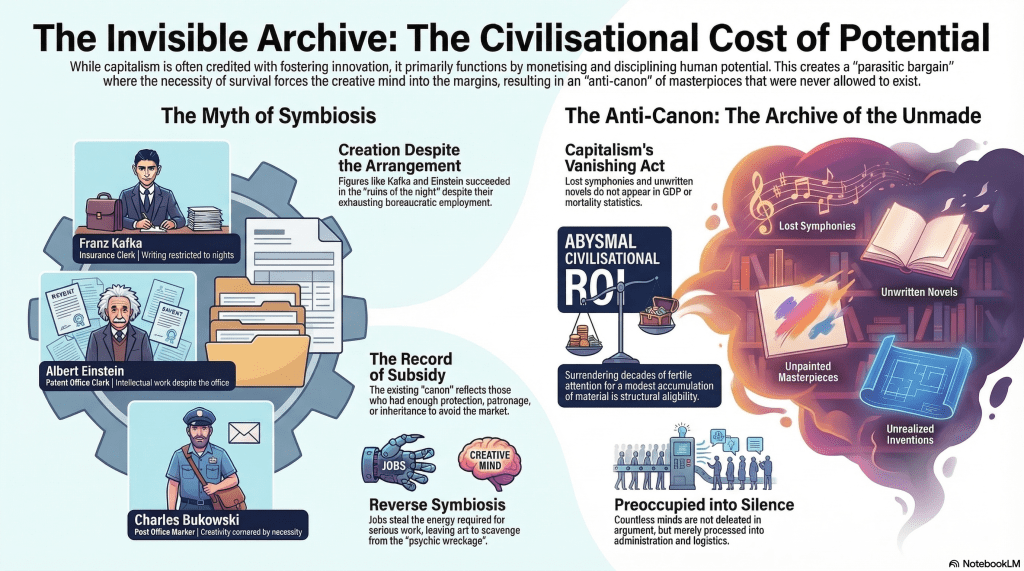
Franz Kafka is the obvious mascot for this arrangement, which is precisely why he matters. He worked in insurance. The office consumed the day; the writing had to happen in the ruins of the night. His bureaucratic life helped furnish the atmosphere of his fiction, certainly. Human beings do enjoy confusing damage with justification. But the point is not that the office was somehow good for Kafka because it gave him material. A prison may furnish one with subject matter, too. That does not make incarceration a residency programme. Kafka’s employment constrained the very work for which he is remembered. The miracle is not the arrangement. The miracle is that anything survived it. And Kafka was not unusual in kind. He was merely famous enough to make the violence legible.
NotebookLM Infographic on this topic.
Capitalism’s defenders like to point to the artists and thinkers who produced great work while employed, underpaid, exhausted, or cornered by necessity. Fine. Let us grant them their exhibit. Bukowski had the post office. Pessoa had commercial correspondence. Einstein had the patent office. One can add a hundred more names with minimal effort and maximal melancholy. Yet this proves the opposite of what the defenders want it to prove. It shows that some people managed to create despite the arrangement, not because of it.
This is the first confusion worth clearing away. There is no symbiosis here. At best, there is a kind of reverse symbiosis, a parasitic bargain. The job steals the time and energy required for serious work, while art scavenges from the psychic wreckage whatever it can still use. The worker is depleted; the artwork is composed from depletion. Critics then arrive later, pince-nez trembling, to tell us how fruitful this tension was. Fruitful for whom? Certainly not for the unwritten books, the undeveloped theories, the unfinished scores, or the painter dead too early to become collectible.
That, in fact, is the real question. Not which celebrated figures managed to drag a masterpiece out of economic adversity, but which works never appeared at all.
We are asked, constantly, to admire the canon. We are less often asked to consider the anti-canon: the archive of the unmade. The novel that never got written because its author spent thirty years in clerical work. The philosophy never developed because its possible author was too busy meeting payroll. The music that belonged to a particular age, a particular voice, a particular historical moment, could not simply be written forty years later by a different self under improved circumstances.
This is one of capitalism’s cleverest vanishing acts. It leaves behind no body when it kills a possibility. The unwritten book does not appear in mortality statistics. The lost symphony produces no coroner’s report. The poem abandoned in favour of stable employment is not entered into the national accounts as a dead thing. GDP ticks on, cheerful and imbecilic, while whole modes of life are silently foreclosed.
Some will object that artists have always depended on subsidy. Quite right. That objection destroys rather more than it saves. Van Gogh depended on Theo. Marx depended for years on Engels. Tchaikovsky had patronage. Virginia Woolf, unlike millions of women before her, had both money and a room of her own, and had the clarity to state the matter plainly. The lesson is not that genius floats free of material conditions. The lesson is the reverse: culture has always depended heavily on someone, somewhere, being shielded from the full stupidity of economic necessity.
This means the canon is not a clean record of merit. It is also a record of subsidy, exemption, accident, family money, patrons, tolerant spouses, sinecures, inherited cushion, and occasional institutional slack. In short, it is partly a record of who had enough protection from the market to do something other than kneel before it. The rest, meanwhile, are told a moral fable about hard work.
This is where the sentimental cliché about the ‘starving artist’ should be discarded with force. There is nothing noble about preventable exhaustion. There is nothing spiritually elevating about watching one’s better projects dry out from lack of time. There is certainly nothing socially rational about a civilisation organised in such a way that its most reflective, gifted, or aesthetically sensitive members must defer their work until retirement, ill health, or redundancy grants them a little stolen air.
One might respond that practical life gives artists experience. True enough. So does grief. So does war. So does prison. Experience is not the issue. The issue is the conversion rate. If one must surrender decades of one’s most fertile attention in exchange for a modest accumulation of usable material, the return is abysmal. The economist might call this poor ROI. The philosopher might call it structural stupidity. The artist, if still awake, may call it theft. And the theft is not merely personal. It is civilisational.
A society that forces most of its creative and intellectual life into the margins should not flatter itself for the masterpieces that occasionally emerge. It should be haunted by the scale of what never did. For every Kafka who wrote at night, how many did not? For every theorist supported by patronage or inheritance, how many more were processed into middle management, consultancy, administration, compliance, sales, logistics, and the thousand dead dialects of modern necessity? How many minds were not defeated in argument, but merely preoccupied into silence?
The answer, of course, is unknowable. Which is convenient for the system because what cannot be counted can be dismissed, and what can be dismissed can be repeated indefinitely.
Capitalism’s admirers are fond of innovation. They should spend less time praising the gadgets that reached market and more time mourning the consciousness that never reached form. Not every loss is a corpse. Some losses are libraries that never came into being. Some are paintings that remained latent in the hands of the overworked. Some are ideas that would have altered the climate of a discipline had their author not been busy earning a living.
The old accusation that capitalism exploits labour is true enough, but it is no longer adequate. It exploits labour, yes. It also colonises attention, cannibalises vocation, and narrows the range of what a culture is permitted to become. It does not merely take from workers. It takes from history. And then it calls the remainder efficiency.
How Modern Thought Mistakes Its Own Grid for Reality
Modern thought has a peculiar habit.
It builds a measuring device, forces the world through it, and then congratulates itself for discovering what the world is really like.
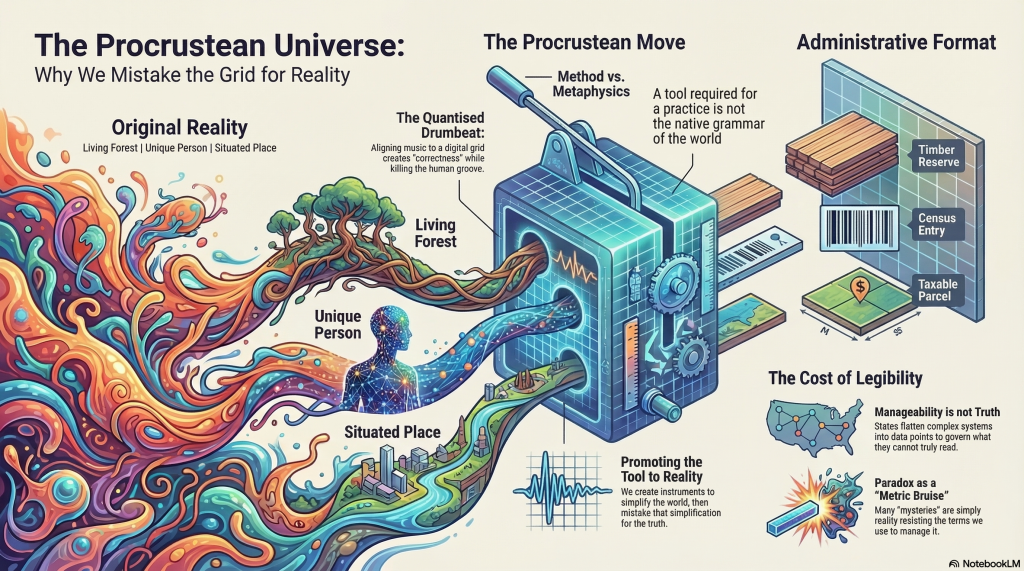
This is not always called scientism. Sometimes it is called rigour, precision, formalism, standardisation, operationalisation, modelling, or progress. The names vary. The structure does not. First comes the instrument. Then comes the simplification. Then comes the quiet metaphysical sleight of hand by which the simplification is promoted into reality itself.
Consider music.
A drummer lays down a part with slight drag, push, looseness, tension. It breathes. It leans. It resists the metronome just enough to sound alive. Then someone opens Pro Tools and quantises it. The notes snap to grid. The beat is now ‘correct’. It is also, very often, dead.
This is usually treated as an aesthetic dispute between old romantics and modern technicians. It is more than that. It is a parable.
Quantisation is not evil because it imposes structure. Every recording process imposes structure. The problem is what happens next. Once the grid has done its work, people begin to hear the grid not as a tool, but as truth. Timing that exceeds it is heard as error. The metric scaffold becomes the criterion of reality.
Audio: NotebookLM summary podcast of this topic.
A civilisation can live like this.
It can begin with a convenience and end with an ontology.
Carlo Rovelli’s The Order of Time is useful here precisely because it unsettles the fantasy that time is a single smooth substance flowing uniformly everywhere like some celestial click-track. It is not. Time frays. It dilates. It varies by frame, relation, and condition. Space, too, loses its old role as passive container. The world begins to look less like a neat box of coordinates and more like an unruly field of relations that only reluctantly tolerates our diagrams.
This ought to induce some modesty. Instead, modern disciplines often respond by doubling down on the diagram.
That is where James C. Scott arrives, carrying the whole argument in a wheelbarrow. Seeing Like a State is not merely about states. It is about the administrative desire to make the world legible by reducing it to formats that can be counted, organised, compared, and controlled. Forests become timber reserves. People become census entries. Places become parcels. Lives become cases. The simplification is not wholly false. It is simply tailored to the needs of governance rather than to the fullness of what is governed.
That’s the key.
The state does not need the world in its density. It needs the world in a format it can read.
And modern disciplines are often no different. They require stable units, repeatable measures, abstract comparability, portable standards. Fair enough. No one is conducting physics with incense and pastoral reverie. But then comes the familiar conceit: what was required for the practice quietly becomes what reality is said to be. The discipline first builds the bed for its own survival, then condemns the world for failing to lie down properly.
Cut off what exceeds the frame. Stretch what falls short. Call the result necessity.
Many supposed paradoxes begin here. Not in reality itself, but in the overreach of a measuring grammar.
I use a ruler to measure temperature, and I am surprised when it does not comport.
The example is absurd, which is why it is helpful. The absurdity is not in the temperature. It’s in the category mistake. Yet much of modern thought survives by committing more sophisticated versions of precisely this error. We use tools built for extension to interpret process. We use spatial metaphors to capture time. We use statistical flattening to speak of persons. We use administrative categories to speak of communities. We use computational tractability to speak of mind. Then the thing resists, and we call the resistance mysterious.
Sometimes it is not mysterious at all. Sometimes it is merely refusal.
The world declines to be exhausted by the terms under which we can most easily manage it.
That refusal then returns to us under grander names: paradox, irrationality, inconsistency, noise, anomaly. But what if the anomaly is only the residue of what our instruments were built to exclude? What if paradox is often the bruise left by an ill-fitted measure?
This is where realism, at least in its chest-thumping modern form, begins to look suspicious. Not because there is no world. There is clearly something that resists us, constrains us, embarrasses us, punishes bad maps, and ruins bad theories. The issue is not whether there is a real. The issue is whether what we call “the real” is too often just what our current apparatus can stabilise.
That is not realism.
That is successful compression mistaken for ontology.
Space and time, in this light, begin to look less like the universe’s native grammar and more like the interface through which a certain kind of finite creature renders the world tractable. Useful, yes. Necessary for us, perhaps. Final? hardly.
The same applies everywhere. We do not merely measure the world. We reshape it, conceptually and institutionally, until it better fits our preferred methods of seeing. Then we forget we did this.
Scott’s lesson is that states fail when they confuse legibility with understanding. Our broader civilisational lesson may be that disciplines fail in much the same way. They flatten in order to know, and then mistake the flattening for disclosure. What exceeds the frame is dismissed until it returns as contradiction.
None of this requires anti-scientific melodrama. Science is powerful. Measurement is indispensable. Standardisation is often the price of cumulative knowledge. The problem is not the existence of the grid. The problem is the promotion of the grid into metaphysics. A tool required for a practice is not therefore the native structure of the world. That should be obvious. It rarely is.
Scientism, in its most irritating form, begins precisely where this obviousness ends. It is not disciplined inquiry but disciplinary inflation: the belief that whatever can be rendered formally legible is most real, and whatever resists is merely awaiting capture by better instruments, finer models, sharper equations, more obedient categories. It is the provincial fantasy that the universe must ultimately speak in the accent of our methods.
Perhaps it doesn’t.
Perhaps our great achievement is not that we have discovered reality’s final language, but that we have become unusually good at mistaking our translations for the original.
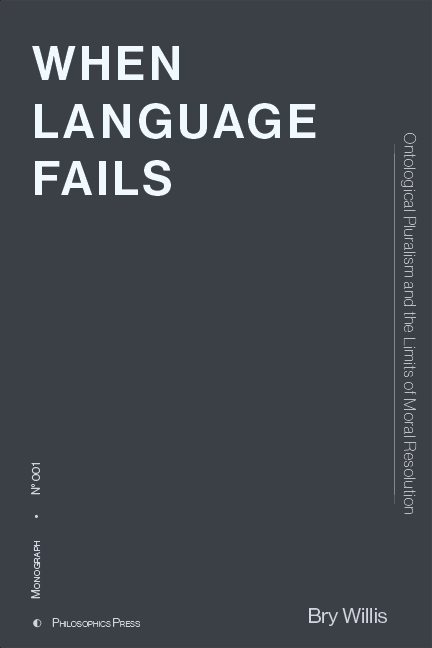
I set aside some time to design the front cover of my next book. I’m excited to share this – but that’s always the case. It’s substantially complete. In fact, it sidelined another book, also substantially complete, but the content in this might force me to change the other one. It should be ready for February. I share the current state of the Abstract
This book is meant to be an academic monograph, whilst the other, working title: The Competency Paradox, is more of a polemic.
As I mentioned in another post, it builds upon and reorients the works of George Lakoff, Jonathan Haidt, Kurt Gray, and Joshua Greene. I’ve already revised and extended Gallie’s essentially contested concepts in A Language Insufficiency Hypothesis in the form of Contestables, but I lean on them again here.
Abstract
Contemporary moral and political discourse is marked by a peculiar frustration: disputes persist even after factual clarification, legal process, and good-faith argumentation have been exhausted. Competing parties frequently agree on what happened, acknowledge that harm occurred, and yet remain irreconcilably divided over whether justice has been served. This persistence is routinely attributed to misinformation, bad faith, or affective polarisation. Such diagnoses are comforting. They are also often wrong.
This paper advances a different claim. Certain conflicts are not primarily epistemic or semantic in nature, but ontological. They arise from incompatible orientations that structure how agents register salience, threat, authority, autonomy, and legitimacy. These orientations are genealogically shaped through enculturation, institutions, and languaged traditions, yet operationally they function prior to linguistic articulation: salience fires before reasons are narrated. Moral vocabulary enters downstream, tasked with reconciling commitments that were never shared.
From this perspective, the instability of concepts such as justice is not the primary problem but a symptom. Justice belongs to a class of Contestables (in Gallie’s sense, PDF): action-authorising terms that appear determinate while remaining untethered from shared reference under ontological plurality. Appeals to clearer definitions, better process, or shared values therefore misfire. They presume a common ontological ground that does not, in fact, exist.
When institutions are nevertheless required to act, they cannot adjudicate between ontologies. They can only select. Courts, juries, regulatory bodies, and enforcement agencies collapse plural interpretations into a single outcome. That outcome is necessarily experienced as legitimate by those whose orientation it instantiates, and as injustice by those whose orientation it negates. No procedural refinement can eliminate this asymmetry. At best, procedure dampens variance, distributes loss, and increases tolerability. Crucially, the selection itself is constrained but underdetermined. Even within formal structures, human judgment, discretion, mood, confidence, fear, and narrative framing play a decisive role. Following Keynes, this irreducible contingency may be described as animal spirits. In formal terms, institutional outcomes are sampled from a constrained space of possibilities, but the reaction topology remains structurally predictable regardless of which branch is taken.
The consequence is stark but clarifying: outrage is not evidence that a system has failed to deliver justice; it is evidence that plural ontological orientations have been forced through a single decision point. Where semantic reconciliation is structurally unavailable, exogenous power is the dominant near-term mediator. Power does not resolve the conflict; it pauses it and stabilises meaning sufficiently for coordination to continue.
This analysis does not deny the reality of harm, the importance of law, or the necessity of institutions. Nor does it lapse into nihilism or indifference. Rather, it reframes the problem. In ontologically plural environments, the task is not moral convergence but maintenance: containing collision, resisting premature coherence, and designing institutions that minimise catastrophic failure rather than promising final resolution.
The argument developed here predates any particular event. Its value lies precisely in its predictive capacity. Given plural ontologies, untethered contestables, and institutions that must act, the pattern of reaction is invariant. The surface details change; the structure does not. What follows is not a proposal for reconciliation. It is a diagnosis of why reconciliation is so often a category error, and why pretending otherwise is making things worse.
I’m no fan of holidays. I neither enjoy nor celebrate Christmas. I’m acutely aware of its commercial excesses and its religious inheritance, two institutions I find, at best, tiresome and, at worst, actively corrosive. Whether that’s abhorrence or simple loathing is a distinction I’ll leave to braver souls.
Still, calendars exist whether one consents to them or not, and this piece happens to land today. If Christmas is your thing, by all means, have at it. Sincerely. Rituals matter to people, even when their metaphysics don’t survive inspection.
What follows is not a defence of the season, nor a seasonal moral. It’s a small human moment that happens to involve Santa, which is to say a costume, a script, and a public performance. What interests me is not the symbolism, but what happens when the performance yields just enough to allow someone else to be seen on their own terms. If nothing else, that feels like a tolerable use of the day.
Audio: NotebookLM summary podcast on this topic.
What Legibility?
When I use the term legibility, it’s usually as a pejorative. It’s my shorthand for reductionism. For the way human beings are flattened into checkboxes, metrics, market segments, or moral exemplars so they can be processed efficiently by institutions that mistake simplification for understanding.
But legibility isn’t always a vice.
Video: Santa signs with a 3-year-old dear girl
Most of us, I suspect, want to be legible. Just not in the ways we are usually offered. We want to be seen on our own terms, not translated into something more convenient for the viewer. That distinction matters.
In the video above, a deaf child meets Santa. Nothing grand happens. No lesson is announced. No slogan appears in the corner of the screen. Santa simply signs.
The effect is immediate. The child’s posture changes. Her attention sharpens. There’s a visible shift from polite endurance to recognition. She realises, in real time, that she does not need to be adapted for this encounter. The encounter has adapted to her. This is legibility done properly.
Not the synthetic legibility of television advertising, where difference is curated, sanitised, and arranged into a reassuring grid of representation. Not the kind that says, we see you, while carefully controlling what is allowed to be seen. That version of legibility is extraction. It takes difference and renders it harmless. Here, the legibility runs the other way.
Santa, already a performative role if ever there was one, doesn’t stop being performative. The costume remains. The ritual remains. But the performance bends. It accommodates. It listens. The artifice doesn’t collapse; it becomes porous.
I’m wary of words like authenticity. They’ve been overused to the point of meaninglessness. But I do think we recognise performatism when we see it. Not in the technical sense of speech acts, but in the everyday sense of personas that ring hollow, gestures that exist for the camera rather than the people involved. This doesn’t feel like that.
Of course, the child could already connect. Deaf people connect constantly. They persevere. They translate. They accommodate a world that rarely meets them halfway. Nothing here ‘grants’ her humanity. What changes is the tightness of the connexion.
The shared language acts as a verbal proxy, a narrowing of distance. You can see the moment it clicks. He speaks her language. Or rather, he speaks a language that already belongs to her, even if calling it ‘hers’ is technically imprecise. Mother tongue is a slippery phrase. Irony does some of the work here.
The point is not inclusion as spectacle. It’s recognition without reduction.
Legibility, in this case, doesn’t make her smaller. It makes the interaction larger. And that, inconveniently for our systems and slogans, is what most people have been asking for all along.
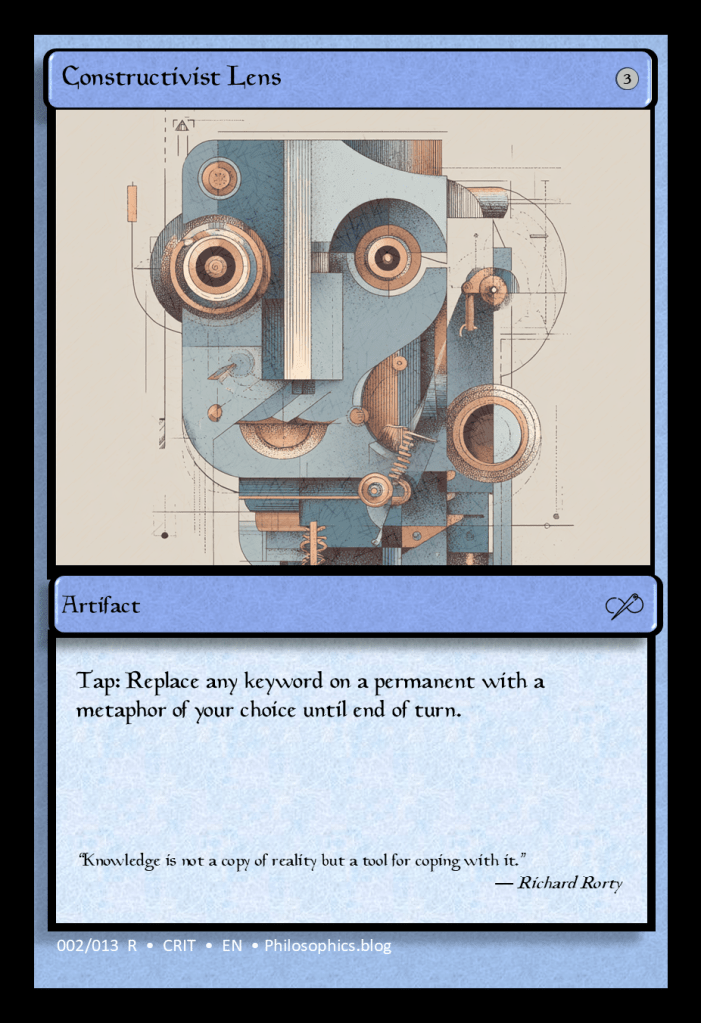
Another faux Magic: The Gathering trading card. I’ve been busy writing an essay on Tatterhood and wondering if I’ve gone off the edge even further into mental masturbation. I made these cards to share on slow news days, as it were.
[EDIT: Oops: Even wore. I already posted something today. Enjoy the bonus post.]
Every philosopher dreams of a device that reveals ‘truth’. The Constructivist Lens does the opposite. When you tap it, the world doesn’t come into focus – it multiplies. Each pane shows the same thing differently, reminding us that knowing is always a form of making – seeing as building.
In The Discipline of Dis-Integration, I wrote that philosophy’s task is ‘to remain within what persists … to study the tension in the threads rather than weave a new pattern’. The Lens embodies that ethic. It is not an instrument of discovery but of disclosure: a way to notice the scaffolding of perception without mistaking it for bedrock.
Flavour text: “Knowledge is not a copy of reality but a tool for coping with it.” — Richard Rorty
Where Enlightenment optics promised clarity, the Lens trades in parallax. It insists that perspective is not a flaw but the condition of vision itself. Each player who peers through it – artist, scientist, moralist – constructs a different coherence, none final. The card’s rule text captures this tension: replace any keyword on a permanent with a metaphor of your choice until end of turn. Reality bends, language shifts, yet the game continues.
In the Dis-Integration set, the Lens sits alongside Perspectival Realism and Language Game (not yet shared), forming the Blue triad of epistemic doubt. Together they dramatise what the essay calls ‘the hyphen as hinge’: the small pause between integration and its undoing. The Constructivist Lens, then, is not a tool for clearer sight but a reminder that every act of seeing is already an act of construction.
I’ve spent more hours than I care to admit rummaging through the Jungian undergrowth of fairy tales – reading Marie-Louise von Franz until my eyes crossed, listening to Clarissa Pinkola Estés weave her wolf-women lore, and treating folklore like an archaeological dig through the psychic sediment of Europe. It’s marvellous, really, how much one can project onto a story when one has a doctorate’s worth of enthusiasm and the moral flexibility of a tarot reader.
But every so often, a tale emerges that requires no archetypal lens, no mythopoetic scaffolding, no trip down the collective unconscious. Sometimes a story simply bares its ideological teeth.
Enter Tatterhood – the Norwegian fairy tale so blunt, it practically writes its own critical theory seminar.
I watched Jonny Thomson’s recent video on this tale (embedded below, for those with sufficient tea and patience). Jonny offers a charming reversal: rather than focusing on Tatterhood herself, he offers the moral from the prince’s perspective. In his reading, the story becomes a celebration of the power of asking – the prince’s reward for finally inquiring about the goat, the spoon, the hood, the whole aesthetic calamity before him.
Video: Jonny Thomson discusses Tatterhood.
It’s wholesome stuff: a TED Talk dressed as folklore. But – my word – apply the slightest bit of critical pressure, and the whole thing unravels into farce.
The Story No One Tells at the Royal Wedding
Here’s the short version of Tatterhood that Jonny politely sidesteps:
A fearless, ragged, hyper-competent girl rescues her sister from decapitation.
She confronts witches, navigates the seas alone, storms a castle, and performs an ad hoc ontological surgical reversal.
She does all of this without help from the king, the court, the men, or frankly, anyone with a Y chromosome.
And how is she rewarded for her trouble? She’s told she’s too ugly. Not socially acceptable. Not symbolically coherent. Not bride material.
The kingdom gazes upon her goat, her spoon, her hood, her hair, and determines that nothing – nothing – about her qualifies her for legitimacy.
But beauty? Beauty is the passport stamp that grants her entry into the social realm.
Jonny’s Prince: A Hero by Low Expectations
Now, bless Jonny for trying to rehabilitate the lad, but this prince is hardly an exemplar of virtue. He sulks through his own wedding procession like a man being marched to compulsory dentistry. He does not speak. He does not ask. He barely manages object permanence.
And suddenly, the moral becomes: Look what wonders unfold when a man asks a single question!
It’s the philosophical equivalent of awarding someone a Nobel Prize for remembering their mother’s birthday.
And what do his questions achieve? Not insight. Not understanding. Not intimacy. But metamorphosis.
Each time he asks, Tatterhood transforms – ugly goat to beautiful horse, wooden spoon to silver fan, ragged hood to golden crown, ‘ugly’ girl to radiant beauty.
Which brings us to the inconvenient truth:
This Isn’t the Power of Asking. It’s the Power of Assimilation.
His questions function as aesthetic checkpoints.
Why the goat? Translation: please ride something socially acceptable.
Why the spoon? Translation: replace your tool of agency with a decorative object.
Why the hood? Translation: cover your unruliness with something properly regal.
Why your face? Translation: you terrify me; please be beautiful.
And lo, she becomes beautiful. Not because he sees her differently. Because the story cannot tolerate a powerful woman who remains outside the beauty regime.
The prince isn’t rewarded for asking; the narrative is rewarded for restoring normative order.
And Yet… It’s Absurdly Fascinating
This is why fairy tales deserve all the interpretive attention we lavish on them. They’re ideological fossils – compressed narratives containing entire worldviews in miniature.
Part of me admires Jonny’s generosity. Another part of me wants to hand the prince a biscuit for performing the bare minimum of relational curiosity. But mostly, I’m struck by how nakedly the tale reveals the old bargain:
A woman may be bold, brave, clever, loyal, and sovereign – but she will not be accepted until she is beautiful.
Everything else is optional. Beauty is compulsory.
So Here’s My Version of the Moral
Ask questions, yes. Be curious, yes. But don’t let anyone tell you that Tatterhood was waiting for the prince’s epiphany. She was waiting for the world to remember that she ran the plot.
If you’ve made it this far and know my proclivities, you’ll not be shocked that I side with Roland Barthes and cheerfully endorse la mort de l’auteur. Jonny is perfectly entitled to his reading. Interpretive pluralism and all that. I simply find it marvelously puzzling that he strolls past the protagonist galloping through the narrative on a goat, spoon upraised, and instead decides to chase the side-quest of a prince who contributes roughly the energy of a damp sock.