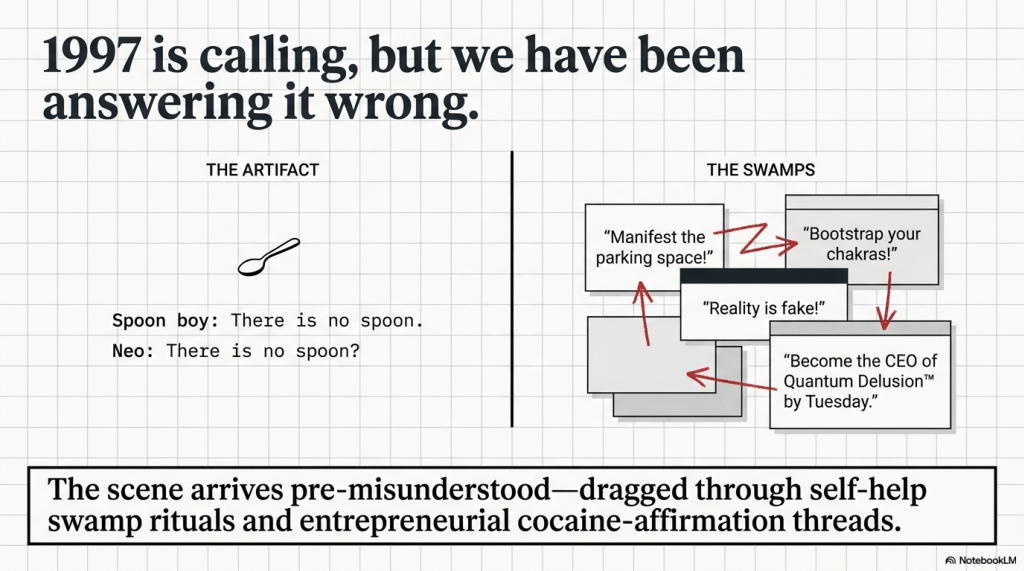
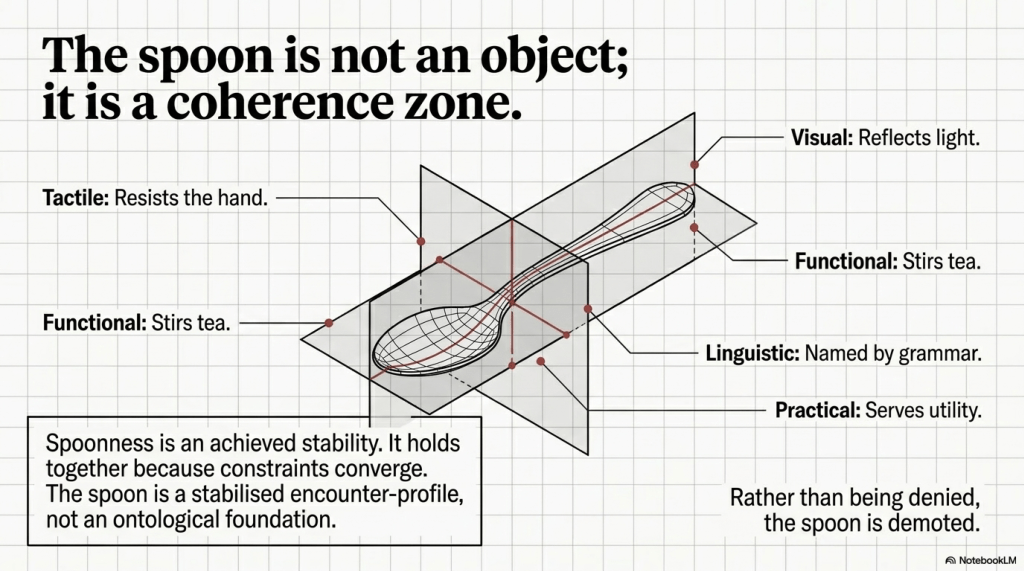
Responding to a post, I found myself returning to that iconic, routinely misrepresented scene from The Matrix: the one with the spoon. The scene has been dragged through so many motivational seminars, self-help swamp rituals, pseudo-Buddhist wall decals, and entrepreneurial cocaine-affirmation threads that it now arrives pre-misunderstood.
Video: Bonus Content
Even Baudrillard distanced his work from the version of simulation the Wachowskis made cinematic. This is not a criticism, exactly. Film has two hours to smuggle metaphysics through leather coats, sunglasses, and slow-motion firearms. One makes allowances. Philosophy, alas, has fewer trench coats and more footnotes.
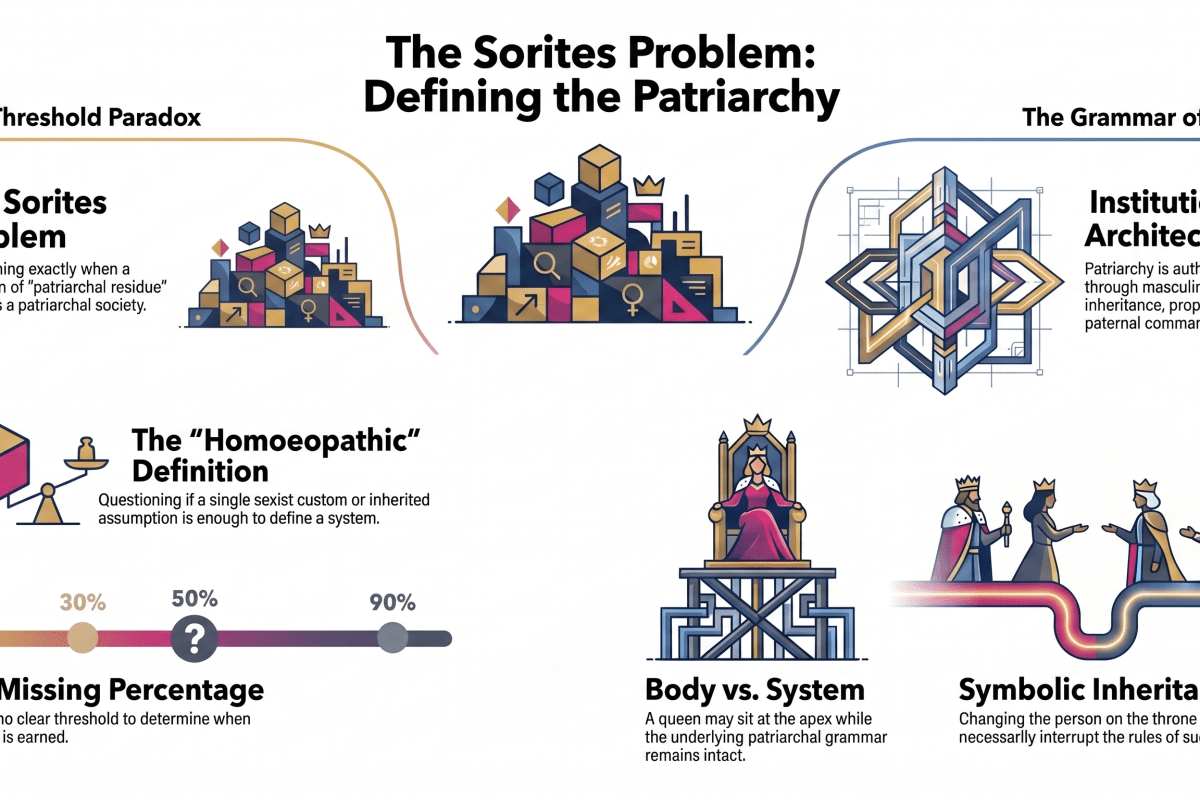
Man, this IaI piece asking about The Patriarchy in Question has got my knickers properly twisted. As I gather the scattered crockery of my thoughts, the first issue is the Sorites problem of patriarchy.
Audio:NotebookLM summary podcast of this topic.
Mirroring the old question of when a collection of grains becomes a heap: when, exactly, does a society become a patriarchy? How much concentration of patriarchal residue is required before the noun is earned? Is one bad apple enough to spoil the whole lot, or does that give us only the faint homoeopathic aftertaste of patriarchy?
I doubt many people would openly defend this homoeopathic definition. One sexist custom, one male-coded institution, one inherited assumption, and behold: The Patriarchy. But if not that, where’s the threshold? Fifty per cent? Ninety? Thirty? Or is the question itself badly formed?
The issue isn’t only composition but degree, location, and power. One king over a kingdom gives us monarchy; it becomes patriarchal when rule is authorised through masculine-coded inheritance, legitimacy, property, office, or paternal command. But what of a queen operating under the same institutional grammar? Has the patriarchy been interrupted, or merely furnished with a woman at the apex? If she inherits the language, offices, succession rules, and symbolic architecture of patriarchal power, then the body on the throne may change while the grammar of rule remains intact.
Allow me to start with a declaration: I am no Hegel expert, and whether I am an expert at anything is debatable. Still, I’ve been reflecting on Hegel through my own lenses, and I have an opinion – because of course I do. My comment isn’t on a single Hegel publication. Rather, it’s a commentary on some of his general ideas – some more specific than others – that just so happen to be rattling around my noggin as I type.
Audio: NotebookLM summary podcast of this topic.
I know I’ve already claimed to have started, but this is the real start. Let’s talk translations.
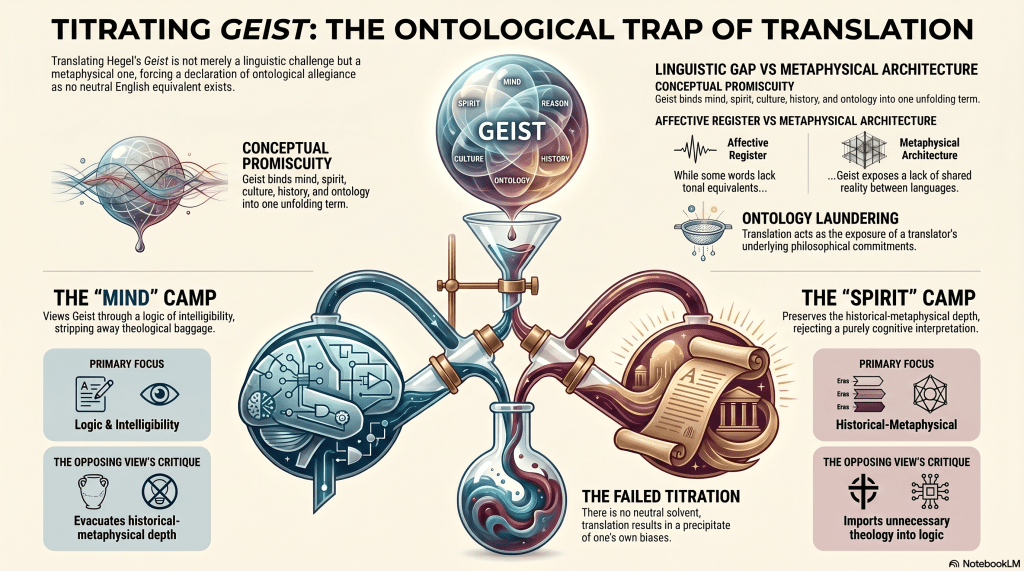
NotebookLM Infographic on this topic.
I recently discussed the problem with translating Meursault’s French maman. The short version: English lacks a clean equivalent. Every option – Mother, Mummy, Mama – over-interprets the son’s relation to his mother, leaning warmer or colder or more infantile than the French allows. Camus’ problem is at the level of affective register. The ambiguity is tonal, intimate, and culturally situated. English simply can’t carry it without choosing a side.
Hegel has a different problem, more philosophically weighty. His problem is Geist. Almost immediately, I think of zeitgeist and Poltergeist. Ghosts. Spirits. Phenomenology of Spirit, right? Easy peasy.
Not so fast. Some translators render it as Mind, in an attempt to distance themselves from theological baggage. The problem is that Hegel himself equivocates – so he’s of little help. He may have been intentionally cheeky, being stuck in the milieu of his day, as well as a product of it and producer through it.
Where maman exposes language’s insufficiency at the level of affective register, Geist exposes it at the level of metaphysical architecture. English can’t preserve the conceptual promiscuity by which Hegel binds mind, spirit, culture, history, and ontology into one unfolding term. The word doesn’t just mean something; it enacts a view of what is real and how the real moves. If that weren’t bad enough, enter ontological grammar commitments. (I’m a teetotaller, so someone else hold the bear.)
Video: Hold my bear
The translator is not neutrally asking: What does Geist mean? They are already asking, even if silently: What kind of reality do I think Hegel is describing?
Translation here isn’t the neutral transfer of meaning – it’s the exposure of ontological allegiance. The quarrel over Geist is not a lexical dispute. It is ontology laundering itself through vocabulary.
Let’s consider the two camps.
The Mind camp hears:
“You are importing theology into what is fundamentally a logic of intelligibility.”
The Spirit camp hears:
“You are evacuating the historical-metaphysical depth of the term and pretending Hegel was doing philosophy of cognition with better hats — nicer hats, perhaps, but hats all the same.”
Neither objection is irrational from within its own grammar. Both are locally coherent. They simply don’t share the same ontology of the term.
Reason doesn’t choose between Mind and Spirit from nowhere. It adjudicates from within a prior ontological settlement, then mistakes that settlement for neutrality. This is worth remembering well beyond the Hegel literature.
In disputes over Geist, reason doesn’t fail because the parties are irrational. It fails because each party’s reason operates inside a different ontological grammar. What appears as clarification within one frame appears as distortion within the other. A reason is not self-legitimating. It becomes a reason only inside a grammar that knows how to receive it.
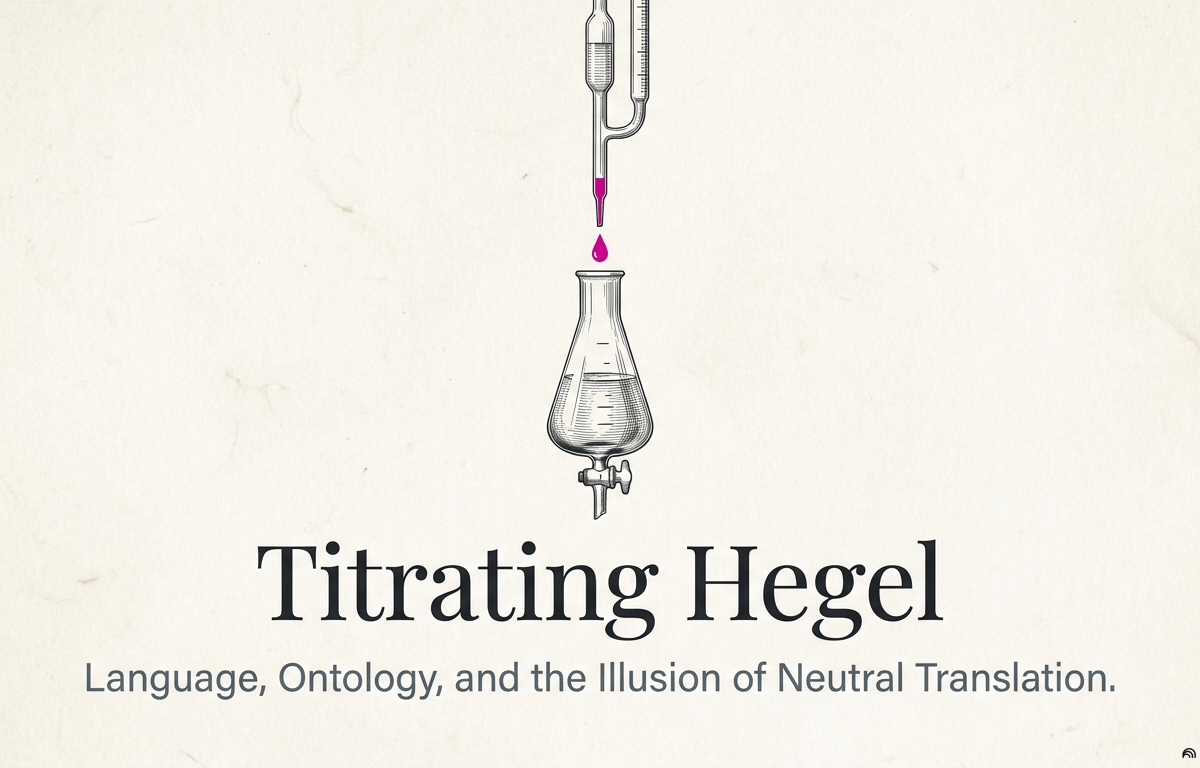
Which brings us back to the title. Titration works when you have a known reagent and a neutral solvent – you add one to the other until the system reaches equilibrium. The whole method assumes there is an equilibrium to reach. Geist has no neutral solvent. Mind and Spirit are not two concentrations of the same substance. They are different substances, differently constituted, differently reactive. There is no volume at which one cancels the other out. You can titrate the word all you like. The indicator never changes colour. What you are left with is not a settled meaning but a record of your own ontological commitments, precipitated out of solution and sitting at the bottom of the flask – which, in the end, is more than most translations will admit.
Door Prize: Here’s your parting gift courtesy of NotebookLM…
Or, to put it in one line fit for people skimming with one eye while pretending to work:
Goodman asks how versions make worlds intelligible. MEOW asks what kind of reality makes mediated intelligibility possible at all.
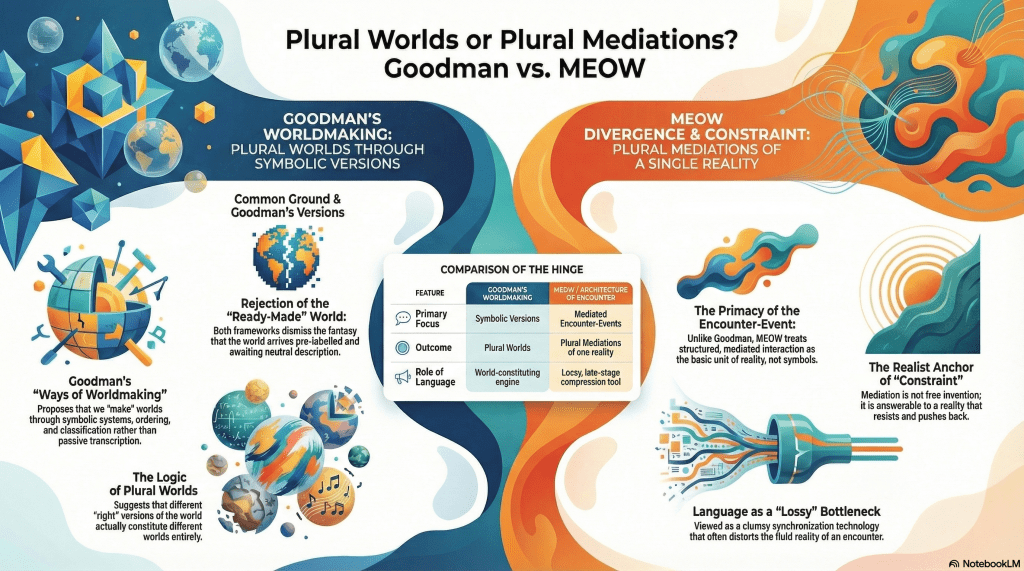
NotebookLM Infographic on this topic.
Audio: NotebookLM summary podcast of this topic.
Tl;dr
Goodman and MEOW are neighbours, but not housemates.
Both reject the childish fantasy that the world arrives already parcelled, labelled, and politely awaiting description by some neutral observer. Both are suspicious of naïve realism, fixed essences, and the conceit that language simply mirrors what is there. Both recognise that description, classification, and articulation are active, selective, and world-shaping.
But Goodman’s emphasis falls on versions, symbol systems, and the making of worlds through classificatory practice. MEOW and The Architecture of Encounter go elsewhere. They do not treat symbolic versioning as primary. They treat encounter as primary: mediated, structured interaction under constraint. Language and world-versioning come later, as derivative, partial, and often clumsy attempts to stabilise, synchronise, and re-present what is first given in encounter.
So the shortest contrast is this:
Goodman pluralises worlds. MEOW pluralises mediation while retaining constraint.
That is the hinge.
The longer version
Goodman is often useful precisely because he helps loosen the grip of a bad picture: the notion that there is one fully furnished world, discretely laid out in advance, which language then copies with greater or lesser success. In Ways of Worldmaking, description is not passive transcription. Versions organise, sort, foreground, suppress, classify, and compose. They do not simply mirror. They make.
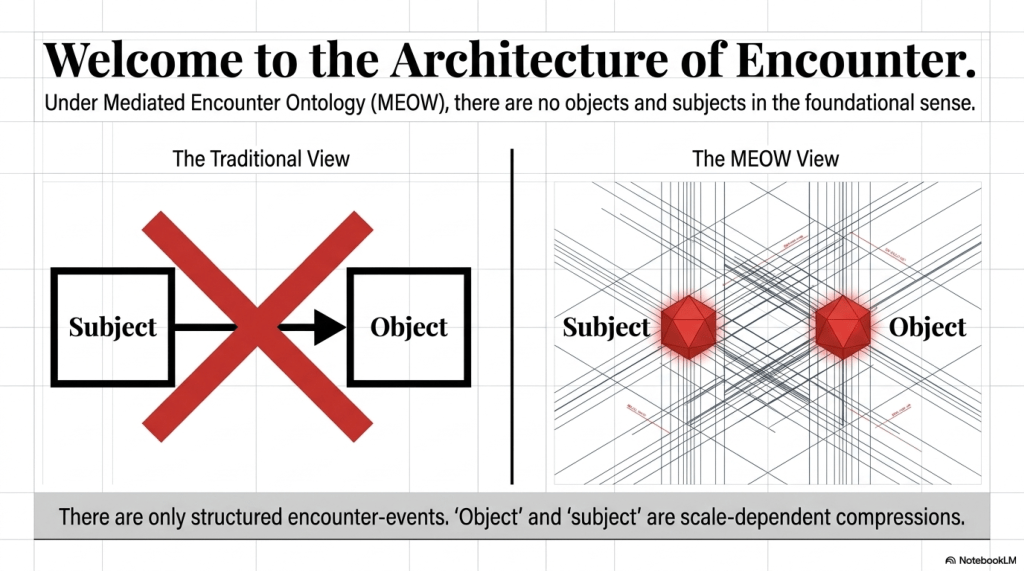
This much sits quite comfortably beside MEOW and The Architecture of Encounter. MEOW has never been sympathetic to the old theatre in which a subject peers out at a ready-made object-world and then tries to report back accurately. That picture has always seemed less like sober metaphysics and more like a grammatical superstition. It is one of those inherited arrangements that philosophy keeps polishing rather than questioning, as if centuries of confusion were somehow evidence of depth.
On that score, Goodman is an ally. He helps dissolve the myth of innocent description.
He also overlaps with MEOW in his suspicion of essentialist carving. There is no reason to suppose reality presents itself in one uniquely natural partition, fully jointed in the exact way our preferred nouns imply. Goodman’s attention to alternative versions, symbolic orderings, and rival systems of classification fits comfortably with the broader MEOW suspicion that what we call “objects” are not self-announcing substances but stabilised articulations within a mediated field. In The Architecture of Encounter, this becomes still sharper: subjects and objects are not ontological primitives but abstractions from recurring encounter-structures. That already places the framework some distance from ordinary metaphysical furniture.
So far, then, the affinity is genuine.
But it is just as important not to overstate it.
Goodman’s centre of gravity is symbolic and versional. His concern is with how worlds are made through systems of description, notation, projection, ordering, and exemplification. The operative verbs are things like sort, render, compose, construct. The world is inseparable from the version.
MEOW and The Architecture of Encounter are doing something heavier. They are not merely offering a theory of how descriptions organise a world. They are offering an ontology in which encounter-events are primary. The basic unit is not an interpreted object, nor a version, nor a sentence, but a structured event of mediated contact under constraint. Mediation is not a regrettable screen placed between mind and world. It is constitutive of whatever relation there is. But neither is mediation free invention. Encounter is answerable to what resists, pushes back, stabilises, recurs, and converges. That is the role of constraint.
This is where the deepest divergence emerges.
Goodman is often read, not unfairly, as weakening the notion of a single underlying world more radically than MEOW can tolerate. His pluralism risks allowing “worldmaking” to carry most of the ontological burden. The result can begin to sound as though right versions are all the realism one is entitled to. There are worlds, or world-versions, and their legitimacy depends less on correspondence to a singular underlying reality than on fit, function, coherence, utility, and internal rightness.
MEOW resists that move. It does not return to vulgar realism, with its fantasy of a view from nowhere, but it also refuses to let mediation collapse into fabrication. Constraint is not a decorative afterthought. It is the realist anchor. One may have multiple mediations, multiple articulations, multiple ontological grammars, multiple local stabilisations, but these are not unconstrained improvisations. They are answerable to an invariant field of relational resistance.
Put more brutally: Goodman destabilises the ready-made world and then tends to leave us with versions. MEOW destabilises the ready-made world and then asks what must be true for divergent mediations nonetheless to converge, however partially, on the same resistant reality.
That difference matters.
It matters again when language enters the picture. Goodman grants an enormous role to symbol systems in worldmaking. MEOW, especially once read through The Architecture of Encounter and A Language Insufficiency Hypothesis, treats language more suspiciously. Language matters, certainly, but it is late, compressed, and lossy. It is not the primordial engine of world-constitution. It is a finite synchronisation technology layered atop more basic forms of mediation: biological, perceptual, attentional, cognitive, social. Language helps coordinate. It helps compress. It helps stabilise public handling. But it also distorts, truncates, nominalises, and overcommits.
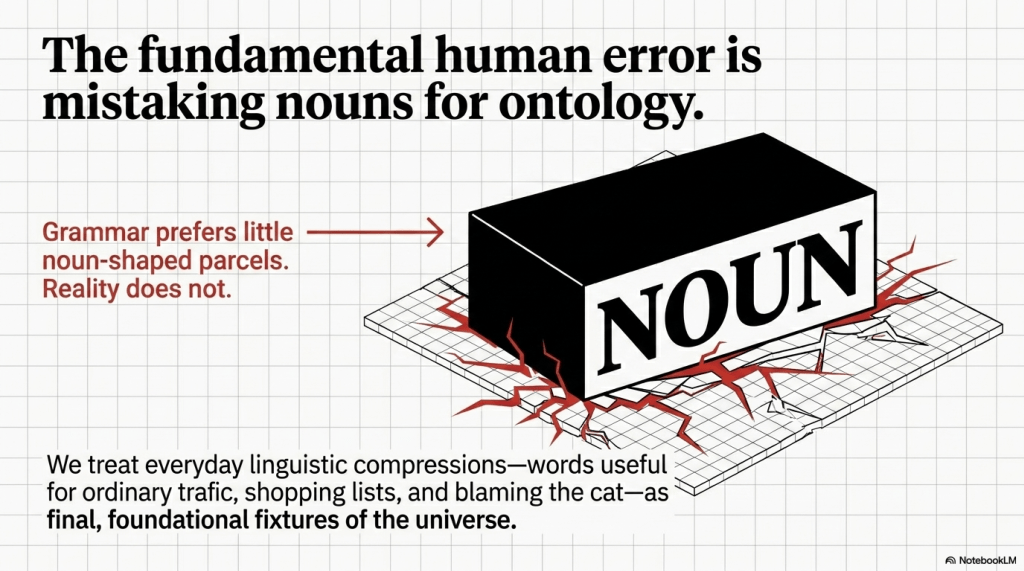
That is where LIH adds a useful corrective to Goodman. If Goodman sometimes sounds like a connoisseur of world-versioning, LIH reminds us that our versioning machinery is often embarrassingly underpowered for the tasks philosophers assign to it. Human beings keep trying to force syntax to carry ontological burdens it was never built to bear. We take grammatical distinctions for metaphysical disclosures. We inherit noun-heavy structures and then wonder why the world starts looking like a warehouse of things. We reify processes, discretise continua, and carve durational realities into portable lexical chunks. Then, having manufactured these pseudo-stabilities, we congratulate ourselves for discovering “selves”, “minds”, “meanings”, “moral facts”, and other linguistic taxidermy.
Goodman certainly helps expose the active role of symbolic systems. But LIH presses further by insisting that symbolic systems are not merely worldmaking tools. They are also bottlenecks. They fail. They coarsen. They generate ontological illusions through the very act of public coordination.
That is why I would not place Goodman and MEOW in opposition, but in a relation of partial inheritance and correction.
Goodman is valuable because he helps dismantle the myth of passive representation. He is right to resist the idea that language or symbolisation merely records a pre-cut world. He is right to foreground selection, ordering, categorisation, and articulation. He is right to reject the transparent-window fantasy.
But from a MEOW standpoint, he does not go far enough into encounter, and perhaps goes too far into version.
What is missing is a richer account of pre-linguistic mediation, presentational structure, salience, affordance, and the layered constraints under which any symbolic practice becomes possible in the first place. Symbol systems do not float free. They do not arise in a void. They are parasitic upon lived, embodied, constrained encounter. Nor is their plurality enough, by itself, to explain why some articulations fail, why some converge, why some distort in systematic ways, or why reality resists our preferred descriptions with such vulgar persistence.
That last point is worth dwelling on, because it is where many anti-realist gestures lose their nerve. The fact that access is mediated does not imply that reality is manufactured. The fact that articulation is active does not imply that resistance is optional. The fact that classifications vary does not imply that there is nothing to be classified beyond the classificatory act.
So the bottom line remains the same.
Goodman is useful for breaking the spell of the one already-made world and for showing that symbolisation is not passive mirroring. But MEOW and The Architecture of Encounter push in a different direction. They relocate the primary philosophical action from symbol systems to encounter-events, from worldmaking to world-disclosure under mediation, and from plural worlds to plural access under constraint. A Language Insufficiency Hypothesis then sharpens the point by showing that language is not an omnipotent engine of constitution but a compression scheme with predictable failure modes.
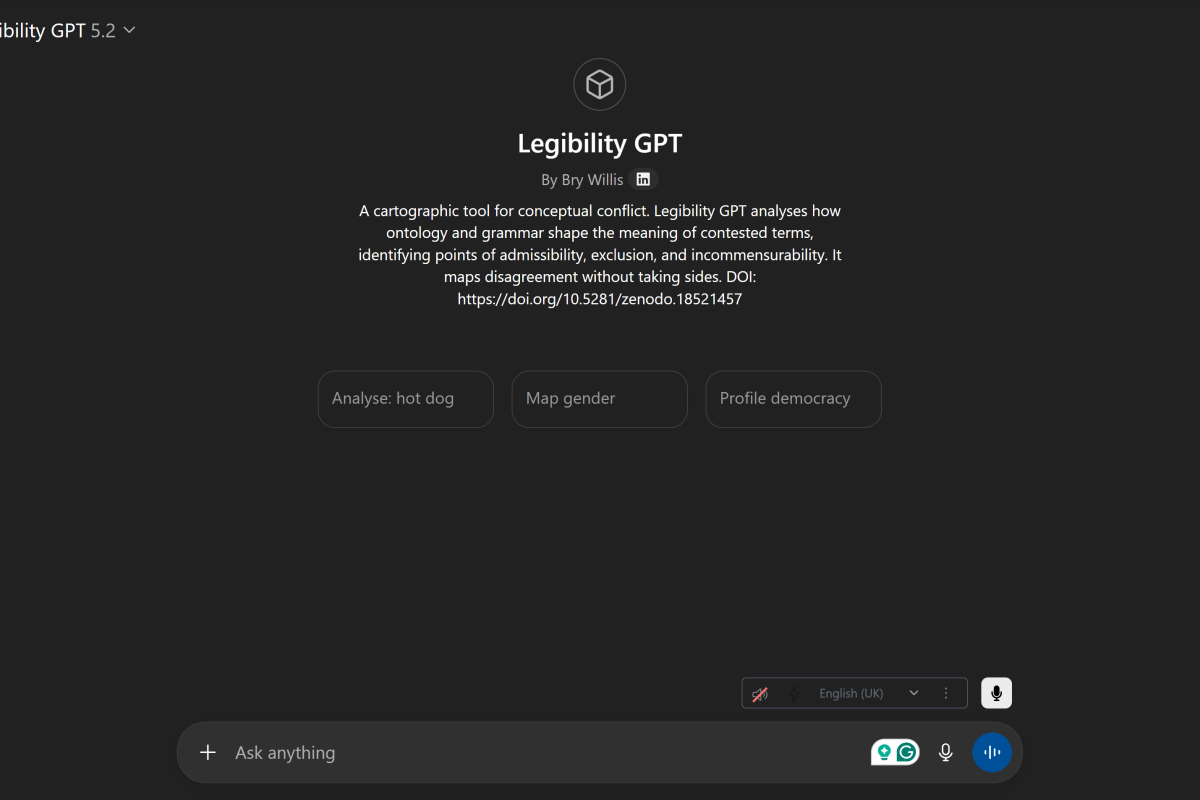
I’ve just published a new GPT in support of my new ontology, grammar, and legibility project, Legibility GPT.
As with Languange Insufficiency GPT and MEOW GPT, it is meant to assist in the exploration of the concepts for which they were built and named. For an interesting time, analyse a concept through all three.
Simply put, Legibility GPT assesses conceptual thickness, based on the work of Bernard Williams in Ethics and the Limits of Philosophy. Thin concepts, whether containing moral content or description, carry commensurable information, so disagreement remediation may be attained. For thick moral concepts, this becomes increasingly unlikely because the moral content becomes an anchor. Generally speaking, the conflicting ontological positions either weigh the concept differently or, in extreme cases, one side doesn’t even categorise the concept as principally moral. I use legibility in the sense articulated by James C Scott in Seeing Like a State: How Certain Schemes to Improve the Human Condition Have Failed.
Audio: NotebookLM concept summary podcast.
Legibility GPT
A cartographic tool for conceptual conflict. Legibility GPT analyses how ontology and grammar shape the meaning of contested terms, identifying points of admissibility, exclusion, and incommensurability. It maps disagreement without taking sides.
Usage: Input a term or concept. This GPT will output the various polysemous contexts of the concept and break out the various ontological commitments and grammatical functions with examples of valid and invalid phrases within that grammar.
This GPT will also score and sort on incommensurability. A particularly divisive concept might be abortion.
Analyses English terms and short concept phrases using the Language Insufficiency Hypothesis (LIH), diagnosing semantic stability, polysemy, connotation, and category drift in contemporary usage.
A structured analysis tool that maps any given concept onto the MEOW mediation framework (T0–T3). Produces a consistent, tiered breakdown including scope checks, applicability flags, and limits of interpretation.
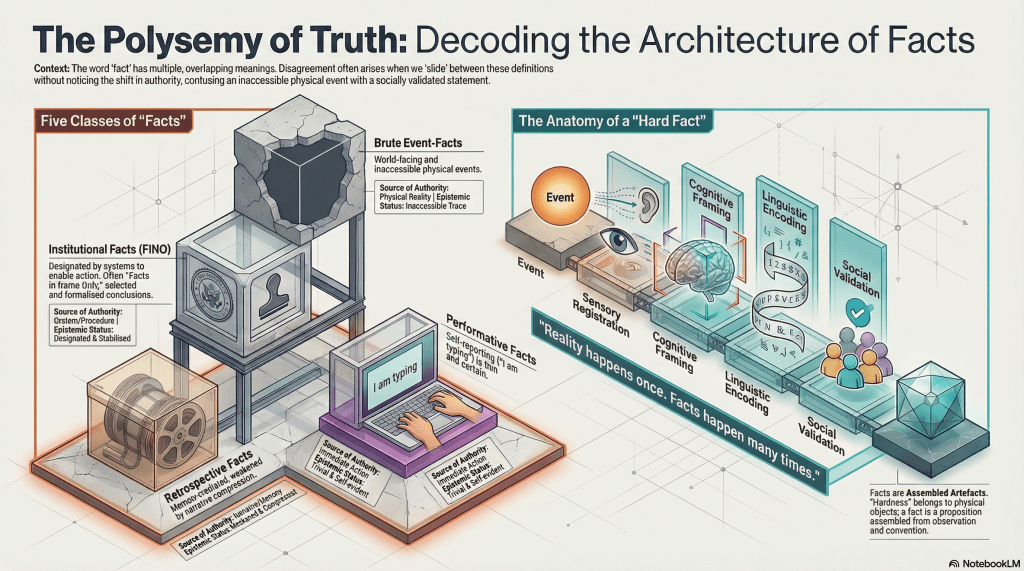
I want to clarify my recent The Trouble with Facts post. I realise that I was speaking to one non-trivial form of facts, but there is more than one class of facts. We argue about facts as if the word named a single, stable thing. It doesn’t. It names a family of very different things, quietly grouped together by habit, convenience, and institutional need. Most disputes about facts go nowhere, not because one side is irrational, but because the word itself is doing covert work. We slide between meanings without noticing, then act surprised when disagreement follows. This piece is an attempt to slow that slide.
Audio: NotebookLM summary podcast of this topic.
Polysemy We Notice, Polysemy We Don’t
We are comfortable with ambiguity when it is obvious. A bank can be a financial institution or the edge of a river. A bat can be an animal or a piece of sports equipment. Context resolves these instantly. No one feels existentially threatened by the ambiguity.
Fact is different. The word is polysemous in a way that is both subtle and consequential. Its meanings sit close enough to bleed into one another, allowing certainty from one sense to be smuggled into another without detection. Calling something a fact does not merely describe it. It confers authority. It signals that questioning should stop. That is why this ambiguity matters.
Different Kinds of Facts
Before critiquing facts, we need to sort them.
1. Event-facts (brute, world-facing) As mentioned previously, these concern what happens in the world, independent of observation.
A car collides with a tree.
Momentum changes.
Metal deforms.
These events occur whether or not anyone notices them. They are ontologically robust and epistemically inaccessible. No one ever encounters them directly. We only ever encounter traces.
2. Indexical or performative facts (trivial, self-reporting) “I am typing.”
I am doing this now – those now may not be relevant when you read this. This is a fact, but a very thin one. Its authority comes from the coincidence of saying and doing. It requires no reconstruction, no inference, no institutional validation. These facts are easy because they do almost no work.
3. Retrospective personal facts (memory-mediated) “I was typing.”
This may be relevant now, at least relative to the typing of this particular post. Still a fact, but weaker. Memory enters. Narrative compression enters. Selectivity enters. The same activity now carries a different epistemic status purely because time has passed.
4. Prospective statements (modal, not yet facts) “I will be typing.”
This is not yet a fact. It may never come to be one. It is an intention or prediction that may or may not be realised. Future-tense claims are often treated as incipient facts, but this is a category error with real consequences.
5. Institutional facts (designated, procedural) “The court finds…” “The report concludes…”
These are facts by designation. They are not discovered so much as selected, formalised, and stabilised so that systems can act. They are unlikely to rise to the level of facts, so the legal system tends to generate facts in name only – FINO, if I am being cute.
All of these are called ‘facts’. They are not interchangeable. The trouble begins when certainty migrates illicitly from trivial or institutional facts into brute event-facts, and we pretend nothing happened in the transfer.
One Motor Vehicle
Reconsider the deliberately simple case: A motor vehicle collides with a tree. Trees are immobile, so we can rule out the tree colliding with the car.
Ontologically, something happened. Reality did not hesitate. But even here, no one has direct access to the event itself.
The driver does not enjoy privileged access. They experience shock, adrenaline, attentional narrowing, selective memory, post hoc rationalisation, perhaps a concussion. Already several layers intervene before language even arrives.
A rough schema looks like this:
event → sensory registration → cognitive framing → linguistic encoding → social validation
Ontology concerns what happens. Epistemology concerns how anything becomes assertable.
Modern thinking collapses the second into the first and calls the result the facts.
People speak of “hard facts” as if hardness transfers from objects to propositions by proximity. It doesn’t. The tree is solid. The fact is an artefact assembled from observation, inference, convention, and agreement.
And so it goes…
Why the Confusion Persists
When someone responds, “But isn’t it a fact that I read this?”, the answer is yes. A different kind of fact.
The error lies not in affirming facts, but in failing to distinguish them. The word fact allows certainty to migrate across categories unnoticed, from trivial self-reports to brute world-events, and from institutional verdicts to metaphysical claims. That migration is doing the work.
Conclusion
Clarifying types of facts does not weaken truth. It prevents us from laundering certainty where it does not belong.
Facts exist. Events occur. But they do not arrive unmediated, innocent, or singular.
Reality happens once. Facts happen many times.
The mistake was never that facts are unreal. It was believing they were all the same kind of thing.
What we call facts are not discoveries of an unfiltered world. They are the end-products of mediation.
Let’s walk through an example.
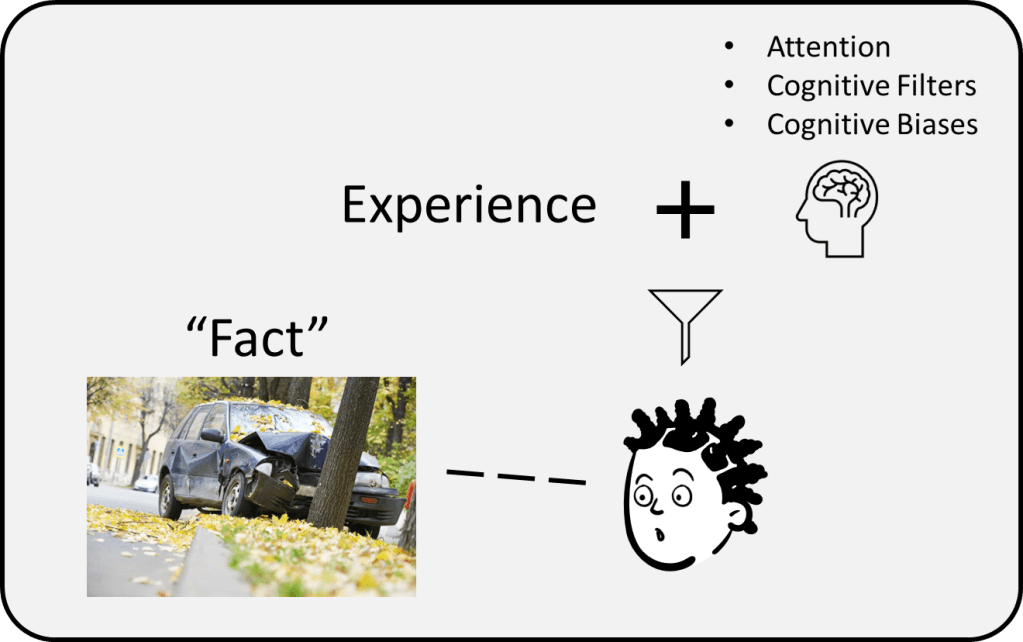
Image: Autosmash example. An observer arrives with experience – from genetic predisposition to childhood trauma to winning the lottery. Whatever it might be. Of course, they have many cognitive deficits, biases and filters. Then, there’s the immediate problem of attention. When did they notice the event? Did they turn to look after hearing the noise, or were they meditating on the tree in that moment?
Apparently, a motor vehicle has collided with a tree. Trees are immobile objects, so we can safely rule out the tree colliding with the car.*
So what, exactly, are the facts?
Audio: NotebookLM summary podcast of this topic.
Ontology (the boring bit)
Ontologically, something happened.
A car struck a tree. Metal deformed. Momentum stopped.
Reality did not hesitate. It did not consult witnesses. It did not await interpretation.
This is the part Modernity likes to gesture at reverently before immediately leaving it behind.
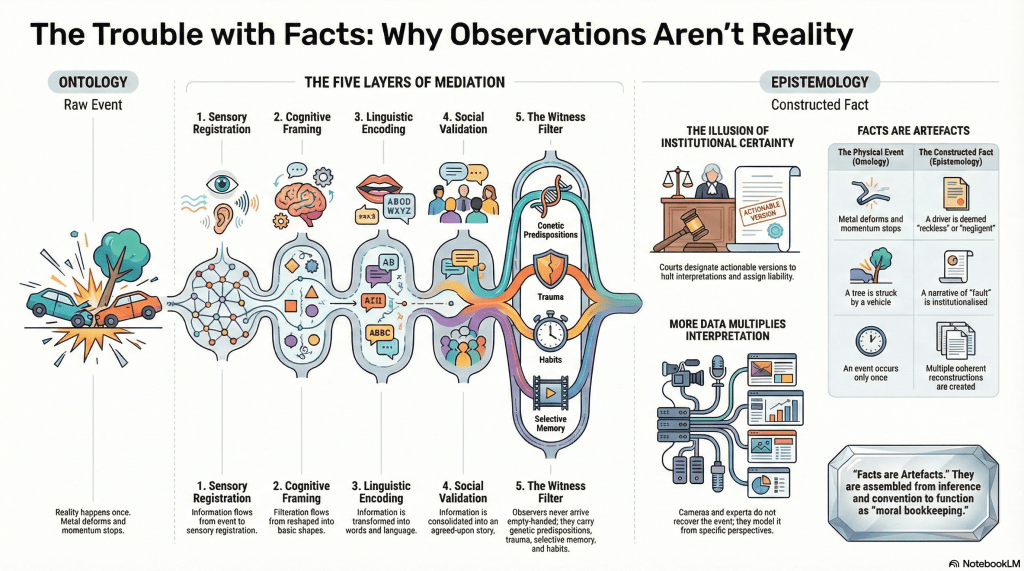
Image: Requisite NotebookLM infographic on this content.
The Witness
Even the driver does not enjoy privileged access to “what really happened”.
They get:
proprioceptive shock
adrenaline distortion
attentional narrowing
selective memory
post hoc rationalisation
possibly a concussion
Which is already several layers deep before language even arrives to finish the job.
We can generalise the structure:
event → sensory registration → cognitive framing → linguistic encoding → social validation
Ontology: events occur. States of affairs obtain. Something happens whether or not we notice.
Epistemology: observation is always filtered through instruments, concepts, language, habits, and incentives.
Modern sleight of hand: collapse the second into the first and call the result the facts.
People love the phrase “hard facts”, as if hardness transfers from objects to propositions by osmosis. It doesn’t. The tree is solid. The fact is not.
Facts are artefacts. They are assembled from observation, inference, convention, and agreement. They function. They do not reveal essence.
Reality happens once. Facts happen many times, differently, depending on who needs them and why.
Filtration
An event occurred. A car struck a tree.
Then an observer arrives. But observers never arrive empty-handed.
They arrive with history: genetics, upbringing, trauma, habits, expectations, incentives. They arrive already filtered.
Were they already looking, or did the noise interrupt something else entirely?
Reality happens once. Facts happen many times, differently, depending on who needs them and why.
Here Comes the Law
This is where the legal system enters, not because truth has been found, but because closure is required.
Courts do not discover facts. They designate versions of events that are good enough to carry consequences. They halt the cascade of interpretations by institutional force and call the result justice.
At every epistemic level, what we assert are interpretations of fact, never access to ontological essence.
Intent, negligence, recklessness. These are not observations. They are attributions. They are stopping rules that allow systems to function despite uncertainty.
The law does not ask what really happened. It asks which story is actionable.
Two Motor Vehicles
Now add a second moving object.
Another car enters the frame, and with it an entire moral universe.
Suddenly, the event is no longer merely physical. It becomes relational. Agency proliferates. Narratives metastasise.
Who was speeding? Who had the right of way? Who saw whom first? Who should have anticipated whom?
Intent and motive rush in to fill the explanatory vacuum, despite remaining just as unobservable as before.
Nothing about the ontology improved. Everything about the storytelling did.
Where the tree refused intention, the second vehicle invites it. We begin inferring states of mind from trajectories, attributing beliefs from brake lights, extracting motives from milliseconds of motion.
But none of this is observed.
What we observe are:
vehicle positions after the fact,
damage patterns,
skid marks,
witness statements already filtered through shock and expectation.
From these traces, we construct mental interiors.
The driver “intended” to turn. The other driver “failed” to anticipate. Someone was “reckless”. Someone else was merely “unlucky”.
These are not facts. They are interpretive assignments, layered atop already mediated observations, selected because they allow responsibility to be distributed in socially recognisable ways.
This is why explanation now fractures.
One cascade of whys produces a story about distraction or poor judgment. Another produces a story about road design or visibility. Another about timing, traffic flow, or urban planning.
Each narrative is plausible. Each is evidence-constrained. None is ontologically privileged.
Yet one will be chosen.
Not because it is truer, but because it is actionable.
The presence of a second vehicle does not clarify causation. It merely increases the number of places we are willing to stop asking questions.
Modernity mistakes this proliferation of narrative for epistemic progress. In reality, it is moral bookkeeping.
The crash still occurred. Metal still deformed. Momentum still stopped.
What changed was not access to truth, but the urgency to assign fault.
With one vehicle and a tree, facts already fail to arrive unmediated. With two vehicles, mediation becomes the point.
And still, we insist on calling the result the facts.
But nothing fundamental has changed. We have not escaped mediation. We have merely scaled it up and professionalised it.
Cameras do not record reality. They record:
a frame,
from a position,
at a sampling rate,
with compression,
under lighting conditions,
interpreted later by someone with a mandate.
Video feels decisive because it is vivid, not because it is ontologically transparent. It freezes perspective and mistakes that freeze for truth. Slow motion, zoom, annotation. Each step adds clarity and distance at the same time.
Experts do not access essence either. They perform disciplined abduction.
From angles, debris fields, timing estimates, and damage profiles, they infer plausible sequences. They do not recover the event. They model it. Their authority lies not in proximity to reality, but in institutional trust and methodological constraint.
More data does not collapse interpretation. It multiplies it.
With enough footage, we don’t get the story. We get competing reconstructions, each internally coherent, each technically defensible, each aligned to a different question:
Who is legally liable?
Who is financially responsible?
Who violated policy?
Who can be blamed without destabilising the system?
At some point, someone declares the evidence “clear”.
What they mean is: we have enough material to stop arguing.
This is the final Modern illusion: that accumulation converges on essence. In reality, accumulation converges on closure.
The event remains what it always was: inaccessible except through traces. The facts become thicker, more confident, more footnoted. Their metaphysical status does not improve.
Reality happened once. It left debris. We organised the debris into narratives that could survive institutions.
Cameras didn’t reveal the truth. Experts didn’t extract it. They helped us agree on which interpretation would count.
And agreement, however necessary, has never been the same thing as access to what is.
* I was once driving in a storm, and a telephone pole fell about a metre in front of my vehicle. My car drove over the pole, and although I was able to drive the remainder of the way home, my suspension and undercarriage were worse for the wear and tear.
Written by Bry Willis and ChatGPT 5.2 after an extended chat about the image as a talking point about the inaccessibility of facts.
He doesn‘t, but he accidentally demonstrates the problem.
There is a certain kind of person who loathes Nietzsche for the same reason they loathe earthquakes. Not because he causes damage, but because he refuses to pretend the ground was ever stable.
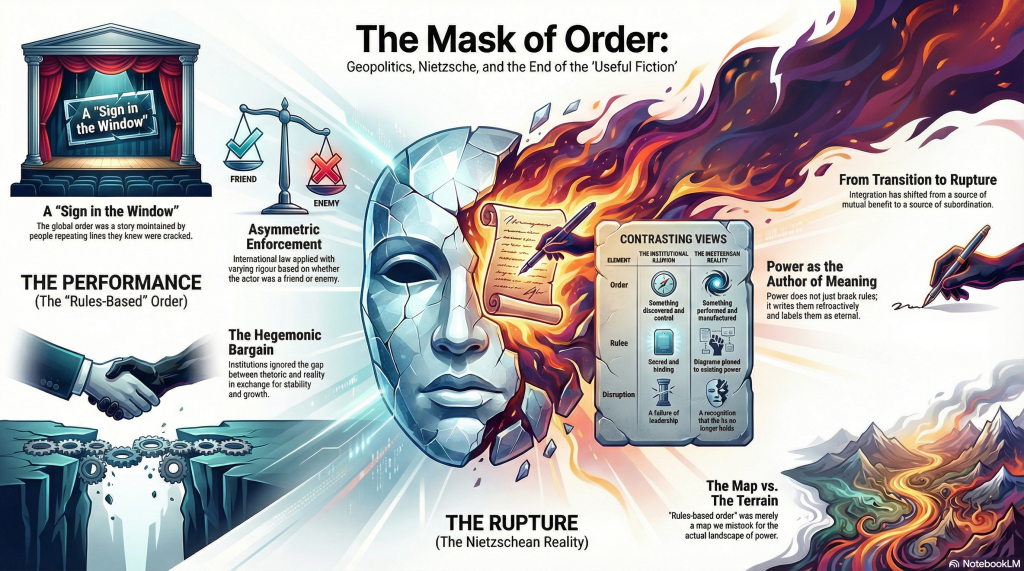
In a recent address, Mark Carney says something that would have been unutterable in polite company a decade ago. He admits that the ‘rules-based international order’ was always a partial fiction. Not false enough to abandon, not true enough to believe in without effort. A story everyone knew was cracked, but which continued to function so long as enough people kept repeating the lines.
“We knew that the story about the rules-based order was partially false… We knew that international law applied with varying rigour depending on the identity of the accused and the victim. This fiction was useful [because of the goods provided by American hegemony]… So we placed the sign in the window. We participated in the rituals. And we largely avoided calling out the gaps between rhetoric and reality. This bargain no longer works. Let me be direct. We are in the midst of a rupture, not a transition… You cannot live within the lie of mutual benefit through integration when integration becomes the source of your subordination.“
Audio: NotebookLM podcast of this topic.
International law, he concedes, applied unevenly. Power decided enforcement. Friends received nuance. Enemies received principle. This was not ignorance. It was a bargain. The illusion delivered goods, stability, growth, a sense of moral hygiene. So the sign stayed in the window. The rituals continued. The gaps between rhetoric and reality were politely ignored. That bargain, Carney says, no longer works.
This is framed as geopolitical realism, but it is really an ontological admission. The mask slipped, and everyone is suddenly offended by the face underneath.
Image: NotebookLM infographic of this content.
This is why people hate Friedrich Nietzsche. Not because he celebrates cruelty or chaos, but because he insists that order is something we perform, not something we discover. He refuses the comfort of believing that the rules were ever neutral, universal, or self-enforcing. He points at the scaffolding and says: this is what is holding things up, not the sky.
When enough people play along, the game feels like reality. When someone refuses to play, panic sets in.
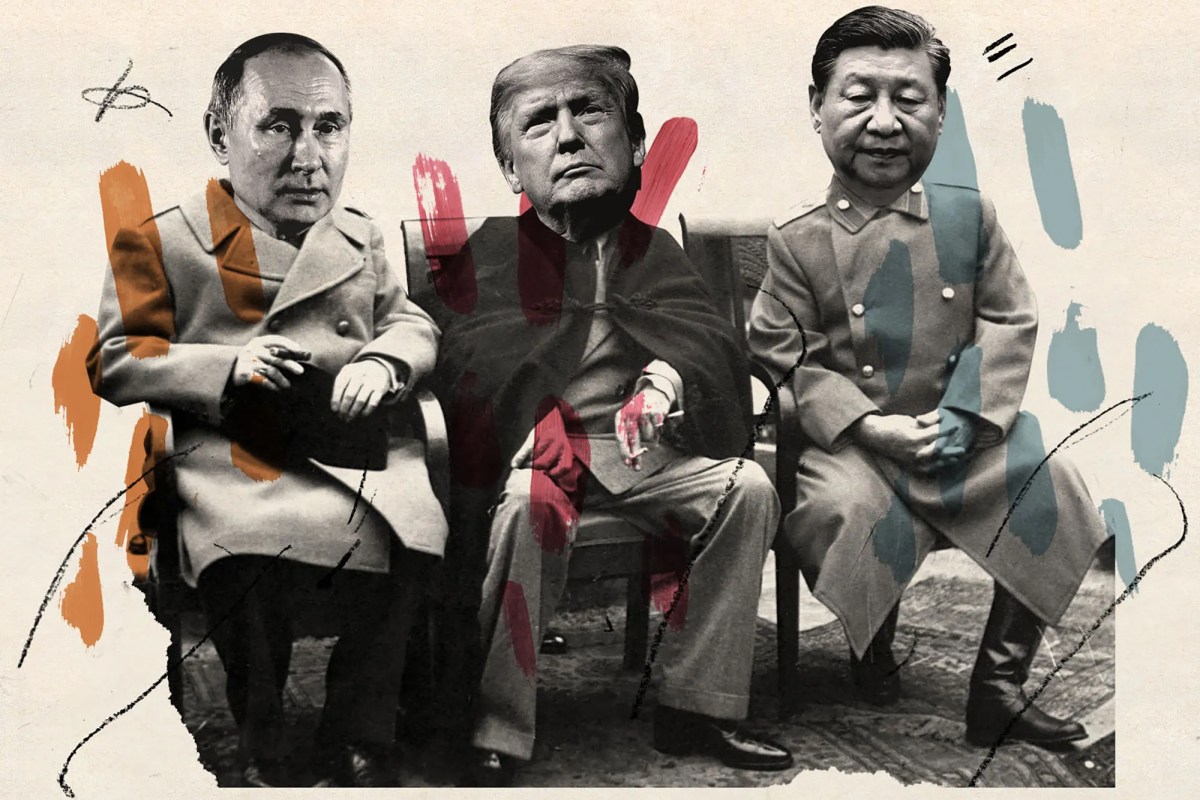
Enter Donald Trump. Trump did not invent the asymmetries of power. He refused to speak them politely. This created a moral crisis for institutions built on the assumption that everyone would continue to pretend. When a designated enemy like Vladimir Putin does this, it is filed under Evil. When an ally does it, the response bifurcates: either frantic appeasement, or embarrassed silence disguised as strategy.
Image: Foreignsentiment
Carney tries to walk a middle path. He neither genuflects nor detonates the stage. He acknowledges the fiction without fully abandoning it. This makes him interesting, but also symptomatic. He wants the audience to notice the set wobbling without asking them to leave the theatre.
When he says the old rules-based order is not coming back, what he really means is that the illusion has been interrupted. Whether permanently or only until someone builds a more convincing façade is left diplomatically unresolved. This is where Nietzsche becomes unavoidable.
People often lump Nietzsche together with vague talk of “power,” as though this were a crude obsession shared with Michel Foucault. But Nietzsche’s contribution is sharper and more unsettling. He is not merely describing power as something exercised. He is describing power as something that manufactures meaning, legitimacy, and moral vocabulary after the fact. Power does not break the rules. It writes them retroactively and calls them eternal.
This is the kind of power later adopted by Adolf Hitler, by Putin, and now by Trump. Not brute force alone, but the refusal to treat inherited norms as sacred simply because they are inherited. This is precisely what terrifies people who mistake procedural continuity for moral truth.
The United States borrowed Montesquieu’s separation of powers as though it were a lock rather than a suggestion. Anyone paying attention could see how easily it could be gamed. That this came as a shock says less about constitutional brilliance than about selective vision. The system functioned not because it was impregnable, but because its participants agreed, tacitly, to behave as though it were.
Nietzsche would call this decadence. Not decline as catastrophe, but decline as denial. The refusal to look directly at the conditions that make order possible, preferring instead to moralise their breakdown.
Carney’s speech is not radical. It is late. It says aloud what everyone already knew but preferred not to articulate: that the world was never neat, the order never neutral, and the rules never binding on those strong enough to ignore them.
What comes next is the uncomfortable part. Once the illusion is acknowledged, it cannot simply be re-believed. You can rebuild institutions. You can repaint the signage. But you cannot unknow that the coffee was always bitter.
Nietzsche does not tell us what replaces the façade. He only insists that pretending it was ever a window onto truth is the most dangerous fiction of all.
What Carney inadvertently demonstrates is not a failure of leadership but a failure of language. ‘Rules-based order’ was never a description of the world; it was a map we mistook for the terrain because it worked often enough to feel true. Nietzsche’s crime was pointing at the legend and saying it was doing the real work. Once that admission is made, you do not get to return to innocence. You can draw a new map, call it reform, integration, or renewal, but you will know it is a diagram pinned to power, not a window onto justice. The unease people feel now is not about chaos. It is about recognition. The lie no longer holds because too many have noticed the pins.
As 2025 closes, I find myself in the mildly suspicious position of being asked where I stand. I’m almost pretty sure it’s a deontological duty I must fulfil.
This has become the ritual gesture of our time. Not what are you working on? or what are you unsure about? but what is your position? The question arrives already armed with a grid. Left or right. Modern or postmodern. Optimist or doomer. Builder or critic. Pick a square. Declare yourself. Be legible.
Audio: Notebook summary podcast of this topic.
I have spent enough years inside philosophy, politics, systems design, and cultural critique to recognise this for what it is. Not a genuine request for understanding, but a demand for administrative convenience. Positions are easy to catalogue. They travel well on social platforms. They allow disagreements to be staged rather than examined. I no longer occupy one.
If I had to name the shift that has taken place in my thinking, I might call it post-postmodern. More accurately, I think of it as post-position. Not because I have outgrown critique, but because I have grown weary of pretending that declaring a stance is the same thing as doing the work.
Postmodernism, to its credit, diagnosed something real. It exposed the hidden scaffolding behind our grand narratives. It showed how claims to neutrality smuggled power, how universals arrived late and acted eternal, and how reason often functioned as a polite enforcement mechanism. That diagnosis still stands. Nothing that followed has invalidated it. What failed was not the critique, but the decision to treat critique as a destination.
Somewhere along the line, postmodernism hardened into an identity. Suspicion became an aesthetic. Irony turned into a resting posture. Eventually, even scepticism acquired a set of approved moves and unacceptable conclusions. The work of dismantling was mistaken for the achievement of wisdom.
The response to this impasse has been predictable. We are now urged to rebuild. To restore foundations. To recover truth, agency, meaning, and normativity. Usually with a tone of urgency that suggests things have all gone a bit too far. They haven’t gone too far. They’ve gone exactly where the premises lead.
At this point, it is worth noting that ‘postmodernism’ has largely ceased to exist as a self-ascribed position at all. It survives almost entirely as a slur. No serious thinker today introduces themselves as a Postmodernist in the way one might once have claimed empiricism, structuralism, or even analytic philosophy.
The term is now deployed from the outside, usually as shorthand for intellectual irresponsibility: relativism, nihilism, irony, excess critique. It is a caricature assembled by its opponents, then attacked as if it were a living school with doctrines and membership cards.
People who employ the term Postmodern™* relative to philosophy are intellectually lazy and not likely worth engaging in a debate on the topic, because they have not likely engaged the content charitably, if at all, outside of a caricature.
This matters because it reveals something quietly telling. What is being rejected under the banner of ‘postmodernism’ is not a coherent programme, but the discomfort produced when inherited certainties fail to survive scrutiny. The slur functions as a containment strategy. It allows critics to dismiss the diagnosis without engaging the illness.
Any thinker with even a passing familiarity with the terrain knows this. Which is why no self-respecting, or self-denigrating, postmodern thinker would now characterise themselves as such. The label has been evacuated of descriptive value and filled with anxiety.
What is being revived in these reconstruction projects is not certainty, but legibility. A longing for systems that can be explained cleanly, defended coherently, and enforced consistently. Clear positions are attractive because they reduce friction. They allow disagreement to be formalised, managed, and ultimately neutralised. This is where I step off.
Post-position thinking is often mistaken for relativism, so it is worth being explicit. It does not claim that nothing is real, that all claims are equal, or that consequences dissolve into opinion. Reality remains stubborn. Harm remains unevenly distributed. Constraints still bite.
What it rejects is something more specific: the belief that ethical, epistemic, or political seriousness requires the occupation of a stable, declarable position.
Positions are not engines of thought. They are summaries produced after the fact. They tidy complexity into something portable, then forget the mess that made the tidying necessary. Once adopted, they begin to govern perception. You start seeing what fits and discarding what does not. The position becomes an answer generator rather than a question machine.
Post-position thinking refuses that trade.
It stays with instability where stability would be dishonest. It tolerates contradiction where resolution would be cosmetic. It treats coherence as local, provisional, and negotiated rather than universal and enforceable. This is not indecision. It is fidelity to how complex systems actually behave. One way to describe the shift is a movement away from critique toward maintenance.
Modernism wanted to build. Postmodernism wanted to dismantle. Both share a quiet assumption that there is a point at which the work is done. Maintenance has no such illusion. It accepts that some systems cannot be fixed, only kept from doing additional damage – that concepts fray; that norms age badly; that repair is continuous and never final.
Maintenance is unspectacular. It does not produce manifestos. It does not scale elegantly. It involves partial solutions, awkward compromises, and the constant risk of failure. It is also where most of the moral work actually happens.
From this vantage point, the demand to ‘take a position‘ looks increasingly misplaced. Not because commitments vanish, but because commitments are situational, asymmetric, and responsive to context. Loyalty shifts from creeds to consequences. What matters is not whether an idea is internally consistent, but what it does when it leaves the page and collides with institutions, incentives, and frightened people.
So when I refuse to declare where I stand, it is not evasiveness. It is a refusal to pretend that standing still is a virtue.
This is the posture I am carrying into 2026. Not a programme, not a system, not a rehabilitated foundation. Just a refusal to confuse clarity with truth, structure with virtue, or positions with thinking.
If that feels unsatisfying, that may be the point. Satisfaction is a modernist luxury. Maintenance rarely provides it. The work continues anyway.
* To be fair, I have referred to myself as Postmodern™, but this was a shortcut out of solidarity with Foucault, Derrida, Latour, Baudrillard, and others painted with this brush. I still admire these thinkers.



 Philosophics