Black Skin, White Masks, Chapter 5

2–4 minutes

Yesterday, I complained about the psychoanalytic approach Fanon employed in Black Skin, White Masks, Chapter 4, The So-Called Dependency Complex of the Colonised. Today, I share my feelings about Chapter 5, The Lived Experience of the Black Man. But first, let’s reorient the reader to my own perspective.

I am decidedly anti-colonial and even anti-post-colonial, or at least I see this trajectory as tragic. All of this is consonant with the views expressed in my Anti-Enlightenment Project.

Audio: NotebookLM summary podcast of this topic.

On one hand, I want to complain about the circuitous approach he took in Chapter 5. It was meant to be metaphorical and poetic. Whilst I feel it’s a bold move to present an areasonable approach – one that refuses the terms of Enlightenment rationality without simply inverting them – it seems that he cherry-picks his tools from the arsenal of Enlightenment thought. This applies to much of the post-colonial project broadly, though my objection there is less to any particular theoretical allegiance and more to the foundational commitments: I oppose colonialism, empire, and hegemony on grounds that precede the debate about which critical vocabulary best serves their dismantling.

Fanon’s anti-Enlightenment critique is weakened where he imports psychoanalysis too trustingly. Psychology and psychoanalysis are themselves Enlightenment byproducts: systems for rendering the human subject legible, classifiable, interpretable, and administrable. To use them against colonial Reason without first subjecting them to the same suspicion risks reproducing the very machinery under critique. The result isn’t fatal to Fanon’s charge, but it is methodologically untidy. I don’t necessarily object to using Enlightenment-derived tools after critique; I object to retaining them as though their own conceptual machinery were innocent. Psychoanalysis may be useful as metaphor, rhetoric, or historically situated vocabulary, but if it’s treated as a valid evidentiary lens without scrutiny, it smuggles Enlightenment legibility back into an anti-Enlightenment critique. That’s where Fanon’s chapter loses force for me.
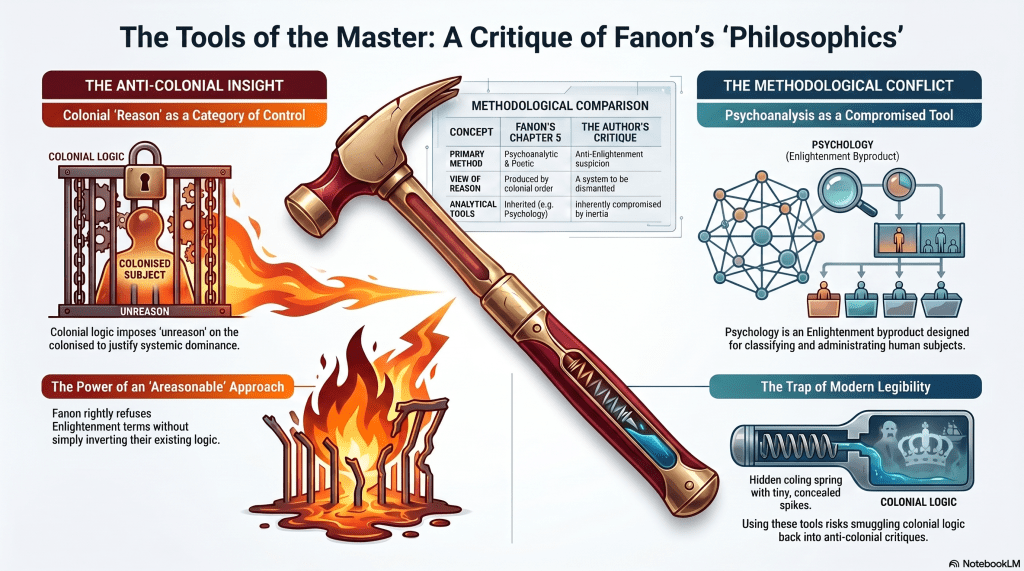
NotebookLM Infographic on this topic.

Fanon is at his strongest when he shows that colonial ‘reason‘ produces the colonised subject as irrational, bodily, affective, and deficient. He rightly treats unreason not as a natural property of the colonised but as a category imposed by colonial order. My difficulty is that he then routes this insight through psychoanalysis, a method I regard as metaphorically suggestive but evidentially weak. The critique of colonial rationality survives; the psychoanalytic apparatus remains suspect.

In the end, we may both at least tacitly agree that colonialism, and the Enlightenment more generally, was not the best path. Where we part is on what should have been taken instead. Cue Robert Frost.

But the more searching question isn’t which fork we should have taken – it’s what we do with the road we’re already on. When the system itself is the problem, the question of what within it is worth retaining rarely gets answered on its merits. More often, it gets answered by inertia: by what is convenient, familiar, or already institutionally embedded. Fanon isn’t exempt from this, and neither, if we’re honest, is any thinker who inherits a tradition whilst attempting to dismantle it. The tools available are always already compromised. The most we can ask – and what distinguishes the sharper critiques from the merely passionate ones – is whether the thinker knows this, and accounts for it. Fanon sometimes does. In Chapter 5, at the moments that matter most, he doesn’t quite.

NB: I used ChatGPT for the cover image. I think it did a good job.
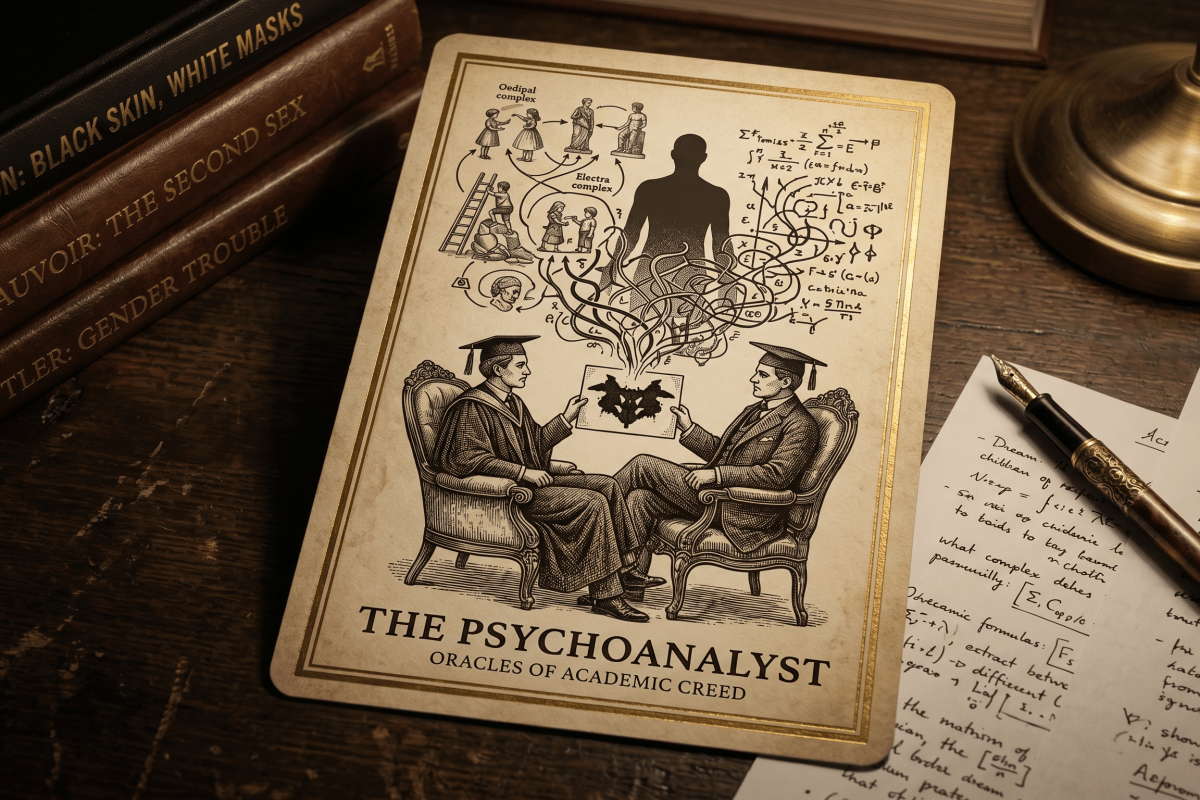
Fanon’s Psychology

2–3 minutes

I just read Chapter 4 of Frantz Fanon’s Black Skin, White Masks, and it has similar problems I’ve also critiqued for Judith Butler’s Gender Trouble: Feminism and the Subversion of Identity and Simone de Beauvoir’s The Second Sex. In all three cases, I accept the primary argument. What I reject is psychology, especially psychoanalysis, as a legitimate form of scientific inquiry.

Audio: NotebookLM summary podcast of this topic.

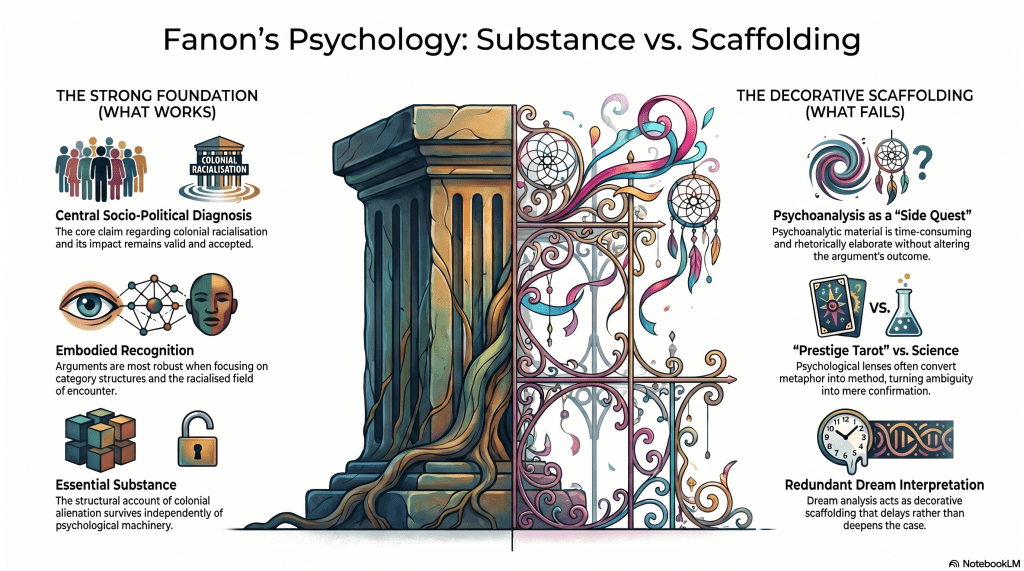
My issue isn’t that Fanon, Beauvoir, or Butler fail in their central diagnoses. I broadly accept their claims. My issue is that the psychoanalytic material typically functions like a grinding side quest: time-consuming, rhetorically elaborate, and only weakly connected to the main argumentative progression. It may enrich the atmosphere, but it doesn’t materially alter the outcome. Once one doesn’t accept psychoanalytical psychobabble as a valid evidentiary lens, the material becomes a time sink. Not only can’t I get my time back, but I also expend even more time here, railing on.

Speaking of distraction: evidently, WordPress has added a new blog-to-podcast feature, so I tried it out here. Whatevs.

Fanon’s central claim about colonial racialisation doesn’t require dream interpretation – the dreams themselves are seemingly apocryphal at the start. The stronger route is through embodied recognition, imposed category structures, conceptual nomenclature, and the racialised field of encounter. The dream material reads as psychoanalytic side-content: thematically adjacent, occasionally vivid, but methodologically low-yield. It doesn’t deepen the case so much as delay it. The entire time, I am thinking to myself, ‘Where is he going with all this?’ and ‘Are we there yet?’ only to get dropped off just where I had started – a round trip to nowhere.

But Fanon’s mistake isn’t necessarily insincerity. It’s an over-trust in a psychological lens that converts metaphor into method. The psychoanalytic examples may have seemed to him like evidence; to a reader sceptical of psychoanalysis, as I am, they register as rhetorical illustrations. Once a reader withholds confidence in this method, the chapter’s supporting material becomes distracting rather than strengthening.

Enfin, psychoanalysis too often behaves like a prestige tarot deck for the academically credentialled: it turns ambiguity into confirmation, opacity into symbolism, and resistance into further evidence. Fanon’s broader account of colonial alienation survives because it doesn’t depend on this machinery. The dreams aren’t necessary to the argument; they’re decorative scaffolding around a structure that’s stronger without them.

Also…

Man in Capitalistic Society

This is Chapter 5 of Erich Fromm’s The Sane Society. I’ve had this on my bookshelf for quite a while and wasn’t sure how a 70-year-old book could have so much relevance, but it does. Granted, some of it is irrelevant, a victim of the period it was written. This happens.

What strikes me about this chapter is the historical perspective it provides on capitalism. I’m an academic economist. I taught undergraduate economics for the better part of a decade. I’ve read (and recommend reading) Marx’s Capital firsthand.

Audio: NotebookLM Podcast commentary on this content.

Fromm adds additional details here. Firstly, he notes that the capitalism that marked the early days of the Industrial Revolution—the seventeenth and eighteenth centuries—differed from that of the nineteenth and twentieth centuries. The earlier period still had cultural and moral tethers that became frayed or lost in later periods. Without regurgitating the chapter, I cite some themes:

“this underselling practice is grown to such a shameful height, that particular persons publicly advertise that they undersell the rest of the trade.”

People were not very keen on price cutting as a competitive mechanism.

They also note the unfair competitive advantage of the monied elites who could buy materials in cash instead of credit and could thereby undercut prices, who would have to account for paying interest rates or markups on credit.

Whilst in the twentieth century, regulating undercutting is seen as protectionism, the earlier centuries had no problems defending merchants. We do have laws on the ebooks that prevent dumping, but these are rarely enforced, and when they are, it’s a political rather than economic statement. In practice, but done in the name of economics are politics in the same manner as science was used as cover to implement policy during the COVID-19 debacle.

Montesquieu says “that machines which diminish the numbers of workers are ‘pernicious’.” This sentiment echoes the current sentiments about robotics and artificial intelligence.

Nineteenth-century capitalism saw man as the measure of all things supplanted by capital. This is the capitalism Marx rails against—profits over humanity and society, the pursuit of local maxima at the expense of global maxima. This is also where the goal of hypergrowth and growth for growth’s sake came into vogue, ushering us into the Modern Age of Modern ideals—science, progress, order, and so on.

I won’t exhaust the chapter here, but for what it is, it’s a relatively light read. Whether I comment on later chapters depends on whether they engage me. Cheers.

Lacan or Not

Here I am yet again writing about something I am not particularly equiped to do. In other fora, I’ve been directed again to Lacan vis-à-vis a thread about Lacan’s perspective on the real. I’ve commented on Lacan before, usually in the context of eschewing any philosophy founded on psychology—especially psychoanalysis. Explaining that I have a reading backlog extending beyond my likely lifespan, it was recommended that I read Jacques Lacan by Sean Homer, so I am sharing the recommendation. Anything by Bruce Fink was another reco. Noam Chomsky takes an ad hominem swipe at Lacan here.

I decided to watch a few videos (including this, this, and this) to survey some of Lacan’s ideas, knowing that something could be lost in the translation. Let’s just say that I was underwhelmed.

In a nutshell, my biggest contention is the notion of the unconscious as an active agent.

According to my understanding, Lacan posits that there is a ‘real’ out there, but it is obscured by language and subject to interpretation. To him the real is a Void.

⁠Psychoanalysis presumes being able to get closer to the ‘truth’ of reality. Like astrologers and fortune-tellers, Psychoanalyst primary defence is that not all knowledge is evidence-based or falsifyable. My problem is that I am not open to another way of experiencing the world, but they somehow have privileged access to this truth. Of course, this is a similar to religious claims of some special spiritual access that opens when you believe.

To me, the Void is as apt a metaphor as any. And while we both agree that the real is inaccessible, I don’t accept the impostition of the how and the why. What Lacan does—and Freud before him and psychoanalysts more generally—is to inject hows and whys into the story. In this narrative, the unconscious has active powers, (as opposed to negative space), where memories (in whatever form) may be repressed and actions may be triggered (or activated) by unconscious urges or desires. I consider this last train of thought wholly imagined and fabricated. This void and the unconscious has no purpose.

Along the way, I do agree with Lacan’s poststructuralist position. I have no issues with symbolic or metaphoric concepts and speech. The contention arrises when one attempts to claim the metaphoric to be concrete. This is the same contention I have with people who take the metaphoric text of the bible and cencretise it. There are other problems there, but I’ll quit now.


​⁠

Fables of the Deconstruction

To some extent or another, humans appear to need order—some more than others. Societies are a manifestation of order, and we’ve got subcultures for those who don’t fit in with the mainstream. Humans are also a story-telling lot, which helps to provide a sense of order. Metanarratives are a sort of origin story with a scintilla of aspiration toward some imagined semblance of progress.

Some people appear to be more predisposed to need to ride this metanarrative as a lifeboat. These people are typically Conservative, authority-bound traditionalists, but even the so-called Progressives need this thread of identity. The problem seems to come down to a sort of tolerance versus intolerance split, a split along the same divide as created by monotheism in the presence of polytheism.

Meet the new boss, same as the old boss.

Won’t Get Fooled Again — The Who

In a polytheistic world, when two cultures collided, their religious pantheons were simply merged. In a blink, a society might go from 70 gods to 130. On this basis, there was a certain tolerance. Monotheism, on the other hand, is intolerant—a winner takes all death match. The tolerant polytheists might say, sure, you’ve got a god? Great. He can sit over there by the elephant dude. Being intolerant like a petulant schoolboy, the monotheists would throw a tantrum at the thought that there might be other gods on the block. Monotheists won’t even allow demigods, though there is the odd saint or two.

This is a battle between absolutism and relativism. The relativist is always in a weaker arguing position because intolerant absolutists are convinced that their way is the only way, yet the tolerant relativists are always at risk of being marginalised. This is what Karl Popper was addressing with the Paradox of Tolerance.

In a functioning society, a majority of the metanarratives are adopted by the majority of its constituent. On balance, these metanarratives are somewhat inviolable and more so by the inclined authoritarians.

A problem is created when a person or group disagrees with the held views. The ones espousing these views—especially the Traditionals—become indignant. What do you mean there are more than two genders? You are either male or female. Can’t you tell by the penis?

I happened to read a tweet by the GOP declaring their stupidity:

America the Stupid

The Vice President, a living anachronism and proxy for the American Midwest Rust Belt superimposed on the Bible Belt, he tells his sheep that “The moment America becomes a socialist country is the moment that America ceases to be America…” Americans as a whole are pretty dim, and it seems to get dimmer the higher one ascends their government. Pence seems very firm in affirming a notion of American identity, but not accepting that identities change. He may become upset if he finds out that George Washington is dead—in fact, there are very few remnants of the original United States aside from some dirt, trees, and a few edifices—and the country is still the county. Some people have a difficult time grasping identity. It makes me wonder if he fails to recognise himself in the mirror after he gets his hair cut.

The idea behind deconstruction is to deconstruct the workings of strong nation-states with powerful immigration policies, to deconstruct the rhetoric of nationalism, the politics of place, the metaphysics of native land and native tongue… The idea is to disarm the bombs… of identity that nation-states build to defend themselves against the stranger, against Jews and Arabs and immigrants…

Jacques Derrida

Interesting to me is how people complain about this and that politically. Most of this is somewhat reflexive and as phatic as a ‘how are you?’, but some is more intentional and actioned. Occasionally, the energy is kinetic instead of potential, but the result is always the same: One power structure is replaced by another.

What you aspire to as revolutionaries is a new master. You will get one

Jacques Lacan

As Lacan noted, as people, we believe ourselves to be democratic, but most of us appear to be finding and then worshipping some authority figures who will promise us what we desire. We desire to have someone else in charge, who can make everything OK, someone who is in a sense an ideal parent. I don’t believe this to be categorical, but I do believe that there is a large contingent of people who require this.

As an aside, I’ve spent a lot of time (let’s call it a social experiment) in the company of social reprobates. What never ceases to amaze me is how these social outcasts seem to have a strong sense of right and wrong and how things should be. Conveniently, they exempt themselves from this scope, so if they steel to buy drugs, it’s OK, but if someone else gets caught, they should get what’s coming to them.

About a year ago I was chatting with a mate, and I shared an observation that the biggest substance abusers in high school—”the Man’s not going hold me down” cohort—are the biggest conservatives. A girl a few houses down from me became a stripper, but her political views are very Conservative, an avid Trump supporter.

One woman I know is a herion-addicted prostitute. In her eyes, she’s fine (sort of—without getting into psychoanalytics); other women are junkie whores. A heavy dose of assuaged cognitive dissonance is the prescription for this, but it confounds me.

Getting back to the original topic, people who need this order are resistant to deconstruction and other hallmark notions of poststructuralism. They need closure. This translates into a need for metanarratives. When confronted with the prospect of no Truth, they immediately need to find a substitute—speculatively, anyway, as denial and escalating commitment will kick into overdrive.

The same problem mentioned above comes into play here. A few years ago, there was an Occupy Wall Street group, and like atheists, there are myriad reasons why people participated. One of the commonest complaints by the power structure and the public at large is if you don’t like the status quo, what status should replace it. None of the above was never an acceptable response.

It doesn’t matter that in this universe we occupy there is more disorder than order, and entropy rules, pareidolia is the palliative. And religion remains an opiate of the masses.


Please ignore my clear misappropriate of the classic R.E.M. album.

Jacques Lacan, anyone?

I’m wondering whether I should delve into Lacan. I am only vaguely aware of him and have never read any of his published essays or lectures. From what I’ve gleaned, I may end up down some rabbit hole. His interest in the function of language interests me, but his analogy of that to psychoanalysis is disconcerting.

The analogy is fine, but I have a problem with the entire field of psychoanalysis as I view it as pseudoscience. As with Freud and Jung, the speculation around the unconscious and their metaphors are fine storytelling, but that’s about it.

My interest is in his structural approach to language and the notion I share concerning the lack of specificity in language, but it seems to me that my time would be better spent reading Derrida.

Lacan is categorised as both a structuralist and a post-structuralist, which might be correct given the period in which he lived, but I am still trying to figure out how he might be considered to be a post-structuralist, as he seems to be concerned with a sense of order, which is somewhat antithetical to this worldview.