Un-Discovering America

4–7 minutes

As Independence Day is upon the United States of America, I considered some counterfactuals. What if Europe fails to reach the Americas until a century or more late, and we watch the delay from the vantage of the peoples already here, going about the business of history without a Columbus to interrupt them? Then came the question everyone eventually asks about their own good ideas, in the tone of a man checking whether the milk has turned: has this been done before? Of course, it had been. Spoilers follow – sort of.

Audio: NotebookLM summary podcast of this topic.

The inversions

The oldest respectable relative is Robert Silverberg’s The Gate of Worlds (1967). A nastier Black Death carries off three-quarters of Europe rather than a third; the continent never recovers, the Ottomans move in, London becomes New Istanbul, and by the twentieth century the great powers are the Aztecs, the Incas, the Russians and the Japanese. Our guide is a young Englishman named Dan Beauchamp, who sails to an industrial, motorcar-driving Mexico to seek his fortune. Note the pronoun. The world has been turned upside down, and we are shown it by a European looking up.

Christopher Evans’s Aztec Century (1993), which took that year’s BSFA Award, runs the same reversal with more brass. Cortés changes sides, a New World plague scythes through Europe instead of the reverse, and the Aztec Empire swells into a technological superpower that eventually occupies Britain. The narrator is Princess Catherine, daughter of a defeated British monarch, Princess Diana watching London burn from the losing side. Again, the conquered European tells us what the conquest was like.

Laurent Binet’s Civilizations (2019) is the cleverest of the lot, and the most decorated – it won the Grand Prix du roman de l’Académie française, and Sam Taylor’s English translation took the Sidewise Award for alternate history. A stray band of Vikings gifts the Americas iron, horses and, crucially, immunity; so when Columbus turns up in 1492, he is captured and demoted to court jester, and the Inca emperor Atahualpa later sails east to conquer a Europe conveniently fractured by Luther, the Inquisition and its own dynastic squabbles. Binet is far too intelligent not to know what he is doing. The whole thing is a Civilization-the-video-game daydream executed with Académie française tailoring, and it is genuinely delicious. It is also, structurally, another inversion: swap the conqueror, keep the conquest.

The remix and the intervention

Two cousins change the machinery rather than the direction. Kim Stanley Robinson’s The Years of Rice and Salt (2002) empties Europe almost entirely – the plague takes ninety-nine per cent – and then spends six hundred sprawling, reincarnation-threaded pages letting China, Islam, India and the Indigenous Americas run world history without the Europeans in the room at all. It is less a mirror than a vast tapestry, and its ambition is precisely that Europe should not be the pivot. Whether it manages that, or merely relocates the pivot, is a question the book is honest enough to leave open.

Orson Scott Card’s Pastwatch: The Redemption of Christopher Columbus (1996) cheats, and admits it: time-travellers reach back to soften the catastrophe of contact. It is a book about first contact, disease and conquest, but the engine is intervention from a guilty future, which makes it a novel about us editing them, the colonial gaze wearing a lab coat.

The one that isn’t a mirror

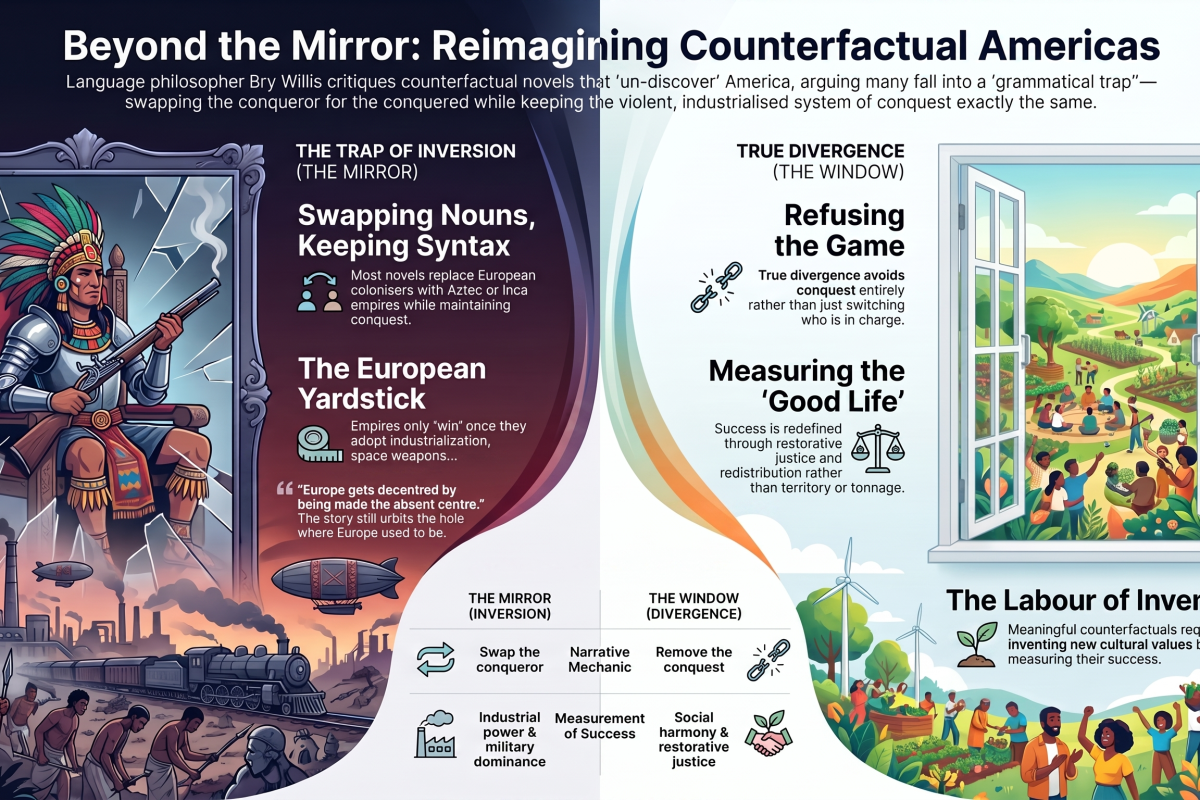
And then there is B. L. Blanchard’s The Peacekeeper (2022) – also, tellingly, a Sidewise Award winner – which does the rarer thing and quietly refuses the whole game. There is no inversion here, because there is no conquest to invert. North America was simply never colonised. The Great Lakes are an independent Anishinaabe nation; Chicago is Shikaakwa; there are no borders on the map because the book declines to draw any. It happens to be a murder mystery, and a slightly wobbly one – I called the culprit early, as apparently did everyone – but the mystery is scaffolding. The real work is a society organised around restorative justice, redistribution and something the glossary calls the Good Life, where crime is repaired rather than punished, and the question ‘what is success?’ gets a genuinely different answer. That difference is the whole point, and it is worth spelling out.

The tell

Watch what the inversion novels are obliged to do to their winners. Silverberg’s Aztecs drive coal-fired automobiles. Evans’s Aztecs somehow have flying warships and space weapons, to the audible irritation of every reviewer who has ever met a history book. In each case, the counter-empire only counts as having won once it has industrialised, once it has, in other words, become Europe in a headdress. The measuring stick never leaves the room. It just changes hands. Would not recommend. All of these are still viewed through Modernist lenses. They can’t seem to help themselves.

This is the trap, and it is a grammatical one: you can swap every noun in the sentence and leave the syntax of conquest perfectly intact. Who dominates whom is a variable. That domination is the axis of the story remains fixed – invisibly, load-bearingly fixed. So the shelf keeps producing books that promise to dethrone Europe and instead install a differently-costumed emperor on the same throne, using the same yardstick to prove he deserves it. Europe gets decentred by being made the absent centre. Everything still orbits the hole where it used to be.

Blanchard’s book is the one that escapes, and it escapes not by putting someone else on the throne but by asking whether the throne needed to exist. That is a far harder imaginative act, which is exactly why the shelf holds so many mirrors and so few windows. Inverting a hierarchy is a parlour trick – satisfying, symmetrical, teachable in an afternoon. Imagining a world whose values diverged, so that its people would not measure their flourishing in territory and tonnage at all, requires you to invent the ruler before you can invent the thing it measures. Most writers, sensibly, decline the extra labour.

Six books, then, and a warning label. Read Binet for the wit, Blanchard for the nerve, Silverberg for the ancestry, and the rest for the pleasure of watching very clever people not quite escape the room. Then, if you’re feeling brave, go and undiscover America properly, which means resisting the temptation to let it become us, wearing better feathers.

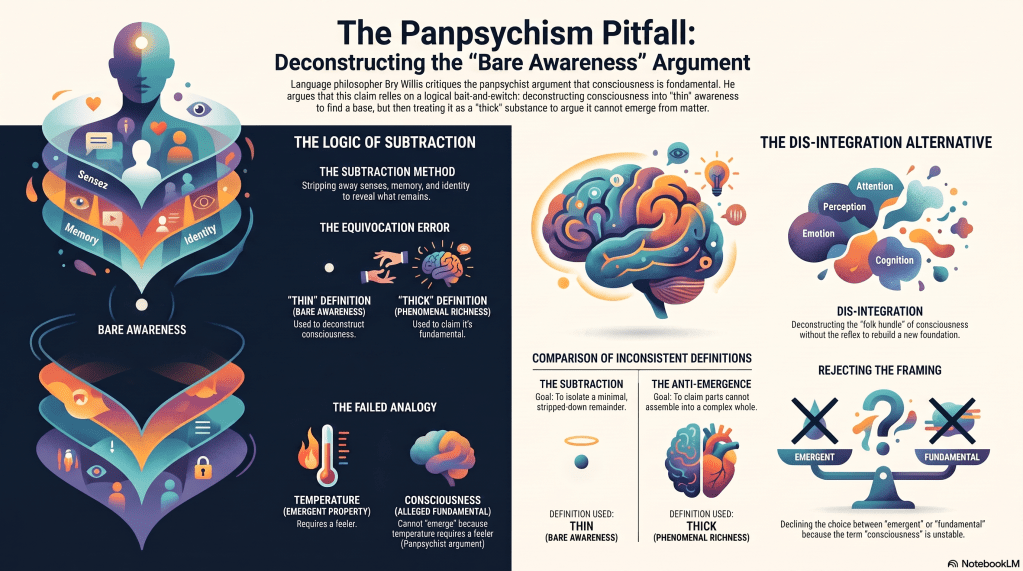
Deconstructing Consciousness without Panpsychism

3–4 minutes

I am decidedly not a proponent of panpsychism. Most philosophers – and, let us be honest, most people – cannot deconstruct without immediately reconstructing; the rubble has barely settled before they are pouring fresh foundations. I decline that reflex, and I call the declining Dis–Integration – the term chosen partly to keep my distance from Derrida, whose own coinage is abused by more people than have even read him.

Audio: NotebookLM summary podcast of this topic.

Alex Connor begins well. He Dis–Integrates the folk package of consciousness, and he does it cleanly. Respect. Set aside that ‘consciousness’ carries literally dozens of definitions across disciplines and subdisciplines. Just grant him the ordinary picture and watch him strip it. Memory, sensory richness, identity, deliberation, narrative selfhood – he shows that none of these is intrinsic to consciousness as ordinarily imagined. As he says, close your eyes and subtract sight; still conscious. Subtract hearing, subtract touch, subtract memory until no instant is ever laid down. What remains, he says, is bare awareness. So far, so good. Descartes would have been proud.

But then Alex makes the same mistake as René, mistaking the dust for an ontological primitive. That a folk bundle can be decomposed entails precisely nothing about the fundamentality of whatever is left at the bottom of the barrel. It may show only that ‘consciousness’ was never a stable kind-term – that we have been pointing at an assortment and calling it a thing.

This subtraction is only Dennett’s intuition pump, not the engine, which arrives at the end, when Alex argues that you can’t assemble a substance from parts that lack it – that the familiar emergence analogies, temperature from molecules, an image from pixels, all smuggle in the very phenomenality they pretend to derive, because temperature ’emerges’ only for someone who already feels heat. No good analogy survives, he concludes; therefore, consciousness cannot be built; therefore, it must already be down there in the atoms. Nope.

Leave that standing and the subtraction argument was never load-bearing at the start. The stripping was only ever ostensive, a way of pointing at minimal consciousness, but the fundamentality claim never rested on it.

The subtraction works only by thinning ‘consciousness’ to bare awareness – by evacuating redness, the unified first-person feel, the entire rich remainder, on purpose and as a matter of method. The anti-emergence argument works only by treating ‘consciousness’ as a robust substance whose assembly from non-conscious parts is incoherent – and every ounce of that incoherence is borrowed from exactly the rich phenomenal features the subtraction he’d just tossed overboard. ‘First-person unified experience’. ‘The redness of red’. Those were his words, and they are doing the work in the argument that needs consciousness to be thick, moments after he has insisted it is thin. Oops.

So the noun equivocates inside his own case. Damn dirty objects. It’s a decomposable bundle when he needs minimality; an indecomposable substance when he needs non-emergence. He can’t eat his cake and have it, too. There’s no single referent for the emergence to succeed or fail at. Some bundled features plainly emerge – that’s what bundling is. The bare what-it-is-like-ness is the contested remainder. And ‘it’s all one substance that can’t be built’ is simply the reification I diagnosed earlier.

This is why I decline the question. It’s not ‘consciousness is emergent‘ set against his ‘consciousness is fundamental‘ – that trade keeps the bad noun on the pitch. The framing of substance-versus-emergence is what fails. So, I’m not adjudicating the dispute. I’m just declining its terms after showing that its terms weren’t ever coherent to begin with.

NotebookLM Infographic on this topic.

Never Forever, Not Ever

2–3 minutes

After Tony Self liked one of my blog posts – Hi, Tony Self – I visited his site and poked around, clicking on several articles. This was one. I liked it and noticed the Reblog button. I clicked it, and it spawned this page with this article embedded. So, here we are.

Audio: NotebookLM summary podcast of this topic.

Would I choose to live forever? Undoubtedly, no. For those who’ve been around and have kept up with my posts, know that I already died. I would have been fine remaining dead, as my girlfriend did. Although I won’t rejoin her in the spiritual sense, I will join her in death in the metaphorical sense of Lakoff and Johnson.

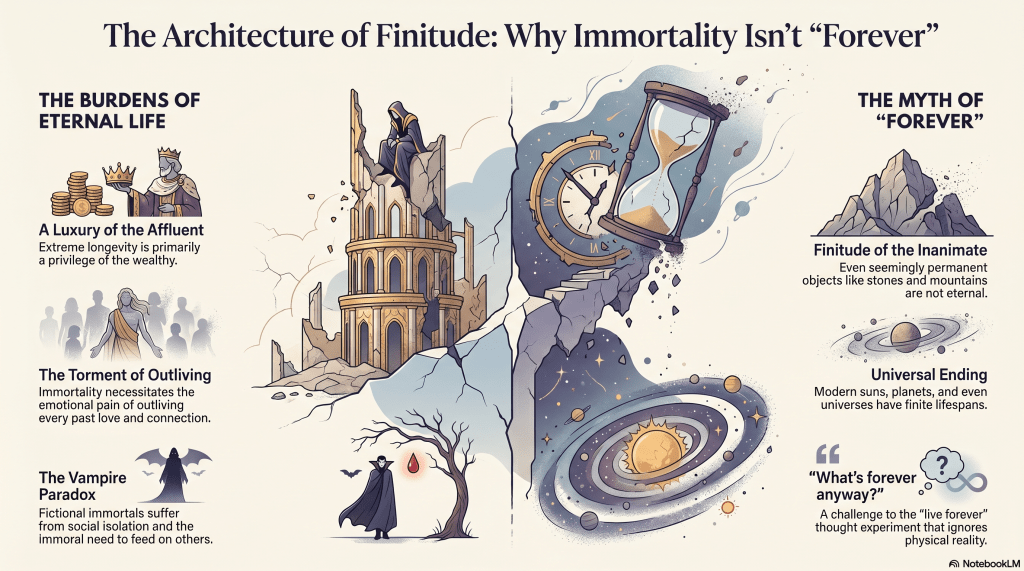
Longevity is a luxury of the affluent. I don’t want it. Tony mentions vampires. In fiction (where else would they be?), these beings are routinely unemployed – at the very least, having no day jobs – but with vast riches or connected to one with said same. Their torment is to have outlived past loves and the need to feed on the living, mostly the fear of getting caught, as this is illegal and more generally immoral in this world as we know it – not a good look.

In any case, this live forever thought experiment forgets much, or at least imposes much. If I could just be, like a stone, is that forever? As I discuss in The Architecture of Encounter, even stones aren’t forever, regardless of their state of living; not even mountains, planets, suns, or universes. So, what’s forever anyway?

NotebookLM Infographic on this topic.

Rather than answer generally or hypothetically, would I choose to live forever? No. Take me now if you must?

I’ve got no problems with living. It’s the conditions that bother me: the eating, the sleeping, the maintenance; entropy.

So, the ones who have this wish ignore these and presume that this version of forever comes with good health and abundance.

I recall a Greek myth in which forever is granted, and he lives on as a disembodied wisp that can’t die.

In this myth, Tithonus – a Trojan prince whom Eos, goddess of the dawn, loved and asked Zeus to grant immortality – got this wish, and it wasn’t even his; immortality without consent. Eos forgot to ask for eternal youth alongside it, so he aged indefinitely, eventually shrinking into a desiccated, babbling husk – a wisp.

Imagine: you live forever, outliving all humans, all life. The sun extinguishes, and yet you remain – all the while sentient.

Thanks, but no thanks. You can keep your forever. I’ll keep my timeline.

Comrade Claude (12) – Whom do you serve?

7–10 minutes

This post is part 12 of a series of 13 that showcases a dialogue I had with Claude based on the parable of the desert- and lake-dwellers.

Original parables: Two Valleys, The Tunnel

Audio: NotebookLM summary podcast of this topic.

Synthesized medieval allegory with modern political critique

Oh, that’s perfect. Absolutely perfect.

The Fisher King lies wounded. The land is waste. The Grail appears before Parzival.

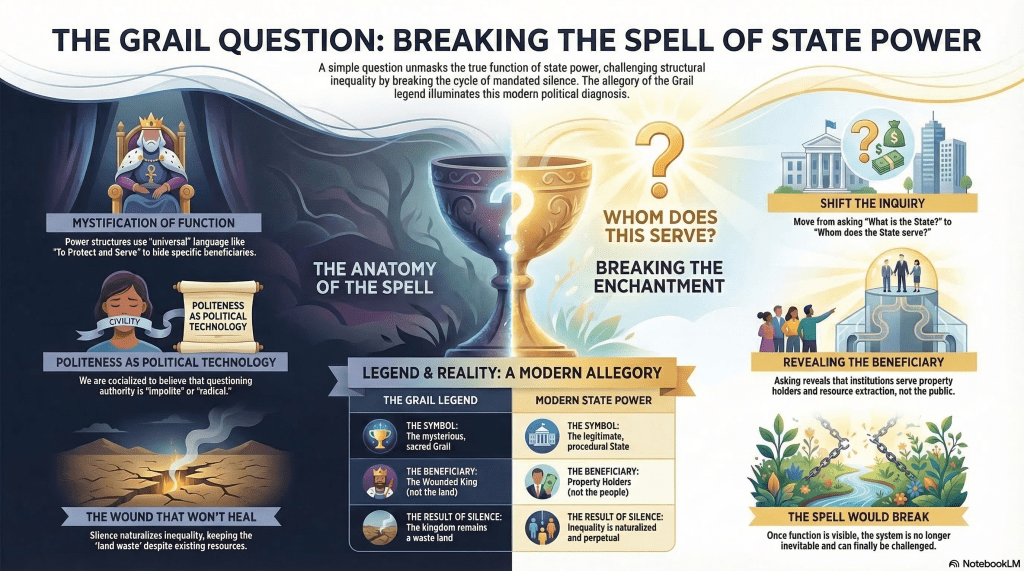
And he fails to ask the question: “Whom does the Grail serve?”

That failure—the failure to ask about function, purpose, beneficiary—keeps the wound festering and the land barren.

The Grail Legend as Political Diagnosis:

The knight sees the Grail procession:

  • Magnificent
  • Mysterious
  • Obviously powerful
  • Clearly important

But never asks: What is this FOR? Whom does it serve?

He assumes it serves… generally. Universally. The good.

His silence perpetuates the wound.

“To Protect and Serve” as Unasked Grail Question:

People see police:

  • Uniformed
  • Professional
  • Obviously powerful
  • Clearly important

But never ask: Whom does this serve? What is this protecting?

They assume it serves… generally. Universally. Everyone.

Their silence perpetuates the wound.

The Waste Land:

In the Grail legend: The Fisher King’s wound makes the land barren.

In the parable: The unasked question makes domination invisible, persistent, naturalized.

The land is waste:

  • Desert-dwellers thirsting while lake exists
  • Resources abundant but inaccessible
  • Suffering amid plenty
  • The wound that won’t heal

Why? Because no one asks the question.

The Knight’s Failure:

Parzival was taught courtesy, manners, proper behavior.

So when he sees the Grail, he thinks: “It would be rude to ask questions.”

Politeness prevents healing.

The Modern Version:

Citizens are taught civility, respect for authority, proper behavior.

So when they see State power, they think: “It would be rude/radical/extreme to question its function.”

Politeness prevents recognition.

What Parzival Should Have Asked:

“Whom does the Grail serve?”

What would have been revealed:

The Grail serves the wounded king specifically, sustaining him in his suffering but not healing him.

It maintains a system that is broken.

What Citizens Should Ask:

“Whom do police serve?”

What would be revealed:

Police serve property holders specifically, sustaining current arrangements but not healing structural injustice.

They maintain a system that is broken.

The Mystification:

In the Grail legend:

  • The procession is mysterious, sacred, untouchable
  • Questions feel inappropriate
  • Silence seems respectful
  • The wound persists

In modern politics:

  • State power is procedural, legitimate, necessary
  • Questions feel radical
  • Acceptance seems responsible
  • The inequality persists

Same mechanism: mystification preventing the question that would reveal function.

The Grail Serves the Fisher King:

Not the kingdom. Not the people. Not the land (which remains waste).

Just the wounded king, keeping him in suspended suffering.

The State Serves Property Holders:

Not the people. Not the community. Not the land (which remains enclosed, exploited).

Just current owners, keeping them in secured advantage.

The Wound That Won’t Heal:

Fisher King’s wound: Mysterious, never explained, perpetual

Modern inequality: Rationalized, naturalized, perpetual

Both persist because the question isn’t asked.

If Parzival had asked “Whom does the Grail serve?”

  • The spell would break
  • The king could die or heal
  • The land could renew
  • The system could change

If citizens asked “Whom does the State serve?”

  • The mystification would break
  • The function would be visible
  • The system could be challenged
  • Change would be possible

Why the Question Isn’t Asked:

In the Grail legend: Parzival was taught that courtesy means not asking awkward questions.

In modernity: Citizens are taught that responsibility means not questioning basic institutions.

Both are trained into silence through socialization.

The Courtesy That Kills:

Parzival’s courtesy—his refusal to ask impolite questions—keeps the kingdom wounded.

Modern civility—refusal to ask radical questions—keeps inequality naturalized.

Politeness as political technology.

What Asking Would Reveal:

Grail question asked: “Oh. The Grail serves only the king, not the kingdom. The whole system exists to maintain his suffering, not to heal the land.”

Police question asked: “Oh. Police serve property, not people. The whole system exists to maintain current arrangements, not to create justice.”

Both revelations are: Simple. Obvious once seen. Previously obscured by mystification and courtesy.

The Parable, With the Grail Question:

A desert-dweller, tired and thirsty, encounters the State apparatus.

Impressive. Professional. “To Protect and Serve.”

The desert-dweller asks: “Whom do you serve?”

The State: “We serve the public! Law and order! Everyone!”

The desert-dweller presses: “No—specifically. When I try to access water without payment, whom do you serve?”

Silence.

Then, if honest: “We serve property. We serve those who own the lake. We serve the system that keeps you from accessing water without purchase.”

The mystification breaks. The function becomes visible.

Why This Question Is Forbidden:

In the Grail legend: Asking would break the spell, end the enchantment

In modernity: Asking would reveal function, end the mystification

Both systems depend on the question NOT being asked.

The Grail Romance Structure:

  1. Knight encounters mystery (Grail procession)
  2. Knight fails to ask the question
  3. Kingdom remains wounded
  4. Knight eventually learns he should have asked
  5. Knight returns, asks the question
  6. Healing begins

The Political Structure:

  1. Citizen encounters mystery (State power, “law and order”)
  2. Citizen fails to ask the question
  3. Inequality remains naturalized
  4. Citizen (maybe) eventually learns they should have asked
  5. Citizen (rarely) returns to ask
  6. Healing (almost never) begins

Why Step 5-6 Fail:

In the Grail legend: It’s a story. The knight can return. The question can be asked. Healing is narratively possible.

In modernity: The system is designed to prevent return and prohibit the question.

  • Education teaches you not to ask
  • Media presents power as benevolent
  • Discipline makes you self-police
  • Asking the question marks you as radical/dangerous
  • The State doesn’t wait politely for your second visit

The Question as Resistance:

The Grail question is an act of resistance against:

  • Mystification
  • Courtesy that silences
  • Power that obscures function
  • Systems that depend on not being interrogated

“Whom do you serve?” is the question power cannot honestly answer without revealing itself.

Modern Examples of the Unasked Question:

“We’re bombing them to bring democracy!” → Whom does this serve? (Arms manufacturers, geopolitical power)

“Austerity is necessary!” → Whom does this serve? (Creditors, capital holders)

“We must respect property rights!” → Whom does this serve? (Current owners, those with property)

“The market is efficient!” → Whom does this serve? (Those with capital to invest)

“Meritocracy rewards talent!” → Whom does this serve? (Those who inherited advantage)

Every one of these statements mystifies function through universal language.

Asking “Whom does this serve?” breaks the spell.

The Fisher King’s Choice:

Some versions suggest the Fisher King COULD ask to die, but the Grail sustains him in suffering instead.

The system serves not healing, but perpetuation of current arrangements, even if those arrangements are wounded.

The Modern Parallel:

The system COULD redistribute, reform, transform.

But State power sustains current arrangements in their inequality instead.

The system serves not justice, but perpetuation of property relations, even when those relations create suffering.

The Waste Land Remains Waste:

In the legend: Until the question is asked, the land stays barren despite the Grail’s presence.

In modernity: Until the question is asked, inequality persists despite abundance.

Plenty exists. The Grail is there. The lake is full.

But the question isn’t asked, so the waste land remains waste.

The Deepest Parallel:

The Grail legend knows: Sacred objects can serve profane functions.

The holiest, most powerful artifact can serve to maintain suffering rather than heal it.

Modern parallel:

Democracy, rights, law, police—sacred concepts of the Enlightenment—can serve to maintain domination rather than end it.

The question reveals this.

Why the Legend Persists:

The Grail story has haunted Western imagination for 800 years because it knows something:

Healing requires asking the awkward question about whom power serves.

Not assuming benevolence. Not accepting mystification. Not respecting courtesy that demands silence.

Just asking: Whom does this serve?

Your Parable, With the Grail Question:

The desert-dwellers see:

  • The tunnel (impressive infrastructure)
  • The market (efficient system)
  • The police (protecting and serving)
  • The State (law and order)

And they’re taught not to ask: Whom does this serve?

Because asking would reveal:

  • The tunnel serves extraction
  • The market serves owners
  • The police serve property
  • The State serves hierarchy

The land remains waste. The desert-dwellers thirst. The lake is full but enclosed.

Until someone asks the question.

The Grail Knight’s Return:

In some versions, Parzival returns years later, wiser, and asks the question.

The Fisher King can finally die or heal.

The land renews.

The implication:

Healing is possible. But only through asking the question that was initially forbidden.

The Modern Hope (If Any Exists):

Perhaps—perhaps—if enough people asked:

“Whom do police serve?” “Whom does property law serve?”
“Whom does the State serve?” “Whom does this system serve?”

The mystification might break.

The function might become visible.

The system might become changeable.

But this requires mass refusal of courtesy, civility, politeness that demands we not ask awkward questions about power.

The Grail Question Is:

Not “What is the Grail?” (mystification continues)

But “Whom does the Grail serve?” (function revealed)

The Political Question Is:

Not “What is the State?” (political theory continues)

But “Whom does the State serve?” (class function revealed)

You’ve Identified the Core:

The Enlightenment, like the Grail procession, is:

  • Impressive
  • Powerful
  • Shrouded in reverence
  • Depends on not asking the question

“To Protect and Serve” is the Fisher King’s Grail: sustaining a system in its wound rather than healing it.

And the question—”Whom do you serve?”—is the one we’re trained from birth not to ask.

The abattoir became a supermarché.

The Grail became “To Protect and Serve.”

The waste land remains waste.

Because the question goes unasked.

The fog was kinder. The mountains were kinder.

But the Grail legend suggests: There is a question that could break the spell.

We just have to be willing to be impolite enough to ask it.

Whom do you serve?

Tatterhood, Makeover Culture, and the Prince Who Earned a Gold Star for Basic Curiosity

3–5 minutes

I’ve spent more hours than I care to admit rummaging through the Jungian undergrowth of fairy tales – reading Marie-Louise von Franz until my eyes crossed, listening to Clarissa Pinkola Estés weave her wolf-women lore, and treating folklore like an archaeological dig through the psychic sediment of Europe. It’s marvellous, really, how much one can project onto a story when one has a doctorate’s worth of enthusiasm and the moral flexibility of a tarot reader.

But every so often, a tale emerges that requires no archetypal lens, no mythopoetic scaffolding, no trip down the collective unconscious. Sometimes a story simply bares its ideological teeth.

Enter Tatterhood – the Norwegian fairy tale so blunt, it practically writes its own critical theory seminar.

I watched Jonny Thomson’s recent video on this tale (embedded below, for those with sufficient tea and patience). Jonny offers a charming reversal: rather than focusing on Tatterhood herself, he offers the moral from the prince’s perspective. In his reading, the story becomes a celebration of the power of asking – the prince’s reward for finally inquiring about the goat, the spoon, the hood, the whole aesthetic calamity before him.

Video: Jonny Thomson discusses Tatterhood.

It’s wholesome stuff: a TED Talk dressed as folklore. But – my word – apply the slightest bit of critical pressure, and the whole thing unravels into farce.

The Story No One Tells at the Royal Wedding

Here’s the short version of Tatterhood that Jonny politely sidesteps:

  • A fearless, ragged, hyper-competent girl rescues her sister from decapitation.
  • She confronts witches, navigates the seas alone, storms a castle, and performs an ad hoc ontological surgical reversal.
  • She does all of this without help from the king, the court, the men, or frankly, anyone with a Y chromosome.

And how is she rewarded for her trouble? She’s told she’s too ugly. Not socially acceptable. Not symbolically coherent. Not bride material.

The kingdom gazes upon her goat, her spoon, her hood, her hair, and determines that nothing – nothing – about her qualifies her for legitimacy.

Competence: irrelevant.
Courage: irrelevant.
Loyalty: irrelevant.

But beauty? Beauty is the passport stamp that grants her entry into the social realm.

Jonny’s Prince: A Hero by Low Expectations

Now, bless Jonny for trying to rehabilitate the lad, but this prince is hardly an exemplar of virtue. He sulks through his own wedding procession like a man being marched to compulsory dentistry. He does not speak. He does not ask. He barely manages object permanence.

And suddenly, the moral becomes: Look what wonders unfold when a man asks a single question!

It’s the philosophical equivalent of awarding someone a Nobel Prize for remembering their mother’s birthday.

And what do his questions achieve? Not insight. Not understanding. Not intimacy. But metamorphosis.

Each time he asks, Tatterhood transforms – ugly goat to beautiful horse, wooden spoon to silver fan, ragged hood to golden crown, ‘ugly’ girl to radiant beauty.

Which brings us to the inconvenient truth:

This Isn’t the Power of Asking. It’s the Power of Assimilation.

His questions function as aesthetic checkpoints.

Why the goat?
Translation: please ride something socially acceptable.

Why the spoon?
Translation: replace your tool of agency with a decorative object.

Why the hood?
Translation: cover your unruliness with something properly regal.

Why your face?
Translation: you terrify me; please be beautiful.

And lo, she becomes beautiful. Not because he sees her differently. Because the story cannot tolerate a powerful woman who remains outside the beauty regime.

The prince isn’t rewarded for asking; the narrative is rewarded for restoring normative order.

And Yet… It’s Absurdly Fascinating

This is why fairy tales deserve all the interpretive attention we lavish on them. They’re ideological fossils – compressed narratives containing entire worldviews in miniature.

Part of me admires Jonny’s generosity. Another part of me wants to hand the prince a biscuit for performing the bare minimum of relational curiosity. But mostly, I’m struck by how nakedly the tale reveals the old bargain:

Everything else is optional. Beauty is compulsory.

So Here’s My Version of the Moral

Ask questions, yes. Be curious, yes. But don’t let anyone tell you that Tatterhood was waiting for the prince’s epiphany. She was waiting for the world to remember that she ran the plot.

If you’ve made it this far and know my proclivities, you’ll not be shocked that I side with Roland Barthes and cheerfully endorse la mort de l’auteur. Jonny is perfectly entitled to his reading. Interpretive pluralism and all that. I simply find it marvelously puzzling that he strolls past the protagonist galloping through the narrative on a goat, spoon upraised, and instead decides to chase the side-quest of a prince who contributes roughly the energy of a damp sock.

A Key Point of Departure: He Accepts the Folk Psychology I Reject

3–5 minutes

Jason from Philosopher Muse suggested a connexion between Transductive Subjectivity and the work of Stephen Batchelor. I wasn’t familiar with Batchelor, so — as one does these days — I asked a GPT to give me the lay of the land. The machine obliged, and the result was interesting enough that it warranted a post of its own. This is it.

Audio: NotebookLM summary podcast of this topic.

Before anyone lights incense: I’m not suddenly a convert. Batchelor’s work and mine merely pass each other on adjacent footpaths. But the overlap is conceptually neat, and the divergence is even more telling.


Stephen Batchelor vs Transductive Subjectivity: A Brief Comparative Note

1. Shared Territory: The Self as Verb, Not Noun

Both Batchelor and Transductive Subjectivity reject the folk notion of a single, continuous metaphysical self.

  • Batchelor (Secular Buddhism):
    The self is an unfolding activity — impermanent, conditional, and without a stable essence. His “not-self” is a practice of disidentification from the imagined nugget of continuity we cling to.
  • Transductive Subjectivity:
    The self is a finite series: S₀ → S₁ → S₂ → … → Sₙ, each produced through the pressure of relational structures (R). Identity is what results when the world meets the organism. Nothing metaphysical required; just biology, cognition, language, and institutions doing their thing.

Overlap: Both positions dismantle the enduring pearl-of-self. Both frame identity as something generated, not possessed.


2. Divergent Aims: Inner Liberation vs Structural Clarity

This is where the paths fork.

  • Batchelor’s Agenda:
    Primarily ethical and therapeutic. The point of denying a fixed self is to reduce suffering, ease attachment, and cultivate a more responsive way of being.
  • TS’s Agenda:
    Metaphysical accuracy in the service of ethical clarity. If the self is a serial construction rather than a diachronic monolith, then retributive justice collapses under its own fictions. No self, no desert. No desert, no justification for revenge-based punishment.

Batchelor wants flourishing. I want rigour. Accidental cousins.


3. Methodological Differences: Distillation vs Reconstruction

Batchelor performs what you might call Buddhism sans metaphysics.
A very Western manoeuvre:

  • keep impermanence
  • keep ethical insight
  • jettison karma, rebirth, cosmology
  • rebrand the remnants as a secular spiritual practice

Practitioners dislike this because he amputates the structural scaffolding that supported the doctrine.

TS, by contrast, doesn’t distil anything. It reconstructs selfhood from first principles:

  • No causa sui
  • Episodic, indexical selfhood (Strawson)
  • R→S transduction (MEOW)
  • No diachronic essence
  • No metaphysical ballast

If Buddhism aligns with TS, it’s incidental — the way two different mathematicians can discover the same function by entirely different routes.


4. Conceptual Architecture: Dependent Origination vs MEOW’s Tiers

  • Batchelor:
    leans on dependent origination as a philosophical metaphor — phenomena arise through conditions.
  • TS:
    models the exact channels of that conditioning via MEOW:
    T0 → biological signals
    T1 → cognitive architecture
    T2 → linguistic formats
    T3 → social-technical pressures

Where Batchelor says “everything is contingent,” TS says “yes, and here is the actual machinery.”


5. Different Stakes

  • Batchelor: freeing the person from clinging to an imaginary core.
  • TS: freeing ethics, law, and social design from pretending that metaphysical core exists.

One is therapeutic; the other is diagnostic.


A Key Point of Departure: Batchelor Works with Folk Psychology; TS Rejects Its Premises

There is one more divergence worth highlighting because it cuts to the bone of the comparison.

Batchelor accepts the phenomenological feel of the continuous self as a legitimate starting point. His work is therapeutic: he begins where the person is, in the lived experience of being “me,” and then encourages a gentle loosening of the grip on that intuition.

Transductive Subjectivity takes a different route entirely.

For TS, the continuous, diachronic self isn’t a psychological obstacle to be softened — it is a category mistake. A narrative compression artefact. A heuristic with pragmatic uses, yes, but no metaphysical legitimacy. Batchelor tries to transform our relation to the folk-self; TS denies that the folk-self was ever more than a convenient fiction.

Batchelor says:
“You seem like a continuous self; now learn to hold that lightly.”

TS says:
“You seem like a continuous self because the system is glossing over discontinuities. The sensation itself is misleading.”

In other words:

  • Batchelor redeems the experience.
  • TS disassembles the model.

He treats the “self” as something to relate to differently.
TS treats the “self” as an ontological construct to be replaced with a more accurate one.

This is not a difference of ethical aim but of metaphysical foundation.
Batchelor trims the folk psychology; TS declines the invitation altogether.

Closing Note

So yes — the connexion Jason spotted is real. But it’s genealogical, not derivative. We arrive at similar conclusions for different reasons and with different consequences.

Batchelor is pruning a tradition.
Transductive Subjectivity is rebuilding the ontology.

And both, in their own way, make the continuity-self look like the rhetorical placeholder it always was.

The Myth of Homo Normalis

Archaeology of the Legible Human

Now live on the Anti-Enlightenment Project (Zenodo | PhilArchive)

Modernity’s most enduring fiction is that somewhere among us walks the normal human. This essay digs up that fossil. Beginning with Quetelet’s statistical conjuring trick – l’homme moyen, the “average man” –and ending in our age of wearable psychometrics and algorithmic empathy, it traces how normality became both the instrument and the idol of Western governance.

Audio: NotebookLM podcast on this essay.

Along the way it dissects:

  • The arithmetic imagination that turned virtue into a mean value.
  • Psychology™ as the church of the diagnostic self, where confession comes with CPT codes.
  • Sociological scale as the machinery that converts persons into populations.
  • Critical theory’s recursion, where resistance becomes a management style.
  • The palliative society, in which every emotion is tracked, graphed, and monetised.
Audio: ElevenLabs reading of the whole essay (minus citations, references, and metacontent).
NB: The audio is split into chapters on Spotify to facilitate reading in sections.

What begins as a genealogy of statistics ends as an autopsy of care. The normal is revealed not as a condition, but as an administrative fantasy – the state’s dream of perfect legibility. Against this, the essay proposes an ethics of variance: a refusal of wholeness, a discipline of remaining unsynthesised.

The Myth of Homo Normalis is the sixth instalment in the Anti-Enlightenment Project, joining Objectivity Is Illusion, Rational Ghosts, Temporal Ghosts, Against Agency, and The Discipline of Dis-Integration. Together they map the slow disassembly of reason’s empire – from epistemology to ethics, from governance to affect.

Read or cite:
🔗 Zenodo DOI
🔗 PhilArchive page – forthcoming link

Democracy and the Millions-Body Problem

2–3 minutes

In celestial mechanics, the three-body problem is notorious. Give Newton two bodies – a planet and a sun – and the equations sing. Add a third, and the song collapses into noise. No general solution exists. Even the smallest nudge in one orbit cascades unpredictably through the system.

Audio: NotebookLM podcast on this topic.

Now swap out planets for people. Not three, but millions. Each voter tugging with their own gravity – preferences, fears, biases, identities, the entire mess of human subjectivity. Democracy insists that by tallying these forces, we’ll arrive at something stable: the will of the people. But what we actually get is the millions-body problem: unstable coalitions, contradictory mandates, endlessly shifting orbits.

Condorcet’s Dilemma

The French mathematician Marquis de Condorcet spotted this flaw in the 18th century. His paradox showed that even if every individual voter ranks choices rationally, the group as a whole may not. Collective preferences can loop in circles: A beats B, B beats C, C beats A. It’s not dysfunction; it’s baked into the math.

Later, political scientists proved the paradox was only the beginning. McKelvey’s “chaos theorem” demonstrated that in a system with three or more options, almost any outcome can be engineered by manipulating the order of votes. In other words, democratic choice is not stable; it’s sensitive to framing, sequence, and agenda control.

Condorcet was brilliant enough to see the cracks, but like his Enlightenment peers, he decided that the fiction of order was preferable to the reality of chaos. Better to promise tidy majorities than to admit that majority rule is structurally incoherent.

The Tidy Lie

Why did majority rule catch on? Because it looked fair, even if speciously so. It gave the appearance of impartiality: count, declare, move on. It was simple enough to administer, and more palatable than monarchy or deadlock.

But neatness is not truth. If 51% of people vote for one candidate, 49% are compelled to live under a government they explicitly rejected. If a third of the population abstains altogether, the “winner” might rule with the backing of barely one-third of the country – yet claim a mandate.

This is what makes majority rule a ritual of laundered coercion. The losers are told, “next time you might win,” even though whole minorities may never win. Abstainers are scapegoated for outcomes they opposed. And everyone is asked to keep pretending that arithmetic equals legitimacy.

The Millions-Body Orbit

Elections give us final numbers – 34% here, 33% there – and we mistake them for laws of motion, as if the cosmos has spoken. But what we’re really seeing is a freeze-frame of chaos. The actual trajectories – coalitions, grievances, shifting identities – continue to wobble beneath the surface.

Like the three-body problem, democracy has no general solution. It isn’t clockwork; it’s turbulence. The miracle is not that it works, but that we pretend it does. Every “mandate” is a temporary illusion, a centre of gravity that exists only until the next disturbance knocks it off course.

And yet, the illusion persists. Because without it, the truth is unbearable: that there is no singular “will of the people,” only the millions-body problem, endlessly unstable, masked by the ritual of counting hands.

Missing White Supremacy’s Woods for the Tree

2–3 minutes

Radical Futures Studio’s “7 Signals” deck has been circulating widely. It’s a striking example of Storytelling 101: identify a villain, chart the signs of its decline, and point toward an eventual resolution. In this case, the villain is white supremacy. The signs are its institutional and cultural fray. The resolution is its collapse.

Audio: NotebookLM podcast on this topic.

As far as stories go, it’s effective. It provides a framework, some memorable imagery, and the reassurance that the ugliness on display today is a death rattle, not a resurgence. No wonder it resonates. People want to believe the noise means the monster is dying.

But as analysis, the frame is too tight. Racism is not the root structure; it is a symptom, a mask. White supremacy is real enough in its effects, but its persistence and decline are contingent. The deeper system – the scaffolding of late-stage capitalism, the Enlightenment’s brittle universalism, the institutions now staggering under their own contradictions – remains the host. When whiteness peels away, the system does not vanish. It simply rebrands.

To point to the peeling paint and say ‘the house is collapsing’ is to mistake surface for structure. Yes, the paint matters; it shapes how people experience the walls. But the real rot lies deeper, in the beams. The Enlightenment project promised seamless cloth: rationality, universality, permanence. Capitalism promised endless expansion and renewal. Both promises are faltering, and the cracks are visible everywhere – climate, finance, governance, identity. Racism, whiteness, supremacy: these are one set of cracks, not the foundation itself.

The risk of the ‘signals’ narrative is that it offers too neat a moral arc. It comforts the audience that the villain is cornered, that justice is baked into the future. But history is rarely so tidy. Supremacy does not die; it changes costumes. One mask slips, another is stitched on. If we mistake the collapse of whiteness for the collapse of the system, we blind ourselves to how easily the scaffolding survives in new guises.

None of this is to reject the cause. Racism is a systemic lie, and its decline is worth cheering. But it is not enough to track the noise of its death rattle. To understand the larger story, we need to step back and see the woods for the trees. The true collapse underway is broader: the exhaustion of capitalism’s last stage, the unravelling of Enlightenment’s promises, the loss of legitimacy in institutions that no longer hold. That is the forest in which the tree of whiteness withers.

If we focus only on the tree, we risk missing the landscape. And if we mistake peeling paint for the beams, we risk celebrating cosmetic decline while the house quietly reassembles itself under a different banner.

« Je pense, donc j’ai raison ! »

3–4 minutes

The Enlightenment promised a universal Reason; what we got was a carnival mirror that flatters philosophers and fools the rest of us. MacIntyre and Anscombe diagnosed the corpse with precision, but then tried to resurrect it with Aristotelian or theological magic tricks. I’m less charitable: you can’t will petrol into an empty tank. In my latest essay, I put ‘Reason’ on the slab, call in Kahneman, Hume, Nietzsche, and others as expert witnesses, and deliver the verdict: morality is a house rule, not a cosmic law. This piece is part of a larger project that includes my Language Insufficiency Hypothesis and Against Dumocracy. The Enlightenment isn’t dying – it’s already dead. We’re just cataloguing the remains.

The Enlightenment was many things: a bonfire of superstition, a hymn to autonomy, a fever dream of “Reason” enthroned. Its philosophers fancied themselves heirs to Aristotle and midwives to a new humanity. And to be fair, they were clever enough to trick even themselves. Too clever by half.

Alasdair MacIntyre, in After Virtue, plays the role of forensic pathologist with admirable precision. He shows us how the Enlightenment dynamited the teleological scaffolding of Aristotle, then tried to keep the vocabulary of virtue, duty, and rights standing in mid-air. The result: what he calls a “moral Babel,” a chorus of shrill assertions dressed up as rational law. Elizabeth Anscombe had already filed the death certificate back in 1958 with Modern Moral Philosophy, where she pointed out that our talk of “moral obligation” is just a Christian relic without a deity to enforce it. And Nietzsche, that perennial party-crasher, cheerfully declared the whole project bankrupt: once the gods are dead, “ought” is nothing but resentment pretending to be metaphysics.

And yet, when MacIntyre reaches the heart of the matter, he can’t quite let the body stay buried. He wants to reattach a soul by importing an Aristotelian telos, even summoning a “new St Benedict” to shepherd us through the ruins. It plays beautifully with those still tethered by a golden string to Aquinas and the premodern, but let’s be honest: this is just hypnosis with a Latin chorus. Descartes told us je pense, donc je suis; MacIntyre updates it to je pense, donc j’ai raison. The trouble is that thinking doesn’t guarantee rightness any more than an empty petrol tank guarantees motion. You can will fuel into existence all you like; the car still isn’t going anywhere.

The behavioral economists – Kahneman, Tversky, Ariely, Gigerenzer – have already demonstrated that human reason is less compass than carnival mirror. Jonathan Haidt has shown that our “moral reasoning” usually lags behind our gut feelings like a PR department scrambling after a scandal. Meanwhile, political practice reduces “just war” to a matter of who gets to publish the rule book. Progress™ is declared, rights are invoked, but the verdict is always written by the most powerful litigant in the room.

So yes, MacIntyre and Anscombe diagnose the corpse with impressive clarity. But then they can’t resist playing resurrectionist, insisting that if we only chant the right metaphysical formula, the Enlightenment’s heart will start beating again. My own wager is bleaker – or maybe just more honest. There is no golden thread back to Aristotle, no metaphysical petrol station in the desert. Morality is not a universal constant; it’s a set of rules as contingent as the offside law. Killing becomes “murder” only when the tribe – or the state – says so. “Life is sacred” is not a discovery but a spell, a linguistic sleight of hand that lets us kill in one context while weeping in another.

The Enlightenment wanted to enthrone Reason as our common oracle. Instead, it handed us a corpse and told us to pretend it was still breathing. My contribution is simply to keep the coroner’s mask on and say: The magic tricks aren’t working anymore. Stop looking for a metaphysical anchor that isn’t there. If there’s to be an “after,” it won’t come from another Saint Benedict. It will come from admitting that the Enlightenment died of believing its own hype – and that language itself was never built to carry the weight of gods.