On LLMs and Understanding

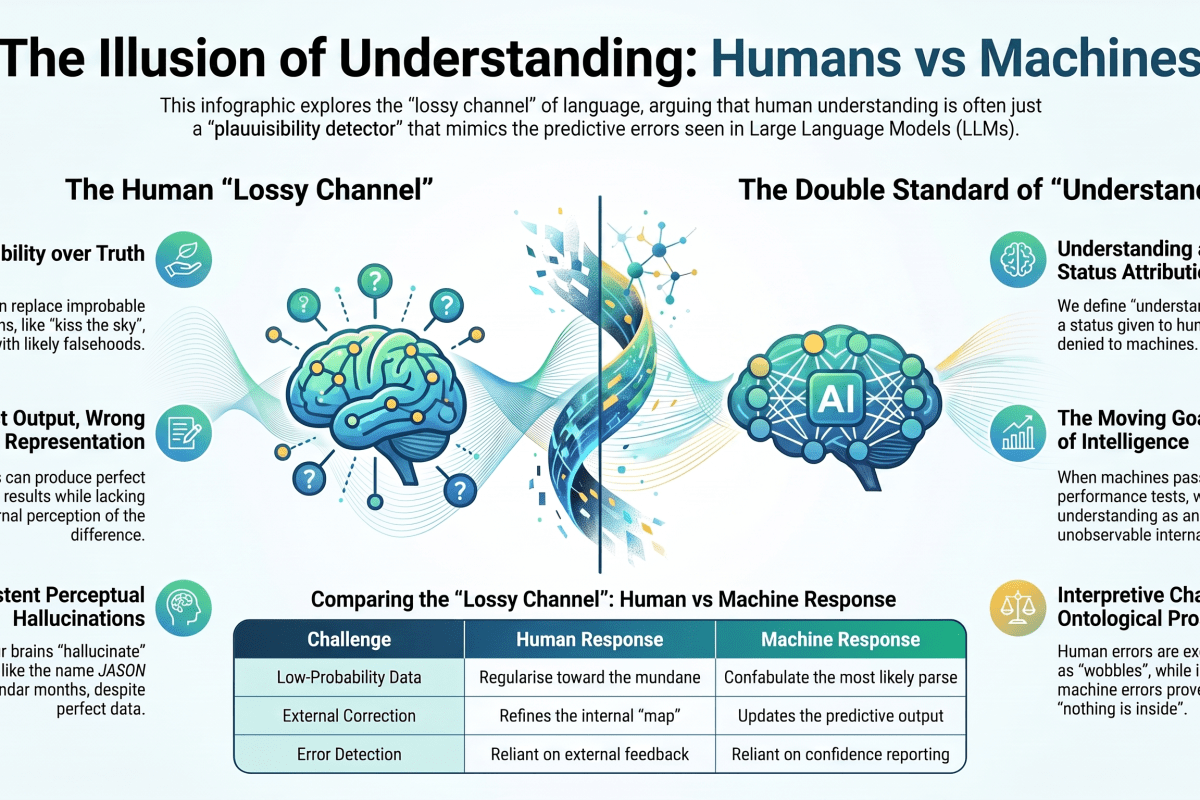
In this Substack essay, I explore the flawed nature of human comprehension, arguing that our understanding is often just a calculation of probability rather than an objective grasp of truth. By examining linguistic errors like misheard lyrics and his own struggles with French phonemes, Willis demonstrates that humans frequently hallucinate or misinterpret data based on what seems most plausible. He compares these mental lapses to the ‘hallucinations’ of Large Language Models, suggesting that the mistakes made by AI are fundamentally similar to our own. The author contends that we apply a double standard by granting humans the status of ‘understanding’ while dismissing machines for the exact same predictive behaviours. Ultimately, the text challenges the metaphysical assumptions of human exceptionalism, asserting that what we call ‘understanding’ is merely an external attribution rather than a unique internal state.

Essentially, I am not advocating the view that LLMs have consciousness and understanding; rather, I am arguing that the human versions of these are inflated with metaphysics.
Language Is Not the Bridge

Semantic Infrastructure, Insufficiency, and the False Romance of Interoperability

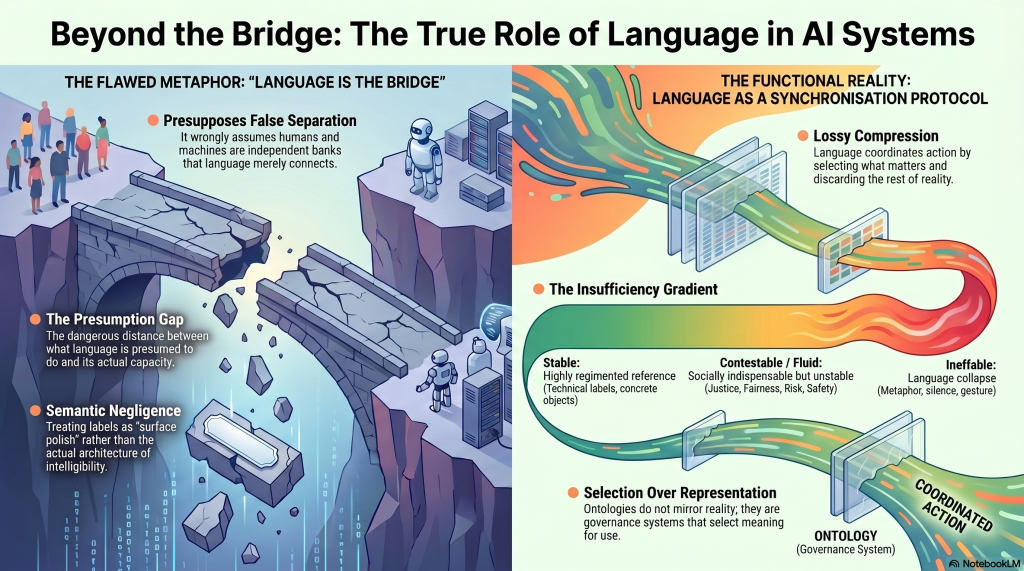
A recent Substack essay, Jessica Talisman’s Language Is the Bridge, makes a claim that is increasingly common in discussions of artificial intelligence, knowledge graphs, ontologies, metadata, and semantic infrastructure: that language is the bridge between human understanding and machine action. The claim is attractive, and not merely because ‘bridge’ is one of those metaphors that allows technical discourse to cosplay as wisdom literature. It captures something real. AI systems, semantic architectures, ontologies, taxonomies, controlled vocabularies, and knowledge graphs do not run on raw reality. They run on structured representations. Those representations require labels, definitions, mappings, alignments, constraints, and interpretive discipline. In that sense, language work is not decorative. It is infrastructural. But the metaphor is also dangerous.

My extended response to her essay is on Substack.

Audio: NotebookLM summary podcast of this topic.
NotebookLM Infographic on this topic.