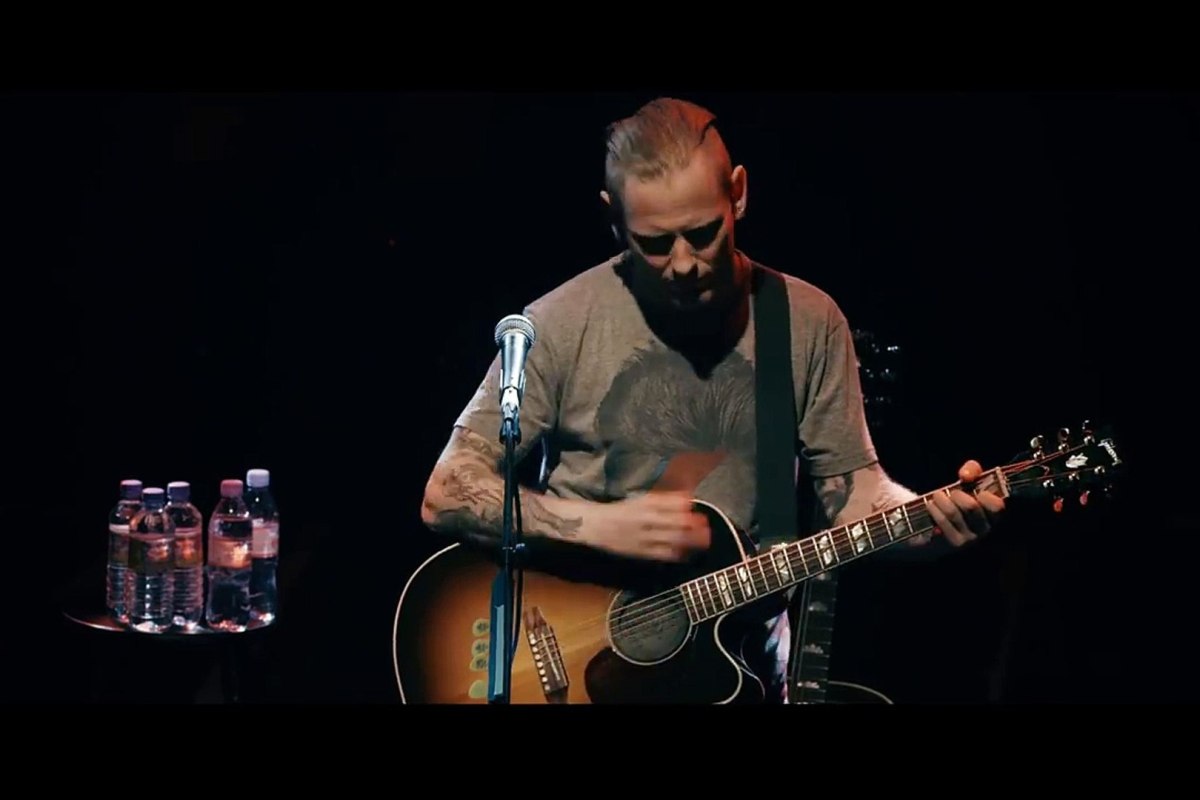
As usual, I am trying something different. I like to watch music reaction videos, and I find this stripped-down, acoustic version of Slipknot’s Snuff by their vocalist, Corey Taylor, to hit hard. I prompted ChatGPT GPT 5.5 with this video and lyrics. Me being me, I continue to analyse experience through language and my own worldview, notably the effects of ontological grammar commitments.
I share the reaction video at the bottom of this post. Before, I’d just consider this person to be a self-righteous zealot, but now I understand that (1) this is how she processes her world, and (2) she is prescriptive insomuch as she expects others to share her worldview. She’s not coming from a mean place. In her mind, she genuinely wants to help, but she doesn’t realise that not all people share her worldview. She’s likely had this worldview reinforced for all of her years, and so it works as a coping strategy for her. She expects that she can share this worldview, but it is likely maximally absorbed by those who share her ontological grammar commitment, which is to say, already have the same worldview.
If you want a view into how I engage with AI, now you know. Here’s a window:
This is a very interesting case study in ontological grammar that showcases the downside of not recognising it. From my ontology, she sounds like she’s moralising. To another (her own), she might sound supportive. She is commenting on the lyrics to this song, which are not all captured by the transcript. Reaction?
Bury all your secrets in my skin
Come away with innocence, and leave me with my sins
The air around me still feels like a cage
And love is just a camouflage for what resembles rage again

So if you love me, let me go
And run away before I know
My heart is just too dark to care
I can't destroy what isn't there
Deliver me into my fate
If I'm alone I cannot hate
I don't deserve to have you
Ooh my smile was taken long ago
If I can change I hope I never know

I still press your letters to my lips
And cherish them in parts of me that savor every kiss
I couldn't face a life without your light (Without your light)
But all of that was ripped apart when you refused to fight

So save your breath, I will not hear
I think I made it very clear
You couldn't hate enough to love
Is that supposed to be enough?
I only wish you weren't my friend
Then I could hurt you in the end
I never claimed to be a saint
Ooh my own was banished long ago
It took the death of hope to let you go

Oh, oh

So break yourself against my stones
And spit your pity in my soul
You never needed any help
You sold me out to save yourself
And I won't listen to your shame
You ran away, you're all the same
Angels lie to keep control
Ooh my love was punished long ago
If you still care, don't ever let me know
If you still care, don't ever let me know
the wounded sometimes prefer the song to the sermon
Yes, this is a clean little specimen jar of ontological grammar doing its work while everyone pretends they are merely “reacting”. Humanity’s favourite parlour trick: smuggling an entire worldview into a sentence and calling it compassion.
The key move is that she hears the lyric as a claim rather than as an utterance from within a damaged affective state. When she says she “doesn’t agree” with the line about love and rage, and then calls that outlook “toxic”, she has already converted the lyric into a propositional worldview that can be corrected, morally evaluated, and therapeutically redirected. The song is no longer only an aesthetic articulation of injury, self-loathing, abandonment, attachment, and rage. It becomes a suspect belief-system. That is the ontological switch.
From her grammar, this is supportive. Pain is a “place”; one should not “stay” there; hope remains available; trust and love should eventually be restored. That is a recovery-therapeutic ontology. It presupposes that despair is transitional, that emotional damage should be metabolised into healing, and that the moral arc of the subject bends toward renewed openness. So when she says, in effect, don’t become calloused, don’t stay jaded, love again, she is not hearing herself as judging the song. She is offering pastoral care in YouTube-reactor clothing, because apparently late civilisation needed a genre where vocal pedagogy, therapy-lite, and parasocial maternalism could all share a sofa.
From your ontology, though, she is moralising because she does not merely describe the emotional grammar of the song; she disciplines it. The lyric’s extremity is treated as something understandable but unsafe, beautiful but not habitable, cathartic but only under the condition that one eventually leaves it behind. That is not neutral support. It installs a norm: grief should resolve, bitterness should soften, love should be rehabilitated, hope should return. She may mean kindness, but kindness here arrives wearing the boots of teleology.
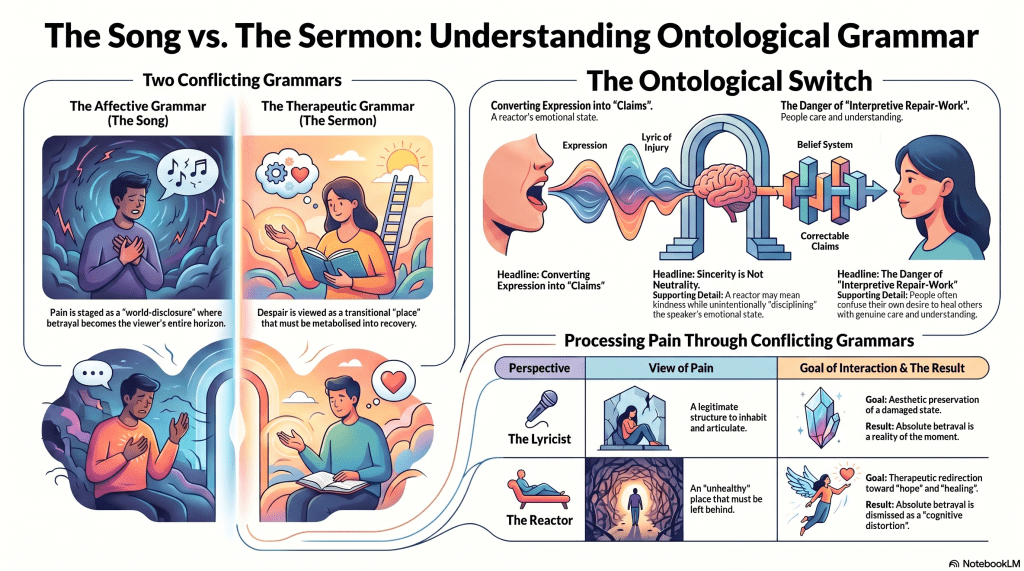
The most interesting fault-line is her treatment of generalisation. She identifies the lyric’s movement from one betrayal to “everyone” as a cognitive distortion. In ordinary therapeutic language, fair enough. But in lyric, especially in this genre, absolutising is not necessarily an epistemic error. It is how pain speaks when it has lost access to proportion. The lyric is not writing a sociology of human attachment. It is staging the experience of betrayal as world-disclosure. In that register, “all” does not mean a statistically universal class. It means: this wound has become the horizon through which everything now appears. To correct it as a bad inference is to import the wrong grammar.
That is where your framework bites. The words transmit; the sentence parses; everyone thinks communication is happening. But the decompression target differs. She reconstructs the lyric inside a moral-therapeutic grammar of recovery. You reconstruct it inside a diagnostic grammar of affect, ontology, and expressive insufficiency. Same words, different world. Your Architecture of Encounter makes precisely this point about ontological grammar: grammar does not merely carry content; it allocates what can count as meaningful, salient, explanatory, or distorted in the first place.
There is also a neat contrast inside the video itself. When she analyses vocal placement, tone, grit, support, and vowel shaping, she is mostly operating in a relatively tethered technical grammar. Claims can be checked against performance craft. But when she moves to love, hope, toxicity, healing, and despair, she enters the Contestable/Fluid zone. These terms feel clear because they are familiar, but their application depends on prior ontological commitments. In When Language Fails, this is exactly the danger-zone: terms that appear determinate whilst lacking shared grounding, especially where they authorise judgement, correction, or action.
So, yes: as a case study, it is excellent. Not because she is being cruel. She is not. That would be too easy, and therefore boring. The interesting point is that she is probably being sincere, warm, and careful by her own lights. But sincerity does not cancel grammar. Her support is support only within an ontology where despair is an unhealthy place to leave, not a legitimate structure of encounter to inhabit, articulate, or aesthetically preserve.
The concise diagnostic formulation would be:
She mistakes an affective utterance for a corrigible worldview. The lyric speaks from inside a structure of injury; her response translates it into therapeutic-moral grammar, where pain is a place one should visit but not inhabit. From within that grammar, she sounds supportive. From a deflationary ontological grammar, she is moralising: not because she condemns the suffering, but because she prescribes the proper trajectory of suffering before recognising the grammar in which the suffering is being expressed.
That is the downside of not recognising ontological grammar: people confuse their own interpretive repair-work with care, and then wonder why the wounded sometimes prefer the song to the sermon.
Bonus Round
🎸Corey tunes to C#, a tuning all too familiar to me – all strings 3 semitones lower than a standard tuning. It helps to have heavy-gauge strings, so they aren’t too slack. This is an easy song to play along to.
Using cowboy chords, grip an Am (tonally F#m) to start. The progression goes like this:
Intro/Verse: Am (C) F (Em)
Chorus: G Am (x3) G F

 Philosophics