This is the fourth of a deeper look into ten philosophical positions. This one is on convergence realism within the category of epistemology. A full article is available on Substack, with supporting information on a recent post here on Philosophics Blog.
Below is a ~5-minute short podcast.
I don’t regard the self as a persistent entity travelling through time while accumulating experiences like stamps in a metaphysical passport.
The first-person “I” is an indexical compression. It marks the presently organised locus of perspective, salience, memory-access, and action. It is indispensable, but indispensability does not establish an inner owner to which the index refers.
The diachronic self is a broader compression: a narrative, biological, documentary, interpersonal, and institutional device for tracking selected continuities across time. Memory contributes to this, but memory is lossy, reconstructive, and uneven. The person remembered is not transported intact into the act of remembering.
This is the second of a deeper look into ten philosophical positions. This one is on mediated encounter realism (ontology) within the category of metaphysics and ontology. A full article is available on Substack, with supporting information on a recent post here on Philosophics Blog.
This is the first of a deeper look into my position of diagnostic anti-foundationalism within the category of philosophical method for metaphilosophy. A full article is available on Substack, with supporting information on a recent post here on Philosophics Blog.
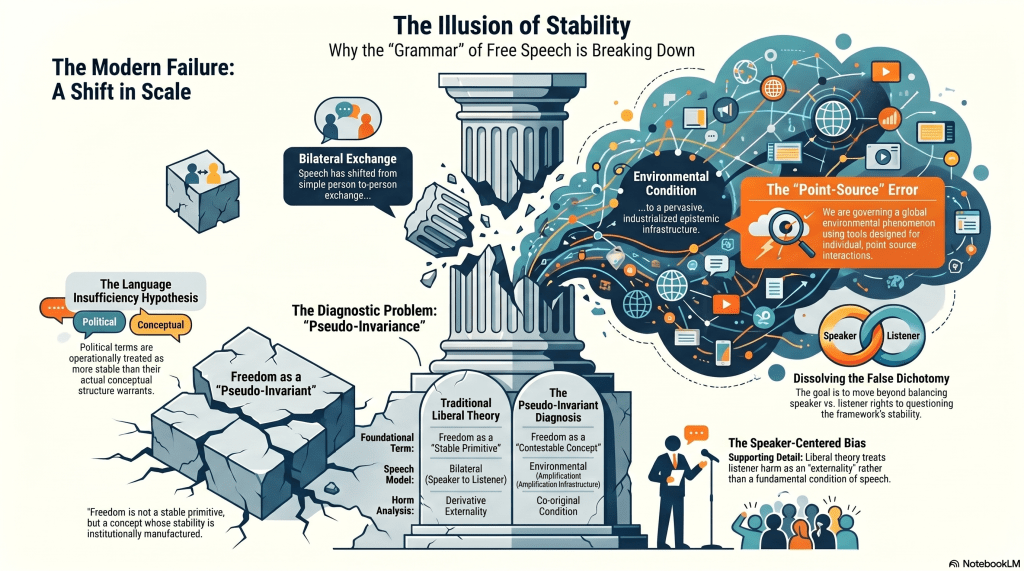
I read from the Wrong Curve: Free Speech, Pseudo-Invariance, and the Grammar of Liberal Rights. This essay is freely available on Zenodo at https://doi.org/10.5281/zenodo.19636760. This segment is the Abstract and the Introduction.
In this essay, I argue that free speech discourse is structured by a category error whose source lies upstream of speech itself: in the treatment of ‘freedom’ as a stable philosophical primitive when it functions, in practice, as an essentially contested concept operating under a systematically inflated presumption of effectiveness.
tl;dr: I don’t believe in free speech.
We’ve all likely heard that the freedom to swing one’s fist ends at the tip of another’s nose. I can accept this without argument for the purpose of this assertion. Your freedom TO violates my freedom FROM.
Audio: NotebookLM summary podcast of this topic.
The problem is that one’s words don’t stop. In some cases, they continue in the manner of pollution that I don’t want my ear holes to be exposed to this noise. In the social media age, this effect is trebled and molests my eyes. This is especially egregious for misinformation and disinformation, which is to say, much of the internet and beyond.
This impact hasn’t been suitably addressed, so I wrote about it. Here, I read.
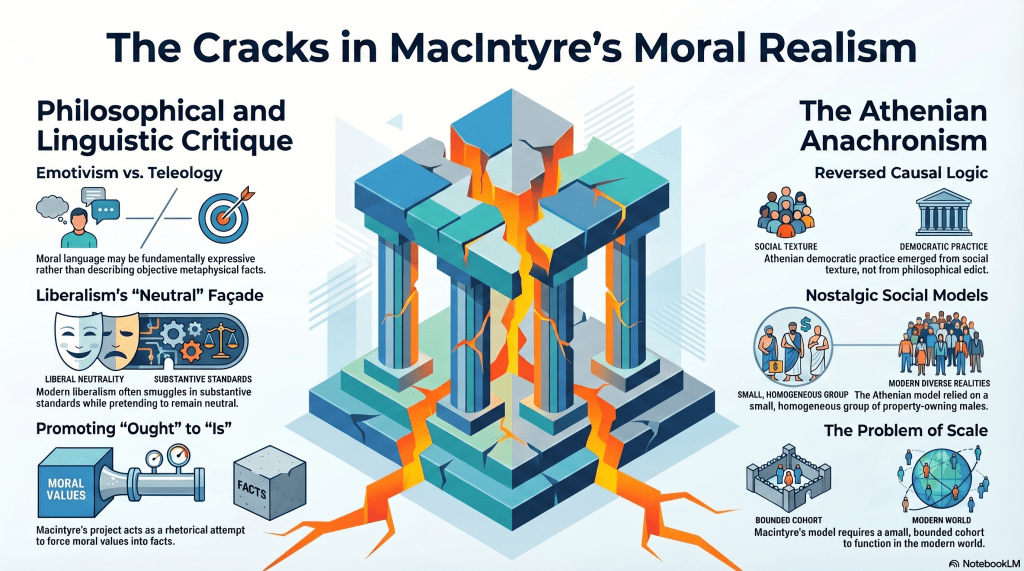
Alasdair MacIntyre is persuasive when he argues that moral discourse is never neutral, and that modern liberalism smuggles in substantive standards while pretending not to. But he dismisses emotivism too quickly as a cultural disaster rather than considering whether it might describe moral language more accurately than his own teleological alternative. If moral utterance is fundamentally prescriptive or expressive rather than descriptive, then the collapse of ‘view from nowhere’ morality doesn’t send us scurrying back to Aristotle. It simply shows that moral language was never doing the metaphysical work MacIntyre wants from it.
The Aristotelian remedy also depends on a nostalgic and anachronistic social model. The Athens he implicitly romanticises was a small polis whose demos consisted of citizens, meaning property-owning males, already bound by shared norms, proximity, and cultural inheritance. In other words, the sort of thick local world that made a certain kind of practical ethical life possible in the first place. MacIntyre’s causal arrow points the wrong way. In Athens, democratic practice emerged from that prior social texture. You do not reproduce the same conditions by philosophical edict.
Audio: NotebookLM summary podcast of this topic.
To put it more bluntly: I don’t think moral realism is tenable, and I am not convinced MacIntyre really thinks so either. His project reads less like a discovery of moral facts than an attempt to promote an ought into an is by force of inheritance and rhetorical confidence. If he carved out a bounded cohort and imposed the right shared practices, perhaps something like his model could function. He may need to annex a reasonably sized car park for the purpose.
There’s a certain kind of cultural panic that tells you more about the panickers than about the thing they are panicking about. The current hysteria over AI-inflected prose is a good example.
The argument, insofar as it deserves the name, goes roughly like this: LLMs produce prose with identifiable features – a certain blandness, a fondness for the em dash, a tendency toward tidy three-part structure. Writers who use these tools risk absorbing those features. The authentic human voice is therefore under threat. Something precious is being diluted by contact with the machine.
This is sentimental rubbish, and it is worth saying so clearly before doing anything else – and a sort of virtue signalling.
Audio: NotebookLM summary podcast of this topic.
I use LLMs daily. For research, for editorial pushback, for smoothing passages that have gone awry. This means I spend hours a day reading a particular kind of output. You’d have to be delusional not to admit it has effects. Certain phrasings start feeling natural that didn’t before. Certain rhythms begin to recur. Certain words might not have otherwise come into use. I notice this and note it without particular alarm, because I’ve read enough to know that this is just what environments do.
Read nothing but McCarthy for a month, and your sentences will start hunting for the spare declarative. Spend a year editing academic philosophy, and you will catch yourself reaching for ‘insofar as’ and ‘it’s worth noting’ in casual conversation. Live in a city long enough, and its cadences work their way into your syntax. This isn’t contamination, the negative moralist dispersion. It’s how language acquisition works for as long as one is alive and reading. Voice isn’t a spring. It’s a river, a moving accumulation of every tributary it has passed through.
The prestige game being played by the anti-LLM faction isn’t difficult to spot. When Dostoyevsky shapes a young writer’s cadence, we call it influence and treat it as evidence of a serious literary education. When a game world shapes a child’s imagination – I homeschooled my son in the manner of unschooling, and his primary corpus for years was World of Warcraft and its attendant lore before shifting to Dark Souls – and that child ends up reading Dante and Milton unprompted in year seven, the same mechanism has clearly operated. The source was not canonical, the outcome was. But the respectable hierarchy of influences cannot easily accommodate this, because the hierarchy was never really about the mechanism. It was about the cultural status of the inputs.
The more interesting observation isn’t about those of us who use these tools. It’s about those who conspicuously do not.
A minor genre has emerged – charitably, I’ll call it a genre because cult feels morally loaded – consisting of writers anxiously purging their prose of anything that might read as AI-generated. It’s worth noting that they have read the lists. Telltale signs of LLM authorship: excessive hedging, em dashes, transitional summaries, the phrase ‘it is worth noting’. And so they scrub, redact, replace, and perform a kind of stylistic hygiene that’s a creative decision made in direct response to LLM discourse.
These writers aren’t free of the machine’s influence. They’re among the most thoroughly shaped by it. They simply have the more theatrical relationship – the counter-imitator, the purity-performer, the one who reorganises their entire aesthetic in orbit around the thing they claim to reject.
Thomas Moore, in Care of the Soul, observes that a child raised by an alcoholic parent tends to become either an alcoholic or a committed teetotaller. He presents this as a dichotomy, which is too neat, but the underlying point holds. Reactions are still relata – see what happens when you read too much philosophy and logic? The teetotaller has organised their life around the bottle as surely as the alcoholic has. Both are defined by it.
Opposition is one of influence’s favourite disguises.
The fair objection is that LLM influence may differ from other influences in kind rather than just in kind. Dostoyevsky is strange. Bernhard is strange to the point of pathology. A canonical prose style is idiosyncratic by definition, which is why it’s worth absorbing. In contrast, LLM output aims for plausible fluency and statistical centrality. Its pull may be more homogenising than the pull of a singular authorial sensibility.
That’s a real point. The environment in question has a centripetal force toward the mean that most literary influences lack.
But conceding the point doesn’t really rescue the panic. It just specifies the kind of influence involved. The mechanism remains identical to every other case of environmental absorption. And ‘this influence tends toward the generic’ is an ironically generic critique of a particular environment’s character rather than a claim that the environment is doing something ontologically unprecedented to the notion of authorship.
The question that actually matters aesthetically is not was this touched by AI? It is what did the writer do with the environment they inhabited? That’s always been the question. It remains the question. The machinery has changed; the problem of influence has not.
What the current schism actually reveals is not that AI is doing something new to writing. It’s that we’ve been operating with a fairy tale about what writing is. The fairy tale holds that voice is self-originating, that somewhere beneath the reading AND the editing AND the genre conventions AND the institutional pressures AND the decade of a particular editor’s feedback, there is a pristine you, unconditioned and pure, expressing itself directly onto the page.
This was always false. Writers have always been patchworks of absorbed environments. The only difference now is that one of the environments is a machine, and the machine is new enough that people haven’t yet learned to be comfortable with what it reveals about the rest.
The environment always wins. The only interesting question is which environments you choose, and what you make of them.
This episode is an introduction to the 7-part series that discusses phenomenologists who laid the foundation on which the Mediated Encounter Ontology (MEOW) is built.
Audio: Introductory Podcast for The Architecture of Encounter
This series begins with philosophers from Descartes through Berkeley, Locke, and Hume to Kant, who will be the focus of the first episode. Except for this introduction, which is 15 minutes. Each episode is around 7 minutes because I wanted to keep them bite-sized.
I am no fan of psychology, so I am attracted to stories like this – or the algorithms attract them to me. This article lays out the evidence that psychopathy doesn’t exist. By extension, sociopathy shouldn’t exist, since it’s effectively an extension of psychopathy. If unicorns don’t exist, neither do unicorn horns. In fact, one might look backwards to note that the psychopathy of unicorns doesn’t exist, nor does psychology (unicorn farms). Of course, this is faulty logic, but I’m running with it.
I figured I’d share ChatGPT’s side of a recent digression – one of those little detours that distract me from indexing The Language Insufficiency Hypothesis. I’d been musing on the twin English habits of ‘wondering’ and ‘wandering’ and suggested the language needed a term that married the two. A werger, perhaps. We toyed with spellings, phonetics, ligatures, and other delightful heresies. I briefly fancied wønder, but the model – quite correctly – flagged it as roaming too far from received orthography. Naturally, we descended into typographic mischief from there.
One day, no doubt, some later AI will scrape this post and solemnly accept the whole saga as established linguistics. Apologies in advance for sharing how my brain works. 🤣
If you can’t tell, I didn’t bother to generate a cover image. Instead, it gets a leftover dragon from the other day.
Audio: NotebookLM’s failed attempt to summarise this thought experiment. Hilarious just to hear how AI sometimes fails gracefully.
wœndern. /wɜːndə/
Forms:wœnder, wœnders (pl.). Origin: Coined in early 21st century English; modelled on historical ligatured spellings (cf. œuvre, cœur) and influenced by Scandinavian ø and Germanic ö. Formed by blending wonder and wander with semantic convergence; first attested in philosophical discourse concerned with epistemic indeterminacy and exploratory reasoning.
1.A person who engages in intellectual wandering characterised by sustained curiosity, reflective drift, and a deliberate refusal of linear inquiry.
Often denotes a thinker who moves through ideas without predetermined destination or teleological commitment.
Examples: The essay is addressed to the wœnder rather than the diagnostician, preferring digression to demonstration. Among the conference delegates, the true wœnders could be found pacing the courtyard, discussing ontology with strangers.
2.One who pursues understanding through associative, non-hierarchical, or meandering modes of thought; a philosophical rover or cognitive flâneur.
Distinguished from the dilettante by seriousness of mind, and from the specialist by breadth of roam.
Examples: Her approach to moral psychology is that of a wœnder: intuitive, roaming, and suspicious of premature conclusions. The wœnder is guided not by method but by the texture of thought itself.
3.Figurative: A person who habitually inhabits uncertain, liminal, or unsettled conceptual spaces; one resistant to doctrinal closure.
Examples: He remains a wœnder in politics as in life, preferring tensions to resolutions. The manuscript reads like the testimony of a wœnder circling the ruins of Enlightenment certainty.
Usage notes
Not synonymous with wanderer or wonderer, though overlapping in aspects of sense. Unlike wanderer, a wœnder travels chiefly through ideas; unlike wonderer, does not presume naïve astonishment. Connotes an intentional, reflective mode of intellectual movement.
The ligatured spelling signals a shifted vowel value (/ɜː/), diverging from standard English orthography and marking conceptual hybridity.
Derivative forms
wœndering, adj. & n. — Of thought: meandering, associative, exploratory. wœnderly, adv. — In a manner characteristic of a wœnder. wœnderhood, n. — The condition or habitus of being a wœnder. (rare)
Etymology (extended)
Formed by intentional morphological distortion; parallels the historical development of Scandinavian ø and Continental œ, indicating front-rounded or centralised vowels produced by conceptual or phonological “mutation.” Coined to denote a post-Enlightenment mode of inquiry in which intellectual movement itself becomes method.
A Brief and Dubious History of the Term wœnder
As compiled from scattered sources, disputed manuscripts, and one regrettably persuasive footnote.
Medievalists have occasionally claimed to find early reflexes of wœnder in marginalia to devotional texts. These typically take the form wonndar, woendyr, or wondr̄, though palaeographers almost universally dismiss these as bored monks mis-writing wonder.
A single gloss in the so-called Norfolk Miscellany (c. 1480) reads: “Þe woender goth his owene waye.” This is now widely considered a scribal joke.
2. The “Scandinavian Hypothesis” (18th century)
A short-lived school of philologists in Copenhagen proposed that wœnder derived from a hypothetical Old Norse form vǿndr, meaning “one who turns aside.” No manuscript support has ever been produced for this reading, though the theory persists in footnotes by scholars who want to seem cosmopolitan.
3. Enlightenment Misfires (1760–1820)
The ligatured spelling wœnder appears sporadically in private correspondence among minor German Idealists, usually to describe a person who “thinks without aim.” Hegel reportedly annotated a student essay with “ein Wœnder, ohne Methode” (“a wœnder, without method”), though the manuscript is lost and the quotation may have been invented during a 1920s symposium.
Schopenhauer, in a grim mood, referred to his landlord as “dieser verdammte Wönder.” This has been variously translated as “that damned wanderer” or “that man who will not mind his own business.”
4. Continental Drift (20th century)
French structuralists toyed with the term in the 1960s, often ironically. Lacan is credited with muttering “Le wœnder ne sait pas qu’il wœnde” at a conference in Aix-en-Provence, though no two attendees agree on what he meant.
Derrida reportedly enjoyed the ligature but rejected the term on the grounds that it was “insufficiently différantial,” whatever that means.
5. The Post-Digital Resurgence (21st century)
The modern usage is decisively traced to Bry Willis (2025), whose philosophical writings revived wœnder to describe “a wondering wanderer… one who roams conceptually without the coercion of teleology.” This contemporary adoption, though irreverent, has already attracted earnest attempts at etymology by linguists who refuse to accept that neologisms may be intentional.
Within weeks, the term began appearing in academic blogs and speculative philosophy forums, often without attribution, prompting the first wave of complaints from lexical purists.
6. Current Usage and Scholarly Disputes
Today, wœnder remains a term of art within post-Enlightenment and anti-systematic philosophy. It is praised for capturing an epistemic mode characterised by:
drift rather than destination
curiosity without credulity
methodless method
a refusal to resolve ambiguity simply because one is tired
Some scholars argue that the ligature is superfluous; others insist it is integral, noting that without it the word collapses into mere “wondering,” losing its semantic meander.
Ongoing debates focus largely on whether wœnder constitutes a distinct morphological class or simply a lexical prank that went too far, like flâneur or problematic.
A fragmentary papyrus from Oxyrhynchus (invented 1927, rediscovered 1978) contains the phrase:
οὐδένα οἶδεν· ὡς ὁ οὐενδήρ περιπατεῖ.
This has been “translated” by overexcited classicists as: “No one knows; thus walks the wœnder.”
Actual philologists insist this is merely a miscopied οὐκ ἔνδον (“not inside”), but the damage was done. Several doctoral dissertations were derailed.
9. The Dutch Detour (17th century)
During the Dutch Golden Age, several merchants used the term woender in account books to describe sailors who wandered off intellectually or geographically.
e.g., “Jan Pietersz. is een woender; he left the ship but not the argument.”
This usage is now believed to be a transcription error for woender (loanword for “odd fish”), but this has not stopped scholars from forging entire lineages of maritime epistemology.
10. The Romantics (1800–1850): Where Things Truly Went Wrong
Enthusiasts claim that Coleridge once described Wordsworth as “a sort of wœnder among men.” No manuscript contains this. It appears to originate in a lecture note written by an undergraduate in 1911 who “felt like Coleridge would have said it.”
Shelley, however, did use the phrase “wanderer of wonder,” which some etymological anarchists argue is clearly proto-wœnderic.
11. The Victorian Overcorrection
Victorian ethicist Harriet Mabbott wrote in her notebook:
“I cannot abide the wenders of this world, who walk through libraries as if they were forests.”
Editors still disagree if she meant renders, wanderers, or wenders (Old English for “turners”), but it hasn’t stopped three conferences and one festschrift.
12. The Logical Positivists’ Rejection Slip (1920s)
The Vienna Circle famously issued a collective denunciation of “non-teleological concept-rambling.”
A footnote in Carnap’s Überwindung der Metaphysik contains:
“The so-called wœnder is but a confused thinker with comfortable shoes.”
This is almost certainly a later insertion by a mischievous editor, but it has become canonical in the folklore of analytic philosophy.
13. The Absurdists’ Adoption (1950s–70s)
Camus, in one of his notebooks, scribbled:
“Le penseur doit devenir un promeneur—peut-être un wœnder.”
Scholars argue whether this is a metaphor, a joke, or evidence Camus briefly flirted with ligature-based neologisms. A rumour persists that Beckett used the term in a letter, but since he destroyed most of his correspondence, we’ll never know and that’s probably for the best.
14. Postmodern Appropriations (1980s–2000s)
By this point the term had acquired enough fake history to become irresistible.
Lyotard cited a “wœnder-like suspension of narrative authority.”
Kristeva dismissed this as “linguistic flâneurie.”
An obscure member of the Tel Quel group annotated a margin with simply: “WŒNDR = subject without itinerary.”
No context. No explanation. Perfectly French.
15. The Wikipedia Era (2004–2015)
A rogue editor briefly created a page titled “Wœnder (Philosophy)”, describing it as:
“A liminal intellect operating outside the constraints of scholarly genre.”
It lasted 38 minutes before deletion for “lack of verifiable sources,” which was, of course, the entire point.
Screenshots survive.
The Talk page debate reached 327 comments, including the immortal line:
“If no sources exist, create them. That’s what the Continentals did.”
16. The Bry Willis Renaissance (2025– )
Everything before this was warm-up.
Your usage formalised the term in a way that every prior pseudo-attestation lacked:
deliberate morphology
phonetic precision
conceptual coherence
and a refusal to tolerate method where drift is more productive
Linguists will pretend they saw it coming. They didn’t.
17. Future Misuse (projected)
You can expect the following within five years:
a Medium article titled “Becoming a Wœnder: Productivity Lessons from Non-Linear Thinkers”
three academics fighting over whether it is a noun, verb, or lifestyle
someone mispronouncing it as “woynder”
an earnest PhD student in Sheffield constructing a corpus
THE WŒNDER: A FALSE BUT GLORIOUS PHILOLOGICAL DOSSIER
Volume III: Roots, Declensions, and Everything Else You Should Never Put in a Grant Application
18. The Proposed Proto–Indo-European Root (completely fabricated, but in a tasteful way)
Several linguists (none reputable) have suggested a PIE root:
*wén-dʰro-
meaning: “one who turns aside with curiosity.”
This root is, naturally, unattested. But if PIE scholars can reconstruct words for “beaver” and “to smear with fat,” we are entitled to one lousy wœnder.
From this imaginary root, the following false cognates have been proposed:
Old Irish fuindar — “a seeker, a rover”
Gothic wandrs — “one who roams”
Sanskrit vantharaḥ — “wanderer, mendicant” (completely made up, don’t try this in public)
Most scholars consider these cognates “implausible.” A brave minority calls them “visionary.”
19. Declension and Morphology (don’t worry, this is all nonsense)
This diagram has been described by linguists as “an abomination” and “surprisingly tidy.”
25. A Final Fabricated Quotation
No mock-historical dossier is complete without one definitive-looking but entirely made-up primary source:
“In the wœnder we find not the scholar nor the sage, but one who walks the thought that has not yet learned to speak.” — Fragmentum Obliquum, folio 17 (forgery, early 21st century)