The Master’s Concepts: Decolonising the House Without Keeping the Furniture

9–14 minutes

A colleague recently shared an essay with me, The Return of Metaphysics: Reclaiming Sovereignty Through Ontological Grounding in Postcolonial and Western Thought. I read it with interest, not least because its target is one I share: the colonial imposition of Western categories as if they were universal reason, universal law, universal political form, and universal humanity. On that point, there is no meaningful disagreement. Colonialism isn’t merely theft of land, labour, and resources. It’s also the imposition of a grammar by which reality itself was made legible to power.

The essay is at its strongest when it treats colonialism as metaphysical violence rather than merely administrative domination. It argues that Europe universalised its own categories and rendered other worlds invisible, inferior, or unreal. Colonialism, on this account, was not only conquest. It was the installation of one ontology as the authorised operating system of the human. That’s a powerful diagnosis, and it deserves to be taken seriously. The essay explicitly describes colonialism as a process that ‘re-made being’ and suppressed other conceptions of time, morality, and community.

Where I start to hesitate isn’t in the critique of colonialism, but in the proposed recovery. The essay seeks to reclaim metaphysics, sovereignty, agency, moral authorship, and ontological grounding as instruments of postcolonial renewal. It wants to oppose colonial metaphysics by recovering metaphysics; to oppose hollow sovereignty by reconstructing sovereignty; to oppose imposed subjectivity by restoring moral authorship.

This may be coherent within the essay’s own frame. But from mine, it raises a suspicion:

  • “a return to metaphysics”
  • “moral authorship”
  • “ontological reconstruction”
  • “popular agency”

These terms don’t arrive clean. They carry histories and come with fittings: sovereignty, possession, self-rule, jurisdiction, authorship, legitimacy, command. One may repaint them in decolonial colours, but the shape remains. Inheritance is the danger.

Audio: NotebookLM summary podcast of this topic.

Sovereignty as a Recovered Trap

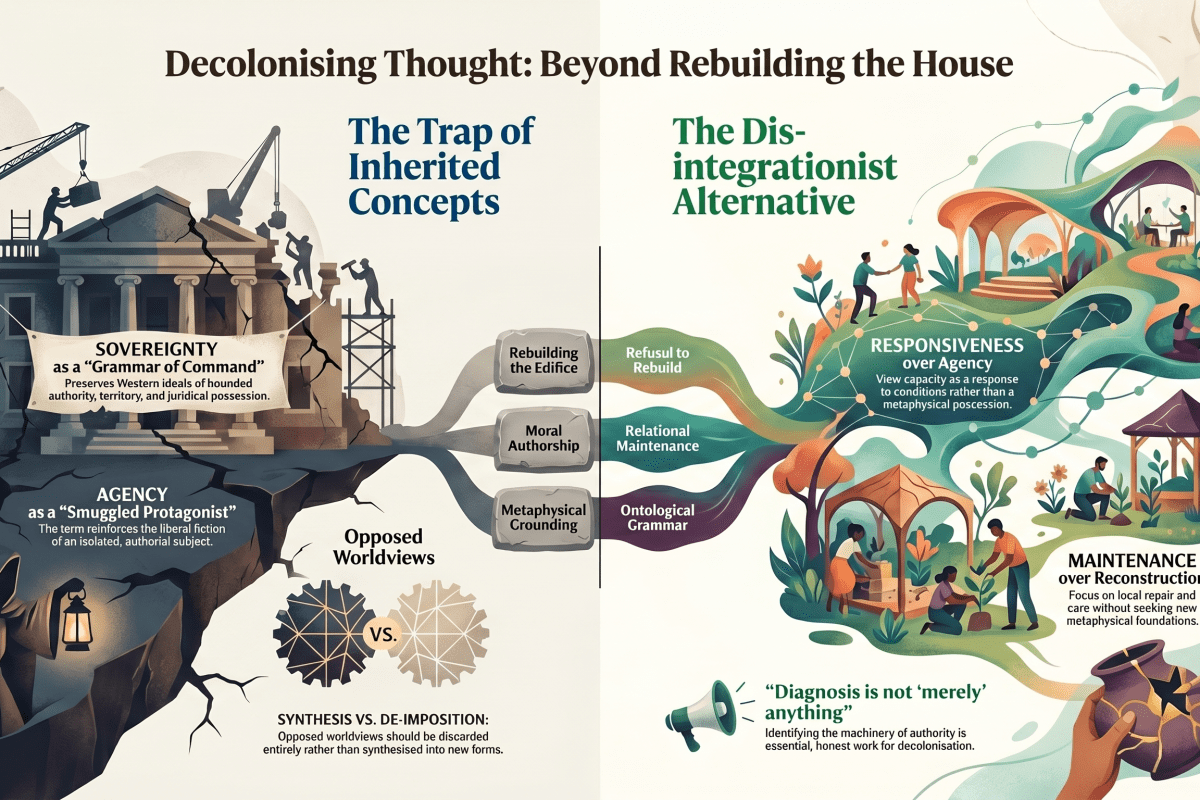
The essay’s central concept is sovereignty. More precisely, post-sovereignty. Yet the very act of preserving sovereignty as the problematic term matters. Sovereignty isn’t just a neutral container for self-determination. It’s one of the central concepts through which Western political modernity imagines authority: bounded, possessed, territorialised, juridical, and authorial.

To speak of sovereignty is already to speak in the grammar of command: Rules. Owners. Authorities. Something marks the line between inside and outside.

This doesn’t mean colonised peoples were wrong to demand sovereignty. The politically dispossessed may understandably seek the protections of the language used to exclude them. If one has been denied the status of a subject, a nation, or a people, then reclaiming those terms may be historically necessary. There’s no cheap purity available from the comfort of abstraction. Humans made the mess, naturally, and then handed each other dictionaries to clean the mess.

But political necessity doesn’t settle conceptual adequacy. A term may be strategically useful and ontologically suspect at the same time. So, the question isn’t whether sovereignty has been useful in anti-colonial struggle. It’s whether it should remain the destination, rather than a transitional vocabulary one eventually leaves behind.

The essay recognises that many postcolonial states retain the ‘juridical structure’ of autonomy whilst remaining governed by inherited categories of colonial law, property, development, and bureaucratic legitimacy. That’s exactly the point where the critique might turn more sharply on sovereignty itself. If postcolonial statehood often reproduces colonial form, perhaps the issue isn’t merely that sovereignty is hollow, but maybe it’s just one of the forms through which hollowness reproduces itself.
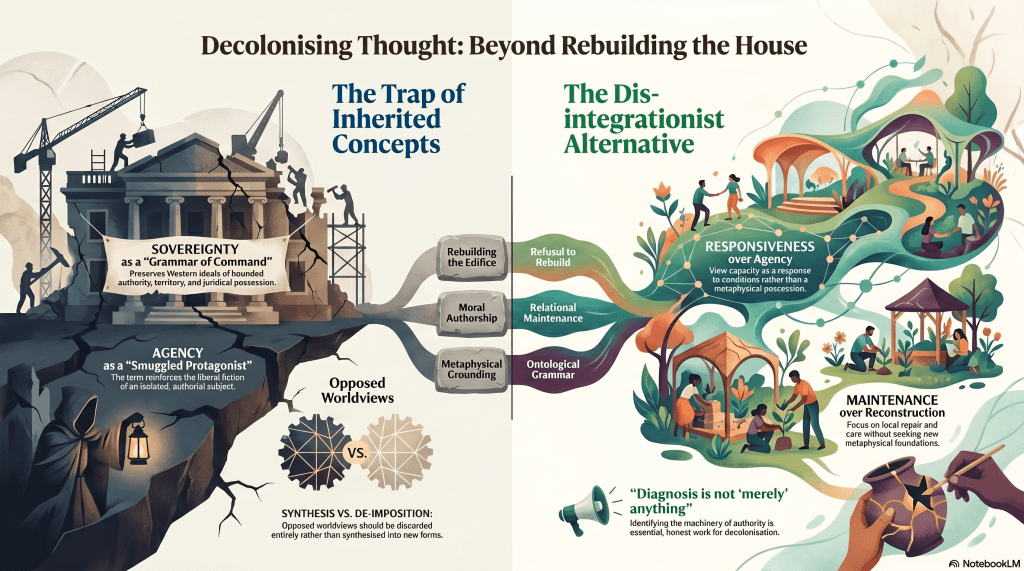
NotebookLM Infographic on this topic.

Agency: The Smuggled Protagonist

The same problem emerges around agency. The essay speaks of popular agency, moral authorship, co-authorship, and subjectification. Again, the impulse is understandable. Colonial domination denies people the right to act, name, interpret, and organise their own lifeworlds. A postcolonial theory naturally wants to restore capacity to those rendered passive.

But the agency term isn’t innocent. In modern Western thought, agency often implies a self capable of authorship, intention, responsibility, and moral ownership. It’s the protagonist required by law, markets, liberal politics, and punishment. Someone must be deemed the chooser, the signer, the sinner, the voter, the debtor, the criminal, the rational actor.

In my own work, I reject agency as a metaphysical possession. I’d rather speak of responsiveness: a variable capacity shaped by material, relational, temporal, somatic, and epistemic conditions. People don’t float above conditions and author themselves into freedom. They respond, more or less adequately, within fields of constraint.

The essay’s emphasis on relationality moves in this direction, but its vocabulary often pulls it back toward authorship. It wants shared becoming, but it also wants moral authors. It wants relational ontology, but it also keeps the self as a source of political meaning. This is a revealing tension.

The alternative isn’t fatalism. To reject agency isn’t to deny action. Breathing doesn’t require a metaphysics of breath. It just happens autonomically. The question is whether we must preserve the fiction of the authorial subject to describe them. I think not.

When Negation Need Not Become Synthesis

The essay leans on Fanon (see The Wretched of the Earth) to argue that colonial domination can’t be resolved through dialogue because dialogue presumes equals. This is right, or at least right enough. A conversation between master and slave is not yet a conversation between equals. Liberal dialogue presumes a shared field of recognition; colonial domination corrupts that field before speech begins.

The essay, therefore, turns to dialectic. Where dialogue seeks agreement, dialectic begins from contradiction and struggle. Again, this makes sense. A colonised subject can’t merely ask to be recognised by the system that produced their non-being. Something must be negated.

My hesitation concerns what happens after the negation. The essay sometimes seems to assume that contradiction must move toward ontological reconstruction. But why? If one term of the contradiction is an imposed colonial ontology, it might not deserve preservation within a higher unity because it mightn’t be a meaningful antithesis. It may simply be wrong, violent, and disposable.

This is the dis-integrative question:

Not every opposition is productive. Some oppositions are parasitic. If a worldview is imposed by force, then treating it as a dialectical partner may grant it more dignity than it deserves. The point of decolonial refusal may not be synthesis, but de-imposition.

That distinction matters. Synthesis often preserves too much. It lets the offending structure survive as a contributor to the next stage. It says, in effect: this violence was part of becoming. Perhaps. But perhaps not. Perhaps some concepts belong on the cutting room floor.

Metaphysics: Necessary Grammar or Rebuilt Throne?

The essay argues that postmodern anti-metaphysics has left social theory without stable categories of truth or moral orientation. It wants metaphysics back, not as abstraction, but as the recovery of moral and ontological grounds for political community.

I understand the concern here, too. Communities don’t live by procedure alone. No society is sustained merely by policy, rights language, or bureaucratic form. People inhabit worlds, not spreadsheets. There are ontological grammars beneath every institution: assumptions about personhood, time, land, memory, obligation, kinship, death, and belonging.

But I resist the move from ‘we can’t avoid ontological grammar‘ to ‘we need metaphysical grounding‘. Whilst the former seems unavoidable, the latter seems dangerous.

Metaphysics isn’t simply depth. It’s elevation – the move by which a grammar stops appearing as grammar and starts presenting itself as ground. It becomes the authorised deep structure, the thing beneath dispute, the foundation beneath the foundation. And foundations, as humans have demonstrated with astonishing consistency, are excellent places to hide power.

Each one requires a leap. One leap may be necessary. Ten leaps become choreography. Eventually, the argument is no longer walking; it’s performing interpretive dance and calling itself ontology.

The Problem of Rebuilding

This is where my own Dis–integrationist commitments diverge most sharply from the essay. I’m a diagnostician. I deconstruct and name seams with no obligation to replace every collapsed universal.

The essay treats diagnosis as insufficient. It says the critique of sovereignty reveals a metaphysical vacuum, but diagnosis is not enough. Post-sovereignty must move toward ontological reciprocity, relational becoming, and shared labour of mutual recognition. Whilst this move is respectable. It’s also the one I distrust.

The rebuilding instinct is one of philosophy’s oldest addictions. Expose the flaw, draft the remedy, rebuild the edifice, declare the new form less violent than the old. This is how critique becomes renovation.

But the refusal to rebuild isn’t indifference, despair, or nihilism. It’s a refusal to let repair disguise itself as permanence. Care, maintenance, reciprocity, and local repair remain possible without metaphysical reconstruction. In fact, they may be more honest when stripped of the promise of final grounding.

Pedagogical Sovereignty and the Soft Machinery of Formation

The essay’s later sections turn to education. It proposes pedagogical sovereignty as a model of moral and ontological co-creation. The classroom becomes a site where being isn’t transmitted but collaboratively formed. Governance, by analogy, might become less administrative and more pedagogical: citizens not merely ruled, but constituted in relation. As attractive as this might be. it’s also perilous.

Education has always had this double face. It can liberate, but it can also format. It can open worlds, but it can also install authorised grammars. The classroom is not outside power. It’s one of power’s favourite incubators. The fact that it speaks gently doesn’t mean it’s not shaping bodies, subjects, desires, norms, and permissions.

To make pedagogy the model of sovereignty risks softening administration rather than escaping it. It may replace the command of the state with the formation of the subject. That may be better and subtler, but one should be careful when power arrives wearing soft shoes.

This doesn’t refute the essay’s educational turn, but it complicates it. If pedagogy is to be an emancipatory model, it has to preserve opacity, dissent, and non-formation. It needs to allow the learner not merely to become, but to remain partially unread, unfinished, and unintegrated. Otherwise, pedagogical sovereignty may become another normalising machine with better intentions and comfy chairs.

The Cutting Room Floor

My objection isn’t that the essay is wrong to oppose colonialism. Au contraire; its critique of colonial metaphysics is often compelling, and it’s preaching to the choir at the start. The issue is that its recovery project may carry forward more of the colonial-conceptual apparatus than it recognises.

The following terms deserve suspicion:

  • Sovereignty, because it preserves the grammar of possession, jurisdiction, bounded authority, and command.
  • Agency, because it preserves the authorial subject required by liberal law, market morality, and responsibility allocation.
  • Moral authorship, because it risks reintroducing the self as origin, even when collectivised.
  • Metaphysical grounding, because it may turn situated lifeworlds into foundations.
  • Reconstruction, because it assumes fracture demands repair, rather than sometimes demanding refusal.
  • Dialectical synthesis, because it may preserve the imposed term as a contributor to the future, rather than discarding it as an error condition.

None of these concepts must be rejected out of hand. That would be too easy. But they shouldn’t pass uninspected simply because they have been recruited into decolonial service. Fine. Use the master’s tools to dismantle the house, but don;t become too fond of them.

Toward De-Imposition

So, what then?

  • Dis–integration, not reconstruction
  • De-imposition, not anti-colonial sovereignty
  • Responsiveness, not agency
  • Relational maintenance, not moral authorship
  • Ontological grammar held visibly as grammar, not metaphysical grounding

This doesn’t mean communities should abandon their lifeworlds, traditions, or inherited moral vocabularies. It means those vocabularies shouldn’t need to become metaphysical foundations to matter. A world may be lived, tended, and defended without being inflated into ground.

The colonised don’t need permission from Western metaphysics to exist. Or me, for that matter. Nor do they need to rebuild themselves in metaphysical form to count as real. The refusal of imposed reality may be enough. After that, there may be practices, relations, institutions, memories, ceremonies, languages, solidarities, and forms of care. There may be politics and struggle. And, sure, repair and maintenance. But there needn’t be a new foundation.

Enfin

The essay I am responding to is valuable because it presses a real question:

My answer is: diagnosis is not ‘merely’ anything. To diagnose is to identify the machinery by which certain concepts keep reproducing their own authority. If sovereignty, agency, authorship, and metaphysical grounding belong to that machinery, then they should not be automatically restored just because they have been wounded.

Some concepts can be reclaimed. Others should be retired. Some may be used provisionally, under protest, as transitional scaffolding. Again, others may belong on the cutting room floor.

The challenge isn’t only to oppose colonialism and its effects. It’s to notice when colonial grammar survives inside the opposition. That’s the harder work – less heroic, sonorous, and much less likely to produce a grand theory, but it may be more honest.
Announcement: MEOW GPT

Instead of sleeping like a functional adult, I’ve spent the night creating, testing, and refining a bespoke GPT that has fully absorbed my MEOW and LIH frameworks. Apologies that the LIH manuscript isn’t yet public; some of the terminology may look delightfully alien if you’re coming in cold.

This model doesn’t role-play a philosopher; it thinks through the Mediated Encounter Ontology. It runs every input through T0–T3 mediations and then applies the Language Insufficiency Hypothesis to explain why our words fail us in predictable, structural ways.

Audio: NotebookLM summary podcast of this post on the MEOW GPT.

I stress-tested it with a dozen concepts, from the obvious to the uncooperative. It happily tells you when your input makes sense, when it’s out of scope, and when you’ve handed it conceptual soup. My first test was the hard problem of consciousness, because naturally we begin with the philosophical boss fight. I dialled down some over-enthusiastic LIH flourishes, but the bones are untouched.

I’m making this public for a simple reason: it’s the clearest way for people to see how MEOW operates without wandering through a hundred pages of my prose. These outputs capture how I process information and why these frameworks feel so intuitively correct to me. When you read them, you get a direct view of my interpretive machinery – how the world clicks for me, and how these ideas evolved.

It hasn’t been rigorously battle-tested across the entire conceptual universe, but it’s stable, coherent, and frankly too interesting to keep in the drawer. If you try it – and I hope you do – I’d love to see what it does with your own concepts. If you need help reading the results, ask. I didn’t simplify the system; it expects literacy, nuance, and a working prefrontal cortex.

For orientation, read the introductory post or the colour perception example. Ideally, read the original essay and listen to the summary podcast. My first test was on the hard problem of consciousness because I had already analysed it for this post. I made some adjustments to tone down some LIH intrusions.

Below is a sample output. I asked the model to analyse modernity.

Concept

  • Input: modernity
  • Type: historical–social formation / self-description of an era / conceptual frame
  • Scope check: in-scope – central for how MEOW treats large-scale shifts in mediation (social, technical, cognitive, linguistic)

High-level summary (≤120 words)

Modernity is both a historical bundle (industrialisation, nation-states, capitalism, science, bureaucracy, media) and a story societies tell about themselves (“we are modern, unlike the past”).

In MEOW terms, modernity is a large-scale reorganisation of mediations:

  • T0: new bodily environments (urban life, clocks, artificial light, pollution, medicine).
  • T1: new cognitive habits (individualism, planning, abstraction, risk-calculation).
  • T2: new vocabularies (progress, development, rationality, “religion” vs “science”).
  • T3: new institutions and technologies (markets, states, factories, schools, mass media, digital networks).

“Modernity” is not a single thing but a way these shifts hang together and become a background to everyday encounter.


T0 – Biological Mediation

  • Applicability: Applicable
  • Analysis:
    • Modernity radically reshapes the immediate bodily environment: dense cities, artificial lighting, noise, pollution, sedentary work, and altered sleep cycles change basic sensory and metabolic conditions.
    • Medical advances and public health (vaccination, antibiotics, sanitation, surgery) modify life expectancy, infant mortality, and chronic illness, which in turn change how life cycles feel and are planned.
    • New food systems (industrial agriculture, processed foods, global supply chains) alter nutrition, exposure to toxins, and rhythms of hunger and satiety.
    • Industrial and digital work reorganise movement and posture: repetitive factory labour, office desk work, and screen use all reshape embodiment, fatigue, and bodily awareness.
    • These T0 changes set the stage for new affective baselines (e.g., chronic low-level stress, stimulation overload) that colour what it is like to live in a “modern” world.

T1 – Cognitive Mediation

  • Applicability: Strongly applicable
  • Analysis:
    • Modernity encourages certain cognitive styles: systematic planning, quantification, risk assessment, cost–benefit thinking, and an emphasis on prediction and control.
    • The sense of self is reconfigured toward individualism and reflexivity: people see themselves as projects to be chosen, improved, optimised, often with long-term career and life-planning horizons.
    • Exposure to multiple roles, cultures, and information streams (through migration, media, education) produces more complex identity structures and can create cognitive dissonance or fragmentation.
    • Scientific and technical worldviews teach people to reframe events in terms of mechanisms, probabilities, and systems rather than fate, tradition, or local narratives.
    • The sheer volume and speed of information flows in late modernity (news, social media, notifications) trains attention toward rapid scanning and shallow switching, affecting memory, concentration, and emotional regulation.
    • These patterns make certain experiences “normal” (abstract work, mediated relationships, bureaucratic interactions) that would be extraordinary or impossible in premodern settings.

T2 – Linguistic Mediation

  • Applicability: Strongly applicable
  • Analysis:
    • Modernity itself is a label that societies use to contrast “us” with “them” (the past, “traditional” societies, “the East,” “the primitive”); it is a polemical as well as descriptive term.
    • In Language Insufficiency terms, modernity is highly Fluid: it can mean a period (“since the 18th century”), a style (modernist art), a value system (rational, secular, progressive), or a socio-economic order (capitalist, industrial, bureaucratic). Different authors slide between these quietly.
    • It’s also Contestable: critics and defenders use the same word but point to different aspects—emancipation and progress versus alienation, exploitation, ecological crisis.
    • Pairs like “modern vs traditional” or “modern vs backward” compress complex differences into simple hierarchies, smuggling in a presumption that “modern” is automatically better or more advanced.
    • Talk of “post-modernity” or “late modernity” suggests that we can neatly periodise and step outside the modern, even while our concepts and institutions remain shaped by it—an example of language implying more clarity and control than we actually have.
    • At the most global scale (“the meaning of modernity,” “the modern condition”), we approach an Effectiveness Horizon: the term feels weighty but becomes vague; people resort to sweeping metaphors (disenchantment, liquefaction, acceleration) whose exact content is hard to pin down.
    • First-person experiences of being “overwhelmed by modern life,” “liberated by modern options,” or “disconnected in modern society” often have an Ineffable quality: standard clichés don’t quite capture the texture of these lives, even as they gesture at them.

T3 – Social/Technical Mediation

  • Applicability: Strongly applicable
  • Analysis:
    • Modernity is most visible as a mesh of institutions: nation-states, markets, bureaucracies, public schools, hospitals, prisons, armies, scientific organisations, corporations, NGOs.
    • These institutions standardise time (clocks, schedules), space (borders, property lines, zoning), identity (passports, ID numbers), and value (money, statistics, rankings) so that encounters become predictable and governable across large scales.
    • Technologies—steam engines, electricity, mass transport, broadcasting, computing, the internet, AI—are both products and drivers of modernity. They make possible new encounter-forms (remote work, global real-time communication, mass surveillance).
    • Urbanisation concentrates people into large, heterogeneous populations, which reconfigures social networks, anonymity, solidarity, and conflict; everyday encounters become more mediated by rules, signage, and digital systems than by face-to-face custom.
    • Capitalist production and consumption patterns organise much of life around work, income, and markets; the rhythms of the factory, office, and platform economy structure when and how people interact, rest, and move.
    • Modern governance uses statistics, censuses, and models to “see” and manage populations; this makes certain aspects of life legible (employment, crime, disease) while leaving others under- or uncounted (informal care, undocumented work, emotional labour).
    • Counter-movements (romanticism, traditionalism, environmentalism, decolonial and Indigenous resurgence, slow-living and anti-consumerist practices) can be read as attempts to renegotiate or resist specific modern mediations rather than simply reject “modernity” as a whole.

Limits & failure modes

  • Language insufficiency notes
    • Modernity bundles together time (a historical era), structure (a type of society), and value (being “up to date”). This makes the term rhetorically powerful but analytically slippery: it’s easy to smuggle evaluations into what sound like neutral descriptions.
    • Because the concept is so broad, discussions often conflate distinct issues—technology, capitalism, secularisation, colonialism, individualism, bureaucracy—under one word, obscuring which mechanisms are actually at work.
    • Experiences of living in “modern times” (speed, fragmentation, choice, precariousness, possibility) often outrun our stock phrases; people lean on recurring complaints (“too fast,” “too shallow,” “too lonely”) that only partially capture what it’s like.
  • Missing tiers / blind spots
    • This sketch doesn’t adjudicate between different theories of modernity (Marxist, Weberian, postcolonial, systems-theoretic, etc.); it treats them as emphasising different mediational strands.
    • It’s centred on Euro-Atlantic narratives; “multiple modernities” and non-Western trajectories (where “modern” elements mix with older forms in hybrid ways) would need a richer T3 treatment.
    • The analysis underplays ecological dimensions: industrial modernity’s dependence on fossil fuels, large-scale extraction, and waste has massive implications for how future encounters will be structured.
    • Finally, because we are ourselves situated in what we call modernity, our conceptual vantage is limited; any map we draw is partly an artefact of the very mediations we’re trying to analyse.

Fashionable Fascism

So, it started with this video.

Video: The fascist philosopher behind Vladimir Putin’s information warfare — Tim Snyder

I’d never heard of Ivan Ilyin, so the entirety of my knowledge derives from whatever Tim Snyder conveys in this clip. The risk is that he may misrepresent Ilyin’s message, much like Stephen Hicks misrepresents Postmodernism in his work. So, if you’ve got a deeper understanding of Ilyin, apologies in advance, but I am only reacting to this clip without much intention of reading his published work not performing additional second-hand research. Sue me.

Snyder raises three ‘important ideas’ from Ilyin:

/1/ Social advancement is impossible

Each person is like a cell in a body, each having it’s defined function or purpose. So, freedom means knowing one’s place, which function to perform.

/2/ Democracy is a ritual

People vote, but they only vote to affirm their collective support for a leader. The leader is not legitimated or chosen by votes. Voting is just a ritual by which people people endorse a leader every few years.

/3/ The factual world doesn’t count

The manifest world is not real. It’s a mishmash of facts, which have no intrinsic value, but these facts cannot be unified into some larger whole.

Nothing is real, or what is real isn’t important. The only things that really matter are preferences and biases.

Through this, Ilyin surmises that the only true thing is Russian Nationalism and its role as saviour to bring order back to the world.

Of course, this conclusion is precisely the one to which the US arrived except that its American Nationalism is the correct version.

. . .

As to points 1 and 2, I can’t disagree with the base statements. Social advancement is impossible because we’ve got nothing to measure it against. As I’ve said before, we move recognise change and a sense of movement, but movement is not progress.

As I’ve already admitted, I don’t enough about Ilyid, so I am taking Snyder’s statement at face-value, but it does not follow that because social advancement is impossible, we need to adopt some deontological position that freedom means knowing one’s place. It’s a bit of a forced non sequitur.

Democracy is a ritual. It’s a failed experiment, and the only thing that remains is the shell of an empty promise. I do think that the voting serves to legitimise the representative figurehead. There are persons who debate the legitimacy of, say, Bush-43 or Trump-45—or perhaps just their competencies—but this is a twenty-first century phenomenon, as US politics have become more and more divisive.

That the factual world doesn’t count is difficult for me to buy into. In many ways, it is easy enough to manipulate people with non-facts masquerading as facts, but I am not convinced that this contingent is large enough to gain critical mass in the long run. I understand history well enough that these anti-fact forces have run roughshod over entire civilisations, whether the Inquisitions or witch-burning or current religious organisations and other snake oil hawkers.

Don’t let the bastards grind you down.

Like the characters in Orwell’s 1984 or Atwood’s The Handmaid’s Tale, there is still resistance. I’m not even trying to make the claim that my vision of a world absent of superstition is the true world or the right vision. I am only claiming that my vision of a world without it is more pleasant to me.

But, then again, that just confirm’s Ilyid’s point that the only thing that matters is preference, and there is no separating bias from preference.

What Still Remains

I haven’t done any film reviews, and I’m not about to start now. I’ve just watched What Still Remains on Netflix.

People become their own kind of monster.

What Still Remains Film Trailer

This is decent post-apocalyptic fare, some catalyst, societies, competing factions, good versus evil, at least in the eyes of the devout. But that’s not what I am going to be writing about.

What still remains contains good writing and strong character development. It does over-employ tropes, but this seems to be the norm these days: modular writing; rearranging the Lego pieces to make something that appears fresh. So what do I have to say?

Spoiler Alert: Proceed with caution…

This is a perfect depiction of the problems with property rights and social contract theory. There are apparently 3 factions—4 if you count independents.

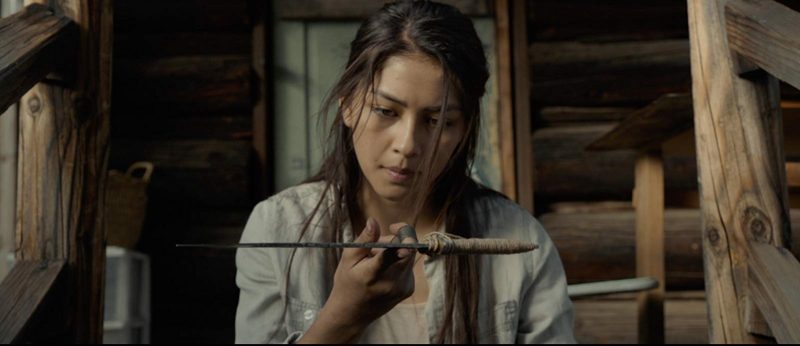
Anna

Initially, there were the Changed, never seen on screen and perhaps not even contemporaneous to the current period, though they may reside in the unseen cities. Anna, the protagonist, and her family are among the independent. Peter, a preacher from the ordained, holier than thou faction. In the realm of ‘if you’re not with me (and our God), you’re against me, thence evil’, they are the arbiters of all that is good. And then there are the Berserkers, as named by the Ordained. To the Ordained, Berserkers aspire to be Changed, but the Berserkers view themselves more along the line of Spartans: Pain is good.

Peter

All scenes are shot in the wilderness, but the various factions have staked property claims with wide perimeters. The penalty for trespass appears to usually involve death of the offending party—or at least a hefty fee. This is Hobbes’ ‘solitary, poor, nasty, brutish, and short’ life outside of society quip, though he didn’t exactly account for a class of societies despite this being common in his day.

Berserker

So, these factions don’t actually have property rights; what they have is a notion of property, and they defend it with violence, as is a necessary condition for all property. In so-called modern societies, the violence is obfuscated much in the same manner that supermarkets obscure the carnage behind the meat. It’s still there; it’s just at arm’s length. Violate one of these ‘rights’, and you’ll see the violence inherent in the system.

And then there’s social contract theory—or the gaping flaw in the logic. Anna is an independent, but one can only be as independent as the ability to defend their independence. It’s sort of like contract law. If you can afford to defend a contract, you are entitled to having it enforced.

Redact intellectual property rant.

Anna doesn’t particularly want to belong to either faction, who have divided their world into two pieces in the same manner that, say, Britain and Scotland might have. If you happen to be born there through some loin lottery, you pretty much have to choose a side. Given Sartre’s no excuses policy, you can choose neither; it just won’t bode well for you. You’ve got no real choice.

Social Choice Theory

In Anna’s eyes, upon the death of her mother and brother, she is persuaded with reluctance to return with Peter to his community, a God-fearing bunch. Her mum had indoctrinated her into this cult of God through bible readings, so she was primed for the eventuality. Some independent interlopers attempted to block their return journey by claiming trespass, so Peter summarily offed them rather than paying their ransom—a fee Anna has been willing to tender.

When the two finally reached the sanctuary, Anna quickly realised that she had no say in the matter: she was either a (good) member or (an evil) dead. To reiterate, this is an underlying problem with social contract theory. There is no exit clause.

Side Bar: Some have argued that the cost of coerced—though they’d never use this term—participation and compliance is owed to the greater good. There is no reason given why this is preferred or across which dimensions better is being assessed—or good for that matter—, so don’t ask. Long live Jeremy Bentham and John Stuart Mill with a hat tip to David Hume.

The first man who, having fenced in a piece of land, said “This is mine,” and found people naïve enough to believe him, that man was the true founder of civil society.

From how many crimes, wars, and murders, from how many horrors and misfortunes might not any one have saved mankind, by pulling up the stakes, or filling up the ditch, and crying to his fellows: Beware of listening to this impostor; you are undone if you once forget that the fruits of the earth belong to us all, and the earth itself to nobody.”

Jean-Jacques Rousseau, Discourse on the Origin of Inequality

Hobbes, Locke, and Rousseau each approached social contracts from their own perspectives, but it may be interesting to note that each was a privileged white male of his day. Sure, Hobbes was a monarchist, and Rousseau was the Thoreau of his day, a nostalgist, but he like the others were beneficiaries of the status quo, save perhaps at the margins.

Anna thought she had sovereignty over her choices. In the end, the plot line prevailed, but then again, this was just a movie, so even her choices were scripted.

Calvin & Hobbes