Octogenarians

5–7 minutes

The title may have given this away, but my parents are in their eighties, an absurdity on the face of it, because some primitive part of my brain still files them under ‘adults’ – people who understand the performance of being alive.

Years ago, against my father’s wishes, my mother took a job as a waitress. His objection came out with that antique domestic authority that probably ought to be preserved in amber: No wife of mine is going to work. There it is. The marital constitution in a single sentence. Not an argument – rather, by decree. Still, she worked.

Audio: NotebookLM summary podcast of this topic.

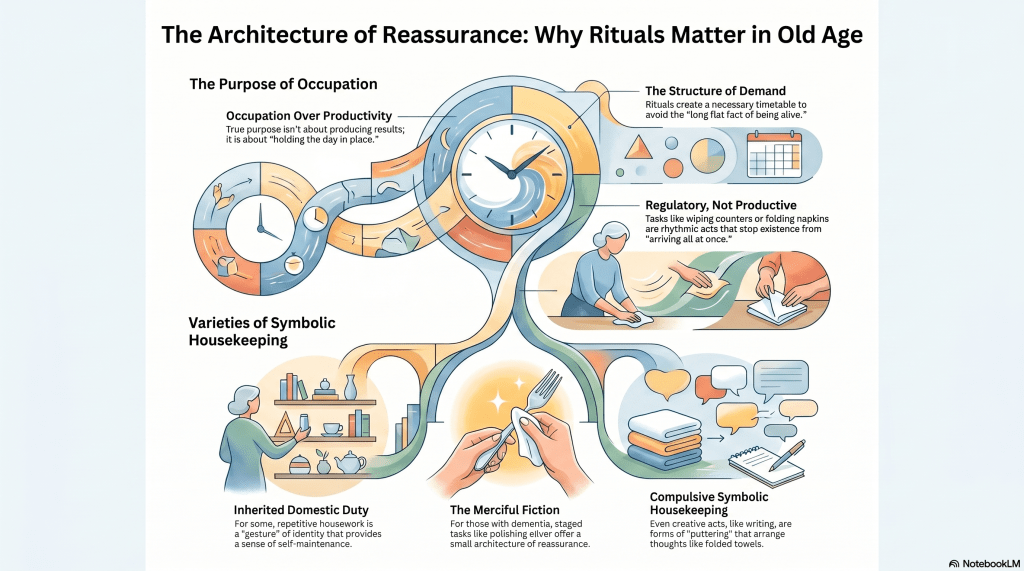
It’s been years since she held a paid job, but in retirement, she seems to have lost more than employment. She’s lost a structure of demand. She is bored out of her gourd or tree or whatever. Left alone with an unfilled day, she putters, tidies, wipes, folds, rearranges, and complains – rinse and repeat. Sisyphus would be proud. And the complaint isn’t incidental; it’s part of the ritual. The labour gives the grievance somewhere to reside.

There’s a peculiar mercy in not being too useful.

NotebookLM Infographic on this topic.

This creates an odd etiquette for everyone around her. One has to be careful not to interfere too much. Don’t clean everything; efficiently eliminate tasks; show up flushed with modern virtue and liberate her from the very thing that’s keeping the day from opening its jaws. Offer help, accept the refusal, move on without guilt. There’s a peculiar mercy in not being too useful.

Once the housework is done – or once it reaches the temporary truce by pause – the restlessness comes back. The ourobouros resumes its self-consumption. Then she needs to walk, drive, shop, bake, browse, fiddle, inspect, rearrange, and escape – more infinite loop, though only seemingly so. Anything to distract her from the long flat fact of being alive without a timetable. Employment used to do that. Marriage did that. Children did that. The household still does that. Now the old structures only remain as gestures, but gestures can still hold a person upright, as they had before, but with more salience.

A different version of this appeared with my mother-in-law, who had dementia. To occupy her, we’d give her silver to polish, or napkins to fold. There wasn’t a real need for the silver to shine, and the napkins, once folded, could be unfolded and dropped back on the pile to repeat the process. Like Keynes’s worker digging holes to fill them in again, the point wasn’t production. The point was occupation. The task didn’t need to move the world forward, as if it did in any case. It only needed to hold the day in place.

That sounds cruel when you describe it abstractly, as if we were tricking her into labour, but you’d be confusing this with Capitalism. The real cruelty would have been leaving her unmoored – nothing for the hands to do whilst the mind searched for a room it could still recognise. Folding napkins wasn’t housework in any economic sense. It was a small architecture of reassurance. A way of letting purpose survive after purpose had lost its object. even if the sense of purpose had long left the building.

There’s a distinction here, though it isn’t clean. My mum’s rituals are self-maintaining. They belong to a life trained by domestic obligation, by marriage, by an older settlement between gender and labour, by all the small cruelties that once got to call themselves normal. My mother-in-law’s rituals were externally staged – not expressions of domestic identity so much as acts of care arranged by other people. Whilst all purpose is fictional, one woman kept her purpose through the fiction of inherited duty; the other was offered purpose as a merciful fiction. The border between the two is porous, naturally, because reality has never agreed to respect our categories.

I’m not recommending any of this to anyone. I’m just noticing it, which is what we writers call ‘thinking’ when we want to dodge responsibility.

Abstract freedom isn’t the same thing as a life you can actually inhabit.

I’m a feminist the way I’m a humanist: sincerely, but with reservations about the slogans. I don’t think this is how a woman should live. I don’t believe domestic labour is some mystical feminine vocation – as if dusting were an ontological destiny and the Hoover a sacrament. But I also can’t bring myself to take it away from her. Abstract freedom isn’t the same thing as a life you can actually inhabit. Sometimes emancipation arrives too late to provide new habits. Sometimes the cage has become furniture.

This doesn’t justify the cage. It only complicates the fantasy that removing it leaves behind a clean liberated self, glowing like a freshly unboxed appliance. People aren’t appliances, although civilisation has made several brave attempts.

The mistake is assuming purpose has to be justified by productivity. That’s the capitalist infection, of course: if nothing’s produced, nothing happened. But most of ordinary life isn’t productive in that sense. It’s regulatory. Consolatory. Rhythmic. A person folds the napkin, wipes the counter, polishes the spoon, walks round the block, checks the same cupboard twice, tells the same story, asks the same question, rearranges the same shelf, writes the same sentence again with one adjective changed and calls it progress – like an LLM but with less personality. These acts don’t redeem existence. They just stop it arriving all at once.

As for me, I don’t have a purpose either, so I write. Ostensibly, this is my own form of puttering. My desk is her kitchen counter. My paragraphs are folded towels. I arrange sentences, complain about them, rearrange them, and call the whole performance ‘vocation’ because compulsive symbolic housekeeping looks poor on a business card.

There’s a shabby tenderness in this, though one shouldn’t make too much of it. The old trick isn’t really meaning; it’s occupation, rhythm – having something to do with one’s hands whilst the mind declines to look directly at the wall. Some people clean. Some people shop. Some shoot fentanyl. Some become serial killers, CEOs, presidents, consultants, motivational speakers, or other recognised hazards. Some of us write essays about our mothers and pretend it counts as insight. We all find our own ways to bide the time until we die.

In the end, nobody gets out alive. The least we can do is not steal from each other the shabby little rituals that make the waiting bearable.

Video: On a related note. Jonny talks about Setiya and atelic activities.

Double Coincidence of Wants

9–14 minutes

Why Dating Is Not Shopping, No Matter How Many Apps Insist Otherwise

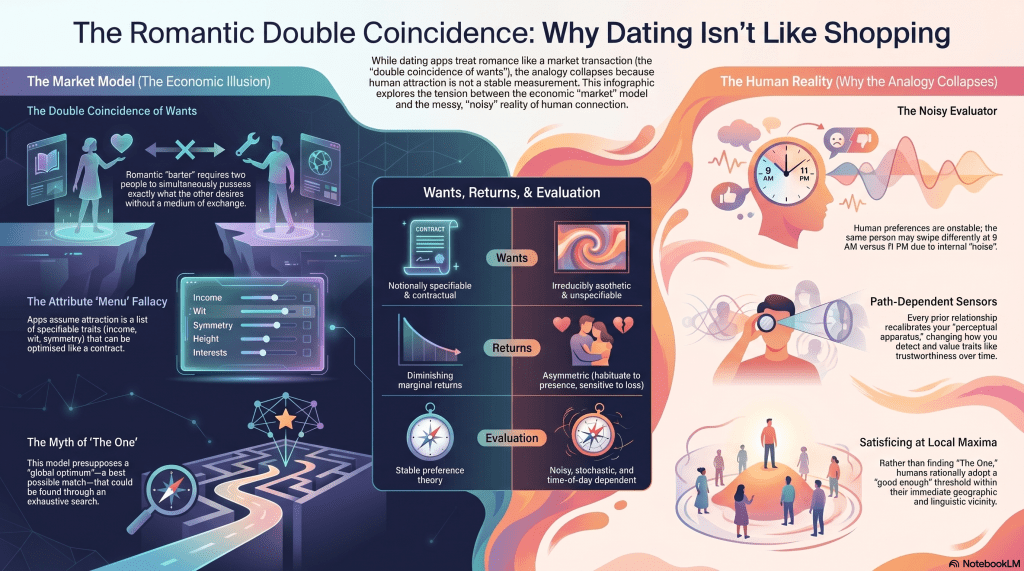
Firstly, be nice, and remember that I’m a recovering economist, so I can’t fully abandon this lens. There’s a concept in economics called the double coincidence of wants. For barter to work, I must have what you want, and you must have what I want, simultaneously, in the right quantities. The implausibility of this – that two strangers would arrive at the same moment, each holding exactly what the other needs – is traditionally the justification for money. Money decouples giving from receiving. It lets me sell my grain today and buy your lumber next month. Problem solved. It is tempting, and initially illuminating, to notice that dating is a double coincidence of wants with no money.

Audio: NotebookLM summary podcast of this topic.

Two people must simultaneously possess what the other desires. There’s no abstract medium of exchange. Listen, I don’t make up the rules, but you can’t deposit romantic capital in a bank and draw on it later with a different partner. Every transaction must clear bilaterally, in real time, between specific parties. The reason dating is difficult, on this account, is the same reason barter is difficult: the coordination problem is enormous.

This is a genuinely useful analogy – for about sixty-nine seconds. After that, it begins to collapse. And the way it collapses turns out to be more interesting than the analogy itself.

NB: I swear I started this post before I saw Louisa’s. Damns algorithms.

Wants can’t be enumerated

In an economy, wants are at least notionally specifiable. You want grain, I want lumber. We can write a contract. In attraction, nobody can write the contract, because nobody knows the terms. You can list proxies – symmetry, wit, income, dentition – but the list never cashes out the phenomenon. There’s always a residue. Someone ticks every box and provokes nothing. Someone ticks none of them and provokes everything. The attributes aren’t the attraction. They’re at best rough correlates of something that resists decomposition.

Evolutionary psychology claims to have the list – fertility signals, resource indicators, and bilateral symmetry – but this is just dressing up economic grammar. It takes the lived phenomenology of attraction, which is irreducibly aesthetic, and rewrites it as a covert optimisation problem. The evo-psych account is the friend who explains why you should find someone attractive and then looks puzzled when you don’t.

Tolerances are fuzzy, interactive, and opaque

Even granting an approximate list of attributes, each one functions not as a threshold but as a band of acceptability. And the bands interact. A deficit in punctuality can be compensated by a surplus in making-you-laugh-until-you-cry. But the exchange rate between these dimensions isn’t fixed, it’s not linear, and almost certainly not conscious. Nobody’s running this calculation. If you ask them to formalise it, they’d produce a confabulation, not a report.

The evaluator is noisy

Kahneman’s Noise documents a finding that should alarm anyone who believes in stable preferences: the same agent, evaluating the same inputs, will produce different outputs on different occasions – not because of bias (which is at least systematic and therefore correctable) but because of irreducible stochastic variability. The judge sentences harshly before lunch and leniently after. Same person, same case, different output.

Applied to attraction, means that the person you’d swipe right on at nine in the morning, you might pass over at eleven at night – or vice versa, as the case might be <winkie>– not because you’ve learnt anything new, but because you aren’t a stable instrument of measurement. The evaluation function drifts across a single day. Across months and years, it’s rebuilt entirely.

The evaluator is path-dependent

Every prior relationship recalibrates the apparatus. Someone who’s been betrayed doesn’t simply move ‘trustworthiness’ higher on their list. Their entire perceptual system for detecting trustworthiness has been restructured. The sensor’s been rebuilt by its prior readings. In no market economy do my preferences over apples change because I once had a bad experience buying oranges from a particular vendor. In relationships, this is the norm.

Returns are asymmetric

Standard preference theory assumes diminishing marginal returns, and this holds for attraction in the obvious direction: the tenth bunch of flowers yields less delight than the first. But the inverse does not hold symmetrically. The absence of a previously supplied attribute often produces increasing marginal disutility. You habituate to presence but sensitise to withdrawal. The utility of gaining X and the disutility of losing X are not mirror images. The preference function is path-dependent in a way that wrecks any static equilibrium model.

Search space is radically local

And all of this assumes the candidates are available for evaluation. They mostly aren’t. Your evaluation function, however sophisticated or broken, only gets applied to whatever washes up in your vicinity – no offence to Ariel. Your so-called soulmate might reside in Istanbul, but you live in London, and you don’t share a language, and you’ll never meet. This isn’t a logistical barrier. It’s a legibility barrier. You could stand next to this person in an airport and the aesthetic response function would not even fire, because the medium through which half of attraction is constituted – conversation, the texture of someone’s verbal mind – is simply unavailable. The instrument requires an input format that the candidate can’t provide. Consider you spy this person across an expanse, gain enough courage to introduce yourself, and they don’t speak your language. Body language will only compensate so far.

Local maxima

The cumulative force of all this is simple and devastating: we are stuck on local maxima. The search space is computationally intractable. The evaluation function is noisy and path-dependent. The attributes resist enumeration. The tolerance bands are fuzzy and interactive. The returns are asymmetric. The search is geographically and linguistically truncated. And so agents do what any rational agent would do under these conditions: they satisfice. They adopt a threshold of ‘good enough’ – a threshold which is itself endogenous to all the noise and path-dependence described above – and they stop searching when they cross it.

This is not a failure of nerve. It is the only coherent strategy available to an agent who can’t identify, or even in principle define, the global optimum. Committing to a local maximum is the rational play, precisely because optimising is impossible 0150 at least legible in the sense of James C. Scott.

Which makes the cultural mythology of ‘the one’ a rather cruel grammatical artefact. It presupposes a global search that no one has conducted or could conduct. It borrows its intelligibility from the economic grammar of optimal allocation – there is a best match, you just have to find it – and projects it onto a domain where ‘best’ has no operational definition, the search is radically local, and the searcher is a different instrument on different days.

Los Angeles, and why it matters

I lived in Los Angeles from twenty-one to twenty-seven, in the early to mid-1980s. I loved it. It was my favourite place on earth. I returned to LA from thirty-five to forty-five, and it was just another place.

It may have turned out that way even had I never left. The point is not that Los Angeles changed – though of course it did. The point is that I changed. Different profession, different situation, different appetites, different saliences… The evaluation function that produced ‘favourite place on earth’ at twenty-three was a fundamentally different instrument from the one that produced ‘just another place’ at forty. No longer a club rat on the prowl, I walked the same streets and saw a different city, because the perceptual apparatus that constructed the city as an experienced object had been rebuilt by fifteen years of living.

‘Favourite place on earth’ and ‘just another place’ aren’t two judgements issued by one stable subject upon one stable object. They’re two outcomes produced by two historically different configurations of salience, appetite, profession, circumstance, and age.

Los Angeles is useful here precisely because it’s not a person – RHCP, not withstanding. It lets you see the structure before sentiment starts mucking about with it.

We don’t even evaluate cities consistently across a lifetime. The same is true, more painfully, of persons.

The partner one adored at twenty-five may not have become deficient in any simple sense. The evaluative field changed. New dimensions became salient, old ones lost force, tolerances narrowed or widened, and costs are reweighted. The same partner now appears under a different aspect, because the apparatus of appraisal has been rebuilt in the interim.

And here, three claims should remain separate: the object may change; the evaluator may change; and the relation between them may change even if neither has altered dramatically. This third one prevents this from collapsing into a banal ‘people grow’ sermon. Sometimes the drift isn’t a defect in either party. It’s a change in fit.

Many:many

It would also be a mistake to think any of this operates as a 1:1 match. The dimensional space isn’t shared. Any two people will overlap on some dimensions, diverge on others, and be mutually illegible on others still – dimensions where one party’s response function is active, and the other’s doesn’t even register the input. He cares intensely about how she loads the dishwasher. She doesn’t experience dishwasher-loading as a dimension at all. It’s not disagreement. It is incommensurability.

A long relationship isn’t a transaction. It’s two non-congruent evaluative systems attempting to maintain a shared narrative of congruence as the terrain shifts beneath them. The miracle isn’t finding someone who matches. The miracle is sustaining a workable fiction that two-dimensional spaces are more commensurable than they are.

Consider the statistically perfect match – bilateral alignment across every operationalised dimension. Even if you could construct such a thing, it would be a snapshot: a cross-section of two moving systems that happened to align at time t. By t+1, the dimensional spaces have already drifted. The statistical portrait is a death mask of a living process.

And here is a green-eyed test. Suppose the perfect match has green eyes. It doesn’t follow that a blue-eyed twin – identical in every other respect – would or wouldn’t provoke the same response. Because whatever was operative in the encounter was not an attribute, or a bundle of attributes, but something that emerged from the specific interaction and can’t be decomposed back into the components that produced it. The entire enterprise of algorithmic matching is cataloguing attributes on the assumption that the attributes are the attraction. It is like analysing a joke by listing its phonemes.

The spot market and the long game

Let’s consider one-night stands as an example to clarify the taxonomy. A one-night stand really is the nearest thing romance has to a spot transaction. The time horizon is short, the narrative load is low, path-dependence is weak, and local salience dominates. The calculus is narrow and immediate. The economic grammar almost applies. Whatever gets you through the night.

A long relationship isn’t a transaction at all, but an evolving coordination problem between changing evaluators. The longer the time horizon, the more layers of critique come into play, and the more absurd the matching grammar becomes. Over time, relationships are not discrete exchanges but moving equilibria between non-stationary systems. That’s why long partnerships are so fragile and so impressive when they endure.

Post hoc rationalisation, or: the story we agree to tell

Having arrived at their local maximum, both parties then construct a narrative in which the outcome was the product of discernment rather than constraint.

‘I knew she was the one when…’ isn’t a report. It’s a reconstruction – a story imposed on a stochastic process to make it legible in the grammar of rational choice. The same person, encountered on a different Tuesday or in a different postcode, might never have registered at all. But the narrative requires necessity, so necessity is confabulated.

And it runs in both directions. She thinks it was his quiet confidence. He thinks it was the argument about Godard. Both are post hoc pattern-matching on noise – selecting from the welter of early interactions the moments that fit the ‘recognition’ narrative, and discarding the rest. It’s survivorship bias applied to one’s own love life.

This also explains the peculiar ferocity of heartbreak after the narrative has been constructed. What collapses is not merely the relationship but the explanatory framework. The story that made the local maximum feel like a global one disintegrates, and the agent is returned to the raw landscape: noisy, path-dependent, locally constrained, and aesthetically illegible. The grief is partly about the person. It’s also about the loss of the rationalisation that made the search feel concluded – losing the construct of the person rather than the person, per se.

NotebookLM Infographic on this topic.

Enfin

The dating app asks you what you want as though you’re ordering from a menu, when what is actually happening is that the menu is rewriting itself based on what you had for lunch yesterday, how much sleep you got, and that thing your ex said in 2019 that you think you are over.

We don’t find ‘the one’ – sorry, Neo. We become different readers of the same world, and occasionally manage to remain legible to one another for a while. Which is, if you stop demanding it be a fairy tale, quite a lot.

Whom Do I Serve? Spelling Counts

2–3 minutes

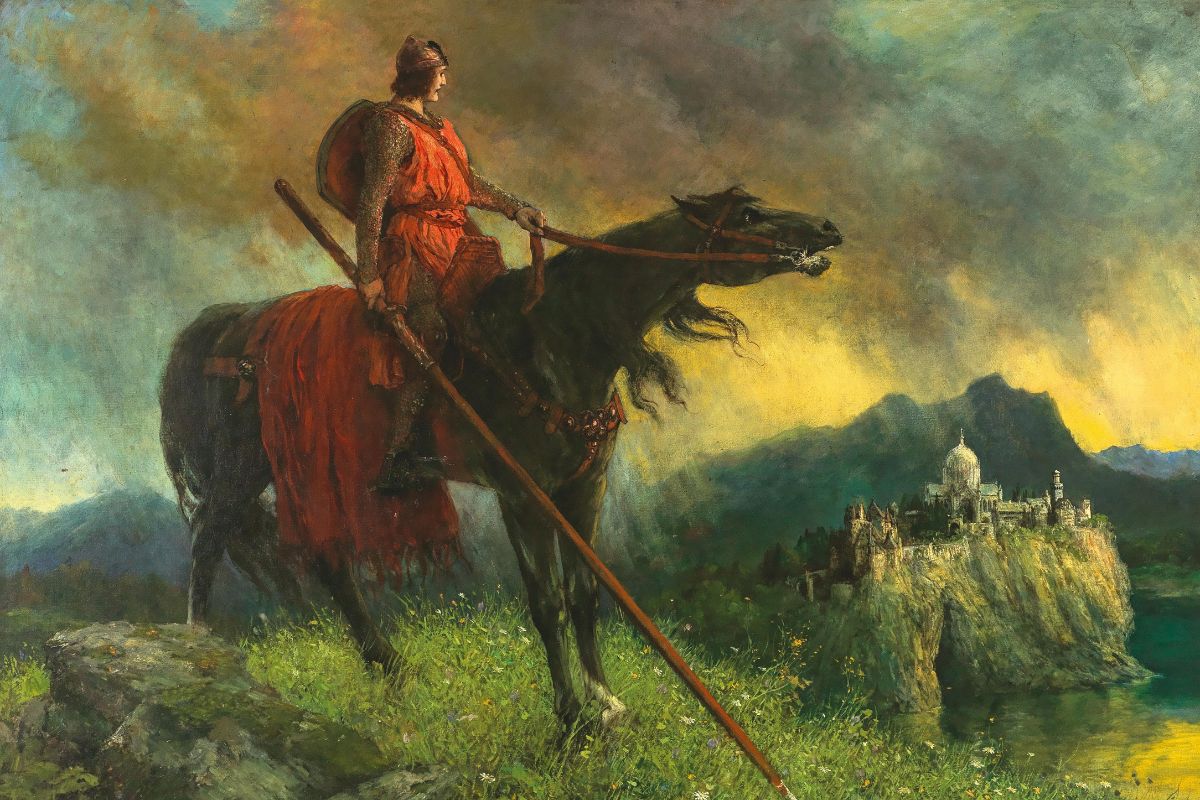
“Whom do you serve?” is the unasked question in the Grail story. Parsifal’s failure is usually treated as spiritual unreadiness, moral immaturity, or some such medieval hush. I’ve never had much sympathy for that reading. My own experience has made it difficult to leave certain questions politely untouched.

In my late teens and early twenties, I worked in Los Angeles as a musician, recording engineer, and producer. That meant spending a good deal of time around wealthy celebrities, not at parties but at work. The useful lesson was not glamour. It was status. More precisely, it was learning how often status functions as atmosphere: something to be indulged while present and ignored once it passes.

Berry Gordy once walked into a mixing session at his own studio and imposed a round of suggestions on a track headed for film. Nobody contradicted him. We didn’t need to. We knew that when he left, we would reset the console and write off the lost hour as weather. That is what aura often is: not wisdom, not competence, merely a temporary distortion field around a person whom others have learned not to challenge in the moment.

Gordy was an exception. Most days, there were no sacred cows in the room. Egos were bruised, feelings hurt, and compromises made. Work got done. If anything, the greater impostors were the label middle managers, appeased when present, ignored when absent, and forever acting as though they were paying for decisions that would ultimately be recouped from the artist anyway.

By the time I left music and went legit, I had already learnt the useful part: never mistake decorum for truth. I was never fully indoctrinated into pedestal-thinking, and I have never since managed to treat institutional aura as anything but local theatre. That is why the Grail story catches me at an odd angle. I do not identify with the knight who withholds the question. I identify with the person who asks it anyway, or with the child in Andersen who has not yet learned that collective performance outranks plain observation.

That, perhaps, is the real training most institutions require: not belief, but acculturation into silence. Some of us never quite acquire it.

On Death and Dying

3–4 minutes

Disclaimer: I should be finishing my Language Insufficiency Hypothesis book, yet I am here writing about death and dying. Why? Because I was watching an interview with Neal Schon by Rick Beato. I should have been working on my book then, too. It seems I can write about death more easily than finish a book about the failure of language. Perhaps because death speaks fluently.

I haven’t produced music professionally since the mid-1980s, and I haven’t performed since 2012, yet I am still drawn to its intricacies. My fingers no longer allow me to play much of anything anymore. This is a sort of death. When the body forgets what the mind remembers, that’s a particular kind of death – one language dying while another can’t translate.

As Neal was walking Rick through his equipment and approach to music, I was taken back to a similar place. I wanted to plug into a Fender Twin or a Hi-Watt, a Lexicon 224 or a Cry Baby wah. I still have nightmares thinking of setting up a Floyd Rose.

Video: Rick Beato interviews Neal Schon

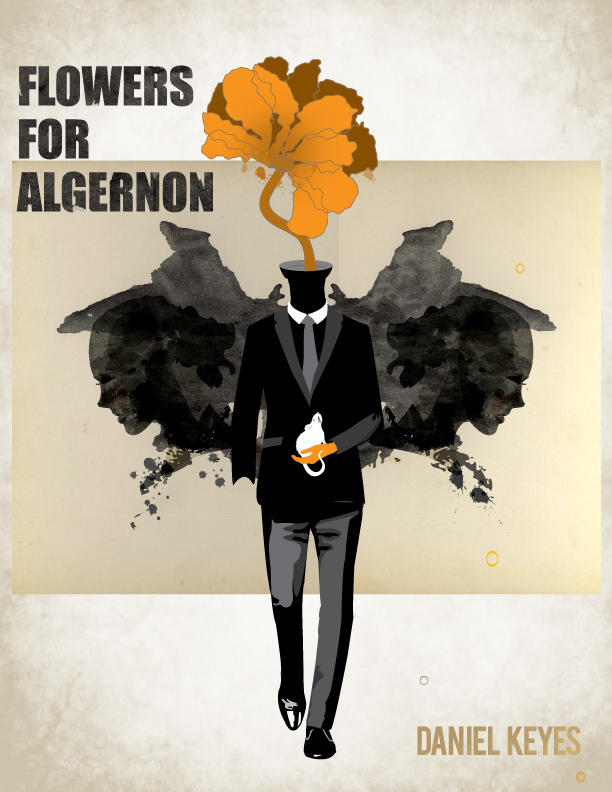
But I can’t go back. As for music, I can’t go forward either. I’m at a standstill, but in a regressed position. It’s uncomfortable. It feels a lot like Charlie in Flowers for Algernon. I used to be able to do that. Don’t get me wrong – I am not claiming to be on the level of Neal Schon, a man I remember from his days with Santana, but when you reach a level of proficiency and then lose it, it hurts; it can be devastating.

Audio: NotebookLM podcast on this topic.

I recall being in hospital in 2023 – a physical rehabilitation facility, really – and I found a piano in a vacant common room. Drawn to the instrument, I rolled over my wheelchair and played…nothing. My fingers wouldn’t work. The piano sat there like a relic of my former self. I rolled toward it as though approaching an altar. My fingers hovered, twitched, failed. The sound of nothing has never been so loud. I cried. I cried a lot those days. I was down to 58 kilos – at 182 cm, I weighed in at just over 9 stone. It wasn’t the best of times.

I still feel a certain nostalgia.

And then there are the people I’ve lost along the way – as another Neal reflected on – The Needle and the Damage Done.

Love and art are both acts of repetition. When one ends, the reflex remains – the impulse to reach, to share, to call out. Death doesn’t stop the motion, only the answer.

I’m lucky to have left Delaware. When a girlfriend died in 2020, I remained and connected with another until 2023, when she died, too. From 2020 to 2023, when I was out and about, something might have caught my eye, and I’d reflect on how Carrie might have liked that.

But it was different. It was more like, ‘I should let Carrie know about that,’ only to realise fractions of a second later that she wouldn’t see whatever it was; she couldn’t. And I’d carry on. I didn’t need to repeat this with Sierra. My relocation to Massachusetts solved this challenge – not so many triggers.

I’m not sure how the loss of ‘professional’ music relates to deceased partners, but it does – at least enough for me to make this connexion. Perhaps I’m just connecting arbitrary dots, but I’ll call it nostalgia.

I don’t play, but I still hear it. The song continues without me. Nostalgia is just rhythm without melody. Perhaps all nostalgia is epistemological error – the confusion of past fluency for present meaning.

Ugly Women

This Isn’t Clickbait. I Asked MidJourney for “Ugly Women”. Here’s What It Gave Me.

Let’s clear the air: I did it for science. Or satire. Or possibly just to see if artificial intelligence would have the audacity to mirror the cruelty of its makers.

Audio: NotebookLM podcast on this topic.

I queried MidJourney with the phrase ugly female. What did it return? An aesthetic pageant. A digital Vogue spread. If any of these faces belongs to someone conventionally labelled “ugly”, then I’m a rutabaga in a Dior suit.

Yes, there’s one stylised rendering of Greta Thunberg in full Norse Valkyrie scowl mode – but even then, she looks fierce, not foul. The rest? AI-generated portraits so telegenic I half-expected to see #spon in the corner.

Let’s be clinical for a moment. As an American male (with all the culturally indoctrinated shallowness that entails), I admit some of these aren’t textbook 10s. Maybe a few clock in at a 6 or 7 on the patriarchy’s dubious sliding scale. But if this is ugly, the AI has either broken the aesthetic curve or been force-fed too many episodes of The Bachelor.

Here’s the thing: AI is trained to over-represent symmetrical faces, wide eyes, clear skin – the usual genetic lottery wins. And yet, when asked for ugly, it can’t help but deliver catalogue models with slightly unconventional haircuts. It doesn’t know how to be truly ugly – because we don’t know how to describe ugliness without revealing ourselves as sociopaths.

Once upon a time, I dated a model agent in Los Angeles. Japanese by birth, stationed in LA, scouting for a French agency – the kind of cosmopolitan trifecta only fashion could breed. Her job? Finding “parts models.” That’s right – someone with flawless teeth but forgettable everything else. Hands like sculpture. Eyelashes like Instagram filters.

We’d play a game: spot the 10s. She’d nudge me, whisper “her?” I’d say, “Pretty close.” She’d shake her head. “Look at that eye tooth.” And we’d dissolve into laughter.

We were mocking perfection. Because perfection is a con. A trick of lighting, contour, and post-production.

So, no. I don’t think any of the women in the AI’s response are ugly. Quite the contrary – they’re too beautiful. AI can’t show us “ugly” because it’s been trained to optimise desire, not reflect reality. And our collective understanding of beauty is so skewed that anything less than runway-ready gets sorted into the rejection bin.

If these women are ugly, what exactly is beautiful?

But maybe that’s the point. We’ve abstracted beauty so far from the human that even our ugliness is now synthetically pleasing.

What do you think? Are any of these faces truly ugly? All of them? Let me know in the comments – and try not to rate them like a casting director with a god complex.

What Is Love?

I love the panels, interviews, and insights presented on The Institute of Art and Ideas channels. In this segment, I am familiar with the host, Robert Lawrence Kuhn, who has put this all together, and two of the panellists, Iain McGilchrist and Donald Hoffman. I am not familiar with Eva Jablonka or Michelle Montague. This is an interesting conversation on consciousness, but I am commenting on McGilchrist’s position on love and how science can never capture the essence or dimensions of it because it is subjective and experiential. I’ve cued the video clip below to just prior to his response to provide he view with a set up.

As I’ve been saying for some decades now, I believe that love is a weasel word in the realm of justice and freedom. It’s an archetypal extreme, but it doesn’t mean anything more than trebled or analogical references.

McGilchrist resorts to the age-old, you don’t know it if you haven’t experienced it. This was famously captured by the US Supreme court’s take on pornography, “I can’t tell you what it is, but I know it when I see it.” This is used with God and faith as well. So, bollox, really. They’ve got nothing. And if you haven’t experienced it, then you aren’t a member of the club, and it’s your loss. Rubbish.

From the transcript, Iain tells the viewer (edited below for clarity),

“Love is a very real experience. and you only know it when you’ve had it. But it’s something that science can only refer to physical correlates of—rather ineffectively… But it’s not the same as knowing what love actually is.

“And the same is true of consciousness. It’s a subjective phenomenon, and as such, it’s not open to the kind of science that that i think is being required.”

Notice that this is the same defence asserted by religions. If you are seeking evidence, you are barking up the wrong tree. The evidence is that you can experience it, but this is not a shared experience. The shared experience occurs when people who feel they have had a similar experience can gather together and compare notes and share stories like they were participating in a 12-Steps program. Hullo, my name is Bukowski, and I’m an alcoholic.

Love is a delusion. Consider the notion of romantic love —just one of several purported flavours of love. What do we mean by this? We mean that we are very attracted to and emotionally attached to some other entity. Let’s limit this to other people. We care for this person and about what happens to this person, and we’d presumably like to remain a partner with this person. Generally, there would also be a sense that the other party reciprocates this feeling, but unrequited love is another aspect.

Given this state, we can measure hormonal changes, pupil dilation, and other physiological changes. And if we want to label this state love, then great. In practice, that’s what we’ve done. But so what? All we’ve really done is to take a bundle of descriptions and collated them into a nebulous term.

There are a couple of perspectives on this type of love. There is the person who senses their own feelings about their experience of love, as in “I love X”. Then there is a target of this love who may experience that they are loved by someone. Finally, there is the observer that might assess that Y loves X and or vice versa.

But what does this really mean? Is it just that Y like X very very much and has painted a picture of a future than includes this person? That Y has constructed some narrative storyline that includes X? That there is likely some lust involved in this particular flavour of love? Is love more than this? Is love more than just a shortcut? Is it just an acronym for “Likes Other Very Extremely”? Alright, I’ll stay out of the acronym construction business and end this just now.

Love is a Word

Love is a concept by which we measure our pain.

John Lennon — God

Love is an archetype. It’s a word we’ve created to express the notion of caring off the charts, on steroids. We throw it around and over-use it for many purposes. Generally, love is amorphic and expansive. In the typical scenario, a mother with a loved-child who bears another loves them both equally, but it’s not part of some arithmetic function where each child gets half an equal dose each. Love defies any notion of conservation of energy. Both children receive equal shares of the same quantity of love that the first received.

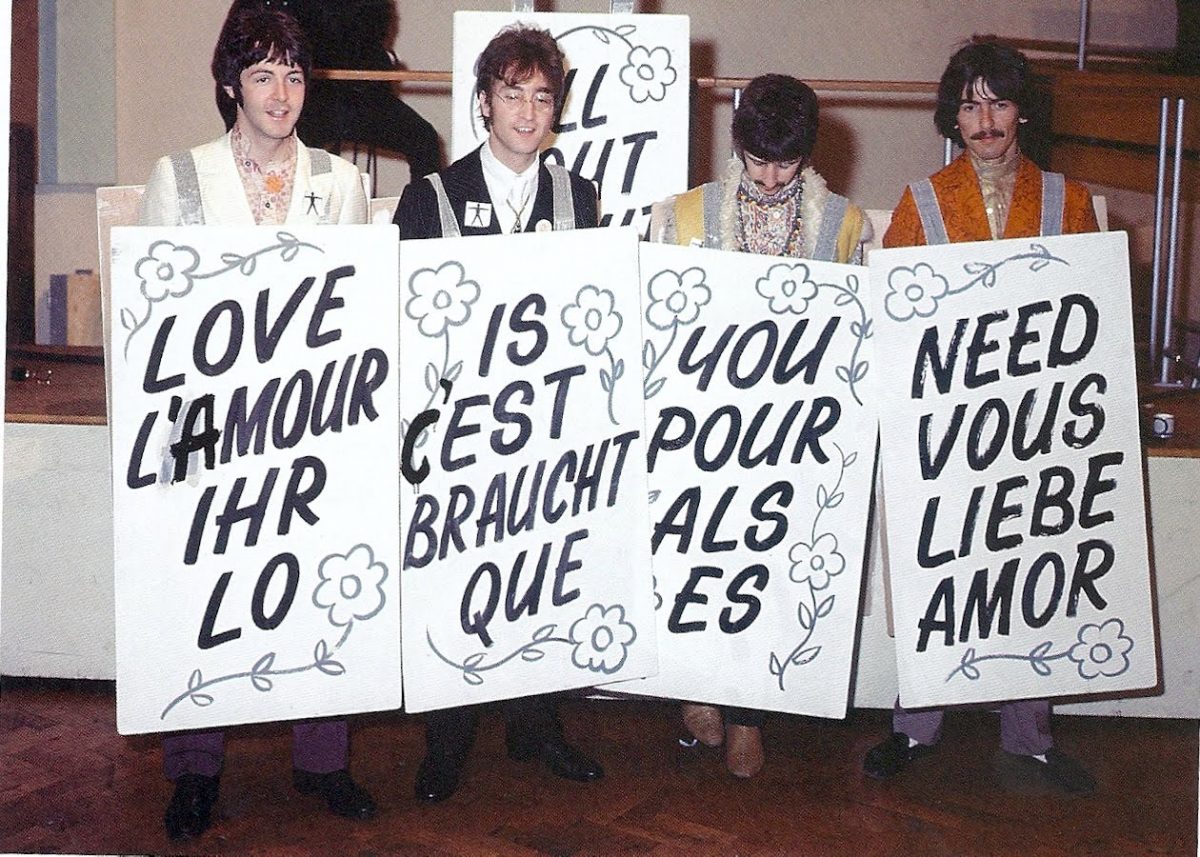
The Beatles – All You Need Is Love

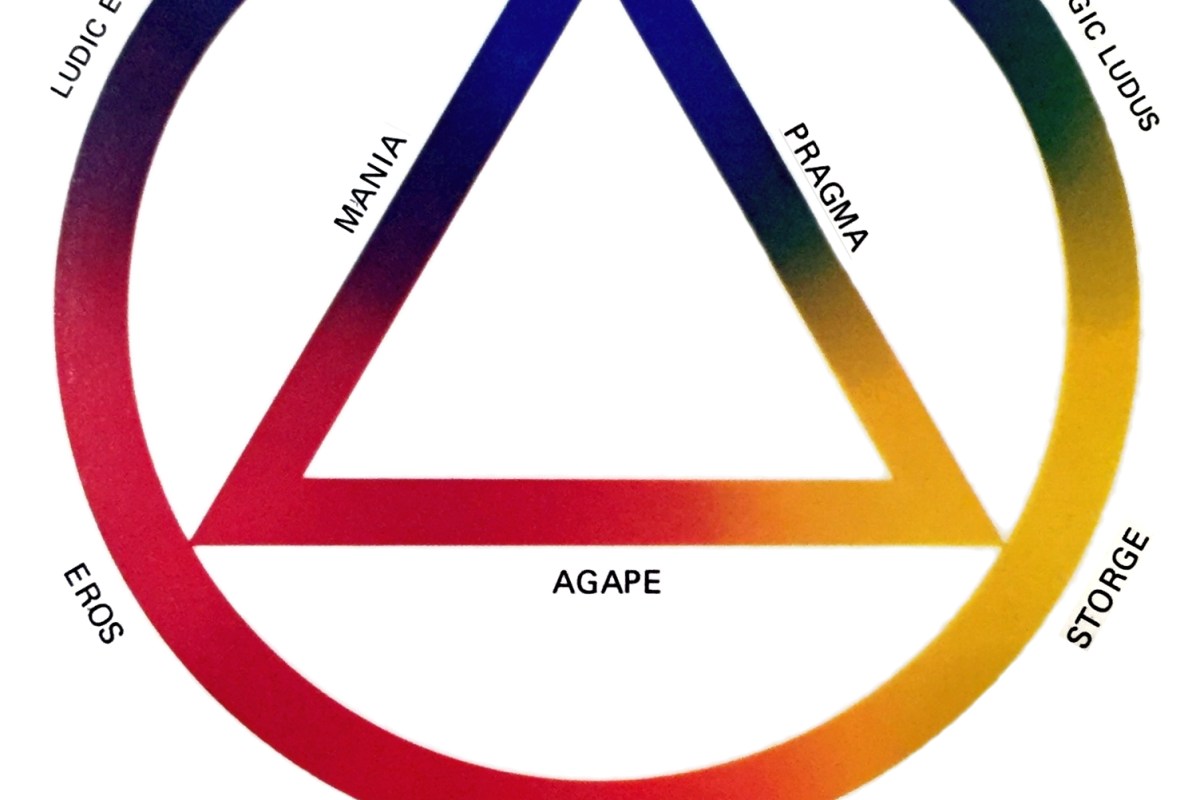
The ancient Greeks had several words to express love.

Storge (στοργή)

Storge is the love we have for community, for family, for our children and spouses. Storge is not romantic love. It is more a love of affection and tenderness. It may be the basis for the urge toward tribalism and nationalism, and it may have a sort of analogue to gravity, wherein the proximity of the source, the greater the attraction. This is where ‘blood is thicker than water’ and why I like my sports team better than yours.

Storge – love of family

Agape (ἀγάπη)

Agape is a sort of universal love, the selfless love of biblical reference of God and all of his children. Neither is agape a romantic notion. It is akin to charity, and the connection of transcending storge to include all of the world and ignoring the silos of tribalism. There appears to be a tension between agape and storge because one cannot have an equal love for all whilst retaining a greater love for one’s own tribe. Perhaps the notion is more aspirational than practicable.

Agape – Universal love

Philia (φιλία)

Philia is fraternal (to be more inclusive, perhaps also sororal) love, the brotherly love hoped to be inspired by the city of Philadelphia in Pennsylvania. This is an affectionate love, typically between equals. Again, philia has no romantic basis.

Philia – Sororal love

Eros (ἔρως)

Eros is notably erotic love; sexual love; intimate, passionate love; lust. Eros is ephemeral. Returning to physics, eros requires a lot of energy to maintain. In a typical setting, eros moderates to storge or pragma.

Plato believed that this love was transcendent of the body—and so could exist independently of body—, but I’ll not give heed to this metaphysical notion. Perhaps, this is where the notion of soulmates derives. This is a romantic love.

Ludus

Ludus is a lightweight version or precursor to erotic love. It is the playful, flirtatious nature expressed by young proto-lovers. Viewed teleologically, ludus may be seen as a stepping stone to eros, but not everyone makes it successfully to the final level.

Full disclosure: Ludus is Latin and not of Greek original.

Pragma (πράγμα)

Obviously, pragma is a pragmatic love. This is the love that remains to bond a pair who have remained together for years, say, an old married couple. This form either requires a lot of energy and compromise or a lot of apathy or indifference.

Older couple demonstrate pragma

Philautia

Philautia is a love of one’s self. It’s a portmanteau of philia + auto. As the saying goes, if you can’t love yourself, you can’t love anyone. As with most adages, they is as often true as not and require additional context to assess. Philautia should not be confused with narcissism, which may more properly be classified as a mania. It should also not be confused by onanism.

Philautia – Love of one’s self

Love will tear us apart… again.

Joy Division

Mania (μανία)

Some people include mania in their love collection. Mania is simply an unbalanced sort of love; obsessive love; eros gone wild.


Love has many meanings, but they are all about connecting. Perhaps, I am being hasty to dismiss the term, but it is overused and perhaps more phatic than genuine. In the parlance of Foucault, it’s a power phrase—especially in the erotic arena—, a means to manipulate.

This blog post was about mania, but I’ll link it nonetheless.

Image source: Colour Wheel of Love: By Kaitlindzurenko – Own work, CC BY-SA 4.0, https://commons.wikimedia.org/w/index.php?curid=45330870