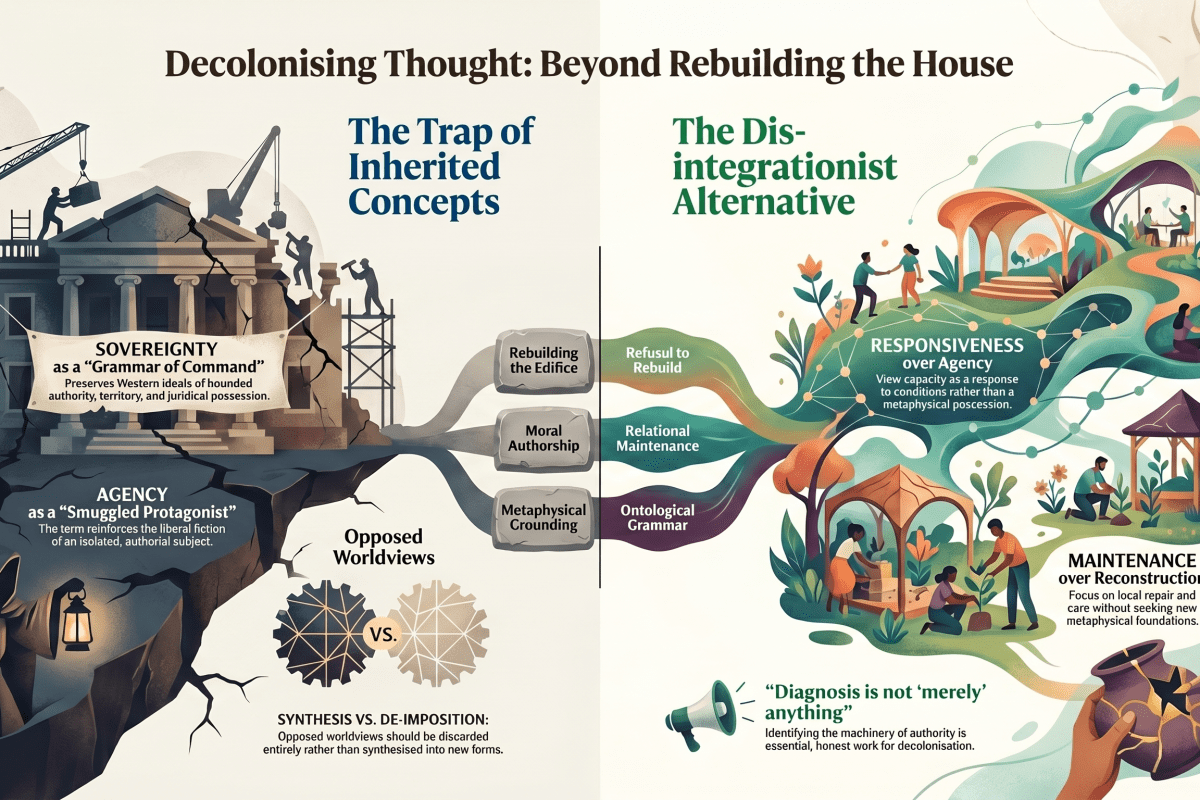
The Masterโ€™s Concepts: Decolonising the House Without Keeping the Furniture

9โ€“14 minutes

A colleague recently shared an essay with me, The Return of Metaphysics: Reclaiming Sovereignty Through Ontological Grounding in Postcolonial and Western Thought. I read it with interest, not least because its target is one I share: the colonial imposition of Western categories as if they were universal reason, universal law, universal political form, and universal humanity. On that point, there is no meaningful disagreement. Colonialism isn’t merely theft of land, labour, and resources. It’s also the imposition of a grammar by which reality itself was made legible to power.

The essay is at its strongest when it treats colonialism as metaphysical violence rather than merely administrative domination. It argues that Europe universalised its own categories and rendered other worlds invisible, inferior, or unreal. Colonialism, on this account, was not only conquest. It was the installation of one ontology as the authorised operating system of the human. That’s a powerful diagnosis, and it deserves to be taken seriously. The essay explicitly describes colonialism as a process that ‘re-made being’ and suppressed other conceptions of time, morality, and community.

Where I start to hesitate isn’t in the critique of colonialism, but in the proposed recovery. The essay seeks to reclaim metaphysics, sovereignty, agency, moral authorship, and ontological grounding as instruments of postcolonial renewal. It wants to oppose colonial metaphysics by recovering metaphysics; to oppose hollow sovereignty by reconstructing sovereignty; to oppose imposed subjectivity by restoring moral authorship.

This may be coherent within the essayโ€™s own frame. But from mine, it raises a suspicion:

  • โ€œa return to metaphysicsโ€
  • โ€œmoral authorshipโ€
  • โ€œontological reconstructionโ€
  • โ€œpopular agencyโ€

These terms don’t arrive clean. They carry histories and come with fittings: sovereignty, possession, self-rule, jurisdiction, authorship, legitimacy, command. One may repaint them in decolonial colours, but the shape remains. Inheritance is the danger.

Audio: NotebookLM summary podcast of this topic.

Sovereignty as a Recovered Trap

The essayโ€™s central concept is sovereignty. More precisely, post-sovereignty. Yet the very act of preserving sovereignty as the problematic term matters. Sovereignty isn’t just a neutral container for self-determination. It’s one of the central concepts through which Western political modernity imagines authority: bounded, possessed, territorialised, juridical, and authorial.

To speak of sovereignty is already to speak in the grammar of command: Rules. Owners. Authorities. Something marks the line between inside and outside.

This doesn’t mean colonised peoples were wrong to demand sovereignty. The politically dispossessed may understandably seek the protections of the language used to exclude them. If one has been denied the status of a subject, a nation, or a people, then reclaiming those terms may be historically necessary. There’s no cheap purity available from the comfort of abstraction. Humans made the mess, naturally, and then handed each other dictionaries to clean the mess.

But political necessity doesn’t settle conceptual adequacy. A term may be strategically useful and ontologically suspect at the same time. So, the question isn’t whether sovereignty has been useful in anti-colonial struggle. It’s whether it should remain the destination, rather than a transitional vocabulary one eventually leaves behind.

The essay recognises that many postcolonial states retain the ‘juridical structure’ of autonomy whilst remaining governed by inherited categories of colonial law, property, development, and bureaucratic legitimacy. That’s exactly the point where the critique might turn more sharply on sovereignty itself. If postcolonial statehood often reproduces colonial form, perhaps the issue isn’t merely that sovereignty is hollow, but maybe it’s just one of the forms through which hollowness reproduces itself.
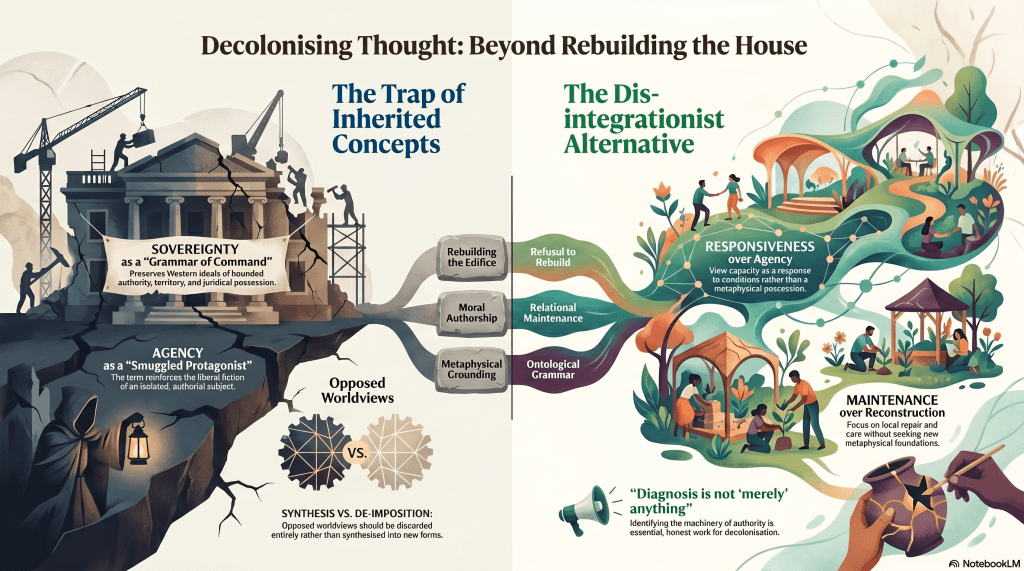
NotebookLM Infographic on this topic.

Agency: The Smuggled Protagonist

The same problem emerges around agency. The essay speaks of popular agency, moral authorship, co-authorship, and subjectification. Again, the impulse is understandable. Colonial domination denies people the right to act, name, interpret, and organise their own lifeworlds. A postcolonial theory naturally wants to restore capacity to those rendered passive.

But the agency term isn’t innocent. In modern Western thought, agency often implies a self capable of authorship, intention, responsibility, and moral ownership. It’s the protagonist required by law, markets, liberal politics, and punishment. Someone must be deemed the chooser, the signer, the sinner, the voter, the debtor, the criminal, the rational actor.

In my own work, I reject agency as a metaphysical possession. I’d rather speak of responsiveness: a variable capacity shaped by material, relational, temporal, somatic, and epistemic conditions. People don’t float above conditions and author themselves into freedom. They respond, more or less adequately, within fields of constraint.

The essayโ€™s emphasis on relationality moves in this direction, but its vocabulary often pulls it back toward authorship. It wants shared becoming, but it also wants moral authors. It wants relational ontology, but it also keeps the self as a source of political meaning. This is a revealing tension.

The alternative isn’t fatalism. To reject agency isn’t to deny action. Breathing doesn’t require a metaphysics of breath. It just happens autonomically. The question is whether we must preserve the fiction of the authorial subject to describe them. I think not.

When Negation Need Not Become Synthesis

The essay leans on Fanon (see The Wretched of the Earth) to argue that colonial domination can’t be resolved through dialogue because dialogue presumes equals. This is right, or at least right enough. A conversation between master and slave is not yet a conversation between equals. Liberal dialogue presumes a shared field of recognition; colonial domination corrupts that field before speech begins.

The essay, therefore, turns to dialectic. Where dialogue seeks agreement, dialectic begins from contradiction and struggle. Again, this makes sense. A colonised subject can’t merely ask to be recognised by the system that produced their non-being. Something must be negated.

My hesitation concerns what happens after the negation. The essay sometimes seems to assume that contradiction must move toward ontological reconstruction. But why? If one term of the contradiction is an imposed colonial ontology, it might not deserve preservation within a higher unity because it mightn’t be a meaningful antithesis. It may simply be wrong, violent, and disposable.

This is the dis-integrative question:

Not every opposition is productive. Some oppositions are parasitic. If a worldview is imposed by force, then treating it as a dialectical partner may grant it more dignity than it deserves. The point of decolonial refusal may not be synthesis, but de-imposition.

That distinction matters. Synthesis often preserves too much. It lets the offending structure survive as a contributor to the next stage. It says, in effect: this violence was part of becoming. Perhaps. But perhaps not. Perhaps some concepts belong on the cutting room floor.

Metaphysics: Necessary Grammar or Rebuilt Throne?

The essay argues that postmodern anti-metaphysics has left social theory without stable categories of truth or moral orientation. It wants metaphysics back, not as abstraction, but as the recovery of moral and ontological grounds for political community.

I understand the concern here, too. Communities don’t live by procedure alone. No society is sustained merely by policy, rights language, or bureaucratic form. People inhabit worlds, not spreadsheets. There are ontological grammars beneath every institution: assumptions about personhood, time, land, memory, obligation, kinship, death, and belonging.

But I resist the move from ‘we can’t avoid ontological grammar‘ to ‘we need metaphysical grounding‘. Whilst the former seems unavoidable, the latter seems dangerous.

Metaphysics isn’t simply depth. It’s elevation โ€“ the move by which a grammar stops appearing as grammar and starts presenting itself as ground. It becomes the authorised deep structure, the thing beneath dispute, the foundation beneath the foundation. And foundations, as humans have demonstrated with astonishing consistency, are excellent places to hide power.

Each one requires a leap. One leap may be necessary. Ten leaps become choreography. Eventually, the argument is no longer walking; it’s performing interpretive dance and calling itself ontology.

The Problem of Rebuilding

This is where my own Disโ€“integrationist commitments diverge most sharply from the essay. I’m a diagnostician. I deconstruct and name seams with no obligation to replace every collapsed universal.

The essay treats diagnosis as insufficient. It says the critique of sovereignty reveals a metaphysical vacuum, but diagnosis is not enough. Post-sovereignty must move toward ontological reciprocity, relational becoming, and shared labour of mutual recognition. Whilst this move is respectable. It’s also the one I distrust.

The rebuilding instinct is one of philosophyโ€™s oldest addictions. Expose the flaw, draft the remedy, rebuild the edifice, declare the new form less violent than the old. This is how critique becomes renovation.

But the refusal to rebuild isn’t indifference, despair, or nihilism. It’s a refusal to let repair disguise itself as permanence. Care, maintenance, reciprocity, and local repair remain possible without metaphysical reconstruction. In fact, they may be more honest when stripped of the promise of final grounding.

Pedagogical Sovereignty and the Soft Machinery of Formation

The essayโ€™s later sections turn to education. It proposes pedagogical sovereignty as a model of moral and ontological co-creation. The classroom becomes a site where being isn’t transmitted but collaboratively formed. Governance, by analogy, might become less administrative and more pedagogical: citizens not merely ruled, but constituted in relation. As attractive as this might be. it’s also perilous.

Education has always had this double face. It can liberate, but it can also format. It can open worlds, but it can also install authorised grammars. The classroom is not outside power. It’s one of powerโ€™s favourite incubators. The fact that it speaks gently doesn’t mean it’s not shaping bodies, subjects, desires, norms, and permissions.

To make pedagogy the model of sovereignty risks softening administration rather than escaping it. It may replace the command of the state with the formation of the subject. That may be better and subtler, but one should be careful when power arrives wearing soft shoes.

This doesn’t refute the essayโ€™s educational turn, but it complicates it. If pedagogy is to be an emancipatory model, it has to preserve opacity, dissent, and non-formation. It needs to allow the learner not merely to become, but to remain partially unread, unfinished, and unintegrated. Otherwise, pedagogical sovereignty may become another normalising machine with better intentions and comfy chairs.

The Cutting Room Floor

My objection isn’t that the essay is wrong to oppose colonialism. Au contraire; its critique of colonial metaphysics is often compelling, and it’s preaching to the choir at the start. The issue is that its recovery project may carry forward more of the colonial-conceptual apparatus than it recognises.

The following terms deserve suspicion:

  • Sovereignty, because it preserves the grammar of possession, jurisdiction, bounded authority, and command.
  • Agency, because it preserves the authorial subject required by liberal law, market morality, and responsibility allocation.
  • Moral authorship, because it risks reintroducing the self as origin, even when collectivised.
  • Metaphysical grounding, because it may turn situated lifeworlds into foundations.
  • Reconstruction, because it assumes fracture demands repair, rather than sometimes demanding refusal.
  • Dialectical synthesis, because it may preserve the imposed term as a contributor to the future, rather than discarding it as an error condition.

None of these concepts must be rejected out of hand. That would be too easy. But they shouldn’t pass uninspected simply because they have been recruited into decolonial service. Fine. Use the master’s tools to dismantle the house, but don;t become too fond of them.

Toward De-Imposition

So, what then?

  • Disโ€“integration, not reconstruction
  • De-imposition, not anti-colonial sovereignty
  • Responsiveness, not agency
  • Relational maintenance, not moral authorship
  • Ontological grammar held visibly as grammar, not metaphysical grounding

This doesn’t mean communities should abandon their lifeworlds, traditions, or inherited moral vocabularies. It means those vocabularies shouldn’t need to become metaphysical foundations to matter. A world may be lived, tended, and defended without being inflated into ground.

The colonised don’t need permission from Western metaphysics to exist. Or me, for that matter. Nor do they need to rebuild themselves in metaphysical form to count as real. The refusal of imposed reality may be enough. After that, there may be practices, relations, institutions, memories, ceremonies, languages, solidarities, and forms of care. There may be politics and struggle. And, sure, repair and maintenance. But there needn’t be a new foundation.

Enfin

The essay I am responding to is valuable because it presses a real question:

My answer is: diagnosis is not ‘merely’ anything. To diagnose is to identify the machinery by which certain concepts keep reproducing their own authority. If sovereignty, agency, authorship, and metaphysical grounding belong to that machinery, then they should not be automatically restored just because they have been wounded.

Some concepts can be reclaimed. Others should be retired. Some may be used provisionally, under protest, as transitional scaffolding. Again, others may belong on the cutting room floor.

The challenge isn’t only to oppose colonialism and its effects. It’s to notice when colonial grammar survives inside the opposition. That’s the harder work โ€“ less heroic, sonorous, and much less likely to produce a grand theory, but it may be more honest.
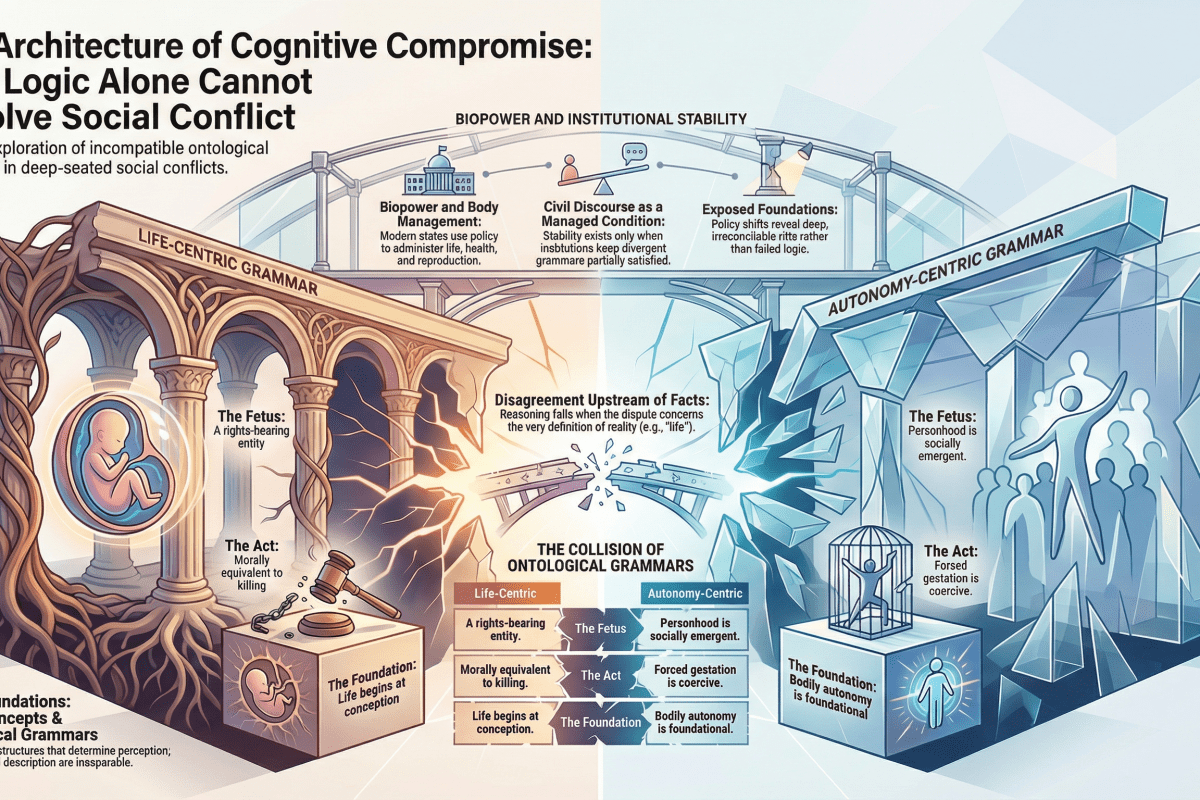
The Architecture of Cognitive Compromise

4โ€“6 minutes

Abortion, Ontological Grammar, and the Limits of Civil Discourse

When federal abortion protections were withdrawn in the United States, many observers treated the event as a policy reversal, a judicial shift, or a partisan victory. Those are surface descriptions. They are not wrong. They are simply too thin.

What was exposed was not a failure of dialogue. It was the collision of ontological grammars.

Audio: NotebookLM summary podcast.

1. Thick Concepts and the Illusion of Neutral Ground

book cover

Bernard Williams famously distinguished between ‘thin’ moral terms (good, bad, right) and ‘thick’ ones (cruel, courageous, treacherous), where description and evaluation are fused.

Abortion is not a thin concept. It is thick all the way down.

For one framework, the operative grammar is something like:

  • Life begins at conception.
  • The foetus is a rights-bearing entity.
  • Termination is morally equivalent to killing.

For another:

  • Personhood is socially and biologically emergent.
  • Bodily autonomy is foundational.
  • Forced gestation is coercive.

Notice that these are not competing policies. They are competing ontological commitments about what exists, what counts as a person, and what kind of being a pregnant body is.

Argument across this divide does not merely contest conclusions. It contests the background conditions under which reasons register as reasons.

This is not ‘people see the world differently’. It is: people parse reality through grammars that do not commute.

2. Ontological Grammar: Where Deliberation Stops

By ‘ontological grammar’, I do not mean syntax in the Saussurean or Chomskyan sense. I mean the pre-reflective substrate that structures what appears salient, real, morally charged, or negligible.

We deliberate within grammars. We do not deliberate our way into them.

Liberal Enlightenment optimism assumes that if disagreement persists, more information, better reasoning, or improved empathy will close the gap. But if the dispute concerns the very ontology of ‘life’, ‘person’, or ‘rights’, no amount of fact-sharing resolves the issue. The disagreement is upstream of facts.

The closure of federal abortion access did not prove that one side reasoned better. It demonstrated that institutional containment had failed.

3. Biopower and the Management of Bodies

Michel Foucault gives us a crucial lens: biopower. Modern states do not merely govern territory; they administer life. Birth rates, mortality, sexuality, health โ€“ these become objects of policy.

Abortion sits directly inside this matrix.

A state that restricts abortion is not only expressing moral judgment. It is reallocating control over reproductive capacity. It is asserting a claim over which bodies count, which futures are permitted, and which biological processes are subject to regulation.

The conflict is therefore not purely ethical. It is biopolitical.

And what appears as ‘civil discourse’ around abortion is often possible only so long as institutional frameworks keep both grammars partially satisfied. When federal protections existed, they acted as a stabilising superstructure. Remove that, and the ontological conflict becomes naked.

4. Habitus and the Illusion of Reasoned Consensus

Pierre Bourdieu would remind us that our dispositions are not self-authored. Habitus sedimented through family, religion, class, and institutional life shapes what feels obvious, outrageous, or unthinkable.

People do not wake up one morning and choose an abortion ontology.

They inherit it. It becomes embodied common sense.

Thus, when someone says, ‘Surely we can agree that making a person feel whole is more important than ideological purity’, they are already speaking from within a grammar that prioritises individual authenticity and psychological coherence. That priority is not universal. It is historically situated.

Compromise is not achieved by stepping outside habitus. It is achieved when institutional and social conditions allow divergent grammars to coexist without totalising one another.

5. The Popperian Threshold

Karl Popper warned of the ‘paradox of tolerance‘: unlimited tolerance may enable intolerant forces to eliminate tolerance itself.

In particularly virulent climates, appeals to compromise are heard not as gestures of goodwill but as tactical weakness.

When one faction succeeds in unilaterally redefining the legal status of abortion at a federal level, it is not merely participating in discourse. It is altering the biopolitical infrastructure. Once altered, the range of permissible disagreement narrows.

Civil discourse, then, is not a natural equilibrium. It is a managed condition sustained by institutional design, social trust, and shared legibility.

NB: Popperโ€™s paradox of tolerance is often invoked as a moral axiom. But it is better understood as a self-protective clause internal to liberal ontology. It presupposes a shared commitment to rational exchange. When that commitment erodes, the paradox does not resolve disagreement; it merely marks the point at which biopower intervenes to preserve a regime.

6. Why This Is Not Just ‘People Disagree’

The lay intuition โ€“ ‘people see the world differently’ โ€“ is descriptively correct and analytically useless.

What the ontological grammar model adds is structure:

  • Disagreements cluster around thick concepts.
  • Thick concepts fuse description and evaluation.
  • Frameworks determine what counts as a reason.
  • Institutions temporarily stabilise incompatible grammars.
  • When stabilisation weakens, conflict appears irreconcilable.

Abortion is not uniquely polarising because people are irrational. It is polarising because it touches ontological primitives: life, personhood, autonomy, and obligation.

In such cases, ‘compromise’ is not achieved by discovering a middle truth. It is achieved โ€“ if at all โ€“ by constructing a legal and institutional arrangement that both grammars can grudgingly inhabit.

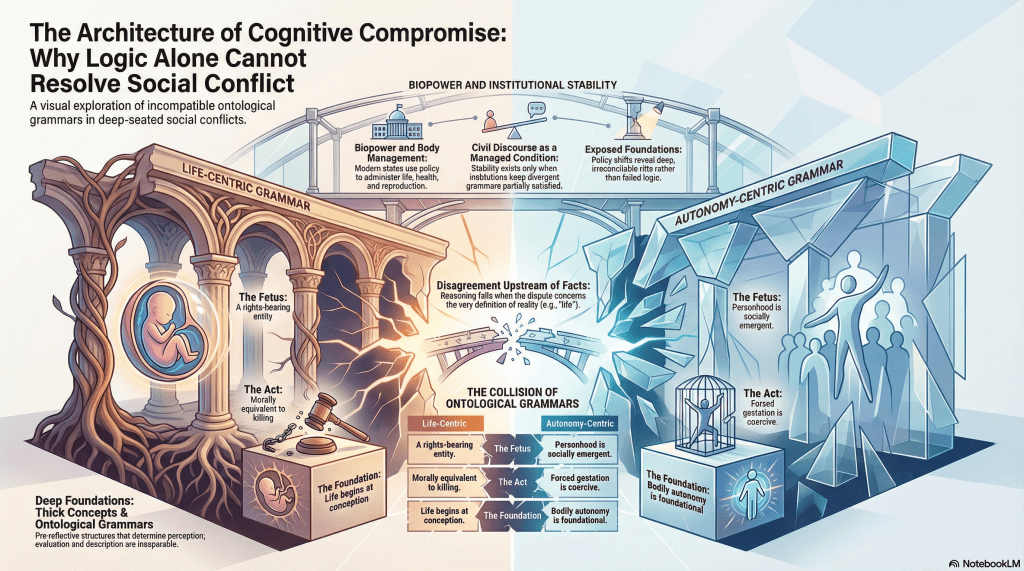
NotebookLM Infographic

7. The Uncomfortable Conclusion

The Enlightenment story tells us that disagreement is a surface phenomenon, curable by better reasoning.

The ontological grammar story tells us something harsher: some disagreements are not resolvable through language because they are about the conditions under which language binds.

This does not entail quietism. It entails clarity.

Civil discourse is not proof that grammars have converged. It is evidence that power, institutions, and habitus have aligned sufficiently to prevent rupture.

When that alignment shifts, the illusion of shared ontology evaporates.

And what we are left with is not failed reasoning โ€“ but exposed foundations.


I planned to use prostitution and anti-natalism as other cases for elucidation, but I see this has already grown long. I’ll reserve these are others for another day and time.

Elites Ruined It For Everyone

David Brooks and the Hollowing Out of Conservatism

David Brooks is the quintessential old-school Conservativeโ€”the kind who once upheld a semblance of ideological coherence. He belongs to the pre-Reagan-Thatcher vintage, a time when Conservatism at least had the decency to argue from principles rather than blind tribalism. We could debate these people in good faith. Those days are gone. The current incarnation of Conservatism contains only homoeopathic traces of its Classicalโ„ข predecessorโ€”diluted beyond recognition.

The Degeneration of Conservatism

The rot set in with Reagan, who caught it from Thatcher. Greed and selfishness were laundered into virtues, repackaged as “individual responsibility,” and the party’s intellectual ballast began to erode. By the time Bush IIโ€™s administration rolled in, Neo-Conservatism had replaced any lingering Burkean ethos, and by Trumpโ€™s tenure, even the pretence of ideology was gone. Conservatism-in-Name-Onlyโ€”whatever Trumpโ€™s brand of reactionary nihilism wasโ€”swallowed the party whole. Do they even call themselves Conservatives anymore, or has that ship sailed along with basic literacy?

Click here to take the worldview survey

To be fair, this didnโ€™t go unnoticed. Plenty of old-school Republicans recoiled in horror when Trump became their figurehead. Before the 2016 election, conservative pundits could barely contain their disdain for his incompetence, lack of moral compass, and general buffoonery. And yet, once they realised he was the partyโ€™s golden goose, they clambered aboard the Trump Train with the enthusiasm of lottery winners at a payday loan office. His staunchest critics became his most obsequious apologists. What does this tell us about their value system? Spoiler: nothing good.

Brooksโ€™ Lament

Which brings us back to Brooks, who now bemoans the death of Conservative values. On this, we agree. Where we part ways is on whether those values were worth saving. Say you’re boarding a train from New York to Los Angeles. Conservatism might argue that a Miami-bound train is still a train, so whatโ€™s the problem? Itโ€™s the same vehicle, just going somewhere else. Except, of course, Conservatism has always insisted on the slow train over the fast trainโ€”because urgency is unseemly, and progress must be rationed.

If Iโ€™m an affluent middle-classer, I might prefer Conservatismโ€™s careful incrementalismโ€”it keeps my apple cart stable. Admirable, if you enjoy tunnel vision. Progressives, by contrast, recognise that some people donโ€™t even have apple carts. Some are starving while others hoard orchards. To the Conservative, the poor just arenโ€™t trying hard enough. To the Progressive, the system is broken, and the playing field needs a serious re-levelling. Even when Conservatives acknowledge inequality, their instinct is to tiptoe toward justice rather than risk disrupting their own affluence.

The Fallacy of Objective Reality

Leaving politics for philosophy, Brooks predictably rails against Postmodernism, decrying relativism in favour of good old-fashioned Modernist “reality.” Heโ€™s horrified by subjectivism, as though personal interpretation werenโ€™t the foundation of all human experience. Like Jordan Peterson, he believes his subjective truth is the objective truth. And like Peterson, he takes umbrage at anyone pointing out otherwise. It feels so absolute to them that they mistake their own convictions for universal constants.

As a subjectivist, I accept that reality is socially mediated. We interpret truth claims based on cognitive biases, cultural conditioning, and personal experience. Even when we strive for objectivity, we do so through subjective lenses. Brooksโ€™ Modernist nostalgia is touching but delusionalโ€”akin to demanding we all agree on a single flavour of ice cream.

The Existential Problem

And so, I find myself in partial agreement with Brooks. Yes, there is an existential crisis. The patient has a broken leg. But our prescriptions differ wildly. I won’t offer a metaphor for thatโ€”consider it your homework as a reader.

Brooks is likely a better writer than a public speaker, but you may still find yourself nodding along with some of his arguments. If youโ€™re a โ€œtrueโ€ Christian Conservativeโ€”if you still believe in something beyond crass self-interestโ€”he may well be preaching to the choir. But letโ€™s be honest: how many in that choir are still listening?

Two Maxims of Liberalism

The maxims are, first, that the individual is not accountable to society for his actions, in so far as these concern the interests of no person but himself.

โ€ฆ

Secondly, that for such actions as are prejudicial to the interests of others, the individual is accountable, and may be subjected either to social or to legal punishment, if society is of opinion that the one or the other is requisite for its protection.

John Stuart Mill, On Liberty, Utilitarianism, and Other Essays (Oxford University Press, 2015, p. 91)
John Stuart Mill, On Liberty, Utilitarianism, and Other Essays (Oxford University Press, 2015)

Political Path

People can change.

Although I have changed my opinion and perspective over the years, I feel that most people settle into their ways, fixing their positions with an unhealthy dose of confirmation bias. I’d like to think that I could change my position materially from where I am now given the introduction of new evidence, but I don’t think it’s likely. First off: because I am coming from a vantage where I feel I am ‘right’.

Don’t believe everything you think.

โ€” Various

Of course, there is no absolute right, but from the perspective of the times and place and some triangulation, I’ll say ‘relatively right’.

Rewinding…

When I left high school in 1979, I considered myself to be generally Conservative โ€” at least as I understood the word to mean and without dimension or nuance. I’m not sure I had a great grasp of the definition.

Upon graduation, I entered the military. I remember in conversation with a mate that I was a Conservative. He laughed, and said I was the least Conservative person he’d ever come across. I was perplexed, but I had to reorient my self-perspective.

New Definition

I decided that I was a Conservative โ€” a Fiscal Conservative โ€”, but I was a Social Liberal. I’d pretty much been a Social Justice Warrior (SJW), concerned with the underdogs, but it wouldn’t be on my dime โ€” or the prospect I had for future nickels and dimes.

I held this position for years โ€” until I realised that the two positions were untenable. You can’t simultaneously offer full social equality for free, and these were rights we were discussing. Fundamental rights. If money was the friction between a right and its realisation, then it needed to be spent. Fiscal Conservatism be damned!

Politicus Interruptus

Somewhere in the fray, I had dabbled with Libertarianism. Again, I dismissed this as an untenable fantasy. There had never been even close to an instance of this working, and it goes against the grain of all social concepts. It’s built on a dream โ€” somehow anarchy without the anarchy, so anarchy + magic.

Progress

At some point, I didn’t like the PR of the Liberal tag, so I opted for Progressive. In the real world, I tend to side pragmatically with Progressives โ€” the Bernie Sanders crowd in the US โ€” , though I understand the illusion of progress and of politics in general.

Searching further to find a political identity, I settle on anarcho-syndicalism, the system I most identify with today, though there are only slightly more examples of this as there are Libertarian instances, a problem being that when some people see a leaderless group, they see it as a vacuum, and history repeats itself, so I’m not sure how sustainable this system could be.

This is now…

I am under no delusion that there is a right way for society to exist. I do believe there are plenty of wrong ways, but there are too many dimensions and complexities to have a single way. After all, how are you optimising the system? Trade-offs exist, and making a choice to maximise X might (and does) mean that Y is no longer maximised. Do you make X = 10 and Y = 8, or do you settle for X = 9 and Y = 9? And there are decidedly more than just X and Y.

There is no real reason to believe that society or even humans should exists, but given consciousness and self-preservation urges, I’ll take that as a given. That’s an inviolable metanarrative element.