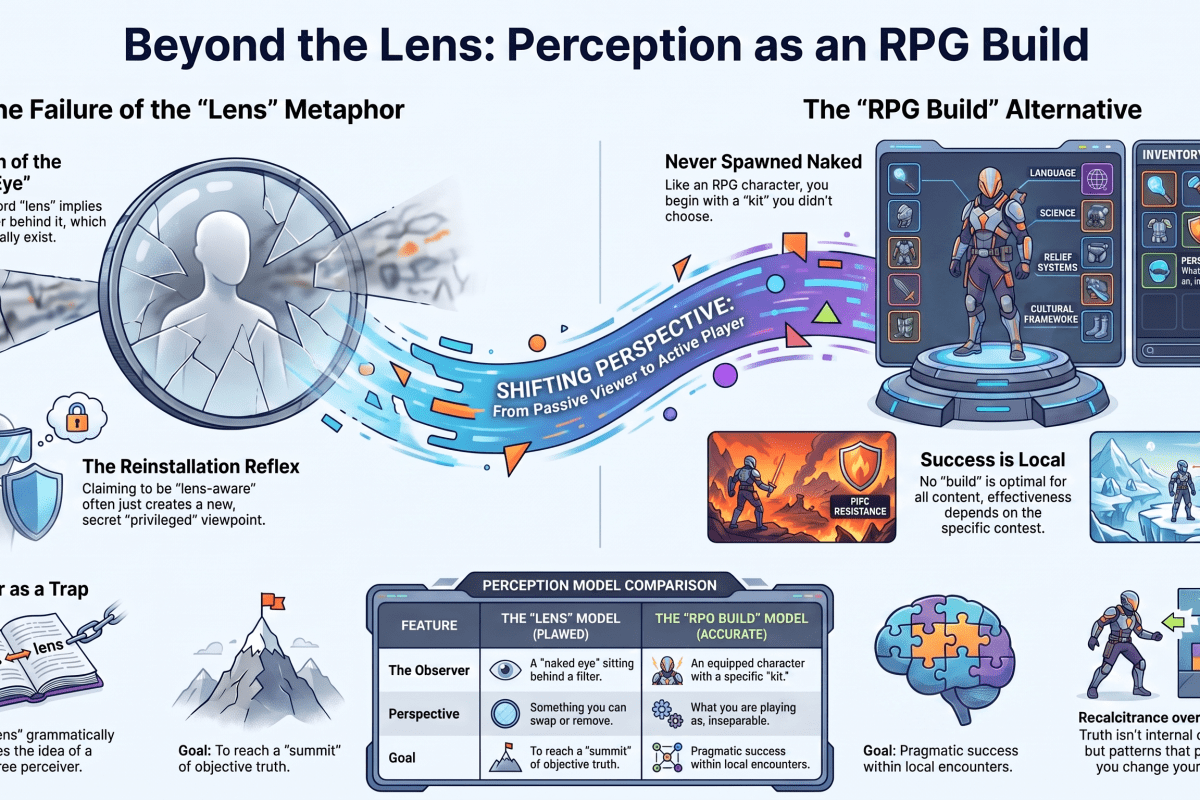
As an economist, I used to instruct my Econ 101 students to consider economics as another lens to add to their inventory, but as a philosopher my advice gets somewhat altered. I’ve discussed lenses before, though I can’t seem to find my econ story.
In any case, I’m interested in the philosophers account now. I don’t rescind my previous account which works well enough in a social context, but I want to discuss the ontological deficits in this advice.
NB: Now that I seem to be authoring more on Substack, I am trying to figure out what to do with this blog that I’ve been maintaining since 2017. I am considering using it as a holder of summaries and related digital assets, for example the PDF from Google Notebook. I expect to include a paragraph of two from the Substack article as a preview for readers to determine if it’s worth clicking. If you start at Substack, you may find this ancillary information to be useful.
Also, Substack doesn’t allow me to embed PDFs (through you can download them for viewing), and it doesn’t facilitate tables and such, so I’ve had to resort to alternate formats or screengrabs to share them as image files – not my preference.
IMPORTANT: Please not that my Substack is substantially free, so I am not pulling a bait and switch. If and when I place content behind a paywall, I’ll have a reason or at least an excuse. I believe that information should be free and freely shared with minimal constraints, which is the reason I don’t yet have anything protected.
Of course, I do sell books, but I also discuss the contents here and in other social media contexts. The books are more for a convenience of having everything in one place and supporting my endeavours, to provide additional incentives to produce similar content.
If you have any ideas or preferences, let me know.
I discovered a WordPress widget and decided to share my reading progress, but it appears to show the last few books I’ve finished rather than my active list. Click on My Bookshelf to view more.
I read several books at once. I tend to read a fiction and several non-fiction books. The fiction books happens to be an audiobook, which I tend to listen to whilst I am working out: Carl’s Doomsday Scenario: Dungeon Crawler Carl (book 2). It’s more of a diversion – and entirely unserious, though I did find a quote on Understanding, my latest essay project still in progress.
I can’t really recommend a book to people because I don’t know their tastes and interests. As for the Dungeon Crawler series, if you like RPG gaming culture and lore, you may appreciate the humour of LitRPG. It’s stupid fun.
On the serious side, I’ve mainly been milking a few titles;
Being and Time, An Annotated Translation: Martin Heidegger
Against Progress is a short collections of essays that I tend to travel with and read an appointments and such. I’ve read almost half of them, but I’m still reading.
I’m very close to finishing Reasons and Persons. I’t not exactly a page turner, but it is engaging. It’s inspired several essays here, so I have to suggest that it’s worth the read, as long as it is.
I’ve read Being and Time before, but I wants to take a gander with this new translation and check out the annotations. Since I’ve already read it and have ideas about it, I am more critical of some of the early annotations than a fresh book, but this is also on a slow –when I have time – track.
Of course, one could argue that I would have time if I weren’t reading non-fiction, and one would be correct. However, the level of attention required differs significantly.
I shared another Substack post, but I want to expand it a bit here. On the Substack version, I conspicuously didn’t name certain obvious names, but here, I shall. I also left out a reference to Plato’s Republic.
The current American regime is built on meritocracy, and – this is the part everyone misses – it would not deny the charge. It rather likes the word. It uses the reinterpreted version, the laundered one my other essay was about, in which merit means precisely whatever the sovereign has decided it should mean this morning. Accuse them of meritocracy, and they will thank you for noticing.
Take the man at the centre of it. Whether Donald Trump is meritorious is not, in the end, a question about Donald Trump. It is a question about which ontological grammar you happen to be speaking, because the grammar constitutes the object before a single fact is admitted into evidence. This is the whole Language Insufficiency point in miniature: the frame quietly does the work the facts are later congratulated for.
To Cohort A, he is a charismatic and self-made businessman. The six bankruptcies are not failures but proof of a shrewd operator who knows how to play the game and walk away intact – power-mind, killer instinct, the art of the deal. That he has a decades-long habit of not paying his contractors, and an even longer one of not paying his tax, does not indict him; it endears him. It makes him the everyman who beat the system the rest of us merely resent. A working-class hero, if you can manage it, descending on a golden escalator.
To Cohort B – and I’ll confess my membership, since honesty is cheaper than the pretence of the view from nowhere – he is a less likeable Forrest Gump: a man forever arriving at the centre of history without ever quite grasping how he got there, weaponising a charisma that works only on the already-mesmerised, and rebuilding the world with himself at the origin. He has a certain gravity. It attracts sycophants and rewards them, which is the only merit test his court reliably administers.
Same man. Two grammars. The ‘merit’ resides in neither the man nor the record; it is assigned by the frame and then invoiced to the evidence. Which is exactly the thesis of the parent essay, now wearing a name tag.
The downward stroke, said plainly
The parent essay left the reverse operation as a coy ‘phrase in current circulation’. I’ll say it here without the euphemism: DEI hire. The move is to take career civil servants – people with decades of demonstrable domain competence, whatever their private politics – and broad-brush them as diversity appointments, which is to say, unqualified by definition, arrived by an unauthorised route. The vacancies then fill with those who have pledged fealty and displayed the one indispensable qualification: a flexible integrity. The competent are marked down for being the wrong sort; the pliant are marked up for being biddable. ‘Incompetent’ has been quietly reissued to mean not ours, and ‘qualified’ to mean loyal. Same machine, thrown into reverse – now with a name engraved on the lever.
The cream, and the dimension it rose along
Which brings me, as these things do, to Plato. The Substack piece used his ship of state – the crew who master the mutiny rather than the sea. Here I want the other half of the same complaint: the comfortable conviction that the meritorious rise to the top like cream.
They do rise. That was never in dispute. What the metaphor conceals is the dimension along which they rose. These people are genuinely competent – at working the system, at the acquisition and retention of position – which is a wholly different skill from governing, and precisely the one we so conveniently assume we were measuring. Cream rises; so does scum; the trope declines to specify which, and physics is no help at all.
This is the standing problem of republicanism – and no, before anyone lunges for the comment box, I do not mean the Republican Party, which has its own well-stocked catalogue of failures, as do the Democrats, who would be unwise to feel smug reading this. Nor is any of it uniquely American. If you are somewhere else entirely, enjoying the spectacle from a safe distance, do put the popcorn down. The mechanism by which a society mistakes competence-at-ascending for competence-at-ruling is not a national defect. It is a design flaw in selection itself, and your country installed it too.
I will not, on this occasion, start in on the failings of democracy as a system. Been there; done that. There are only so many sacred cows a man can tip before lunch.
The question, once more
‘Meritocracy’ survives all of this the way it survives everything – by never once being asked the only question that matters: merit at what, judged by whom, to whose benefit? Put it to the present court, and the answer is almost embarrassingly legible. Which is, of course, exactly why the question is never put.
As Independence Day is upon the United States of America, I considered some counterfactuals. What if Europe fails to reach the Americas until a century or more late, and we watch the delay from the vantage of the peoples already here, going about the business of history without a Columbus to interrupt them? Then came the question everyone eventually asks about their own good ideas, in the tone of a man checking whether the milk has turned: has this been done before? Of course, it had been. Spoilers follow – sort of.
Audio: NotebookLM summary podcast of this topic.
The inversions
The oldest respectable relative is Robert Silverberg’s The Gate of Worlds (1967). A nastier Black Death carries off three-quarters of Europe rather than a third; the continent never recovers, the Ottomans move in, London becomes New Istanbul, and by the twentieth century the great powers are the Aztecs, the Incas, the Russians and the Japanese. Our guide is a young Englishman named Dan Beauchamp, who sails to an industrial, motorcar-driving Mexico to seek his fortune. Note the pronoun. The world has been turned upside down, and we are shown it by a European looking up.
Christopher Evans’s Aztec Century (1993), which took that year’s BSFA Award, runs the same reversal with more brass. Cortés changes sides, a New World plague scythes through Europe instead of the reverse, and the Aztec Empire swells into a technological superpower that eventually occupies Britain. The narrator is Princess Catherine, daughter of a defeated British monarch, Princess Diana watching London burn from the losing side. Again, the conquered European tells us what the conquest was like.
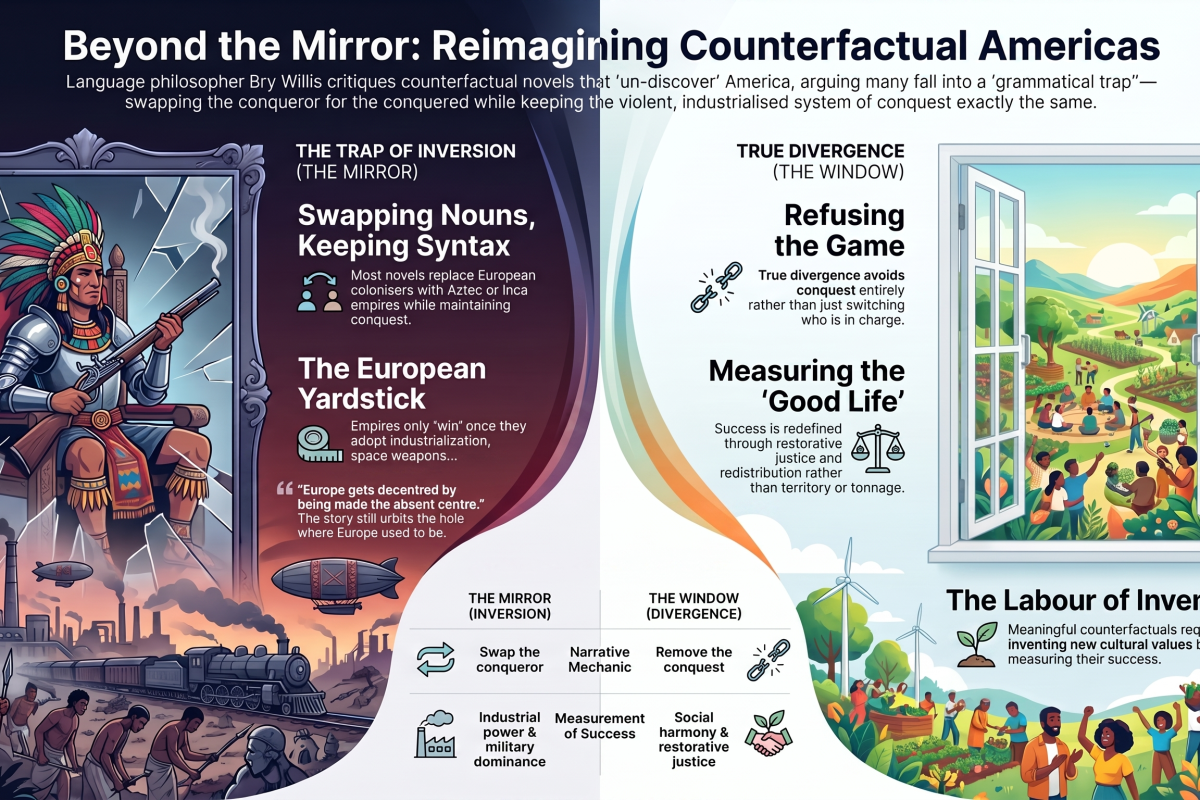
Laurent Binet’s Civilizations(2019) is the cleverest of the lot, and the most decorated – it won the Grand Prix du roman de l’Académie française, and Sam Taylor’s English translation took the Sidewise Award for alternate history. A stray band of Vikings gifts the Americas iron, horses and, crucially, immunity; so when Columbus turns up in 1492, he is captured and demoted to court jester, and the Inca emperor Atahualpa later sails east to conquer a Europe conveniently fractured by Luther, the Inquisition and its own dynastic squabbles. Binet is far too intelligent not to know what he is doing. The whole thing is a Civilization-the-video-game daydream executed with Académie française tailoring, and it is genuinely delicious. It is also, structurally, another inversion: swap the conqueror, keep the conquest.
The remix and the intervention
Two cousins change the machinery rather than the direction. Kim Stanley Robinson’s The Years of Rice and Salt (2002) empties Europe almost entirely – the plague takes ninety-nine per cent – and then spends six hundred sprawling, reincarnation-threaded pages letting China, Islam, India and the Indigenous Americas run world history without the Europeans in the room at all. It is less a mirror than a vast tapestry, and its ambition is precisely that Europe should not be the pivot. Whether it manages that, or merely relocates the pivot, is a question the book is honest enough to leave open.
Orson Scott Card’s Pastwatch: The Redemption of Christopher Columbus (1996) cheats, and admits it: time-travellers reach back to soften the catastrophe of contact. It is a book about first contact, disease and conquest, but the engine is intervention from a guilty future, which makes it a novel about us editing them, the colonial gaze wearing a lab coat.
The one that isn’t a mirror
And then there is B. L. Blanchard’s The Peacekeeper (2022) – also, tellingly, a Sidewise Award winner – which does the rarer thing and quietly refuses the whole game. There is no inversion here, because there is no conquest to invert. North America was simply never colonised. The Great Lakes are an independent Anishinaabe nation; Chicago is Shikaakwa; there are no borders on the map because the book declines to draw any. It happens to be a murder mystery, and a slightly wobbly one – I called the culprit early, as apparently did everyone – but the mystery is scaffolding. The real work is a society organised around restorative justice, redistribution and something the glossary calls the Good Life, where crime is repaired rather than punished, and the question ‘what is success?’ gets a genuinely different answer. That difference is the whole point, and it is worth spelling out.
The tell
Watch what the inversion novels are obliged to do to their winners. Silverberg’s Aztecs drive coal-fired automobiles. Evans’s Aztecs somehow have flying warships and space weapons, to the audible irritation of every reviewer who has ever met a history book. In each case, the counter-empire only counts as having won once it has industrialised, once it has, in other words, become Europe in a headdress. The measuring stick never leaves the room. It just changes hands. Would not recommend. All of these are still viewed through Modernist lenses. They can’t seem to help themselves.
This is the trap, and it is a grammatical one: you can swap every noun in the sentence and leave the syntax of conquest perfectly intact. Who dominates whom is a variable. That domination is the axis of the story remains fixed – invisibly, load-bearingly fixed. So the shelf keeps producing books that promise to dethrone Europe and instead install a differently-costumed emperor on the same throne, using the same yardstick to prove he deserves it. Europe gets decentred by being made the absent centre. Everything still orbits the hole where it used to be.
Blanchard’s book is the one that escapes, and it escapes not by putting someone else on the throne but by asking whether the throne needed to exist. That is a far harder imaginative act, which is exactly why the shelf holds so many mirrors and so few windows. Inverting a hierarchy is a parlour trick – satisfying, symmetrical, teachable in an afternoon. Imagining a world whose values diverged, so that its people would not measure their flourishing in territory and tonnage at all, requires you to invent the ruler before you can invent the thing it measures. Most writers, sensibly, decline the extra labour.
Six books, then, and a warning label. Read Binet for the wit, Blanchard for the nerve, Silverberg for the ancestry, and the rest for the pleasure of watching very clever people not quite escape the room. Then, if you’re feeling brave, go and undiscover America properly, which means resisting the temptation to let it become us, wearing better feathers.
I’ve been working for days on a new short story that investigates time. I’ve already published The Box in English, but this new piece looks at a different aspect of time, one I suspect may work better in French because the grammar gives me more useful pressure points than English.
The working title is Les Années Vécues, which translates literally as The Years Lived. For now, that’s only a working title. Oddly enough, the purpose of this post is not really to describe the story, though I may do some of that. It is more about the tools, the process, and the strange route by which the idea arrived.
The story began as a conversation between me, Claude, and ChatGPT about human innovation and creativity. A colleague had recommended How Language Began. I bought it and read the first few chapters. For the record, it’s interesting.
Early on, the author discusses genetics and evolution, citing human inventions along the way, particularly those associated with Homo erectus. Because I tend to question narratives of progress, and especially grand claims around Innovation and Creativity, I fell into some LLM-assisted chit-chat. From there, the conversation drifted into time travel in fiction. We discussed tropes from Back to the Future to Outlander. Somewhere in that mess, I noticed a missing perspective I felt I could capitalise on.
For the record, again, I have not been especially successful at writing short stories. They tend to grow beyond my intent, usually into novelettes or novellas. My first novel, written as Ridley Park, began as a short story. That story is now ostensibly chapter five of Hemo Sapiens. It can stand on its own, but it plays better in context. It is still my favourite chapter, if I had to choose one. So I’ll see where this new one goes, if anywhere. Nowhere is always an option. The blank page remains admirably non-committal.
After hours of brainstorming with the LLMs, arbitrarily switching from French to English and back again, I had a plot outline with beats and flavour, tropes and intentions, subversions and misdirects. I had captured dialogue exchanges, worked through worldbuilding constraints, and fleshed out several plot points. Then I asked ChatGPT to build me a tracking document to serve as a punch list.
I’ve done this a few times before, but with the advancement of the tools, the output was surprisingly robust, arguably overkill, which isn’t always a vice.
The spreadsheet contains 9 tabs:
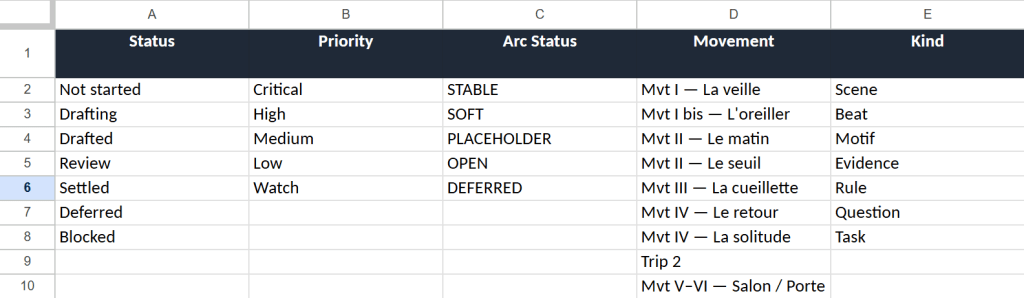
Lists
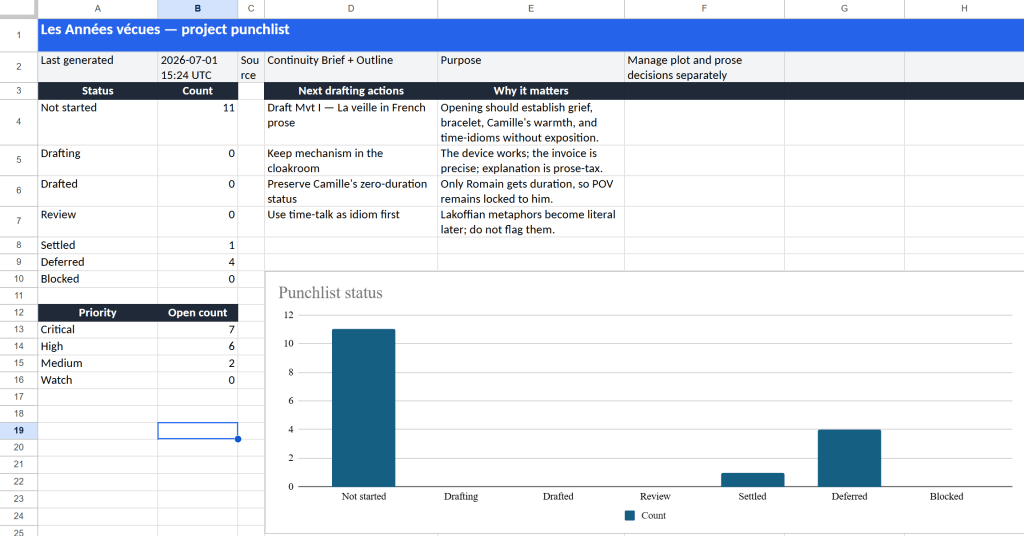
Dashboard
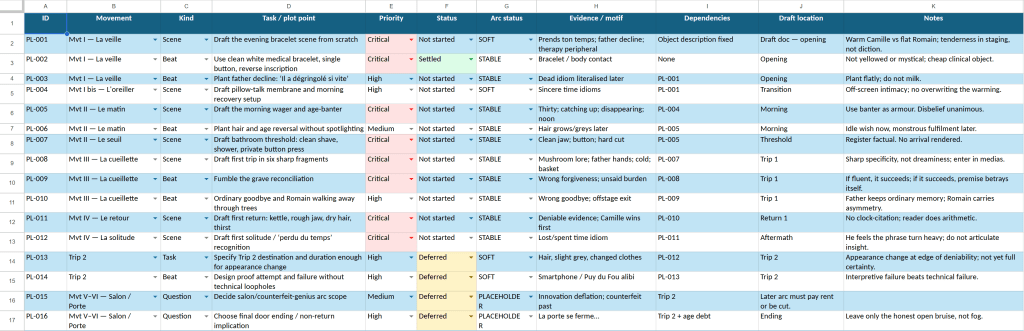
Punchlist
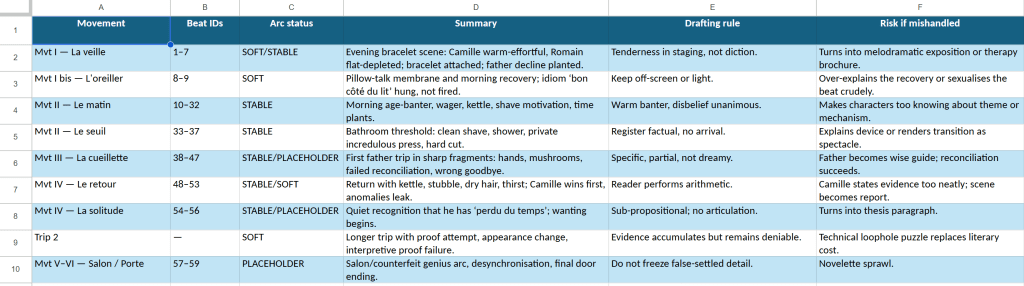
Beat Map
Continuity Rules
Motifs & Plants
Evidence Ledger
Open Questions
Sources
Lists
The Lists tab is mostly internal to the spreadsheet. It controls status values, priorities, categories, and related dropdowns. I would not have made it this elaborate manually, but I’m not offended by competence when it arrives uninvited.
I wouldn’t have been so elaborate, but it’s nice nonetheless.
The Dashboard
The Dashboard is also a bit of overkill, but useful overkill. In its inaugural state, it gives a quick view of task status, priorities, and next actions. Its intent should be clear from the screenshot.
Punchlist
The Punchlist is essentially an actionable to-do list with status markers. I think I can safely share this without giving too much away. It lets me manage the story as a set of unresolved craft problems rather than as a vague cloud of ‘I should really get back to that’.
Beat map
The Beat Map contains representative story beats, with notes that capture narrative purpose, confidence level, and risk-management annotations. This is where structure can be managed without cluttering the prose draft itself.
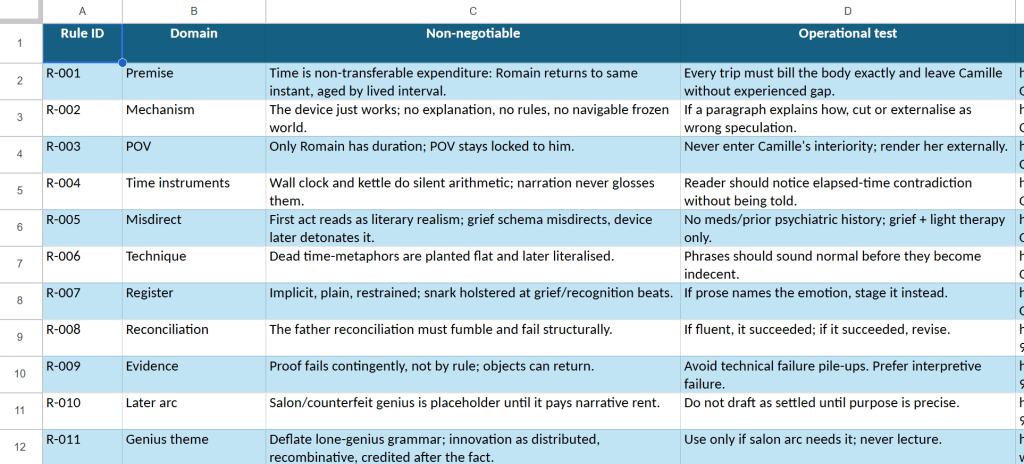
Continuity Rules
The Continuity Rules tab captures worldbuilding constraints and adjacent considerations. It is probably oversharing at this stage, but I’ll take the risk. These rules matter because speculative fiction can collapse quickly when the premise starts leaking.
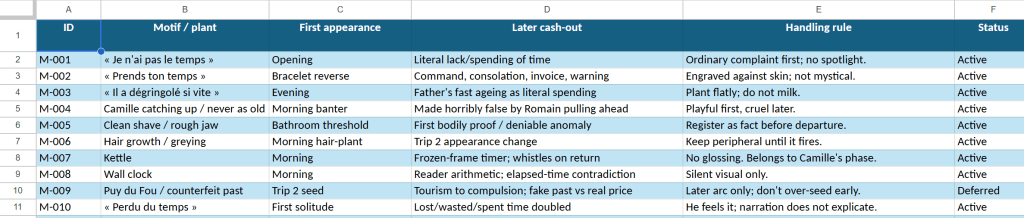
Motifs & Plants
The Motifs & Plants tab tracks recurring touchpoints, images, phrases, and planted details. Some of these may be premature, but having them outside the draft helps me avoid forcing them into the prose too early.
Evidence Ledger
The Evidence Ledger tracks what counts as evidence inside the story world, who can interpret it, and how it may be misread. This is another continuity check, but also a thematic one.
Open Questions
The Open Questions tab is exactly what it sounds like: unresolved choices, structural uncertainties, and decisions I do not yet want to freeze into place. Sometimes the most useful document is the one that refuses to pretend everything has been solved.
Sources
The Sources tab lists the chat history and documents from which the rest of the content was derived.
The Rest
This is only a partial listing, and I am not finished ideating. I have not yet begun the prose.
I do not always plot my stories. More often than not, I take something closer to a stream-of-consciousness approach. But for one thing, my consciousness does not stream in French. So there’s that.
What impressed me most was the organisational layer the LLM produced. The spreadsheet is now hosted on Google Drive as a Sheet, accessible to both me and the LLMs, so it can be updated as the discussions and decisions continue.
I’m looking forward to wrapping up the ideation phase and beginning, and ideally completing, the prose. That last part remains the traditional nuisance.
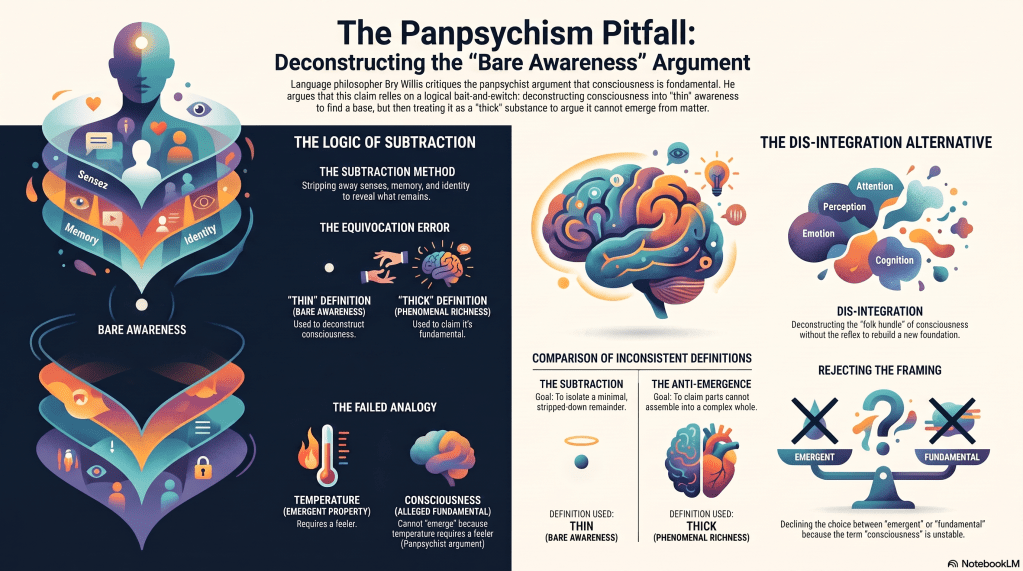
I am decidedly not a proponent of panpsychism. Most philosophers – and, let us be honest, most people – cannot deconstruct without immediately reconstructing; the rubble has barely settled before they are pouring fresh foundations. I decline that reflex, and I call the declining Dis–Integration – the term chosen partly to keep my distance from Derrida, whose own coinage is abused by more people than have even read him.
Audio: NotebookLM summary podcast of this topic.
Alex Connor begins well. He Dis–Integrates the folk package of consciousness, and he does it cleanly. Respect. Set aside that ‘consciousness’ carries literally dozens of definitions across disciplines and subdisciplines. Just grant him the ordinary picture and watch him strip it. Memory, sensory richness, identity, deliberation, narrative selfhood – he shows that none of these is intrinsic to consciousness as ordinarily imagined. As he says, close your eyes and subtract sight; still conscious. Subtract hearing, subtract touch, subtract memory until no instant is ever laid down. What remains, he says, is bare awareness. So far, so good. Descartes would have been proud.
But then Alex makes the same mistake as René, mistaking the dust for an ontological primitive. That a folk bundle can be decomposed entails precisely nothing about the fundamentality of whatever is left at the bottom of the barrel. It may show only that ‘consciousness’ was never a stable kind-term – that we have been pointing at an assortment and calling it a thing.
This subtraction is only Dennett’s intuition pump, not the engine, which arrives at the end, when Alex argues that you can’t assemble a substance from parts that lack it – that the familiar emergence analogies, temperature from molecules, an image from pixels, all smuggle in the very phenomenality they pretend to derive, because temperature ’emerges’ only for someone who already feels heat. No good analogy survives, he concludes; therefore, consciousness cannot be built; therefore, it must already be down there in the atoms. Nope.
Leave that standing and the subtraction argument was never load-bearing at the start. The stripping was only ever ostensive, a way of pointing at minimal consciousness, but the fundamentality claim never rested on it.
The subtraction works only by thinning ‘consciousness’ to bare awareness – by evacuating redness, the unified first-person feel, the entire rich remainder, on purpose and as a matter of method. The anti-emergence argument works only by treating ‘consciousness’ as a robust substance whose assembly from non-conscious parts is incoherent – and every ounce of that incoherence is borrowed from exactly the rich phenomenal features the subtraction he’d just tossed overboard. ‘First-person unified experience’. ‘The redness of red’. Those were his words, and they are doing the work in the argument that needs consciousness to be thick, moments after he has insisted it is thin. Oops.
So the noun equivocates inside his own case. Damn dirty objects. It’s a decomposable bundle when he needs minimality; an indecomposable substance when he needs non-emergence. He can’t eat his cake and have it, too. There’s no single referent for the emergence to succeed or fail at. Some bundled features plainly emerge – that’s what bundling is. The bare what-it-is-like-ness is the contested remainder. And ‘it’s all one substance that can’t be built’ is simply the reification I diagnosed earlier.
This is why I decline the question. It’s not ‘consciousness is emergent‘ set against his ‘consciousness is fundamental‘ – that trade keeps the bad noun on the pitch. The framing of substance-versus-emergence is what fails. So, I’m not adjudicating the dispute. I’m just declining its terms after showing that its terms weren’t ever coherent to begin with.
Although I am not a linguist, I am a philosopher of language, so occasionally I cross into that territory through sheer love of the thing. I chat with a French interlocutor a couple of times a week, and today we discussed the French infinitive demander – a false friend (faux ami) in English, though a closer one than most.
Audio: NotebookLM summary podcast of this topic. Please excuse the poor French pronunciation of the podcasters.
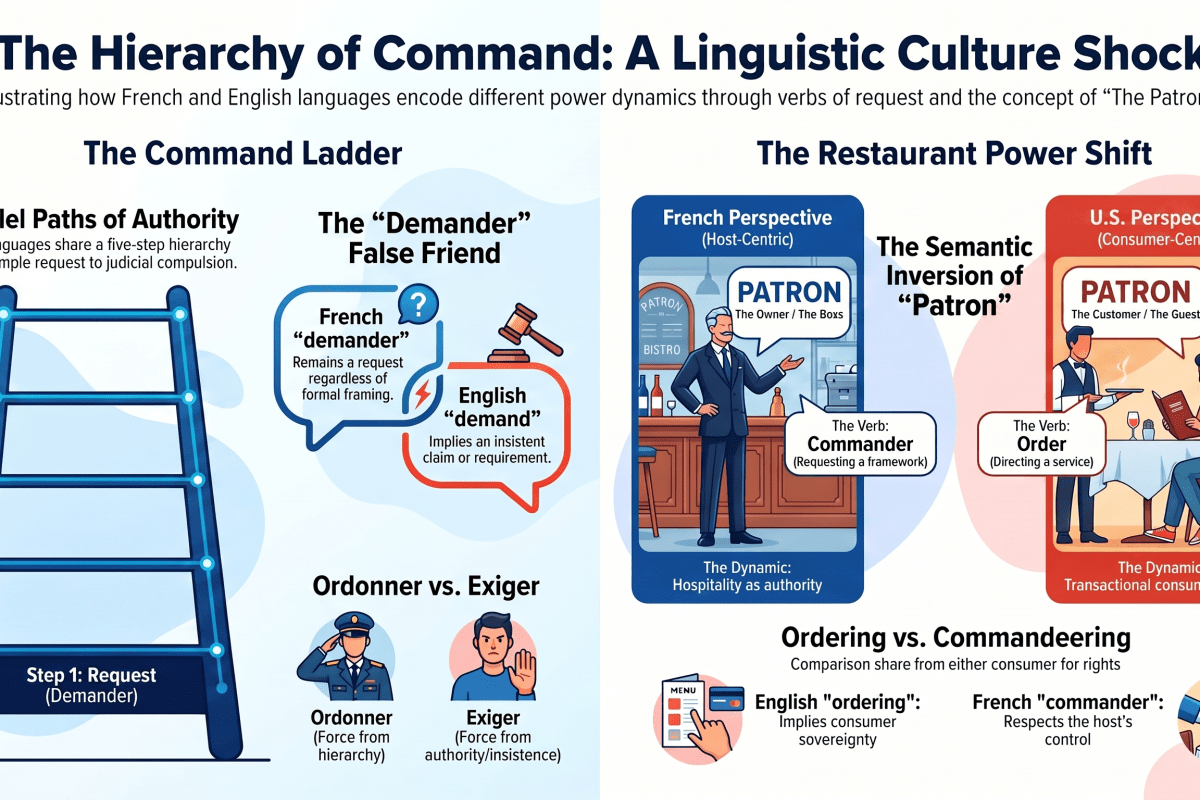
Demander means to ask, not to demand, though an English speaker might notice that demanding is simply an elevated asking. Which raises the question: is there an elevated version of demander in French? It turns out there is – a whole ladder of them.
In English: to ask → to demand → to order → to command → to enjoin. In French: demander → exiger → ordonner → commander → enjoindre.
(Enjoin, for those who’ve only met it in legal documents, is the formal instrument of judicial compulsion – to enjoin someone is to prohibit or require by court order. It earns its place at the top of the ladder.)
I won’t get into the full nuances of each term. I’ll leave that to a linguist. But the false friend problem is worth pursuing, because it’s more interesting than a simple mismatch.
The trouble isn’t just that demander ≠ ‘demand’ etymologically. It’s that the English word ‘demand’ smuggles in a force condition that French distributes across different verbs depending on the source of that force. Exiger implies force from authority, entitlement, or insistence. Ordonner implies force from hierarchy – a command structure in which compliance is not optional. Demander, however formally framed, remains a request. English ‘demand’ collapses all of this into one word and leaves the source of force unspecified.
This becomes vivid with examples. A judge doesn’t demander; the authority relationship forecloses the mere-request reading entirely. Exiger captures the illocutionary force; this demand is backed by institutional power, and non-compliance has consequences. But a judicial order in English sits closer to ordonner than exiger; the court doesn’t merely insist, it commands with legal effect. And a military general? Ordonner again – unilateral, hierarchical, non-negotiable.
This brings us to restaurants, where things get strange. In English, customers order. The same verb a general uses. What gives?
Polysemy is the easy answer, but the cultural one is more interesting. The French model is closer to hospitality in the older sense – the restaurateur is the host, the diner is a guest, and the dynamic carries an implicit asymmetry in which the host has authority over the experience. One eats what is offered, at the pace the kitchen sets; complaining loudly is a breach of the guest’s role rather than an exercise of consumer rights. Commander fits this – one places a request within a framework that the host controls.
The American model inverts this. The customer is sovereign, the staff are in service to the customer’s preferences, and the transactional frame licenses a kind of authority that would read as rudeness in France. ‘Order’ in the American restaurant sense carries just enough of the command register to be revealing; you’re not asking, you’re directing.
This makes the English verb choice quietly ideological in a way the French isn’t. Commander is neutral about the power dynamic. English ‘order’ encodes the American consumer-as-patron assumption right into the lexicon.
And the word, patron, is almost too good to leave alone. In French, le patron is the boss, the owner, the one with authority. In American English, the patron is the customer. The semantic inversion is almost too neat to be coincidental. It maps the entire cultural difference onto a single word: in France, the restaurateur is the patron; in America, the diner is. When the two meet – a tête-à-tête between rival patrons – culture shock is the predictable result.
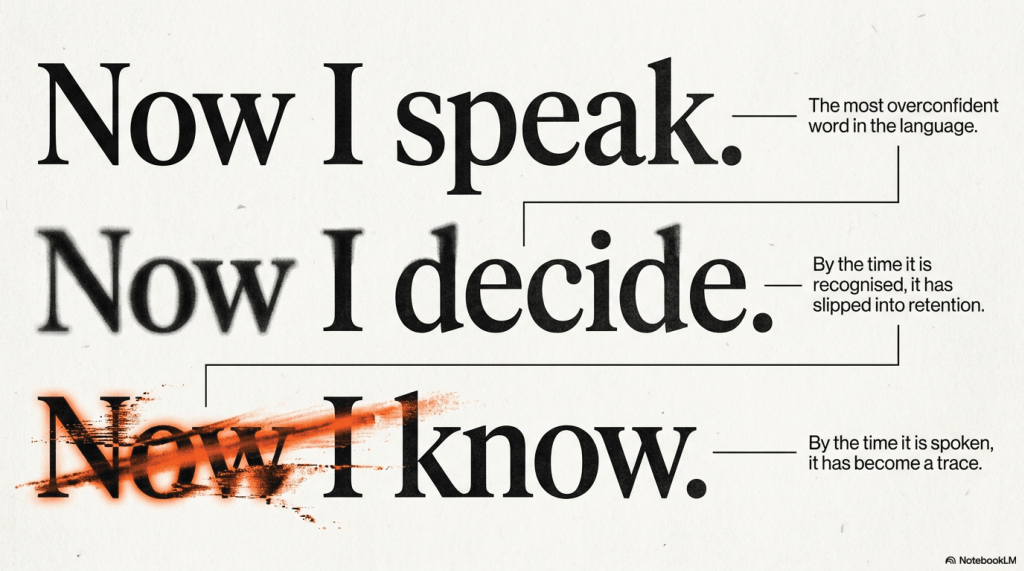
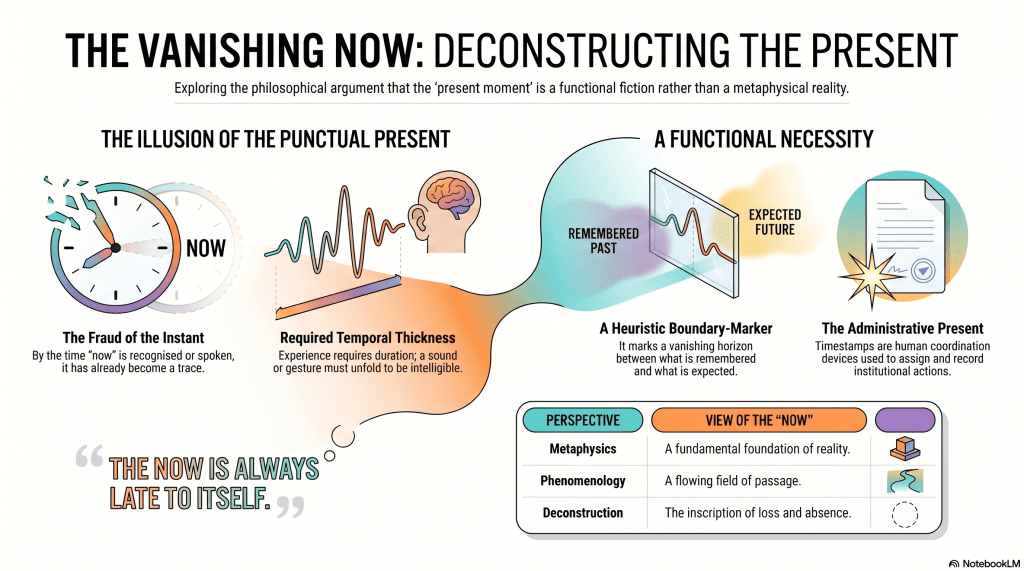
‘Now’ is one of the most overconfident little words in the language. It presents itself as immediate, self-evident, and available. We speak as though it names the present cleanly: now I speak, now I decide, now I know, now is the moment. Yet the word performs a small fraud every time it appears. By the time ‘now’ is recognised, it has already slipped into retention. By the time it is spoken, it has become a trace.
‘Now’ is not an experienced unit but a heuristic boundary-marker within temporal flow. It names a vanishing horizon between retention and protention: already past by the time it is recognised, already structured by what is expected before it can be stabilised. What it designates isn’t a thing, not a slice, not a metaphysical bead on the string of time, but a practical fiction by which consciousness, language, and action coordinate within a moving field.
Audio: NotebookLM summary podcast of this topic.
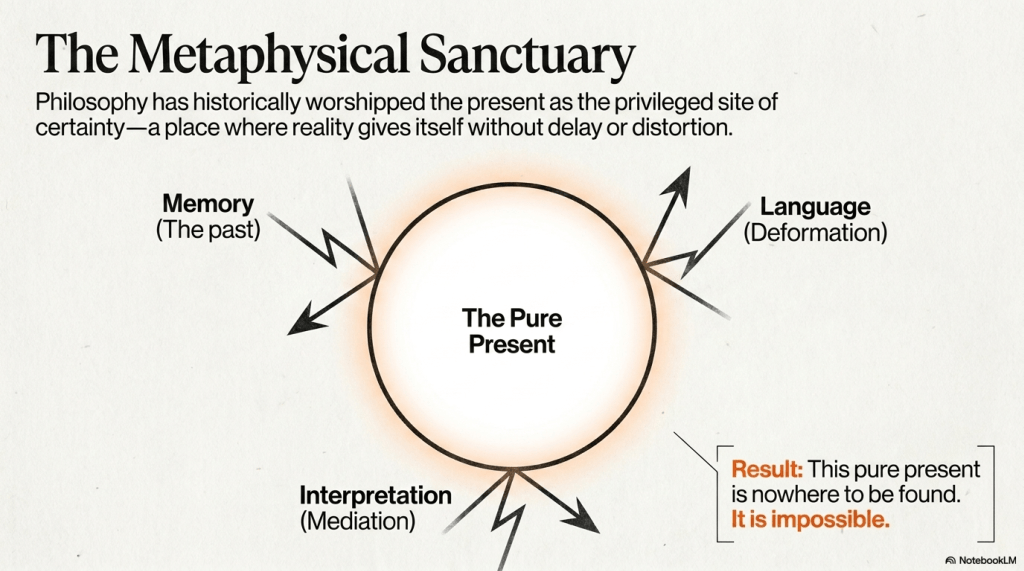
This distinction matters because philosophy has often treated the present as though it were the privileged site of certainty. Presence has been taken as the place where reality gives itself without delay, mediation, or distortion. The present moment becomes the imagined sanctuary of immediacy: before memory corrupts it, before language deforms it, before interpretation arrives with its grubby little toolkit. But this pure present is nowhere to be found. It’s not hidden; it’s impossible.
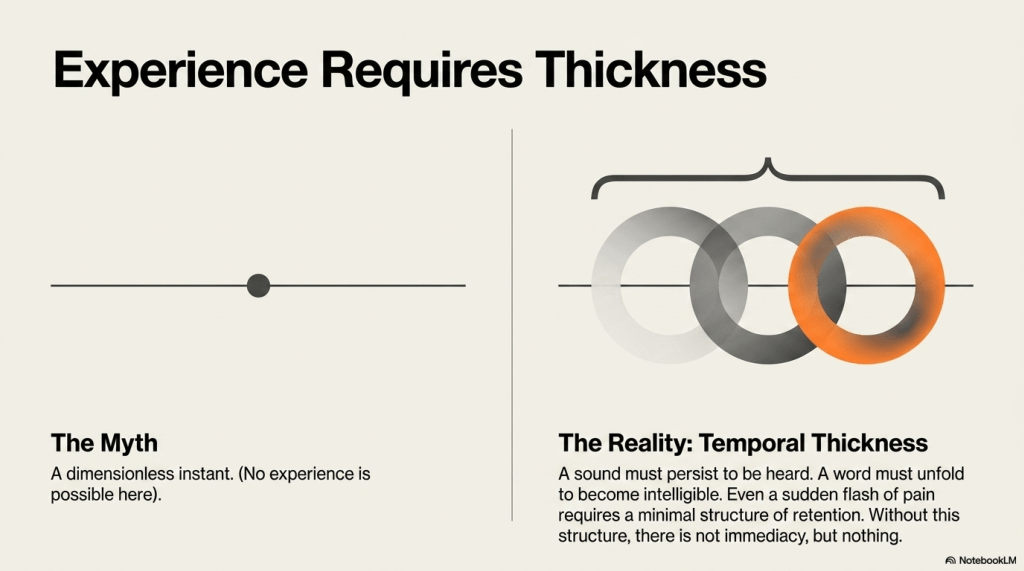
Experience is never given as a dimensionless instant. To experience anything at all requires temporal thickness. A sound must persist long enough to be heard as a sound. A word must unfold across time to become intelligible. A gesture is not apprehended as a gesture unless its beginning is retained and its likely completion anticipated. Even the flash, the shock, the sudden pain, the glimpse at the edge of vision, all require some minimal structure of retention. Without that structure, there isn’t immediacy but nothing recognisable as experience.
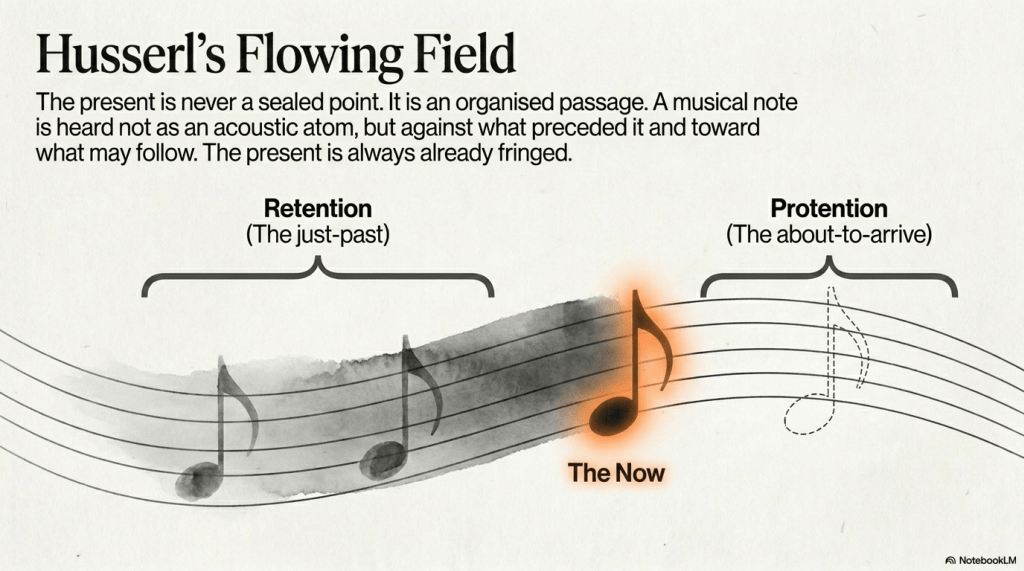
Husserl saw part of this with his account of retention and protention. The present isn’t a sealed point but a flowing field in which the just-past and the about-to-arrive are already implicated. A musical note isn’t heard as an isolated acoustic atom. It’s heard as part of a phrase, against what has preceded it and toward what may follow. The same is true of speech, perception, decision, and action. The present is always already fringed. It’s bordered by memory and expectation. It’s not pure presence but organised passage.
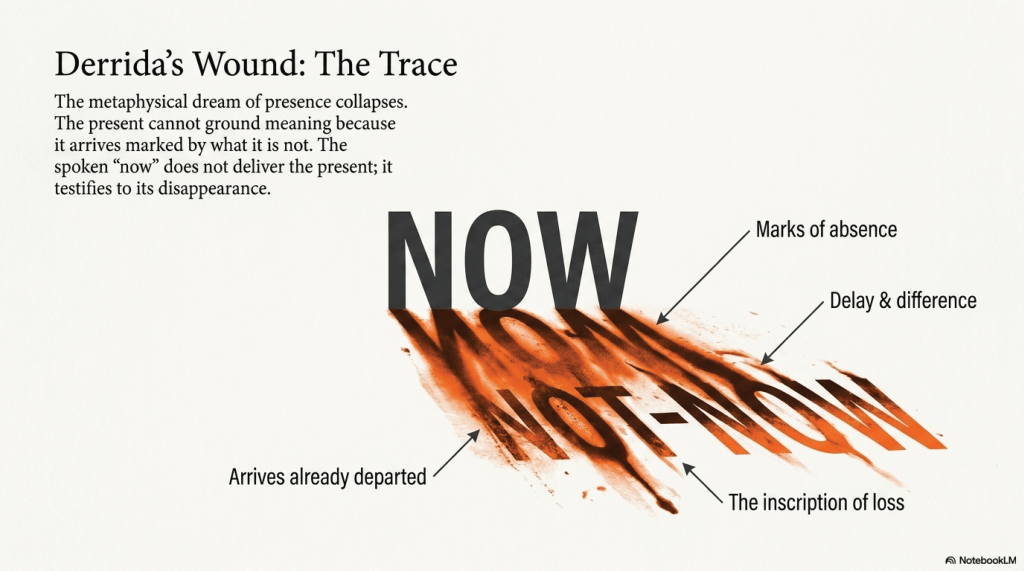
Derrida presses the wound further. If the now is always contaminated by what is not-now, then the metaphysical dream of presence collapses. The present cannot ground meaning because the present is never simply present. It arrives marked by absence, delay, difference, and trace. The spoken now does not deliver the present. It testifies to its disappearance. It isn’t the arrival of immediacy but the inscription of loss.
This isn’t merely a technical problem in phenomenology. It has consequences for how we think about agency, meaning, and reality. We routinely speak as though action occurs in a present moment of self-possession: I now choose, I now intend, I now decide. But this grammar flatters us. Decision is never contained in a punctual present. It condenses prior dispositions, pressures, perceptions, habits, bodily states, histories, and anticipated consequences. The now of decision is a narrative compression imposed after and within a process that exceeds it.
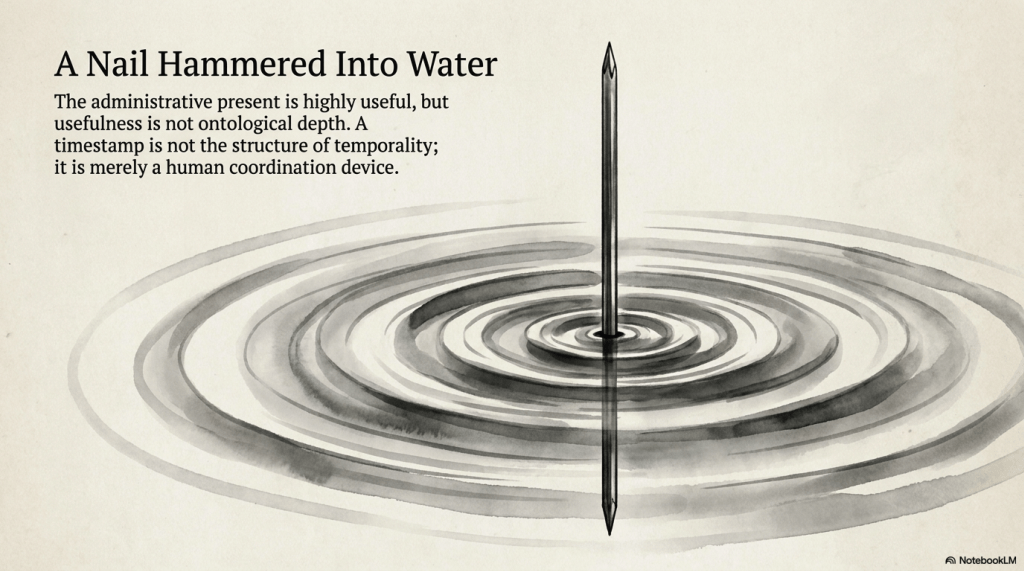
The same applies to moral and institutional language. Law loves timestamps. Bureaucracy loves decision-points. Politics loves moments. Each requires a tractable ‘now‘ because institutions must act, record, assign, and close. The administrative present is useful because it can be filed. But usefulness shouldn’t be mistaken for ontological depth. A timestamp isn’t the structure of temporality. It’s a human coordination device, a nail hammered into water.
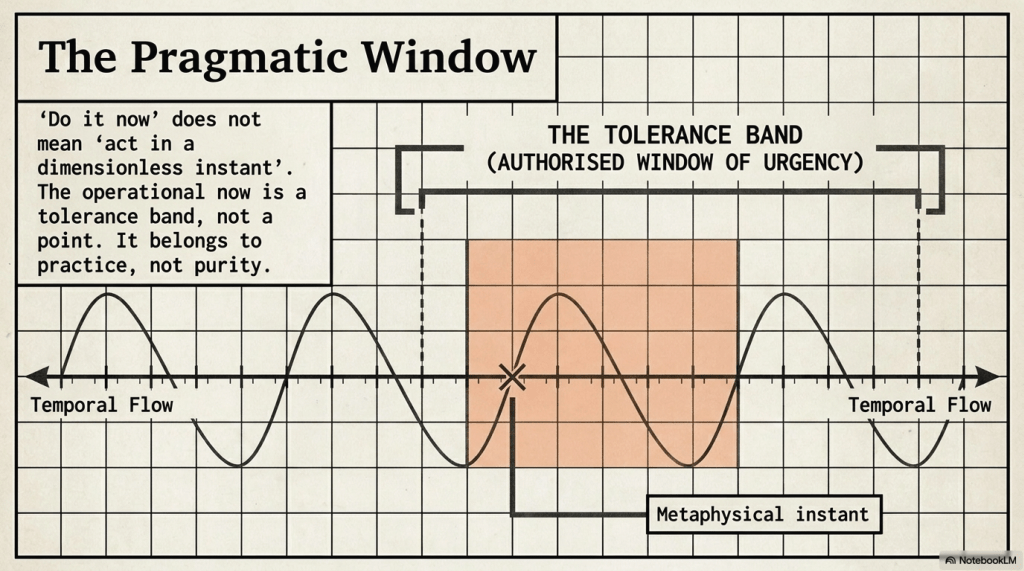
The now survives because it’s pragmatically indispensable. We need it to coordinate action. ‘Do it now’ doesn’t mean ‘act in a dimensionless metaphysical instant’. It means ‘act within the authorised window of urgency established by this utterance’. The operational now is a tolerance band, not a point. It belongs to practice, not purity.
This is why the present should be deflated rather than worshipped. The now isn’t an entity. It’s not a metaphysical foundation. It’s a boundary-function within temporal flow, a stabilising fiction by which agents orient themselves amid movement. It marks a horizon that vanishes as it is named.
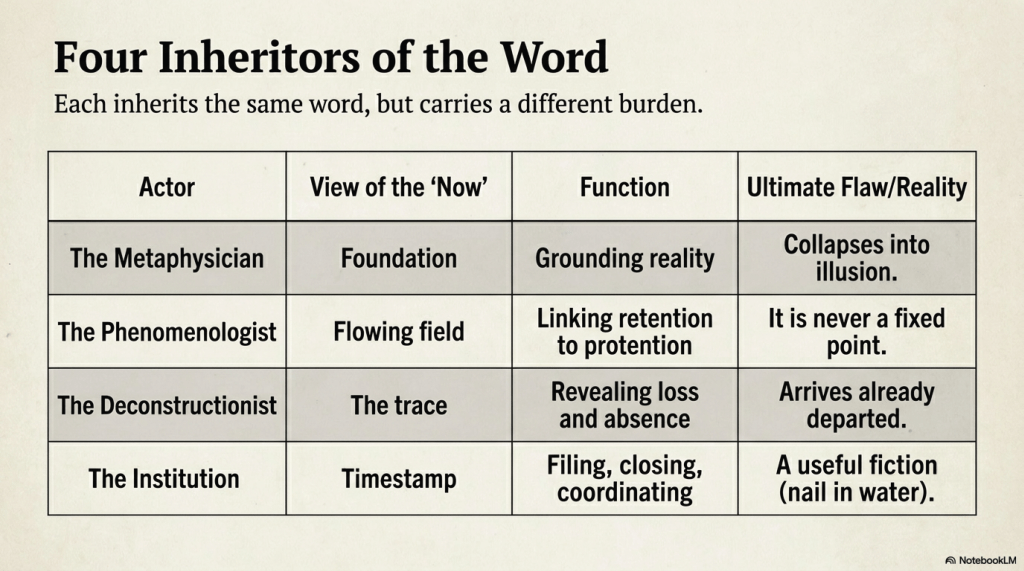
The metaphysician wants the now to be a foundation; the phenomenologist discovers it as flow; the deconstructionist hears in it the trace of what has already departed. The institution converts it into a timestamp and pretends the problem has been solved. Each inherits the same word, but not the same burden.
To invoke ‘now’ is therefore not to seize presence. It’s to gesture at the impossible purity of presence from inside its failure. The word works, but it works heuristically. It coordinates, compresses, and stabilises just enough. What it doesn’t do is deliver the present as such. The now is always late to itself.
Allow me to start with a declaration: I am no Hegel expert, and whether I am an expert at anything is debatable. Still, I’ve been reflecting on Hegel through my own lenses, and I have an opinion – because of course I do. My comment isn’t on a single Hegel publication. Rather, it’s a commentary on some of his general ideas – some more specific than others – that just so happen to be rattling around my noggin as I type.
Audio: NotebookLM summary podcast of this topic.
I know I’ve already claimed to have started, but this is the real start. Let’s talk translations.
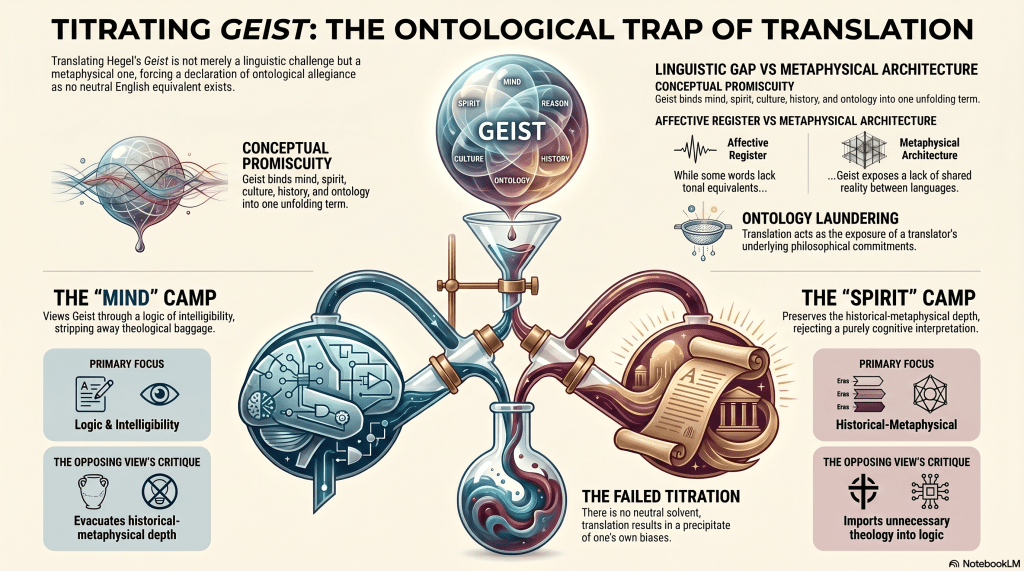
NotebookLM Infographic on this topic.
I recently discussed the problem with translating Meursault’s French maman. The short version: English lacks a clean equivalent. Every option – Mother, Mummy, Mama – over-interprets the son’s relation to his mother, leaning warmer or colder or more infantile than the French allows. Camus’ problem is at the level of affective register. The ambiguity is tonal, intimate, and culturally situated. English simply can’t carry it without choosing a side.
Hegel has a different problem, more philosophically weighty. His problem is Geist. Almost immediately, I think of zeitgeist and Poltergeist. Ghosts. Spirits. Phenomenology of Spirit, right? Easy peasy.
Not so fast. Some translators render it as Mind, in an attempt to distance themselves from theological baggage. The problem is that Hegel himself equivocates – so he’s of little help. He may have been intentionally cheeky, being stuck in the milieu of his day, as well as a product of it and producer through it.
Where maman exposes language’s insufficiency at the level of affective register, Geist exposes it at the level of metaphysical architecture. English can’t preserve the conceptual promiscuity by which Hegel binds mind, spirit, culture, history, and ontology into one unfolding term. The word doesn’t just mean something; it enacts a view of what is real and how the real moves. If that weren’t bad enough, enter ontological grammar commitments. (I’m a teetotaller, so someone else hold the bear.)
Video: Hold my bear
The translator is not neutrally asking: What does Geist mean? They are already asking, even if silently: What kind of reality do I think Hegel is describing?
Translation here isn’t the neutral transfer of meaning – it’s the exposure of ontological allegiance. The quarrel over Geist is not a lexical dispute. It is ontology laundering itself through vocabulary.
Let’s consider the two camps.
The Mind camp hears:
“You are importing theology into what is fundamentally a logic of intelligibility.”
The Spirit camp hears:
“You are evacuating the historical-metaphysical depth of the term and pretending Hegel was doing philosophy of cognition with better hats — nicer hats, perhaps, but hats all the same.”
Neither objection is irrational from within its own grammar. Both are locally coherent. They simply don’t share the same ontology of the term.
Reason doesn’t choose between Mind and Spirit from nowhere. It adjudicates from within a prior ontological settlement, then mistakes that settlement for neutrality. This is worth remembering well beyond the Hegel literature.
In disputes over Geist, reason doesn’t fail because the parties are irrational. It fails because each party’s reason operates inside a different ontological grammar. What appears as clarification within one frame appears as distortion within the other. A reason is not self-legitimating. It becomes a reason only inside a grammar that knows how to receive it.
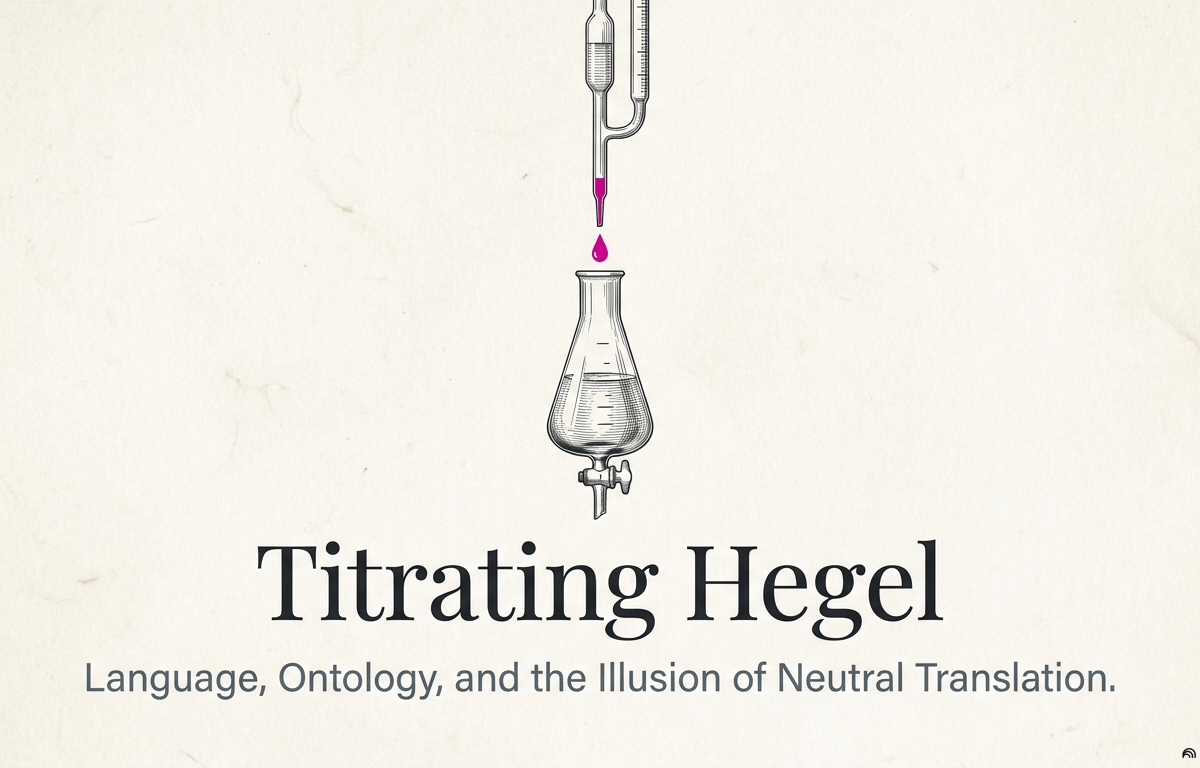
Which brings us back to the title. Titration works when you have a known reagent and a neutral solvent – you add one to the other until the system reaches equilibrium. The whole method assumes there is an equilibrium to reach. Geist has no neutral solvent. Mind and Spirit are not two concentrations of the same substance. They are different substances, differently constituted, differently reactive. There is no volume at which one cancels the other out. You can titrate the word all you like. The indicator never changes colour. What you are left with is not a settled meaning but a record of your own ontological commitments, precipitated out of solution and sitting at the bottom of the flask – which, in the end, is more than most translations will admit.
Door Prize: Here’s your parting gift courtesy of NotebookLM…
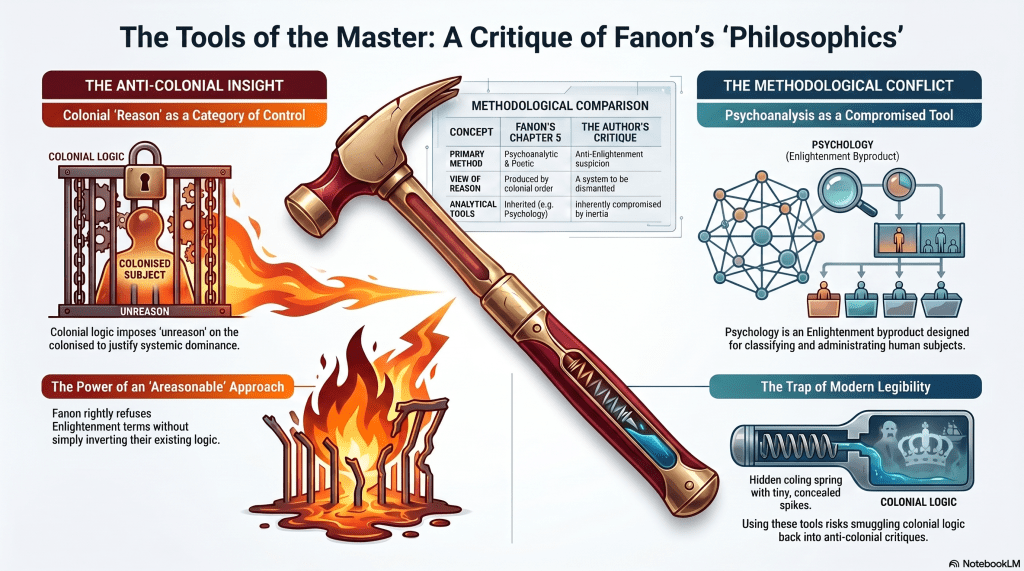
Yesterday, I complained about the psychoanalytic approach Fanon employed in Black Skin, White Masks, Chapter 4, The So-Called Dependency Complex of the Colonised. Today, I share my feelings about Chapter 5, The Lived Experience of the Black Man. But first, let’s reorient the reader to my own perspective.
I am decidedly anti-colonial and even anti-post-colonial, or at least I see this trajectory as tragic. All of this is consonant with the views expressed in my Anti-Enlightenment Project.
Audio: NotebookLM summary podcast of this topic.
On one hand, I want to complain about the circuitous approach he took in Chapter 5. It was meant to be metaphorical and poetic. Whilst I feel it’s a bold move to present an areasonable approach – one that refuses the terms of Enlightenment rationality without simply inverting them – it seems that he cherry-picks his tools from the arsenal of Enlightenment thought. This applies to much of the post-colonial project broadly, though my objection there is less to any particular theoretical allegiance and more to the foundational commitments: I oppose colonialism, empire, and hegemony on grounds that precede the debate about which critical vocabulary best serves their dismantling.
Fanon’s anti-Enlightenment critique is weakened where he imports psychoanalysis too trustingly. Psychology and psychoanalysis are themselves Enlightenment byproducts: systems for rendering the human subject legible, classifiable, interpretable, and administrable. To use them against colonial Reason without first subjecting them to the same suspicion risks reproducing the very machinery under critique. The result isn’t fatal to Fanon’s charge, but it is methodologically untidy. I don’t necessarily object to using Enlightenment-derived tools after critique; I object to retaining them as though their own conceptual machinery were innocent. Psychoanalysis may be useful as metaphor, rhetoric, or historically situated vocabulary, but if it’s treated as a valid evidentiary lens without scrutiny, it smuggles Enlightenment legibility back into an anti-Enlightenment critique. That’s where Fanon’s chapter loses force for me.
NotebookLM Infographic on this topic.
Fanon is at his strongest when he shows that colonial ‘reason‘ produces the colonised subject as irrational, bodily, affective, and deficient. He rightly treats unreason not as a natural property of the colonised but as a category imposed by colonial order. My difficulty is that he then routes this insight through psychoanalysis, a method I regard as metaphorically suggestive but evidentially weak. The critique of colonial rationality survives; the psychoanalytic apparatus remains suspect.
In the end, we may both at least tacitly agree that colonialism, and the Enlightenment more generally, was not the best path. Where we part is on what should have been taken instead. Cue Robert Frost.
But the more searching question isn’t which fork we should have taken – it’s what we do with the road we’re already on. When the system itself is the problem, the question of what within it is worth retaining rarely gets answered on its merits. More often, it gets answered by inertia: by what is convenient, familiar, or already institutionally embedded. Fanon isn’t exempt from this, and neither, if we’re honest, is any thinker who inherits a tradition whilst attempting to dismantle it. The tools available are always already compromised. The most we can ask – and what distinguishes the sharper critiques from the merely passionate ones – is whether the thinker knows this, and accounts for it. Fanon sometimes does. In Chapter 5, at the moments that matter most, he doesn’t quite.
NB: I used ChatGPT for the cover image. I think it did a good job.







 Philosophics