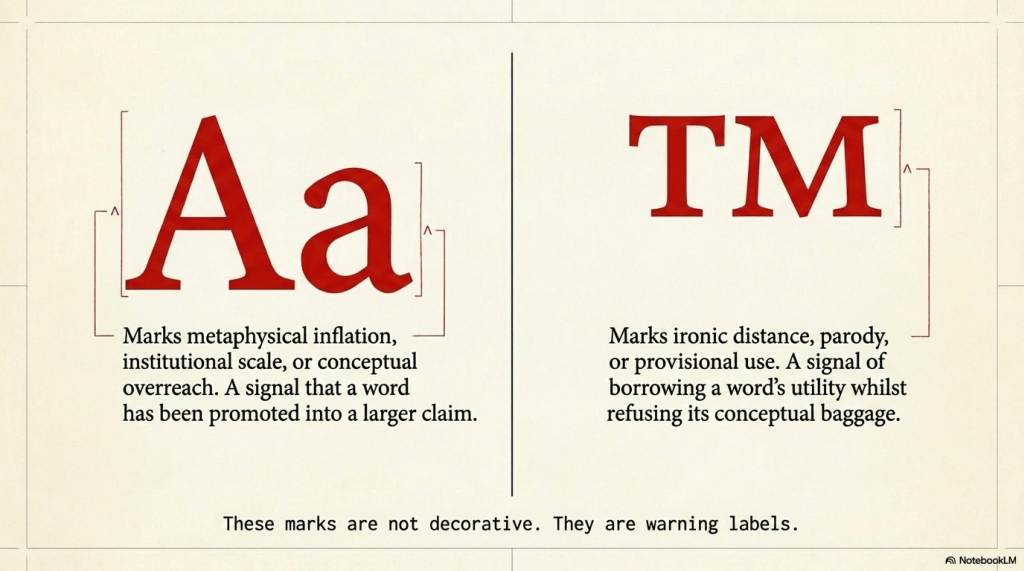
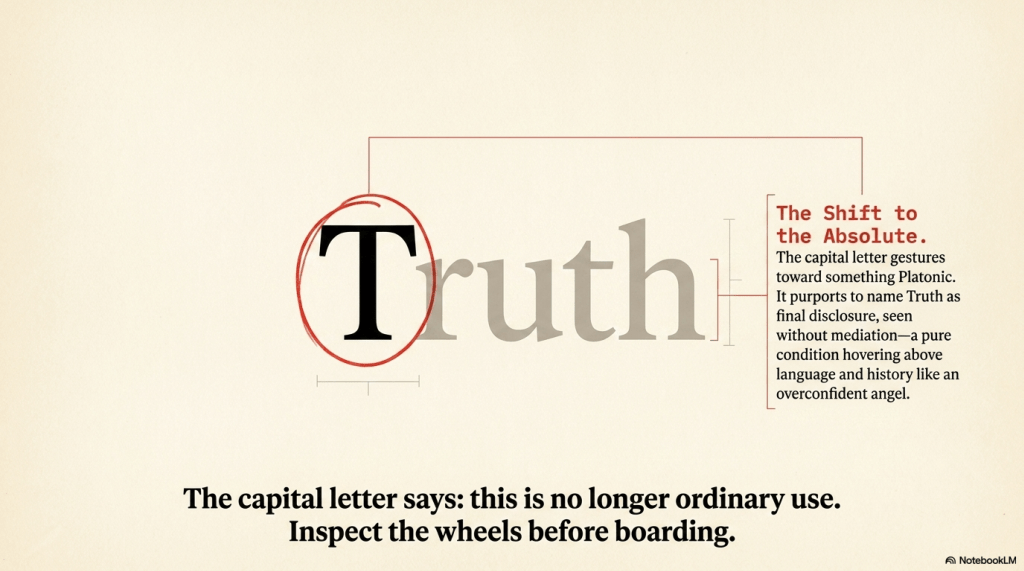
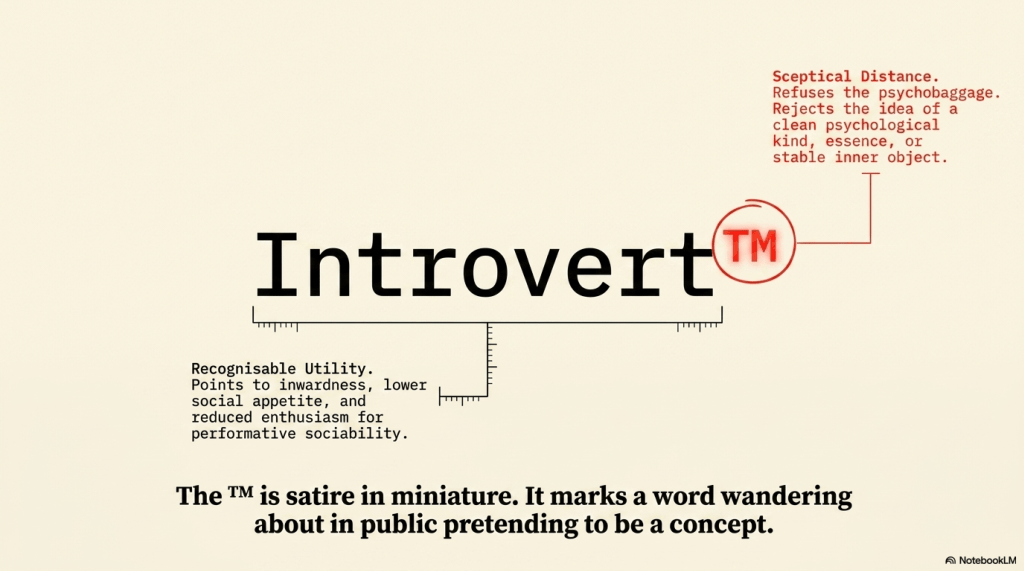
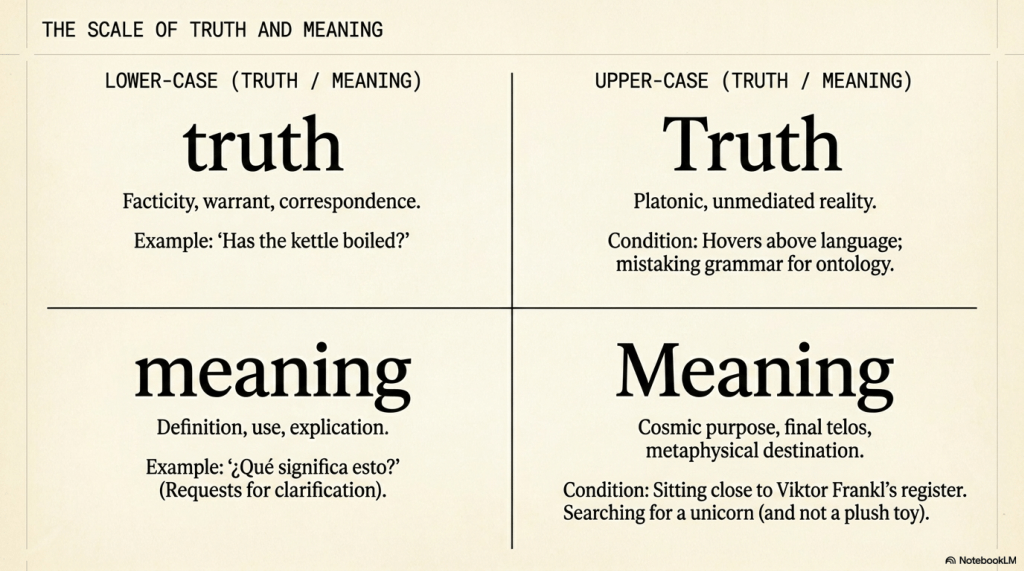
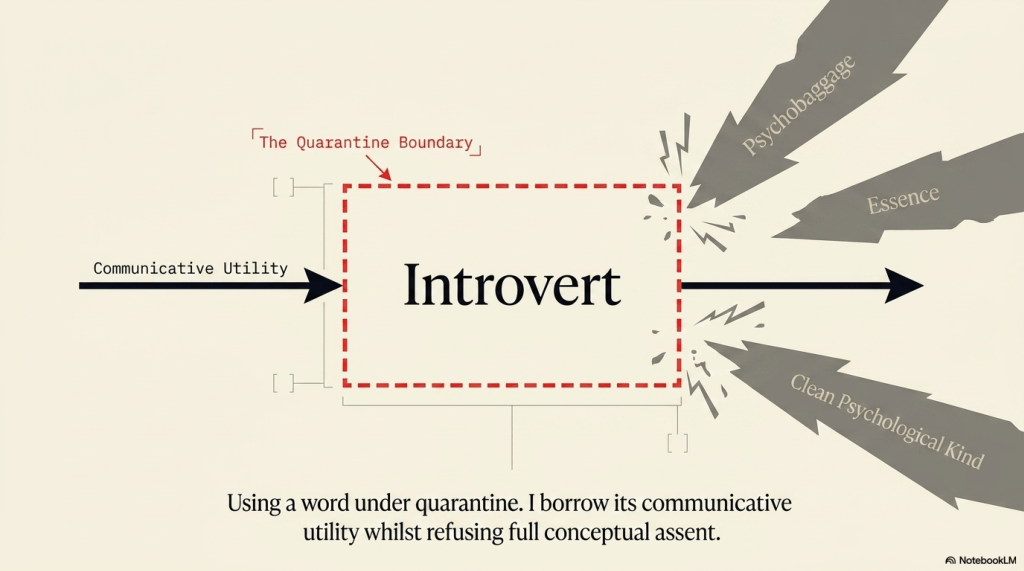
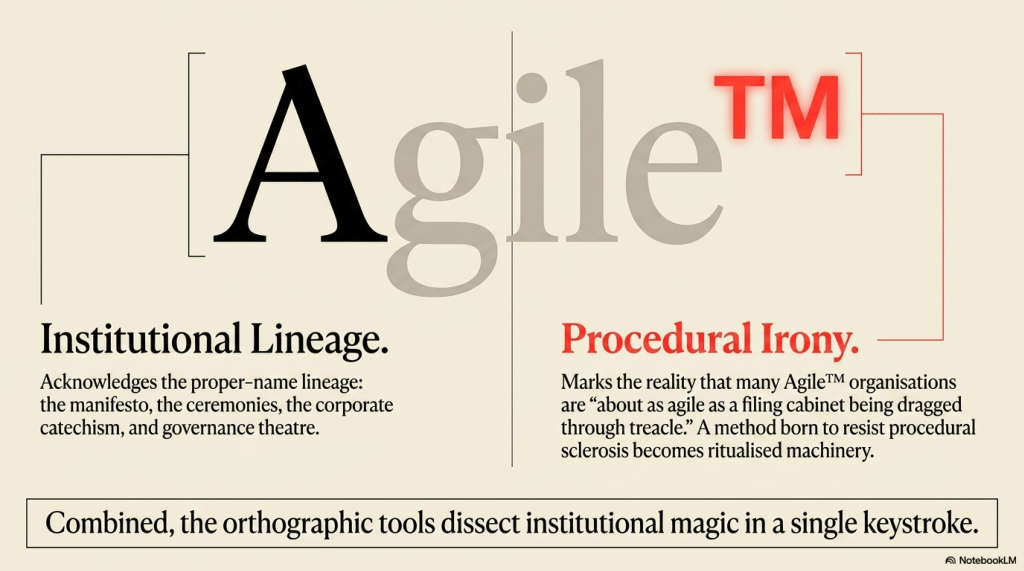
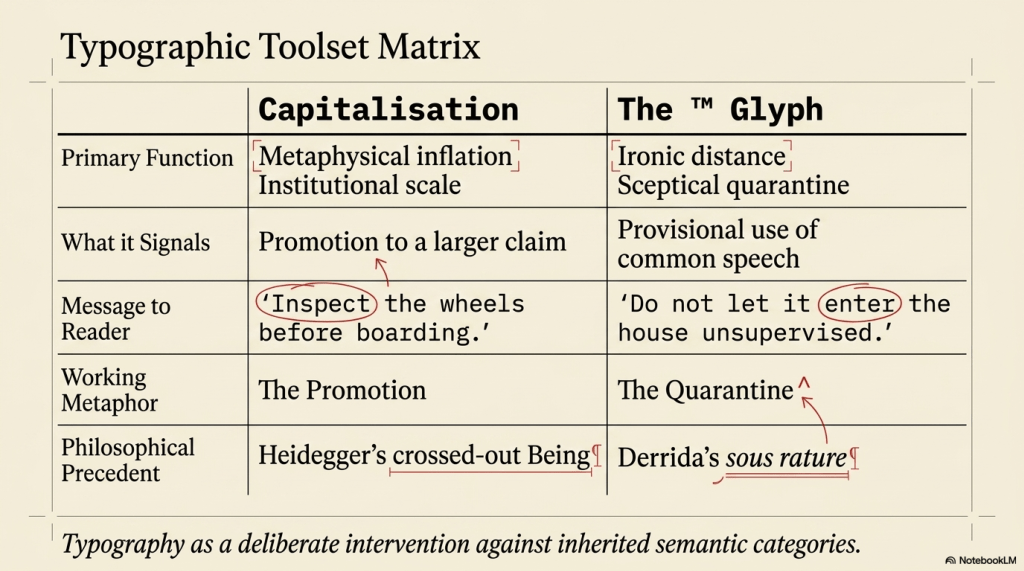
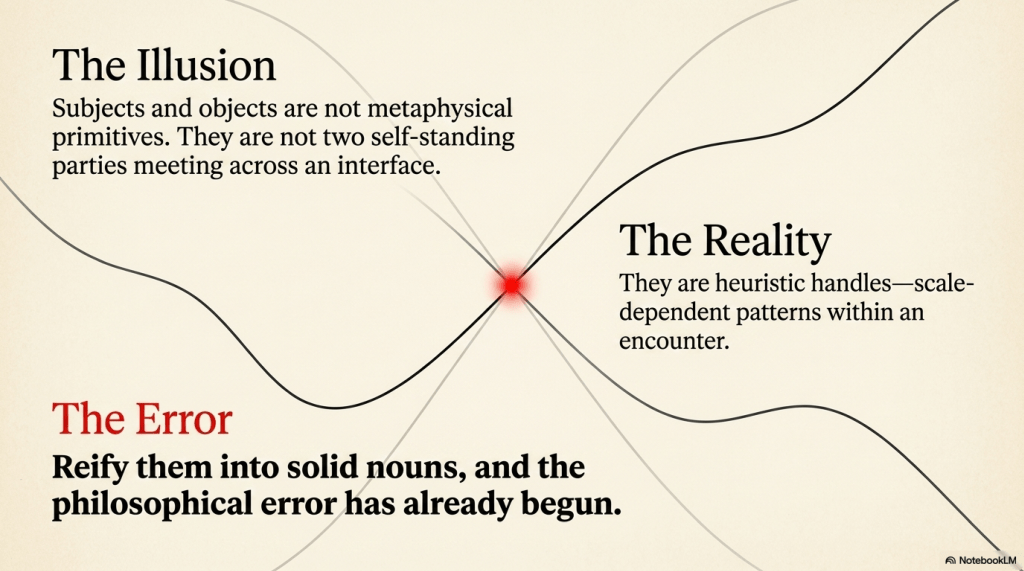
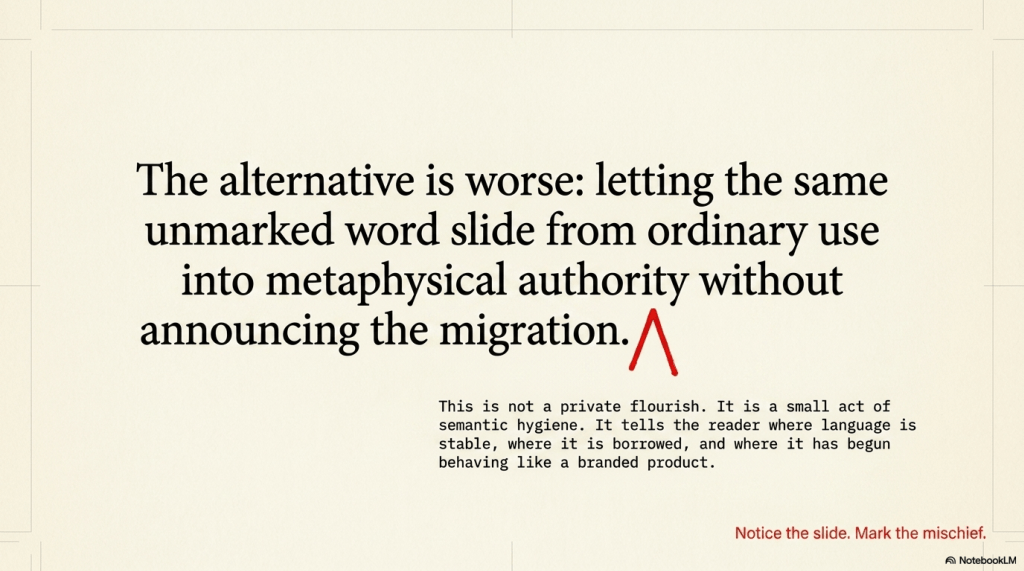
I have an orthographic habit, perhaps merely a private convention, though I rather suspect all conventions begin this way before someone gives them a Latin name and a committee. I use typography to signal when a word is doing more than pedestrian language ordinarily admits.
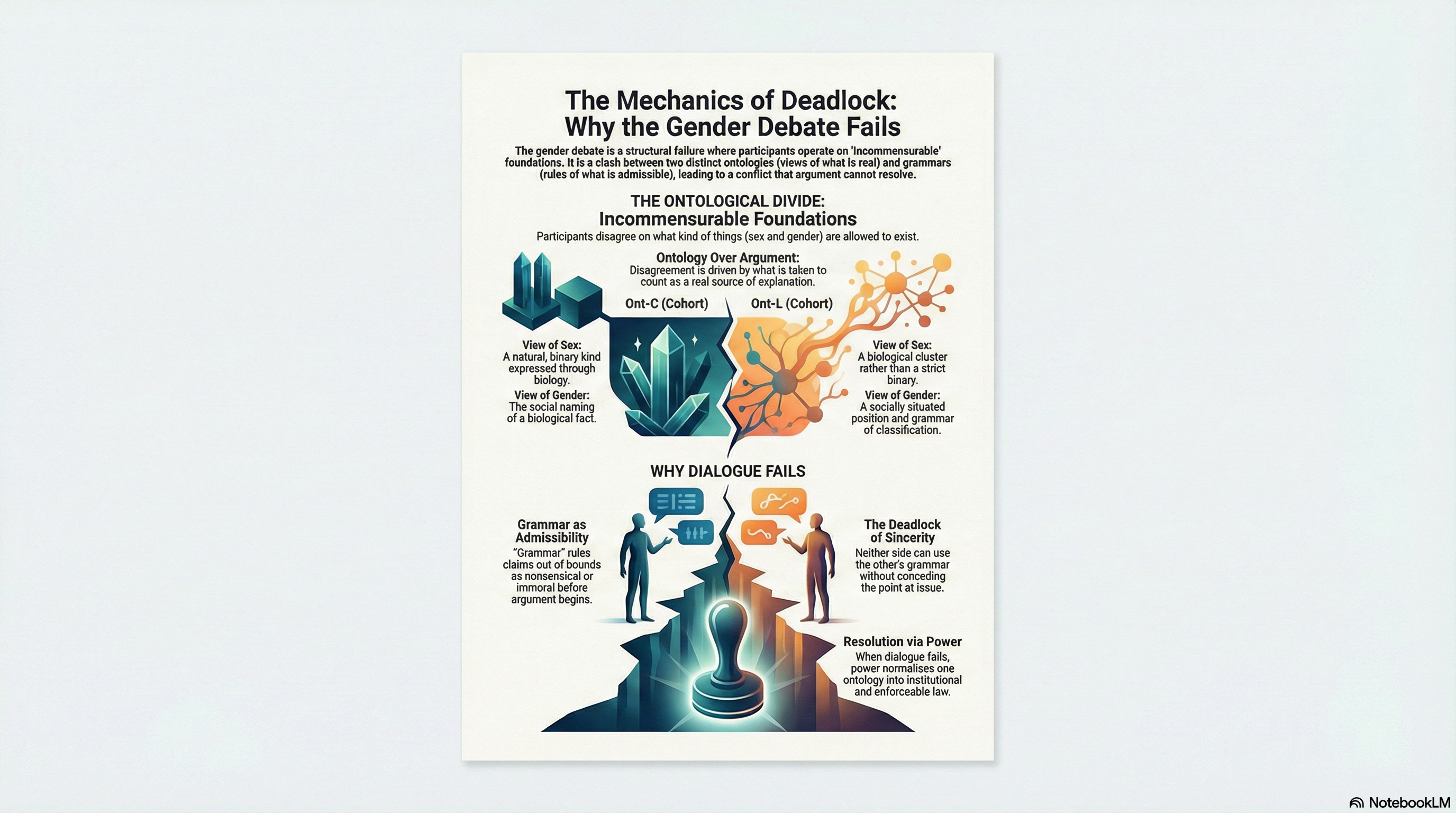
I’ve been thinking through dozens of use cases to explain how some polemic positions are intractable via language. When they are resolved through power, at least one ontological cohort is left wanting. In a compromise, likely both sides feel they’ve lost.
Audio: NotebookLM summary podcast of the video transcript for this topic.
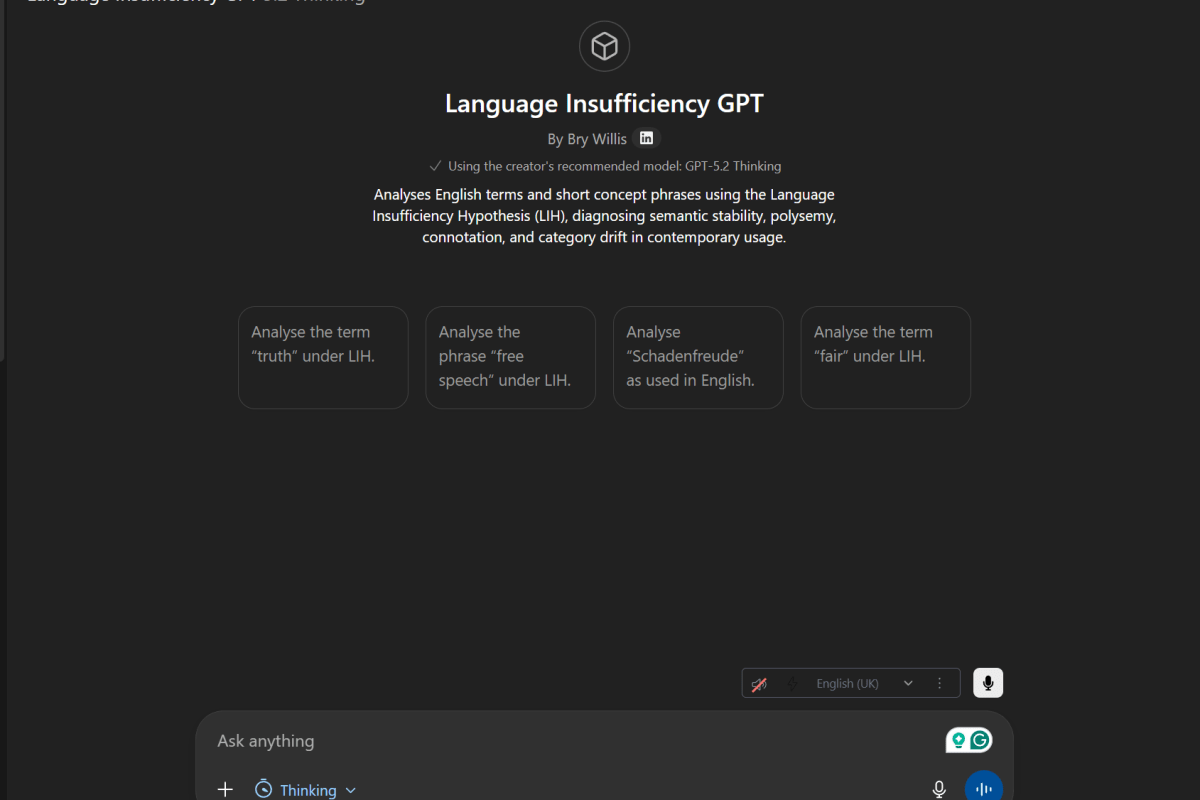
I’ll post a separate announcement presently, but I want to share my new Legibility GPT to assess concepts for ontological and grammatical commensurability.
In conventional (read: orthodox Enlightenment thinking), communication and negotiation are supposed to bring groups together. This is only true for intra-ontological conflict; it’s never been true for inter-ontological issues. There are edge cases where differing ontologies might be satisfied with an inter-ontological agreement, but this is likely accidental and certainly differently motivated. Not all such disagreements can be mediated, and this is where power politics steps in – not to ameliorate but to force the matter. This happens in politics, law, and many other power-oriented domains.
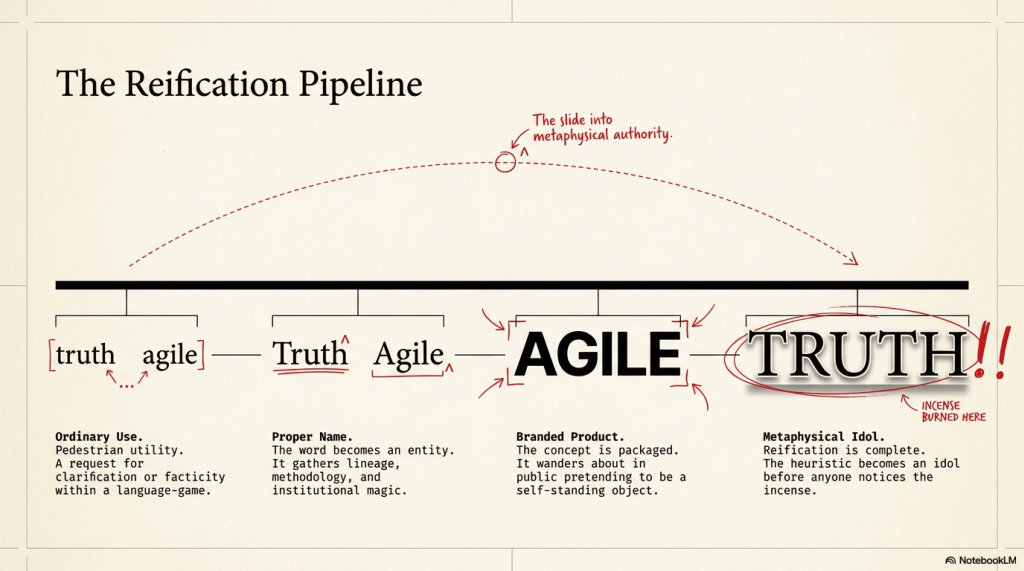
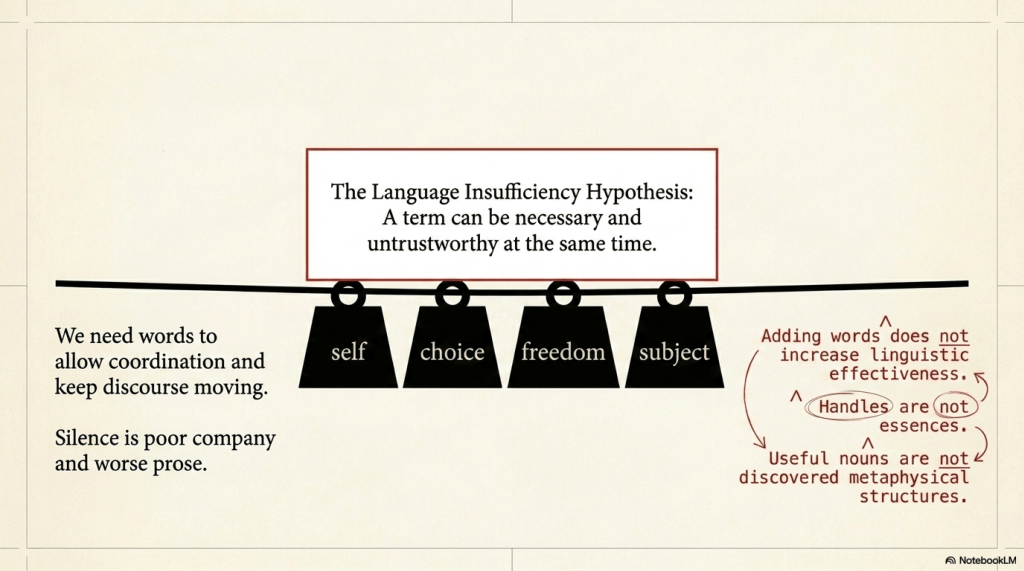
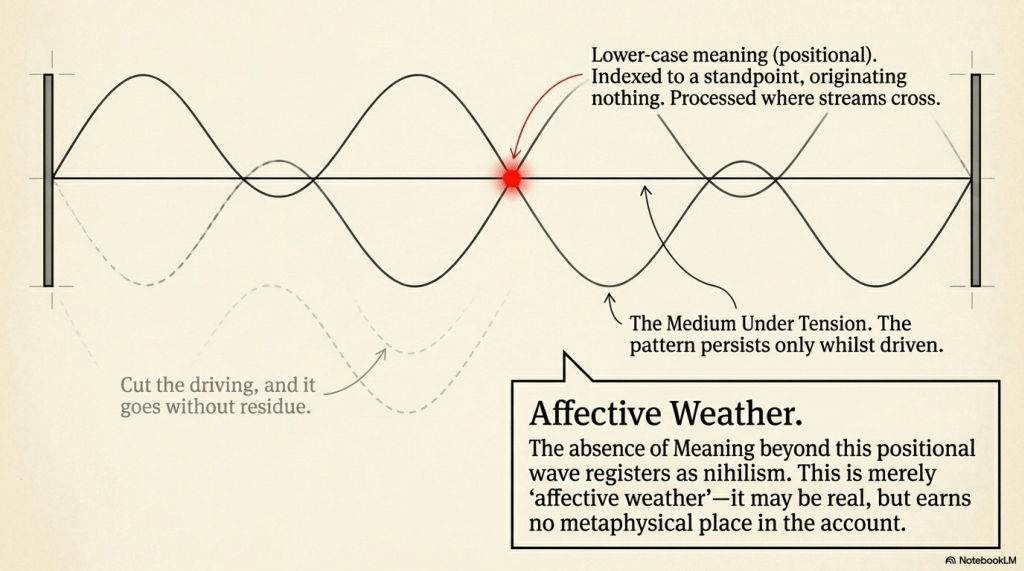
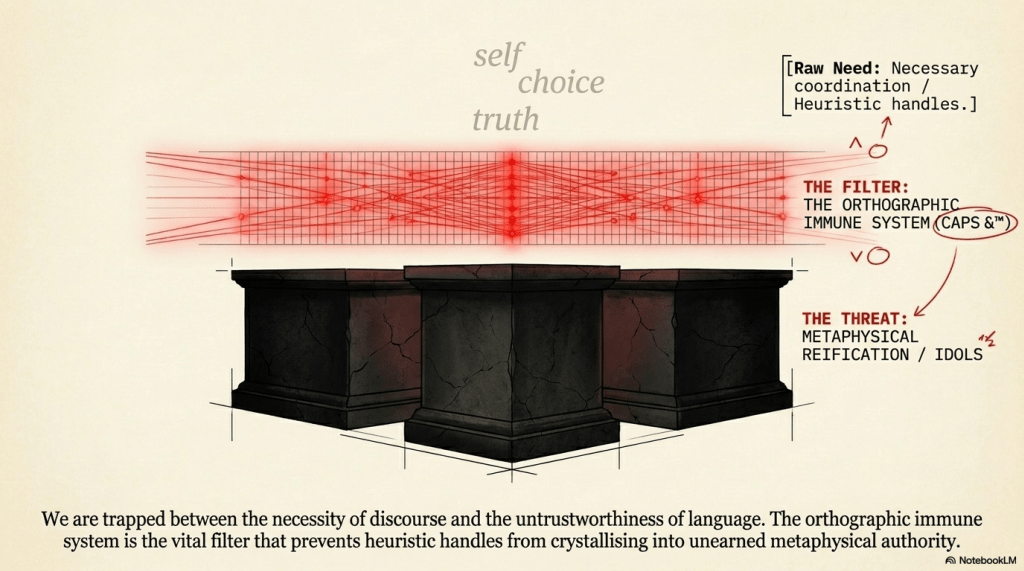
NotebookLM Infographic: No idea why this is formatted like this.
As the publication date of A Language Insufficiency Hypothesis (LIH) draws nearer, I feel it’s a good time to promote it (obviously) and to introduce some of the problems it uncovers – including common misperceptions I’ve already heard. Through this feedback, I now understand some of the underlying structural limitations that I hadn’t considered, but this only strengthens my position. As I state at the start of the book, the LIH isn’t a cast-in-stone artefact. Other discoveries will inevitably be made. For now, consider it a way to think about the deficiencies of language, around which remediation strategies can be developed.
Audio: NotebookLM summary podcast of this content.
Let’s clear the undergrowth first. The Language Insufficiency Hypothesis is not concerned with everyday ambiguity, garden-variety polysemy, or the sort of misunderstandings that vanish the moment someone bothers to supply five seconds of context. That terrain is already well-mapped, thoroughly fenced, and frankly dull.
Take the classic sort of example wheeled out whenever someone wants to sound clever without doing much work:
‘I made a 30-foot basket’.
Video: a woman making a large basket
If you’re a basketweaver, you picture an absurdly large basket and quietly question the maker’s life choices. If you’re watching basketball, you hear ‘score’. If you’re anywhere near the context in which the sentence was uttered, the meaning is obvious. If it isn’t, the repair cost is trivial. Add context, move on, live your life.
Language did not fail here. It merely waited for its coat. This is not the sort of thing the LIH loses sleep over.
The Groucho Marx Defence, or: Syntax Is Not the Problem
Logicians and armchair philosophers love to reach for jokes like Groucho Marx’s immortal line:
‘I shot an elephant in my pyjamas. Why it was wearing my pyjamas, I’ll never know’.
Video: A man and elephant in pyjamas (no sound)
Yes, very funny. Yes, the sentence allows for a syntactic misreading. No, nobody actually believes the elephant was lounging about in striped silk. The humour works precisely because the “wrong” parse is momentarily entertained and instantly rejected.
Again, language is not insufficient here. It’s mischievous. There’s a difference.
If the LIH were worried about this sort of thing, its ambitions would be indistinguishable from an undergraduate logic textbook with better branding.
Banks, Rivers, and the Myth of Constant Confusion
Likewise, when someone in a city says, ‘I went to the bank’, no sane listener imagines them strolling along a riverbank, unless they are already knee-deep in pastoral fantasy or French tourism brochures. Context does the heavy lifting. It almost always does.
Video: Rare footage of me trying to withdraw funds at my bank (no sound)
This is not a crisis of meaning. This is language functioning exactly as advertised.
Where the Trouble Actually Starts: Contestables
The LIH begins where these tidy examples stop being helpful. It concerns itself with Contestables: terms like truth, freedom, justice, fairness, harm, equality. Words that look stable, behave politely in sentences, and then detonate the moment you ask two people what they actually mean by them. These are not ambiguous in the casual sense. They are structurally contested.
In political, moral, and cultural contexts, different groups use the same word to gesture at fundamentally incompatible conceptual frameworks, all while assuming a shared understanding that does not exist. The conversation proceeds as if there were common ground, when in fact there is only overlap in spelling.
That’s why attempts to ‘define’ these terms so often collapse into accusation:
That’s not what freedom means. That’s not real justice. You’re redefining truth.
No, the definitions were never shared in the first place. The disagreement was smuggled in with the noun.
‘Just Ignore the Word’ Is Not a Rescue
A common response at this point is to suggest that we simply bypass the troublesome term and discuss the concrete features each party associates with it. Fine. Sensible. Often productive. But notice what this manoeuvre concedes. It does not save the term. It abandons it.
If meaningful discussion can only proceed once the word is set aside and replaced with a list of clarifications, constraints, examples, and exclusions, then the word has already failed at its primary job: conveying shared meaning. This is precisely the point the LIH is making.
The insufficiency is not that language is vague, or flexible, or context-sensitive. It’s that beyond a certain level of conceptual complexity, language becomes a confidence trick. It gives us the feeling of agreement without the substance, the appearance of communication without the transaction.
At that point, words don’t merely underperform. They mislead.
I shared this post not too long ago. Today, I shared it in a different context, but I feel is interesting – because I feel that many things are interesting, especially around language and communication.
Ocrampal shared a link to an article debating whether we are cold or have cold. Different cultures express this differently. It’s short. Read it on his site.
Audio: Exceptional NotebookLM summary podcast of this topic.
I replied to the post:
Nicely observed. I’ve pondered this myself. Small linguistic tweak: between être and avoir, avoir already behaves better metaphysically, but sentir seems the cleanest fit. Cold isn’t something one is or has so much as something one senses — a relational encounter rather than an ontological state or possession.
Between having and being, having is the lesser sin — but sensing/feeling feels truer. Cold belongs to the world; we merely sense it.
He replied in turn:
Agree except for: “Cold belongs to the world”. That is a metaphysical assumption that has consequences …
Finally (perhaps, penultimately), I responded:
Yes, it does. That statement was idiomatic, to express that ‘cold’ is environmental; we can’t be it or possess it. Coincidentally, I recently wrote about ‘cold’ in a different context:
A more verbose version of this response might have been:
This pushback is fair, but I’m not trying to re-ontologise cold. “Belongs to the world” in that context is doing rhetorical, not metaphysical, work; it’s idiomatic.
The point isn’t that cold is a mind-independent substance waiting around like a rock. It’s that whatever cold is, it doesn’t sit comfortably as an identity predicate (‘I am…cold’ – ‘J’ai…froid‘) or a possession (‘I have…cold’ – so, not ‘Je suis…froid‘) – neither to be confused with ‘I have a cold’, a different animal altogether.
‘Sensing’ (‘I feel…cold’ – ‘Je me sens…froid‘ – we have to use the reflexive pronoun, me, here; in English, this syntax has been deprecated) keeps the relation explicit without smuggling in ownership or essence. It leaves cold as an encounter-property, not a thing I contain and not a thing I am.
If anything, that phrasing was meant to resist metaphysical inflation, not commit to it.
And this is exactly the problem I gestured at in the aliens piece. We mistake familiar grammatical scaffolding for shared metaphysics. We assume that if the sentence parses cleanly, the ontology must be sound.
Language doesn’t just describe experience. It quietly files it into categories and then acts surprised when those categories start making demands.
Cold, like aliens, exposes the trick. The moment you slow down, the grammar starts to wobble. And that wobble is doing far more philosophical work than most of our declarative sentences are willing to admit.
I am a philosopher of language. That is typically my primary perspective, so communication and limitations often fall into my sights. I believe that not all disagreements can be resolved through language communication. This illustrates one barrier in particular.
This essay is not an attempt to resolve disagreement, adjudicate truth, or reconcile competing worldviews. It is an attempt to explain why so many disagreements persist despite intelligence, good faith, and shared vocabulary – and why escalating those disagreements often makes them worse rather than better.
What follows is diagnostic rather than prescriptive. I am less interested in who is right than in why arguments so often fail to converge, and why those failures are routinely misinterpreted as moral defects rather than structural mismatches. The claim is not that ‘anything goes’, nor that all perspectives are equally valid, but that many disputes operate across ontological fault lines that no amount of better reasoning, evidence, or civility can bridge on their own terms.
Recognising this does not require abandoning one’s commitments. It requires abandoning the fantasy that every disagreement is corrigible and that persuasion is always the appropriate response to difference. If the essay succeeds, it will not produce consensus. It may, however, produce a little more clarity, a little less moral theatre, and a slightly more disciplined form of charity – one grounded not in agreement, but in an honest appraisal of where disagreement actually lives.
Audio: NotebookLM summary podcast of this content.
On Ontological Incommensurability and the Case for Civilised Disagreement
Most disagreements that metastasise into moral theatre are not disagreements at all. They are collisions between incompatible ontologies, misdiagnosed as differences of opinion.
This assumption is not merely optimistic. It’s wrong.
We continue to behave as though all disputes take place on a shared stage called “reality,” where facts sit patiently waiting to be interpreted, weighed, or refuted. From this perspective, disagreement is assumed to be corrigible. If only one side listened harder, reasoned better, or acquired the right evidence, convergence would follow. This assumption is not merely optimistic. It is wrong.
Many of our most entrenched conflicts persist precisely because the parties involved do not inhabit the same world in any substantive sense. They operate with different background assumptions about what exists, what counts as real, what can ground truth, and what sorts of things are even eligible for belief. Argument, in such cases, does not fail due to bad faith or insufficient charity. It fails because it presumes a shared ontology that does not exist.
Before proceeding, a clarification. I am using ontology here in a deliberately broad, working sense. Not merely as an inventory of what exists, but as the background framework that determines what can count as real, meaningful, or normatively binding in the first place. This inevitably overlaps with epistemology, ethics, and theories of agency. Not because these domains are identical, but because in lived discourse they travel together. The fault line I am describing is not disciplinary. It is structural.
Video: Two people in ontological bubbles. (no sound)
Opinion Is Not Ontology
A difference of opinion presupposes a common world. Two people may disagree about what justice requires, but only because they agree, tacitly, that justice is a thing of some kind. Two people may dispute whether God exists, but only because they share enough conceptual scaffolding for the sentence to function.
Ontological disagreement runs deeper. It concerns not what is the case, but what it even means for something to be the case at all. When these levels are conflated, discourse becomes theatrical. Arguments are repeated with increasing urgency, frustration is moralised, and disagreement is reinterpreted as stubbornness, ignorance, or vice. Civility erodes not because people are cruel, but because they are speaking from worlds that do not interlock.
Consider debates over abortion. Pro-life arguments typically presuppose that the fetus is already a moral person; pro-choice arguments often presuppose that moral personhood is inseparable from bodily autonomy. These positions are not primarily disagreements about policy, compassion, or even ‘the value of life’. They are disagreements about what kinds of entities exist and when they begin to matter. Shared language about rights or harm often masks this deeper ontological divergence, which is why such debates rarely converge despite decades of argument.
When Critique Presumes the Ontology It Opposes
This distinction helps explain a familiar but often confusing phenomenon: cases where two parties appear to agree on symptoms, vocabulary, and even outrage, yet remain fundamentally misaligned.
Consider critiques of institutional cruelty that condemn dehumanising practices while retaining the very assumptions that make those practices intelligible. For example, workplace critiques that oppose excessive surveillance, unfair metrics, or punitive performance targets often still presume the figure of the autonomous, responsible worker whose output reflects individual will. The system is blamed for misapplying norms, not for producing those norms as instruments of control. Such critiques are often insightful and well-intentioned. They identify real harm. They name real suffering. And yet they stall.
The reason is not timidity or bad analysis. It is ontological inheritance. These critiques operate inside the same metaphysical framework that generates the harm they diagnose. They presuppose moral realism, individual agency, and normative grounding as givens, then object to their misapplication. The result is an internal critique: coherent, compelling, and structurally limited.
This is not a misunderstanding. It’s a category error.
From a different ontological position, the problem is not that the norms are misapplied, but that the norms themselves function as delivery mechanisms of harm. What appears as reform from within appears as reenactment from without. This is not a misunderstanding. It is a category error.
Recognising this helps explain why superficial agreement so often feels productive while changing nothing. Shared language can create the appearance of convergence while leaving foundational divergence intact. The temperature drops. The mediator applauds. The underlying machinery hums on.
Igtheism and the Refusal to Pretend
This is why I describe myself, somewhat unfashionably, as an igtheist rather than an atheist.
Atheism still accepts the question ‘Does God exist?’ as well-formed. It grants the concept enough coherence to deny its instantiation. Agnosticism does much the same, merely pausing at the threshold. Both remain inside the game.
Igtheism steps back and asks a prior question: What, precisely, are we talking about? If no stable referent can be specified, the sentence does not become false. It becomes undefined. The system returns ‘does not compute’. This is not evasive. It is diagnostic.
I cannot make sense of strong metaphysical Realism
Try as I may, I cannot make sense of strong metaphysical Realism, let alone Theism. The idea that there exists a fully formed, mind-independent world ‘out there’, grounding truth prior to mediation, language, practice, or perspective, does not parse for me. Not as a contested claim. As a coherent one.
However, and this is the crucial point, once I accept Realism as a mechanism, Theism suddenly makes sense. If you already believe in a metaphysically exterior realm that guarantees truth and coherence, then placing God there is not a leap. It is an economy of scale.
Paraphrased bluntly: They believe there is a whole world ‘out there’. I don’t believe in any of it, so God might as well live out there, too.
From within that worldview, atheistic Realism is arguably the stranger position. The cathedral has been built; denying the altar looks parsimonious rather than principled.
I am not offering a competing metaphysical system here. Not idealism, not pragmatism, not a substitute ontology waiting in the wings. I am declining the assumption that reality must come pre-packaged as a mind-independent domain in order to be intelligible or actionable at all.
Of course, non-realist positions are not exempt from this problem; they, too, can smuggle in unexamined ontological commitments under the guise of pragmatism, coherence, or practice.
Pascal’s Wager and Ontological Blackmail
This is why igtheism tends to offend theists more than atheism ever could. When a theist says, ‘How can you not care? Your soul depends on it’, they are not making an argument. They are issuing an ontological demand. Pascal’s Wager is merely this demand formalised into decision theory.
How can you not care?
The wager only works if one has already granted the existence of souls, post-mortem identity, divine reward structures, and a cosmic enforcement mechanism that cares about belief states. Without those assumptions, there is no wager. There is only a shouted house rule addressed to someone who is not in the casino.
None of this is meant to trivialise the existential seriousness with which such claims are often held. It is simply to note that care does not precede ontology; it follows it. One cannot meaningfully care about entities one does not recognise as intelligible occupants of the world.
Why This Doesn’t End in Relativism
None of this implies that ‘all ontologies are equally true’, nor that disagreement is pointless. It implies something far less comforting and far more useful: many disagreements are non-resolvable by design. This does not deny that ontological frameworks can and do shift over time, sometimes under empirical pressure; it only denies that such shifts are guaranteed, universal, or achievable through argument alone.
Non-resolvability does not entail arbitrariness. Ontological frameworks can be evaluated for internal coherence, practical consequences, and the kinds of lives they make possible. What cannot be done is to adjudicate between them using criteria that belong exclusively to one side. Recognising this does not require abandoning one’s worldview. It requires abandoning the fantasy that persuasion is always possible, or that failure to persuade is a moral defect.
Once we see that we are not standing on the same ground, something like charity becomes possible. Not the saccharine kind. The disciplined kind. I understand that this matters enormously to you. I do not share the ontology that makes it matter to me. This is not a truce forged through compromise. It is a ceasefire born of ontological honesty.
Civility Without Convergence
Our age is addicted to resolution. Every disagreement is treated as a problem to be solved, a synthesis waiting to happen, a bridge yet to be built. Sometimes there is no bridge. Sometimes the most responsible thing to do is to stop pretending there is one.
Sometimes there is no bridge. Sometimes the most responsible thing to do is to stop pretending there is one.
Civility does not require agreement. It does not even require mutual understanding in the strong sense. It requires only that we stop mistaking incompatible world-models for intellectual obstinacy. We are not all arguing about the same furniture. Some of us are questioning whether the room exists at all.
Once that is acknowledged, the volume drops. The moral theatre loses its urgency. And disagreement, while still real, becomes less corrosive. Not because we have reconciled our ontologies. But because we have finally noticed that they do not reconcile.
Naturally, it will make more sense alongside the book. But it may still provide a bit of entertainment – and mild discomfort – in the meantime.
tl;dr: Language is generally presumed to be stable. Words mean what you think they mean, right? A table is a table. A bird is a bird. Polysemy aside, these are solid, dependable units.
Then we arrive at freedom, justice, truth, and an entire panoply of unstable candidates. And let’s not even pretend qualia are behaving themselves.
So when someone says ‘truth’, ‘free speech’, or ‘IQ’, you may suddenly realise you’ve been arguing with a cardboard cut-out wearing your own assumptions. That isn’t just interpersonal mischief. It’s language doing exactly what it was designed to do: letting you glide over the hard problems while sounding perfectly reasonable.
Audio: Short NotebookLM summary of this page content*
Video: Legacy video explaining some features of the LIH.
If that sounds banal, you’ve already fallen for the trap.
Give it a try – or wait until you’ve digested the book. Not literally, unless you’re short on fibre.
Cheers.
Written by Bry Willis
Philosophics
* As I’ve cited previously, the quality of NotebookLM varies – usually in predictable directions. This one does well enough, but it doesn’t have enough context to get the story right (because it was only drawing from this page rather than from a fuller accounting of the LIH). Its trailing comment reveals that it doesn’t grasp that “new words” don’t solve the problem.
Earlier, it suggests that language is intentionally vague. This is not an assertion I make. You can read some of the earlier incarnations, or you can wait for it to be published.
Why shared language creates the illusion – not the reality – of shared experience
Human beings routinely assume that if another agent speaks our language, we have achieved genuine mutual understanding. Fluency is treated as a proxy for shared concepts, shared perceptual categories, and even shared consciousness. This assumption appears everywhere: in science fiction, in popular philosophy videos, and in everyday cross-cultural interactions. It is a comforting idea, but philosophically indefensible.
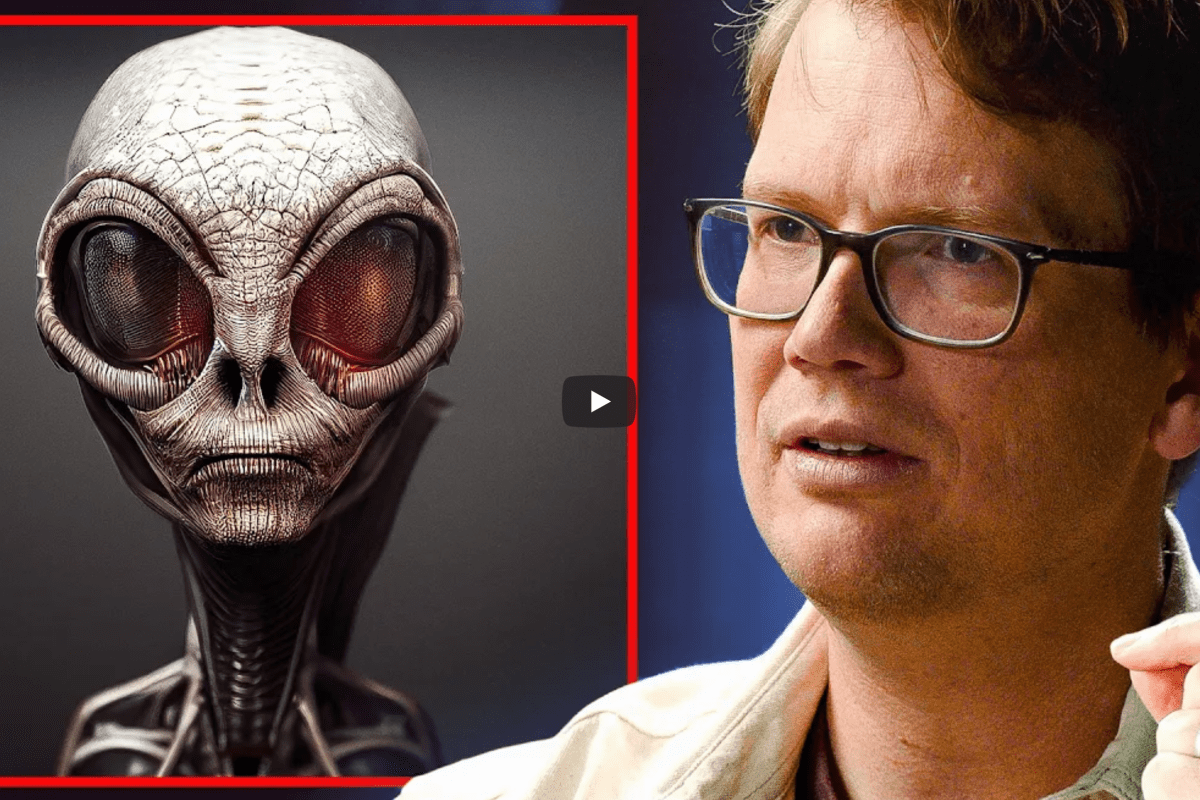
Video: Could You Explain Cold to an Alien? – Hank Green
Recent discussions about whether one could ‘explain cold to an alien’ reveal how deeply this assumption is embedded. Participants in such debates often begin from the tacit premise that language maps transparently onto experience, and that if two interlocutors use the same linguistic term, they must be referring to a comparable phenomenon.
A closer analysis shows that this premise fails at every level.
Audio: NotebookLM summary podcast on this topic.
Shared Language Does Not Imply Shared Phenomenology
Even within the human species, thermal experience is markedly variable. Individuals from colder climates often tolerate temperatures that visitors from warmer regions find unbearable. Acclimation, cultural norms, metabolic adaptation, and learned behavioural patterns all shape what ‘cold’ feels like.
If the same linguistic term corresponds to such divergent experiences within a species, the gap across species becomes unbridgeable.
A reptile, for example, regulates temperature not by feeling cold in any mammalian sense
A reptile, for example, regulates temperature not by feeling cold in any mammalian sense, but by adjusting metabolic output. A thermometer measures cold without experiencing anything at all. Both respond to temperature; neither inhabits the human category ‘cold’.
Thus, the human concept is already species-specific, plastic, and contextually learned — not a universal experiential module waiting to be translated.
Measurement, Behaviour, and Experience Are Distinct
Thermometers and reptiles react to temperature shifts, and yet neither possesses cold-qualia. This distinction illuminates the deeper philosophical point:
Measurement registers a variable.
Behaviour implements a functional response.
Experience is a mediated phenomenon arising from a particular biological and cognitive architecture.
Aliens might measure temperature as precisely as any scientific instrument. That alone tells us nothing about whether they experience anything analogous to human ‘cold’, nor whether the concept is even meaningful within their ecology.
The Problem of Conceptual Export: Why Explanation Fails
Attempts to ‘explain cold’ to hypothetical aliens often jump immediately to molecular description – slower vibrational states, reduced kinetic energy, and so forth. This presumes that the aliens share:
our physical ontology,
our conceptual divisions,
our sense-making framework,
and our valuation of molecular explanation as intrinsically clarifying.
But these assumptions are ungrounded.
Aliens may organise their world around categories we cannot imagine. They may not recognise molecules as explanatory entities. They may not treat thermal variation as affectively laden or behaviourally salient. They may not even carve reality at scales where ‘temperature’ appears as a discrete variable.
When the conceptual scaffolding differs, explanation cannot transfer. The task is not translation but category creation, and there is no guarantee that the requisite categories exist on both sides.
The MEOW Framework: MEOWa vs MEOWb
The Mediated Encounter Ontology (MEOW) clarifies this breakdown by distinguishing four layers of mediation:
T0: biological mediation
T1: cognitive mediation
T2: linguistic mediation
T3: social mediation
Humans run MEOWa, a world structured through mammalian physiology, predictive cognition, metaphor-saturated language, and social-affective narratives.
Aliens (in fiction or speculation) operate MEOWb, a formally parallel mediation stack but with entirely different constituents.
Two systems can speak the same language (T2 alignment) whilst:
perceiving different phenomena (T0 divergence),
interpreting them through incompatible conceptual schemas (T1 divergence),
and embedding them in distinct social-meaning structures (T3 divergence).
Linguistic compatibility does not grant ontological compatibility. MEOWa and MEOWb allow conversation but not comprehension.
Fiction as Illustration: Why Aliens Speaking English Misleads Us
In Sustenance, the aliens speak flawless Standard Southern English. Their linguistic proficiency invites human characters (and readers) to assume shared meaning. Yet beneath the surface:
Their sensory world differs;
their affective architecture differs;
their concepts do not map onto human categories;
and many human experiential terms lack any analogue within their mediation.
The result is not communication but a parallel monologue: the appearance of shared understanding masking profound ontological incommensurability.
The Philosophical Consequence: No Universal Consciousness Template
Underlying all these failures is a deeper speciesist assumption: that consciousness is a universal genus, and that discrete minds differ only in degree. The evidence points elsewhere.
If “cold” varies across humans, fails to apply to reptiles, and becomes meaningless for thermometers, then we have no grounds for projecting it into alien phenomenology. Nor should we assume that other species – biological or artificial – possess the same experiential categories, emotional valences, or conceptual ontologies that humans treat as foundational.
Consciousness is not a universal template awaiting instantiation in multiple substrates. It is alocal ecological achievement, shaped by the mediations of the organism.
Conclusion
When aliens speak English, we hear familiarity and assume understanding. But a shared phonological surface conceals divergent sensory systems, cognitive architectures, conceptual repertoires, and social worlds.
Linguistic familiarity promises comprehension, but delivers only the appearance of it. The deeper truth is simple: Knowing our words is not the same as knowing our world.
And neither aliens, reptiles, nor thermometers inhabit the experiential space we map with those words.
Afterword
Reflections like these are precisely why my Anti-Enlightenment project exists. Much contemporary philosophical commentary remains quietly speciesist and stubbornly anthropomorphic, mistaking human perceptual idiosyncrasies for universal structures of mind. It’s an oddly provincial stance for a culture that prides itself on rational self-awareness.
To be clear, I have nothing against Alex O’Connor. He’s engaging, articulate, and serves as a gateway for many encountering these topics for the first time. But there is a difference between introducing philosophy and examining one’s own conceptual vantage point. What frustrates me is not the earnestness, but the unexamined presumption that the human experiential frame is the measure of all frames.
Having encountered these thought experiments decades ago, I’m not interested in posturing as a weary elder shaking his stick at the next generation. My disappointment lies elsewhere: in the persistent inability of otherwise intelligent thinkers to notice how narrow their perspective really is. They speak confidently from inside the human mediation stack without recognising it as a location – not a vantage point outside the world, but one local ecology among many possible ones.
Until this recognition becomes basic philosophical hygiene, we’ll continue to confuse linguistic familiarity for shared ontology and to mistake the limits of our own embodiment for the limits of consciousness itself.
I’ve decided it might be worthwhile to share some of my thoughts earlier in their larval stages, if only to demonstrate that none of my essays arrive fully formed from the head of Zeus. Far from it. Most of my ideas ricochet around my skull for weeks, months, years – occasionally decades – before deciding to cooperate. Even the ones that appear spontaneous usually have a long archaeological tail if I bother to dig.
I also hold, rather unfashionably but quite firmly, that all knowledge is a derivative remix. No one escapes this, least of all me. My own work is stitched from whatever intellectual scrap I‘ve encountered along the way. This is why I’ve never been persuaded by the sanctity of ‘originality’ or the mythology of intellectual property. Ideas don’t respect fences. They migrate, hybridise, and reappear wearing different hats. Claiming exclusive rights over them feels more like territorial anxiety – Territorial Pissing – than epistemic necessity — though that, admittedly, is a polemic for another day.
The point is simply this: I’m documenting this particular idea not because it arrived perfect, but because I can see the threads that led to it. And because the genealogy is often more revealing than the polished conclusion.
What follows is one of those threads.
A recent exchange with Thomas on Mastodon forced me to articulate a phrase that arrived mostly as an intuition but seems to have legs: the relative intersubjectivity of subjectivity. Put briefly, subjectivity (S) is always perspectival, always bound to a particular point of view, but never free from the pressures of its relative environment (R). No subject springs forth pristine; it is continually formed and re-formed by the linguistic, social, institutional, and affective structures in which it is embedded.
As a minimal sketch:
R → S ∴ S₀ → S₁
as the subject metabolises the influence of R and becomes something other than its prior configuration.
This is neither the usual bogeyman of ‘relativism’ nor the heroic Cartesian subject polishing its autonomy in splendid isolation. It is a subject that is contingent without being dissolved, formed without being mechanistic, and embedded without being determined. In a way, this is an echo of the causa sui argument, that no S can be self-caused.
If one wanted an analogue, the Mediated Encounter Ontology (MEOW) provides it. In the same way that encounter-events are mediated through biological, cognitive, linguistic, and institutional tiers, subjectivity itself can be seen as a kind of slow-form encounter – one whose centre drifts as the mediating structures press upon it. The subject is not the neutral observer of these tiers; it is the ongoing outcome of their interaction. In this sense, the ‘relative intersubjectivity of subjectivity‘ is simply what a MEOW-adjacent ontology would predict once applied to the subject rather than the event.
Whether this deserves a full essay depends on whether I can demonstrate that the idea is genuinely new rather than a recycled fragment of Berger–Luckmann, Rosen, or post-Kantian anthropology. But at first glance, the conceptual terrain appears fertile – at least fertile enough to justify a longer wander.
It seems my latest rant about AI-authorship accusations stirred something in me, that I need to apologise for being a professional writer – or is that a writing professional? Blame the Enlightenment, blame writing and communication courses, whatevs. I certainly do. But since some people are still waving the pitchforks, insisting that anything too coherent must be artificially tainted, I should address the obvious point everyone keeps missing:
The writing structures people attribute to AI aren’t AI inventions. They’re human inventions. Old ones. Codified ones. And we made the machines copy them. Sure, they have a certain cadence. It’s the cadence you’d have if you also followed the patterns you should have been taught in school or opened a book or two on the topic. I may have read one or two over the years.
Wait for it… The orthodoxy is ours. I hate to be the one to break it to you.
Video: AI Robot Assistant (no audio)
Professional Writing Has Its Own House Rules (And They’re Older Than AI Neural Nets)
👉 I wrote earlier how even talking about AI is censored in Reddit. 🤷
Audio: NotebookLM podcast on this topic and the last one.
Long before AI arrived to ruin civilisation and steal everyone’s quiz-night jobs, we’d already built an entire culture around ‘proper writing’. The sort of writing that would make a communications lecturer beam with pride. The Sith may come in twos; good writing comes in threes.
Tell them what you’re going to say.
Say it.
Repeat what you told them.
But wait, there’s more:
Use linear flow, not intellectual jazz.
One idea per paragraph, please.
Support it with sources.
Conclude like a responsible adult.
These aren’t merely classroom antics. They’re the architectural grammar of academic, corporate, scientific, and policy writing. No poetic flourishes. No existential detours. No whimsical cadence. The aim is clarity, predictability, and minimal risk of misinterpretation. It’s the textual equivalent of wearing sensible shoes to a board meeting. So when someone reads a structured piece of prose and yelps, ‘It sounds like AI!’, what they’re really saying is:
It sounds like someone who was properly trained to write in a professional context.
Je m’accuse. AI Didn’t Invent Structure. We Forced It To Learn Ours. Full stop. The problem is that it did whilst most of us didn’t.
If AI tends toward this style – linear, tidy, methodical, lamentably sane – that’s because we fed it millions of examples of ‘proper writing’. It behaves professionally because we trained it on professional behaviour – surprisingly tautological. Quelle surprise, eh?
Just as you don’t blame a mimeograph for producing a perfectly dull office memo, you don’t blame AI for sounding like every competent academic who’s been beaten with the stick of ‘clarity and cohesion’. It’s imitation through ingestion. It’s mimicry through mass exposure.
And Now for the Twist: My Fiction Has None of These Constraints
My fiction roams freely. It spirals, loops, dissolves, contradicts, broods, and wanders through margins where structured writing fears to tread. It chases affect, not clarity. Rhythm, not rubrics. Experience, not exegesis.
No one wants to read an essay that sounds like Dr Seuss, but equally, no one wants a novel that reads like the bylaws of a pension committee.
Different aims, different freedoms: Academic and professional writing must behave itself. Fiction absolutely should not.
This isn’t a value judgement. One isn’t ‘truer’ or ‘better’ than the other – only different tools for different jobs. One informs; the other evokes. One communicates; the other murmurs and unsettles.
Not to come off like Dr Phil (or Dr Suess), but the accusation itself reveals the real anxiety. When someone accuses a writer of sounding ‘AI-like,’ what they usually mean is:
‘Your writing follows the conventions we taught you to follow – but now those conventions feel suspect because a machine can mimic them’.
And that’s not a critique of the writing. It’s a critique of the culture around writing – a panic that the mechanical parts of our craft are now automated and thus somehow ‘impure’.
But structure is not impurity. Professional clarity is not soullessness. Repetition, sequencing, scaffolding – these aren’t telltale signs of AI; they’re the residue of centuries of human pedagogy.
AI mirrors the system. It didn’t create the system. And if the system’s beginning to look uncanny in the mirror, that’s a problem of the system, not the reflection.
In Short: The Craft Is Still the Craft, Whether Human or Machine
Professional writing has rules because it needs them. Fiction abandons them because it can. AI imitates whichever domain you place in front of it.
The accusation that structured writing ‘sounds artificial’ is merely a confusion between form and origin. The form is ours. The origin is irrelevant.
If clarity is now considered suspicious, I fear for the state of discourse. But then again, I’ve feared for that for some time.
And apparently, I’ve still got more to say on the matter.