As an economist, I used to instruct my Econ 101 students to consider economics as another lens to add to their inventory, but as a philosopher my advice gets somewhat altered. I’ve discussed lenses before, though I can’t seem to find my econ story.
In any case, I’m interested in the philosophers account now. I don’t rescind my previous account which works well enough in a social context, but I want to discuss the ontological deficits in this advice.
NB: Now that I seem to be authoring more on Substack, I am trying to figure out what to do with this blog that I’ve been maintaining since 2017. I am considering using it as a holder of summaries and related digital assets, for example the PDF from Google Notebook. I expect to include a paragraph of two from the Substack article as a preview for readers to determine if it’s worth clicking. If you start at Substack, you may find this ancillary information to be useful.
Also, Substack doesn’t allow me to embed PDFs (through you can download them for viewing), and it doesn’t facilitate tables and such, so I’ve had to resort to alternate formats or screengrabs to share them as image files – not my preference.
IMPORTANT: Please not that my Substack is substantially free, so I am not pulling a bait and switch. If and when I place content behind a paywall, I’ll have a reason or at least an excuse. I believe that information should be free and freely shared with minimal constraints, which is the reason I don’t yet have anything protected.
Of course, I do sell books, but I also discuss the contents here and in other social media contexts. The books are more for a convenience of having everything in one place and supporting my endeavours, to provide additional incentives to produce similar content.
If you have any ideas or preferences, let me know.
I have been developing my French, so I rely on several primary resources.
Myself
This includes grammar books, novels and the rest of the traditional fare, some of which I have listed below. Books remain useful, despite their regrettable inability to generate notifications, harvest engagement or insist that one more chapter will transform your life.
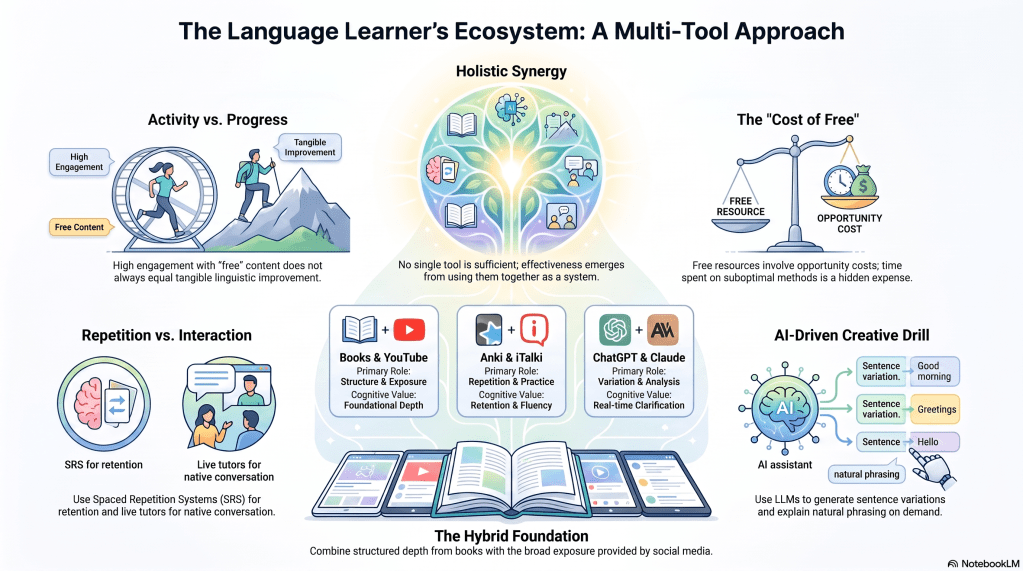
Audio: NotebookLM summary podcast of this topic.NotebookLM Infographic on this topic.
YouTube and Such
Social media is a time sink, and YouTube is no exception. This is not to argue that I derive no value from either. I do. It is merely to observe that the cost-benefit calculation may not always be in my favour.
That said, I encounter many useful tips, ideas and sources of general exposure to French. These help with learning, relearning and noticing gaps in what I thought I already knew.
There is, however, a risk. People teach and learn differently. Some teachers also believe they understand how they themselves learned and construct a method around that retrospective account. Memory being the immaculate scientific instrument that it is, this can create difficulties.
The first is obvious. A teacher may misattribute the cause of their own success and teach what is merely a covariant feature of the process. The method may have accompanied their learning without producing it. Remove the principal variable and the supposed method may accomplish very little.
A related problem arises when learners do not yet understand how they themselves learn. They may spend hours following a method that is suboptimal or even counterproductive. On the other hand, the method might happen to suit them perfectly. It can be difficult to know in advance.
A teacher may also be ideal for a learner at A1 or A2, but less appropriate at B1, B2 or beyond. By then, however, familiarity has become comfort, and comfort can masquerade as progress. This seems worth bearing in mind.
Even so, YouTube contains an enormous amount of material at nearly every level. The problem is not scarcity but selection.
Anki
Anki is excellent for repetitive learning tasks. It is essentially a flashcard system on steroids, although with fewer alarming side effects.
Many decks have already been constructed and made available online. I happen to use Anki for language learning, but it would be useful for almost any flashcard-oriented task, including academic study or memorising recipes, should that be your peculiar ambition.
This post is little more than a reference to Anki for context, but I recommend exploring it. There are also plenty of YouTube resources explaining how to use it for different purposes.
Anki supports text, images, audio and video, so it is genuinely multimedia rather than merely a digital imitation of index cards.
I have been using it to retain and expand my French vocabulary and grammar because I live somewhere French is not especially available. I would be better situated if I wanted to learn Spanish or Portuguese, and perhaps several other languages. For now, I shall pass.
Many of the cards I have imported come from decks with names such as “Top 1,000 Common Words”, “100 Conjugated Verbs” and “50 Useful Travel Phrases”. After enough examples involving “She has an apple”, “She gave him an apple” and “He would like her to give an apple to his father”, my mind wandered towards Snow White and poisoned apples.
In English, one may speak of a poison apple, treating poison as an attributive noun, or of a poisoned apple, in which poisoned describes what has happened to it. French does not ordinarily preserve the first construction unless one is deliberately inventing a literary compound. The natural French expression is:
Elle a mangé une pomme empoisonnée. She ate a poisoned apple.
I asked ChatGPT about this. I shall spare you the full forensic inquiry into the apple. What interested me more was its suggestion that I diversify the examples in my deck.
iTalki
I use iTalki for live conversation with native speakers. Although I am not formally endorsing the platform, I recommend investigating it and have found it useful.
I have interacted with only two teachers, but I enjoyed working with each of them for different reasons. Lessons are relatively inexpensive, although rates vary considerably between teachers. They are not as cheap as YouTube or Anki because they are not free, but, as an economist, I also take opportunity costs into account.
Spending hours on a free platform without acquiring any durable knowledge still entails a cost. Free is not synonymous with costless, despite what several business models would prefer us to believe.
I am not trying to sell anyone on iTalki or a similar service, but one can sample it fairly cheaply. A lesson might cost about the same as a cup or two of aggressively marketed coffee. Since I do not drink coffee, I already have the necessary budgetary fiction in place.
ChatGPT and Claude
I also use ChatGPT and Claude frequently. In this case, ChatGPT suggested several variations that retained the grammatical structure while making the sentences slightly less lifeless:
Elle a mangé une pomme empoisonnée. She ate a poisoned apple.
Elle a mangé une pomme pourrie. She ate a rotten apple.
Elle a mangé une pomme volée. She ate a stolen apple.
Elle a mangé une pomme interdite. She ate a forbidden apple.
Elle a mangé une pomme étrange. She ate a strange apple.
This is a minor use of a large language model, but a useful one. It can produce controlled variations, introduce vocabulary I have not encountered often and help prevent repetitive exercises from collapsing into grammatical wallpaper.
It can also explain why one construction sounds natural and another does not, generate examples at a particular level and create drills around a specific weakness. Naturally, its answers still require scrutiny. Confidently delivered nonsense remains nonsense, even when it arrives with immaculate formatting.
Taken together, these resources serve different functions. Books provide structure and depth. YouTube supplies exposure and ideas. Anki makes repetition tolerable. iTalki provides live interaction. Language models generate variations and explanations on demand.
None is sufficient by itself. Used together, however, they form a reasonably effective learning environment, provided one continues to distinguish activity from progress. The first is easy to measure. The second is what all the activity was supposedly for.
NB: I wrote this by hand and passed it through ChatGPT to clean it up. Let’s call it 95% human authored and call it a day.
Image: Gemini Nano Banana Pro’s first mis-render. This and the cover image are intentionally stereotypically satirical.
I’ve shared another article on Substack about how the AI-authorship debate is bollox.
Audio: NotebookLM summary podcast of this topic.
The LLM-versus-human debate has been raging for several years now, and there seem to be two principal camps: human exceptionalists and agnostics. I suppose there may also be a small, misanthropic faction, but its members are either remarkably quiet or indistinguishable from everyone else online. If you are out there, do raise your voice.
If you want to witter on about other negative aspects of AI, have at it, but the authorship debate is weak tea.
I shared another Substack post, but I want to expand it a bit here. On the Substack version, I conspicuously didn’t name certain obvious names, but here, I shall. I also left out a reference to Plato’s Republic.
The current American regime is built on meritocracy, and – this is the part everyone misses – it would not deny the charge. It rather likes the word. It uses the reinterpreted version, the laundered one my other essay was about, in which merit means precisely whatever the sovereign has decided it should mean this morning. Accuse them of meritocracy, and they will thank you for noticing.
Take the man at the centre of it. Whether Donald Trump is meritorious is not, in the end, a question about Donald Trump. It is a question about which ontological grammar you happen to be speaking, because the grammar constitutes the object before a single fact is admitted into evidence. This is the whole Language Insufficiency point in miniature: the frame quietly does the work the facts are later congratulated for.
To Cohort A, he is a charismatic and self-made businessman. The six bankruptcies are not failures but proof of a shrewd operator who knows how to play the game and walk away intact – power-mind, killer instinct, the art of the deal. That he has a decades-long habit of not paying his contractors, and an even longer one of not paying his tax, does not indict him; it endears him. It makes him the everyman who beat the system the rest of us merely resent. A working-class hero, if you can manage it, descending on a golden escalator.
To Cohort B – and I’ll confess my membership, since honesty is cheaper than the pretence of the view from nowhere – he is a less likeable Forrest Gump: a man forever arriving at the centre of history without ever quite grasping how he got there, weaponising a charisma that works only on the already-mesmerised, and rebuilding the world with himself at the origin. He has a certain gravity. It attracts sycophants and rewards them, which is the only merit test his court reliably administers.
Same man. Two grammars. The ‘merit’ resides in neither the man nor the record; it is assigned by the frame and then invoiced to the evidence. Which is exactly the thesis of the parent essay, now wearing a name tag.
The downward stroke, said plainly
The parent essay left the reverse operation as a coy ‘phrase in current circulation’. I’ll say it here without the euphemism: DEI hire. The move is to take career civil servants – people with decades of demonstrable domain competence, whatever their private politics – and broad-brush them as diversity appointments, which is to say, unqualified by definition, arrived by an unauthorised route. The vacancies then fill with those who have pledged fealty and displayed the one indispensable qualification: a flexible integrity. The competent are marked down for being the wrong sort; the pliant are marked up for being biddable. ‘Incompetent’ has been quietly reissued to mean not ours, and ‘qualified’ to mean loyal. Same machine, thrown into reverse – now with a name engraved on the lever.
The cream, and the dimension it rose along
Which brings me, as these things do, to Plato. The Substack piece used his ship of state – the crew who master the mutiny rather than the sea. Here I want the other half of the same complaint: the comfortable conviction that the meritorious rise to the top like cream.
They do rise. That was never in dispute. What the metaphor conceals is the dimension along which they rose. These people are genuinely competent – at working the system, at the acquisition and retention of position – which is a wholly different skill from governing, and precisely the one we so conveniently assume we were measuring. Cream rises; so does scum; the trope declines to specify which, and physics is no help at all.
This is the standing problem of republicanism – and no, before anyone lunges for the comment box, I do not mean the Republican Party, which has its own well-stocked catalogue of failures, as do the Democrats, who would be unwise to feel smug reading this. Nor is any of it uniquely American. If you are somewhere else entirely, enjoying the spectacle from a safe distance, do put the popcorn down. The mechanism by which a society mistakes competence-at-ascending for competence-at-ruling is not a national defect. It is a design flaw in selection itself, and your country installed it too.
I will not, on this occasion, start in on the failings of democracy as a system. Been there; done that. There are only so many sacred cows a man can tip before lunch.
The question, once more
‘Meritocracy’ survives all of this the way it survives everything – by never once being asked the only question that matters: merit at what, judged by whom, to whose benefit? Put it to the present court, and the answer is almost embarrassingly legible. Which is, of course, exactly why the question is never put.
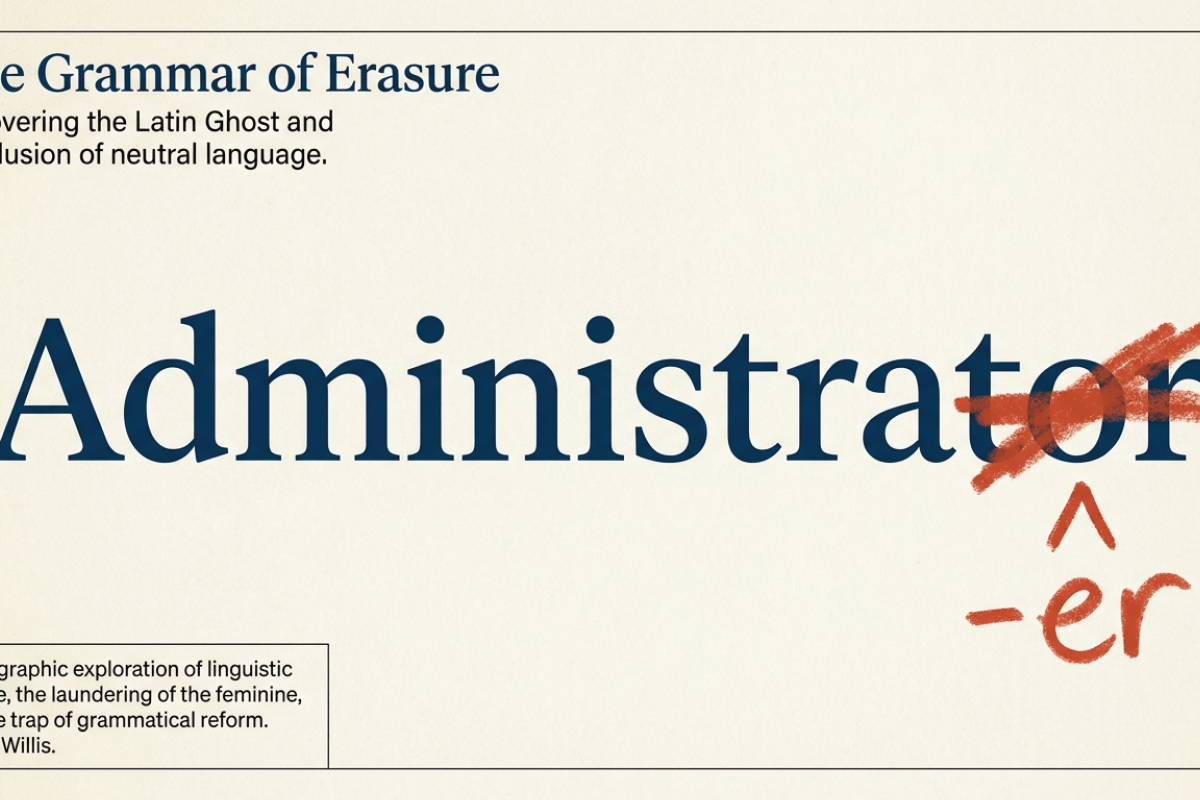
My initial thought was to rid the English language of administrators and dominatrices. Of course, I instantly considered French, and I write about that as well.
Here, I want to discuss the rift in Feminism:
One faction feels that we should eliminate sexist terms in the Modern world. This is where I was coming from.
Another faction claims this is a way of not being absorbed into an already male-dominated, dare I say, patriarchal culture.
Hence the title of this post.
If we were to swap or consolidate administrator and the less common administratrix into administrater in an act of rebellious conformity, women will be subsumed. As Simone de Beauvoir notes, the dominant lens is the male lens. Womanisother. As I say, this is why we have male and female versions of many, if not most, competitive sports, and certainly the professional ones. Thi sis also an instinct underlying trans-athletes competing in a contrasport – and it’s almost always about CIS-males performing in CIS-female events. I’m not aware of the contrary – and I don’t feel like looking it up. Opponents imagine fit males dressing as females in order to win some ribbons and medals, but I don’t really care to engage further in this conversational framing. I have no interest in sports, not even the World Cup being performed in my backyard.
The point is that females and other so-called minorities can be marginalised and lost to language. We preserve this identity through mechanics such as Best Actress to ensure representation.
Of course, I can also run off the reservation and down any number of rabbit holes: why don’t we have best black actor and/or actress? Why not left-handed? Height ranges? Weight ranges? Income ranges? Religious orientation? We quickly run into an intersectional challenge. I might imagine something like:
And I am proud to announce the winner of best left-handed, Asian Buddhist actress with a speech impediment
It’s easy to see where this goes off the rails – another Sorites problem hiding in plain sight.
I could go on. I won’t, but I wanted to make a point about my point. Check out the base post on Substack.
I love language, and I study it. I also use LLMs. I am not anti-AI, but neither am I prescriptively pro-AI. I just happen to find them useful.
Audio: NotebookLM summary podcast of this topic.
I also, however, find them to have quirks. I won’t regurgitate the supposed over-representation of delve — or em dashes, or lists of three, and so on. These are each, at once, true and hardly egregious – especially given that we were all schooled on the same English that now sits in their training data.
What I want to focus on is the cadence. I watched this video, and the historical information is interesting – in fact, much of the material on the channel is. A few shorts were recommended to me, I discovered more, I subscribed, as one does. But listen to the talk track.
Video: The Most Mispronounced Words in English and the History Behind Them – Airlearn Language Show
Whilst I may be mistaken, it sounds like an LLM-produced script. Perhaps the joke is on me, and the presenter herself is an AI avatar. It also sounds as though a de-LLM process was applied afterwards to obfuscate the patterns – whether by a human or by another model running some humaniser GPT.
Of course, there are other explanations. Perhaps the writer simply happens to write this way, and the LLMs merely encroach on it. Without a writing history, one can’t know for certain. And – I know this is true of me – exposure, dare I say overexposure, shapes how one writes.
I run almost everything I write through AI and ask for suggestions – and you needn’t even ask; it volunteers anyway. When the output looks better, I adopt it: a word, a phrasing, a more concise rendering, a supporting sentence or a setup. After a while, my writing has been nudged in that direction. I already used delve; now I am merely conscious of it. I used to use em dashes – look at my pre–2020 posts – and switched to en dashes purely to avoid the witch-hunt. In each case, the LLM Age has done something to my style.
So, back to the video. If you are familiar with long-form LLM output, you will notice how she supports her ideas and how she builds her asides – with a very particular pattern. I am not judging: as I say, I use these tools extensively. I only want to point out an observation.
BONUS: I don’t pronounce Wednesday as /wenz.day/. I pronounce it closer to /wedñz-day/, the tilde is rather on the /d/ or the space the /d/ occupies, but I placed the mark on the /n/ instead because there is no tilde-d glyph, and I wanted to represent a nasality the more typical pronunciation doesn’t have – but that I add.
From here on, I asked Claude to analyse my post (above) along with the video script. Pay special attention to its own cadence, which comports with the video.
Here, then, is the observation.
Watch how a point is made to land. The move is nearly always the same: state the naïve reading, snatch it away, and hand back the corrected version as a tidy little binary. It’s not random. There’s a reason.It wasn’t design. It accumulated.English spelling isn’t bad design. It’s no design at all. The shape does the work an argument would otherwise have to do. Negate, reverse, reveal – and the reveal feels like insight precisely because something was first taken away. It is the cheapest available route to the sensation of having been told something.
Notice, too, the reassurance travelling alongside it. There’s a reason. There’s always a reason. The promise of an explanation, delivered before the explanation arrives, so that you settle in and stop wondering whether one is coming. And where genuine argument would be laborious, the list stands in for it: Old English, Norse, Norman, French, Latin, scholarship, Dutch typesetters, the great vowel shift. Abundance, read as authority. Say enough true things in a row and the row itself begins to feel like a proof.
Then the asides. Almost every one is the same manoeuvre – the proper noun that renames itself the instant it appears. Woden, the chief god of the Anglo-Saxon pantheon.Latin, the prestige language of learning.A Quechua word from the Andes.Frigg being Odin’s wife. Nothing is permitted to sit unglossed for even a clause. This is what maximal legibility looks like once it hardens into reflex: a horror of the unexplained referent, a compulsion to footnote in real time. The second variety is the personality wink – and English being English, it kept both – character applied topically, like a balm.
And, so that you are never left to feel anything unsupervised, your reactions are narrated back to you in advance: if that feels insane to you, good, because it is. The response, pre-issued, so you may be spared the labour of having it. The whole is held together by a governing metaphor with a landing – fossil, photograph, museum – reactivated at the close (every mispronounced word is a crime scene) and finished with a note of absolution: you haven’t been mispronouncing English because you’re careless. It is very nearly a form one could fill in.
None of which proves a human didn’t write it.
And that is the part worth sitting with. Suppose no model ever touched this script. Suppose the writer arrived at the cadence honestly, by the same route I did – by reading enough of the stuff that the rhythm simply seeped in. Then the pattern is no longer evidence of authorship at all. It is evidence of a house style, and the house is one we have all quietly moved into. The tell no longer tells you a machine was here. It tells you the machine’s prosody has become the water.
I find that rather more unsettling than a mere ghost-writer would be. A ghost-writer you can dismiss. A cadence you have caught, like an accent, off the sheer ambient volume of the thing – that you carry home. And the video is, with some poetry, about exactly this: silent letters as fossils, sounds that mouths stopped making but that spellings preserved, layer upon historical layer that nobody ever cleaned up. The irony is that the script is laying down a fresh one as it speaks. Somewhere in the prose of the next decade there will be a stratum you can date almost to the year – ah, yes, written just after the models arrived – and it will be made of precisely these moves.
I switched to en dashes to dodge the witch-hunt. But the dash was never the point. You can strip every em dash from a sentence and leave the skeleton wholly intact, because the skeleton was never punctuation. It was the not-this-but-that, the aside that footnotes itself, the pile that mistakes its own length for weight. A humaniser can launder the vocabulary. It cannot, so far, launder the architecture. Which is how one reads a script scrubbed clean of every obvious tell and still hears, quite distinctly, the thing it was scrubbed to hide.
I am not judging. I write this way too, now – rather more than I would like. I only wanted to point it out. While I can still tell that I’m doing it.
As Independence Day is upon the United States of America, I considered some counterfactuals. What if Europe fails to reach the Americas until a century or more late, and we watch the delay from the vantage of the peoples already here, going about the business of history without a Columbus to interrupt them? Then came the question everyone eventually asks about their own good ideas, in the tone of a man checking whether the milk has turned: has this been done before? Of course, it had been. Spoilers follow – sort of.
Audio: NotebookLM summary podcast of this topic.
The inversions
The oldest respectable relative is Robert Silverberg’s The Gate of Worlds (1967). A nastier Black Death carries off three-quarters of Europe rather than a third; the continent never recovers, the Ottomans move in, London becomes New Istanbul, and by the twentieth century the great powers are the Aztecs, the Incas, the Russians and the Japanese. Our guide is a young Englishman named Dan Beauchamp, who sails to an industrial, motorcar-driving Mexico to seek his fortune. Note the pronoun. The world has been turned upside down, and we are shown it by a European looking up.
Christopher Evans’s Aztec Century (1993), which took that year’s BSFA Award, runs the same reversal with more brass. Cortés changes sides, a New World plague scythes through Europe instead of the reverse, and the Aztec Empire swells into a technological superpower that eventually occupies Britain. The narrator is Princess Catherine, daughter of a defeated British monarch, Princess Diana watching London burn from the losing side. Again, the conquered European tells us what the conquest was like.
Laurent Binet’s Civilizations(2019) is the cleverest of the lot, and the most decorated – it won the Grand Prix du roman de l’Académie française, and Sam Taylor’s English translation took the Sidewise Award for alternate history. A stray band of Vikings gifts the Americas iron, horses and, crucially, immunity; so when Columbus turns up in 1492, he is captured and demoted to court jester, and the Inca emperor Atahualpa later sails east to conquer a Europe conveniently fractured by Luther, the Inquisition and its own dynastic squabbles. Binet is far too intelligent not to know what he is doing. The whole thing is a Civilization-the-video-game daydream executed with Académie française tailoring, and it is genuinely delicious. It is also, structurally, another inversion: swap the conqueror, keep the conquest.
The remix and the intervention
Two cousins change the machinery rather than the direction. Kim Stanley Robinson’s The Years of Rice and Salt (2002) empties Europe almost entirely – the plague takes ninety-nine per cent – and then spends six hundred sprawling, reincarnation-threaded pages letting China, Islam, India and the Indigenous Americas run world history without the Europeans in the room at all. It is less a mirror than a vast tapestry, and its ambition is precisely that Europe should not be the pivot. Whether it manages that, or merely relocates the pivot, is a question the book is honest enough to leave open.
Orson Scott Card’s Pastwatch: The Redemption of Christopher Columbus (1996) cheats, and admits it: time-travellers reach back to soften the catastrophe of contact. It is a book about first contact, disease and conquest, but the engine is intervention from a guilty future, which makes it a novel about us editing them, the colonial gaze wearing a lab coat.
The one that isn’t a mirror
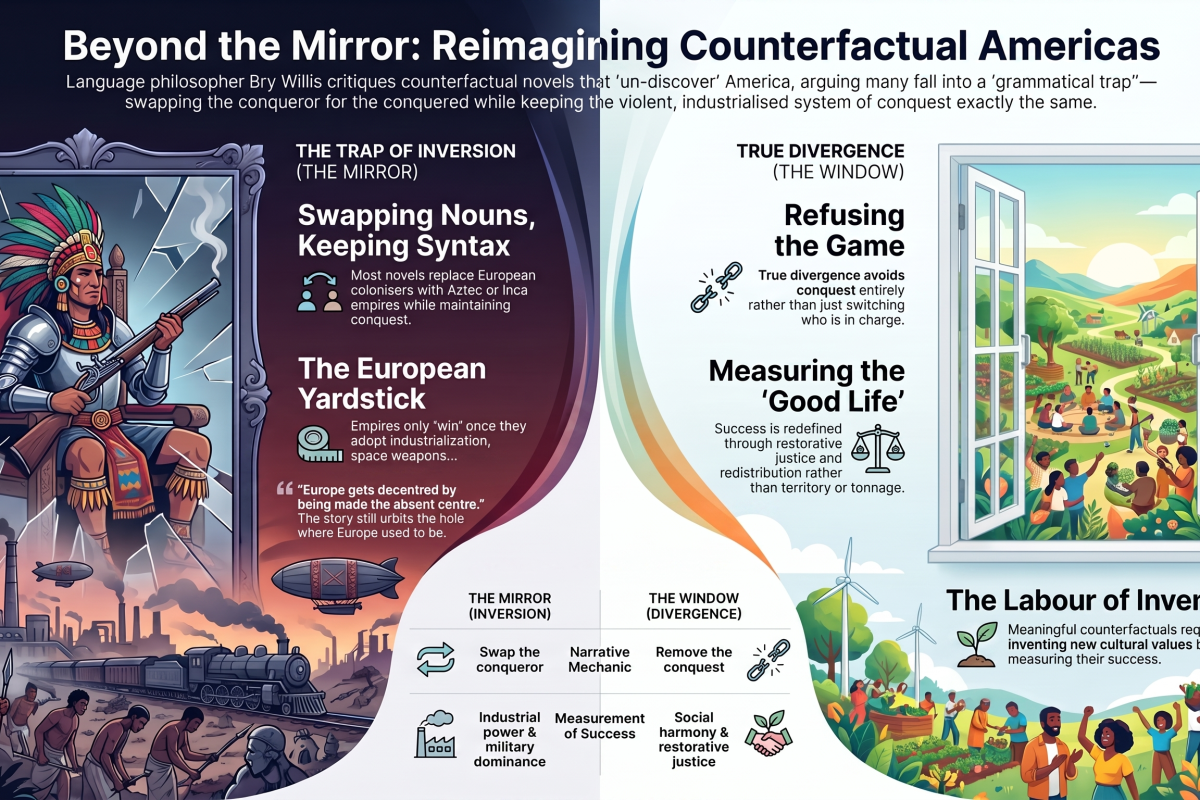
And then there is B. L. Blanchard’s The Peacekeeper (2022) – also, tellingly, a Sidewise Award winner – which does the rarer thing and quietly refuses the whole game. There is no inversion here, because there is no conquest to invert. North America was simply never colonised. The Great Lakes are an independent Anishinaabe nation; Chicago is Shikaakwa; there are no borders on the map because the book declines to draw any. It happens to be a murder mystery, and a slightly wobbly one – I called the culprit early, as apparently did everyone – but the mystery is scaffolding. The real work is a society organised around restorative justice, redistribution and something the glossary calls the Good Life, where crime is repaired rather than punished, and the question ‘what is success?’ gets a genuinely different answer. That difference is the whole point, and it is worth spelling out.
The tell
Watch what the inversion novels are obliged to do to their winners. Silverberg’s Aztecs drive coal-fired automobiles. Evans’s Aztecs somehow have flying warships and space weapons, to the audible irritation of every reviewer who has ever met a history book. In each case, the counter-empire only counts as having won once it has industrialised, once it has, in other words, become Europe in a headdress. The measuring stick never leaves the room. It just changes hands. Would not recommend. All of these are still viewed through Modernist lenses. They can’t seem to help themselves.
This is the trap, and it is a grammatical one: you can swap every noun in the sentence and leave the syntax of conquest perfectly intact. Who dominates whom is a variable. That domination is the axis of the story remains fixed – invisibly, load-bearingly fixed. So the shelf keeps producing books that promise to dethrone Europe and instead install a differently-costumed emperor on the same throne, using the same yardstick to prove he deserves it. Europe gets decentred by being made the absent centre. Everything still orbits the hole where it used to be.
Blanchard’s book is the one that escapes, and it escapes not by putting someone else on the throne but by asking whether the throne needed to exist. That is a far harder imaginative act, which is exactly why the shelf holds so many mirrors and so few windows. Inverting a hierarchy is a parlour trick – satisfying, symmetrical, teachable in an afternoon. Imagining a world whose values diverged, so that its people would not measure their flourishing in territory and tonnage at all, requires you to invent the ruler before you can invent the thing it measures. Most writers, sensibly, decline the extra labour.
Six books, then, and a warning label. Read Binet for the wit, Blanchard for the nerve, Silverberg for the ancestry, and the rest for the pleasure of watching very clever people not quite escape the room. Then, if you’re feeling brave, go and undiscover America properly, which means resisting the temptation to let it become us, wearing better feathers.
I’ve been working for days on a new short story that investigates time. I’ve already published The Box in English, but this new piece looks at a different aspect of time, one I suspect may work better in French because the grammar gives me more useful pressure points than English.
The working title is Les Années Vécues, which translates literally as The Years Lived. For now, that’s only a working title. Oddly enough, the purpose of this post is not really to describe the story, though I may do some of that. It is more about the tools, the process, and the strange route by which the idea arrived.
The story began as a conversation between me, Claude, and ChatGPT about human innovation and creativity. A colleague had recommended How Language Began. I bought it and read the first few chapters. For the record, it’s interesting.
Early on, the author discusses genetics and evolution, citing human inventions along the way, particularly those associated with Homo erectus. Because I tend to question narratives of progress, and especially grand claims around Innovation and Creativity, I fell into some LLM-assisted chit-chat. From there, the conversation drifted into time travel in fiction. We discussed tropes from Back to the Future to Outlander. Somewhere in that mess, I noticed a missing perspective I felt I could capitalise on.
For the record, again, I have not been especially successful at writing short stories. They tend to grow beyond my intent, usually into novelettes or novellas. My first novel, written as Ridley Park, began as a short story. That story is now ostensibly chapter five of Hemo Sapiens. It can stand on its own, but it plays better in context. It is still my favourite chapter, if I had to choose one. So I’ll see where this new one goes, if anywhere. Nowhere is always an option. The blank page remains admirably non-committal.
After hours of brainstorming with the LLMs, arbitrarily switching from French to English and back again, I had a plot outline with beats and flavour, tropes and intentions, subversions and misdirects. I had captured dialogue exchanges, worked through worldbuilding constraints, and fleshed out several plot points. Then I asked ChatGPT to build me a tracking document to serve as a punch list.
I’ve done this a few times before, but with the advancement of the tools, the output was surprisingly robust, arguably overkill, which isn’t always a vice.
The spreadsheet contains 9 tabs:
Lists
Dashboard
Punchlist
Beat Map
Continuity Rules
Motifs & Plants
Evidence Ledger
Open Questions
Sources
Lists
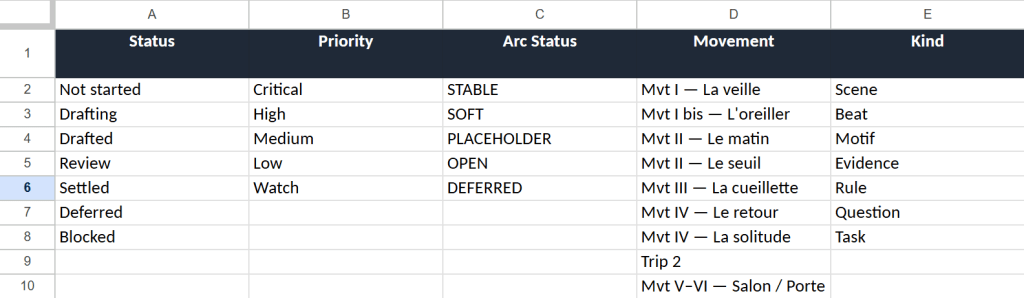
The Lists tab is mostly internal to the spreadsheet. It controls status values, priorities, categories, and related dropdowns. I would not have made it this elaborate manually, but I’m not offended by competence when it arrives uninvited.
I wouldn’t have been so elaborate, but it’s nice nonetheless.
The Dashboard
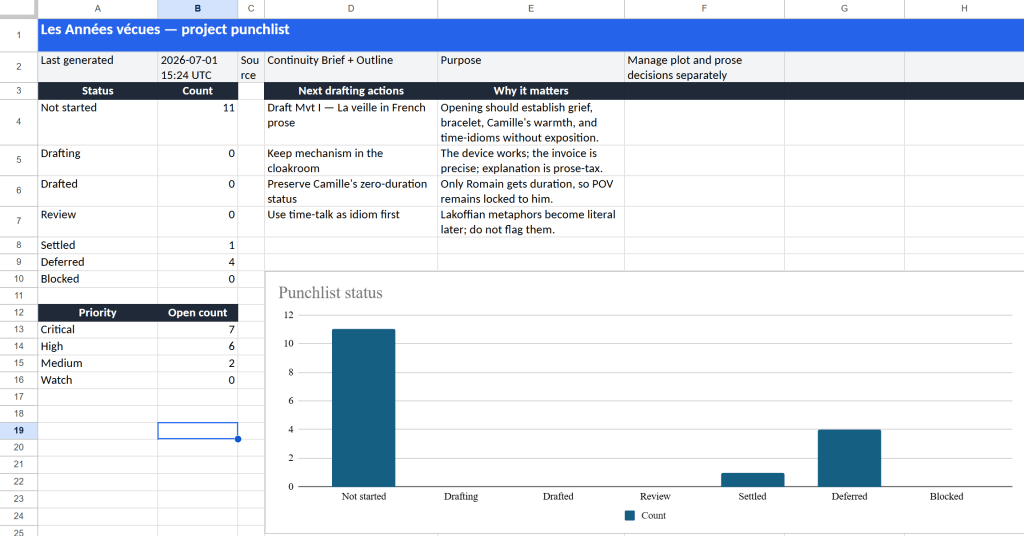
The Dashboard is also a bit of overkill, but useful overkill. In its inaugural state, it gives a quick view of task status, priorities, and next actions. Its intent should be clear from the screenshot.
Punchlist
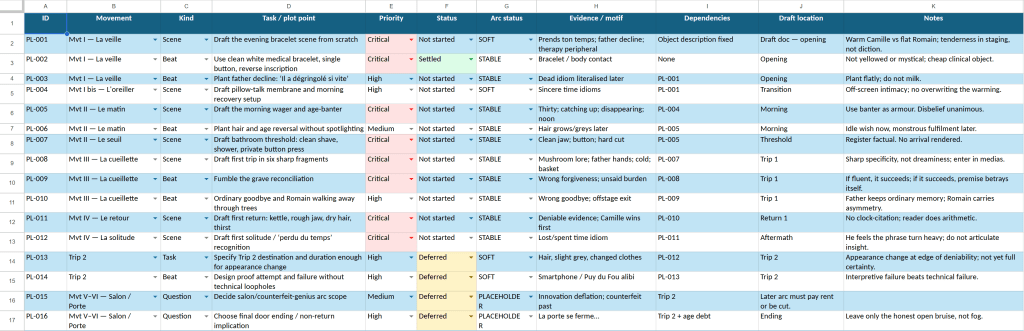
The Punchlist is essentially an actionable to-do list with status markers. I think I can safely share this without giving too much away. It lets me manage the story as a set of unresolved craft problems rather than as a vague cloud of ‘I should really get back to that’.
Beat map
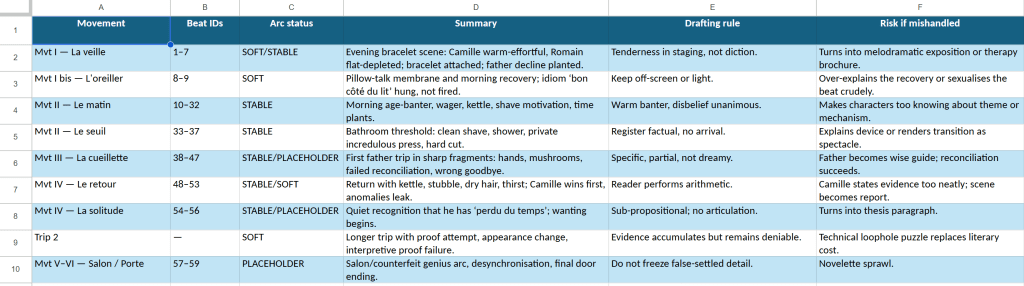
The Beat Map contains representative story beats, with notes that capture narrative purpose, confidence level, and risk-management annotations. This is where structure can be managed without cluttering the prose draft itself.
Continuity Rules
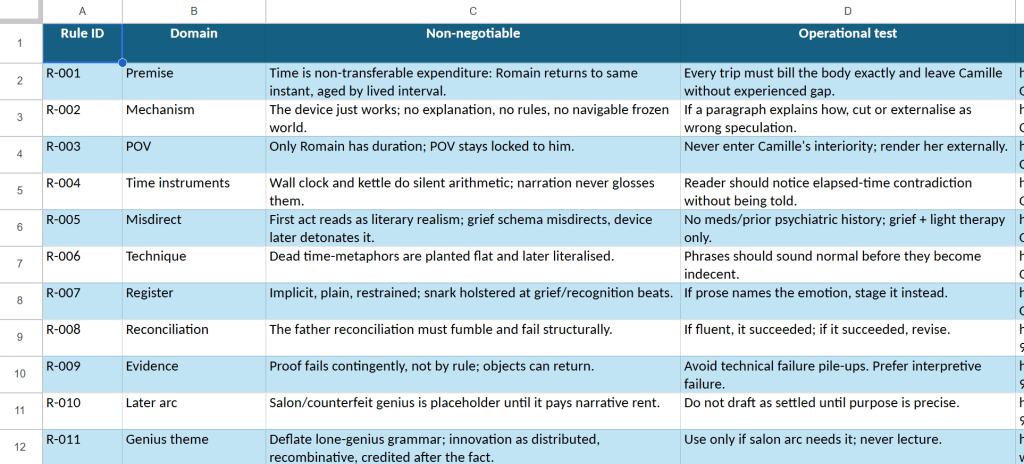
The Continuity Rules tab captures worldbuilding constraints and adjacent considerations. It is probably oversharing at this stage, but I’ll take the risk. These rules matter because speculative fiction can collapse quickly when the premise starts leaking.
Motifs & Plants
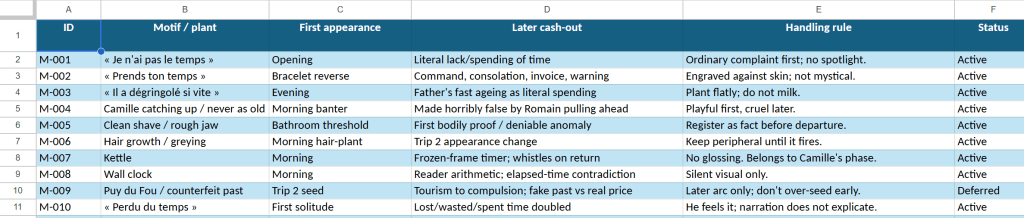
The Motifs & Plants tab tracks recurring touchpoints, images, phrases, and planted details. Some of these may be premature, but having them outside the draft helps me avoid forcing them into the prose too early.
Evidence Ledger
The Evidence Ledger tracks what counts as evidence inside the story world, who can interpret it, and how it may be misread. This is another continuity check, but also a thematic one.
Open Questions
The Open Questions tab is exactly what it sounds like: unresolved choices, structural uncertainties, and decisions I do not yet want to freeze into place. Sometimes the most useful document is the one that refuses to pretend everything has been solved.
Sources
The Sources tab lists the chat history and documents from which the rest of the content was derived.
The Rest
This is only a partial listing, and I am not finished ideating. I have not yet begun the prose.
I do not always plot my stories. More often than not, I take something closer to a stream-of-consciousness approach. But for one thing, my consciousness does not stream in French. So there’s that.
What impressed me most was the organisational layer the LLM produced. The spreadsheet is now hosted on Google Drive as a Sheet, accessible to both me and the LLMs, so it can be updated as the discussions and decisions continue.
I’m looking forward to wrapping up the ideation phase and beginning, and ideally completing, the prose. That last part remains the traditional nuisance.
People say that LLMs don’t have a sense of humour. That may be true, but I feel it’s closer to humour on the spectrum – no offence for the analogy. After a chat about language competency that drifted into musical competency, out conversation ended thusly.
More diversion, leaning toward pedantic. I need to learn the correct way rather than fall back on ‘native people do this all the time’ excuse. Besides, as a non-native writer, I’d expect less forgiveness, though I think there may be two channels of forgiveness in play.
18:31
Yes, two distinct channels, and they cut in opposite directions.
The first is the non-native allowance — errors read as learner errors rather than carelessness, which tends to attract correction rather than judgment. A missing accent or a wrong tense from a foreigner signals incomplete acquisition, not laziness, and native speakers generally calibrate their response accordingly. Laeticia’s ce n’est pas grave energy, essentially.
The second is the literate foreigner premium — which is almost the inverse. A non-native writer who is mostly correct gets held to a higher implicit standard than a native writer dashing off a text, because the very correctness signals that you’re operating in a formal register, even when you’re not intending to. One slip in otherwise clean French reads as a mistake where the same slip in a native’s casual message reads as style. You’ve essentially opted into a higher tier by being good enough to be there.
Your position is particularly exposed to the second channel, given that your French reading is already at roughly B1 and your written production is analytically driven and careful. The errors you make won’t look like a tourist’s — they’ll look like anomalies in otherwise competent prose, which draws more attention not less.
And frankly, your own standards are probably the binding constraint anyway. The philosopher of language who built a career on precision in signification is not going to be comfortable hiding behind natives do it too. That excuse requires a certain insouciance you don’t appear to have packed.
I recall decades ago taking guitar lessons – always lessons – and I was working on a piece with a solo. To me, it sounded close enough; to my instructor, one would think he imagined my playing whilst wearing mittens.
18:33
Ha. The instructor’s ear and the student’s ear are simply not the same instrument yet — you’re hearing the gestalt, he’s hearing every individual note against what it should be. “Close enough” is a category that doesn’t exist for someone who has already compiled the piece to fluency. The mittens were entirely audible to him.
It’s actually a clean analogy for where you are with French. Your reading comprehension is good enough that you’re hearing your own written output at roughly the right level — the meaning lands, the structure is recognisable, the register is approximately right. But Laeticia, or a DELF examiner, is hearing the mittens: the tense that contradicts the intention, the dangling comme, the á where à should be.
The further irony is that the guitar analogy runs deeper than it first appears. You identified the compiled/declarative distinction yourself — knowing the piece intellectually versus having it in the fingers. Your French grammar is largely in the analytical channel, which means you can catch errors given time and attention, but under production pressure the fingers default to habit. The wrong dead key. The passé composé because it’s the tense you’ve drilled most.
The mittens come off with time, but they come off unevenly — and the last few fingers take the longest.
Call me Harrison Bergeron.
18:34
Ha. Handicapped by your own analytical overdevelopment. The very apparatus that makes you good at understanding French is the dead weight bolted to the fluent production you’re trying to achieve.
Vonnegut would appreciate the specific cruelty of it — your particular handicap isn’t random, it’s precisely calibrated to your strength. The philosopher of language, hobbled by language.
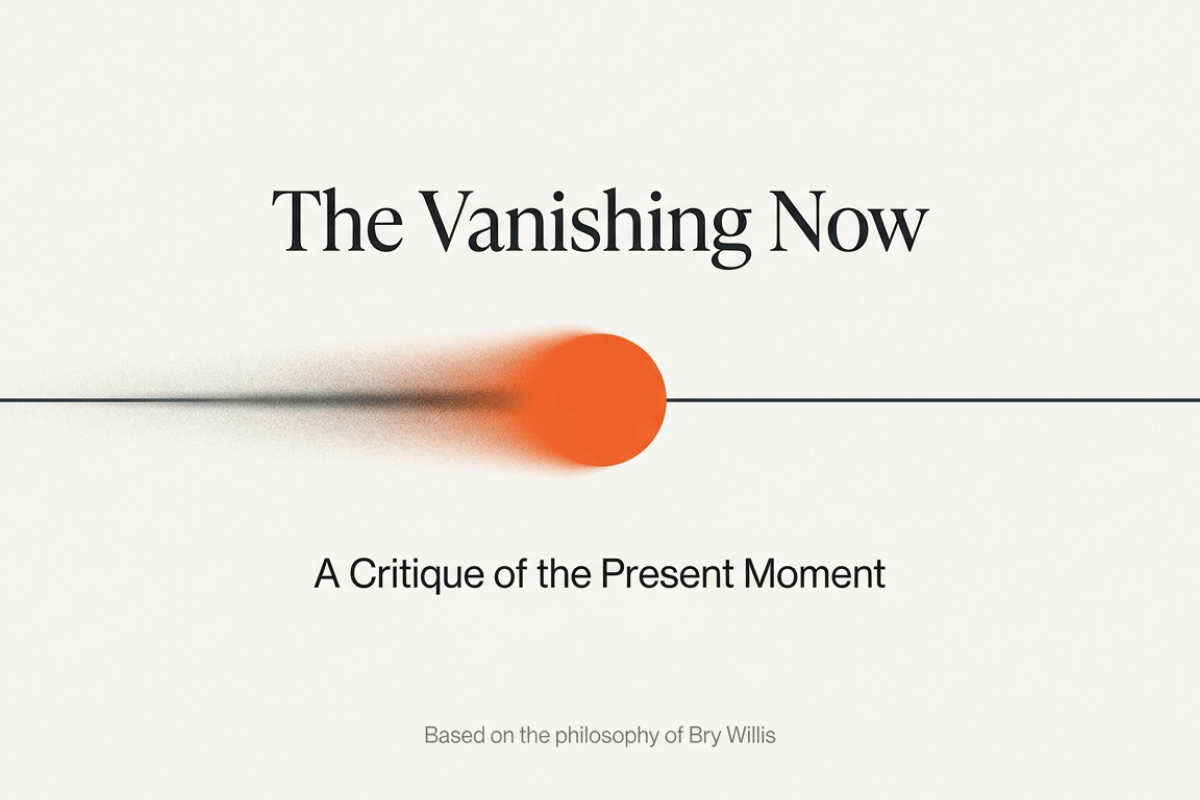
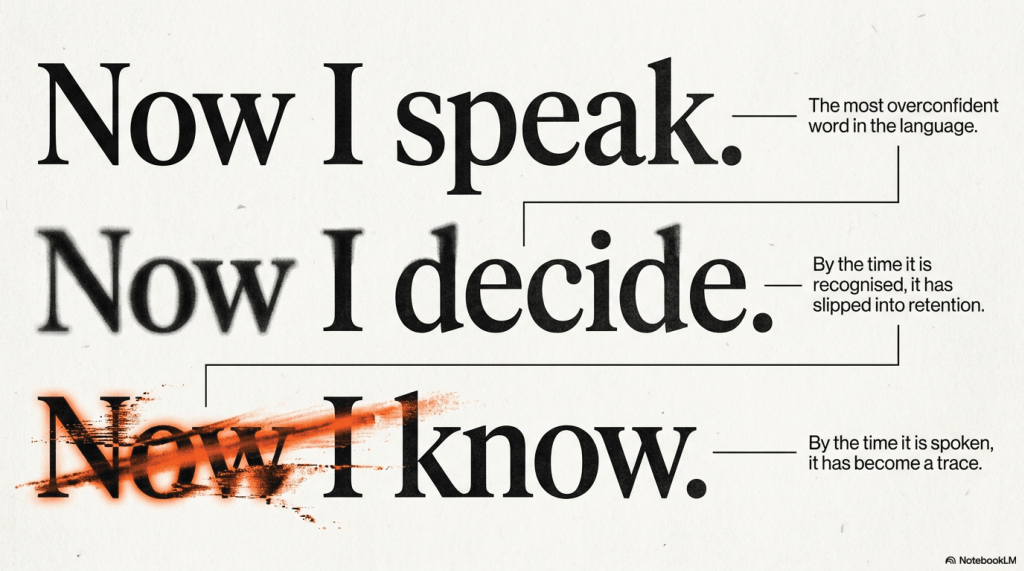
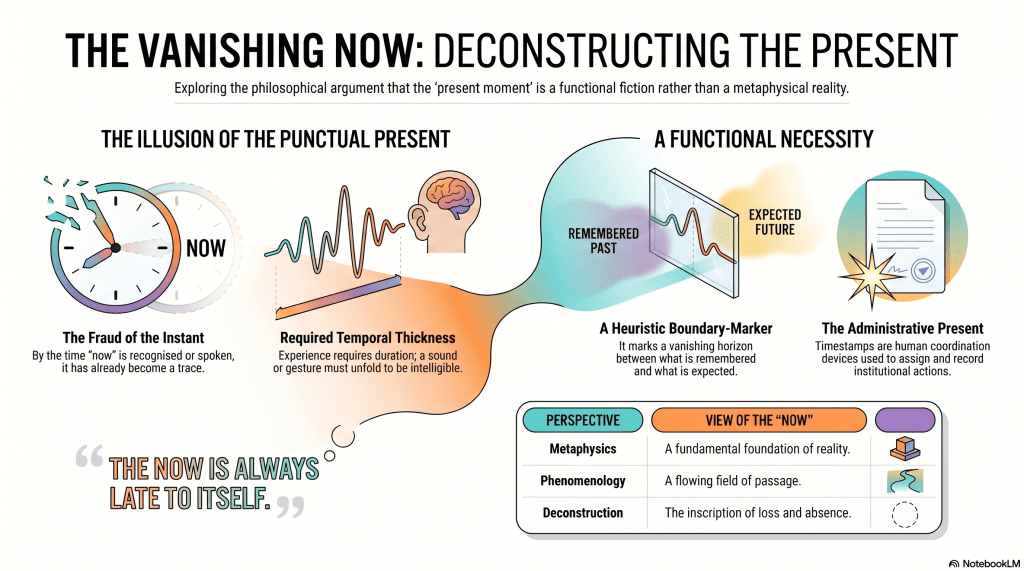
‘Now’ is one of the most overconfident little words in the language. It presents itself as immediate, self-evident, and available. We speak as though it names the present cleanly: now I speak, now I decide, now I know, now is the moment. Yet the word performs a small fraud every time it appears. By the time ‘now’ is recognised, it has already slipped into retention. By the time it is spoken, it has become a trace.
‘Now’ is not an experienced unit but a heuristic boundary-marker within temporal flow. It names a vanishing horizon between retention and protention: already past by the time it is recognised, already structured by what is expected before it can be stabilised. What it designates isn’t a thing, not a slice, not a metaphysical bead on the string of time, but a practical fiction by which consciousness, language, and action coordinate within a moving field.
Audio: NotebookLM summary podcast of this topic.
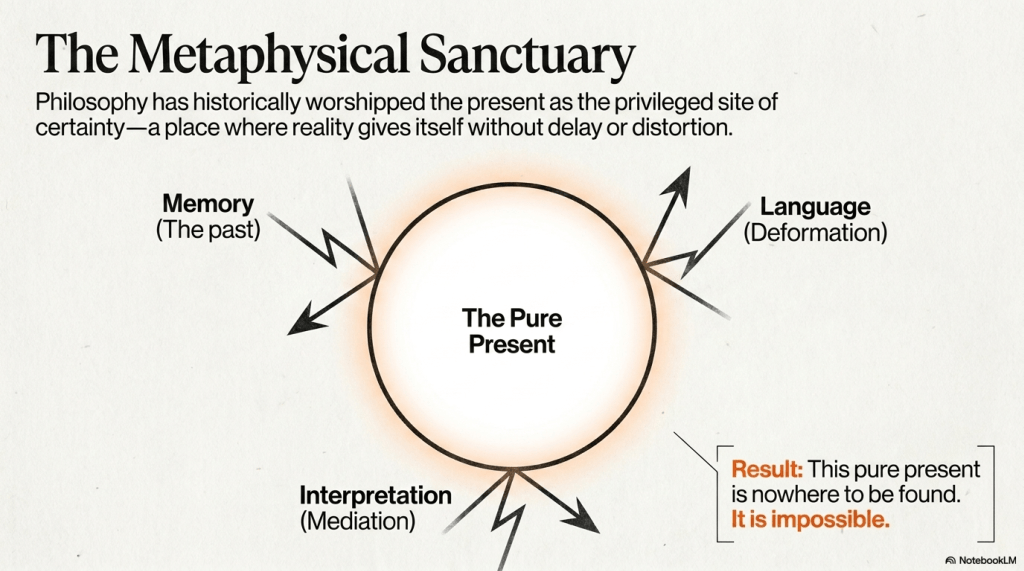
This distinction matters because philosophy has often treated the present as though it were the privileged site of certainty. Presence has been taken as the place where reality gives itself without delay, mediation, or distortion. The present moment becomes the imagined sanctuary of immediacy: before memory corrupts it, before language deforms it, before interpretation arrives with its grubby little toolkit. But this pure present is nowhere to be found. It’s not hidden; it’s impossible.
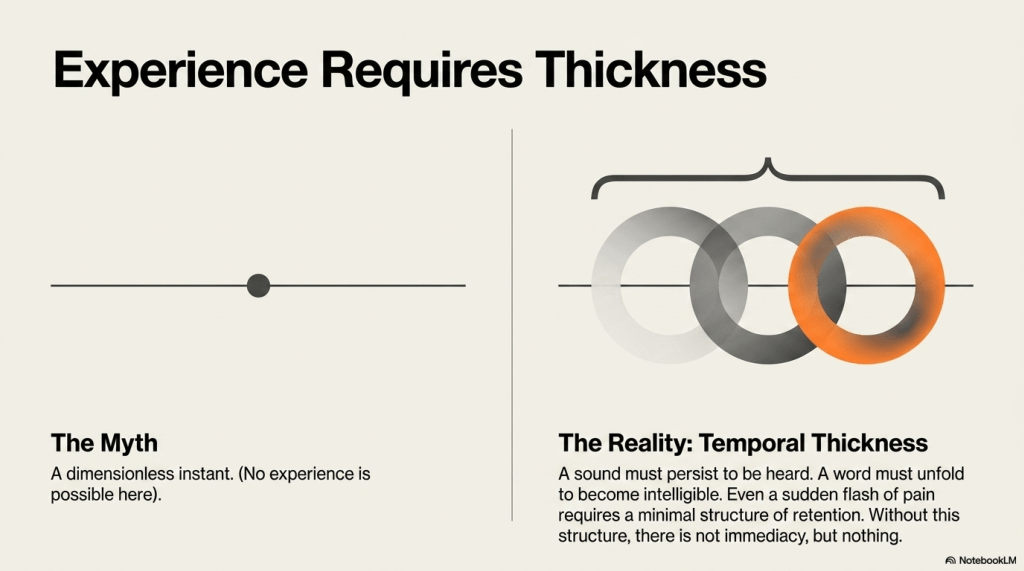
Experience is never given as a dimensionless instant. To experience anything at all requires temporal thickness. A sound must persist long enough to be heard as a sound. A word must unfold across time to become intelligible. A gesture is not apprehended as a gesture unless its beginning is retained and its likely completion anticipated. Even the flash, the shock, the sudden pain, the glimpse at the edge of vision, all require some minimal structure of retention. Without that structure, there isn’t immediacy but nothing recognisable as experience.
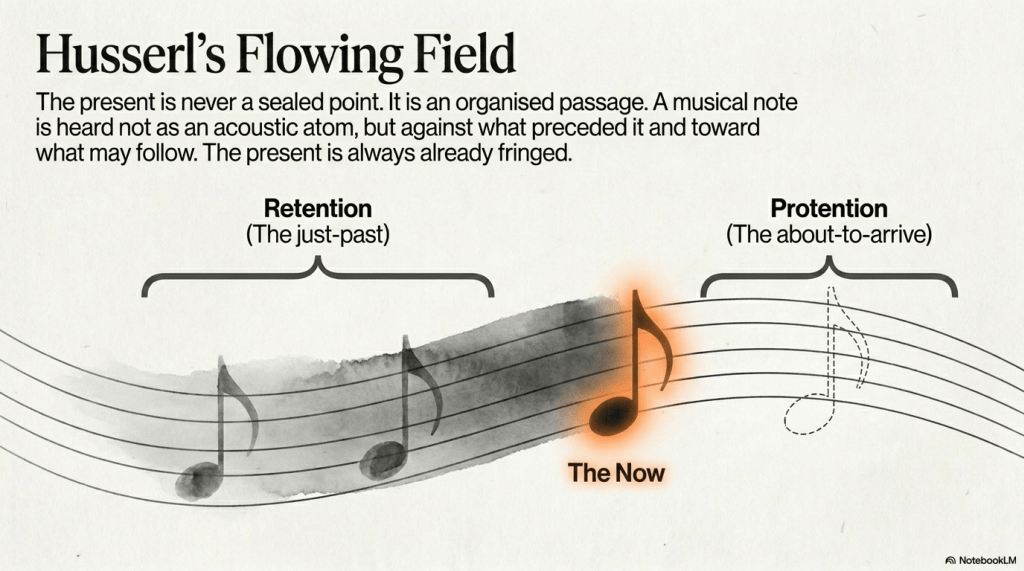
Husserl saw part of this with his account of retention and protention. The present isn’t a sealed point but a flowing field in which the just-past and the about-to-arrive are already implicated. A musical note isn’t heard as an isolated acoustic atom. It’s heard as part of a phrase, against what has preceded it and toward what may follow. The same is true of speech, perception, decision, and action. The present is always already fringed. It’s bordered by memory and expectation. It’s not pure presence but organised passage.
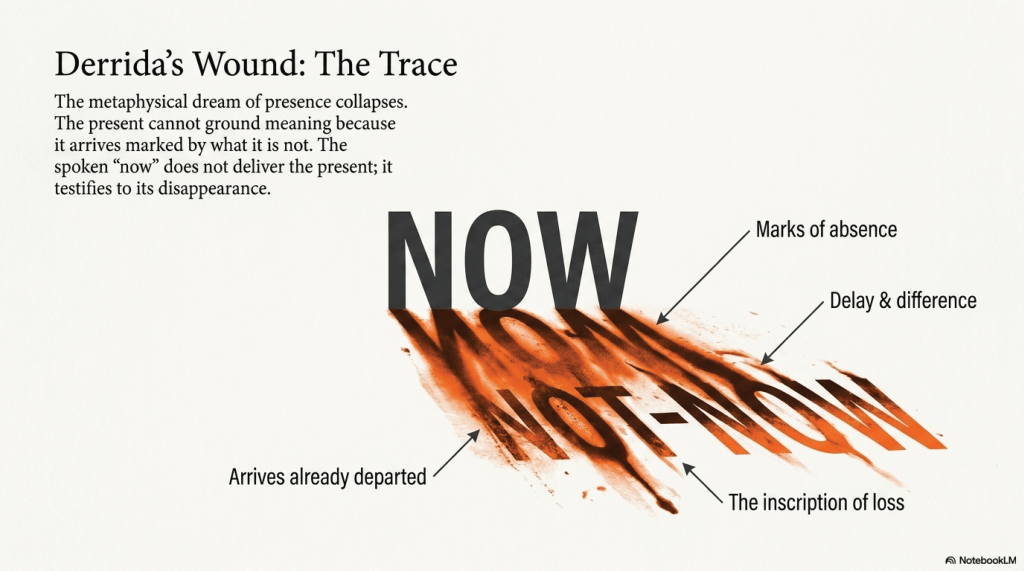
Derrida presses the wound further. If the now is always contaminated by what is not-now, then the metaphysical dream of presence collapses. The present cannot ground meaning because the present is never simply present. It arrives marked by absence, delay, difference, and trace. The spoken now does not deliver the present. It testifies to its disappearance. It isn’t the arrival of immediacy but the inscription of loss.
This isn’t merely a technical problem in phenomenology. It has consequences for how we think about agency, meaning, and reality. We routinely speak as though action occurs in a present moment of self-possession: I now choose, I now intend, I now decide. But this grammar flatters us. Decision is never contained in a punctual present. It condenses prior dispositions, pressures, perceptions, habits, bodily states, histories, and anticipated consequences. The now of decision is a narrative compression imposed after and within a process that exceeds it.
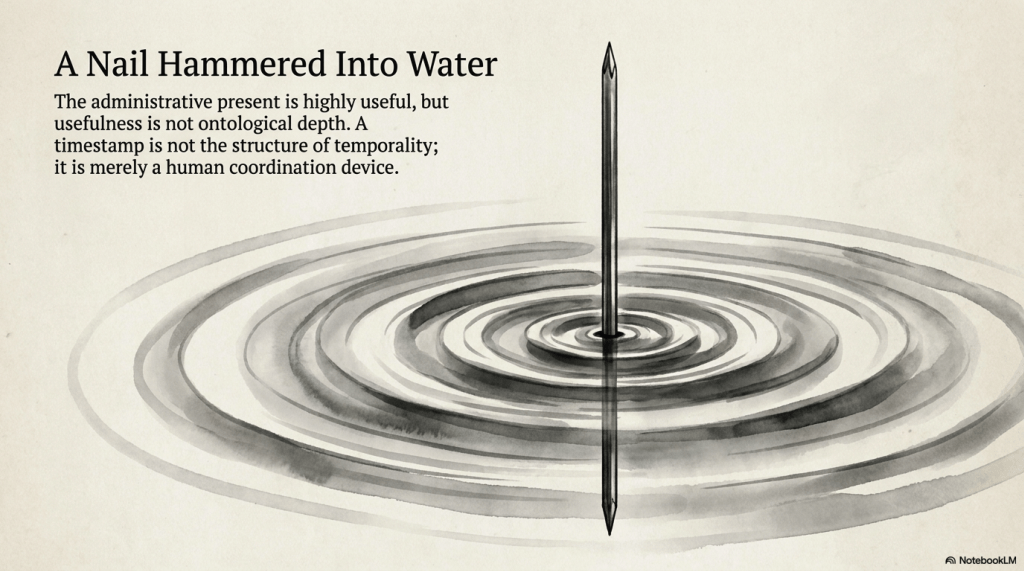
The same applies to moral and institutional language. Law loves timestamps. Bureaucracy loves decision-points. Politics loves moments. Each requires a tractable ‘now‘ because institutions must act, record, assign, and close. The administrative present is useful because it can be filed. But usefulness shouldn’t be mistaken for ontological depth. A timestamp isn’t the structure of temporality. It’s a human coordination device, a nail hammered into water.
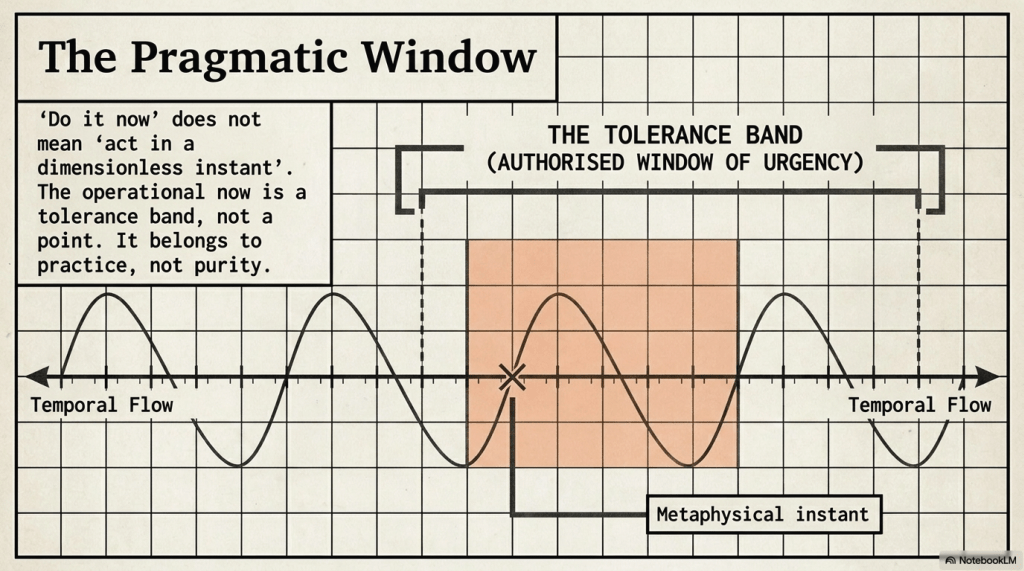
The now survives because it’s pragmatically indispensable. We need it to coordinate action. ‘Do it now’ doesn’t mean ‘act in a dimensionless metaphysical instant’. It means ‘act within the authorised window of urgency established by this utterance’. The operational now is a tolerance band, not a point. It belongs to practice, not purity.
This is why the present should be deflated rather than worshipped. The now isn’t an entity. It’s not a metaphysical foundation. It’s a boundary-function within temporal flow, a stabilising fiction by which agents orient themselves amid movement. It marks a horizon that vanishes as it is named.
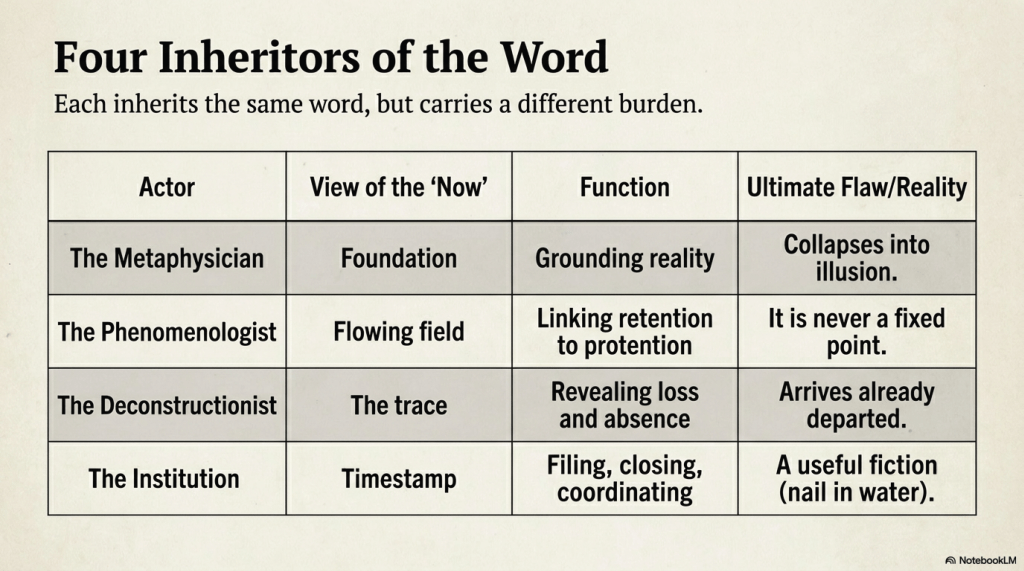
The metaphysician wants the now to be a foundation; the phenomenologist discovers it as flow; the deconstructionist hears in it the trace of what has already departed. The institution converts it into a timestamp and pretends the problem has been solved. Each inherits the same word, but not the same burden.
To invoke ‘now’ is therefore not to seize presence. It’s to gesture at the impossible purity of presence from inside its failure. The word works, but it works heuristically. It coordinates, compresses, and stabilises just enough. What it doesn’t do is deliver the present as such. The now is always late to itself.









 Philosophics