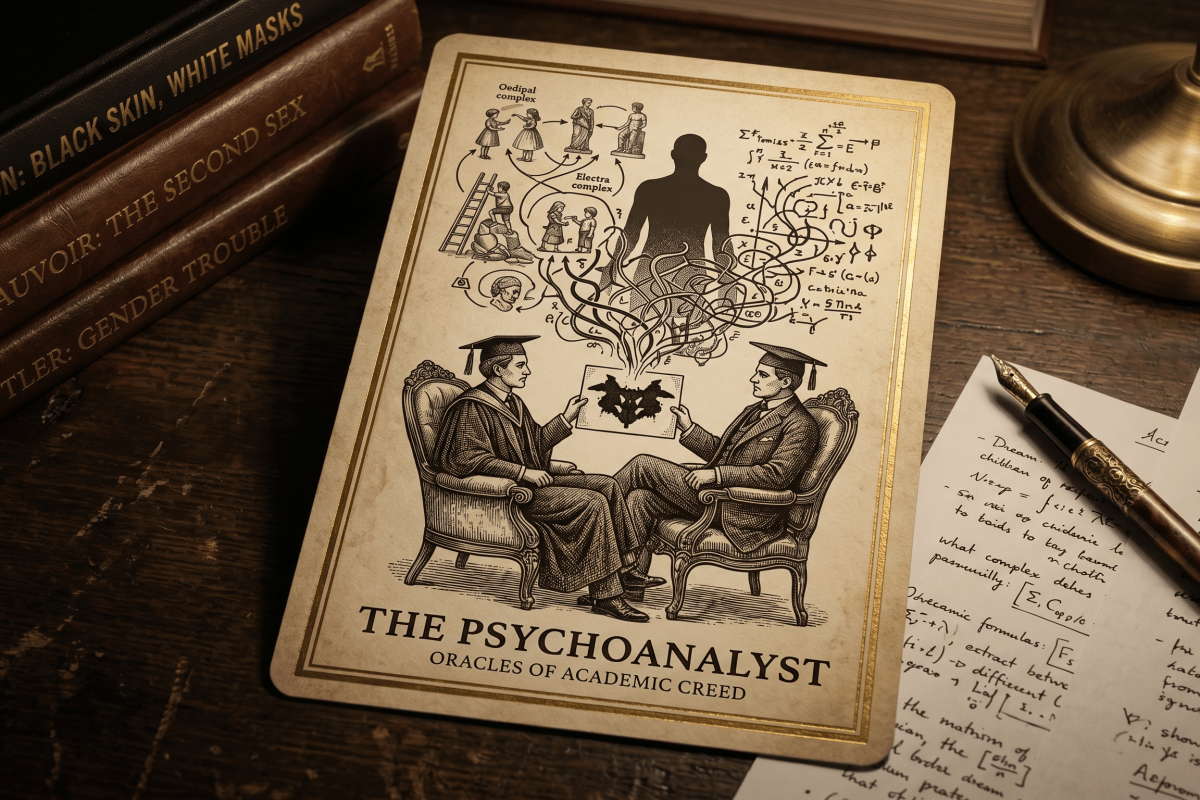
The Striated Woman: No One Owns the Category

A longer post about my thoughts after having read the first section of Judith Butler’s Gender Trouble.

โ€˜womanโ€™ is a normative identity, and like all normative identities it is striated. It is composed of putative essences, recurring structural constraints, intersectional positions, cohort-relative projections, subjective inhabitations, and external gatekeeping.

Audio: NotebookLM summary podcast of this topic.

Against Agency: The Fiction of the Autonomous Self

2โ€“3 minutes

The Enlightenmentโ€™s Most Beloved Lie

๐Ÿ”— Read the full preprint on Zenodo
๐Ÿ”— Explore the Anti-Enlightenment Project

The Enlightenment promised liberation through reason โ€“ that if we could think clearly enough, we could act freely enough. Agency, it claimed, was the defining trait of the rational individual: a sovereign chooser, self-contained and self-determining.

But this was always a fiction.

Not an innocent one, either.

Audio: NotebookLM podcast discussing the essay, Against Agency

Agency became the moral infrastructure of modernity โ€“ the premise behind law, punishment, merit, guilt, and even political participation. To say โ€œI choseโ€ was not simply to describe behaviour; it was to perform belonging within a metaphysical system that made individuals the unit of responsibility. The fiction worked, for a while, because it kept the machinery running.

Against Agency argues that this story has collapsed โ€“ not metaphorically but structurally. Cognitive science, postcolonial thought, and relational philosophies all point to the same conclusion: there is no autonomous agent, only differential responsiveness โ€“ a systemโ€™s fluctuating capacity to register and transmit influence.

Copper sings under current; rubber resists. Humans, likewise, respond within the constraints of biology, fatigue, trauma, and social design. What we call โ€œfreedomโ€ is merely a condition in which responsiveness remains broad and protected.

This reframing dismantles the binary of โ€œfreeโ€ and โ€œunfree.โ€ There is no metaphysical threshold where agency appears. Instead, responsiveness scales โ€“ widened by safety, narrowed by coercion, eroded by exhaustion. Politics becomes engineering: the maintenance of conditions that sustain responsiveness, rather than the worship of choice.

Ethics, too, must shift.

Not โ€œWho is to blame?โ€ but โ€œWhere did the circuit break?โ€

The essay proposes a gradient model of conduct grounded in relation and feedback, rather than autonomy and will. Responsibility becomes less about moral worth and more about bandwidth โ€“ a physics of care.

Itโ€™s an uncomfortable vision for a culture addicted to outrage and repentance. The loss of agency removes our favourite alibi: the chooser who could have done otherwise. But it also opens the possibility of a more honest ethics โ€“ one that replaces judgment with maintenance, retribution with repair.

This is not nihilism. Itโ€™s realism.

Systems appear stable only from a distance. Up close, everything is process โ€“ bodies, institutions, meanings โ€“ held together by temporary alignments of responsiveness. Against Agency names this collapse not as tragedy, but as opportunity: a clearing from which to think and act without the fictions that sustained modernity.

The essay forms the foundation for what comes next in the Anti-Enlightenment Project โ€“ Dis-Integration, a philosophical sequel that explores what remains once coherence, control, and autonomy have been decommissioned.

Butler versus Butler (on a bed of Beauvoir)

2โ€“3 minutes

Iโ€™ve been reading Octavia Butlerโ€™s Dawn and find myself restless. The book is often lauded as a classic of feminist science fiction, but I struggle with it. My problem isnโ€™t with aliens, or even with science fiction tropes; itโ€™s with the form itself, the Modernist project embedded in the genre, which insists on posing questions and then supplying answers, like a catechism for progress. Sci-Fi rarely leaves ambiguity alone; it instructs.

Find the companion piece on my Ridley Park blog.

Audio: NotebookLM podcast summarising this topic.

Beauvoirโ€™s Ground

Simone de Beauvoir understood โ€œwomanโ€ as the Other โ€“ defined in relation to men, consigned to roles of reproduction, care, and passivity. Her point was not that these roles were natural, but that they were imposed, and that liberation required stripping them away.

Octavia Butlerโ€™s Lilith

Lilith Iyapo, the protagonist of Dawn, should be radical. She is the first human awakened after Earthโ€™s destruction, a Black woman given the impossible role of mediating between humans and aliens. Yet she is not allowed to resist her role so much as to embody it. She becomes the dutiful mother, the reluctant carer, the compliant negotiator. Butlerโ€™s narration frequently tells us what Lilith thinks and feels, as though to pre-empt the readerโ€™s interpretation. She is less a character than an archetype: the โ€œreasonable woman,โ€ performing the script of liberal Western femininity circa the 1980s.

Judith Butlerโ€™s Lens

Judith Butler would have a field day with this. For her, gender is performative: not an essence but a repetition of norms. Agency, in her view, is never sovereign; it emerges, if at all, in the slippages of those repetitions. Read through this lens, Octavia Butlerโ€™s Lilith is not destabilising gender; she is repeating it almost too faithfully. The novel makes her into an allegory, a vessel for explaining and reassuring. She performs the role assigned and is praised for her compliance โ€“ which is precisely how power inscribes itself.

Why Sci-Fi Leaves Me Cold

This helps me understand why science fiction so often fails to resonate with me. The problem isnโ€™t the speculative element; I like the idea of estrangement, of encountering the alien. The problem is the Modernist scaffolding that underwrites so much of the genre: the drive to solve problems, to instruct the reader, to present archetypes as universal stand-ins. I donโ€™t identify with that project. I prefer literature that unsettles rather than reassures, that leaves questions open rather than connecting the dots.

So, Butler versus Butler on the bedrock of Beauvoir: one Butler scripting a woman into an archetype, another Butler reminding us that archetypes are scripts. And me, somewhere between them, realising that my discomfort with Dawn is not just with the book but with a genre that still carries the DNA of the very Modernism it sometimes claims to resist.

Identity as Fiction: You Do Not Exist

Identity is a fiction; it doesn’t exist. It’s a contrivance, a makeshift construct, a label slapped on to an entity with some blurry amalgam of shared experiences. But this isn’t just street wisdom; some of history’s sharpest minds have said as much.

โ€” Friedrich Nietzsche

Think about Hume, who saw identity as nothing more than a bundle of perceptions, devoid of any central core. Or Nietzsche, who embraced the chaos and contradictions within us, rejecting any fixed notion of self.

Edmund Dantes chose to become the Count of Monte Cristo, but what choice do we have? We all have control over our performative identities, a concept that Judith Butler would argue isn’t limited to gender but applies to the very essence of who we are.

โ€” Michel Foucault

But here’s the kicker, identities are a paradox. Just ask Michel Foucault, who’d say our sense of self is shaped not by who we are but by power, society, and external forces.

You think you know who you are? Well, Erik Erikson might say your identity’s still evolving, shifting through different stages of life. And what’s “normal” anyway? Try to define it, and you’ll end up chasing shadows, much like Derrida’s deconstruction of stable identities.

โ€” Thomas Metzinger

“He seemed like a nice man,” how many times have we heard that line after someone’s accused of a crime? It’s a mystery, but Thomas Metzinger might tell you that the self is just an illusion, a by-product of the brain.

Nations, they’re the same mess. Like Heraclitus’s ever-changing river, a nation is never the same thing twice. So what the hell is a nation, anyway? What are you defending as a nationalist? It’s a riddle that echoes through history, resonating with the philosophical challenges to identity itself.

โ€” David Hume

If identity and nations are just made-up stories, what’s all the fuss about? Why do people get so worked up, even ready to die, for these fictions? Maybe it’s fear, maybe it’s pride, or maybe it’s because, as Kierkegaard warned, rationality itself can seem mad in a world gone astray.

In a world where everything’s shifting and nothing’s set in stone, these fictions offer some solid ground. But next time you’re ready to go to the mat for your identity or your nation, take a minute and ask yourself: what the hell am I really fighting for? What am I clinging to?