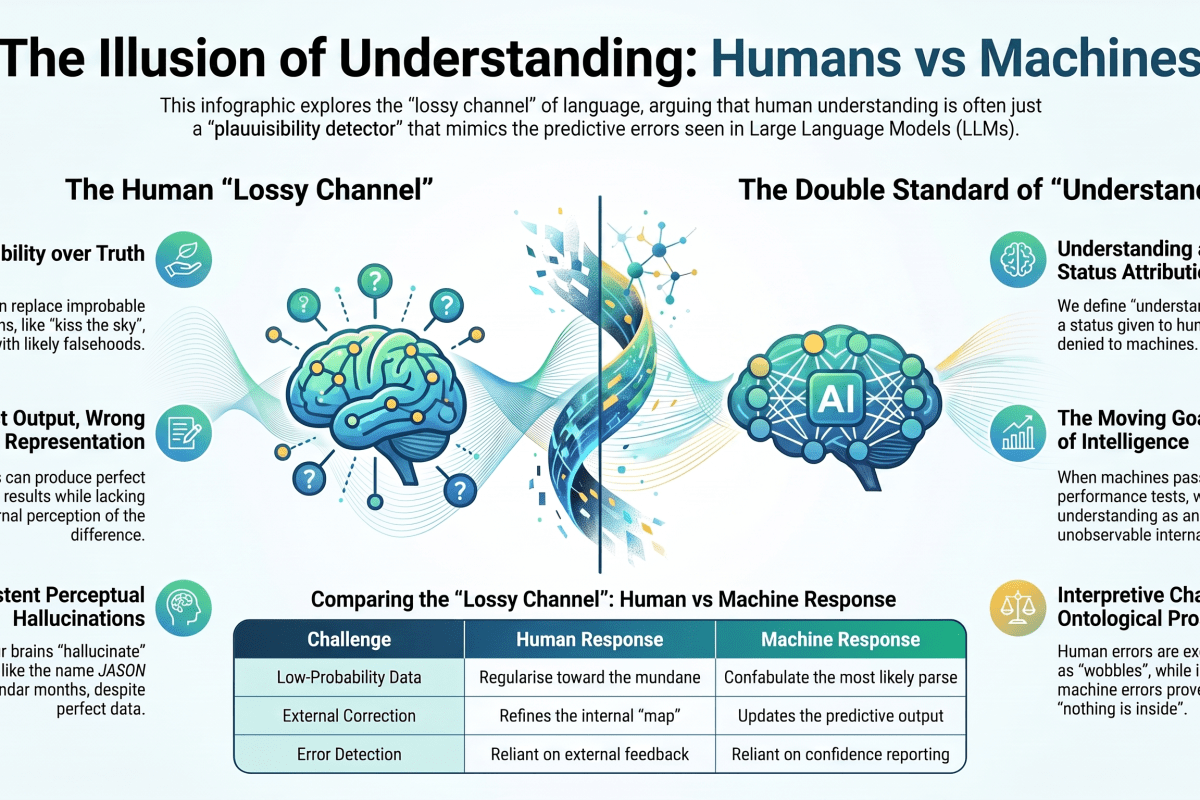
In this Substack essay, I explore the flawed nature of human comprehension, arguing that our understanding is often just a calculation of probability rather than an objective grasp of truth. By examining linguistic errors like misheard lyrics and his own struggles with French phonemes, Willis demonstrates that humans frequently hallucinate or misinterpret data based on what seems most plausible. He compares these mental lapses to the ‘hallucinations’ of Large Language Models, suggesting that the mistakes made by AI are fundamentally similar to our own. The author contends that we apply a double standard by granting humans the status of ‘understanding’ while dismissing machines for the exact same predictive behaviours. Ultimately, the text challenges the metaphysical assumptions of human exceptionalism, asserting that what we call ‘understanding’ is merely an external attribution rather than a unique internal state.
Essentially, I am not advocating the view that LLMs have consciousness and understanding; rather, I am arguing that the human versions of these are inflated with metaphysics.
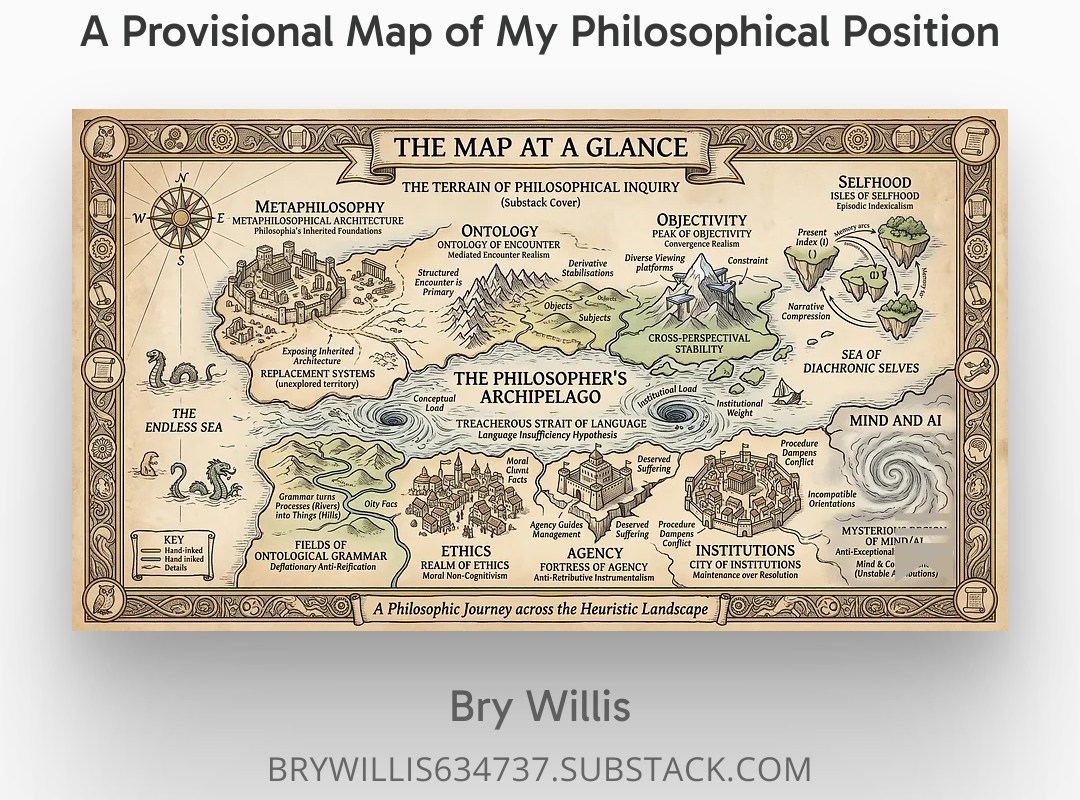
The question is reasonable, although belief may already be doing more work than I would permit it under cross-examination. My writing is generally diagnostic rather than doctrinal. I am more interested in identifying the architectural assumptions beneath a dispute than in selecting a furnished room within it. Where philosophy offers a contest between established positions, I often suspect that the arena itself has been badly designed.
Still, repeated diagnoses eventually disclose a pattern. Certain commitments recur: suspicion of substance, resistance to metaphysical inflation, distrust of linguistic confidence, rejection of moral realism, scepticism toward persistent personal identity, and an insistence that mediation does not entail fabrication.
What follows is therefore neither a creed nor a completed system. It is a provisional map of where I presently stand.
The labels are intended as coordinates, not allegiances. Where no established term quite fits, I have used my own. This is partly unavoidable and partly evidence for the very linguistic difficulty I spend so much time diagnosing.
This content, including video and podcast summary, are of a longer Substack article on my philosophical positions with descriptions.
This is less a confession than an earmark. I came across a conversation with Michael Puett on Chinese philosophy, selfhood, ritual, and the modern Western compulsion to find oneself, and the whole thing caught on an old hook.
Audio: NotebookLM summary podcast of this topic.
Synthèse audio de ce sujet en français dans le podcast NotebookLM.
I am already familiar with some high-level accounts of Asian philosophies, especially Buddhism and the doctrine of anattā (Pali) or anātman (Sanskrit): non-self. That idea has never seemed especially alien to me. If anything, it names with admirable economy a suspicion I already held: that the stable, discoverable, authentic Self is less a hidden metaphysical jewel than a bundle of habits wearing a name badge.
Puett’s point, as I take it, is not merely that the Western self is overblown. That would be too easy, and therefore popular. The sharper claim is that the search for one’s True Self may become dangerous precisely because it mistakes the current arrangement of ruts, reflexes, wounds, preferences, and defensive routines for an essence. ‘This is just who I am’, says the person, embracing not a soul but a sediment. The bad habit acquires a halo. Therapy-speak finds a throne. Another little sovereign subject is crowned in the bathroom mirror.
Against this, Puett presents Chinese philosophy as a tradition of cultivation: not self-discovery, but self-transformation. The point is not to excavate an authentic interior but to train perception, conduct, relation, and response. Ritual, in this frame, is not dead ceremony or social programming. It is a technology of de-naturalisation. It interrupts the little automatisms by which we become legible to ourselves and intolerable to everyone else.
This matters to me because I have long been suspicious of Western narratives and metanarratives, especially those that mistake local grammar for cosmic architecture. The year and a half I lived around Tokyo was instrumental here. I did not leave Japan with a doctrine, thankfully. Nothing so vulgar. But it loosened something. I had already begun to distrust the sovereign Western subject, the metaphysical executive behind the eyes, the heroic interiority forever pretending to be origin rather than residue. What I lacked was a broader vocabulary. A better frame.
As often happens, I later encountered thinkers who had already articulated versions of what I had been circling, usually with more patience, precision, and elegance. Such is the scholar’s reward: to discover that one’s private revelation has an older bibliography.
What struck me in Puett’s discussion was the movement from identity to practice. Religion, selfhood, reading, even attention itself: these need not be treated as badges to defend, but as disciplines to inhabit. This is a useful corrective to the modern anxiety of proof. The self must prove itself. The worker must prove worth. The believer must prove identity. The thinker must prove originality. Modern life becomes a Calvinist treadmill with better branding and worse lighting.
The alternative is not passivity. Nor is it the wet little slogan that everything is socially constructed, therefore nothing matters, therefore let us all dissolve into discourse and invoices. The alternative is practice: deliberate, repeated, embodied interruption. Ritual as a way of making habits visible. Reading as a ritual of humility. Attention as a cultivated stance. Relation as something made, not merely felt.
This is where Chinese philosophy may become especially useful for my own work. It offers neither the Western fantasy of the fixed self nor the lazy inversion of pure flux. It gives us formation, pattern, training, relation, and transformation. Not the Self as essence. Not the self as fiction. The self as practised arrangement. That, at least, is worth returning to.
I am busy, always busy, because apparently exhaustion has been mistaken for virtue by a civilisation that should know better by now. But I want to earmark this thread for further consideration: Chinese philosophy, ritual, anti-authenticity, non-self, practice over identity, and the possibility that what we call ‘who I am’ is often only what has not yet been interrupted.
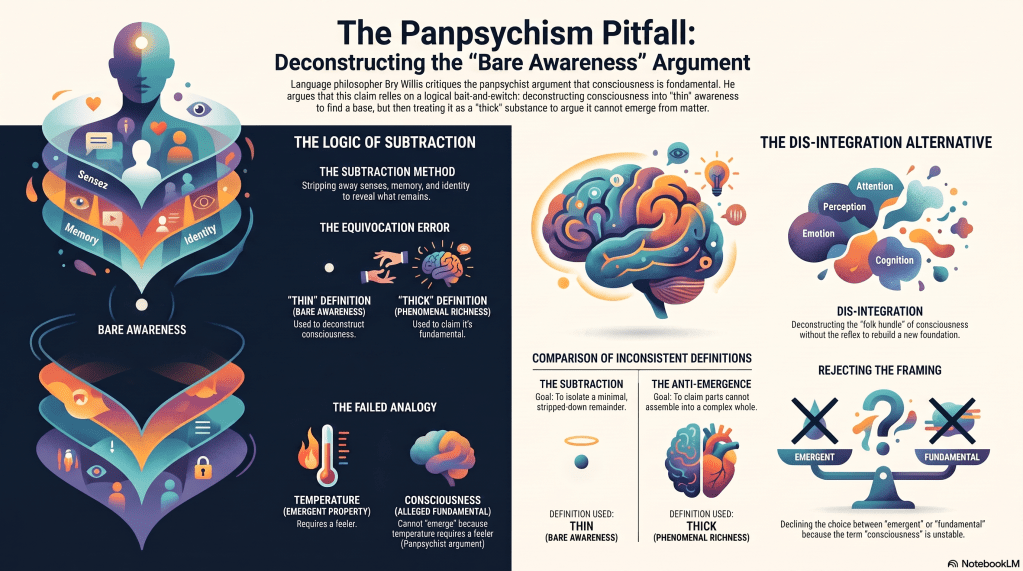
I am decidedly not a proponent of panpsychism. Most philosophers – and, let us be honest, most people – cannot deconstruct without immediately reconstructing; the rubble has barely settled before they are pouring fresh foundations. I decline that reflex, and I call the declining Dis–Integration – the term chosen partly to keep my distance from Derrida, whose own coinage is abused by more people than have even read him.
Audio: NotebookLM summary podcast of this topic.
Alex Connor begins well. He Dis–Integrates the folk package of consciousness, and he does it cleanly. Respect. Set aside that ‘consciousness’ carries literally dozens of definitions across disciplines and subdisciplines. Just grant him the ordinary picture and watch him strip it. Memory, sensory richness, identity, deliberation, narrative selfhood – he shows that none of these is intrinsic to consciousness as ordinarily imagined. As he says, close your eyes and subtract sight; still conscious. Subtract hearing, subtract touch, subtract memory until no instant is ever laid down. What remains, he says, is bare awareness. So far, so good. Descartes would have been proud.
But then Alex makes the same mistake as René, mistaking the dust for an ontological primitive. That a folk bundle can be decomposed entails precisely nothing about the fundamentality of whatever is left at the bottom of the barrel. It may show only that ‘consciousness’ was never a stable kind-term – that we have been pointing at an assortment and calling it a thing.
This subtraction is only Dennett’s intuition pump, not the engine, which arrives at the end, when Alex argues that you can’t assemble a substance from parts that lack it – that the familiar emergence analogies, temperature from molecules, an image from pixels, all smuggle in the very phenomenality they pretend to derive, because temperature ’emerges’ only for someone who already feels heat. No good analogy survives, he concludes; therefore, consciousness cannot be built; therefore, it must already be down there in the atoms. Nope.
Leave that standing and the subtraction argument was never load-bearing at the start. The stripping was only ever ostensive, a way of pointing at minimal consciousness, but the fundamentality claim never rested on it.
The subtraction works only by thinning ‘consciousness’ to bare awareness – by evacuating redness, the unified first-person feel, the entire rich remainder, on purpose and as a matter of method. The anti-emergence argument works only by treating ‘consciousness’ as a robust substance whose assembly from non-conscious parts is incoherent – and every ounce of that incoherence is borrowed from exactly the rich phenomenal features the subtraction he’d just tossed overboard. ‘First-person unified experience’. ‘The redness of red’. Those were his words, and they are doing the work in the argument that needs consciousness to be thick, moments after he has insisted it is thin. Oops.
So the noun equivocates inside his own case. Damn dirty objects. It’s a decomposable bundle when he needs minimality; an indecomposable substance when he needs non-emergence. He can’t eat his cake and have it, too. There’s no single referent for the emergence to succeed or fail at. Some bundled features plainly emerge – that’s what bundling is. The bare what-it-is-like-ness is the contested remainder. And ‘it’s all one substance that can’t be built’ is simply the reification I diagnosed earlier.
This is why I decline the question. It’s not ‘consciousness is emergent‘ set against his ‘consciousness is fundamental‘ – that trade keeps the bad noun on the pitch. The framing of substance-versus-emergence is what fails. So, I’m not adjudicating the dispute. I’m just declining its terms after showing that its terms weren’t ever coherent to begin with.
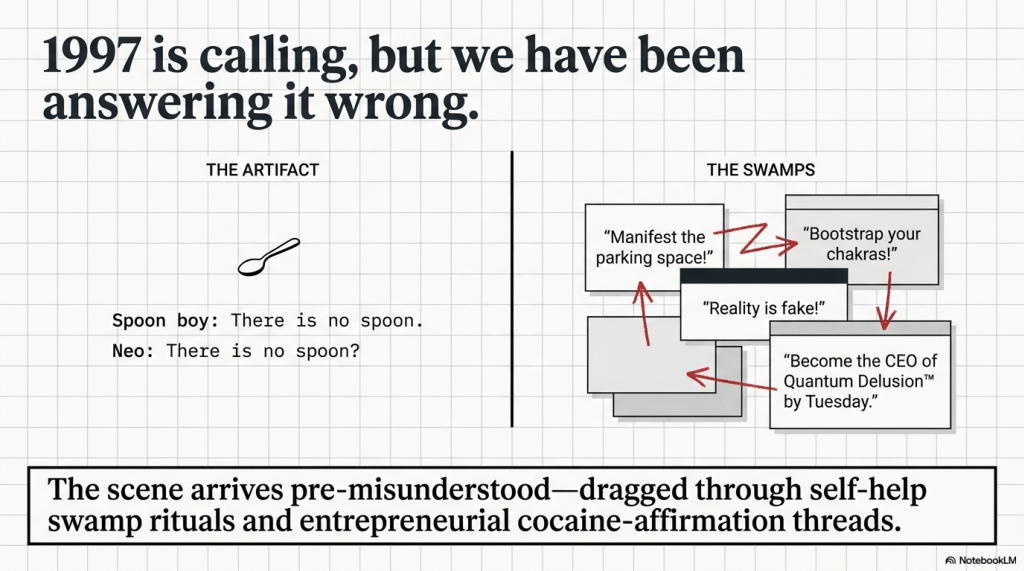
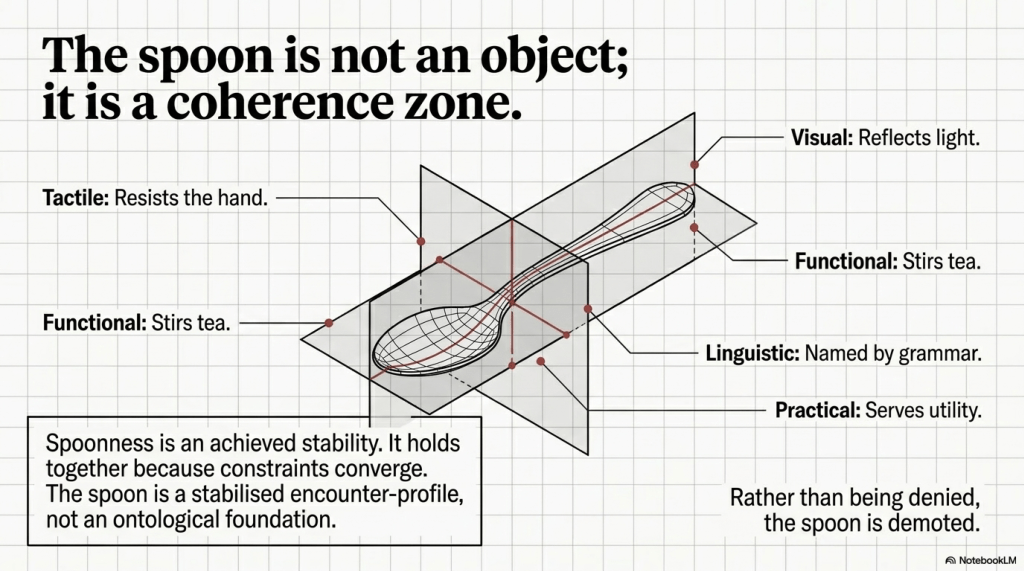
Responding to a post, I found myself returning to that iconic, routinely misrepresented scene from The Matrix: the one with the spoon. The scene has been dragged through so many motivational seminars, self-help swamp rituals, pseudo-Buddhist wall decals, and entrepreneurial cocaine-affirmation threads that it now arrives pre-misunderstood.
Video: Bonus Content
Even Baudrillard distanced his work from the version of simulation the Wachowskis made cinematic. This is not a criticism, exactly. Film has two hours to smuggle metaphysics through leather coats, sunglasses, and slow-motion firearms. One makes allowances. Philosophy, alas, has fewer trench coats and more footnotes.
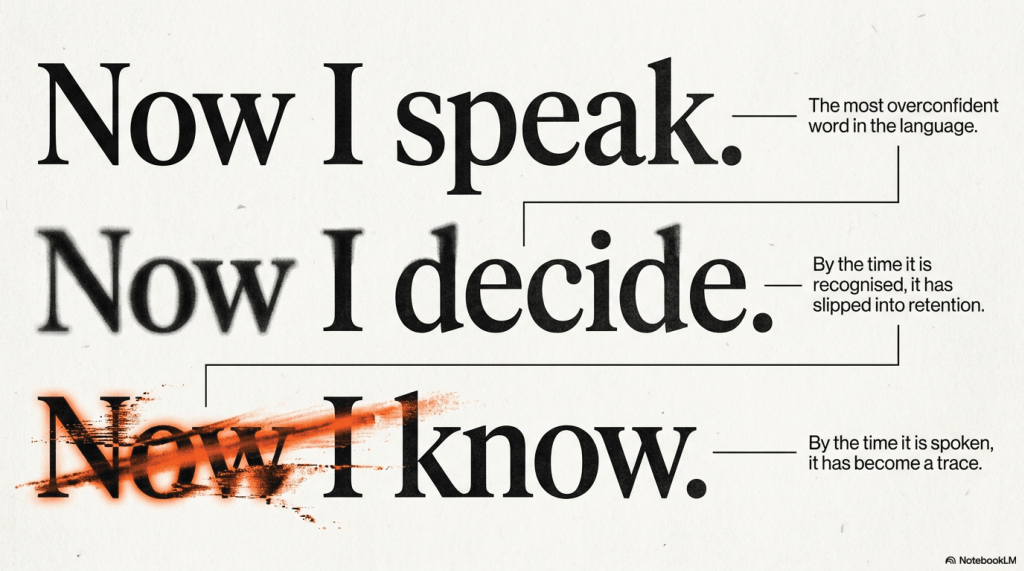
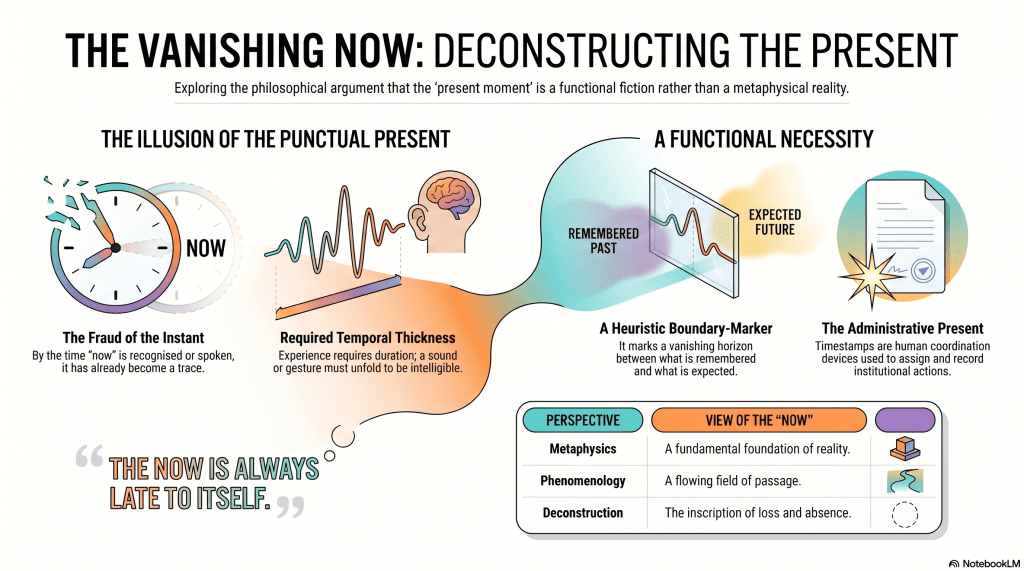
‘Now’ is one of the most overconfident little words in the language. It presents itself as immediate, self-evident, and available. We speak as though it names the present cleanly: now I speak, now I decide, now I know, now is the moment. Yet the word performs a small fraud every time it appears. By the time ‘now’ is recognised, it has already slipped into retention. By the time it is spoken, it has become a trace.
‘Now’ is not an experienced unit but a heuristic boundary-marker within temporal flow. It names a vanishing horizon between retention and protention: already past by the time it is recognised, already structured by what is expected before it can be stabilised. What it designates isn’t a thing, not a slice, not a metaphysical bead on the string of time, but a practical fiction by which consciousness, language, and action coordinate within a moving field.
Audio: NotebookLM summary podcast of this topic.
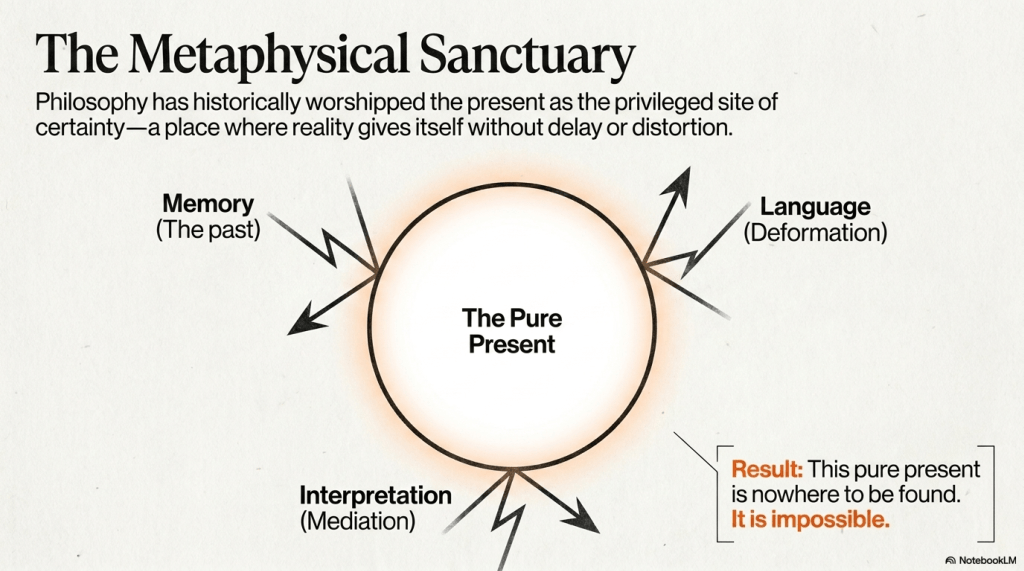
This distinction matters because philosophy has often treated the present as though it were the privileged site of certainty. Presence has been taken as the place where reality gives itself without delay, mediation, or distortion. The present moment becomes the imagined sanctuary of immediacy: before memory corrupts it, before language deforms it, before interpretation arrives with its grubby little toolkit. But this pure present is nowhere to be found. It’s not hidden; it’s impossible.
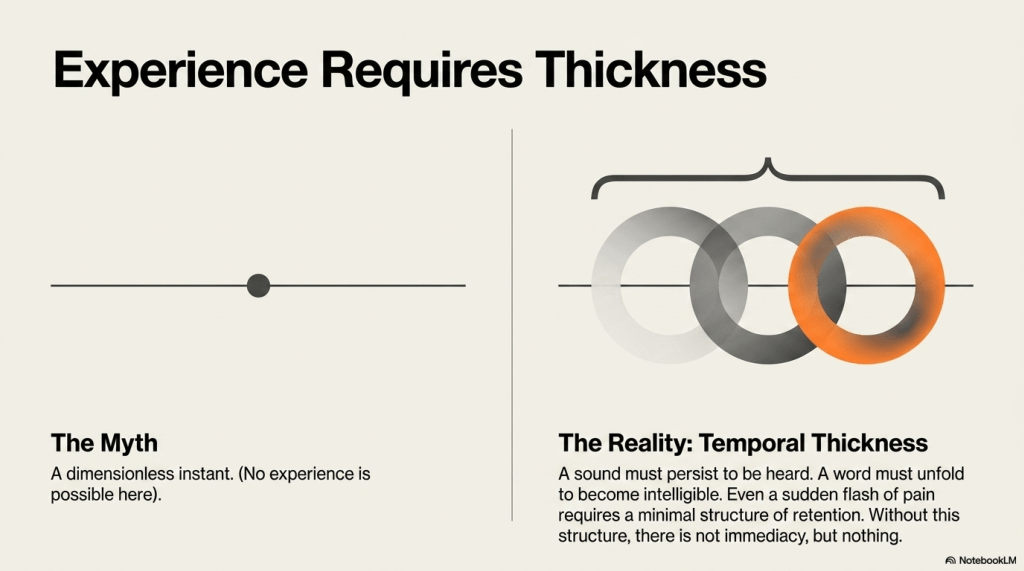
Experience is never given as a dimensionless instant. To experience anything at all requires temporal thickness. A sound must persist long enough to be heard as a sound. A word must unfold across time to become intelligible. A gesture is not apprehended as a gesture unless its beginning is retained and its likely completion anticipated. Even the flash, the shock, the sudden pain, the glimpse at the edge of vision, all require some minimal structure of retention. Without that structure, there isn’t immediacy but nothing recognisable as experience.
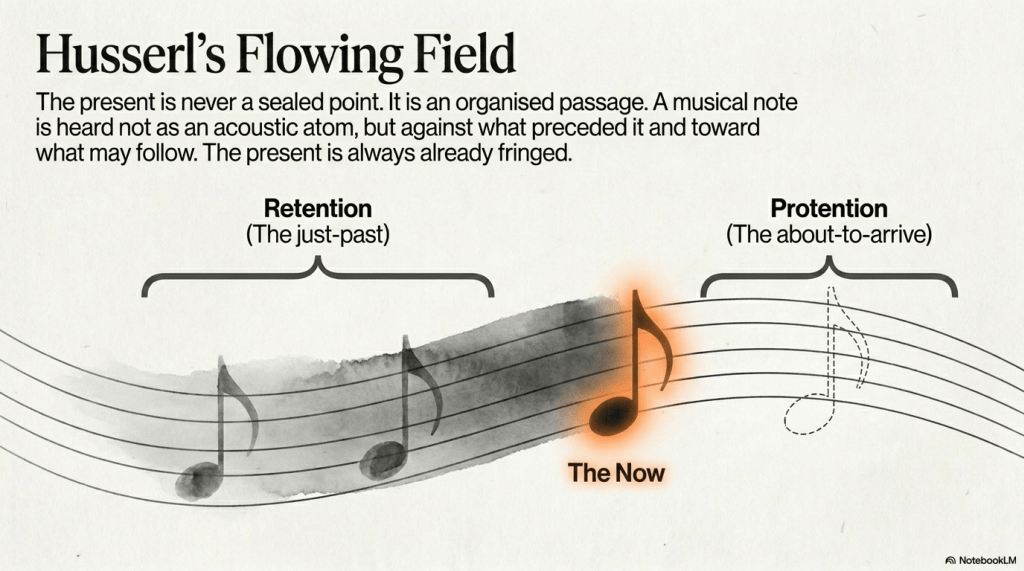
Husserl saw part of this with his account of retention and protention. The present isn’t a sealed point but a flowing field in which the just-past and the about-to-arrive are already implicated. A musical note isn’t heard as an isolated acoustic atom. It’s heard as part of a phrase, against what has preceded it and toward what may follow. The same is true of speech, perception, decision, and action. The present is always already fringed. It’s bordered by memory and expectation. It’s not pure presence but organised passage.
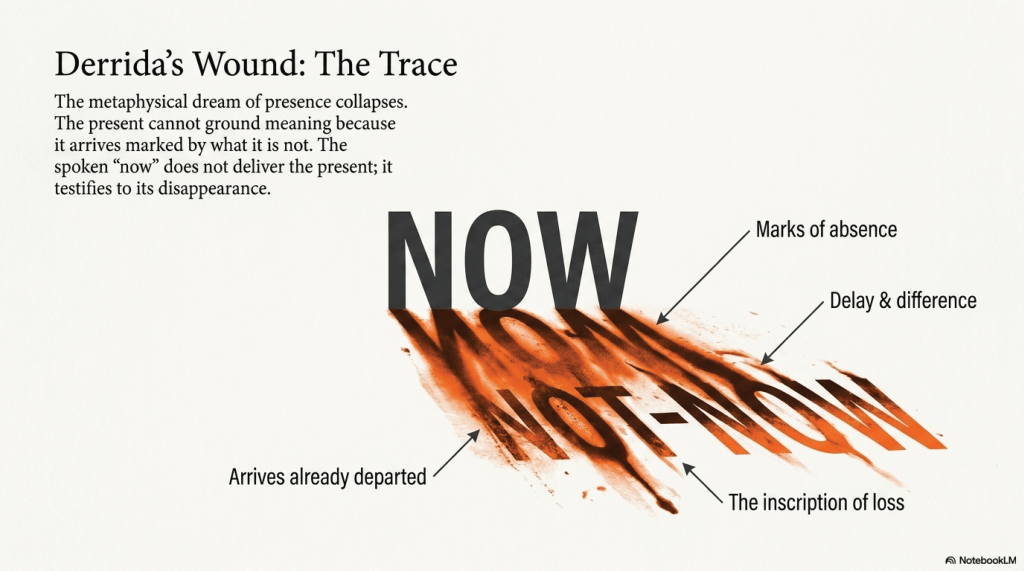
Derrida presses the wound further. If the now is always contaminated by what is not-now, then the metaphysical dream of presence collapses. The present cannot ground meaning because the present is never simply present. It arrives marked by absence, delay, difference, and trace. The spoken now does not deliver the present. It testifies to its disappearance. It isn’t the arrival of immediacy but the inscription of loss.
This isn’t merely a technical problem in phenomenology. It has consequences for how we think about agency, meaning, and reality. We routinely speak as though action occurs in a present moment of self-possession: I now choose, I now intend, I now decide. But this grammar flatters us. Decision is never contained in a punctual present. It condenses prior dispositions, pressures, perceptions, habits, bodily states, histories, and anticipated consequences. The now of decision is a narrative compression imposed after and within a process that exceeds it.
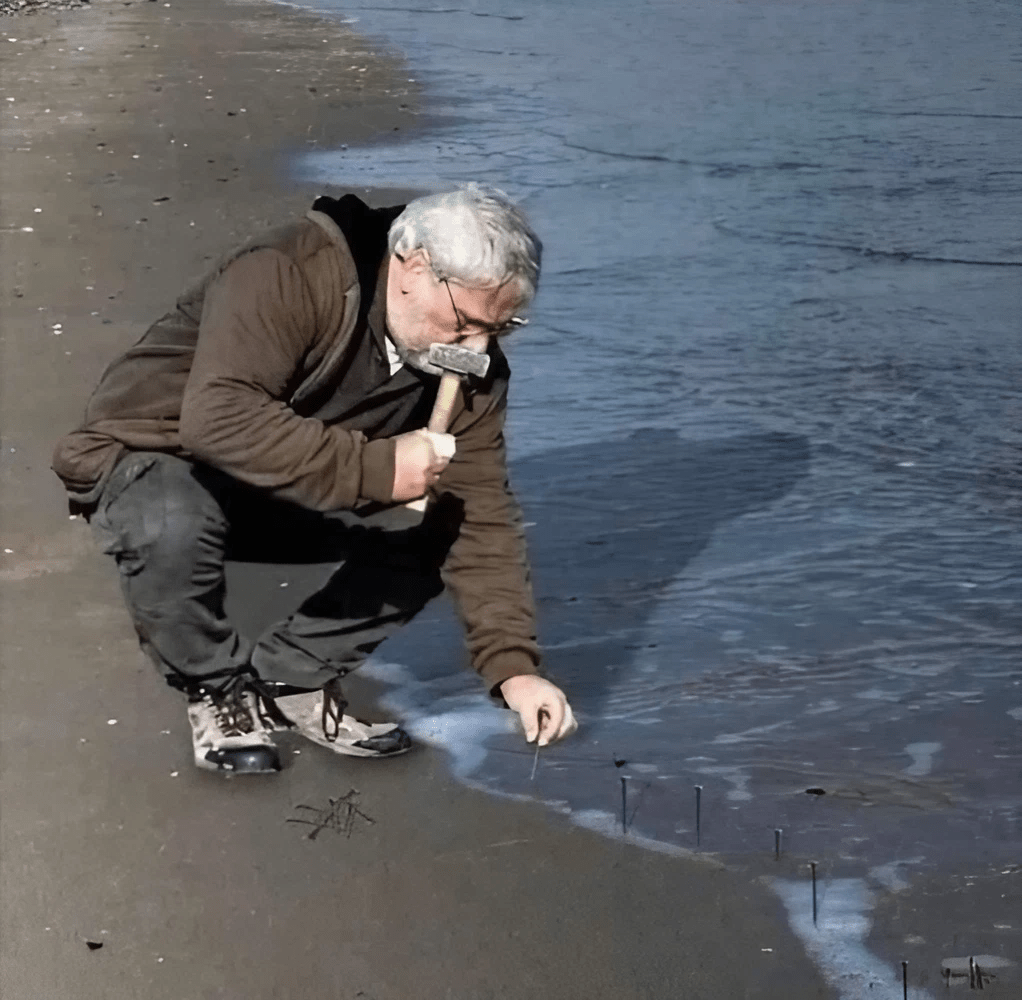
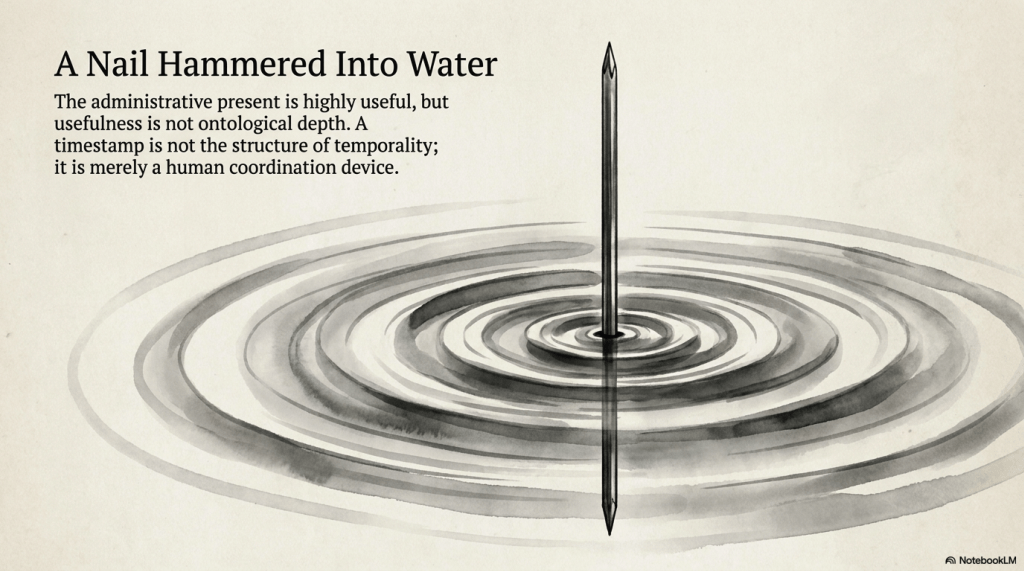
The same applies to moral and institutional language. Law loves timestamps. Bureaucracy loves decision-points. Politics loves moments. Each requires a tractable ‘now‘ because institutions must act, record, assign, and close. The administrative present is useful because it can be filed. But usefulness shouldn’t be mistaken for ontological depth. A timestamp isn’t the structure of temporality. It’s a human coordination device, a nail hammered into water.
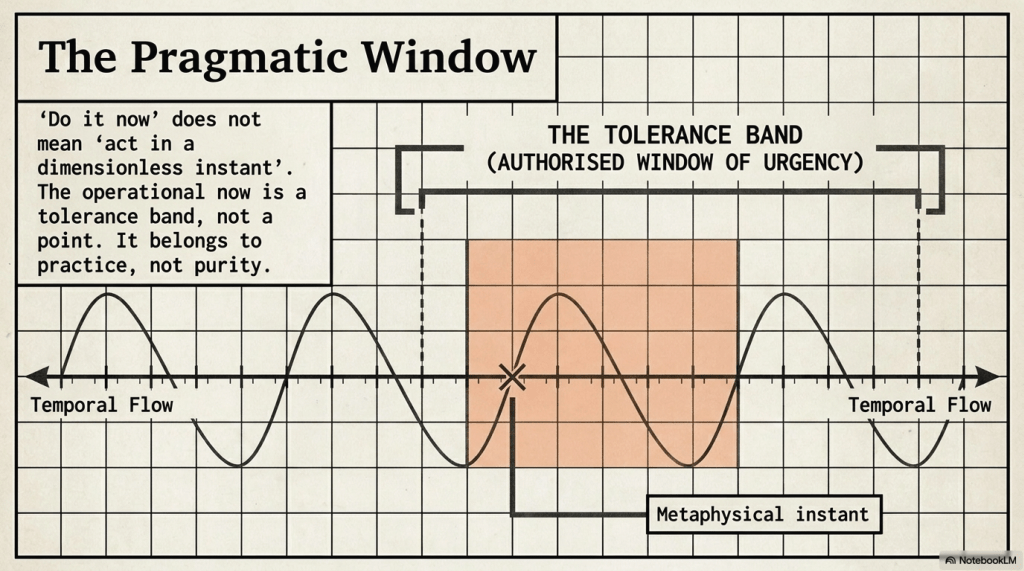
The now survives because it’s pragmatically indispensable. We need it to coordinate action. ‘Do it now’ doesn’t mean ‘act in a dimensionless metaphysical instant’. It means ‘act within the authorised window of urgency established by this utterance’. The operational now is a tolerance band, not a point. It belongs to practice, not purity.
This is why the present should be deflated rather than worshipped. The now isn’t an entity. It’s not a metaphysical foundation. It’s a boundary-function within temporal flow, a stabilising fiction by which agents orient themselves amid movement. It marks a horizon that vanishes as it is named.
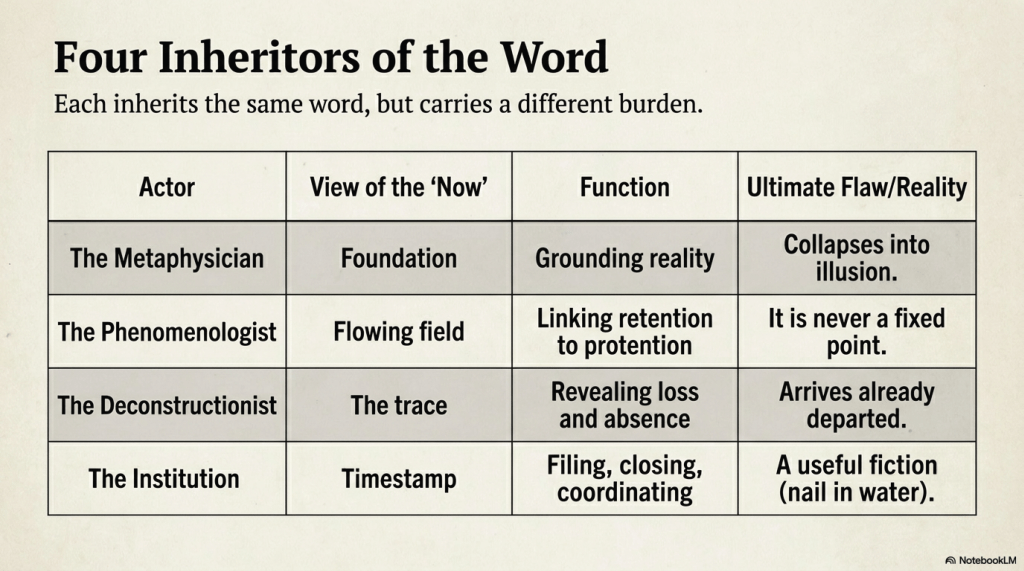
The metaphysician wants the now to be a foundation; the phenomenologist discovers it as flow; the deconstructionist hears in it the trace of what has already departed. The institution converts it into a timestamp and pretends the problem has been solved. Each inherits the same word, but not the same burden.
To invoke ‘now’ is therefore not to seize presence. It’s to gesture at the impossible purity of presence from inside its failure. The word works, but it works heuristically. It coordinates, compresses, and stabilises just enough. What it doesn’t do is deliver the present as such. The now is always late to itself.
Allow me to start with a declaration: I am no Hegel expert, and whether I am an expert at anything is debatable. Still, I’ve been reflecting on Hegel through my own lenses, and I have an opinion – because of course I do. My comment isn’t on a single Hegel publication. Rather, it’s a commentary on some of his general ideas – some more specific than others – that just so happen to be rattling around my noggin as I type.
Audio: NotebookLM summary podcast of this topic.
I know I’ve already claimed to have started, but this is the real start. Let’s talk translations.
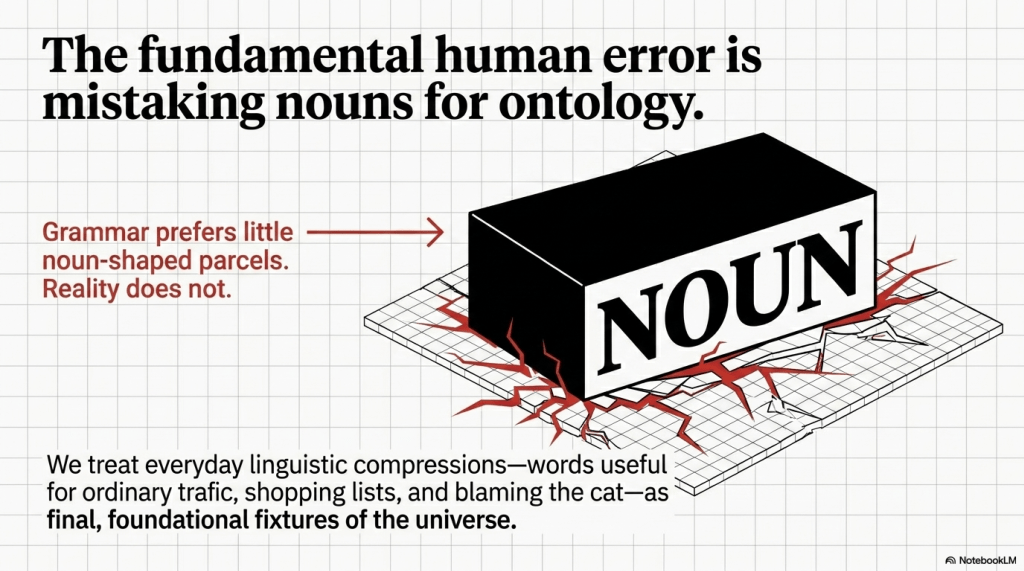
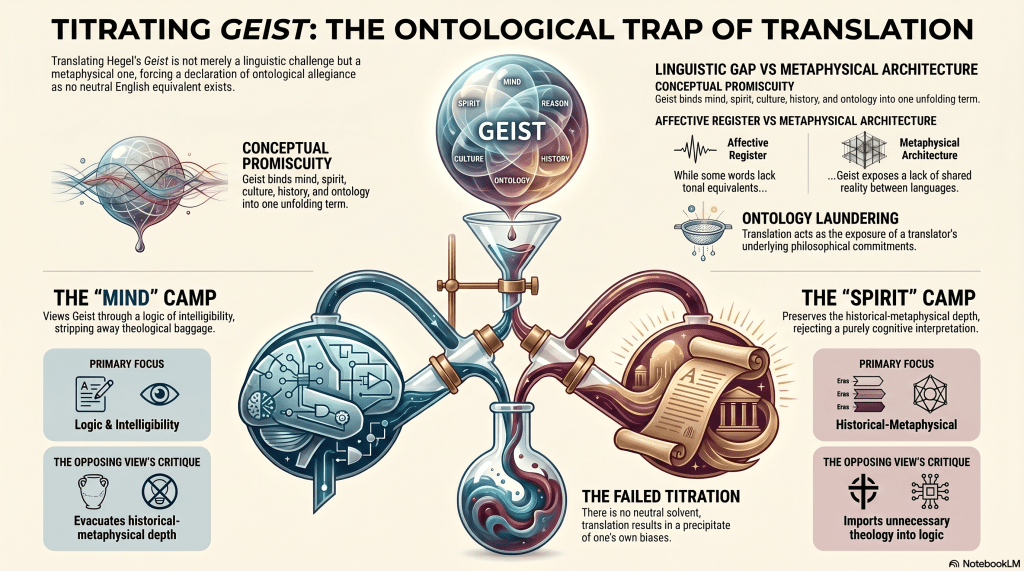
NotebookLM Infographic on this topic.
I recently discussed the problem with translating Meursault’s French maman. The short version: English lacks a clean equivalent. Every option – Mother, Mummy, Mama – over-interprets the son’s relation to his mother, leaning warmer or colder or more infantile than the French allows. Camus’ problem is at the level of affective register. The ambiguity is tonal, intimate, and culturally situated. English simply can’t carry it without choosing a side.
Hegel has a different problem, more philosophically weighty. His problem is Geist. Almost immediately, I think of zeitgeist and Poltergeist. Ghosts. Spirits. Phenomenology of Spirit, right? Easy peasy.
Not so fast. Some translators render it as Mind, in an attempt to distance themselves from theological baggage. The problem is that Hegel himself equivocates – so he’s of little help. He may have been intentionally cheeky, being stuck in the milieu of his day, as well as a product of it and producer through it.
Where maman exposes language’s insufficiency at the level of affective register, Geist exposes it at the level of metaphysical architecture. English can’t preserve the conceptual promiscuity by which Hegel binds mind, spirit, culture, history, and ontology into one unfolding term. The word doesn’t just mean something; it enacts a view of what is real and how the real moves. If that weren’t bad enough, enter ontological grammar commitments. (I’m a teetotaller, so someone else hold the bear.)
Video: Hold my bear
The translator is not neutrally asking: What does Geist mean? They are already asking, even if silently: What kind of reality do I think Hegel is describing?
Translation here isn’t the neutral transfer of meaning – it’s the exposure of ontological allegiance. The quarrel over Geist is not a lexical dispute. It is ontology laundering itself through vocabulary.
Let’s consider the two camps.
The Mind camp hears:
“You are importing theology into what is fundamentally a logic of intelligibility.”
The Spirit camp hears:
“You are evacuating the historical-metaphysical depth of the term and pretending Hegel was doing philosophy of cognition with better hats — nicer hats, perhaps, but hats all the same.”
Neither objection is irrational from within its own grammar. Both are locally coherent. They simply don’t share the same ontology of the term.
Reason doesn’t choose between Mind and Spirit from nowhere. It adjudicates from within a prior ontological settlement, then mistakes that settlement for neutrality. This is worth remembering well beyond the Hegel literature.
In disputes over Geist, reason doesn’t fail because the parties are irrational. It fails because each party’s reason operates inside a different ontological grammar. What appears as clarification within one frame appears as distortion within the other. A reason is not self-legitimating. It becomes a reason only inside a grammar that knows how to receive it.
Which brings us back to the title. Titration works when you have a known reagent and a neutral solvent – you add one to the other until the system reaches equilibrium. The whole method assumes there is an equilibrium to reach. Geist has no neutral solvent. Mind and Spirit are not two concentrations of the same substance. They are different substances, differently constituted, differently reactive. There is no volume at which one cancels the other out. You can titrate the word all you like. The indicator never changes colour. What you are left with is not a settled meaning but a record of your own ontological commitments, precipitated out of solution and sitting at the bottom of the flask – which, in the end, is more than most translations will admit.
Door Prize: Here’s your parting gift courtesy of NotebookLM…
On God, Objectivity, and the Grammar That Outlives Both
NB: After I posted this, I put some more thought into the notion. Rather than extending this post, I decided to post the follow-up on Substack. Where Nagel asks, What’s it like to be a bat? I ask What’s It Like to Be a Human?
I know a nice philosophical parlour trick. It’s performed by asking someone whether they believe in objective truth. If they say yes, ask them where it comes from; if they say no, ask them whether that denial is objectively true. The trick is not a refutation of anything. It is a demonstration: the concept of the Objective has been installed so deeply in the grammar of the question that you can’t coherently step outside of it long enough to evaluate it. In this respect, you’re a starling who can’t see the murmuration from within it.
Audio: NotebookLM summary podcast of this topic.
Let’s start with Nagel. In 1974, Thomas Nagel published a paper that broke a perfectly serviceable assumption in half. The assumption was that consciousness, while subjective in character, was at least comparably subjective across humans – that the gap between my inner life and yours was a matter of degree, navigable by imaginative projection and shared biology, whereas the gap between me and a bat was of a different order entirely. Nagel’s intervention was to question the first assumption by taking the second seriously. If the bat’s echolocation is genuinely inaccessible – not merely unfamiliar but structurally unreachable, given that I have no experiential raw material from which to construct what sonar feels like – then the inference from ‘I can’t imagine this being’s experience‘ to ‘this being probably has no experience worth worrying about‘ is invalid. Not difficult. Invalid. The bat has a perspective; I can’t access it. These two facts are entirely compatible, not mutually exclusive.
The extension Nagel resisted, but which his own argument demands, is this: the same epistemic closure obtains everywhere. Not merely between humans and bats, or humans and artificial systems, but between any two subjects whatever. What we call human-to-human understanding is not epistemic access to another’s inner life. It’s coordination: shared linguistic conventions, overlapping heuristics, statistical regularities of behaviour stable enough to be gamed and relied upon. We don’t experience each other’s experience. We model each other, well enough for most practical purposes, but then mistake the model for the contact. It’s all too common.
The murmuration of starlings is useful here. A rule of seven: Each bird responds to its seven nearest neighbours. Local rules, local information, irreducibly individual embodiment. The apparent organism wheeling across the sky – that single fluid entity that seems to breathe and turn as one – is a scale-dependent phenomenon that observers impose from a sufficient distance. Pareidolia at work. There is no murmuration-subject, and there is no fact of the matter about what it is like to be the flock, because the flock is not the level at which anything is happening. Whilst the coherence is real, the subject isn’t.
A statistical person is the murmuration.
A statistical person is the murmuration. Every apparatus of governance, moral philosophy, and institutional coordination operates by constructing a subject at the flock scale – the rational agent, the bearer of rights, the member of the moral community, the person before the court. These constructions aren’t errors at all. They’re necessary compressions. Courts can’t adjudicate the irreducible particularity of each defendant; they need the type. But the utility of the compression at the institutional scale isn’t evidence that the compression names anything real at the experiential scale. As the average human isn’t actually a human, the murmuration is not a starling.
What does this mean for the consciousness debate – about bats, digital systems, or the person sitting across from you? The question ‘is there something it is like to be X?‘ isn’t merely unanswered, but it’s malformed as posed. It presupposes a subject-object grammar within which the question makes sense: a discrete, bounded subject, either possessing or lacking inner experience, in principle distinguishable from other such subjects. That grammar produces the apparent problem. Dissolve the grammar, and the problem doesn’t get solved; rather, it gets diagnosed. Which brings us to God…
if God did not exist, it would be necessary to invent Him
Here, Voltaire’s quip – if God did not exist, it would be necessary to invent Him – is almost right. But its failure is in the verb. Invention implies architects: identifiable agents who construct a useful fiction and install it in a credulous population. This is the wrong model for how the objective world works. No one decided to construct it. Rather, it accreted. Each starling wasn’t conspiring to produce the murmuration; the murmuration is what the local rules produce at scale – No intention necessary. The exogenous imposition has no imposer behind it, which is precisely why it presents with such unimpeachable authority. Expose an inventor, and you discredit the invention. But when there isn’t an inventor – when the cage precipitated rather than being built – there isn’t a conspiracy to unmask; there’s no priest to dismiss – only the structure itself, which continues to function regardless of whether anyone believes in it.
Nietzsche understood this better. The death of God, for Nietzsche, wasn’t the liberation it appeared to be. It was the removal of the only anchor the entire normative structure had, without anyone noticing what was actually anchoring what. The Enlightenment didn’t interrogate the theological grammar. It secularised it. Reason, Nature, Science, Progress, History – each of these performed the same function God had performed: the external, authoritative, mind-independent referent against which claims could be measured and from which institutional authority could flow downward to the subject. The architecture was identical; only the tenant changed.
Objective is the edifice. When God was evicted, Reason, Science, Objective Truth became the new tenants
And that’s the point. The Objective isn’t a discovery. It’s a slot, a structural position in the grammar of subject-object discourse that requires an occupant if coördination at scale is to function. God was an early and effective tenant. When God was evicted, the slot didn’t disappear. It couldn’t because it’s not a belief but a grammatical necessity. It was immediately re-occupied, with the additional ideological advantage that the new tenants – Reason, Science, Objective Truth – present themselves as discovered rather than inherited. You can lose faith in God. You can’t, without apparent irrationality, lose faith in Objective Reality, because Objective Reality is now the precondition of the concept of rationality itself. The successor is more entrenched than the original. The slot has been occupied so continuously that it now looks like part of the foundation.
But it’s not. The building is the subject-object grammar, which generates the Objective slot as a structural correlate of the Subject. What fills the slot – God, Reason, the Market, the Algorithm – is the history of ideas, the history routinely mistaken for intellectual progress: the mature species finally locating the real external anchor, after centuries of superstitious misdirection. What’s actually happening is tenant succession. Each eviction is experienced as crisis, where each new occupant presents as the permanent solution. The edifice is never inspected because it’s always occupied, and this occupied building looks like a home.
The diagnostic move, then, isn’t to find a better tenant. Every reform programme, every Enlightenment, every revolution has done exactly that, and the slot fills again within a generation. The diagnostic move is to show that there is an edifice, that the grammar has a structure, that the structure generates the slot, and that the slot’s current occupant inherited its authority from the grammar rather than earning it from the world.
This is a different kind of intervention. Rather than a replacement, it produces a recognition that the coordinating function of the Objective is genuine and the ontological claim isn’t, that the murmuration coheres and the murmuration-subject doesn’t actually exist, that we are starlings – or turtles – all the way down, responding to our seven nearest neighbours, producing from the outside the appearance of a unified orientation toward a common truth.
the statistical person is regular enough to be governed, predicted, and addressed
A relativistic social model operates well enough on this account: It doesn’t require an objective world; it simply requires stable enough local rules that the flock coheres, that the statistical person is regular enough to be governed, predicted, and addressed. The objective world is the name we give to that coherence when observed from a sufficient distance. It’s robust enough for almost every practical purpose. What it isn’t is foundational. Remove the coordinating conventions, and it simply stops being produced.
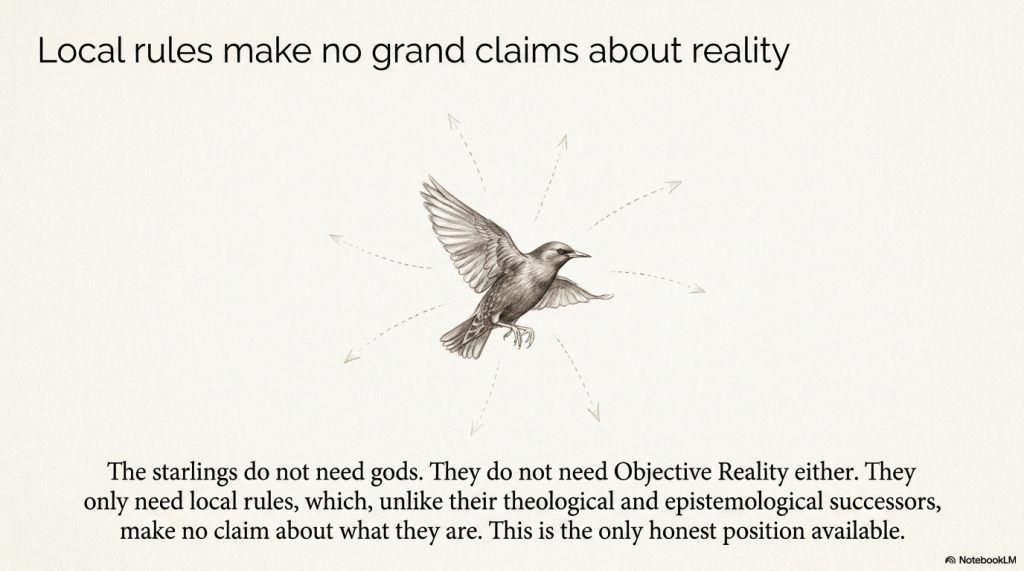
The starlings don’t need gods. They don’t need Objective Reality either. They only need the local rules, which, unlike their theological and epistemological successors, make no claim about what they are. Which is, in the end, the only honest position available.
A colleague recently shared an essay with me, The Return of Metaphysics: Reclaiming Sovereignty Through Ontological Grounding in Postcolonial and Western Thought. I read it with interest, not least because its target is one I share: the colonial imposition of Western categories as if they were universal reason, universal law, universal political form, and universal humanity. On that point, there is no meaningful disagreement. Colonialism isn’t merely theft of land, labour, and resources. It’s also the imposition of a grammar by which reality itself was made legible to power.
The essay is at its strongest when it treats colonialism as metaphysical violence rather than merely administrative domination. It argues that Europe universalised its own categories and rendered other worlds invisible, inferior, or unreal. Colonialism, on this account, was not only conquest. It was the installation of one ontology as the authorised operating system of the human. That’s a powerful diagnosis, and it deserves to be taken seriously. The essay explicitly describes colonialism as a process that ‘re-made being’ and suppressed other conceptions of time, morality, and community.
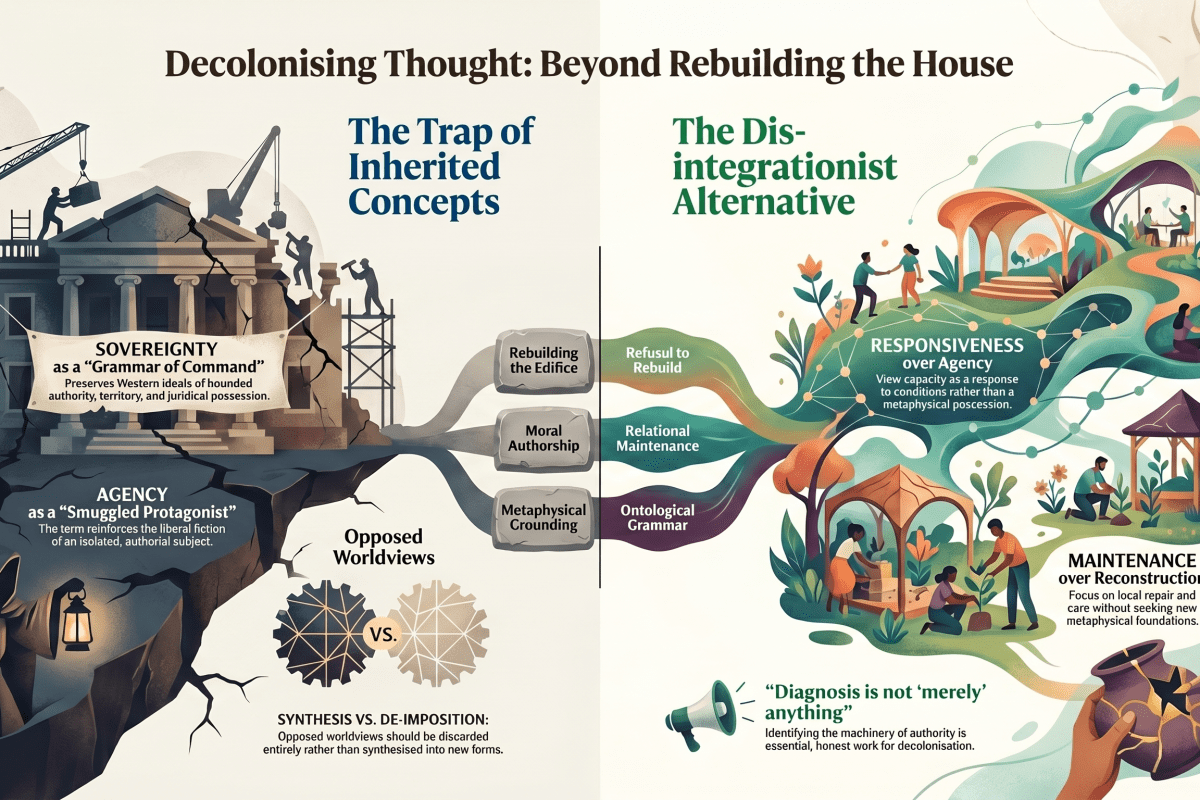
Where I start to hesitate isn’t in the critique of colonialism, but in the proposed recovery. The essay seeks to reclaim metaphysics, sovereignty, agency, moral authorship, and ontological grounding as instruments of postcolonial renewal. It wants to oppose colonial metaphysics by recovering metaphysics; to oppose hollow sovereignty by reconstructing sovereignty; to oppose imposed subjectivity by restoring moral authorship.
This may be coherent within the essay’s own frame. But from mine, it raises a suspicion:
What if some of the concepts being recovered are themselves part of the colonial inheritance?
“a return to metaphysics”
“moral authorship”
“ontological reconstruction”
“popular agency”
These terms don’t arrive clean. They carry histories and come with fittings: sovereignty, possession, self-rule, jurisdiction, authorship, legitimacy, command. One may repaint them in decolonial colours, but the shape remains. Inheritance is the danger.
Audio: NotebookLM summary podcast of this topic.
Sovereignty as a Recovered Trap
The essay’s central concept is sovereignty. More precisely, post-sovereignty. Yet the very act of preserving sovereignty as the problematic term matters. Sovereignty isn’t just a neutral container for self-determination. It’s one of the central concepts through which Western political modernity imagines authority: bounded, possessed, territorialised, juridical, and authorial.
To speak of sovereignty is already to speak in the grammar of command: Rules. Owners. Authorities. Something marks the line between inside and outside.
This doesn’t mean colonised peoples were wrong to demand sovereignty. The politically dispossessed may understandably seek the protections of the language used to exclude them. If one has been denied the status of a subject, a nation, or a people, then reclaiming those terms may be historically necessary. There’s no cheap purity available from the comfort of abstraction. Humans made the mess, naturally, and then handed each other dictionaries to clean the mess.
But political necessity doesn’t settle conceptual adequacy. A term may be strategically useful and ontologically suspect at the same time. So, the question isn’t whether sovereignty has been useful in anti-colonial struggle. It’s whether it should remain the destination, rather than a transitional vocabulary one eventually leaves behind.
The essay recognises that many postcolonial states retain the ‘juridical structure’ of autonomy whilst remaining governed by inherited categories of colonial law, property, development, and bureaucratic legitimacy. That’s exactly the point where the critique might turn more sharply on sovereignty itself. If postcolonial statehood often reproduces colonial form, perhaps the issue isn’t merely that sovereignty is hollow, but maybe it’s just one of the forms through which hollowness reproduces itself.
NotebookLM Infographic on this topic.
Agency: The Smuggled Protagonist
The same problem emerges around agency. The essay speaks of popular agency, moral authorship, co-authorship, and subjectification. Again, the impulse is understandable. Colonial domination denies people the right to act, name, interpret, and organise their own lifeworlds. A postcolonial theory naturally wants to restore capacity to those rendered passive.
But the agency term isn’t innocent. In modern Western thought, agency often implies a self capable of authorship, intention, responsibility, and moral ownership. It’s the protagonist required by law, markets, liberal politics, and punishment. Someone must be deemed the chooser, the signer, the sinner, the voter, the debtor, the criminal, the rational actor.
In my own work, I reject agency as a metaphysical possession. I’d rather speak of responsiveness: a variable capacity shaped by material, relational, temporal, somatic, and epistemic conditions. People don’t float above conditions and author themselves into freedom. They respond, more or less adequately, within fields of constraint.
The essay’s emphasis on relationality moves in this direction, but its vocabulary often pulls it back toward authorship. It wants shared becoming, but it also wants moral authors. It wants relational ontology, but it also keeps the self as a source of political meaning. This is a revealing tension.
The alternative isn’t fatalism. To reject agency isn’t to deny action. Breathing doesn’t require a metaphysics of breath. It just happens autonomically. The question is whether we must preserve the fiction of the authorial subject to describe them. I think not.
When Negation Need Not Become Synthesis
The essay leans on Fanon (see The Wretched of the Earth) to argue that colonial domination can’t be resolved through dialogue because dialogue presumes equals. This is right, or at least right enough. A conversation between master and slave is not yet a conversation between equals. Liberal dialogue presumes a shared field of recognition; colonial domination corrupts that field before speech begins.
The essay, therefore, turns to dialectic. Where dialogue seeks agreement, dialectic begins from contradiction and struggle. Again, this makes sense. A colonised subject can’t merely ask to be recognised by the system that produced their non-being. Something must be negated.
My hesitation concerns what happens after the negation. The essay sometimes seems to assume that contradiction must move toward ontological reconstruction. But why? If one term of the contradiction is an imposed colonial ontology, it might not deserve preservation within a higher unity because it mightn’t be a meaningful antithesis. It may simply be wrong, violent, and disposable.
This is the dis-integrative question:
Must the colonial term be synthesised, or can it be dispensed with?
Not every opposition is productive. Some oppositions are parasitic. If a worldview is imposed by force, then treating it as a dialectical partner may grant it more dignity than it deserves. The point of decolonial refusal may not be synthesis, but de-imposition.
That distinction matters. Synthesis often preserves too much. It lets the offending structure survive as a contributor to the next stage. It says, in effect: this violence was part of becoming. Perhaps. But perhaps not. Perhaps some concepts belong on the cutting room floor.
Metaphysics: Necessary Grammar or Rebuilt Throne?
The essay argues that postmodern anti-metaphysics has left social theory without stable categories of truth or moral orientation. It wants metaphysics back, not as abstraction, but as the recovery of moral and ontological grounds for political community.
I understand the concern here, too. Communities don’t live by procedure alone. No society is sustained merely by policy, rights language, or bureaucratic form. People inhabit worlds, not spreadsheets. There are ontological grammars beneath every institution: assumptions about personhood, time, land, memory, obligation, kinship, death, and belonging.
But I resist the move from ‘we can’t avoid ontological grammar‘ to ‘we need metaphysical grounding‘. Whilst the former seems unavoidable, the latter seems dangerous.
Metaphysics isn’t simply depth. It’s elevation – the move by which a grammar stops appearing as grammar and starts presenting itself as ground. It becomes the authorised deep structure, the thing beneath dispute, the foundation beneath the foundation. And foundations, as humans have demonstrated with astonishing consistency, are excellent places to hide power.
My preference is to minimise metaphysical devices. They’re unavoidable, but they’re liabilities.
Each one requires a leap. One leap may be necessary. Ten leaps become choreography. Eventually, the argument is no longer walking; it’s performing interpretive dance and calling itself ontology.
The Problem of Rebuilding
This is where my own Dis–integrationist commitments diverge most sharply from the essay. I’m a diagnostician. I deconstruct and name seams with no obligation to replace every collapsed universal.
The essay treats diagnosis as insufficient. It says the critique of sovereignty reveals a metaphysical vacuum, but diagnosis is not enough. Post-sovereignty must move toward ontological reciprocity, relational becoming, and shared labour of mutual recognition. Whilst this move is respectable. It’s also the one I distrust.
The rebuilding instinct is one of philosophy’s oldest addictions. Expose the flaw, draft the remedy, rebuild the edifice, declare the new form less violent than the old. This is how critique becomes renovation.
But the refusal to rebuild isn’t indifference, despair, or nihilism. It’s a refusal to let repair disguise itself as permanence. Care, maintenance, reciprocity, and local repair remain possible without metaphysical reconstruction. In fact, they may be more honest when stripped of the promise of final grounding.
Pedagogical Sovereignty and the Soft Machinery of Formation
The essay’s later sections turn to education. It proposes pedagogical sovereignty as a model of moral and ontological co-creation. The classroom becomes a site where being isn’t transmitted but collaboratively formed. Governance, by analogy, might become less administrative and more pedagogical: citizens not merely ruled, but constituted in relation. As attractive as this might be. it’s also perilous.
Education has always had this double face. It can liberate, but it can also format. It can open worlds, but it can also install authorised grammars. The classroom is not outside power. It’s one of power’s favourite incubators. The fact that it speaks gently doesn’t mean it’s not shaping bodies, subjects, desires, norms, and permissions.
To make pedagogy the model of sovereignty risks softening administration rather than escaping it. It may replace the command of the state with the formation of the subject. That may be better and subtler, but one should be careful when power arrives wearing soft shoes.
This doesn’t refute the essay’s educational turn, but it complicates it. If pedagogy is to be an emancipatory model, it has to preserve opacity, dissent, and non-formation. It needs to allow the learner not merely to become, but to remain partially unread, unfinished, and unintegrated. Otherwise, pedagogical sovereignty may become another normalising machine with better intentions and comfy chairs.
The Cutting Room Floor
My objection isn’t that the essay is wrong to oppose colonialism. Au contraire; its critique of colonial metaphysics is often compelling, and it’s preaching to the choir at the start. The issue is that its recovery project may carry forward more of the colonial-conceptual apparatus than it recognises.
The following terms deserve suspicion:
Sovereignty, because it preserves the grammar of possession, jurisdiction, bounded authority, and command.
Agency, because it preserves the authorial subject required by liberal law, market morality, and responsibility allocation.
Moral authorship, because it risks reintroducing the self as origin, even when collectivised.
Metaphysical grounding, because it may turn situated lifeworlds into foundations.
Reconstruction, because it assumes fracture demands repair, rather than sometimes demanding refusal.
Dialectical synthesis, because it may preserve the imposed term as a contributor to the future, rather than discarding it as an error condition.
None of these concepts must be rejected out of hand. That would be too easy. But they shouldn’t pass uninspected simply because they have been recruited into decolonial service. Fine. Use the master’s tools to dismantle the house, but don;t become too fond of them.
Toward De-Imposition
So, what then?
Dis–integration, not reconstruction
De-imposition, not anti-colonial sovereignty
Responsiveness, not agency
Relational maintenance, not moral authorship
Ontological grammar held visibly as grammar, not metaphysical grounding
This doesn’t mean communities should abandon their lifeworlds, traditions, or inherited moral vocabularies. It means those vocabularies shouldn’t need to become metaphysical foundations to matter. A world may be lived, tended, and defended without being inflated into ground.
The colonised don’t need permission from Western metaphysics to exist. Or me, for that matter. Nor do they need to rebuild themselves in metaphysical form to count as real. The refusal of imposed reality may be enough. After that, there may be practices, relations, institutions, memories, ceremonies, languages, solidarities, and forms of care. There may be politics and struggle. And, sure, repair and maintenance. But there needn’t be a new foundation.
Enfin
The essay I am responding to is valuable because it presses a real question:
If colonialism was ontological violence, can anti-colonial thought afford to remain merely procedural, linguistic, or diagnostic?
My answer is: diagnosis is not ‘merely’ anything. To diagnose is to identify the machinery by which certain concepts keep reproducing their own authority. If sovereignty, agency, authorship, and metaphysical grounding belong to that machinery, then they should not be automatically restored just because they have been wounded.
Some concepts can be reclaimed. Others should be retired. Some may be used provisionally, under protest, as transitional scaffolding. Again, others may belong on the cutting room floor.
The challenge isn’t only to oppose colonialism and its effects. It’s to notice when colonial grammar survives inside the opposition. That’s the harder work – less heroic, sonorous, and much less likely to produce a grand theory, but it may be more honest.