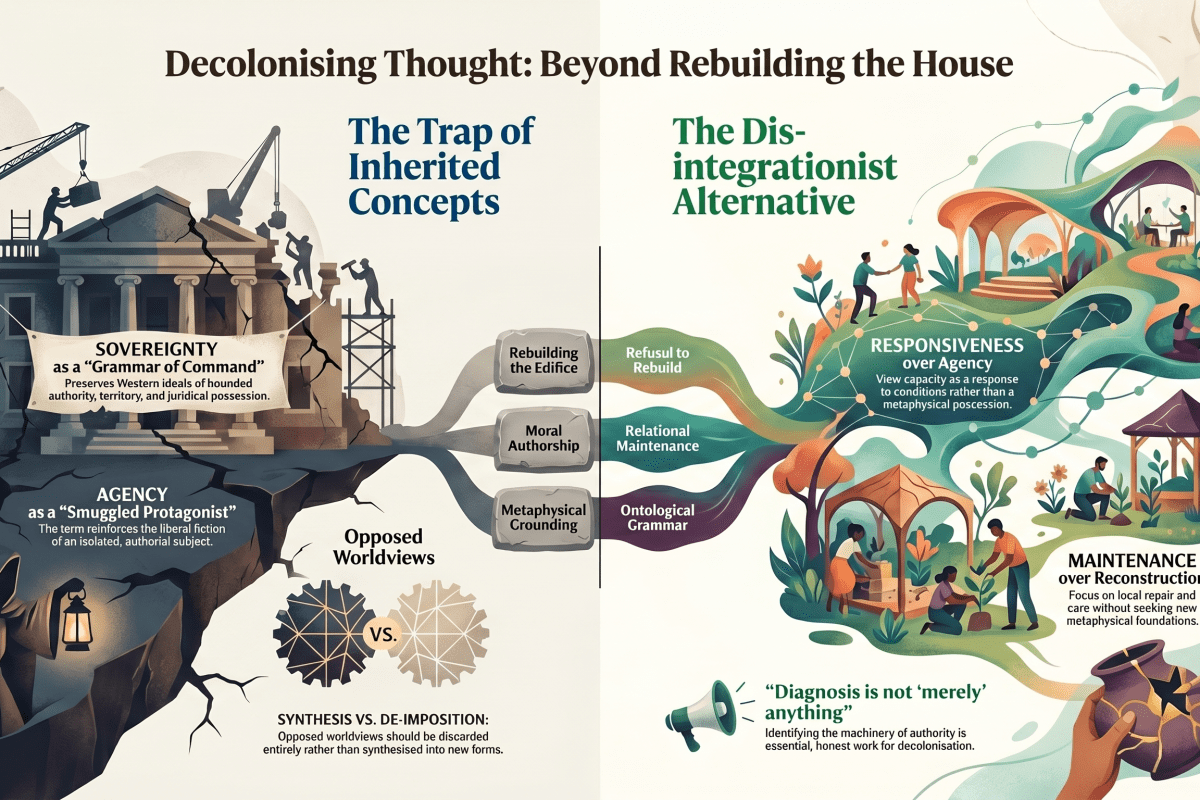
The Master’s Concepts: Decolonising the House Without Keeping the Furniture

9–14 minutes

A colleague recently shared an essay with me, The Return of Metaphysics: Reclaiming Sovereignty Through Ontological Grounding in Postcolonial and Western Thought. I read it with interest, not least because its target is one I share: the colonial imposition of Western categories as if they were universal reason, universal law, universal political form, and universal humanity. On that point, there is no meaningful disagreement. Colonialism isn’t merely theft of land, labour, and resources. It’s also the imposition of a grammar by which reality itself was made legible to power.

The essay is at its strongest when it treats colonialism as metaphysical violence rather than merely administrative domination. It argues that Europe universalised its own categories and rendered other worlds invisible, inferior, or unreal. Colonialism, on this account, was not only conquest. It was the installation of one ontology as the authorised operating system of the human. That’s a powerful diagnosis, and it deserves to be taken seriously. The essay explicitly describes colonialism as a process that ‘re-made being’ and suppressed other conceptions of time, morality, and community.

Where I start to hesitate isn’t in the critique of colonialism, but in the proposed recovery. The essay seeks to reclaim metaphysics, sovereignty, agency, moral authorship, and ontological grounding as instruments of postcolonial renewal. It wants to oppose colonial metaphysics by recovering metaphysics; to oppose hollow sovereignty by reconstructing sovereignty; to oppose imposed subjectivity by restoring moral authorship.

This may be coherent within the essay’s own frame. But from mine, it raises a suspicion:

  • “a return to metaphysics”
  • “moral authorship”
  • “ontological reconstruction”
  • “popular agency”

These terms don’t arrive clean. They carry histories and come with fittings: sovereignty, possession, self-rule, jurisdiction, authorship, legitimacy, command. One may repaint them in decolonial colours, but the shape remains. Inheritance is the danger.

Audio: NotebookLM summary podcast of this topic.

Sovereignty as a Recovered Trap

The essay’s central concept is sovereignty. More precisely, post-sovereignty. Yet the very act of preserving sovereignty as the problematic term matters. Sovereignty isn’t just a neutral container for self-determination. It’s one of the central concepts through which Western political modernity imagines authority: bounded, possessed, territorialised, juridical, and authorial.

To speak of sovereignty is already to speak in the grammar of command: Rules. Owners. Authorities. Something marks the line between inside and outside.

This doesn’t mean colonised peoples were wrong to demand sovereignty. The politically dispossessed may understandably seek the protections of the language used to exclude them. If one has been denied the status of a subject, a nation, or a people, then reclaiming those terms may be historically necessary. There’s no cheap purity available from the comfort of abstraction. Humans made the mess, naturally, and then handed each other dictionaries to clean the mess.

But political necessity doesn’t settle conceptual adequacy. A term may be strategically useful and ontologically suspect at the same time. So, the question isn’t whether sovereignty has been useful in anti-colonial struggle. It’s whether it should remain the destination, rather than a transitional vocabulary one eventually leaves behind.

The essay recognises that many postcolonial states retain the ‘juridical structure’ of autonomy whilst remaining governed by inherited categories of colonial law, property, development, and bureaucratic legitimacy. That’s exactly the point where the critique might turn more sharply on sovereignty itself. If postcolonial statehood often reproduces colonial form, perhaps the issue isn’t merely that sovereignty is hollow, but maybe it’s just one of the forms through which hollowness reproduces itself.
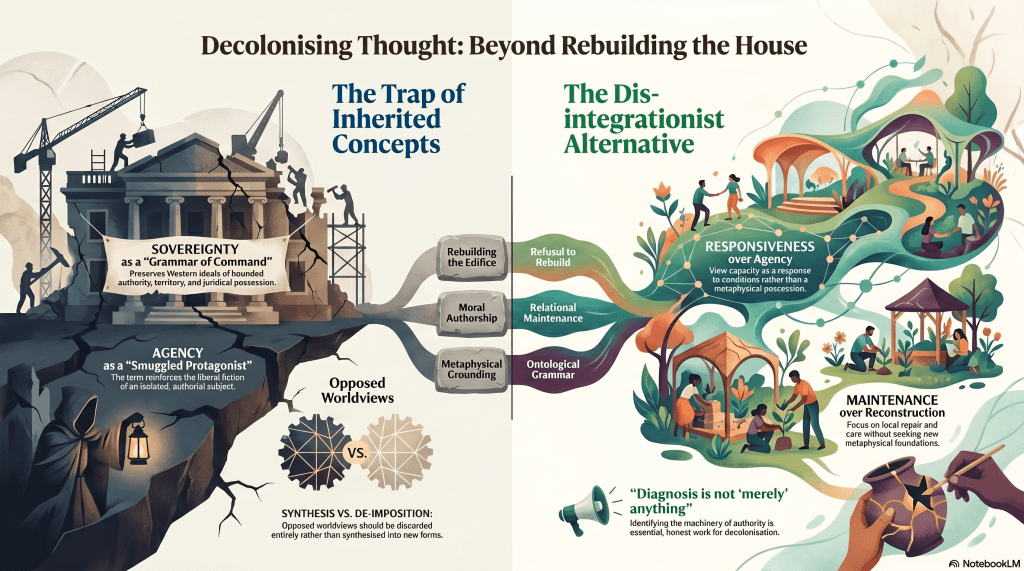
NotebookLM Infographic on this topic.

Agency: The Smuggled Protagonist

The same problem emerges around agency. The essay speaks of popular agency, moral authorship, co-authorship, and subjectification. Again, the impulse is understandable. Colonial domination denies people the right to act, name, interpret, and organise their own lifeworlds. A postcolonial theory naturally wants to restore capacity to those rendered passive.

But the agency term isn’t innocent. In modern Western thought, agency often implies a self capable of authorship, intention, responsibility, and moral ownership. It’s the protagonist required by law, markets, liberal politics, and punishment. Someone must be deemed the chooser, the signer, the sinner, the voter, the debtor, the criminal, the rational actor.

In my own work, I reject agency as a metaphysical possession. I’d rather speak of responsiveness: a variable capacity shaped by material, relational, temporal, somatic, and epistemic conditions. People don’t float above conditions and author themselves into freedom. They respond, more or less adequately, within fields of constraint.

The essay’s emphasis on relationality moves in this direction, but its vocabulary often pulls it back toward authorship. It wants shared becoming, but it also wants moral authors. It wants relational ontology, but it also keeps the self as a source of political meaning. This is a revealing tension.

The alternative isn’t fatalism. To reject agency isn’t to deny action. Breathing doesn’t require a metaphysics of breath. It just happens autonomically. The question is whether we must preserve the fiction of the authorial subject to describe them. I think not.

When Negation Need Not Become Synthesis

The essay leans on Fanon (see The Wretched of the Earth) to argue that colonial domination can’t be resolved through dialogue because dialogue presumes equals. This is right, or at least right enough. A conversation between master and slave is not yet a conversation between equals. Liberal dialogue presumes a shared field of recognition; colonial domination corrupts that field before speech begins.

The essay, therefore, turns to dialectic. Where dialogue seeks agreement, dialectic begins from contradiction and struggle. Again, this makes sense. A colonised subject can’t merely ask to be recognised by the system that produced their non-being. Something must be negated.

My hesitation concerns what happens after the negation. The essay sometimes seems to assume that contradiction must move toward ontological reconstruction. But why? If one term of the contradiction is an imposed colonial ontology, it might not deserve preservation within a higher unity because it mightn’t be a meaningful antithesis. It may simply be wrong, violent, and disposable.

This is the dis-integrative question:

Not every opposition is productive. Some oppositions are parasitic. If a worldview is imposed by force, then treating it as a dialectical partner may grant it more dignity than it deserves. The point of decolonial refusal may not be synthesis, but de-imposition.

That distinction matters. Synthesis often preserves too much. It lets the offending structure survive as a contributor to the next stage. It says, in effect: this violence was part of becoming. Perhaps. But perhaps not. Perhaps some concepts belong on the cutting room floor.

Metaphysics: Necessary Grammar or Rebuilt Throne?

The essay argues that postmodern anti-metaphysics has left social theory without stable categories of truth or moral orientation. It wants metaphysics back, not as abstraction, but as the recovery of moral and ontological grounds for political community.

I understand the concern here, too. Communities don’t live by procedure alone. No society is sustained merely by policy, rights language, or bureaucratic form. People inhabit worlds, not spreadsheets. There are ontological grammars beneath every institution: assumptions about personhood, time, land, memory, obligation, kinship, death, and belonging.

But I resist the move from ‘we can’t avoid ontological grammar‘ to ‘we need metaphysical grounding‘. Whilst the former seems unavoidable, the latter seems dangerous.

Metaphysics isn’t simply depth. It’s elevation – the move by which a grammar stops appearing as grammar and starts presenting itself as ground. It becomes the authorised deep structure, the thing beneath dispute, the foundation beneath the foundation. And foundations, as humans have demonstrated with astonishing consistency, are excellent places to hide power.

Each one requires a leap. One leap may be necessary. Ten leaps become choreography. Eventually, the argument is no longer walking; it’s performing interpretive dance and calling itself ontology.

The Problem of Rebuilding

This is where my own Dis–integrationist commitments diverge most sharply from the essay. I’m a diagnostician. I deconstruct and name seams with no obligation to replace every collapsed universal.

The essay treats diagnosis as insufficient. It says the critique of sovereignty reveals a metaphysical vacuum, but diagnosis is not enough. Post-sovereignty must move toward ontological reciprocity, relational becoming, and shared labour of mutual recognition. Whilst this move is respectable. It’s also the one I distrust.

The rebuilding instinct is one of philosophy’s oldest addictions. Expose the flaw, draft the remedy, rebuild the edifice, declare the new form less violent than the old. This is how critique becomes renovation.

But the refusal to rebuild isn’t indifference, despair, or nihilism. It’s a refusal to let repair disguise itself as permanence. Care, maintenance, reciprocity, and local repair remain possible without metaphysical reconstruction. In fact, they may be more honest when stripped of the promise of final grounding.

Pedagogical Sovereignty and the Soft Machinery of Formation

The essay’s later sections turn to education. It proposes pedagogical sovereignty as a model of moral and ontological co-creation. The classroom becomes a site where being isn’t transmitted but collaboratively formed. Governance, by analogy, might become less administrative and more pedagogical: citizens not merely ruled, but constituted in relation. As attractive as this might be. it’s also perilous.

Education has always had this double face. It can liberate, but it can also format. It can open worlds, but it can also install authorised grammars. The classroom is not outside power. It’s one of power’s favourite incubators. The fact that it speaks gently doesn’t mean it’s not shaping bodies, subjects, desires, norms, and permissions.

To make pedagogy the model of sovereignty risks softening administration rather than escaping it. It may replace the command of the state with the formation of the subject. That may be better and subtler, but one should be careful when power arrives wearing soft shoes.

This doesn’t refute the essay’s educational turn, but it complicates it. If pedagogy is to be an emancipatory model, it has to preserve opacity, dissent, and non-formation. It needs to allow the learner not merely to become, but to remain partially unread, unfinished, and unintegrated. Otherwise, pedagogical sovereignty may become another normalising machine with better intentions and comfy chairs.

The Cutting Room Floor

My objection isn’t that the essay is wrong to oppose colonialism. Au contraire; its critique of colonial metaphysics is often compelling, and it’s preaching to the choir at the start. The issue is that its recovery project may carry forward more of the colonial-conceptual apparatus than it recognises.

The following terms deserve suspicion:

  • Sovereignty, because it preserves the grammar of possession, jurisdiction, bounded authority, and command.
  • Agency, because it preserves the authorial subject required by liberal law, market morality, and responsibility allocation.
  • Moral authorship, because it risks reintroducing the self as origin, even when collectivised.
  • Metaphysical grounding, because it may turn situated lifeworlds into foundations.
  • Reconstruction, because it assumes fracture demands repair, rather than sometimes demanding refusal.
  • Dialectical synthesis, because it may preserve the imposed term as a contributor to the future, rather than discarding it as an error condition.

None of these concepts must be rejected out of hand. That would be too easy. But they shouldn’t pass uninspected simply because they have been recruited into decolonial service. Fine. Use the master’s tools to dismantle the house, but don;t become too fond of them.

Toward De-Imposition

So, what then?

  • Dis–integration, not reconstruction
  • De-imposition, not anti-colonial sovereignty
  • Responsiveness, not agency
  • Relational maintenance, not moral authorship
  • Ontological grammar held visibly as grammar, not metaphysical grounding

This doesn’t mean communities should abandon their lifeworlds, traditions, or inherited moral vocabularies. It means those vocabularies shouldn’t need to become metaphysical foundations to matter. A world may be lived, tended, and defended without being inflated into ground.

The colonised don’t need permission from Western metaphysics to exist. Or me, for that matter. Nor do they need to rebuild themselves in metaphysical form to count as real. The refusal of imposed reality may be enough. After that, there may be practices, relations, institutions, memories, ceremonies, languages, solidarities, and forms of care. There may be politics and struggle. And, sure, repair and maintenance. But there needn’t be a new foundation.

Enfin

The essay I am responding to is valuable because it presses a real question:

My answer is: diagnosis is not ‘merely’ anything. To diagnose is to identify the machinery by which certain concepts keep reproducing their own authority. If sovereignty, agency, authorship, and metaphysical grounding belong to that machinery, then they should not be automatically restored just because they have been wounded.

Some concepts can be reclaimed. Others should be retired. Some may be used provisionally, under protest, as transitional scaffolding. Again, others may belong on the cutting room floor.

The challenge isn’t only to oppose colonialism and its effects. It’s to notice when colonial grammar survives inside the opposition. That’s the harder work – less heroic, sonorous, and much less likely to produce a grand theory, but it may be more honest.


Why So Negative?

The Travelogue of a Recovering Enlightenment Subject

I’m asked endlessly – usually by people who still believe TED talks are a form of knowledge production – ‘Why are you so negative? Why must you tear things down if you’ve no intention of replacing them?’

It’s adorable, really. Like watching a toddler demand that gravity apologise.

They’ve been trained for years in the managerial catechism:

As if the world were some badly-run workshop in need of a fresh coat of agile methodology.

They might as well say, ‘Don’t tell me I can’t win at Lotto; give me money’.

I, too, would enjoy the spare universe. Or the winning Lotto ticket. And yes, one day I might even buy one. Until then, I’ve embraced the only adult philosophy left: Dis-Integrationism – the fine art of taking things apart without pretending they can be reassembled into anything coherent.

A Little History

My suspicion began early. Secondary school. All those civic fairytales whispered as if they were geology.

The ‘reasonable person’? Bollox.
‘Jury of one’s peers’? What are peers? Whose peers? I have no peers.
‘Impartial judges’? Please. Even as a teenager, I could see those robed magicians palming cards like bored street performers. Everyone else nodded along, grateful for the spectacle. I stared, wondering how the other children hadn’t noticed the emperor’s bare arse.

Later, I watched adults talk past each other with a fluency bordering on performance art. Not disagreement – different universes, cosmetically aligned by grammar.

A Federal mediator once tried to teach me that common ground could be manufactured. Not by clarifying meaning, mind you – that would have required honesty – but by rhetorical pressure and a touch of Jedi mind-trickery. Negotiation was simply controlled hallucination.

University communications classes offered temporary distraction with denotation and connotation, a little semantic drift, the illusion that language might be domesticated with enough theory. Charming. Almost convincing.

Then Gödel and Arrow arrived like two polite assassins and quietly removed the floorboards.

And then – happily, inevitably – Derrida, Foucault, Lyotard. I’d already danced with Beauvoir, Sartre, Camus. I’d ingested the Western canon like every obedient young acolyte: Plato, Aristotle, Hobbes, Locke, Rousseau, Montesquieu, Voltaire. Americans force-feed their citizenry Jefferson and Franklin as moral fibre, as if the republic might otherwise suffer constipation.

It never gelled. Too much myth, too much marketing. The Enlightenment had the energy of a regime insisting on its own benevolence while confiscating your torch. To call oneself ‘enlightened’ should have raised suspicion – but no, the branding stuck.

Whenever les garçons dared tug at the curtain, we were assured they simply didn’t ‘understand’, or worse, they ‘hated civilisation’.

Image: “I would have gotten away with it if it weren’t for those meddling kids.”

Then Came the Internet

The digital age didn’t usher in clarity — it unmasked the whole pantomime.
Like Neo seeing the Matrix code or Roddy Piper slipping on the sunglasses in They Live, one suddenly perceives the circuitry: meaning as glitch, discourse as scaffolding, truth as a shabby stage-set blinking under fluorescent tubes.

Our civilisation speaks in metaphors it mistakes for mechanisms. The Enlightenment gave us the fantasy that language might behave, that concepts were furniture rather than fog. Musicians and artists always knew better. We swim in metaphor; we never expected words to bear weight. But philosophers kept pretending communication was a conveyor belt conveying ‘meaning units’ from A to B.

By 2018, the cracks were gaping. I began taking the notes that would metastasise into A Language Insufficiency Hypothesis – an attempt to map the hollow spaces between our words, the fractures we keep wallpapering with reason.

Half a decade later, the work is ready. Not to save anything – nothing here merits salvation – but to name the debris honestly.

If that sounds negative, good. Someone has to switch off the Enlightenment’s flickering lightbulb before it burns the whole house down.

Where This Road Actually Leads

People imagine negativity is a posture – a sort of philosophical eyeliner, worn for effect. But dismantling the world’s conceptual furniture isn’t a hobby; it’s the only reasonable response once you’ve noticed the screws aren’t actually attached to anything.

The Enlightenment promised us a palace. Step inside and you discover it’s built out of IKEA flatpacks held together with wishful thinking and a prayer to Kant.

Once you’ve seen that, you can’t go back to pretending the furniture is sturdy.

You stop sitting.

You start tapping the beams.

You catalogue the wobble.

This is where Dis–Integrationism enters – not as a manifesto, but as the practice of refusing to live inside collapsing architecture out of sheer politeness. Negativity is simply the weather report.

The Lie We Keep Telling Ourselves

We cling to the fantasy that if we critique something long enough, a solution will crystallise out of the void, like enlightenment through sheer irritation. It’s the Protestant work ethic meets metaphysics: salvation through sufficient grumbling.

But critique is not alchemy. It unmakes. It refuses. It loosens the bolts we pretended were load-bearing.

Once you stop demanding that thought be constructive, you can finally see the world as it is: improvised, rhetorical, and permanently under renovation by people who don’t read the instructions.

The Enlightenment’s heirs keep insisting there must be a blueprint. There isn’t. There never was. We’ve merely been tracing the silhouettes of scaffolding, calling it a cathedral.

And Yet – Here We Still Are

The online age (God help us all) didn’t deepen the crisis; it merely turned the lights on. What Enlightenment rationality hid beneath a tasteful layer of neoclassical varnish, the internet sprayed with fluorescent graffiti.

Turns out, when seven billion people speak at once, meaning doesn’t ’emerge’; it buckles. Our systems weren’t built for this volume of contradiction. Our language wasn’t built for this density of metaphor. Our myths weren’t built for this much empirical evidence against them.

And yet here we are, still demanding coherence from a medium held together by emojis and trauma. If you laugh, it’s only to stop crying. If you critique, it’s only because someone has to keep the fire marshal informed.

The Only Honest Next Step

Having traced the cracks, you’re now in the foyer of the real argument – the one hanging like a neon sign over your entire Anti-Enlightenment project:

Language is insufficient. Agency is a fiction. Objectivity is an etiquette ritual. Democracy is a séance. Progress is a hallucination with better marketing. And yet – life continues. People wake, work, argue, aspire, despair.

Dis-Integrationism isn’t about nihilism; it’s about maintenance. Not repairing the myth, but tending the human who must live among its debris. Not constructing new temples, but learning to see in the half-light once the old gods have gone.

The travelogue becomes a guidebook: Welcome to the ruins. Mind the uneven floor. Here is how we walk without pretending the path is paved.

The Fetish for Solutions

Here is the final indignity of the age: the demand that every critique come bundled with a solution, like some moral warranty card. As if naming the rot weren’t labour enough. As if truth required a customer-service plan.

‘Where is your alternative?’ they ask, clutching Enlightenment logic the way a drowning man clutches a shopping receipt.

But solutions are the real tyranny. They arrive bearing the smile of reason and the posture of progress, and behind both sits the same old imperial instinct: replace ambiguity with order; replace lived complexity with a diagram. A solution is merely a problem wearing a fresh coat of confidence.

Worse, a solution presumes the system is sound, merely in need of adjustment. It imagines the structure holds. It imagines the furniture can be rearranged without collapsing into splinters, and the memory of Kant.

Solutions promise inevitability. They promise teleology. They promise that the mess can be disinfected if only one applies the correct solvent. This is theology masquerading as engineering.

The Violence of the Answer

A solution is a closure – a metaphysical brute force. It slams the window shut so no further interpretation can slip in through the draft. It stabilises the world by amputating everything that wriggles. Answers are how systems defend themselves. They’re the intellectual equivalent of riot police: clean uniforms, straight lines, zero tolerance for nuance.

This is why the world keeps mistaking refusal for chaos. Refusal isn’t chaos. It’s hygiene. It is the simple act of not adding more furniture to a house already bending under its own delusions. When you decline to provide a solution, you aren’t abandoning the world. You’re declining to participate in its coercive optimism.

And So the Travelogue Ends Where It Must

Not in triumph or a bluepirnt, but in composure – the only posture left after the Enlightenment’s glare has dimmed. Negativity isn’t sabotage; it’s sobriety. Dis-Integrationism isn’t cynicism; it’s the refusal to replace one failing mythology with another wearing vegan leather.

A world obsessed with solutions cannot recognise maintenance as wisdom. It can’t tolerate ambiguity without reaching for a hammer. It can’t breathe unless someone somewhere is building a ladder to a future that never arrives.

So no – I won’t provide solutions. I won’t participate in the fantasy that the human condition can be patched with conceptual duct tape. I will not gift the Enlightenment a eulogy that surrenders to its grammar.

What I offer is far smaller and far more honest: Attention. Description. Steady hands in a collapsing house. And the simple dignity of refusing to lie about the architecture.

That, for now, is enough.

Unwilling Steelman, Part V

A five-part descent into the illusion of autonomy, where biology writes the script, reason provides the excuse, and the self is merely the echo of its own conditioning. This is a follow-up to a recent post on the implausibility of free will.

You Cannot Originate Yourself

The causa sui argument, and the final collapse of moral responsibility

“If you cannot cause yourself, you cannot cause your choices.
And if you cannot cause your choices, you cannot own them.”

Audio: NotenookLM podcast on this topic.

Everything until now has pointed to erosion:

  • Your choices are state-dependent.
  • Your identity is cumulative, not authored.
  • Your evaluations are judged by compromised observers.

But here, finally, we strike at the bedrock.

It isn’t merely that you are manipulated.
It isn’t merely that you are misperceived.
It’s that you never could have been free, even in theory.

Because you did not make yourself.

The Causa Sui Problem

To be ultimately morally responsible, you must be the origin of who you are.

  • You must have chosen your disposition.
  • You must have selected your values.
  • You must have designed your will.

But you didn’t.

You emerged:

  • With a particular genetic cocktail.
  • Into a particular historical moment.
  • Through particular developmental experiences.
  • With particular neurological quirks and vulnerabilities.

And at no point did you step outside yourself to say:

“I would like to be this kind of agent, with this kind of character.”

You were thrown — as Heidegger might say — into a situation not of your choosing, with equipment you didn’t request, subject to pressures you couldn’t anticipate.

And everything you think of as “yours” — your courage, your laziness, your generosity, your rage — is the unfolding of that original unchosen situation.

No Escape via Reflexivity

Some will protest:

“But I can reflect! I can change myself!”

But this, too, is a mirage.

Because:

  • The desire to reflect is conditioned.
  • The capacity to reflect is conditioned.
  • The courage to act on reflection is conditioned.

You didn’t author your ability to self-correct.
You simply inherited it — like a river inheriting a particular gradient.

Even your rebellion is written in your blueprint.

Freedom by Degrees Is Not Freedom

The compatibilist fallback — that freedom is just “acting according to oneself” — collapses under causa sui.

Because the self that acts was never authored. It was configured by prior causes.

If you cannot be the cause of yourself,
then you cannot be the cause of your actions in any ultimate sense.

Thus:

  • No ultimate credit for your virtues.
  • No ultimate blame for your vices.
  • Only causal flow, chemical procession, narrative stitching after the fact.

The criminal and the saint are both unlucky configurations of biology and circumstance.

TL;DR: No Self, No Sovereignty

  • To be responsible, you must be causa sui — the cause of yourself.
  • You are not.
  • Therefore, you are not ultimately responsible for your actions.
  • Therefore, free will — as traditionally imagined — does not exist.

There is choice.
But there is no chooser behind the choice.
Only the momentum of prior conditions, impersonating agency.


Series Summary: Unwilling Steelmen

A five-part descent into the illusion of autonomy

What remains, if not free will?
Something perhaps stranger — and possibly, more humane:

A universe of actors who deserve understanding, but not blame.
Compassion, but not judgment.
Help, but not hagiography.

Unwilling Steelman, Part IV

A five-part descent into the illusion of autonomy, where biology writes the script, reason provides the excuse, and the self is merely the echo of its own conditioning. This is a follow-up to a recent post on the implausibility of free will.

Audio: NotebookLM podcast on the topic.

“It’s not just that you’re a hallucination of yourself.
It’s that everyone else is hallucinating you, too — through their own fog.”

The Feedback Loop of False Selves

You are being judged — by others who are also compromised

If you are a chemically modulated, state-dependent, narrativising automaton, then so is everyone who evaluates you. The moral courtroom — society, the law, the dinner table — is just a gathering of biased systems confidently misreading each other.

We are taught to believe in things like:

  • “Good character”
  • “Knowing someone”
  • “Getting a read on people”

But these are myths of stability, rituals of judgment, and cognitive vanity projects. There is no fixed you — and there is no fixed them to do the judging.

Judging the Snapshot, Not the Self

Let’s say you act irritable. Or generous. Or quiet.
An observer sees this and says:

“That’s who you are.”

But which version of you are they observing?

  • The you on two hours of sleep?
  • The you on SSRIs?
  • The you grieving, healing, adjusting, masking?

They don’t know. They don’t ask.
They just flatten the moment into character.

One gesture becomes identity.
One expression becomes essence.

This isn’t judgment.
It’s snapshot essentialism — moral conclusion by convenience.

The Observer Is No Less Biased

Here’s the darker truth: they’re compromised, too.

  • If they’re stressed, you’re rude.
  • If they’re lonely, you’re charming.
  • If they’re hungry, you’re annoying.

What they’re perceiving is not you — it’s their current chemistry’s reaction to your presentation, filtered through their history, memory, mood, and assumptions.

It’s not a moral lens.
It’s a funhouse mirror, polished with certainty.

Mutual Delusion in a Moral Marketplace

The tragedy is recursive:

  • You act based on internal constraints.
  • They judge based on theirs.
  • Then you interpret their reaction… and adjust accordingly.
  • And they, in turn, react to your adjustment…

And on it goes — chemical systems calibrating against each other, mistaking interaction for insight, familiarity for truth, coherence for character.

Identity isn’t formed.
It’s inferred, then reinforced.
By people who have no access to your internal states and no awareness of their own.

The Myth of the Moral Evaluator

This has massive implications:

  • Justice assumes objectivity.
  • Culture assumes shared moral standards.
  • Relationships assume “knowing” someone.

But all of these are built on the fantasy that moral evaluation is accurate, stable, and earned.

It is not.

It is probabilistic, state-sensitive, and mutually confabulatory.

You are being judged by the weather inside someone else’s skull.

TL;DR: Everyone’s Lying to Themselves About You

  • You behave according to contingent states.
  • Others judge you based on their own contingent states.
  • Both of you invent reasons to justify your interpretations.
  • Neither of you has access to the full picture.
  • The result is a hall of mirrors with no ground floor.

So no — you’re not “being seen.”
You’re being misread, reinterpreted, and categorised
— by people who are also misreading themselves.

📅 Coming Tomorrow

You Cannot Originate Yourself

The causa sui argument, and the final collapse of moral responsibility.