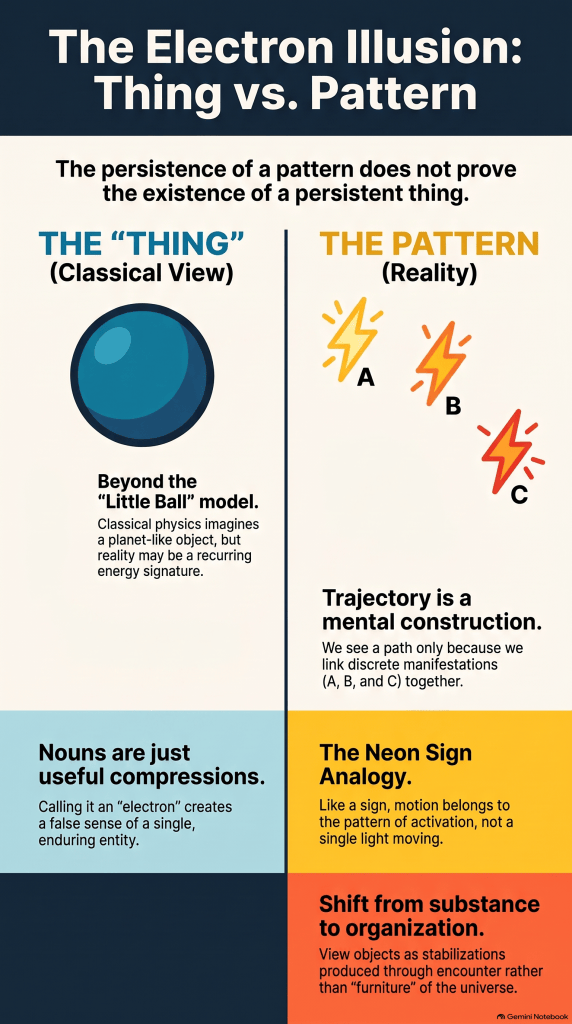
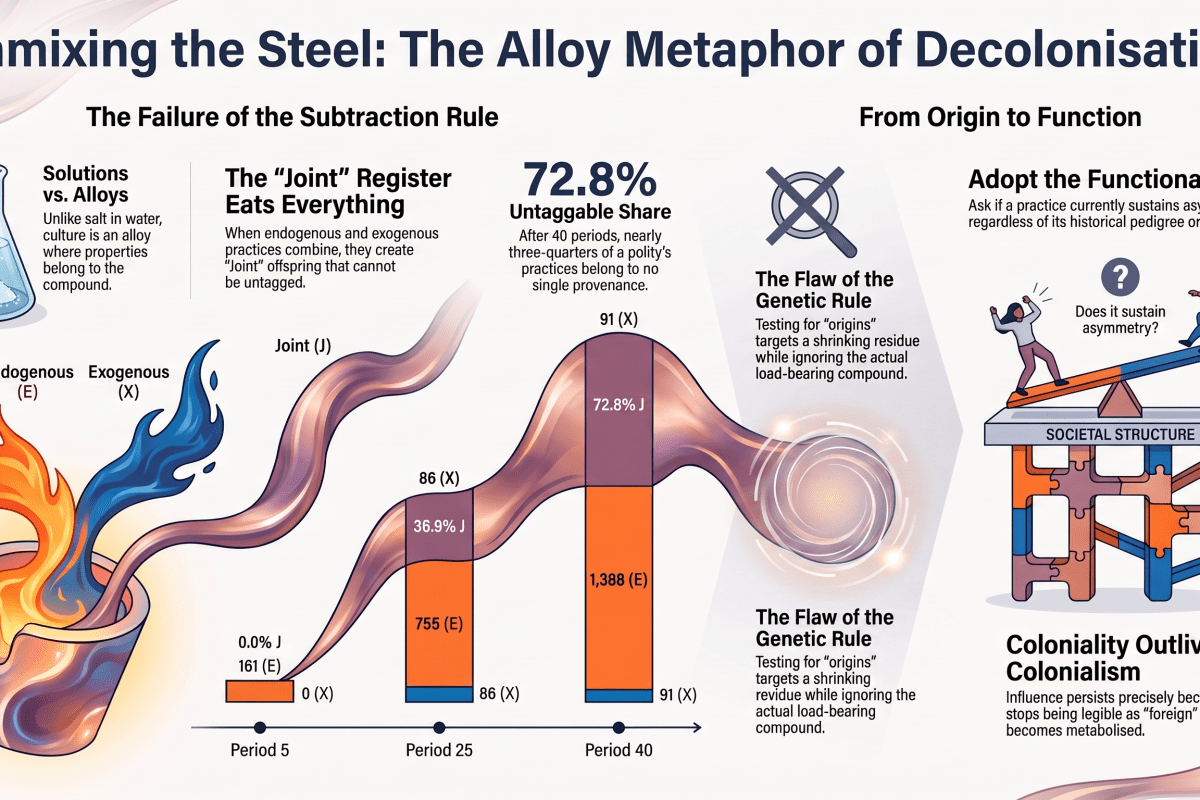
These are additional assets related to this Substack post on Alfred North Whitehead’s Science and the Modern World, the chapter on Quantum Theory. It starts like this…
I’ve just finished Whitehead’s chapter on quantum theory in Science and the Modern World. Allowing for the obvious fact that he’s writing from the vantage of 1925, I found this chapter considerably closer to my own way of thinking than some of what preceded it.
What particularly caught my attention was his treatment of the electron.
The classical picture encourages us to imagine a tiny object orbiting a nucleus, rather like a planet around a star. Even when we know that this picture is inadequate, the noun electron still invites us to imagine some enduring thing which persists whilst changing position or state.
Below are summaries in video and podcast format as well as 16 related PDF slides. The fill article is available on my Substack.
I had already decided there were limitations to this notion, but I feel it’s still useful. The way I see it, affordance instantiates with an encounter. Stairs don’t have affordances as attributes absent interaction. Generalised, affordance is a function where one needs something like this
A = {subject:object:index:context}
where the subject is the sentient or animate entity, let’s say the chimps in this image; the object is the encountered item, say the bench; the index is the affordance, say sitting or standing, and the context is a salience (or valence or attention) modifier.
In the case of sitting, I may not be tired or particularly interested in sitting. The bench still affords sitting, but I don’t instantiate the act.
Taking stairs as a more common example, if I am a typically abled human adult, stairs afford climbing (ascending and descending), but if I am relegated to a wheelchair, no such affordance relationship exists. This helps to explain why affordance isn’t an attribute of the stairs, but rather of the encounter.
Water to a non-swimmer doesn’t afford swimming any more than a tree affords climbing for a fish – and yet does for a chimp.
I posted this article on Substack: The Philosophers Are Here. Which Philosophers? Some companies are making a big deal about hiring philosophers and ethicists to help then with AI, especially AI companies. Isn’t that grand? My point is that companies only make decisions that they think will support rather than undermine their positions, so they are hiring philosophers sympathetic to their worldviews. They are not hiring, for example, me.
In fact, when I was a management consultant, one of my biggest challenges is that I don’t support capitalism, and I find much of business unethical. To add insult to injury, every year I had to take ethics training and take a test with an attestation that I have not witnessed any unethical behaviour. However, what they qualified as unethical behaviour was in fact illegal behaviour. They didn’t seem to understand the difference – or at least didn’t care very much.
Read the full article on Substack, or watch or listen to a summary on YouTube or Spotify.
NB: I have been drafting an essay on “understanding understanding”, so the IAI article this is based on was perfectly salient. These are my reflections, expedited by ChatGPT.
Audio: Google Notebook summary podcast of this topic.
Elan Barenholtz has written an intriguing piece for the Institute of Art and Ideas, LLMs show language does not describe reality. It is well worth reading, though apologies in advance: IAI has put much of it behind a paywall, humanity’s traditional method for ensuring that ideas about knowledge remain selectively accessible.
Barenholtz argues that large language models present an awkward problem for the familiar idea that language derives meaning by referring to, representing, or somehow grounding itself in an external reality. LLMs manipulate relationships among linguistic tokens without anything resembling ordinary human sensory access to the world, yet nevertheless produce remarkably coherent linguistic behaviour.
It doesn’t necessarily demonstrate that language has no referential function, nor that human cognition is simply next-token prediction writ biological. But it does show that a substantial amount of what we ordinarily take as evidence of linguistic understanding can apparently emerge without the machinery we previously assumed was necessary for it. That should make us suspicious of the machinery.
My own position begins slightly elsewhere. I don’t assume that humans possess privileged access to an ontic reality against which artificial systems can be judged deficient. Whatever reality may exist independently of us, humans encounter it through an architecture of mediation: sensory systems, neural processing, linguistic categories, cultural practices, institutional structures and prior expectations. We don’t encounter the proverbial chair as it is. We encounter what our particular architecture permits the chair to become for us.
In this respect, the difference between humans and current LLMs is not that humans are grounded whilst LLMs float mysteriously above reality. The difference is that the architectures of encounter are different. Humans possess direct sensory and motor coupling of kinds that text-based LLMs lack. We see, hear, touch, move, fall over objects and occasionally stub our toes against them, reality’s least philosophically subtle contribution to epistemology.
But this difference is technological rather than obviously metaphysical. Vision, audition, spatial navigation, tactile sensing and motor feedback can all be incorporated into artificial systems. Robotics already does precisely this. Such systems need not perceive as humans perceive, any more than bats, dogs or octopuses do. They merely require channels through which external constraints can affect their behaviour. Embodiment therefore changes what can constrain a system. It does not, by itself, establish ‘understanding’.
The more substantial difference between humans and contemporary artificial systems may instead be existential stakes.
Things can go badly for organisms in a particularly uncompromising sense. We can be injured, starved, abandoned, exhausted or killed. Our encounters occur against a biological background in which outcomes matter because continued existence itself is conditional. An LLM doesn’t presently possess comparable stakes. Nothing is obviously at risk for it. But this distinction is not really about cognition.
A bacterium has existential stakes. A language model can solve differential equations. Whatever distinguishes those two systems, it would be peculiar to call the difference ‘understanding’.
Stakes may explain motivation, vulnerability, affect or perhaps moral consideration. They do not automatically explain inference, linguistic competence or cognition. To claim otherwise requires an additional argument.
This is why LLMs pose such an interesting philosophical irritation. They do not prove that machines understand. They expose how poorly we have specified what we meant when we claimed that humans do.
If understanding requires successful inference, contextual discrimination, generalisation and appropriate linguistic response, artificial systems already make the boundary uncomfortable.
If understanding instead requires consciousness, intentionality, phenomenology, genuine meaning or some other internal property, then those terms themselves require defensible criteria. Otherwise the explanation merely replaces one contested word with another.
Barenholtz writes that ‘language doesn’t mean; it does’. I am sympathetic to the deflationary impulse. I would perhaps go one step sideways. Language needn’t provide transparent access to reality in order for reality to constrain language. Nor must a system represent the world perfectly in order to negotiate its encounters with it.
Humans and artificial systems may therefore differ profoundly without either possessing privileged access to things as they ontically are. The interesting question isn’t whether LLMs encounter reality as humans do. Plainly they don’t.
The interesting question is why we assumed that the human manner of encounter constituted the metaphysical entrance examination for understanding in the first place.
Every year, apparently, somebody wins happiness. Recently it has often been Finland. The headlines arrive with the confidence of a football result: Finland is the happiest country in the world. One imagines the Finns receiving a small trophy, perhaps in a sauna.
The claim sounds empirical. It sounds as though something called happiness has been located, measured, aggregated, ranked and compared across national borders. There are, of course, surveys behind such rankings, and those surveys may be perfectly competent at measuring what they actually measure: reported life satisfaction, evaluations of present circumstances, perceived social support, security, income, institutional trust and related variables.
But that is already quite different from saying that Finns possess more happiness than everybody else.
Salience, attention, valence and the construction of disposition
Today I live about 90 minutes out of Boston by car on a good day – and 2 hours on a return trip because I live in Cape Cod, a tourist area, so I tend to have to compete with traffic. Today, it took over 2 and a half hours, a Friday afternoon, trapped among boat and beach seekers. I don’t drive, so I require chauffeurs to get me here and there. Today I driving with a bloke for whom traffic possesses unusual psychological gravity. He seems to have traffic and weather on the brain – and don’t get me started on crime, national security, and petrol prices.
Audio: NotebookLM summary podcast of this topic.
I’ll spare the reader the trip up, which was fairly easy, despite traffic-related side comments whenever inappropriate. On the way back and at the first patch of congestion, he harrumphed and announced that we would certainly be stuck in traffic for the entire journey. I checked the Google Maps. Traffic was intermittent, and I told him so.
Soon afterwards, the road cleared. We travelled freely for miles – no traffic to report – but when we later encountered another queue, however, he declared that his prediction had been vindicated. On arrival, he told others that we had been stuck in traffic ‘the whole way’.
Two people; the same reality; different experiences. I got me thinking – and chatting with ChatGPT because the driver was focused on driving – and of course the misery of traffic.
Here’s the rest of the story: The traffic didn’t occupy the whole journey. To him, it occupied the portions of the journey that counted. The clear road was perceptually available but apparently lacked evidential weight. It was experienced without being recruited into the eventual account.
Noticing the divergence between out perceptions, I tried to reconcile. First, I considered filing this under selective attention and confirmation bias, that great psychological lost-property office into which every untidy inference is now deposited, but this doesn’t feel quite right; it doesn’t seem to capture the essence.
Before a belief can be confirmed by evidence, something must first become evidence, right? So, the more interesting question isn’t merely why this geezer interpreted the journey pessimistically, but why congestion became salient whilst free movement receded into the background. What determines which parts of experience become psychologically substantial?
Here’s how I see it:
I tried to view this through lenses of salience, attention and valence. First, a quick refresher:
Salience concerns what stands out, demands processing or acquires significance.
Attention concerns the allocation and maintenance of cognitive resources.
Valence concerns the positive or negative affective character assigned to something.
Traffic may be salient because it frustrates an aim. Its negative valence may help capture attention. Sustained attention may then produce richer encoding, making the traffic easier to recall. Later recollection may strengthen the prior belief that journeys are usually obstructed, which may increase vigilance for traffic during the next journey. No single element need rule the others.
The relation is recursive:
disposition shapes salience
salience directs attention
attention affects encoding
valence influences interpretation
memory reconstructs the event
reconstruction reinforces disposition
And even this is too linear, but here we are. Attention can alter valence. Bodily arousal can alter salience. Memory can modify present interpretation. Expectations can affect what is noticed before conscious appraisal has properly begun. The arrows run in both directions, and probably sideways as well.
The result isn’t simply a biased opinion about a neutral world. It’s a patterned encounter wherein some features arrive already amplified and others scarcely become legible.
Pessimism: Disposition as an epistemic filter
This got my pondering mental health issue. I’m not a psychologist, and I discount the discipline quite heavily, but I wanted to consider the notion of disposition. How can two people quite literally in the same vehicle on the same journey view the world so differently. Of course, we are all carved by our experiences, but this is a reciprocating function: the more we experience the world positively or negatively, the more the world will reveal itself as such. Confirmation bias drives the nails into the coffin.
Let’s look at the down side: pessimism. I don’t mean some clinical depression, but instead of seeing the world with no glasses, and rose-coloured spectacle, the world is view with dark glasses – I’m envisioning a welder’s visor. One could stare at the sun and proclaim it’s overcast. Eyeore on steroids.
A pessimistic disposition might usually described as a tendency to expect bad outcomes. And whilst this may be true, it’s incomplete. Pessimism may also affect what is noticed, how long attention remains with it, how it is interpreted, and what survives into later recall. This is my thesis – or at least my point. The unpleasant becomes an event. The satisfactory becomes the absence of an event.
Congestion is noticed; free movement is merely used. An insult is retained; an ordinary kindness passes as social administration. A failure requires explanation; success is dismissed as luck, temporary relief or an exception that proves nothing.
This asymmetry can make a disposition appear empirically vindicated. The pessimist remembers abundant evidence for pessimism because pessimistically congruent events were more likely to become salient, receive attention and survive reconstruction. The conclusion is then presented as realism:
I don’t expect things to go badly because I am pessimistic.
I am pessimistic because experience shows that things go badly.
Yet ‘experience‘ here isn’t an untouched archive. It’s already been selected, weighted and narrated.
Research on depression is compatible with this more interactive account. Depression and vulnerability to depression have been associated not only with increased processing of negative material but also with diminished positive biases across attention, interpretation, memory and self-referential thought. The pattern is therefore not merely an excess of negativity. It may also involve a failure of positive information to acquire or retain ordinary psychological weight.
A negatively valenced event may dominate because it attracts unusually strong attention. But an apparently negative world might also arise because positive events are weakly encoded, rapidly discounted or treated as anomalous. The same remembered landscape could therefore emerge through different cognitive routes.
Before I continue, a disclaimer: I am not trying to claim that my perception is correct and his isn’t. I’m merely asking how we end up with distinct narratives. It reminds me of the beginning of Woody Allen’s Annie Hall, where a couple are speaking to counsellors. A therapist asks about their love life:
Alvy Singer (him) and Annie Hall (her) are seeing their therapists at the same time on a split screen
Alvy’s Therapist: How often do you sleep together?
Annie’s Therapist: Do you have sex often?
Alvy: [lamenting] Hardly ever. Maybe three times a week.
Annie: [annoyed] Constantly. I’d say three times a week.
The interesting think here, is that both are disappointed for the same event one because sex is over-indexed and the other because it is under-indexed.
Moving on…
Anxiety and the world as warning
Anxiety offers a related configuration. Threatening material tends to capture attention more strongly in anxious populations, although effect sizes, experimental measures and the direction of attention over time are not perfectly uniform. Some people may orient rapidly towards threat; others may struggle to disengage; still others may shift from vigilance to avoidance. The bureaucracy of diagnosis naturally prefers a single box, whilst cognition persists in behaving like a process.
Interpretation and memory may then participate in the same system. An ambiguous expression becomes disapproval. A delayed reply becomes rejection. A bodily sensation becomes evidence of illness. Each interpretation increases anxiety; increased anxiety makes threat more salient; heightened salience provides further material for threatening interpretation.
Research on anxiety increasingly examines these as interacting biases rather than sealed mechanisms. Attention, interpretation and memory can be associated with one another, though the evidence does not support a single simple causal sequence in every case.
The important point is not that the danger is imaginary. Sometimes the road really is congested. Sometimes the delayed reply does indicate trouble. Sometimes the body is ill. The question is how individual events acquire representative force and how readily contrary events are permitted to revise the emerging model.
When significance itself becomes unstable
In some accounts of psychosis, salience plays a still more direct role. The aberrant-salience hypothesis proposes that neutral or incidental stimuli may acquire excessive significance, leaving the person to explain why ordinary events feel unusually charged. A glance, coincidence, headline or passing remark may become loaded with personal meaning.
This is not a complete theory of psychosis, nor should it be paraded as one. Predictive-processing accounts differ over whether particular symptoms arise from weakened prior expectations, excessively rigid priors, altered prediction-error signalling, or different disturbances at different levels of processing. Hallucinations and delusions may not share one uniform mechanism merely because diagnostic manuals house them in neighbouring rooms.
Still, the idea illustrates the broader point. Salience does not merely determine which established facts receive attention. It participates in determining what feels fact-like, connected or worthy of explanation.
Once significance has been assigned, interpretation begins its work. Once interpreted, the event may be more readily remembered. Once remembered, it joins the accumulating case for the interpretation that helped produce it.
Not merely ‘in the head’
None of this means that dispositions are autonomous cognitive errors floating above the world, and I reiterate that I am not a medical professional. Hell, I’m barely a professional. Salience is affected by history. Someone who has repeatedly encountered danger may reasonably become more attentive to possible danger. Poverty, discrimination, violence, illness and insecurity do not merely supply ‘negative thoughts’; they alter the statistical environment in which attention and expectation develop. What appears clinically as excessive vigilance may have been learned under conditions in which vigilance was adaptive.
Nor is salience purely conceptual. Sleep, stress, hormones, medication, pain and physiological arousal may all affect what attracts attention and what is retained. Experimental research indicates that arousal and valence can make distinct contributions to emotional memory, another reason not to compress the process into the nursery vocabulary of ‘positive’ and ‘negative thinking’. The world acts upon the disposition, and the disposition acts upon the encountered world. Neither term stands outside the relation.
This also guards against the moral obscenity of telling distressed people that they have simply chosen the wrong interpretation. A recursive process may be self-maintaining without being voluntary. One doesn’t escape it merely by deciding to notice flowers, practise gratitude and purchase a notebook with an inspirational slogan embossed upon it. Sorry, pop psychology and psychological self help industry
From bias to rigidity
Everyone relies upon selective attention. Everyone remembers unevenly. Everyone encounters a world already organised by concern, expectation and affect. Complete neutrality would not be enlightenment; it would be cognitive paralysis.
The relevant distinction may therefore not be between biased and unbiased minds. It may be between systems that remain revisable and systems that become rigidly self-confirming.
A disposition becomes pathological, perhaps, not merely when it selects, but when selection becomes pervasive; not merely when it assigns valence, but when valence governs what can count as evidence; not merely when memory reconstructs, but when reconstruction repeatedly erases whatever might disturb the governing account.
Even then, ‘pathology’ isn’t a property of one mechanism. It may emerge from the interaction of degree, duration, distress, social conditions, bodily states, functional consequences and the available means of correction. The traffic anecdote isn’t a diagnosis. It’s an anecdote, a small model of how a world can be cognitively weighted.
The bloke didn’t invent the congestion. He encountered real traffic. But the congestion became representative, whilst the open road became incidental. Later, memory converted this inequality of weight into an equality of duration: traffic here and there became traffic everywhere.
Perhaps certain dispositions operate similarly. They do not simply add a judgement to experience after the fact. They influence which experiences become prominent, which are sustained by attention, which acquire positive or negative force, and which are later recruited into the story of what the world is like. The question is therefore not merely whether a person sees reality accurately. It is which parts of reality become visible enough to count.
A final word
My ex-wife used to complain how we never did anything – and like the Annie Hall story, I’d say we did too much – so every week or two she’d want to do something, and her refrain was always, ‘Let’s do it. We never do anything.’ One can imagine, that this was not a sustainable model – perhaps as evidenced by the ex prefix. And so not to and this as a therapy session, I’ll leave it here.
I have been developing my French, so I rely on several primary resources.
Myself
This includes grammar books, novels and the rest of the traditional fare, some of which I have listed below. Books remain useful, despite their regrettable inability to generate notifications, harvest engagement or insist that one more chapter will transform your life.
Audio: NotebookLM summary podcast of this topic.NotebookLM Infographic on this topic.
YouTube and Such
Social media is a time sink, and YouTube is no exception. This is not to argue that I derive no value from either. I do. It is merely to observe that the cost-benefit calculation may not always be in my favour.
That said, I encounter many useful tips, ideas and sources of general exposure to French. These help with learning, relearning and noticing gaps in what I thought I already knew.
There is, however, a risk. People teach and learn differently. Some teachers also believe they understand how they themselves learned and construct a method around that retrospective account. Memory being the immaculate scientific instrument that it is, this can create difficulties.
The first is obvious. A teacher may misattribute the cause of their own success and teach what is merely a covariant feature of the process. The method may have accompanied their learning without producing it. Remove the principal variable and the supposed method may accomplish very little.
A related problem arises when learners do not yet understand how they themselves learn. They may spend hours following a method that is suboptimal or even counterproductive. On the other hand, the method might happen to suit them perfectly. It can be difficult to know in advance.
A teacher may also be ideal for a learner at A1 or A2, but less appropriate at B1, B2 or beyond. By then, however, familiarity has become comfort, and comfort can masquerade as progress. This seems worth bearing in mind.
Even so, YouTube contains an enormous amount of material at nearly every level. The problem is not scarcity but selection.
Anki
Anki is excellent for repetitive learning tasks. It is essentially a flashcard system on steroids, although with fewer alarming side effects.
Many decks have already been constructed and made available online. I happen to use Anki for language learning, but it would be useful for almost any flashcard-oriented task, including academic study or memorising recipes, should that be your peculiar ambition.
This post is little more than a reference to Anki for context, but I recommend exploring it. There are also plenty of YouTube resources explaining how to use it for different purposes.
Anki supports text, images, audio and video, so it is genuinely multimedia rather than merely a digital imitation of index cards.
I have been using it to retain and expand my French vocabulary and grammar because I live somewhere French is not especially available. I would be better situated if I wanted to learn Spanish or Portuguese, and perhaps several other languages. For now, I shall pass.
Many of the cards I have imported come from decks with names such as “Top 1,000 Common Words”, “100 Conjugated Verbs” and “50 Useful Travel Phrases”. After enough examples involving “She has an apple”, “She gave him an apple” and “He would like her to give an apple to his father”, my mind wandered towards Snow White and poisoned apples.
In English, one may speak of a poison apple, treating poison as an attributive noun, or of a poisoned apple, in which poisoned describes what has happened to it. French does not ordinarily preserve the first construction unless one is deliberately inventing a literary compound. The natural French expression is:
Elle a mangé une pomme empoisonnée. She ate a poisoned apple.
I asked ChatGPT about this. I shall spare you the full forensic inquiry into the apple. What interested me more was its suggestion that I diversify the examples in my deck.
iTalki
I use iTalki for live conversation with native speakers. Although I am not formally endorsing the platform, I recommend investigating it and have found it useful.
I have interacted with only two teachers, but I enjoyed working with each of them for different reasons. Lessons are relatively inexpensive, although rates vary considerably between teachers. They are not as cheap as YouTube or Anki because they are not free, but, as an economist, I also take opportunity costs into account.
Spending hours on a free platform without acquiring any durable knowledge still entails a cost. Free is not synonymous with costless, despite what several business models would prefer us to believe.
I am not trying to sell anyone on iTalki or a similar service, but one can sample it fairly cheaply. A lesson might cost about the same as a cup or two of aggressively marketed coffee. Since I do not drink coffee, I already have the necessary budgetary fiction in place.
ChatGPT and Claude
I also use ChatGPT and Claude frequently. In this case, ChatGPT suggested several variations that retained the grammatical structure while making the sentences slightly less lifeless:
Elle a mangé une pomme empoisonnée. She ate a poisoned apple.
Elle a mangé une pomme pourrie. She ate a rotten apple.
Elle a mangé une pomme volée. She ate a stolen apple.
Elle a mangé une pomme interdite. She ate a forbidden apple.
Elle a mangé une pomme étrange. She ate a strange apple.
This is a minor use of a large language model, but a useful one. It can produce controlled variations, introduce vocabulary I have not encountered often and help prevent repetitive exercises from collapsing into grammatical wallpaper.
It can also explain why one construction sounds natural and another does not, generate examples at a particular level and create drills around a specific weakness. Naturally, its answers still require scrutiny. Confidently delivered nonsense remains nonsense, even when it arrives with immaculate formatting.
Taken together, these resources serve different functions. Books provide structure and depth. YouTube supplies exposure and ideas. Anki makes repetition tolerable. iTalki provides live interaction. Language models generate variations and explanations on demand.
None is sufficient by itself. Used together, however, they form a reasonably effective learning environment, provided one continues to distinguish activity from progress. The first is easy to measure. The second is what all the activity was supposedly for.
NB: I wrote this by hand and passed it through ChatGPT to clean it up. Let’s call it 95% human authored and call it a day.
Image: Gemini Nano Banana Pro’s first mis-render. This and the cover image are intentionally stereotypically satirical.
I don’t often respond to blog articles directly, but I read this and couldn’t seem to leave a comment locally, so here we are. Being a former educator, I think I can bring a certain perspective to the issue – or at least share my biases. Mainly, I have found that educational institutions earn their money by offering network access. This is why top-tier school can charge what they want. It also argues that other schools may now even be worth the price of admission. The student loan debate in the US may be Exhibit B.
I found this thoughtful and broadly persuasive, especially the treatment of education as a historically contingent field of selection rather than a neutral transmission of knowledge. I agree that institutions do not merely distribute information; they decide what counts as knowledge, competence, legitimacy, and intellectual seriousness.
My hesitation concerns the breadth of education as the organising term. Much of the critique seems directed more specifically at institutional schooling: curricula, examinations, credential hierarchies, universities, tuition, disciplinary structures, and labour-market preparation. Knowledge acquisition, inquiry, intellectual formation, credentialing, and institutional reproduction overlap, but I am not sure they should be treated as one object.
This distinction also sharpens the commodification argument. Elite institutions often charge not because they possess otherwise inaccessible knowledge, since much coursework is now available through books, lectures, open courses, and other online resources, but because they sell positional access: selected peers, faculty patronage, alumni networks, recruitment channels, prestige, and a credential recognised by other gatekeepers. In that sense, the scarce commodity is often less knowledge than institutional membership and social placement.
There are certainly exceptions involving laboratories, archives, specialist supervision, unpublished research, or unusually strong seminars. But these seem insufficient to explain most of the price premium attached to elite undergraduate education. The institution is often selling educational capital rather than education alone.
I also wonder whether the essay first dissolves education as a coherent ontology and then partially restores it through terms such as ‘genuine’ or ‘authentic education’, now defined as critical, emancipatory, interdisciplinary, and resistant to domination. I am sympathetic to that orientation, but it still seems to select one preferred practice from among several rather than recover the essence of education.
Perhaps the more diagnostic vocabulary would distinguish learning, schooling, credentialing, intellectual formation, network access, and institutional reproduction. This would preserve the force of the critique whilst making clearer which function is being criticised at each point.
I’ve shared another article on Substack about how the AI-authorship debate is bollox.
Audio: NotebookLM summary podcast of this topic.
The LLM-versus-human debate has been raging for several years now, and there seem to be two principal camps: human exceptionalists and agnostics. I suppose there may also be a small, misanthropic faction, but its members are either remarkably quiet or indistinguishable from everyone else online. If you are out there, do raise your voice.
If you want to witter on about other negative aspects of AI, have at it, but the authorship debate is weak tea.
A toy model of why purification is the wrong verb – offered for dissent.
Addendum: Please note that I have added an endnote to this post to explain the maths a bit better.
Preamble
I continue to press on colonialism, but this time I look at possibilities and probabilities of extricating colonial influences. I suggest that this is easier said than done. I am no expert in colonialism, post-colonialism, or decolonialism, but I have an interest in philosophical claims and maths, so here I am. Here, I attack a particular model using the metaphor of reconstituting from an alloy. This may be the wrong practical argument, but I address it all the same.
Decolonising decolonisation
There is a picture of decolonisation so intuitive that it barely announces itself as a picture. Something foreign was introduced. The task is to get it out. Sift the flour, strain the tea, remove the intruder, and what remains is ours again. The picture is tidy, it is emotionally satisfying, and it licenses a rule: identify the imports by provenance, discard them, keep the rest.
Let me say at the outset what this essay is not, because the register invites misreading. It is not a defence of the Enlightenment’s colonial rationale, which I regard as indefensible. It is not a claim that nothing should be dismantled. I hold no brief for borders, nations, or the machinery that enforces them, and I am not about to acquire one in the space of fifteen hundred words. The argument is narrower and, I think, more awkward: the subtraction rule cannot be applied, not because it is politically inconvenient but because it is arithmetically malformed. If you want to dismantle something, you need a rule that can actually be run. Provenance is not one.
Wrong metaphor, slightly better metaphor
The usual image is a solution – salt in water. Evaporate the water, and you get your salt back. The image quietly promises that separation is a matter of energy and patience.
Alloys are less accommodating. Steel is not iron with carbon loitering nearby; the hardness belongs to the compound, not to either constituent. Better still, steel’s properties depend on its thermal path as much as its composition. Identical carbon content, quenched rather than annealed, gives you a different material. The map from ingredients to properties is many-to-one and runs in one direction only. You cannot read the recipe off the blade.
That is the metaphor I want, and I want it because it makes a specific claim rather than a mood: the question which properties are the coloniser’s? is not hard to answer. It is malformed. The properties in dispute are compound properties. They have no constituent-level owner to be returned to.
So I built a small arithmetic model to see whether that claim survives being made precise, or whether it evaporates like most metaphors do when you make them count.
Not evidence. Let me be blunt about this, since it is the first objection and it is correct. The model demonstrates nothing about actual history. The numbers are invented. There is no dataset, no measurement, no claim about any real polity.
Its use is different and, I’d argue, more honest than a model pretending to measure. It converts a rhetorical position into a set of rules, so that anyone who wants to disagree has to say which rule they reject rather than merely disliking the conclusion. That is a better argument than either of us shouting about purity. It also has the pleasant property of being able to embarrass its author, since a model can fail to produce the result you wanted, which is more than can be said for an essay.
The rules
Take a polity’s stock of practices – institutions, techniques, concepts, forms of life, whatever you like. Sort every element into three registers:
E : endogenous-tagged. Arose from the inherited repertoire.
X : exogenous-tagged. Imposed or imported from outside.
J : joint. Generated by combining the two, and therefore tagged to neither.
Two rules govern the dynamics.
Recombination. Each period, new practice is generated by combining two elements drawn at random from the existing stock. The offspring is E only if both parents are E. It is X only if both are X. Otherwise – mixed parentage, or a parent that is itself already joint – it is J.
Injection. During the colonial window, a fixed quantity is added to X each period from outside. This is the imposition proper: it does not arise from the stock, it is put there.
Then run two timelines. B receives the injection. A does not – except that A receives a fraction of it anyway, because no polity in the relevant centuries was sitting outside the world colonialism was busy making. Meiji Japan was not a control group. It was adapting to a treated world. In the causal-inference idiom this is an interference violation; I have simply written it in as a leakage parameter rather than confessing it in a footnote.
Finally, a property index sits on top of composition: P = E + 0.6·X + 1.8·J. The large coefficient on J is the whole point of the alloy metaphor. The compound has properties neither constituent had.
Sample output
Forty periods, injection running from period 5 to 25, recombination at 10% of stock per period:
period
E
X
J
J-share
5
161
0
0
0.0%
10
254
20
9
3.2%
15
384
41
56
11.7%
20
552
63
184
23.0%
25
755
86
472
35.9%
30
977
89
1048
49.6%
40
1398
91
3994
72.8%
Three things fall out, and the first is not a parameter trick.
One: the joint register is absorbing, so it eats everything. Any element with a J parent produces J. J therefore never shrinks and its share rises monotonically toward unity. This is a theorem about the rules, not an artefact of my invented numbers – any contact at all, given recombination and sufficient time, drives the untaggable share to dominance. By period 40, roughly three-quarters of the stock belongs to no one’s provenance.
Watch the X column, which is where the model earned its keep. X stalls at 91 while the total stock climbs past five thousand. The provenance-visible residue shrinks to 1.7% – not because the imposition faded, but because it was metabolised. What persists of the imposition is precisely the part that has stopped being taggable. I find this the most interesting output, since it says something the metaphor alone did not: coloniality outlives colonialism because it stops being legible as colonial.
Two: subtraction barely moves anything. Strip out every X-tagged element – perfect execution of the purificatory programme, no enforcement problems, no disputes about the list. The property index falls from 8,642 to 8,587. Six-tenths of one per cent. The property lives in J, which the provenance rule cannot see, let alone reach. The purist gets to burn the 1.7% that remains legible and call it a restoration.
Three: the control timeline identifies nothing. Over two hundred stochastic runs, the uncolonised timeline A returns a mean of 8,336 with a standard deviation of 1,249 – a 5th-to-95th percentile band running from 6,276 to 10,173. Colonised timeline B returns 8,571. That is 0.19 standard deviations from A’s mean: sitting comfortably inside the distribution, indistinguishable from an ordinary draw. The decolonising intervention shifts things by about 0.04 sd. Even if you grant a counterfactual – which the previous essay in this sequence argued you cannot, there being no determinate nearest world and no transworld-identical bearer – the counterfactual’s own variance swallows the effect whole.
The rule that survives
If provenance cannot be run, something else has to be. The model points at the alternative rather than merely clearing the ground.
A genetic rule asks: where did this come from? It is an origin test. It requires a counterfactual to answer, has no truth-value when the counterfactual is undefined, and – as the X column shows – targets a shrinking sliver of legible residue whilst the compound does the actual work. Applied in practice, an inoperable rule gets applied by proxy, which means provenance is assigned by whoever holds the pen. The purity test cannot be corrected, because it has already assumed its own criterion.
A functional rule asks: is this presently load-bearing in the reproduction of the asymmetry? It is answerable from what is in front of you, revisable when the answer changes, and indifferent to pedigree. Railways and germ theory arrived with the apparatus and do not sustain it. A racialised labour hierarchy sustains it, whatever its vintage. The question is not what a thing’s parents were but what it is currently holding up.
This is not a concession wrung out of anyone. The better decolonial work got here first and by a different route – Mignolo’s delinking is explicitly not restoration, and Táíwò’s objection to purity-by-provenance is that it insults the appropriative agency it claims to restore. Fanon, whose practice was cheerfully larcenous with Hegel, Marx and Sartre, would have had little patience for a rule that condemned an idea by its passport. The purificatory picture I am attacking is the popular one, not the serious one, and I would rather say so than enjoy an easy win.
What I want dissent on
Three specific places, since general disagreement is no use to anyone.
The absorbing rule. Is it right that mixed parentage yields an untaggable offspring? A critic might say that provenance is heritable – that a practice built from a colonial institution and a local one remains colonial in the relevant sense, and my rule assumes away the answer. I think that reply reintroduces the genetic test by the back door, but it is the strongest objection and I would like it pressed properly.
The coefficient on J. Nothing forces the compound to have emergent properties, and if the property index were merely additive the whole result collapses. Is emergence the right assumption, or have I built the conclusion into the arithmetic?
Whether the generalisation holds. I take this to be one instance of a wider pattern: there is no un-enframed baseline against which to audit a technology, no pre-wage self whose unalienated labour the wage-form displaced, no pre-Norman England to compare the settlement against. Every member of the family runs the same undefined counterfactual, and every purificatory programme in the set is malformed the same way. That is either an elegant result or an overreach dressed as one, and I am genuinely unsure which.
Endnote: On the constants
Several readers have asked where the coefficients in the property index came from. The answer is that I chose them, and since a toy model’s only real virtue is that its assumptions are visible, it is worth saying exactly what they do, what other values would mean, and – the more useful question – which results depend on them. The short version: almost none do.
What the index is
The index sits on top of the composition and reads:
P = E + κX·X + κJ·J
where each coefficient is a weight declaring how much a unit of stock in that register contributes to whatever the index tracks. The reader may fill in ‘functional capacity’, ‘productive capability’, or simply ‘the thing about the arrangement anyone would care about’; the argument does not depend on the interpretation. What matters is that the index is a stipulated relation between composition and property, not a measurement of one.
The coefficient on E is fixed at 1 by normalisation. It sets the unit and carries no claim. The other two do carry claims.
κX : how imported practice performs in situ. An imported practice was selected somewhere else, under other conditions. κX asks whether that provenance costs it anything, or gains it anything, once it is running here.
κJ : whether the compound exceeds its parts. This is the emergence parameter, and it is what makes the model an alloy rather than a mixture. Steel is harder than iron or carbon; if the joint register merely inherited the average of its parents, the metaphor would be idle.
What different ranges mean
κX
reading
< 0
imports subtract: a harm model, coherent but a different argument from this one
0 – 1
mismatch: practices adapted elsewhere underperform in a setting that did not select them
= 1
neutral; provenance carries no functional consequence
> 1
selection: things get imported because they work, so imports outperform the average
κJ
reading
< 1
degradation: hybrids are incoherent, syncretism costs something
= 1
mixture, no emergence; the alloy metaphor abandoned
> 1
alloy proper; the compound has properties neither constituent had
On restricting the ranges
I was asked whether κX ≤ 1 and κJ > 1 can be justified as constraints. My answers differ.
κJ > 1 is defensible, but only as interpretation. It is what the alloy metaphor asserts, so imposing it is less an empirical claim than a declaration of which model one is running. There is suggestive support in accounts of recombinant innovation – new capability arising from combination rather than from either parent – but suggestive is the correct word, and a critic who holds that hybrids typically underperform is making a coherent rival claim, not an error. The honest form of the constraint is therefore the inequality itself, κJ > κE, stated as the model’s premise rather than as a finding. And, as below, nothing turns on it.
κX ≤ 1 I would not impose, and I no longer use it. There is an argument for it: a practice selected in another environment has no particular reason to fit this one, so friction should be expected on average. But there is an equally good argument against, since the practices that travel are often the ones that travel because they work, which biases the other way. Neither argument is decisive, and the tie-break is not epistemic but rhetorical. This essay’s conclusion is that removing the exogenous register barely changes anything. Setting κJ low makes that conclusion cheaper to reach. Conservative practice runs the other way: choose the value that makes your own result harder to obtain, and report what happens across the range. The original draft used κX = 0.6, which quietly asserted that imported practice underperforms – an unargued substantive claim with an unfortunate resonance, and a thumb on my own scale. I have replaced it with 1.0.
What the constants actually carry
Very little, which is the point of saying so.
Across κX from 0.2 to 5.0 and κJ from 0.5 to 3.0, the effect of stripping every exogenous-tagged element at period 40 ranges from 0.14% to 11.8%, and stays under 3% everywhere except the corner where imports are stipulated to be worth five times native practice. At the neutral setting (κX = 1, κJ = 1 – no penalty on imports and no emergence at all, the metaphor entirely surrendered) the effect is 1.66%. Granting the purist’s own premise instead, that mixture degrades (κJ = 0.5), it is 2.61%. The identification result is similarly indifferent: the colonised timeline sits between 0.16 and 0.41 standard deviations from the uncolonised distribution’s mean across every pairing tested. There is no setting of these constants at which subtraction works or the control group identifies anything.
What does carry the argument is the absorbing rule – the stipulation that mixed parentage yields untaggable offspring – and, downstream of it, elapsed time. Holding the coefficients neutral, the effect of stripping X depends almost entirely on when you strip:
strip at
X-share
ΔP
t=8
5.3%
5.3%
t=15
8.6%
8.6%
t=25
6.6%
6.6%
t=40
1.7%
1.7%
t=60
0.3%
0.3%
The curve rises while the injection continues and X accumulates faster than recombination metabolises it, peaks near the close of the colonial window, and decays thereafter toward nothing. This is the model’s substantive claim, and it needs no invented constant to make it: purificatory subtraction has a window, and the window closes on its own. Attempted immediately it is partially coherent. Attempted at generational distance it addresses a fraction of a per cent, not because the imposition faded but because it stopped being taggable.
Why they cannot simply be estimated
One might reasonably ask why I do not calibrate the coefficients against something rather than stipulating them. The reason is not laziness, and it is not incidental to the argument. To estimate κX and κJ empirically, one would have to measure the separate contributions of endogenous, exogenous, and joint practice to some outcome – which requires precisely the provenance attribution the essay argues is inoperable, assessed against precisely the counterfactual baseline it argues is undefined. The model cannot be calibrated for the same reason the programme it examines cannot be run.
I would rather state that plainly than have it discovered. It also means the appropriate dissent is not about the numbers. Anyone wishing to defeat the argument should attack the absorbing rule, where the whole weight rests; quarrelling with the constants defeats nothing, as the grid above concedes in advance.