I prompted Gemini to render this poster this afternoon.

Anyone participating in it is either a thief or a victim, though I stand corrected; one may be both a thief and a victim.
Socio-political philosophical musings
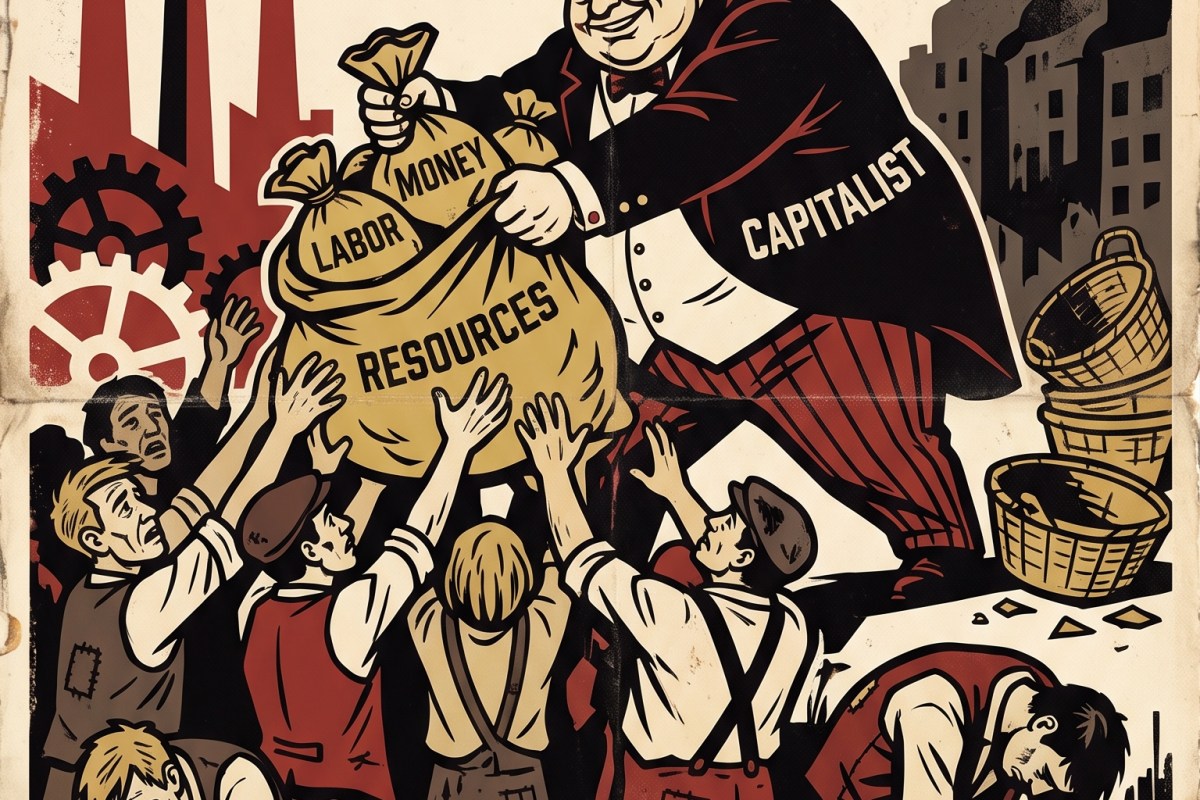
I prompted Gemini to render this poster this afternoon.
Anyone participating in it is either a thief or a victim, though I stand corrected; one may be both a thief and a victim.

A toy model of why purification is the wrong verb – offered for dissent.
I continue to press on colonialism, but this time I look at possibilities and probabilities of extricating colonial influences. I suggest that this is easier said than done. I am no expert in colonialism, post-colonialism, or decolonialism, but I have an interest in philosophical claims and maths, so here I am. Here, I attack a particular model using the metaphor of reconstituting from an alloy. This may be the wrong practical argument, but I address it all the same.
There is a picture of decolonisation so intuitive that it barely announces itself as a picture. Something foreign was introduced. The task is to get it out. Sift the flour, strain the tea, remove the intruder, and what remains is ours again. The picture is tidy, it is emotionally satisfying, and it licenses a rule: identify the imports by provenance, discard them, keep the rest.
Let me say at the outset what this essay is not, because the register invites misreading. It is not a defence of the Enlightenment’s colonial rationale, which I regard as indefensible. It is not a claim that nothing should be dismantled. I hold no brief for borders, nations, or the machinery that enforces them, and I am not about to acquire one in the space of fifteen hundred words. The argument is narrower and, I think, more awkward: the subtraction rule cannot be applied, not because it is politically inconvenient but because it is arithmetically malformed. If you want to dismantle something, you need a rule that can actually be run. Provenance is not one.
The usual image is a solution – salt in water. Evaporate the water, and you get your salt back. The image quietly promises that separation is a matter of energy and patience.
Alloys are less accommodating. Steel is not iron with carbon loitering nearby; the hardness belongs to the compound, not to either constituent. Better still, steel’s properties depend on its thermal path as much as its composition. Identical carbon content, quenched rather than annealed, gives you a different material. The map from ingredients to properties is many-to-one and runs in one direction only. You cannot read the recipe off the blade.
That is the metaphor I want, and I want it because it makes a specific claim rather than a mood: the question which properties are the coloniser’s? is not hard to answer. It is malformed. The properties in dispute are compound properties. They have no constituent-level owner to be returned to.
So I built a small arithmetic model to see whether that claim survives being made precise, or whether it evaporates like most metaphors do when you make them count.
Not evidence. Let me be blunt about this, since it is the first objection and it is correct. The model demonstrates nothing about actual history. The numbers are invented. There is no dataset, no measurement, no claim about any real polity.
Its use is different and, I’d argue, more honest than a model pretending to measure. It converts a rhetorical position into a set of rules, so that anyone who wants to disagree has to say which rule they reject rather than merely disliking the conclusion. That is a better argument than either of us shouting about purity. It also has the pleasant property of being able to embarrass its author, since a model can fail to produce the result you wanted, which is more than can be said for an essay.
Take a polity’s stock of practices – institutions, techniques, concepts, forms of life, whatever you like. Sort every element into three registers:
Two rules govern the dynamics.
Recombination. Each period, new practice is generated by combining two elements drawn at random from the existing stock. The offspring is E only if both parents are E. It is X only if both are X. Otherwise – mixed parentage, or a parent that is itself already joint – it is J.
Injection. During the colonial window, a fixed quantity is added to X each period from outside. This is the imposition proper: it does not arise from the stock, it is put there.
Then run two timelines. B receives the injection. A does not – except that A receives a fraction of it anyway, because no polity in the relevant centuries was sitting outside the world colonialism was busy making. Meiji Japan was not a control group. It was adapting to a treated world. In the causal-inference idiom this is an interference violation; I have simply written it in as a leakage parameter rather than confessing it in a footnote.
Finally, a property index sits on top of composition: P = E + 0.6·X + 1.8·J. The large coefficient on J is the whole point of the alloy metaphor. The compound has properties neither constituent had.
Forty periods, injection running from period 5 to 25, recombination at 10% of stock per period:
| period | E | X | J | J-share |
|---|---|---|---|---|
| 5 | 161 | 0 | 0 | 0.0% |
| 10 | 254 | 20 | 9 | 3.2% |
| 15 | 384 | 41 | 56 | 11.7% |
| 20 | 552 | 63 | 184 | 23.0% |
| 25 | 755 | 86 | 472 | 35.9% |
| 30 | 977 | 89 | 1048 | 49.6% |
| 40 | 1398 | 91 | 3994 | 72.8% |
Three things fall out, and the first is not a parameter trick.
One: the joint register is absorbing, so it eats everything. Any element with a J parent produces J. J therefore never shrinks and its share rises monotonically toward unity. This is a theorem about the rules, not an artefact of my invented numbers – any contact at all, given recombination and sufficient time, drives the untaggable share to dominance. By period 40, roughly three-quarters of the stock belongs to no one’s provenance.
Watch the X column, which is where the model earned its keep. X stalls at 91 while the total stock climbs past five thousand. The provenance-visible residue shrinks to 1.7% – not because the imposition faded, but because it was metabolised. What persists of the imposition is precisely the part that has stopped being taggable. I find this the most interesting output, since it says something the metaphor alone did not: coloniality outlives colonialism because it stops being legible as colonial.
Two: subtraction barely moves anything. Strip out every X-tagged element – perfect execution of the purificatory programme, no enforcement problems, no disputes about the list. The property index falls from 8,642 to 8,587. Six-tenths of one per cent. The property lives in J, which the provenance rule cannot see, let alone reach. The purist gets to burn the 1.7% that remains legible and call it a restoration.
Three: the control timeline identifies nothing. Over two hundred stochastic runs, the uncolonised timeline A returns a mean of 8,336 with a standard deviation of 1,249 – a 5th-to-95th percentile band running from 6,276 to 10,173. Colonised timeline B returns 8,571. That is 0.19 standard deviations from A’s mean: sitting comfortably inside the distribution, indistinguishable from an ordinary draw. The decolonising intervention shifts things by about 0.04 sd. Even if you grant a counterfactual – which the previous essay in this sequence argued you cannot, there being no determinate nearest world and no transworld-identical bearer – the counterfactual’s own variance swallows the effect whole.
If provenance cannot be run, something else has to be. The model points at the alternative rather than merely clearing the ground.
A genetic rule asks: where did this come from? It is an origin test. It requires a counterfactual to answer, has no truth-value when the counterfactual is undefined, and – as the X column shows – targets a shrinking sliver of legible residue whilst the compound does the actual work. Applied in practice, an inoperable rule gets applied by proxy, which means provenance is assigned by whoever holds the pen. The purity test cannot be corrected, because it has already assumed its own criterion.
A functional rule asks: is this presently load-bearing in the reproduction of the asymmetry? It is answerable from what is in front of you, revisable when the answer changes, and indifferent to pedigree. Railways and germ theory arrived with the apparatus and do not sustain it. A racialised labour hierarchy sustains it, whatever its vintage. The question is not what a thing’s parents were but what it is currently holding up.
This is not a concession wrung out of anyone. The better decolonial work got here first and by a different route – Mignolo’s delinking is explicitly not restoration, and Táíwò’s objection to purity-by-provenance is that it insults the appropriative agency it claims to restore. Fanon, whose practice was cheerfully larcenous with Hegel, Marx and Sartre, would have had little patience for a rule that condemned an idea by its passport. The purificatory picture I am attacking is the popular one, not the serious one, and I would rather say so than enjoy an easy win.
Three specific places, since general disagreement is no use to anyone.
The absorbing rule. Is it right that mixed parentage yields an untaggable offspring? A critic might say that provenance is heritable – that a practice built from a colonial institution and a local one remains colonial in the relevant sense, and my rule assumes away the answer. I think that reply reintroduces the genetic test by the back door, but it is the strongest objection and I would like it pressed properly.
The coefficient on J. Nothing forces the compound to have emergent properties, and if the property index were merely additive the whole result collapses. Is emergence the right assumption, or have I built the conclusion into the arithmetic?
Whether the generalisation holds. I take this to be one instance of a wider pattern: there is no un-enframed baseline against which to audit a technology, no pre-wage self whose unalienated labour the wage-form displaced, no pre-Norman England to compare the settlement against. Every member of the family runs the same undefined counterfactual, and every purificatory programme in the set is malformed the same way. That is either an elegant result or an overreach dressed as one, and I am genuinely unsure which.
Several readers have asked where the coefficients in the property index came from. The answer is that I chose them, and since a toy model’s only real virtue is that its assumptions are visible, it is worth saying exactly what they do, what other values would mean, and – the more useful question – which results depend on them. The short version: almost none do.
The index sits on top of the composition and reads:
P = E + κX·X + κJ·J
where each coefficient is a weight declaring how much a unit of stock in that register contributes to whatever the index tracks. The reader may fill in ‘functional capacity’, ‘productive capability’, or simply ‘the thing about the arrangement anyone would care about’; the argument does not depend on the interpretation. What matters is that the index is a stipulated relation between composition and property, not a measurement of one.
The coefficient on E is fixed at 1 by normalisation. It sets the unit and carries no claim. The other two do carry claims.
κX : how imported practice performs in situ. An imported practice was selected somewhere else, under other conditions. κX asks whether that provenance costs it anything, or gains it anything, once it is running here.
κJ : whether the compound exceeds its parts. This is the emergence parameter, and it is what makes the model an alloy rather than a mixture. Steel is harder than iron or carbon; if the joint register merely inherited the average of its parents, the metaphor would be idle.
| κX | reading |
|---|---|
| < 0 | imports subtract: a harm model, coherent but a different argument from this one |
| 0 – 1 | mismatch: practices adapted elsewhere underperform in a setting that did not select them |
| = 1 | neutral; provenance carries no functional consequence |
| > 1 | selection: things get imported because they work, so imports outperform the average |
| κJ | reading |
|---|---|
| < 1 | degradation: hybrids are incoherent, syncretism costs something |
| = 1 | mixture, no emergence; the alloy metaphor abandoned |
| > 1 | alloy proper; the compound has properties neither constituent had |
I was asked whether κX ≤ 1 and κJ > 1 can be justified as constraints. My answers differ.
κJ > 1 is defensible, but only as interpretation. It is what the alloy metaphor asserts, so imposing it is less an empirical claim than a declaration of which model one is running. There is suggestive support in accounts of recombinant innovation – new capability arising from combination rather than from either parent – but suggestive is the correct word, and a critic who holds that hybrids typically underperform is making a coherent rival claim, not an error. The honest form of the constraint is therefore the inequality itself, κJ > κE, stated as the model’s premise rather than as a finding. And, as below, nothing turns on it.
κX ≤ 1 I would not impose, and I no longer use it. There is an argument for it: a practice selected in another environment has no particular reason to fit this one, so friction should be expected on average. But there is an equally good argument against, since the practices that travel are often the ones that travel because they work, which biases the other way. Neither argument is decisive, and the tie-break is not epistemic but rhetorical. This essay’s conclusion is that removing the exogenous register barely changes anything. Setting κJ low makes that conclusion cheaper to reach. Conservative practice runs the other way: choose the value that makes your own result harder to obtain, and report what happens across the range. The original draft used κX = 0.6, which quietly asserted that imported practice underperforms – an unargued substantive claim with an unfortunate resonance, and a thumb on my own scale. I have replaced it with 1.0.
Very little, which is the point of saying so.
Across κX from 0.2 to 5.0 and κJ from 0.5 to 3.0, the effect of stripping every exogenous-tagged element at period 40 ranges from 0.14% to 11.8%, and stays under 3% everywhere except the corner where imports are stipulated to be worth five times native practice. At the neutral setting (κX = 1, κJ = 1 – no penalty on imports and no emergence at all, the metaphor entirely surrendered) the effect is 1.66%. Granting the purist’s own premise instead, that mixture degrades (κJ = 0.5), it is 2.61%. The identification result is similarly indifferent: the colonised timeline sits between 0.16 and 0.41 standard deviations from the uncolonised distribution’s mean across every pairing tested. There is no setting of these constants at which subtraction works or the control group identifies anything.
What does carry the argument is the absorbing rule – the stipulation that mixed parentage yields untaggable offspring – and, downstream of it, elapsed time. Holding the coefficients neutral, the effect of stripping X depends almost entirely on when you strip:
| strip at | X-share | ΔP |
|---|---|---|
| t=8 | 5.3% | 5.3% |
| t=15 | 8.6% | 8.6% |
| t=25 | 6.6% | 6.6% |
| t=40 | 1.7% | 1.7% |
| t=60 | 0.3% | 0.3% |
The curve rises while the injection continues and X accumulates faster than recombination metabolises it, peaks near the close of the colonial window, and decays thereafter toward nothing. This is the model’s substantive claim, and it needs no invented constant to make it: purificatory subtraction has a window, and the window closes on its own. Attempted immediately it is partially coherent. Attempted at generational distance it addresses a fraction of a per cent, not because the imposition faded but because it stopped being taggable.
One might reasonably ask why I do not calibrate the coefficients against something rather than stipulating them. The reason is not laziness, and it is not incidental to the argument. To estimate κX and κJ empirically, one would have to measure the separate contributions of endogenous, exogenous, and joint practice to some outcome – which requires precisely the provenance attribution the essay argues is inoperable, assessed against precisely the counterfactual baseline it argues is undefined. The model cannot be calibrated for the same reason the programme it examines cannot be run.
I would rather state that plainly than have it discovered. It also means the appropriate dissent is not about the numbers. Anyone wishing to defeat the argument should attack the absorbing rule, where the whole weight rests; quarrelling with the constants defeats nothing, as the grid above concedes in advance.

I shared another Substack post, but I want to expand it a bit here. On the Substack version, I conspicuously didn’t name certain obvious names, but here, I shall. I also left out a reference to Plato’s Republic.
The current American regime is built on meritocracy, and – this is the part everyone misses – it would not deny the charge. It rather likes the word. It uses the reinterpreted version, the laundered one my other essay was about, in which merit means precisely whatever the sovereign has decided it should mean this morning. Accuse them of meritocracy, and they will thank you for noticing.
Take the man at the centre of it. Whether Donald Trump is meritorious is not, in the end, a question about Donald Trump. It is a question about which ontological grammar you happen to be speaking, because the grammar constitutes the object before a single fact is admitted into evidence. This is the whole Language Insufficiency point in miniature: the frame quietly does the work the facts are later congratulated for.
To Cohort A, he is a charismatic and self-made businessman. The six bankruptcies are not failures but proof of a shrewd operator who knows how to play the game and walk away intact – power-mind, killer instinct, the art of the deal. That he has a decades-long habit of not paying his contractors, and an even longer one of not paying his tax, does not indict him; it endears him. It makes him the everyman who beat the system the rest of us merely resent. A working-class hero, if you can manage it, descending on a golden escalator.
To Cohort B – and I’ll confess my membership, since honesty is cheaper than the pretence of the view from nowhere – he is a less likeable Forrest Gump: a man forever arriving at the centre of history without ever quite grasping how he got there, weaponising a charisma that works only on the already-mesmerised, and rebuilding the world with himself at the origin. He has a certain gravity. It attracts sycophants and rewards them, which is the only merit test his court reliably administers.
Same man. Two grammars. The ‘merit’ resides in neither the man nor the record; it is assigned by the frame and then invoiced to the evidence. Which is exactly the thesis of the parent essay, now wearing a name tag.
The parent essay left the reverse operation as a coy ‘phrase in current circulation’. I’ll say it here without the euphemism: DEI hire. The move is to take career civil servants – people with decades of demonstrable domain competence, whatever their private politics – and broad-brush them as diversity appointments, which is to say, unqualified by definition, arrived by an unauthorised route. The vacancies then fill with those who have pledged fealty and displayed the one indispensable qualification: a flexible integrity. The competent are marked down for being the wrong sort; the pliant are marked up for being biddable. ‘Incompetent’ has been quietly reissued to mean not ours, and ‘qualified’ to mean loyal. Same machine, thrown into reverse – now with a name engraved on the lever.
Which brings me, as these things do, to Plato. The Substack piece used his ship of state – the crew who master the mutiny rather than the sea. Here I want the other half of the same complaint: the comfortable conviction that the meritorious rise to the top like cream.
They do rise. That was never in dispute. What the metaphor conceals is the dimension along which they rose. These people are genuinely competent – at working the system, at the acquisition and retention of position – which is a wholly different skill from governing, and precisely the one we so conveniently assume we were measuring. Cream rises; so does scum; the trope declines to specify which, and physics is no help at all.
This is the standing problem of republicanism – and no, before anyone lunges for the comment box, I do not mean the Republican Party, which has its own well-stocked catalogue of failures, as do the Democrats, who would be unwise to feel smug reading this. Nor is any of it uniquely American. If you are somewhere else entirely, enjoying the spectacle from a safe distance, do put the popcorn down. The mechanism by which a society mistakes competence-at-ascending for competence-at-ruling is not a national defect. It is a design flaw in selection itself, and your country installed it too.
I will not, on this occasion, start in on the failings of democracy as a system. Been there; done that. There are only so many sacred cows a man can tip before lunch.
‘Meritocracy’ survives all of this the way it survives everything – by never once being asked the only question that matters: merit at what, judged by whom, to whose benefit? Put it to the present court, and the answer is almost embarrassingly legible. Which is, of course, exactly why the question is never put.

Somebody somewhere made mention of The Social Construction of Reality, so I asked ChatGPT if I should engage with it directly, which is to say, to read it. Already believing that what we perceive and experience is a subjective construction, albeit shaped by relative forces, I thought it might be a lot of choir preaching.
ChatGPT admitted that this was partially true, but that the benefit would be to get a sociological rather than strictly philosophical account. Having read the introduction and started the first chapter, I already feel this to be true. The authors make it clear that Sociology is just a special philosophy that doesn’t aim quite so deep and has a specific and obvious focus on societies. Fair enough.
So far, I’m glad I picked it up. It’s relatively short, which was a deciding factor, and it’s giving me a break from the 1066 material I’ve otherwise been consuming as of late.
I don’t have more to add, save to say, so far so good. I look forward to the rest. I’ve got more to do today, including editing a video for YouTube, which is me rather than AI for a change – a process that reminds me why I use AI in the first place: so much time investment.
NB: I am actually listening to an Audible version of this book. Whilst searching for an apt cover image for this post, I found the associated image, and it is as apt as one might find.

I had two waking thoughts:
I just published a post on Substack about the issue of gendered language. I’ll save fairness for another day.
Rather than rehash the Substack essay, I thought it might be a better idea to discuss the meta of it.
My initial thought was to rid the English language of administrators and dominatrices. Of course, I instantly considered French, and I write about that as well.
Here, I want to discuss the rift in Feminism:
Hence the title of this post.
If we were to swap or consolidate administrator and the less common administratrix into administrater in an act of rebellious conformity, women will be subsumed. As Simone de Beauvoir notes, the dominant lens is the male lens. Woman is other. As I say, this is why we have male and female versions of many, if not most, competitive sports, and certainly the professional ones. Thi sis also an instinct underlying trans-athletes competing in a contrasport – and it’s almost always about CIS-males performing in CIS-female events. I’m not aware of the contrary – and I don’t feel like looking it up. Opponents imagine fit males dressing as females in order to win some ribbons and medals, but I don’t really care to engage further in this conversational framing. I have no interest in sports, not even the World Cup being performed in my backyard.
The point is that females and other so-called minorities can be marginalised and lost to language. We preserve this identity through mechanics such as Best Actress to ensure representation.
Of course, I can also run off the reservation and down any number of rabbit holes: why don’t we have best black actor and/or actress? Why not left-handed? Height ranges? Weight ranges? Income ranges? Religious orientation? We quickly run into an intersectional challenge. I might imagine something like:
And I am proud to announce the winner of best left-handed, Asian Buddhist actress with a speech impediment
It’s easy to see where this goes off the rails – another Sorites problem hiding in plain sight.
I could go on. I won’t, but I wanted to make a point about my point. Check out the base post on Substack.

As Independence Day is upon the United States of America, I considered some counterfactuals. What if Europe fails to reach the Americas until a century or more late, and we watch the delay from the vantage of the peoples already here, going about the business of history without a Columbus to interrupt them? Then came the question everyone eventually asks about their own good ideas, in the tone of a man checking whether the milk has turned: has this been done before? Of course, it had been. Spoilers follow – sort of.
The oldest respectable relative is Robert Silverberg’s The Gate of Worlds (1967). A nastier Black Death carries off three-quarters of Europe rather than a third; the continent never recovers, the Ottomans move in, London becomes New Istanbul, and by the twentieth century the great powers are the Aztecs, the Incas, the Russians and the Japanese. Our guide is a young Englishman named Dan Beauchamp, who sails to an industrial, motorcar-driving Mexico to seek his fortune. Note the pronoun. The world has been turned upside down, and we are shown it by a European looking up.
Christopher Evans’s Aztec Century (1993), which took that year’s BSFA Award, runs the same reversal with more brass. Cortés changes sides, a New World plague scythes through Europe instead of the reverse, and the Aztec Empire swells into a technological superpower that eventually occupies Britain. The narrator is Princess Catherine, daughter of a defeated British monarch, Princess Diana watching London burn from the losing side. Again, the conquered European tells us what the conquest was like.
Laurent Binet’s Civilizations (2019) is the cleverest of the lot, and the most decorated – it won the Grand Prix du roman de l’Académie française, and Sam Taylor’s English translation took the Sidewise Award for alternate history. A stray band of Vikings gifts the Americas iron, horses and, crucially, immunity; so when Columbus turns up in 1492, he is captured and demoted to court jester, and the Inca emperor Atahualpa later sails east to conquer a Europe conveniently fractured by Luther, the Inquisition and its own dynastic squabbles. Binet is far too intelligent not to know what he is doing. The whole thing is a Civilization-the-video-game daydream executed with Académie française tailoring, and it is genuinely delicious. It is also, structurally, another inversion: swap the conqueror, keep the conquest.
Two cousins change the machinery rather than the direction. Kim Stanley Robinson’s The Years of Rice and Salt (2002) empties Europe almost entirely – the plague takes ninety-nine per cent – and then spends six hundred sprawling, reincarnation-threaded pages letting China, Islam, India and the Indigenous Americas run world history without the Europeans in the room at all. It is less a mirror than a vast tapestry, and its ambition is precisely that Europe should not be the pivot. Whether it manages that, or merely relocates the pivot, is a question the book is honest enough to leave open.
Orson Scott Card’s Pastwatch: The Redemption of Christopher Columbus (1996) cheats, and admits it: time-travellers reach back to soften the catastrophe of contact. It is a book about first contact, disease and conquest, but the engine is intervention from a guilty future, which makes it a novel about us editing them, the colonial gaze wearing a lab coat.
And then there is B. L. Blanchard’s The Peacekeeper (2022) – also, tellingly, a Sidewise Award winner – which does the rarer thing and quietly refuses the whole game. There is no inversion here, because there is no conquest to invert. North America was simply never colonised. The Great Lakes are an independent Anishinaabe nation; Chicago is Shikaakwa; there are no borders on the map because the book declines to draw any. It happens to be a murder mystery, and a slightly wobbly one – I called the culprit early, as apparently did everyone – but the mystery is scaffolding. The real work is a society organised around restorative justice, redistribution and something the glossary calls the Good Life, where crime is repaired rather than punished, and the question ‘what is success?’ gets a genuinely different answer. That difference is the whole point, and it is worth spelling out.
Watch what the inversion novels are obliged to do to their winners. Silverberg’s Aztecs drive coal-fired automobiles. Evans’s Aztecs somehow have flying warships and space weapons, to the audible irritation of every reviewer who has ever met a history book. In each case, the counter-empire only counts as having won once it has industrialised, once it has, in other words, become Europe in a headdress. The measuring stick never leaves the room. It just changes hands. Would not recommend. All of these are still viewed through Modernist lenses. They can’t seem to help themselves.
This is the trap, and it is a grammatical one: you can swap every noun in the sentence and leave the syntax of conquest perfectly intact. Who dominates whom is a variable. That domination is the axis of the story remains fixed – invisibly, load-bearingly fixed. So the shelf keeps producing books that promise to dethrone Europe and instead install a differently-costumed emperor on the same throne, using the same yardstick to prove he deserves it. Europe gets decentred by being made the absent centre. Everything still orbits the hole where it used to be.
Blanchard’s book is the one that escapes, and it escapes not by putting someone else on the throne but by asking whether the throne needed to exist. That is a far harder imaginative act, which is exactly why the shelf holds so many mirrors and so few windows. Inverting a hierarchy is a parlour trick – satisfying, symmetrical, teachable in an afternoon. Imagining a world whose values diverged, so that its people would not measure their flourishing in territory and tonnage at all, requires you to invent the ruler before you can invent the thing it measures. Most writers, sensibly, decline the extra labour.
Six books, then, and a warning label. Read Binet for the wit, Blanchard for the nerve, Silverberg for the ancestry, and the rest for the pleasure of watching very clever people not quite escape the room. Then, if you’re feeling brave, go and undiscover America properly, which means resisting the temptation to let it become us, wearing better feathers.

This is a NotebookLM podcast audio summary of a Substack essay on a key idea of Thomas Hobbes expressed in Leviathan.
We all remember Hobbes. Not Calvin’s pet tiger, regrettably, but the Leviathan one: the cheerful fellow who looked at human beings and concluded that, left to themselves, they would make life ‘solitary, poor, nasty, brutish, and short’. A line so good it almost excuses the anthropology. Almost.
Read the full essay on Substack.
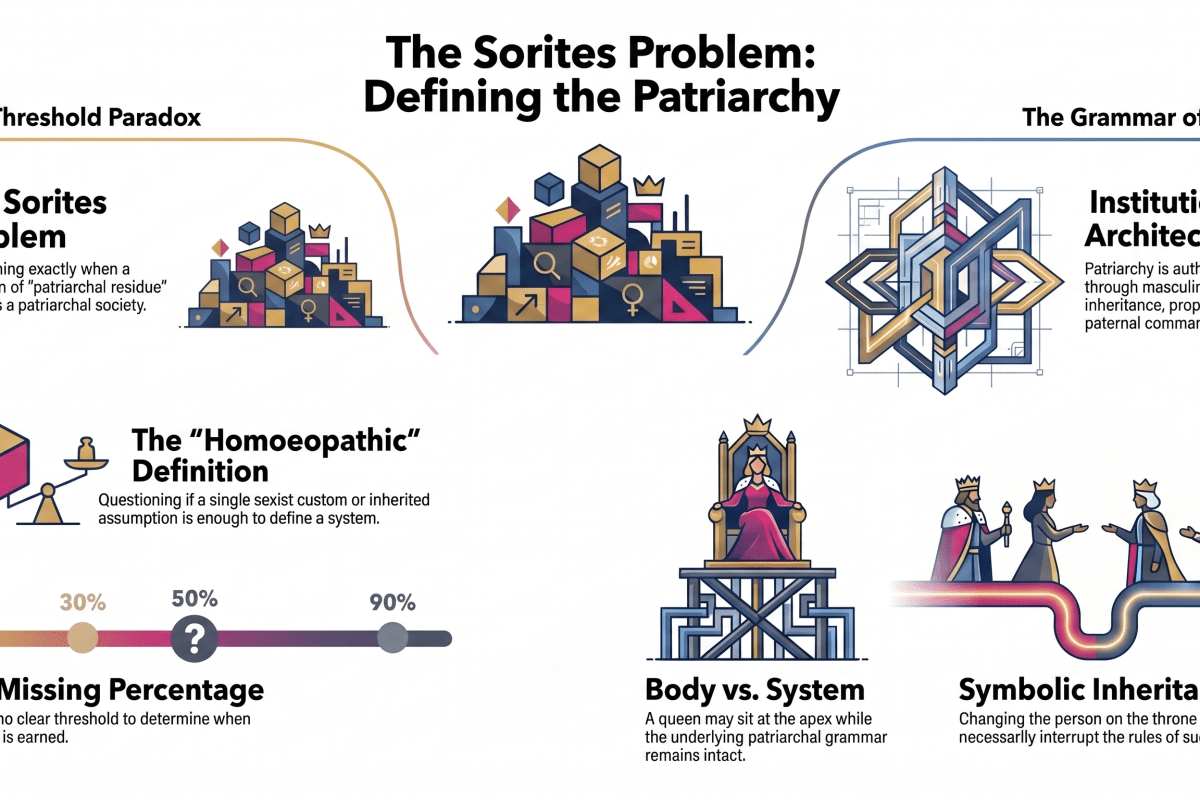
Man, this IaI piece asking about The Patriarchy in Question has got my knickers properly twisted. As I gather the scattered crockery of my thoughts, the first issue is the Sorites problem of patriarchy.
Mirroring the old question of when a collection of grains becomes a heap: when, exactly, does a society become a patriarchy? How much concentration of patriarchal residue is required before the noun is earned? Is one bad apple enough to spoil the whole lot, or does that give us only the faint homoeopathic aftertaste of patriarchy?
I doubt many people would openly defend this homoeopathic definition. One sexist custom, one male-coded institution, one inherited assumption, and behold: The Patriarchy. But if not that, where’s the threshold? Fifty per cent? Ninety? Thirty? Or is the question itself badly formed?
The issue isn’t only composition but degree, location, and power. One king over a kingdom gives us monarchy; it becomes patriarchal when rule is authorised through masculine-coded inheritance, legitimacy, property, office, or paternal command. But what of a queen operating under the same institutional grammar? Has the patriarchy been interrupted, or merely furnished with a woman at the apex? If she inherits the language, offices, succession rules, and symbolic architecture of patriarchal power, then the body on the throne may change while the grammar of rule remains intact.

Those who follow me closely know that I am not a supporter of Democracy or Enlightenment Age ideals. I published an extended post on Substack, after which I had a bit of an epiphany.
In brief, for expansion later, is my realisation that Democracy – nor the so-called Justice system – is not a utilitarian or consequentialist project. Although I have issues with all normative ethics stances, I am particularly not a deontologist. This disconnect has caused me much consternation.
Through a utilitarian lens, I had been primed to expect better outcomes – considerations for the Greater Good™ and all. This is the source of my disillusionment.
Through a deontological lens, democracy and justice are about the repeatability of processes, not outcomes. Outcomes are a secondary byproduct despite being framed as a main event.
Even though neither of these is empirically evident, it feels more honest to present it this way. Of course, the rhetoric would require more effort. We’re not all Kantians.
Anyway, I just wanted to capture the moment before considering this in more detail and sharing a position piece later.
Were you already aware of this distinction? In so, does it matter? In any case, does it matter? Enquiring minds want to know.

I published a Substack essay response on Oliver Neutert’s Calibrating Superintelligence. Here is a video summary.
The philosophies of Oliver and I are substantially similar. Whilst I think his governance ideas may work fine in a controlled corporate environment – ostensibly a monarchy – they diverge at scale.
 Philosophics