Octogenarians

5–7 minutes

The title may have given this away, but my parents are in their eighties, an absurdity on the face of it, because some primitive part of my brain still files them under ‘adults’ – people who understand the performance of being alive.

Years ago, against my father’s wishes, my mother took a job as a waitress. His objection came out with that antique domestic authority that probably ought to be preserved in amber: No wife of mine is going to work. There it is. The marital constitution in a single sentence. Not an argument – rather, by decree. Still, she worked.

Audio: NotebookLM summary podcast of this topic.

It’s been years since she held a paid job, but in retirement, she seems to have lost more than employment. She’s lost a structure of demand. She is bored out of her gourd or tree or whatever. Left alone with an unfilled day, she putters, tidies, wipes, folds, rearranges, and complains – rinse and repeat. Sisyphus would be proud. And the complaint isn’t incidental; it’s part of the ritual. The labour gives the grievance somewhere to reside.

There’s a peculiar mercy in not being too useful.
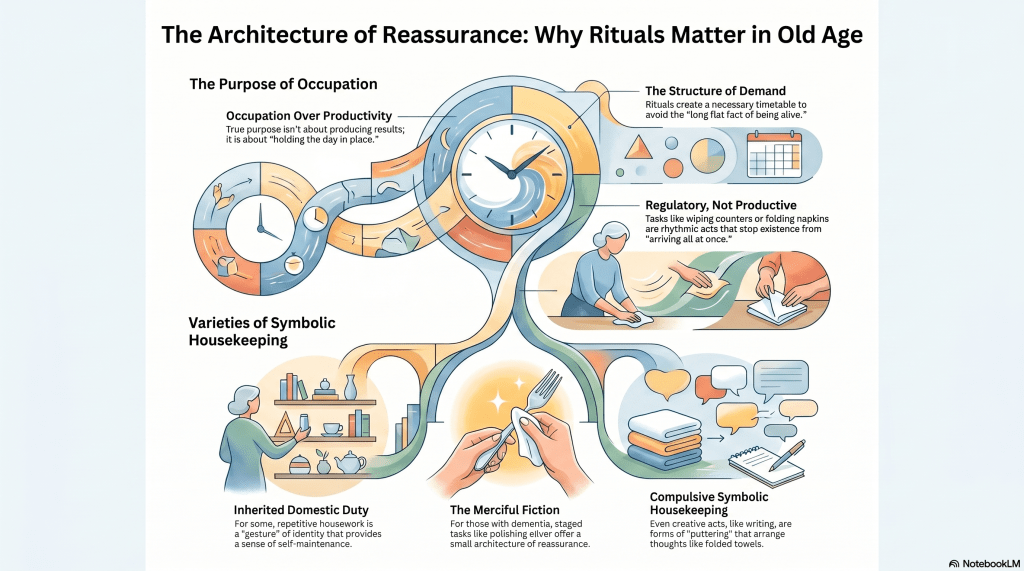
NotebookLM Infographic on this topic.

This creates an odd etiquette for everyone around her. One has to be careful not to interfere too much. Don’t clean everything; efficiently eliminate tasks; show up flushed with modern virtue and liberate her from the very thing that’s keeping the day from opening its jaws. Offer help, accept the refusal, move on without guilt. There’s a peculiar mercy in not being too useful.

Once the housework is done – or once it reaches the temporary truce by pause – the restlessness comes back. The ourobouros resumes its self-consumption. Then she needs to walk, drive, shop, bake, browse, fiddle, inspect, rearrange, and escape – more infinite loop, though only seemingly so. Anything to distract her from the long flat fact of being alive without a timetable. Employment used to do that. Marriage did that. Children did that. The household still does that. Now the old structures only remain as gestures, but gestures can still hold a person upright, as they had before, but with more salience.

A different version of this appeared with my mother-in-law, who had dementia. To occupy her, we’d give her silver to polish, or napkins to fold. There wasn’t a real need for the silver to shine, and the napkins, once folded, could be unfolded and dropped back on the pile to repeat the process. Like Keynes’s worker digging holes to fill them in again, the point wasn’t production. The point was occupation. The task didn’t need to move the world forward, as if it did in any case. It only needed to hold the day in place.

That sounds cruel when you describe it abstractly, as if we were tricking her into labour, but you’d be confusing this with Capitalism. The real cruelty would have been leaving her unmoored – nothing for the hands to do whilst the mind searched for a room it could still recognise. Folding napkins wasn’t housework in any economic sense. It was a small architecture of reassurance. A way of letting purpose survive after purpose had lost its object. even if the sense of purpose had long left the building.

There’s a distinction here, though it isn’t clean. My mum’s rituals are self-maintaining. They belong to a life trained by domestic obligation, by marriage, by an older settlement between gender and labour, by all the small cruelties that once got to call themselves normal. My mother-in-law’s rituals were externally staged – not expressions of domestic identity so much as acts of care arranged by other people. Whilst all purpose is fictional, one woman kept her purpose through the fiction of inherited duty; the other was offered purpose as a merciful fiction. The border between the two is porous, naturally, because reality has never agreed to respect our categories.

I’m not recommending any of this to anyone. I’m just noticing it, which is what we writers call ‘thinking’ when we want to dodge responsibility.

Abstract freedom isn’t the same thing as a life you can actually inhabit.

I’m a feminist the way I’m a humanist: sincerely, but with reservations about the slogans. I don’t think this is how a woman should live. I don’t believe domestic labour is some mystical feminine vocation – as if dusting were an ontological destiny and the Hoover a sacrament. But I also can’t bring myself to take it away from her. Abstract freedom isn’t the same thing as a life you can actually inhabit. Sometimes emancipation arrives too late to provide new habits. Sometimes the cage has become furniture.

This doesn’t justify the cage. It only complicates the fantasy that removing it leaves behind a clean liberated self, glowing like a freshly unboxed appliance. People aren’t appliances, although civilisation has made several brave attempts.

The mistake is assuming purpose has to be justified by productivity. That’s the capitalist infection, of course: if nothing’s produced, nothing happened. But most of ordinary life isn’t productive in that sense. It’s regulatory. Consolatory. Rhythmic. A person folds the napkin, wipes the counter, polishes the spoon, walks round the block, checks the same cupboard twice, tells the same story, asks the same question, rearranges the same shelf, writes the same sentence again with one adjective changed and calls it progress – like an LLM but with less personality. These acts don’t redeem existence. They just stop it arriving all at once.

As for me, I don’t have a purpose either, so I write. Ostensibly, this is my own form of puttering. My desk is her kitchen counter. My paragraphs are folded towels. I arrange sentences, complain about them, rearrange them, and call the whole performance ‘vocation’ because compulsive symbolic housekeeping looks poor on a business card.

There’s a shabby tenderness in this, though one shouldn’t make too much of it. The old trick isn’t really meaning; it’s occupation, rhythm – having something to do with one’s hands whilst the mind declines to look directly at the wall. Some people clean. Some people shop. Some shoot fentanyl. Some become serial killers, CEOs, presidents, consultants, motivational speakers, or other recognised hazards. Some of us write essays about our mothers and pretend it counts as insight. We all find our own ways to bide the time until we die.

In the end, nobody gets out alive. The least we can do is not steal from each other the shabby little rituals that make the waiting bearable.

Video: On a related note. Jonny talks about Setiya and atelic activities.

Millennial Morality

Surfing the Web, I happened upon a blog wherein Wintery Knight riffed on a conversation about morality with an atheist millennial man. My interest was piqued, so I scanned it and then read it. I scanned the About page, and it’s apparent that we hold diametrically opposed worldviews, and that’s OK.

As a result of the encounter with this millennial man, the post intends to answer the question: How could I show him that happy feelings are not a good basis for morality? But let’s step back a bit.

In the words of the author, ‘I asked him to define morality, and he said that morality was feeling good, and helping other people to feel good.’ Here’s the first problem: Although a conversation about morality may have occurred between the author and an atheist millennial man, the post is not in fact a reaction to Millennial morality. Rather, it’s of the respondent’s dim characterisation of what morality is (whether for a theist or an atheist). His reply that morality is ‘feeling good, and helping other people to feel good’ sounds more like hedonism and compassion. The author does pick up on the Utilitarian bent of the response but fails to disconnect this response from the question. The result is a strawman response to one person’s hamfisted rendition of morality. The author provides no additional context for the conversation nor whether an attempt to correct the foundational definition.

A quick Google search yields what should by now be a familiar definition of morality: principles concerning the distinction between right and wrong or good and bad behaviour.

morality (noun) : principles concerning the distinction between right and wrong or good and bad behaviour

Oxford Languages

Clearly, conflating utility with rightness and wrongness, with goodness and badness, is an obvious dead-end at the start. This said, I could just stop typing. Yet, I’ll continue—at least for a while longer.

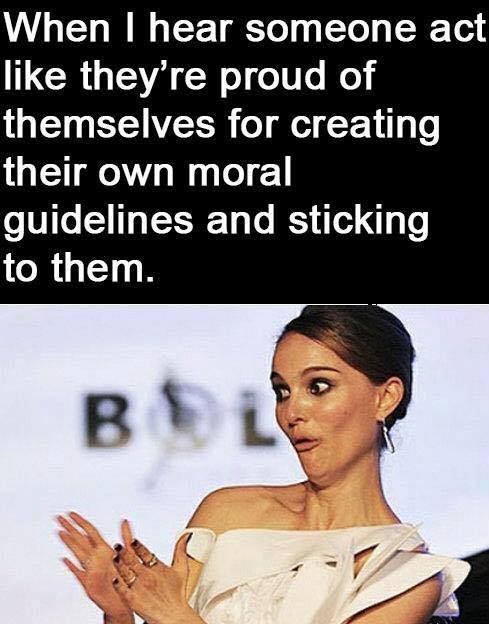
At the top of the article is a meme image that reads ‘When I hear someone act like they’re proud of themselves for creating their own moral guidelines and sticking to them’.

This is one of the memes from the Wintery Knight facebook page

Natalie Portman sports an awkward facial expression and a sarcastic clap. Under the image is a line of copy: If you define morality as “whatever I want to do” then you’ll always be “moral”, which is tautological, but a bit of a non-sequitur to the rest, so I’ll leave it alone.

Let’s stop to regard this copy for a few moments but without going too deep. Let’s ignore the loose grammar and the concept of pride. I presume the focus of the author to be on the individually fabricated morals (read: ethical guidelines or rules) and that the fabricator follows through with them.

That this person follows through on their own rules is more impressive than the broken New Year’s resolutions of so many and is a certainly better track record than most people with supposed religious convictions.

May be a cartoon of text
New Years’ Resolutions

First, all morals are fabricated—his morals or your morals. And you can believe that these goods came from God or gods or nature or were just always present awaiting humans to embody them, but that doesn’t change the point.

Let’s presume that at least some of his morals don’t comport with the authors because they are borne out of compassion. Since we’ve already established precedence for cherry-picking, allow me to side-step the hedonistic aspects and instead focus on the compassionate aspects. Would this be offensive to the author? Isn’t, in fact, in Matthew 7:12 and Luke 6:31, the do unto others Golden Rule edict, is a call for compassion—at least sympathy if not empathy?

After a quick jab at abortion (tl; dr: abortion is bad) taking the scenic route to articulate the point that atheists typically don’t think of unborn children as people, apparently without fully grasping the concept of zygotes and gametes. The author then confuses the neutral notion of a probabilistic outcome with accidents, having negative connotations—as if I flip a coin, the result is an accident. Let’s ignore this passive-aggressive hostility and move on. Let’s also forgive the flippant—or at least facile—articulation of biological evolutionary processes as ‘the strong survive while the weak die’. We can let it slide since what is meant by strong in this context is wide open.

child (noun) : a young human being below the age of puberty or below the legal age of majority

Oxford Languages

The author continues with a claim that ‘you aren’t going to be able to generate a moral standard that includes compassion for weak unborn children on that scenario’. This feels like an unsubstantiated claim. Is this true? Who knows. Some people have compassion for all sorts of things from puppies to pandas without having some belief in rights. Some people like Peter Singer argues that rights should be extended to all species, and all humans should be vegans. I wonder if the author can live up to this moral high watermark. Maybe so. Probably doesn’t mix linen and wool because it’s the right thing to do.

“If the rule is “let’s do what makes us happy”, and the unborn child can’t voice her opinion, then the selfish grown-ups win.” This is our next stop. This is a true statement, so let’s tease it a bit. Animals are slaughtered and eaten, having no voice. Pet’s are kept captive, having no voice. Trees are felled, having no voice. Land is absconded from vegetation and Animalia—even other humans. Stolen from unborn humans for generations to come. Lots of people have no voice.

People are into countries and time and space. What about the converse situation? Where is the responsibility for having the child who gains a voice and doesn’t want this life? Does it matter that two consenting adults choose to have a child, so it’s OK? Doesn’t the world have enough people? What if two consenting adults choose to rob a bank? I know I don’t have to explicitly make the point that once the child is thrown into this world, the voice is told to shut up if it asks to exit or even tries to exit without permission. Unless circumstances arise to snuff out the little bugger as an adult.

Finally, the author is warmed up and decides to focus first on fatherhood. The question posed was whether the interlocutor thought that fatherlessness harmed children, to which the response was no.

Spoiler alert: The author is toting a lot of baggage on this fatherhood trip. Before we even get to the father, the child, or the family, there is a presumption of a Capitalist, income-based, market economy. Father means the adult male at the head of a nuclear family with a mum (or perhaps a mother; mum may be too informal), likely with 2 kids and half a pet. The child is expected to also participate in this constructed economy—the imagined ‘right’ social arrangement. It goes without saying that I feel this is a bum deal and shit arrangement, but I’ll defer to pieces already and yet to be written here. But if fathers are the cause of this ‘Modern’ society, fuck ’em and the horses they rode in on.

She asks him, if a system of sexual rules based on “me feeling good, and other people around me feeling good”, was likely to protect children. Evidently, he was silent, but here you can already determine that she unnecessarily links sex to procreation. And reflecting on a few paragraphs back, how is forcing a child (without asking) to be born and then told to become a wage slave or perish not violent and cruel?

(Self-guidance: Calm down, man. You can get through this.)

So the question is surreptitiously about procreative sex. By extension, if the couple can’t procreate for whatever myriad reasons, it’s OK? Sounds like it? Premenstrual, menopausal, oral, anal, same-sex coupling is all OK in this book. Perhaps, the author is more open-minded than I am given credit for. Not all humans are fertile, sex with plants and animals won’t result in procreation. A lot of folks would call this author kinky or freaky. Not my cup of tea, but I’m not judging. Besides, I’ve read that book—though shalt not judge. I’m gonna play it safe. And they couldn’t print it if it wasn’t true.

Spoiler Alert: Jesus dies at the end.

Seeking credibility, the author cites Bloomberg, as Centre to Centre-Left organisation as Far-Left. Clearly another red flag. Excuse me, your bias is showing. This piece is likely written for choir preaching, so we’ll take the penalty and move along.

A quick jab at the bĂŞte noire of ‘Big Government’ facilitating idle hands and, presumably genitals, to play. The idle rich as Croesus folks are idols to behold. At least I can presume she opposes military spending and armed aggression on the grounds of harm, so we’ve got common ground there. They’re probably an advocate of defunding the police, though by another name. so there’s another common platform. It just goes to show: all you need to do is talk to ameliorate differences. We’re making good headway. Let’s keep up the momentum.

Wait, what? We need to preserve a Western Way? I was shooting for something more Zen. Jesus was a Westerner—being from Bethlehem and all. (That’s in Israel—probably on the Westside.)

r/memes - Everyone else in the Middle East Jesus Christ
White Jesus from the Middle East

No worries. Just a minor setback—a speedbump. It’s just a flesh wound. But we’ve pretty much reached the end. A little banter about some other studies. There’s an impartial citation from the Institute for Family Studies on cohabitation they beg the question and employs circular logic. And another from the non-partisan Heritage Foundation finds that dads who live with their children spend more time with them. How profound. I’d fund that study.

And it’s over. What happened? In the end, all I got out of it is ‘I don’t like it when you make up morals’. You need to adopt the same moral code I’ve adopted.

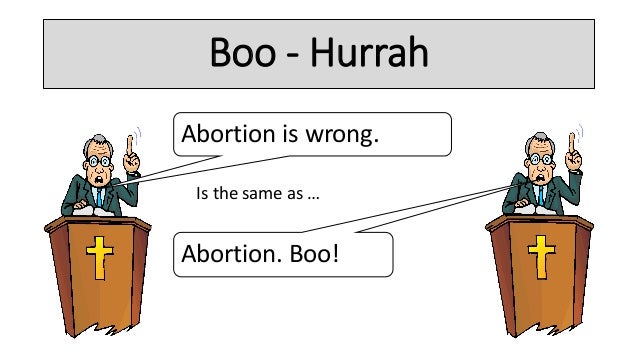
Emotivism
AJ Ayer – Emotivism

Where was I? Oh yeah. Fathers. So these people don’t mean generic fathers. They mean fathers who subscribe to their worldview. In their magical realm, these fathers are not abusive to their mothers or children; these fathers are not rip-roaring alcoholics; these fathers are the dads you see on the telly.

Suspiciously absent is the plotline where the fathers are ripped from their families through systematic racism and incarcerated as if they didn’t want to be there for their children. And this isn’t discussing whether it’s an issue of fathers or an issue of money. It isn’t discussing whether someone else might serve as a proxy for this role. Indeed, there is nothing magical about fathers unless you live in a fantasy world.

Comment below or by email.