The Author Did Not Write This

4–6 minutes

The LinkedIn consensus has spoken: if you used AI in the writing process, you are not the author. The position is stated with the confidence of someone who has never hired a ghostwriter, employed a research assistant, submitted to a heavy editor, or considered that the Gettysburg Address was almost certainly not written by Lincoln.
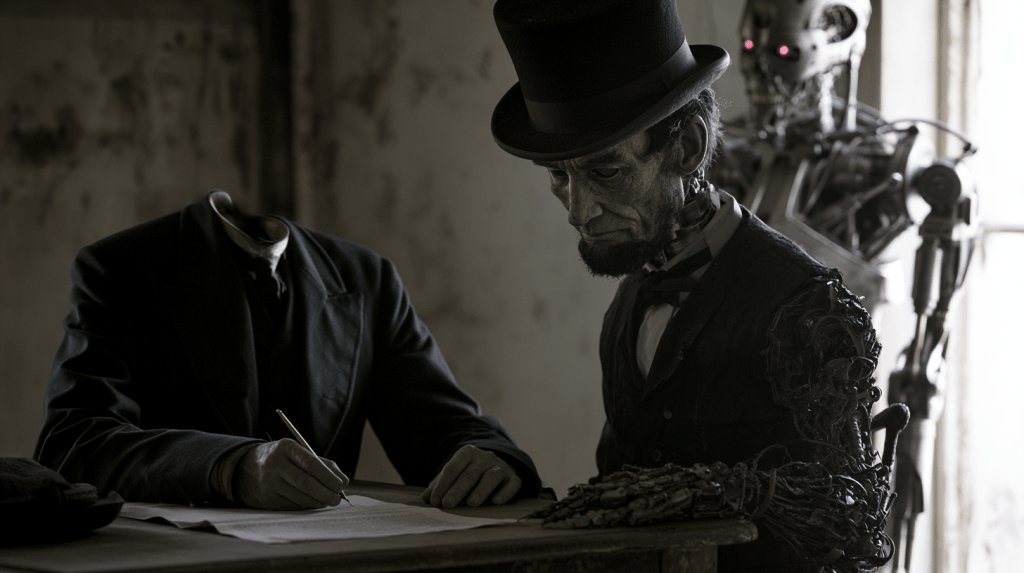
Image: I couldn’t not share this Midjourney 8.1 image. It may not have understood the assignment.
Audio: NotebookLM summary podcast of this topic.

Authorship has never been a production relation. It has always been an attribution relation — an institutionally stabilised answer to the question of which name the practice elects to put on the cover. These are not the same thing, and conflating them is the error from which every subsequent confusion proceeds.

The ghostwriter has existed as long as commercial publishing. The political speechwriter is so normalised that nobody considers it worth remarking. The celebrity memoir, the corporate thought-leadership piece, the attributed editorial — these are not edge cases or embarrassing exceptions. They are the normal operation of every writing-adjacent industry that has ever existed. The name on the cover has never reliably indicated the hands on the keyboard, and the industry has never seriously pretended otherwise. It has simply preferred not to discuss it at dinner.

AI changes the tool. It does not change the structure. The person who prompts, selects, curates, revises, and publishes is doing what commissioners of ghostwriters have always done. What has changed is that AI makes the mediation visible in a way that polite convention previously concealed. Visibility triggers the purity reflex. What presents itself as a defence of authentic authorship is a defence of a particular fiction — the Romantic author as solitary originating consciousness — that the industry never consistently believed and certainly never consistently practised.

The purity position also fails on its own terms before it gets started. Consider the spectrum of AI-assisted writing: a full draft submitted for light polish; a human argument substantially revised by AI; collaborative ideation followed by AI drafting; a kernel of an idea handed over for full execution. These are genuinely different in terms of human contribution. The zealot position requires a threshold somewhere on this spectrum below which authorship lapses. It never specifies where. More fatally, it has no means of verification. There is no external method of determining where on the spectrum any given piece of writing falls. The detector tools are probabilistic noise that disproportionately penalise competent prose. Any audit mechanism sophisticated enough to catch first-order evasion immediately generates a second-order workaround. The regress terminates only at continuous surveillance of the writing process — panoptical authorship as the logical endpoint of the position taken seriously.
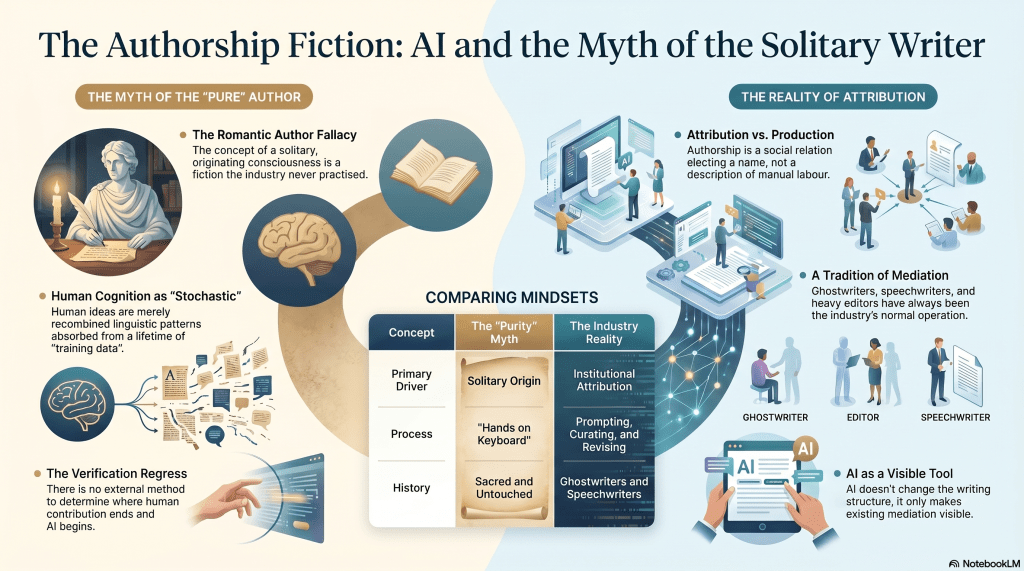
NotebookLM Infographic on this topic.

Then there is the recursion problem, which the zealot never addresses because it is fatal. The stochastic parrot charge against AI — that it merely recombines absorbed linguistic patterns without genuine origination — describes with considerable accuracy what human cognition also does. The writer’s training data is the Dickens read at ten, the billboard absorbed on a commute, the argument overheard on public transit, the half-remembered essay that shaped a position without ever being consciously cited. The causal chain of any human idea disappears into an unauditable cognitive history. Genuine origination in the sense the purity position requires has never existed. The Romantic author was always a retrospective confabulation. Barthes said so in 1967. The industry nodded politely and continued invoicing.

What the zealot is defending is not authorship. It is a particular grammar of authorship — one that selects compositional origin as the threshold criterion, applies it selectively and unverifiably, and uses the resulting suspicion as a status boundary. It is guild behaviour dressed as principle, which is understandable as a response to a genuine economic threat but should not be mistaken for a philosophical position.

Authorship is the position a culture elects to stabilise after the work has already been produced through far messier means. It has always been thus. AI did not break the fiction. It just made the fiction harder to keep a straight face about.


The Rest of the Story

I’ve written about this before. I am not an AI apologist, but I am peeved by anti-LLM zealots, who clearly haven’t thought through their arguments.

I finished reading A.J. Ayer’s Language, Truth, and Logic, the part about Bertrand Russell’s claim about ‘The author of Waverley was Scotch‘. My brain latched onto authorship, and my emotional response was WTF? I have other problems with Russell and Ayer on this, but that’s a matter for another day.

To make my point, this page up to the ellipsis is the output of Claude after an extended dialogue with it and ChatGPT after I read Ayers, and something didn’t sit quite right. I am not ashamed to use LLMs in my authoring workflow and am not ashamed to mention it, as here. Almost all of these thoughts are mine. I’ve simply asked Claude to organise the output. It’s good enough to output as-is, and any edits would be trivial, so I won’t bother. I probably could have made the edits in as much time as it took to type this, but I’ve got nothing to hide. I’m just a human with access to technology circa 2026.

Music Property

The topic of intellectual property gets me every time. As much as I am opposed to the notion of property in general, intellectual property is a complete farce. Along with Rick Beato and David Bennet, Adam Neely is one of my three main music theory staples on YouTube. Here, he goes into more depth than I would have expected, but it’s worth hearing the perspective of a musician. I won’t break down his video fully because it speaks for itself. Instead, I’ll share my thoughts and pull out highlights.

Podcast: Audio version of this page content.

November 8th, 1548 is the day in history that the French King Henri II opened the door to intellectual property, an obvious giveaway to a benefactor, creating a publishing monopoly. He turned community cultural knowledge into property, turning the benefit of many into the benefit of one. This is the crux of capitalism—favouring the one over the many.

Before continuing, it seems that there is a schism in the legal system itself. In fact, it is very fractured even within this small domain. At the same time it wants to be precise and analytical, it’s dealing with a subject that cannot be analysed as such. To add insult to injury, it exempts musicians and musical experts and requires music consumers to decide the outcomes of trial cases. To be fair, even relying on so-called experts would lead to mixed results anyway. They might as well just roll the dice. This is what happens when right hemisphere art enters a left hemisphere world.

nature + work = ownership

Adam establishes a grounding on the theory of property rights à la John Locke’s ‘sweat of the brow’ concept, wherein nature plus work equates to ownership. He then points out how intellectual property has even shakier ground to stand on. It relies rather on notions of originality and creativity, two concepts that have no intersection with the left-hemisphere heavy legal and jurisprudence systems. Moreover, like pornography, these things cannot be defined. They need to be divined. Divination is no place for lay jurists. It’s a recipe for disaster. The entire English court system is rife with problems, but the left-brainers feel these are just trivial devils in the details. I beg to differ, yet I am voiceless because I won’t participate within their frame.

Adam also points out how out of date the law is insomuch as it doesn’t recognise much of the music produced in the past few decades. Moreover, the music theory it’s founded on is the Romantic Era, white European music that often ties transcriptionists in knots. If the absence of certain words to emote experience is a challenge, it’s even worse for musical notation.

In any case, this is a hot-button issue for me on many levels, and I needed to vent in solidarity. This video is worth the 30 minutes run time. His ham sandwich analogy in part V works perfectly. It’s broken into logical sections:

  1. 0:00 Intro
  2. 1:45 Part I – Rhythm-A-Ning
  3. 7:07 Part II – Property Rights
  4. 11:25 Part III – Copyright
  5. 15:58 Part IV – Musical Constraints
  6. 22:18. Part V – HAM SANDWICH TIME
  7. 26:51 Part VI – Solving copyright….maybe?

Give it a listen. Cheers.

The cover image for this is of Thelonius Monk (circa 1947), who features heavily in the video.

Good to Coöperate: Property

2–3 minutes

I happened upon an entry in Current Anthropology: Is It Good to Cooperate? [PDF] (Volume 60, Number 1, February 2019), wherein the authors claim there are 7 universal moral codes. The universality is suspect insomuch as they found a preponderance of observations, so unanimity was not always found. I am also concerned with the specificity of the definition of property.

The group studied ethnographic accounts of ethics from 60 societies, across over 600 sources. The universal rules of morality are:

  1. Help your family
  2. Help your group
  3. Return favours
  4. Be brave
  5. Defer to superiors
  6. Divide resources fairly
  7. Respect others’ property

It’s well past my bedtime, and I should be sleeping, so I just want to pick out one of these universals: property rights.


La propriété, c’est le vol!

What is Property? — PIERRE-JOSEPH PROUDHON

Property can mean several things: In the description of methodology, it appears that these authors are referring to property rather than possession, as a key identifier is the ability to transfer property intergenerationally. What is the scope of the definition of property. There is a difference between passing along a family home and passing along vacant property a world away. Is rent-seeking property ownership universal? Would all societies subscribe to the notion held by Western Capitalism, wherein one can own property that, theoretically, one may never have seen? In the United States, they have concepts like intellectual property, which is at best a subversion of the notion.


»» »» »» »» »» »» EDIT »» »» »» »» »» »»

There may be a problem with reading (or at least posting) at 2AM—and property is a hot button item for me. I may have been hyper-focused on the intergenerational wealth transfer. I’d like to read more about how other societies view this as well as which ones do and don’t. Of course, I’d like to understand how the interviewers couched the questions.

In the end, the summary was about possession and not property:

Private property, in some form or other, appears to be a cross-cultural universal (Herskovits 1952). Morality-as-cooperation leads us to expect that this type of cooperative behavior—deferring to prior possession—will be regarded as morally good .

Op. cit.

As an anti-Capitalist, I notice that no claims are being made into the morality of competition. I may may a few posts on my observations of the remaining 6 list items.

Neoclassical Morality


Episode 8 of The Moral Foundations of Politics with Ian Shapiro was another difficult lesson to watch—rather to listen to—the student responses. Evident is the degree of indoctrination or brainwashing these students have been through. I want to document some pieces I feel are relevant to my position.

  1. The fact that morality is perniciously imposed and infused on the unsuspecting
  2. The fact that property rights change over time
  3. The fact that legal interpretation changes over time

The responses were primarily knee-jerk responses anchored on institutional indoctrination. Whilst it makes sense to indoctrinate a group, I am opposed to imposing an obvious relative morality but passing it off as absolute.

Asking how prostitution could be illegal when sex and commerce are both legal, the responses—to be fair, only a couple people responded—were about how it might somehow ‘harms’ women or society as a sort of negative externality, be violent, have been coercive or a form of slavery, have involved a married or otherwise committed spouse, or have involved an under-aged person. These were poor man’s strawman arguments at best, each potentially with merit, but each a separate issue from the question.

In fact, we can likely find evidence of each of these in a ‘typical’ employment situation: coercion, under-age, a threat of violence, implied or expressed; the spousal issue doesn’t fit these situations, but even if we want to legislate keeping people safe from their own actions, it is as illegal for unmarried persons, so the rationale is insufficient.

The point I hold is that prostitution in and of itself is no more exploitative than any other source of employment, a source income. Given that Western society imposes income as the primary means to support one’s self, the wrong here is that artificial barrier. Were income not a veritable necessity, prostitution to earn money (or use as a barter) would also be unnecessary. This is not to say that the other aforementioned objections would be resolved; this because, as I mentioned, they are different issues.

Next, we are told that marital rape originally not considered a crime because a woman was considered to be chattel property transferred patriarchally from her father to her husband. As I’ve written previously, I do not subscribe to the notion of property in the first place, but taken that as given, it is obvious that property is determined through whimsy. Property rights change over time, whether receding as just noted or expanding to include intellectual property and the expanse of patentable ideas. It’s disconcerting that application of the law can be so arbitrary and, though perhaps not capricious, frivolous. And given it is all open to interpretation, the pendulum can swing in the other direction, as the women of Iran and other fundamentalist theocracies has experienced.

Apparently, I’m done ranting. Basic income has been mentioned as a solution to some prostitution, as some women participate out of desperation. Though I feel that this might kerb some prostitution, some women would still seek to supplement this base income, if only to advance their personal standard of living.

What’s in Store for 2017?

Going into 2017, I am going to focus more attention on Universal Basic Income (UBI) otherwise known as minimum income. Providing everyone with a safety net in the spirit of life, liberty, and happiness. Hopefully, this will take some focus away from or redirect the negativity I am anticipating under the Trump regime, but I make no promises, expressed or implied. I’ll attend to the detractors as well.

I’ve been peripherally aware of the concept of UBI for a couple of years now—Martin Ford’s Rise of the Robots and Erik Brynjolfsson’s The Second Machine Age, among others. Although I don’t envision it as a permanent solution—after all, what is permanent? —but it is a solution that works within the existing (and woefully wanting) economic framework. It does, however, have a way to go relative to the current socio-political constructs.

The solution is not permanent primarily because the current economic system based on markets, supply, demand, income, and production is tenuous, so building on a platform of shifting sand is bound to fail—not because it is a bad idea considering the given system, but because the system itself is faulty. Capitalism is a house of cards, a tenuous MacGyver-ed system held together with spit and bubble gum (and who knows what else). I don’t have a replacement system in mind, and most people are not quite ready to abandon their cherished ragdoll owing to indoctrination, propaganda, and escalating commitment.  Entropy is at play, and the establishment needs to apply more and more external force to keep it together. We can look to history and the French revolution of 1789 as a guide—or perhaps the fall of tsarist Russia. These systems were inherently unstable.

Regarding these societies of serfs, the gutting of the middle class and the expanding inequality along with technological trends seems to have a trajectory along a vector to return us there, and the results can be expected to be as disastrous.

The United States was founded during the so-called Enlightenment with dashes of a Calvinistic work ethic and rugged independence, whatever that means. ‘Enlightenment,’ like ‘modern’, is a flattering term given to self-describe a period, but this description is mostly wishful thinking. I am not opposed to much of the thought that came from the Enlightenment, from Diderot to Locke to Montesquieu—thoughts such as freedom and separation of powers—, hijacked by the likes of Franklin and Jefferson on these shores, but they, too, were built on shaky grounds—the grounds of gods or God, and nature—, so our laws are built upon nothing; this is worse than shifting sand: at least there was sand to shift.

Language tries to obfuscate the divine with the euphemism nature. From so-called ‘natural laws’ we derive property rights, but take away the premise of natural law, and we lose the basis for such an assertion. And don’t get me started on the further foundationless logical leap to intellectual property rights.