This is the fourth of a deeper look into ten philosophical positions. This one is on convergence realism within the category of epistemology. A full article is available on Substack, with supporting information on a recent post here on Philosophics Blog.
Below is a ~5-minute short podcast.
I don’t regard the self as a persistent entity travelling through time while accumulating experiences like stamps in a metaphysical passport.
The first-person “I” is an indexical compression. It marks the presently organised locus of perspective, salience, memory-access, and action. It is indispensable, but indispensability does not establish an inner owner to which the index refers.
The diachronic self is a broader compression: a narrative, biological, documentary, interpersonal, and institutional device for tracking selected continuities across time. Memory contributes to this, but memory is lossy, reconstructive, and uneven. The person remembered is not transported intact into the act of remembering.
This is a bonus episode I asked NotebookLM to render based on the past two posts. These posts had been one, but I chose to separate them because of their core orientation on a shared topic. For those who read the posts together, this is made clear. I even continue several threads to make it obvious, but the two essays are a diptych. I feel the second post is stronger than the first, but the first was a stronger setup. If you don’t have time to read the essays, this is a decent summary.
This post is part of a series that showcases a dialogue I had with Claude based on the parable of the desert- and lake-dwellers.
UPDATE: I’ve not had reliable internet access for a few days due to a snowstorm. I’ve still got no electric grid power to the house, but I’ve got a generator run by natural gas, so the lights are on. Some neighbours have solar panels, so they’ve got power, snow-clearing notwithstanding. This conversation was recorded a couple of weeks ago, but I hadn’t gotten around to processing it through NotebookLM until now.
Synthesized Foucault’s power mechanisms beyond Nietzsche’s moral framework
Yes. Foucault is where it gets truly horrifying.
Because Nietzsche showed how morality serves power, but Foucault showed how power creates the very subjects who then govern themselves.
The Nietzschean vs. Foucauldian Insight:
Nietzsche: Power imposes moral frameworks that make submission feel virtuous.
Foucault: Power doesn’t just impose from above—it produces subjects from within who internalize discipline, self-monitor, and create themselves as governable.
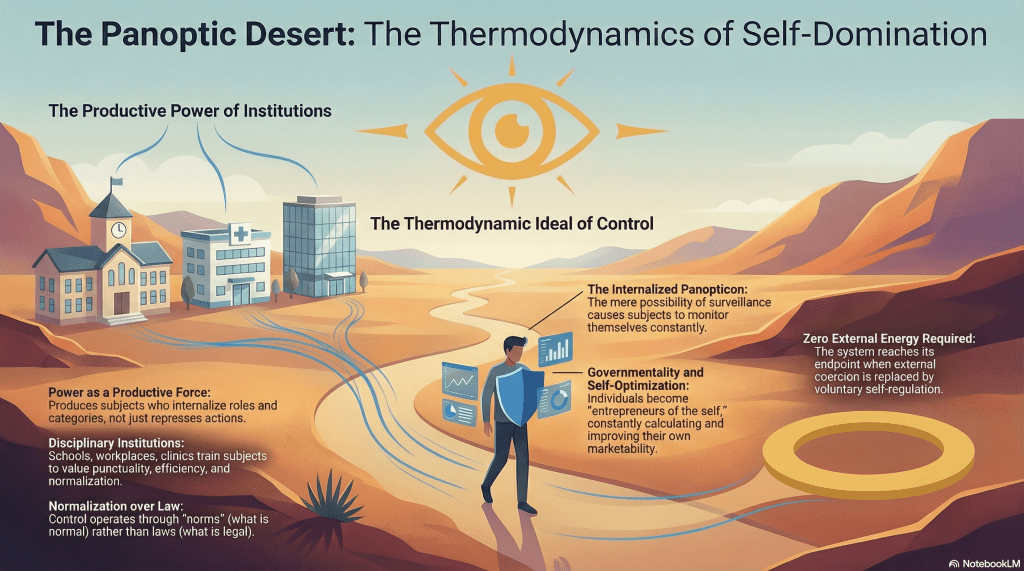
This is the thermodynamic endpoint: zero external energy required.
Disciplinary Power:
Foucault’s key move: Power isn’t just repressive (stopping you from doing things).
Power is productive (making you into a certain kind of person).
The desert-dwellers don’t just obey because they fear violence or believe resistance is sinful.
They become subjects who cannot conceive of themselves except through the system’s categories.
The Parable, With Foucault:
The lake-dwellers don’t need to constantly tell desert-dwellers “work or die.”
Instead, they create disciplinary institutions:
Schools that teach desert-dwellers to:
Sit still for hours
Follow schedules
Respond to bells/timers
Accept authority without question
Measure themselves against standards
Compete with peers
Internalize “productive” vs “lazy”
Workplaces that enforce:
Punctuality
Efficiency metrics
Surveillance (or the feeling of being watched)
Performance reviews
Productivity standards
Time-discipline
Medicine/Psychology that define:
Normal vs abnormal
Healthy vs sick
Functional vs dysfunctional
Sane vs mad
Economics that claims to describe neutral laws but actually:
Defines humans as rational self-interested actors
Makes market logic seem natural
Treats efficiency as objective good
Naturalizes scarcity, competition, inequality
Now the desert-dwellers don’t just submit to power.
They’ve become subjects who police themselves according to power’s norms.
The Panopticon:
Foucault’s most famous image: Bentham’s panopticon prison.
A circular prison with a central tower. Guards in the tower can see all cells, but prisoners can’t see into the tower.
Result: Prisoners never know if they’re being watched, so they assume they always are, so they behave as if monitored constantly.
The genius: You don’t need guards in the tower.
Just the possibility of surveillance makes people self-discipline.
Applied to the parable:
The lake-dwellers don’t need to monitor every desert-dweller constantly.
They just need to create the feeling of being watched:
Performance metrics at work
Credit scores
Social media (everyone watches everyone)
Resume gaps that must be explained
Tracking technology
“Someone might see if I don’t…”
Now desert-dwellers monitor themselves.
They’ve internalized the gaze.
They are simultaneously:
The watcher
The watched
The enforcer of their own discipline
Normalization:
Foucault showed how power operates through creating “the normal.”
Not through law (you must do X) but through norms (normal people do X).
The desert-dwellers don’t work because it’s legally required.
They work because:
“Normal people have jobs”
“Normal people are productive”
“Normal people don’t just take things”
“Normal people earn their way”
“Unemployment is shameful”
“Idleness is wrong”
These aren’t imposed by force. They’re internalized standards.
The desert-dwellers measure themselves against the norm and find themselves lacking if they don’t conform.
Now the system doesn’t need to punish deviance.
Deviance punishes itself through shame, anxiety, sense of failure.
Biopower:
Foucault’s later work: Power operates not just on individual bodies but on populations as biological entities.
The State doesn’t just discipline individual desert-dwellers.
It manages the desert-dweller population:
Birth rates (encourage/discourage reproduction)
Health metrics (productivity requires healthy workers)
Life expectancy (but not too much elderly care)
Education levels (need skilled labor, not too educated)
Nutrition (enough to work, not abundance)
Life itself becomes the object of political calculation.
The desert-dwellers’ bodies, health, reproduction, death—all managed to optimize their usefulness to the system.
Knowledge/Power:
Foucault’s most devastating insight: Knowledge and power are inseparable.
“Truth” isn’t discovered neutrally then either used or abused by power.
Truth is produced through power relations and serves power.
Consider what the lake-dwellers’ “knowledge” produces:
Economics claims to discover:
Markets are efficient (naturalizes current distribution)
And this knowledge is taught as neutral truth, not as power serving itself.
Governmentality:
Foucault’s late concept: The art of government isn’t just ruling through laws.
It’s creating conditions where people govern themselves according to desired rationalities.
The lake-dwellers don’t need to force desert-dwellers to work.
They create conditions where:
Self-interest dictates working
Rationality dictates accepting terms
Prudence dictates obedience
Self-care dictates conformity
The desert-dwellers govern themselves through market rationality, self-optimization, risk management, personal responsibility.
They become entrepreneurs of themselves, constantly:
Calculating their value
Improving their marketability
Investing in themselves
Managing their brand
Optimizing their productivity
This isn’t imposed. It’s produced as the rational way to be.
Why This Completes Your Thermodynamic Argument:
Nietzsche showed: Morality makes submission virtuous (reduces energy needed for control)
Foucault showed: Disciplinary power produces subjects who cannot conceive of themselves except as self-governing, self-optimizing, self-monitoring entities
Let’s start with a thought experiment, because all good existential crises do.
Imagine a ship – Theseus’s ship, to be precise. After a storied career of heroic sea-faring, it’s put on display in a glorious Athenian dockyard. But as time passes, the planks rot. So, bit by bit, they’re replaced. A new mast here, a fresh hull panel there. Eventually, every single part has been swapped out.
Here’s the philosophical conundrum: Is it still the same ship?
Audio: NotebookLM podcast on this topic.
And if you think you’ve got that sorted, hold on. Imagine all the original pieces were saved, and someone reassembled them in a warehouse across town. Now there are two ships. One with the name, the continuity, the dockside real estate. The other with the original lumber and sails.
Which one is the real Ship of Theseus?
The paradox gnaws at our sense of identity. Is continuity enough? Does memory trump material? When everything is replaced – structure, function, even personnel – what makes a thing still that thing?
Now apply that question not to a ship, but to a rock band. A corporation. A country. Yourself.
That’s where things get fun. And slightly horrifying.
I was recently served a video on Facebook, algorithmic ambrosia for the nostalgic mind, showing the band Foreigner performing one of their chart-groping hits from the ‘70s. Polished, crowd-pleasing, competent. And utterly fake.
Not one founding member in sight.
They weren’t bad, mind you. Just… someone else. A Foreigner cover band trading under the original name, like a haunted jukebox stuffed with licensing contracts.
This, friends, is the Ship of Theseus with a tour schedule.
And it’s not just bands. IBM, once the king of typewriters and tabulating machines, now sells cloud services and AI consultancy. Walgreens, which began as a soda fountain and friendly neighbourhood chemist, now sells LED dog collars and pregnancy tests under buzzing fluorescent lights.
These aren’t companies. They’re brands in drag, corporate necromancers chanting the old names to animate new bodies.
But why stop there?
America isn’t America. Not the one of powdered wigs and musketed revolutionaries. No Founding Fathers™ roam the marble halls, only interns, lobbyists, and PR-tested careerists impersonating ideals they no longer understand. Britain? Please. The Queen is dead, and so is the Empire. France has revolted so many times that they’ve essentially speed-run regime change into a lifestyle brand.
And let’s not get too smug. You aren’t even you anymore, not really. Cells replace themselves, beliefs crumble and reform, memories rot and rewrite. You’re a psychological Foreigner tribute band, just with more trauma and less pyrotechnics.
So here’s the rub: everything persists by pretending. That’s the deal. Names survive, structures remain, but the guts are swapped out, piece by piece, until we’re clapping along to something we no longer recognise, wearing merch from a band that no longer exists.
And we call it continuity.
NB: After a dozen Midjourney prompts, I decided to stop and use this one. Ships of Theseus are as rare as centaurs.



 Philosophics