The title may have given this away, but my parents are in their eighties, an absurdity on the face of it, because some primitive part of my brain still files them under ‘adults’ – people who understand the performance of being alive.
Years ago, against my father’s wishes, my mother took a job as a waitress. His objection came out with that antique domestic authority that probably ought to be preserved in amber: No wife of mine is going to work. There it is. The marital constitution in a single sentence. Not an argument – rather, by decree. Still, she worked.
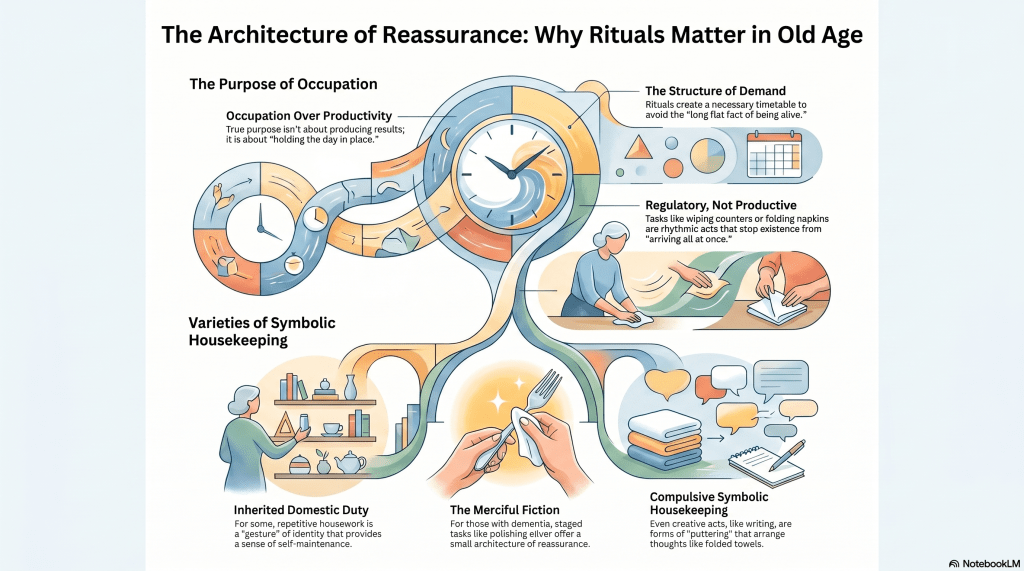
It’s been years since she held a paid job, but in retirement, she seems to have lost more than employment. She’s lost a structure of demand. She is bored out of her gourd or tree or whatever. Left alone with an unfilled day, she putters, tidies, wipes, folds, rearranges, and complains – rinse and repeat. Sisyphus would be proud. And the complaint isn’t incidental; it’s part of the ritual. The labour gives the grievance somewhere to reside.
There’s a peculiar mercy in not being too useful.
This creates an odd etiquette for everyone around her. One has to be careful not to interfere too much. Don’t clean everything; efficiently eliminate tasks; show up flushed with modern virtue and liberate her from the very thing that’s keeping the day from opening its jaws. Offer help, accept the refusal, move on without guilt. There’s a peculiar mercy in not being too useful.
Once the housework is done – or once it reaches the temporary truce by pause – the restlessness comes back. The ourobouros resumes its self-consumption. Then she needs to walk, drive, shop, bake, browse, fiddle, inspect, rearrange, and escape – more infinite loop, though only seemingly so. Anything to distract her from the long flat fact of being alive without a timetable. Employment used to do that. Marriage did that. Children did that. The household still does that. Now the old structures only remain as gestures, but gestures can still hold a person upright, as they had before, but with more salience.
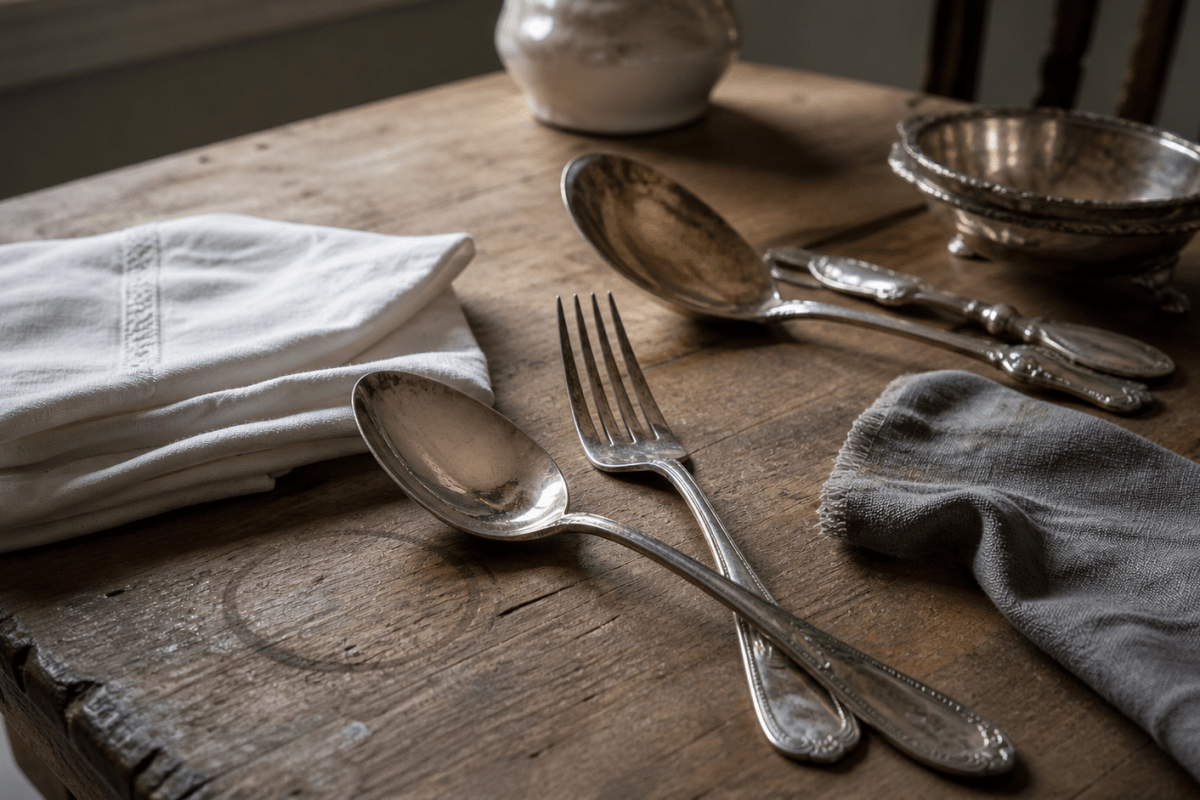
A different version of this appeared with my mother-in-law, who had dementia. To occupy her, we’d give her silver to polish, or napkins to fold. There wasn’t a real need for the silver to shine, and the napkins, once folded, could be unfolded and dropped back on the pile to repeat the process. Like Keynes’s worker digging holes to fill them in again, the point wasn’t production. The point was occupation. The task didn’t need to move the world forward, as if it did in any case. It only needed to hold the day in place.
That sounds cruel when you describe it abstractly, as if we were tricking her into labour, but you’d be confusing this with Capitalism. The real cruelty would have been leaving her unmoored – nothing for the hands to do whilst the mind searched for a room it could still recognise. Folding napkins wasn’t housework in any economic sense. It was a small architecture of reassurance. A way of letting purpose survive after purpose had lost its object. even if the sense of purpose had long left the building.
There’s a distinction here, though it isn’t clean. My mum’s rituals are self-maintaining. They belong to a life trained by domestic obligation, by marriage, by an older settlement between gender and labour, by all the small cruelties that once got to call themselves normal. My mother-in-law’s rituals were externally staged – not expressions of domestic identity so much as acts of care arranged by other people. Whilst all purpose is fictional, one woman kept her purpose through the fiction of inherited duty; the other was offered purpose as a merciful fiction. The border between the two is porous, naturally, because reality has never agreed to respect our categories.
I’m not recommending any of this to anyone. I’m just noticing it, which is what we writers call ‘thinking’ when we want to dodge responsibility.
Abstract freedom isn’t the same thing as a life you can actually inhabit.
I’m a feminist the way I’m a humanist: sincerely, but with reservations about the slogans. I don’t think this is how a woman should live. I don’t believe domestic labour is some mystical feminine vocation – as if dusting were an ontological destiny and the Hoover a sacrament. But I also can’t bring myself to take it away from her. Abstract freedom isn’t the same thing as a life you can actually inhabit. Sometimes emancipation arrives too late to provide new habits. Sometimes the cage has become furniture.
This doesn’t justify the cage. It only complicates the fantasy that removing it leaves behind a clean liberated self, glowing like a freshly unboxed appliance. People aren’t appliances, although civilisation has made several brave attempts.
The mistake is assuming purpose has to be justified by productivity. That’s the capitalist infection, of course: if nothing’s produced, nothing happened. But most of ordinary life isn’t productive in that sense. It’s regulatory. Consolatory. Rhythmic. A person folds the napkin, wipes the counter, polishes the spoon, walks round the block, checks the same cupboard twice, tells the same story, asks the same question, rearranges the same shelf, writes the same sentence again with one adjective changed and calls it progress – like an LLM but with less personality. These acts don’t redeem existence. They just stop it arriving all at once.
As for me, I don’t have a purpose either, so I write. Ostensibly, this is my own form of puttering. My desk is her kitchen counter. My paragraphs are folded towels. I arrange sentences, complain about them, rearrange them, and call the whole performance ‘vocation’ because compulsive symbolic housekeeping looks poor on a business card.
There’s a shabby tenderness in this, though one shouldn’t make too much of it. The old trick isn’t really meaning; it’s occupation, rhythm – having something to do with one’s hands whilst the mind declines to look directly at the wall. Some people clean. Some people shop. Some shoot fentanyl. Some become serial killers, CEOs, presidents, consultants, motivational speakers, or other recognised hazards. Some of us write essays about our mothers and pretend it counts as insight. We all find our own ways to bide the time until we die.
In the end, nobody gets out alive. The least we can do is not steal from each other the shabby little rituals that make the waiting bearable.

 Philosophics