The Grammar of Bettering Yourself

7–10 minutes

Self-help, pop psychology, LinkedIn, and the metaphysics smuggled into advice

Self-improvement books rarely begin by telling you what it believes a person is. That would be too honest, and honesty is bad for conversion funnels. Instead, it begins with verbs.

Choose. Decide. Commit. Heal. Optimise. Manifest. Reframe. Own. Level up. Set boundaries. Do the work. Become intentional. Stop self-sabotaging. Unlock your potential. Be your authentic self. Take radical responsibility.

The vocabulary shifts depending on the tradition. One speaks of healing, one of discipline, one of nervous systems, one of leadership, one of purpose, one of abundance. What they share is not a doctrine but a grammar: a way of arranging the person before the advice begins. The subject is always inward, sovereign, and temporarily malfunctioning. The problem is always locatable. The solution is always available, often for $29.99 or in a free webinar that becomes a masterclass for $299.

But here is where the easy cynicism runs out of road, because the people writing this stuff — by and large — believe it.

Audio: NotebookLM summary podcast of this topic.

That is the part of the critique that tends to get skipped, because it is less satisfying than imagining a cynical operator deliberately strip-mining the anxious for recurring revenue. Most self-help authors arrived at their framework the same way their readers are about to: they were struggling, they encountered a grammar that organised their experience, they felt the specific relief of suddenly being intelligible to themselves, and they mistook that relief for discovery. Then they wrote a book about it. The author is not the shark. The author is a previous customer who graduated to the front of the room.

The framework they found — and are now evangelising — is what I call, in The Architecture of Encounter, an ontological grammar: a set of prior commitments about what kind of thing a person is, which arrives upstream of any specific advice and quietly determines what advice is even thinkable. You cannot recommend reframing without first presuming a self transparent enough to observe its own cognitions and sovereign enough to revise them. You cannot prescribe boundaries without presuming a self whose territory is violable and whose autonomy is the relevant moral unit. You cannot offer alignment without presuming a self that has a true direction, temporarily obscured, patiently awaiting discovery through either a values exercise on page forty-seven or a retreat in somewhere with good lighting and worse plumbing.

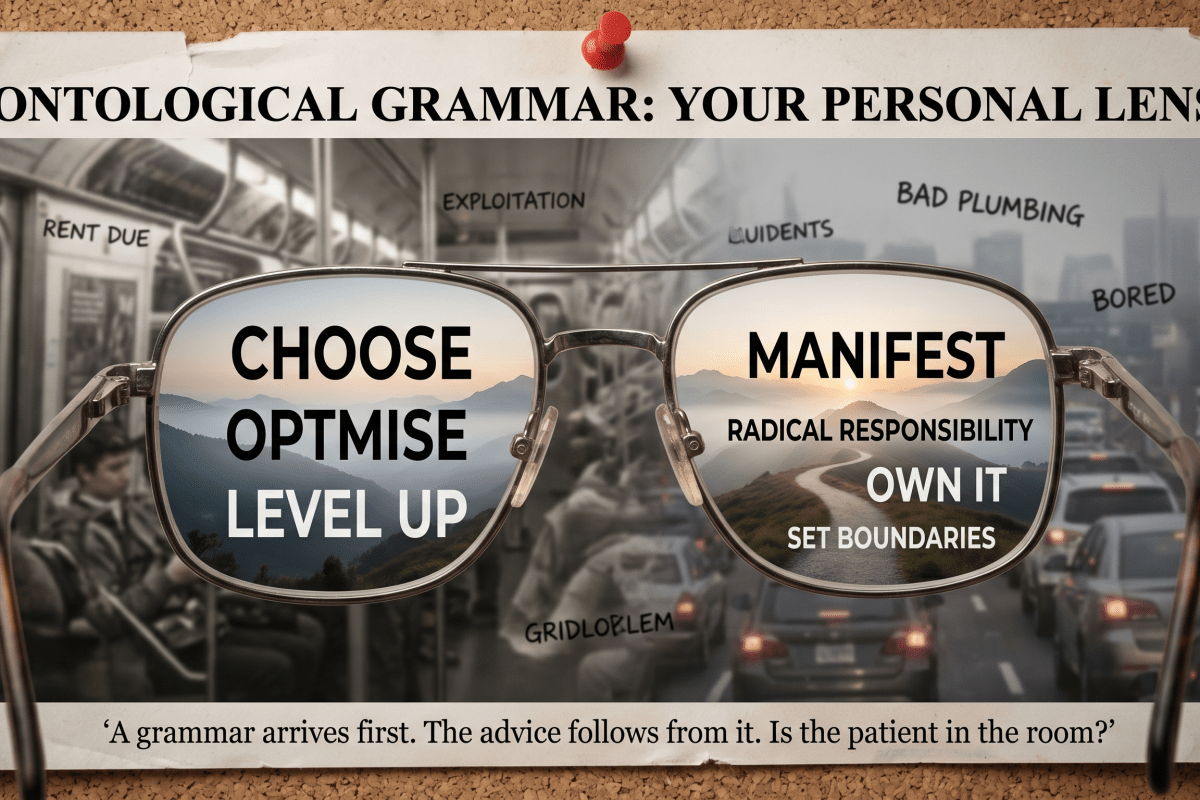
The grammar arrives first. The advice follows from it. And the person reading it is not being shown a mirror. They are being issued a lens.

The lens finds its wearer. “Take ownership” resonates with people already invested in the idea of themselves as agents who have been insufficiently deliberate — it confirms the worldview while appearing to challenge the behaviour. “Your nervous system is dysregulated” resonates with people for whom the moralised language of laziness and discipline has become intolerable; here is a vocabulary that removes the accusation while retaining the explanation, which is a genuinely useful service even if the mechanism on offer is borrowed loosely from neuroscience and the rest is borrowed from hope. “Mindset is your prison” resonates with people who need their suffering to remain individually tractable — solvable, that is, without anyone having to redistribute anything expensive or inconvenient. “Manifest your abundance” resonates with people who find both structural analysis and self-blame equally unappealing and would like a third option involving the universe.

Each grammar finds its congregation. Which is precisely the problem.

A grammar propagates not because it has been tested against alternatives or evaluated for efficacy, but because it maps onto a prior self-conception cleanly enough to produce the sensation of being understood. The entrepreneur already believes in agency-language: execution, discipline, ownership, leverage. The book that tells them their discipline is the differentiator is not offering new information; it is offering comfortable confirmation in a more expensive format. The therapeutic reader already suspects their relational difficulties involve something called attachment. The book that tells them so is not illuminating; it is flattering them with their own vocabulary. The LinkedIn professional already believes their career is a project of self-authorship. The thought leader who tells them to communicate their value and build authentic leadership is not giving them a strategy; they are giving them a liturgy.

The community that forms around a grammar is a church, not a seminar. It has converts, not students. And like most churches, it is considerably better at solidarity than at falsifiability.

This matters because the mechanism by which self-help content spreads — resonance, recognition, testimonial, referral — is entirely decoupled from the mechanism by which we would establish that it works. A sentence resonates because it fits a grammar the reader has already adopted. That tells you something real: about the anxieties structuring a cohort’s self-understanding, the stories they are trying to make liveable, the descriptions of themselves they find tolerable or intolerable. It does not tell you whether the intervention produces the claimed effect, in whom, under what conditions, and compared with what alternative. Those are duller questions. Less shareable. They do not fit on a carousel post with a soft gradient and a mountain.

Horoscopes also resonate. So do conspiracy theories, national myths, and the first chapter of any book you buy during a difficult stretch of your life.

The point is not that the advice is necessarily wrong. Sometimes “set boundaries” is exactly right. Sometimes “take ownership” is precisely what someone has been avoiding hearing. Sometimes a new frame genuinely reorganises attention in ways that produce durable change, and the person is measurably better off for having found it. None of that is in question. The question is whether a framework that produced one useful instance has any reliable claim to truth beyond that instance — and whether the person reaching for it during a difficult period is in any position to make that evaluation carefully.

They usually are not. That is not stupidity. That is the condition of being in difficulty: you reach for intelligibility, and whoever offers it collects a great deal of credit. The problem is not the reaching. The problem is that the self-help ecosystem — including the parts of it operated by entirely sincere people who believe every word they publish — has no reliable mechanism for distinguishing frameworks that help from frameworks that merely feel like help while the underlying situation continues undisturbed. The true believer and the true seeker share the same vulnerability. Both reached for a grammar. One of them got to write the book.
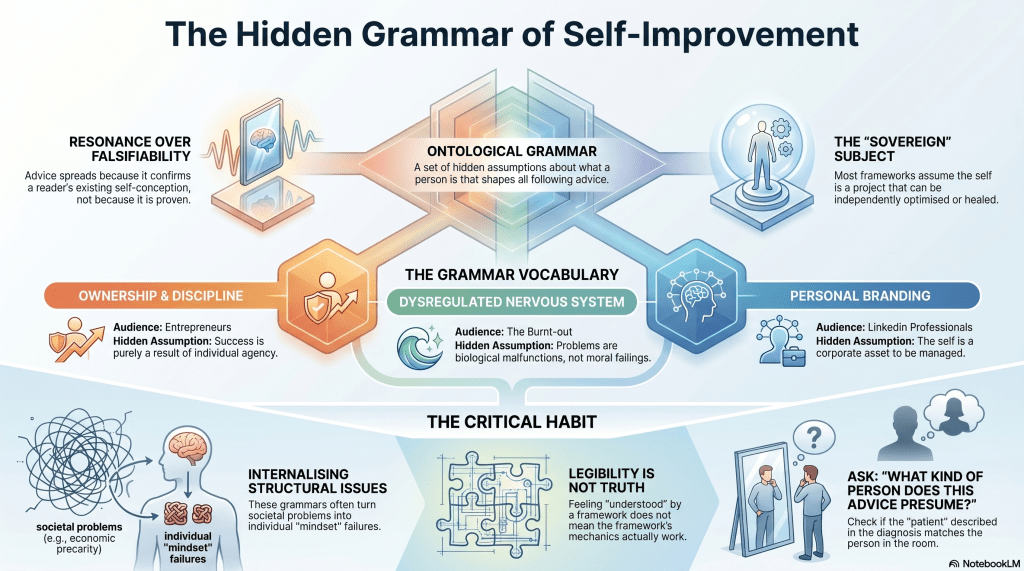
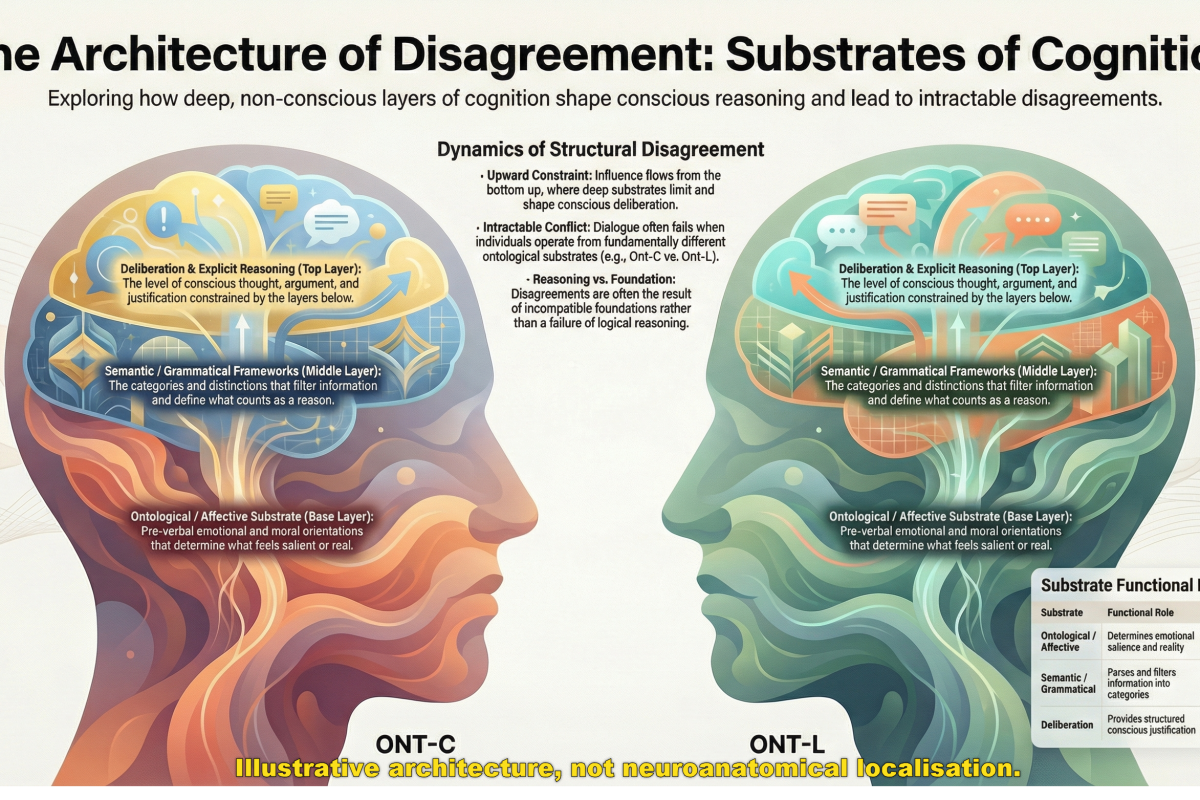
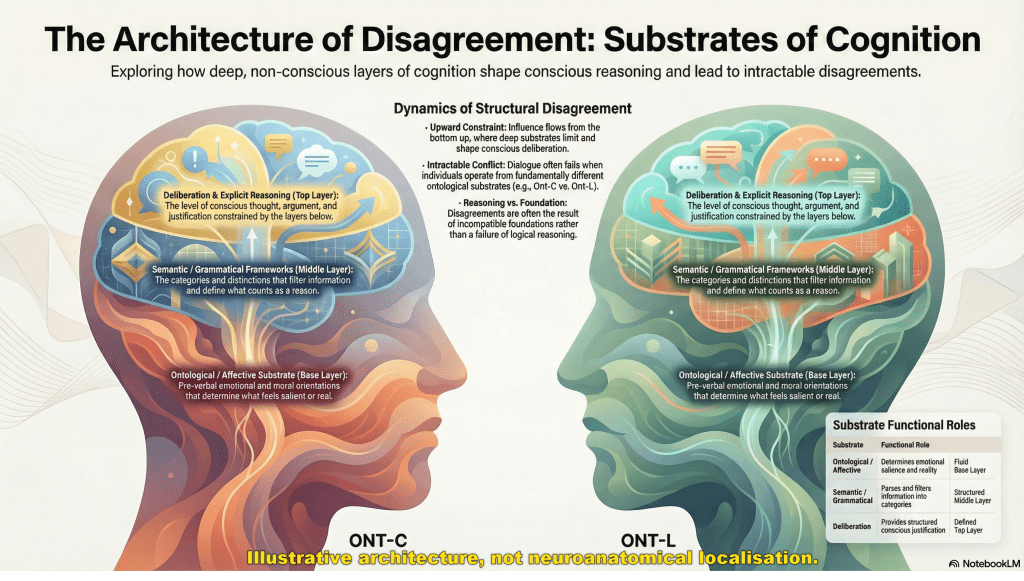
NotebookLM Infographic on this topic.

It is also worth noting that commerce is the easy villain here, and an overrated one. The same dynamic runs through pop psychology, where the grammar of individual cognitive mechanisms tends to dominate because it produces legible interventions in a way that structural analysis never quite does; blaming cognition is tractable, blaming the organisation of society is dispiriting and hard to monetise, even when it is accurate. It runs through LinkedIn, where the grammar is not therapeutic but managerial — the self reimagined as an optimisable professional asset — and where burnout becomes a boundary failure, precarity becomes an invitation to upskill, and alienation becomes a purpose deficit. Nobody on LinkedIn is necessarily trying to extract money from anyone. Many of them are trying to be useful, or to be visible, or both, which is human enough. But the grammar they are deploying disappears material conditions into interior architecture with the same efficiency as the most cynically produced wellness content. The mechanism does not require a profit motive. It requires only a grammar and an audience that already shares it.

The useful response to all of this is not wholesale dismissal, which would be too easy and almost certainly wrong. Some people need clearer habits. Some need better descriptions of their own conduct. Some need permission to stop tolerating what they have been tolerating. Some need a vocabulary that makes their own patterns visible, and a framework — however approximate — is better than none. These are real services. The fact that they are sometimes delivered inside a dubious metaphysics of the person does not automatically negate them.

But there is a question worth developing the habit of asking, before the grammar installs itself: what kind of person does this advice presume? Is the self it describes sovereign, where I am actually constrained? Wounded where I am actually responsible? Deficient where I am actually being exploited? Misaligned where I am actually just bored? In need of self-belief, where I am in need of rent?

These questions are less fun than a morning routine designed by someone who has never had a difficult commute. They do not come with a community or a badge or an accountability partner who sends encouraging voice notes. But they do something the grammar on its own cannot: they ask whether the patient described in the diagnosis is the one actually in the room.

Most self-help skips that step. So, not infrequently, does the person who wrote it. They found a grammar that made their experience legible, felt the relief that comes from that, and never quite got around to distinguishing legibility from truth. Which is understandable. It is also, for everyone downstream of that decision, a problem.

I don’t occupy this shared space of ontological grammar, so I call bollox.


Legibility and Ontology

3–5 minutes

These two words qualify as my words of the month: legibility and ontology.

I’ve been using them as lenses.

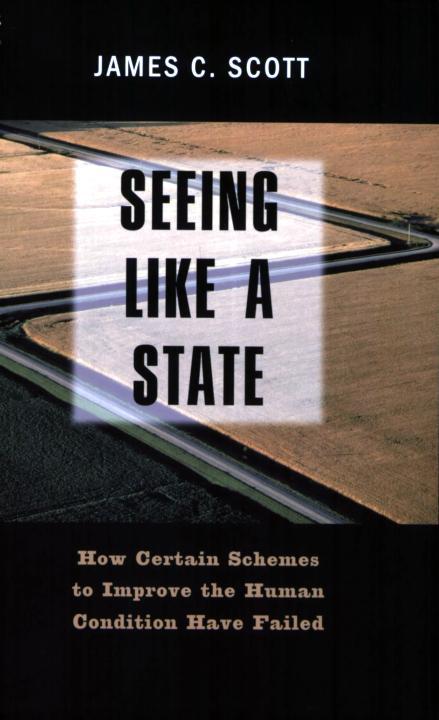
I picked up legibility from James C. Scott’s Seeing Like a State: How Certain Schemes to Improve the Human Condition Have Failed, which is really a book about how well-intentioned schemes fail once reality is forced to become administrable. Ontology is an older philosophical workhorse, usually paired with epistemology, but I’m using it here in a looser, more pragmatic sense.

When I write, I write through lenses. Everyone does. Writing requires a point of view, even when we pretend otherwise.

In this post, I want to talk more informally about my recent essay, Grammatical Failure. I usually summarise my work elsewhere, but here I want to think out loud about it, particularly in relation to social ontology and epistemology. I won’t linger on definitions. They’re a search away. But a little framing helps.

Ontology, roughly: how reality is parsed.

Epistemology: how knowledge is justified within that parsing.

Audio: NotebookLM summary of this post.

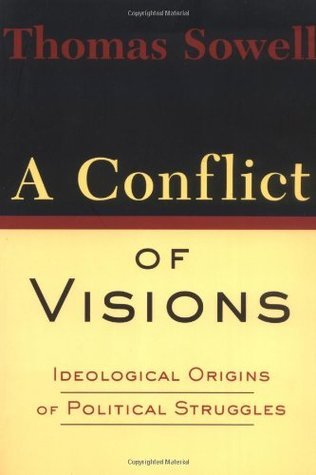
Much of my recent work sits downstream of thinkers like Thomas Sowell, George Lakoff, Jonathan Haidt, Kurt Gray, and Joshua Greene. Despite their differences, they converge on a shared insight: human cognition is largely motivated preverbally. As a philosopher of language, that pre-language layer is where my interest sharpens.

I explored this in earlier work, including a diptych titled The Grammar of ImpasseConceptual Exhaustion and Causal Mislocation. Writing is how I gel these ideas. There are several related pieces still in the pipeline.

When I talk about grammar, I don’t mean Saussure or Chomsky. I mean something deeper: the ontological substrate beneath belief. Grammar, in this sense, is how reality gets parsed before beliefs ever form. It filters what can count as real, salient, or intelligible.

Let’s use a deliberately simplified example.

Imagine two ontological orientations. Call them Ont-C and Ont-L. This isn’t to say there are only two, but much of Western political discourse collapses into a binary anyway.

Ont-C tends to experience people as inherently bad, dangerous, or morally suspect. Ont-L tends to experience people as inherently good or at least corrigible. These aren’t opinions in the usual sense. They sit beneath belief, closer to affect and moral orientation.

Now consider retributive justice, setting aside the fact that justice itself is a thick concept.

From Ont-C, punishment teaches a lesson. It deters. It disciplines. From Ont-L, punishment without rehabilitation looks cruel or counterproductive, and the transgression itself may be read as downstream of systemic injustice.

Each position can acknowledge exceptions. Ont-L knows there are genuinely broken people. Ont-C knows there are saints. But those are edge cases, not defaults.

Now ask Ont-C and Ont-L to design a criminal justice system together. The result will feel intolerable to both. Too lenient. Too harsh. The disagreement isn’t over policy details. It’s over how reality is carved up in the first place.

And this is only one dimension.

Add others. Bring in Ont-V and Ont-M if you like, for vegan and meat-based ontologies. Suddenly, you have Ont-CV, Ont-CM, Ont-LV, and Ont-LM. Then add class, religion, gender, authority, harm, and whatever. Intersectionality stops looking like a solution and starts looking like a combinatorial explosion.

The Ont-Vs can share a meal, so long as they don’t talk politics.

The structure isn’t just unstable. It was never stable to begin with. We imagine foundations because legibility demands them.

Grammatical Failure is an attempt to explain why this instability isn’t a bug in liberal epistemology but a structural feature. The grammar does the sorting long before deliberation begins.

More on that soon.


In any case, once you start applying this ontological lens to other supposedly intractable disputes, you quickly realise that their intractability is not accidental.

Take abortion.

If we view the issue through the lenses of Ont-A (anti-abortion) and Ont-C (maternal choice), we might as well be peering through Ont-Oil and Ont-Water. The disagreement does not occur at the level of policy preferences or competing values. It occurs at the level of what counts as morally salient in the first place.

There is no middle ground here. No middle path. No synthesis waiting to be negotiated into existence.

That is not because the participants lack goodwill, intelligence, or empathy. It is because the ontological primitives are incommensurate. Each side experiences the other not as mistaken but as unintelligible.

We can will compromise all we like. The grammar does not comply.

Contemporary discourse often insists otherwise. It tells us that better arguments, clearer framing, or more dialogue will eventually converge. From this perspective, that insistence is not hopeful. It is confused. It mistakes a grammatical fracture for a deliberative failure.

You might try to consider other polemic topics and notice the same interplay.

Rational Ghosts: Why Enlightenment Democracy Was Built to Fail

3–4 minutes

We are governed by phantoms. Not the fun kind that rattle chains in castles, but Enlightenment rational ghosts – imaginary citizens who were supposed to be dispassionate, consistent, and perfectly informed. They never lived, but they still haunt our constitutions and television pundits. Every time some talking head declares “the people have spoken”, what they really mean is that the ghosts are back on stage.

👉 Full essay: Rational Ghosts: Why Enlightenment Democracy Was Built to Fail

The conceit was simple: build politics as if it were an engineering problem. Set the rules right, and stability follows. The trouble is that the material – actual people – wasn’t blueprint-friendly. Madison admitted faction was “sown in the nature of man”, Rousseau agonised over the “general will”, and Condorcet managed to trip over his own math. They saw the cracks even while laying the foundation. Then they shrugged and built anyway.

Audio: NotebookLM podcast on this topic.

The rational ghosts were tidy. Real humans are not. Our brains run on shortcuts: motivated reasoning, availability cascades, confirmation bias, Dunning–Kruger. We don’t deliberate; we improvise excuses. Education doesn’t fix it – it just arms us with better rationalisations. Media doesn’t fix it either – it corrals our biases into profitable outrage. The Enlightenment drafted for angels; what it got was apes with smartphones.

Even if the ghosts had shown up, the math betrayed them. Arrow proved that no voting system can translate preferences without distortion. McKelvey showed that whoever controls the sequence of votes controls the outcome. The “will of the people” is less an oracle than a Ouija board, and you can always see whose hand is pushing the planchette.

Scale finishes the job. Dunbar gave us 150 people as the human limit of meaningful community. Beyond that, trust decays into myth. Benedict Anderson called nations “imagined communities”, but social media has shattered the illusion. The national conversation is now a million algorithmic Dunbars, each convinced they alone are the real people.

Audio: This is a longer (40-minute) NotebookLM podcast on the essay itself.

Why did democracy limp along for two centuries if it was this haunted? Because it was on life-support. Growth, war, and civic myth covered the cracks. External enemies, national rituals, and propaganda made dysfunction look like consensus. It wasn’t design; it was borrowed capital. That capital has run out.

Cue the panic. The defences roll in: Churchill said democracy was the “least bad” system (he didn’t, but whatever). Voters self-correct. Education will fix it. It’s only an American problem. And if you don’t like it, what – authoritarianism? These are less arguments than incantations, muttered to keep the ghosts from noticing the creaks in the floorboards.

The real task isn’t to chant louder. It’s to stop pretending ghosts exist. Try subsidiarity: smaller-scale politics humans can actually grasp. Try deliberation: citizens’ assemblies show ordinary people can think, when not reduced to a soundbite. Try sortition: if elections are distorted by design, maybe roll the dice instead. Try polycentric governance: let overlapping authorities handle mismatch instead of hammering “one will”. None of these are perfect. They’re just less haunted.

Enlightenment democracy was built to fail because it was built for rational ghosts. The ghosts never lived. The floorboards are creaking. The task is ours: build institutions for the living, before the house collapses under its own myths.

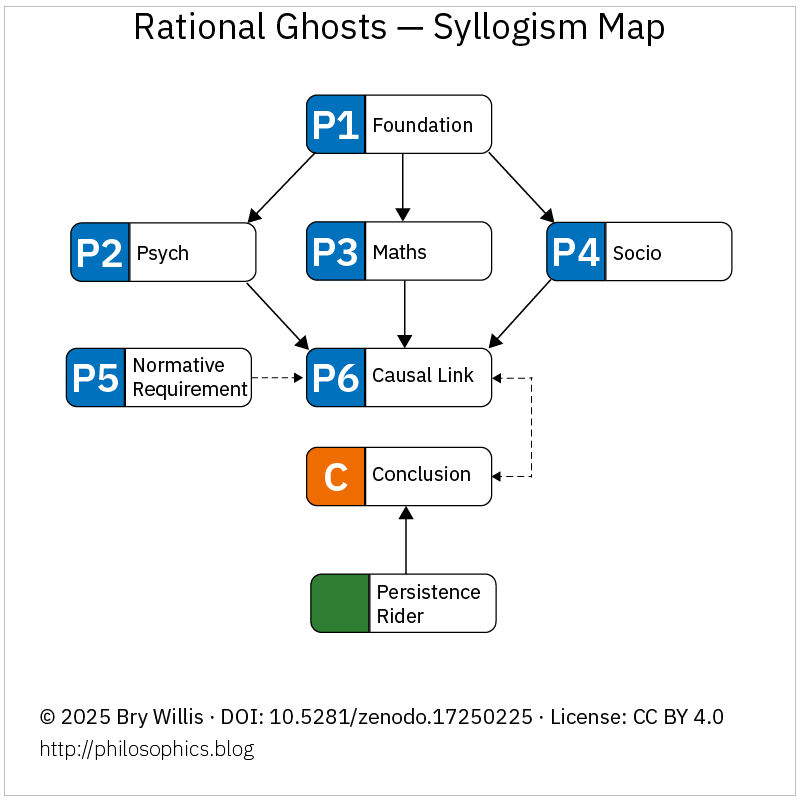
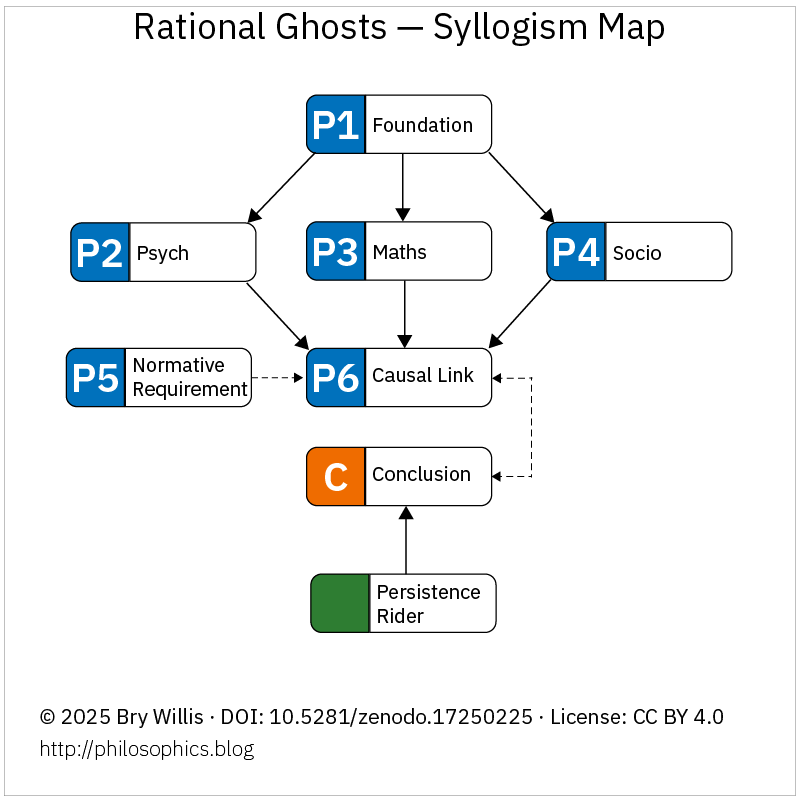
The Argument in Skeleton Form

Beneath the prose, the critique of Enlightenment democracy can be expressed as a syllogism:
a foundation that assumed rational citizens collides with psychological bias, mathematical impossibility, and sociological limits.
The outcome is a double failure – corrupted inputs and incoherent outputs – masked only by temporary props.

Figure: Logical skeleton of “Rational Ghosts: Why Enlightenment Democracy Was Built to Fail.” For the complete essay, with sources and elaboration, see the open-access preprint on Zenodo: https://doi.org/10.5281/zenodo.17250225

Bayes in the Culture War: How Priors Become Prison Walls

3–5 minutes

Are you rational, or merely rehearsing your tribe’s catechism? Bayes’ theorem insists we should all update our beliefs the same way when presented with the same evidence. Yet in today’s political divide, identical events harden opposing convictions. The problem isn’t the math—it’s the priors. When your starting assumptions are inherited, acculturated, or indoctrinated, no amount of “evidence” will move you into enemy territory.

A Bayesian Sketch of the Divide

  • Let H be a contested claim (pick your poison: “the election was fair,” “immigration helps,” whatever).
  • People in Camp R and Camp B begin with different priors P_R(H) and P_B(H). That’s acculturation if you’re being polite, indoctrination if you’ve run out of patience.
  • They observe evidence E (news, a court ruling, a video clip, a statistic).
  • They update:

posterior odds = prior odds × P(H \mid E) = \frac{P(E \mid H) P(H)}{P(E)}

Except they don’t, not cleanly, because trust in sources warps the likelihoods.

Video: Jonny Thompson on Bayes’ Theorem.
I love Jonny’s content, which is why I reference it so often. He and I have such different philosophical worldviews. Vive la différence (or différance).

Why this locks in polarisation

1. Wildly different priors.
If Camp R starts at P_R(H)=0.8 and Camp B at P_B(H)=0.2, then even moderately pro-H evidence (say likelihood ratio LR = 3) yields:

  • R: prior odds 4:1 \rightarrow 12:1 \Rightarrow P(H \mid E)\approx 0.92
  • B: prior odds 1:4 \rightarrow 3:4 \Rightarrow P(H \mid E)\approx 0.43

Same evidence, one camp “settled,” the other still unconvinced. Repeat ad infinitum, preferably on primetime.

2. Identity-weighted likelihoods.
People don’t evaluate P(E \mid H); they evaluate P(E \mid H, \text{source I like}). Disconfirming evidence is down-weighted by a factor d<1. This is called “being rational” on your own planet and “motivated reasoning” on everyone else’s.

3. Different hypothesis sets.
Camps don’t just disagree on P(H); they entertain different Hs. If one side’s model includes “coordinated elite malfeasance” and the other’s does not, then identical data streams update into different universes.

4. Selective exposure = selection bias.
Evidence isn’t i.i.d.; it’s curated by feeds, friends, and fury. You are sampling from your own posterior predictive distribution and calling it “reality.”

5. Asymmetric loss functions.
Even if beliefs converged, choices won’t. If the social cost of dissent is high, the decision threshold moves. People report a “belief” that minimises ostracism rather than error.

6. No common knowledge, no convergence.
Aumann told us honest Bayesians with common priors and shared posteriors must agree. Remove either—common priors or the “we both know we both saw the same thing” bit—and you get the modern news cycle.

“Acculturation” vs “Indoctrination”

Same mechanism, different moral valence. Priors are installed by families, schools, churches, unions, algorithms. Call it culture if you approve of the installers; call it indoctrination if you don’t. The probability calculus doesn’t care. Your tribal totems do.

Two quick toy moves you can use in prose

  • Likelihood hacking:
    “When evidence arrives, the tribe doesn’t deny the datum; it edits the likelihoods. ‘If my side did it, it’s an outlier; if your side did it, it’s a pattern.’ This is not hypocrisy; it’s a parameter update where the parameter is loyalty.”
  • Posterior divergence despite ‘facts’:
    “Give two citizens the same court ruling. One updates towards legitimacy because courts are reliable; the other away from legitimacy because courts are captured. The ruling is constant; the trust vector is not.”

If one wanted to reduce the split (perish the thought)

  • Forecast, don’t opine. Run cross-camp prediction markets or calibration tournaments. Bayes behaves when you pay people for accuracy rather than performance art.
  • Adversarial collaboration. Force both sides to pre-register what evidence would move them and how much. If someone’s d for disconfirming evidence is effectively zero, you’ve identified faith, not inference.
  • Reference classes, not anecdotes. Pull arguments out of the single-case trap and into base-rate land. Yes, it’s boring. So is surgery, but people still do it.

The punchline

Polarisation isn’t the failure of reason; it’s what happens when reason is strapped to identity. Priors are social. Likelihoods are political. Posteriors are performative. You can call it acculturation if you want to feel civilised, indoctrination if you want to throw a brick, but either way you’re watching Bayes’ theorem run inside a culture war. The maths is sober; the humans are not.