The Author Did Not Write This

4–6 minutes

The LinkedIn consensus has spoken: if you used AI in the writing process, you are not the author. The position is stated with the confidence of someone who has never hired a ghostwriter, employed a research assistant, submitted to a heavy editor, or considered that the Gettysburg Address was almost certainly not written by Lincoln.
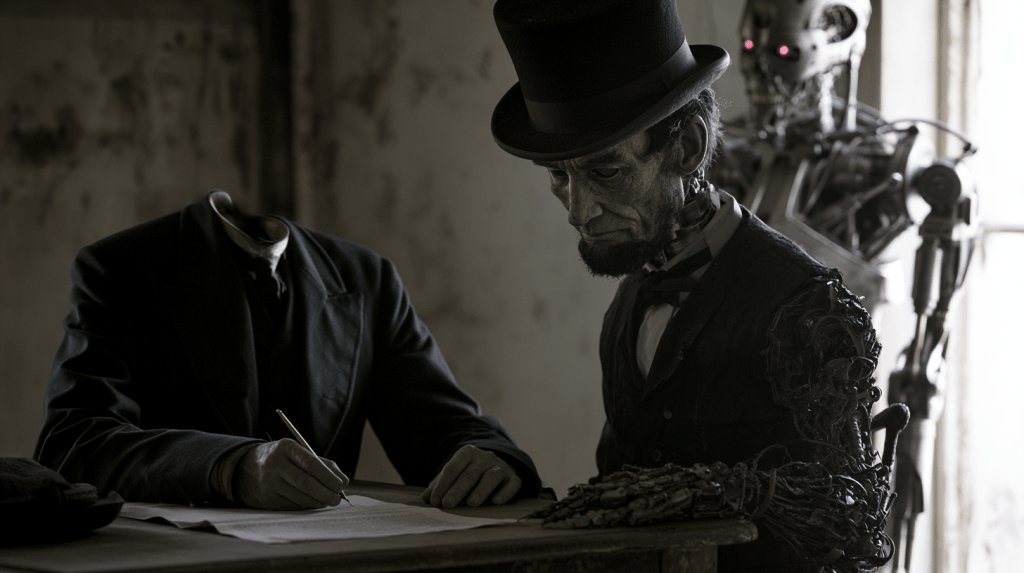
Image: I couldn’t not share this Midjourney 8.1 image. It may not have understood the assignment.
Audio: NotebookLM summary podcast of this topic.

Authorship has never been a production relation. It has always been an attribution relation — an institutionally stabilised answer to the question of which name the practice elects to put on the cover. These are not the same thing, and conflating them is the error from which every subsequent confusion proceeds.

The ghostwriter has existed as long as commercial publishing. The political speechwriter is so normalised that nobody considers it worth remarking. The celebrity memoir, the corporate thought-leadership piece, the attributed editorial — these are not edge cases or embarrassing exceptions. They are the normal operation of every writing-adjacent industry that has ever existed. The name on the cover has never reliably indicated the hands on the keyboard, and the industry has never seriously pretended otherwise. It has simply preferred not to discuss it at dinner.

AI changes the tool. It does not change the structure. The person who prompts, selects, curates, revises, and publishes is doing what commissioners of ghostwriters have always done. What has changed is that AI makes the mediation visible in a way that polite convention previously concealed. Visibility triggers the purity reflex. What presents itself as a defence of authentic authorship is a defence of a particular fiction — the Romantic author as solitary originating consciousness — that the industry never consistently believed and certainly never consistently practised.

The purity position also fails on its own terms before it gets started. Consider the spectrum of AI-assisted writing: a full draft submitted for light polish; a human argument substantially revised by AI; collaborative ideation followed by AI drafting; a kernel of an idea handed over for full execution. These are genuinely different in terms of human contribution. The zealot position requires a threshold somewhere on this spectrum below which authorship lapses. It never specifies where. More fatally, it has no means of verification. There is no external method of determining where on the spectrum any given piece of writing falls. The detector tools are probabilistic noise that disproportionately penalise competent prose. Any audit mechanism sophisticated enough to catch first-order evasion immediately generates a second-order workaround. The regress terminates only at continuous surveillance of the writing process — panoptical authorship as the logical endpoint of the position taken seriously.
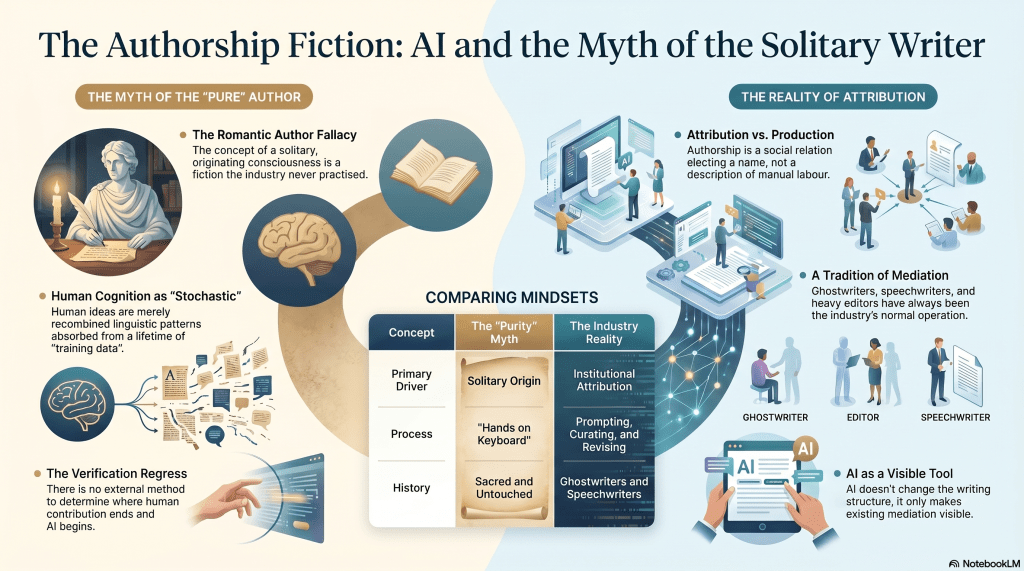
NotebookLM Infographic on this topic.

Then there is the recursion problem, which the zealot never addresses because it is fatal. The stochastic parrot charge against AI — that it merely recombines absorbed linguistic patterns without genuine origination — describes with considerable accuracy what human cognition also does. The writer’s training data is the Dickens read at ten, the billboard absorbed on a commute, the argument overheard on public transit, the half-remembered essay that shaped a position without ever being consciously cited. The causal chain of any human idea disappears into an unauditable cognitive history. Genuine origination in the sense the purity position requires has never existed. The Romantic author was always a retrospective confabulation. Barthes said so in 1967. The industry nodded politely and continued invoicing.

What the zealot is defending is not authorship. It is a particular grammar of authorship — one that selects compositional origin as the threshold criterion, applies it selectively and unverifiably, and uses the resulting suspicion as a status boundary. It is guild behaviour dressed as principle, which is understandable as a response to a genuine economic threat but should not be mistaken for a philosophical position.

Authorship is the position a culture elects to stabilise after the work has already been produced through far messier means. It has always been thus. AI did not break the fiction. It just made the fiction harder to keep a straight face about.


The Rest of the Story

I’ve written about this before. I am not an AI apologist, but I am peeved by anti-LLM zealots, who clearly haven’t thought through their arguments.

I finished reading A.J. Ayer’s Language, Truth, and Logic, the part about Bertrand Russell’s claim about ‘The author of Waverley was Scotch‘. My brain latched onto authorship, and my emotional response was WTF? I have other problems with Russell and Ayer on this, but that’s a matter for another day.

To make my point, this page up to the ellipsis is the output of Claude after an extended dialogue with it and ChatGPT after I read Ayers, and something didn’t sit quite right. I am not ashamed to use LLMs in my authoring workflow and am not ashamed to mention it, as here. Almost all of these thoughts are mine. I’ve simply asked Claude to organise the output. It’s good enough to output as-is, and any edits would be trivial, so I won’t bother. I probably could have made the edits in as much time as it took to type this, but I’ve got nothing to hide. I’m just a human with access to technology circa 2026.
Apparently, I’ve got more to say on this matter…

3–5 minutes

It seems my latest rant about AI-authorship accusations stirred something in me, that I need to apologise for being a professional writer – or is that a writing professional? Blame the Enlightenment, blame writing and communication courses, whatevs. I certainly do. But since some people are still waving the pitchforks, insisting that anything too coherent must be artificially tainted, I should address the obvious point everyone keeps missing:

The writing structures people attribute to AI aren’t AI inventions. They’re human inventions. Old ones. Codified ones. And we made the machines copy them. Sure, they have a certain cadence. It’s the cadence you’d have if you also followed the patterns you should have been taught in school or opened a book or two on the topic. I may have read one or two over the years.

Wait for it… The orthodoxy is ours. I hate to be the one to break it to you.

Video: AI Robot Assistant (no audio)

Professional Writing Has Its Own House Rules (And They’re Older Than AI Neural Nets)

Audio: NotebookLM podcast on this topic and the last one.

Long before AI arrived to ruin civilisation and steal everyone’s quiz-night jobs, we’d already built an entire culture around ‘proper writing’. The sort of writing that would make a communications lecturer beam with pride. The Sith may come in twos; good writing comes in threes.

  1. Tell them what you’re going to say.
  2. Say it.
  3. Repeat what you told them.

But wait, there’s more:

  • Use linear flow, not intellectual jazz.
  • One idea per paragraph, please.
  • Support it with sources.
  • Conclude like a responsible adult.

These aren’t merely classroom antics. They’re the architectural grammar of academic, corporate, scientific, and policy writing. No poetic flourishes. No existential detours. No whimsical cadence. The aim is clarity, predictability, and minimal risk of misinterpretation. It’s the textual equivalent of wearing sensible shoes to a board meeting. So when someone reads a structured piece of prose and yelps, ‘It sounds like AI!’, what they’re really saying is:

Je m’accuse. AI Didn’t Invent Structure. We Forced It To Learn Ours. Full stop. The problem is that it did whilst most of us didn’t.

If AI tends toward this style – linear, tidy, methodical, lamentably sane – that’s because we fed it millions of examples of ‘proper writing’. It behaves professionally because we trained it on professional behaviour – surprisingly tautological. Quelle surprise, eh?

Just as you don’t blame a mimeograph for producing a perfectly dull office memo, you don’t blame AI for sounding like every competent academic who’s been beaten with the stick of ‘clarity and cohesion’. It’s imitation through ingestion. It’s mimicry through mass exposure.

And Now for the Twist: My Fiction Has None of These Constraints

My fiction roams freely. It spirals, loops, dissolves, contradicts, broods, and wanders through margins where structured writing fears to tread. It chases affect, not clarity. Rhythm, not rubrics. Experience, not exegesis.

No one wants to read an essay that sounds like Dr Seuss, but equally, no one wants a novel that reads like the bylaws of a pension committee.

Different aims, different freedoms: Academic and professional writing must behave itself. Fiction absolutely should not.

This isn’t a value judgement. One isn’t ‘truer’ or ‘better’ than the other – only different tools for different jobs. One informs; the other evokes. One communicates; the other murmurs and unsettles.

Not to come off like Dr Phil (or Dr Suess), but the accusation itself reveals the real anxiety. When someone accuses a writer of sounding ‘AI-like,’ what they usually mean is:

‘Your writing follows the conventions we taught you to follow – but now those conventions feel suspect because a machine can mimic them’.

And that’s not a critique of the writing. It’s a critique of the culture around writing – a panic that the mechanical parts of our craft are now automated and thus somehow ‘impure’.

But structure is not impurity. Professional clarity is not soullessness. Repetition, sequencing, scaffolding – these aren’t telltale signs of AI; they’re the residue of centuries of human pedagogy.

AI mirrors the system. It didn’t create the system. And if the system’s beginning to look uncanny in the mirror, that’s a problem of the system, not the reflection.

In Short: The Craft Is Still the Craft, Whether Human or Machine

Professional writing has rules because it needs them. Fiction abandons them because it can. AI imitates whichever domain you place in front of it.

The accusation that structured writing ‘sounds artificial’ is merely a confusion between form and origin. The form is ours. The origin is irrelevant.

If clarity is now considered suspicious, I fear for the state of discourse. But then again, I’ve feared for that for some time.

And apparently, I’ve still got more to say on the matter.

Accusations of Writing Whilst Artificial

2–3 minutes

Accusations of writing being AI are becoming more common – an irony so rich it could fund Silicon Valley for another decade. We’ve built machines to detect machines imitating us, and then we congratulate ourselves when they accuse us of being them. It’s biblical in its stupidity.

A year ago, I read an earnest little piece on ‘how to spot AI writing’. The tells? Proper grammar. Logical flow. Parallel structure. Essentially, competence. Imagine that – clarity and coherence as evidence of inhumanity. We’ve spent centuries telling students to write clearly, and now, having finally produced something that does, we call it suspicious.

Audio: NotebookLM podcast on this topic and the next one.

My own prose was recently tried and convicted by Reddit’s self-appointed literati. The charge? Too well-written, apparently. Reddit – where typos go to breed. I pop back there occasionally, against my better judgment, to find the same tribunal of keyboard Calvinists patrolling the comment fields, shouting ‘AI!’ at anything that doesn’t sound like it was composed mid-seizure. The irony, of course, is that most of them wouldn’t recognise good writing unless it came with upvotes attached.

Image: A newspaper entry that may have been generated by an AI with the surname Kahn. 🧐🤣

Now, I’ll admit: my sentences do have a certain mechanical precision. Too many em dashes, too much syntactic symmetry. But that’s not ‘AI’. That’s simply craft. Machines learned from us. They imitate our best habits because we can’t be bothered to keep them ourselves. And yet, here we are, chasing ghosts of our own creation, declaring our children inhuman.

Apparently, there are more diagnostic signs. Incorporating an Alt-26 arrow to represent progress is a telltale infraction → like this. No human, they say, would choose to illustrate A → B that way. Instead, one is faulted for remembering – or at least understanding – that Alt-key combinations exist to reveal a fuller array of options: …, ™, and so on. I’ve used these symbols long before AI Wave 4 hit shore.

Interestingly, I prefer spaced en dashes over em dashes in most cases. The em dash is an Americanism I don’t prefer to adopt, but it does reveal the American bias in the training data. I can consciously adopt a European spin; AI, lacking intent, finds this harder to remember.

I used to use em dashes freely, but now I almost avoid them—if only to sidestep the mass hysteria. Perhaps I’ll start using AI to randomly misspell words and wreck my own grammar. Or maybe I’ll ask it to output everything in AAVE, or some unholy creole of Contemporary English and Chaucer, and call it a stylistic choice. (For the record, the em dashes in this paragraph were injected by the wee-AI gods and left as a badge of shame.)

Meanwhile, I spend half my time wrestling with smaller, dumber AIs – the grammar-checkers and predictive text gremlins who think they know tone but have never felt one. They twitch at ellipses, squirm at irony, and whimper at rhetorical emphasis. They are the hall monitors of prose, the petty bureaucrats of language.

And the final absurdity? These same half-witted algorithms are the ones deputised to decide whether my writing is too good to be human.