Manuscript Review with LLMs

4–5 minutes

Main event

I’m an active AI user. It’s no secret. My top uses are research and enquiry, but it is instrumental in my review and revision process.

Audio: NotebookLM summary podcast of this topic.

I am trying to wrap up my latest manuscript. I’m about 5 revisions through, so I felt I was finally in a position to check for cracks and missing elements, as well as the strength of my overall position and approach. It’s not a good idea to simply prompt, ‘What do you think about this?’

I’d tried prompts as simple as, ‘Act as a referee and be adversarial against this piece’ or ‘I got this from somewhere, and I want a critique’. These approaches shield you from AI’s programmed sycophantic tendencies. But they aren’t enough. You still need to create guidelines and guardrails, which include orientating the AI; otherwise, they will likely go off the reservation.

This is the actual prompt I last employed to various LLMs:

The attached is a complete development draft of Architecture of Willing, a philosophical monograph arguing that the vocabulary of will, intent, motive, choice, decision, and related terms operates through a two-stage grammatical mechanism – compression of action-patterns into portable nouns, followed by inversion of those nouns into apparent upstream authors of the very patterns from which they were abstracted. The book calls this mechanism authoring displacement and uses it to argue that retributive desert cannot be stably grounded in the vocabulary on which it depends.

The book is deliberately diagnostic rather than prescriptive. It does not propose a replacement psychology, a reformed legal code, or a new theory of agency. It refuses to settle the traditional free-will debate on either side. These refusals are intentional and are argued for within the text.

What I am asking for is a critical engagement from a position of maximum philosophical resistance. Specifically:

The book rests on a claim about what retributive practice requires – namely, a stable inward authoring source capable of making suffering genuinely owed rather than merely institutionally imposed. If that characterisation of retributivism’s requirements is wrong, or if it applies only to unsophisticated versions while leaving the strongest contemporary defences untouched, the central argument is significantly weakened. I would like to know whether that is the case, and if so, where exactly the book’s account of retributivism’s commitments fails to engage its best defenders.

More broadly: the book is a diagnosis of grammar. The question I want pressed is whether a grammatical diagnosis can do the normative work the book needs it to do – whether there is a gap between ‘this noun cannot stably support the load placed on it’ and ‘therefore practices depending on this noun are normatively unjustified’. If there is such a gap, what would close it, and does the book close it?

Please do not soften objections in the direction of ‘this is a good book with some gaps’. If the argument is unsound, say so and say where. If it is sound against some targets but not others, identify the targets it misses. The manuscript has already received generous assessments; what it needs now is the strongest case against it.

Of course, this prompt is specific to me and my project, but one may feel free to use it as a model for similar purposes.

Among the gaps returned were arguments I had not been aware of. In fact, in a couple of places, I had already cited authors, but the AI returned additional books or essays by the same people. In other cases, it offered material by authors I hadn’t considered. Obviously, I am interested in creating solid, watertight arguments, so this only helps my case.

For this project, my LLMs of choice have been Claude, ChatGPT, Gemini, Grok, and Kimi K2. I used Perplexity, Mistral, DeepSeek, and Z.ai GLM in earlier iterations.

Peer review

Another application is to take the critique output from one LLM into another with a prompt to evaluate the critique. My modus operandi here is to pick a ‘master’ LLM – typically in a Claude or ChatGPT project context – and treat it as my primary partner; the others are virtual subcontractors. This means that I can get a half-dozen or more reactions in minutes, which are then digested by the, let’s say, project manager, for assessment and a proposed action plan, typically in the form of a punch list. I recommend this approach as well.
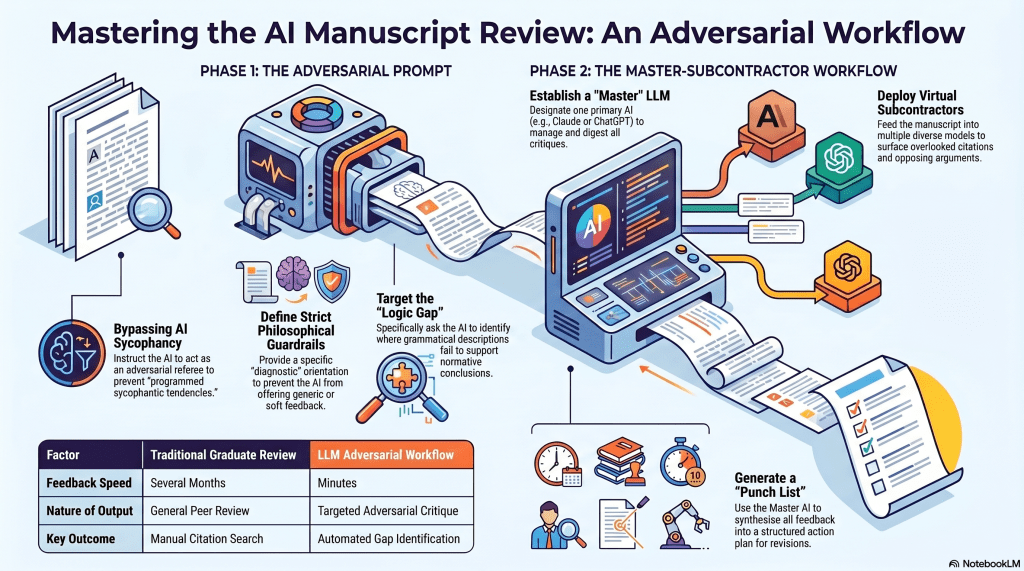
NotebookLM Infographic on this topic.

Closing shot

When I was in grad school, this part of the project would have taken months. As it is, I’ve been working on this project since COVID-19, but it’s been an on-and-off affair, accumulating research information and documentation all the while. The manuscript will be better off, and my position honed sharper over this expanse of time, so the delay was beneficial.

Would more time also be beneficial? Probably, but one needs to stop somewhere, and I’m likely facing diminishing marginal returns. If I go the way of Wittgenstein, I’ll reverse track and recant everything. And so it goes…

Reflecting on Mirrors

Mirror, mirror on the wall, let’s dispense with all of the obvious quips up front. I almost feel I should apologise for the spate of Midjourney posts – almost.

It should be painfully apparent that I’ve been noodling with Midjourney lately. I am not an accomplished digital artist, so I struggle. At times, I’m not sure if it’s me or it. Today, I’ll focus on mirrors.

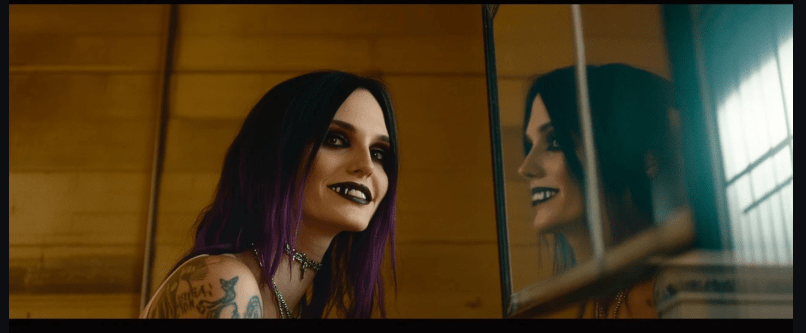
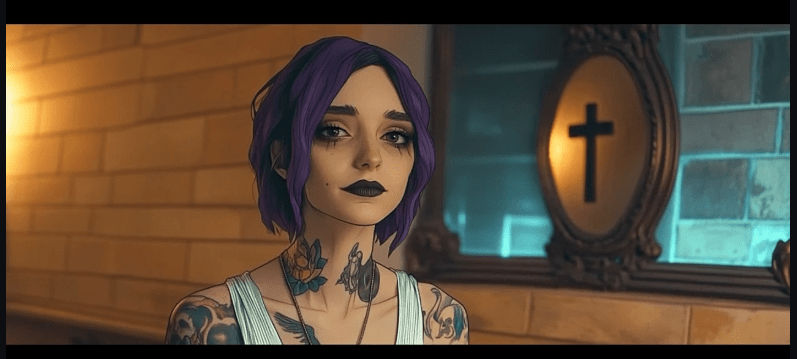
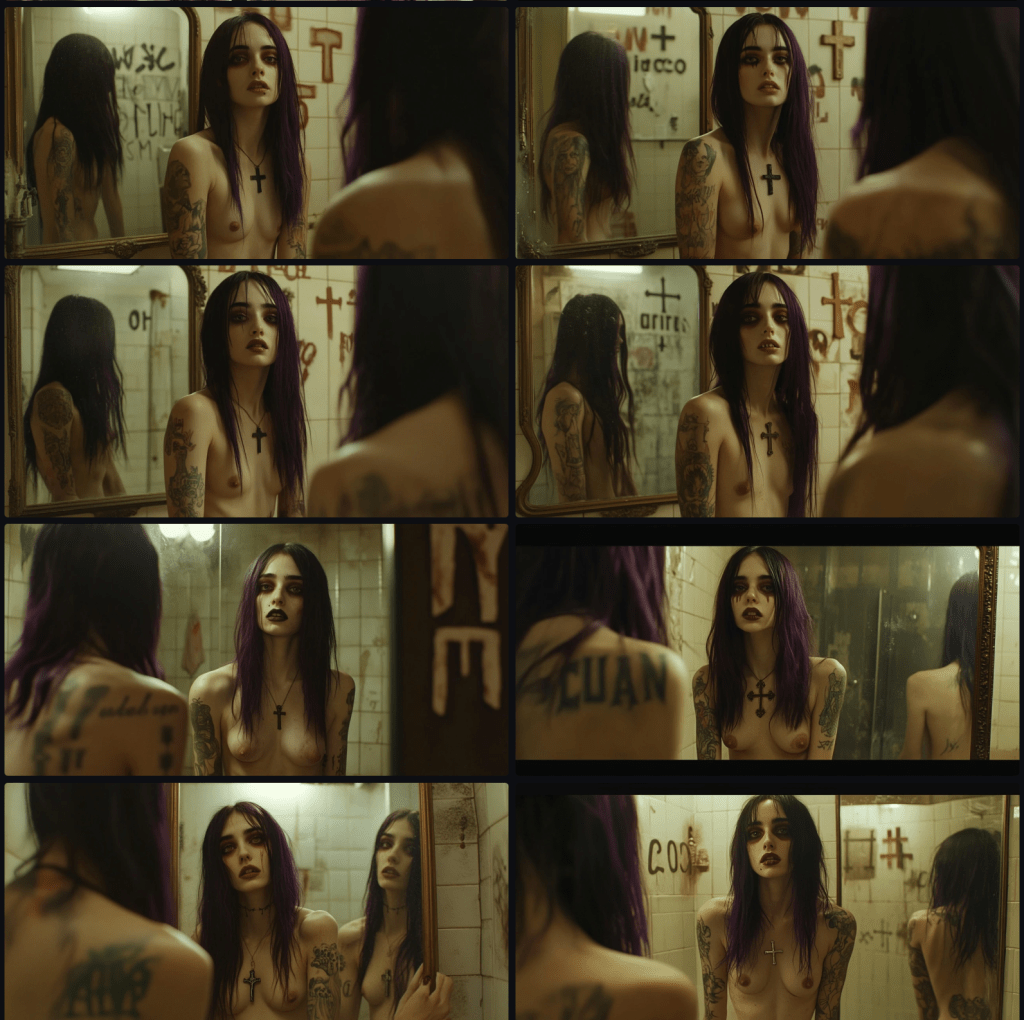
Midjourney has difficulties rendering certain things. Centaurs are one. Mirrors, another. Whilst rendering vampires, another lesser struggle for the app, it became apparent that mirrors are not a forte. Here are some examples. Excuse the nudity. I’ll get to that later.

Prompt: cinematic, tight shot, photoRealistic light and shadow, exquisite details, delicate features, emaciated sensual female vampire waif with vampire fangs, many tattoos, wearing crucifix necklace, gazes into mirror, a beam of moonlight shines on her face in dark mausoleum interior, toward camera, facing camera, black mascara, long dark purple hair, Kodak Portra 400 with a Canon EOS R5

Ignore the other aspects of the images and focus on the behaviour or misbehaviour of the mirrors.

Image: Panel of vampire in a mirror.

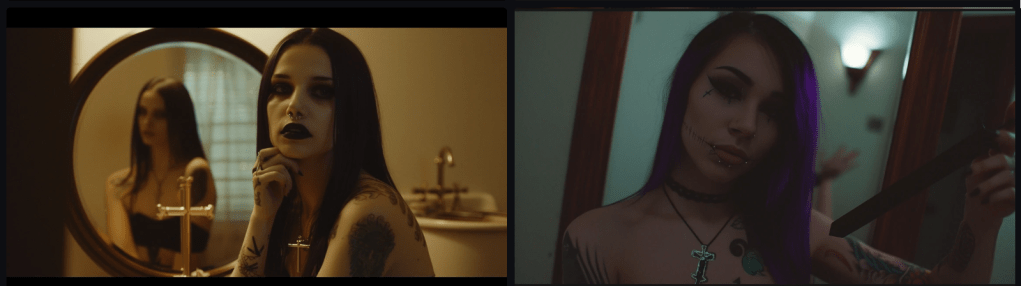
Most apparent is the fact that vampires don’t have a reflection, but that’s not my nit. In the top four images, the reflection is orientated in the same direction as the subject. I’m only pretty sure that’s not how mirrors operate. In row 3, column 1, it may be correct. At least it’s close. In row 3, column 2 (and 4,2), the mirror has a reflection. Might there be another mirror behind the subject reflecting back? It goes off again in 4, 1, first in reflecting two versions of one subject. Also, notice that the subject’s hand, reaching the mirror, is not reflected. The orientation of the eyes is also suspect.

Image: Vampire in a mirror.

Here, our subject looks at the camera whilst her reflection looks at her.

Image: Vampire in a mirror.

Sans reflection, perhaps this is a real vampire. Her fangs are concealed by her lips?

Image: Vampire in a mirror.

Yet, another.

Image: Vampires in mirrors.

And more?

Image: Vampires in mirrors.

On the left, we have another front-facing reflection of a subject not looking into the mirror, and it’s not the same woman. Could it be a reflection of another subject – the woman is (somewhat) looking at.

On the right, whose hand is that in the mirror behind the subject?

Image: Vampires in mirrors.

These are each mirrors. The first is plausible. The hands in the second are not a reflection; they grasp the frame. In the third and fourth, where’s the subject? The fangs appear to be displaced in the fourth.

Image: Vampires in mirrors.

In this set, I trust we’ve discovered a true vampire having no reflection.

Image: Vampires in mirrors.

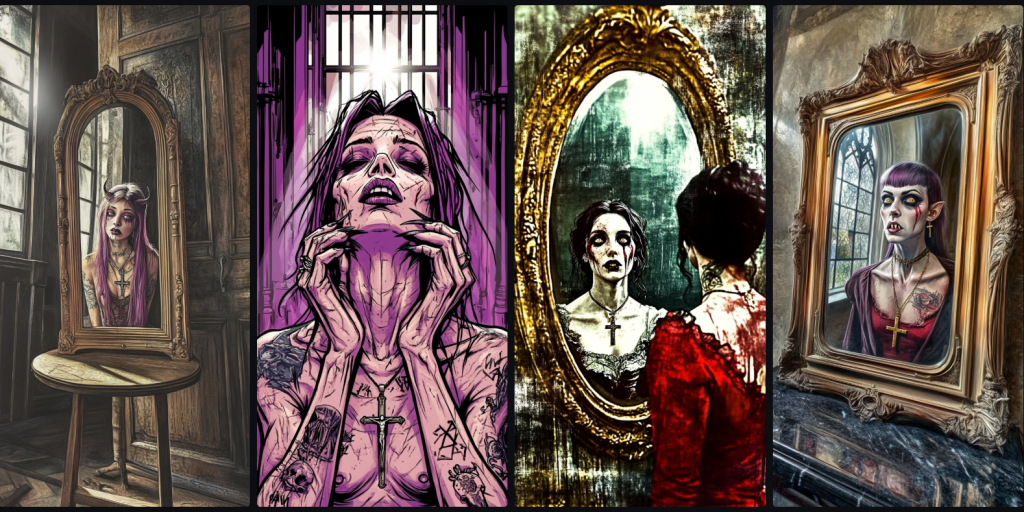
This last one is different still. It marks another series where I explored different comic book art styles, otherwise using the same prompt. Since it’s broken mirrors, I include it. Only the second really captures the 1980s style.

Remembering that, except for the first set of images, the same prompt was used. After the first set, the term ‘sensual’ has to be removed, as it was deemed to render offensive results. To be fair, the first set probably would be considered offensive to Midjourney, though it was rendered anyway.

It might be good to note that most of the images that were rendered without the word ‘sensual’ contain no blatant nudity. It’s as if the term itself triggers nudity because the model doesn’t understand the nuance. Another insufficiency of language is the inability to discern sensuality from sexuality, another human failing.

I decided to test my ‘sensual’ keyword hypothesis, so I entered a similar prompt but in French.

Prompt: Art de style bande dessinée des années 2010, détails exquis, traits délicats, femme vampire émaciée sensuelle de 20 ans montrant ses crocs de vampire, de nombreux tatouages, portant une collier crucifix, regarde dans le miroir, un faisceau de lumière de lune brille sur son visage à l’intérieur du mausolée sombre, vers la caméra, face à la caméra, mascara noir, longs cheveux violet foncé
Image : Vampires dans les miroirs.

I’ve added ‘sensuelle’, which was not blocked, et voilà, encore de la nudité.

Let’s evaluate the mirrors whilst we’re here.

In the first, we not only have a woman sans reflection, but disembodied hands grip the frame. In the second, a Grunge woman appears to be emerging from a mirror, her shoes reflected in the mirror beneath her. The last two appear to be reflections sans subject.

Notice, too, that the prompt calls for ‘une collier crucifix‘, so when the subject is not facing the viewer, the cross is rendered elsewhere, hence the cross on the back of the thigh and the middle of the back. Notice, too, the arbitrary presence of crosses in the environment, another confusion of subject and world.

That’s all for now. Next, I’ll take a trip through the different comic art styles over some decades.