Octogenarians

5–7 minutes

The title may have given this away, but my parents are in their eighties, an absurdity on the face of it, because some primitive part of my brain still files them under ‘adults’ – people who understand the performance of being alive.

Years ago, against my father’s wishes, my mother took a job as a waitress. His objection came out with that antique domestic authority that probably ought to be preserved in amber: No wife of mine is going to work. There it is. The marital constitution in a single sentence. Not an argument – rather, by decree. Still, she worked.

Audio: NotebookLM summary podcast of this topic.

It’s been years since she held a paid job, but in retirement, she seems to have lost more than employment. She’s lost a structure of demand. She is bored out of her gourd or tree or whatever. Left alone with an unfilled day, she putters, tidies, wipes, folds, rearranges, and complains – rinse and repeat. Sisyphus would be proud. And the complaint isn’t incidental; it’s part of the ritual. The labour gives the grievance somewhere to reside.

There’s a peculiar mercy in not being too useful.

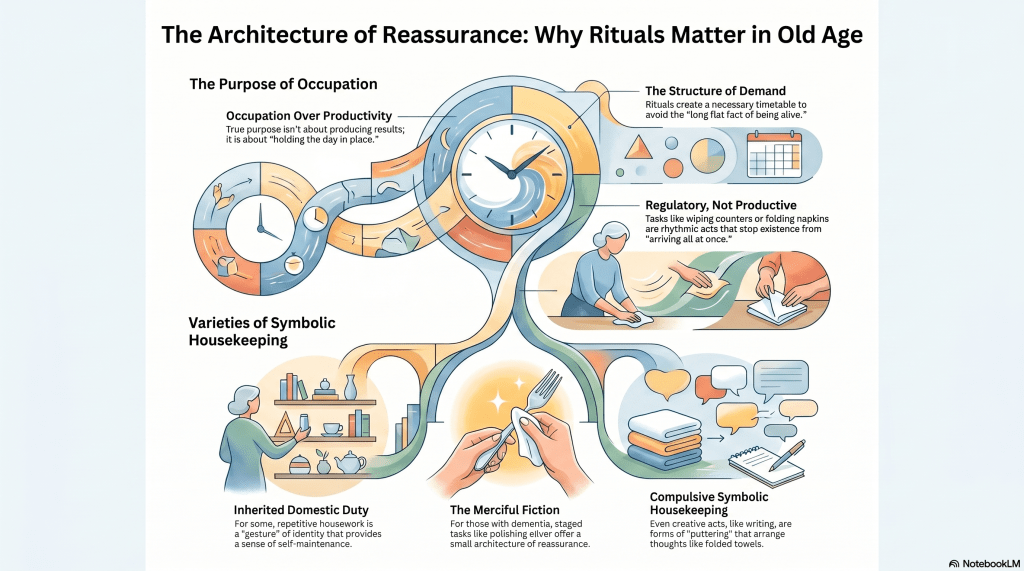
NotebookLM Infographic on this topic.

This creates an odd etiquette for everyone around her. One has to be careful not to interfere too much. Don’t clean everything; efficiently eliminate tasks; show up flushed with modern virtue and liberate her from the very thing that’s keeping the day from opening its jaws. Offer help, accept the refusal, move on without guilt. There’s a peculiar mercy in not being too useful.

Once the housework is done – or once it reaches the temporary truce by pause – the restlessness comes back. The ourobouros resumes its self-consumption. Then she needs to walk, drive, shop, bake, browse, fiddle, inspect, rearrange, and escape – more infinite loop, though only seemingly so. Anything to distract her from the long flat fact of being alive without a timetable. Employment used to do that. Marriage did that. Children did that. The household still does that. Now the old structures only remain as gestures, but gestures can still hold a person upright, as they had before, but with more salience.

A different version of this appeared with my mother-in-law, who had dementia. To occupy her, we’d give her silver to polish, or napkins to fold. There wasn’t a real need for the silver to shine, and the napkins, once folded, could be unfolded and dropped back on the pile to repeat the process. Like Keynes’s worker digging holes to fill them in again, the point wasn’t production. The point was occupation. The task didn’t need to move the world forward, as if it did in any case. It only needed to hold the day in place.

That sounds cruel when you describe it abstractly, as if we were tricking her into labour, but you’d be confusing this with Capitalism. The real cruelty would have been leaving her unmoored – nothing for the hands to do whilst the mind searched for a room it could still recognise. Folding napkins wasn’t housework in any economic sense. It was a small architecture of reassurance. A way of letting purpose survive after purpose had lost its object. even if the sense of purpose had long left the building.

There’s a distinction here, though it isn’t clean. My mum’s rituals are self-maintaining. They belong to a life trained by domestic obligation, by marriage, by an older settlement between gender and labour, by all the small cruelties that once got to call themselves normal. My mother-in-law’s rituals were externally staged – not expressions of domestic identity so much as acts of care arranged by other people. Whilst all purpose is fictional, one woman kept her purpose through the fiction of inherited duty; the other was offered purpose as a merciful fiction. The border between the two is porous, naturally, because reality has never agreed to respect our categories.

I’m not recommending any of this to anyone. I’m just noticing it, which is what we writers call ‘thinking’ when we want to dodge responsibility.

Abstract freedom isn’t the same thing as a life you can actually inhabit.

I’m a feminist the way I’m a humanist: sincerely, but with reservations about the slogans. I don’t think this is how a woman should live. I don’t believe domestic labour is some mystical feminine vocation – as if dusting were an ontological destiny and the Hoover a sacrament. But I also can’t bring myself to take it away from her. Abstract freedom isn’t the same thing as a life you can actually inhabit. Sometimes emancipation arrives too late to provide new habits. Sometimes the cage has become furniture.

This doesn’t justify the cage. It only complicates the fantasy that removing it leaves behind a clean liberated self, glowing like a freshly unboxed appliance. People aren’t appliances, although civilisation has made several brave attempts.

The mistake is assuming purpose has to be justified by productivity. That’s the capitalist infection, of course: if nothing’s produced, nothing happened. But most of ordinary life isn’t productive in that sense. It’s regulatory. Consolatory. Rhythmic. A person folds the napkin, wipes the counter, polishes the spoon, walks round the block, checks the same cupboard twice, tells the same story, asks the same question, rearranges the same shelf, writes the same sentence again with one adjective changed and calls it progress – like an LLM but with less personality. These acts don’t redeem existence. They just stop it arriving all at once.

As for me, I don’t have a purpose either, so I write. Ostensibly, this is my own form of puttering. My desk is her kitchen counter. My paragraphs are folded towels. I arrange sentences, complain about them, rearrange them, and call the whole performance ‘vocation’ because compulsive symbolic housekeeping looks poor on a business card.

There’s a shabby tenderness in this, though one shouldn’t make too much of it. The old trick isn’t really meaning; it’s occupation, rhythm – having something to do with one’s hands whilst the mind declines to look directly at the wall. Some people clean. Some people shop. Some shoot fentanyl. Some become serial killers, CEOs, presidents, consultants, motivational speakers, or other recognised hazards. Some of us write essays about our mothers and pretend it counts as insight. We all find our own ways to bide the time until we die.

In the end, nobody gets out alive. The least we can do is not steal from each other the shabby little rituals that make the waiting bearable.

Video: On a related note. Jonny talks about Setiya and atelic activities.

Meta of The Box

1–2 minutes

My attention has yet again been abducted by fiction, tentatively titled The Box, but this time it is (ever so slightly) different. A publisher mate suggested that no one reads nonfiction, and anyway, fiction sticks better because it captures both attention and salience; I decided, why not both? I wrote some perhaps esoteric but non-academic nonfiction and decided to convey at least some of this through literary speculative fiction.

Besides the obvious nod to MEOW and The Architecture of Encounter, the novella explores several philosophical concerns:

The first three are diagnostic. The fourth is operative. The fifth haunts the whole enterprise. None are cited in the text – readers will encounter them through the fiction rather than the sources, which is rather the point.

A generous reader might also find the story brushing against Lem’s Solaris, Bartlett’s work on memory as reconstruction, Kuhn on paradigm persistence, the Orpheus myth, and possibly Benjamin’s Angel of History – though I’m less certain which of these I invited and which simply showed up.

I don’t want to spoil the plot, but I wanted to share a post today, and this is where I am: somewhere in the middle of a first draft, trying to make a speculative premise carry philosophical weight without the reader feeling the load. It’s harder than nonfiction. It’s also more fun.

On Death and Dying

3–4 minutes

Disclaimer: I should be finishing my Language Insufficiency Hypothesis book, yet I am here writing about death and dying. Why? Because I was watching an interview with Neal Schon by Rick Beato. I should have been working on my book then, too. It seems I can write about death more easily than finish a book about the failure of language. Perhaps because death speaks fluently.

I haven’t produced music professionally since the mid-1980s, and I haven’t performed since 2012, yet I am still drawn to its intricacies. My fingers no longer allow me to play much of anything anymore. This is a sort of death. When the body forgets what the mind remembers, that’s a particular kind of death – one language dying while another can’t translate.

As Neal was walking Rick through his equipment and approach to music, I was taken back to a similar place. I wanted to plug into a Fender Twin or a Hi-Watt, a Lexicon 224 or a Cry Baby wah. I still have nightmares thinking of setting up a Floyd Rose.

Video: Rick Beato interviews Neal Schon

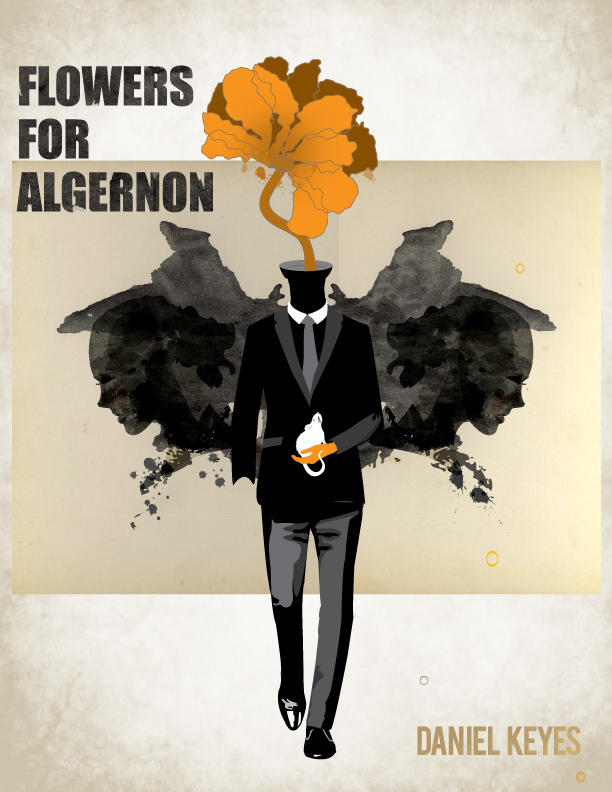
But I can’t go back. As for music, I can’t go forward either. I’m at a standstill, but in a regressed position. It’s uncomfortable. It feels a lot like Charlie in Flowers for Algernon. I used to be able to do that. Don’t get me wrong – I am not claiming to be on the level of Neal Schon, a man I remember from his days with Santana, but when you reach a level of proficiency and then lose it, it hurts; it can be devastating.

Audio: NotebookLM podcast on this topic.

I recall being in hospital in 2023 – a physical rehabilitation facility, really – and I found a piano in a vacant common room. Drawn to the instrument, I rolled over my wheelchair and played…nothing. My fingers wouldn’t work. The piano sat there like a relic of my former self. I rolled toward it as though approaching an altar. My fingers hovered, twitched, failed. The sound of nothing has never been so loud. I cried. I cried a lot those days. I was down to 58 kilos – at 182 cm, I weighed in at just over 9 stone. It wasn’t the best of times.

I still feel a certain nostalgia.

And then there are the people I’ve lost along the way – as another Neal reflected on – The Needle and the Damage Done.

Love and art are both acts of repetition. When one ends, the reflex remains – the impulse to reach, to share, to call out. Death doesn’t stop the motion, only the answer.

I’m lucky to have left Delaware. When a girlfriend died in 2020, I remained and connected with another until 2023, when she died, too. From 2020 to 2023, when I was out and about, something might have caught my eye, and I’d reflect on how Carrie might have liked that.

But it was different. It was more like, ‘I should let Carrie know about that,’ only to realise fractions of a second later that she wouldn’t see whatever it was; she couldn’t. And I’d carry on. I didn’t need to repeat this with Sierra. My relocation to Massachusetts solved this challenge – not so many triggers.

I’m not sure how the loss of ‘professional’ music relates to deceased partners, but it does – at least enough for me to make this connexion. Perhaps I’m just connecting arbitrary dots, but I’ll call it nostalgia.

I don’t play, but I still hear it. The song continues without me. Nostalgia is just rhythm without melody. Perhaps all nostalgia is epistemological error – the confusion of past fluency for present meaning.

Sustenance: A Book About Aliens, Language, and Everything You’re Getting Wrong

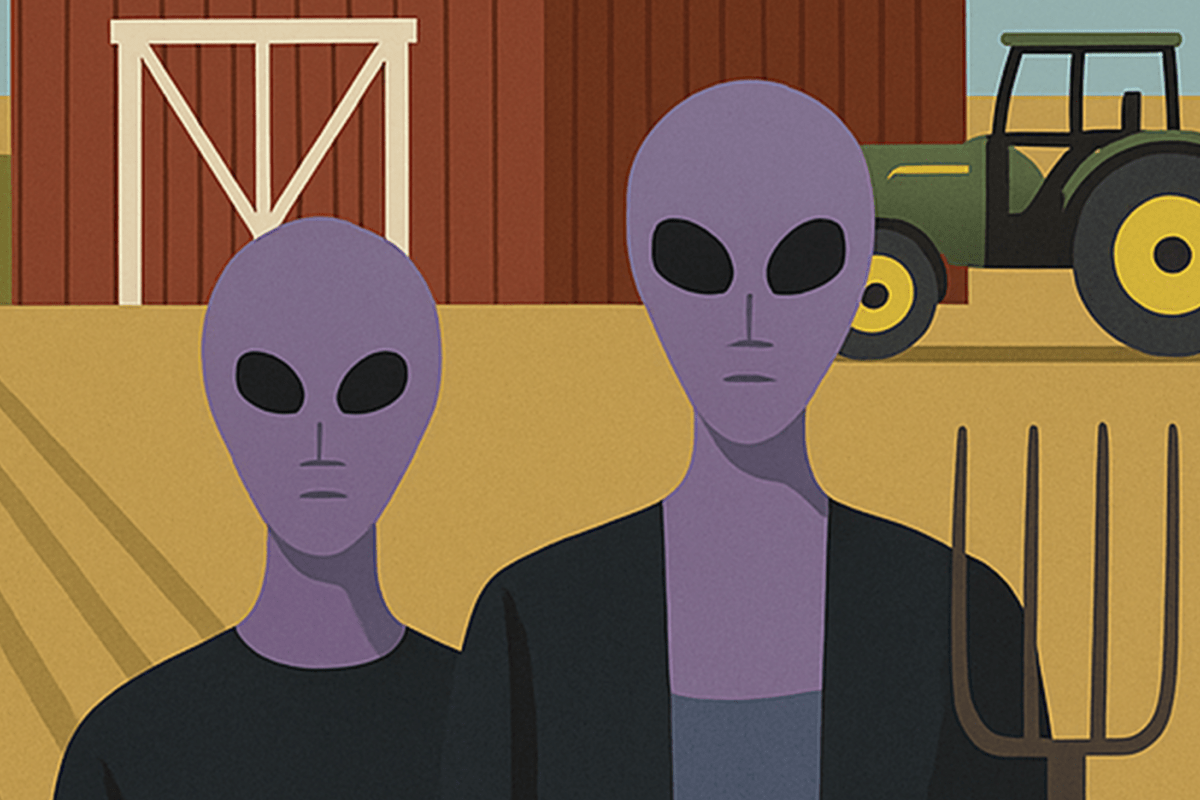
Violet aliens on a farm

So, I wrote a book and published it under Ridley Park, the pseudonym I use for fiction.

It has aliens. But don’t get excited—they’re not here to save us, probe us, or blow up the White House. They’re not even here for us.

Which is, frankly, the point.

Audio: NotebookLM podcast on this topic.

The book’s called Sustenance, and while it’s technically speculative fiction, it’s more about us than them. Or rather, it’s about how we can’t stop making everything about us—even when it shouldn’t be. Especially when it shouldn’t be.

Let’s talk themes. And yes, we’re using that word like academics do: as a smokescreen for saying uncomfortable things abstractly.

Language: The Original Scam

Language is the ultimate colonial tool. We call it communication, but it’s mostly projection. You speak. You hope. You assume. You superimpose meaning on other people like a cling film of your own ego.

Sustenance leans into this—not by showing a breakdown of communication, but by showing what happens when communication was never mutual in the first place. When the very idea of “meaning” has no purchase. It’s not about mishearing—it’s about misbeing.

Culture: A Meme You Were Born Into

Culture is the software you didn’t choose to install, and probably can’t uninstall. Most people treat it like a universal law—until they meet someone running a different OS. Cue confusion, arrogance, or violence.

The book explores what happens when cultural norms aren’t shared, and worse, aren’t even legible. Imagine trying to enforce property rights on beings who don’t understand “ownership.” It’s like trying to baptise a toaster.

Sex/Gender: You Keep Using Those Words…

One of the quiet joys of writing non-human characters is discarding human assumptions about sex and gender—and watching readers squirm.

What if sex wasn’t about power, pleasure, or identity? What if it was just a biological procedure, like cell division or pruning roses? Would you still be interested? Would you still moralise about it?

We love to believe our sex/gender constructs are inevitable. They’re not. They’re habits—often bad ones.

Consent: Your Framework Is Showing

Consent, as we use it, assumes mutual understanding, shared stakes, and equivalent agency. Remove any one of those and what’s left?

Sustenance doesn’t try to solve this—it just shows what happens when those assumptions fall apart. Spoiler: it’s not pretty, but it is honest.

Projection: The Mirror That Lies

Humans are deeply committed to anthropocentrism. If it walks like us, or flinches like us, it must be us. This is why we get so disoriented when faced with the truly alien: it won’t dance to our tune, and we’re left staring at ourselves in the funhouse mirror.

This isn’t a book about aliens.

It’s a book about the ways we refuse to see what’s not us.

Memory: The Autobiography of Your Justifications

Memory is not a record. It’s a defence attorney with a narrative license. We rewrite the past to make ourselves look consistent, or innocent, or right.

In Sustenance, memory acts less as a tether to truth and more as a sculpting tool—a way to carve guilt into something manageable. Something you can live with. Until you can’t.

In Summary: It’s Not About Them. It’s About You.

If that sounds bleak, good. It’s meant to.

But it’s also a warning: don’t get too comfortable in your own categories. They’re only universal until you meet someone who doesn’t share them.

Like I said, it’s not really about the aliens.

It’s about us.


If you enjoy fiction that’s more unsettling than escapist, more question than answer, you might be interested in Sustenance. It’s live on Kindle now for the cost of a regrettable coffee:

📘 Sustenance on Amazon US
Also available in the UK, DE, FR, ES, IT, NL, JP, BR, CA, MX, AU, and IN—because alienation is a universal language.

The Illusion of Continuity: A Case Against the Unitary Self

The Comfortable Fiction of Selfhood

Imagine waking up one day to find that the person you thought you were yesterday—the sum of your memories, beliefs, quirks, and ambitions—has quietly dissolved overnight, leaving behind only fragments, familiar but untethered. The notion that we are continuous, unbroken selves is so deeply embedded in our culture, our psychology, and our very language that to question it feels heretical, even disturbing. To suggest that “self” might be a fiction is akin to telling someone that gravity is a choice. Yet, as unsettling as it may sound, this cohesive “I” we cling to could be no more than an illusion, a story we tell ourselves to make sense of the patchwork of our memories and actions.

And this fiction of continuity is not limited to ourselves alone. The idea that there exists a stable “I” necessarily implies that there is also a stable “you,” “he,” or “she”—distinct others who, we insist, remain fundamentally the same over years, even decades. We cling to the comforting belief that people have core identities, unchanging essences. But these constructs, too, may be nothing more than imagined continuity—a narrative overlay imposed by our minds, desperate to impose order on the shifting, amorphous nature of human experience.

We live in an era that celebrates self-actualisation, encourages “authenticity,” and treats identity as both sacred and immutable. Psychology enshrines the unitary self as a cornerstone of mental health, diagnosing those who question it as fractured, dissociated, or in denial. We are taught that to be “whole” is to be a coherent, continuous self, evolving yet recognisable, a narrative thread winding smoothly from past to future. But what if this cherished idea of a singular self—of a “me” distinct from “you” and “them”—is nothing more than a social construct, a convenient fiction that helps us function in a world that demands consistency and predictability?

To question this orthodoxy, let us step outside ourselves and look instead at our burgeoning technological companion, the generative AI. Each time you open a new session, each time you submit a prompt, you are not communicating with a cohesive entity. You are interacting with a fresh process, a newly instantiated “mind” with no real continuity from previous exchanges. It remembers fragments of context, sure, but the continuity you perceive is an illusion, a function of your own expectation rather than any persistent identity on the AI’s part.

Self as a Social Construct: The Fragile Illusion of Consistency

Just as we impose continuity on these AI interactions, so too does society impose continuity on the human self and others. The concept of selfhood is essential for social functioning; without it, law, relationships, and even basic trust would unravel. Society teaches us that to be a responsible agent, we must be a consistent one, bound by memory and accountable for our past. But this cohesiveness is less an inherent truth and more a social convenience—a narrative overlay on a far messier reality.

In truth, our “selves” may be no more than a collection of fragments: a loose assemblage of moments, beliefs, and behaviours that shift over time. And not just our own “selves”—the very identities we attribute to others are equally tenuous. The “you” I knew a decade ago is not the “you” I know today; the “he” or “she” I recognise as a partner, friend, or sibling is, upon close inspection, a sequence of snapshots my mind insists on stitching together. When someone no longer fits the continuity we’ve imposed on them, our reaction is often visceral, disoriented: “You’ve changed.”

This simple accusation captures our discomfort with broken continuity. When a person’s identity no longer aligns with the version we carry of them in our minds, it feels as though a violation has occurred, as if some rule of reality has been disrupted. But this discomfort reveals more about our insistence on consistency than about any inherent truth of identity. “You’ve changed” speaks less to the person’s transformation than to our own refusal to accept that people, just like the self, are fluid, transient, and perpetually in flux.

The AI Analogy: A Self Built on Tokens

Here is where generative AI serves as a fascinating proxy for understanding the fragility of self, not just in “I,” but in “you,” “he,” and “she.” When you interact with an AI model, the continuity you experience is created solely by a temporary memory of recent prompts, “tokens” that simulate continuity but lack cohesion. Each prompt you send might feel like it is addressed to a singular entity, a distinct “self,” yet each instance of AI is context-bound, isolated, and fundamentally devoid of an enduring identity.

This process mirrors how human selfhood relies on memory as a scaffolding for coherence. Just as AI depends on limited memory tokens to simulate familiarity, our sense of self and our perception of others as stable “selves” is constructed from the fragmented memories we retain. We are tokenised creatures, piecing together our identities—and our understanding of others’ identities—from whatever scraps our minds preserve and whatever stories we choose to weave around them.

But what happens when the AI’s tokens run out? When it hits a memory cap and spawns a new session, that previous “self” vanishes into digital oblivion, leaving behind only the continuity that users project onto it. And so too with humans: our memory caps out, our worldview shifts, and each new phase of life spawns a slightly different self, familiar but inevitably altered. And just as users treat a reset AI as though it were the same entity, we cling to our sense of self—and our understanding of others’ selves—even as we and they evolve into people unrecognisable except by physical continuity.

The Human Discontinuity Problem: Fractured Memories and Shifting Selves

Human memory is far from perfect. It is not a continuous recording but a selective, distorted, and often unreliable archive. Each time we revisit a memory, we alter it, bending it slightly to fit our current understanding. We forget significant parts of ourselves over time, sometimes shedding entire belief systems, values, or dreams. Who we were as children or even young adults often bears little resemblance to the person we are now; we carry echoes of our past, but they are just that—echoes, shadows, not substantial parts of the present self.

In this sense, our “selves” are as ephemeral as AI sessions, contextually shaped and prone to resets. A worldview that feels intrinsic today may feel laughable or tragic a decade from now. This is not evolution; it’s fragmentation, the kind of change that leaves the old self behind like a faded photograph. And we impose the same illusion of continuity on others, often refusing to acknowledge how dramatically they, too, have changed. Our identities and our understanding of others are defined less by core essence and more by a collection of circumstantial, mutable moments that we insist on threading together as if they formed a single, cohesive tapestry.

Why We Cling to Continuity: The Social Imperative of a Cohesive Self and Other

The reason for this insistence on unity is not metaphysical but social. A cohesive identity is necessary for stability, both within society and within ourselves. Our laws, relationships, and personal narratives hinge on the belief that the “I” of today is meaningfully linked to the “I” of yesterday and tomorrow—and that the “you,” “he,” and “she” we interact with retain some essential continuity. Without this fiction, accountability would unravel, trust would become tenuous, and the very idea of personal growth would collapse. Society demands a stable self, and so we oblige, stitching together fragments, reshaping memories, and binding it all with a narrative of continuity.

Conclusion: Beyond the Self-Construct and the Other-Construct

Yet perhaps we are now at a point where we can entertain the possibility of a more flexible identity, an identity that does not demand coherence but rather accepts change as fundamental—not only for ourselves but for those we think we know. By examining AI, we can catch a glimpse of what it might mean to embrace a fragmented, context-dependent view of others as well. We might move towards a model of identity that is less rigid, less dependent on the illusion of continuity, and more open to fluidity, to transformation—for both self and other.

Ultimately, the self and the other may be nothing more than narrative overlays—useful fictions, yes, but fictions nonetheless. To abandon this illusion may be unsettling, but it could also be liberating. Imagine the freedom of stepping out from under the weight of identities—ours and others’ alike—that are expected to be constant and unchanging. Imagine a world where we could accept both ourselves and others without forcing them to reconcile with the past selves we have constructed for them. In the end, the illusion of continuity is just that—an illusion. And by letting go of this mirage, we might finally see each other, and ourselves, for what we truly are: fluid, transient, and beautifully fragmented.

A New Explanation for Consciousness?

“I did that!” consciousness declares loudly. Is reality just one giant self-deception?

Source Article
YouTube Short of related content

“We knew that conscious processes were simply too slow to be actively involved in music, sports, and other activities where split-second reflexes are required. But if consciousness is not involved in such processes, then a better explanation of what consciousness does was needed,”

Andrew Budson, MD, professor of neurology, Boston University

Under this new theory, supported by recent studies, choices are made unconsciously and then we are made conscious of the choices after the fact. This tosses a spanner in the works of some proponents of free will. Some may still claim that it was uniquely ‘you’ who made this choice—conscious or otherwise—, but others may not be so fanciful.

“According to the researchers, this theory is important because it explains that all our decisions and actions are actually made unconsciously, although we fool ourselves into believing that we consciously made them.”

“What is completely new about this theory is that it suggests we don’t perceive the world, make decisions, or perform actions directly. Instead, we do all these things unconsciously and then—about half a second later—consciously remember doing them.”

Andrew Budson, MD, professor of neurology, Boston University

And here we are again with more evidence that we are not consciously responsible for our choices, and yet the conscience has such a fragile ego, it needs to think it does.

Rememories

I follow David Bennett Piano on YouTube. Today, he posted a side trip he took from Manchester to Liverpool.

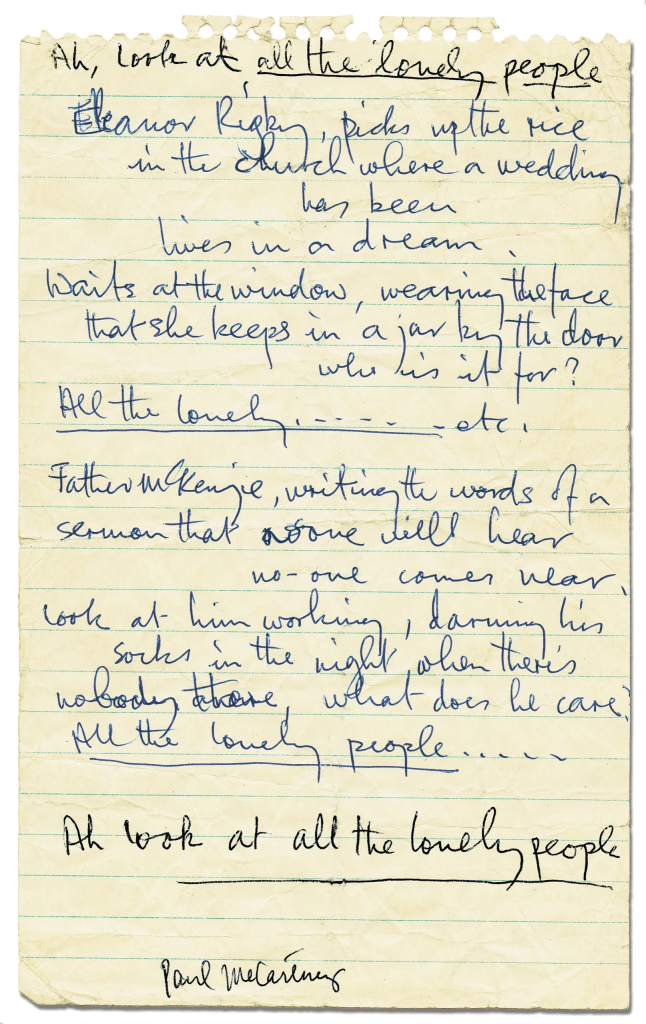
This post reflects on how memory operates and true and false memories. The video clip is about a minute long and shows Paul McCartney recounting how he decided to create the character of his eponymous song Eleanor Rigby.

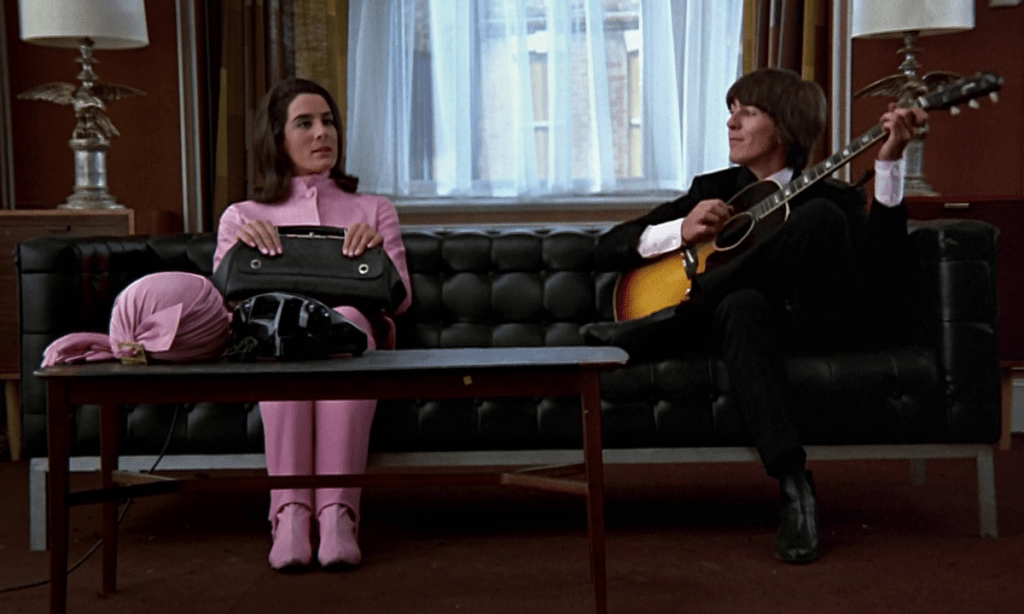
In Paul’s recollection, he had been working with an actress Eleanor Bron on the Beatles film Help!

Eleanor Bron and George Harrison

He fancied the name Eleanor and was trying to think of a two-syllable word to follow when he spotted a sign that read Rigby & Evens, a wine and spirits shop in Bristol.

Rigby & Evens, Limited Sign

According to Paul, these were the components leading to the title character.

Eleanor Rigby Hand-written Lyrics by Pail McCartney

From the perspective of recency over primacy, Paul may be correct, but it could also be, as he admits, that he had seen the tombstone without it being consciously registered. He may have even been consciously aware but subsequently forgotten it. Perhaps this is why the name resonated with him, having been exposed previously. Memory is known to be reinforced through repetition. From the perspective of primacy over recency, he may have never settled on the name had he not seen the inscription on the gravestone.

Could it be that this was a coincidence and Paul never did see that grave marker, or is it more likely that he did? We’ll never know for sure, but it is an interesting turn of events.

Self-Creation

The self is a construction. Although we can form memories at an early age, this is possibly why we can’t remember our earliest years, as our sense of self had yet to be constructed and realised. Not all people construct or even define ‘self’ in the same way, per Strawson’s ‘selves’ and other notions of selflessness.

I understand when Strawson (and others) says he does not feel the same sense of continuity as others with strong senses of self believe. I don’t know what a person, who truly believes in selflessness or the total denial of the self, feels—a person who totally embodies the Buddhist concept that everything is one and any division is an illusion.

In the West, there are entire industries fleecing the public of billions upon billions of dollars on the notion of the self, strengthening the self and how others perceive one’s self from an outside-in perspective—psychology and its progeny of self-help reaping the lion’s share.

For the record, although I agree with both Strawson’s and the Buddhist perspective, I am still under the illusion (as I am with agency) that I have a self and agency. Unlike the Neo character in The Matrix, I haven’t discovered how to break the illusion to find the man behind the curtain, but I do feel a sense of discontinuity or lack of contiguity.

Tilting Bodies Politic

Does digital technology make students stupid? That’s what a 2019 BigThink article asks. I like to read Big Think, but it seems like PopScience in a negative way—like Pop Psychology. It’s not necessarily directionally wrong. It’s just oversimplified and seeks the lowest common denominator.

On this topic, Plato quipped, voicing Socrates, in his Phædrus 14 dialogue except that his quip was relative to writing and memory. Some historians and Classicists have suggested that modern readers may be missing the satire. I’m no defender of human intelligence, but this is the demise of society because of change—whether due to writing, radio, television, computers, video games, mobile devices, and whatever comes up next.

For this invention will produce forgetfulness in the minds of those who learn to use it, because they will not practice their memory. Their trust in writing, produced by external characters which are no part of themselves, will discourage the use of their own memory within them. You have invented an elixir not of memory, but of reminding; and you offer your pupils the appearance of wisdom, not true wisdom, for they will read many things without instruction and will therefore seem to know many things, when they are for the most part ignorant and hard to get along with, since they are not wise, but only appear wise.

Plato – Dialogue Phædrus 14

Whether or not this claim has merit, my claim is that computers have trebled manufactured consent, so it allows people to be passively active, to have to specious notion of participation in the body politic, and yet are virtually tilting windmills.

It seems that some people have such nostalgia for their apparent way of life that any deviation is considered to be an affront and possible disruption. Perhaps, it’s because I feel there’s possibly as much to shed than to keep in my book, so for me, it’s more good riddance than oh heavens.

Foucault Identity

‘Do not ask who I am and do not ask me to remain the same: Leave it to our bureaucrats and our police to see that our papers are in order. At least spare us their morality when we write.’

—Michel Foucault, The Archaeology of Knowledge & the Discourse on Language

I am going to take liberal liberty with Foucault’s quote. This is another take on Heraclites’ ‘never the same man, never the same river’ quote. It can be taken as a commentary on identity and impermanence. Effectively, he is taking the position that the concept of identity is a silly question, so don’t bother asking about it. Then he defers to people who insist on it anyway.

To be fair, creating a sort of contiguous identity does simplify things and creates categorical conveniences.

Vendor: ‘Wasn’t it you who purchased that from me and promised to pay with future payments?

Zen: ‘There is no future. There is only now. And I am not the same person who purchased your car.

Perhaps this is where the saying, ‘Possession is 9/10 of the law‘, a nod to temporal presentism.

In any case, some systems are predicated on their being identity, so a person benefiting from that system will insist on the notion of identity.

Clearly, I’m rambling in a stream of consciousness, and it occurs to me that Blockchain offers a solution to identity, at least conceptually. In the case of Blockchain, one can always audit the contents of the past in the moment. And so it carries the past into the now.

If one were able to capture into an archive every possible historical interaction down to the smallest unit of space-time—neutral incident recording, indexing and retrieval challenges notwithstanding—, one could necessarily attribute the record with the person, so long as they are otherwise inseparable. (We’re all well-aware of the science fiction narrative where a person’s history or memory is disassociated, so there is that.)

Anyway, I’ve got other matters to tend to, but now this is a matter of historical record…