The title may have given this away, but my parents are in their eighties, an absurdity on the face of it, because some primitive part of my brain still files them under ‘adults’ – people who understand the performance of being alive.
Years ago, against my father’s wishes, my mother took a job as a waitress. His objection came out with that antique domestic authority that probably ought to be preserved in amber: No wife of mine is going to work. There it is. The marital constitution in a single sentence. Not an argument – rather, by decree. Still, she worked.
Audio: NotebookLM summary podcast of this topic.
It’s been years since she held a paid job, but in retirement, she seems to have lost more than employment. She’s lost a structure of demand. She is bored out of her gourd or tree or whatever. Left alone with an unfilled day, she putters, tidies, wipes, folds, rearranges, and complains – rinse and repeat. Sisyphus would be proud. And the complaint isn’t incidental; it’s part of the ritual. The labour gives the grievance somewhere to reside.
There’s a peculiar mercy in not being too useful.
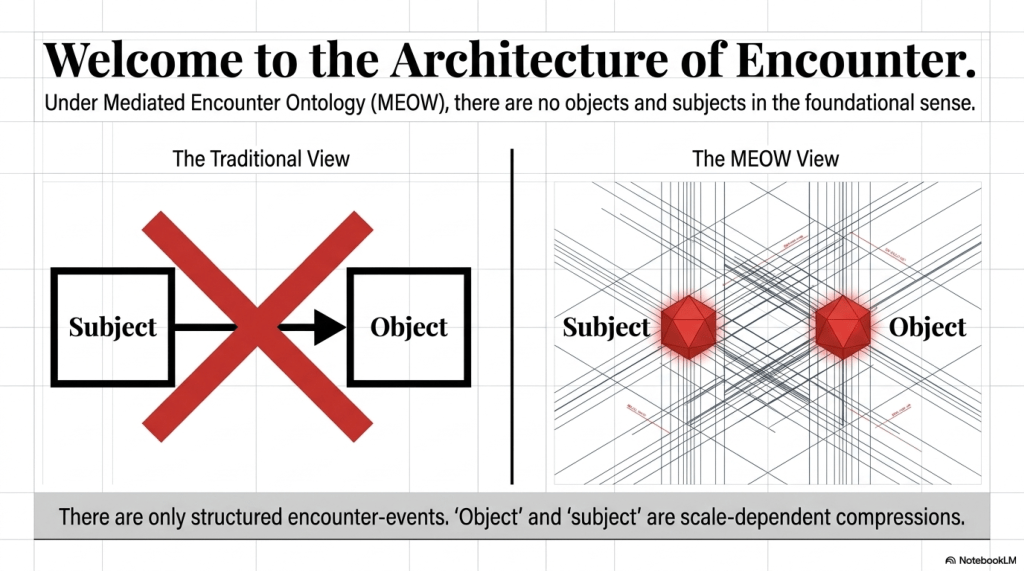
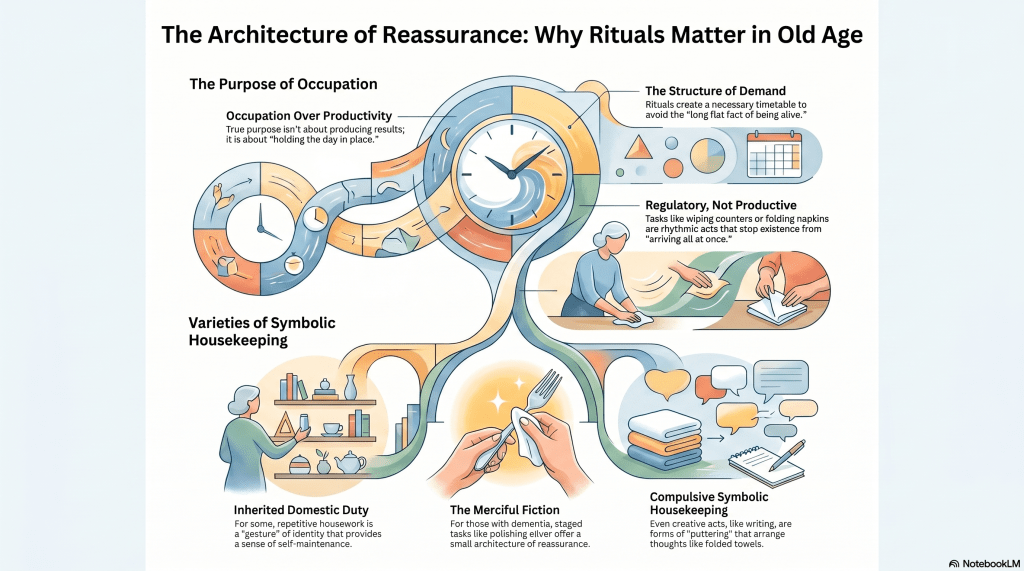
NotebookLM Infographic on this topic.
This creates an odd etiquette for everyone around her. One has to be careful not to interfere too much. Don’t clean everything; efficiently eliminate tasks; show up flushed with modern virtue and liberate her from the very thing that’s keeping the day from opening its jaws. Offer help, accept the refusal, move on without guilt. There’s a peculiar mercy in not being too useful.
Once the housework is done – or once it reaches the temporary truce by pause – the restlessness comes back. The ourobouros resumes its self-consumption. Then she needs to walk, drive, shop, bake, browse, fiddle, inspect, rearrange, and escape – more infinite loop, though only seemingly so. Anything to distract her from the long flat fact of being alive without a timetable. Employment used to do that. Marriage did that. Children did that. The household still does that. Now the old structures only remain as gestures, but gestures can still hold a person upright, as they had before, but with more salience.
A different version of this appeared with my mother-in-law, who had dementia. To occupy her, we’d give her silver to polish, or napkins to fold. There wasn’t a real need for the silver to shine, and the napkins, once folded, could be unfolded and dropped back on the pile to repeat the process. Like Keynes’s worker digging holes to fill them in again, the point wasn’t production. The point was occupation. The task didn’t need to move the world forward, as if it did in any case. It only needed to hold the day in place.
That sounds cruel when you describe it abstractly, as if we were tricking her into labour, but you’d be confusing this with Capitalism. The real cruelty would have been leaving her unmoored – nothing for the hands to do whilst the mind searched for a room it could still recognise. Folding napkins wasn’t housework in any economic sense. It was a small architecture of reassurance. A way of letting purpose survive after purpose had lost its object. even if the sense of purpose had long left the building.
There’s a distinction here, though it isn’t clean. My mum’s rituals are self-maintaining. They belong to a life trained by domestic obligation, by marriage, by an older settlement between gender and labour, by all the small cruelties that once got to call themselves normal. My mother-in-law’s rituals were externally staged – not expressions of domestic identity so much as acts of care arranged by other people. Whilst all purpose is fictional, one woman kept her purpose through the fiction of inherited duty; the other was offered purpose as a merciful fiction. The border between the two is porous, naturally, because reality has never agreed to respect our categories.
I’m not recommending any of this to anyone. I’m just noticing it, which is what we writers call ‘thinking’ when we want to dodge responsibility.
Abstract freedom isn’t the same thing as a life you can actually inhabit.
I’m a feminist the way I’m a humanist: sincerely, but with reservations about the slogans. I don’t think this is how a woman should live. I don’t believe domestic labour is some mystical feminine vocation – as if dusting were an ontological destiny and the Hoover a sacrament. But I also can’t bring myself to take it away from her. Abstract freedom isn’t the same thing as a life you can actually inhabit. Sometimes emancipation arrives too late to provide new habits. Sometimes the cage has become furniture.
This doesn’t justify the cage. It only complicates the fantasy that removing it leaves behind a clean liberated self, glowing like a freshly unboxed appliance. People aren’t appliances, although civilisation has made several brave attempts.
The mistake is assuming purpose has to be justified by productivity. That’s the capitalist infection, of course: if nothing’s produced, nothing happened. But most of ordinary life isn’t productive in that sense. It’s regulatory. Consolatory. Rhythmic. A person folds the napkin, wipes the counter, polishes the spoon, walks round the block, checks the same cupboard twice, tells the same story, asks the same question, rearranges the same shelf, writes the same sentence again with one adjective changed and calls it progress – like an LLM but with less personality. These acts don’t redeem existence. They just stop it arriving all at once.
As for me, I don’t have a purpose either, so I write. Ostensibly, this is my own form of puttering. My desk is her kitchen counter. My paragraphs are folded towels. I arrange sentences, complain about them, rearrange them, and call the whole performance ‘vocation’ because compulsive symbolic housekeeping looks poor on a business card.
There’s a shabby tenderness in this, though one shouldn’t make too much of it. The old trick isn’t really meaning; it’s occupation, rhythm – having something to do with one’s hands whilst the mind declines to look directly at the wall. Some people clean. Some people shop. Some shoot fentanyl. Some become serial killers, CEOs, presidents, consultants, motivational speakers, or other recognised hazards. Some of us write essays about our mothers and pretend it counts as insight. We all find our own ways to bide the time until we die.
In the end, nobody gets out alive. The least we can do is not steal from each other the shabby little rituals that make the waiting bearable.
Video: On a related note. Jonny talks about Setiya and atelic activities.
NB: I reviewed the credentials of the hosts and revised my critique at the end of this piece.
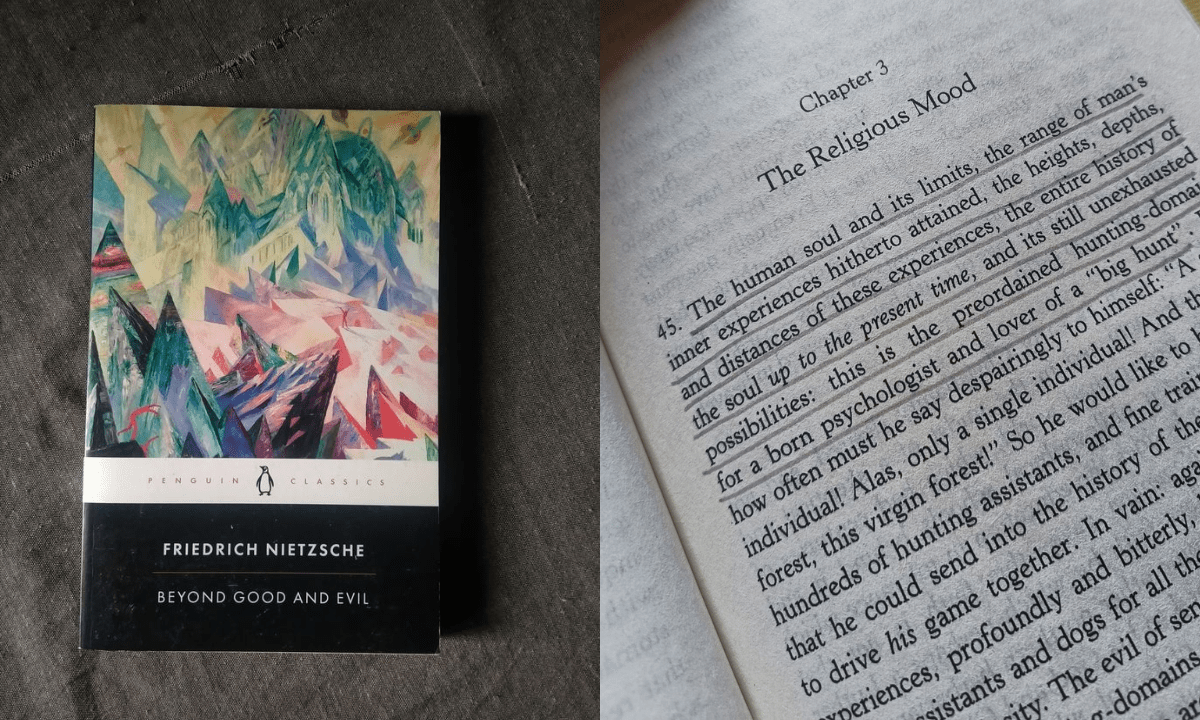
I joined a scheduled close reading of Nietzsche’s Beyond Good and Evil recently and came away less refreshed than exasperated. I will spare the platform and the hosts, not out of charity exactly, but because the problem is broader than two particular men fumbling through a canonical text in public. What disappointed me wasn’t that they disagreed with Nietzsche, nor even that they may have misunderstood him in places. Misreading is inevitable. The problem was that they seemed not to have brought much of a reading to begin with.
I had read Beyond Good and Evil years ago and thought a return to it might do me some good, or at least less evil than the usual intellectual content mill. The format sounded promising enough: two interested hosts working through the introduction live, sentence by sentence, in a supposedly close reading. Both had apparently read the book before. One therefore assumed they might arrive with at least a provisional grasp of its architecture, key provocations, and habitual traps. That assumption, in the event, turned out to be embarrassingly optimistic.
Audio: NotebookLM summary podcast of this topic.
As one host read line by line, the discussion lurched forward by way of hesitant paraphrase, speculative gloss, and the occasional verbal shrug. He offered the more substantive guesses, such as they were, while the other contributed mostly vague assent, half-memory, and the sort of foggy commentary one gives when one dimly recalls having once encountered a difficult book in a previous phase of life. It was less a close reading than a public rehearsal of not quite knowing what one was doing.
Now, I am not demanding exegetical perfection. Nietzsche is not a writer one simply ‘gets’ and files away like a user manual. Nor am I naïve enough to think authorial intention settles everything. Barthes is right enough to remind us that the text exceeds the author’s sovereign control. But the death of the author is not a licence for the death of preparation. If one is going to host a close reading of a notoriously elliptical and performative philosopher, the least one might do is arrive having done some prior work. Read the introduction carefully beforehand. Refresh the major themes. Check the loaded terms. Develop an argument, or at least a point of view.
That point of view may be wrong. Fine. Better that than the contemporary preference for the curated shrug, where one mistakes visible uncertainty for intellectual seriousness. There is a difference between interpretive openness and simple lack of preparation. One is a virtue. The other is an aesthetic.
I find this especially grating because I cannot imagine teaching a class that way. When I taught, I’d spend hours preparing before entering the room. Not because I imagined myself infallible, but because students deserve more than watching a lecturer discover the material in real time. A formed point of view is not a dogma. It is a starting position. It gives the discussion shape, stakes, and resistance. Without it, one is not leading inquiry but merely simulating it.
The second host did little to improve matters. Rather than complicating or sharpening the reading, he mostly echoed the first. There was very little friction, and thus very little illumination. One of the virtues of reading Nietzsche in company is that he invites productive disagreement. He is slippery, aphoristic, ironic, and often strategic in his provocations. A good discussion can tease out the tensions in his prose, test competing emphases, and ask whether a claim is literal, tactical, genealogical, or satirical. None of that really happened. Instead, one host fumbled, and the other nodded. The result was a kind of interpretive ventriloquism in which agreement substituted for insight.
The accompanying chat made things worse, or perhaps simply made the missed opportunity more obvious. Viewers were offering questions and interpretations, yet the hosts largely ignored them. Aside from one participant, who seemed likely to have some prior relationship with them, the chat was treated as background furniture. This was especially irritating because the event was live. If one is going to perform reading in public, the public should not be reduced to silent witnesses of one’s uncertainty. Otherwise, the ‘community’ aspect is just branding, another little liturgy of digital participation in which the audience is invited to attend but not to matter.
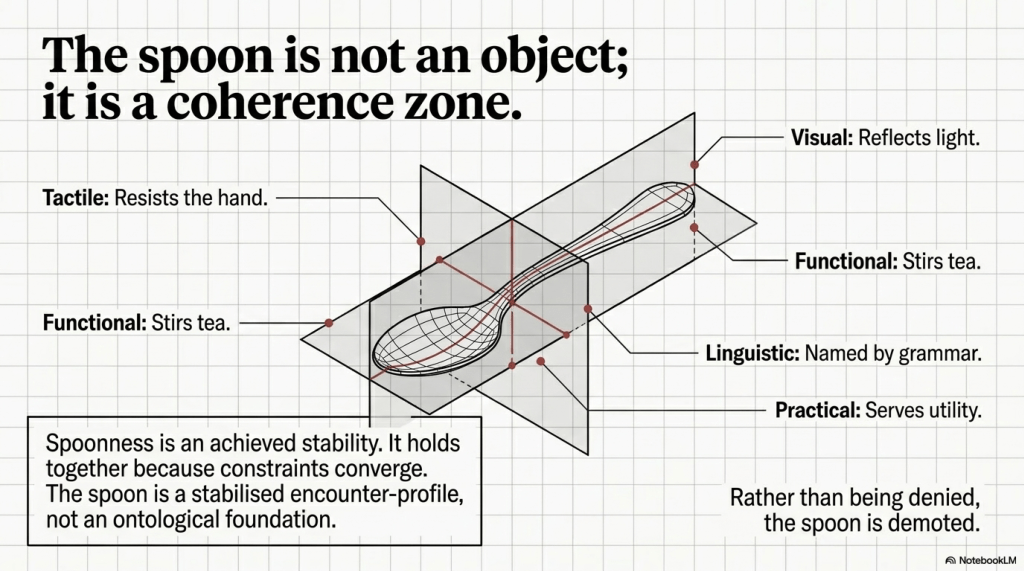
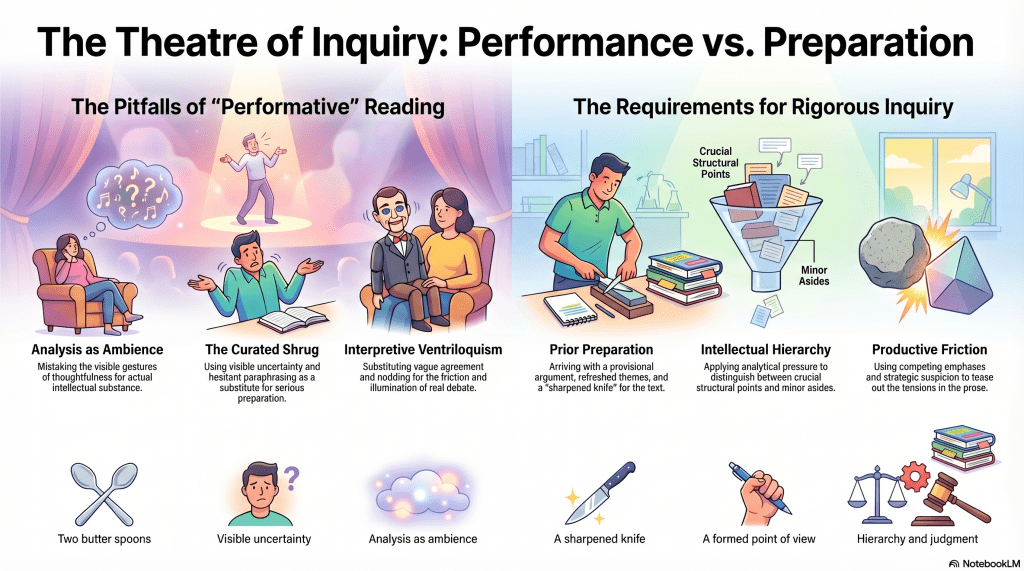
NotebookLM Infographic on this topic. To be honest, I am including this because I find it to be humorous.
To be fair, even when they did read from the chat, they handled those comments much as they handled Nietzsche: superficially, without much analytical pressure, as though any sentence placed before them deserved the same tone of vague consideration. This flattening effect was revealing. It suggested not generosity but a lack of discrimination. A close reading requires hierarchy, emphasis, and judgement. One must be able to say: this is a crucial phrase; this term matters; this apparent aside is actually structural; this comment in the chat opens something worth pursuing; that one does not. Without such judgement, everything becomes equally interesting, which is another way of saying that nothing really is.
What emerged, then, was not close reading but the theatre of close reading. The ritual gestures were all in place: slow pace, sentence-by-sentence attention, occasional lexical speculation, the performance of thoughtfulness. But the substance was strangely absent. One had the form of seriousness without much seriousness of form. It was analysis as ambience.
This points to a broader problem in online intellectual culture. Much of it now confuses exposure with engagement. To read a difficult text aloud is not yet to wrestle with it. To host a discussion is not yet to lead one. To hesitate publicly is not yet to think. Somewhere along the line, people began mistaking the visible performance of inquiry for inquiry itself. The result is a style of pseudo-seriousness in which the host need not know very much, so long as he can sound tentative in the correct register.
Nietzsche, of all people, deserves better than that. He is not an author who yields his force to the merely dutiful or the casually adjacent. He requires energy, suspicion, historical feel, and the willingness to risk a reading. One need not become a priest of correctness. But one should at least bring a sharpened knife to the table, rather than two butter spoons and a podcast voice.
What disappointed me, then, was not simply that these hosts stumbled. Everyone stumbles with Nietzsche. It was that the stumbling seemed to be the content. No deep framework, no clear prior preparation, little tension between the readers, and scant engagement with the audience. The whole affair felt less like a serious encounter with Beyond Good and Evil than a performance of cultural literacy: a way of being seen near an important book.
And perhaps that is the real irritation. One expects difficulty. One can even forgive error. What is harder to forgive is the peculiar modern tendency to make a spectacle of one’s underpreparedness and call it interpretation.
To be fair, I later learned that the co-host was not a philosopher by training but came from Literature. That in itself is no objection. Indeed, a pairing like that could have worked very well. Nietzsche is precisely the sort of writer who benefits from both conceptual and stylistic scrutiny. A philosopher can situate the argument, trace its targets, and identify the intellectual inheritance under pressure. A literary reader can pick up tone, irony, rhetorical staging, and the peculiar way Nietzsche so often performs thought rather than merely stating it.
The problem, then, was not the pairing but the execution. The session might have worked if both hosts had prepared properly and if each had leaned into his own strength. Instead, what emerged was a flatter sort of exchange, with the philosopher soliciting the literary co-host’s ‘opinion’ on semantic content as though interpretive adequacy were simply a matter of free-floating textual impressions. What was missing was any real division of labour, any methodological self-awareness, or any sense that different competences might illuminate different aspects of the text.
I Am a Qualified Subjectivist. No, That Does Not Mean ‘Anything Goes’.
Make no mistake: I am a subjectivist. A qualified one. Not that kind of qualified – the qualification matters, but it’s rarely the part anyone listens to.
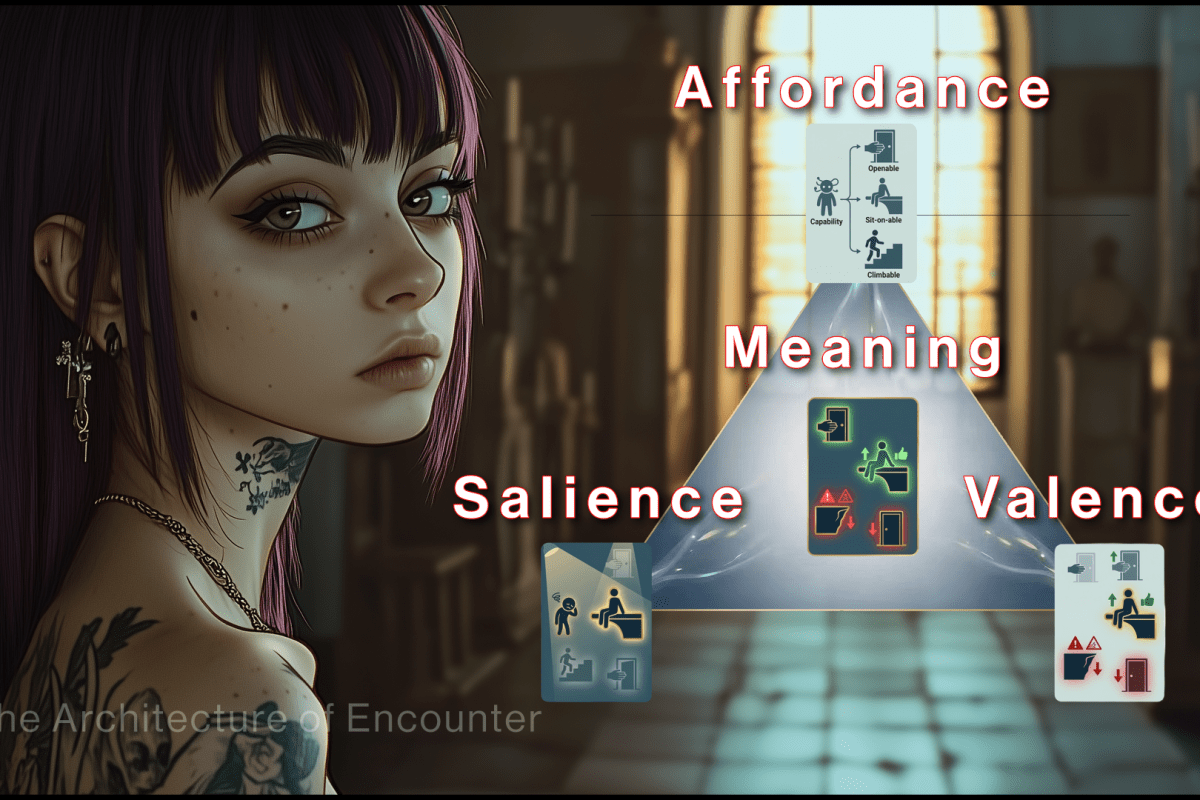
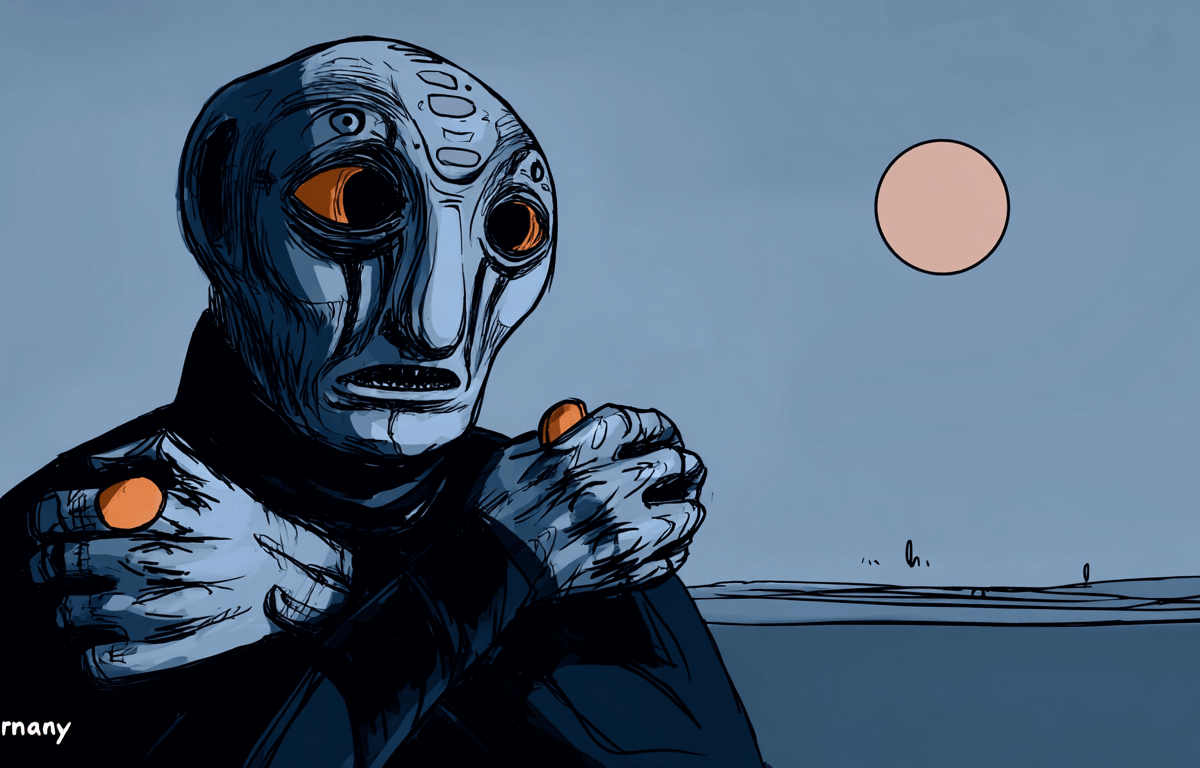
Image: Not that kind…
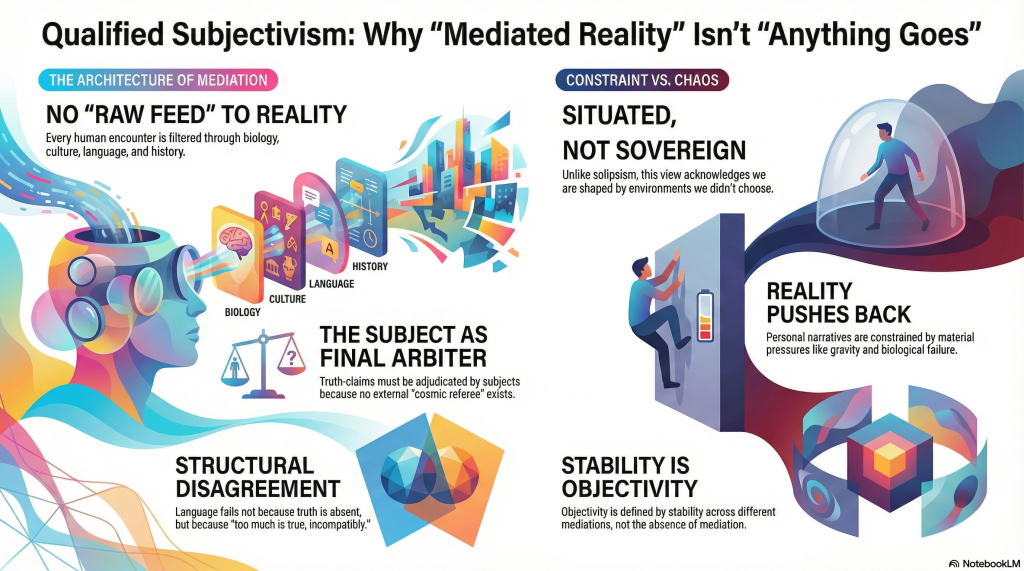
Here is the unglamorous starting point: all human encounters with the world are mediated. There is no raw feed. No unfiltered access. No metaphysical lead running directly from ‘reality’ into the human mind. Every encounter is processed through bodies, nervous systems, cultures, languages, technologies, institutions, and histories.
Audio: NotebookLM summary podcast of this content – See addendum below.
Whilst I discuss the specific architecture of this mediation at length in this preprint, here I will keep it simple.
If you are human, you do not encounter reality as such. You encounter it as processed. This is not controversial. What is controversial is admitting the obvious consequence: the subject is the final arbiter.
Image: NotebookLM Infographic of Qualified Subjectivism
The Subject Is the Final Arbiter
Every account of truth, reality, meaning, value, or fact is ultimately adjudicated by a subject. Not because subjects are sovereign gods, but because there is literally no other place adjudication can occur.
Who, exactly, do critics imagine is doing the adjudicating instead? A neutral tribunal floating outside experience? A cosmic referee with a clipboard? A universal consciousness we all forgot to log into?
There is no one else.
This does not mean that truth is ‘whatever I feel like’. It means that truth-claims only ever arrive through a subject, even when they are heavily constrained by the world. And constraint matters. Reality pushes back. Environments resist. Bodies fail. Gravity does not care about your personal narrative.
Why This Is Not Solipsism
Solipsism says: only my mind exists. That is not my claim. My claim is almost boring by comparison: subjects are situated, not sovereign.
We are shaped by environments we did not choose and histories we did not write. Mediation does not eliminate reality; it is how reality arrives. Your beliefs are not free-floating inventions; they are formed under biological, social, and material pressure. Two people can be exposed to the same event and encounter it differently because the encounter is not the event itself – it is the event as mediated through a particular orientation.
Why Objectivity Keeps Sneaking Back In
At this point, someone usually says: ‘But surely some things are objectively true.’
Yes. And those truths are still encountered subjectively. The mistake is thinking that objectivity requires a ‘view from nowhere’. It doesn’t. It requires stability across mediations, not the elimination of mediation altogether. We treat some claims as objective because they hold up under variation, while others fracture immediately. But in all cases, the encounter still happens somewhere, to someone.
The Real Source of the Panic
The real anxiety here is not philosophical. It’s moral and political. People are terrified that if we give up the fantasy of unmediated access to universal truth, then legitimacy collapses and ‘anything goes’.
This is a category error born of wishful thinking. What actually collapses is the hope that semantic convergence is guaranteed. Once you accept that mediation is unavoidable, you are forced to confront a harder reality: disagreement is often structural, not corrigible. Language does not fail because nothing is true. Language fails because too much is true, incompatibly.
So Yes, I Am a Qualified Subjectivist
Interpretation only ever occurs through subjects. Subjects are always mediated. Mediation is always constrained. And constraint does not guarantee convergence.
That is the position. It is not radical, fashionable, or comforting. It is simply what remains once you stop pretending there is a god’s-eye view quietly underwriting your arguments. Discomfort is simply a reliable indicator that a fantasy has been disturbed.
Addendum: Geworfenheit and the Myth of the Neutral Subject
Audio: NotebookLM summary of this Geworfenheit addendum
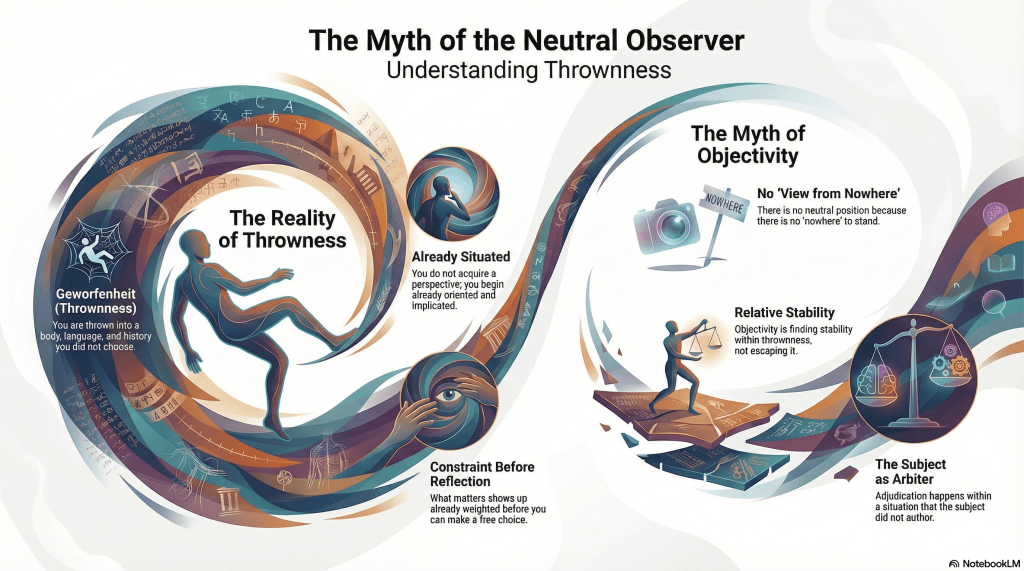
If all this sounds suspiciously familiar, that’s because it is. Heidegger had a word for it: Geworfenheit – usually translated as thrownness.
The idea is simple, and deeply irritating to anyone still hoping for a clean start. You do not enter the world as a neutral observer. You are thrown into it: into a body, a language, a culture, a history, a set of institutions, a moment you did not choose. You do not begin from nowhere and then acquire a perspective. You begin already situated, already oriented, already implicated.
This is not a poetic flourish. It is a structural claim about human existence.
Image: Another NotebookLM infographic for the fun of it.
What my qualified subjectivism insists on – without Heidegger’s ontological theatre – is the same basic constraint: there is no view from nowhere because there is no nowhere to stand. The subject does not float above mediation; the subject is constituted by it. Thrownness is not an accident to be corrected by better theory. It is the condition under which any theorising occurs at all.
Seen this way, the demand for pure objectivity starts to look less like a philosophical ideal and more like nostalgia for an impossible innocence. A wish to rewind existence to a point before bodies, languages, power, and history got involved. That point never existed.
Geworfenheit matters here because it dissolves the caricature that subjectivism is about arbitrary choice. Being thrown is the opposite of choosing freely. It is constraint before reflection. Orientation before argument. Salience before reasons. You do not decide what matters from a neutral menu; what matters shows up already weighted, already charged, already resistant.
This is why appeals to “just be objective” always ring hollow. Objectivity does not mean escaping thrownness. It means achieving relative stability within it. Some claims hold across many thrown positions. Others fracture immediately. That distinction matters. But none of it happens outside mediation.
So when I say the subject is the final arbiter, I am not crowning the subject king of reality. I am pointing out the obvious: adjudication happens somewhere, to someone, from within a situation they did not author. Thrownness guarantees that there is no cosmic referee waiting to overrule the encounter.
If that makes you uncomfortable, good. It should. Discomfort is often just the sensation of a fantasy losing its grip.
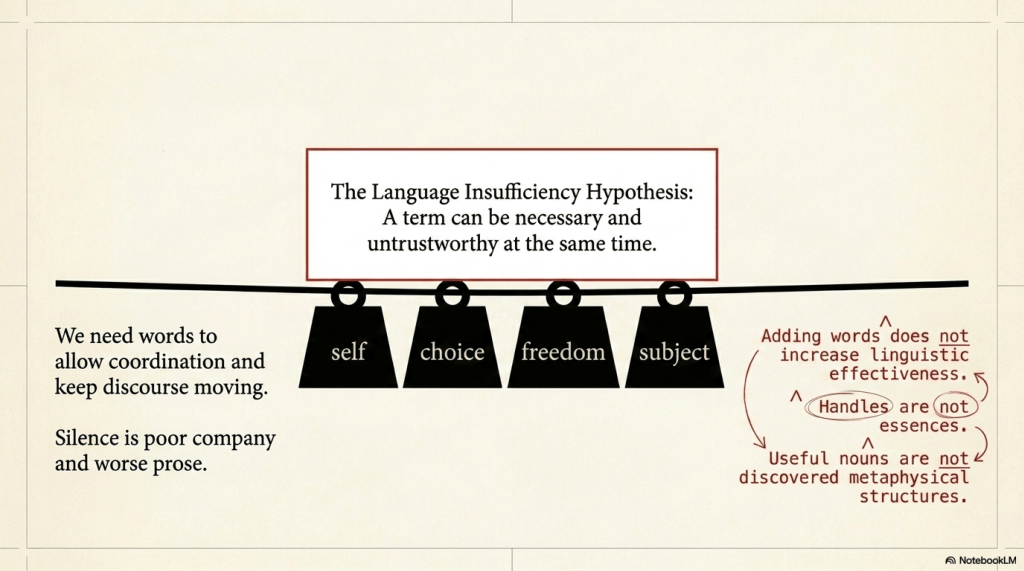
As the publication date of A Language Insufficiency Hypothesis (LIH) draws nearer, I feel it’s a good time to promote it (obviously) and to introduce some of the problems it uncovers – including common misperceptions I’ve already heard. Through this feedback, I now understand some of the underlying structural limitations that I hadn’t considered, but this only strengthens my position. As I state at the start of the book, the LIH isn’t a cast-in-stone artefact. Other discoveries will inevitably be made. For now, consider it a way to think about the deficiencies of language, around which remediation strategies can be developed.
Audio: NotebookLM summary podcast of this content.
Let’s clear the undergrowth first. The Language Insufficiency Hypothesis is not concerned with everyday ambiguity, garden-variety polysemy, or the sort of misunderstandings that vanish the moment someone bothers to supply five seconds of context. That terrain is already well-mapped, thoroughly fenced, and frankly dull.
Take the classic sort of example wheeled out whenever someone wants to sound clever without doing much work:
‘I made a 30-foot basket’.
Video: a woman making a large basket
If you’re a basketweaver, you picture an absurdly large basket and quietly question the maker’s life choices. If you’re watching basketball, you hear ‘score’. If you’re anywhere near the context in which the sentence was uttered, the meaning is obvious. If it isn’t, the repair cost is trivial. Add context, move on, live your life.
Language did not fail here. It merely waited for its coat. This is not the sort of thing the LIH loses sleep over.
The Groucho Marx Defence, or: Syntax Is Not the Problem
Logicians and armchair philosophers love to reach for jokes like Groucho Marx’s immortal line:
‘I shot an elephant in my pyjamas. Why it was wearing my pyjamas, I’ll never know’.
Video: A man and elephant in pyjamas (no sound)
Yes, very funny. Yes, the sentence allows for a syntactic misreading. No, nobody actually believes the elephant was lounging about in striped silk. The humour works precisely because the “wrong” parse is momentarily entertained and instantly rejected.
Again, language is not insufficient here. It’s mischievous. There’s a difference.
If the LIH were worried about this sort of thing, its ambitions would be indistinguishable from an undergraduate logic textbook with better branding.
Banks, Rivers, and the Myth of Constant Confusion
Likewise, when someone in a city says, ‘I went to the bank’, no sane listener imagines them strolling along a riverbank, unless they are already knee-deep in pastoral fantasy or French tourism brochures. Context does the heavy lifting. It almost always does.
Video: Rare footage of me trying to withdraw funds at my bank (no sound)
This is not a crisis of meaning. This is language functioning exactly as advertised.
Where the Trouble Actually Starts: Contestables
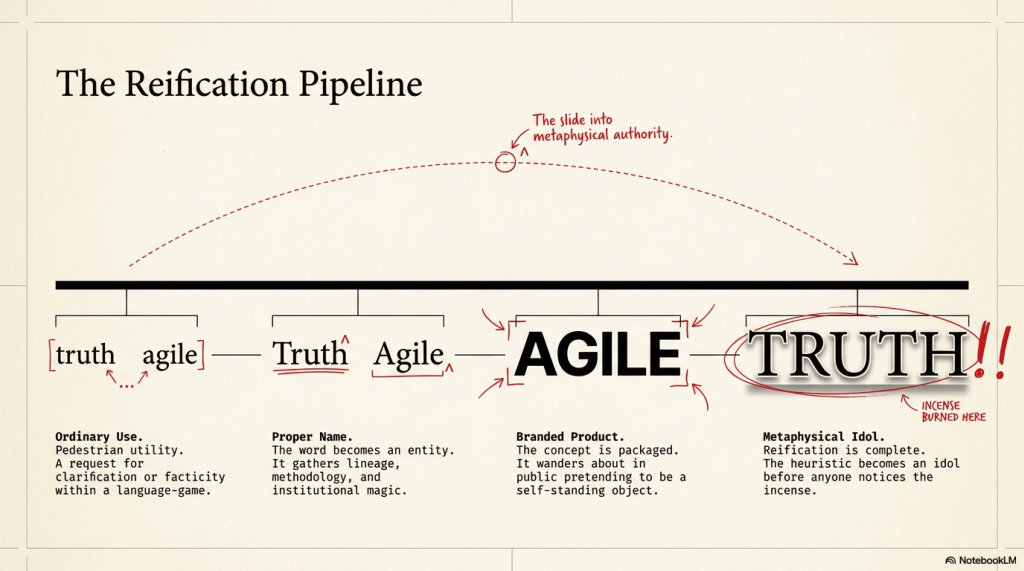
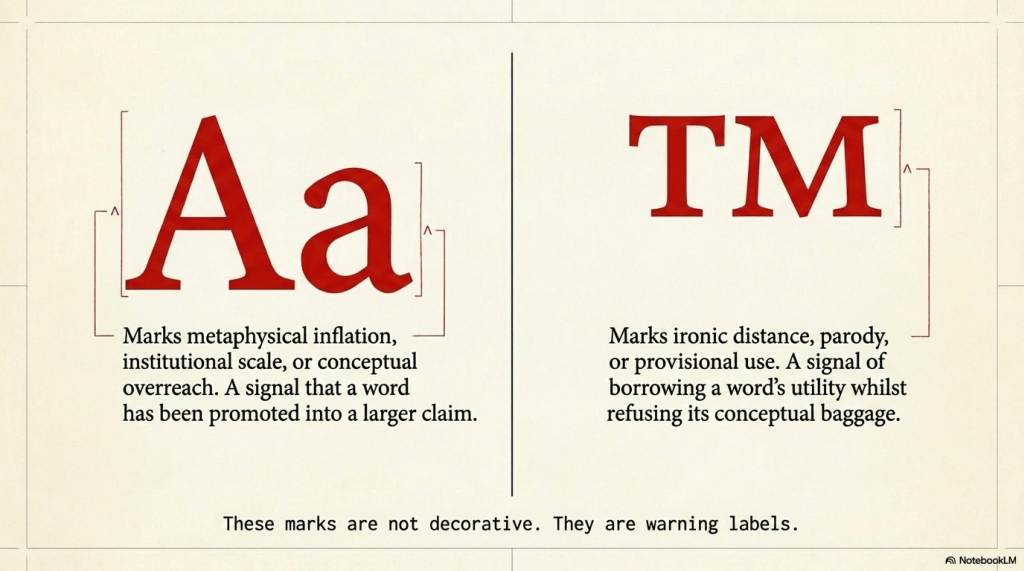
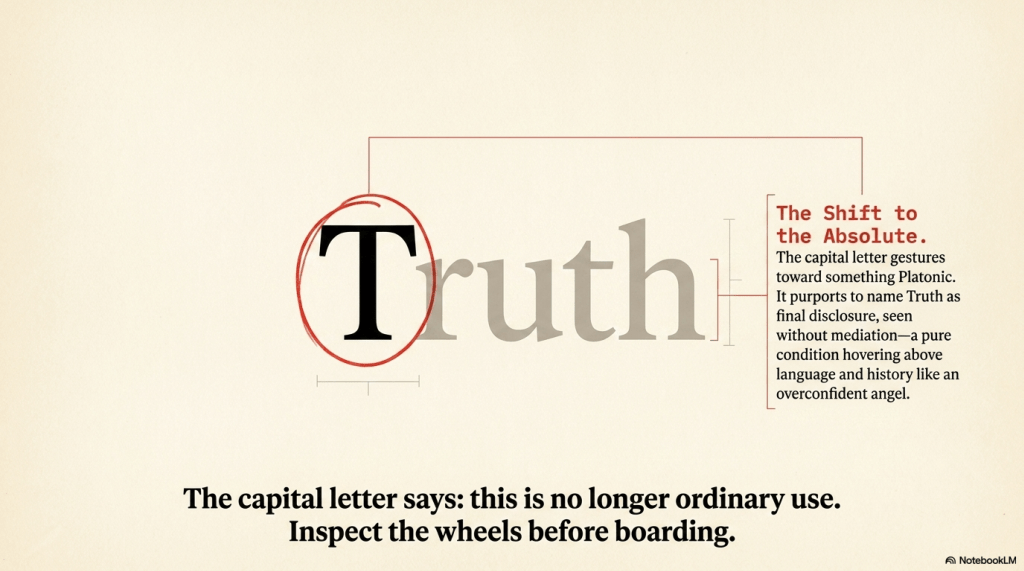
The LIH begins where these tidy examples stop being helpful. It concerns itself with Contestables: terms like truth, freedom, justice, fairness, harm, equality. Words that look stable, behave politely in sentences, and then detonate the moment you ask two people what they actually mean by them. These are not ambiguous in the casual sense. They are structurally contested.
In political, moral, and cultural contexts, different groups use the same word to gesture at fundamentally incompatible conceptual frameworks, all while assuming a shared understanding that does not exist. The conversation proceeds as if there were common ground, when in fact there is only overlap in spelling.
That’s why attempts to ‘define’ these terms so often collapse into accusation:
That’s not what freedom means. That’s not real justice. You’re redefining truth.
No, the definitions were never shared in the first place. The disagreement was smuggled in with the noun.
‘Just Ignore the Word’ Is Not a Rescue
A common response at this point is to suggest that we simply bypass the troublesome term and discuss the concrete features each party associates with it. Fine. Sensible. Often productive. But notice what this manoeuvre concedes. It does not save the term. It abandons it.
If meaningful discussion can only proceed once the word is set aside and replaced with a list of clarifications, constraints, examples, and exclusions, then the word has already failed at its primary job: conveying shared meaning. This is precisely the point the LIH is making.
The insufficiency is not that language is vague, or flexible, or context-sensitive. It’s that beyond a certain level of conceptual complexity, language becomes a confidence trick. It gives us the feeling of agreement without the substance, the appearance of communication without the transaction.
At that point, words don’t merely underperform. They mislead.
I shared this post not too long ago. Today, I shared it in a different context, but I feel is interesting – because I feel that many things are interesting, especially around language and communication.
Ocrampal shared a link to an article debating whether we are cold or have cold. Different cultures express this differently. It’s short. Read it on his site.
Audio: Exceptional NotebookLM summary podcast of this topic.
I replied to the post:
Nicely observed. I’ve pondered this myself. Small linguistic tweak: between être and avoir, avoir already behaves better metaphysically, but sentir seems the cleanest fit. Cold isn’t something one is or has so much as something one senses — a relational encounter rather than an ontological state or possession.
Between having and being, having is the lesser sin — but sensing/feeling feels truer. Cold belongs to the world; we merely sense it.
He replied in turn:
Agree except for: “Cold belongs to the world”. That is a metaphysical assumption that has consequences …
Finally (perhaps, penultimately), I responded:
Yes, it does. That statement was idiomatic, to express that ‘cold’ is environmental; we can’t be it or possess it. Coincidentally, I recently wrote about ‘cold’ in a different context:
A more verbose version of this response might have been:
This pushback is fair, but I’m not trying to re-ontologise cold. “Belongs to the world” in that context is doing rhetorical, not metaphysical, work; it’s idiomatic.
The point isn’t that cold is a mind-independent substance waiting around like a rock. It’s that whatever cold is, it doesn’t sit comfortably as an identity predicate (‘I am…cold’ – ‘J’ai…froid‘) or a possession (‘I have…cold’ – so, not ‘Je suis…froid‘) – neither to be confused with ‘I have a cold’, a different animal altogether.
‘Sensing’ (‘I feel…cold’ – ‘Je me sens…froid‘ – we have to use the reflexive pronoun, me, here; in English, this syntax has been deprecated) keeps the relation explicit without smuggling in ownership or essence. It leaves cold as an encounter-property, not a thing I contain and not a thing I am.
If anything, that phrasing was meant to resist metaphysical inflation, not commit to it.
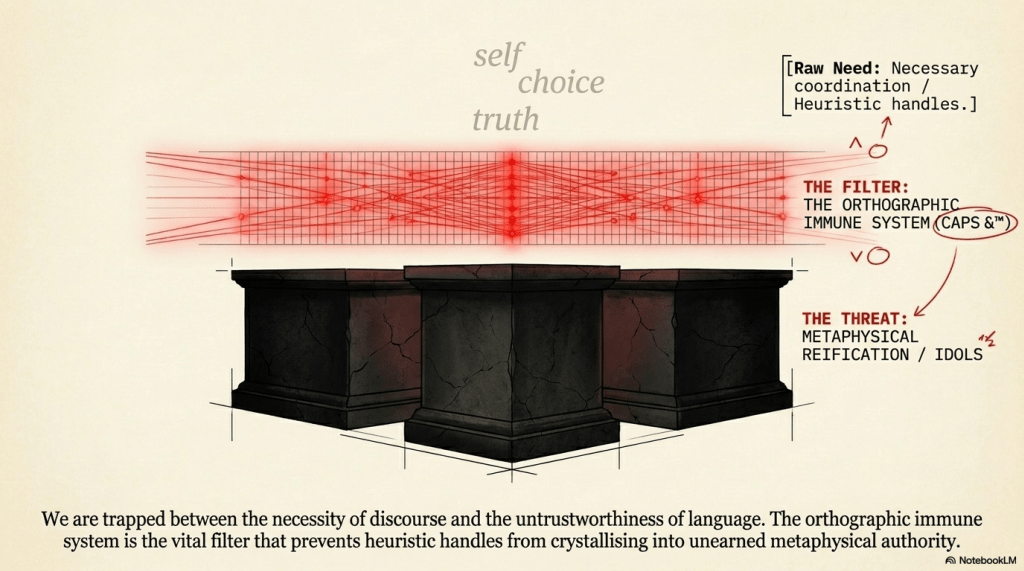
And this is exactly the problem I gestured at in the aliens piece. We mistake familiar grammatical scaffolding for shared metaphysics. We assume that if the sentence parses cleanly, the ontology must be sound.
Language doesn’t just describe experience. It quietly files it into categories and then acts surprised when those categories start making demands.
Cold, like aliens, exposes the trick. The moment you slow down, the grammar starts to wobble. And that wobble is doing far more philosophical work than most of our declarative sentences are willing to admit.
Naturally, it will make more sense alongside the book. But it may still provide a bit of entertainment – and mild discomfort – in the meantime.
tl;dr: Language is generally presumed to be stable. Words mean what you think they mean, right? A table is a table. A bird is a bird. Polysemy aside, these are solid, dependable units.
Then we arrive at freedom, justice, truth, and an entire panoply of unstable candidates. And let’s not even pretend qualia are behaving themselves.
So when someone says ‘truth’, ‘free speech’, or ‘IQ’, you may suddenly realise you’ve been arguing with a cardboard cut-out wearing your own assumptions. That isn’t just interpersonal mischief. It’s language doing exactly what it was designed to do: letting you glide over the hard problems while sounding perfectly reasonable.
Audio: Short NotebookLM summary of this page content*
Video: Legacy video explaining some features of the LIH.
If that sounds banal, you’ve already fallen for the trap.
Give it a try – or wait until you’ve digested the book. Not literally, unless you’re short on fibre.
Cheers.
Written by Bry Willis
Philosophics
* As I’ve cited previously, the quality of NotebookLM varies – usually in predictable directions. This one does well enough, but it doesn’t have enough context to get the story right (because it was only drawing from this page rather than from a fuller accounting of the LIH). Its trailing comment reveals that it doesn’t grasp that “new words” don’t solve the problem.
Earlier, it suggests that language is intentionally vague. This is not an assertion I make. You can read some of the earlier incarnations, or you can wait for it to be published.
I’m a nihilist. Possibly always have been. But let’s get one thing straight: nihilism is not despair. That’s a slander cooked up by the Meaning Merchants – the sentimentalists and functionalists who can’t get through breakfast without hallucinating some grand purpose to butter their toast. They fear the void, so they fill it. With God. With country. With yoga.
Audio: NotebookLM podcast on this topic.
Humans are obsessed with function. Seeing it. Creating it. Projecting it onto everything, like graffiti on the cosmos. Everything must mean something. Even nonsense gets rebranded as metaphor. Why do men have nipples? Why does a fork exist if you’re just going to eat soup? Doesn’t matter – it must do something. When we can’t find this function, we invent it.
But function isn’t discovered – it’s manufactured. A collaboration between our pattern-seeking brains and our desperate need for relevance, where function becomes fiction, where language and anthropomorphism go to copulate. A neat little fiction. An ontological fantasy. We ask, “What is the function of the human in this grand ballet of entropy and expansion?” Answer: there isn’t one. None. Nada. Cosmic indifference doesn’t write job descriptions.
And yet we prance around in lab coats and uniforms – doctors, arsonists, firemen, philosophers – playing roles in a drama no one is watching. We build professions and identities the way children host tea parties for dolls. Elaborate rituals of pretend, choreographed displays of purpose. Satisfying? Sometimes. Meaningful? Don’t kid yourself.
We’ve constructed these meaning-machines – society, culture, progress – not because they’re real, but because they help us forget that they’re not. It’s theatre. Absurdist, and often bad. But it gives us something to do between birth and decomposition.
Sisyphus had his rock. We have careers.
But let’s not confuse labour for meaning, or imagination for truth. The boulder never reaches the top, and that’s not failure. That’s the show.
So roll the stone. Build the company. Write the blog. Pour tea for Barbie. Just don’t lie to yourself about what it all means.
“Is the universe really infinite? Or could it loop back on itself like a sphere?” Sabine Hossenfelder’s words on the nature of space-time are arresting, not merely for the cosmological implications but for the deeper metaphor they offer. They strike a resonant chord with anyone wrestling with a different kind of infinite: the slippery expanse of language.
As Sabine walks us through the intricacies of curved space-time, she inadvertently shines a light on something equally abstract yet close to home—how language, like the universe, seems vast and unbounded but is, in practice, riddled with constraints. What if language itself, for all its apparent openness, is its own kind of finite geometry?
Drawing on my Language Insufficiency Hypothesis (LIH), I propose that Sabine’s insights into cosmology can offer a lens to explore the paradoxes of human communication. Language, like space-time, is internally defined, replete with loops, and prone to infinite configurations that fail to expand meaningfully. Let’s explore how the universe’s curvature mirrors the curvatures of our words.
The Closed Systems of Space and Language
In physics, the curvature of space-time is measured internally. You can determine if space is flat or curved by drawing a triangle and adding its angles. If they don’t sum to 180 degrees, you’re in curved space. Sabine highlights that this is true without any external reference point; the geometry is self-contained.
Language operates much the same way. Words and meanings are often bounded by the internal logic of the systems they inhabit—be they legal, technical, or ideological. Much like the curvature of space-time, linguistic meaning is determined not externally but within the context of its own closed system. Think of a term like “justice”: in a legal setting, it might add up to one interpretation, while in a political debate, its angles skew wildly. To an outsider, the system is opaque, even though it seems perfectly flat from within.
Infinite Expanses or Finite Loops?
Sabine explains that the universe might be infinite, but it might also loop back on itself, creating patterns of repetition. Her analogy of light travelling endlessly through a curved universe only to return to its origin provides a striking metaphor for language’s “effectiveness horizons.”
As concepts grow more abstract—freedom, truth, beauty—language seems to expand infinitely. But in practice, it often circles back, repeating itself in kaleidoscopic loops of contested meaning. Philosophers have debated terms like “good” or “justice” for millennia, yet here we are, still tracing the same paths, unable to break free from the system’s internal constraints. Language doesn’t expand into new meaning; it curves back on itself.
Schrödinger’s Words: Infinite Interpretations
One of Sabine’s most evocative ideas is the notion that in an infinite universe, there are infinite copies of you, some slightly different, some wildly so. A version of you with more hair. One with less brain. This multiplicity mirrors what I call Schrödinger’s Weasels: words that exist in multiple, contradictory states until “collapsed” by context.
Take a word like “freedom.” In political discourse, it can simultaneously mean the right to self-determination, freedom from government interference, or the economic liberty to exploit markets. Much like Sabine’s infinite configurations, these meanings coexist until someone forces them into a single interpretive frame. The result? Semantic exhaustion. A single word tries to carry the weight of an infinite universe.
The Precision Paradox
Sabine notes that asking what the universe expands into is a meaningless question because expansion describes relationships within space-time, not beyond it. Similarly, the pursuit of perfect precision in language often collapses into meaninglessness. Trying to pin down a word like “justice” leads to endless definitions, each requiring further clarification. It’s a Zeno’s paradox of semantics: the closer we get to precision, the more distance remains.
Lessons from Curved Space and Twisted Words
What does this tell us about the limits of language? Sabine’s insights reinforce the idea that complexity doesn’t always lead to clarity. Like the universe, language isn’t infinite in the way we might wish; it’s bounded by its own structure. The more abstract the concept, the greater the chance we’ll find ourselves lost in a linguistic loop, navigating words that seem to expand but merely repeat.
Understanding this doesn’t mean abandoning the pursuit of meaning but accepting its constraints. Just as cosmologists use models to map the unobservable edges of the universe, we can use frameworks like the Language Insufficiency Hypothesis to chart the limits of our words. Both efforts are acts of humility in the face of infinite complexity.
Closing Thought
If Sabine is right that there are infinitely many versions of ourselves in the universe, perhaps one of them has already solved the riddle of language. Or, more likely, they’ve just found a new loop to wander.
What do you think? Is language a closed system, forever folding back on itself? Or can we stretch it, like space-time, to infinity and beyond?
I’ve written a lot on the insufficiency of language, and it’s not even an original idea. Language, our primary tool for sharing thoughts and ideas, harbours a fundamental flaw: it’s inherently insufficient for conveying precise meaning. While this observation isn’t novel, recent developments in artificial intelligence provide us with new ways to illuminate and examine this limitation. Through a progression from simple geometry to complex abstractions, we can explore how language both serves and fails us in different contexts.
Audio: NotebookLM summary podcast of this topic.
The Simple Made Complex
Consider what appears to be a straightforward instruction: Draw a 1-millimetre square in the centre of an A4 sheet of paper using an HB pencil and a ruler. Despite the mathematical precision of these specifications, two people following these exact instructions would likely produce different results. The variables are numerous: ruler calibration, pencil sharpness, line thickness, paper texture, applied pressure, interpretation of ‘centre’, and even ambient conditions affecting the paper.
This example reveals a paradox: the more precisely we attempt to specify requirements, the more variables we introduce, creating additional points of potential divergence. Even in mathematics and formal logic—languages specifically designed to eliminate ambiguity—we cannot escape this fundamental problem.
Precision vs Accuracy: A Useful Lens
The scientific distinction between precision and accuracy provides a valuable framework for understanding these limitations. In measurement, precision refers to the consistency of results (how close repeated measurements are to each other), while accuracy describes how close these measurements are to the true value.
Returning to our square example:
Precision: Two people might consistently reproduce their own squares with exact dimensions
Accuracy: Yet neither might capture the ‘true’ square we intended to convey
As we move from geometric shapes to natural objects, this distinction becomes even more revealing. Consider a maple tree in autumn. We might precisely convey certain categorical aspects (‘maple’, ‘autumn colours’), but accurately describing the exact arrangement of branches and leaves becomes increasingly difficult.
The Target of Meaning: Precision vs. Accuracy in Communication
To understand language’s limitations, we can borrow an illuminating concept from the world of measurement: the distinction between precision and accuracy. Imagine a target with a bullseye, where the bullseye represents perfect communication of meaning. Just as archers might hit different parts of a target, our attempts at communication can vary in both precision and accuracy.
Consider four scenarios:
Low Precision, Low Accuracy When describing our autumn maple tree, we might say ‘it’s a big tree with colourful leaves’. This description is neither precise (it could apply to many trees) nor accurate (it misses the specific characteristics that make our maple unique). The communication scatters widely and misses the mark entirely.
High Precision, Low Accuracy We might describe the tree as ‘a 47-foot tall maple with exactly 23,487 leaves displaying RGB color values of #FF4500’. This description is precisely specific but entirely misses the meaningful essence of the tree we’re trying to describe. Like arrows clustering tightly in the wrong spot, we’re consistently missing the point.
Low Precision, High Accuracy ‘It’s sort of spreading out, you know, with those typical maple leaves turning reddish-orange, kind of graceful looking.’ While imprecise, this description might actually capture something true about the tree’s essence. The arrows scatter, but their centre mass hits the target.
High Precision, High Accuracy This ideal state is rarely achievable in complex communication. Even in our simple geometric example of drawing a 1mm square, achieving both precise specifications and accurate execution proves challenging. With natural objects and abstract concepts, this challenge compounds exponentially.
The Communication Paradox
This framework reveals a crucial paradox in language: often, our attempts to increase precision (by adding more specific details) can actually decrease accuracy (by moving us further from the essential meaning we’re trying to convey). Consider legal documents: their high precision often comes at the cost of accurately conveying meaning to most readers.
Implications for AI Communication
This precision-accuracy framework helps explain why AI systems like our Midjourney experiment show asymptotic behaviour. The system might achieve high precision (consistently generating similar images based on descriptions) while struggling with accuracy (matching the original intended image), or vice versa. The gap between human intention and machine interpretation often manifests as a trade-off between these two qualities.
Our challenge, both in human-to-human and human-to-AI communication, isn’t to achieve perfect precision and accuracy – a likely impossible goal – but to find the optimal balance for each context. Sometimes, like in poetry, low precision might better serve accurate meaning. In other contexts, like technical specifications, high precision becomes crucial despite potential sacrifices in broader accuracy.
The Power and Limits of Distinction
This leads us to a crucial insight from Ferdinand de Saussure’s semiotics about the relationship between signifier (the word) and signified (the concept or object). Language proves remarkably effective when its primary task is distinction among a limited set. In a garden containing three trees – a pine, a maple, and a willow – asking someone to ‘point to the pine’ will likely succeed. The shared understanding of these categorical distinctions allows for reliable communication.
However, this effectiveness dramatically diminishes when we move from distinction to description. In a forest of a thousand pines, describing one specific tree becomes nearly impossible. Each additional descriptive detail (‘the tall one with a bent branch pointing east’) paradoxically makes precise identification both more specific and less likely to succeed.
An AI Experiment in Description
To explore this phenomenon systematically, I conducted an experiment using Midjourney 6.1, a state-of-the-art image generation AI. The methodology was simple:
Generate an initial image
Describe the generated image in words
Use that description to generate a new image
Repeat the process multiple times
Attempt to refine the description to close the gap
Continue iterations
The results support an asymptotic hypothesis: while subsequent iterations might approach the original image, they never fully converge. This isn’t merely a limitation of the AI system but rather a demonstration of language’s fundamental insufficiency.
A cute woman and her dog stand next to a tree
One can already analyse this for improvements, but let’s parse it together.
a cute woman
With this, we know we are referencing a woman, a female of the human species. There are billions of women in the world. What does she look like? What colour, height, ethnicity, and phenotypical attributes does she embody?
We also know she’s cute – whatever that means to the sender and receiver of these instructions.
I used an indefinite article, a, so there is one cute woman. Is she alone, or is she one from a group?
It should be obvious that we could provide more adjectives (and perhaps adjectives) to better convey our subject. We’ll get there, but let’s move on.
and
We’ve got a conjunction here. Let’s see what it connects to.
her dog
She’s with a dog. In fact, it’s her dog. This possession may not be conveyable or differentiable from some arbitrary dog, but what type of dog is it? Is it large or small? What colour coat? Is it groomed? Is it on a leash? Let’s continue.
stand
It seems that the verb stand refers to the woman, but is the dog also standing, or is she holding it? More words could qualify this statement better.
next to a tree
A tree is referenced. Similar questions arise regarding this tree. At a minimum, there is one tree or some variety. She and her dog are next to it. Is she on the right or left of it?
We think we can refine our statements with precision and accuracy, but can we? Might we just settle for “close enough”?
Let’s see how AI interpreted this statement.
Image: Eight Midjourney renders from the prompt: A cute woman and her dog stand next to a tree. I’ll choose one of these as my source image.
Let’s deconstruct the eight renders above. Compositionally, we can see that each image contains a woman, a dog, and a tree. Do any of these match what you had in mind? First, let’s see how Midjourney describes the first image.
In a bout of hypocrisy, Midjourney refused to /DESCRIBE the image it just generated.
Last Midjourney description for now.
Let’s cycle through them in turn.
A woman is standing to the left of an old-growth tree – twice identified as an oak tree. She’s wearing faded blue jeans and a loose light-coloured T-shirt. She’s got medium-length (maybe) red-brown hair in a small ponytail. A dog – her black and white dog identified as a pitbull, an American Foxhound, and an American Bulldog – is also standing on his hind legs. I won’t even discuss the implied intent projected on the animal – happy, playful, wants attention… In two of the descriptions, she’s said to be training it. They appear to be in a somewhat residential area given the automobiles in the background. We see descriptions of season, time of day, lighting, angle, quality,
A woman is standing to the right of an old-growth tree. She’s wearing short summer attire. Her dog is perched on the tree.
An older woman and her dog closer up.
A read view of both a woman and her dog near an oak tree.
As it turned out, I wasn’t thrilled with any of these images, so I rendered a different one. Its description follows.
The consensus is that ‘a beautiful girl in a white dress and black boots stands next to a tree’ with a Jack Russell Terrier dog. I see birch trees and snow. It’s overcast. Let’s spend some time trying to reproduce it. To start, I’m consolidating the above descriptions. I notice some elements are missing, but we’ll add them as we try to triangulate to the original image.
A beautiful girl in a white dress and black boots stands next to a tree in a winter forest with birch trees. A Jack Russell Terrier dog is nearby, and the weather is cloudy. The photo has a cinematic style. --ar 128:71
This is pretty far off the mark. We need to account for the overall setting and composition, relative positioning, clothing, hair, camera, perspective – even lighting and film emulsion.
Let’s see how we can refine it with some adjectives. Before this, I asked Anthropic’s Claude 3.5 to describe the image. Perhaps we’ll get more details.
An atmospheric winter photograph was taken in what appears to be a birch and pine forest. The ground is partially covered with snow, creating a patchy pattern of white snow and brown leaves or soil. In the image, there's a person wearing winter attire consisting of a white knit turtleneck sweater, a white skirt, dark knee-high socks, and grey lace-up boots. They're standing against a large tree trunk with their arms crossed. Next to them is a Jack Russell Terrier mix dog with distinctive brown and white colouring. The dog appears to be well-behaved, sitting attentively beside the tree. The composition is quite striking, with the massive dark tree trunk serving as a central focal point against the misty, winter forest background. The white clothing of the person creates a visual echo with the white bark of birch trees visible in the background, as well as with the patches of snow on the ground. The overall mood of the photo is somewhat moody and contemplative, enhanced by what appears to be overcast lighting and the misty quality of the forest in the background. The colour palette is largely monochromatic, dominated by whites, greys, and browns, which adds to the winter atmosphere of the scene.
We don’t seem to be moving in a good direction. Let’s modify the initial prompt.
A beautiful girl in a white dress and tall laced black boots stands facing the camera to the right of large oak tree centred in the foreground of a winter forest with birch trees in the background. To the left of the tree is a Jack Russell Terrier dog looking at the camera, and the weather is cloudy. The photo has a cinematic style. --ar 128:71
I’ll allow the results to speak for themselves. Let’s see if we can’t get her out of the wedding gown and into a white jumper and skirt. I’ll bold the amends.
A beautiful girl in a white jumper and skirt wearing black leggings and tall laced black boots stands facing the camera to the right of large oak tree centred in the foreground of a winter forest with birch trees in the background. To the left of the tree is a Jack Russell Terrier dog looking at the camera, and the weather is cloudy. The photo has a cinematic style. --ar 128:71
s
A beautiful young woman with long brown hair pulled to the side of her face in a white jumper and white skirt wearing black leggings under tall laced black boots stands facing the camera to the right of large oak tree centred in the foreground of a winter forest with birch trees in the background. Patchy snow is on the ground. To the left of the tree is a Jack Russell Terrier dog looking at the camera, and the weather is overcast. The photo has a cinematic style. --ar 128:71
What gives?
I think my point has been reinforced. I’m getting nowhere fast. Let’s give it one more go and see where we end up. I’ve not got a good feeling about this.
A single large oak tree centred in the foreground of a winter forest with birch trees in the background. Patches of snow is on the ground. To the right of the oak tree stands a beautiful young woman with long brown hair pulled to the side of her face in a white jumper and white skirt wearing black boots over tall laced black boots. She stands facing the camera. To the left of the tree is a Jack Russell Terrier dog looking at the camera, and the weather is overcast. The photo has a cinematic style. --ar 128:71
With this last one, I re-uploaded the original render along with this text prompt. Notice that the girl now looks the same and the scene (mostly) appears to be in the same location, but there are still challenges.
After several more divergent attempts, I decided to focus on one element – the girl.
As I regard the image, I’m thinking of a police sketch artist. They get sort of close, don’t they? They’re experts. I’m not confident that I even have the vocabulary to convey accurately what I see. How do I describe her jumper? Is that a turtleneck or a high collar? It appears to be knit. Is is wool or some blend? does that matter for an image? Does this pleated skirt have a particular name or shade of white? It looks as though she’s wearing black leggings – perhaps polyester. And those boots – how to describe them. I’m rerunning just the image above through a describe function to see if I can get any closer.
These descriptions are particularly interesting and telling. First, I’ll point out that AI attempts to identify the subject. I couldn’t find Noa Levin by a Google search, so I’m not sure how prominent she might be if she even exists at all in this capacity. More interesting still, the AI has placed her in a scenario where the pose was taken after a match. Evidently, this image reflects the style of photographer Guy Bourdin. Perhaps the jumper mystery is solved. It identified a turtleneck. I’ll ignore the tree and see if I can capture her with an amalgamation of these descriptions. Let’s see where this goes.
A photo-realistic portrait of Israeli female soccer player Noa Levin wearing a white turtleneck sweater, arms crossed, black boots, and a short skirt, with long brown hair, standing near a tree in a winter park. The image captured a full-length shot taken in a studio setting, using a Canon EOS R5 camera with a Canon L-series 80mm f/2 lens. The image has been professionally color-graded, with soft shadows, low contrast, and a clean, sharp focus. --ar 9:16
Close-ish. Let’s zoom in to get better descriptions of various elements starting with her face and hair.
Now, she’s a sad and angry Russian woman with (very) pale skin; large, sad, grey eyes; long, straight brown hair. Filmed in the style of either David LaChapelle or Alini Aenami (apparently misspelt from Alena Aenami). One thinks it was a SnapChat post. I was focusing on her face and hair, but it notices her wearing a white (oversized yet form-fitting) jumper sweater and crossed arms .
I’ll drop the angry bit – and then the sad.
Stick a fork in it. I’m done. Perhaps it’s not that language is insufficient; it that my language skills are insufficient. If you can get closer to the original image, please forward the image, the prompt, and the seed, so I can post it.
The Complexity Gradient
A clear pattern emerges when we examine how language performs across different levels of complexity:
Categorical Distinction (High Success)
Identifying shapes among limited options
Distinguishing between tree species
Basic color categorization
Simple Description (Moderate Success)
Basic geometric specifications
General object characteristics
Broad emotional states
Complex Description (Low Success)
Specific natural objects
Precise emotional experiences
Unique instances within categories
Abstract Concepts (Lowest Success)
Philosophical ideas
Personal experiences
Qualia
As we move up this complexity gradient, the gap between intended meaning and received understanding widens exponentially.
The Tolerance Problem
Understanding these limitations leads us to a practical question: what level of communicative tolerance is acceptable for different contexts? Just as engineering embraces acceptable tolerances rather than seeking perfect measurements, perhaps effective communication requires:
Acknowledging the gap between intended and received meaning
Establishing context-appropriate tolerance levels
Developing better frameworks for managing these tolerances
Recognizing when precision matters more than accuracy (or vice versa)
Implications for Human-AI Communication
These insights have particular relevance as we develop more sophisticated AI systems. The limitations we’ve explored suggest that:
Some communication problems might be fundamental rather than technical
AI systems may face similar boundaries as human communication
The gap between intended and received meaning might be unbridgeable
Future development should focus on managing rather than eliminating these limitations
Conclusion
Perhaps this is a simple exercise in mental masturbation. Language’s insufficiency isn’t a flaw to be fixed but a fundamental characteristic to be understood and accommodated. By definition, it can’t be fixed. The gap between intended and received meaning may be unbridgeable, but acknowledging this limitation is the first step toward more effective communication. As we continue to develop AI systems and push the boundaries of human-machine interaction, this understanding becomes increasingly critical.
Rather than seeking perfect precision in language, we might instead focus on:
Developing new forms of multimodal communication
Creating better frameworks for establishing shared context
Accepting and accounting for interpretative variance
Building systems that can operate effectively within these constraints
Understanding language’s limitations doesn’t diminish its value; rather, it helps us use it more effectively by working within its natural constraints.