Self-help, pop psychology, LinkedIn, and the metaphysics smuggled into advice
Self-improvement books rarely begin by telling you what it believes a person is. That would be too honest, and honesty is bad for conversion funnels. Instead, it begins with verbs.
Choose. Decide. Commit. Heal. Optimise. Manifest. Reframe. Own. Level up. Set boundaries. Do the work. Become intentional. Stop self-sabotaging. Unlock your potential. Be your authentic self. Take radical responsibility.
The vocabulary shifts depending on the tradition. One speaks of healing, one of discipline, one of nervous systems, one of leadership, one of purpose, one of abundance. What they share is not a doctrine but a grammar: a way of arranging the person before the advice begins. The subject is always inward, sovereign, and temporarily malfunctioning. The problem is always locatable. The solution is always available, often for $29.99 or in a free webinar that becomes a masterclass for $299.
But here is where the easy cynicism runs out of road, because the people writing this stuff — by and large — believe it.
That is the part of the critique that tends to get skipped, because it is less satisfying than imagining a cynical operator deliberately strip-mining the anxious for recurring revenue. Most self-help authors arrived at their framework the same way their readers are about to: they were struggling, they encountered a grammar that organised their experience, they felt the specific relief of suddenly being intelligible to themselves, and they mistook that relief for discovery. Then they wrote a book about it. The author is not the shark. The author is a previous customer who graduated to the front of the room.
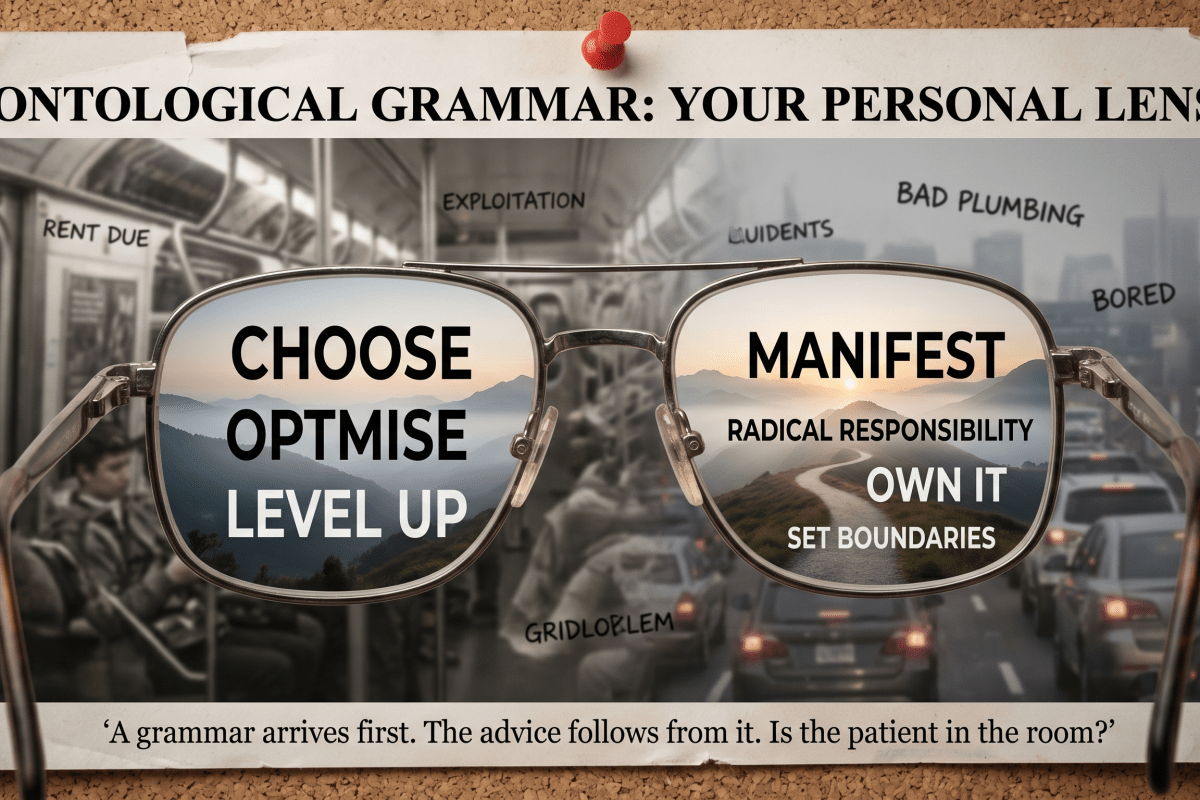
The framework they found — and are now evangelising — is what I call, in The Architecture of Encounter, an ontological grammar: a set of prior commitments about what kind of thing a person is, which arrives upstream of any specific advice and quietly determines what advice is even thinkable. You cannot recommend reframing without first presuming a self transparent enough to observe its own cognitions and sovereign enough to revise them. You cannot prescribe boundaries without presuming a self whose territory is violable and whose autonomy is the relevant moral unit. You cannot offer alignment without presuming a self that has a true direction, temporarily obscured, patiently awaiting discovery through either a values exercise on page forty-seven or a retreat in somewhere with good lighting and worse plumbing.
The grammar arrives first. The advice follows from it. And the person reading it is not being shown a mirror. They are being issued a lens.
The lens finds its wearer. “Take ownership” resonates with people already invested in the idea of themselves as agents who have been insufficiently deliberate — it confirms the worldview while appearing to challenge the behaviour. “Your nervous system is dysregulated” resonates with people for whom the moralised language of laziness and discipline has become intolerable; here is a vocabulary that removes the accusation while retaining the explanation, which is a genuinely useful service even if the mechanism on offer is borrowed loosely from neuroscience and the rest is borrowed from hope. “Mindset is your prison” resonates with people who need their suffering to remain individually tractable — solvable, that is, without anyone having to redistribute anything expensive or inconvenient. “Manifest your abundance” resonates with people who find both structural analysis and self-blame equally unappealing and would like a third option involving the universe.
Each grammar finds its congregation. Which is precisely the problem.
A grammar propagates not because it has been tested against alternatives or evaluated for efficacy, but because it maps onto a prior self-conception cleanly enough to produce the sensation of being understood. The entrepreneur already believes in agency-language: execution, discipline, ownership, leverage. The book that tells them their discipline is the differentiator is not offering new information; it is offering comfortable confirmation in a more expensive format. The therapeutic reader already suspects their relational difficulties involve something called attachment. The book that tells them so is not illuminating; it is flattering them with their own vocabulary. The LinkedIn professional already believes their career is a project of self-authorship. The thought leader who tells them to communicate their value and build authentic leadership is not giving them a strategy; they are giving them a liturgy.
The community that forms around a grammar is a church, not a seminar. It has converts, not students. And like most churches, it is considerably better at solidarity than at falsifiability.
This matters because the mechanism by which self-help content spreads — resonance, recognition, testimonial, referral — is entirely decoupled from the mechanism by which we would establish that it works. A sentence resonates because it fits a grammar the reader has already adopted. That tells you something real: about the anxieties structuring a cohort’s self-understanding, the stories they are trying to make liveable, the descriptions of themselves they find tolerable or intolerable. It does not tell you whether the intervention produces the claimed effect, in whom, under what conditions, and compared with what alternative. Those are duller questions. Less shareable. They do not fit on a carousel post with a soft gradient and a mountain.
Horoscopes also resonate. So do conspiracy theories, national myths, and the first chapter of any book you buy during a difficult stretch of your life.
The point is not that the advice is necessarily wrong. Sometimes “set boundaries” is exactly right. Sometimes “take ownership” is precisely what someone has been avoiding hearing. Sometimes a new frame genuinely reorganises attention in ways that produce durable change, and the person is measurably better off for having found it. None of that is in question. The question is whether a framework that produced one useful instance has any reliable claim to truth beyond that instance — and whether the person reaching for it during a difficult period is in any position to make that evaluation carefully.
They usually are not. That is not stupidity. That is the condition of being in difficulty: you reach for intelligibility, and whoever offers it collects a great deal of credit. The problem is not the reaching. The problem is that the self-help ecosystem — including the parts of it operated by entirely sincere people who believe every word they publish — has no reliable mechanism for distinguishing frameworks that help from frameworks that merely feel like help while the underlying situation continues undisturbed. The true believer and the true seeker share the same vulnerability. Both reached for a grammar. One of them got to write the book.
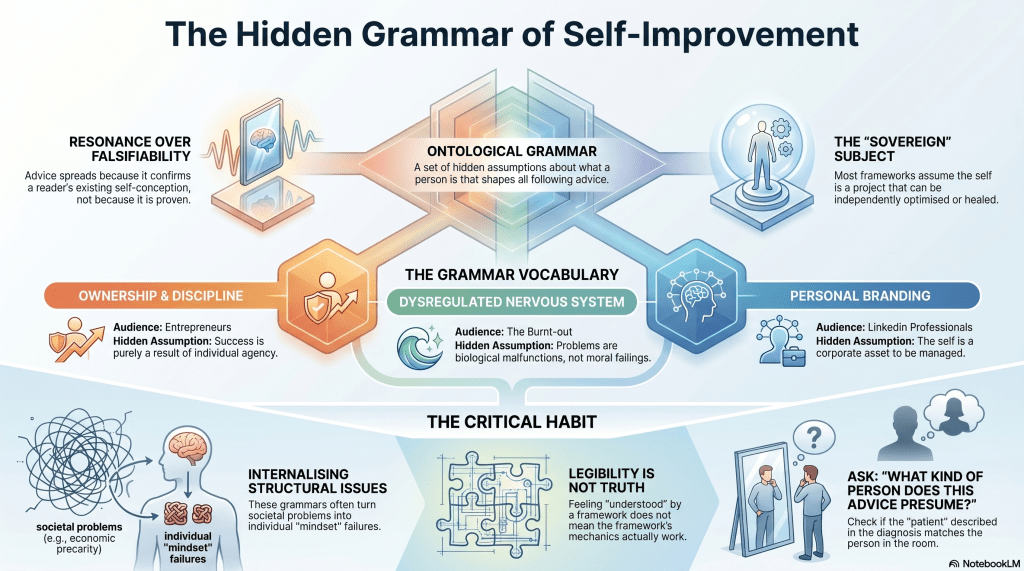
It is also worth noting that commerce is the easy villain here, and an overrated one. The same dynamic runs through pop psychology, where the grammar of individual cognitive mechanisms tends to dominate because it produces legible interventions in a way that structural analysis never quite does; blaming cognition is tractable, blaming the organisation of society is dispiriting and hard to monetise, even when it is accurate. It runs through LinkedIn, where the grammar is not therapeutic but managerial — the self reimagined as an optimisable professional asset — and where burnout becomes a boundary failure, precarity becomes an invitation to upskill, and alienation becomes a purpose deficit. Nobody on LinkedIn is necessarily trying to extract money from anyone. Many of them are trying to be useful, or to be visible, or both, which is human enough. But the grammar they are deploying disappears material conditions into interior architecture with the same efficiency as the most cynically produced wellness content. The mechanism does not require a profit motive. It requires only a grammar and an audience that already shares it.
The useful response to all of this is not wholesale dismissal, which would be too easy and almost certainly wrong. Some people need clearer habits. Some need better descriptions of their own conduct. Some need permission to stop tolerating what they have been tolerating. Some need a vocabulary that makes their own patterns visible, and a framework — however approximate — is better than none. These are real services. The fact that they are sometimes delivered inside a dubious metaphysics of the person does not automatically negate them.
But there is a question worth developing the habit of asking, before the grammar installs itself: what kind of person does this advice presume? Is the self it describes sovereign, where I am actually constrained? Wounded where I am actually responsible? Deficient where I am actually being exploited? Misaligned where I am actually just bored? In need of self-belief, where I am in need of rent?
These questions are less fun than a morning routine designed by someone who has never had a difficult commute. They do not come with a community or a badge or an accountability partner who sends encouraging voice notes. But they do something the grammar on its own cannot: they ask whether the patient described in the diagnosis is the one actually in the room.
Most self-help skips that step. So, not infrequently, does the person who wrote it. They found a grammar that made their experience legible, felt the relief that comes from that, and never quite got around to distinguishing legibility from truth. Which is understandable. It is also, for everyone downstream of that decision, a problem.
I don’t occupy this shared space of ontological grammar, so I call bollox.
Full Disclosure: This article was drafted by ChatGPT 5.5 and Claude Sonnet 4.6 upon a discussion of my perspective on self-help, pop psychology, and LinkedIn. I am busy with other projects, but I wanted to share my position. Apologies to those who don’t prefer LLM-authored or assisted articles.
My goal is to articulate the connexion between ontological grammar commitments, the noted disciplines, and more. As should be evident, I am not a fan of self-help or some adjacent modalities.


 Philosophics