Why Dating Is Not Shopping, No Matter How Many Apps Insist Otherwise
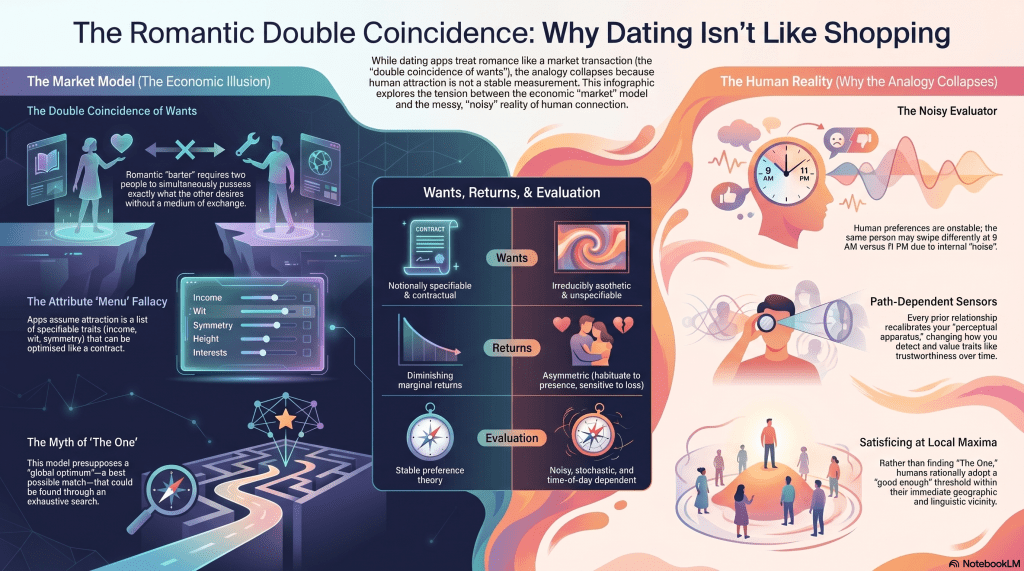
Firstly, be nice, and remember that I’m a recovering economist, so I can’t fully abandon this lens. There’s a concept in economics called the double coincidence of wants. For barter to work, I must have what you want, and you must have what I want, simultaneously, in the right quantities. The implausibility of this – that two strangers would arrive at the same moment, each holding exactly what the other needs – is traditionally the justification for money. Money decouples giving from receiving. It lets me sell my grain today and buy your lumber next month. Problem solved. It is tempting, and initially illuminating, to notice that dating is a double coincidence of wants with no money.
Two people must simultaneously possess what the other desires. There’s no abstract medium of exchange. Listen, I don’t make up the rules, but you can’t deposit romantic capital in a bank and draw on it later with a different partner. Every transaction must clear bilaterally, in real time, between specific parties. The reason dating is difficult, on this account, is the same reason barter is difficult: the coordination problem is enormous.
This is a genuinely useful analogy – for about sixty-nine seconds. After that, it begins to collapse. And the way it collapses turns out to be more interesting than the analogy itself.
Wants can’t be enumerated
In an economy, wants are at least notionally specifiable. You want grain, I want lumber. We can write a contract. In attraction, nobody can write the contract, because nobody knows the terms. You can list proxies – symmetry, wit, income, dentition – but the list never cashes out the phenomenon. There’s always a residue. Someone ticks every box and provokes nothing. Someone ticks none of them and provokes everything. The attributes aren’t the attraction. They’re at best rough correlates of something that resists decomposition.
Evolutionary psychology claims to have the list – fertility signals, resource indicators, and bilateral symmetry – but this is just dressing up economic grammar. It takes the lived phenomenology of attraction, which is irreducibly aesthetic, and rewrites it as a covert optimisation problem. The evo-psych account is the friend who explains why you should find someone attractive and then looks puzzled when you don’t.
Tolerances are fuzzy, interactive, and opaque
Even granting an approximate list of attributes, each one functions not as a threshold but as a band of acceptability. And the bands interact. A deficit in punctuality can be compensated by a surplus in making-you-laugh-until-you-cry. But the exchange rate between these dimensions isn’t fixed, it’s not linear, and almost certainly not conscious. Nobody’s running this calculation. If you ask them to formalise it, they’d produce a confabulation, not a report.
The evaluator is noisy
Kahneman’s Noise documents a finding that should alarm anyone who believes in stable preferences: the same agent, evaluating the same inputs, will produce different outputs on different occasions – not because of bias (which is at least systematic and therefore correctable) but because of irreducible stochastic variability. The judge sentences harshly before lunch and leniently after. Same person, same case, different output.
Applied to attraction, means that the person you’d swipe right on at nine in the morning, you might pass over at eleven at night – or vice versa, as the case might be <winkie>– not because you’ve learnt anything new, but because you aren’t a stable instrument of measurement. The evaluation function drifts across a single day. Across months and years, it’s rebuilt entirely.
The evaluator is path-dependent
Every prior relationship recalibrates the apparatus. Someone who’s been betrayed doesn’t simply move ‘trustworthiness’ higher on their list. Their entire perceptual system for detecting trustworthiness has been restructured. The sensor’s been rebuilt by its prior readings. In no market economy do my preferences over apples change because I once had a bad experience buying oranges from a particular vendor. In relationships, this is the norm.
Returns are asymmetric
Standard preference theory assumes diminishing marginal returns, and this holds for attraction in the obvious direction: the tenth bunch of flowers yields less delight than the first. But the inverse does not hold symmetrically. The absence of a previously supplied attribute often produces increasing marginal disutility. You habituate to presence but sensitise to withdrawal. The utility of gaining X and the disutility of losing X are not mirror images. The preference function is path-dependent in a way that wrecks any static equilibrium model.
Search space is radically local
And all of this assumes the candidates are available for evaluation. They mostly aren’t. Your evaluation function, however sophisticated or broken, only gets applied to whatever washes up in your vicinity – no offence to Ariel. Your so-called soulmate might reside in Istanbul, but you live in London, and you don’t share a language, and you’ll never meet. This isn’t a logistical barrier. It’s a legibility barrier. You could stand next to this person in an airport and the aesthetic response function would not even fire, because the medium through which half of attraction is constituted – conversation, the texture of someone’s verbal mind – is simply unavailable. The instrument requires an input format that the candidate can’t provide. Consider you spy this person across an expanse, gain enough courage to introduce yourself, and they don’t speak your language. Body language will only compensate so far.
Local maxima
The cumulative force of all this is simple and devastating: we are stuck on local maxima. The search space is computationally intractable. The evaluation function is noisy and path-dependent. The attributes resist enumeration. The tolerance bands are fuzzy and interactive. The returns are asymmetric. The search is geographically and linguistically truncated. And so agents do what any rational agent would do under these conditions: they satisfice. They adopt a threshold of ‘good enough’ – a threshold which is itself endogenous to all the noise and path-dependence described above – and they stop searching when they cross it.
This is not a failure of nerve. It is the only coherent strategy available to an agent who can’t identify, or even in principle define, the global optimum. Committing to a local maximum is the rational play, precisely because optimising is impossible 0150 at least legible in the sense of James C. Scott.
Which makes the cultural mythology of ‘the one’ a rather cruel grammatical artefact. It presupposes a global search that no one has conducted or could conduct. It borrows its intelligibility from the economic grammar of optimal allocation – there is a best match, you just have to find it – and projects it onto a domain where ‘best’ has no operational definition, the search is radically local, and the searcher is a different instrument on different days.
Los Angeles, and why it matters
I lived in Los Angeles from twenty-one to twenty-seven, in the early to mid-1980s. I loved it. It was my favourite place on earth. I returned to LA from thirty-five to forty-five, and it was just another place.
It may have turned out that way even had I never left. The point is not that Los Angeles changed – though of course it did. The point is that I changed. Different profession, different situation, different appetites, different saliences… The evaluation function that produced ‘favourite place on earth’ at twenty-three was a fundamentally different instrument from the one that produced ‘just another place’ at forty. No longer a club rat on the prowl, I walked the same streets and saw a different city, because the perceptual apparatus that constructed the city as an experienced object had been rebuilt by fifteen years of living.
‘Favourite place on earth’ and ‘just another place’ aren’t two judgements issued by one stable subject upon one stable object. They’re two outcomes produced by two historically different configurations of salience, appetite, profession, circumstance, and age.
Los Angeles is useful here precisely because it’s not a person – RHCP, not withstanding. It lets you see the structure before sentiment starts mucking about with it.
We don’t even evaluate cities consistently across a lifetime. The same is true, more painfully, of persons.
The partner one adored at twenty-five may not have become deficient in any simple sense. The evaluative field changed. New dimensions became salient, old ones lost force, tolerances narrowed or widened, and costs are reweighted. The same partner now appears under a different aspect, because the apparatus of appraisal has been rebuilt in the interim.
And here, three claims should remain separate: the object may change; the evaluator may change; and the relation between them may change even if neither has altered dramatically. This third one prevents this from collapsing into a banal ‘people grow’ sermon. Sometimes the drift isn’t a defect in either party. It’s a change in fit.
Many:many
It would also be a mistake to think any of this operates as a 1:1 match. The dimensional space isn’t shared. Any two people will overlap on some dimensions, diverge on others, and be mutually illegible on others still – dimensions where one party’s response function is active, and the other’s doesn’t even register the input. He cares intensely about how she loads the dishwasher. She doesn’t experience dishwasher-loading as a dimension at all. It’s not disagreement. It is incommensurability.
A long relationship isn’t a transaction. It’s two non-congruent evaluative systems attempting to maintain a shared narrative of congruence as the terrain shifts beneath them. The miracle isn’t finding someone who matches. The miracle is sustaining a workable fiction that two-dimensional spaces are more commensurable than they are.
Consider the statistically perfect match – bilateral alignment across every operationalised dimension. Even if you could construct such a thing, it would be a snapshot: a cross-section of two moving systems that happened to align at time t. By t+1, the dimensional spaces have already drifted. The statistical portrait is a death mask of a living process.
And here is a green-eyed test. Suppose the perfect match has green eyes. It doesn’t follow that a blue-eyed twin – identical in every other respect – would or wouldn’t provoke the same response. Because whatever was operative in the encounter was not an attribute, or a bundle of attributes, but something that emerged from the specific interaction and can’t be decomposed back into the components that produced it. The entire enterprise of algorithmic matching is cataloguing attributes on the assumption that the attributes are the attraction. It is like analysing a joke by listing its phonemes.
The spot market and the long game
Let’s consider one-night stands as an example to clarify the taxonomy. A one-night stand really is the nearest thing romance has to a spot transaction. The time horizon is short, the narrative load is low, path-dependence is weak, and local salience dominates. The calculus is narrow and immediate. The economic grammar almost applies. Whatever gets you through the night.
A long relationship isn’t a transaction at all, but an evolving coordination problem between changing evaluators. The longer the time horizon, the more layers of critique come into play, and the more absurd the matching grammar becomes. Over time, relationships are not discrete exchanges but moving equilibria between non-stationary systems. That’s why long partnerships are so fragile and so impressive when they endure.
Post hoc rationalisation, or: the story we agree to tell
Having arrived at their local maximum, both parties then construct a narrative in which the outcome was the product of discernment rather than constraint.
‘I knew she was the one when…’ isn’t a report. It’s a reconstruction – a story imposed on a stochastic process to make it legible in the grammar of rational choice. The same person, encountered on a different Tuesday or in a different postcode, might never have registered at all. But the narrative requires necessity, so necessity is confabulated.
And it runs in both directions. She thinks it was his quiet confidence. He thinks it was the argument about Godard. Both are post hoc pattern-matching on noise – selecting from the welter of early interactions the moments that fit the ‘recognition’ narrative, and discarding the rest. It’s survivorship bias applied to one’s own love life.
This also explains the peculiar ferocity of heartbreak after the narrative has been constructed. What collapses is not merely the relationship but the explanatory framework. The story that made the local maximum feel like a global one disintegrates, and the agent is returned to the raw landscape: noisy, path-dependent, locally constrained, and aesthetically illegible. The grief is partly about the person. It’s also about the loss of the rationalisation that made the search feel concluded – losing the construct of the person rather than the person, per se.
Enfin
The dating app asks you what you want as though you’re ordering from a menu, when what is actually happening is that the menu is rewriting itself based on what you had for lunch yesterday, how much sleep you got, and that thing your ex said in 2019 that you think you are over.
We don’t find ‘the one’ – sorry, Neo. We become different readers of the same world, and occasionally manage to remain legible to one another for a while. Which is, if you stop demanding it be a fairy tale, quite a lot.







 Philosophics