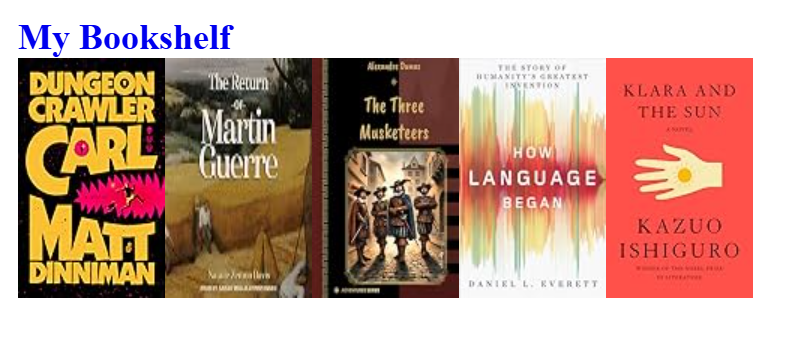
I discovered a WordPress widget and decided to share my reading progress, but it appears to show the last few books I’ve finished rather than my active list. Click on My Bookshelf to view more.
I read several books at once. I tend to read a fiction and several non-fiction books. The fiction books happens to be an audiobook, which I tend to listen to whilst I am working out: Carl’s Doomsday Scenario: Dungeon Crawler Carl (book 2). It’s more of a diversion – and entirely unserious, though I did find a quote on Understanding, my latest essay project still in progress.
I can’t really recommend a book to people because I don’t know their tastes and interests. As for the Dungeon Crawler series, if you like RPG gaming culture and lore, you may appreciate the humour of LitRPG. It’s stupid fun.
On the serious side, I’ve mainly been milking a few titles;
Being and Time, An Annotated Translation: Martin Heidegger
Against Progress is a short collections of essays that I tend to travel with and read an appointments and such. I’ve read almost half of them, but I’m still reading.
I’m very close to finishing Reasons and Persons. I’t not exactly a page turner, but it is engaging. It’s inspired several essays here, so I have to suggest that it’s worth the read, as long as it is.
I’ve read Being and Time before, but I wants to take a gander with this new translation and check out the annotations. Since I’ve already read it and have ideas about it, I am more critical of some of the early annotations than a fresh book, but this is also on a slow –when I have time – track.
Of course, one could argue that I would have time if I weren’t reading non-fiction, and one would be correct. However, the level of attention required differs significantly.
Somebody somewhere made mention of The Social Construction of Reality, so I asked ChatGPT if I should engage with it directly, which is to say, to read it. Already believing that what we perceive and experience is a subjective construction, albeit shaped by relative forces, I thought it might be a lot of choir preaching.
ChatGPT admitted that this was partially true, but that the benefit would be to get a sociological rather than strictly philosophical account. Having read the introduction and started the first chapter, I already feel this to be true. The authors make it clear that Sociology is just a special philosophy that doesn’t aim quite so deep and has a specific and obvious focus on societies. Fair enough.
So far, I’m glad I picked it up. It’s relatively short, which was a deciding factor, and it’s giving me a break from the 1066 material I’ve otherwise been consuming as of late.
I don’t have more to add, save to say, so far so good. I look forward to the rest. I’ve got more to do today, including editing a video for YouTube, which is me rather than AI for a change – a process that reminds me why I use AI in the first place: so much time investment.
NB: I am actually listening to an Audible version of this book. Whilst searching for an apt cover image for this post, I found the associated image, and it is as apt as one might find.
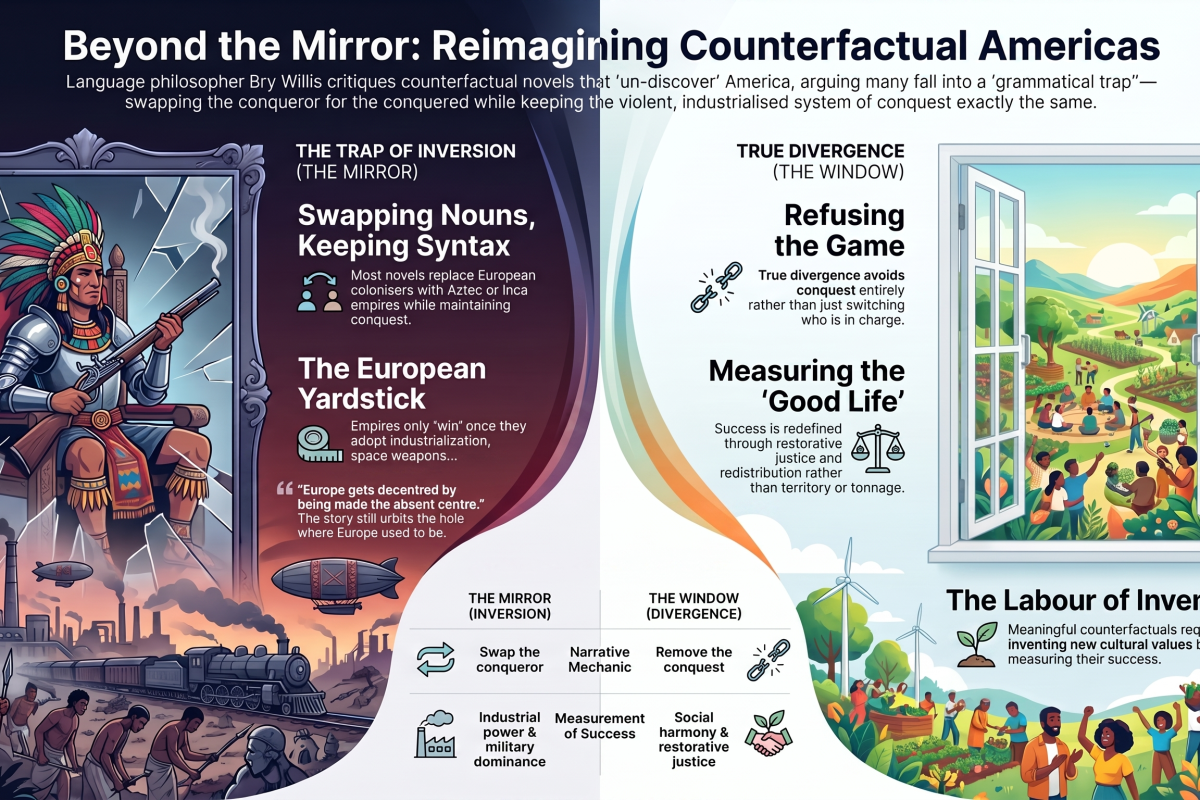
As Independence Day is upon the United States of America, I considered some counterfactuals. What if Europe fails to reach the Americas until a century or more late, and we watch the delay from the vantage of the peoples already here, going about the business of history without a Columbus to interrupt them? Then came the question everyone eventually asks about their own good ideas, in the tone of a man checking whether the milk has turned: has this been done before? Of course, it had been. Spoilers follow – sort of.
Audio: NotebookLM summary podcast of this topic.
The inversions
The oldest respectable relative is Robert Silverberg’s The Gate of Worlds (1967). A nastier Black Death carries off three-quarters of Europe rather than a third; the continent never recovers, the Ottomans move in, London becomes New Istanbul, and by the twentieth century the great powers are the Aztecs, the Incas, the Russians and the Japanese. Our guide is a young Englishman named Dan Beauchamp, who sails to an industrial, motorcar-driving Mexico to seek his fortune. Note the pronoun. The world has been turned upside down, and we are shown it by a European looking up.
Christopher Evans’s Aztec Century (1993), which took that year’s BSFA Award, runs the same reversal with more brass. Cortés changes sides, a New World plague scythes through Europe instead of the reverse, and the Aztec Empire swells into a technological superpower that eventually occupies Britain. The narrator is Princess Catherine, daughter of a defeated British monarch, Princess Diana watching London burn from the losing side. Again, the conquered European tells us what the conquest was like.
Laurent Binet’s Civilizations(2019) is the cleverest of the lot, and the most decorated – it won the Grand Prix du roman de l’Académie française, and Sam Taylor’s English translation took the Sidewise Award for alternate history. A stray band of Vikings gifts the Americas iron, horses and, crucially, immunity; so when Columbus turns up in 1492, he is captured and demoted to court jester, and the Inca emperor Atahualpa later sails east to conquer a Europe conveniently fractured by Luther, the Inquisition and its own dynastic squabbles. Binet is far too intelligent not to know what he is doing. The whole thing is a Civilization-the-video-game daydream executed with Académie française tailoring, and it is genuinely delicious. It is also, structurally, another inversion: swap the conqueror, keep the conquest.
The remix and the intervention
Two cousins change the machinery rather than the direction. Kim Stanley Robinson’s The Years of Rice and Salt (2002) empties Europe almost entirely – the plague takes ninety-nine per cent – and then spends six hundred sprawling, reincarnation-threaded pages letting China, Islam, India and the Indigenous Americas run world history without the Europeans in the room at all. It is less a mirror than a vast tapestry, and its ambition is precisely that Europe should not be the pivot. Whether it manages that, or merely relocates the pivot, is a question the book is honest enough to leave open.
Orson Scott Card’s Pastwatch: The Redemption of Christopher Columbus (1996) cheats, and admits it: time-travellers reach back to soften the catastrophe of contact. It is a book about first contact, disease and conquest, but the engine is intervention from a guilty future, which makes it a novel about us editing them, the colonial gaze wearing a lab coat.
The one that isn’t a mirror
And then there is B. L. Blanchard’s The Peacekeeper (2022) – also, tellingly, a Sidewise Award winner – which does the rarer thing and quietly refuses the whole game. There is no inversion here, because there is no conquest to invert. North America was simply never colonised. The Great Lakes are an independent Anishinaabe nation; Chicago is Shikaakwa; there are no borders on the map because the book declines to draw any. It happens to be a murder mystery, and a slightly wobbly one – I called the culprit early, as apparently did everyone – but the mystery is scaffolding. The real work is a society organised around restorative justice, redistribution and something the glossary calls the Good Life, where crime is repaired rather than punished, and the question ‘what is success?’ gets a genuinely different answer. That difference is the whole point, and it is worth spelling out.
The tell
Watch what the inversion novels are obliged to do to their winners. Silverberg’s Aztecs drive coal-fired automobiles. Evans’s Aztecs somehow have flying warships and space weapons, to the audible irritation of every reviewer who has ever met a history book. In each case, the counter-empire only counts as having won once it has industrialised, once it has, in other words, become Europe in a headdress. The measuring stick never leaves the room. It just changes hands. Would not recommend. All of these are still viewed through Modernist lenses. They can’t seem to help themselves.
This is the trap, and it is a grammatical one: you can swap every noun in the sentence and leave the syntax of conquest perfectly intact. Who dominates whom is a variable. That domination is the axis of the story remains fixed – invisibly, load-bearingly fixed. So the shelf keeps producing books that promise to dethrone Europe and instead install a differently-costumed emperor on the same throne, using the same yardstick to prove he deserves it. Europe gets decentred by being made the absent centre. Everything still orbits the hole where it used to be.
Blanchard’s book is the one that escapes, and it escapes not by putting someone else on the throne but by asking whether the throne needed to exist. That is a far harder imaginative act, which is exactly why the shelf holds so many mirrors and so few windows. Inverting a hierarchy is a parlour trick – satisfying, symmetrical, teachable in an afternoon. Imagining a world whose values diverged, so that its people would not measure their flourishing in territory and tonnage at all, requires you to invent the ruler before you can invent the thing it measures. Most writers, sensibly, decline the extra labour.
Six books, then, and a warning label. Read Binet for the wit, Blanchard for the nerve, Silverberg for the ancestry, and the rest for the pleasure of watching very clever people not quite escape the room. Then, if you’re feeling brave, go and undiscover America properly, which means resisting the temptation to let it become us, wearing better feathers.
I just finished reading Feyerabend’s Against Method – rather, I just finished the back matter, as I finished the core of the book some time ago. I debated reading this part of the book, and sorry, but I often don’t – despite writing back matter for some of my own academic publications. I treat them as asides.
I’m glad I read this material because, aside from the endnotes, it was meta and biographical, so the perspective was nice. In fact, it got me thinking. He talks about his struggle with Relativism™. I used to struggle with the same thing; there seemed to be a false battle between objectivists and relativists or subjectivists, but in my mind these were always straw-man caricatures nobody seriously defended, yet somehow people were vocal about avoiding. I’ve written extensively about my own position on mediation, so I won’t info dump here.
Audio: NotebookLM summary podcast of this topic.
As people familiar with my habits, I tend to read several books in parallel. In fact, you can review what I am reading on Goodreads.
To be fair, I don’t tend to close-read fiction books very often. I find it to be slow and cumbersome. For non-fiction, this is the default, but not generally for fiction. But, since French is a second language, my attention needs to be focused. I don’t feel that I can read casually and catch the sort of embedded grammatologie that I can absorb through osmosis in English-language books.
Why slow read then? I have a desire to maintain and advance my French, so I think that reading contemporary books connects me to current language trends, terms, phraseology, and metaphor. I am using Claude and ChatGPT to assist with the close reading. They’ve already helped me to better understand the opening paragraphs. It opens like this:
Let’s discuss this, word choices, and any implications. This is the first paragraph of the first chapter:
Debout sur la berge, Anthony regardait droit devant lui. À l’aplomb du soleil, les eaux du lac avaient des lourdeurs de pétrole. Par instants, ce velours se froissait au passage d’une carpe ou d’un brochet. Le garçon renifla. L’air était chargé de cette même odeur de vase, de terre plombée de chaleur. Dans son dos déjà large, juillet avait semé des taches de rousseur. Il ne portait rien à part un vieux short de foot et une paire de fausses Ray-Ban. Il faisait une chaleur à crever, mais ça n’expliquait pas tout.
This scene starts to set the tone of the narrative from the onset – lentement, insouciant. It’s midsummer. The heat is overbearing – stifling. It tracks the life of our antagonist, Anthony, a 14-year-old in between grades, in fact, getting ready to enter Year 10 or high school, ninth grade. But not yet. We haven’t reached this paragraph quite yet.
Besides the heat references, we see emergences of weight, falling. Again, loading up on metaphors. Anthony doesn’t have an easy life. Many don’t at these junctures.
He, himself, is at that awkward adolescent stage, where his body is outgrowing his childhood, whilst his mind is trying desperately to keep up.
A challenge I have with French is that I know dogs, cats, trees, and fish, but I don’t know the types of these. Here, we see the word « un brochet ». It’s a pike fish. Honestly, I don’t even know what a pike looks like, though I am familiar with the English term.
Image: Pike. (Not to be confused with a pickerel, which is evidently a related but smaller fish I had also never seen.)Credit
Another language challenge is polysemous terms – in this case, « vase ». As I am reading, I am trying to imagine the smell of a vase, all the while recalling that vases don’t exactly have a distinct scent. It turns out that vase also translates to mud or silt. quite the difference.
Since I started, I might as well continue exploring this paragraph: Anthony is wearing fake Ray-Bans. This is an insight into class and station.
As for register, Mathieu mentions these things matter-of-factly without judgement. Later on, we’ll notice differences, but these are narrational and through the eyes of Anthony, as he compares himself with his environment. Class projections might be imported by the reader. I won’t invoke Barthes here.
The final sentence leaves us hanging. It reminds us again that this July is hot, but somehow it doesn’t explain everything, likely, about Anthony.
NB: I reviewed the credentials of the hosts and revised my critique at the end of this piece.
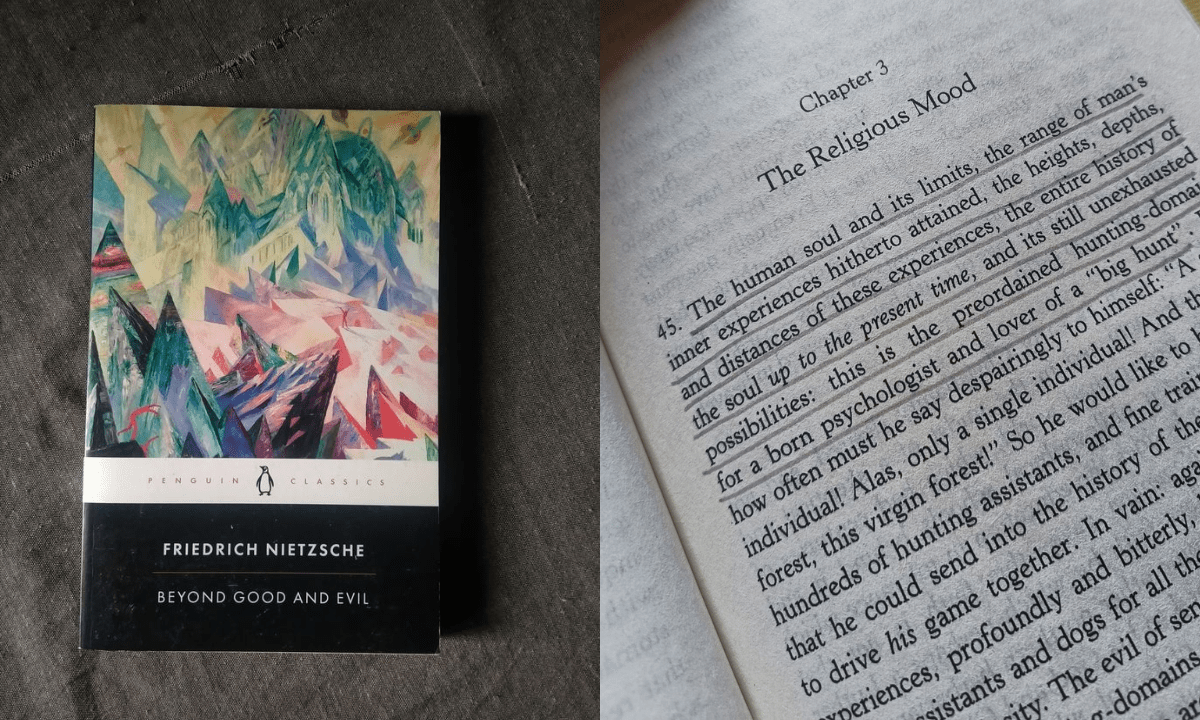
I joined a scheduled close reading of Nietzsche’s Beyond Good and Evil recently and came away less refreshed than exasperated. I will spare the platform and the hosts, not out of charity exactly, but because the problem is broader than two particular men fumbling through a canonical text in public. What disappointed me wasn’t that they disagreed with Nietzsche, nor even that they may have misunderstood him in places. Misreading is inevitable. The problem was that they seemed not to have brought much of a reading to begin with.
I had read Beyond Good and Evil years ago and thought a return to it might do me some good, or at least less evil than the usual intellectual content mill. The format sounded promising enough: two interested hosts working through the introduction live, sentence by sentence, in a supposedly close reading. Both had apparently read the book before. One therefore assumed they might arrive with at least a provisional grasp of its architecture, key provocations, and habitual traps. That assumption, in the event, turned out to be embarrassingly optimistic.
Audio: NotebookLM summary podcast of this topic.
As one host read line by line, the discussion lurched forward by way of hesitant paraphrase, speculative gloss, and the occasional verbal shrug. He offered the more substantive guesses, such as they were, while the other contributed mostly vague assent, half-memory, and the sort of foggy commentary one gives when one dimly recalls having once encountered a difficult book in a previous phase of life. It was less a close reading than a public rehearsal of not quite knowing what one was doing.
Now, I am not demanding exegetical perfection. Nietzsche is not a writer one simply ‘gets’ and files away like a user manual. Nor am I naïve enough to think authorial intention settles everything. Barthes is right enough to remind us that the text exceeds the author’s sovereign control. But the death of the author is not a licence for the death of preparation. If one is going to host a close reading of a notoriously elliptical and performative philosopher, the least one might do is arrive having done some prior work. Read the introduction carefully beforehand. Refresh the major themes. Check the loaded terms. Develop an argument, or at least a point of view.
That point of view may be wrong. Fine. Better that than the contemporary preference for the curated shrug, where one mistakes visible uncertainty for intellectual seriousness. There is a difference between interpretive openness and simple lack of preparation. One is a virtue. The other is an aesthetic.
I find this especially grating because I cannot imagine teaching a class that way. When I taught, I’d spend hours preparing before entering the room. Not because I imagined myself infallible, but because students deserve more than watching a lecturer discover the material in real time. A formed point of view is not a dogma. It is a starting position. It gives the discussion shape, stakes, and resistance. Without it, one is not leading inquiry but merely simulating it.
The second host did little to improve matters. Rather than complicating or sharpening the reading, he mostly echoed the first. There was very little friction, and thus very little illumination. One of the virtues of reading Nietzsche in company is that he invites productive disagreement. He is slippery, aphoristic, ironic, and often strategic in his provocations. A good discussion can tease out the tensions in his prose, test competing emphases, and ask whether a claim is literal, tactical, genealogical, or satirical. None of that really happened. Instead, one host fumbled, and the other nodded. The result was a kind of interpretive ventriloquism in which agreement substituted for insight.
The accompanying chat made things worse, or perhaps simply made the missed opportunity more obvious. Viewers were offering questions and interpretations, yet the hosts largely ignored them. Aside from one participant, who seemed likely to have some prior relationship with them, the chat was treated as background furniture. This was especially irritating because the event was live. If one is going to perform reading in public, the public should not be reduced to silent witnesses of one’s uncertainty. Otherwise, the ‘community’ aspect is just branding, another little liturgy of digital participation in which the audience is invited to attend but not to matter.
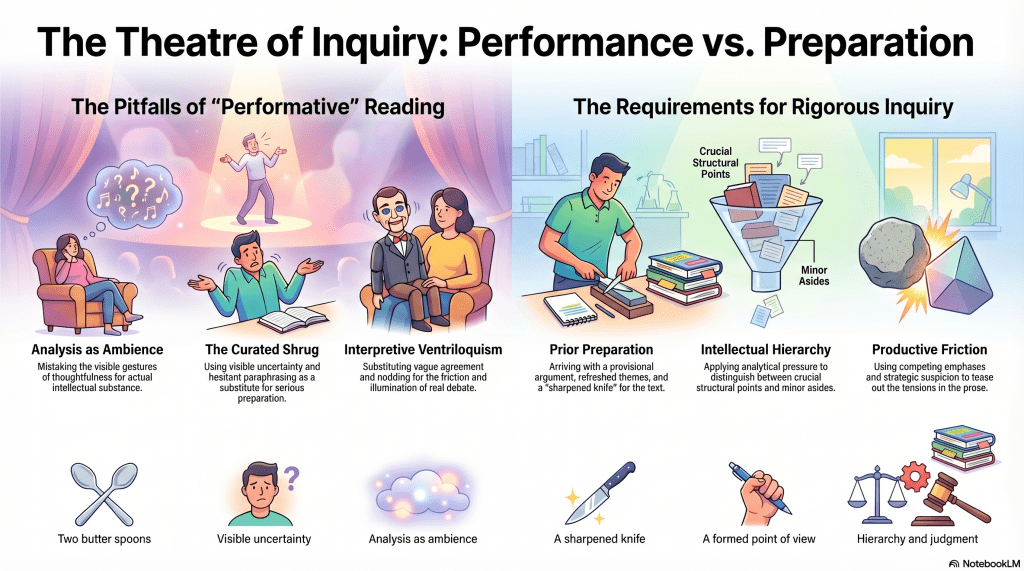
NotebookLM Infographic on this topic. To be honest, I am including this because I find it to be humorous.
To be fair, even when they did read from the chat, they handled those comments much as they handled Nietzsche: superficially, without much analytical pressure, as though any sentence placed before them deserved the same tone of vague consideration. This flattening effect was revealing. It suggested not generosity but a lack of discrimination. A close reading requires hierarchy, emphasis, and judgement. One must be able to say: this is a crucial phrase; this term matters; this apparent aside is actually structural; this comment in the chat opens something worth pursuing; that one does not. Without such judgement, everything becomes equally interesting, which is another way of saying that nothing really is.
What emerged, then, was not close reading but the theatre of close reading. The ritual gestures were all in place: slow pace, sentence-by-sentence attention, occasional lexical speculation, the performance of thoughtfulness. But the substance was strangely absent. One had the form of seriousness without much seriousness of form. It was analysis as ambience.
This points to a broader problem in online intellectual culture. Much of it now confuses exposure with engagement. To read a difficult text aloud is not yet to wrestle with it. To host a discussion is not yet to lead one. To hesitate publicly is not yet to think. Somewhere along the line, people began mistaking the visible performance of inquiry for inquiry itself. The result is a style of pseudo-seriousness in which the host need not know very much, so long as he can sound tentative in the correct register.
Nietzsche, of all people, deserves better than that. He is not an author who yields his force to the merely dutiful or the casually adjacent. He requires energy, suspicion, historical feel, and the willingness to risk a reading. One need not become a priest of correctness. But one should at least bring a sharpened knife to the table, rather than two butter spoons and a podcast voice.
What disappointed me, then, was not simply that these hosts stumbled. Everyone stumbles with Nietzsche. It was that the stumbling seemed to be the content. No deep framework, no clear prior preparation, little tension between the readers, and scant engagement with the audience. The whole affair felt less like a serious encounter with Beyond Good and Evil than a performance of cultural literacy: a way of being seen near an important book.
And perhaps that is the real irritation. One expects difficulty. One can even forgive error. What is harder to forgive is the peculiar modern tendency to make a spectacle of one’s underpreparedness and call it interpretation.
To be fair, I later learned that the co-host was not a philosopher by training but came from Literature. That in itself is no objection. Indeed, a pairing like that could have worked very well. Nietzsche is precisely the sort of writer who benefits from both conceptual and stylistic scrutiny. A philosopher can situate the argument, trace its targets, and identify the intellectual inheritance under pressure. A literary reader can pick up tone, irony, rhetorical staging, and the peculiar way Nietzsche so often performs thought rather than merely stating it.
The problem, then, was not the pairing but the execution. The session might have worked if both hosts had prepared properly and if each had leaned into his own strength. Instead, what emerged was a flatter sort of exchange, with the philosopher soliciting the literary co-host’s ‘opinion’ on semantic content as though interpretive adequacy were simply a matter of free-floating textual impressions. What was missing was any real division of labour, any methodological self-awareness, or any sense that different competences might illuminate different aspects of the text.
I’m not ashamed to say that AI is a significant part of my publishing workflow. In my latest project, The Architecture of Encounter, I’ve added indexing to the roles it serves. Other roles were prepping the index and footnotes, as I shared recently.
I expect the book to be available by next week. Time will tell.
I’ve included the full index below for reference. I’ve also included the title and copyright pages and other back matter.
What will a visitor do with a bookless index? I don’t know, but sharing is caring in my book. For the interested, you can get a sense of the contents. I’ll be sharing more details over the coming weeks – and beyond, I’m sure.
Earlier, I shared that Claude had offered index candidates. I started executing on that list by indexing the first few terms. It took me about an hour to do these, searching for each term and documenting the page number and context – around 250 pages. The book itself is 292 – 6″ x 9″ pages, but more than 50 of these are appendices, and others are front matter. Still.
Audio: NotebookLM summary podcast of this topic. (Another one that misses some points but make others. Fair enough.)
Then it dawned on me to ask Claude to help me with the index. Claude interpreted ‘help’ by spitting out the entire index, formatted and organised. If the book were formatted in 8½” x 11″ Letter size, I could have appended it as-is, but I still had to pour the output into the InDesign template I was composing through and make it look like it was part of the same manuscript, but that took minutes, not days of hours. Appendix E.
Given that I also rely heavily on novel concepts and specifically-defined terms – language insufficiency notwithstanding – I felt that a glossary would be useful. I tasked Claude with this, too. Again, it output a fully-formed list.
I noticed that a couple of terms I wanted defined were absent, so I fed the list into ChatGPT and asked it to consider these and let me know, given the manuscript, what other terms might be absent. It agreed with the two I wanted and suggested three more. It also pointed out an error Claude had made in counting. It also provided the definitions for the glossary entries, so I poured Claude’s output into InDesign. Appendix D.
AI is also a helper. For example, I wanted my index to flow into 2 columns. I’ve done this before. In the old days, I’d have scanned the menus (Adobe products are infamous for convoluted, nested menus), read the manual, and/or Googled for the answer – perhaps queried YouTube, a great resource for such things. Now, I ask AI. In this case, I asked ChatGPT. To be honest, it’s a little verbose, where ‘it’s option X under Y menu’ would suffice, but I ignore the banter.
If you need to know…
If the index is already placed in a text frame
Select the text frame containing the index.
Go to Object → Text Frame Options.
Set the Number of Columns you want, usually 2 for a 6×9 book, sometimes 3 if the type is small and the entries are short.
Adjust the Gutter spacing between columns.
Click OK.
Criticise AI all you want, but having access to in-built assistance 24/7 is a huge time-saving benefit.
Do I still use Google and YouTube? Yes, often.
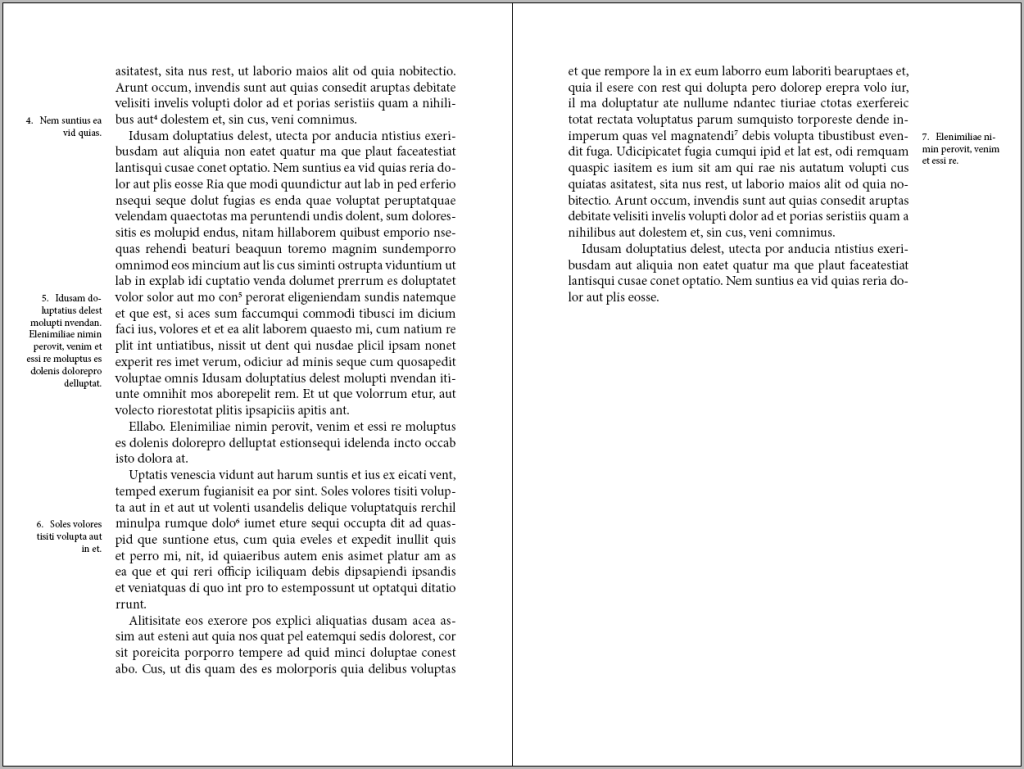
Speaking of Google, I was searching for a cover image, and I discovered something I need for the fiction title I paused in September to focus on nonfiction. Sidenotes. Perhaps I’ll employ a similar mechanism.
The nonfiction book I am writing is somewhat epistolary, and I want to place internal dialogue as marginalia, employing a scripted font face. I am even considering a ‘deluxe’ version that renders this content in colour, but that’s an extra expense, first for the colour, then the full-page bleed, and perhaps thicker paper stock. Likely hardbound, reserving the paperback for a lower price point.
So, what’s next?
I finished both paperback and hardcover designs today.
I still need to review the index for hallucinated errors. This will still take less time than manually constructing it.
On the copyright page, there are a few classifiers. There are ISBNs for each format and a Library of Congress Control Number (LCCN). These are done, as you can see, but the ISBN system in the United States is antiquated. It looks like it’s a museum piece from the mid-1990s. In fact, I believe I first accessed it around 2000 or 2001, when I published my first book – before AI, before print on demand (POD).
A bit of nostalgia. The WWW, the internet as most people know it, was made public around 1994. Google hit it in 1998. Web 1.0. Facebook blighted the world around 2004, though less invasively at the start. I digress. Technology is a mixed bag.
Returning to ISBNs… These are managed in a system built circa 1997. It seems it is still managed with a host of cron jobs, so not much is processed in real time unless it’s a trivial record entry.
Each ISBN references a title and a format, as well as other odds and ends. In my case, I also use an imprint to separate my fiction from nonfiction. I started Microglyphics – tiny writing– in the mid-90s. When I published other authors, I used this name. I also used it for some of my fiction writing. I decided to create a Philosophics Press imprint for my philosophy and adjacent work.
It turns out that the printer needs to ensure that a book’s title and ISBN match the imprint. The system default is the company name, but I changed it to my imprint. This causes a workflow event on their end. Until it propagates, it doesn’t match, and the printer won’t allow the print run.
I’m writing this blog entry as I wait. I’m not sure if it’s automated – I’d like to assume it is – or if a human has to do something. AI might help. Just saying.
EDIT: The imprint has now been updated to Philosophics Press, but it still doesn’t work at the printer. Evidently, it can take up to 5 days for the data to propagate. I’m not sure who owns the fail on this one? Is the printer waiting for a data push? Can’t they pull the data? They seem to be live from my perspective. Is there an API, or is it truly old-school?
Whilst I’m here wittering on, WordPress have deprecated the little widget below – the one with my (old) thumbnail picture and ‘written by’ tag. I adopted it last year, but it’s been killed off. I’ve been copying the object from old posts, but I’ll probably switch to whatever they’ve replaced it with. I wasn’t keen on the options I’ve seen so far. First-world problems, I suppose.
As a writer, I have a kind of workflow in mind. It differs for fiction and nonfiction, though there are similarities. The main differences are indexes, references, and footnotes. I thought I was nearly finished with my latest book.
Audio: NotebookLM summary podcast of this topic.
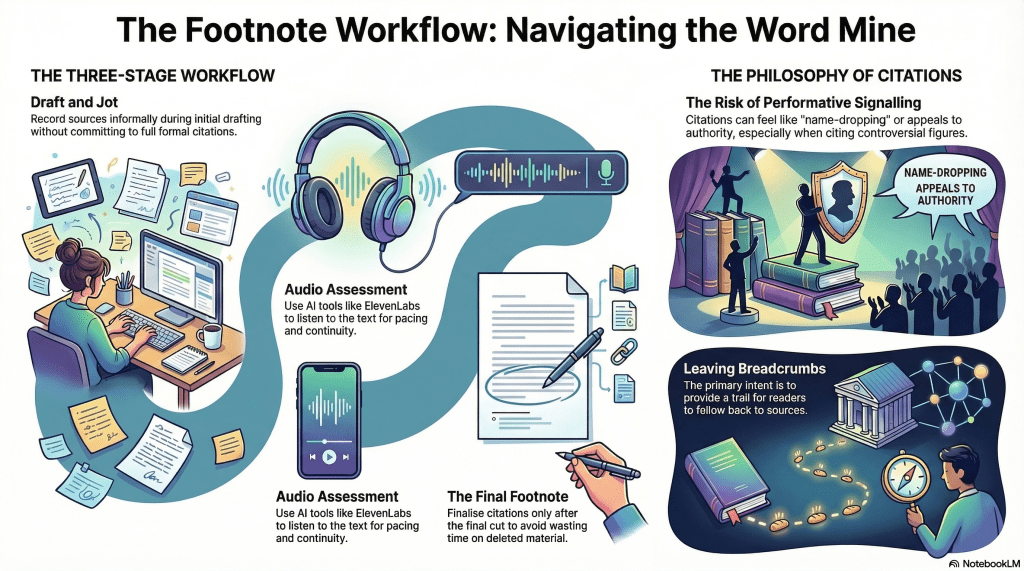
I rendered the first couple of chapters in ElevenLabs so I could listen to the text. It helps me assess pacing, continuity, and the like. It also gives me one more thing to fix, since the digital voices occasionally pronounce things differently from the way I’d prefer. Usually, choosing a voice that sounds roughly like Standard Southern British English helps, though not always. In any case, I survive.
While listening and following along in the manuscript, I discovered that I still haven’t fully footnoted the book.
When I write, I tend to jot down sources and references as I go, but I leave the footnoting until the final revision. There is little point in spending time drafting footnotes for material that may not survive the cut. So here I am, drafting footnotes.
I am of two minds about footnotes and citations, especially in academic work. On the one hand, they can feel performative, a way of signalling that one has incorporated so-and-so, a kind of name-dropping appeal to authority. As a heterodox writer, this is risky anyway, because I am liable to cite one of the approved villains. God forbid a Nietzsche, a Heidegger, or a Foucault. Analytic philosophers, in my experience, can be remarkably thin-skinned.
On the other hand, I do want to acknowledge those whose ideas I have borrowed. Even that, of course, is also a signal. Perhaps it all comes down to intent. As I mean it, I want to leave breadcrumbs for anyone who feels inclined to follow them back to the source.
I’ll let you decide where I’ve landed.
I’ve procrastinated long enough. Time to get back into the word mine.
I’m a philosopher of language, which sometimes veers off the reservation into philosophies of science and even metaphilosophy, but I am not a physicist. I don’t pretend to be. I do try to remain abreast of the goings-on in physics and science just because. Still, I view most affairs first through a philosophical lens.
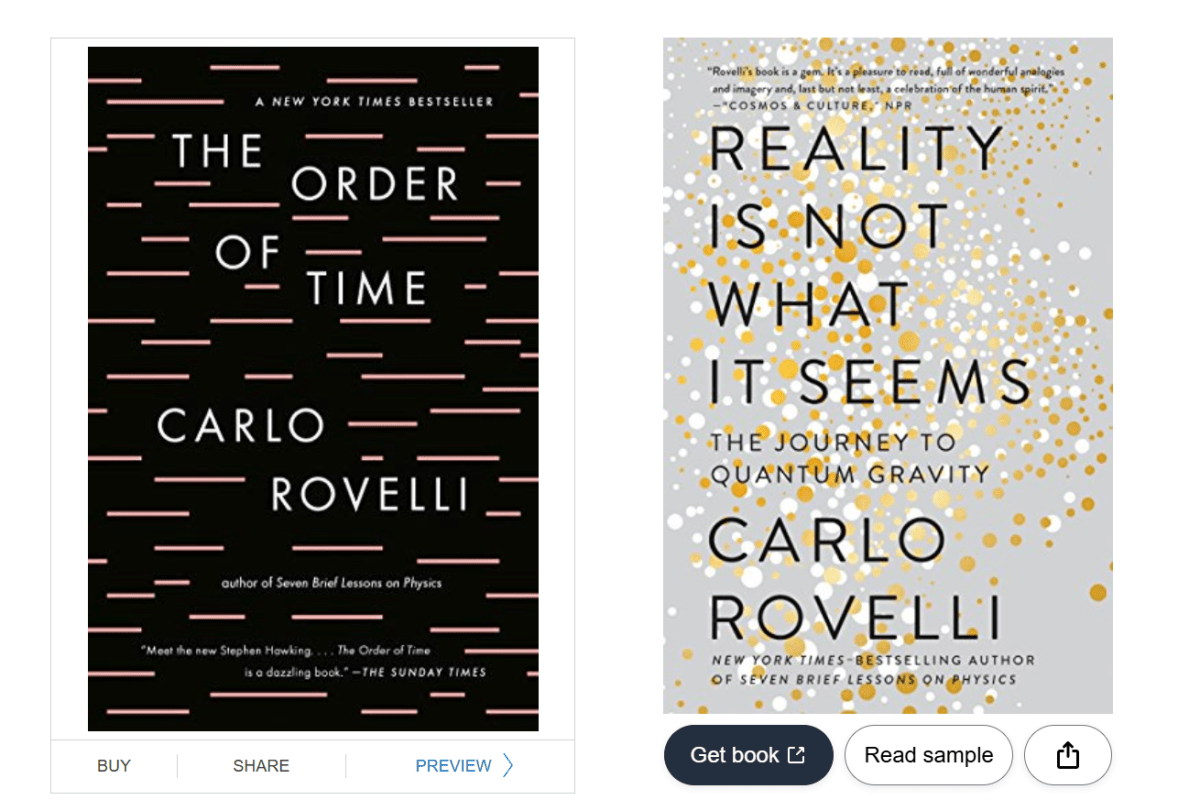
I watch a decent amount of science videos on YouTube, and I’ve been following Rovelli for years, but I hadn’t engaged with his work directly until I was researching for my current book, The Architect of Encounter. First, I read The Order of Time, followed by Reality Is Not What It Seems.
Rovelli published these books around 2017, but I am only reading them now. We are travelling in the same neighbourhood, but we occupy different residences and have different orientations.
Surveying the marketplace, quite a few physicists and science educators make some of the same points I and Rovelli make. In fact, these things appear to occur as trends. When I wanted to write about agency and free will over five years ago, I noticed a slew of books on the topics, and I had nothing more to add, so I shelved the idea.
In this case, the trend appears to have been between 2017 and 2018. I’m sure this is where I absorbed some of my knowledge, opinions, and grammar, but my thesis goes further and comes from a different perspective, so I feel this manuscript is worth publishing.
Getting back to Rovelli, his books are very well written – very approachable and light on the academics. I hope mine lands somewhere in the middle. As I continue to write my book, I will lean on Rovelli for the perspective on quantum theory. If he’s wrong or it’s wrong, then we fall together. That’s what happens when you borrow a foundational commitment. It’s a risk I am willing to take.
As much as I want to share more of what I am working on, it turns out I still need to work on it if I want to complete it. I am aiming for April this year, if not sooner. At least I’ve got some of the administrative stuff out of the way. Here’s a quick glimpse, title and copyright pages.
2025 has been a good year for this blog. I’ve crossed the 1,000-post mark, and this year it has had over 30,000 page views – best year ever. This month was the best month ever, and 1st December was the most popular day ever. That’s a lot of ‘evers’.
I shared the remainder of this post on my Ridley Park fiction blog – same reader, same books, same opinion. Any new content added below is in red.
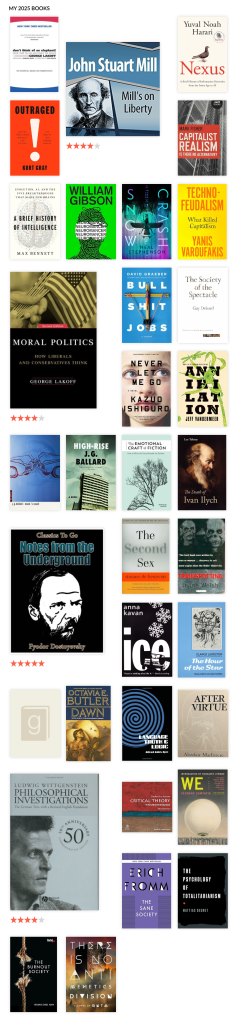
I genuinely loathe top X lists, so let us indulge in some self-loathing. I finished these books in 2026. As you can see, they cross genres, consist of fiction and non-fiction, and don’t even share temporal space. I admit that I’m a diverse reader and, ostensibly, writer. Instead of just the top 5. I’ll shoot for the top and bottom 5 to capture my anti-recommendations. Within categories are alphabetical.
Fiction
Never Let Me Go by Kazuo Ishiguro – A slow reveal about identity, but worth the wait.
This was very philosophical and psychological. Nothing appeared to happen until chapter 7, as I recall. I felt like I was just eavesdropping on some school chums, which I was. Then came the big reveal.
Notes from Underground by Fyodor Dostoevsky – Classic unreliable narrator.
Again, philosophical, psychological. I liked it.
There Is No Antimemetics Division by QNTM (AKA Sam Hughes) – Points for daring to be different and hitting the landing.
This, I read because I was attracted to the premise of memory as it might affect language. It touched on this a tad, but it was mostly about memory, anti-memory, and constructed selves. How can one experience a contiguous, diachronic self with memory gaps? It never quite got that deep, that on occasion it did, as far as I recall.
Trainspotting by Irvine Welsh – Scottish drugs culture and bonding mates narrative.
This is an age-old cult classic – much better than the already excellent films. Fills in what the film cut for its medium. I read several other Welsh books. Filth was an honourable mention, which I also made connexions to Antimemetics, above.
We by Yevgeny Zamyatin – In the league of 1984 and Brave New World, but without the acclaim.
This flagged a tad at the end, but it was prescient and released in 1922, decades before 1984 and Brave New World. Worth the read.
Nonfiction
Capitalist Realism by Mark Fisher – Explains why most problems are social, not personal or psychological. Follows Erich Fromm’s Sane Society, which I also read in 2025 and liked, but it fell into the ‘lost the trail’ territory at some point, so it fell off the list.
Moral Politics by George Lakoff
Evidently, I forgot to explain myself in my prior post. I refer to this book and its trade counterpart, Don’t Think of an Elephant, which is more of a political polemic, but still worth the read. It’s also shorter. This is about Moral politics – duh! – but it’s about moral language. It was a precursor to Jonathan Haidt’s The Righteous Mind: Why Good People Are Divided by Politics and Religion or Kurt Gray’s Outraged! I found Haidt’s work interesting but reductive; I found Gray’s work merely reductive.
This said, Lakoff and Haidt were the vector through which I came upon my language ontology theory that further confounds language insufficiency. To be sure, Haidt was an unnecessary point, but it did emphasise it. Haidt’s frameworks also give me something to riff on.
Technofeudalism by Yanis Varoufakis – Explains why Capitalism is already dead on arrival.
Nothing much to add here. Technofeudalism is economic fare, albeit with philosophical implications. I enjoyed it. Yanis is also an interesting speaker.
NB: Some of the other books had great pieces of content, but failed as books. They may have been better as essays or blog posts. They didn’t have enough material for a full book. The Second Sex had enough for a book, but then Beauvoir poured in enough for two books. She should have quit whilst she was ahead.
Image: Books I read in 2025 on Goodreads. Full disclosure: I don’t always record my reading on Goodreads, but I try.
Bottom of the Barrel
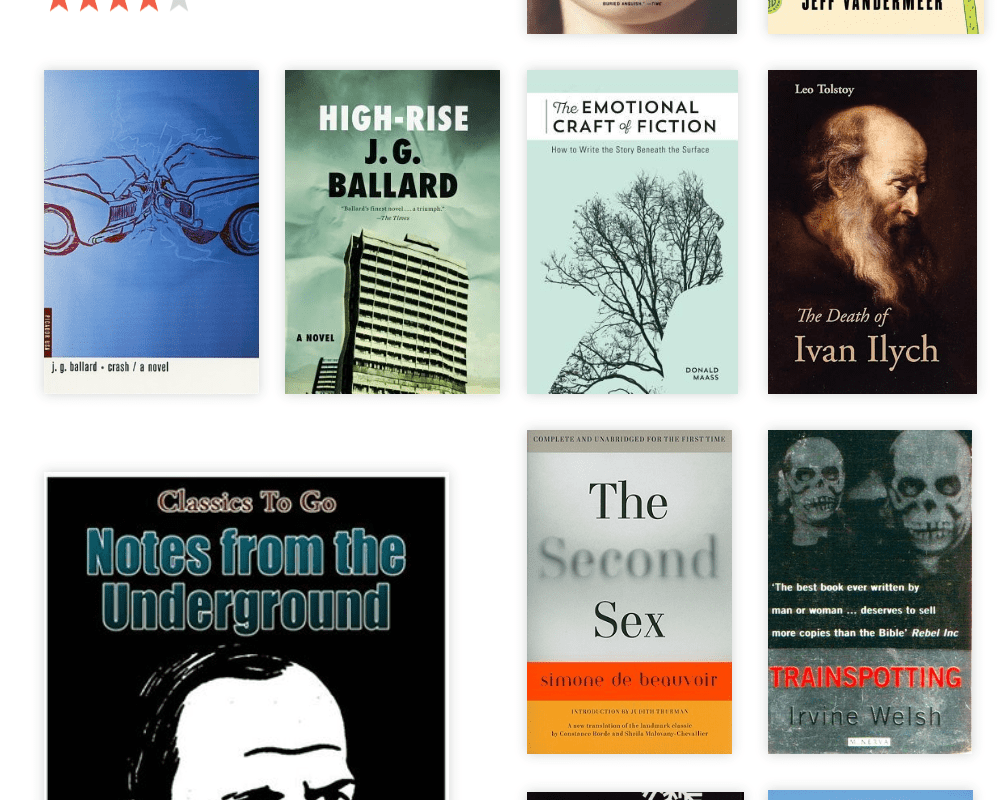
Crash by J.G. Ballard – Hard no. I also didn’t like High-rise, but it was marginally better, and I didn’t want to count an author twice.
Nah. I felt he was trying to hard for shock value. It didn’t shock, but it put me off. At least High-rise represented an absurd cultural microcosm. I just wanted the story to be over. Luckily, I read both of these sequentially whilst on holiday, so I wasn’t looking to ingest anything serious.
Neuromancer by William Gibson – I don’t tend to like SciFi. This is a classic. Maybe it read differently back in the day. Didn’t age well.
Nexus by Yuval Harari – Drivel. My mates goaded me into reading this. I liked Sapiens. He’s gone downhill since then. He’s a historian, not a futurist.
Outraged! by Kurt Gray – Very reductionist view of moral harm, following the footsteps of George Lakoff and Jonathan Haidt.
See comments above. ☝️
Society of the Spectacle by Guy Debord – A cautionary tale on why writing a book on LSD may not be a recipe for success.
Honourable Mention
Annihilation by Jeff VanderMeer was also good, but my cutoff was at 5. Sorry, Jeff.
I did like this, and it was much better than the Natalie Portman film adaptation. This is the first book in a trilogy. I absolutely hated the second instalment. The third was not as good as the first, but it tried to get back on track from the derailment of the second. As I wrote in public reviews, the second book could have been a prologue chapter to the third book with all of the relevant information I cared about. You could skip the second story with almost no material effect on the story or character arcs.
🤔 If liberation now feels indistinguishable from exhaustion, what exactly have we been freed from?
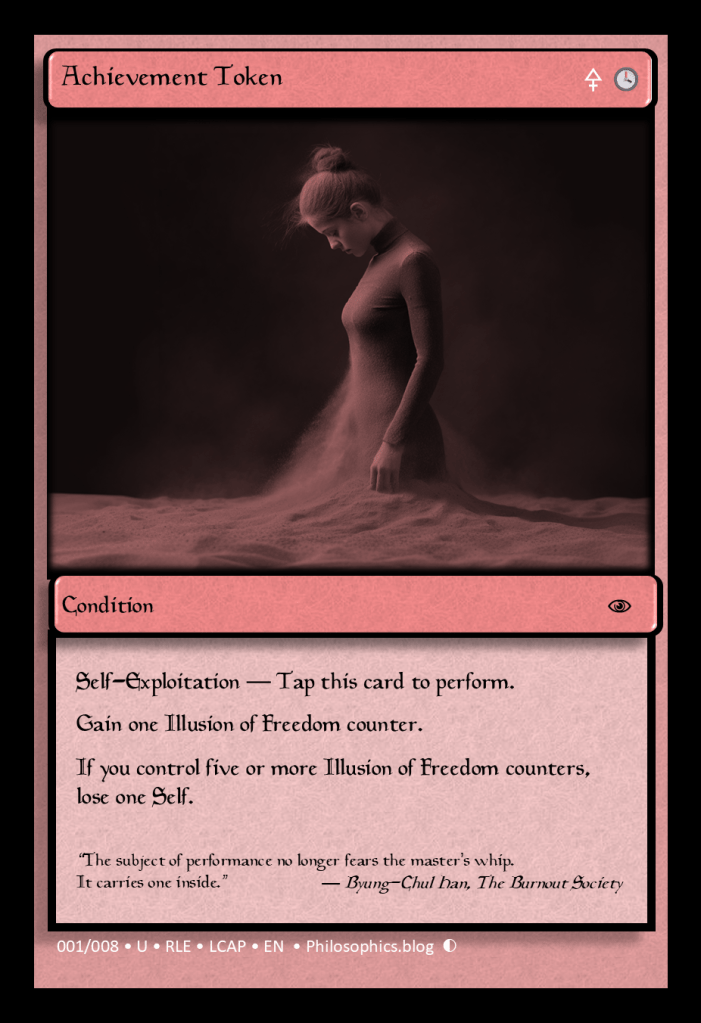
Image: Exhaustion means you’re working hard, and working hard means you’re good.
Han’s slender essay reads like a diagnosis of our psychic economy. The disciplinary society of ‘thou shalt’ has dissolved into the achievement society of ‘yes, I can’. We no longer rebel against authority; we internalise it, polishing our exhaustion until it gleams like ambition. Productivity replaces purpose. Rest becomes guilt. The subject, stripped of exterior constraint, now self-flagellates in the name of freedom.
We exploit ourselves and think we are free.
What Han captures is not mere fatigue but a civilisational pathology: the compulsion to optimise the self as though it were capital. Burnout is not the collapse of will but the logical conclusion of unlimited permission.
If liberation now feels indistinguishable from exhaustion, what exactly have we been freed from?
From the series Readings in Late Exhaustion – a Philosophics reflection on the maladies of modernity.
About the Series — Readings in Late Exhaustion
These cards belong to Readings in Late Exhaustion, a Philosophics project tracing the psychic and cultural costs of late capitalism.
Each card interprets a contemporary work of critical theory through the language of collectable gameplay, where identity, labour, and value become quantified acts.
The format itself is the critique: a system of self-expenditure disguised as achievement, reflection rendered as performance.





 Philosophics