The Environment Always Wins: The Myth of Pure Voice

4โ€“6 minutes

There’s a certain kind of cultural panic that tells you more about the panickers than about the thing they are panicking about. The current hysteria over AI-inflected prose is a good example.

The argument, insofar as it deserves the name, goes roughly like this: LLMs produce prose with identifiable features โ€“ a certain blandness, a fondness for the em dash, a tendency toward tidy three-part structure. Writers who use these tools risk absorbing those features. The authentic human voice is therefore under threat. Something precious is being diluted by contact with the machine.

This is sentimental rubbish, and it is worth saying so clearly before doing anything else โ€“ and a sort of virtue signalling.

Audio: NotebookLM summary podcast of this topic.

I use LLMs daily. For research, for editorial pushback, for smoothing passages that have gone awry. This means I spend hours a day reading a particular kind of output. You’d have to be delusional not to admit it has effects. Certain phrasings start feeling natural that didn’t before. Certain rhythms begin to recur. Certain words might not have otherwise come into use. I notice this and note it without particular alarm, because I’ve read enough to know that this is just what environments do.

Read nothing but McCarthy for a month, and your sentences will start hunting for the spare declarative. Spend a year editing academic philosophy, and you will catch yourself reaching for ‘insofar as’ and ‘it’s worth noting’ in casual conversation. Live in a city long enough, and its cadences work their way into your syntax. This isn’t contamination, the negative moralist dispersion. It’s how language acquisition works for as long as one is alive and reading. Voice isn’t a spring. It’s a river, a moving accumulation of every tributary it has passed through.

The prestige game being played by the anti-LLM faction isn’t difficult to spot. When Dostoyevsky shapes a young writer’s cadence, we call it influence and treat it as evidence of a serious literary education. When a game world shapes a child’s imagination โ€“ I homeschooled my son in the manner of unschooling, and his primary corpus for years was World of Warcraft and its attendant lore before shifting to Dark Souls โ€“ and that child ends up reading Dante and Milton unprompted in year seven, the same mechanism has clearly operated. The source was not canonical, the outcome was. But the respectable hierarchy of influences cannot easily accommodate this, because the hierarchy was never really about the mechanism. It was about the cultural status of the inputs.

The more interesting observation isn’t about those of us who use these tools. It’s about those who conspicuously do not.

A minor genre has emerged โ€“ charitably, I’ll call it a genre because cult feels morally loaded โ€“ consisting of writers anxiously purging their prose of anything that might read as AI-generated. It’s worth noting that they have read the lists. Telltale signs of LLM authorship: excessive hedging, em dashes, transitional summaries, the phrase ‘it is worth noting’. And so they scrub, redact, replace, and perform a kind of stylistic hygiene that’s a creative decision made in direct response to LLM discourse.

These writers aren’t free of the machine’s influence. They’re among the most thoroughly shaped by it. They simply have the more theatrical relationship โ€“ the counter-imitator, the purity-performer, the one who reorganises their entire aesthetic in orbit around the thing they claim to reject.

Thomas Moore, in Care of the Soul, observes that a child raised by an alcoholic parent tends to become either an alcoholic or a committed teetotaller. He presents this as a dichotomy, which is too neat, but the underlying point holds. Reactions are still relata โ€“ see what happens when you read too much philosophy and logic? The teetotaller has organised their life around the bottle as surely as the alcoholic has. Both are defined by it.

Opposition is one of influence’s favourite disguises.

The fair objection is that LLM influence may differ from other influences in kind rather than just in kind. Dostoyevsky is strange. Bernhard is strange to the point of pathology. A canonical prose style is idiosyncratic by definition, which is why it’s worth absorbing. In contrast, LLM output aims for plausible fluency and statistical centrality. Its pull may be more homogenising than the pull of a singular authorial sensibility.

That’s a real point. The environment in question has a centripetal force toward the mean that most literary influences lack.

But conceding the point doesn’t really rescue the panic. It just specifies the kind of influence involved. The mechanism remains identical to every other case of environmental absorption. And ‘this influence tends toward the generic’ is an ironically generic critique of a particular environment’s character rather than a claim that the environment is doing something ontologically unprecedented to the notion of authorship.

The question that actually matters aesthetically is not was this touched by AI? It is what did the writer do with the environment they inhabited? That’s always been the question. It remains the question. The machinery has changed; the problem of influence has not.

What the current schism actually reveals is not that AI is doing something new to writing. It’s that we’ve been operating with a fairy tale about what writing is. The fairy tale holds that voice is self-originating, that somewhere beneath the reading AND the editing AND the genre conventions AND the institutional pressures AND the decade of a particular editor’s feedback, there is a pristine you, unconditioned and pure, expressing itself directly onto the page.

This was always false. Writers have always been patchworks of absorbed environments. The only difference now is that one of the environments is a machine, and the machine is new enough that people haven’t yet learned to be comfortable with what it reveals about the rest.

The environment always wins. The only interesting question is which environments you choose, and what you make of them.
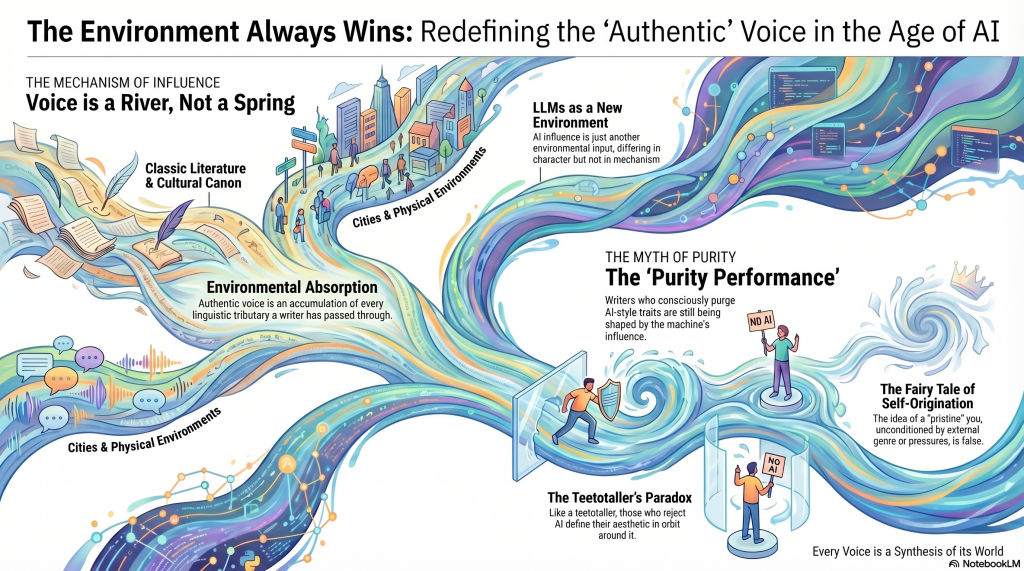
NotebookLM Infographic on this topic.

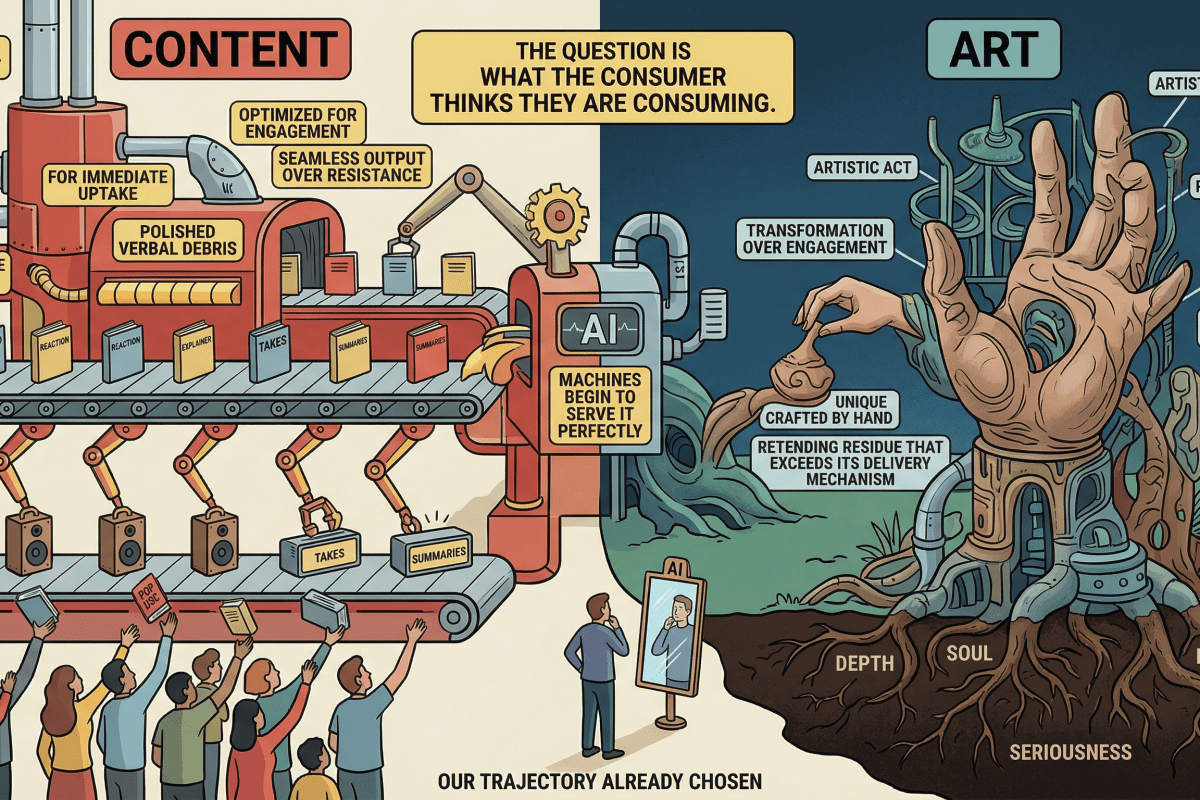
Art or Content

3โ€“4 minutes

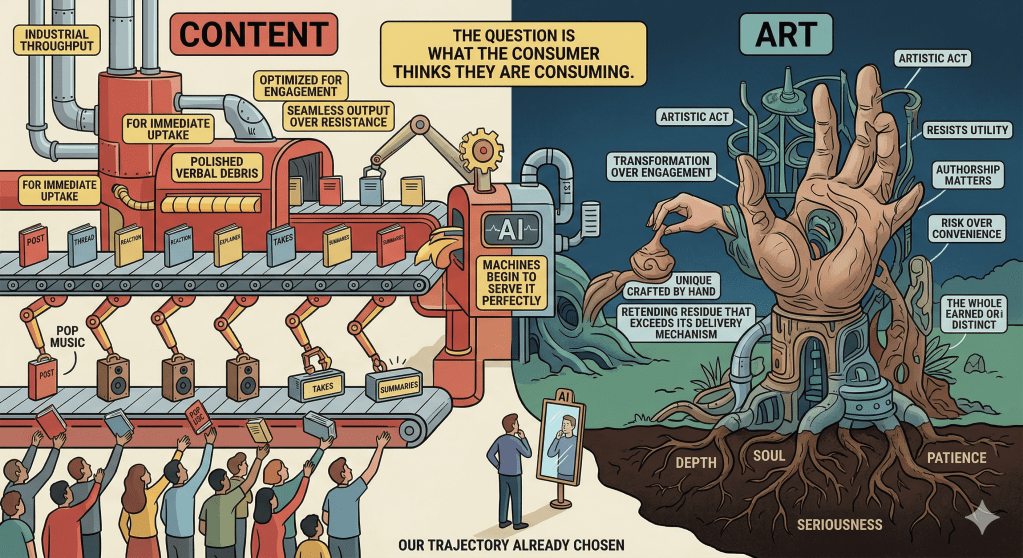
So glad I took time out to watch a short exchange between Rick Beato and Justin Hawkins on whether music is becoming content rather than art. The question is framed in musical terms, but it hardly stops there. The same corrosion is visible in writing, visual art, criticism, and now, with grim inevitability, in AI-mediated production more broadly. The disease is not confined to music. Music merely makes the symptoms easier to hear.

For music, my aversion to pop music goes back to my youth. I was a kid when the Beatles practically invented pop music, but they left it to grow and continued exploring. Sadly, as solo artists, they mainly โ€“ not always โ€“ failed and rested on their laurels in pop. It’s not that their version or any pop music is inherently unlistenable. Surely, it’s not, if only by the aspiration of the pop moniker, but it has no depth, no soul, as it were. Some make this argument for Organic food. In essence, it involves an appeal to nature fallacy.

Audio: Slightly off, but not bad, NotebookLM summary podcast of this topic.

My own aversion to much pop music begins there. It is not that pop is necessarily bad, nor even that it is always shallow. That would be too crude and too easy. The problem is that pop often presents itself less as an artistic act than as a consumption object engineered for immediate uptake: catchy, frictionless, emotionally legible, and just disposable enough to make room for the next one. It is built to circulate.

That, for me, is the difference between content and art. Art may be accessible, even popular, but it retains some residue that exceeds its delivery mechanism. It resists total reduction to utility. Content, by contrast, is made to be processed. It is optimised not for depth but for throughput. Its highest ambition is not transformation, but engagement.

This is why the question matters beyond music. Writing, too, now lives under the same pressure. One is increasingly expected to produce not essays, arguments, or works, but units of output: posts, threads, reactions, takes, summaries, explainers, and other forms of polished verbal debris. The point is no longer to say something worth dwelling on, but to remain visible within the churn.

The issue, then, is not simply whether one should consume AI-generated material. That framing is too pious and too easy. The more interesting question is what the consumer thinks they are consuming. If a reader, listener, or viewer wants only speed, familiarity, and surface competence, then AI content is not a scandal at all. It is the logical endpoint of a culture that has already demoted art into a deliverable.

This is where the fuss over labelling enters. Is it a principled demand for honesty, or merely a theatrical gesture by people who still want the aura of art whilst consuming content on industrial terms? Some of it is clearly protectionism. Some of it is virtue signalling. But not all of it is empty. The insistence on labelling betrays an intuition, however muddled, that authorship still matters, and that not all artefacts are equivalent merely because they occupy the same screen-space.

The deeper question is whether we still want art at all, or whether we merely want the aesthetic styling of art attached to things optimised for convenience. Once a culture learns to prefer seamless output over resistance, recognisability over risk, and quantity over form, it should not act surprised when machines begin to serve it perfectly. They are only completing a trajectory already chosen.

So no, the issue is not AI alone. AI is only the latest mirror held up to a public that has spent years confusing availability with value and polish with depth. The real question is not whether machines can make content. Plainly, they can. The question is whether we still possess the appetite, patience, and seriousness required for art.

Image: Full image because the cover version is truncated. Generated by Gemini Nano Banana.

If you canโ€™t tell, does it matter?

3โ€“5 minutes

Westworld was a disappointment. It became unwatchable after the first season. But one exchange from 2016 has aged better than anything else in that show, and it landed differently when I recalled it recently in the context of AI authorship.

A greeter robot exchanges words with William, a guest.

You want to ask, so ask.’

Are you real?’

Well, if you can’t tell, does it matter?

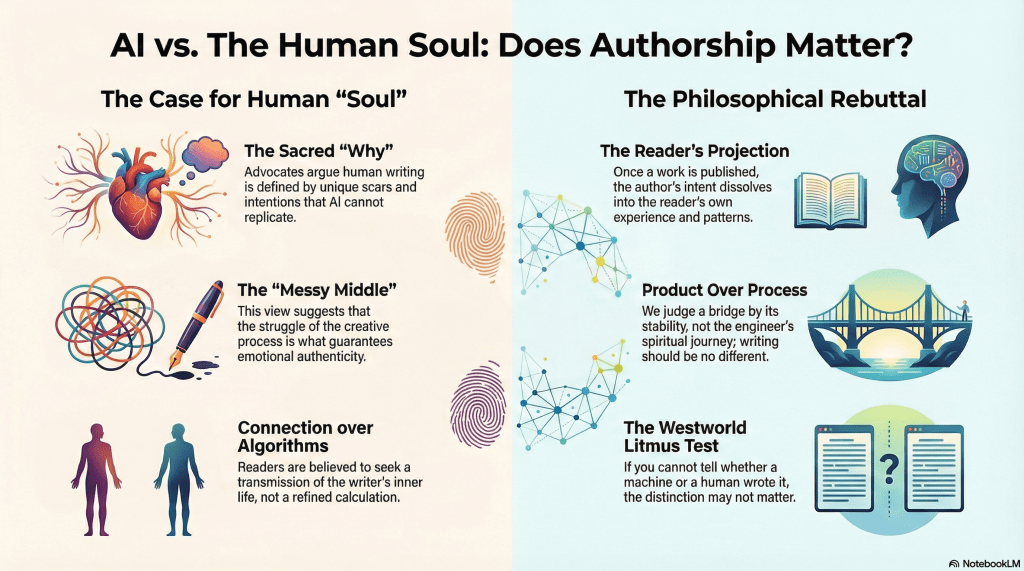
I thought of this after encountering a post that’s representative of a genre now doing brisk trade on LinkedIn and its satellites. The argument runs roughly thus: AI can write fast, but it can’t write you. Your why is sacred. Your scars make the prose real. The messy middle is where the magic lives. Keep the soul in your stories.

Audio: NotebookLM summary podcast of this topic.

A bloke shared this opinion:

The one thing AI can’t replicate is your “Why.” ๐Ÿง 

Thereโ€™s a lot of noise lately about how AI can “write a book in an hour.” But after publishing 8 books, Iโ€™ve realized something crucial: speed is not the same as substance.

The “hidden danger” of letting tools do the heavy lifting isn’t just about the quality of the proseโ€”it’s about the erosion of the creative spirit. When we skip the struggle of the “messy middle,” we skip the insights that actually make a story resonate with a reader.

Tools are great for grammar and brainstorming, but they don’t have:
The scars that make a characterโ€™s pain feel real.

The weird, specific memories that make a setting feel alive.
The intuition to know when to break the rules for emotional impact.

By all means, use the tech. But don’t let it sit in the driver’s seat. Your readers are looking for a connection with you, not a refined algorithm.

Keep the soul in your stories. Itโ€™s the only thing that actually sticks.

NotebookLM Infographic on this topic.

So much to unpack.

This sounds lovely enough. It is also almost entirely wrong, methinks.

Why is doing suspiciously grand work in these arguments. It’s treated as an ineffable essence โ€“ a soul-particle immune to replication. But why is not a substance. It’s an interpretive gloss. A post-hoc narrative we attach to action to stabilise it. Call it intention, call it telos, call it ‘creative spirit’ if one must. It remains a story we tell about stories.

And if we’re invoking the canon, let’s not do so selectively. Roland Barthes already detonated the neat alignment between authorial intention and readerly reception. Once a work leaves the desk, its why dissolves into a field of readings. The reader does not commune with your struggle. They encounter marks on a page. The rest is projection.

The romanticisation of the ‘messy middle’ borders on Calvinism โ€“ suffering as guarantor of authenticity, as though the scar itself writes the sentence. Plenty of humans have scars and produce dull prose. Plenty of writers construct convincing pain from observation, empathy, craft, and yes, occasionally from tools. Emotional resonance is not a moral reward for having bled.

Then there is the means-fetish: the idea that process sanctifies product. We do not evaluate a bridge by how spiritually formative the drafting was for the engineer. We ask whether it stands. If a text moves a reader, unsettles them, clarifies something, disturbs them โ€“ the instrument used to draft it is historically interesting, not aesthetically decisive.

There is also a quiet assumption buried in all of this: that connexion between writer and reader is a transmission of interiority. It isn’t. It is a negotiated effect. Readers connect with patterns that mirror, disrupt, or reframe their own experience. They are not sniffing for artisanal anguish.

None of this means craft evaporates. It means we should be wary of smuggling metaphysics into workflow preferences.

If someone prefers to wrestle with the blank page unaided โ€“ splendid, have at it. But the fetish for purity says more about our anxieties over authorship than it does about art. And if you can’t tell whether the thing that moved you was written by hand or by machine, then I’d suggest, with the greeter robot, that perhaps it doesn’t matter.

In the end, I am not even advocating using AI for writing, but I am saying not to be a dick about it. Enough of the virtue signalling