Anki Meets ChatGPT for Snacks in Paris for Lunch

5–7 minutes

I have been developing my French, so I rely on several primary resources.

Myself

This includes grammar books, novels and the rest of the traditional fare, some of which I have listed below. Books remain useful, despite their regrettable inability to generate notifications, harvest engagement or insist that one more chapter will transform your life.
Audio: NotebookLM summary podcast of this topic.
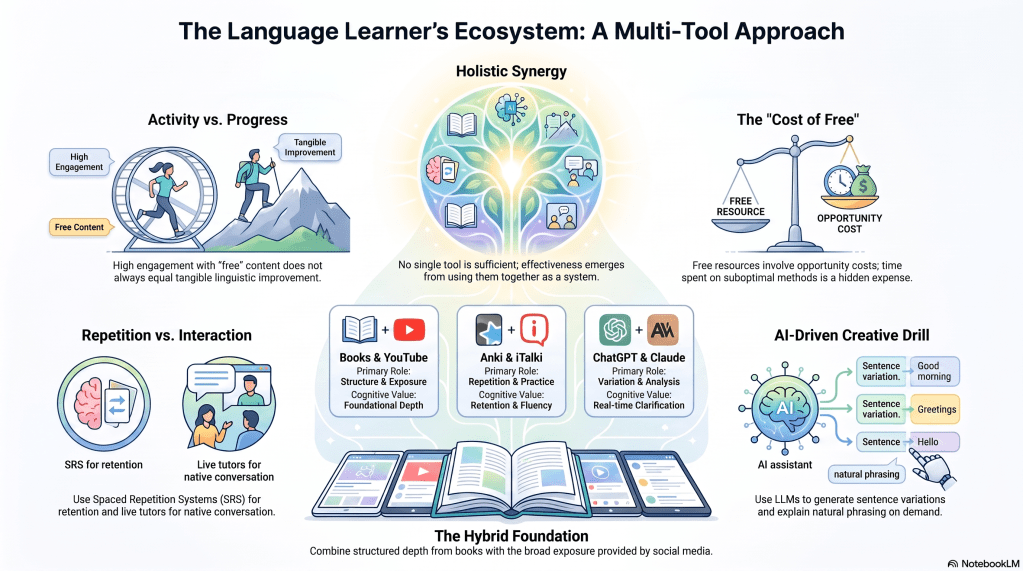
NotebookLM Infographic on this topic.

YouTube and Such

Social media is a time sink, and YouTube is no exception. This is not to argue that I derive no value from either. I do. It is merely to observe that the cost-benefit calculation may not always be in my favour.

That said, I encounter many useful tips, ideas and sources of general exposure to French. These help with learning, relearning and noticing gaps in what I thought I already knew.

There is, however, a risk. People teach and learn differently. Some teachers also believe they understand how they themselves learned and construct a method around that retrospective account. Memory being the immaculate scientific instrument that it is, this can create difficulties.

The first is obvious. A teacher may misattribute the cause of their own success and teach what is merely a covariant feature of the process. The method may have accompanied their learning without producing it. Remove the principal variable and the supposed method may accomplish very little.

A related problem arises when learners do not yet understand how they themselves learn. They may spend hours following a method that is suboptimal or even counterproductive. On the other hand, the method might happen to suit them perfectly. It can be difficult to know in advance.

A teacher may also be ideal for a learner at A1 or A2, but less appropriate at B1, B2 or beyond. By then, however, familiarity has become comfort, and comfort can masquerade as progress. This seems worth bearing in mind.

Even so, YouTube contains an enormous amount of material at nearly every level. The problem is not scarcity but selection.

Anki

Anki is excellent for repetitive learning tasks. It is essentially a flashcard system on steroids, although with fewer alarming side effects.

Many decks have already been constructed and made available online. I happen to use Anki for language learning, but it would be useful for almost any flashcard-oriented task, including academic study or memorising recipes, should that be your peculiar ambition.

This post is little more than a reference to Anki for context, but I recommend exploring it. There are also plenty of YouTube resources explaining how to use it for different purposes.

Anki supports text, images, audio and video, so it is genuinely multimedia rather than merely a digital imitation of index cards.

I have been using it to retain and expand my French vocabulary and grammar because I live somewhere French is not especially available. I would be better situated if I wanted to learn Spanish or Portuguese, and perhaps several other languages. For now, I shall pass.

Many of the cards I have imported come from decks with names such as “Top 1,000 Common Words”, “100 Conjugated Verbs” and “50 Useful Travel Phrases”. After enough examples involving “She has an apple”, “She gave him an apple” and “He would like her to give an apple to his father”, my mind wandered towards Snow White and poisoned apples.

In English, one may speak of a poison apple, treating poison as an attributive noun, or of a poisoned apple, in which poisoned describes what has happened to it. French does not ordinarily preserve the first construction unless one is deliberately inventing a literary compound. The natural French expression is:

Elle a mangé une pomme empoisonnée.
She ate a poisoned apple.

I asked ChatGPT about this. I shall spare you the full forensic inquiry into the apple. What interested me more was its suggestion that I diversify the examples in my deck.

iTalki

I use iTalki for live conversation with native speakers. Although I am not formally endorsing the platform, I recommend investigating it and have found it useful.

I have interacted with only two teachers, but I enjoyed working with each of them for different reasons. Lessons are relatively inexpensive, although rates vary considerably between teachers. They are not as cheap as YouTube or Anki because they are not free, but, as an economist, I also take opportunity costs into account.

Spending hours on a free platform without acquiring any durable knowledge still entails a cost. Free is not synonymous with costless, despite what several business models would prefer us to believe.

I am not trying to sell anyone on iTalki or a similar service, but one can sample it fairly cheaply. A lesson might cost about the same as a cup or two of aggressively marketed coffee. Since I do not drink coffee, I already have the necessary budgetary fiction in place.

ChatGPT and Claude

I also use ChatGPT and Claude frequently. In this case, ChatGPT suggested several variations that retained the grammatical structure while making the sentences slightly less lifeless:

Elle a mangé une pomme empoisonnée.
She ate a poisoned apple.

Elle a mangé une pomme pourrie.
She ate a rotten apple.

Elle a mangé une pomme volée.
She ate a stolen apple.

Elle a mangé une pomme interdite.
She ate a forbidden apple.

Elle a mangé une pomme étrange.
She ate a strange apple.

This is a minor use of a large language model, but a useful one. It can produce controlled variations, introduce vocabulary I have not encountered often and help prevent repetitive exercises from collapsing into grammatical wallpaper.

It can also explain why one construction sounds natural and another does not, generate examples at a particular level and create drills around a specific weakness. Naturally, its answers still require scrutiny. Confidently delivered nonsense remains nonsense, even when it arrives with immaculate formatting.

Taken together, these resources serve different functions. Books provide structure and depth. YouTube supplies exposure and ideas. Anki makes repetition tolerable. iTalki provides live interaction. Language models generate variations and explanations on demand.

None is sufficient by itself. Used together, however, they form a reasonably effective learning environment, provided one continues to distinguish activity from progress. The first is easy to measure. The second is what all the activity was supposedly for.


NB: I wrote this by hand and passed it through ChatGPT to clean it up. Let’s call it 95% human authored and call it a day.


Image: Gemini Nano Banana Pro’s first mis-render. This and the cover image are intentionally stereotypically satirical.

Funny, That

1–2 minutes

I find myself interesting, not in a narcissistic way, but in examination.

I wrote an academic blog post (and then a couple others, 1, 2) to clarify a nonfiction book that commenced as an academic essay. The blog post spawned a novella (pending, in revision), which in turn spawned both a short story (pending novella) and another academic essay (pending novella). With the short story, I plan to release meta commentary and background around the novella.

This seems like an unusual ecosystem, but it’s how my brain operates – on inputs and synthesis. Having completed The Architecture of Encounter, itself a follow-up to A Language Insufficiency Hypothesis and the second of a planned series of three, but hard-pressed to call it a trilogy.

This post might make more sense when the unfinished projects are complete, but until then, consider it a status update.

A bit more…

The reason for the short story is that the novella ends intentionally ambiguous, and the short story is a disconnected possible resolution. But I want the novella to remain open to interpretation, as is my modus operandi in many cases. I had considered including it as an epilogue – and I may do this in a future edition – but for now, I don’t want to prematurely close the discussion.

If I can get someone to publish the short story in a collection, that would be great, but I’ll otherwise publish it with the notes I mentioned above.

To quote The Critical Drinker, ‘Anyway, that’s all I’ve got today. Go away, now‘.

Two Valleys Diverged in a Mountain Range

(Or: What I Learned When I Learned Nothing)

NB: This is the first of a parable triptych. Read part 2, The Tunnel.

Two valleys diverged in a mountain range, And sorry I could not travel both And be one traveller, long I stood And looked down one as far as I could To where it bent in the undergrowth of reeds and optimism;

Then took the other, just as fair, And having perhaps the better claim, Because it was sandy and wanted wear— Though as for that, the passing there Had worn them really about the same,

And both that morning equally lay In fog no step had trodden black. Oh, I kept the first for another day! Yet knowing how way leads on to way, I doubted if I should ever come back.

—Except I did come back. And I met someone coming the other way. And we stood there in the clouds like a pair of idiots trying to explain our respective valleys using the same words for completely different things.

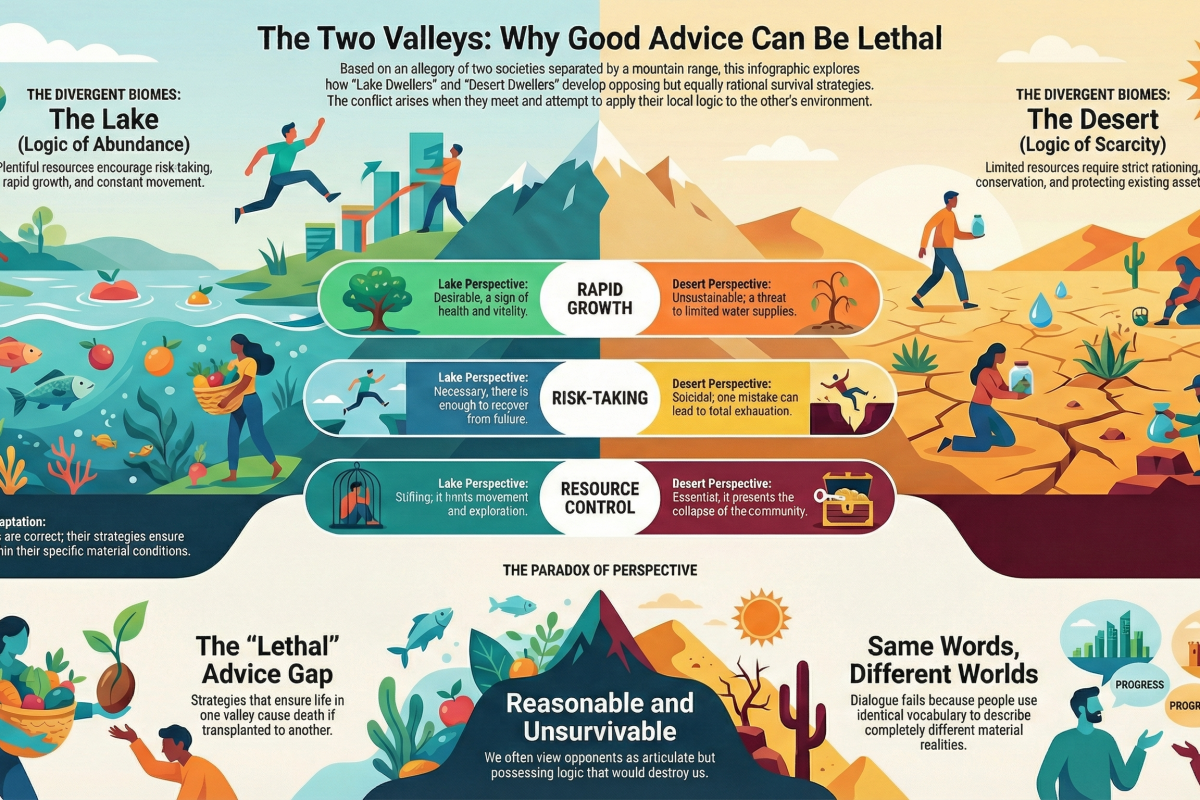
Audio: NotebookLM summary podcast of this topic.

Image: NotebookLM infographic of this topic.

Here’s what they don’t tell you about Frost’s poem: the two paths were “really about the same.” He says it right there in the text. The divergence happens retroactively, in the telling, when he sighs and claims “that has made all the difference.”

But he doesn’t know that yet. He can’t know that. The paths only diverge in memory, once he’s committed to one and cannot check the other.

Here’s what they don’t tell you about political disagreement: it works the same way.

Video essay of this topic. Another NotebookLM experience.

The Actual Story (Minus the Versification)

Once upon a time—and I’m going to need you to suspend your allergy to fairy tales for about eight minutes—there was one settlement. One people. One language. One lake with drinkable water and fish that cooperated by swimming in schools.

Then mountains happened. Slowly. No dramatic rupture, no war, no evil king. Just tectonics doing what tectonics does, which is ruin everyone’s commute.

The people on one side kept the lake. The people on the other side got a rain shadow and a lot of bloody sand.

Both sides adapted. Rationally. Reasonably. Like competent humans responding to actual material conditions.

Lake people: “There’s enough water. Let’s experiment. Let’s move around. Let’s try things.”

Desert people: “There is definitely not enough water. Let’s ration. Let’s stay put. Let’s not waste things.”

Neither wrong. Neither irrational. Just oriented differently because the ground beneath them had literal different moisture content.

The Bit Where It Gets Interesting

Centuries later, two people—one from each side—decide to climb the mountains and meet at the top.

Why? I don’t know. Curiosity. Stupidity. The desire to write a tedious blog post about epistemology.

They meet in the fog. They speak the same language. Grammar intact. Vocabulary functional. Syntax cooperative.

And then one tries to explain “reeds.”

“Right, so we have these plants that grow really fast near the water, and we have to cut them back because otherwise they take over—”

“Sorry, cut them back? You have too much plant?”

“Well, yes, they grow quite quickly—”

“Why would a plant grow quickly? That sounds unsustainable.”

Meanwhile, the other one tries to explain “cactus.”

“We have these plants with spines that store water inside for months—”

“Store water for months? Why doesn’t the plant just… drink when it’s thirsty?”

“Because there’s no water to drink.”

“But you just said the plant is full of water.”

“Yes. Which it stored. Previously. When there was water. Which there no longer is.”

“Right. So… hoarding?”


You see the problem.

Not stupidity. Not bad faith. Not even—and this is the part that will annoy people—framing.

They can both see perfectly well. The fog prevents them from seeing each other’s valleys, but that’s almost beside the point. Even if the fog lifted, even if they could point and gesture and show each other their respective biomes, the fundamental issue remains:

Both are correct. Both are adaptive. Both would be lethal if transplanted.

The Retreat (Wherein Nothing Is Learned)

They part amicably. No shouting. No recriminations. Both feel they explained themselves rather well, actually.

As they descend back into their respective valleys, each carries the same thought:

“The other person seemed reasonable. Articulate, even. But their world is completely unworkable and if we adopted their practices here, people would die.”

Not hyperbole. Actual environmental prediction.

If the lake people adopted desert-logic—ration everything, control movement, assume scarcity—they would strangle their own adaptability in a context where adaptability is the whole point.

If the desert people adopted lake-logic—explore freely, trust abundance, move without restraint—they would exhaust their resources in a context where resources are the whole point.

The Bit Where I Connect This to Politics (Because Subtlety Is Dead)

So when someone tells you that political disagreement is just a matter of perspective, just a failure of empathy, just a problem of framing—

Ask them this:

Do the two valleys become the same valley if both sides squint really hard?

Does the desert get wetter if you reframe scarcity as “efficiency”?

Does the lake dry up if you reframe abundance as “waste”?

No?

Then perhaps the problem is not that people are choosing the wrong lens.

Perhaps the problem is that they are standing in different material conditions, have adapted rational survival strategies to those conditions, and are now shouting advice at each other that would be lethal if followed.

The lake-dweller says: “Take risks! Explore! There’s enough!”

True. In a lake biome. Suicidal in a desert.

The desert-dweller says: “Conserve! Protect! Ration!”

True. In a desert biome. Suffocating near a lake.

Same words. Different worlds. No amount of dialogue makes water appear in sand.

The Frostian Coda (With Apologies to New England)

I shall be telling this with a sigh Somewhere ages and ages hence: Two valleys diverged on a mountainside, and I— I stood in the fog and tried to explain reeds to someone who only knew cactus, And that has made… well, no difference at all, actually.

We’re still shouting across the mountains.

We still think the other side would be fine if only they’d listen.

We still use the same words for utterly different referents.

And we still confuse “I explained it clearly” with “explanation bridges material conditions.”

Frost was right about one thing: way leads on to way.

The valleys keep diverging.

The fog doesn’t lift.

And knowing how mountains work, I doubt we’ll meet again.


Moral: If your political metaphor doesn’t account for actual rivers, actual deserts, and actual fog, it’s not a metaphor. It’s a fairy tale. And unlike fairy tales, this one doesn’t end with reunion.

It ends with two people walking home, each convinced the other is perfectly reasonable and completely unsurvivable.

Which, if you think about it, is far more terrifying than simple disagreement.

Read part 2 of 3, The Tunnel.

Ridley Park Propensity

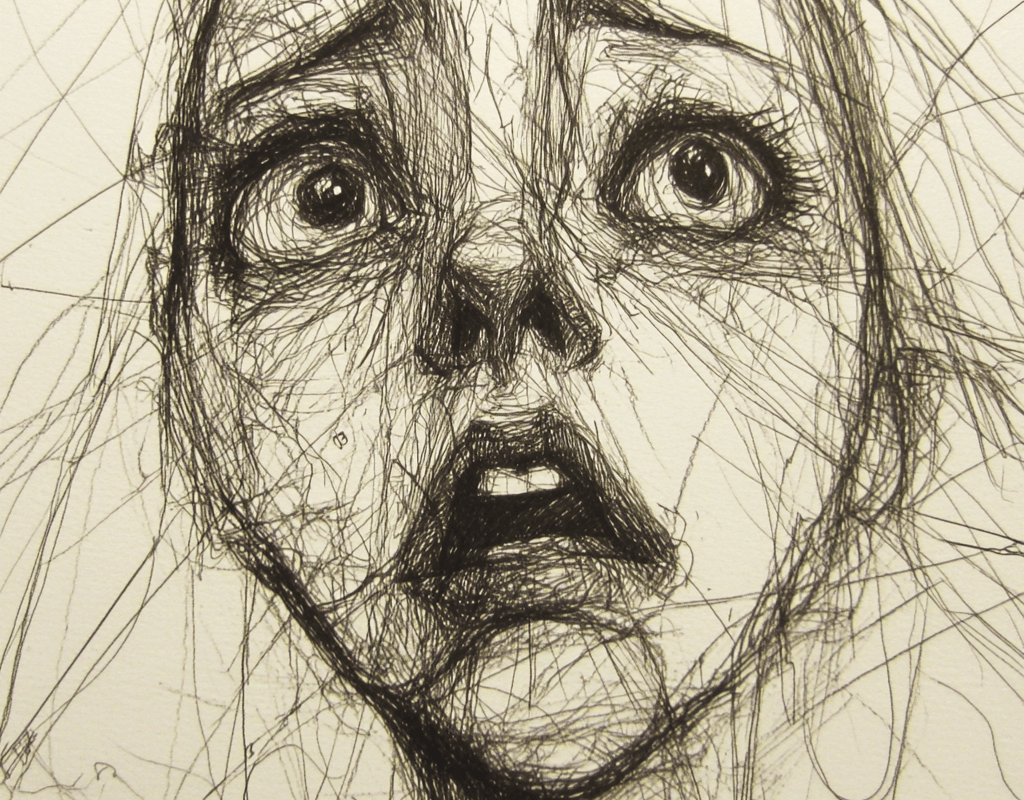
frantic woman, pen and ink

As some of you know, I publish speculative fiction under the name Ridley Park. Propensity is one of several recent releases – a novella that leans philosophical, brushes up against literary fiction, and steps quietly into the margins of sci-fi.

It’s not about spaceships or superintelligence. It’s about modulation.

About peace engineered through neurochemical compliance.

About the slow horror of obedience without belief, and the behavioural architecture that lets us think we’re still in control.

The ideas explored include:

  • Free will as illusion
  • Peace as compliance
  • Drift, echo, and the limits of modulation
  • Obedience without belief
  • Institutional horror and soft dystopia
  • Consent and behavioural control
  • Narrative as residue
  • Collapse by calibration

Though filed under speculative fiction, Propensity [US] is best read as a literary artefact – anti-sci-fi, in a sense. There’s no fetishisation of technology or progress. Just modulation, consequence, and the absence of noise.

This PDF contains selected visual excerpts from the physical book to accompany the free audiobook edition. For readers and listeners alike, it offers a glimpse into Ridley Park’s world – a quietly dystopian, clinically unsettling, and depressingly plausible one.

  • Title page
  • Copyrights page
  • Table of Contents
  • Chapter 10: Memorandum. This chapter is read in the audiobook. The inclusion here is for visualisation as it is rendered in the form of a memo.
  • Chapter 26: Simulacra. This chapter is read in the audiobook. The inclusion here is for visualisation as it is rendered in the format of a screenplay.
  • Chapter 28: Standard Test: This chapter is read in the audiobook. The inclusion here is for visualisation as it is rendered in the format of a standardised test.
  • Chapter 34: Calendar. This chapter is read in the audiobook. The inclusion here is for visualisation as it is rendered in the format of a calendar.
  • Chapter 39: Carnage. This chapter is read in the audiobook. The inclusion here is for visualisation as it is rendered in the form of a Dr Suess-type poem.
  • Chapter 41: Leviathan. This chapter is excerpted in the audiobook. The inclusion here is for visualisation as it is rendered with an image of the cover of Hobbes’ Leviathan and redacted page content.
  • Chapter 42: Ashes to Ashes. This chapter is read in the audiobook. The inclusion here is for visualisation as it is rendered in the form of text art.
  • Chapter 43: Unknown. A description of this chapter is read in the audiobook. The inclusion here is for visualisation as it is rendered in the form of an ink sketch.
  • Chapter 44: Vestige. A description of this chapter is read in the audiobook. The inclusion here is for visualisation as it is rendered in the form of text art.

For more information about Ridley Park’s Propensity, visit the website. I’ll be sharing content related to Propensity and my other publications. I’ll cross-post here when the material has a philosophical bent, which it almost always does.

Choice and Blame: Why We Forgive Some and Condemn Others

A recent parody video making the rounds on social media shows a man at a kitchen table, his girlfriend, and their cat. In a desperate attempt to gain his girlfriend’s attention, he knocks a cup off the table. The moment it hits the floor, she turns on him, scolding him for his clumsiness. Quick to deflect, he blames the cat, and suddenly her anger dissipates. She shifts from reprimanding him to lavishing affection on the supposedly guilty feline. The tension lifts—until he sheepishly confesses that it was, in fact, his doing all along. Her response? An incredulous, “Are you kidding me?”

What’s fascinating about this skit isn’t the comedy of the man’s mischief or even the cat’s unknowing role in the charade. It’s the girlfriend’s starkly different reactions to the same act, depending on who she believes committed it. The cat, in her eyes, can do no wrong; the boyfriend, however, is immediately culpable. It’s easy to laugh at the scenario’s absurdity, but the dynamic it portrays is familiar and, dare I say, quite telling about human behaviour.

The Double Standard of Blame

Why is it that we’re quick to exonerate some and just as quick to indict others? The phenomenon is more than a quirk of personality; it reveals our deeper, often unconscious, biases. While it’s understandable that the girlfriend might think the cat incapable of intentional mischief, her reaction also suggests a predisposition to forgive certain actors—whether due to perceived innocence, attachment, or simply habit.

This dynamic isn’t limited to pets and partners. In families, workplaces, and social groups, we often see a similar pattern. One person becomes the perennial scapegoat, bearing the brunt of blame for any and all misdeeds, while another enjoys a seemingly unshakeable immunity. Think of the “golden child” and the “black sheep” within a family. One can rarely put a foot wrong, while the other’s every move is scrutinised, questioned, or condemned.

Beyond the Blame: Motivations and Consequences

The reasons behind these imbalances can be complex. Sometimes, they stem from past behaviour: if someone has repeatedly erred, we may be primed to expect the worst from them, even if they’ve reformed. Other times, they arise from emotional bonds or biases: we excuse those we love or admire because acknowledging their faults would cause us discomfort or cognitive dissonance.

This phenomenon isn’t just about playing favourites; it can have significant psychological consequences. For the person perpetually cast as the villain, the burden of unwarranted blame can lead to feelings of resentment, anxiety, or self-doubt. Meanwhile, those consistently exonerated may internalise a skewed perception of their own infallibility, which can be equally damaging.

A Broader Reflection on Accountability

Returning to the video’s context, the girlfriend’s swift switch from reproach to indulgence once she believed the cat was at fault, and her subsequent anger when the truth was revealed, invites us to question our own responses to perceived transgressions. Are we, too, guilty of selectively assigning blame based on who we think is responsible? How often do we let our preconceptions shape our judgments, favouring one actor over another without truly weighing the evidence?

The parody is amusing, no doubt, but it also serves as a subtle reminder: our reactions often reveal more about our biases and expectations than about the actions themselves. The next time we find ourselves quick to blame or forgive, it’s worth pausing to ask: are we reacting to the act, or to the actor?

In a world increasingly marked by polarised opinions and knee-jerk reactions, cultivating this kind of self-awareness is crucial. We need to be vigilant not only about how we judge others but also about why we do so. For, in the end, it’s not just about who knocked the cup off the table—it’s about who we believe deserves to be scolded for it.