I find myself interesting, not in a narcissistic way, but in examination.
I wrote an academic blog post (and then a couple others, 1, 2) to clarify a nonfiction book that commenced as an academic essay. The blog post spawned a novella (pending, in revision), which in turn spawned both a short story (pending novella) and another academic essay (pending novella). With the short story, I plan to release meta commentary and background around the novella.
This seems like an unusual ecosystem, but it’s how my brain operates – on inputs and synthesis. Having completed The Architecture of Encounter, itself a follow-up to A Language Insufficiency Hypothesis and the second of a planned series of three, but hard-pressed to call it a trilogy.
This post might make more sense when the unfinished projects are complete, but until then, consider it a status update.
A bit more…
The reason for the short story is that the novella ends intentionally ambiguous, and the short story is a disconnected possible resolution. But I want the novella to remain open to interpretation, as is my modus operandi in many cases. I had considered including it as an epilogue – and I may do this in a future edition – but for now, I don’t want to prematurely close the discussion.
If I can get someone to publish the short story in a collection, that would be great, but I’ll otherwise publish it with the notes I mentioned above.
To quote The Critical Drinker, ‘Anyway, that’s all I’ve got today. Go away, now‘.
My attention has yet again been abducted by fiction, tentatively titled The Box, but this time it is (ever so slightly) different. A publisher mate suggested that no one reads nonfiction, and anyway, fiction sticks better because it captures both attention and salience; I decided, why not both? I wrote some perhaps esoteric but non-academic nonfiction and decided to convey at least some of this through literary speculative fiction.
Besides the obvious nod to MEOW and The Architecture of Encounter, the novella explores several philosophical concerns:
The first three are diagnostic. The fourth is operative. The fifth haunts the whole enterprise. None are cited in the text – readers will encounter them through the fiction rather than the sources, which is rather the point.
I don’t want to spoil the plot, but I wanted to share a post today, and this is where I am: somewhere in the middle of a first draft, trying to make a speculative premise carry philosophical weight without the reader feeling the load. It’s harder than nonfiction. It’s also more fun.
On 7–8 September 2025, the Kindle version of my Ridley Park novella Sustenance will be available free to everyone on Amazon. (It’s always free if you’re a KindleUnlimited member, but these two days open it up to all readers.)
It’s a novella that begins with the dust and grit of rural Iowa – soybean fields, rusted trucks, a small town where everyone knows your name (and your secrets). At first glance, it reads like plainspoken realism, narrated by a local mechanic who insists he’s just a “regular guy.” But then the ground literally shifts. A crash. Figures glimpsed by firelight in the woods. Naked, violet-skinned beings who don’t laugh, don’t sleep, don’t even breathe.
What follows is not your usual alien-invasion story. It’s quieter, stranger, and more unsettling. The encounters with the visitors aren’t about lasers or spaceships – they’re about language, culture, and the limits of human understanding. What happens when concepts like property, law, or even woman and man don’t translate? What does it mean when intimacy itself becomes a site of misunderstanding?
Sustenance is for readers who:
Gravitate toward literary fiction with a speculative edge rather than straight genre beats
Appreciate the mix of the banal and the uncanny – the smell of corn dust giving way to the shock of alien otherness
Are interested in themes of language, power, misunderstanding, and human self-deception
Enjoy writers like Jeff VanderMeer, Margaret Atwood, Octavia Butler, or Denis Johnson – voices that blur realism, philosophy, and estrangement
This isn’t a story that offers tidy answers. It lingers, provokes, and resists easy moral closure. Think of it less as a sci-fi romp and more as a philosophical fable wrapped in small-town dust and cicada-song.
This version of the book is available in these Kindle storefronts: United States, United Kingdom, Germany, France, Spain, Italy, Netherlands, Japan, Brazil, Canada, Mexico, Australia, and India
📚 Grab your free Kindle copy on 7–8 September 2025
Why a Free Copy of Sustenance?
I made this Kindle version available for free to get some reviews. This promotion is all or nothing, so take advantage of the opportunity. If you want to leave a review, please do.
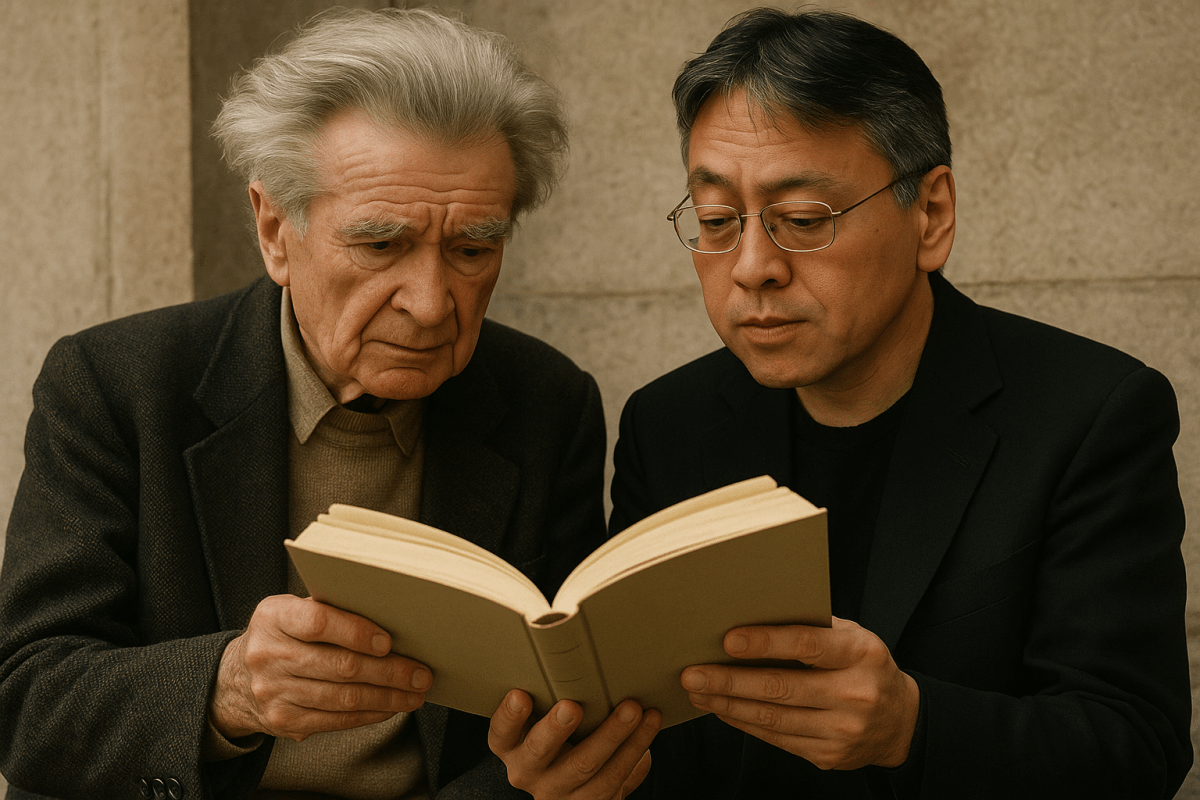
Having just finished Never Let Me Go by Kazuo Ishiguro, I’ve now cracked open my first taste of Cioran—History and Utopia. You might reasonably ask why. Why these two? And what, if anything, do they have in common? Better yet—what do the three of us have in common?
Audio: NotebookLM podcast on this topic.
Recently, I finished writing a novella titled Propensity (currently gathering metaphorical dust on the release runway). Out of curiosity—or narcissism—I fed it to AI and asked whose style it resembled. Among the usual suspects were two names I hadn’t yet read: Ishiguro and Cioran. I’d read the others and understood the links. These two, though, were unknown quantities. So I gave them a go.
Ishiguro is perhaps best known for The Remains of the Day, which, like Never Let Me Go, got the Hollywood treatment. I chose the latter, arbitrarily. I even asked ChatGPT to compare both books with their cinematic counterparts. The AI was less than charitable, describing Hollywood’s adaptations as bastardised and bowdlerised—flattened into tidy narratives for American palates too dim to digest ambiguity. On this, we agree.
What struck me about Never Let Me Go was its richly textured mundanity. That’s apparently where AI saw the resemblance to Propensity. I’m not here to write a book report—partly because I detest spoilers, and partly because summaries miss the point. It took about seven chapters before anything ‘happened’, and then it kept happening. What had at first seemed like a neurotic, wandering narrative from the maddeningly passive Kathy H. suddenly hooked me. The reveals began to unfold. It’s a book that resists retelling. It demands firsthand experience. A vibe. A tone. A slow, aching dread.
Which brings me neatly to Cioran.
History and Utopia is a collection of essays penned in French (not his mother tongue, but you’d never guess it) while Cioran was holed up in postwar Paris. I opted for the English translation—unapologetically—and was instantly drawn in. His prose? Electric. His wit? Acidic. If Ishiguro was a comparison of style, then Cioran was one of spirit. Snark, pessimism, fatalistic shrugs toward civilisation—finally, someone speaking my language.
Unlike the cardboard cut-outs of Cold War polemics we get from most Western writers of the era, Cioran’s take is layered, uncomfortably self-aware, and written by someone who actually fled political chaos. There’s no naïve idealism here, no facile hero-villain binaries. Just a deeply weary intellect peering into the abyss and refusing to blink. It’s not just what he says, but the tone—the curled-lip sneer at utopian pretensions and historical self-delusions. If I earned even a drop of that comparison, I’ll take it.
Both Ishiguro and Cioran delivered what I didn’t know I needed: the reminder that some writers aren’t there to tell you a story. They’re there to infect you with an atmosphere. An idea. A quiet existential panic you can’t shake.
I’ve gotten what I came for from these two, though I suspect I’ll be returning, especially to Cioran. Philosophically, he’s my kind of bastard. I doubt this’ll be my last post on his work.



 Philosophics